Volume 1 — Introductory material (continued 2)
George Burnham Ives translation
"What! he was not twenty years old?" cried De Beuvre; "can it be that I have become, all of a sudden, the older of the two?"
"One is never older than one appears," replied Lauriane, "and it is only necessary to look at the marquis——"
She paused, lacking the courage to tell a downright falsehood even to console him; but the intention was enough, for Bois-Doré was content with very little.
He thanked her with a glance, his brow cleared; De Beuvre began to laugh, D'Alvimar admired Lauriane's charming delicacy, and the storm was turned aside.
VIII
They conversed pleasantly for a few moments. Monsieur de Beuvre urged D'Alvimar not to take fright at his outbreaks, and to come again on the second day thereafter with Bois-Doré, who was accustomed to dine at La Motte every Sunday. Thereupon a servant announced that la carroche of monsieur le marquis was ready.—Everyone knows that, previous to the time of Louis XIV., who ordered otherwise, carrosse was of both genders, and more frequently feminine, after the Italian carrozza.
Now, Monsieur de Bois-Doré's carroche or carrosse was an enormous, lumbering chariot, which four fine strong Percheron horses drew with admirable courage; they were somewhat too fat, perhaps, for one and all, men and beasts alike, were well-fed under worthy Monsieur Sylvain's roof.
This venerable equipage, constructed to defy the difficulties of roads carriageable or not, was stout enough to stand any test, and, if it left something to be desired in the way of ease, one was assured at all events of not breaking many bones in case of an upset, because the interior was so bountifully stuffed. There were six inches of wool and tow under the damask lining, so that one had a sense of security, if not all possible comfort.
For the rest, it was a handsome chariot, all covered with leather, embellished with gilt nails which formed a decorative border for the panels. For convenience in entering and alighting, there was a small ladder, which was placed inside when not in use.
In the four corners of this citadel on wheels, there was a very arsenal of swords and pistols, not forgetting the powder and ball; so that, at need, they could sustain a siege therein.
Two servants on horseback, carrying torches, headed the procession; two other torch-bearers rode behind the carriage with D'Alvimar's servant, who led his master's horse.
The marquis's young page sat on the box beside the coachman.
The party clattered noisily under the portcullis of La Motte-Seuilly; and the rattling of the chains of the drawbridge as it rose behind the procession, amid the joyous barking of the watch dogs as they were set loose in the courtyard, combined to make an uproar which could be heard as far as the hamlet of Champillé, a good fourth of a league away.
D'Alvimar felt called upon to say a few words to Bois-Doré in praise of his fine carriage, an article of comfort and luxury still rare in the country districts, and considered a marvel of magnificence, particularly in Berry.
"I did not expect," he said, "to find the luxury of the great cities in the heart of Berry, and I see, monsieur le marquis, that you lead the life of a man of quality."
Nothing could have been more flattering to the marquis than this last expression. Being a simple gentleman, he was not and could not be, despite his title, a man of quality. His marquisate was a little farm in the Beauvoisis which he did not even own. On a certain day of fatigue and peril, Henri IV., arriving with him and a very small escort at that farm, where the chances of partisan warfare had compelled them to halt, and which they found entirely abandoned,—Henri IV., we say, was in great danger of not breakfasting at all, when Monsieur Sylvain, who was a most resourceful man in adventures of this sort, discovered in a thicket a number of fowls which had been left behind and had become wild. The Béarnais had taken part in the hunt with great zest, and Sylvain had undertaken to cook the game to a turn.
This unlooked-for repast had put the King of Navarre in excellent humor, and he had conferred the farm upon his loyal retainer, erecting it into a marquisate by his good pleasure, to reward him, he said, for having rescued a king from death by starvation.
His possession was limited to this sojourn of a few hours on the little fief he had won without striking a blow. It had been retaken on the following day by the contrary party; and, after the peace, its lawful owners had re-entered into possession.
It mattered little to Bois-Doré, who cared nothing for that hovel but much for his title, and to whom the King of France afterward laughingly fulfilled the promise he had made as King of Navarre. The dignity was not conferred upon the Berrichon squire by any parchment; but, under the protection of the omnipotent monarch, the title was tolerated, and the obscure country gentleman admitted to the king's select circle as Marquis de Bois-Doré.
As no one made any objection, the king's jest and his sufferance created a precedent at least, if not a right, and to no purpose did people make merry at the expense of Monsieur Sylvain Bouron du Noyer—such was his real name,—he esteemed himself a man of quality despite the scoffers. After all he had a better claim to the title and bore it more honorably than many other partisans.
D'Alvimar was not aware of any of these circumstances. He had paid little attention to what Guillaume d'Ars had told him hurriedly. It did not occur to him to scoff at his host's nobility, and our marquis, being accustomed to be teased upon that point, was infinitely grateful to him for his courtesy.
However he felt bound to assume the airs of a man in robust health, in order to neutralize that troublesome date of the siege of Sancerre.
"I keep this carriage," he said, "for no other purpose than that I may be able to offer it to the ladies in my neighborhood when occasion offers; for, so far as I am concerned, I much prefer the saddle. One travels faster and with less hindrance."
"So you treated me like a lady," rejoined D'Alvimar, "by sending for this carriage during the day. I am overwhelmed, and if I had thought that you did not fear the cool evening air, I should have begged you to make no change in your habits."
"But I thought that, after the long journey you have taken, you had ridden enough for to-day; and as to the cold, to tell you the truth, I am a terribly lazy mortal, and indulge myself in many little comforts which are not at all necessary to my health."
Bois-Doré attempted to reconcile the slothful nonchalance of young courtiers with the sturdy vigor of young country gentlemen, and he was sometimes sorely embarrassed over it. He was, in truth, still hale and hearty, a good horseman and in good health, despite occasional twinges of rheumatism which he never mentioned, and a slight deafness which he did not admit, attributing the mistakes made by his ear to his absent-mindedness.
"I must needs apologize to you for the discourtesy of my friend De Beuvre," he said. "Nothing can be in worse taste than these religious discussions, which are no longer in fashion. But you will pardon an old man's obstinacy. In reality De Beuvre worries no more than I do about these subtleties. It is infatuation for the past which causes now and then an attack of inveighing against the dead, and thereby making himself a good deal of a bore to the living. I do not see why old age is so pedantic over its reminiscences, as if, at any age, one had not seen enough things and enough people to be as much of a philosopher as is necessary! Ah! commend me to the good people of Paris, my dear guest, for ability to talk with refinement and moderation on every subject of controversy! Commend me to the Hôtel de Rambouillet for example! Of course you have frequented the blue salon of Arthenice?"[8]
D'Alvimar was able to reply that he was received by the marchioness, without departing from the truth. His wit and his learning had thrown open to him the doors of the fashionable Parnassus; but he had acquired no footing there, his intolerance having made itself manifest too soon in that sanctuary of French urbanity.
Moreover he had little taste for the literary sheepfold. The ambition of the age was consuming him, and the pastoral, which is the ideal of repose and unostentatious leisure, was not at all in his line. So that he was overcome with fatigue and drowsiness when Bois-Doré, overjoyed to have somebody to talk with, began to recite whole pages from Astrée.
"What can be more beautiful," he cried, "than this letter from the shepherdess to her lover:
"'I am suspicious, I am jealous, I am hard to win and easy to lose, and more easy to offend and most exceeding hard to appease. My desires must be decrees of fate, my opinions arguments, and my commands inviolable laws.'
"What style! and what beautiful character painting! And does not the sequel contain all the wisdom, all the philosophy and morality that a man can need? Listen to this, Sylvie's reply to Galatée:
"'You must not doubt that this shepherd is in love, being so honorable a man!'
"Do you understand, monsieur, the deep meaning of that sentiment? However, Sylvie herself explains it:
"'The lover desires nothing so much as to be loved; to be loved one must make oneself lovable; and that which makes one lovable is the same which makes one an honorable man?'"
"What? what does that mean?" cried D'Alvimar, awakened with a start by the remarks of the learned shepherdess, which Bois-Doré roared into his ear to drown the clattering of the carrosse over the hard pavement of the old Roman road from La Châtre to Château-Meillant.
"Yes, monsieur, yes, I would maintain it against all the world!" rejoined Bois-Doré, not observing his guest's start; "and I tire myself out repeating it to that old dotard, that old heretic in matters of sentiment!"
"Who?" queried D'Alvimar in dismay.
"I am speaking of my neighbor De Beuvre, a most excellent man, I promise you, but infatuated with the idea that virtue is found only in theological works, which he does not read, inasmuch as he could not understand them; whereas I maintain that it is found in poetic works, in agreeable and becoming thoughts, which every man, however simple he may be, may turn to his advantage. For example, when young Lycidas yields to the mad love of Olympe——"
At this juncture D'Alvimar resolutely went to sleep again, and Bois-Doré was still declaiming when the chariot and the escort woke the echoes on the drawbridge of Briantes, with an uproar equal to that they had made on leaving La Motte.
It had grown quite dark; D'Alvimar could see naught of the château but the interior, which seemed to him very small, and which was so, in fact, compared with the enormous dwellings common at that period.
To-day the apartments in the château would seem very large, but in those days they seemed very diminutive.
The portion occupied by the marquis, which had been ruined by the bands of partisans in 1594, was of recent construction. It was a square pavilion, flanked by a very old tower and by another even more ancient building, the whole forming a single mass of composite architecture, graceful in its narrow proportions, and of attractive and picturesque aspect.
"Do not be dismayed at the poor appearance of my cottage," said the marquis, leading the way into the hall, while the page and Bellinde lighted them; "it is just a hunting-box and bachelor's den. If I should ever take it into my head to marry, I should have to build; but I have not thought of it thus far, and I trust that, being yourself a bachelor, you will not find this hovel too inconvenient."
IX
In truth the bachelor's den was arranged, carpeted and decorated with a magnificence of which the low carved door and the narrow vestibule, from which the spiral staircase rose abruptly, gave no indication.
On the flagged hall were excellent Berry mats, on the wood floors richer carpets from the looms of Aubusson, and in the salon and the master's bedroom Persian rugs of very great value.
The window-panes were large and of plain glass; that is to say, they were diamond-shaped, about two inches square and unstained, with medallions, bearing a coat-of-arms in colors, in relief. The hangings represented slender, fascinating ladies and dainty little gentlemen, whom it was very easy to identify as shepherds and shepherdesses by their satchels and crooks.
The names of the principal characters of Astrée were embroidered in the grass under their feet, and their eloquent speeches were issuing from their mouths, meeting the no less eloquent replies of their neighbors.
On a panel in the salon de compagnie the ill-fated Celadon was represented, plunging with graceful contortions into the blue waters of the Lignon, which rippled in circles in anticipation of his fall. Behind him the incomparable Astrée, giving free vent to her tears, ran up too late to stop him, although his foot was almost in the shepherdess's hand. Above this pathetic group a tree, more like a sheep than the sheep themselves in those fantastic fields, reared to the ceiling its fleecy, curly branches.
But, in order not to rend the heart by this lamentable spectacle of the demise of Celadon, the artist had represented him, on the same panel, on the other side of the Lignon, tossed up by the water, and lying betwixt life and death among the bushes, but rescued by "three lovely nymphs, whose unbound hair fell in waves over their shoulders, covered with a garland of pearls of divers shapes. The sleeves of their gowns were turned back to the elbow, whence a shirred undersleeve of thin lawn extended to the wrist, where two large bracelets of pearls secured it. Each one had at her side the quiver filled with arrows, and carried in her hand an ivory bow. Their dresses were turned up so that their gilded buskins could be seen halfway to the knee."
Beside these lovely creatures stood little Meril guarding their chariot, shaped like a shell, with a parasol above, and drawn by two horses which might readily have been mistaken for sheep, their eyes were so mild and their heads so round.
The next panel represented the shepherd, saved and supported by the obliging nymphs, and busily discharging through his mouth all the water of the Lignon which he had swallowed; which occupation did not prevent his saying, in words written all along the gushing stream: "If I survive, how can Astrée's cruelty fail to kill me?"
During this soliloquy Sylvie said to Galatée: "There is in his manners and his speech something more noble than the title of shepherd denotes."
And, above the group, Cupid discharged an arrow larger than himself into Galatée's heart, although he aimed at her shoulder, through the fault of a tree which prevented him from taking the proper position. But the arrows of love are so adroit!
What shall I say of the third panel, which pictured the terrible combat between the blond Filandre and the redoubtable Moor, who held his opponent spitted through the body, while the valiant shepherd, in nowise disconcerted, skilfully buried the iron-shod point of his crook between the monster's eyes?
And of the fourth panel, whereon the fair Mélandre, in the armor of Chevalier Triste, was led into the presence of the cruel Lypandas?
But who does not know the marvels of that fair land of tapestry, as one of our poets calls it, a fantastic, smiling land, wherein our youthful imaginations saw and dreamed of so many wondrous things?
Monsieur de Bois-Doré's hangings were put together with marvellous skill, in the sense that several adventures were successfully combined in a single one, by the agency of distant groups scattered over the landscape, and the honest nobleman had the pleasure of viewing all the scenes of his favorite poem while making the circuit of his apartment. But there were the most absurd drawings and the most impossible combinations of colors that one can imagine, and there could have been no better exemplification of the wretched taste, false and insipid, which in those days was found side by side with Rubens's magnificent work and the bold and lifelike drawings of Callot.
Every epoch runs thus to extremes; that is why we need never despair of the one in which we live.
We must recognize the fact, however, that certain periods of the history of art are more favored than others, and that there are some periods whereof the taste is so pure and so fruitful, that the sentiment of the beautiful finds its way into all the details of everyday life and into all the strata of society.
When the Renaissance is at its height everything assumes a character of refined originality, and one feels, even in the most trivial details, that the excitements of social life have marvellously quickened the flight of the imagination. The imaginative instinct descends from the region of lofty intellects to the humble artisan; from the palace to the hovel, nothing can accustom the eye and the mind to the sight of the ugly and the trivial.
It had already ceased to be so under Louis XIII., and the provincials in the neighborhood preferred Monsieur de Bois-Doré's modern tapestries and furniture to the valuable specimens of the style of the last century, which the reiters had pillaged or broken in his father's château fifty years before.
As for the marquis, who considered himself artistic, he did not regret those antiquities, and whenever he could pick up some landscape-dauber on the highway, he would bid him sketch before his eyes what he artlessly called his ideas, in the way of furniture and decorations, and would then have them manufactured at great expense, for he shrank from no outlay to gratify his mania for tawdry and eccentric splendor.
Thus the château was filled to overflowing with buffets with secret compartments and curious cabinets,—those wonderful cabinets, like great boxes with drawers, where the pressure of a spring causes an enchanted palace in miniature to appear, supported by twisted pillars, incrusted with enormous false precious stones, and occupied by diminutive figures in lapis-lazuli, ivory or jasper.
Other cabinets, sheathed in transparent shell over a red ground, with gleaming copper ornaments in relief, or all inlaid with carved ivory, contained some marvellous toy, of which the ingenious and mystery-laden mechanism served to conceal billets-doux, portraits, locks of hair, rings, flowers and other love-relics dear to the beaux of the period.
Bois-Doré hinted that those specimens of the cabinet-maker's art were stuffed with treasures of that sort; some evil-minded scoffers declared that they were empty.
Despite all these vagaries of his magnificence, Bois-Doré had transformed his little manor-house into a luxurious nest, warm and cheery, which had cost him more than it was worth, but which it would be most delightful to find intact in one of the little provincial châteaux, which to-day are neglected, dilapidated, falling in ruins, or changed into farmhouses.
It would have taken three days to inspect all the curious trifles which are described to-day by the new name of bibelots, but which would be more appropriately called bribelots.[9] Our inquisitive and investigating generation is entitled, however, to give whatever name it chooses to a variety of exploration which is peculiar to it, and we gladly accept the verb bibeloter, although it is only used by the initiated.
However, we will not bibeloter—catalogue—here the interesting collection of curios at Briantes; it would take too long; we will say simply that Monsieur d'Alvimar might well have fancied himself in the shop of a second-hand dealer, so striking was the contrast between the profusion of gewgaws heaped upon sideboards and mantels, or piled in pyramids on the tables, and the chilling bareness of the Spanish palaces in which he had passed his youth.
Amid all that glass and porcelain, flagons, candlesticks, chandeliers, punch-bowls, urns, to say nothing of the ewers, cups and small dishes of gold, silver, amber or agate; the chairs of all shapes and sizes, nailed, fringed and covered with Chinese silk; the benches and cupboards of carved oak, with great clasps of openwork iron over a background of scarlet cloth; the curtains of satin worked with gold flowers, large and small, and embellished with gold-fringed lambrequins, etc., etc., there were certainly some beautiful objects of art and charming products of industry, mingled with much worthless trash and much inappropriate elegance. In a word the general effect was brilliant and agreeable, although there was altogether too much of it, and one hardly dared move for fear of breaking something.
When D'Alvimar had expressed his surprise at finding that palace of the fairy Babiole in the modest valleys of Berry, and Bois-Doré had obligingly exhibited the principal treasures of his salon, Bellinde the housekeeper, who went in and out issuing orders in a clear and resonant voice, announced to her master in an undertone that the supper was ready, while the page threw the doors wide open, shouting the usual formula, and the clock of the château struck seven with a burst of music in the Flemish style.
D'Alvimar, who had never been able to accustom himself to the abundance of dishes in France, was surprised to find the table covered, not only with gold plate and candlesticks adorned with glass flowers of all colors, but with a quantity of food sufficient to have satisfied a dozen persons with hearty appetites.
"Oh! this is not a supper," said Bois-Doré, whom he gently chid for treating him like a gourmand; "this is simply a little lunch by candlelight. Make an effort, and if my chief cook has not got tipsy in my absence, you will see that the rascal knows how to awaken the sluggish appetite."
D'Alvimar made no further remonstrance, and found that his appetite did in fact come to him in spite of himself.
Never had he tasted such exquisite cheer at the table of the great noblemen of his own nation, nor anything more exquisite in the most splendid mansions in Paris. There were none but the daintiest little dishes, deliciously seasoned, and most scientifically compounded after the fashion of the time: bisque of crab, fat quail stuffed, pastry light as air, perfumed creams of several flavors in marchpane shells, biscuits with saffron and with clove, fine native wines, among which the old wine of Issoudun could hold its own with the best vintages of Bourgogne; and at dessert the headiest wines of Greece and Spain.
They passed two hours tasting a little of everything, Bois-Doré talking of the cellar and cuisine like a consummate master, and Bellinde directing the servants with unequalled knowledge and skill.
The young page played the theorbo very pleasantly during the first two courses; but simultaneously with the third a new personage appeared and caused D'Alvimar some uneasiness, although he could not tell why.
X
He was a man of some forty years, whom the marquis greeted by the name of Master Jovelin, and who, without speaking, seated himself on a leather-covered gilt chair in a corner of the room, in such way as not to interfere with the going to and fro of the servants. He carried a little red serge bag which he placed on his knees, and he glanced at the table companions with a pleasant, smiling expression.
His face was handsome, although the features were without distinction. His nose and mouth were large, he had a retreating chin and a low forehead.
Despite these defects, it was impossible for an honest man to look upon him without interest; and if one paid the slightest heed to his beautiful black hair, which was sadly neglected, but of fine texture and naturally curly, his magnificent white teeth which his melancholy but cordial smile revealed, and his black eyes, so keen and intelligent, so kind and sympathetic, that his yellow face was lighted up by them, one felt as it were compelled to love him, ay, and to respect him.
He was dressed like a petty bourgeois, but very neatly, in a suit of bluish-gray, with woollen stockings; the coat long and tightly buttoned, a wide collar turned down and cut square across the chest, open sleeves in the Flemish style, and a broad-brimmed felt hat without feathers.
Monsieur de Bois-Doré, having asked politely as to his health and ordered a servant to give him a glass of Cyprus, which he declined with a wave of his hand, said no more to him, but bestowed his attention on his guest exclusively.
Such was the etiquette of that time, a man of quality being prohibited from showing much consideration for an inferior, under pain of seeming to insult his equals.
But D'Alvimar noticed that their eyes met frequently and that, after every remark made by the marquis, they exchanged a smile of intelligence, as if he desired to share all his thoughts with the new-comer, perhaps to obtain his approbation, perhaps to divert his mind from some secret trouble.
Surely, in all this there was no cause for alarm on D'Alvimar's part. But it may be that he was not on very good terms with his conscience; for that handsome and honest face, far from being attractive to him, caused him a great mental perturbation and sudden distrust.
The marquis, however, did not say a word or ask a question referring to the reasons of the Spaniard's flight to Berry. He talked entirely of himself, and therein gave proof of great tact, for D'Alvimar had as yet shown no inclination to be confidential, and his host found a way to keep up the conversation without questioning him upon any subject whatsoever.
"You find me in comfortable, well-furnished quarters and well-served," he said; "that is quite true. It is several years"—he did not say how many—"since I withdrew from society to rest a while and recover from the fatigues of war, awaiting events. I confess that, since the death of our great King Henri, I care not at all for the court or the city. I am not given to complaining, and I take the times as they come; but I have had three great sorrows in my life: the first was when I lost my mother, the second when I lost my younger brother, the third when I lost my great and good king. And there is this peculiarity in my story, that all three of those persons who were so dear to me died a violent death. My king was assassinated, my mother fell from her horse, and my brother—But this is too sad a subject, and I do not choose to tell you unpleasant tales to prepare you for your first night under my roof. I will simply tell you what it was that made me slothful and inclined to domesticity. When I saw my King Henri breathe his last, I reasoned thus with myself: 'You have lost all those you loved, you have nobody left but yourself to lose; now then, if you do not wish your turn to come soon, you will do well to turn your back on these regions of commotion and intriguing, and go and nurse your poor, afflicted and weary person in your native province.' You were right therefore to esteem me as fortunate as a man can be, since I was wise enough to adopt the course best suited to me, and to save myself from all annoyance; but you would have made a mistake to think that I lack nothing; for, while I desire nothing, I cannot say that I regret nobody. But I have regaled you enough with my sorrows and I am not one of those who feed upon them, refusing to be comforted or diverted. While we taste this jelly, do you care to listen to a more skilful musician than our little page?—Do you listen to him, too, my young friend," he added, addressing the page; "it will do you no harm."
As he spoke to D'Alvimar, he had bestowed upon him he called Master Jovelin one of those affectionate glances which resembled prayers rather than commands.
The man in the gray suit unbuttoned the flowing sleeve which covered another tighter sleeve of a dull red color, and threw it over his shoulder; then he took from his bag one of those little bag-pipes with a short, carved bass, which were then called sourdelines, and were employed in chamber music.
This instrument, the tone of which was as sweet and veiled as the bag-pipes of our own minstrels of to-day are noisy and shrill, was much in vogue, and before Master Jovelin had concluded his prelude, he had taken possession not only of the attention but of the very soul of his hearers; for he performed marvellously on the sourdeline, and made it sing like a human voice.
D'Alvimar was a connoisseur, and beautiful music possessed the power of making his natural melancholy less bitter than usual. He abandoned himself the more readily to this sort of relief, because his mind was set at rest when he discovered that this silent and watchful individual, whom he had taken at first for an insinuating spy, was an accomplished and harmless musician.
As for the marquis, he loved the art and the artist, and he always listened to his master sourdelinier with religious emotion.
D'Alvimar expressed his admiration in well-chosen terms. Whereupon, the supper being at an end, he asked leave to retire.
The marquis rose at once, motioned to Master Jovelin to await his return and to the page to take a light, and himself escorted his guest to the room that had been prepared for him; after which he returned to the table, removed his hat, which, in those days, was a sign that ceremony was dispensed with, contrary to the usage introduced at a later date, ordered a sort of punch called clairette, compounded of white wine, honey, musk, saffron and cloves, and invited Master Jovelin to sit opposite him in the place D'Alvimar had just vacated.
"Now, Messire Clindor," said the marquis, smiling good-humoredly at the page, whom, in accordance with his usual custom, he had burdened with a name taken from Astrée, "you may go to sup with Bellinde. Leave us, and tell her to take care of you.—Stay," he added, as the page was about to leave the room, "I have been intending all day to reprove you for your manner of walking. I have noticed, my young friend, that you have adopted some habits which you may think are military, but which are simply vulgar. Do not forget, therefore, that, although you are not noble, you are in a way to become so, and that a well-mannered little bourgeois in the service of a man of quality is on the road to the acquisition of a little fief of which he may assume the name. But what will it avail you that I assist you to rub the dirt off your birth, if you persist in befouling your manners? Try to be a gentleman, monsieur, not a peasant. Now then, adopt an easy carriage, try to put your whole foot on the floor when you walk, and not begin your step with the heel and end on the great toe; a trick which makes your gait and the clatter of your shoes resemble the amble of a millers horse. Go now in peace, eat well and sleep well, or else beware of the stirrup-leathers!"
Little Clindor, whose real name was Jean Fachot—his father was an apothecary at Saint-Amand,—received the sermon of his lord and master with great respect, saluted and left the room on tiptoe, like a ballet-dancer, to make it perfectly evident that he could not touch his heels first, since he did not touch them at all.
The old servant, who always remained to the last, having gone likewise to his supper, the marquis said to his sourdelinier:
"Come, my dear friend, just take off that great hat, and eat, without fear of the servants, a good slice of this paté and another of this ham, as you do every evening when we are alone."
Master Jovelin uttered some inarticulate sounds by way of thanks, and began to eat, while the marquis slowly sipped his clairette, less from desire than from courtesy, to bear him company; for it is well to say that, although the old man had many absurd foibles, he had not a single vice.
Then, while the poor mute ate, the good châtelain carried on the conversation all by himself, which was a very great pleasure to the musician, for no other person would take the trouble to speak to a man who could not answer. People had become accustomed to treat him as a deaf-mute; that is to say, knowing that he could not repeat what he heard, they indulged without hesitation in lying or slander in his hearing. The marquis alone talked directly to him, with much deference for his noble character, his great learning and his misfortunes, of which the following is a brief narrative:
Lucilio Giovellino, a native of Florence, was a friend and disciple of the unfortunate and illustrious Giordano Bruno. Trained in the sublime ideas and vast learning of his master, he had, in addition, great aptitude for the fine arts, poetry and languages. Lovable, eloquent and persuasive, he had propagated with success the bold doctrine of the plurality of worlds.
On the day when Giordano died at the stake with the calm dignity of a martyr, Giovellino was banished from Italy forever.
This happened at Rome two years before the period of our narrative.
Under the hand of the tormenters, Giovellino had not chosen to adhere to all of Giordano's doctrines. Although he was deeply attached to his master, he had declined to accept certain of his errors, and as they were able to convict him of only the half of his heresy, they had inflicted only the half of his punishment: they had cut out his tongue.
Ruined, banished, exhausted by the torture, Giovellino had come to France, where he played his sweet-toned bag-pipe from door to door, for a crust of bread; and, Providence having guided him to the marquis's door, he was taken in, nursed, cured, entertained by him, and—which was worth far more to the poor fellow—appreciated and loved. He had told him of his misfortunes in writing.
Bois-Doré was neither a scholar nor a philosopher; he had become interested in him at first as a man who was persecuted, as he himself had been for a long time, by Catholic intolerance. He would not, however, have become attached to a savage, violent sectary, of the type of a goodly number of Huguenots, who were no less addicted to persecution in those days than their adversaries. He had a vague knowledge of the blasphemies imputed to Giordano Bruno; he bade Giovellino explain his doctrines to him. The mute wrote rapidly, and with that refined lucidity of expression which great minds were beginning not to disdain, wishing to instruct everybody, even the common herd, in those great questions which Galileo was already investigating in the domain of pure science.
The marquis enjoyed this conversation in writing, in which the essential points were summarized soberly, and without the inevitable digressions of speech. Gradually he conceived an enthusiastic, passionate interest in these new definitions which afforded him repose and relieved him from tedious disputes. He desired to read an exposition of Giordano's ideas, also of those of his predecessor Vanini. Lucilio was able to express them so that he could understand them, pointing out the weak or false passages, in order to lead him to the only conclusions which human knowledge asserts with certainty to-day: a creation as infinite as the Creator, an infinity of stars peopling infinite space, not to serve as luminaries and objects of interest to our little planet, but as sources and sustenance of universal life.
This was very easy to understand, and man had understood it ever since the first ray of genius had made itself manifest in mankind. But the doctrines of the Church in the Middle Ages had reduced God and Heaven to the proportions of our little world, and the marquis thought that he was dreaming when he learned that the existence of the real universe was not—as he had always imagined, so he said—a poet's fancy.
He did not rest until he had procured a telescope, and he expected, the dear man, to see the inhabitants of the moon distinctly, his ideas were raised so high. He had to abandon that hope; but he passed all his evenings reading Giovellino's explanation of the movements of the stars, and of the wonderful celestial mechanism, which Galileo was destined to be condemned to abjure as heretical, a few years later, under torture, on his knees, with a torch in his hand.
XI
"Well," cried the marquis, while his friend ate, hastening as a matter of course, although his amiable and obliging host urged him to take his time, "what have you done to-day, my redoubtable scholar? Yes, I understand, pages of fine writing. Do not lose a line, I pray you! Those are words of refined gold which will go down to posterity; for these days of gloom will go hence into the dungeons of the past! Meanwhile, always conceal your sheets carefully in the secret drawer of the cupboard I have had placed in your chamber, when you do not write in mine."
The mute made a sign that he had been writing in the marquis's study, and that his sheets were in a certain ebony casket where the marquis kept them. He made himself understood by gestures with great ease.
"That is still better," continued Bois-Doré; "they are even safer there, as no woman enters the room. It is not that I distrust Bellinde, but she seems to me altogether too devoutly inclined since the arrival of this new rector whom Monseigneur de Bourges has sent us, and who is not to be compared, I fear, with our old friend the former curé, whom we owed to the last archbishop, Jean de Beaune.
"Ah! if only we had retained that excellent prelate, with his flowing beard, his gigantic stature, his fat paunch, his Gargantuan appetite, his handsome face, his great mind and his vast learning! one of the shrewdest and best men in the kingdom, although, to look at him, one would have taken him for a bon vivant and nothing more!
"If you had come in his time, my dear friend, you would not have had to keep out of sight in this little hunting-box; you would not have been obliged to translate your name into French, to lock up your learning, to pass for a poor bagpiper, and to give people hereabout to understand that you were mutilated by the Huguenots; our excellent primate would have taken you under his protection, and you would have printed your noble thoughts at Bourges, to the great honor of your name and of our province; whereas we now have for archbishops none but Condé's too zealous servants.
"Yes, yes, I learned some fine things to-day, at De Beuvre's, concerning that prince, a renegade to the faith of his fathers and the friendships of his youth! He inundates us with Jesuits, and, if poor Henri IV. should return to life, he would see some diverting masquerading! Monsieur de Sully is falling deeper and deeper into disgrace. Condé is purchasing from him by threats all his estates in Berry. Fancy! he has forced him to give up the grand-bailiwick and the command of the great tower! He is king of our province now, and people say that he dreams of becoming King of France. So, you see, affairs are going badly out-of-doors, and there is no safety except in our little fortresses, and that only on condition that we are prudent and wait patiently for the end of it all."
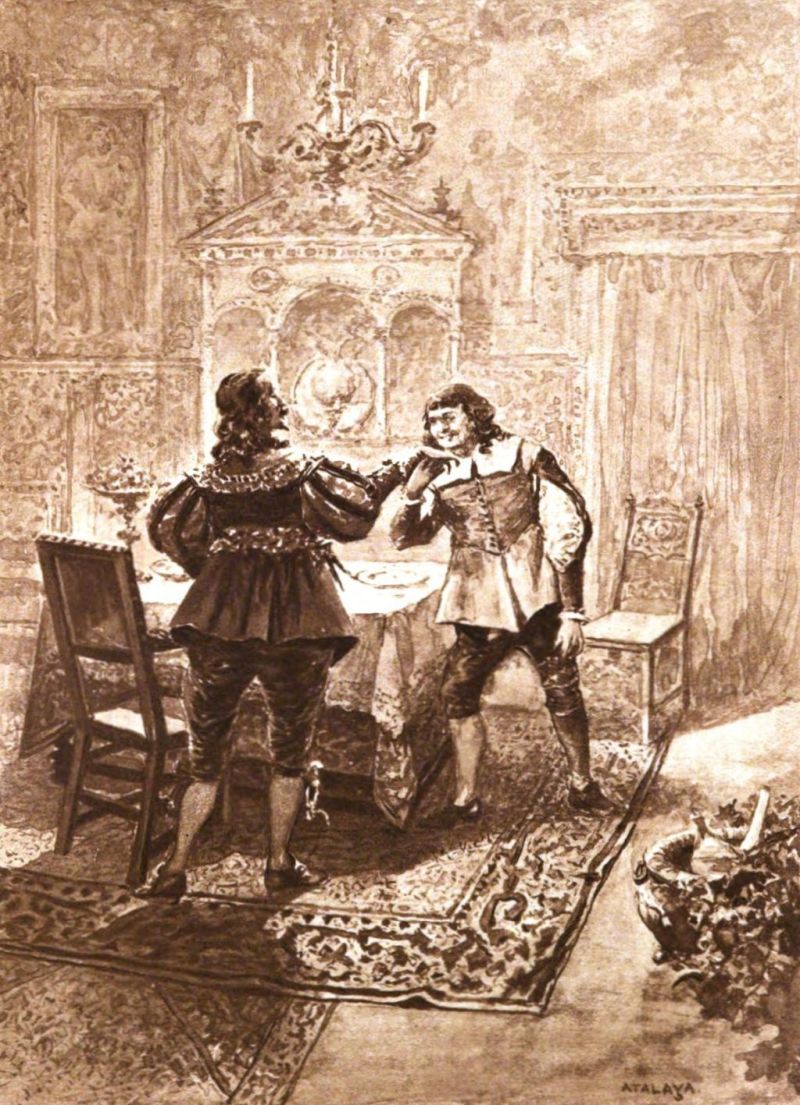
BOIS-DORÉ AND JOVELIN, HIS PROTÉGÉ.
Giovellino took the hand that the marquis held out to him over the table, and kissed it with the eloquent warmth which took the place of speech with him.
Giovellino took the hand that the marquis held out to him over the table, and kissed it with the eloquent warmth which took the place of speech with him. At the same time, he made him understand, by pantomime and by his expression, that he was happy with him, that he did not regret glory and the tumult of the world, and that he was altogether disposed to be prudent, lest he should compromise his protector.
"As to the young gentleman whom I brought home with me and have done my best to entertain," continued Bois-Doré, "you must know that I know nothing about him except that he is a friend of Messire Guillaume d'Ars, that he is threatened with some danger, and that he is to be concealed and defended at need. But do you not think it odd that this stranger did not once take me aside to confide his story to me, or that he did not do it when we were naturally left together on our return hither?"
Lucilio, who always had a pencil and paper beside him on the table, wrote to Bois-Doré:
"Spanish pride."
"Yes," rejoined the marquis, reading, so to speak, before he had written, so accustomed had he become, in two years, to divine his words from the first letters; "'Castilian pride,' that is what I said to myself. I have known a goodly number of these hidalgos, and I know that they do not consider it discourteous to show lack of confidence. So I must needs exercise hospitality here in the old-fashioned way, respect my guest's secrets and treat him courteously, as an old friend whom one believes to be the most honorable man on earth. But that does not compel me to accord him the confidence that he denies me, and that is why, as you saw, I left you in a corner, like a poor, paid musician, when he was here. And hereupon, my dear friend, I ask you to forgive me, once for all, for any apparent lack of affection or courtesy to which I am forced by regard for your safety, just as I clothe you in these common, ill-fitting clothes."
Poor Giovellino, who had never been so well dressed and so tenderly cared for in his whole life, interrupted the marquis by pressing his hands, and Bois-Doré was deeply moved to see tears of gratitude fall upon his friend's long, black moustache.
"Nay," he said, "you overpay me by loving me so dearly! I must reward you now by speaking to you of the sweet Lauriane. But must I repeat what she said to me about you? You will not be too puffed-up by it? No?—Well then, here goes. In the first place:
"'How is your druid?'
"I replied that the said druid was hers much more than mine, and that she ought to remember that Climante, in Astrée, was only a false druid, as deep in love as every other lover in that beautiful story.
"'Nay, nay,' she replied, 'you are deceiving me; if your Climante were as much in love with me as you represent him, he would have come with you to-day, whereas two whole weeks have passed since we saw him. Will you tell me that he starts when he hears my name, as in Astrée, and that he utters sighs which seem to rend his stomach in twain? I do not believe a word of it, and look upon him as an inconstant Hylas rather!'
"You see that the charming Lauriane continues to make sport of Astrée, of you and of me. However, when I took leave of her at nightfall, she said to me:
"'I insist upon your bringing the druid and his bag-pipe to us the day after to-morrow, or I will give you a cool reception, I promise you.'"
The poor druid listened with a smile to Bois-Doré's story; he knew how to jest on occasion, that is to say to take others' jesting in good part. Lauriane was to him nothing more than a lovely child, whose father he might have been; but he was still young enough to remember that he had loved, and in the depths of his heart his sense of isolation was exceedingly bitter to him.
As he thought of the past he stifled a sigh of regret, and began instinctively to play an Italian air which the marquis loved above all others.
He played it with so much grace and passion that Bois-Doré said to him, resorting to his favorite oath, borrowed from Monsieur d'Urfé:
"Numes célestes! you need no tongue to talk of love, my dear friend, and if the object of your passion were here, she must be deaf to avoid understanding that your heart is pouring itself forth to hers. But come, will you not let me read those pages of sublime learning?"
Lucilio signified that his head was a little tired, and Bois-Doré at once sent him off to bed, after embracing him fraternally.
Giovellino, in truth, often felt that he was more of an artist and a creature of sentiment, than a scholar and philosopher. His nature was at once enthusiastic and meditative.
Meanwhile Monsieur de Bois-Doré had retired to his "night apartment," situated above the salon. He had spoken truly when he said to Lucilio that no woman ever entered that sanctuary of repose or the cabinets connected therewith; Bellinde herself was forbidden to cross the threshold under the severest penalties.
Only old Mathias—dubbed Adamas, for the same reason that Guillette Carcat was obliged to call herself Bellinde, and Jean Fachot, Clindor—was privileged to assist in the mysteries of the marquis's toilet, so perfectly sincere was he in the belief that the secret of his rouge and his dyes could be revealed only by the arsenal of boxes, phials and jars spread out upon his tables.
As usual, therefore, he found Adamas alone, preparing the curl-papers, powders and perfumed unguents which were to preserve the marquis's beauty even in his slumber.
XII
Adamas was a pure-blooded Gascon: stout of heart, keen of wit, untiring of tongue. Bois-Doré artlessly called him his old servant, although he himself was at least ten years his senior.
This Adamas, who had accompanied him in his last campaigns, was his âme damnée, and filled his nostrils with the incense of perpetual admiration, the more injurious to his mental equilibrium in that it was the result of a sincere infatuation. It was he who persuaded him that he was still young, that he could not grow old, and that, when he went forth from his hands, glistening and high-colored like a page from a missal, he was certain to supplant all the coxcombs and deceive all the fair.
No man is great in the eyes of his valet de chambre, witness Sancho Panza who told his master such sound truths. But Bois-Doré, who was simply an excellent man, enjoyed the privilege of being a demi-god in the eyes of his servant; and, while some heroes have been the laughing-stock of their retainers, this laughable old man was taken quite seriously by the majority of his.
So things go in this world. Everyone must have noticed, as I have, that they sometimes go entirely contrary to logic and common-sense.
The old nobleman's extraordinary kindliness was responsible for this state of affairs. Great characters make people too exacting. At the slightest weakness on their part, people are astonished; at the slightest impatience they are scandalized. He who has no character at all never irritates anybody and reaps the advantages of his never-failing good nature.
"Monsieur le marquis," said Adamas, kneeling on the floor to remove his old idol's boots, "I must tell you a very strange occurrence that happened to-day on your domain."
"Speak, my friend, speak, since you desire to speak," replied Bois-Doré, who allowed his dresser to chatter familiarly with him, and furthermore, when he was half asleep, loved to be soothed by some bit of harmless gossip.
"You must know, then, my dear and well-beloved master," said Adamas, with his Gascon accent, which we will not attempt to reproduce, "that, about five o'clock this evening, a very extraordinary woman came here, one of those poor creatures of whom we saw so many on the shores of the Mediterranean and the Southern provinces; you know, monsieur, not very dark women, with heavy lips, fine eyes, and black hair—like yours!"
As he made this comparison, in perfect good faith, Adamas respectfully placed his master's wig on an ivory block.
"Do you mean those Egyptian women, who play all kinds of tricks?" said Bois-Doré, paying no heed to the subject of the comparison.
"No, monsieur, no! This one is a Spaniard, who swears by Mahomet, I am sure, when she is all alone."
"Then you mean that she is a Moor?"
"That's it exactly, monsieur le marquis; she's a Moor, and she doesn't know a word of French."
"But you know a little Spanish?"
"A little, monsieur. I remember so well what I used to know of it, that I talked with that woman almost as readily as I am speaking to you."
"Well, is that the whole story?"
"Oh! no; but give me time! It seems that this Moorish woman was one of the great band of a hundred and fifty thousand, who perished, almost all of them, some half score years ago, some by hunger and murder on the galleys that were taking them to Africa, others by want and disease on the shores of Languedoc and Provence."
"Poor creatures!" said Bois-Doré. "That was the most detestable deed that ever was done!"
"Is it true, monsieur, that Spain drove out a million of these Moors, and that barely a hundred thousand arrived in Tunis?"
"I couldn't tell you the number; but I can tell you that it was downright butchery, and that beasts of burden were never treated like those wretched human beings. You know that our Henri would fain have made Calvinists of them, which would have saved them by making them French."
"I remember very well, monsieur, that the Catholics of the South wouldn't listen to such a thing, and said that they would murder them all rather than go to mass with those devils. The Calvinists were not any more reasonable, and the result was that our good king left the poor wretches at peace in the Pyrenees, waiting for an opportunity to do something for them. But after his death the queen regent wanted to rid Spain of them, so they drove them into the sea, with or without ships. Some, however, consented to be baptized and became Christians, to escape that cruel fate, and the woman in question followed that wise course, although I suspect her of not being perfectly sincere."
"What difference does that make to you, Adamas? Do you think that the great Maker of the sun, the moon and the Milky Way——"
"I beg your pardon, monsieur?" said Adamas, who had not a very clear understanding of his master's recently acquired knowledge, and indeed was somewhat disturbed about it; "I don't recognize milky voice[10] as a French expression."
"I will tell you about that another time," said the marquis yawning, for he was drowsing in front of the fire that crackled on the hearth. "Finish your story."
"Well, monsieur," Adamas continued, "this Moorish woman remained till last year in the Pyrenees mountains, where she watched the flocks for poor farmers; so that she continued to speak her Catalan patois, which people understand well enough on the other side of the mountains."
"And that explains to me how, with your Gascon patois, which is not very different from the mountain patois, you were able to talk Spanish with this woman."
"That is as monsieur pleases; all the same, I said many Spanish words which she understood perfectly.—And then I must tell you that she had a little child with her, who isn't her own child, but of whom she is as fond as a goat of her kid, and the pretty little lad, whose mind is bigger than his body, speaks French as well as you and I. Now, monsieur, this Moorish woman, whose name in French is Mercedes——"
"Mercedes is a Spanish name!" said the marquis, climbing into his great bed with Adamas's aid.
"I meant to say that it was a Christian name," continued the servant. "Six months ago, Mercedes took it into her head to go and find Monsieur de Rosny, whom she had heard spoken of as the late king's right arm, and who, she had been told, although he was in disgrace, was still powerful because of his wealth and his virtue. So she started for Poitou, where she was told Monsieur de Sully lived. Aren't you surprised, monsieur, at the resolution of such a poor, ignorant woman, to travel across half of France, on foot, with only a little child who is hardly ten years old, with the idea of calling on such an exalted personage?"
"But you don't tell me what this woman's reason was for acting thus?"
"That is the wonderful part of the story, monsieur! What can it be, do you think?"
"I could never guess! tell me at once, for it is late."
"I would tell you if I knew; but I know no more about it than you do, and, try as hard as I would, I could not induce her to tell."
"Good-night, then."
"Wait till I cover the fire, monsieur."
And, as he covered the fire, Adamas continued, raising his voice:
"That woman is altogether mysterious, monsieur le marquis, and I would like to have you see her!"
"Now?" said the marquis, rousing himself with a start. "You are joking; it is time to go to sleep."
"To be sure; but to-morrow morning?"
"Is she in the house, pray?"
"Why, yes, monsieur! She asked for a corner to pass the night under shelter. I gave her some supper, for I know monsieur does not wish us to refuse bread to the unfortunate, and I sent her to lie on the straw after talking with her."
"And you did wrong, monsieur; a woman is always a woman. And—I hope that there are no other beggars there? I do not want any indecency on my premises."
"Nor do I, monsieur! I put her and her child, all alone, in the small cellar, where they are quite comfortable, I assure you; they do not seem accustomed to such good quarters, poor things! And yet this Mercedes is as neat and clean as one can be in such poverty. Moreover, she is not at all ugly."
"I trust, Adamas, that you will not impose upon her destitute condition. Hospitality is a sacred thing!"
"Monsieur is making fun of a poor old man! It is all very well for monsieur le marquis to have virtuous principles! For my part, I assure you that I have little need of them, being no longer tempted by the devil. Besides, the woman seems very honest, and she does not take a step without her child clinging to her dress. She must have run other risks than that of pleasing me too much, for she has been travelling with gypsies who passed through this region to-day. There was a large party of them, partly Egyptians, partly picked up here and there, as their custom is. She says that the vagabonds were not unkind to her, so true it is that beggars stand by one another. As she did not know the roads, she followed them, because they said they were going to Poitou; but she left them to-night, saying that she had no further need of them, and that she had business in this province. Now, monsieur, that is another thing that seems very strange to me, for she would not tell me why she acted so. What do you think of it, monsieur?"
Bois-Doré did not reply. He was sleeping soundly, despite the noise that Adamas made, to some extent wilfully, to force him to listen to his story.
When the old retainer saw that the marquis had really set out for the land of dreams, he tucked in the sheets carefully, placed his beautiful pistols in the morocco bag hanging at the head of his bed; on a table at his right, his rapier unsheathed and his hunting knife, his folio edition of Astrée, a superb volume with engravings, a large goblet of hippocras, a bell with its hammer, and a handkerchief of fine Holland linen saturated with musk. Then he lighted the night lamp, blew out the multicolored candles, and arranged at the foot of the bed the red velvet slippers and the dressing-gown of flowered silk serge, light-green on dark-green.
Then, as he was about to leave the room, the faithful Adamas gazed at his master, his friend, his demigod.
The marquis, with all his cosmetics washed off, was a handsome old man, and the tranquillity of his conscience imparted a venerable air to his face as he lay asleep. While his wig reposed on the table, and his garments, stuffed to conceal the hollows that age had made in his shoulders and his legs, lay scattered about on chairs, the angular outlines of his great body, shrunken to half its size, could be traced under a lodier or coverlet of white satin, with coats-of-arms in silver purl in relief at the four corners.
The headboard of the bed, a single panel ten feet high, as well as the fringed tester connected therewith in the shape of a canopy, was also of white satin stitched on thick wadding, and with large silver figures in relief. The inside of the bed-curtains was of similar material; the outer surface was of pink damask.
In that comfortable and sumptuous bed, that strongly-marked, venerable face, martial still with all its gentleness, with its moustache bristling with curl-papers, and its night-cap of wadded silk in the shape of half a mortar, embellished with rich lace that stood erect like a crown, presented a most singular combination of absurdity and austerity in the bluish light of the night lamp.
"Monsieur is sleeping quietly," said Adamas to himself; "but he forgot to say his prayers, and it is my fault. I will do it for him."
He knelt and prayed very fervently; after which he withdrew to his own room, which was separated only by a partition from his master's.
The arsenal that Adamas had arranged around the marquis's bed was only a matter of habit or luxury.
Everything was perfectly quiet around the little château; within the château everybody was sleeping soundly.
XIII
The first to awake was Monsieur Sciarra d'Alvimar, who had also been the first to fall asleep, being thoroughly tired out.
He did not like to remain in bed, and the habit born of straitened circumstances, skilfully concealed, made the attentions of his valet useless to him. This was the more fortunate, inasmuch as the old Spaniard who was in attendance upon him would not readily have consented to perform other functions than those of an esquire.
And yet that man was as devoted to him as Adamas was to Bois-Doré; but there was as much difference in their relations as in their characters and their respective situations.
They talked but little to each other, perhaps because they were disinclined, perhaps because they understood each other on all subjects at a single word. Moreover, the valet considered himself, up to a certain point, his master's equal, for their families were equally ancient and equally pure—such at least was their claim—of all admixture with the Moorish or Jewish races, so solemnly ostracized, and so solemnly persecuted in Spain.
Sancho of Cordova—such was the old esquire's name,—had been present at young D'Alvimar's birth in the castle of the village where he himself was living, reduced by poverty to the trade of swineherd. The young châtelain, who was little richer than he, had taken him into his service on the very day when he had determined to go to seek his fortune in foreign lands.
It was said in that Castilian village that Sancho had loved Madame Isabella, D'Alvimar's mother, and even that she had not been indifferent to his passion. In this way they explained the attachment of that taciturn and morose man for a cold and haughty youth, who treated him, not as a valet properly so-called, but as an unintelligent inferior.
Thus Sancho, meditative or brutish, passed his life grooming horses and keeping his master's weapons sharp and bright. The rest of the time he played, slept or mused, avoiding familiarity with the other servants, whom he looked upon as his inferiors, and forming no intimacies, for he was suspicious of everybody, ate little, drank little, and never looked a person in the face.
D'Alvimar dressed himself therefore and went out to inspect his surroundings, although it was hardly daylight.
The manor house looked upon a small pond, from which a broad moat issued, to return to it at another point after making the circuit of the buildings, which consisted, as we have said, of a conglomerate mass of architecture of several periods.
1st. An entirely new white pavilion, small in size, covered with slates—a great luxury in a province where even tiles were rare—and crowned with a double mansard roof with carved spandrels adorned with balls.[11]
2d. Another pavilion, very old but completely restored, with a roof of oaken tiles, and resembling certain Swiss chalets in shape. This building, which contained the kitchens, offices and guest chambers, was arranged after the fashion of the wild old days of unrest. It had no outer door, and could be entered only through the other buildings; its windows looked on the courtyard, and its façade, turned toward the fields, had no other openings than two small square holes in the gable, like two suspicious little eyes in a silent face.
3d. A prism-shaped tower with an ogival door of delicate workmanship; the tower had a slated roof, also pentagonal, and surmounted by a belfry and a slender weather-vane. This tower contained the only staircase in the château, and connected the old and new buildings.
Other low structures attached to the main pile stood on the edge of the moat, and were occupied by the indoor servants.
The courtyard, with its well in the centre, was surrounded by the château, the pond, another building of a single story, with mansards and stone balls, used for stables, hunting equipments and visitors' servants; and lastly, by the entrance tower, which was smaller and less beautiful than that at La Motte-Seuilly, but was flanked by a wall pierced with loop-holes for falconets, covering the approaches to the bridge.
This trivial fortification was sufficient because of the two moats: the first around the courtyard, wide and deep, with running water; the second around the poultry-yard, marshy and stagnant, but protected by stout walls.
Between the two moats, at the right of the drawbridge, lay the garden; it was of considerable size and enclosed by high walls and well-kept ditches; on the left the mall, the kennels, the orchard, the farm and the meadow, with the seignioral dove-cote, heron yard and falconry; an immense enclosure reaching to the houses of the village, almost all of which belonged to the marquis.
The village was fortified, and in some places the solid foundation of its low walls was said to date from the time of Cæsar.
Comparing the small proportions of the manor-house with the extent of the domain, with the rich furniture heaped up in the apartments, and the master's luxurious habits, Monsieur d'Alvimar tried to divine the reason of the contrast; and as he was by no means charitably inclined, he concluded that the marquis concealed his wealth, not from avarice, but because the source of that wealth was not altogether pure.
Therein he was not entirely in error.
The marquis had this in common with a great number of gentlemen of his time, that he had lined his pockets somewhat unscrupulously during the civil commotions, at the expense of the rich abbeys, and by means of the exactions of the war time, rights of conquest, and the smuggling of salt.
Pillage was a sort of recognized right in those days; witness the petition of Monsieur d'Arquian, who appealed to the courts because his château was burned by Monsieur de la Châtre, "contrary to all the usages of war; for he would not have mentioned the destruction and sacking of his furniture."
As for the contraband trade in salt, it would have been difficult, at the beginning of the seventeenth century, to find a nobleman in our provinces who considered himself insulted by the epithet, gentilhomme faux saulnier.[12]
So that the wealth of which, by the way, Monsieur de Bois-Doré made an excellent use by his inexhaustible generosity and charity, was not a mystery in the region about La Châtre; but he wisely avoided drawing the attention of the provincial government upon himself, by an enormous house and a too splendid household.
He was well aware that the petty tyrants who were dividing among themselves the wealth of France would not have lacked so-called legal pretexts for making him disgorge.
D'Alvimar walked through the gardens, a laughable creation of his host, of which he was unquestionably more vain than of his most glorious feats of arms.
He had undertaken to produce, upon rather a limited space, the gardens of Isaure, as they are described in Astrée: "That enchanted spot was all fountains and flower-beds, avenues and noble trees."—The great forest which formed such a charming labyrinth was represented by a labyrinthine thicket wherein he had forgotten neither the square of hazel-trees, nor the fountain of the verity of love, nor the cavern of Damon and Fortune, nor the den of old Mandrague.
All these things seemed exceedingly childish to Monsieur d'Alvimar, but not so utterly ridiculous as they would seem to us to-day.
Monsieur de Bois-Doré's monomania was sufficiently prevalent in his day not to be considered eccentric. Henri IV. and his court devoured Astrée, and in the petty German courts even princes and princesses assumed the resounding names that the marquis imposed upon his servants and his animals. The extreme popularity of Monsieur d'Urfé's romance lasted two centuries; it touched and charmed Jean-Jacques Rousseau; nor must we forget that, on the eve of the Terror, the skilful engraver Moreau still introduced in his works ladies named Chloris, and gentlemen named Hylas and Cidamant. But these illustrious names were borne, in the engravings and in the romance, by imaginary marquises; while the new shepherds were called Colin or Colas. Only a short step had been taken toward the real; the shepherds and shepherdesses were not improved; from being heroic they had become obscene.
D'Alvimar, wishing to obtain an idea of the surrounding country, walked through the hamlet, which consisted of about a hundred hearth-stones and was literally situated in a hole. It is so with many of those old places. When they are not powerful enough to perch proudly and threateningly upon some precipitous height, they seem to cower designedly in the valleys, as if to avoid the eyes of marauding bands.
The locality is, however, one of the most charming in Lower Berry. The gravelled roads leading thither are hard and clean at all seasons. Two pretty little streams form a natural defence, which may have been turned to advantage long ago for Cæsar's camp.
One of these streams fed the moats of the château; the other flowed through two small ponds below the village.
The Indre, which is near at hand, receives these streams and hurries them along a narrow valley, cut by sunken roads, heavily shaded, and running through unenclosed, untilled land of wild aspect.
You must expect to find not grandeur but charm, in that little desert, where virgin fields, thickets, wild grasses, genesta, heather and chestnut trees encompass you on all sides.
On the bank of the Indre, which becomes a brook as you ascend toward the source, wild flowers grow in a profusion most delightful to see.[13] The placid, transparent stream has torn apart the fields that blocked its path, and formed islets of verdure whereon trees grow vigorously. Standing too close together to be imposing, they extend an arch of foliage over the water.
The ground is fertile around the village. Magnificent walnuts and a large number of tall fruit trees make it a very nest of verdure.
The greater part of the land belonged to Monsieur de Bois-Doré. He farmed out the best portions; the others were his hunting-grounds.
Monsieur d'Alvimar, having explored this little bailiwick, which by reason of its isolation and the absence of communications, led him to hope for a like absence of unpleasant meetings, returned to the village and deliberated whether he should pay a visit to the rector.
Monsieur de Beuvre had happened to say to Monsieur de Bois-Doré in his presence:
"How about your new priest? does he still preach sermons after the pattern of the League?"
This expression had attracted the Spaniard's attention.
"If this priest is zealous for the good cause," he thought, "he may be a useful friend to me; for that De Beuvre is a Huguenot, and Bois-Doré with his tolerance is little better. Who knows if I shall be able to live, on friendly terms with such people?"
He began by inspecting the church, and was scandalized by its dilapidated and bare condition, which bore witness to the neglect of the last incumbent, the indifference of the lord of the manor, and the lukewarmness of the parishioners.
Bois-Doré, whose abjuration, real or feigned, had caused a sensation, had not thought of signalizing his return to orthodoxy by gifts to the village church and alms to the chaplain. His vassals, who hated the Huguenots, had not hailed his final return, in 1610, with truly heartfelt rejoicing; but their suspicions had speedily given place to a deep attachment, since, in place of a steward who drained them dry, they had found a free-and-easy lord, lavish of benefactions.
Thus the good people of the village of Briantes were only moderately devout; and, the peasants having resisted the payment of tithes to some monastery or other, the archbishop had sent them a man exceedingly well adapted to lead those stray lambs back to virtuous principles, and to spy upon the châtelain's opinions.
The pious Sciarra knelt in the church and murmured some formula of prayer; but he did not feel inclined to pray with the heart, and he soon went out and bent his steps toward the rector's house.
He had not the trouble of going all the way thither; for he saw him in the village square talking with Bellinde, and had an opportunity to examine him.
He was a man still young, with a bilious, wheedling, treacherous face. Probably his interest in temporal affairs was as keen as D'Alvimar's; for he had no sooner spied that grave and fashionably dressed stranger coming from the church, than his only thought was to wonder who he could be.
He knew already that a new guest had arrived at the manor-house the night before, for he had little other occupation than to make inquiries about the marquis's doings; but how could a man, so devout as this early visit of D'Alvimar's to the church seemed to indicate, consort with so problematical a convert as Bois-Doré?
While he tried to obtain information on that subject from the housekeeper at the château, he noticed that he could not look up without finding the stranger's eyes fixed upon him.
He walked a few steps with Bellinde, in order to avoid his gaze, like one who did not wish to risk a salutation before he knew with whom he had to deal.
D'Alvimar, who understood or guessed his purpose, remained behind and waited for him in the little cemetery which surrounded the church, fully determined, after the examination he had made of his face, to address him and form an alliance with him.
He stood there, musing upon his destiny, a problem by which he was constantly beset, and which the sight of the scattered gravestones seemed to render more irritating to him than usual.
D'Alvimar believed in the church, but he did not believe in the true God. The church was to him above all else an institution of discipline and terror, the instrument of torture of which a ferocious and implacable God made use to establish his authority. If he had given his mind to it, he would readily have persuaded himself that the merciful Jesus was stained with heresy.
The idea of death was abhorrent to him. He dreaded hell, and—a natural result of evil beliefs—he could not make his life conform to his rigid principles.
He had no ardor except for discussion; when alone with himself, he found that his heart was dry, his mind overstrained and confused by worldly ambition. In vain did he reproach himself therefor. The thought of damnation could not be fruitful of good, and terror is not remorse.
"So I must die!" he said to himself, gazing at the turf-covered mounds, like furrows in a field, which covered the graves of those obscure villagers; "die, it may be, penniless and without power, like the wretched serfs who have not left even a name to be inscribed on these little crosses of rotten wood! Neither influence nor renown in this world! Wrath, disappointment, useless labors, useless efforts—crimes, perhaps!—and all to reach the threshold of eternity, having never been able to forward the glory of the church in this life, and having failed to earn my pardon in the other!"
By dint of thinking about destiny, he persuaded himself that it was the influence of the devil that had ruined his.
He thought for an instant of confessing to this priest, whose eyes had seemed to him to glow with intelligence; but he was afraid to confide to any person the secrets which were consuming his life and his repose.
Engrossed by these black thoughts, he saw Monsieur Poulain enter the cemetery at last, and, coming toward him, salute him deferentially.
The acquaintance was soon made. With the first words they exchanged, the two men felt that they were equally ambitious.
The rector invited D'Alvimar to breakfast with him.
"I can offer you only a very scanty repast," he said; "my cuisine does not resemble that at the château. I have neither vassals nor valets at my beck and call to serve as purveyors for my table. So that my frugal fare will enable you to retain sufficient appetite to do honor to the marquis's, whose bell will not ring for two or three hours to come."
There was, in this exordium, an undercurrent of jealous resentment against the château which did not escape the Spaniard. He made haste to accept the rector's invitation, feeling certain that he should learn from him all that he had reason to hope or fear from the marquis's hospitality.
XIV
The rector began by speaking well of the marquis. He was a very good man; his intentions were excellent; he gave freely to the poor, there was no denying that; unfortunately he lacked judgment, he distributed his benefactions helter-skelter, without consulting the natural intermediary between the château and the cottage, to wit the rector of the parish. He was a little mad, harmless in himself, dangerous by reason of his rank, his wealth, and the example of refined sensuality, of frivolity and indifference in religious matters, which he afforded those about him.
And then he had a very suspicious individual in his household: that bagpipe player, who was not so dumb perhaps as he pretended to be, some heretic or sham scholar, who dabbled in astronomy, perhaps in astrology!
Old Adamas was no better: he was a base flatterer and hypocrite; and that page, so absurdly tricked out as a petty gentleman, who, being a bourgeois, was not entitled to wear satin, and who came to mass on Sundays in some sort of damask doublet!
The servants as a whole were a worthless lot. They were civil, nothing more, to Monsieur Poulain; no marked attentions; he had not yet received a special pressing invitation to dinner. They had simply told him once for all, that a cover was always laid for him. That was too unceremonious treatment. It was surprising on the part of a man who had lived a long while at court. To be sure, at the court of the Béarnais, they did not pride themselves on being over-refined, and nobodies were petted and spoiled there most shamefully. In short, Bellinde alone of all the people at the château seemed to him a person of sense.
D'Alvimar considered Monsieur Poulain's judgment excellent; the bagpiper especially seemed to him more than ever deserving of suspicion.
However, he did not dwell long upon these trivial matters. As soon as he was assured that he would do well to repose no confidence in the old marquis, he advanced a step in his investigations, and wished to know what opinion he should hold of the leading men of the province.
Monsieur Poulain was well posted as to all the little secrets of the provincial government at Bourges. He understood politics as D'Alvimar did: to pry into everyone's private life as a step toward acquiring a predominant influence in public affairs.
That evil-minded priest saw that he could safely speak; he admitted that he was mortally bored in that little hamlet, but that he was patient, because, some day or other, Monsieur de Bois-Doré or his neighbor Monsieur de Beuvre might well afford him an opportunity for a little petty persecution, of which he desired to be the victim rather than the author.
"You understand me; it is much better to be on the defensive on solid ground, than on the offensive and in the breach. One is never safe in a breach; if these Berrichon heathen would only threaten me or even injure me a little, I would make noise enough about it to obtain my release from these paltry functions and this deserted province. Do not think me ambitious; I am ambitious only to serve the Church, and, in order to be of use, one must bow to the necessity of keeping oneself in view."
"This little priestling is shrewder than I am," said D'Alvimar to himself; "he knows enough to wait until he is in a favorable position to fire on the enemy; I have always been aggressive, that is what has ruined me. But it is not too late to profit by good advice; I will come often to this man in search of it."
In very truth, this priest, who seemed to be engrossed by church-porch gossip, but who really was not at all interested in it except in so far as he could make something out of it, was a shrewder man than D'Alvimar; so much so that in an hour he fathomed him completely, distrustful as he was, and learned, if not the secrets of his life, at all events those of his character, and his disappointments, his defeats, his desires and his needs.
When he had extorted his confession, seeming all the while to confess himself, he spoke thus to him, going straight to his goal:
"You have more chances of success than I, since wealth is the great element of power. A priest cannot make a fortune as a layman can. He must be content to progress slowly, by the power of his intellect and his zeal alone. He must not forget that wealth is not his goal, and he cannot desire it except as an instrument As for you, you are at liberty to acquire wealth at any time. You have simply to marry."
"I do not think it!" said D'Alvimar. "Women in these corrupt days are more likely to make their lovers' fortunes than their husbands'."
"So I have heard," rejoined Monsieur Poulain; "but I know the remedy."
"Indeed! You possess a valuable secret!"
"Very simple and very easy. You must not aim so high as you have done, perhaps. You must not marry a woman of the highest rank. You must look for a substantial dowry and a modest wife in the provinces. Do you understand me? You must spend your money at the court, and not take your wife there."
"What! marry a bourgeoise?"
"There are young ladies of noble birth who are richer and more modest than bourgeoises."
"I know of none such."
"There is one in this province, not very far away! The little widow of La Motte-Seuilly."
"She has a competence at the most."
"You judge by appearances. People hereabout are not accustomed to luxurious living. With the exception of this mad marquis, all the resident nobility live without display; but there is plenty of money here. Salt smuggling and the spoils of the convents have made the nobles rich. Whenever you choose, I will convince you that, with Madame de Beuvre's revenues, you will be able to live very handsomely in Paris. Moreover she is connected with the best families in France, and none of them would be sorry to have a Spaniard of the true faith become allied to them."
"But isn't she a Calvinist like her father?"
"You will convert her, unless her Calvinism is simply a pretext for allowing her to live at peace in her little château."
"You are far-sighted, monsieur le recteur! But suppose you declare war upon that family some fine day?"
"Provided that I do not cause it to be despoiled of its property, such a was might be of advantage to you under certain circumstances. Pray observe that I do not advise you to maltreat and desert your wife, but to insist upon being at liberty to absent yourself from her, to fulfil the duties of your position. If she becomes bitter or rebellious, you can checkmate her by her heresy. The freedom of conscience granted to those people is dependent upon conditions which they often fail to observe. So that we always have them in our power, witness the fact that this same little widow finds it impossible to marry again. The young men of the province, who are weary of the war between châteaux, are afraid of marrying a war. So you would have no rival at this moment, except possibly Monsieur Guillaume d'Ars, who is a moderate Catholic, and a constant visitor at La Motte; but they will find a way at Bourges to impose other bonds on him. He is a young popinjay, easily diverted. Furthermore, given a widow who must be weary of solitude, such a man as you are must be very awkward indeed to fail. I see, by your smile, that you are not doubtful of success."
"Well, I admit that you speak truly," replied D'Alvimar, to whom there suddenly came a vivid remembrance of the emotion which the young lady had not succeeded in concealing from him, and the source of which he might readily have misunderstood. "I think that, if I chose——"
"You must choose—Think about it," continued Monsieur Poulain, rising. "If you have decided, I will write confidentially to certain persons who can assist you materially."
He referred to the Jesuits, who had already shaken Monsieur de Beuvre's resolution by threatening to prevent his daughters marriage. That gentleman's own tranquillity could be assured, at the price of this marriage. D'Alvimar understood the hint, promised the rector to consider the matter seriously and give him an answer two days later, since, as it happened, he was to pass the following day at Madame de Beuvre's.
The bell on the château announced the marquis's dinner. Monsieur d'Alvimar took leave of the priest who had caused him to think more hopefully of his destiny, and retraced his steps to the manor.
He felt more at ease and more light-hearted than he had been for several days, because he felt that he was in communication with a keen mind, ready to support him at need. His courage returned. This flight into Berry, this disquieting residence with those who were hostile to his faith and opinions, and this species of isolation which, two hours earlier, had assumed the gloomiest colors in his mind, now smiled upon him as the forerunners of a fortunate event.
"Yes, yes, that man is right," he thought. "That marriage would be my salvation. I have only to make up my mind. Let me once turn that little provincial's head, and I shall be able to confess to her my disgrace at court. She will consider herself bound in honor to make up to me for it. And even if I must play the moderate for a few days—well, I will try it! Courage! my horizon is brightening, and perhaps the star of my fortune is about to come forth from the clouds at last."
He raised his hand as he spoke, and saw in front of him, on the bridge leading to the courtyard, the Moorish woman's child boldly riding one of the marquis's chariot horses.
Mercedes had asked leave of Adamas to pass the day at the château, and the goodman had granted it in his master's name, proposing to present her to him as soon as he should be visible.
As he was playing in the courtyard, the child had made a favorable impression on the coachman—cocher; in those days the common term was carrossier or carrosseur; in Berry carrosseux—and he had consented to put him upon Squilindre, while he himself, mounted on Pimante, his mate, held the rein and led the team to the brook for its daily leg-bath.
D'Alvimar was struck by the face of that child, who, on the preceding day, had darted among his horse's legs to beg, and had fled from his whip, and now, perched on the monumental Squilindre, looked down upon him with an air of kindly triumph.
It was impossible to imagine a more interesting and touching face than that little vagrant's. His beauty was of a quiet type, however; he was pale, sunburned, and seemed not strong. His features were not absolutely perfect, but there was in the expression of his soft black eyes and in the sweet, sly smile that played about his delicately-chiselled mouth, a something absolutely irresistible to all whose hearts were not closed to the divine charm of childhood.
Adamas had yielded instinctively to that gentle influence, and the rudest servants in the barnyard had yielded to it no less. Such rough natures were oftentimes so kindly! Was it not of such that Madame de Sévigné wrote that there were "peasants whose hearts were straighter than straight lines, loving virtue as naturally as horses trot?"
But D'Alvimar, not being fond of innocence, was not fond of children, and this one in particular caused in him a sense of discomfort which he could not understand.
He had a shuddering, dizzy sensation, as if the portcullis had fallen upon his head as he was returning to the château of Briantes, more tranquil and less dejected than when he went forth.
He had been subject for some years to these sudden attacks of vertigo, and he readily attributed to the faces that happened to be before him at such times a phenomenon the cause of which was really in himself. He believed in mysterious influences, and, to avert them, he denied and cursed inwardly with great warmth the persons who seemed possessed of that occult power.
"May that big horse break your neck!" he muttered, as he raised two fingers of his left hand, under his cloak, to exorcise the evil eye.
He repeated that cabalistic gesture when he saw the Moorish woman coming toward him across the courtyard.
She stopped for a moment, and, as on the preceding day, gazed at him with an earnestness which irritated him.
"What do you want with me?" he demanded abruptly, walking toward her.
She made no reply, but, courtesying to him, hurried to her child, alarmed to see him on horseback.
The marquis came forward with Lucilio Giovellino, to meet his guest.
"Pray, come and eat," he said to him; "you must be dying of hunger! Bellinde is in despair because she did not see you go out this morning, and consequently allowed you to take your walk without breaking your fast."
Monsieur d'Alvimar thought it best not to mention his visit to the vicarage and his breakfast there. He dilated upon the rural beauty of the neighborhood, and on the soft, bright autumn morning.
"Yes," said Bois-Doré, "we shall have several days of it, for the sun——"
He was interrupted by a piercing shriek outside the enclosure, and ran as fast as he could to the bridge, whither D'Alvimar had preceded him and Lucilio instinctively followed him.
They saw the Moorish woman on the edge of the moat, holding out her arms in an agony of fear toward her child, whom the huge horse was bearing down stream, and she was apparently on the point of throwing herself in from the elevated point where she stood.
XV
This is what had happened.
The little gypsy, proud and overjoyed to be riding such a big rocking-horse all by himself, had cajoled the coachman into allowing him to hold the halter. Honest Squilindre, feeling that he had been turned over to that tiny hand, and excited by the merry little heels drumming against his sides, had ventured too far to the right, missed the ford, and swum under the bridge. The coachman tried to go to his assistance, but Pimante, being more suspicious than his mate, refused to leave the solid ground; and the child, clinging to the mane, was delighted with the adventure.
His mothers shrieks calmed his excitement, however, and he shouted to her, in a tone which Lucilio alone understood:
"Don't be afraid, mother, I am holding on tight."
But they were fairly in the current of the little river which fed the moat. The bulky, phlegmatic Squilindre had already had enough of it, and his nostrils, tremendously dilated, betrayed his discomfort and his anxiety.
He had not the wit to turn back. He was heading straight for the pond, where the impossibility of passing the dam might well exhaust what little swimming strength he still retained.
However, the danger was not imminent as yet, and Lucilio strove by gestures to make the Moor understand that she must not jump into the water. She paid no heed, and was descending the grassy bank, when the marquis, realizing the danger that threatened those two poor creatures, attempted to unbutton his cloak.
He would have thrown himself into the stream; indeed, he was about to do it without consulting anybody, and before D'Alvimar had any suspicion of his purpose, when Lucilio, who did detect it, and who wore nothing to impede his freedom of movement, leaped from the bridge and swam vigorously toward the child.
"Ah! dear, brave Giovellino!" cried the marquis, forgetting in his emotion the French translation which disguised his friend's name.
D'Alvimar recorded that name in the archives of his memory, which was very reliable, and, while the marquis approached the bank to pacify and restrain the Moor, he remained on the bridge, awaiting with strange interest the conclusion of the adventure.
His interest was not of the sort that every kind heart would have felt at such a time, and yet the Spaniard was conscious of a keen anxiety.
He did not desire the death of the mute, which was in nowise likely to result; but he did desire the death of the child, which seemed more than possible. He did not pray to heaven to abandon that poor creature; he did not seek the explanation of his cruel instinct; he submitted to it, in spite of himself, as to a strange, unconquerable disease. He was more and more conscious that that child inspired him with superstitious terror.
"If this that I feel is a revelation of my destiny," he thought, "it is in the balance and is being decided at this moment. If the child dies, I am saved; if he is saved, I am lost."
The child was saved.
Lucilio overtook the horse, grasped his little rider by the collar of his jacket, and tossed him to the bank, into the arms of his mother, who had followed the changing scenes of this little drama, running by the stream and shrieking.
Then he calmly returned to the too simple-minded Squilindre, who was making a desperate assault on the dam at the pond, and, forcing him to turn back, delivered him safe and sound to the frantic coachman.
The whole house had been attracted by the Moorish woman's shrieks, and they were deeply moved to see her, weeping copiously the while, hug Lucilio's knees and speak earnestly to him in Arabic, greatly surprised that he did not say a word to her in reply, although he seemed to understand the language, and did in fact understand it perfectly.
The marquis embraced Lucilio, saying to him in an undertone:
"Ah! my poor friend! for a man who has suffered at the hands of the torturer, even to the very marrow of his bones, you are a sturdy swimmer! God, who knows that you live only to do good, has deigned to perform miracles in your person. Now go at once and change everything, and do you, Adamas, see that yonder little devil is thoroughly dried and warmed; he seems no more frightened than if he were just out of bed. I wish you to bring him to me with his mother, after my breakfast; so make them as clean as you can. Why, where has Monsieur de Villareal gone?"
The pretended Villareal had returned to the château, and was praying, alone in his room, to the revengeful God in whom he believed, not to punish him too severely for the eagerness with which he had, without just cause, longed for the little gypsy's death.
We give the child this title, following the example of the servants of the château, by whom he was surrounded at that moment; but when, after his repast, Monsieur de Bois-Doré betook himself to an ancient apartment of his castle, which Adamas dignified with the title of salle des audiences, and sometimes of salle de justice; when that old minister of the interior to the marquis introduced the Moorish woman and her child, the marquis's first words, after a moment of impressive silence, were these:
"The more I look at this little fellow, the more certain I feel that he is neither Egyptian nor Moor, but rather a Spaniard of good family, perhaps of French blood."
It was not necessary to be a magician to make that discovery; nevertheless it was listened to with great respect by Adamas, who, in his capacity of introducer, remained at the conference. Monsieur d'Alvimar and Lucilio had been invited by the marquis to be present.