Volume 1 — Introductory material (continued 4)
George Burnham Ives translation
"No, father," replied Lauriane; "on the contrary, it would have grieved him terribly, and nothing more. He is too old to correct his foibles, and I cannot see what we should gain by insulting so excellent a man, when it is easy for us to lull him to sleep in his reveries. Believe me, if coquetry is ever innocent in a woman, it is innocent when practised upon old men; indeed, it is often an act of kindness to allow them to enjoy their fantasy. Be assured that, if I should ever tell him that I am in love with some other man, he would be well pleased; whereas, if I had told him that I could never love him, he would very probably be ill at this moment, not so much because of my cruelty as of the cruelty of his old age, which I should have placed squarely before him without consideration or compassion."
Lauriane had some influence over her father. She procured his promise that he would abstain from teasing the marquis about his love-affair with her, and D'Alvimar, with all his penetration, suspected nothing of what had taken place between them.
It was really a kind action that Lauriane had performed; and, as there is an open account between us and Providence, she was rewarded for it at once by that invisible assistance which is the recompense, often immediate, of every generous impulse of our hearts.
Lauriane was a good deal of a child, but there was the making of a strong woman in her; and, even if she was capable, like every daughter of Eve, of yielding momentarily to a dangerous fascination, she was also capable of recovering herself and of finding a firm support in her conscience.
She passed the rest of the day, therefore, untouched by D'Alvimar's gallant hints; and it seemed to her that, by giving her dagger to the marquis as the pledge of a generous affection, she had rid herself of something that had disturbed her and burned her hands. She took pains not to be left alone with the Spaniard, and not to encourage any of the efforts he made to lead the conversation back to the delicate commonplaces of love.
Moreover, all private conversation was interrupted and the attention of the whole party diverted by a strange incident.
A young gypsy appeared and requested permission to entertain the illustrious company by his accomplishments; I believe that the rascal said "his genius."
He had no sooner made his appearance than D'Alvimar recognized the young vagabond who had served as interpreter between Monsieur D'Ars and the Moorish woman on the moor of Champillé, and who had declared that he was French by birth and that his name was La Flèche.
He was a young man of some twenty years, with a handsome face, although it already showed the ravages of debauchery. His eye was keen and insolent; his lips flat and treacherous; his speech conceited, impudent and satirical; he was short of stature, but well-formed, as active with his body as a pantomimist, and with his hands as a thief; intelligent in everything that is serviceable in evil-doing; stupid in respect to any useful work or any sound reasoning.
Like all of his profession, he possessed a few rags in addition to what he wore, and these he used as a costume in which to perform his tricks.
He made his appearance dressed in a sort of Genoese cloak lined with red; on his head one of those hats bristling with cocks' feathers, hats without name or shape or excuse for being; pretentious yet despairing ruins, whose gorgeous improbability Callot has immortalized in his Italian grotesques.
Short, slashed boots, one much too large, the other much too small for his foot, disclosed stockings once red, now faded to the hue of wine lees. An enormous scapulary covered the miscreant's breast, a safeguard against the charge of paganism and sorcery that was constantly hanging over his head. Lustreless light hair, of absurd length, fell over his lean face, aflame with red ochre, and an incipient moustache joined two patches of downy white hair planted under his smooth and glistening chin.
He began in a voice like a cracked trumpet:
"I beg this illustrious company to deign to excuse the assurance with which I venture to throw myself at the feet of its indulgence. In truth, does it befit a varlet of my sort, with his bristling face, his scarred doublet and hat, which have long been candidates for the post of scarecrow, to appear before a lady whose eyes put the sunlight to shame, and to utter a multiplicity of foolish things? She will tell me perhaps, that I must take heart, that I am not a peasant pack-saddler, nor a miserable spy, nor a servant to be beaten from morning till night, for it is said of servants that they are like walnut-trees, the more they are beaten the more they bear. She will tell me too that I am neither a sharper, nor a pickpocket, nor a coxcomb, nor a bully, nor an arrogant cur, nor a puppy, nor a giant-killer, nor a barbarian, nor a snail; that I am not an evil-looking fellow, despite a slightly vulgar countenance; but in the face of such qualities as those of the lady I see before me—it doesn't cripple a goddess to look at her,—and before an assemblage of noble lords who resemble a party of monarchs more than a cartload of calves at market, the bravest man in the world loses his bearings and becomes simply a gutter of ignorance, a sewer of stupidities, and the cesspool of all sorts of impudence."
Master La Flèche might have chattered on for two hours in this strain, with intolerable volubility, had they not interrupted him to ask him what he could do.
"Everything!" cried the good-for-naught. "I can dance on my feet, on my hands, on my head and on my back; on a rope, on a broomstick, on the point of a steeple or on the point of a lance; on eggs, on bottles, on a galloping horse, on a hoop, on a cask, and on running water, but this last only on condition that some one of the company will deign to be my vis-à-vis on stagnant water. I can sing and rhyme in thirty-seven languages and a half, provided that some one of the company will deign to answer me, without an error, in thirty-seven languages and a half. I can eat rats, hemp, swords, fire——"
"Enough, enough," said De Beuvre impatiently; "we know your catalogue: it is the same with all such braggarts as you. You claim to know everything, and you know but one thing, which is how to tell fortunes."
"To be quite frank," retorted La Flèche, "that is what I excel in, and if your radiant highnesses will write your names, I will draw to see with whom I shall begin; for destiny is an ill-tempered fellow who knows no distinction of rank or sex."
"Go on and draw; here is my token," said Monsieur De Beuvre, tossing him a piece of money. "Your turn, my child."
Lauriane tossed him a larger coin, the marquis a gold crown, Lucilio some copper, and D'Alvimar a pebble, saying:
"I see that you all give money to the conjurer, but in my opinion he deserves only to be stoned."
"Beware," said Lauriane, smiling, "he will predict only unpleasant things for you; everyone knows that, in the matter of horoscopes, you only get what you pay for."
"Do not think that; destiny is my master," said La Flèche, putting the money into a box, and suddenly affecting to speak simply and with a fatalistic air.
He turned his indescribable hat, which seemed to threaten heaven like an insolent castle tower, pulled it over his eyes like an extinguisher, made several wry faces, pronounced divers unmeaning words supposed to be cabalistic formulas, and, having turned his back in order to wipe off the coarse paint unseen, showed his face made pale by prophetic inspiration.
Then he traced upon the gravel the great asphère of ignorant necromancers, with all the symbols of street-corner astrology; he placed a stone in the centre and threw the box at it, which broke and distributed the contents over the symbols drawn in the different compartments.
Thereupon D'Alvimar stooped to pick up his pebble.
"No, no!" cried the gypsy, darting into the circle with the agility of a monkey, and placing his foot on D'Alvimar's token, without effacing any of the signs that surrounded it; "no, messire, you cannot interfere with destiny. It is above you as it is above me!"
"Certainly not," said Lauriane, putting her little cane between D'Alvimar and La Flèche. "The magician is master in his magic circle, and by disarranging your destiny, you may disarrange ours too."
D'Alvimar submitted; but his face betrayed an extraordinary agitation which he instantly suppressed.
XXII
La Flèche began with the token nearest the central stone, which he called Sinai.
It was Lucilio's; the gypsy pretended to measure angles and make computations, then said in rhyming prose:
"Homme sans langue et de grand cœur, Savoir de misere est vainqueur."[18]
"You see," whispered Bois-Doré to D'Alvimar, "the rascal has divined our musician's melancholy plight."
"That was not very difficult," rejoined D'Alvimar contemptuously. "For a quarter of an hour past the mute has been talking to you by signs."
"So you have no faith at all in divination?" replied Bois-Doré, while La Flèche continued his calculations with a preoccupied air, but with his ears open to all that was going on about him.
"Why, do you believe in it yourself, messire, I would ask?" said D'Alvimar, pretending to be surprised at the seriousness with which the marquis asked the question.
"I? Why—yes, more or less, like everybody else!"
"No one believes in this nonsense nowadays!"
"Oh! yes; I believe in it quite seriously," said Lauriane. "I beg you, sorcerer, if my destiny is unfavorable, either to leave me a little hope, or to find in your learning some means of averting it."
"Illustrious queen of hearts," replied La Flèche, "I obey your commands. You are threatened by a great danger; but if, during three days from the present moment,
'Vous ne donnez point votre cœur, Du diable il sera le vainqueur."[19]
"Can you invent no other rhymes?" exclaimed D'Alvimar. "Your vocabulary is not rich!"
"Everyone is not rich who wishes to be, messire," rejoined the gypsy; "and yet there are those who wish it very earnestly, so earnestly that they do everything to obtain wealth, even at the risk of the axe and the halter!"
"Do you read such things in this gentleman's destiny?" said Lauriane, who had been deeply impressed by the conjurer's warning to herself, and now strove to turn the whole affair into a jest.
"Perhaps!" said Monsieur d'Alvimar carelessly; "one never knows what may happen."
"But one can find out!" cried La Flèche. "Come who wants to know?"
"No one," said the marquis, "no one, if there is anything unpleasant in store for any of us."
"Well, neighbor, you have faith, on my word!" said De Beuvre, who did not exactly believe in anything. "You are an excellent customer for any mountebank who chooses to fill your ears with idle tales!"
"As you please," rejoined Bois-Doré, "but I cannot help it. I have seen such surprising things! A score of times things that have been predicted have happened to me."
"How can you believe that an ignorant idiot like this fellow can look into the future, of which God alone knows the secrets?" said D'Alvimar.
"I do not believe in the knowledge of the operator himself," replied Bois-Doré, "except in so far as, by long practice, he knows how to compute numbers, and those numbers are to him like letters in a book whereof the peculiar quality of numbers composes words and phrases."
De Beuvre laughed at the marquis, and called upon the gypsy to tell all he knew.
D'Alvimar would have been glad of a different result of the discussion, for his incredulity was only feigned; he believed that the devil had a hand in all evil, and he determined inwardly to commend La Flèche to the attention of Monsieur Poulain, to be locked up and burned at the first opportunity. But he was none the less consumed, in spite of himself, with anxiety to open the book of his destiny, and he was strongly impelled, moreover, to assume the rôle of a man free from superstitions, before Madame de Beuvre.
La Flèche, being called upon to speak, since he had studied his chart sufficiently, indulged in some serious reflections. He was afraid of the Spaniard. He knew that he ran no risk with people who believed in nothing, for they are not the sort who denounce or accuse sorcerers; and he was too sharp not to understand that, when he tried to withdraw his token, D'Alvimar's object was to escape the revelations which he pretended to despise.
He adopted the course to which he was accustomed to resort when he had to do with people who were inclined to become over-excited—he began to make meaningless remarks to everybody.
He hoped that D'Alvimar would retire, and that he could make some pleasant prediction for the others, for which they would pay handsomely; for in the three days that he had been wandering about the neighborhood, prowling everywhere, listening at doors, or pretending not to understand French to induce people to talk in his presence, he had learned many things; and he knew one fact about D'Alvimar which that gentleman would have been very glad to bury in profound oblivion.
But D'Alvimar, tranquillized by the trivial nature of the predictions, did not retire; La Flèche had ceased to entertain any of the party, and was on the point of making a fiasco, after great preparations to reap a fine harvest.
They were about to dismiss him. He drew himself up.
"Illustrious noble lords," he said, "I am not a sorcerer, I swear it by the image of my patron saint which I wear upon my breast; I protest against any compact with the devil. I practise only white magic, permitted by the ecclesiastical authorities; but——"
"Well, if you are not pledged to the devil, go to the devil!" laughed Monsieur de Beuvre; "you bore us!"
"Very good," said La Flèche insolently; "you want black magic, and you shall have it, at your own risk and peril! but I will have nothing to do with it, I wash my hands of it!"
He turned at once to a basket which he had brought with him, and in which they supposed that he kept some juggling apparatus or some strange beast, and took from it a little girl of eight or ten years, who seemed to be no more than four or five, she was so small and slender; and, with all the rest, dark-skinned, with a tangled mass of hair; a veritable imp, dressed all in red, who began, while he held her in his arms, by striking him again and again, pulling his hair, and tearing his face with her nails.
They thought at first that this frantic resistance was part of the performance, until they saw the blood flowing in a stream down the gypsy's nose.
He paid little heed to it, but said, as he wiped his face with his sleeve:
"That is nothing; the princess was asleep in her basket, and she is always cross when she wakes."
Then he added in Spanish, speaking to the child in an undertone.
"Never fear! you shall dance for this to-night!"
The child, whom he had deposited on the stone of Sinai, cowered like a monkey and glared about her with the eyes of a wild cat.
In her emaciated ugliness there were such strongly marked indications of suffering and of fierce temper, of unhappiness and of hatred, that she was almost beautiful, and indubitably terrifying.
It made Lauriane's heart ache to see the extreme emaciation of the wretched creature, who was almost naked under the gaudy, but filthy rags she wore. She shuddered as she thought of the probable fate of that child, driven to frenzy doubtless by the tyranny and the blows of a vile mountebank; and she walked away a few steps, leaning on the arm of her good Celadon, Bois-Doré, who, although he did not say so, felt almost as distressed as she.
But De Beuvre was of tougher fibre, and he urged La Flèche to make the evil spirit speak.
"Come, my lovely Pilar," said La Flèche, accompanying each word with a gesture big with threats, which were readily intelligible to his victim; "come, queen of the elves and hobgoblins, you must speak. Pick up that coin which is nearest you."
Pilar sat motionless for a long time, pretending to be asleep; she was shivering with fever.
"Come, come, gallows-bird, tow for the stake!" continued La Flèche, "pick up that gold piece, and I will tell you where Mario, your beloved Mario, is."
"What's that!" said the marquis, turning back; "what does he say about Mario?"
"Who is Mario?" asked Lauriane.
"Silence!" cried De Beuvre; "the devil speaks, and you are interested, neighbor!"
The child spoke thus in French, in a shrill voice and with a strongly marked accent:
"Celui de qui depend ce gage, S'il veut ecouter le presage Et se bien garer de l'amour—[20]
"I have said enough, I won't say any more," she added in Spanish.
She had forgotten her lesson. Neither prayers nor threats availed to refresh her memory; but she did not admit that she had been coached; she was already a sorceress and proud of her profession. She knew the magic chart much better than La Flèche, and she loved to prophesy. By trying to teach her poetry, which she called another kind of magic, La Flèche had irritated her, and the feeling that she should not succeed had wounded her self-esteem.
She shook her head, bristling with hair as black as ink, stamped her foot and gave way to a paroxysm of pythoness-like rage.
"Good! good!" cried La Flèche, determined to make use of her, in one way or another. "Now it is coming! the devil is entering her body, she will speak in a moment!"
"Yes," said the child in Spanish, darting madly into the circle, "and I know it all better than you, better than all the others. Come! come! come! I know; question me!"
"Let us speak French," said La Flèche. "What will happen to the noble lord whose token I hold?"
It was the marquis's.
"Joy and consolation!" said the child.
"Very good! but in what form?"
"Vengeance!"
"I, vengeance?" said Bois-Doré. "That is not my disposition."
"No, surely not," said Lauriane, glancing involuntarily at D'Alvimar. "The devil must have mistaken the token."
"No! I am not mistaken," replied the elf.
"Really?" said La Flèche. "If you are quite sure, speak, she-devil! So you think that this noble lord here present has some insult to avenge?"
"In blood!" replied Pilar, with the energy of a tragic actress.
"Alas!" said the marquis to Lauriane under his breath, "that is only too true, I doubt not! My poor brother, you know!" And he added, aloud: "I wish to question this little soothsayer myself."
"Do so, monseigneur," said La Flèche. "Listen, black fly! and speak truly to a gentleman who is of much more consequence than you!"
Thereupon, the marquis, turning to Pilar, questioned her gently:
"Tell me, my poor little girl, what I have lost?"
"A son!" she replied.
"Don't laugh, neighbor," said the marquis to De Beuvre, "she tells the truth. He was like a son to me!"
And to Pilar:
"When did I lose him?"
"Eleven years and five months since."
"And how many days?"
"Less five days."
"She is mistaken there," said the marquis to Lucilio; "for I heard from him after the time she mentions; but let us see if she can read the rest."
Again he turned to the child.
"How did I lose him?" he asked.
"By a violent death!" she replied; "but you will have consolation."
"When?"
"Within three months, three weeks or three days."
"What sort of consolation?"
"Three sorts: vengeance, wisdom, a family."
"A family? Am I to be married, pray?"
"No; you will be a father!"
"Really?" cried the marquis, undisturbed by Monsieur de Beuvre's hearty laughter. "When shall I be a father?"
"Within three months, three weeks or three days. I have told everything about you, and I want to rest."
The sitting was suspended with a deluge of jests showered by Monsieur de Beuvre on the marquis.
In order that the predicted advent of an heir should take place within three months, three weeks or three days, three women must have "received the order."
The poor marquis was so well aware of the contrary that all his faith in magic was destroyed.
He submitted to be made fun of, protesting his innocence, but not over desirous that they should believe it to be so absolute as it really was.
The child asked leave to prepare her conjurations for the last token.
It was D'Alvimar's pebble.
But in order that the reader may understand what follows, it is necessary that he should know what Pilar and her master, La Flèche, had agreed upon.
What La Flèche knew and wished to impart to Bois-Doré, he expected to have the child divulge when D'Alvimar was not present. The child, from caprice and vanity, refused to adhere to the agreement made between them. She insisted upon reciting her whole lesson, even though she had to suffer for it, and though La Flèche might lose his life or his liberty.
It may be that these perils, in which, as she well knew, she could involve him, sharpened her instincts of hate.
So she spoke as she chose, despite the warning gestures and grimaces of her master, who could say nothing to her in Spanish which D'Alvimar would not understand.
She picked up the stone, examined the signs that surrounded it, pretended to make a computation, and said in Spanish, threateningly and with appalling vehemence:
"Woe and disgrace to him whose token fell on the red star!"
"Bravo!" said D'Alvimar, with a nervous, forced laugh; "go on, filthy creature! Go on, go on, progeny of dogs, offscouring of the earth, tell us the decrees of heaven!"
Pilar, angered by these insults, became so wild that she terrified all who saw her, even La Flèche himself.
"Blood and murder!" she shrieked, jumping up and down with convulsive gestures; "murder and damnation! blood, blood, blood!"
"All this for me?" said D'Alvimar, unable to conceal his terror at that moment.
"For you! for you!" cried the frenzied creature, "and death and hell! soon, instantly, within three months, three weeks or three days! damned! damned! hell!"
"Enough! enough!" said Bois-Doré, who understood but little Spanish, but who saw that D'Alvimar was pale and on the verge of swooning; "this child is possessed of a bad devil, and it may be that it is sinful to listen to her."
"Yes, monsieur," rejoined D'Alvimar, "doubtless she is possessed of the devil, and her threats are vain and beneath contempt, for hell is powerless against the will of God; but if I were châtelain and dispenser of justice here, I would throw this brigand and this vile worm into prison, and I would hand them over to——"
"La la!" said Monsieur de Beuvre, "there is no reason for being so angry. I don't know what was said to you, but I am surprised that you ended by sneering at it. However, I agree that this mad young monkey's gusts of temper are a disgusting comedy, and I see that my daughter is disturbed by them. Come, knave," he said to La Flèche, "we have had enough. Keep the tokens, if all consent, and go and get yourself hanged elsewhere."
La Flèche had not awaited this permission to decamp. He was in great haste to elude the Spaniard's benevolent designs in respect to him.
Little Pilar was not at all disturbed. On the contrary, she picked up the gold and silver pieces which had served as tokens, and when she came to D'Alvimar's stone she threw it disdainfully at his feet. He was so angered that he would perhaps have treated her as he did the young wolf, had he still the weapon of which he had made such prompt and deadly use.
But when he involuntarily felt for it, he found nothing, and Lauriane, who was watching him, congratulated herself upon having disarmed him. He met her eyes and made haste to smile; then he tried to change the conversation, and Bois-Doré asked Lucilio for an air on the bagpipe to dispel the unpleasant effect of this episode, while La Flèche, carrying his great basket on his head and his instruments of magic under his arm, and dragging along with the other hand the little sybil, still quivering from head to foot, hastily passed the drawbridge and portcullis.
"Now will you give me something to eat?" she said, when they were in the open country.
"No, you did your work too badly."
"I am hungry."
"So much the better!"
"I am hungry, I can't walk any more."
"Into your cage you go, then!"
And he put her in the basket, despite her resistance, and ran away with her at full speed.
The unfortunate creature's shrieks died away without echo in the vast plain.
"Mario! Mario!" she wailed in a voice broken by sobs; "I want to see Mario. Villain! assassin! You promised that I should see Mario, who used to give me things to eat and play with me, and his mother, who kept me from being beaten! Mercedes! Mario! come to help me! Kill him! he is hurting me, he is shaking me, he is killing me, he is starving me to death! Damnation on him! death and blood and murder! The lash, the stake, the wheel, hell itself for the wicked!"
XXIII
While the gypsy fled toward the north, the marquis, with D'Alvimar and Lucilio, rode in the opposite direction toward Briantes. He was most anxious to tell his faithful Adamas of what he regarded as a happy issue of his enterprise; and, although he thought that he owed it to his love to indulge in a few stifled sighs of anxiety or impatience, he was by no means ill-pleased, taking everything into consideration, to have seven years before him in which to adopt a new matrimonial resolution.
D'Alvimar was in a very bad humor, not only because of the predictions which had stirred his bile and disturbed his brain, but also because of the tranquil manner in which Madame de Beuvre had taken leave of him, while she had given both her little hands to the marquis, as she gayly promised him a visit on the second day following.
"Can it be possible," he thought, "that she has accepted that old man's gold pieces, and that I am supplanted by a rival of seventy?"
He was exceedingly desirous to question his host, to poke fun at him, to quarrel with him. But it was impossible to enter into conversation with Bois-Doré on that subject. The marquis bore himself with an air of discreet and modest triumph, which caused him to outdo himself in courteous attentions to his guest.
D'Alvimar was able to avenge himself for his discomfiture in no other way than by doing his best to splash Master Jovelin, who rode behind the marquis.
When they reached the château, as the supper hour had not arrived, he walked to the rectory to consult with Monsieur Poulain.
"Well, monsieur," said the trusty Adamas, as he removed his master's boots—in his capacity of homme de chambre he almost never left the château of Briantes—"well, monsieur, must we think about preparing the betrothal banquet?"
"To be sure, my friend. We must think about it at once."
"Really, monsieur? Well, I was sure of it, and I am so pleased that I don't know where I am. Just fancy, monsieur, that that red hackney whom you call Bellinde, and who would be better named Tisiphone——"
"Fie! fie, Adamas! You know that I do not like to hear one of the sex spoken of in a slighting manner. What new trouble is there between you?"
"Pardon me, my noble master, but the trouble is that that ill-tempered creature listens at doors, and that she knows of the step monsieur has taken to-day. Only a little while ago she was laughing about it like a cackling hen with that stupid housekeeper of the rector."
"How do you know that, Adamas?"
"I know it by magic, monsieur; but, at all events, I know it!"
"By magic? Since when have you been dabbling in the occult sciences?"
"I will tell you, monsieur. I have nothing to hide from you, but will you not deign to tell me first how you made your sentiments known to the peerless lady of your thoughts, and how she replied; for I am sure that nothing so eloquent was ever said under the heavens since the world was made, and I would like to be able to write as fast as Master Jovelin, so that I could put it on paper as monsieur repeats it to me."
"No, Adamas, no word of it shall ever issue from my mouth, sealed as it is by the oath of a loyal knight. I swore that I would not divulge the secret of my felicity. All that I can say to you, my friend, is to rejoice now with your master, and to hope with him in the future!"
"Then it is all arranged, is it, monsieur, and——"
Adamas was interrupted by a soft scratching, as of a cat, at the door.
"Ah!" he said, after he had looked out, "it is the child; he wants to bid you good-night.—Go away, my young friend, monseigneur will see you later; he is busy now."
"Yes, yes, Adamas, let him come again! I have something to say about children. Some very strange ideas on the subject of paternity came into my head yesterday. This freak is worthy of the lowest bourgeois! No! no! I am no longer the old bachelor who wanted to marry in hot haste, to have done with it. I am a young man, Adamas, yes, a young lover, a dandy, on my word, affectionately sentenced to prove his constancy by the test of time, to sigh and write poetry; in a word, to await, in the torments and ecstasies of hope, the good pleasure of my sovereign."
"If I understand rightly," said Adamas, "this jealous divinity mistrusts my master's fickle humor, and demands that he renounce all love-making!"
"Yes, yes, that is it, Adamas; that must be it! A little distrust! That is a fitting punishment for my wild youth; but I shall be so well able to prove my sincerity—Go to the door; he is still knocking!"
"What!" said Adamas seriously to Mario, opening the door slightly, "is it you again, my little imp? Did I not tell you to wait?"
"I have waited," Mario replied, in his soft voice—soft and caressing even in his mischief; "you told me to go away and come back. I went to the end of the next room, and now I have come back."
"The little rascal!" said the marquis; "let him come in.—Bonjour, my young friend; just come to kiss me, then play quietly with Fleurial. I have some important business to discuss with good Monsieur Adamas. Come, Adamas, the day after to-morrow I am to entertain my incomparable neighbor. We must be preparing for it; a little informal dinner, fourteen courses at the most."
"You shall have them, monsieur. Do you wish me to call the master-cook?"
"No, I do not like to order my repasts, and, however clean and neat the kitchen people may be, they always smell of the kitchen. Help me to plan——"
"What knife is that?" said Mario, very earnestly, as the marquis, always good-humored and momentarily preoccupied, held him between his legs and allowed him to ransack his pockets.
"Nothing, nothing," said the marquis, trying to recover the pledge that Lauriane had given him. "Give it back to me, my boy; children must not touch such things. They bite, you see! Give it to me!"
"Yes, yes, here it is!" said Mario; "but I saw what was written on it, and I know whose it is."
"You don't know what you are saying!"
"Yes, I do; I say that it belongs to the Spanish gentleman you call Villareal. Did he give it to you?"
"Come, come, what is this you are muttering? You are dreaming!"
"No, kind monsieur! I saw the device on the blade. It is in Spanish, and I know it very well; my mother Mercedes has one just like it, with the same device."
"What does the device mean?"
"I serve God.—S. A."
"What does S. A. mean?"
"They must be the initials of the man who owns the dagger. That is where they are usually put, in open work, near the hilt."
"I know that; but why do you say that this dagger belongs to the Spanish gentleman named Villareal?"
The child made no reply and seemed embarrassed. He was no longer under the Moorish woman's watchful and suspicious eye. He had said more than he ought, and he remembered her injunctions too late.
"Mon Dieu! monsieur," said Adamas, "children talk sometimes for the sake of talking without knowing what they say. Let us go back to the important subject. Your keeper, Père Andoche, brought in to-day a string of birds so fat that——"
"Yes, yes, you are right, my friend; let us arrange about the dinner. But, I don't know—I wonder how she had that Spanish dagger in the pocket of her skirt?"
"Who, monsieur?"
"Why, she, parbleu! Of whom else can I speak henceforth?"
"To be sure; I beg pardon, monsieur! Let us talk about the dagger. I supposed that it was a gift from Monsieur de Villareal, or that he had lent it to you. For it is the truth that it comes from him. Those letters S. A. are on his other weapons, which are very handsome, and which I noticed this morning while his servant was polishing them."
The marquis relapsed into meditation.
How did Lauriane obtain Villareal's dagger? She must have received it from him, since she had disposed of it as her own property.
In vain did he search the genealogical tree of the De Beuvres, he found there no name to which the initials S. A. could refer.
"Can it be," he said to himself, "that she made the same agreement with him that she afterward made with me?"
He consoled himself, however, by the thought that she apparently cared but little for the former compact, since she had sacrificed it to him; but there was none the less something incomprehensible in the episode, and the honest marquis was not yet foolish enough not to fear that he was the victim of some practical joke.
And then, what the child had said complicated the confusion in his mind, and he could not imagine what intrigue of destiny or mystification encompassed that dagger.
He was inclined to go to have an explanation at once with his guest; but he remembered that Lauriane had urged him to conceal her pledge and to let no one see it.
Adamas saw the anxiety on his master's brow and was touched by it.
"What is it, monsieur," he said, "what can your poor old Adamas do to relieve your perplexity?"
"I do not know, my friend. I would like to be able to divine how it happens that the Moor has a weapon like this, bearing the same device and the same initials."
Then, lowering his voice so that Mario could not hear:
"You told me, and it has seemed to me that that young woman was very honest. But can she have stolen this dagger from our guest? That is something that I cannot endure, that there should be thieving in my house."
Adamas instantly espoused his master's suspicions, especially as Mario, feeling that he had spoken heedlessly, was gliding out of the room on tiptoe, to avoid further questions. Adamas detained him.
"You have been telling us fairy tales, my pretty boy," said he, "and for that you deserve to lose my lord and master's favor. It is not true that your Mercedes has what you say she has, or——"
The marquis interrupted him, not wishing that the charge should be made before the child.
"Has your mother had the dagger a long time, my boy?" he said.
The child had passed some time with the gypsies, so he knew what stealing was. He was blest, moreover, with extraordinary shrewdness. He understood the suspicion he had brought on his adopted mother, and he preferred to disobey her rather than not justify her.
"Yes," he replied, "a very long time."
And, as he had assumed an exceedingly proud and self-assured air, the marquis and Adamas felt that they had in their hands a means of making him speak.
"Then it was Monsieur de Villareal who gave it to her?" said Adamas.
"Oh! no, he left it behind——"
"Where?" queried the marquis. "Come, you must tell us, or I shall have no more confidence in you, boy. Where did he leave it?"
"In my father's heart!" replied Mario, in whose eyes there shone an extraordinary light. He longed to pour out his heart; the mystery weighed heavily upon him; he had said the first word and he could not keep silent.
"Adamas," said the marquis, moved by a sudden, indefinable emotion, "close the doors, and do you, my child, come here and speak out. You are with friends, have no fear, we will defend you, we will see that you have justice. Tell me all that you know about your family?"
"If you love me," said the child, "you must punish Monsieur de Villareal, because he murdered my father."
"Murdered him?"
"Yes, Mercedes saw him!"
"When was that?"
"The day I was born, the day my mother died."
"Why did he murder him?"
"To get a lot of money and jewels that my father had."
"Robber and assassin!" said the marquis, looking at Adamas; "a man of quality! a friend of Guillaume d'Ars! Is it conceivable?"
"Monsieur," said Adamas, "children often invent stories, and I believe that this boy is making sport of us."
The blood rose in Mario's cheeks.
"I never tell a lie!" he said with touching vehemence. "Monsieur Anjorrant always said: 'That child is not at all untruthful.' My Mercedes always told me that I must never lie, but keep silent when I didn't wish to reply. Since you make me speak, I say what is true."
"He is right," exclaimed the marquis, "and I see that he has noble blood in his heart, the beautiful boy!—Say on, I believe you. Tell me what your father's name was."
"Ah! that I do not know."
"On your honor, my boy?"
"It is the truth," replied the child; "my mother's name was Marie, that is all I know, and that is why Monsieur Anjorrant gave me the name of Mario when he baptized me."
"But I remember that Mercedes said that the lady gave the curé a wedding ring," said Adamas; "she also spoke of a seal."
"Yes," said Mario, "the seal belonged to my father, there was a coat of arms on it: but it was stolen from us not long ago. As for the ring, neither Monsieur Anjorrant, nor my Mercedes, who is very clever, nor I, nor anybody has ever been able to open it. But there's something inside. My mother, who died without saying a word except her name, Marie, motioned to the curé to open her ring. She had not the strength to do it; but he could not."
"Go and get it," said the marquis, "perhaps we can do it."
"Oh! no," replied Mario in dismay; "my Mercedes won't like it, and, if she knows that I have spoken, she will be very sorry."
"But, after all, why does she conceal all this from us, who may be able to help her to find your family?"
"Because she thinks that you will listen to the Spaniard, and that he will kill her if he learns that she has recognized him."
"But does he not recognize her?"
"He never saw her, for she was hiding."
"Has she ever seen him since that terrible business?"
"No, never."
"And, after ten years, she feels sure that she can identify him! It is very doubtful."
"She says that she is sure of it, that he has grown hardly any older, that he is dressed in black as he was then; and she is very sure that his old servant is the same man who was with him then. Oh! she looked closely at them. When we met them three days ago, near another château not far from here——"
"Ah! yes," said the marquis, "tell us how she met him."
"He was with a kind, handsome young lord, whom I have since heard spoken of as Guillaume. Monsieur Guillaume had given a lot of money to the gypsies we were with. And suddenly, when the Spaniard looked very stern and was going to strike me, Mercedes said:
"'It is he! look! it is he! and the other, the old valet is the other!'
"And she ran after them to see them better, until Monsieur Guillaume told us that we annoyed him. Then Mercedes made some one ask him his name and his friend's name, so that we could pray for them, she said. But Monsieur Guillaume laughed at us, and the gypsies went off in another direction. My Mercedes let them go without us, and said to me:
"'We have your father's murderers, I promise you. We must find out their names.'
"Then we turned back and went to the château of La Motte to beg; and as they didn't pay much attention to us, Mercedes told me to listen to what the servants and the peasants said; and in that way we found out that the Spaniard was going to stay with the marquis, because the marquis had sent for his chariot and ordered his guest chamber to be prepared for a stranger. And then we talked with a shepherdess in a field near there. She told us:
"'The marquis is the kindest of men. You can go to pass the night at his château; he will treat you well. That's his château yonder.'
"So then we came here at once, and yesterday morning we saw the murderer again, the two murderers! And when I saw the letters on the pistols and the great sword that the servant had, and I said to Mercedes:
"'Show me the wicked knife that killed my poor papa; I think those are the same letters that are on it.'"
"And are you sure of it?" said the marquis.
"I am very sure; and you will see for yourself if Mercedes will show them to you."
"Where is she now?"
"With Monsieur Jovelin, whom she is very fond of because he jumped into the water for me."
"Jovelin absolutely must extort her secret from her," said the marquis to Adamas; "go, bring him here, that I may speak with him."
XXIV
Adamas went out and soon returned to say that Jovelin would come at once. He had found him engaged in a very animated conversation with the Moor, she speaking Arabic, he writing down all that she said, and making many gestures which she seemed to understand.
"He motioned to me that he must not be interrupted," said Adamas; "I think, monsieur, that he is inducing her to tell the truth by gentleness and persuasion; let us not disturb him. He writes quickly, but she does not read very well, even in her own language, and it is wonderful to see how he makes himself understood with his hands. Be patient, monsieur; we shall soon find out something."
They waited a quarter of an hour, which to the marquis seemed a century.
Time was flying; the first bell had rung for supper. It would be necessary to sit at the table with Villareal, without having obtained any definite information.
The marquis was in a state of intense excitement. He kept rising and sitting down again, muttering to himself unintelligible words which sorely puzzled Adamas.
Mario, thinking that he was angry with him, stood apart in a corner, thoughtful and abashed. Fleurial, seeing his master's perplexity, gazed steadfastly at him, followed his every step and whined from time to time, wagging his tail, as if to say: "What is the matter, pray?"
At last Adamas ventured to put the question in words.
"Monsieur," he cried, "you have something in your mind which you are concealing from your servant, and in that way you make your trouble still more painful to him. Speak, monsieur, speak to old Adamas as you would to your night-cap; he will no more repeat what you say than your night-cap would, and it will relieve you so much."
"Adamas," replied Bois-Doré, "I greatly fear that I am mad; for there is something about this child and the story he tells us that excites me more than is natural. You must know that I had my fortune told by a gypsy to-day, and that she used some very obscure words, which may however be fully explained by the interest I feel for this poor little fellow. I was told, among other strange things, that I should be a father within three months, three weeks or three days. Now, as I swear to you, Adamas, that I can look forward to no direct paternity within so short a period, it is evident that I am to become a father by adoption. But another part of that prediction perplexes me even more: my brother's death was referred to as having taken place at exactly the same date that the Moor assigns for the death of this child's father. How can that be explained? The witch spoke in veiled, symbolical words, but she fixed that date clearly, computing the years, months and days that have passed since. And I made the same computation as I was riding home and I found that it carried me back to the very day of our King Henri's death. Come here, Mario; didn't you say that was the day?"
"But, monsieur," observed Adamas, "didn't you say yourself yesterday that Monsieur Florimond's last letter was dated at Genoa on the sixteenth of June?"
"True, my friend; but one may make a mistake in a date and put one month instead of another; that has happened to everybody."
"But, monsieur, isn't the city of Genoa, in Italy, very far from the place where this child puts his father's death?"
"Undoubtedly, my friend. I twist the probabilities in order to confirm the fortune-teller's words, and that is a whim for which I give you leave to rebuke me. But open the cupboard in which my brother's cherished records are kept, including that last letter which I have read so many times without fathoming its meaning."
"Mon Dieu! monsieur," said Adamas, opening the drawer and handing his master the letter, "you divined and understood clearly enough at the time everything that happened and was likely to happen. You heard from Monsieur Florimond very seldom, because of the weighty secret employments he had in the Italian courts, to which his master the Duc de Savoie sent him. He wrote of his journeys without telling you of their object, because he was forbidden to do that by the political party with which he acted, which was not always yours. This last letter tells you of other journeys to be undertaken after that from which he had just returned, and this is what he says to you in his very words: 'If you do not hear of me before autumn, do not be alarmed. My health is good and my personal affairs are not in bad condition.'—The date is evidently accurate, for he begins by saying: 'Monsieur and dear brother, doubtless you received my letter of January last; in the past five months——'"
"I know all that, Adamas, I know it by heart; and, nevertheless, when I went to Italy in 1611, to make personal inquiries for that poor brother of mine, from whom I had never heard again, I was told that he had never returned from a mission to Rome, on which he had set out fifteen months before. And, when I went to Rome, he had not been seen there for more than two years. I travelled all over Italy until late in 1612, without finding any trace of him, so that I finally concluded that he must have undertaken some long voyage, to the East or West Indies, on his own account, and that I should see him again some day; but at last I made up my mind that he had certainly been murdered by the brigands who infest Italy, or had perished in a storm at sea. He had not acquired great wealth in the Savoyard's service, although he never complained; and I think that he seldom had companions in his journeys. In the end I lost all hope of finding him, but not of learning his fate and avenging him if he was slain by treachery."
While the marquis and Adamas were talking thus, Mario, whose presence they had forgotten, had glided behind the marquis's chair.
He listened, and he looked closely at the letter Bois-Doré held in his hands. He could read very well, as we have said, even manuscript; but he was in dire perplexity, fearing lest he should make a mistake and should be accused again of speaking at random.
At last he felt almost perfectly sure of his facts, not only because of the handwriting, but because of the expressions used in the letter and of the peculiar coincidences.
"What!" he cried.
And he ran from the room, his heart swelling with determination and joy, scarcely heeded by the marquis, who was absorbed by his reflections.
Mario knew Master Jovelin's room, and he found his mother there, just about to withdraw without exhibiting the articles of which she was so jealous and distrustful a guardian.
Lucilio had been as profoundly impressed as the marquis by the coincidence of the date fixed in the child's mind by Abbé Anjorrant with that mentioned by the little gypsy as the date of Florimond's death. He had not the slightest belief in magic; but, as he was also struck by La Flèche's mention of the name of Mario, he feared that the marquis was the dupe of some juggling scheme.
He began to suspect the Moorish woman herself, and his first act, on returning to the château, was to send for her and question her in writing, with much conciseness and severity. He insisted that she should produce the ring and the letter from Monsieur Anjorrant of which she had spoken; and, although she felt profound respect and sympathy for him, as his persistence led her to fear the indirect intervention of D'Alvimar in this examination she was undergoing, she had taken refuge in agonized silence.
As soon as Mario appeared, her wounded heart gave vent in the complaint which it dared not address directly to Lucilio.
"Come, my poor child," she said, "we must go away from here, for we are accused of seeking to deceive and of having told a story that is not true. Come, let us go at once, so that they may know that we seek aid only from God and ourselves."
But Mario held her back.
"We have had enough of distrust," he said to her; "we must do what they ask, mother. Give me the letter and the ring! They are mine; I want them this moment!"
Lucilio was impressed by the child's vehemence, and the Moor, utterly dumbfounded, said nothing for several moments.
Never before had Mario spoken so to her; never had she detected in him the slightest tendency to independence; and now, in the most peremptory way, he ordered her to do his bidding.
She was afraid; she thought that some miracle had happened; all her strength of will vanished before the idea that fate had intervened. She took from her belt the sheepskin bag in which she had sewn the precious objects.
"That is not all, mother," said Mario; "I must have the knife too."
"You will not dare to touch it, boy! it is the knife that killed——"
"I know it; I have seen it before now. It is necessary that I should touch it, and I will touch it. Give it to me!"
Mercedes handed him the knife, and said, clasping her hands:
"If it is the evil spirit that guides my son's hand and tongue, we are lost, Mario!"
He did not listen to her, but, placing the little bag on Lucilio's table, hastily ripped it open with the dagger. He took from it the ring, which he placed on his thumb, and Abbé Anjorrant's letter to Monsieur Sully, of which he burst the seal and silk thread, to Mercedes's dire consternation.
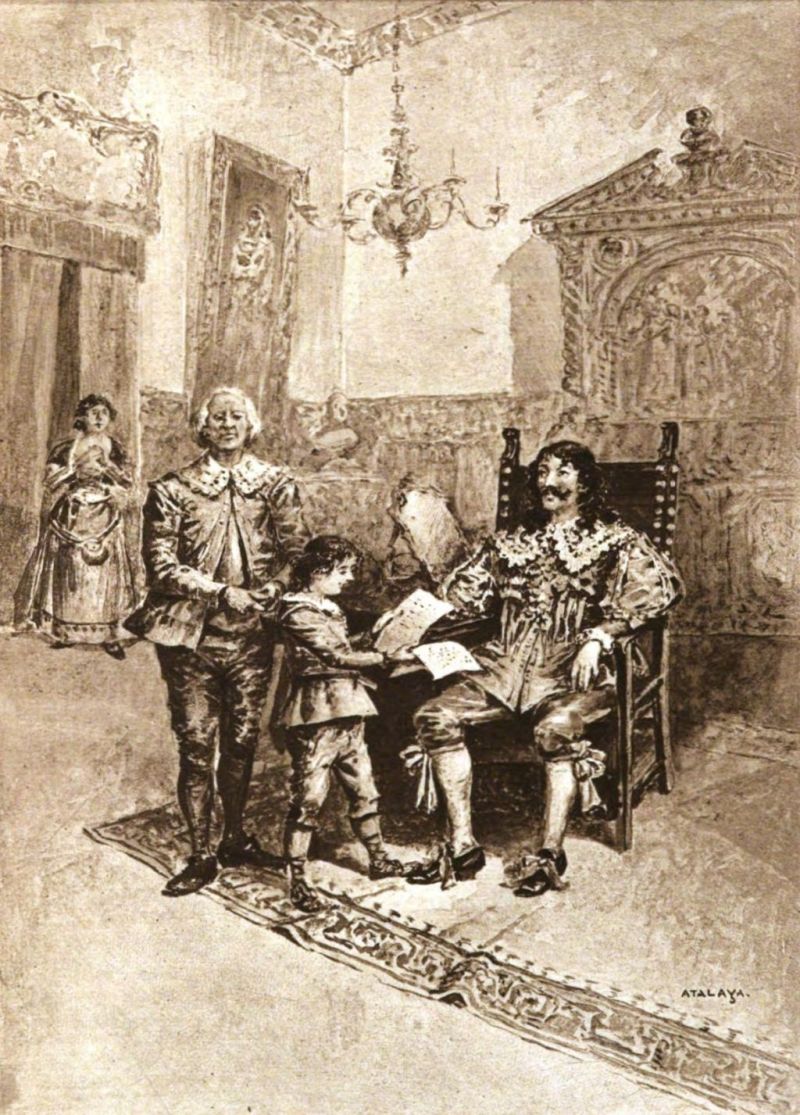
MARIO ESTABLISHES HIS IDENTITY.
He darted into the hall, ran back to the marquis's chamber, snatched unceremoniously from his hands the letter over which he was still meditating, compared the handwritings,...
That done, he opened the letter, took out a stained and spotted paper, kissed it and examined it carefully; then, shouting: "Come, mother! Come, Monsieur Jovelin!" he darted into the hall, ran back to the marquis's chamber, snatched unceremoniously from his hands the letter over which he was still meditating, compared the handwritings, and, thrusting everything that he held, letters, ring and dagger, into Adamas's hand, leaped on the marquis's knees, threw his arms about his neck, and hugged him so tight that the worthy man was almost suffocated for a moment.
"Come, come!" said Bois-Doré at last, somewhat annoyed by this familiarity, which he did not expect, and which had seriously deranged his wig, "this is not the time for play of this sort, my young friend, and you are taking liberties which—Whom is this you have brought here and why?"
The marquis paused when he saw Mario burst into tears.
The child had acted in obedience to an inspiration, he had had faith; but, as the minds of the others did not move so fast or so straight as his, doubt, fear and shame returned to him. He had disobeyed Mercedes, who was weeping and trembling.
Lucilio watched him so closely that he felt intimidated; the marquis repelled his passionate embrace, and Adamas was dazed, and did not seem to recognize unhesitatingly the similarity of the handwritings.
"Come, do not weep, my child," said the perturbed marquis, taking from Adamas's hands his brother's letter and the worn and crumpled paper that Mario had brought. "What is the matter, Adamas, and why are you trembling so? What is that paper, all covered with black spots? Vrai Dieu! those are blood-stains! Bring the candle nearer, Adamas, and let me look! Why, my friends! O Lord God in Heaven! Jovelin! Adamas! Look at this! I am not dreaming, am I? It is the handwriting of my darling brother! every letter is his! And this blood——Ah! my friends! that is a very cruel thing to see. But—where did you get this, Mario?"
"Read, read, monsieur," cried Adamas, "make sure that you are right."
"I cannot," said the marquis, turning deathly pale; "my heart fails me! Whence comes this paper?"
"It was found on my father," said Mario, recovering his courage; "look, see if it is not a letter for you that he intended to send you. Monsieur Anjorrant made me read it many times; but your name was not on it, and we never knew to whom to send it."
"Your father!" repeated the marquis, as if waking from a dream; "your father!"
"Pray read it, monsieur!" cried Adamas; "make sure."
"No! not yet," said the marquis. "If I am dreaming, I do not desire to be awakened. Let me fancy that this lovely child—Come here, boy, to my arms.—And do you, Adamas, read it if you can! I could never do it!"
"I will read it," said Mario; "follow with your eyes." And he read as follows:
"Monsieur and dear brother:
"Pay no heed to the letter you will receive after this, which I wrote at Genoa, under date of the sixteenth of next month, in anticipation of a long and dangerous journey, during which, as I feared that you would be anxious on my account, I desired to allay your anxiety by a post-dated letter, and thereby prevent your making inquiries for me in that country, where I desired that my absence should not be noticed.
"As I have arrived here, thank God! more quickly and with less trouble than I dared hope, and am now out of difficulty and danger, I propose to tell you of my adventures, which I am at last able to do without concealment or reserve, leaving the details, however, for the approaching, eagerly anticipated moment when I shall be with you, accompanied by my beloved and honored wife, and, God willing, by the child of whom she will make me the father in a few days!
"It will suffice for you to know to-day, that, having been married secretly last year, in Spain, to a beautiful lady of noble birth, against the will of her parents, I was obliged to leave her on my master's service, and to return to her, with the same secrecy, to rescue her from the tyranny of her parents and take her to France, where we have at last arrived to-day, under favor of our precautions and disguises.
"We expect to stop at Pau, whence I shall forward this letter to you, to be followed by another which will announce, if it be God's pleasure, my wife's safe delivery, and in which I shall have the leisure that I have not at this moment, to tell you——"
At this point the letter had been interrupted by some unexpected occurrence. It had been folded and carried about in the traveller's pocket, to be finished and sealed at Pau, in all probability, and there entrusted to the carriers who, at that time, conducted the mail service, with more or less despatch, between places of importance.
XXV
Bois-Doré wept copiously as he listened to this letter, which, being read by Mario, penetrated the more deeply into his heart.
"Alas!" he said, "I often accused him of neglect, and he thought of me on the very first day of his happiness and safety! He intended doubtless to bring his wife and child to me, and place them in my care, and I should not have passed my life alone, without a family! But rest in peace in God's bosom, my poor boy! your son shall be my son, and in my grief at having so cruelly lost you, I have at all events the consolation of embracing your living image! for it is his very manner and his charm, my dear Jovelin, and my heart was stirred at the first glance I cast upon the child. And now, Mario, let us embrace as uncle and nephew, which we are, or rather as father and son, which we are to be from this moment."
The marquis worried little about his wig this time, but embraced his adopted son with an affectionate warmth which changed to heartfelt joy the painful memories evoked by the letter.
Meanwhile Mercedes, heartbroken by Lucilio's suspicions, had resolved to make known the truth in all its details.
"Give them the ring," she said to Mario; "perhaps they will be able to open it, and you will learn your mother's name."
The marquis took the heavy gold ring and turned it in every direction; but, versed as he was in mechanical secrets, he could not succeed in opening it.
Neither Jovelin nor Adamas was more adroit, and they were obliged to abandon the project temporarily.
"Never mind!" said the marquis to Mario, "let us not worry about it. You are my brother's son, I can entertain no doubt of that. Judging from his letter, you descend from a family of higher rank than ours; but we have no need to know your Spanish ancestors to cherish you and rejoice in you!"
Meanwhile Mercedes continued to weep.
"What is the matter with that poor creature?" the marquis asked Adamas.
"I do not understand what she says to Master Jovelin, monsieur," was the reply; "but I see plainly enough that she is afraid that she will not be allowed to remain with her child."
"Who will prevent her, I wonder? Am I likely to do it, who owe her so much gratitude and am indebted to her for so much joy? Come hither, my excellent girl, and ask me whatever you will. If you want a house, lands, flocks and servants, aye, and a good husband to your taste, you shall have them all, or may I lose my name!"
The Moor, to whom Mario translated these words, replied that she desired nothing except to work for her living, but somewhere where she could see her dear Mario every day.
"Granted!" said the marquis, offering her both hands, which she covered with kisses; "you shall remain in my house, and, if you are willing to see my son every hour in the day, you will confer a great favor on me; for, since you love him so dearly, no other woman than you shall take care of him. And now, my friends, congratulate me on the great consolation which has come to me, and which, as you know, Jovelin, confirms in every point the gypsy's prediction."
Thereupon he embraced Lucilio, and also, for the first time in his life, the faithful Adamas, who wrote that glorious fact in letters of gold on his tablets.
Then the marquis took Mario in his arms, placed him on the table in the middle of the room, and, walking a few steps away, began to gaze at him as if he had not seen him at all as yet. He was his own, his heir, his son, the greatest joy of his whole life.
He examined him from head to foot, smiling, with a blending of affection, pride and childish delight, as if he were a superb picture or piece of furniture; and as he already had the feelings of a father and did not wish to make that noble child absurdly vain, he forced back his exclamations and contented himself by rolling his great black eyes, showing his great white teeth, and moving his head with a self-satisfied air to the right and left, as if to say to Adamas and Lucilio; "Just look! what a fine fellow, what a figure, what eyes, what a bearing, what pretty ways, what a son!"
His two friends shared his delight, and Mario endured their scrutinizing with a confident and affectionate air, which seemed to say to them: "You can look at me, you will find no evil in me." But he seemed to say more particularly to the old marquis: "You can love me with all your strength, I will pay you back."
And when the scrutiny was at an end, they embraced again, as if they would fain exchange in a kiss all the kisses of which the childhood of the one and the others old age had been deprived.
"You see, my dear friend," the marquis in his joy said to Lucilio, "that we must not make sport of soothsayers, when they predict our future by the stars. You shake your dear old head? Yet you surely believe that our planet——"
The worthy marquis would doubtless have attempted to elucidate some theory of his own invention, wherein astronomy, to which he was devoted, was in some measure confirmed by astrology, to which he was even more devoted, had not Lucilio interrupted him by handing him a note in which he urged a consultation as to the means of unmasking his brother's murderer.
"You are quite right," said Bois-Doré; "and yet, on this day of incomparable bliss, it hurts me to think of inflicting punishment. But I must do it, and, if you please, we will discuss the matter together.—Go, Adamas, and say to this Monsieur D'Alvimar that I beg him to excuse a slight delay in serving supper; and above all, let us not divulge a syllable of the great discovery we have made.—Go, my friend.—What are you doing there?" he added, as he saw Adamas looking into the great mirror, framed in gilt network, and making strange faces at himself.
"Nothing, monsieur," replied Adamas; "I am just studying my smile."
"For what purpose, I pray to know?"
"Is it not fitting, monsieur, that I should make up a treacherous expression to speak to that traitor?"
"No, my friend; for, before we adjudge him a traitor, we must examine into the affair more carefully, and that is what we are about to do."
At that moment Clindor knocked at the door. He announced that Monsieur de Villareal was indisposed and desired to keep his chamber.
"That is so much the better," said the marquis; "I will go to pay him a visit. After which we will have a preliminary hearing in his case among ourselves."
"You must not go alone, monsieur," said Adamas. "How can we be sure that this indisposition is not feigned, and that the knave has not laid some trap for you, being warned by his conscience?"
"You are talking nonsense, my dear Adamas. Even if he killed my brother, he certainly never knew his name, since he remains under my roof without uneasiness."
"But look at this dagger, my dear master! You have not yet looked at this proof."
"Alas!" said Bois-Doré, "do you think that I can examine it dispassionately?"
Lucilio advised the marquis to see his guest before pursuing his investigations, so that he might be sure of being calm enough to conceal his suspicions.
Adamas allowed the marquis to go; but he glided close on his heels to the door of the Spaniard's apartment.
D'Alvimar was really ill. He was subject to nervous sick-headaches of great violence, which were often brought on by paroxysms of anger, and he had had more than one of the latter in the course of the day.
He thanked the marquis for his solicitude and begged him not to put himself out on his account. He needed nothing more than careful diet, silence and rest until the following day.
Bois-Doré withdrew, telling Bellinde, without obtruding, to see to it that his guest lacked nothing; and he took advantage of this visit to examine the features of old Sancho, to whom he had previously paid no attention.
The former swineherd, tall, lean and sallow, but wiry and muscular, was sitting in a deep window-recess, reading by the last rays of daylight a religious book from which he never parted, and which he did not understand. To spell out with his lips the words in that book and to tell his beads mechanically, such was his principal occupation, and, apparently, his only pleasure!
Bois-Doré glanced furtively from the master lying stretched out on the bed, with an air of utter prostration, to the calm, stern, devout servant, whose monkish profile was outlined against the window.
"These are not highwaymen," he thought. "What the devil! this fair, slender young man, with an eye as soft as a girl's—To be sure, this morning when he was angry with the gypsies, and yesterday when he inveighed against the Moors, his expression was less benignant than usual. But this old esquire with the Capuchin's beard, who is so profoundly engrossed in his religious book—To be sure, there is nothing so like an honest man as a knave who knows his business! No, my penetration is insufficient in this matter, and we must weigh all the facts."
He returned to the pavilion, the whole of which was given over to his suite of apartments, each floor consisting of one large and one small room: on the ground floor, the dining-room with a serving-room; on the first floor, the salon and boudoir; on the second, the châtelain's bedroom and another boudoir; on the third, the large, so-called Salle des Verdures[21] which Adamas sometimes honored with the title of Salle de Justice; on the fourth, an unfinished, vacant room.
In the later building attached to the side of this pavilion, were the apartments of Adamas, Clindor and Jovelin, connecting with those in the grand'maison, as the marquis's little pavilion was ingenuously and in all seriousness called in the village.
He found his friends assembled in the Salle des Verdures, and not until then did he remember that in the general excitement the Moorish woman had been admitted to his chamber. He was grateful to Adamas for having transferred the session to some place other than his sanctuary. He saw that Jovelin was writing busily, and, not wishing to disturb him, he sat down and perused the letter written by Abbé Anjorrant to Monsieur de Sully, with the view of putting him on the track of Mario's family.
That letter was written very soon after Florimond's death, before Monsieur Anjorrant knew of the death of Henri IV. and Sully's fall from power; it had not reached its destination. This was a copy, which the abbé had retained and bequeathed to Mario with Florimond's unfinished letter. The abbé's letter—it was more properly a memorial—contained most precise details of the murder of the pretended peddler, as the abbé had received them from Mercedes, and as they had been confirmed by various incidents.
In it all there was nothing to fasten the guilt upon d'Alvimar and his valet. The assassins had not been discovered. Both, it is true, were minutely described in the Moorish woman's statement contained in the memorial; but, although she declared now that she recognized them, she might very well be mistaken, and her accusation was not sufficient to condemn them.
The Catalan dagger, the instrument of murder, being placed beside the one given by Lauriane to the marquis, was more convincing evidence. The two weapons were, if not identical, so nearly alike that at the first glance one had difficulty in distinguishing them. The initials and the device were made with the same instrument, and the blades were of the same make.
But Florimond might have been killed with a weapon stolen from Monsieur de Villareal, or lost by him.
Nor was there any proof that the one given by Lauriane to the marquis came from the Spaniard.
And, lastly, the initials seen by Mario, Mercedes and Adamas on his other weapons could not be his, for he had been introduced by Guillaume under the name of Antonio de Villareal.
XXVI
The fair-minded Bois-Doré was making these observations aloud to Adamas, when the mute handed him the sheet upon which he had just been writing.
It was a brief narrative of what had taken place at La Motte-Seuilly in the morning, between Lauriane, the Spaniard and himself: how Villareal had hurled the knife again and again to frighten him and interrupt his music, how he had plunged it into the entrails of the wolf, and lastly how he had given it to Madame de Beuvre as a token of submission and penitence before Jovelin's eyes.
"Oho! this is becoming serious!" said the marquis, lost in thought, "and I see that this Villareal is a very bad man. However, it may be that none of these weapons were in his possession ten years ago, and that he has received them since by gift or by inheritance. In that case he must have been the assassin's kinsman or friend; there are villains and cowards in the best families. Like yourself, Master Jovelin, I have a bad opinion of our guest; but I am certain that, like me, you still hesitate to condemn him on this evidence."
Lucilio nodded assent and advised the marquis to try to make him confess the truth by surprise or by stratagem.
"We will deliberate with care thereupon," replied Bois-Doré, "and you will assist us, my dear friend. For the moment, we must go to supper, and since we have no guests, we will give ourselves the pleasure of eating with our little marquis that is to be, who no more belongs in the servants' quarters than you do yourself."
"Still, monsieur, if you take my advice," said Adamas, "you will leave things as they are for to-day. Bellinde is a wicked creature and a plague, and to my mind she is on much too friendly terms with the rectory, which is a sink of slanderous remarks against all of us."
"Hoity-toity! Adamas, what in God's name is the trouble between you and the rectory?"
"The trouble is, monsieur, that I have been consulting a magician too. You had hardly gone away this morning, when a certain La Flèche, the same gypsy, doubtless, whom you saw later in the day at La Motte, came prowling around the château and offered to tell my fortune. I refused; I am too much afraid of prophecies, and I hold that any harm that is destined to happen to us happens twice over when we know it beforehand. I contented myself by asking him who had stolen the key of the wine closet, and he answered without hesitation:
"'The one you suspect!'
"'Tell me her name,' I replied, knowing well enough that it was Bellinde, but wishing to test the clever rascal's skill.
"'The stars forbid me,' he said; 'but I can tell what the person is doing at this moment. She is at the rector's, where she is chattering about you, saying that you put it into the head of the lord of this château to marry young Madame——"
"Hush, hush, Adamas!" cried the marquis modesty; "you should not repeat such nonsense."
"No, monsieur, no! I will say nothing; but, as I was determined to know whether the sorcerer told the truth, I went out as if for a walk, as soon as he had gone; and as I passed the rectory I saw Bellinde at a window with the housekeeper, and both of them began to laugh and to mock at me behind my back."
Jovelin asked if the gypsy had entered the château.
"He would have liked to right well," said Adamas, "but Mercedes, who watched him from the kitchen without letting him see her, begged me not to admit him, saying that he was likely to steal; so I did not let him into the courtyard. He gazed at the door with much emotion, and, when I asked him what he saw there, he answered:
"'I see great events about to take place in this house; so great and so surprising that it is my duty to warn your master. Let me speak to him.'
"'You cannot,' said, 'he is not within.'
"'I know where he is,' said he; 'he is at La Motte-Seuilly, where I will try to see him; but if I am not able to speak with him there without witnesses, I will come back here, and I assure you that if you refuse me admission again, you will live to regret it, for many destinies are in my hands.'"
"All this is very remarkable," said the marquis, artlessly. "It is a fact that he predicted all that has happened, and I regret now that I did not question him further. If he returns, Adamas, you must bring him to me. Did not you say, my dear Mario, that he was an intelligent fellow?"
"He is very amusing," replied Mario, "but my Mercedes doesn't like him. She thinks it was he who stole my father's seal. I don't think so, because he helped us to look for it and to ask the other gypsies about it. He seemed to be very fond of us, and he did all we asked him to."
"And what was there on the seal, my dear boy?"
"A crest. Wait! Monsieur l'Abbé Anjorrant looked at it with a glass and it looked big, for it was so small—so small that you couldn't make it out; and he said to me:
"'Remember this: Argent with a tree sinople.'"
"That is right," said the marquis; "that is my father's crest! It would be mine if King Henri had not composed another for me to suit himself."
"Both are carved on the courtyard door," wrote Lucilio. "Ask the child if he did not see them when he came here."
"How could he have seen them?" said Adamas, who read Lucilio's words simultaneously with his master. "The masons who were repairing the arch had their scaffolding in front of them."
"Could the gypsy see the escutcheons this morning," said Lucilio with his pencil, "when he looked at the gate?"
"Yes," replied Adamas, "the stagings had been taken down, and the masons were at work elsewhere. The escutcheons were made over—But now I think of it, Master Jovelin, this La Flèche must know something of our dear child's story, as they had travelled together?"
"I don't think so," said Mario. "We never mentioned it to anyone."
"But you and Mercedes talked about it?" wrote Lucilio. "Does La Flèche understand Arabic?"
"No, he understands Spanish; but I always talked Arabic with Mercedes."
"Were there no other Moors in that band of gypsies?"
"There was little Pilar, who understands Arabic because she is the child of a Moor and a gitana."
"In that case," wrote Lucilio to the marquis, "abandon your belief in the supernatural. La Flèche attempted to make money out of what he had learned. He knew Mario's story down to a certain point; he learned yours in the neighborhood, and the fact of your brother's having disappeared ten years ago. He had stolen the seal. He recognized the coat-of-arms on the door. He remembered the dates. He divined or imagined the whole truth. He hurried to La Motte to make his prediction, which he taught the little gitana by heart. To-night or to-morrow he will bring you the seal, expecting to solve for you the mystery which you have already solved, and to receive a handsome reward. He is a thief and a schemer; nothing more."
It cost the marquis a pang to assent to this reasonable and probable explanation. However, he did so.
Adamas still held out.
"How can you explain what he told me about Bellinde and the rectory?" he asked Lucilio.
Lucilio replied that that was very easy. Bellinde had listened at the door of the marquis's apartment the night before; La Flèche had listened in the morning at the door or under the windows of the rectory.
"You state the case very sensibly," cried the marquis, "and I see plainly enough that there is no other magic in all this than the magic of Divine Providence, which has brought truth and joy into my house with this child. Let us go to supper! our minds will be clearer afterward."
The marquis supped hastily and without enjoyment. He felt that he was being spied upon by Bellinde, who was no longer able to listen in the secret passages; for Adamas, while the masons were on the spot, had had that passage closed; but the prying and malevolent creature had observed the long interviews of the marquis and Jovelin with Mercedes and the child, behind closed doors, and, above all, the self-important and triumphant airs of Adamas, whose every glance seemed to say to her: "You shall know nothing!"
She was not intelligent enough to divine anything. She imagined that the marquis, following up the project of marriage, was arranging an entertainment for the young widow, with the assistance of the "Egyptians."
There was nothing in that which she could use against Adamas, her personal enemy; but she was consumed with a jealousy of him and of the Moorish woman which sought only an opportunity for revenge.
When Bois-Doré was alone with Jovelin, they concerted and agreed upon a plan of action for the following day with respect to D'Alvimar.
They reread Monsieur Anjorrant's letter carefully and analyzed it. Then, honest Sylvain, who was not fond of giving his mind to serious and depressing subjects, sent for his heir and passed the evening chatting and playing with him. Therein he showed a marked resemblance to his dear master, Henri IV., although he did not think of imitating him. He adored the charms of childhood, and, except for the stiffness of his old bones, would gladly have played horse for him around the room.
"Now," he said to Adamas, when he saw Mario's silky eyelashes drooping with sleep, "we must give him to the Moor, so that she may take care of him one night more. But to-morrow, when we have settled this Villareal business, there will be no further occasion to conceal the truth, and I propose that my heir shall have his bed in the boudoir adjoining my own bedroom.—See, my child," he said to Mario, "look at this little nest, all silk and gold, which has long been waiting for a noble fellow like you! Do you like the pink silk hangings, and this low furniture inlaid with mother-of-pearl? Doesn't it seem as if it were made for a young man of your height? We shall have to arrange a bed for him that will be a genuine chef-d'œuvre, Adamas. What say you to twisted columns of ivory, with a great bunch of red plumes at each corner?"
"As soon as our minds are at rest, monsieur," said Adamas, "I will turn my attention to the question, in order to gratify you, for nothing is too fine for your heir. We will consider the matter of clothes too, which must be suited to his rank."
"I will think about it, I will think about it, Adamas!" cried the marquis, "and I propose that his wardrobe shall be just like mine. You will send for the best tailors, linen-drapers, shoemakers, hatters and plumemakers in the province, and for a whole month, if necessary, they shall work day and night, under my eye, preparing my nephew's outfit."
"And my Mercedes," said Mario, leaping for joy, "will you give her beautiful dresses too, like Bellinde's?"
"Mercedes shall have beautiful dresses, dresses of gold and silver, if such is her whim. And that reminds me—Look you, my dear Jovelin, this woman is lovely, so it seems to me, and still young. Would you not think it well to allow her to resume the Moorish costume, which is very pretty, except the veil, which is altogether too Mohammedan? As the excellent creature is a sincere Christian now, and we live in a neighborhood where the common people never saw a Moor, that costume will offend nobody and will gratify our eyes. What is your wisdom's opinion?"
Lucilio's wisdom had much ado to reconcile the warm affection which the marquis really deserved with the feelings naturally aroused by his childishness. But, hopeless of correcting so old a child, reason advised him to make the best of him and to love him as he was.
The philosopher would have preferred that Mario should not be overwhelmed with splendor and finery at the outset of his new career, but rather that he should be told something of the new duties he had to fulfil. He found some consolation in the fact that the child was less intoxicated by the possession of all those things, than overjoyed and touched by the affection and endearments of which he found himself the object.
On the following day D'Alvimar, who had passed a sleepless night, requested through Bellinde, who obligingly acted as his nurse, permission to keep his room until afternoon.
The marquis paid him another brief visit, and was struck by the alteration of his features. He had had ghastly visions, under the spell of the sinister prophecies that had been hurled at him.
Daylight had finally revived hope in his heart, and he slept part of the day.
XXVII
The marquis took advantage of this respite to recur to the subject of dress.
He went up with Mario and Adamas to the vacant room on the fourth floor, that is to say, immediately over the Salle des Verdures.
That unfinished apartment was strewn with innumerable chests and cupboards; and Mario, as soon as the padlocks were removed, and the lids raised and doors thrown open, fancied that he was in fairyland. There was a bewildering mass of magnificent stuffs, dazzling gold lace, ribbons, laces, feathers and jewels, rich hangings, cordovan leather, furniture in parts, all new and ready to be put together, reliquaries heavy with precious stones, beautiful paintings on glass which needed only to be assembled, lovely enamelled mosaics, arranged in piles and numbered, whole pieces of fine linen, enormous guipure curtains, with gold and silver stripes; in a word, a hoard of plunder, which smelt of the partisan warrior a league away, and which the marquis considered to have been legally acquired at the sword's point.
This receptacle of rich spoil was known in the household as the store-room, the garret. It was supposed to contain spare articles of furniture, together with what was broken or discarded.
Adamas alone was aware of the contents of those wonderful chests, and under his breath he called that room the treasure or the abbey. There were no fashionable gewgaws, as in the marquis's apartments, but artistic objects and fabrics of great value and great beauty, some of great antiquity, and the more valuable on that account: stuffs manufactured by processes no longer known, weapons of all sizes and of all nations, many excellent pictures, valuable manuscripts, etc.
All this rarely saw the light, the marquis fearing lest he might arouse the cupidity of some of his neighbors, and producing his treasures only one at a time and in the guise of a recent purchase.
However, it was very rarely the case that the pillaging heroes of those days were compelled to make restitution; but it might well happen that some powerful individual, acting on his own account, but claiming to act in the name of the Church or the State, would calmly appropriate an article in dispute.
It was thus that Catherine de Médicis, to reward Jean de Hangest—called Capitaine d'Yvoi—for treacherously surrendering Bourges to her, seized the superb chalice, decorated with precious stones, which he had taken from the treasure-chest of Sainte-Chapelle in that city, and had put aside as his share of the plunder.
From all these marvels the marquis selected what was required for Mario's outfit, calling upon him to make known his taste with regard to the colors.
One would but imperfectly understand the manners of that period, who should assume that it was necessary, as it is to-day, to go to Paris to learn the fashions and to find skilled workmen in the art of dress and decoration. It was not until the reign of Louis XIV. that the civilization of luxury and fashion made of Paris the school of good taste and the arbiter of refinement. Richelieu began this work of centralization by destroying the power of the nobles. Before his time, the princes held court in the great provincial centres, and the artisans of the smallest places supplied the needs of the nobility with traditional skill. A rich châtelain had artisans among his vassals; and, even in bourgeois houses, furniture, clothes, boots and shoes were made at home.
Bois-Doré therefore had only to select the materials and order the articles that Adamas was to have made under his own eyes.
In the matter of dress Adamas was beyond praise. He could safely be trusted, and, at need, he could put his own hand to the work with success.
The ivory columns and cornices destined for the child's bed were found after some searching.
"I knew that there was something here like that," said the marquis smiling. "They are of beautiful workmanship; they came from a state canopy taken from the chapel of the Abbey of Fontgombaud, of which I was abbot, that is to say, lord by right of conquest, for a whole fortnight. When I took possession of it, I remember saying to myself: 'If the new Abbot of Fontgombaud could become a father soon, this would be a fitting canopy for his first-born son!'—But, alas! my friend, I did not inherit all the monkish virtues, and in order to have a son, I was obliged to find one by a miracle long after I came to maturity. Never mind! he will be none the less dear, and he will none the less sleep his angel's sleep under the canopy of the Virgin of Fontgombaud."
The marquis was interrupted in his reminiscences by the arrival of La Flèche, who asked to speak with him.
The chests and the door of the treasury were carefully locked, and the vagabond was received in the barnyard.
It was beautiful weather, and Jovelin was of opinion that a trickster of that sort should not be admitted to the house.
What he had foreseen actually happened. La Flèche brought with him the seal, which he claimed to have found in little Pilar's possession; he also assumed to reveal the mystery of Mario's birth and of the murder of Florimond by Monsieur de Villareal.
The marquis allowed him to say all that he had to say, then dismissed him, with a crown, for the trouble he had taken to bring back the seal; but he pretended not to understand the story he had told, to place no faith in it, and to be much shocked that he should dare to accuse Monsieur de Villareal, against whom he had no other proof than the Moorish woman's excitement and her exclamation when she thought that she recognized him on the moor of Champillé.
Herein the marquis, advised by Lucilio, acted wisely. If he had seemed to credit the accusation, La Flèche would have been quite capable of giving the Spaniard warning, in order to have two strings to his bow.
La Flèche, bitterly disappointed by his fiasco, sheepishly withdrew, and was walking along the outer wall of Galatée's garden, when he heard a soft voice calling his name.
It was Mario, whom the marquis had not chosen to admit to the interview, desiring that all relations between his heir and gypsydom should be severed irrevocably. But as he had not explained his wishes in that respect, the child did not know that he was acting in opposition to them when he glided through the labyrinth and watched for the gypsy to pass, through a little loophole looking toward the village.
"Who calls me?" he said, looking about him.
"I," said Mario. "I want you to tell me about Pilar."
"What will you give for that?"
"I can't give you anything. I haven't anything!"
"Idiot! steal something!"
"No, never! Will you answer me?"
"In a minute; answer me first. What do you do in this château?"
"Play music."
"What else?—Aha! you don't choose to speak? All right. Adieu!"
"And you won't tell me where Pilar is?"
"She is dead," replied the gypsy brutally, and he walked away whistling.
Mario tried in vain to recall him. When he could no longer hear him, he began to run about and play in the labyrinth, trying to convince himself that La Flèche had made sport of him. But the idea of his little companion's death caused a terrible shock to his vivid imagination.
"She used to say that La Flèche beat her," he thought; "but I didn't believe her. He never beat her before us. But perhaps she didn't lie; perhaps he beat her until he killed her."
And, as he reflected thus, the child shed a few tears. Pilar was not a very amiable creature; but there was something of the Bois-Doré in dear Mario; he was particularly sensitive to pity, and the Abbé Anjorrant had brought him up to abhor violence and cruelty. But he concealed his tears, fearing to pain his uncle, whom he already loved passionately.
D'Alvimar left his room at last.
The rest that he had taken, a lovely sunset and the joyous song of the thrushes dispelled the black presentiments by which he had been besieged for several days.
Having dressed and perfumed himself, he sought the marquis and thanked him for the interest he had shown and the care that had been taken of him. Bois-Doré could not make up his mind to accuse even inwardly a man, still so young, of a bearing so distinguished, and a countenance whose habitual melancholy seemed to him genuinely touching; but when they were seated at the supper table, Lucilio being there, as usual, to furnish music, Bois-Doré remembered their agreement, and collected what he called his siege-guns, to make a violent assault upon his guest's conscience.
He had seen too much fighting and had had too many perilous adventures not to be able to arrange his bearing and his features, without having, like Adamas, to make preparatory studies before a mirror. Although his life had long been so placid that he had not been obliged to depart from his natural mildness of manner, he was too much the man of his time not to be able to make his glance say, twenty times a day if need be:
"Vive le roi! Vive la Ligue!"
The sweet notes of the bagpipe relieved him from the necessity of carrying on a commonplace conversation which would have seemed to him very tedious.
The music which helped to produce the tranquillity that he needed, now caused a feverish excitement in D'Alvimar.
He really hated Lucilio. He knew his baptismal name, which the marquis had let fall in his presence, and Monsieur Poulain, who was thoroughly posted in contemporary heresy, had divined from that circumstance that Jovelin was a free translation of Giovellino. The fact of his mutilation confirmed him in that suspicion, and he was already deliberating upon the means of making perfectly sure, and of stirring up some new persecution against him.
D'Alvimar would readily have assisted him, if he had not been forced to keep out of sight for some time, and the poor philosopher was the more antipathetic to him because he could take no steps against him at present. His beautiful music, by which he had been charmed at the first hearing, seemed to him now intolerable bravado, and the ill-humor which took possession of him did not dispose him to undergo patiently the examination that was being prepared for him.
After the supper the marquis proposed a game of chess in the boudoir adjoining his salon.
"I agree," the Spaniard replied, "on condition that we have no music there. I cannot play with that to distract my attention."
"Nor I, most certainly," said the marquis.—"Put your sweet voice away in its box, good Master Jovelin, and come to watch our peaceful battle. I know that you enjoy a well-fought game."
They went into the boudoir, and found there a magnificent chess-board of crystal with gold mountings, comfortable chairs, and many lighted candles.