Volume 1 — Introductory material (continued 3)
George Burnham Ives translation
"See," continued Bois-Doré, with ingenuous pride in his own penetration, putting aside the child's coarse white shirt, "his face is sun-burned, but no more than our peasants are in harvest-time; his neck is as white as snow, and he has feet and hands so small that serf or villein never could show the like. Come, my little imp, be not ashamed; and, as I am told that you understand French, answer our questions. What is your name?"
"Mario," the child replied without hesitation.
"Mario? That is an Italian name!"
"I don't know."
"From what country are you?"
"I am French, I think."
"Where were you born?"
"I don't remember."
"I should think not," laughed the marquis; "but ask your mother."
Mario turned to the Moor, and opened his mouth to speak to her. His face wore an expression of satisfaction and joy, because he had been welcomed so like a father by this fine gentleman who held him between his legs, and whose beautiful silk clothes and pretty little beribboned dog he stroked timidly with the tips of his little fingers.
But when he met his mother's eyes, he seemed to read therein a warning of great importance; for he gently extricated himself from Monsieur de Bois-Doré's grasp, and went to the Moor, lowering his eyes and not speaking.
The marquis asked him divers other questions to which he did not reply, although he seemed, by the sweet and melting glance he turned upon him, to apologize furtively for his discourtesy.
"It is my opinion, friend Adamas, that you exaggerated a trifle when you declared that this boy spoke our language fluently," said the marquis. "It is true that his pronunciation is very good, and that he says several words without much foreign accent; but I fancy that that is all he knows. As you know Spanish so well—for my part, I confess that I know very little of it—make him explain himself."
"Useless, monsieur le marquis," said Adamas, not at all disconcerted, "I give you my word that the little rascal speaks French like a clerk; but he is frightened in your presence, that's the whole story."
"No, indeed!" rejoined the marquis; "he's a little lion and afraid of nothing. He came out of the water laughing as heartily as when he went in, and he must see that we are kind-hearted people."
Mario seemed to understand perfectly; for his affectionate eye said yes, while the Moorish woman's intelligent and timid eyes, resting upon D'Alvimar, seemed to say no, so far as she was concerned.
"Come, come," continued worthy Monsieur Sylvain, taking Mario between his legs again, "I propose that we shall be good friends. I love children and this one attracts me. Tell me, Master Jovelin, isn't it true that that face was not made to deceive, and that that innocent glance goes straight to the heart? There is some mystery under all this, and I propose to solve it. Listen, Master Mario, if you answer me truthfully, I will give you—What would you like me to give you?"
The child, obeying the artless impulse of his age, pounced upon Fleurial, the beautiful little white dog which never left its master's chair when he was seated.
It seemed that Mario was determined to risk everything to possess the creature; but another glance from Mercedes warned him to restrain himself, and he replaced the little dog on the marquis's knees, to the great satisfaction of the latter, who had feared for a moment that he had gone too far.
The child sadly shook his head and made a sign that he wanted nothing.
Thus far D'Alvimar had said nothing; as he recited his prayer after the scene at the moat, he had reviewed rapidly, but with unerring accuracy, all the events of his life. Nothing had come to his memory which could have any connection, direct or indirect, with a woman and child in the situation of these two.
The emotion he had felt therefore must have been purely imaginary; he had regretted his failure to overcome it at once; he had recovered possession of his reason.
During dinner the marquis had not mentioned Adamas's story concerning Mercedes's mysterious journey. He himself had only listened to it with one ear, as he was falling asleep the night before. So that D'Alvimar eyed the two vagrants with calm contempt, and fancied that he had discovered at last the commonplace explanation of his repugnance for them.
He joined in the conversation.
"Monsieur le marquis," he said, "if you will permit me to retire, I am sure that with a little money you will make this varlet talk all you desire. It is possible that he is a Christian child stolen by this Moor, for I have no question as to her nationality. However, you are much mistaken, if you think that the color of the skin is a certain sign. Some of these wretched children are as white as yourself, and if you wish to make sure, you will do well to raise the hair that covers this brat's forehead; perhaps you will find there the brand of the red-hot iron."
"What!" said the marquis with a smile, "are they so afraid of the water of baptism that they efface the sign by fire?"
"The mark I refer to is the brand of slavery," replied D'Alvimar. "The Spanish law inflicts it upon them. They are branded on the forehead with an S. and a nail's head, which represents in figurative language the word slave."
"Yes," said the marquis, "I remember, it is a rebus! Well, for my part, I consider it very shocking, and if this poor child is branded with it and is a slave by your laws, I will purchase him and set him free on good French soil."
Mercedes had not understood a word of what was being said. But she watched with intense anxiety D'Alvimar approach Mario, as if to touch him; but not for anything in the world would D'Alvimar have sullied his gloved hand by contact with a Moor, and he waited for the marquis to lift the child's hair; but the marquis did nothing of the kind, from a feeling of generous compassion for the poor mother, whose humiliation and anxiety he thought that he could understand.
As for Mario, he understood what was taking place; but controlled and, as it were, fascinated by Mercedes's glance, he took refuge in stolid silence.
"You see," said D'Alvimar to the marquis, "he hangs his head and conceals his shame. Well, I know all I wish to know about them, and I leave you in this respectable society. There is no danger that they will unclench their teeth before a Spaniard, and they evidently know that I am one. There is an instinctive aversion between that degraded race and ours, so unerring that they scent our approach as wild game scents the approach of the hunter. I met this woman yesterday on the highroad, and I am sure that she put some spell on my horse, for he is lame this morning. If I were the master of this house, such vermin would not remain in it another instant!"
"You are my guest," rejoined Bois-Doré, blending with his courtesy an accent of dignity and resolution of which Monsieur d'Alvimar deemed him incapable, "and, in that capacity, you are entitled to entertain your opinions without being called upon to defend them, whether they are or are not identical with my own. If the sight of these unfortunate creatures is distasteful to you, as I do not wish it to be said that you were annoyed in any manner under my roof, I will arrange that they shall not offend your eyes; but you cannot demand that I shall brutally turn a woman and a child out-of-doors."
"Surely not, monsieur," said D'Alvimar, recovering his self-possession; "by so doing I should ill requite your courtesy, and I ask your pardon for my vehemence. You are aware of the horror with which my nation regards these infidels, and I know that I should have held it in check here."
"What do you mean?" demanded Bois-Doré, somewhat testily; "do you take us for Mussulmans?"
"God forbid, monsieur le marquis! I intended to refer to the tolerant spirit of the French in general; and as it is a law of civility that we must conform to the customs of the country in which we accept hospitality, I promise to keep watch upon myself, and to meet without repugnance whomever it may please you to receive."
"Very good!" replied the honest marquis, offering him his hand; "in a few moments, when I have finished here, is it your pleasure to go out and kill a hare or two?"
"You are too kind," said D'Alvimar, as he was leaving the room; "but do not disturb yourself on my account; with your permission I will go to write some letters, awaiting the supper hour."
The marquis, having risen to salute him, seated himself again with his careless grace, and said to Lucilio:
"Our guest is a very well-bred knight, but he is quick-tempered, and, all things considered, he has one great drawback, which is that he is too much of a Spaniard. Those sublime mortals despise everything that is not Spanish; but I believe that they have crushed out their own life by martyrizing and exterminating those wretched Moors. They will gnaw their hands over it some day. The Moors were untiring workers and scrupulously neat, in a land of sloth and vermin. They were gentle and humane before they were tormented so cruelly. Well, well, if we have here a poor remnant of that race which was so great in the past, let us not trample on it. Let us be merciful! God for us all!"
Lucilio had listened to the marquis with religious attention, but while he was saying the last words he was writing.
"What are you doing?" said Bois-Doré.
Lucilio handed him the paper, which seemed to the marquis an undecipherable scrawl.
"This," said the mute with his pencil, "is a translation in Arabic of the noble words you just said. See if the child knows how to read, and if he understands that language."
Mario glanced at the paper which was handed him, ran to the Moor and read it to her; she listened with great emotion, kissed the paper and fell on her knees at the marquis's feet.
Then she turned to Giovellino and said to him in Arabic:
"Man of courage and virtue, say to this good man what I am going to say to you. I did not wish you to speak my language before the Spaniard. I was not willing that the child should say a word before him. The Spaniard hates us, and, wherever he meets us, he does us harm. But the child is a Christian, he is not a slave. You can see on my brow the brand of the Inquisition; it is still there, although I was very small when they branded me."
As she spoke, she untied the kerchief of multicolored sackcloth which confined her long black hair, and pointed to her forehead on which there was no sign of the red-hot iron. But she rubbed it with her hand, and the ghastly rebus stood out in white on the red skin.
"But look at this youthful brow," she said, lifting Mario's abundant, silky locks. "If it had been branded like mine, it would not be possible to mistake the mark. This brow was baptized by a priest of your religion; the child has been reared in the faith and the language of his fathers."
While the Moor was speaking, Lucilio had written a translation of her words, and the marquis read as he wrote.
"Ask her for her story," he said to the mute; "make her understand that we are interested in her misfortunes and that we will take her under our protection."
It was not necessary for Lucilio to write Bois-Doré's interruptions. Mario, who spoke Arabic as readily as French and Catalan, translated it to his adoptive mother with remarkable fidelity.
We will continue the interview of those four persons, as if they had all spoken the same language, and as if Lucilio, quick as he was with his pencil, had not been incapable of speaking any language.
XVI
The Moorish woman began thus:
"Mario, my beloved, say to this kind-hearted nobleman that I speak Spanish very little, and French still less; I will tell my story to his scrivener, and he can read it.
"I am the daughter of a poor farmer of Catalonia. It was in Catalonia that the few Moors who were spared by the Inquisition lived at peace, hoping that they would be allowed to remain there and earn their living by toil, since we had taken no part in the recent wars which were so disastrous to our brothers in the other provinces of Spain.
"My father's name was Yesid in Arabic and Juan in Spanish; I was baptized by aspersion like the others, my Christian name was Mercedes, my Moorish name Ssobyha.[14]
"I am now thirty years old. I was thirteen when we began to receive secret warnings that we were to be stripped and driven from the country in our turn.
"Even before I was born the terrible King Philip II. had ordered that all Moors must learn the Castilian language within three years, and must no longer speak, read or write in Arabic, openly or secretly; that all contracts made in that language should be void; that all our books should be burned; that we should exchange our national costumes for the dress worn by Christians; that the Moorish women should go out without veils, with faces uncovered; that we should have no national festivals or songs or dances; that we should lay aside our family and individual names and take Christian names; that no Moor, male or female, should bathe in the future, and that the baths in the houses should be destroyed.
"Thus they insulted us even in the decency of our manners and the health of our bodies! My parents submitted. When they saw that it availed them nothing, and that they were persecuted solely because of their money, they thought only of collecting and concealing all that they could, intending to fly when they should again be in danger of death.
"By dint of hard work and patience they amassed a little hoard. It was to prevent the necessity of my begging, they said, as so many others had had to do who had allowed themselves to be taken by surprise. But it was written that I should ask alms like all the rest.
"We were still happy enough, notwithstanding the humiliation they heaped upon us. Our Spanish lords did not love us; but, as they realized that we alone in Spain were able and willing to till their lands, they asked their king to spare us.
"When I was seventeen years old, King Philip suddenly issued a new decree against all the Catalan Moors. We were banished from the kingdom with such goods and chattels as we could carry on our bodies. We must leave our houses within three days, under pain of death, and go, under escort, to the place of embarkation. Every Christian who harbored a Moor would be sent to the galleys for six years.
"We were ruined. However, my father and I concealed about our persons such gold as we could carry, and we left our home without a complaint. They promised to take us to Africa, the home of our ancestors. Thereupon we prayed to the God of our fathers to take us once more for his faithful children.
"They allowed us on the journey to resume our former costumes, which had been preserved in our families for a whole century, and to chant our prayers in our own language, which we had not forgotten; for, in spite of the decrees, we used no other among ourselves.
"We were packed on the state galleys like sheep, but were no sooner on board than they called upon us to pay for our passage. The majority had nothing. They insisted that the rich should pay for the poor.
"My father, seeing that they cast into the sea those who could find no one to help them, paid without regret for all those who were on our ship; but when they saw that he had nothing left, they tossed him into the sea with the rest!"
At this point the Moorish woman stopped. She did not weep, but her breast was heaving with sobs.
"Execrable hounds of Spaniards! Poor Moors!" muttered the marquis. "Alas!" he added, as if warned by a melancholy glance from Lucilio, "France has done no better; the Regent treated them just the same way!"
"Finding myself alone in the world," continued Mercedes, "without a sou, and deprived of all I loved, I tried to follow my poor father; they prevented me. I was pretty. The commander of the galley wanted me for a slave. But God unloosed the tempest, and they had to give all their thought to struggling against it. Several vessels sank, thousands of Moors perished with their persecutors. The galley upon which we were was hurled by the storm on the coast of France, and was dashed to pieces near a place of which I have never learned the name.
"I was washed upon the shore amid the dead and dying; that was my salvation. I dragged myself among the rocks, and there, drenched to the skin and utterly exhausted, having carefully concealed myself, for I had no strength to go farther, I slept for the first time for many days and nights.
"When I awoke the storm was at an end. It was quite warm. I was alone. The wretched ship lay off the shore, the dead bodies on the beach. I was hungry, but I had strength enough to walk.
"I left the shore as quickly as I could, fearing to encounter Spaniards there, and walked toward the mountains, begging bread, water and lodging. I was received very coldly; my costume made the peasants suspicious.
"At last I met several women of my own race, who were settled in a certain village, and who gave me other clothes. They advised me to conceal my birth and my religion, because the people thereabout did not like foreigners, and detested Moors above all others. Alas! it seems that they are detested everywhere, for I was told later that, instead of welcoming as brothers those who succeeded in reaching Africa, the men of Barbary massacred them or reduced them to a worse slavery than that of Spain.
"How could I follow the advice that was given me to conceal my origin? I did not know the Catalan language well enough for that. At first people gave me alms; but, when a Spaniard passed, he would say to the people of the neighborhood:
"'You have a Moorish woman among you.'
"And they would turn me away. I wandered from valley to valley.
"One day I found myself on a highroad—I learned afterward that it was the Pau road—and there it was that heaven caused me to fall in with a woman even more unhappy than myself. She was the mother of the child before you, who has become mine."
"Go on," said the marquis.
But Mercedes paused, seemed to reflect, and finally said to Lucilio:
"I cannot tell the story of the child's parents except to you alone—you, who saved his life, and who seem to me to be an angel on earth. If I may remain here a few days, and if I see no danger for Mario, I swear that I will tell the whole story; but I am afraid of the Spaniard, and I saw this old gentleman put his hand in his, after reproving him for his harshness toward us. I understood it all with my eyes; nobles are nobles, and we poor slaves cannot hope that the kindest-hearted of them all will take our part against their equals."
"Equality has nothing to do with it!" cried the marquis as soon as Lucilio had translated Mercedes's words for him in writing. "I swear, on my faith as a Christian and my honor as a gentleman, to protect the weak against the whole world."
The Moor replied that she would tell the truth, but that she should omit certain unimportant details.
Then she resumed her narrative in these words:
"I was on the Pau road, but at a very lonely spot in the heart of the mountains. There, as I was taking a little rest, having concealed myself for fear of the wicked men whom one is likely to meet in all countries, I saw a man pass with his wife.
"The woman was walking a little in advance; brigands ran up behind them, and killed and robbed the man so quickly that his wife did not see it, and, when she turned to speak to him, found him lying dead across the road.
"At that sight she fell in a swoon, and I saw that she was enceinte.
"I did not know how to take her up and comfort her. I was on my knees beside her, praying and weeping, when a man on horseback, dressed in black, and with a gray moustache, suddenly appeared and asked me why I was weeping so. I pointed to the woman lying on her husband's body. He spoke to her in several languages, for he was a great scholar; but he very soon saw that she was in no condition to reply.
"The shock that she had received hastened her labor.
"Some shepherds passed with their flocks. He called to them, and as they saw that that good man was a priest of their Christian religion, they obeyed his orders and carried the woman to their house, where she died an hour after bringing Mario into the world, and giving the priest the wedding-ring she wore on her finger, unable to say anything, but pointing to the child and to heaven!
"The priest stayed at the shepherd's house until the two unfortunate creatures were buried, and as he supposed that I had been the lady's slave, he entrusted the child to me and bade me accompany him. But I did not choose to deceive him, having seen that he was learned and humane. I told him my story and how I happened to be a witness of the peddler's murder."
"So he was a peddler?" said the marquis.
"Or a gentleman in disguise," Mercedes replied; "for his wife wore the clothing of a lady under her cloak, and when we undressed him to lay him out, we found a shirt of fine linen and silk short clothes under his coarser garments. His hands were white, and we also found upon him a seal on which there was a crest."
"Show me the seal!" cried Bois-Doré deeply moved.
The Moor shook her head, saying:
"I haven't it."
"This woman distrusts us," rejoined the marquis, addressing Lucilio, "and yet this story interests me more than she thinks! Who knows that—Come, my dear friend, try to make her tell us at least the precise date of this adventure she is describing."
Lucilio motioned to the marquis to question the child, who answered without hesitation:
"I was born an hour after my father's death and an hour before the death of good King Henri the Fourth of France. That is what Monsieur l'Abbé Anjorrant, who took care of me, told me, bidding me never forget it, and my mother Mercedes said I might tell you, on condition that the Spaniard shall not know it."
"Why?" said Adamas.
"I do not know," replied Mario.
"In that case beg your mother to go on with her story," said Monsieur de Bois-Doré, "and rely upon our keeping her secret, as we have promised to do."
The Moor resumed her narrative thus:
"The good priest, having procured a goat to nourish the child, took us away, saying:
"'We will talk about religion later. You are unfortunate, and it is my duty to have pity upon you.'
"He lived some distance away, in the heart of the mountain. He placed us in a little cabin built of blocks of marble and covered with great flat black stones, and there was nothing in the house but dried grass. That saint had nothing better to give us than a roof over our heads and the word of God. He lived in a house little more luxurious than the hut in which we were.
"But I had not been there a week before the child was neat and well cared for, and the house quite comfortable. The shepherds and peasants did not turn their backs upon me, their priest had so thoroughly imbued them with gentleness and pity. I soon taught them certain things about the care of their flocks and the cultivation of their fields which they did not know, but which are familiar to all Moorish husbandmen. They listened to me, and, finding that I could help them, they allowed me to lack nothing that I needed.
"I should have been very happy at falling in with that man of peace and that indulgent country, if I could have forgotten my poor father, the house in which I was born, my kinsmen and my friends, whom I was never to see again; but I came to love the poor orphan so dearly, that little by little I was consoled for everything.
"The priest educated him and taught him French and Spanish, while I taught him my language, so that I might have one person in the world with whom I could speak it; but, do not think that, in teaching him Arabian prayers, I turned him away from the religion the priest was teaching him. Do not think that I spurn your God. No, no! when I saw that sincere, compassionate, learned, virtuous man, who talked so eloquently of his prophet Issa[15] and of the beautiful precepts of the Engil,[16] which do not tell us to do what the Koran forbids, it seemed to me that the best religion must be the one that he practised; and as I had not received baptism, despite the immersion of the Spanish priests—for I sheltered myself with my hands so that no drop of Christian water should fall on my head,—I consented to be baptized anew by that holy man, and I swore to Allah that I would never again deny in my heart the worship of Issa and Paraclet."[17]
This artless declaration gave great satisfaction to the marquis, who, despite his recent philosophical notions, was, no more than Adamas, an upholder of the heathen idolatry attributed to the Moors of Spain.
"So," he said, patting Mario's brown cheeks, "we are not dealing with devils, but with human beings of our own species. Numes célestes! I am very glad to hear it, for this poor woman interests me and this orphan touches my heart. And so, my handsome friend Mario, you were brought up by an excellent and learned curé of the Pyrenees! and you are a little scholar yourself! I cannot speak Arabic to you; but if your mother will consent to give you to me, I promise to have you brought up as a gentleman."
Mario did not know what being a gentleman was. He was unquestionably very far advanced for his age, and for the period and the environment in which he had been reared; but, in every other direction than religion, morality and languages, he was a genuine little savage, having no conception of the society which the marquis invited him to enter.
He saw in the proposal nothing but ribbons, sweetmeats, pet dogs, and beautiful rooms filled with bibelots, which he took for toys. His eyes shone with ingenuous greed, and Bois-Doré, who was as ingenuous as he in his way, cried:
"Vive Dieu! Master Jovelin, this child was born to high station. Did you see how his eyes sparkled at the word gentleman? Come, Mario, ask Mercedes to remain with us."
"And me too!" said the child, naturally assuming that the offer was made first of all to his adopted mother.
"You and she," replied Bois-Doré; "I know that it would be very cruel to separate you."
Mario, overjoyed, hastened to say to the Moorish woman in Arabic, covering her with kisses:
"Mother, we are not to travel the highroads any more. This kind lord is going to keep us here in his fine house!"
Mercedes expressed her thanks with a sigh.
"The child is not mine," she said, "he is God's, who has placed him in my care. I must seek his family until I find it. If his family no longer exists, or does not want him, I will return here, and on my knees I will say to you: 'Take him and turn me away if you will. I prefer to weep alone outside the door of the house where he lives and is happy, than to make him beg his bread any more."
"This woman has a noble heart," said the marquis. "We will assist her with our money and our influence to find the persons she is seeking; but why does she not tell us what she knows of them? Perhaps we shall be able to assist her at once when we know the child's family name."
"I do not know his name," said the Moor.
"What hope had she then, when she left the mountains?"
"Tell them what they want to know," said Mercedes to Mario, "but nothing of that which they must not know yet."
XVII
Mario, enchanted to have an opportunity to tell his story, but without imprudence or affectation, with all the charm of his natural candor and of his limpid glance, began as follows:
"We were very happy there; there were grottoes, cascades, high peaks and tall trees; everything was much bigger than it is here, and the water made much more noise. My mother kept some very good cows, and she dyed and spun wool and made a very strong cloth. Look at my white cap and her red cape. She made the material for both of them. I worked too. I made baskets; oh! I can make very nice ones! If I come back here to be a gentleman, you shall see! I will make all the baskets for the house!
"I spent two hours every day learning to read and write French and Spanish with Monsieur le Curé Anjorrant. He never scolded me, he was always pleased with me. No one ever saw such a kind-hearted man! He loved me so much that my mother was jealous sometimes. She used to say to me:
"'Come, I will wager that you love the priest better than you do me!'
"But I would say:
"'No, indeed! I love you both the same. I love you as much as I can. I love you as big as the mountains, and more too; as big as the sky!'
"But when I was ten years old, everything changed. All of a sudden Monsieur Anjorrant was taken very sick, because he walked too much in the snow to save some little children who were lost and whom he found, for we used to have snow in winter, sometimes as high as the top of your house. And all of a sudden Monsieur Anjorrant died.
"My mother and I cried so much that I don't see how we have any eyes left to see with.
"Then my mother said to me:
"'We must do what our father, our friend who is dead, wanted us to do. He has left with us the papers and jewels which may serve to make your family acknowledge you. He has written to the French minister about you many times. He never had any answer. Perhaps they did not get his letters. We will go and see the king, or someone who can speak to him for us, and if you have a grandmother or aunts or cousins, they will see to it that you do not remain a slave, because you were born free, and freedom is the greatest thing in the world.'
"We started with very little money. Good Monsieur Anjorrant left nothing for anybody. As soon as he got a piece of money he would give it to somebody who needed it. We walked and walked; France is so big! For three months now we have been on the road. My mother, when she saw how far it was, was afraid we should never get there, and we begged bread and shelter at every door. People always gave us something, because my mother is so sweet, and they thought I was a pretty boy. But we did not know the roads, and we took many steps which delayed us instead of taking us forward.
"Then we met some very funny people, who called themselves Egyptians, and they told us we could go to Poitou with them if we knew how to do anything. My mother can sing very well in Arabic, and I can play the tympanon a little, and the guitar of the Pyrenees. I will play for you all you want. Those people thought that we knew enough. They were not unkind to us, and there was a little Moorish girl with them named Pilar, whom I was very fond of, and a bigger boy, La Flèche, who is a Frenchman and who amused me with his wry faces and his stories. But they were almost all thieves, and it pained my mother to see how gluttonous and lazy they were.
"That is why she said to me every day:
"'We must leave these people, they are good for nothing.'
"We finally left them yesterday, because——"
"Because?" repeated the marquis.
"That is something my mother Mercedes will tell you later, perhaps, when she has prayed to God to reveal the truth to her. That is what she told me, and it is all I know."
"Taking everything into consideration," said the marquis, rising, "I am deeply interested in these people, and I propose that they shall be well treated and cared for under my roof, until it shall please God to point out to me in what way I can assist them further. But did you not tell me, my faithful Adamas, that this Mercedes had a letter for Monsieur de Sully?"
"Yes, yes!" cried Mario. "That is the name on Monsieur Anjorrant's letter."
"Very well, that simplifies matters. I am very much attached to him, and I will undertake to send you to him without fatigue or discomfort. So make yourself at home here and ask for whatever you want.—Adamas, both the mother and the child are very neat and clean, and their mountain garb is not unbecoming. But have they every thing that they possess on their bodies?"
"Yes, monsieur, except the much shabbier clothes that they wore last night and this morning; they have two shirts each and other things in proportion. But the woman washes and combs the child and mends his clothes whenever she is not walking. See how nicely kept his hair is! She knows all sorts of Arabian secrets for maintaining cleanliness; she knows how to make powders and elixirs which I intend to learn from her."
"That is a very good idea; but remember to give her some linen and other materials, so that she may be well provided. As she is so clever with her fingers, she will make the most of them. I am going out for a walk; after which, if she has no objection to singing one of her national songs to the accompaniment of the little fellow's guitar, I shall be very glad to hear their outlandish music. Au revoir, Master Mario! As you have talked very civilly, I intend to give you something soon; be sure that I shall not forget it."
The lovely boy kissed the marquis's hand, not without a most expressive glance at Fleurial, the little dog, whom he would have preferred to all the treasures in the house.
To be sure Fleurial was a marvel; of the marquis's three canine pets, he was justly enough the favorite, and never left his master when he was in the house. He was as white as snow, woolly as a muff, and, in contrast to the ways of most spoiled curs, as gentle as a lamb.
When the marquis had taken his accustomed walk, spoken kindly to those of his vassals whom he met, and inquired for those who were ill, so that he could send them what they needed, he returned and sent for Adamas.
"What shall I give this pretty little Mario?" he said. "We must find some plaything suited to his years, and there are none such here. Alas! my friend, there are three of us in this house who are fast turning into old bachelors: Master Jovelin and you and I."
"I have been thinking about it, monsieur," said Adamas.
"About what, my old servant? marriage?"
"No, monsieur; as that isn't to your taste, it isn't to mine either; but I have thought of the plaything to give the child."
"Go to fetch it at once."
"Here it is, monsieur!" said Adamas, producing the object, which he had deposited in the window recess. "As I noticed that the child was dying with longing for Fleurial, and as you could not give him Fleurial, I remembered seeing in the garret a number of toys that had been lying there a long while, and, among others, this dog of tow, which is not very badly worm-eaten, and which resembles Fleurial, except that its coat is like a black sheep's and it hasn't much tail left."
"And except a thousand other differences, which result in its not looking in the least like him! But where did you say this toy came from, Adamas?"
"From the garret, monsieur."
"Very good; and you say that there are others there?"
"Yes, monsieur; a little horse with only three legs, a broken drum, some little toy weapons, the remains of a feudal donjon——"
Adamas paused abruptly as he noticed that the marquis was gazing with an absorbed expression at the stuffed dog, while a tear made a furrow through the paint on his cheek.
"I have done some stupid thing!" said the old servant to himself; "for God's sake, my dear good master, what makes you weep?"
"I do not know—a moment's weakness!" said the marquis, wiping his cheek with his perfumed handkerchief, upon which a considerable portion of the roses of his complexion remained; "I fancied that I recognized that plaything, and if I am right, Adamas, it is a relic that must not be given away! It was my poor brother's!"
"Really, monsieur? Ah! I am nothing but an old fool! I ought to have thought of that. I supposed that it was something that you used to play with when you were a little child."
"No! when I was a child, I had no playthings. It was a time of war and sorrow in this country; my father was a terrible man, and to amuse me showed me fetters and chains, peasants astride the wooden horse, and prisoners hanging on the elms in the park. Later, much later, he had a second wife and a second son."
"I know it, monsieur—young Monsieur Florimond, whom you loved so dearly! The flower of young gentlemen, most assuredly! And he disappeared in such a strange way!"
"I loved him more than I can say, Adamas! not so much for any relations we had together after he grew to manhood, for then we followed different banners, and met very seldom, just long enough to embrace and to tell each other that we were friends and brothers in spite of everything; but for his sweet, charming ways in his childhood, when, as I have told you, I had occasion to take care of him and watch over him during one of my father's absences which lasted about a year. His second wife was dead and the province very unsettled. I knew that the Calvinists detested my father, and I thought it my duty to protect that poor child, whom I did not know, and who grew to love me as if he realized our father's injustice to me. He was as gentle and beautiful as this little Mario. He had neither kindred nor friends about him, for in those days some died of the plague and others of fright. He would have died, too, for lack of care and cheer, had not I become so attached to him that I played with him for whole days at a time. It was I who brought him these toys, and I have good reason to remember them, now I think about it, for they came within an ace of costing me very dear."
"Tell me about it, monsieur; it will divert your thoughts."
"I will gladly do so, Adamas. It was in fifteen hundred—never mind the date!"
"Of course not, of course not, monsieur, the date is of no importance."
"My dear little Florimond was tired of having to stay in the house, but I dared not take him out-of-doors, because parties of troops of all factions were constantly passing, who killed everybody and recognized no friends. I happened to think of a diversion which had tempted me sorely in my own childhood. At the château of Sarzay I had seen many of those stuffed animals and other toys with which the young Barbançois used to play. The lords of Barbançois, who held that fief of Sarzay, from father to son, for many years, were among the fiercest enemies of the poor Calvinists, and at that time they were at Issoudun, hanging and burning as many as they could. In their absence the manor of Sarzay was not very carefully guarded. The country roundabout being absolutely devoted to the Catholics and to Monsieur de la Châtre, they had no suspicion of poor me, for I was too entirely alone and too poor to undertake anything.
"It occurred to me to go thither on some pretext, and to lay violent hands on the toys, unless some servant would sell them to me, for it was useless to try to find any elsewhere. They were luxuries, and were not sold in out of the way places.
"I presented myself, therefore, as coming from my father, and asked to be admitted to the château to speak to the young folks' nurse, for they were then old enough to ride, like myself, and were scouring the country. I went in, explained my errand, and was coldly received by the nurse. She knew that I had already fought with the Calvinists and that my father did not love me: but money softened her. She went to a room at the top of the house and brought down what the children, now full-grown, had injured least.
"So away I went with a horse, a dog, a citadel, six cannons, a chariot and many little iron dishes, the whole in a big basket covered with a cloth, which I had fastened upon my horse behind me. It came up to my shoulders, and, as I rode out of the courtyard, I heard the servants laughing at the window and saying to one another:
"'He's a great booby, and, if we never have to deal with any Reformers of a different stamp, we will soon settle their business.'
"Some were inclined to shoot at me, but I escaped with nothing worse than a fright. I dug my spurs into my horse, my baggage jingling behind like a Limousin tinker's bag of old iron.
"However, all went well, and I rode tranquilly along the crossroad, in order not to pass through La Châtre with that outfit; but I had to cross the Couarde, by the bridge on the Aigurande road, and there I found myself face to face with a party of ten or twelve reiters riding toward the town.
"They were simply marauders, but they had with them one of the vilest partisan troopers of the time, a certain knave whose father or uncle was in command of the great tower of Bourges, and was known as Captain Macabre.
"This fellow, who was about my own age but already old in villainy, acted as guide to such bands of pillagers, who were very willing to let him try his hand with them. I had fallen in with him several times, and he knew that, having fought for the Calvinists, I ought not to be roughly handled by the Germans. But when he saw the load I was carrying, he concluded that I was a valuable prize, and, assuming a mighty swagger, he ordered me to dismount and turn over horse and baggage to his men, who called themselves for the moment cavalry of the Duc d'Alençon.
"As they did not know a word of French, and young Macabre acted as their interpreter, it would have been utterly useless for me to try to parley with them. Knowing with whom I had to deal, and that, after I had submitted and dismounted, I should be soundly beaten and possibly shot, by way of pastime, as was the habit of the marauding bands, I risked all to win all.
"With my boot and stirrup together I kicked Macabre violently in the stomach—he had already dismounted to unhorse me—and stretched him flat on his back, swearing like forty devils."
"And you did well, monsieur!" cried Adamas, enthusiastically.
"The others," continued Bois-Doré, "were so far from expecting to see a stripling like me do such a thing under their noses, they being old troopers one and all, and armed to the teeth, that they began to laugh; whereof I took advantage to ride away like a shot; but, having recovered from their amazement, they sent after me a hailstorm of German plums, which they called in those days Monsieur's plums, because those Germans used the plans drawn by Monsieur, the king's brother, against the queen-mother's troops.
"Fate willed that I should not be hit, and, thanks to my excellent mare, who carried me swiftly through the tortuous sunken roads of the Couarde, I returned home safe and sound. Great was the joy of my little brother as he watched me unpack all those gewgaws.
"'My dear,' I said to him, as I gave him the citadel, 'it was very lucky for me that I was so well fortified, for, if it had not been for these stout walls which I had over my spine, I fancy that you would never have seen me again.'
"Indeed, Adamas, I believe that if you should take this stuffed dog to pieces, you would find some lead inside; and that, if the citadel did not protect me, the animals protected the citadel at all events."
"If that is the case, monsieur, I shall keep all the things most carefully, and place them as a trophy in some room in the château."
"No, Adamas, people would laugh at us. And here comes that beautiful boy; we must give him the dog and all the rest, for the things that come from an angel should go to another angel, and I see in this Mario's eyes the innocence and affection that were in my young brother's eyes.—Yes, it is certain," continued the marquis, glancing at Mario and Mercedes, as they entered the room, escorted by Clindor the page, "that if Florimond had had a son, he would have been exactly like this boy; and, if you wish me to tell you why I was attracted to him at first sight, it was because he recalled to my mind, not so much by his features as by his bearing, his soft voice and his gentle manners, my brother as he was at about that age."
"Monsieur your brother never married," said Adamas, whose mind was even more romantic than his master's; "but he may have had natural children, and who knows whether——"
"No, no, my friend, let us not dream! I had a vision while this Moorish woman was telling us the story of the murdered gentleman. Would you believe that I actually fancied that it might have been my brother?"
"Well, and why should it not have been, monsieur, since no one knows how he died?"
"It was not he," replied the marquis, "for this little Mario's father was killed before the death of our good King Henri, whereas my last letter from my brother was dated at Genoa on June 16th, that is to say about a month after that event. It is not possible to reconcile the two."
XVIII
While the marquis and Adamas exchanged these reflections, the Moorish woman had made her preparations for singing, and Lucilio had arrived to listen to her.
The marquis was so pleased with her manner that he begged Lucilio to write down the airs she sung. Lucilio was even more captivated by them, as being, he said, "very old and rare, of great beauty and perfect in their way."
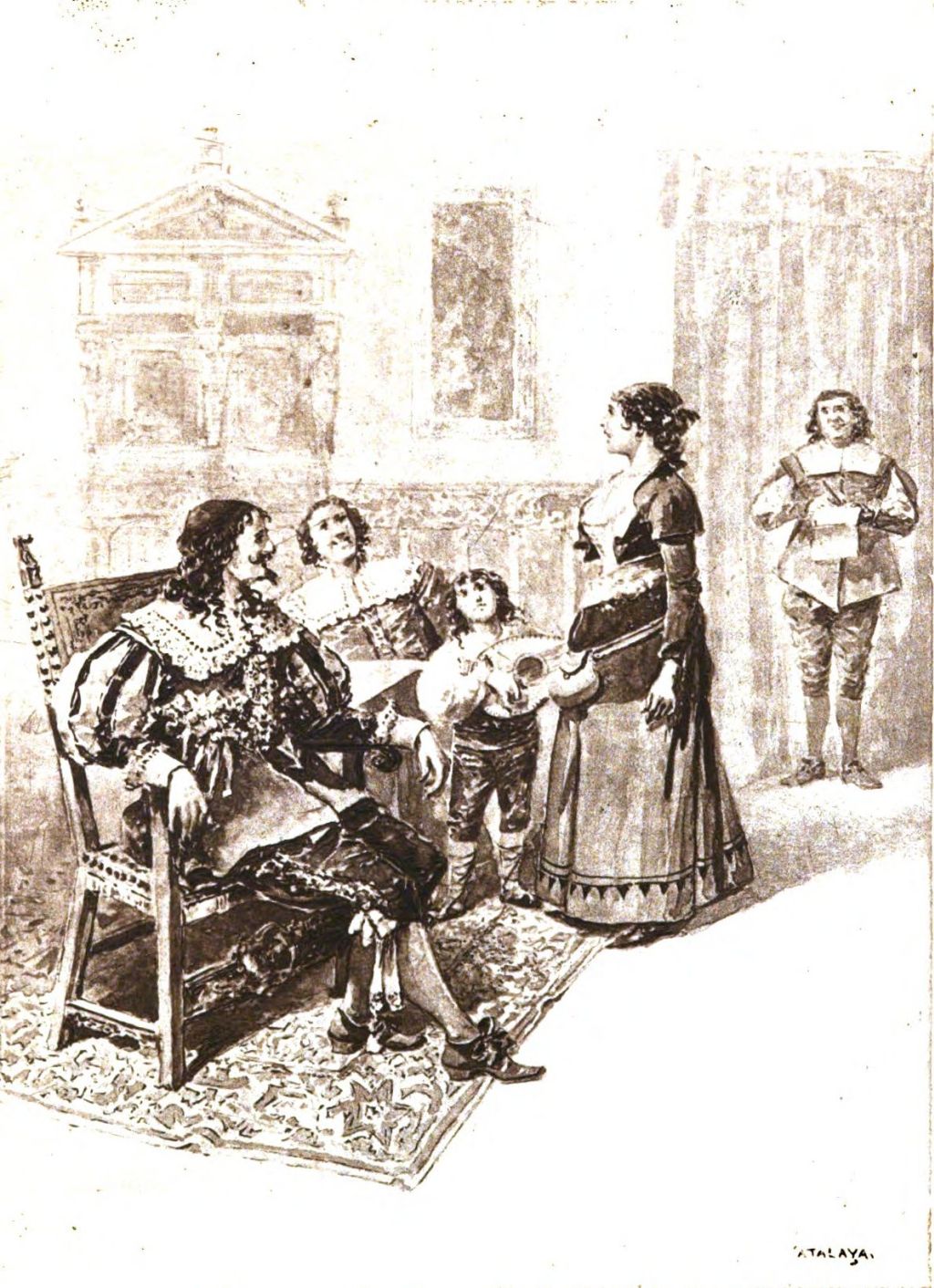
MERCEDES AND MARIO ENTERTAIN THE MARQUIS.
Mercedes sang better and better as they encouraged her, and Mario played her accompaniments very well.
Mercedes sang better and better as they encouraged her, and Mario played her accompaniments very well.
He was so fascinating with his long guitar, his wise expression, his lips half-parted and his beautiful hair falling in waves over his shoulders, that one could never weary of looking at him. His costume, which consisted of a coarse white shirt, and brown woollen knee-breeches, with a red girdle and gray stockings with strips of red cloth wound around the legs, heightened the grace of his movements and the elegance of his shapely figure.
He received with joyous bewilderment the toys which were brought from the garret, and the marquis was gratified to see that, after an admiring scrutiny of all those marvellous things, he arranged them in a corner with a sort of respect.
The fact was that they did not appeal to him very strongly, and that, when his surprise had passed, his thoughts returned to Fleurial, who was alive, playful and affectionate, and would have followed him in his wandering life, whereas the possession of horses, cannon and citadels was only the dream of an instant in that life of want and constant motion.
The rest of the day passed with no new outbreak on the part of Monsieur d'Alvimar.
He saw Monsieur Poulain again and told him that he had decided to lay siege to the fair Lauriane.
At supper he did his best to avoid having in the person of the marquis an enemy or an obstacle in his intercourse with her, and he succeeded in creating a favorable impression. He did not encounter the Moor or the child, nor did he hear them mentioned, and he retired early to muse upon his projects.
The marquis's whole retinue was overjoyed to keep Mario a few days; so Adamas announced. He had covers laid for the child and his mother at the second table, at which he himself ate, in the capacity of valet de chambre, with Master Jovelin, whom Bois-Doré purposely treated as an inferior, and with Bellinde the housekeeper and Clindor the page.
The coachman and other servants ate at different hours and in a different place. Theirs was the third table.
There was a fourth for the farm hands, wayfarers, poor travellers and mendicant monks; so that, from dawn until dark, that is to say, until eight or nine o'clock at night, eating was in progress at the château of Briantes, and some chimney was always pouring forth a rich, greasy smoke, which attracted swarms of urchins and beggars from a long way off. They always received a bountiful supply of broken food at the main gate, and laid the fifth table on the turf along the avenue, or on the banks of the ditches.
Despite this generous hospitality and this numerous retinue, which did not correspond with the narrow proportions of the château itself, the marquis's income met all demands, and he always had money to spare for his innocent whims.
He lost very little by peculation, although he kept no accounts; as Adamas and Bellinde detested each other, they watched each other closely, and although Bellinde was not the woman to abstain altogether from plunder, the fear of arousing suspicion made her prudent and necessarily moderate in the matter of profit. Being handsomely paid, and always magnificently dressed at the expense of the châtelain, who did not choose to see rags or dirt about him, she certainly had no excuse for malversation; but she complained none the less, being one of those who cherish a stolen sou and disdain an honestly acquired louis.
As for Adamas, if he was not the soul of probity in all his relations—for he had fought in the civil wars and had acquired the manners of the partisan troops,—he was so devoted to his master, that if, in the eminent post of confidential servant which he had attained, he had dared to pillage other people and hold them to ransom, it would have been solely to enrich the manor of Briantes.
Clindor made common cause with him against Bellinde, who hated him and treated him like a dog dressed in boy's clothes.
He was an honest little fellow, half clever, half stupid, uncertain as yet whether he should pose as a man of the third estate, a title which was assuming more real importance every day, or should assume the airs of a future gentleman, a species of vanity which was to keep the third estate for a long time to come in an equivocal attitude and cause it to play the rôle of dupe between factions, despite its intellectual superiority.
The secret of the Moorish woman's nationality was not divulged. In order not to expose her to the suspicious intolerance of Bellinde, who made a great show of piety, Adamas represented her as a Spaniard pure and simple.
Not a word of her story or of Mario's transpired.
"Monsieur le marquis," said Adamas to his master as he undressed him, "we are children and know nothing at all of the artifices of the toilet. This Moor, with whom I have been talking upon serious subjects, has taught me more in an hour than all your Parisian artists know. She has the most valuable secrets about all sorts of things, and knows how to extract miraculous juices from plants."
"Very good, very good, Adamas! Talk about something else. Recite some verses to me as you shave me; for I feel depressed, and I might truly say with Monsieur d'Urfé, speaking of Astrée, that the effervescence of my ennui disturbs the repose of my stomach and the breath of my life."
"Numes célestes! monsieur," cried the faithful Adamas, who loved to use his master's favorite expressions; "so you are still thinking of your brother?"
"Alas! his memory came back to me yesterday, I don't know why. There are such days in every man's life, you know, when a slumbering sorrow wakes. It is like the wounds one brings back from the war. Let me tell you something of which that orphan's pretty ways made me think just now. It is that I am growing old, my poor Adamas!"
"Monsieur is jesting!"
"No, we are growing old, my friend, and my name will die with me. I have a few distant cousins, to be sure, for whom I care but little, and who will perpetuate my father's name, if they can; but I shall be the first and last of the Bois-Dorés, and my marquisate will descend to no one, being entirely honorary and determinable at the king's pleasure."
"I have often thought about it, and I regret that monsieur has always been too active to consent to put an end to his bachelor life and marry some beautiful nymph of this neighborhood."
"To be sure, I have done wrong not to think of it. I have roamed too much from fair to fair, and although I never met Monsieur d'Urfé, I would stake my life that, having heard of me somewhere, he intended to describe me under the features of Hylas the shepherd."
"And suppose it were so? That shepherd is a very amiable man, exceedingly clever, and the most entertaining, in my opinion, of all the heroes of the book."
"True; but he is young, and I tell you again that I am beginning not to be young any more and to regret very bitterly my having no family. Do you know that I have had the idea of adopting a child, or have been conscious of a longing to do so, at least a score of times?"
"I know it, monsieur; whenever you see a pretty, attractive little baby, that idea comes back to you. Well, what prevents you?"
"The difficulty of finding one with an attractive face and a good disposition, who has no parents likely to take him away from me when I have brought him up; for to dote on a child just to have him taken from you at the age of twenty or twenty-five——"
"But the interval, monsieur."
"Oh! time flies so fast! one is not conscious of its flight! You know that I once thought of taking some young poor relation into my house; but my family are all old Leaguers, and their children are ugly, or obstreperous, or dirty."
"It is certain, monsieur, that the younger branch of the Bourons is not attractive. You appropriated the stature, all the charm and all the gallantry of the family, and no one but yourself can give you an heir worthy of you."
"Myself!" said Bois-Doré, slightly dazed by this declaration.
"Yes, monsieur, I am speaking seriously. Since you are tired of your liberty; since I hear you say, for the tenth time, that you mean to settle down——"
"Why, Adamas, you speak of me as if I were an old rake! It seems to me that, since our Henri's sad death, I have lived as becomes a man overwhelmed by grief, and a resident nobleman in duty bound to set a good example."
"Certainly, certainly, monsieur, you can say all that you please to me on that subject It is my duty not to contradict you. You are not obliged to tell me of your delightful adventures in the châteaux or groves of the neighborhood, eh, monsieur? That is nobody's business but yours. A faithful servant ought not to spy upon his master, and I do not think that I have ever asked monsieur any indiscreet questions."
"I do justice to your delicacy, my dear Adamas," replied Bois-Doré, at once embarrassed, disturbed and flattered by the chimerical suppositions of his idolatrous valet. "Let us talk of something else," he added, afraid to dwell upon so delicate a subject, and trying to believe that Adamas knew of adventures of his of which he had no knowledge himself.
The marquis did not boast openly. He was too well bred to tell of the love-affairs he had had and to invent others that he had never had. But he was delighted that he should still be accredited with them, and provided that no particular woman was compromised, he did not contradict those who said that he was favored of all women. His friends connived at his modest conceit, and it was the great delight of the younger men, of Guillaume d'Ars in particular, to tease him on that point, knowing how agreeable such teasing was to him.
But Adamas was not so ceremonious. He was not very much of a Gascon on his own account; having blended his personality with the radiations from his master's, he was a Gascon for him and in his place.
So he continued the discussion with much self-possession, declaring that monsieur was quite right to think of marrying. It was a subject which was often renewed between them, and of which neither of them wearied, although it had never had any other result in thirty years than this reflection from Bois-Doré:
"To be sure! to be sure! but I am so peaceful and so happy thus! There is no hurry, we will talk about it again."
This time, however, he seemed to listen to Adamas's boasting on his account with more attention than usual.
"If I thought that there was no danger of my marrying a barren woman," he said to his confidant, "I would marry, on my word! Perhaps I should do well to marry a widow with children?"
"Fie! monsieur," cried Adamas, "do not think of such a thing. Take some young and lovely demoiselle, who will give you children after your own image."
"Adamas!" said the marquis, after a moment's hesitation, "I have some doubt whether heaven will send me that blessing. But you suggest an attractive thought, which is to marry a woman so young that I can imagine that she is my daughter and love her as if I were her father. What do you say to that?"
"I say, that if she is young, very young, monsieur can at need imagine that he has adopted a child. And if that is monsieur's idea, there is no need to go very far; the little lady of La Motte-Seuilly is exactly suited to monsieur's wants. She is beautiful, she is good, she is virtuous, she is merry; those qualities are what we need to brighten up our manor-house, and I am very sure that her father has thought of it more than once."
"Do you think so, Adamas?"
"To be sure! and so has she! Do you suppose that, when they come here, she draws no comparison between her old château and yours, which is a fairy palace? Do you suppose, that, for all she is so young and innocent, she has never discovered what sort of man you are compared with all the other suitors whom she has ever seen?"
Bois-Doré fell asleep thinking of the absence of suitors about the fair Lauriane, of the enmity that the neighbors bore the rough and outspoken De Beuvre, and of the annoyance which De Beuvre felt on account of that state of things, temporary doubtless, but of which he exaggerated the possible duration.
The marquis persuaded himself that his proposal would be hailed as one of fortune's greatest boons.
The religious question would adjust itself as between them. In any event, if Lauriane should reproach him for having abjured Calvinism, he saw no objection to embracing it a second time.
His self-conceit did not permit him to consider the possibility of an objection based upon his age. Adamas had the gift of dispelling that unpleasant memory every night by his flatteries.
Honest Sylvain therefore fell asleep on that evening more absurd than ever; but whoever could have read in his heart the purely paternal feeling that guided his course, the boundless philosophical tolerance with which he looked forward to the possibility of being made a cuckold, and the projects of indulgence, of submission and absolute devotion which he formed with regard to his youthful helpmeet, would certainly have forgiven him, even while laughing at him.
When Adamas went into his own room, it seemed to him that he heard the rustling of a dress in the secret stairway. He rushed into the passage as quickly as possible, but failed to catch Bellinde, who had time to disappear, after overhearing, as she had often done before, all the conversation between the two old fellows.
Adamas knew her to be quite capable of playing the spy. But he concluded that he was mistaken, and barricaded all the doors when there was nothing to be heard save the loud snoring of the marquis and the muffled yelping of little Fleurial, who lay at the foot of the bed dreaming of a certain black cat, which was to him what Bellinde was to Adamas.
XIX
They arrived at La Motte-Seuilly about nine o'clock the next morning. The reader has not forgotten that in those days dinner was served at ten in the morning, supper at six in the evening.
On this occasion our marquis, who was fully determined to open his matrimonial projects, had deemed it best to use some lighter and less cumbersome means of locomotion than his magnificent lumbering chariot.
He had mounted, not without a mighty effort, his pretty Andalusian steed, called Rosidor—another name from Astrée,—an excellent beast with an easy gait and placid disposition, a little mischievous, as it was fitting that he should be in order to give his rider a chance to shine—that is to say, ready at the slightest sign with leg or hand, to roll his eyes savagely, curvet, dilate his nostrils like a wicked devil, rear to a respectable height, and, in a word, assume the airs of a bad-tempered brute.
"For all that, the best fellow in the world."
As he dismounted, the marquis ordered Clindor to lead his horse around the courtyard for a quarter of an hour, on the pretext that he was too warm to be taken to the stable at once, but in reality so that his hosts might know that he still rode that restive palfrey.
Before he entered Lauriane's presence, honest Sylvain went to the room set aside for him in his neighbor's house, to readjust his clothes, and perfume and beautify himself in the jauntiest and most refined manner.
On his side Monsieur Sciarra d'Alvimar, dressed in black velvet and satin, after the Spanish fashion, with hair cut short and a ruff of rich lace, had only to change his boots for silk hose and shoes bedecked with ribbons, to show himself at his best.
Although his sedate costume, then considered old-fashioned in France, was better suited to Bois-Doré's age than his own, it gave him an indefinable air of a diplomat and a priest at once, which emphasized the more strongly his extraordinarily well-preserved youth and the self-assured refinement of his person.
It seemed that old De Beuvre had anticipated a day of offers of marriage; for he had made himself less like a Huguenot, that is to say less austere in his dress than usual, and, deeming his daughter's dress too simple, he had urged her to don a handsomer one. So she made herself as fine as the widow's weeds, which she was in duty bound to wear until she married again, would permit. In those days custom was not to be trifled with.
She arrayed herself in white taffeta, with a raised skirt over an underskirt of grayish white, called rye bread color. She put on a lace neckband and wristbands, and as the widow's hood—Mary Stuart's little cap—relieved her from the necessity of conforming to the fashion of wearing the ugly powdered wigs which were then in vogue, she was able to show her lovely fair hair brushed back in a wavy mass which left her beautiful forehead bare and framed her finely-veined temples.
In order not to seem too provincial, she sprinkled her hair with Cyprus powder, which made her more than ever like a child. Although the two suitors had severally determined to be agreeable, they were somewhat embarrassed during the dinner, as if they had conceived some suspicion that they were rivals.
Indeed, Bellinde had repeated to Monsieur Poulain's housekeeper the conversation she had overheard. The housekeeper had told the rector, who had put D'Alvimar on his guard by a note thus conceived:
"You have, in the person of your host, a rival with whom you can amuse yourself; make the most of the opportunity."
D'Alvimar laughed in his sleeve at the idea of rivalry from such a quarter; his plan was to attack the young lady's heart at once. Little he cared for her father's approval. He thought that, if he were once in control of Lauriane's feelings, there would be no difficulty about the rest.
Bois-Doré reasoned differently. He could not doubt the esteem and attachment of both father and daughter for him. He did not hope to take her imagination by surprise and turn her head; he would have liked to be alone with them, to set forth in simple terms his advantages in the way of rank and wealth; after which he hoped, by humble attentions, to make his purpose manifest ingeniously and honorably. In short, he determined to act the part of a well-bred youth of good family, while his rival preferred to carry the place by storm like a hero of romance.
De Beuvre, who saw that D'Alvimar was becoming sentimental, vexed his old friend sorely by leading him away along the little stream, to ask him numerous questions touching his guest's rank and fortune; to which Bois-Doré could make no other reply than that Monsieur d'Ars had recommended him to him as a man of quality to whom he was much attached.
"Guillaume is young," said Monsieur de Beuvre; "but he realizes too well what he owes us to introduce to us a man unworthy of a cordial reception at our hands. Still, I am surprised that he told you nothing more; but Monsieur de Villareal must have confided to you his motive in coming hither. How does it happen that he did not accompany Guillaume to the fêtes at Bourges?"
Bois-Doré could not answer that question; but in his inmost heart De Beuvre was convinced that this mystery concealed no other design than that of paying court to his daughter.
"He must have seen her somewhere, when she did not notice him," he said to himself; "and although he seems a very earnest Catholic, he also seems very much in love with her."
He said to himself further that, in the then state of affairs, a Catholic Spanish son-in-law might restore the fortunes of his house and repair the wrong he had done his daughter by joining the ranks of the Reformers.
If for no other reason than to give the lie to the Jesuits, who had threatened him, he would have been glad to learn that the Spaniard was of sufficiently good family to pretend to the hand of Lauriane, even if he were only moderately wealthy.
Monsieur de Beuvre reasoned like a sceptic. He did not talk so loudly of Montaigne's Essays, as Bois-Doré did of Astrée, but he fed his mind upon them assiduously, and he read no other book.
Bois-Doré, being more straightforward in his politics than his neighbor, would not have reasoned as he did if he had been a father. He was no more attached than he to religion; but of the beliefs of the olden time, he had never laid aside the love of country, and the spirit of the League would never have induced him to trifle with it.
He did not suspect the thoughts of his friend, absorbed as he was by his own, and during a quarter of an hour, as if playing at cross purposes, they discussed, without understanding each other, the urgent need of a good marriage for Lauriane.
At last light was thrown upon the discussion.
"You!" cried De Beuvre in stupefaction, when the marquis had declared himself. "Bless my soul! who the devil could have expected that? I imagined that you were talking in veiled words about your Spaniard, and it seems that you mean yourself! Look you! neighbor, are you in your right mind, and don't you mistake yourself for your grandson?"
Bois-Doré gnawed his moustache; but, being accustomed to his friend's jesting, he soon recovered himself, and strove to persuade him that people were mistaken about his age, and that he was not so old as his own father was when he remarried, at the age of sixty, with most successful results.
While he was wasting time thus, D'Alvimar was striving to make the most of it.
He had succeeded in bringing Madame de Beuvre to a halt under the great yew, whose branches, drooping to the ground, formed a sort of apartment of dark verdure, where one was entirely isolated in the middle of the garden.
He began awkwardly enough with extravagant compliments.
Lauriane was not on her guard against the poison of praise; she knew little of the refined manners of young men of quality, and was not able to distinguish the false from the true; but, luckily for her, her heart had not yet felt the tedium of solitude, and she was much more of a child than she seemed to be. She considered D'Alvimar's hyperbolical language highly amusing, and laughed at his gallantry with a heartiness that disconcerted him.
He saw that his fine phrases had no luck, so strove to talk of love in a more natural vein. Perhaps he would have succeeded and would have sown confusion in that young heart; but Lucilio suddenly appeared, as if sent by Providence, to interrupt this dangerous interview with the sweet notes of his sourdeline.
He had been averse to coming with Bois-Doré, knowing that he would be made to dine in the servants' quarters and would not see Lauriane before noon.
Lauriane, as well as her father, was acquainted with the tragic story of Bruno's disciple, and, following Bois-Doré's example, they ostentatiously treated him at La Motte-Seuilly as a musician simply, fearing to compromise him, although they really entertained for him the high esteem that he deserved.
Lucilio was the only one who had not thought of making a toilet for the occasion. He had no hope of attracting attention; indeed, he had no desire to draw any eye upon himself, knowing that the mysterious intercourse of minds was the most to which he could aspire.
So he approached the yew without useless timidity or pretended caution; and, relying upon the beauty and sincerity of what he had to say in music, he began to play, to the great displeasure and vexation of D'Alvimar.
Lauriane, too, was annoyed for a moment by the interruption, but she reproached herself when she read on the bagpiper's beautiful face an ingenuous purpose to gratify her.
"I do not know why it is," she thought, "that there seems to be on that face a sort of radiance of genuine affection and of a healthy conscience, which I do not find on the other's face."
And she glanced once more at D'Alvimar, now thoroughly irritated, morose and overbearing, and felt something like a shiver of fear—perhaps of him, perhaps of herself.
Again, whether because she was very sensitive to music, or because her emotions were keyed up to a high pitch, she fancied that she could hear in her brain the words of the beautiful airs Lucilio was playing to her, and those imaginary words were:
"See the bright sun shining in the clear sky, and the swift streams receiving its rays on their changing surfaces!
"See the beautiful trees bent in black arches against the pale golden background of the meadows, and the meadows themselves, as cheery and bright as in the springtime, under the embroidery of the pink flowers of autumn; and the graceful swan, that seems to paddle rhythmically at your feet; and the migratory birds flying across yonder multicolored clouds.
"All these are the music that I sing to thee: youth, purity, faith, love and happiness.
"Listen not to the strange voice which thou dost not understand. It is soft but deceptive. It would extinguish the sun over your head; it would dry up the water under your feet; it would wither the flowers in the fields and shatter the wings of the birds among the clouds; it would cause cold, fear and death to descend upon thee, and would exhaust forever the source of the divine harmonies I sing to thee."
Lauriane no longer saw D'Alvimar. Lost in a delicious reverie, she did not see Lucilio. She was transported into the past, and, thinking of Charlotte d'Albret, she said to herself:
"No, no, I will never listen to the voice of the demon!—My friend," she said aloud, rising, when the musician stopped, "you have done me an immense amount of good, and I thank you. I have nothing to give you which can pay for the noble thoughts which you are able to suggest to us; that is why I beg you to accept these fragrant violets, which are the emblem of your modesty."
She had refused to give D'Alvimar the violets, and she ostentatiously gave them to the poor musician, before his face.
D'Alvimar smiled triumphantly, thinking that she meant to incite him by a challenge more stimulating than an avowal. But such was not Lauriane's thought, for, making a pretence of fastening the flowers in Lucilio's hat, she said to him under her breath:
"Master Giovellino, I ask you to be a father to me, and not to stir from my side until I tell you to."
Thanks to his keen Italian penetration, Lucilio grasped her meaning.
"Yes, yes, I understand, rely on me!" his expressive eyes replied.
And he seated himself on the huge roots of the yew, at a respectful distance, like a servant awaiting such orders as may be given him, but near enough to make it impossible for D'Alvimar to say a word which he did not hear.
D'Alvimar divined the whole plan. She was afraid of him; that was still better! He held the bagpiper in such utter contempt that he began anew to pay court to his hostess before him as if he were a log of wood.
But his dangerous magnetism lost all its virtue.
It seemed to Lauriane that the presence of a calm, virtuous man like Lucilio was an antidote. She would have blushed to display any vanity before him. She felt that his eyes were upon her, and that feeling was a protection. She saw that the Spaniard was piqued, and was gradually growing angry. She tried her strength by resisting him.
He wanted her to dismiss that interloper, and he told her so, designedly, in a tone loud enough to be overheard by him.
Lauriane flatly refused, saying that she desired more music.
Lucilio at once began to inflate his bagpipe.
D'Alvimar put his hand to his breast, drew a very sharp Spanish knife, and, having removed it from its sheath, began to play with it as if to keep himself in countenance; sometimes pretending to write with the point on the old yew, sometimes to hurl it at something as if to show his dexterity.
Lauriane did not understand his threat.
Lucilio was impassive, and yet he was too much of an Italian not to be familiar with the cold-blooded anger of a Spaniard, and with the possible destination of a stiletto apparently thrown at random.
Under any other circumstances he would have been anxious concerning his instrument, which D'Alvimar's eye seemed to be watching, as if for a chance to pierce it. But he was complying with Lauriane's wish; he was fighting in behalf of innocence, as Orpheus fought for love with his triumphant lyre; and he courageously attacked one of the Moorish airs which he had heard and written down the day before.
D'Alvimar felt that he was defied, and the fire of wrath that was smouldering within him began to burn him.
Being as dexterous as a Chinaman in throwing the knife, he determined to frighten the impertinent minstrel, and began to make the gleaming blade fly all around him, drawing nearer and nearer as he proceeded with his soft and plaintive song. Lauriane had walked away a few steps, and at that moment her back was turned to that horrible scene.
"I have defied tortures and death," said Giovellino to himself. "I will defy them again, and this Spaniard shall not have the pleasure of seeing me turn pale."
He turned his eyes in another direction and played as carefully and accurately as if he were at Bois-Doré's table.
Meanwhile D'Alvimar, moving hither and thither, amused himself by standing in front of him and aiming at him, as if he were tempted to take him for a target; and by virtue of one of those inexplicable fascinations which are as it were the punishment of cruel jests, he began really to feel that horrible temptation.
The cold perspiration stood out on his body and a film passed over his eyes.
Lucilio felt it rather than saw it; but he chose to risk everything rather than show a moment's fear in the face of the enemy of his native land, who likewise cast contempt upon his manly dignity.
XX
While this terrible game was in progress, a strange spectator was looking on within two steps of the heedless Lauriane; it was the young wolf brought up in the kennels, who had adopted the habits and manners of a dog, but not his instincts and nature. He fawned upon everybody but was attached to nobody.
Lying at Lucilio's feet, he had watched the Spaniard's cruel game with evident uneasiness, and, the dagger having fallen close beside him several times, he had risen and sought shelter behind the tree, thinking of nothing but his own safety.
However, as the game continued, the animal, who was just beginning to feel his teeth, showed them several times in silence, and, considering that he was attacked, felt for the first time in his life the instinct of hatred of man.
With his eye on fire, muscles tense, hair erect and quivering, he was concealed from D'Alvimar by the colossal trunk of the yew, where he watched for a favorable moment, and suddenly sprang out and tried to seize him by the throat.
He would have wounded him at least, if he had not strangled him, had he not been thrown back by a vigorous kick from Lucilio, which sent him rolling over and over along the ground.
The sudden interruption of the music, and the plaintive sound made by the bagpipe as the artist dropped it, caused Lauriane to turn hastily. Entirely ignorant of what was taking place, she ran up in time to see D'Alvimar, frantic with rage, disemboweling the beast with his knife.
He performed that act of reprisal with all the heat of revenge. It was easy to read on his pale face and in his bloodshot eye the profound and incomprehensible joy that he felt in having something to murder.
Thrice he buried the blade in the throbbing entrails, and at the sight of blood his lips contracted with an expression of voluptuous pleasure, while Lauriane, trembling from head to foot, pressed Lucilio's arms with both hands, saying in a low voice:
"Look! look! Cæsar Borgia! it is he in person!"
Lucilio, who had often seen at Rome the portrait painted by Raphael, was even better able to appreciate the resemblance, and nodded his head to indicate that he was deeply impressed by it.
"How now, monsieur?" said the young woman, deeply moved, to the triumphant Spaniard; "do you think that you are in the heart of the forest, and do you expect to make yourself agreeable to me by presenting me with the head or the claws of a creature that I have fed with my own hands, and that I was caressing before you a moment ago? For shame! you are not civil; and with that bloody knife in your hand, you look more like a butcher than a gentleman!"
Lauriane was angry; she had no other feeling now for the stranger than one of aversion.
He, as if emerging from a dream, apologized, saying that the wolf had tried to devour him; that such creatures were bad company in a house, and that he was very glad to have rescued madame from an accident which might as well have happened to her as to him.
"Do you mean that he attacked you?" she said, and glanced at Lucilio, who nodded assent.—"Did he bite you?" she added; "where is the wound?"
And as D'Alvimar had not even a scratch, she was indignant that he had manifested fear of a beast that was so young and so far from dangerous.
"The word fear is not very fair to me," he replied in a sort of frenzy; "I did not suppose that it could be thrown at one who still holds the instrument of death in his hands."
"How proud you are of having killed that young wolf! A child could have done it, and it would have been pardonable in a child, but not in a man, who could easily have got rid of him with a blow of a whip. I tell you, messire, you were terribly frightened, and fright is the disease of those who love to shed blood."
"I see," said the Spaniard, suddenly downcast, "that I am in disgrace with you, and I recognize in this, as in everything else, the effect of my ill luck. It is so persistent that there have been many times when I have thought of yielding to it as victor in a battle in which I find naught save discomfort and discomfiture."
There was much truth in what D'Alvimar had said; and as, after he had instinctively wiped his dagger, he seemed to hesitate to replace it in its sheath, Lauriane, impressed by the sinister gleam in his eye, concluded that he was a little mad, as the result of some great misfortune, and inclined to take his own life.
"If I am to forgive you," she said, "I demand that you hand me the weapon of which you have just made such an unworthy use. I do not like that treacherous blade, which French gentlemen no longer carry, except when hunting. The sword is enough for a true knight, and one should take time for reflection before unsheathing it in a lady's presence. I should always be afraid of a man who conceals about his person a weapon so easy to handle and so prompt to kill; and as this one does not seem to be of great value, I ask you to sacrifice it to me, by way of reparation for the pain you have caused me."
D'Alvimar thought that in thus disarming him she intended to caress him. Nevertheless, it cost him a pang to part with so trusty a weapon, and he hesitated.
"I see," said Lauriane, "that it is a gift from some fair dame whom you are not at liberty to disobey."
"If you have any such thought as that," he retorted, "I will very quickly disabuse you of it."
And, kneeling on one knee, he handed her the poniard.
"It is well," she said, withdrawing her hand, which he tried to kiss. "I forgive you, as a guest whom I do not desire to humiliate; but that is all, I assure you; and as for this wretched blade, if I keep it, I do so not for love of you, but to prevent the evil that it might do."
They were then at the foot of the donjon, where they met the marquis and Monsieur de Beuvre, engaged in earnest conversation.
Lauriane was about to tell them what had happened, but her father did not give her time.
"Look you, my dearest daughter," he said, taking her hand and putting it through the marquis's arm; "our friend wishes to tell you a secret, and while he is telling it, I will do my best to entertain Monsieur de Villareal. You see," he added, addressing Monsieur de Bois-Doré, "I entrust my lamb to you without fear of your sharp teeth, and I say nothing to her to lower you in her estimation! Speak to her therefore as you choose. If you are burned, I wash my hands of it, it will be of your own seeking."
"I see," said Madame de Beuvre to the marquis, "that you have some request to make."
And as she supposed that it referred, as usual, to some hunting party on his estates, she added that, whatever it might be, she granted it beforehand.
"Beware, my child!" laughed Monsieur de Beuvre; "you don't know what you are pledging yourself to!"
"You do not frighten me," she replied; "he can speak quickly."
"Indeed! you think so! but you are sadly mistaken," rejoined Monsieur de Beuvre. "I will wager that his compliments will last more than an hour. So go, both of you, to some room where you will not be disturbed, and when you have said all you have to say, you can join us again."
The marquis was not disconcerted by this jesting. He had not reached the resolution to prefer his request without stifling some vivid apprehensions touching the marriage state, into which he had delayed entering for about forty years.
If he had decided at last, it was because he wished to make someone else rich and happy, and, having once adopted that idea, he considered it his duty not to allow himself to be turned aside from it.
No sooner had they reached the salon, therefore, than he offered his heart, his name and his fortune, after the style in vogue in Astrée, with the unbridled passion which knows nothing milder than horrible torments, sighs that rend the heart, terrors that cause a thousand deaths, hopes that take away the reason, etc.; and all this with such chaste and cold propriety that the most timid virtue could not take alarm.
When Lauriane realized that he was talking about marriage, she was as surprised as her father.
She knew that the marquis was capable of anything, and instead of laughing at him she felt sorry for him. She had a warm friendship for him, and respect for his goodness of heart and loyalty. She felt that the poor old man would lay himself open to interminable taunts, if she should set the example, and that the friendly and kindly raillery of which he had hitherto been the object, would become stinging and cruel.
"No," thought the judicious child, "it shall not be so, I will not suffer my old friend to be the laughing-stock of his servants.—My dear marquis," she said, exerting herself to speak after his style, "I have often reflected upon the possibility and the suitability of the plan which you propose to me. I had divined your noble and virtuous flame, and, if I have not reciprocated it, it is only because I am still so young that mischievous Cupid has paid no attention to me as yet. Allow me therefore to frolic yet a little while in the enchanted isle of Ignorance of Love; I can be in no haste to come forth, since I am happy in your friendship. Of all the men whom I know, you are the best and most lovable, and, when my heart speaks, it may well be that it will speak to me of you. But that is written in the book of destinies, and you must e'en give me time to question mine. If, by some fatality, it should be my destiny to be ungrateful to you, I would confess it honestly and sorrowfully, for it would be my loss and my shame; but your heart is so great and so kind that you would still be my brother and my friend despite my folly."
"That would I, I swear it!" cried Bois-Doré with ingenuous warmth.
"Very well, my loyal friend," continued Lauriane, "let us wait awhile. I ask you for a seven years' trial as the ancient custom is among knights without reproach; and do me the favor to allow this agreement to remain a secret between us two. Seven years hence, if my heart has remained insensible to love, you will renounce me; and in like manner, if I share your passion, I will tell you so without mystery. I swear to you likewise, that if, before the expiration of our agreement, I am moved, despite myself, by another's attentions, I will humbly and frankly make confession to you thereof. Of that there seems but little likelihood; yet do I seek to provide for everything, so earnestly do I desire to preserve at least your friendship, if I lose your love."
"I submit to all your conditions," replied the marquis, "and I pledge to you, adorable Lauriane, the faith of a gentleman and the fidelity of a perfect lover."
"I rely thereupon," she said, offering him her hand; "I know that you are a man of heart and an incomparable lover. And now, let us return to my father, and let me tell him of that which is agreed between us, so that our secret may be shared by him alone."
"I agree," said the marquis; "but shall we not exchange pledges?"
"What shall they be? I am willing; but let it not be a ring. Remember that, being a widow, I can wear no other ring than the gift of a second husband."
"Permit me to send you to-morrow a present worthy of you."
"No, no! that would mean admitting others to our confidence. Give me any trinket that you have about you. See, that little box of ivory and enamel that you have in your hand!"
"'Tis well! but what will you give me? I see you have the right understanding of this exchange. It must be something that we have upon us when we exchange promises."
Lauriane looked in her pockets and found there only her gloves, her handkerchief, her purse and Monsieur Sciarra's dagger. The purse came to her from her another: she gave him the dagger.
"Hide it carefully," she said, "and, so long as I allow you to keep it, hope. In like manner, if I come and ask you for it——"
"I will pierce my bosom with it!" cried the old Celadon.
"No! that is something that you will not do," said Lauriane, with the utmost seriousness, "for I should die of grief; and, moreover, you would break the promise you have given me to remain my friend whatever happens."
"That is true," said Bois-Doré, kneeling to receive the pledge. "I swear to you that I will not die, even as I swear that I will neither love nor glance at any other fair, so long as you shall not have torn from my heart the hope of winning yours."
XXI
They returned to the garden, where Monsieur de Beuvre greeted them with a bantering air. The grave and tranquil demeanor of Lauriane, the radiant and tender expression which the marquis could not dissemble, surprised him so that he could not refrain from questioning them, covertly though transparently, in D'Alvimar's presence.
But Lauriane replied that she and the marquis were in perfect accord, and D'Alvimar, unwilling to believe his ears, took that assertion for a bit of coquetry aimed at him.
Thereupon Monsieur de Beuvre's anxiety became very keen, and, leading his daughter aside, he asked her if she were speaking seriously, and if she were insane enough or ambitious enough to accept a spark born in the reign of Henri II.
Lauriane told him how she had postponed her reply and any definitive agreement for seven years.
After laughing as if he would burst, De Beuvre, when Lauriane urged him to keep her secret, had some difficulty in understanding his daughter's kindly delicacy.
He would have enjoyed making merry over the marquis's discomfiture, and he considered that to have laughed in his face would have been an excellent way to teach him a lesson.