Introductory material (continued 5)
Reading edition
“Oh, don’t trouble yourself, sir!” she interrupted him, with a smile. “My landlady, my servant, my friends have all read the description of the woman who murdered Mr. Culledon. For the past twenty-four hours I have been watched by your police, therefore I have come to you of my own accord, before they came to arrest me in my flat. I am not too soon, am I?” she asked, with that same cool indifference which was so startling, considering the subject of her conversation.
She spoke English with a scarcely perceptible foreign accent, but I quite understood what Katherine Harris had meant when she said that the lady looked “French like.” She certainly did not look English, and when I caught sight of her name on the card, which the chief had handed to Lady Molly, I put her down at once as Viennese. Miss Elizabeth Löwenthal had all the charm, the grace, the elegance, which one associates with Austrian women more than with those of any other nation.
No wonder the chief found it difficult to tell her that, as a matter of fact, the police were about to apply for a warrant that very morning for her arrest on a charge of wilful murder.
“I know—I know,” she said, seeming to divine his thoughts; “but let me tell you at once, sir, that I did not murder Mark Culledon. He treated me shamefully, and I would willingly have made a scandal just to spite him; he had become so respectable and strait-laced. But between scandal and murder there is a wide gulf. Don’t you think so, madam,” she added, turning for the first time towards Lady Molly.
“Undoubtedly,” replied my dear lady, with the same quizzical smile.
“A wide gulf which, no doubt, Miss Elizabeth Löwenthal will best be able to demonstrate to the magistrate to-morrow,” rejoined the chief, with official sternness of manner.
I thought that, for the space of a few seconds, the lady lost her self-assurance at this obvious suggestion—the bloom on her cheeks seemed to vanish, and two hard lines appeared between her fine eyes. But, frightened or not, she quickly recovered herself, and said quietly:
“Now, my dear sir, let us understand one another. I came here for that express purpose. I take it that you don’t want your police to look ridiculous any more than I want a scandal. I don’t want detectives to hang about round my flat, questioning my neighbours and my servants. They would soon find out that I did not murder Mark Culledon, of course; but the atmosphere of the police would hang round me, and I—I prefer Parma violets,” she added, raising a daintily perfumed handkerchief to her nose.
“Then you have come to make a statement?” asked the chief.
“Yes,” she replied; “I’ll tell you all I know. Mr. Culledon was engaged to marry me; then he met the daughter of an earl, and thought he would like her better as a wife than a simple Miss Löwenthal. I suppose I should be considered an undesirable match for a young man who has a highly respectable and snobbish aunt, who would leave him all her money only on the condition that he made a suitable marriage. I have a voice, and I came over to England two years ago to study English, so that I might sing in oratorio at the Albert Hall. I met Mark on the Calais-Dover boat, when he was returning from a holiday abroad. He fell in love with me, and presently he asked me to be his wife. After some demur, I accepted him; we became engaged, but he told me that our engagement must remain a secret, for he had an old aunt from whom he had great expectations, and who might not approve of his marrying a foreign girl, who was without connections and a professional singer. From that moment I mistrusted him, nor was I very astonished when gradually his affection for me seemed to cool. Soon after, he informed me, quite callously, that he had changed his mind, and was going to marry some swell English lady. I didn’t care much, but I wanted to punish him by making a scandal, you understand. I went to his house just to worry him, and finally I decided to bring an action for breach of promise against him. It would have upset him, I know; no doubt his aunt would have cut him out of her will. That is all I wanted, but I did not care enough about him to murder him.”
Somehow her tale carried conviction. We were all of us obviously impressed. The chief alone looked visibly disturbed, and I could read what was going on in his mind.
“As you say, Miss Löwenthal,” he rejoined, “the police would have found all this out within the next few hours. Once your connection with the murdered man was known to us, the record of your past and his becomes an easy one to peruse. No doubt, too,” he added insinuatingly, “our men would soon have been placed in possession of the one undisputable proof of your complete innocence with regard to that fateful afternoon spent at Mathis’ café.”
“What is that?” she queried blandly.
“An alibi.”
“You mean, where I was during the time that Mark was being murdered in a tea shop?”
“Yes,” said the chief.
“I was out for a walk,” she replied quietly.
“Shopping, perhaps?”
“No.”
“You met some one who would remember the circumstance—or your servants could say at what time you came in?”
“No,” she repeated dryly; “I met no one, for I took a brisk walk on Primrose Hill. My two servants could only say that I went out at three o’clock that afternoon and returned after five.”
There was silence in the little office for a moment or two. I could hear the scraping of the pen with which the chief was idly scribbling geometrical figures on his blotting pad.
Lady Molly was quite still. Her large, luminous eyes were fixed on the beautiful woman who had just told us her strange story, with its unaccountable sequel, its mystery which had deepened with the last phrase which she had uttered. Miss Löwenthal, I felt sure, was conscious of her peril. I am not sufficiently a psychologist to know whether it was guilt or merely fear which was distorting the handsome features now, hardening the face and causing the lips to tremble.
Lady Molly scribbled a few words on a scrap of paper, which she then passed over to the chief. Miss Löwenthal was making visible efforts to steady her nerves.
“That is all I have to tell you,” she said, in a voice which sounded dry and harsh. “I think I will go home now.”
But she did not rise from her chair, and seemed to hesitate as if fearful lest permission to go were not granted her.
To her obvious astonishment—and, I must add, to my own—the chief immediately rose and said, quite urbanely:
“I thank you very much for the helpful information which you have given me. Of course, we may rely on your presence in town for the next few days, may we not?”
She seemed greatly relieved, and all at once resumed her former charm of manner and elegance of attitude. The beautiful face was lit up by a smile.
The chief was bowing to her in quite a foreign fashion, and in spite of her visible reassurance she eyed him very intently. Then she went up to Lady Molly and held out her hand.
My dear lady took it without an instant’s hesitation. I, who knew that it was the few words hastily scribbled by Lady Molly which had dictated the chief’s conduct with regard to Miss Löwenthal, was left wondering whether the woman I loved best in all the world had been shaking hands with a murderess.
4
No doubt you will remember the sensation which was caused by the arrest of Miss Löwenthal, on a charge of having murdered Mr. Mark Culledon, by administering morphia to him in a cup of chocolate at Mathis’ café in Regent Street.
The beauty of the accused, her undeniable charm of manner, the hitherto blameless character of her life, all tended to make the public take violent sides either for or against her, and the usual budget of amateur correspondence, suggestions, recriminations and advice poured into the chief’s office in titanic proportions.
I must say that, personally, all my sympathies went out to Miss Löwenthal. As I have said before, I am no psychologist, but I had seen her in the original interview at the office, and I could not get rid of an absolutely unreasoning certitude that the beautiful Viennese singer was innocent.
The magistrate’s court was packed, as you may well imagine, on that first day of the inquiry; and, of course, sympathy with the accused went up to fever pitch when she staggered into the dock, beautiful still, despite the ravages caused by horror, anxiety, fear, in face of the deadly peril in which she stood.
The magistrate was most kind to her; her solicitor was unimpeachably assiduous; even our fellows, who had to give evidence against her, did no more than their duty, and were as lenient in their statements as possible.
Miss Löwenthal had been arrested in her flat by Danvers, accompanied by two constables. She had loudly protested her innocence all along, and did so still, pleading “Not guilty” in a firm voice.
The great points in favour of the arrest were, firstly, the undoubted motive of disappointment and revenge against a faithless sweetheart, then the total inability to prove any kind of alibi, which, under the circumstances, certainly added to the appearance of guilt.
The question of where the fatal drug was obtained was more difficult to prove. It was stated that Mr. Mark Culledon was director of several important companies, one of which carried on business as wholesale druggists.
Therefore it was argued that the accused, at different times and under some pretext or other, had obtained drugs from Mr. Culledon himself. She had admitted to having visited the deceased at his office in the City, both before and after his marriage.
Miss Löwenthal listened to all this evidence against her with a hard, set face, as she did also to Katherine Harris’s statement about her calling on Mr. Culledon at Lorbury House, but she brightened up visibly when the various attendants at Mathis’ café were placed in the box.
A very large hat belonging to the accused was shown to the witnesses, but, though the police upheld the theory that that was the headgear worn by the mysterious lady at the café on that fateful afternoon, the waitresses made distinctly contradictory statements with regard to it.
Whilst one girl swore that she recognised the very hat, another was equally positive that it was distinctly smaller than the one she recollected, and when the hat was placed on the head of Miss Löwenthal, three out of the four witnesses positively refused to identify her.
Most of these young women declared that though the accused, when wearing the big hat, looked as if she might have been the lady in question, yet there was a certain something about her which was different.
With that vagueness which is a usual and highly irritating characteristic of their class, the girls finally parried every question by refusing to swear positively either for or against the identity of Miss Löwenthal.
“There’s something that’s different about her somehow,” one of the waitresses asserted positively.
“What is it that’s different?” asked the solicitor for the accused, pressing his point.
“I can’t say,” was the perpetual, maddening reply.
Of course the poor young widow had to be dragged into the case, and here, I think, opinions and even expressions of sympathy were quite unanimous.
The whole tragedy had been inexpressibly painful to her, of course, and now it must have seemed doubly so. The scandal which had accumulated round her late husband’s name must have added the poignancy of shame to that of grief. Mark Culledon had behaved as callously to the girl whom clearly he had married from interested, family motives, as he had to the one whom he had heartlessly cast aside.
Lady Irene, however, was most moderate in her statements. There was no doubt that she had known of her husband’s previous entanglement with Miss Löwenthal, but apparently had not thought fit to make him accountable for the past. She did not know that Miss Löwenthal had threatened a breach of promise action against her husband.
Throughout her evidence she spoke with absolute calm and dignity, and looked indeed a strange contrast, in her closely fitting tailor-made costume of black serge and tiny black toque, to the more brilliant woman who stood in the dock.
The two great points in favour of the accused were, firstly, the vagueness of the witnesses who were called to identify her, and, secondly, the fact that she had undoubtedly begun proceedings for breach of promise against the deceased. Judging by the latter’s letters to her, she would have had a splendid case against him, which fact naturally dealt a severe blow to the theory as to motive for the murder.
On the whole, the magistrate felt that there was not a sufficiency of evidence against the accused to warrant his committing her for trial; he therefore discharged her, and, amid loud applause from the public, Miss Löwenthal left the court a free woman.
Now, I know that the public did loudly, and, to my mind, very justly, blame the police for that arrest, which was denounced as being as cruel as it was unjustifiable. I felt as strongly as anybody on the subject, for I knew that the prosecution had been instituted in defiance of Lady Molly’s express advice, and in distinct contradiction to the evidence which she had collected. When, therefore, the chief again asked my dear lady to renew her efforts in that mysterious case, it was small wonder that her enthusiasm did not respond to his anxiety. That she would do her duty was beyond a doubt, but she had very naturally lost her more fervent interest in the case.
The mysterious woman in the big hat was still the chief subject of leading articles in the papers, coupled with that of the ineptitude of the police who could not discover her. There were caricatures and picture post-cards in all the shop windows of a gigantic hat covering the whole figure of its wearer, only the feet, and a very long and pointed chin, protruding from beneath the enormous brim. Below was the device, “Who is she? Ask the police?”
One day—it was the second since the discharge of Miss Löwenthal—my dear lady came into my room beaming. It was the first time I had seen her smile for more than a week, and already I had guessed what it was that had cheered her.
“Good news, Mary,” she said gaily. “At last I’ve got the chief to let me have a free hand. Oh, dear! what a lot of argument it takes to extricate that man from the tangled meshes of red tape!”
“What are you going to do?” I asked.
“Prove that my theory is right as to who murdered Mark Culledon,” she replied seriously; “and as a preliminary we’ll go and ask his servants at Lorbury House a few questions.”
It was then three o’clock in the afternoon. At Lady Molly’s bidding, I dressed somewhat smartly, and together we went off in a taxi to Fitzjohn’s Avenue.
Lady Molly had written a few words on one of her cards, urgently requesting an interview with Lady Irene Culledon. This she handed over to the man-servant who opened the door at Lorbury House. A few moments later we were sitting in the cosy boudoir. The young widow, high-bred and dignified in her tight-fitting black gown, sat opposite to us, her white hands folded demurely before her, her small head, with its very close coiffure, bent in closest attention towards Lady Molly.
“I most sincerely hope, Lady Irene,” began my dear lady, in her most gentle and persuasive voice, “that you will look with all possible indulgence on my growing desire—shared, I may say, by all my superiors at Scotland Yard—to elucidate the mystery which still surrounds your late husband’s death.”
Lady Molly paused, as if waiting for encouragement to proceed. The subject must have been extremely painful to the young widow; nevertheless she responded quite gently:
“I can understand that the police wish to do their duty in the matter; as for me, I have done all, I think, that could be expected of me. I am not made of iron, and after that day in the police court——”
She checked herself, as if afraid of having betrayed more emotion than was consistent with good breeding, and concluded more calmly:
“I cannot do any more.”
“I fully appreciate your feelings in the matter,” said Lady Molly, “but you would not mind helping us—would you?—in a passive way, if you could, by some simple means, further the cause of justice.”
“What is it you want me to do?” asked Lady Irene.
“Only to allow me to ring for two of your maids and to ask them a few questions. I promise you that they shall not be of such a nature as to cause you the slightest pain.”
For a moment I thought that the young widow hesitated, then, without a word, she rose and rang the bell.
“Which of my servants did you wish to see?” she asked, turning to my dear lady as soon as the butler entered in answer to the bell.
“Your own maid and your parlour-maid, if I may,” replied Lady Molly.
Lady Irene gave the necessary orders, and we all sat expectant and silent until, a minute or two later, two girls entered the room. One wore a cap and apron, the other, in neat black dress and dainty lace collar, was obviously the lady’s maid.
“This lady,” said their mistress, addressing the two girls, “wishes to ask you a few questions. She is a representative of the police, so you had better do your best to satisfy her with your answers.”
“Oh!” rejoined Lady Molly pleasantly—choosing not to notice the tone of acerbity with which the young widow had spoken, nor the unmistakable barrier of hostility and reserve which her words had immediately raised between the young servants and the “representative of the police”—“what I am going to ask these two young ladies is neither very difficult nor very unpleasant. I merely want their kind help in a little comedy which will have to be played this evening, in order to test the accuracy of certain statements made by one of the waitresses at Mathis’ tea shop with regard to the terrible tragedy which has darkened this house. You will do that much, will you not?” she added, speaking directly to the maids.
No one can be so winning or so persuasive as my dear lady. In a moment I saw the girls’ hostility melting before the sunshine of Lady Molly’s smile.
“We’ll do what we can, ma’am,” said the maid.
“That’s a brave, good girl!” replied my lady. “You must know that the chief waitress at Mathis’ has, this very morning, identified the woman in the big hat who, we all believe, murdered your late master. Yes!” she continued, in response to a gasp of astonishment which seemed to go round the room like a wave, “the girl seems quite positive, both as regards the hat and the woman who wore it. But, of course, one cannot allow a human life to be sworn away without bringing every possible proof to bear on such a statement, and I am sure that everyone in this house will understand that we don’t want to introduce strangers more than we can help into this sad affair, which already has been bruited abroad too much.”
She paused a moment; then, as neither Lady Irene nor the maids made any comment, she continued:
“My superiors at Scotland Yard think it their duty to try and confuse the witness as much as possible in her act of identification. They desire that a certain number of ladies wearing abnormally large hats should parade before the waitress. Among them will be, of course, the one whom the girl has already identified as being the mysterious person who had tea with Mr. Culledon at Mathis’ that afternoon.
“My superiors can then satisfy themselves whether the waitress is or is not so sure of her statement that she invariably picks out again and again one particular individual amongst a number of others or not.”
“Surely,” interrupted Lady Irene, dryly, “you and your superiors do not expect my servants to help in such a farce?”
“We don’t look upon such a proceeding as a farce, Lady Irene,” rejoined Lady Molly, gently. “It is often resorted to in the interests of an accused person, and we certainly would ask the co-operation of your household.”
“I don’t see what they can do.”
But the two girls did not seem unwilling. The idea appealed to them, I felt sure; it suggested an exciting episode, and gave promise of variety in their monotonous lives.
“I am sure both these young ladies possess fine big hats,” continued Lady Molly with an encouraging smile.
“I should not allow them to wear ridiculous headgear,” retorted Lady Irene, sternly.
“I have the one your ladyship wouldn’t wear, and threw away,” interposed the young parlour-maid. “I put it together again with the scraps I found in the dusthole.”
There was just one instant of absolute silence, one of those magnetic moments when Fate seems to have dropped the spool on which she was spinning the threads of a life, and is just stooping in order to pick it up.
Lady Irene raised a black-bordered handkerchief to her lips, then said quietly:
“I don’t know what you mean, Mary. I never wear big hats.”
“No, my lady,” here interposed the lady’s maid; “but Mary means the one you ordered at Sanchia’s and only wore the once—the day you went to that concert.”
“Which day was that?” asked Lady Molly, blandly.
“Oh! I couldn’t forget that day,” ejaculated the maid; “her ladyship came home from the concert—I had undressed her, and she told me that she would never wear her big hat again—it was too heavy. That same day Mr. Culledon was murdered.”
“That hat would answer our purpose very well,” said Lady Molly, quite calmly. “Perhaps Mary will go and fetch it, and you had better go and help her put it on.”
The two girls went out of the room without another word, and there were we three women left facing one another, with that awful secret, only half-revealed, hovering in the air like an intangible spectre.
“What are you going to do, Lady Irene?” asked Lady Molly, after a moment’s pause, during which I literally could hear my own heart beating, whilst I watched the rigid figure of the widow in deep black crape, her face set and white, her eyes fixed steadily on Lady Molly.
“You can’t prove it!” she said defiantly.
“I think we can,” rejoined Lady Molly, simply; “at any rate, I mean to try. I have two of the waitresses from Mathis’ outside in a cab, and I have already spoken to the attendant who served you at Sanchia’s, an obscure milliner in a back street near Portland Road. We know that you were at great pains there to order a hat of certain dimensions and to your own minute description; it was a copy of one you had once seen Miss Löwenthal wear when you met her at your late husband’s office. We can prove that meeting, too. Then we have your maid’s testimony that you wore that same hat once, and once only, the day, presumably, that you went out to a concert—a statement which you will find it difficult to substantiate—and also the day on which your husband was murdered.”
“Bah! the public will laugh at you!” retorted Lady Irene, still defiantly. “You would not dare to formulate so monstrous a charge!”
“It will not seem monstrous when justice has
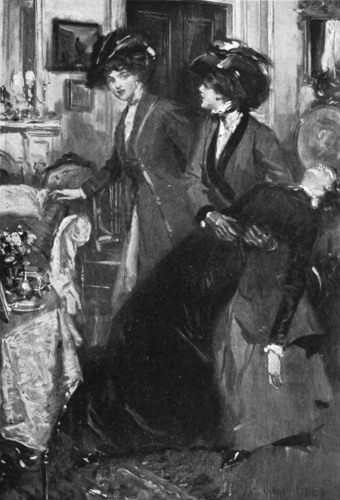
“Lady Irene, with a cry of agony, fell senseless in my dear lady’s arms”
weighed in the balance the facts which we can prove. Let me tell you a few of these, the result of careful investigation. There is the fact that you knew of Mr. Culledon’s entanglement with Miss Elizabeth Löwenthal, and did your best to keep it from old Mrs. Steinberg’s knowledge, realising that any scandal round her favourite nephew would result in the old lady cutting him—and therefore you—out of her will. You dismissed a parlour-maid for the sole reason that she had been present when Miss Löwenthal was shown into Mr. Culledon’s study. There is the fact that Mrs. Steinberg had so worded her will that, in the event of her nephew dying before her, her fortune would devolve on you; the fact that, with Miss Löwenthal’s action for breach of promise against your husband, your last hope of keeping the scandal from the old lady’s ears had effectually vanished. You saw the fortune eluding your grasp; you feared Mrs. Steinberg would alter her will. Had you found the means, and had you dared, would you not rather have killed the old lady? But discovery would have been certain. The other crime was bolder and surer. You have inherited the old lady’s millions, for she never knew of her nephew’s earlier peccadillos.
“All this we can state and prove, and the history of the hat, bought, and worn one day only, that same memorable day, and then thrown away.”
A loud laugh interrupted her—a laugh that froze my very marrow.
“There is one fact you have forgotten, my lady of Scotland Yard,” came in sharp, strident accents from the black-robed figure, which seemed to have become strangely spectral in the fast gathering gloom which had been enveloping the luxurious little boudoir. “Don’t omit to mention the fact that the accused took the law into her own hands.”
And before my dear lady and I could rush to prevent her, Lady Irene Culledon had conveyed something—we dared not think what—to her mouth.
“Find Danvers quickly, Mary!” said Lady Molly, calmly. “You’ll find him outside. Bring a doctor back with you.”
Even as she spoke Lady Irene, with a cry of agony, fell senseless in my dear lady’s arms.
The doctor, I may tell you, came too late. The unfortunate woman evidently had a good knowledge of poisons. She had been determined not to fail; in case of discovery, she was ready and able to mete out justice to herself.
I don’t think the public ever knew the real truth about the woman in the big hat. Interest in her went the way of all things. Yet my dear lady had been right from beginning to end. With unerring precision she had placed her dainty finger on the real motive and the real perpetrator of the crime—the ambitious woman who had married solely for money, and meant to have that money even at the cost of one of the most dastardly murders that have ever darkened the criminal annals of this country.
I asked Lady Molly what it was that first made her think of Lady Irene as the possible murderess. No one else for a moment had thought her guilty.
“The big hat,” replied my dear lady with a smile. “Had the mysterious woman at Mathis’ been tall, the waitresses would not, one and all, have been struck by the abnormal size of the hat. The wearer must have been petite, hence the reason that under a wide brim only the chin would be visible. I at once sought for a small woman. Our fellows did not think of that, because they are men.”
You see how simple it all was!
XI. SIR JEREMIAH’S WILL
Many people have asked me whether I knew when, and in what circumstances, Lady Molly joined the detective staff at Scotland Yard, who she was, and how she managed to keep her position in Society—as she undoubtedly did—whilst exercising a profession which usually does not make for high social standing.
Well, of course, there is much that I have known all along about my dear lady—just as much, in fact, as her aristocratic friends and relations did—but I had promised her not to let the general public know anything of her private life until she gave me leave to do so.
Now things have taken a different turn, and I can tell you all I know. But I must go back some years for that, and recall to your mind that extraordinary crime known in those days as the Baddock Will Case, which sent one of the most prominent and popular young men in Society to penal servitude—a life sentence, mind you, which was considered to be remarkably lenient by a number of people who thought that Captain de Mazareen ought to have been hanged.
He was such a good-looking young soldier in those days. I specially remember him at the late Queen’s funeral—one of the tallest men in the British army, and with that peculiar charm of manner which, alas! one has ceased to associate with young Englishmen nowadays. If to these two undeniable advantages you add the one that Hubert de Mazareen was the dearly loved grandson of Sir Jeremiah Baddock, the multi-millionaire shipowner of Liverpool, you will realise how easy it was for that young Guardsman to ingratiate himself with every woman in Society, and more particularly with every mamma who had a marriageable daughter.
But Fate and Love have a proverbial knack of making a muddle of things. Captain de Mazareen, with a bevy of pretty and eligible girls from whom to select a wife, chose to fall in love with the one woman in the whole of England who, in his grandfather’s opinion, should have remained a stranger, even an enemy, to him.
You remember the sad story—more than a quarter of a century old now—of Sir Jeremiah’s unhappy second marriage with the pretty French actress, Mlle. Adèle Desty, who was then over thirty years younger than himself. He married her abroad, and never brought her to England. She made him supremely wretched for about three years, and finally ran away with the Earl of Flintshire, whom she had met at Monte Carlo.
Well! it was with a daughter of that same Earl of Flintshire, Lady Molly Robertson-Kirk, that Captain Hubert de Mazareen fell desperately in love. Imagine Sir Jeremiah’s feelings when he heard of it.
Captain Hubert, you must know, had resigned his commission in 1902 at his grandfather’s request, when the latter’s health first began to fail. He had taken up his permanent abode at Appledore Castle, Sir Jeremiah’s magnificent home in Cumberland, and, of course, it was generally understood that ultimately he would become possessed of the wealthy shipowner’s millions as well as of the fine property, seeing that his mother had been Sir Jeremiah’s only child by the latter’s first marriage.
Lord Flintshire’s property was quite close to Appledore; but, needless to say, old Sir Jeremiah never forgave his noble neighbour the cruel wrong he had suffered at his hands.
The second Lady Baddock, afterwards Countess of Flintshire, has been dead twenty years. Neither the county nor the more exclusive sets of London ever received her, but her daughter Molly, who inherited all her beauty and none of her faults, was the idol of her father, and the acknowledged queen of county and town Society.
You see, it was the ancient, yet ever new, story of Cappelletti and Montecchi over again, and one day Captain Hubert de Mazareen had to tell Sir Jeremiah that he desired to marry the daughter of his grandfather’s most cruel enemy.
What the immediate result of that announcement was, no one could say. Neither Sir Jeremiah nor Captain Hubert de Mazareen would have allowed servants or dependents to hear a word of disagreement that might have passed between them, much less to suspect that an unpleasant scene had occurred.
Outwardly everything went on as usual at Appledore Castle for about a fortnight or so, after which Captain Hubert went away one day, ostensibly for a brief stay in London; but he never re-entered the doors of the Castle until after the dark veil of an appalling tragedy had begun to descend on the stately old Cumberland home.
Sir Jeremiah bore up pretty well for a time, then he had a slight paralytic stroke and became a confirmed invalid. The postmaster at Appledore declared that after that many letters came, addressed to Sir Jeremiah in Captain Hubert’s well-known handwriting and bearing the London postmark; but presumably the old gentleman felt bitterly irreconcilable towards his grandson, for Captain de Mazareen was never seen at the Castle.
Soon the invalid grew more and more eccentric and morose. He ordered all the reception rooms of his magnificent home to be closed and shuttered, and he dismissed all his indoor servants, with the exception of his own male attendant and an old married couple named Bradley, who had been in his service for years, and who now did the little work that was required in what had once been one of the most richly appointed country mansions in England.
Bitter resentment against his once dearly loved grandson, and against the man who had robbed him of his young wife twenty-five years ago, seemed to have cut off the old man from contact with the outside world.
Thus matters stood until the spring of 1903, when Sir Jeremiah announced one morning to the three members of his household that Mr. Philip Baddock was coming to stay at the Castle, and that a room must be got ready immediately.
Mr. Philip Baddock came that same evening. He was a young man of quite ordinary appearance: short, rather dark, with the somewhat uncouth manners suggestive of an upbringing in a country parsonage.
His arrival created no little excitement in the neighbourhood. Who was Mr. Philip Baddock, and where did he come from? No one had ever heard of him before, and now—after a very brief time spent at the Castle—he seemed to be gradually taking up the position which originally had belonged to Captain Hubert.
He took over the command of the small household, dismissing Sir Jeremiah’s personal attendant after a while and engaging another. He supervised the outdoor men, reducing the staff both in the gardens and the stables. He sold most of the horses and carriages, and presently bought a motor-car, which he at once took to driving all over the country.
But he spoke to no one in the village, and soon, in answer to inquiries by one or two of Sir Jeremiah’s faithful friends and cronies, the reply came regularly from Mr. Philip Baddock that the invalid was disinclined for company. Only Doctor Thorne, the local practitioner, saw the patient. Sir Jeremiah, it was understood, was slowly sinking towards the grave; but his mind was quite clear, even if his temper was abnormal.
One day Mr. Philip Baddock made inquiries in the village for a good chauffeur. George Taylor presented himself, and was at once told off to drive the car as quickly as possible to Carlisle, to the office of Mr. Steadman, solicitor, and to bring that gentleman back to the Castle as soon as he could come.
The distance from Appledore to Carlisle is over fifty miles. It was seven o’clock in the evening before George Taylor was back, bringing Mr. Steadman with him.
The solicitor was received at the Castle door by old Bradley, and at Sir Jeremiah’s door by Felkin, the new attendant, who showed him in. The interview between the invalid and Mr. Steadman lasted half an hour, after which the latter was driven back to Carlisle by George Taylor.
That same evening a telegram was sent off by Mr. Philip Baddock to Captain de Mazareen in London, containing the few words:
“Sir Jeremiah very ill. Come at once.”
Twenty-four hours later Captain Hubert arrived at Appledore Castle—too late, however, to see his grandfather alive.
Sir Jeremiah Baddock had died an hour before the arrival of his once so tenderly cherished grandson, and all hopes of a reconciliation had now been mercilessly annihilated by death.
The end had come much more suddenly than Doctor Thorne had anticipated. He had seen the patient in the morning and thought that he might last some days. But when Sir Jeremiah had heard that Captain de Mazareen had been sent for he had worked himself into a state of such terrible agitation that the poor, overtaxed brain and heart finally gave way.
2
The events of those memorable days—in the early spring of 1904—are so graven on my memory that I can recount them as if they happened yesterday.
I was maid to Lady Molly Robertson-Kirk at the time. Since then she has honoured me with her friendship.
Directly after Captain Hubert’s first estrangement from his grandfather, she and I came down to Cumberland and lived very quietly at Kirk Hall, which, as you know, is but a stone’s throw from Appledore.
Here Captain Hubert paid my dear lady several visits. She had irrevocably made up her mind that their engagement was to be indefinitely prolonged, for she had a vague hope that, sooner or later, Sir Jeremiah would relent towards the grandson whom he had loved so dearly. At any rate, there was a chance of it whilst the marriage had not actually taken place.
Captain de Mazareen, mind you, was in no sense of the word badly off. His father had left him some £25,000, and Lady Molly had a small private fortune of her own. Therefore I assure you that there was not a single mercenary thought behind this protracted engagement or Captain Hubert’s desire for a reconciliation with his grandfather.
The evening that he arrived at Appledore in response to Mr. Philip Baddock’s telegram, Lady Molly met him at the station. He sent his luggage on to Kirk Hall, and the two young people walked together as far as the Elkhorn Woods, which divide the Earl of Flintshire’s property from Appledore itself.
Here they met Mr. Steadman, the solicitor, who had motored over from Carlisle in response to an urgent summons from Sir Jeremiah Baddock, but whose car had broken down about two hundred yards up the road.
It seems that the chauffeur had suggested his walking on through the woods, it being an exceptionally fine and mild spring evening, with a glorious full moon overhead, which lit up almost every turn of the path that cuts through the pretty coppice.
Lady Molly had given me rendezvous at the edge of the wood, so that I might accompany her home after she had taken leave of Captain Hubert. It seems that the latter knew Mr. Steadman slightly, and we saw the two men shake hands with one another, then, after a few words of conversation, turn off to walk together through the wood. We then made our way back silently to Kirk Hall.
My dear lady was inexpressibly sad. She appreciated very deeply the love which Captain Hubert bore for his grandfather, and was loath to see the final annihilation of all her hopes of an ultimate reconciliation between the two men.
I had dressed Lady Molly for dinner, and she was just going downstairs, when Captain de Mazareen arrived at the Hall.
He announced the sad news of his grandfather’s death, and looked extremely dejected and upset.
Of course, he stayed at the Hall, for Mr. Philip Baddock seemed quite to have taken command at Appledore Castle, and Captain Hubert did not care to be beholden to him for hospitality.
My dear lady asked him what had become of Mr. Steadman.
“I don’t know,” he replied. “He started to walk with me through the wood, then he seemed to think that the tramp would be too much for him, and that the car could be put right very quickly. He preferred to drive round, and was quite sure that he would meet me at the Castle in less than half an hour. However, he never turned up.”
Lady Molly asked several more questions about Sir Jeremiah, which Captain Hubert answered in a listless way. He had been met at the door of the Castle by Mr. Philip Baddock, who told him that the old gentleman had breathed his last half an hour before.
I remember that we all went to bed that night feeling quite unaccountably depressed. It seemed that something more tragic than the natural death of a septuagenarian hovered in the air of these remote Cumberland villages.
The next morning our strange premonitions were confirmed. Lord Flintshire, my dear lady, and Captain Hubert were sitting at breakfast when the news was brought to the Hall that Mr. Steadman, the Carlisle solicitor, had been found murdered in the Elkhorn Woods earlier in the morning. Evidently he had been stunned, and then done to death by a heavily-loaded stick or some similar weapon. When he was discovered in the early hours of the morning, he had, apparently, been dead some time. The local police were at once apprised of the terrible event, which created as much excitement as the death of the eccentric old millionaire at Appledore Castle.
Everyone at Kirk Hall, of course, was keenly interested, and Captain de Mazareen went over to Appledore as soon as he could in order to place his information at the service of the police.
It is a strange fact, but nevertheless a true one, that when a deadly peril arises such as now threatened Captain de Mazareen, the person most in danger is the last to be conscious of it.
I am quite sure that Lady Molly, the moment she heard that Mr. Steadman had been murdered in the Elkhorn Woods, realised that the man she loved would be implicated in that tragedy in some sinister manner. But that is the intuition of a woman—of a woman who loves.
As for Captain Hubert, he went about during the whole of that day quite unconscious of the abyss which already was yawning at his feet. He even discussed quite equably the several valuable bits of information which the local police had already collected, and which eventually formed a portion of that damning fabric of circumstantial evidence which was to bring him within sight of the gallows.
Earlier in the day, Mr. Philip Baddock sent him a stiff little note, saying that, as Captain de Mazareen was now the owner of Appledore Castle, he (Philip Baddock) did not desire to trespass a moment longer than was necessary on his relative’s hospitality, and had arranged to stay at the village inn until after the funeral, when he would leave Cumberland.
To this Captain Hubert sent an equally curt note saying that, as far as he knew, he had no say in the matter of anyone coming or going from the Castle, and that Mr. Philip Baddock must, of course, please himself as to whether he stayed there or not.
So far, of course, the old gentleman’s testamentary dispositions were not known. He had made a will in 1902 bequeathing Appledore and everything he possessed unconditionally to his beloved grandson, Hubert de Mazareen, whom he also appointed his sole executor. That will was lodged with Mr. Truscott, who had been solicitor to the deceased practically until the last moment, when Mr. Steadman, a new arrival at Carlisle, had been sent for.
Whether that will had been revoked or not Mr. Truscott did not know; but, in the course of the afternoon, Lord Flintshire, whilst out driving, met the local superintendent of police, who told him that Mr. Steadman’s senior partner—a Mr. Fuelling—had made a statement to the effect that Sir Jeremiah had sent for Mr. Steadman the day before his death and given instructions for the drafting of a new will whereby the old gentleman bequeathed Appledore and everything he possessed to his beloved grandson, Hubert de Mazareen, but only on the condition that the latter did not marry the daughter or any other relative of the Earl of Flintshire. In the event of Hubert de Mazareen disregarding this condition at any future time of his life, Sir Jeremiah’s entire fortune was to devolve on Philip Baddock, sole issue of testator’s second marriage, with Adèle Desty. The draft of this will, added Mr. Fuelling, was in Mr. Steadman’s pocket ready for Sir Jeremiah’s signature on that fateful night when the unfortunate young solicitor was murdered.
The draft had not been found in the murdered man’s pocket. A copy of it, however, was in Mr. Fuelling’s safe. But as this will had never been signed by the deceased the one of 1902 remained valid, and Captain Hubert de Mazareen remained unconditionally his grandfather’s sole heir.
3
Events crowded thick and fast on that day—one of the most miserable I have ever lived through.
After an early tea, which my dear lady had alone in her little boudoir, she sent me down to ask Captain Hubert to come up and speak to her. He did so at once, and I went into the next room—which was Lady Molly’s bedroom—there to prepare her dress for the evening.
I had, of course, discreetly closed the door of communication between the two rooms, but after the first five minutes, Lady Molly deliberately reopened it, from which I gathered that she actually wished me to know what was going on.
It was then a little after four o’clock. I could hear Captain de Mazareen’s voice, low-toned and infinitely tender. He adored my dear lady, but he was a very quiet man, and it was only by the passionate tensity of his attitude when he was near her that a shrewdly observant person could guess how deeply he cared. Now, through the open door, I could see his handsome head bowed very low, so that he could better look into her upturned eyes. His arms were round her, as if he were fighting the world for the possession of her, and would never let her go again. But there were tears in her eyes.
“Hubert,” she said after a while, “I want you to marry me. Will you?”
“Will I?” he whispered, with an intensity of
“Philip Baddock looked defiant, and Felkin taciturn and sulky”
passionate longing which seemed to me then so unutterably pathetic that I could have sat down and had a good cry.
“But,” rejoined Lady Molly, earnestly, “I mean as soon as possible—to-morrow, by special licence. You can wire to Mr. Hurford to-night, and he will see about it the first thing in the morning. We can travel up to town by the night train. Father and Mary will come with me. Father has promised, you know, and we can be married to-morrow … I think that would be the quickest way.”
There was a pause. I could well imagine how astonished and perturbed Captain Hubert must be feeling. It was such a strange request for a woman to make at such a time. I could see by the expression of his eyes that he was trying to read her thoughts. But she looked up quite serenely at him, and, frankly, I do not think that he had the slightest inkling of the sublime motive which lay at the back of her strange insistence.
“You prefer to be married in London rather than here?” he asked quite simply.
“Yes,” she replied; “I desire to be married in London to-morrow.”
A few moments later my dear lady quietly shut the door again, and I heard and saw no more; but half an hour later she called me. She was alone in her boudoir, bravely trying to smile through a veil of tears. Captain Hubert’s footsteps could still be heard going along the hall below.
Lady Molly listened until the final echo of that tread died away in the distance; then she buried her sweet face on my shoulder and sobbed her very heart out.
“Get ready as quickly as you can, Mary,” she said to me when the paroxysm had somewhat subsided. “We go up to town by the 9.10.”
“Is his lordship coming with us, my lady?” I asked.
“Oh, yes!” she said, whilst a bright smile lit up her face. “Father is simply grand … and yet he knows.”
“Knows what, my lady?” I queried instinctively, for Lady Molly had paused, and I saw a look of acute pain once more darken her soft, grey eyes.
“My father knows,” she said, slowly and almost tonelessly, “that half an hour ago the police found a weighted stick in the Elkhorn Woods not far from the spot where Mr. Steadman was murdered. The stick has the appearance of having been very vigorously cleaned and scraped recently, in spite of which fact tiny traces of blood are still visible on the leaden knob. The inspector showed my father that stick. I saw it too. It is the property of Captain Hubert de Mazareen, and by to-morrow, at the latest, it will be identified as such.”
There was silence in the little boudoir now: a silence broken only by the sound of dull sobs which rose from my dear lady’s overburdened heart. Lady Molly at this moment had looked into the future, and with that unerring intuition which has since been of such immense service to her she had already perceived the grim web which Fate was weaving round the destiny of the man she loved.
I said nothing. What could I say? I waited for her to speak again.
The first words she uttered after the terrible pronouncement which she had just made were:
“I’ll wear my white cloth gown to-morrow, Mary. It is the most becoming frock I have, and I want to look my best on my wedding-day.”
4
Captain Hubert de Mazareen was married to Lady Molly Robertson-Kirk by special licence on April 22nd, 1904, at the Church of St. Margaret, Westminster. No one was present to witness the ceremony except the Earl of Flintshire and myself. No one was apprised of the event at the time, nor, until recently, did anyone know that Lady Molly of Scotland Yard was the wife of De Mazareen the convict.
As you know, he was arrested at Appledore railway station the following morning and charged with the wilful murder of Alexander Steadman, solicitor, of Carlisle.
Everything was against him from the first. The draft of the will which Mr. Steadman was taking up to Sir Jeremiah for signature supplied the motive for the alleged crime, and he was the last person seen in company with the murdered man.
The chauffeur, George Taylor, who had driven to Carlisle to fetch Mr. Steadman, and brought him back that evening, explained how two of his tyres burst almost simultaneously after going over a bit of broken road close to the coppice. He had suggested to Mr. Steadman the idea of walking through the wood, and, as he had not two fresh tyres with him, he started pushing his car along, as the village was not more than half a mile away. He never saw Mr. Steadman again.
The stick with which the terrible deed had been committed was the most damning piece of evidence against the accused. It had been identified as his property by more than one witness, and was found within twenty yards of the victim, obviously cleaned and scraped, but still bearing minute traces of blood. Moreover, it had actually been seen in Captain Hubert’s hand by one or two of the porters when he arrived at Appledore Station on that fatal night, was met there by Lady Molly, and subsequently walked away with her previous to meeting Mr. Steadman on the edge of the wood.
Captain de Mazareen, late of His Majesty’s Household Brigade, was indicted for the wilful murder of Alexander Steadman, tried at the next assizes, found guilty, and condemned to be hanged. The jury, however, had strongly recommended him to mercy owing to his hitherto spotless reputation, and to the many services he had rendered his country during the last Boer War. A monster petition was sent up to the Home Office, and the sentence was commuted to twenty years’ penal servitude.
That same year, Lady Molly applied for, and obtained, a small post on the detective staff of the police. From that small post she has worked her way upwards, analysing and studying, exercising her powers of intuition and of deduction, until at the present moment she is considered, by chiefs and men alike, the greatest authority among them on criminal investigation.
The Earl of Flintshire died some three years ago. Kirk Hall devolved on a distant cousin, but Lady Molly has kept a small home at Kirk ready for her husband when he comes back from Dartmoor.
The task of her life is to apply her gifts, and the obvious advantages at her disposal as a prominent member of the detective force, to prove the innocence of Captain Hubert de Mazareen, which she never doubted for a moment.
But it was sublime, and at the same time deeply pathetic, to see the frantic efforts at self-sacrifice which these two noble-hearted young people made for one another’s sake.
Directly Captain Hubert realised that, so far as proving his innocence was concerned, he was a lost man, he used every effort to release Lady Molly from the bonds of matrimony. The marriage had been, and was still, kept a profound secret. He determined to plead guilty to murder at his trial, and then to make a declaration that he had entrapped Lady Molly into a marriage, knowing at the time that a warrant was out for his arrest, and hoping, by his connection with the Earl of Flintshire, to obtain a certain amount of leniency. When he was sufficiently convinced that such a course was out of the question, he begged Lady Molly to bring a nullity suit against him. He would not defend it. He only wished to set her free.
But the love she bore him triumphed over all. They did keep their marriage a secret, but she remained faithful to him in every thought and feeling within her, and loyal to him with her whole soul. Only I—once her maid, now her devoted friend—knew what she suffered, even whilst she threw herself heart and mind into her work.
We lived mostly in our little flat in Maida Vale, but spent some delightful days of freedom and peace in the little house at Kirk. Hither—in spite of the terrible memories the place evoked—Lady Molly loved to spend her time in wandering over the ground where that mysterious crime had been committed which had doomed an innocent man to the life of a convict.
“That mystery has got to be cleared up, Mary,” she would repeat to me with unswerving loyalty, “and cleared up soon, before Captain de Mazareen loses all joy in life and all belief in me.”
5
I suspect you will be interested to hear something about Appledore Castle and about Mr. Philip Baddock, who had been so near getting an immense fortune, yet had it snatched from him before his very eyes.
As Sir Jeremiah Baddock never signed the will of 1904, Captain de Mazareen’s solicitors, on his behalf, sought to obtain probate of the former one, dated 1902. In view of the terrible circumstances connected with the proposed last testamentary dispositions of the deceased, Mr. Philip Baddock was advised to fight that suit.
It seems that he really was the son of Sir Jeremiah by the latter’s second marriage with Mlle. Desty, but the old gentleman, with heartless vengefulness, had practically repudiated the boy from the first, and absolutely refused to have anything to do with him beyond paying for his maintenance and education, and afterwards making him a goodly allowance on the express condition that Philip—soon to become a young man—never set his foot on English soil.
The condition was strictly complied with. Philip Baddock was born abroad, and lived abroad until 1903, when he suddenly appeared at Appledore Castle. Whether Sir Jeremiah, in a fit of tardy repentance, had sent for him, or whether he risked coming of his own accord, no one ever knew.
Captain de Mazareen was not, until that same year 1903, aware of the existence of Philip Baddock any more than was anybody else, and he spent his last days of freedom in stating positively that he would not accept the terms of the will of 1902, but would agree to Sir Jeremiah’s fortune being divided up as it would have been if the old gentleman had died intestate. Thus Philip Baddock, the son, and Hubert de Mazareen, the grandson, received an equal share of Sir Jeremiah’s immense wealth, estimated at close upon £2,000,000 sterling.
Appledore was put up for sale and bought in by Mr. Philip Baddock, who took up his residence there and gradually gained for himself a position in the county as one of the most wealthy magnates in the north of England. Thus he became acquainted with the present Lord Flintshire, and, later on, met my dear lady. She neither sought nor avoided his acquaintance, and even went once to a dinner party at Appledore Castle.
That was lately, on the occasion of our last stay at Kirk. I had gone up to the Castle in the brougham so that I might accompany Lady Molly home, and had been shown into the library, whither my dear lady came in order to put on her cloak.
While she was doing so Mr. Philip Baddock came in. He had a newspaper in his hand and seemed greatly agitated.
“Such extraordinary news, Lady Molly,” he said, pointing to a head-line in the paper. “You know, of course, that the other day a convict succeeded in effecting his escape from Dartmoor?”
“Yes, I knew that,” said my dear lady, quietly.
“Well, I have reason to—to suppose,” continued Mr. Baddock, “that that convict was none other than my unfortunate nephew, De Mazareen.”
“Yes?” rejoined Lady Molly, whose perfect calm and serene expression of face contrasted strangely with the obvious agitation of Philip Baddock.
“Heaven knows that he tried to do me an evil turn,” rejoined the latter after a while; “but of course I bear him no grudge, now that the law has given me that which he tried to wrench from me—a just share of my father’s possessions. Since he has thrown himself on my mercy——”
“Thrown himself on your mercy!” ejaculated my dear lady, whose face had become almost grey with a sudden fear. “What do you mean?”
“De Mazareen is in my house at the present moment,” replied Mr. Baddock, quietly.
“Here?”
“Yes. It seems that he tramped here. I am afraid that his object was to try and see you. He wants money, of course. I happened to be out in the woods this afternoon, and saw him.
“No, no!” added Philip Baddock quickly, in response to an instinctive gasp of pain from Lady Molly; “you need not have the slightest fear. My nephew is as safe with me as he would be in your own house. I brought him here, for he was exhausted with fatigue and want of food. None of my servants know of his presence in the house except Felkin, whom I can trust. By to-morrow he will have rested. … We’ll make a start in the very early morning in my car; we’ll get to Liverpool before midday. De Mazareen shall wear Felkin’s clothes—no one will know him. One of the Baddock steamers is leaving for Buenos Ayres the same afternoon, and I can arrange with the captain. You need not have the slightest fear,” he repeated, with simple yet earnest emphasis; “I pledge you my word that De Mazareen will be safe.”
“I should like to thank you,” she murmured.
“Please don’t,” he rejoined with a sad smile. “It is a great happiness to me to be able to do this. … I know that you—you cared for him at one time. … I wish you had known and trusted me in those days—but I am glad of this opportunity which enables me to tell you that, even had my father signed his last will and testament, I should have shared his fortune with De Mazareen. The man whom you honoured with your love need never have resorted to crime in order to gain a fortune.”
Philip Baddock paused. His eyes were fixed on Lady Molly with unmistakable love and an appeal for sympathy. I had no idea that he cared for her—nor had she, I am quite sure. Her heart belonged solely to the poor, fugitive convict, but she could not fail, I thought, to be touched by the other man’s obvious sincerity and earnestness.
There was silence in the room for a few moments. Only the old clock in its Sheraton case ticked on in solemn imperturbability.
Lady Molly turned her luminous eyes on the man who had just made so simple, so touching a profession of love. Was she about to tell him that she was no longer free, that she bore the name of the man whom the law had ostracised and pronounced a criminal—who had even now, by this daring attempt at escape, added a few years to his already long term of punishment and another load to his burden of shame?
“Do you think,” she asked quietly, “that I might speak to Captain de Mazareen for a few moments without endangering his safety?”
Mr. Baddock did not reply immediately. He seemed to be pondering over the request. Then he said:
“I will see that everything is safe. I don’t think there need be any danger.”
He went out of the room, and my dear lady and I were left alone for a minute or two. She was so calm and serene that I marvelled at her self-control, and wondered what was going on in her mind.
“Mary,” she said to me, speaking very quickly, for already we could hear two men’s footsteps approaching the library door, “you must station yourself just outside the front door; you understand? If you see or hear anything suspicious come and warn me at once.”
I made ready to obey, and the next moment the door opened and Mr. Philip Baddock entered, accompanied by Captain Hubert.
I smothered the involuntary sob which rose to my throat at sight of the man who had once been the most gallant, the handsomest soldier I had ever seen. I had only just time to notice that Mr. Baddock prepared to leave the room again immediately. At the door he turned back and said to Lady Molly:
“Felkin has gone down to the lodge. If he hears or sees anything that seems suspicious he will ring up on the telephone;” and he pointed to the apparatus which stood on the library table in the centre of the room.
After that he closed the door, and I was left to imagine the moments of joy, mingled with acute anguish, which my dear lady would be living through.
I walked up and down restlessly on the terrace which fronts the Castle. The house itself appeared silent and dark: I presume all the servants had gone to bed. Far away on my right I caught the glimmer of a light. It came from the lodge where Felkin was watching. From the church in Appledore village came the sound of the clock striking the hour of midnight.
How long I had been on the watch I cannot say, when suddenly I was aware of a man’s figure running rapidly along the drive towards the house. The next moment the figure had skirted the Castle, apparently making for one of the back doors.
I did not hesitate a moment. Having left the big front door on the latch, I ran straight in and made for the library door.
Already Mr. Philip Baddock had forestalled me. His hand was on the latch. Without more ado he pushed open the door and I followed him in.
Lady Molly was sitting on the sofa, with Captain Hubert beside her. They both rose at our entrance.
“The police!” said Mr. Baddock, speaking very rapidly. “Felkin has just run up from the lodge. He is getting the car ready. Pray God we may yet be able to get away.”
Even as he spoke the front door bell sounded with a loud clang, which to me had the sound of a death knell.
“It is too late, you see,” said my dear lady, quietly.
“No, not too late,” ejaculated Philip Baddock, in a rapid whisper. “Quick! De Mazareen, follow me through the hall. Felkin is at the stables getting the car ready. It will be some time before the servants are roused.”
“Mary, I am sure, has failed to fasten the front door,” interrupted Lady Molly, with the same strange calm. “I think the police are already in the hall.”
There was no mistaking the muffled sound of feet treading the thick Turkey carpet in the hall. The library had but one exit. Captain Hubert was literally in a trap. But Mr. Baddock had not lost his presence of mind.
“The police would never dream of searching my house,” he said; “they will take my word that De Mazareen is not here. Here!” he added, pointing to a tall Jacobean wardrobe which stood in an angle of the room. “In there, man, and leave the rest to me!”
“I am afraid that such a proceeding would bring useless trouble upon you, Mr. Baddock,” once more interposed Lady Molly; “the police, if they do not at once find Captain de Mazareen, will surely search the house.”
“Impossible! They would not dare!”
“Indeed they would. The police know that Captain de Mazareen is here.”
“I swear they do not,” rejoined Mr. Baddock. “Felkin is no traitor, and no one else——”
“It was I who gave information to the police,” said Lady Molly, speaking loudly and clearly. “I called up the superintendent on the telephone just now, and told him that his men would find the escaped convict hiding at Appledore Castle.”
“You!” ejaculated Mr. Baddock, in a tone of surprise and horror, not unmixed with a certain note of triumph. “You?”
“Yes!” she replied calmly. “I am of the police, you know. I had to do my duty. Open the door, Mary,” she added, turning to me.
Captain Hubert had not spoken a word so far. Now, when the men, led by Detective-Inspector Etty, entered the room, he walked with a firm step towards them, held out his hands for the irons, and with a final look at Lady Molly, in which love, trust, and hope were clearly expressed, he passed out of the room and was soon lost to sight.
My dear lady waited until the heavy footfalls had died away; then she turned with a pleasant smile to Mr. Philip Baddock:
“I thank you for your kind thoughts of me,” she said, “and for your noble efforts on behalf of your nephew. My position was a difficult one. I hope you will forgive the pain I have been obliged to bring upon you.”
“I will do more than forgive, Lady Molly,” he said earnestly, “I will venture to hope.”
He took her hand and kissed it. Then she beckoned to me and I followed her into the hall.
Our brougham—a hired one—had been waiting in the stable-yard. We drove home in silence; but half an hour later, when my dear lady kissed me good night she whispered in my ear:
“And now, Mary, we’ll prove him innocent.”
XII. THE END
One or two people knew that at one time Lady Molly Robertson-Kirk had been engaged to Captain Hubert de Mazareen, who was now convict No. 97, undergoing a life sentence for the murder of Mr. Steadman, a solicitor of Carlisle, in the Elkhorn woods in April, 1904. Few, on the other hand, knew of the secret marriage solemnised on that never-to-be-forgotten afternoon, when all of us present in the church, with the exception of the bridegroom himself, were fully aware that proofs of guilt—deadly and irrefutable—were even then being heaped up against the man to whom Lady Molly was plighting her troth, for better or for worse, with her mental eyes wide open, her unerring intuition keen to the fact that nothing but a miracle could save the man she loved from an ignoble condemnation, perhaps from the gallows.
The husband of my dear lady, the man whom she loved with all the strength of her romantic and passionate nature, was duly tried and convicted of murder. Condemned to be hanged, he was reprieved, and his sentence commuted to penal servitude for life.
The question of Sir Jeremiah’s estate became a complicated one, for his last will and testament was never signed, and the former one, dated 1902, bequeathed everything he possessed unconditionally to his beloved grandson Hubert.
After much legal argument, which it is useless to recapitulate here, it was agreed between the parties, and ratified in court, that the deceased gentleman’s vast wealth should be disposed of as if he had died intestate. One half of it, therefore, went to Captain Hubert de Mazareen, grandson, and the other half to Philip Baddock, the son. The latter bought Appledore Castle and resided there, whilst his nephew became No. 97 in Dartmoor Prison.
Captain Hubert had served two years of his sentence when he made that daring and successful escape which caused so much sensation at the time. He managed to reach Appledore, where he was discovered by Mr. Philip Baddock, who gave him food and shelter and got everything ready for the safe conveyance of his unfortunate nephew to Liverpool and thence to a port of safety in South America.
You remember how he was thwarted in this laudable attempt by Lady Molly herself, who communicated with the police and gave up convict No. 97 into the hands of the authorities once more.
Of course, public outcry was loud against my dear lady’s action. Sense of duty was all very well, so people argued, but no one could forget that at one time Captain Hubert de Mazareen and Lady Molly Robertson-Kirk had actually been engaged to be married, and it seemed positively monstrous for a woman to be so pitiless towards the man whom she must at one time have loved.
You see how little people understood my dear lady’s motives. Some went so far as to say that she had only contemplated marriage with Captain Hubert de Mazareen because he was then, presumably, the heir to Sir Jeremiah’s fortune; now—continued the gossips—she was equally ready to marry Mr. Philip Baddock, who at any rate was the happy possessor of one half of the deceased gentleman’s wealth.
Certainly Lady Molly’s conduct at this time helped to foster this idea. Finding that even the chief was inclined to give her the cold shoulder, she shut up our flat in Maida Vale and took up her residence at the little house which she owned in Kirk, and from the windows of which she had a splendid view of stately Appledore Castle nestling among the trees on the hillside.
I was with her, of course, and Mr. Philip Baddock was a frequent visitor at the house. There could be no doubt that he admired her greatly, and that she accepted his attentions with a fair amount of graciousness. The county fought shy of her. Her former engagement to Captain de Mazareen was well known, and her treachery to him—so it was called—was severely censured.
Living almost in isolation in the village, her whole soul seemed wrapped in thoughts of how to unravel the mystery of the death of Mr. Steadman. Captain de Mazareen had sworn in his defence that
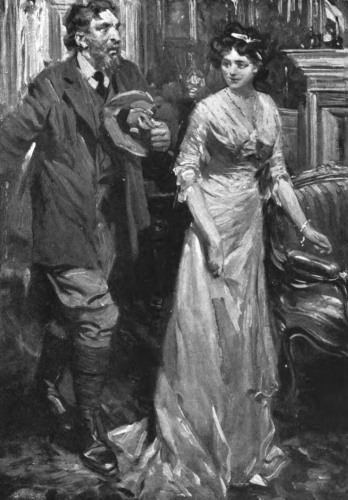
“ ‘Ask Philip Baddock if my threats are paltry’ ”
the solicitor, after starting to walk through the Elkhorn woods with him, had feared that the tramp over rough ground would be too much for him, and had almost immediately turned back in order to regain the road. But the chauffeur, George Taylor, who was busy with the broken-down car some two hundred yards up the road, never saw Mr. Steadman again, whilst Captain de Mazareen arrived at the gates of Appledore Castle alone. Here he was met by Mr. Philip Baddock, who informed him that Sir Jeremiah had breathed his last an hour before.
No one at the Castle recollected seeing a stick in Captain Hubert’s hand when he arrived, whilst there were several witnesses who swore that he carried one at Appledore Station when he started to walk with her ladyship. The stick was found close to the body of the solicitor; and the solicitor, when he met with his terrible death, had in his pocket the draft of a will which meant disinheritance to Captain de Mazareen.
Here was the awful problem which Lady Molly had to face and to solve if she persisted in believing that the man whom she loved, and whom she had married at the moment when she knew that proofs of guilt were dead against him, was indeed innocent.
2
We had spent all the morning shopping in Carlisle, and in the afternoon we called on Mr. Fuelling, of the firm of Fuelling, Steadman and Co., solicitors.
Lady Molly had some business to arrange in connection with the purchase of an additional bit of land to round off her little garden at Kirk.
Mr. Fuelling was courteous, but distinctly stiff, in his manner towards the lady who was “connected with the police,” more especially when—her business being transacted—she seemed inclined to tarry for a little while in the busy solicitor’s office, and to lead conversation round to the subject of the murder of Mr. Steadman.
“Five years have gone by since then,” said Mr. Fuelling, curtly, in response to a remark from Lady Molly, “I prefer not to revive unpleasant memories.”
“You, of course, believed Captain de Mazareen guilty?” retorted my dear lady, imperturbably.
“There were circumstances——” rejoined the solicitor, “and—and, of course, I hardly knew the unfortunate young man. Messrs. Truscott and Truscott used to be the family solicitors.”
“Yes. It seemed curious that when Sir Jeremiah wished to make his will he should have sent for you, rather than for his accustomed lawyer,” mused Lady Molly.
“Sir Jeremiah did not send for me,” replied Mr. Fuelling, with some acerbity, “he sent for my junior, Mr. Steadman.”
“Perhaps Mr. Steadman was a personal friend of his.”
“Not at all. Not at all. Mr. Steadman was a new arrival in Carlisle, and had never seen Sir Jeremiah before the day when he was sent for and, in a brief interview, drafted the will which, alas! proved to be the primary cause of my unfortunate young partner’s death.”
“You cannot draft a will in a brief interview, Mr. Fuelling,” remarked Lady Molly, lightly.
“Mr. Steadman did so,” retorted Mr. Fuelling, curtly. “Though Sir Jeremiah’s mind was as clear as crystal, he was very feeble, and the interview had to take place in a darkened room. That was the only time my young partner saw Sir Jeremiah. Twenty-four hours later they were both dead.”
“Oh!” commented my dear lady with sudden indifference. “Well! I won’t detain you, Mr. Fuelling. Good afternoon.”
A few moments later, having parted from the worthy old solicitor, we were out in the street once more.
“The darkened room is my first ray of light,” quoth Lady Molly to me, with a smile at her own paradoxical remark.
When we reached home later that afternoon we were met at the garden gate by Mr. Felkin, Mr. Philip Baddock’s friend and agent, who lived with him at Appledore Castle.
Mr. Felkin was a curious personality; very taciturn in manner but a man of considerable education. He was the son of a country parson, and at the time of his father’s death he had been studying for the medical profession. Finding himself unable to pursue his studies for lack of means, and being left entirely destitute, he had been forced to earn his living by taking up the less exalted calling of male nurse. It seems that he had met Mr. Philip Baddock on the Continent some years ago, and the two young men had somehow drifted into close acquaintanceship. When the late Sir Jeremiah required a personal nurse-attendant Mr. Philip Baddock sent for his friend and installed him at Appledore Castle.
Here Mr. Felkin remained, even after the old gentleman’s death. He was nominally called Mr. Baddock’s agent, but really did very little work. He was very fond of shooting and of riding, and spent his life in the pursuit of these sports, and he always had plenty of money to spend.
But everyone voted him a disagreeable bear, and the only one who ever succeeded in making him smile was Lady Molly, who always showed an unaccountable liking for the uncouth creature. Even now, when he extended a somewhat grimy hand and murmured a clumsy apology at his intrusion, she greeted him with warm effusiveness and insisted on his coming into the house.
We all turned to walk along the little drive, when Mr. Baddock’s car came whizzing round the corner of the road from the village. He pulled up at our gate, and the next moment had joined us in the drive.
There was a very black look in his eyes, as they wandered restlessly from my dear lady’s face to that of his friend. Lady Molly’s little hand was even then resting on Mr. Felkin’s coat-sleeve; she had been in the act of leading him herself towards the house, and did not withdraw her hand when Mr. Baddock appeared upon the scene.
“Burton has just called about those estimates, Felkin,” said the latter, somewhat roughly; “he is waiting at the Castle. You had better take the car—I can walk home later on.”
“Oh! how disappointing!” exclaimed Lady Molly, with what looked uncommonly like a pout. “I was going to have such a cosy chat with Mr. Felkin—all about horses and dogs. Couldn’t you see that tiresome Burton, Mr. Baddock?” she added ingenuously.
I don’t think that Mr. Baddock actually swore, but I am sure he was very near doing so.
“Burton can wait,” said Mr. Felkin, curtly.
“No, he cannot,” retorted Philip Baddock, whose face was a frowning mirror of uncontrolled jealousy; “take the car, Felkin, and go at once.”
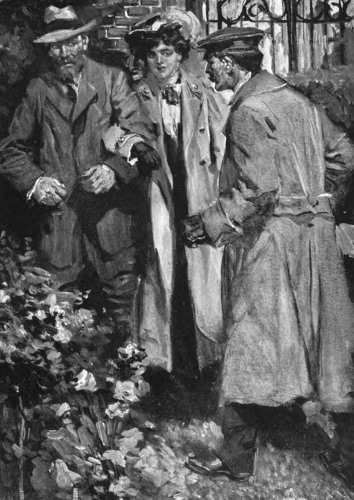
For a moment it seemed as if Felkin would refuse to obey. The two men stood looking at each other, measuring one another’s power of will and strength of passion. Hate and jealousy were clearly written in each pair of glowering eyes. Philip Baddock looked defiant, and Felkin taciturn and sulky.
Close to them stood my dear lady. Her beautiful eyes literally glowed with triumph. That these two men loved her, each in his own curious, uncontrolled way, I, her friend and confidant, knew very well. I had seen, and often puzzled over, the feminine attacks which she had made on the susceptibilities of that morose lout Felkin. It had taken her nearly two years to bring him to her feet. During that time she had alternately rendered him happy with her smiles and half mad with her coquetries, whilst Philip Baddock’s love for her was perpetually fanned by his ever-growing jealousy.
I remember that I often thought her game a cruel one. She was one of those women whom few men could resist; if she really desired to conquer she invariably succeeded, and her victory over Felkin seemed to me as purposeless as it was unkind. After all, she was the lawful wife of Captain de Mazareen, and to rouse hatred between two friends for the sake of her love, when that love was not hers to give, seemed unworthy of her. At this moment, when I could read deadly hatred in the faces of these two men, her cooing laugh grated unpleasantly on my ear.
“Never mind, Mr. Felkin,” she said, turning her luminous eyes on him. “Since you have so hard a taskmaster, you must do your duty now. But,” she added, throwing a strange, defiant look at Mr. Baddock, “I shall be at home this evening; come and have our cosy chat after dinner.”
She gave him her hand, and he took it with a certain clumsy gallantry and raised it to his lips. I thought that Philip Baddock would strike his friend with his open hand. The veins on his temples were swollen like dark cords, and I don’t think that I ever saw such an evil look in anyone’s eyes before.
Strangely enough, the moment Mr. Felkin’s back was turned my dear lady seemed to set herself the task of soothing the violent passions which she had wilfully aroused in the other man. She invited him to come into the house, and, some ten minutes later, I heard her singing to him. When, later on, I went into the boudoir to join them at tea, she was sitting on the music stool whilst he half bent over her, half knelt at her feet; her hands were clasped in her lap, and his fingers were closed over hers.
He did not attempt to leave her side when he saw me entering the room. In fact, he wore a triumphant air of possession, and paid her those little attentions which only an accepted lover would dare to offer.
He left soon after tea, and she accompanied him to the door. She gave him her hand to kiss, and I, who stood at some little distance in the shadow, thought that he would take her in his arms, so yielding and gracious did she seem. But some look or gesture on her part must have checked him, for he turned and walked quickly down the drive.
Lady Molly stood in the doorway gazing out towards the sunset. I, in my humble mind, wondered once again what was the purport of this cruel game.
3
Half an hour later she called to me, asked for her hat, told me to put on mine and to come out for a stroll.
As so often happened, she led the way towards the Elkhorn woods, which in spite, or perhaps because, of the painful memories they evoked, was a very favourite walk of hers.
As a rule the wood, especially that portion of it where the unfortunate solicitor had been murdered, was deserted after sunset. The villagers declared that Mr. Steadman’s ghost haunted the clearing, and that the cry of the murdered man, as he was being foully struck from behind, could be distinctly heard echoing through the trees.
Needless to say, these superstitious fancies never disturbed Lady Molly. She liked to wander over the ground where was committed that mysterious crime which had sent to ignominy worse than death the man she loved so passionately. It seemed as if she meant to wrench its secret from the silent ground, from the leafy undergrowth, from the furtive inhabitants of the glades.
The sun had gone down behind the hills; the wood was dark and still. We strolled up as far as the first clearing, where a plain, granite stone, put up by Mr. Philip Baddock, marked the spot where Mr. Steadman had been murdered.
We sat down on it to rest. My dear lady’s mood was a silent one; I did not dare to disturb it, and, for a while, only the gentle “hush—sh—sh” of the leaves, stirred by the evening breeze, broke the peaceful stillness of the glade.
Then we heard a murmur of voices, deep-toned and low. We could not hear the words spoken, though we both strained our ears, and presently Lady Molly arose and cautiously made her way among the trees in the direction whence the voices came, I following as closely as I could.
We had not gone far when we recognised the voices, and heard the words that were said. I paused, distinctly frightened, whilst my dear lady whispered a warning “Hush!”
Never in all my life had I heard so much hatred, such vengeful malignity expressed in the intonation of the human voice as I did in the half-dozen words which now struck my ear.
“You will give her up, or——”
It was Mr. Felkin who spoke. I recognised his raucous delivery, but I could not distinguish either of the two men in the gloom.
“Or what?” queried the other, in a voice which trembled with either rage or fear—perhaps with both.
“You will give her up,” repeated Felkin, sullenly. “I tell you that it is an impossibility—do you understand?—an impossibility for me to stand by and see her wedded to you, or to any other man for the matter of that. But that is neither here nor there,” he added after a slight pause. “It is with you I have to deal now. You shan’t have her—you shan’t—I won’t allow it, even if I have to——”
He paused again. I cannot describe the extraordinary effect this rough voice coming out of the darkness had upon my nerves. I had edged up to Lady Molly, and had succeeded in getting hold of her hand. It was like ice, and she herself was as rigid as that piece of granite on which we had been sitting.
“You seem bubbling over with covert threats,” interposed Philip Baddock, with what was obviously a sneer; “what are the extreme measures to which you will resort if I do not give up the lady whom I love with my whole heart, and who has honoured me to-day by accepting my hand in marriage?”
“That is a lie!” ejaculated Felkin.
“What is a lie?” queried the other, quietly.
“She has not accepted you—and you know it. You are trying to keep me away from her—arrogating rights which you do not possess. Give her up, man, give her up. It will be best for you. She will listen to me—I can win her all right—but you must stand aside for me this time. Take the word of a desperate man for it, Baddock. It will be best for you to give her up.”
Silence reigned in the wood for a few moments, and then we heard Philip Baddock’s voice again, but he seemed to speak more calmly, almost indifferently, as I thought.
“Are you going now?” he asked. “Won’t you come in to dinner?”
“No,” replied Felkin, “I don’t want any dinner, and I have an appointment for afterwards.”
“Don’t let us part ill friends, Felkin,” continued Philip Baddock in conciliatory tones. “Do you know that, personally, my feeling is that no woman on earth is worth a serious quarrel between two old friends, such as we have been.”
“I’m glad you think so,” rejoined the other drily. “S’long.”
The cracking of twigs on the moss-covered ground indicated that the two men had parted and were going their several ways.
With infinite caution, and holding my hand tightly in hers, my dear lady made her way along the narrow path which led us out of the wood.
Once in the road we walked rapidly, and soon reached our garden gate. Lady Molly had not spoken a word during all that time, and no one knew better than I did how to respect her silence.
During dinner she tried to talk of indifferent subjects, and never once alluded to the two men whom she had thus wilfully pitted one against the other. That her calm was only on the surface, however, I realised from the fact that every sound on the gravel path outside caused her to start. She was, of course, expecting the visit of Mr. Felkin.
At eight o’clock he came. It was obvious that he had spent the past hour in wandering about in the woods. He looked untidy and unkempt. My dear lady greeted him very coldly, and when he tried to kiss her hand she withdrew it abruptly.
Our drawing-room was a double one, divided by portière curtains. Lady Molly led the way into the front room, followed by Mr. Felkin. Then she drew the curtains together, leaving me standing behind them. I concluded that she wished me to stay there and to listen, conscious of the fact that Felkin, in the agitated mood in which he was, would be quite oblivious of my presence.
I almost pitied the poor man, for to me—the listener—it was at once apparent that my dear lady had only bidden him come to-night in order to torture him. For about a year she had been playing with him as a cat does with a mouse; encouraging him at times with sweet words and smiles, repelling him at others with coldness not unmixed with coquetry. But to-night her coldness was unalloyed; her voice was trenchant, her attitude almost one of contempt.
I missed the beginning of their conversation, for the curtains were thick and I did not like to go too near, but soon Mr. Felkin’s voice was raised. It was harsh and uncompromising.
“I suppose that I am only good enough for a summer’s flirtation?” he said sullenly, “but not to marry, eh? The owner of Appledore Castle, the millionaire, Mr. Baddock, is more in your line——”
“It certainly would be a more suitable match for me,” rejoined Lady Molly, coolly.
“He told me you had formally accepted him,” said the man, with enforced calm; “is that true?”
“Partly,” she replied.
“But you won’t marry him!”
The exclamation seemed to come straight from a heart brimful of passion, of love, of hate, and of revenge. The voice had the same intonation in it which had rung an hour ago in the dark Elkhorn woods.
“I may do,” came in quiet accents from my dear lady.
“You won’t marry him,” repeated Felkin, roughly.
“Who shall prevent me?” retorted Lady Molly, with a low, sarcastic laugh.
“I will.”
“You?” she said contemptuously.
“I told him an hour ago that he must give you up. I tell you now that you shall not be Philip Baddock’s wife.”
“Oh!” she interposed. And I could almost see the disdainful shrug of her shoulders, the flash of contempt in her expressive eyes.
No doubt it maddened him to see her so cool, so indifferent, when he had thought that he could win her. I do believe that the poor wretch loved her. She was always beautiful, but never more so than to-night when she had obviously determined finally to dismiss him.
“If you marry Philip Baddock,” he now said, in a voice which quivered with uncontrolled passion, “then within six months of your wedding-day you will be a widow, for your husband will have ended his life on the gallows.”
“You are mad!” she retorted calmly.
“That is as it may be,” he replied. “I warned him to-night, and he seems inclined to heed my warning; but he won’t stand aside if you beckon to him. Therefore, if you love him, take my warning. I may not be able to get you, but I swear to you that Philip Baddock shan’t either. I’ll see him hanged first,” he added, with gruesome significance.
“And you think that you can force me to do your bidding by such paltry threats?” she retorted.
“Paltry threats? Ask Philip Baddock if my threats are paltry. He knows full well that in my room at Appledore Castle, safe from thievish fingers, lie the proofs that he killed Alexander Steadman in the Elkhorn woods. Oh! I wouldn’t help him in his nefarious deeds until he placed himself in my hands. He had to take my terms or leave the thing alone altogether, for he could not work without me. My wants are few, and he has treated and paid me well. Now we are rivals, and I’ll destroy him before I’ll let him gloat over me.
“Do you know how we worked it? Sir Jeremiah would not disinherit his grandson—he steadily refused to make a will in Philip Baddock’s favour. But when he was practically dying we sent for Alexander Steadman—a newcomer, who had never seen Sir Jeremiah before—and I impersonated the old gentleman for the occasion. Yes, I!” he repeated with a coarse laugh, “I was Sir Jeremiah for the space of half an hour, and I think that I played the part splendidly. I dictated the terms of a new will. Young Steadman never suspected the fraud for a single instant. We had darkened the room for the comedy, you see, and Mr. Steadman was destined by Baddock and myself never to set eyes on the real Sir Jeremiah.
“After the interview Baddock sent for Captain de Mazareen; this was all part of his plan and mine. We engineered it all, and we knew that Sir Jeremiah could only last a few hours. We sent for Steadman again, and I myself scattered a few dozen sharp nails among the loose stones in the road where the motor-car was intended to break down, thus forcing the solicitor to walk through the woods. Captain de Mazareen’s appearance on the scene at that particular moment was an unrehearsed effect which nearly upset all our plans, for had Mr. Steadman stuck to him that night, instead of turning back, he would probably be alive now, and Baddock and I would be doing time somewhere for attempted fraud. We should have been done, at any rate.
“Well! you know what happened. Mr. Steadman was killed. Baddock killed him, and then ran straight back to the house, just in time to greet Captain de Mazareen, who evidently had loitered on his way. But it was I who thought of the stick, as an additional precaution to avert suspicion from ourselves. Captain de Mazareen was carrying one, and left it in the hall at the Castle. I cut my own hand and stained the stick with it, then polished and cleaned it up, and later, during the night, deposited it in the near neighbourhood of the murdered body. Ingenious, wasn’t it? I am a clever beggar, you see. Because I was cleverer than Baddock he could not do without me, and because he could not do without me I made him write and sign a request to me to help him to manufacture a bogus will and then to murder the solicitor who had drawn it up. And I have hidden that precious document in the wing of Appledore Castle which I inhabit; the exact spot is known only to myself. Baddock has often tried to find out, but all he knows is that these things are in that particular wing of the house. I have the document, and the draft of the will taken out of Mr. Steadman’s pocket, and the short bludgeon with which he was killed—it is still stained with blood—and the rags with which I cleaned the stick. I swear that I will never make use of these things against Philip Baddock unless he drives me to it, and if you make use of what I have just told you I’ll swear that I have lied. No one can find the proofs which I hold. But on the day that you marry Baddock I’ll place them in the hands of the police.”
There was silence in the room. I could almost hear the beating of my own heart, so horrified, so appalled was I at the horrible tale which the man had just told to my dear lady.