Introductory material (continued 4)
Reading edition
In addition to these two ladies, the household consisted of three servants and Miss Cruikshank. The latter was a quiet, unassuming girl who was by way of being secretary and lady-help to Mrs. Dunstan, but who, in reality, was nothing but a willing drudge. Up betimes in the morning, she combined the work of a housekeeper with that of an upper servant. She interviewed the tradespeople, kept the servants in order, and ironed and smartened up Miss Violet’s blouses. A Cinderella, in fact.
Mrs. Dunstan kept a cook and two maids, all of whom had been with her for years. In addition to these, a charwoman came very early in the morning to light fires, clean boots, and do the front steps.
On November 22nd, 1907—for the early history of this curious drama dates back to that year—the charwoman who had been employed at Mrs. Dunstan’s house in Eaton Terrace for some considerable time, sent word in the morning that in future she would be unable to come. Her husband had been obliged to move to lodgings nearer to his work, and she herself could not undertake to come the greater distance at the early hour at which Mrs. Dunstan required her.
The woman had written a very nice letter explaining these facts, and sent it by hand, stating at the same time that the bearer of the note was a very respectable woman, a friend of her own, who would be very pleased to “oblige” Mrs. Dunstan by taking on the morning’s work.
I must tell you that the message and its bearer arrived at Eaton Terrace somewhere about 6.0 a.m., when no one was down except the Cinderella of the house, Miss Cruikshank.
She saw the woman, liked her appearance, and there and then engaged her to do the work, subject to Mrs. Dunstan’s approval.
The woman, who had given her name as Mrs. Thomas, seemed very quiet and respectable. She said that she lived close by, in St. Peter’s Mews, and therefore could come as early as Mrs. Dunstan wished. In fact, from that day, she came every morning at 5.30 a.m., and by seven o’clock had finished her work, and was able to go home.
If, in addition to these details, I tell you that, at that time, pretty Miss Violet Frostwicke was engaged to a young Scotsman, Mr. David Athol, of whom her aunt totally disapproved, I shall have put before you all the personages who, directly or indirectly, were connected with that drama, the final act of which has not yet been witnessed either by the police or by the public.
2
On the following New Year’s Eve, Mrs. Dunstan, as was her invariable custom on that day, went to her married brother’s house to dine and to see the New Year in.
During her absence the usual thing occurred at Eaton Terrace. Miss Violet Frostwicke took the opportunity of inviting Mr. David Athol to spend the evening with her.
Mrs. Dunstan’s servants, mind you, all knew of the engagement between the young people, and with the characteristic sentimentality of their class, connived at these secret meetings and helped to hoodwink the irascible old aunt.
Mr. Athol was a good-looking young man, whose chief demerit lay in his total lack of money or prospects. Also he was by way of being an actor, another deadly sin in the eyes of the puritanically-minded old lady.
Already, on more than one occasion, there had been vigorous wordy warfare ’twixt Mr. Athol and Mrs. Dunstan, and the latter had declared that if Violet chose to take up with this mountebank, she should never see a penny of her aunt’s money now or in the future.
The young man did not come very often to Eaton Terrace, but on this festive New Year’s Eve, when Mrs. Dunstan was not expected to be home until long after midnight, it seemed too splendid an opportunity for an ardent lover to miss.
As ill-luck would have it, Mrs. Dunstan had not felt very well after her copious dinner, and her brother, Mr. Nicholas Jones, escorted her home soon after ten o’clock.
Jane, the parlour-maid who opened the front door, was, in her own graphic language, “knocked all of a heap” when she saw her mistress, knowing full well that Mr. Athol was still in the dining-room with Miss Violet, and that Miss Cruikshank was at that very moment busy getting him a whisky and soda.
Meanwhile the coat and hat in the hall had revealed the young man’s presence in the house.
For a moment Mrs. Dunstan paused, whilst Jane stood by trembling with fright. Then the old lady turned to Mr. Nicholas Jones, who was still standing on the doorstep, and said quietly:
“Will you telephone over to Mr. Blenkinsop, Nick, the first thing in the morning, and tell him I’ll be at his office by ten o’clock?”
Mr. Blenkinsop was Mrs. Dunstan’s solicitor, and as Jane explained to the cook later on, what could such an appointment mean but a determination to cut Miss Violet out of the missis’s will with the proverbial shilling?
After this Mrs. Dunstan took leave of her brother and went straight into the dining-room.
According to the subsequent testimony of all three servants, the mistress “went on dreadful.” Words were not easily distinguishable from behind the closed door, but it seems that, immediately she entered, Mrs. Dunstan’s voice was raised as if in terrible anger, and a few moments later Miss Violet fled crying from the dining-room, and ran quickly upstairs.
Whilst the door was thus momentarily opened and shut, the voice of the old lady was heard saying, in majestic wrath:
“That’s what you have done. Get out of this house. As for her, she’ll never see a penny of my money, and she may starve for aught I care!”
The quarrel seems to have continued for a short while after that, the servants being too deeply awed by those last vindictive words which they had heard to take much note of what went on subsequently.
Mrs. Dunstan and Mr. Athol were closeted together for some time; but apparently the old lady’s wrath did not subside, for when she marched up to bed an hour later she was heard to say:
“Out of this house she shall go, and the first thing in the morning, too. I’ll have no goings-on with a mountebank like you.”
Miss Cruikshank was terribly upset.
“It is a frightful blow for Miss Violet,” she said to cook, “but perhaps Mrs. Dunstan will feel more forgiving in the morning. I’ll take her up a glass of champagne now. She is very fond of that, and it will help her to get to sleep.”
Miss Cruikshank went up with the champagne, and told cook to see Mr. Athol out of the house; but the young man, who seemed very anxious and agitated, would not go away immediately. He stayed in the dining-room, smoking, for a while, and when the two younger servants went up to bed, he asked cook to let him remain until he had seen Miss Violet once more, for he was sure she would come down again—he had asked Miss Cruikshank to beg her to do so.
Mrs. Kennett, the cook, was a kind-hearted old woman. She had taken the young people under her special protection, and felt very vexed that the course of true love should not be allowed to run quite smoothly. So she told Mr. Athol to make himself happy and comfortable in the dining-room, and she would sit up by the fire in the library until he was ready to go.
The good soul thereupon made up the fire in the library, drew a chair in front of it, and—went fast to sleep.
Suddenly something awoke her. She sat up and looked round in that dazed manner peculiar to people just aroused from deep sleep.
She looked at the clock; it was past three. Surely, she thought, it must have been Mr. Athol calling to her which had caused her to wake. She went into the hall, where the gas had not yet been turned off, and there she saw Miss Violet, fully dressed and wearing a hat and coat, in the very act of going out at the front door.
In the cook’s own words, before she could ask a question or even utter a sound, the young girl had opened the front door, which was still on the latch, and then banged it to again, she herself having disappeared into the darkness of the street beyond.
Mrs. Kennett ran to the door and out into the street as fast as her old legs would let her; but the night was an exceptionally foggy one. Violet, no doubt, had walked rapidly away, and there came no answer to Mrs. Kennett’s repeated calls.
Thoroughly upset, and not knowing what to do, the good woman went back into the house. Mr. Athol had evidently left, for there was no sign of him in the dining-room or elsewhere. She then went upstairs and knocked at Mrs. Dunstan’s door. To her astonishment the gas was still burning in her mistress’s room, as she could see a thin ray of light filtering through the keyhole. At her first knock there came a quick, impatient answer:
“What is it?”
“Miss Violet, ’m,” said the cook, who was too agitated to speak very coherently, “she is gone——”
“The best thing she could do,” came promptly from the other side of the door. “You go to bed, Mrs. Kennett, and don’t worry.”
Whereupon the gas was suddenly turned off inside the room, and, in spite of Mrs. Kennett’s further feeble protests, no other word issued from the room save another impatient:
“Go to bed.”
The cook then did as she was bid; but before going to bed she made the round of the house, turned off all the gas, and finally bolted the front door.
3
Some three hours later the servants were called, as usual, by Miss Cruikshank, who then went down to open the area door to Mrs. Thomas, the charwoman.
At half-past six, when Mary the housemaid came down, candle in hand, she saw the charwoman a flight or two lower down, also apparently in the act of going downstairs. This astonished Mary not a little, as the woman’s work lay entirely in the basement, and she was supposed never to come to the upper floors.
The woman, though walking rapidly down the stairs, seemed, moreover, to be carrying something heavy.
“Anything wrong, Mrs. Thomas?” asked Mary, in a whisper.
The woman looked up, pausing a moment immediately under the gas bracket, the by-pass of which shed a feeble light upon her and upon her burden. The latter Mary recognised as the bag containing the sand which, on frosty mornings, had to be strewn on the front steps of the house.
On the whole, though she certainly was puzzled, Mary did not think very much about the incident then. As was her custom, she went into the housemaid’s closet, got the hot water for Miss Cruikshank’s bath, and carried it to the latter’s room, where she also pulled up the blinds and got things ready generally. For Miss Cruikshank usually ran down in her dressing-gown, and came up to tidy herself later on.
As a rule, by the time the three servants got downstairs, it was nearly seven, and Mrs. Thomas had generally gone by that time; but on this occasion Mary was earlier. Miss Cruikshank was busy in the kitchen getting Mrs. Dunstan’s tea ready. Mary spoke about seeing Mrs. Thomas on the stairs with the bag of sand, and Miss Cruikshank, too, was very astonished at the occurrence.
Mrs. Kennett was not yet down, and the charwoman apparently had gone; her work had been done as usual, and the sand was strewn over the stone steps in front, as the frosty fog had rendered them very slippery.
At a quarter past seven Miss Cruikshank went up with Mrs. Dunstan’s tea, and less than two minutes later a fearful scream rang through the entire house, followed by the noise of breaking crockery.
In an instant the two maids ran upstairs, straight to Mrs. Dunstan’s room, the door of which stood wide open.
The first thing Mary and Jane were conscious of was a terrific smell of gas, then of Miss Cruikshank, with eyes dilated with horror, staring at the bed in front of her, whereon lay Mrs. Dunstan, with one end of a piece of indiarubber piping still resting in her mouth, her jaw having dropped in death. The other end of that piece of piping was attached to the burner of a gas-bracket on the wall close by.
Every window in the room was fastened and the curtains drawn. The whole room reeked of gas.
Mrs. Dunstan had been asphyxiated by its fumes.
4
A year went by after the discovery of the mysterious tragedy, and I can assure you that our fellows at the Yard had one of the toughest jobs in connection with the case that ever fell to their lot. Just think of all the contradictions which met them at every turn.
Firstly, the disappearance of Miss Violet.
No sooner had the women in the Dunstan household roused themselves sufficiently from their horror at the terrible discovery which they had just made, than they were confronted with another almost equally awful fact—awful, of course, because of its connection with the primary tragedy.
Miss Violet Frostwicke had gone. Her room was empty, her bed had not been slept in. She herself had been seen by the cook, Mrs. Kennett, stealing out of the house at dead of night.
To connect the pretty, dainty young girl even remotely with a crime so hideous, so callous, as the deliberate murder of an old woman, who had been as a mother to her, seemed absolutely out of the question, and by tacit consent the four women, who now remained in the desolate and gloom-laden house at Eaton Terrace, forbore to mention Miss Violet Frostwicke’s name either to police or doctor.
Both these, of course, had been summoned immediately; Miss Cruikshank sending Mary to the police-station and thence to Dr. Folwell, in Eaton Square, whilst Jane went off in a cab to fetch Mr. Nicholas Jones, who, fortunately, had not yet left for his place of business.
The doctor’s and the police-inspector’s first thought, on examining the mise en scène of the terrible tragedy, was that Mrs. Dunstan had committed suicide. It was practically impossible to imagine that a woman in full possession of health and strength would allow a piece of indiarubber piping to be fixed between her teeth, and would, without a struggle, continue to inhale the poisonous fumes which would mean certain death. Yet there were no marks of injury upon the body, nothing to show how sufficient unconsciousness had been produced in the victim to permit of the miscreant completing his awesome deed.
But the theory of suicide set up by Dr. Folwell was promptly refuted by the most cursory examination of the room.
Though the drawers were found closed, they had obviously been turned over, as if the murderer had been in search either of money or papers, or the key of the safe.
The latter, on investigation, was found to be open, whilst the key lay on the floor close by. A brief examination of the safe revealed the fact that the tin boxes must have been ransacked, for they contained neither money nor important papers now, whilst the gold and platinum settings of necklaces, bracelets, and a tiara showed that the stones—which, as Mr. Nicholas Jones subsequently averred, were of considerable value—had been carefully, if somewhat clumsily, taken out by obviously inexperienced hands.
On the whole, therefore, appearances suggested deliberate, systematic, and very leisurely robbery, which wholly contradicted the theory of suicide.
Then suddenly the name of Miss Frostwicke was mentioned. Who first brought it on the tapis no one subsequently could say; but in a moment the whole story of the young girl’s engagement to Mr. Athol, in defiance of her aunt’s wishes, the quarrel of the night before, and the final disappearance of both young people from the house during the small hours of the morning, was dragged from the four unwilling witnesses by the able police-inspector.
Nay, more. One very unpleasant little circumstance was detailed by one of the maids and corroborated by Miss Cruikshank.
It seems that when the latter took up the champagne to Mrs. Dunstan, the old lady desired Miss Violet to come to her room. Mary, the housemaid, was on the stairs when she saw the young girl, still dressed in her evening gown of white chiffon, her eyes still swollen with tears, knocking at her aunt’s door.
The police-inspector was busy taking notes, already building up in his mind a simple, if very sensational, case against Violet Frostwicke, when Mrs. Kennett promptly upset all his calculations.
Miss Violet could have had nothing to do with the murder of her aunt, seeing that Mrs. Dunstan was alive and actually spoke to the cook when the latter knocked at her bedroom door after she had seen the young girl walk out of the house.
Then came the question of Mr. Athol. But, if you remember, it was quite impossible even to begin to build up a case against the young man. His own statement that he left the house at about midnight, having totally forgotten to rouse the cook when he did so, was amply corroborated from every side.
The cabman who took him up to the corner of Eaton Terrace at 11.50 p.m. was one witness in his favour; his landlady at his rooms in Jermyn Street, who let him in, since he had mislaid his latchkey, and who took him up some tea at seven o’clock the next morning, was another; whilst, when Mary saw Miss Violet going into her aunt’s room, the clock at St. Peter’s, Eaton Square, was just striking twelve.
I dare say you think I ought by now to have mentioned the charwoman, Mrs. Thomas, who represented the final, most complete, most hopeless contradiction in this remarkable case.
Mrs. Thomas was seen by Mary, the housemaid, at half-past six o’clock in the morning, coming down from the upper floors, where she had no business to be, and carrying the bag of sand used for strewing over the slippery front-door steps.
The bag of sand, of course, was always kept in the area.
The moment that bag of sand was mentioned Dr. Folwell gave a curious gasp. Here, at least, was the solution to one mystery. The victim had been stunned whilst still in bed by a blow on the head dealt with that bag of sand; and whilst she was unconscious the callous miscreant had robbed her and finally asphyxiated her with the gas fumes.
Where was the woman who, at half-past six in the morning, was seen in possession of the silent instrument of death?
Mrs. Thomas had disappeared. The last that was then or ever has been seen of her was when she passed underneath the dim light of a by-pass on the landing, as if tired out with the weight which she was carrying.
Since then, as you know, the police have been unswerving in their efforts to find Mrs. Thomas. The address which she had given in St. Peter’s Mews was found to be false. No one of that name or appearance had ever been seen there.
The woman who was supposed to have sent her with a letter of recommendation to Mrs. Dunstan knew nothing of her. She swore that she had never sent anyone with a letter to Mrs. Dunstan. She gave up her work there one day because she found it too hard at such an early hour in the morning; but she never heard anything more from her late employer after that.
Strange, wasn’t it, that two people should have disappeared out of that house on that same memorable night?
Of course, you will remember the tremendous sensation that was caused some twenty-four hours later, when it transpired that the young person who had thrown herself into the river from Waterloo Bridge on that same eventful morning, and whose body was subsequently recovered and conveyed to the Thames Police station, was identified as Miss Violet Frostwicke, the niece of the lady who had been murdered in her own house in Eaton Terrace.
Neither money nor diamonds were found on poor Miss Violet. She had herself given the most complete proof that she, at least, had no hand in robbing or killing Mrs. Dunstan.
The public wondered why she took her aunt’s wrath and her probable disinheritance so fearfully to heart, and sympathised with Mr. David Athol for the terribly sad loss which he had sustained.
But Mrs. Thomas, the charwoman, had not yet been found.
5
I think I looked an extremely respectable, good plain cook when I presented myself at the house in Eaton Terrace in response to the advertisement in the “Daily Telegraph.”
As, in addition to my prepossessing appearance, I also asked very low wages and declared myself ready to do anything except scour the front steps and the stone area, I was immediately engaged by Mrs. Jones, and was duly installed in the house the following day under the name of Mrs. Curwen.
But few events had occurred here since the discovery of the dual tragedy, now more than a year ago, and none that had thrown any light upon the mystery which surrounded it.
The verdict at the inquest had been one of wilful murder against a person known as Mrs. Thomas, the weight of evidence, coupled with her disappearance, having been very heavy against her; and there was a warrant out for her arrest.
Mrs. Dunstan had died intestate. To the astonishment of all those in the know, she had never signed the will which Messrs. Blenkinsop and Blenkinsop had drafted for her, and wherein she bequeathed £20,000 and the lease of her house in Eaton Terrace to her beloved niece, Violet Frostwicke, £1,000 to Miss Cruikshank, and other, smaller, legacies to friends or servants.
In default of a will, Mr. Nicholas Jones, only brother of the deceased, became possessed of all her wealth.
He was a very rich man himself, and many people thought that he ought to give Miss Cruikshank the £1,000 which the poor girl had thus lost through no fault of her own.
What his ultimate intentions were with regard to this no one could know. For the present he contented himself with moving to Eaton Terrace with his family; and, as his wife was a great invalid, he asked Miss Cruikshank to continue to make her home in the house and to help in its management.
Neither the diamonds nor the money stolen from Mrs. Dunstan’s safe were ever traced. It seems that Mrs. Dunstan, a day or two before her death, had sold a freehold cottage which she owned near Teddington. The money, as is customary, had been handed over to her in gold, in Mr. Blenkinsop’s office, and she had been foolish enough not to bank it immediately. This money and the diamonds had been the chief spoils of her assailant. And all the while no trace of Mrs. Thomas, in spite of the most strenuous efforts on the part of the police to find her.
Strangely enough, when I had been in Eaton Terrace about three days, and was already getting very tired of early rising and hard work, the charwoman there fell ill one day and did not come to her work as usual.
I, of course, grumbled like six, for I had to be on my hands and knees the next morning scrubbing stone steps, and my thoughts of Lady Molly, for the moment, were not quite as loyal as they usually were.
Suddenly I heard a shuffling footstep close behind me. I turned and saw a rough-looking, ill-dressed woman standing at the bottom of the steps.
“What do you want?” I asked sourly, for I was in a very bad humour.
“I saw you scrubbing them steps, miss,” she replied in a raucous voice; “my ’usband is out of work, and the children hain’t ’ad no breakfast this morning. I’d do them steps, miss, if you’d give me a trifle.”
The woman certainly did not look very prepossessing, with her shabby, broad-brimmed hat hiding the upper part of her face, and her skirt, torn and muddy, pinned up untidily round her stooping figure.
However, I did not think that I could be doing anything very wrong by letting her do this one bit of rough work, which I hated, so I agreed to give her sixpence, and left her there with kneeling mat and scrubbing-brush, and went in, leaving, however, the front door open.
In the hall I met Miss Cruikshank, who, as usual, was down before everybody else.
“What is it, Curwen?” she asked, for through the open door she had caught sight of the woman kneeling on the step.
“A woman, miss,” I replied, somewhat curtly. “She offered to do the steps. I thought Mrs. Jones wouldn’t mind, as Mrs. Callaghan hasn’t turned up.”
Miss Cruikshank hesitated an instant, and then walked up to the front door.
At the same moment the woman looked up, rose from her knees, and boldly went up to accost Miss Cruikshank.
“You’ll remember me, miss,” she said, in her raucous voice. “I used to work for Mrs. Dunstan once. My name is Mrs. Thomas.”
No wonder Miss Cruikshank uttered a quickly smothered cry of horror. Thinking that she would faint, I ran to her assistance; but she waved me aside and then said quite quietly:
“This poor woman’s mind is deranged. She is no more Mrs. Thomas than I am. Perhaps we had better send for the police.”
“Yes, miss; p’r’aps you’d better,” said the woman with a sigh. “My secret has been weighin’ heavy on me of late.”
“But, my good woman,” said Miss Cruikshank, very kindly, for I suppose that she thought, as I did, that this was one of those singular cases of madness which sometimes cause innocent people to accuse themselves of undiscovered crimes. “You are not Mrs. Thomas at all. I knew Mrs. Thomas well, of course—and——”
“Of course you knew me, miss,” replied the woman. “The last conversation you and I had together was in the kitchen that morning, when Mrs. Dunstan was killed. I remember your saying to me——”
“Fetch the police, Curwen,” said Miss Cruikshank, peremptorily.
Whereupon the woman broke into a harsh and loud laugh of defiance.
To tell you the truth, I was not a little puzzled. That this scene had been foreseen by my dear lady, and that she had sent me to this house on purpose that I should witness it, I was absolutely convinced. But—here was my dilemma: ought I to warn the police at once or not?
On the whole, I decided that my best plan would undoubtedly be to communicate with Lady Molly first of all, and to await her instructions. So I ran upstairs, scribbled a hasty note to my dear lady, and, in response to Miss Cruikshank’s orders, flew out of the house through the area gate, noticing, as I did so, that Miss Cruikshank was still parleying with the woman on the doorstep.
I sent the note off to Maida Vale by taxicab; then I went back to Eaton Terrace. Miss Cruikshank met me at the front door, and told me that she had tried to detain the woman, pending my return; but that she felt very sorry for the unfortunate creature, who obviously was labouring under a delusion, and she had allowed her to go away.
About an hour later I received a curt note from Lady Molly ordering me to do nothing whatever without her special authorisation.
In the course of the day, Miss Cruikshank told me that she had been to the police-station, and had consulted with the inspector, who said there would be no harm in engaging the pseudo Mrs. Thomas to work at Eaton Terrace, especially as thus she would remain under observation.
Then followed a curious era in Mr. Nicholas Jones’s otherwise well-ordered household. We three servants, instead of being called at six as heretofore, were allowed to sleep on until seven. When we came down we were not scolded. On the contrary, we found our work already done.
The charwoman—whoever she was—must have been a very hard-working woman. It was marvellous what she accomplished single-handed before seven a.m., by which time she had invariably gone.
The two maids, of course, were content to let this pleasant state of things go on, but I was devoured with curiosity.
One morning I crept quietly downstairs and went into the kitchen soon after six. I found the pseudo Mrs. Thomas sitting at a very copious breakfast. I noticed that she had on altogether different—though equally shabby and dirty—clothes from those she had worn when she first appeared on the doorstep of 180, Eaton Terrace. Near her plate were three or four golden sovereigns over which she had thrown her grimy hand.
Miss Cruikshank the while was on her hands and knees scrubbing the floor. At sight of me she jumped up, and with obvious confusion muttered something about “hating to be idle,” etc.
That day Miss Cruikshank told me that I did not suit Mrs. Jones, who wished me to leave at the end of my month. In the afternoon I received a little note from my dear lady, telling me to be downstairs by six o’clock the following morning.
I did as I was ordered, of course, and when I came into the kitchen punctually at six a.m. I found the charwoman sitting at the table with a pile of gold in front of her, which she was counting over with a very grubby finger. She had her back to me, and was saying as I entered:
“I think if you was to give me another fifty quid I’d leave you the rest now. You’d still have the diamonds and the rest of the money.”
She spoke to Miss Cruikshank, who was facing me, and who, on seeing me appear, turned as white as a ghost. But she quickly recovered herself, and, standing between me and the woman, she said vehemently:
“What do you mean by prying on me like this? Go and pack your boxes and leave the house this instant.”
But before I could reply the woman had interposed.
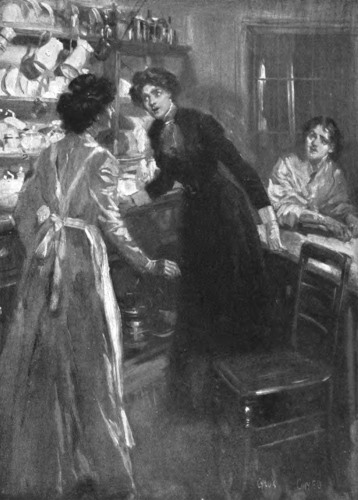
“ ‘Go and pack your boxes and leave the house this instant’ ”
“Don’t you fret yourself, miss,” she said, placing her grimy hand on Miss Cruikshank’s shoulder. “There’s the bag of sand in that there corner; we’ll knock ’er down as we did Mrs. Dunstan—eh?”
“Hold your tongue, you lying fool!” said the girl, who now looked like a maddened fury.
“Give me that other fifty quid and I’ll hold my tongue,” retorted the woman, boldly.
“This creature is mad,” said Miss Cruikshank, who had made a vigorous and successful effort to recover herself. “She is under the delusion that not only is she Mrs. Thomas, but that she murdered Mrs. Dunstan——”
“No—no!” interrupted the woman. “I only came back that morning because I recollected that you had left the bag of sand upstairs after you so cleverly did away with Mrs. Dunstan, robbed her of all her money and jewels, and even were sharp enough to imitate her voice when Mrs. Kennett, the cook, terrified you by speaking to Mrs. Dunstan through the door.”
“It is false! You are not Mrs. Thomas. The two maids who are here now, and who were in this house at the time, can swear that you are a liar.”
“Let us change clothes now, Miss Cruikshank,” said a voice, which sounded almost weirdly in my ear in spite of its familiarity, for I could not locate whence it came, “and see if in a charwoman’s dress those two maids would not recognise you.”
“Mary,” continued the same familiar voice, “help me out of these filthy clothes. Perhaps Miss Cruikshank would like to resume her own part of Mrs. Thomas, the charwoman.”
“Liars and impostors—both!” shouted the girl, who was rapidly losing all presence of mind. “I’ll send for the police.”
“Quite unnecessary,” rejoined Lady Molly coolly; “Detective-Inspector Danvers is just outside that door.”
The girl made a dash for the other door, but I was too quick for her, and held her back, even whilst Lady Molly gave a short, sharp call which brought Danvers on the scene.
I must say that Miss Cruikshank made a bold fight, but Danvers had two of our fellows with him, and arrested her on the warrant for the apprehension of the person known as Mrs. Thomas.
The clothes of the charwoman who had so mysteriously disappeared had been found by Lady Molly at the back of the coal cellar, and she was still dressed in them at the present moment.
No wonder I had not recognised my own dainty lady in the grimy woman who had so successfully played the part of a blackmailer on the murderess of Mrs. Dunstan. She explained to me subsequently that the first inkling that she had had of the horrible truth—namely, that it was Miss Cruikshank who had deliberately planned to murder Mrs. Dunstan by impersonating a charwoman for a while, and thus throwing dust in the eyes of the police—was when she heard of the callous words which the old lady was supposed to have uttered when she was told of Miss Violet’s flight from the house in the middle of the night.
“She may have been very angry at the girl’s escapade,” explained Lady Molly to me, “but she would not have allowed her to starve. Such cruelty was out of all proportion to the offence. Then I looked about me for a stronger motive for the old lady’s wrath; and, remembering what she said on New Year’s Eve, when Violet fled crying from the room, I came to the conclusion that her anger was not directed against her niece, but against the other girl, and against the man who had transferred his affections from Violet Frostwicke to Miss Cruikshank, and had not only irritated Mrs. Dunstan by this clandestine, double-faced love-making, but had broken the heart of his trusting fiancée.
“No doubt Miss Cruikshank did not know that the will, whereby she was to inherit £1,000, was not signed, and no doubt she and young Athol planned out that cruel murder between them. The charwoman was also a bag of sand which was literally thrown in the eyes of the police.”
“But,” I objected, “I can’t understand how a cold-blooded creature like that Miss Cruikshank could have allowed herself to be terrorised and blackmailed. She knew that you could not be Mrs. Thomas, since Mrs. Thomas never existed.”
“Yes; but one must reckon a little sometimes with that negligible quantity known as conscience. My appearance as Mrs. Thomas vaguely frightened Miss Cruikshank. She wondered who I was and what I knew. When, three days later, I found the shabby clothes in the coal-cellar and appeared dressed in them, she lost her head. She gave me money! From that moment she was done for. Confession was only a matter of time.”
And Miss Cruikshank did make full confession. She was recommended to mercy on account of her sex, but she was plucky enough not to implicate David Athol in the recital of her crime.
He has since emigrated to Western Canada.
IX. THE MAN IN THE INVERNESS CAPE
I have heard many people say—people, too, mind you, who read their daily paper regularly—that it is quite impossible for anyone to “disappear” within the confines of the British Isles. At the same time these wise people invariably admit one great exception to their otherwise unimpeachable theory, and that is the case of Mr. Leonard Marvell, who, as you know, walked out one afternoon from the Scotia Hotel in Cromwell Road and has never been seen or heard of since.
Information had originally been given to the police by Mr. Marvell’s sister Olive, a Scotchwoman of the usually accepted type: tall, bony, with sandy-coloured hair, and a somewhat melancholy expression in her blue-grey eyes.
Her brother, she said, had gone out on a rather foggy afternoon. I think it was the 3rd of February, just about a year ago. His intention had been to go and consult a solicitor in the City—whose address had been given him recently by a friend—about some private business of his own.
Mr. Marvell had told his sister that he would get a train at South Kensington Station to Moorgate Street, and walk thence to Finsbury Square. She was to expect him home by dinner-time.
As he was, however, very irregular in his habits, being fond of spending his evenings at restaurants and music-halls, the sister did not feel the least anxious when he did not return home at the appointed time. She had her dinner in the table d’hôte room, and went to bed soon after 10.0.
She and her brother occupied two bedrooms and a sitting-room on the second floor of the little private hotel. Miss Marvell, moreover, had a maid always with her, as she was somewhat of an invalid. This girl, Rosie Campbell, a nice-looking Scotch lassie, slept on the top floor.
It was only on the following morning, when Mr. Leonard did not put in an appearance at breakfast, that Miss Marvell began to feel anxious. According to her own account, she sent Rosie in to see if anything was the matter, and the girl, wide-eyed and not a little frightened, came back with the news that Mr. Marvell was not in his room, and that his bed had not been slept in that night.
With characteristic Scottish reserve, Miss Olive said nothing about the matter at the time to anyone, nor did she give information to the police until two days later, when she herself had exhausted every means in her power to discover her brother’s whereabouts.
She had seen the lawyer to whose office Leonard Marvell had intended going that afternoon, but Mr. Statham, the solicitor in question, had seen nothing of the missing man.
With great adroitness Rosie, the maid, had made inquiries at South Kensington and Moorgate Street stations. At the former, the booking clerk, who knew Mr. Marvell by sight, distinctly remembered selling him a first-class ticket to one of the City stations in the early part of the afternoon; but at Moorgate Street, which is a very busy station, no one recollected seeing a tall, red-haired Scotchman in an Inverness cape—such was the description given of the missing man. By that time the fog had become very thick in the City; traffic was disorganised, and everyone felt fussy, ill-tempered, and self-centred.
These, in substance, were the details which Miss Marvell gave to the police on the subject of her brother’s strange disappearance.
At first she did not appear very anxious; she seemed to have great faith in Mr. Marvell’s power to look after himself; moreover, she declared positively that her brother had neither valuables nor money about his person when he went out that afternoon.
But as day succeeded day and no trace of the missing man had yet been found, matters became more serious, and the search instituted by our fellows at the Yard waxed more keen.
A description of Mr. Leonard Marvell was published in the leading London and provincial dailies. Unfortunately, there was no good photograph of him extant, and descriptions are apt to prove vague.
Very little was known about the man beyond his disappearance, which had rendered him famous. He and his sister had arrived at the Scotia Hotel about a month previously, and subsequently they were joined by the maid Campbell.
Scotch people are far too reserved ever to speak of themselves or their affairs to strangers. Brother and sister spoke very little to anyone at the hotel. They had their meals in their sitting-room, waited on by the maid, who messed with the staff. But, in face of the present terrible calamity, Miss Marvell’s frigidity relaxed before the police inspector, to whom she gave what information she could about her brother.
“He was like a son to me,” she explained with scarcely restrained tears, “for we lost our parents early in life, and as we were left very, very badly off, our relations took but little notice of us. My brother was years younger than I am—and though he was a little wild and fond of pleasure, he was as good as gold to me, and has supported us both for years by journalistic work. We came to London from Glasgow about a month ago, because Leonard got a very good appointment on the staff of the ‘Daily Post.’ ”
All this, of course, was soon proved to be true; and although, on minute inquiries being instituted in Glasgow, but little seemed to be known about Mr. Leonard Marvell in that city, there seemed no doubt that he had done some reporting for the “Courier,” and that latterly, in response to an advertisement, he had applied for and obtained regular employment on the “Daily Post.”
The latter enterprising halfpenny journal, with characteristic magnanimity, made an offer of £50 reward to any of its subscribers who gave information which would lead to the discovery of the whereabouts of Mr. Leonard Marvell.
But time went by, and that £50 remained unclaimed.
2
Lady Molly had not seemed as interested as she usually was in cases of this sort. With strange flippancy—wholly unlike herself—she remarked that one Scotch journalist more or less in London did not vastly matter.
I was much amused, therefore, one morning about three weeks after the mysterious disappearance of Mr. Leonard Marvell, when Jane, our little parlour-maid, brought in a card accompanied by a letter.
The card bore the name “Miss Olive Marvell.” The letter was the usual formula from the chief, asking Lady Molly to have a talk with the lady in question, and to come and see him on the subject after the interview.
With a smothered yawn my dear lady told Jane to show in Miss Marvell.
“There are two of them, my lady,” said Jane, as she prepared to obey.
“Two what?” asked Lady Molly with a laugh.
“Two ladies, I mean,” explained Jane.
“Well! Show them both into the drawing-room,” said Lady Molly, impatiently.
Then, as Jane went off on this errand, a very funny thing happened; funny, because during the entire course of my intimate association with my dear lady, I had never known her act with such marked indifference in the face of an obviously interesting case. She turned to me and said:
“Mary, you had better see these two women, whoever they may be; I feel that they would bore me to distraction. Take note of what they say, and let me know. Now, don’t argue,” she added with a laugh, which peremptorily put a stop to my rising protest, “but go and interview Miss Marvell and Co.”
Needless to say, I promptly did as I was told, and the next few seconds saw me installed in our little drawing-room, saying polite preliminaries to the two ladies who sat opposite to me.
I had no need to ask which of them was Miss Marvell. Tall, ill-dressed in deep black, with a heavy crape veil over her face, and black cotton gloves, she looked the uncompromising Scotchwoman to the life. In strange contrast to her depressing appearance, there sat beside her an over-dressed, much behatted, peroxided young woman, who bore the stamp of the profession all over her pretty, painted face.
Miss Marvell, I was glad to note, was not long in plunging into the subject which had brought her here.
“I saw a gentleman at Scotland Yard,” she explained, after a short preamble, “because Miss—er—Lulu Fay came to me at the hotel this very morning with a story which, in my opinion, should have been told to the police directly my brother’s disappearance became known, and not three weeks later.”
The emphasis which she laid on the last few words, and the stern look with which she regarded the golden-haired young woman beside her, showed the disapproval with which the rigid Scotchwoman viewed any connection which her brother might have had with the lady, whose very name seemed unpleasant to her lips.
Miss—er—Lulu Fay blushed even through her rouge, and turned a pair of large, liquid eyes imploringly upon me.
“I—I didn’t know. I was frightened,” she stammered.
“There’s no occasion to be frightened now,” retorted Miss Marvell, “and the sooner you try and be truthful about the whole matter, the better it will be for all of us.”
And the stern woman’s lips closed with a snap, as she deliberately turned her back on Miss Fay and began turning over the leaves of a magazine which happened to be on a table close to her hand.
I muttered a few words of encouragement, for the little actress looked ready to cry. I spoke as kindly as I could, telling her that if indeed she could throw some light on Mr. Marvell’s present whereabouts it was her duty to be quite frank on the subject.
She “hem”-ed and “ha”-ed for awhile, and her simpering ways were just beginning to tell on my nerves, when she suddenly started talking very fast.
“I am principal boy at the Grand,” she explained with great volubility; “and I knew Mr. Leonard Marvell well—in fact—er—he paid me a good deal of attention and——”
“Yes—and——?” I queried, for the girl was obviously nervous.
There was a pause. Miss Fay began to cry.
“And it seems that my brother took this young—er—lady to supper on the night of February 3rd, after which no one has ever seen or heard of him again,” here interposed Miss Marvell, quietly.
“Is that so?” I asked.
Lulu Fay nodded, whilst heavy tears fell upon her clasped hands.
“But why did you not tell this to the police three weeks ago?” I ejaculated, with all the sternness at my command.
“I—I was frightened,” she stammered.
“Frightened? Of what?”
“I am engaged to Lord Mountnewte and——”
“And you did not wish him to know that you were accepting the attentions of Mr. Leonard Marvell—was that it? Well,” I added, with involuntary impatience, “what happened after you had supper with Mr. Marvell?”
“Oh! I hope—I hope that nothing happened,” she said through more tears; “we had supper at the Trocadero, and he saw me into my brougham. Suddenly, just as I was driving away, I saw Lord Mountnewte standing quite close to us in the crowd.”
“Did the two men know one another?” I asked.
“No,” replied Miss Fay; “at least, I didn’t think so, but when I looked back through the window of my carriage I saw them standing on the kerb talking to each other for a moment, and then walk off together towards Piccadilly Circus. That is the last I have seen of either of them,” continued the little actress with a fresh flood of tears. “Lord Mountnewte hasn’t spoken to me since, and Mr. Marvell has disappeared with my money and my diamonds.”
“Your money and your diamonds?” I gasped in amazement.
“Yes; he told me he was a jeweller, and that my diamonds wanted re-setting. He took them with him that evening, for he said that London jewellers were clumsy thieves, and that he would love to do the work for me himself. I also gave him two hundred pounds, which he said he would want for buying the gold and platinum required for the settings. And now he has disappeared—and my diamonds—and my money! Oh! I have been very—very foolish—and——”
Her voice broke down completely. Of course, one often hears of the idiocy of girls giving money and jewels unquestioningly to clever adventurers who know how to trade upon their inordinate vanity. There was, therefore, nothing very out of the way in the story just told me by Miss—er—Lulu Fay, until the moment when Miss Marvell’s quiet voice, with its marked Scotch burr, broke in upon the short silence which had followed the actress’s narrative.
“As I explained to the chief detective-inspector at Scotland Yard,” she said calmly, “the story which this young—er—lady tells is only partly true. She may have had supper with Mr. Leonard Marvell on the night of February 3rd, and he may have paid her certain attentions; but he never deceived her by telling her that he was a jeweller, nor did he obtain possession of her diamonds and her money through false statements. My brother was the soul of honour and loyalty. If, for some reason which Miss—er—Lulu Fay chooses to keep secret, he had her jewels and money in his possession on the fatal February 3rd, then I think his disappearance is accounted for. He has been robbed and perhaps murdered.”
Like a true Scotchwoman she did not give way to tears, but even her harsh voice trembled slightly when she thus bore witness to her brother’s honesty, and expressed the fears which assailed her as to his fate.
Imagine my plight! I could ill forgive my dear lady for leaving me in this unpleasant position—a sort of peacemaker between two women who evidently hated one another, and each of whom was trying her best to give the other “the lie direct.”
I ventured to ring for our faithful Jane and to send her with an imploring message to Lady Molly, begging her to come and disentangle the threads of this muddled skein with her clever fingers; but Jane returned with a curt note from my dear lady, telling me not to worry about such a silly case, and to bow the two women out of the flat as soon as possible and then come for a nice walk.
I wore my official manner as well as I could, trying not to betray the ’prentice hand. Of course, the interview lasted a great deal longer, and there was considerably more talk than I can tell you of in a brief narrative. But the gist of it all was just as I have said. Miss Lulu Fay stuck to every point of the story which she had originally told Miss Marvell. It was the latter uncompromising lady who had immediately marched the younger woman off to Scotland Yard in order that she might repeat her tale to the police. I did not wonder that the chief promptly referred them both to Lady Molly.
Anyway, I made excellent shorthand notes of the conflicting stories which I heard; and I finally saw, with real relief, the two women walk out of our little front door.
3
Miss—er—Lulu Fay, mind you, never contradicted in any one particular the original story which she had told me, about going out to supper with Leonard Marvell, entrusting him with £200 and the diamonds, which he said he would have reset for her, and seeing him finally in close conversation with her recognised fiancé, Lord Mountnewte. Miss Marvell, on the other hand, very commendably refused to admit that her brother acted dishonestly towards the girl. If he had her jewels and money in his possession at the time of his disappearance, then he had undoubtedly been robbed, or perhaps murdered, on his way back to the hotel, and if Lord Mountnewte had been the last to speak to him on that fatal night, then Lord Mountnewte must be able to throw some light on the mysterious occurrence.
Our fellows at the Yard were abnormally active. It seemed, on the face of it, impossible that a man, healthy, vigorous, and admittedly sober, should vanish in London between Piccadilly Circus and Cromwell Road without leaving the slightest trace of himself or of the valuables said to have been in his possession.
Of course, Lord Mountnewte was closely questioned. He was a young Guardsman of the usual pattern, and, after a great deal of vapid talk which irritated Detective-Inspector Saunders not a little, he made the following statement—
“I certainly am acquainted with Miss Lulu Fay. On the night in question I was standing outside the Troc, when I saw this young lady at her own carriage window talking to a tall man in an Inverness cape. She had, earlier in the day, refused my invitation to supper, saying that she was not feeling very well, and would go home directly after the theatre; therefore I felt, naturally, a little vexed. I was just about to hail a taxi, meaning to go on to the club, when, to my intense astonishment, the man in the Inverness cape came up to me and asked me if I could tell him the best way to get back to Cromwell Road.”
“And what did you do?” asked Saunders.
“I walked a few steps with him and put him on his way,” replied Lord Mountnewte, blandly.
In Saunders’s own expressive words, he thought that story “fishy.” He could not imagine the arm of coincidence being quite so long as to cause these two men—who presumably were both in love with the same girl, and who had just met at a moment when one of them was obviously suffering pangs of jealousy—to hold merely a topographical conversation with one another. But it was equally difficult to suppose that the eldest son and heir of the Marquis of Loam should murder a successful rival and then rob him in the streets of London.
Moreover, here came the eternal and unanswerable questions: If Lord Mountnewte had murdered Leonard Marvell, where and how had he done it, and what had he done with the body?
I dare say you are wondering by this time why I have said nothing about the maid, Rosie Campbell.
Well, plenty of very clever people (I mean those who write letters to the papers and give suggestions to every official department in the kingdom) thought that the police ought to keep a very strict eye upon that pretty Scotch lassie. For she was very pretty, and had quaint, demure ways which rendered her singularly attractive, in spite of the fact that, for most masculine tastes, she would have been considered too tall. Of course, Saunders and Danvers kept an eye on her—you may be sure of that—and got a good deal of information about her from the people at the hotel. Most of it, unfortunately, was irrelevant to the case. She was maid-attendant to Miss Marvell, who was feeble in health, and who went out but little. Rosie waited on her master and mistress upstairs, carrying their meals to their private room, and doing their bedrooms. The rest of the day she was fairly free, and was quite sociable downstairs with the hotel staff.
With regard to her movements and actions on that memorable 3rd of February, Saunders—though he worked very hard—could glean but little useful information. You see, in an hotel of that kind, with an average of thirty to forty guests at one time, it is extremely difficult to state positively what any one person did or did not do on that particular day.
Most people at the Scotia remembered that Miss Marvell dined in the table d’hôte room on that 3rd of February; this she did about once a fortnight, when her maid had an evening “out.”
The hotel staff also recollected fairly distinctly that Miss Rosie Campbell was not in the steward’s room at supper-time that evening, but no one could remember definitely when she came in.
One of the chambermaids who occupied the bedroom adjoining hers, said that she heard her moving about soon after midnight; the hall porter declared that he saw her come in just before half-past twelve when he closed the doors for the night.
But one of the ground-floor valets said that, on the morning of the 4th, he saw Miss Marvell’s maid, in hat and coat, slip into the house and upstairs, very quickly and quietly, soon after the front doors were opened, namely, about 7.0 a.m.
Here, of course, was a direct contradiction between the chambermaid and hall porter on the one side, and the valet on the other, whilst Miss Marvell said that Campbell came into her room and made her some tea long before seven o’clock every morning, including that of the 4th.
I assure you our fellows at the Yard were ready to tear their hair out by the roots, from sheer aggravation at this maze of contradictions which met them at every turn.
The whole thing seemed so simple. There was nothing “to it” as it were, and but very little real suggestion of foul play, and yet Mr. Leonard Marvell had disappeared, and no trace of him could be found.
Everyone now talked freely of murder. London is a big town, and this would not have been the first instance of a stranger—for Mr. Leonard Marvell was practically a stranger in London—being enticed to a lonely part of the city on a foggy night, and there done away with and robbed, and the body hidden in an out-of-the-way cellar, where it might not be discovered for months to come.
But the newspaper-reading public is notably fickle, and Mr. Leonard Marvell was soon forgotten by everyone save the chief and the batch of our fellows who had charge of the case.
Thus I heard through Danvers one day that Rosie Campbell had left Miss Marvell’s employ, and was living in rooms in Findlater Terrace, near Walham Green.
I was alone in our Maida Vale flat at the time, my dear lady having gone to spend the week-end with the Dowager Lady Loam, who was an old friend of hers; nor, when she returned, did she seem any more interested in Rosie Campbell’s movements than she had been hitherto.
Yet another month went by, and I for one had absolutely ceased to think of the man in the Inverness cape, who had so mysteriously and so completely vanished in the very midst of busy London, when, one morning early in January, Lady Molly made her appearance in my room, looking more like the landlady of a disreputable gambling-house than anything else I could imagine.
“What in the world——?” I began.
“Yes! I think I look the part,” she replied, surveying with obvious complacency the extraordinary figure which confronted her in the glass.
My dear lady had on a purple cloth coat and skirt of a peculiarly vivid hue, and of a singular cut, which made her matchless figure look like a sack of potatoes. Her soft brown hair was quite hidden beneath a “transformation,” of that yellow-reddish tint only to be met with in very cheap dyes.
As for her hat! I won’t attempt to describe it. It towered above and around her face, which was plentifully covered with brick-red and with that kind of powder which causes the cheeks to look a deep mauve.
My dear lady looked, indeed, a perfect picture of appalling vulgarity.
“Where are you going in this elegant attire?” I asked in amazement.
“I have taken rooms in Findlater Terrace,” she replied lightly. “I feel that the air of Walham Green will do us both good. Our amiable, if somewhat slatternly, landlady expects us in time for luncheon. You will have to keep rigidly in the background, Mary, all the while we are there. I said that I was bringing an invalid niece with me, and, as a preliminary, you may as well tie two or three thick veils over your face. I think I may safely promise that you won’t be dull.”
And we certainly were not dull during our brief stay at 34, Findlater Terrace, Walham Green. Fully equipped, and arrayed in our extraordinary garments, we duly arrived there, in a rickety four-wheeler, on the top of which were perched two seedy-looking boxes.
The landlady was a toothless old creature, who apparently thought washing a quite unnecessary proceeding. In this she was evidently at one with every one of her neighbours. Findlater Terrace looked unspeakably squalid; groups of dirty children congregated in the gutters and gave forth discordant shrieks as our cab drove up.
Through my thick veils I thought that, some distance down the road, I spied a horsy-looking man in ill-fitting riding-breeches and gaiters, who vaguely reminded me of Danvers.
Within half an hour of our installation, and whilst we were eating a tough steak over a doubtful table cloth, my dear lady told me that she had been waiting a full month, until rooms in this particular house happened to be vacant. Fortunately the population in Findlater Terrace is always a shifting one, and Lady Molly had kept a sharp eye on No. 34, where, on the floor above, lived Miss Rosie Campbell. Directly the last set of lodgers walked out of the ground-floor rooms, we were ready to walk in.
My dear lady’s manners and customs, whilst living at the above aristocratic address, were fully in keeping with her appearance. The shrill, rasping voice which she assumed echoed from attic to cellar.
One day I heard her giving vague hints to the landlady that her husband, Mr. Marcus Stein, had had a little trouble with the police about a small hotel which he had kept somewhere near Fitzroy Square, and where “young gentlemen used to come and play cards of a night.” The landlady was also made to understand that the worthy Mr. Stein was now living temporarily at His Majesty’s expense, whilst Mrs. Stein had to live a somewhat secluded life, away from her fashionable friends.
The misfortunes of the pseudo Mrs. Stein in no way marred the amiability of Mrs. Tredwen, our landlady. The inhabitants of Findlater Terrace care very little about the antecedents of their lodgers, so long as they pay their week’s rent in advance, and settle their “extras” without much murmur.
This Lady Molly did, with a generosity characteristic of an ex-lady of means. She never grumbled at the quantity of jam and marmalade which we were supposed to have consumed every week, and which anon reached titanic proportions. She tolerated Mrs. Tredwen’s cat, tipped Ermyntrude—the tousled lodging-house slavey—lavishly, and lent the upstairs lodger her spirit-lamp and curling-tongs when Miss Rosie Campbell’s got out of order.
A certain degree of intimacy followed the loan of those curling-tongs. Miss Campbell, reserved and demure, greatly sympathised with the lady who was not on the best of terms with the police. I kept steadily in the background. The two ladies did not visit each other’s rooms, but they held long and confidential conversations on the landings, and I gathered, presently, that the pseudo Mrs. Stein had succeeded in persuading Rosie Campbell that, if the police were watching No. 34, Findlater Terrace, at all, it was undoubtedly on account of the unfortunate Mr. Stein’s faithful wife.
I found it a little difficult to fathom Lady Molly’s intentions. We had been in the house over three weeks, and nothing whatever had happened. Once I ventured on a discreet query as to whether we were to expect the sudden re-appearance of Mr. Leonard Marvell.
“For if that’s all about it,” I argued, “then surely the men from the Yard could have kept the house in view, without all this inconvenience and masquerading on our part.”
But to this tirade my dear lady vouchsafed no reply.
She and her newly acquired friend were, about this time, deeply interested in the case known as the “West End Shop Robberies,” which no doubt you recollect, since they occurred such a very little while ago. Ladies who were shopping in the large drapers’ emporiums during the crowded and busy sale time, lost reticules, purses, and valuable parcels, without any trace of the clever thief being found.
The drapers, during sale-time, invariably employ detectives in plain clothes to look after their goods, but in this case it was the customers who were robbed, and the detectives, attentive to every attempt at “shoplifting,” had had no eyes for the more subtle thief.
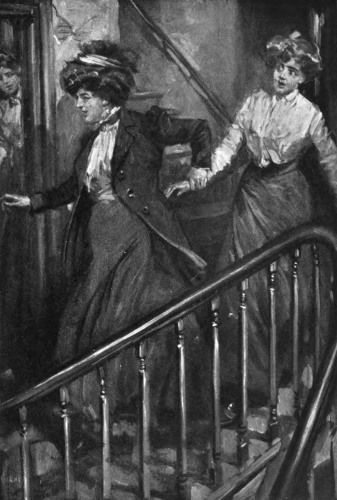
“Still talking shrilly … the pseudo Mrs. Stein dragged her into our own sitting-room”
I had already noticed Miss Rosie Campbell’s keen look of excitement whenever the pseudo Mrs. Stein discussed these cases with her. I was not a bit surprised, therefore, when, one afternoon at about tea-time, my dear lady came home from her habitual walk, and, at the top of her shrill voice, called out to me from the hall:
“Mary! Mary! they’ve got the man of the shop robberies. He’s given the silly police the slip this time, but they know who he is now, and I suppose they’ll get him presently. ’Tisn’t anybody I know,” she added, with that harsh, common laugh which she had adopted for her part.
I had come out of the room in response to her call, and was standing just outside our own sitting-room door. Mrs. Tredwen, too, bedraggled and unkempt, as usual, had sneaked up the area steps, closely followed by Ermyntrude.
But on the half-landing just above us the trembling figure of Rosie Campbell, with scared white face and dilated eyes, looked on the verge of a sudden fall.
Still talking shrilly and volubly, Lady Molly ran up to her, but Campbell met her half-way, and the pseudo Mrs. Stein, taking vigorous hold of her wrist, dragged her into our own sitting-room.
“Pull yourself together, now,” she said with rough kindness; “that owl Tredwen is listening, and you needn’t let her know too much. Shut the door, Mary. Lor’ bless you, m’dear, I’ve gone through worse scares than these. There! you just lie down on this sofa a bit. My niece’ll make you a cup o’ tea; and I’ll go and get an evening paper, and see what’s going on. I suppose you are very interested in the shop robbery man, or you wouldn’t have took on so.”
Without waiting for Campbell’s contradiction to this statement, Lady Molly flounced out of the house.
Miss Campbell hardly spoke during the next ten minutes that she and I were left alone together. She lay on the sofa with eyes wide open, staring up at the ceiling, evidently still in a great state of fear.
I had just got tea ready when Lady Molly came back. She had an evening paper in her hand, but threw this down on the table directly she came in.
“I could only get an early edition,” she said breathlessly, “and the silly thing hasn’t got anything in it about the matter.”
She drew near to the sofa, and, subduing the shrillness of her voice, she whispered rapidly, bending down towards Campbell:
“There’s a man hanging about at the corner down there. No, no; it’s not the police,” she added quickly, in response to the girl’s sudden start of alarm. “Trust me, my dear, for knowing a ’tec when I see one! Why, I’d smell one half a mile off. No; my opinion is that it’s your man, my dear, and that he’s in a devil of a hole.”
“Oh! he oughtn’t to come here,” ejaculated Campbell in great alarm. “He’ll get me into trouble and do himself no good. He’s been a fool!” she added, with a fierceness wholly unlike her usual demure placidity, “getting himself caught like that. Now I suppose we shall have to hook it—if there’s time.”
“Can I do anything to help you?” asked the pseudo Mrs. Stein. “You know I’ve been through all this myself, when they was after Mr. Stein. Or perhaps Mary could do something.”
“Well, yes,” said the girl, after a slight pause, during which she seemed to be gathering her wits together; “I’ll write a note, and you shall take it, if you will, to a friend of mine—a lady who lives in the Cromwell Road. But if you still see a man lurking about at the corner of the street, then, just as you pass him, say the word ‘Campbell,’ and if he replies ‘Rosie,’ then give him the note. Will you do that?”
“Of course I will, my dear. Just you leave it all to me.”
And the pseudo Mrs. Stein brought ink and paper and placed them on the table. Rosie Campbell wrote a brief note, and then fastened it down with a bit of sealing-wax before she handed it over to Lady Molly. The note was addressed to Miss Marvell, Scotia Hotel, Cromwell Road.
“You understand?” she said eagerly. “Don’t give the note to the man unless he says ‘Rosie’ in reply to the word ‘Campbell.’ ”
“All right—all right!” said Lady Molly, slipping the note into her reticule. “And you go up to your room, Miss Campbell; it’s no good giving that old fool Tredwen too much to gossip about.”
Rosie Campbell went upstairs, and presently my dear lady and I were walking rapidly down the badly-lighted street.
“Where is the man?” I whispered eagerly as soon as we were out of earshot of No. 34.
“There is no man,” replied Lady Molly, quickly.
“But the West End shop thief?” I asked.
“He hasn’t been caught yet, and won’t be either, for he is far too clever a scoundrel to fall into an ordinary trap.”
She did not give me time to ask further questions, for presently, when we had reached Reporton Square, my dear lady handed me the note written by Campbell, and said:
“Go straight on to the Scotia Hotel, and ask for Miss Marvell; send up the note to her, but don’t let her see you, as she knows you by sight. I must see the chief first, and will be with you as soon as possible. Having delivered the note, you must hang about outside as long as you can. Use your wits; she must not leave the hotel before I see her.”
There was no hansom to be got in this elegant quarter of the town, so, having parted from my dear lady, I made for the nearest Underground station, and took a train for South Kensington.
Thus it was nearly seven o’clock before I reached the Scotia. In answer to my inquiries for Miss Marvell, I was told that she was ill in bed and could see no one. I replied that I had only brought a note for her, and would wait for a reply.
Acting on my dear lady’s instructions, I was as slow in my movements as ever I could be, and was some time in finding the note and handing it to a waiter, who then took it upstairs.
Presently he returned with the message: “Miss Marvell says there is no answer.”
Whereupon I asked for pen and paper at the office, and wrote the following brief note on my own responsibility, using my wits as my dear lady had bidden me to do.
“Please, madam,” I wrote, “will you send just a line to Miss Rosie Campbell? She seems very upset and frightened at some news she has had.”
Once more the waiter ran upstairs, and returned with a sealed envelope, which I slipped into my reticule.
Time was slipping by very slowly. I did not know how long I should have to wait about outside in the cold, when, to my horror, I heard a hard voice, with a marked Scotch accent, saying:
“I am going out, waiter, and shan’t be back to dinner. Tell them to lay a little cold supper upstairs in my room.”
The next moment Miss Marvell, with coat, hat, and veil, was descending the stairs.
My plight was awkward. I certainly did not think it safe to present myself before the lady; she would undoubtedly recollect my face. Yet I had orders to detain her until the appearance of Lady Molly.
Miss Marvell seemed in no hurry. She was putting on her gloves as she came downstairs. In the hall she gave a few more instructions to the porter, whilst I, in a dark corner in the background, was vaguely planning an assault or an alarm of fire.
Suddenly, at the hotel entrance, where the porter was obsequiously holding open the door for Miss Marvell to pass through, I saw the latter’s figure stiffen; she took one step back as if involuntarily, then, equally quickly, attempted to dart across the threshold, on which a group—composed of my dear lady, of Saunders, and of two or three people scarcely distinguishable in the gloom beyond—had suddenly made its appearance.
Miss Marvell was forced to retreat into the hall; already I had heard Saunders’s hurriedly whispered words:
“Try and not make a fuss in this place, now. Everything can go off quietly, you know.”
Danvers and Cotton, whom I knew well, were already standing one each side of Miss Marvell, whilst suddenly amongst this group I recognised Fanny, the wife of Danvers, who is one of our female searchers at the Yard.
“Shall we go up to your own room?” suggested Saunders.
“I think that is quite unnecessary,” interposed Lady Molly. “I feel convinced that Mr. Leonard Marvell will yield to the inevitable quietly, and follow you without giving any trouble.”
Marvell, however, did make a bold dash for liberty. As Lady Molly had said previously, he was far too clever to allow himself to be captured easily. But my dear lady had been cleverer. As she told me subsequently, she had from the first suspected that the trio who lodged at the Scotia Hotel were really only a duo—namely, Leonard Marvell and his wife. The latter impersonated a maid most of the time; but among these two clever people the three characters were interchangeable. Of course, there was no Miss Marvell at all. Leonard was alternately dressed up as man or woman, according to the requirements of his villainies.
“As soon as I heard that Miss Marvell was very tall and bony,” said Lady Molly, “I thought that there might be a possibility of her being merely a man in disguise. Then there was the fact—but little dwelt on by either the police or public—that no one seems ever to have seen brother and sister together, nor was the entire trio ever seen at one and the same time.
“On that 3rd of February Leonard Marvell went out. No doubt he changed his attire in a lady’s waiting-room at one of the railway stations; subsequently he came home, now dressed as Miss Marvell, and had dinner in the table d’hôte room so as to set up a fairly plausible alibi. But ultimately it was his wife, the pseudo Rosie Campbell, who stayed indoors that night, whilst he, Leonard Marvell, when going out after dinner, impersonated the maid until he was clear of the hotel; then he reassumed his male clothes once more, no doubt in the deserted waiting-room of some railway station, and met Miss Lulu Fay at supper, subsequently returning to the hotel in the guise of the maid.
“You see the game of criss-cross, don’t you? This interchanging of characters was bound to baffle everyone. Many clever scoundrels have assumed disguises, sometimes personating members of the opposite sex to their own, but never before have I known two people play the part of three. Thus, endless contradictions followed as to the hour when Campbell the maid went out and when she came in, for at one time it was she herself who was seen by the valet, and at another it was Leonard Marvell dressed in her clothes.”
He was also clever enough to accost Lord Mountnewte in the open street, thus bringing further complications into this strange case.
After the successful robbery of Miss Fay’s diamonds, Leonard Marvell and his wife parted for awhile. They were waiting for an opportunity to get across the Channel and there turn their booty into solid cash. Whilst Mrs. Marvell, alias Rosie Campbell, led a retired life in Findlater Terrace, Leonard kept his hand in with West End shop robberies.
Then Lady Molly entered the lists. As usual, her scheme was bold and daring; she trusted her own intuition and acted accordingly.
When she brought home the false news that the author of the shop robberies had been spotted by the police, Rosie Campbell’s obvious terror confirmed her suspicions. The note written by the latter to the so-called Miss Marvell, though it contained nothing in any way incriminating, was the crowning certitude that my dear lady was right, as usual, in all her surmises.
And now Mr. Leonard Marvell will be living for a couple of years at the tax-payers’ expense; he has “disappeared” temporarily from the public eye.
Rosie Campbell—i.e. Mrs. Marvell—has gone to Glasgow. I feel convinced that two years hence we shall hear of the worthy couple again.
X. THE WOMAN IN THE BIG HAT
Lady Molly always had the idea that if the finger of Fate had pointed to Mathis’ in Regent Street, rather than to Lyons’, as the most advisable place for us to have a cup of tea that afternoon, Mr. Culledon would be alive at the present moment.
My dear lady is quite sure—and needless to say that I share her belief in herself—that she would have anticipated the murderer’s intentions, and thus prevented one of the most cruel and callous of crimes which were ever perpetrated in the heart of London.
She and I had been to a matinée of “Trilby,” and were having tea at Lyons’, which is exactly opposite Mathis’ Vienna café in Regent Street. From where we sat we commanded a view of the street and of the café, which had been very crowded during the last hour.
We had lingered over our toasted muffin until past six, when our attention was drawn to the unusual commotion which had arisen both outside and in the brilliantly lighted place over the road.
We saw two men run out of the doorway, and return a minute or two later in company with a policeman. You know what is the inevitable result of such a proceeding in London. Within three minutes a crowd had collected outside Mathis’. Two or three more constables had already assembled, and had some difficulty in keeping the entrance clear of intruders.
But already my dear lady, keen as a pointer on the scent, had hastily paid her bill, and, without waiting to see if I followed her or not, had quickly crossed the road, and the next moment her graceful form was lost in the crowd.
I went after her, impelled by curiosity, and presently caught sight of her in close conversation with one of our own men. I have always thought that Lady Molly must have eyes at the back of her head, otherwise how could she have known that I stood behind her now? Anyway, she beckoned to me, and together we entered Mathis’, much to the astonishment and anger of the less fortunate crowd.
The usually gay little place was indeed sadly transformed. In one corner the waitresses, in dainty caps and aprons, had put their heads together, and were eagerly whispering to one another whilst casting furtive looks at the small group assembled in front of one of those pretty alcoves, which, as you know, line the walls all round the big tea-room at Mathis’.
Here two of our men were busy with pencil and note-book, whilst one fair-haired waitress, dissolved in tears, was apparently giving them a great deal of irrelevant and confused information.
Chief Inspector Saunders had, I understood, been already sent for; the constables, confronted with this extraordinary tragedy, were casting anxious glances towards the main entrance, whilst putting the conventional questions to the young waitress.
And in the alcove itself, raised from the floor of the room by a couple of carpeted steps, the cause of all this commotion, all this anxiety, and all these tears, sat huddled up on a chair, with arms lying straight across the marble-topped table, on which the usual paraphernalia of afternoon tea still lay scattered about. The upper part of the body, limp, backboneless, and awry, half propped up against the wall, half falling back upon the outstretched arms, told quite plainly its weird tale of death.
Before my dear lady and I had time to ask any questions, Saunders arrived in a taxicab. He was accompanied by the medical officer, Dr. Townson, who at once busied himself with the dead man, whilst Saunders went up quickly to Lady Molly.
“The chief suggested sending for you,” he said quickly; “he was ’phoning you when I left. There’s a woman in this case, and we shall rely on you a good deal.”
“What has happened?” asked my dear lady, whose fine eyes were glowing with excitement at the mere suggestion of work.
“I have only a few stray particulars,” replied Saunders, “but the chief witness is that yellow-haired girl over there. We’ll find out what we can from her directly Dr. Townson has given us his opinion.”
The medical officer, who had been kneeling beside the dead man, now rose and turned to Saunders. His face was very grave.
“The whole matter is simple enough, so far as I am concerned,” he said. “The man has been killed by a terrific dose of morphia—administered, no doubt, in this cup of chocolate,” he added, pointing to a cup in which there still lingered the cold dregs of the thick beverage.
“But when did this occur?” asked Saunders, turning to the waitress.
“I can’t say,” she replied, speaking with obvious nervousness. “The gentleman came in very early with a lady, somewhere about four. They made straight for this alcove. The place was just beginning to fill, and the music had begun.”
“And where is the lady now?”
“She went off almost directly. She had ordered tea for herself and a cup of chocolate for the gentleman, also muffins and cakes. About five minutes afterwards, as I went past their table, I heard her say to him, ‘I am afraid I must go now, or Jay’s will be closed, but I’ll be back in less than half an hour. You’ll wait for me, won’t you?’ ”
“Did the gentleman seem all right then?”
“Oh, yes,” said the waitress. “He had just begun to sip his chocolate, and merely said ‘S’long’ as she gathered up her gloves and muff and then went out of the shop.”
“And she has not returned since?”
“No.”
“When did you first notice there was anything wrong with this gentleman?” asked Lady Molly.
“Well,” said the girl with some hesitation, “I looked at him once or twice as I went up and down, for he certainly seemed to have fallen all of a heap. Of course, I thought that he had gone to sleep, and I spoke to the manageress about him, but she thought that I ought to leave him alone for a bit. Then we got very busy, and I paid no more attention to him, until about six o’clock, when most afternoon tea customers had gone, and we were beginning to get the tables ready for dinners. Then I certainly did think there was something wrong with the man. I called to the manageress, and we sent for the police.”
“And the lady who was with him at first, what was she like? Would you know her again?” queried Saunders.
“I don’t know,” replied the girl; “you see, I have to attend to such crowds of people of an afternoon, I can’t notice each one. And she had on one of those enormous mushroom hats; no one could have seen her face—not more than her chin—unless they looked right under the hat.”
“Would you know the hat again?” asked Lady Molly.
“Yes—I think I should,” said the waitress. “It was black velvet and had a lot of plumes. It was enormous,” she added, with a sigh of admiration and of longing for the monumental headgear.
During the girl’s narrative one of the constables had searched the dead man’s pockets. Among other items, he had found several letters addressed to Mark Culledon, Esq., some with an address in Lombard Street, others with one in Fitzjohn’s Avenue, Hampstead. The initials M. C., which appeared both in the hat and on the silver mount of a letter-case belonging to the unfortunate gentleman, proved his identity beyond a doubt.
A house in Fitzjohn’s Avenue does not, somehow, suggest a bachelor establishment. Even whilst Saunders and the other men were looking through the belongings of the deceased, Lady Molly had already thought of his family—children, perhaps a wife, a mother—who could tell?
What awful news to bring to an unsuspecting, happy family, who might even now be expecting the return of father, husband, or son, at the very moment when he lay murdered in a public place, the victim of some hideous plot or feminine revenge!
As our amiable friends in Paris would say, it jumped to the eyes that there was a woman in the case—a woman who had worn a gargantuan hat for the obvious purpose of remaining unidentifiable when the question of the unfortunate victim’s companion that afternoon came up for solution. And all these facts to put before an expectant wife or an anxious mother!
As, no doubt, you have already foreseen, Lady Molly took the difficult task on her own kind shoulders. She and I drove together to Lorbury House, Fitzjohn’s Avenue, and on asking of the manservant who opened the door if his mistress were at home, we were told that Lady Irene Culledon was in the drawing-room.
Mine is not a story of sentiment, so I am not going to dwell on that interview, which was one of the most painful moments I recollect having lived through.
Lady Irene was young—not five-and-twenty, I should say—petite and frail-looking, but with a quiet dignity of manner which was most impressive. She was Irish, as you know, the daughter of the Earl of Athyville, and, it seems, had married Mr. Mark Culledon in the teeth of strenuous opposition on the part of her family, which was as penniless as it was aristocratic, whilst Mr. Culledon had great prospects and a splendid business, but possessed neither ancestors nor high connections. She had only been married six months, poor little soul, and from all accounts must have idolised her husband.
Lady Molly broke the news to her with infinite tact, but there it was! It was a terrific blow—wasn’t it?—to deal to a young wife—now a widow; and there was so little that a stranger could say in these circumstances. Even my dear lady’s gentle voice, her persuasive eloquence, her kindly words, sounded empty and conventional in the face of such appalling grief.
2
Of course, everyone expected that the inquest would reveal something of the murdered man’s inner life—would, in fact, allow the over-eager public to get a peep into Mr. Mark Culledon’s secret orchard, wherein walked a lady who wore abnormally large velvet hats, and who nourished in her heart one of those terrible grudges against a man which can only find satisfaction in crime.
Equally, of course, the inquest revealed nothing that the public did not already know. The young widow was extremely reticent on the subject of her late husband’s life, and the servants had all been fresh arrivals when the young couple, just home from their honeymoon, organised their new household at Lorbury House.
There was an old aunt of the deceased—a Mrs. Steinberg—who lived with the Culledons, but who at the present moment was very ill. Someone in the house—one of the younger servants, probably—very foolishly had told her every detail of the awful tragedy. With positively amazing strength, the invalid thereupon insisted on making a sworn statement, which she desired should be placed before the coroner’s jury. She wished to bear solemn testimony to the integrity of her late nephew, Mark Culledon, in case the personality of the mysterious woman in the big hat suggested to evilly disposed minds any thought of scandal.
“Mark Culledon was the one nephew whom I loved,” she stated with solemn emphasis. “I have shown my love for him by bequeathing to him the large fortune which I inherited from the late Mr. Steinberg. Mark was the soul of honour, or I should have cut him out of my will as I did my other nephews and nieces. I was brought up in a Scotch home, and I hate all this modern fastness and smartness, which are only other words for what I call profligacy.”
Needless to say, the old lady’s statement, solemn though it was, was of no use whatever for the elucidation of the mystery which surrounded the death of Mr. Mark Culledon. But as Mrs. Steinberg had talked of “other nephews,” whom she had cut out of her will in favour of the murdered man, the police directed inquiries in those various quarters.
Mr. Mark Culledon certainly had several brothers and sisters, also cousins, who at different times—usually for some peccadillo or other—seemed to have incurred the wrath of the strait-laced old lady. But there did not appear to have been any ill-feeling in the family owing to this. Mrs. Steinberg was sole mistress of her fortune. She might just as well have bequeathed it in toto to some hospital as to one particular nephew whom she favoured, and the various relations were glad, on the whole, that the money was going to remain in the family rather than be cast abroad.
The mystery surrounding the woman in the big hat deepened as the days went by. As you know, the longer the period of time which elapses between a crime and the identification of the criminal, the greater chance the latter has of remaining at large.
In spite of strenuous efforts and close questionings of every one of the employees at Mathis’, no one could give a very accurate description of the lady who had tea with the deceased on that fateful afternoon.
The first glimmer of light on the mysterious occurrence was thrown, about three weeks later, by a young woman named Katherine Harris, who had been parlour-maid at Lorbury House when first Mr. and Lady Irene Culledon returned from their honeymoon.
I must tell you that Mrs. Steinberg had died a few days after the inquest. The excitement had been too much for her enfeebled heart. Just before her death she had deposited £250 with her banker, which sum was to be paid over to any person giving information which would lead to the apprehension and conviction of the murderer of Mr. Mark Culledon.
This offer had stimulated everyone’s zeal, and, I presume, had aroused Katherine Harris to a realisation of what had all the while been her obvious duty.
Lady Molly saw her in the chief’s private office, and had much ado to disentangle the threads of the girl’s confused narrative. But the main point of Harris’s story was that a foreign lady had once called at Lorbury House, about a week after the master and mistress had returned from their honeymoon. Lady Irene was out at the time, and Mr. Culledon saw the lady in his smoking-room.
“She was a very handsome lady,” explained Harris, “and was beautifully dressed.”
“Did she wear a large hat?” asked the chief.
“I don’t remember if it was particularly large,” replied the girl.
“But you remember what the lady was like?” suggested Lady Molly.
“Yes, pretty well. She was very, very tall, and very good-looking.”
“Would you know her again if you saw her?” rejoined my dear lady.
“Oh, yes; I think so,” was Katherine Harris’s reply.
Unfortunately, beyond this assurance the girl could say nothing very definite. The foreign lady seems to have been closeted with Mr. Culledon for about an hour, at the end of which time Lady Irene came home.
The butler being out that afternoon it was Harris who let her mistress in, and as the latter asked no questions, the girl did not volunteer the information that her master had a visitor. She went back to the servants’ hall, but five minutes later the smoking-room bell rang, and she had to run up again. The foreign lady was then in the hall alone, and obviously waiting to be shown out. This Harris did, after which Mr. Culledon came out of his room, and, in the girl’s own graphic words, “he went on dreadful.”
“I didn’t know I ’ad done anything so very wrong,” she explained, “but the master seemed quite furious, and said I wasn’t a proper parlour-maid, or I’d have known that visitors must not be shown in straight away like that. I ought to have said that I didn’t know if Mr. Culledon was in; that I would go and see. Oh, he did go on at me!” continued Katherine Harris, volubly. “And I suppose he complained to the mistress, for she give me notice the next day.”
“And you have never seen the foreign lady since?” concluded Lady Molly.
“No; she never come while I was there.”
“By the way, how did you know she was foreign. Did she speak like a foreigner?”
“Oh, no,” replied the girl. “She did not say much—only asked for Mr. Culledon—but she looked French like.”
This unanswerable bit of logic concluded Katherine’s statement. She was very anxious to know whether, if the foreign lady was hanged for murder, she herself would get the £250.
On Lady Molly’s assurance that she certainly would, she departed in apparent content.
3
“Well! we are no nearer than we were before,” said the chief, with an impatient sigh, when the door had closed behind Katherine Harris.
“Don’t you think so?” rejoined Lady Molly, blandly.
“Do you consider that what we have heard just now has helped us to discover who was the woman in the big hat?” retorted the chief, somewhat testily.
“Perhaps not,” replied my dear lady, with her sweet smile; “but it may help us to discover who murdered Mr. Culledon.”
With which enigmatical statement she effectually silenced the chief, and finally walked out of his office, followed by her faithful Mary.
Following Katherine Harris’s indications, a description of the lady who was wanted in connection with the murder of Mr. Culledon was very widely circulated, and within two days of the interview with the ex-parlour-maid another very momentous one took place in the same office.
Lady Molly was at work with the chief over some reports, whilst I was taking shorthand notes at a side desk, when a card was brought in by one of the men, and the next moment, without waiting either for permission to enter or to be more formally announced, a magnificent apparition literally sailed into the dust-covered little back office, filling it with an atmosphere of Parma violets and russia leather.
I don’t think that I had ever seen a more beautiful woman in my life. Tall, with a splendid figure and perfect carriage, she vaguely reminded me of the portraits one sees of the late Empress of Austria. This lady was, moreover, dressed to perfection, and wore a large hat adorned with a quantity of plumes.
The chief had instinctively risen to greet her, whilst Lady Molly, still and placid, was eyeing her with a quizzical smile.
“You know who I am, sir,” began the visitor as soon as she had sunk gracefully into a chair; “my name is on that card. My appearance, I understand, tallies exactly with that of a woman who is supposed to have murdered Mark Culledon.”
She said this so calmly, with such perfect self-possession, that I literally gasped. The chief, too, seemed to have been metaphorically lifted off his feet. He tried to mutter a reply.