Introductory material (continued 3)
Reading edition
“Quick, Mary—the inner room!” said Lady Molly. “I thought the girl might do that.”
I dared not pause in order to ask what “that” meant, but flew to the door.
It was locked.
“Downstairs—quick!” commanded my lady. “I ordered Danvers to be on the watch outside.”
You may imagine how I flew, and how I blessed my dear lady’s forethought in the midst of her daring plan, when, having literally torn open the front door, I saw Inspector Danvers in plain clothes, calmly patrolling the street. I beckoned to him—he was keeping a sharp look-out—and together we ran back into the house.
Fortunately, the landlady and the servant were busy in the basement, and had neither heard the crash nor seen me run in search of Danvers. My dear lady was still alone in the dingy parlour, stooping against the door of the inner room, her ear glued to the key-hole.
“Not too late, I think,” she whispered hurriedly. “Break it open, Danvers.”
Danvers, who is a great, strong man, soon put his shoulder to the rickety door, which yielded to the first blow.
The sight which greeted us filled me with horror, for I had never seen such a tragedy before. The wretched girl, Jane Turner, had tied a rope to a ring in the ceiling, which I suppose at one time held a hanging lamp; the other end of that rope she had formed into a slip-noose, and passed round her neck.
She had apparently climbed on to a table, and then used her best efforts to end her life by kicking the table away from under her. This was the crash which we had heard, and which had caused us to come to her rescue. Fortunately, her feet had caught in the back of a chair close by; the slip-noose was strangling her, and her face was awful to behold, but she was not dead.
Danvers soon got her down. He is a first-aid man, and has done these terrible jobs before. As soon as the girl had partially recovered, Lady Molly sent him and me out of the room. In the dark and dusty parlour, where but a few moments ago I had played my small part in a grim comedy, I now waited to hear what the sequel to it would be.
Danvers had been gone some time, and the shades of evening were drawing in; outside, the mean-looking street looked particularly dreary. It was close on six o’clock when at last I heard the welcome rustle of silks, the opening of a door, and at last my dear lady—looking grave but serene—came out of the inner room, and, beckoning to me, without a word led the way out of the house and into the fly, which was still waiting at the door.
“We’ll send a doctor to her,” were her first words as soon as we were clear of Bread Street. “But she is quite all right now, save that she wants a sleeping draught. Well, she has been punished enough, I think. She won’t try her hand at blackmailing again.”
“Then the photograph never existed?” I asked amazed.
“No; the plate was a failure, but Jane Turner would not thus readily give up the idea of getting money out of the poor, pusillanimous Countess. We know how she succeeded in terrorising that silly little woman. It is wonderful how cleverly a girl like that worked out such a complicated scheme, all alone.”
“All alone?”
“Yes; there was no one else. She was the elderly woman who used to meet the Countess, and who rang at the front door of the Weston apartment-house. She arranged the whole of the mise en scène of the assault on herself, all alone, and took everybody in with it—it was so perfectly done. She planned and executed it
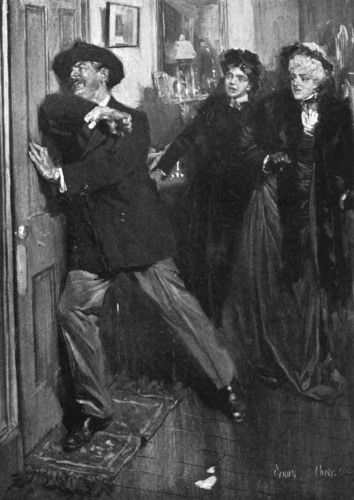
“ ‘Not too late, I think,’ she whispered hurriedly. ‘Break it open, Danvers’ ”
because she was afraid that the little Countess would be goaded into confessing her folly to her husband, or to her own parents, when a prosecution for blackmail would inevitably follow. So she risked everything on a big coup, and almost succeeded in getting a thousand pounds from Her Serene Highness, meaning to reassure her, as soon as she had the money, by the statement that the negative and prints had been destroyed. But the appearance of the Grand Duchess of Starkburg-Nauheim this afternoon frightened her into an act of despair. Confronted with the prosecution she dreaded and with the prison she dared not face, she, in a mad moment, attempted to take her life.”
“I suppose now the whole matter will be hushed up.”
“Yes,” replied Lady Molly with a wistful sigh. “The public will never know who assaulted Jane Turner.”
She was naturally a little regretful at that. But it was a joy to see her the day when she was able to assure Her Serene Highness the Countess of Hohengebirg that she need never again fear the consequences of that fatal day’s folly.
VI. A CASTLE IN BRITTANY
Yes! we are just back from our holiday, my dear lady and I—a well-earned holiday, I can tell you that.
We went to Porhoët, you know—a dear little village in the hinterland of Brittany, not very far from the coast; an enchanting spot, hidden away in a valley, bordered by a mountain stream, wild, romantic, picturesque—Brittany, in fact.
We had discovered the little place quite accidentally last year, in the course of our wanderings, and stayed there then about three weeks, laying the foundations of that strange adventure which reached its culminating point just a month ago.
I don’t know if the story will interest you, for Lady Molly’s share in the adventure was purely a private one and had nothing whatever to do with her professional work. At the same time it illustrates in a very marked manner that extraordinary faculty which she possesses of divining her fellow-creatures’ motives and intentions.
We had rooms and pension in the dear little convent on the outskirts of the village, close to the quaint church and the picturesque presbytery, and soon we made the acquaintance of the Curé, a simple-minded, kindly old man, whose sorrow at the thought that two such charming English ladies as Lady Molly and myself should be heretics was more than counterbalanced by his delight in having someone of the “great outside world”—as he called it—to talk to, whilst he told us quite ingenuously something of his own simple life, of this village which he loved, and also of his parishioners.
One personality among the latter occupied his thoughts and conversation a great deal, and I must say interested us keenly. It was that of Miss Angela de Genneville, who owned the magnificent château of Porhoët, one of the seven wonders of architectural France. She was an Englishwoman by birth—being of a Jersey family—and was immensely wealthy, her uncle, who was also her godfather, having bequeathed to her the largest cigar factory in St. Heliers, besides three-quarters of a million sterling.
To say that Miss de Genneville was eccentric was but to put it mildly; in the village she was generally thought to be quite mad. The Curé vaguely hinted that a tragic love story was at the bottom of all her eccentricities. Certain it is that, for no apparent reason, and when she was still a youngish woman, she had sold the Jersey business and realised the whole of her fortune. After two years of continuous travelling, she came to Brittany on a visit to her sister—the widowed Marquise de Terhoven, who owned a small property close to Porhoët, and lived there in retirement and poverty with her only son, Amédé.
Miss Angela de Genneville was agreeably taken with the beauty and quietude of this remote little village. The beautiful château of Porhoët being for sale at the time, she bought it, took out letters of naturalisation, became a French subject, and from that moment never went outside the precincts of her newly acquired domain.
She never returned to England, and, with the exception of the Curé and her own sister and nephew, saw no one beyond her small retinue of servants.
But the dear old Curé thought all the world of her, for she was supremely charitable to him and to the poor, and scarcely a day passed but he told us something either of her kindness or of her eccentric ways. One day he arrived at the convent at an unaccustomed hour; we had just finished our simple déjeuner of steaming coffee and rolls when we saw him coming towards us across the garden.
That he was excited and perturbed was at once apparent by his hurried gait and by the flush on his kindly face. He bade us a very hasty “Good morning, my daughters!” and plunged abruptly into his subject. He explained with great volubility, which was intended to mask his agitation, that he was the bearer of an invitation to the charming English lady—a curious invitation, ah, yes! perhaps!—Mademoiselle de Genneville—very eccentric—but she is in great trouble—in very serious trouble—and very ill too, now—poor lady—half paralysed and feeble—yes, feeble in the brain—and then her nephew, the Marquis Amédé de Terhoven—such a misguided young man—has got into bad company in that den of wickedness called Paris—since then it has been debts—always debts—his mother is so indulgent!—too indulgent! but an only son!—the charming English ladies would understand. It was very sad—very, very sad—and no wonder Mademoiselle de Genneville was very angry. She had paid Monsieur le Marquis’ debts once, twice, three times—but now she will not pay any more—but she is in great trouble and wants a friend—a female friend, one of her own country, she declares—for he himself, alas! was only a poor curé de village, and did not understand great ladies and their curious ways. It would be true Christian charity if the charming English lady would come and see Mademoiselle.
“But her own sister, the Marquise?” suggested Lady Molly, breaking in on the old man’s volubility.
“Ah! her sister, of course,” he replied with a sigh. “Madame la Marquise—but then she is Monsieur le Marquis’ mother, and the charming English lady would understand—a mother’s heart, of course——”
“But I am a complete stranger to Miss de Genneville,” protested Lady Molly.
“Ah, but Mademoiselle has always remained an Englishwoman at heart,” replied the Curé. “She said to me to-day: ‘I seem to long for an Englishwoman’s handshake, a sober-minded, sensible Englishwoman, to help me in this difficulty. Bring your English friend to me, Monsieur le Curé, if she will come to the assistance of an old woman who has no one to turn to in her distress.’ ”
Of course, after that I knew that my dear lady would yield. Moreover, she was keenly interested in Miss de Genneville, and without further discussion she told Monsieur le Curé that she was quite ready to accompany him to the château of Porhoët.
2
Of course, I was not present at the interview, but Lady Molly has so often told me all that happened and how it happened, and with such a wealth of picturesque and minute detail, that sometimes I find it difficult to realise that I myself was not there in person.
It seems that Monsieur le Curé himself ushered my lady into the presence of Miss Angela de Genneville. The old lady was not alone when they entered; Madame la Marquise de Terhoven, an elderly, somewhat florid woman, whose features, though distinctly coarse, recalled those of her sister, sat on a high-backed chair close to a table, on which her fingers were nervously drumming a tattoo, whilst in the window embrasure stood a young man whose resemblance to both the ladies at once proclaimed him to Lady Molly’s quick perception as the son of the one and nephew of the other—the Marquis de Terhoven, in fact.
Miss de Genneville sat erect in a huge armchair; her face was the hue of yellow wax, the flesh literally shrivelled on the bones, the eyes of a curious, unnatural brilliance; one hand clutched feverishly the arm of her chair, the other, totally paralysed, lay limp and inert on her lap.
“Ah! the Englishwoman at last, thank God!” she said in a high-pitched, strident voice as soon as Lady Molly entered the room. “Come here, my dear, for I have wanted one of your kind badly. A true-hearted Englishwoman is the finest product of God’s earth, after all’s said and done. Pardieu! but I breathe again,” she added, as my dear lady advanced somewhat diffidently to greet her, and took the trembling hand which Miss Angela extended to her.
“Sit down close to me,” commanded the eccentric old lady, whilst Lady Molly, confused, and not a little angered at finding herself in the very midst of what was obviously a family conclave, was vaguely wondering how soon she could slip away again. But the trembling hand of the paralytic clutched her own slender wrist so tightly, forcing her to sink into a low chair close by, and holding her there as with a grip of steel, that it would have been useless and perhaps cruel to resist.
Satisfied now that her newly found friend, as well as Monsieur le Curé, were prepared to remain by her and to listen to what she had to say, the sick woman turned with a look of violent wrath towards the window embrasure.
“I was just telling that fine nephew of mine that he is counting his chickens before they are hatched. I am not yet dead, as Monsieur my nephew can see; and I have made a will—aye, and placed it where his thievish fingers can never reach it.”
The young man, who up to now had been gazing stolidly out of the window, now suddenly turned on his heel, confronting the old woman, with a look of hate gleaming in his eyes.
“We can fight the will,” here interposed Madame la Marquise, icily.
“On what grounds?” queried the other.
“That you were paralysed and imbecile when you made it,” replied the Marquise, dryly.
Monsieur le Curé, who up to now had been fidgeting nervously with his hat, now raised his hands and eyes up to the ceiling to emphasise the horror which he felt at this callous suggestion. Lady Molly no longer desired to go; the half-paralysed grip on her wrist had relaxed, but she sat there quietly, interested with every fibre of her quick intelligence in the moving drama which was being unfolded before her.
There was a pause now, a silence broken only by the monotonous ticking of a monumental, curious-looking clock which stood in an angle of the room. Miss de Genneville had made no reply to her sister’s cruel taunt, but a look, furtive, maniacal, almost dangerous, now crept into her eyes.
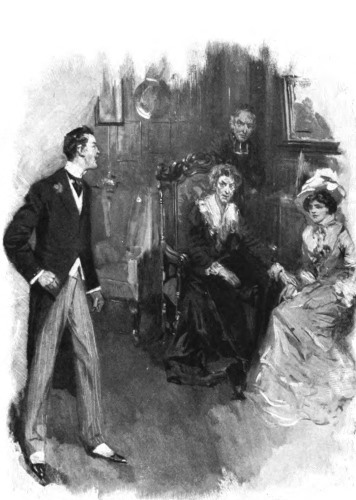
“Confronting the old woman, with a look of hate gleaming in his eyes”
Then she addressed the Curé.
“I pray you pen, ink and paper—here, on this table,” she requested. Then as he complied with alacrity, she once more turned to her nephew, and pointing to the writing materials:
“Sit down and write, Amédé,” she commanded.
“Write what?” he queried.
“A confession, my nephew,” said the old woman, with a shrill laugh. “A confession of those little peccadilloes of yours, which, unless I come to your rescue now, will land you for seven years in a penal settlement, if I mistake not. Eh, my fine nephew?”
“A confession?” retorted Amédé de Terhoven savagely. “Do you take me for a fool?”
“No, my nephew, I take you for a wise man—who understands that his dear aunt will not buy those interesting forgeries, perpetrated by Monsieur le Marquis Amédé de Terhoven, and offered to her by Rubinstein the money-lender, unless that confession is written and signed by you. Write Amédé, write that confession, my dear nephew, if you do not wish to see yourself in the dock on a charge of forging your aunt’s name to a bill for one hundred thousand francs.”
Amédé muttered a curse between his teeth. Obviously the old woman’s shaft had struck home. He knew himself to be in a hopeless plight. It appears that a money-lender had threatened to send the forged bills to Monsieur le Procureur de la République unless they were paid within twenty-four hours, and no one could pay them but Miss de Genneville, who had refused to do it except at the price of this humiliating confession.
A look of intelligence passed between mother and son. Intercepted by Lady Molly and interpreted by her, it seemed to suggest the idea of humouring the old aunt, for the moment, until the forgeries were safely out of the money-lender’s hands, then of mollifying her later on, when perhaps she would have forgotten, or sunk deeper into helplessness and imbecility.
As if in answer to his mother’s look the young man now said curtly:
“I must know what use you mean to make of the confession if I do write it.”
“That will depend on yourself,” replied Mademoiselle, dryly. “You may be sure that I will not willingly send my own nephew to penal servitude.”
For another moment the young man hesitated, then he sat down, sullen and wrathful, and said:
“I’ll write—you may dictate——”
The old woman laughed a short, dry, sarcastic laugh. Then, at her dictation, Amédé wrote:
“I, Amédé, Marquis de Terhoven, hereby make confession to having forged Mademoiselle Angela de Genneville’s name to the annexed bills, thereby obtaining the sum of one hundred thousand francs from Abraham Rubinstein, of Brest.”
“Now, Monsieur le Curé, will you kindly witness le Marquis’ signature?” said the irascible old lady when Amédé had finished writing; “and you, too, my dear?” she added, turning to Lady Molly.
My dear lady hesitated for a moment. Naturally she did not desire to be thus mixed up in this family feud, but a strange impulse had drawn her sympathy to this eccentric old lady, who, in the midst of her semi-regal splendour seemed so forlorn, between her nephew, who was a criminal and a blackguard, and her sister, who was but little less contemptible.
Obeying this impulse, and also a look of entreaty from the Curé, she affixed her own signature as witness to the document, and this despite the fact that both the Marquise and her son threw her a look of hate which might have made a weaker spirit tremble with foreboding.
Not so Lady Molly. Those very same threatening looks served but to decide her. Then, at Mademoiselle’s command, she folded up the document, slipped it into an envelope, sealed it, and finally addressed it to M. le Procureur de la République, resident at Caen.
Amédé watched all these proceedings with eyes that were burning with impotent wrath.
“This letter,” now resumed the old lady, more calmly, “will be sent under cover to my lawyer, Maître Vendôme, of Paris, who drew up my will, with orders only to post it in case of certain eventualities, which I will explain later on. In the meanwhile, my dear nephew, you may apprise your friend, Abraham Rubinstein, that I will buy back those interesting forgeries of yours the day on which I hear from Maître Vendôme that he has safely received my letter with this enclosure.”
“This is infamous——” here broke in the Marquise, rising in full wrath, unable to control herself any longer. “I’ll have you put under restraint as a dangerous lunatic. I——”
“Then, of course, I could not buy back the bills from Rubinstein,” rejoined Mademoiselle, calmly.
Then, as the Marquise subsided—cowed, terrified, realising the hopelessness of her son’s position—the old lady turned placidly to my dear lady, whilst her trembling fingers once more clutched the slender hand of her newly found English friend.
“I have asked you, my dear, and Monsieur le Curé, to come to me to-day,” she said, “because I wish you both to be of assistance to me in the carrying out of my dying wishes. You must promise me most solemnly, both of you, that when I am dead you will carry out these wishes to the letter. Promise!” she added with passionate earnestness.
The promise was duly given by Lady Molly and the old Curé, then Mademoiselle resumed more calmly:
“And now I want you to look at that clock,” she said abruptly, with seeming irrelevance. “It is an old heirloom which belonged to the former owners of Porhoët, and which I bought along with the house. You will notice that it is one of the most remarkable pieces of mechanism which brain of man has ever devised, for it has this great peculiarity, that it goes for three hundred and sixty-six days consecutively, keeping most perfect time. When the works have all but run down, the weights—which are enormous—release a certain spring, and the great doors of the case open of themselves, thus allowing the clock to be wound up. After that is done, and the doors pushed to again, no one can open them until another three hundred and sixty-six days have gone by—that is to say, not without breaking the case to pieces.”
Lady Molly examined the curious old clock with great attention. Vaguely she guessed already what the drift of the old lady’s curious explanations would be.
“Two days ago,” continued Mademoiselle, “the clock was open, and Monsieur le Curé wound it up, but before I pushed the doors to again I slipped certain papers into the case—you remember, Monsieur?”
“Yes, Mademoiselle, I remember,” responded the old man.
“Those papers were my last will and testament, bequeathing all I possess to the parish of Porhoët,” said Miss de Genneville, dryly, “and now the doors of the massive case are closed. No one can get at my will for another three hundred and sixty-four days—no one,” she added with a shrill laugh, “not even my nephew, Amédé de Terhoven.”
A silence ensued, only broken by the rustle of Madame la Marquise’s silk dress as she shrugged her shoulders and gave a short, sarcastic chuckle.
“My dear,” resumed Mademoiselle, looking straight into Lady Molly’s eager, glowing face, “you must promise me that, three hundred and sixty-four days hence, that is to say on the 20th September next year, you and Monsieur le Curé—or one of you if the other be incapacitated—will be present in this room at this hour when the door of the clock will open. You will then wind up the family heirloom, take out the papers which you will find buried beneath the weights, and hand them over to Maître Vendôme for probate at the earliest opportunity. Monseigneur the Bishop of Caen, the Mayor of this Commune, and the Souspréfet of this Department have all been informed of the contents of my will, and also that it is practically in the keeping of le Curé de Porhoët, who, no doubt, realises what the serious consequences to himself would be if he failed to produce the will at the necessary time.”
The poor Curé gasped with terror.
“But—but—but——” he stammered meekly, “I may be forcibly prevented from entering the house—I might be ill or——”
He shuddered with an unavowable fear, then added more calmly:
“I might be unjustly accused then of stealing the will—of defrauding the poor of Porhoët in favour of—Mademoiselle’s direct heirs.”
“Have no fear, my good friend,” said Mademoiselle, dryly; “though I have one foot in the grave I am not quite so imbecile as my dear sister and nephew here would suggest, and I have provided for every eventuality. If you are ill or otherwise prevented by outside causes from being present here on the day and hour named, this charming English lady will be able to replace you. But if either of you is forcibly prevented from entering this house, or if, having entered this room, the slightest violence or even pressure is put upon you, or if you should find the clock broken, damaged and—stripped of its contents, all you need do is to apprise Maître Vendôme of the fact. He will know how to act.”
“What would he do?”
“Send a certain confession we all know of to Monsieur le Procureur de la République,” replied the old lady, fixing the young Marquis Amédé with her irascible eye. “That same confession,” she continued lightly, “Maître Vendôme is instructed to destroy if you, Monsieur, and my English friend here, and the clock, are all undamaged on the eventful day.”
There was silence in the great, dark room for awhile, broken only by the sarcastic chuckle of the enfeebled invalid, tired out after this harrowing scene, wherein she had pitted her half-maniacal ingenuity against the greed and rapacity of a conscienceless roué.
That she had hemmed her nephew and sister in on every side could not be denied. Lady Molly herself felt somewhat awed at this weird revenge conceived by the outraged old lady against her grasping relatives.
She was far too interested in the whole drama to give up her own part in it, and, as she subsequently explained to me, she felt it her duty to remain the partner and co-worker of the poor Curé in this dangerous task of securing to the poor of Porhoët the fortune which otherwise would be squandered away on gaming tables and race-courses.
For this, and many reasons too complicated to analyse, she decided to accept her share in the trust imposed upon her by her newly-found friend.
Neither the Marquise nor her son took any notice of Lady Molly as she presently took leave of Mademoiselle de Genneville, who, at the last, made her take a solemn oath that she would stand by the Curé and fulfil the wishes of a dying and much-wronged woman.
Much perturbed, Monsieur le Curé went away. Lady Molly went several times after that to the château of Porhoët to see the invalid, who had taken a violent fancy to her. In October we had, perforce, to return to England and to work, and the following spring we had news from the Curé that Mademoiselle de Genneville was dead.
3
Lady Molly had certainly been working too hard, and was in a feeble state of health when we reached Porhoët the following 19th of September, less than twenty-four hours before the eventful moment when the old clock would reveal the will and testament of Mademoiselle de Genneville.
We walked straight from the station to the presbytery, anxious to see the Curé and to make all arrangements for to-morrow’s business. To our terrible sorrow and distress, we were informed by the housekeeper that the Curé was very seriously ill at the hospital at Brest, whither he had been removed by the doctor’s orders.
This was the first inkling I had that things would not go as smoothly as I had anticipated. Miss de Genneville’s dispositions with regard to the sensational disclosure of her will had, to my mind, been so ably taken that it had never struck me until now that the Marquise de Terhoven and her precious son would make a desperate fight before they gave up all thoughts of the coveted fortune.
I imagined the Marquis hemmed in on every side; any violence offered against the Curé or Lady Molly when they entered the château in order to accomplish the task allotted to them being visited by the sending of the confession to Monsieur le Procureur de la République, when prosecution for forgery would immediately follow. Damage to the clock itself would be punished in the same way.
But I had never thought of sudden illnesses, of—heaven help us!—poison or unaccountable accidents to either the Curé or to the woman I loved best in all the world.
No wonder Lady Molly looked pale and fragile as, having thanked the housekeeper, we found our way back in silence to the convent where we had once again engaged rooms.
Somehow the hospitality shown us last year had lost something of its cordiality. Moreover, our bedrooms this time did not communicate with one another, but opened out independently on to a stone passage.
The sister who showed us upstairs explained, somewhat shamefacedly, that as the Mother Superior had not expected us, she had let the room which was between our two bedrooms to a lady visitor, who, however, was ill in bed at the present moment.
That sixth sense, of which so much has been said and written, but which I will not attempt to explain, told me plainly enough that we were no longer amidst friends in the convent.
Had bribery been at work? Was the lady visitor a spy set upon our movements by the Terhovens? It was impossible to say. I could no longer chase away the many gloomy forebodings which assailed me the rest of that day and drove away sleep during the night. I can assure you that in my heart I wished all eccentric old ladies and their hidden wills at the bottom of the sea.
My dear lady was apparently also very deeply perturbed; any attempt on my part to broach the subject of Miss de Genneville’s will was promptly and authoritatively checked by her. At the same time I knew her well enough to guess that all these nameless dangers which seemed to have crept up round her only served to enhance her determination to carry out her old friend’s dying wishes to the letter.
We went to bed quite early; for the first time without that delightful final gossip, when events, plans, surmises and work were freely discussed between us. The unseen lady visitor in the room which separated us acted as a wet blanket on our intimacy.
I stayed with Lady Molly until she was in bed. She hardly talked to me whilst she undressed, but when I kissed her “good-night” she whispered almost inaudibly right into my ear:
“The Terhoven faction are at work. They may waylay you and offer you a bribe to keep me out of the château to-morrow. Pretend to fall in with their views. Accept all bribes and place yourself at their disposal. I must not say more now. We are being spied upon.”
That my lady was, as usual, right in her surmises was proved within the next five minutes. I had slipped out of her room, and was just going into mine, when I heard my name spoken hardly above a whisper, whilst I felt my arm gently seized from behind.
An elderly, somewhat florid, woman stood before me attired in a dingy-coloured dressing-gown. She was pointing towards my own bedroom door, implying her desire to accompany me to my room. Remembering my dear lady’s parting injunctions, I nodded in acquiescence. She followed me, after having peered cautiously up and down the passage.
Then, when the door was duly closed, and she was satisfied that we were alone, she said very abruptly:
“Miss Granard, tell me! you are poor, eh?—a paid companion to your rich friend, what?”
Still thinking of Lady Molly’s commands, I replied with a pathetic sigh.
“Then,” said the old lady, eagerly, “would you like to earn fifty thousand francs?”
The eagerness with which I responded “Rather!” apparently pleased her, for she gave a sigh of satisfaction.
“You know the story of my sister’s will—of the clock?” she asked eagerly: “of your friend’s rôle in this shameless business?”
Once more I nodded. I knew that my lady had guessed rightly. This was the Marquise de Terhoven, planted here in the convent to gain my confidence, to spy on Lady Molly, and to offer me a bribe.
Now for some clever tactics on my part.
“Can you prevent your friend from being at the château to-morrow before one o’clock?” asked the Marquise.
“Easily,” I replied calmly.
“How?”
“She is ill, as you know. The doctor has ordered her a sleeping draught. I administer it. I can arrange that she has a strong dose in the morning instead of her other medicine. She will sleep till the late afternoon.”
I rattled this off glibly in my best French. Madame la Marquise heaved a deep sigh of relief.
“Ah! that is good!” she said. “Then listen to me. Do as I tell you, and to-morrow you will be richer by fifty thousand francs. Come to the château in the morning, dressed in your friend’s clothes. My son will be there; together you will assist at the opening of the secret doors, and when my son has wound up the old clock himself, he will place fifty thousand francs in your hands.”
“But Monsieur le Curé?” I suggested tentatively.
“He is ill,” she replied curtly.
But as she spoke these three words there was such an evil sneer in her face, such a look of cruel triumph in her eyes, that all my worst suspicions were at once confirmed.
Had these people’s unscrupulous rapacity indeed bribed some needy country practitioner to put the Curé temporarily out of the way? It was too awful to think of, and I can tell you that I needed all my presence of mind, all my desire to act my part bravely and intelligently to the end, not to fly from this woman in horror.
She gave me a few more instructions with regard to the services which she and her precious son would expect of me on the morrow. It seems that, some time before her death, Miss de Genneville had laid strict injunctions on two of her most trusted men-servants to remain in the château, and to be on the watch on the eventful 20th day of September of this year, lest any serious violence be done to the English lady or to the Curé. It was with a view to allay any suspicion which might arise in the minds of these two men that the Marquis desired me to impersonate Lady Molly to-morrow, and to enter with him—on seemingly friendly terms—the room where stood the monumental clock.
For these services, together with those whereby Lady Molly was to be sent into a drugged sleep whilst the theft of the will was being carried through, I—Mary Granard—was to receive from Monsieur le Marquis de Terhoven the sum of fifty thousand francs.
All these matters being settled to this wicked woman’s apparent satisfaction, she presently took hold of both my hands, shook them warmly, and called me her dearest friend; assured me of everlasting gratitude, and finally, to my intense relief, slipped noiselessly out of my room.
4
I surmised—I think correctly—that Madame la Marquise would spend most of the night with her ear glued to the thin partition which separated her room from that of Lady Molly; so I did not dare to go and report myself and the momentous conversation which I had just had, and vaguely wondered when I should have an opportunity of talking matters over with my dear lady without feeling that a spy was at my heels.
The next morning when I went into her room, to my boundless amazement—and before I had time to utter a word—she moaned audibly, as if in great pain, and said feebly, but very distinctly:
“Oh, Mary! I’m so glad you’ve come. I feel terribly ill. I haven’t had a wink of sleep all night, and I am too weak to attempt to get up.”
Fortunately my perceptions had not been dulled by the excitement of the past few hours, and I could see that she was not so ill as she made out. Her eyes sought mine as I approached her bed, and her lips alone framed the words which I believed I interpreted correctly.
“Do as they want. I stay in bed. Will explain later.”
Evidently she had reason to think that we were being closely watched; but what I could not understand was, what did she expect would happen if she herself were not present when the opening of the clock door would disclose the will? Did she want me to snatch the document: to bear the brunt of the Terhovens’ wrath and disappointment? It was not like her to be afraid of fulfilling a duty, however dangerous that fulfilment might prove; and it certainly was not like her to break a promise given to a dying person.
But, of course, my business was to obey. Assuming that our movements were being watched, I poured out a dose of medicine for my dear lady, which she took and then fell back on her pillows as if exhausted.
“I think I could sleep now, Mary,” she said; “but wake me later on; I must be at the château by twelve o’clock, you know.”
As one of Lady Molly’s boxes was in my room, I had no difficulty in arraying myself in some of her clothes. Thus equipped and closely veiled, still ignorant of my lady’s plans, anxious, but determined to obey like a soldier, blindly and unquestioningly, I made my way to the château a little before noon.
An old butler opened the door in answer to my ring, and in the inner hall sat the Marquise de Terhoven, whilst her son was walking agitatedly up and down.
“Ah! here comes my lady,” said the Marquise, with easy unconcern. “You have come, my lady,” she added, rising and taking my hand, “to perform a duty which will rob my son of a fortune which by right should have been his. We can put no hindrance in your way, under penalty of an appalling disgrace which would then fall on my son; moreover, my late sister has filled this house with guards and spies. So, believe me, you need have no fear. You can perform your duty undisturbed. Perhaps you will not object to my son keeping you company. My precious sister had the door of her room removed before her death and a curtain put in its stead,” she concluded with what was intended to be the sneer of a disappointed fortune-hunter, “so the least call from you will bring her spies to your assistance.”
Without a word the Marquis and I bowed to one another, then, preceded by the old family butler, we went up the monumental staircase to what I suppose had been the eccentric old lady’s room.
The butler drew the portière curtain aside and he remained in the corridor whilst we went within. There stood the massive clock exactly as my lady had often described it to me. It was ticking with slow and deep-toned majesty.
Monsieur le Marquis pointed to an armchair for me. He was obviously in a state of terrible nerve-tension. He could not sit still, and his fingers were incessantly clasped and unclasped with a curious, febrile movement, which betrayed his intense agitation.
I was about to make a remark when he abruptly seized my wrist, placed one finger to his lips, and pointed in the direction of the portière. Apparently he thought that someone was on the watch outside, but the clock itself was so placed that it could not be seen by anyone who was not actually in the room.
After that we were both silent, whilst that old piece of mechanism ticked on relentlessly, still hiding the secret which it contained.
I would have given two years’ salary to know what Lady Molly would have wished me to do. Frankly, I fully expected to see her walk in at any moment. I could not bring myself to believe that she meant to shirk her duty.
But she had said to me, “Fall in with their views,” so that when, presently, the Marquis beckoned to me across the room to come and examine the clock, I obeyed readily enough. I felt, by that time, as if my entire body was stuffed with needles and pins, which were pricking my nerves and skin until I could have yelled with the agony of the sensation.
I walked across the room as if in a dream, and looked at the curious clock which, in less than fifteen minutes, would reveal its hidden secret. I suppose cleverer people than poor Mary Granard could enter into long philosophical disquisitions as to this dumb piece of mechanism which held the fate of this ruined, unscrupulous gambler safely within its doors; but I was only conscious of that incessant tick, tick, tick, whilst my eyes literally ached with staring at the door.
I don’t know now how it all happened, for, of course, I was taken unawares; but the next moment I found myself quite helpless, hardly able to breathe, for a woollen scarf was being wound round my mouth, whilst two strong arms encircled my body so that I could not move.
“This is only a protection for myself, my dear Miss Granard,” a trembling voice whispered in my ear; “keep quite still; no harm will come to you. In ten minutes you shall have your fifty thousand francs in your pocket, and can walk unconcernedly out of the château. Neither your English lady nor Monsieur le Curé can say that they suffered any violence, nor will the clock be damaged. What happens after that I care not. The law cannot wrest the old fool’s fortune from me, once I have destroyed her accursed will.”
To begin to tell you what passed in my mind then were an impossibility. Did I actually guess what would happen, and what my dear lady had planned? Or was it merely the ingrafted sympathy which exists between her and me which caused me to act blindly in accordance with her wishes?
“Fall in with their views. Take their bribes,” she had said, and I—like a soldier—obeyed this command to the letter.
I remained absolutely still, scarcely moving an eyelid as I watched the face of the clock, the minutes speeding on—now three—now five—now ten——
I could hear the Marquis’ stertorous breathing close beside me.
Was I dreaming, or did I really see now a dark line—the width of a hair—between the massive double doors of the clock case? Oh, how my pulses throbbed!
That dark line was widening perceptibly. The doors were slowly opening! For the moment I almost felt in sympathy with the blackguard who was on the watch with me. His agitation must have been the most exquisite torture.
Now we could distinctly see the glimmer of white paper—not pressed down by the ponderous weights, but lying loosely just inside the doors; and anon, as the aperture widened, the papers fell out just at my feet.
With a smothered, gurgling exclamation which I will not attempt to describe, the Marquis literally fell on that paper, like a hungry wild beast upon its prey. He was on his knees before me, and I could see that the paper was a square envelope, which, with a trembling hand, he tore open.
It contained a short document whereon the signature “Amédé de Terhoven” was clearly visible. It was the confession of forgery made by the young Marquis just a year ago; there were also a few bank-notes: some hundred thousand francs, perhaps. The young man threw them furiously aside, and once more turned to the clock. The doors were wide open, but they revealed nothing save the huge and complicated mechanism of the clock.
Mademoiselle de Genneville—eccentric and far-seeing
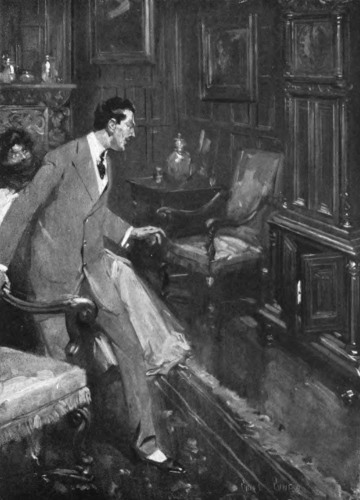
“Now we could distinctly see the glimmer of white paper”
to the last—had played this gigantic hoax on her scheming relatives. Whilst they directed all their unscrupulous energies towards trying to obtain possession of her will in one place, she had calmly put it securely somewhere else.
Meantime, Monsieur le Marquis had sufficient presence of mind, and, I must own, sufficient dignity, not only to release me from my bonds but also to offer me the fifty thousand francs which he had promised me.
“I can wind up the clock now,” he said dully, “and you can walk straight out of this place. No one need know that you impersonated your friend. She, no doubt, knew of this—hoax; therefore we found the scheme to keep her out of the way so easy of accomplishment. It was a grisly joke, wasn’t it? How the old witch must be chortling in her grave!”
Needless to say, I did not take his money. He escorted me downstairs silently, subdued, no doubt, by the spirit of hatred which had followed him up from the land of shadows.
He even showed no surprise when, on reaching the hall, he was met by his late aunt’s lawyer, Maître Vendôme, and also by Lady Molly, who had just arrived. Madame la Marquise de Terhoven was nowhere to be seen.
My dear lady smiled at me approvingly, and when I came near her she contrived to draw me aside and to whisper hurriedly:
“You have done admirably, Mary. I came to fetch you. But now that this young blackguard is thoroughly outwitted, we may as well go, for our work here is done.”
The Marquis did not even glance at her as she slightly bowed her head to him, took leave of Maître Vendôme, and finally walked out of the château with me.
As soon as we were out in the open air I begged for an explanation.
“Maître Vendôme has Mademoiselle’s will,” she replied. “She had enjoined him to read it in the château to-day in the presence of the three trustees appointed for the poor of Porhoët, who inherit all her wealth.”
“And the Terhovens?” I asked.
“They’ve got his confession back,” she said dryly, “and they will receive an annuity from the trustees.”
“And you knew this all along?” I rejoined somewhat reproachfully.
“Yes, so did the Curé, but Mademoiselle made me swear a most solemn oath not to reveal her secret even to you; she was so afraid of the machinations of the Terhovens. You see,” continued Lady Molly, smiling at my eagerness, “Miss de Genneville possessed the ancient key wherewith she could open the clock case at any time. Obviously, even so perfect a piece of mechanism might go wrong, when examination and re-adjustment of the works would be necessary. After the family conclave wherein she had announced that her will was hidden in the clock, I—at my next interview with her—begged her to modify this idea, to send her will to her solicitor, but to leave the Terhovens under the impression that it was still lying in its strange hiding place. At first she refused to listen to me or to discuss the subject, but I am happy to say that I finally succeeded in persuading her, with what result you already know.”
“But poor Monsieur le Curé!” I ejaculated.
Her bright eyes gleamed with merriment.
“Oh! that was a final little hoax. He himself, poor dear, was afraid lest he might blurt out the whole thing. His illness was partly a sham, and he is quite all right again now, but the doctor at the Brest hospital is a great friend of his, and is keeping him there until all this business has blown over.”
“I was the only one who was kept in the dark,” I concluded ruefully.
“Yes, Mary, dear,” said my dear lady, gently; “it was a promise, remember. But I never thought that we should get so much excitement outside our own professional work.”
It certainly had been a non-professional experience; but here, too, as in the detection of crime, her keen intuition had proved more than a match for an unscrupulous blackguard, and certainly on the 20th day of September last I lived through the most exciting ten minutes of my life.
VII. A CHRISTMAS TRAGEDY
It was a fairly merry Christmas party, although the surliness of our host somewhat marred the festivities. But imagine two such beautiful young women as my own dear lady and Margaret Ceely, and a Christmas Eve Cinderella in the beautiful ball-room at Clevere Hall, and you will understand that even Major Ceely’s well-known cantankerous temper could not altogether spoil the merriment of a good, old-fashioned, festive gathering.
It is a far cry from a Christmas Eve party to a series of cattle-maiming outrages, yet I am forced to mention these now, for although they were ultimately proved to have no connection with the murder of the unfortunate Major, yet they were undoubtedly the means whereby the miscreant was enabled to accomplish the horrible deed with surety, swiftness, and—as it turned out afterwards—a very grave chance of immunity.
Everyone in the neighbourhood had been taking the keenest possible interest in those dastardly outrages against innocent animals. They were either the work of desperate ruffians who stick at nothing in order to obtain a few shillings, or else of madmen with weird propensities for purposeless crimes.
Once or twice suspicious characters had been seen lurking about in the fields, and on more than one occasion a cart was heard in the middle of the night driving away at furious speed. Whenever this occurred the discovery of a fresh outrage was sure to follow, but, so far, the miscreants had succeeded in baffling not only the police, but also the many farm hands who had formed themselves into a band of volunteer watchmen, determined to bring the cattle maimers to justice.
We had all been talking about these mysterious events during the dinner which preceded the dance at Clevere Hall; but later on, when the young people had assembled, and when the first strains of “The Merry Widow” waltz had set us aglow with prospective enjoyment, the unpleasant topic was wholly forgotten.
The guests went away early, Major Ceely, as usual, doing nothing to detain them; and by midnight all of us who were staying in the house had gone up to bed.
My dear lady and I shared a bedroom and dressing-room together, our windows giving on the front. Clevere Hall is, as you know, not very far from York, on the other side of Bishopthorpe, and is one of the finest old mansions in the neighbourhood, its only disadvantage being that, in spite of the gardens being very extensive in the rear, the front of the house lies very near the road.
It was about two hours after I had switched off the electric light and called out “Good-night” to my dear lady, that something roused me out of my first sleep. Suddenly I felt very wide-awake, and sat up in bed. Most unmistakably—though still from some considerable distance along the road—came the sound of a cart being driven at unusual speed.
Evidently my dear lady was also awake. She jumped out of bed and, drawing aside the curtains, looked out of the window. The same idea had, of course, flashed upon us both, at the very moment of waking: all the conversations anent the cattle-maimers and their cart, which we had heard since our arrival at Clevere, recurring to our minds simultaneously.
I had joined Lady Molly beside the window, and I don’t know how many minutes we remained there in observation, not more than two probably, for anon the sound of the cart died away in the distance along a side road. Suddenly we were startled with a terrible cry of “Murder! Help! Help!” issuing from the other side of the house, followed by an awful, deadly silence. I stood there near the window shivering with terror, while my dear lady, having already turned on the light, was hastily slipping into some clothes.
The cry had, of course, aroused the entire household, but my dear lady was even then the first to get downstairs, and to reach the garden door at the back of the house, whence the weird and despairing cry had undoubtedly proceeded.
That door was wide open. Two steps lead from it to the terraced walk which borders the house on that side, and along these steps Major Ceely was lying, face downwards, with arms outstretched, and a terrible wound between his shoulder-blades.
A gun was lying close by—his own. It was easy to conjecture that he, too, hearing the rumble of the wheels, had run out, gun in hand, meaning, no doubt, to effect, or at least to help, in the capture of the escaping criminals. Someone had been lying in wait for him; that was obvious—someone who had perhaps waited and watched for this special opportunity for days, or even weeks, in order to catch the unfortunate man unawares.
Well, it were useless to recapitulate all the various little incidents which occurred from the moment when Lady Molly and the butler first lifted the Major’s lifeless body from the terrace steps until that instant when Miss Ceely, with remarkable coolness and presence of mind, gave what details she could of the terrible event to the local police inspector and to the doctor, both hastily summoned.
These little incidents, with but slight variations, occur in every instance when a crime has been committed. The broad facts alone are of weird and paramount interest.
Major Ceely was dead. He had been stabbed with amazing sureness and terrible violence in the back. The weapon used must have been some sort of heavy, clasp knife. The murdered man was now lying in his own bedroom upstairs, even as the Christmas bells on that cold, crisp morning sent cheering echoes through the stillness of the air.
We had, of course, left the house, as had all the other guests. Everyone felt the deepest possible sympathy for the beautiful young girl who had been so full of the joy of living but a few hours ago, and was now the pivot round which revolved the weird shadow of tragedy, of curious suspicions and of an ever-growing mystery. But at such times all strangers, acquaintances, and even friends in a house, are only an additional burden to an already overwhelming load of sorrow and of trouble.
We took up our quarters at the “Black Swan,” in York. The local superintendent, hearing that Lady Molly had been actually a guest at Clevere on the night of the murder, had asked her to remain in the neighbourhood.
There was no doubt that she could easily obtain the chief’s consent to assist the local police in the elucidation of this extraordinary crime. At this time both her reputation and her remarkable powers were at their zenith, and there was not a single member of the entire police force in the kingdom who would not have availed himself gladly of her help when confronted with a seemingly impenetrable mystery.
That the murder of Major Ceely threatened to become such no one could deny. In cases of this sort, when no robbery of any kind has accompanied the graver crime, it is the duty of the police and also of the coroner to try to find out, first and foremost, what possible motive there could be behind so cowardly an assault; and among motives, of course, deadly hatred, revenge, and animosity stand paramount.
But here the police were at once confronted with the terrible difficulty, not of discovering whether Major Ceely had an enemy at all, but rather which, of all those people who owed him a grudge, hated him sufficiently to risk hanging for the sake of getting him out of the way.
As a matter of fact, the unfortunate Major was one of those miserable people who seem to live in a state of perpetual enmity with everything and everybody. Morning, noon and night he grumbled, and when he did not grumble he quarrelled either with his own daughter or with the people of his household, or with his neighbours.
I had often heard about him and his eccentric, disagreeable ways from Lady Molly, who had known him for many years. She—like everybody in the county who otherwise would have shunned the old man—kept up a semblance of friendship with him for the sake of the daughter.
Margaret Ceely was a singularly beautiful girl, and as the Major was reputed to be very wealthy, these two facts perhaps combined to prevent the irascible gentleman from living in quite so complete an isolation as he would have wished.
Mammas of marriageable young men vied with one another in their welcome to Miss Ceely at garden parties, dances and bazaars. Indeed, Margaret had been surrounded with admirers ever since she had come out of the schoolroom. Needless to say, the cantankerous Major received these pretenders to his daughter’s hand not only with insolent disdain, but at times even with violent opposition.
In spite of this the moths fluttered round the candle, and amongst this venturesome tribe none stood out more prominently than Mr. Laurence Smethick, son of the M.P. for the Pakethorpe division. Some folk there were who vowed that the young people were secretly engaged, in spite of the fact that Margaret was an outrageous flirt and openly encouraged more than one of her crowd of adorers.
Be that as it may, one thing was very certain—namely, that Major Ceely did not approve of Mr. Smethick any more than he did of the others, and there had been more than one quarrel between the young man and his prospective father-in-law.
On that memorable Christmas Eve at Clevere none of us could fail to notice his absence; whilst Margaret, on the other hand, had shown marked predilection for the society of Captain Glynne, who, since the sudden death of his cousin, Viscount Heslington, Lord Ullesthorpe’s only son (who was killed in the hunting field last October, if you remember), had become heir to the earldom and its £40,000 a year.
Personally, I strongly disapproved of Margaret’s behaviour the night of the dance; her attitude with regard to Mr. Smethick—whose constant attendance on her had justified the rumour that they were engaged—being more than callous.
On that morning of December 24th—Christmas Eve, in fact—the young man had called at Clevere. I remember seeing him just as he was being shown into the boudoir downstairs. A few moments later the sound of angry voices rose with appalling distinctness from that room. We all tried not to listen, yet could not fail to hear Major Ceely’s overbearing words of rudeness to the visitor, who, it seems, had merely asked to see Miss Ceely, and had been most unexpectedly confronted by the irascible and extremely disagreeable Major. Of course, the young man speedily lost his temper, too, and the whole incident ended with a very unpleasant quarrel between the two men in the hall, and with the Major peremptorily forbidding Mr. Smethick ever to darken his doors again.
On that night Major Ceely was murdered.
2
Of course, at first, no one attached any importance to this weird coincidence. The very thought of connecting the idea of murder with that of the personality of a bright, good-looking young Yorkshireman like Mr. Smethick seemed, indeed, preposterous, and with one accord all of us who were practically witnesses to the quarrel between the two men, tacitly agreed to say nothing at all about it at the inquest, unless we were absolutely obliged to do so on oath.
In view of the Major’s terrible temper, this quarrel, mind you, had not the importance which it otherwise would have had; and we all flattered ourselves that we had well succeeded in parrying the coroner’s questions.
The verdict at the inquest was against some person or persons unknown; and I, for one, was very glad that young Smethick’s name had not been mentioned in connection with this terrible crime.
Two days later the superintendent at Bishopthorpe sent an urgent telephonic message to Lady Molly, begging her to come to the police-station immediately. We had the use of a motor all the while that we stayed at the “Black Swan,” and in less than ten minutes we were bowling along at express speed towards Bishopthorpe.
On arrival we were immediately shown into Superintendent Etty’s private room behind the office. He was there talking with Danvers—who had recently come down from London. In a corner of the room, sitting very straight on a high-backed chair, was a youngish woman of the servant class, who, as we entered, cast a quick, and I thought suspicious, glance at us both.
She was dressed in a coat and skirt of shabby-looking black, and although her face might have been called good-looking—for she had fine, dark eyes—her entire appearance was distinctly repellent. It suggested slatternliness in an unusual degree; there were holes in her shoes and in her stockings, the sleeve of her coat was half unsewn, and the braid on her skirt hung in loops all round the bottom. She had very red and very coarse-looking hands, and undoubtedly there was a furtive expression in her eyes, which, when she began speaking, changed to one of defiance.
Etty came forward with great alacrity when my dear lady entered. He looked perturbed, and seemed greatly relieved at sight of her.
“She is the wife of one of the outdoor men at Clevere,” he explained rapidly to Lady Molly, nodding in the direction of the young woman, “and she has come here with such a queer tale that I thought you would like to hear it.”
“She knows something about the murder?” asked Lady Molly.
“Noa! I didn’t say that!” here interposed the woman, roughly, “doan’t you go and tell no lies, Master Inspector. I thought as how you might wish to know what my husband saw on the night when the Major was murdered, that’s all; and I’ve come to tell you.”
“Why didn’t your husband come himself?” asked Lady Molly.
“Oh, Haggett ain’t well enough—he——” she began explaining, with a careless shrug of the shoulders, “so to speak——”
“The fact of the matter is, my lady,” interposed Etty, “this woman’s husband is half-witted. I believe he is only kept on in the garden because he is very strong and can help with the digging. It is because his testimony is so little to be relied on that I wished to consult you as to how we should act in the matter.”
“What is his testimony, then?”
“Tell this lady what you have just told us, Mrs. Haggett, will you?” said Etty, curtly.
Again that quick, suspicious glance shot into the woman’s eyes. Lady Molly took the chair which Danvers had brought forward for her, and sat down opposite Mrs. Haggett, fixing her earnest, calm gaze upon her.
“There’s not much to tell,” said the woman, sullenly. “Haggett is certainly queer in his head sometimes—and when he is queer he goes wandering about the place of nights.”
“Yes?” said my lady, for Mrs. Haggett had paused awhile and now seemed unwilling to proceed.
“Well!” she resumed with sudden determination, “he had got one of his queer fits on on Christmas Eve, and didn’t come in till long after midnight. He told me as how he’d seen a young gentleman prowling about the garden on the terrace side. He heard the cry of ‘Murder’ and ‘Help’ soon after that, and ran in home because he was frightened.”
“Home?” asked Lady Molly, quietly, “where is home?”
“The cottage where we live. Just back of the kitchen garden.”
“Why didn’t you tell all this to the superintendent before?”
“Because Haggett only told me last night, when he seemed less queer-like. He is mighty silent when the fits are on him.”
“Did he know who the gentleman was whom he saw?”
“No, ma’am—I don’t suppose he did—leastways he wouldn’t say—but——”
“Yes? But?”
“He found this in the garden yesterday,” said the woman, holding out a screw of paper which apparently she had held tightly clutched up to now, “and maybe that’s what brought Christmas Eve and the murder back to his mind.”
Lady Molly took the thing from her, and undid the soiled bit of paper with her dainty fingers. The next moment she held up for Etty’s inspection a beautiful ring composed of an exquisitely carved moonstone surrounded with diamonds of unusual brilliance.
At the moment the setting and the stones themselves were marred by scraps of sticky mud which clung to them; the ring obviously having lain on the ground, and perhaps been trampled on for some days, and then been only very partially washed.
“At any rate you can find out the ownership of the ring,” commented my dear lady after awhile, in answer to Etty’s silent attitude of expectancy. “There would be no harm in that.”
Then she turned once more to the woman.
“I’ll walk with you to your cottage, if I may,” she said decisively, “and have a chat with your husband. Is he at home?”
I thought Mrs. Haggett took this suggestion with marked reluctance. I could well imagine, from her own personal appearance, that her home was most unlikely to be in a fit state for a lady’s visit. However, she could, of course, do nothing but obey, and, after a few muttered words of grudging acquiescence, she rose from her chair and stalked towards the door, leaving my lady to follow as she chose.
Before going, however, she turned and shot an angry glance at Etty.
“You’ll give me back the ring, Master Inspector,” she said with her usual tone of sullen defiance. “ ‘Findings is keepings’ you know.”
“I am afraid not,” replied Etty, curtly; “but there’s always the reward offered by Miss Ceely for information which would lead to the apprehension of her father’s murderer. You may get that, you know. It is a hundred pounds.”
“Yes! I knew that,” she remarked dryly, as, without further comment, she finally went out of the room.
3
My dear lady came back very disappointed from her interview with Haggett.
It seems that he was indeed half-witted—almost an imbecile, in fact, with but a few lucid intervals, of which this present day was one. But, of course, his testimony was practically valueless.
He reiterated the story already told by his wife, adding no details. He had seen a young gentleman roaming on the terraced walk on the night of the murder. He did not know who the young gentleman was. He was going homewards when he heard the cry of “Murder,” and ran to his cottage because he was frightened. He picked up the ring yesterday in the perennial border below the terrace and gave it to his wife.
Two of these brief statements made by the imbecile were easily proved to be true, and my dear lady had ascertained this before she returned to me. One of the Clevere under-gardeners said he had seen Haggett running home in the small hours of that fateful Christmas morning. He himself had been on the watch for the cattle-maimers that night, and remembered the little circumstance quite plainly. He added that Haggett certainly looked to be in a panic.
Then Newby, another outdoor man at the Hall, saw Haggett pick up the ring in the perennial border and advised him to take it to the police.
Somehow, all of us who were so interested in that terrible Christmas tragedy felt strangely perturbed at all this. No names had been mentioned as yet, but whenever my dear lady and I looked at one another, or whenever we talked to Etty or Danvers, we all felt that a certain name, one particular personality, was lurking at the back of all our minds.
The two men, of course, had no sentimental scruples to worry them. Taking the Haggett story merely as a clue, they worked diligently on that, with the result that twenty-four hours later Etty appeared in our private room at the “Black Swan” and calmly informed us that he had just got a warrant out against Mr. Laurence Smethick on a charge of murder, and was on his way even now to effect the arrest.
“Mr. Smethick did not murder Major Ceely,” was Lady Molly’s firm and only comment when she heard the news.
“Well, my lady, that’s as it may be!” rejoined Etty, speaking with that deference with which the entire force invariably addressed my dear lady; “but we have collected a sufficiency of evidence, at any rate, to justify the arrest, and, in my opinion, enough of it to hang any man. Mr. Smethick purchased the moonstone and diamond ring at Nicholson’s in Coney Street about a week ago. He was seen abroad on Christmas Eve by several persons, loitering round the gates at Clevere Hall, somewhere about the time when the guests were leaving after the dance, and, again, some few moments after the first cry of ‘Murder’ had been heard. His own valet admits that his master did not get home that night until long after 2.0 a.m., whilst even Miss Granard here won’t deny that there was a terrible quarrel between Mr. Smethick and Major Ceely less than twenty-four hours before the latter was murdered.”
Lady Molly offered no remark to this array of facts which Etty thus pitilessly marshalled before us, but I could not refrain from exclaiming:
“Mr. Smethick is innocent, I am sure.”
“I hope, for his sake, he may be,” retorted Etty, gravely, “but somehow ’tis a pity that he don’t seem able to give a good account of himself between midnight and two o’clock that Christmas morning.”
“Oh!” I ejaculated, “what does he say about that?”
“Nothing,” replied the man, dryly; “that’s just the trouble.”
Well, of course, as you who read the papers will doubtless remember, Mr. Laurence Smethick, son of Colonel Smethick, M.P., of Pakethorpe Hall, Yorks, was arrested on the charge of having murdered Major Ceely on the night of December 24th-25th, and, after the usual magisterial inquiry, was duly committed to stand his trial at the next York assizes.
I remember well that, throughout his preliminary ordeal, young Smethick bore himself like one who had given up all hope of refuting the terrible charges brought against him, and, I must say, the formidable number of witnesses which the police brought up against him more than explained that attitude.
Of course, Haggett was not called, but, as it happened, there were plenty of people to swear that Mr. Laurence Smethick was seen loitering round the gates of Clevere Hall after the guests had departed on Christmas Eve. The head gardener, who lives at the lodge, actually spoke to him, and Captain Glynne, leaning out of his brougham window, was heard to exclaim:
“Hello, Smethick, what are you doing here at this time of night?”
And there were others, too.
To Captain Glynne’s credit, be it here recorded, he tried his best to deny having recognised his unfortunate friend in the dark. Pressed by the magistrate, he said obstinately:
“I thought at the time that it was Mr. Smethick standing by the lodge gates, but on thinking the matter over I feel sure that I was mistaken.”
On the other hand, what stood dead against young Smethick was, firstly, the question of the ring, and then the fact that he was seen in the immediate neighbourhood of Clevere, both at midnight and again at about two, when some men, who had been on the watch for the cattle-maimers, saw him walking away rapidly in the direction of Pakethorpe.
What was, of course, unexplainable and very terrible to witness was Mr. Smethick’s obstinate silence with regard to his own movements during those fatal hours on that night. He did not contradict those who said that they had seen him at about midnight near the gates of Clevere, nor his own valet’s statements as to the hour when he returned home. All he said was that he could not account for what he did between the time when the guests left the Hall and he himself went back to Pakethorpe. He realised the danger in which he stood, and what caused him to be silent about a matter which might mean life or death to him could not easily be conjectured.
The ownership of the ring he could not and did not dispute. He had lost it in the grounds of Clevere, he said. But the jeweller in Coney Street swore that he had sold the ring to Mr. Smethick on the 18th of December, whilst it was a well-known and an admitted fact that the young man had not openly been inside the gates of Clevere for over a fortnight before that.
On this evidence Laurence Smethick was committed for trial. Though the actual weapon with which the unfortunate Major had been stabbed had not been found, nor its ownership traced, there was such a vast array of circumstantial evidence against the young man that bail was refused.
He had, on the advice of his solicitor, Mr. Grayson—one of the ablest lawyers in York—reserved his defence, and on that miserable afternoon at the close of the year, we all filed out of the crowded court, feeling terribly depressed and anxious.
4
My dear lady and I walked back to our hotel in silence. Our hearts seemed to weigh heavily within us. We felt mortally sorry for that good-looking young Yorkshireman, who, we were convinced, was innocent, yet at the same time seemed involved in a tangled web of deadly circumstances from which he seemed quite unable to extricate himself.
We did not feel like discussing the matter in the open streets, neither did we make any comment when presently, in a block in the traffic in Coney Street, we saw Margaret Ceely driving her smart dog-cart, whilst sitting beside her, and talking with great earnestness close to her ear, sat Captain Glynne.
She was in deep mourning, and had obviously been doing some shopping, for she was surrounded with parcels; so perhaps it was hypercritical to blame her. Yet somehow it struck me that just at the moment when there hung in the balance the life and honour of a man with whose name her own had oft been linked by popular rumour, it showed more than callous contempt for his welfare to be seen driving about with another man who, since his sudden access to fortune, had undoubtedly become a rival in her favours.
When we arrived at the “Black Swan,” we were surprised to hear that Mr. Grayson had called to see my dear lady, and was upstairs waiting.
Lady Molly ran up to our sitting-room and greeted him with marked cordiality. Mr. Grayson is an elderly, dry-looking man, but he looked visibly affected, and it was some time before he seemed able to plunge into the subject which had brought him hither. He fidgeted in his chair, and started talking about the weather.
“I am not here in a strictly professional capacity, you know,” said Lady Molly presently, with a kindly smile and with a view to helping him out of his embarrassment. “Our police, I fear me, have an exaggerated view of my capacities, and the men here asked me unofficially to remain in the neighbourhood and to give them my advice if they should require it. Our chief is very lenient to me, and has allowed me to stay. Therefore, if there is anything I can do——”
“Indeed, indeed there is!” ejaculated Mr. Grayson with sudden energy. “From all I hear, there is not another soul in the kingdom but you who can save this innocent man from the gallows.”
My dear lady heaved a little sigh of satisfaction. She had all along wanted to have a more important finger in that Yorkshire pie.
“Mr. Smethick?” she said.
“Yes; my unfortunate young client,” replied the lawyer. “I may as well tell you,” he resumed after a slight pause, during which he seemed to pull himself together, “as briefly as possible what occurred on December 24th last and on the following Christmas morning. You will then understand the terrible plight in which my client finds himself, and how impossible it is for him to explain his actions on that eventful night. You will understand, also, why I have come to ask your help and your advice. Mr. Smethick considered himself engaged to Miss Ceely. The engagement had not been made public because of Major Ceely’s anticipated opposition, but the young people had been very intimate, and many letters had passed between them. On the morning of the 24th Mr. Smethick called at the Hall, his intention then being merely to present his fiancée with the ring you know of. You remember the unfortunate contretemps that occurred: I mean the unprovoked quarrel sought by Major Ceely with my poor client, ending with the irascible old man forbidding Mr. Smethick the house.
“My client walked out of Clevere feeling, as you may well imagine, very wrathful; on the doorstep, just as he was leaving, he met Miss Margaret, and told her very briefly what had occurred. She took the matter very lightly at first, but finally became more serious, and ended the brief interview with the request that, since he could not come to the dance after what had occurred, he should come and see her afterwards, meeting her in the gardens soon after midnight. She would not take the ring from him then, but talked a good deal of sentiment about Christmas morning, asking him to bring the ring to her at night, and also the letters which she had written him. Well—you can guess the rest.”
Lady Molly nodded thoughtfully.
“Miss Ceely was playing a double game,” continued Mr. Grayson, earnestly. “She was determined to break off all relationship with Mr. Smethick, for she had transferred her volatile affections to Captain Glynne, who had lately become heir to an earldom and £40,000 a year. Under the guise of sentimental twaddle she got my unfortunate client to meet her at night in the grounds of Clevere and to give up to her the letters which might have compromised her in the eyes of her new lover. At two o’clock a.m. Major Ceely was murdered by one of his numerous enemies; as to which I do not know, nor does Mr. Smethick. He had just parted from Miss Ceely at the very moment when the first cry of ‘Murder’ roused Clevere from its slumbers. This she could confirm if she only would, for the two were still in sight of each other, she inside the gates, he just a little way down the road. Mr. Smethick saw Margaret Ceely run rapidly back towards the house. He waited about a little while, half hesitating what to do; then he reflected that his presence might be embarrassing, or even compromising to her whom, in spite of all, he still loved dearly; and knowing that there were plenty of men in and about the house to render what assistance was necessary, he finally turned his steps and went home a broken-hearted man, since she had given him the go-by, taken her letters away, and flung contemptuously into the mud the ring he had bought for her.”
The lawyer paused, mopping his forehead and gazing with whole-souled earnestness at my lady’s beautiful, thoughtful face.
“Has Mr. Smethick spoken to Miss Ceely since?” asked Lady Molly, after a while.
“No; but I did,” replied the lawyer.
“What was her attitude?”
“One of bitter and callous contempt. She denies my unfortunate client’s story from beginning to end; declares that she never saw him after she bade him ‘good-morning’ on the doorstep of Clevere Hall, when she heard of his unfortunate quarrel with her father. Nay, more; she scornfully calls the whole tale a cowardly attempt to shield a dastardly crime behind a still more dastardly libel on a defenceless girl.”
We were all silent now, buried in thought which none of us would have cared to translate into words. That the impasse seemed indeed hopeless no one could deny.
The tower of damning evidence against the unfortunate young man had indeed been built by remorseless circumstances with no faltering hand.
Margaret Ceely alone could have saved him, but with brutal indifference she preferred the sacrifice of an innocent man’s life and honour to that of her own chances of a brilliant marriage. There are such women in the world; thank God I have never met any but that one!
Yet am I wrong when I say that she alone could save the unfortunate young man, who throughout was behaving with such consummate gallantry, refusing to give his own explanation of the events that occurred on that Christmas morning, unless she chose first to tell the tale. There was one present now in the dingy little room at the “Black Swan” who could disentangle that weird skein of coincidences, if any human being not gifted with miraculous powers could indeed do it at this eleventh hour.
She now said, gently:
“What would you like me to do in this matter, Mr. Grayson? And why have you come to me rather than to the police?”
“How can I go with this tale to the police?” he ejaculated in obvious despair. “Would they not also look upon it as a dastardly libel on a woman’s reputation? We have no proofs, remember, and Miss Ceely denies the whole story from first to last. No, no!” he exclaimed with wonderful fervour. “I came to you because I have heard of your marvellous gifts, your extraordinary intuition. Someone murdered Major Ceely! It was not my old friend Colonel Smethick’s son. Find out who it was, then! I beg of you, find out who it was!”
He fell back in his chair, broken down with grief. With inexpressible gentleness Lady Molly went up to him and placed her beautiful white hand on his shoulder.
“I will do my best, Mr. Grayson,” she said simply.
5
We remained alone and singularly quiet the whole of that evening. That my dear lady’s active brain was hard at work I could guess by the brilliance of her eyes, and that sort of absolute stillness in her person through which one could almost feel the delicate nerves vibrating.
The story told her by the lawyer had moved her singularly. Mind you, she had always been morally convinced of young Smethick’s innocence, but in her the professional woman always fought hard battles against the sentimentalist, and in this instance the overwhelming circumstantial evidence and the conviction of her superiors had forced her to accept the young man’s guilt as something out of her ken.
By his silence, too, the young man had tacitly confessed; and if a man is perceived on the very scene of a crime, both before it has been committed and directly afterwards; if something admittedly belonging to him is found within three yards of where the murderer must have stood; if, added to this, he has had a bitter quarrel with the victim, and can give no account of his actions or whereabouts during the fatal time, it were vain to cling to optimistic beliefs in that same man’s innocence.
But now matters had assumed an altogether different aspect. The story told by Mr. Smethick’s lawyer had all the appearance of truth. Margaret Ceely’s character, her callousness on the very day when her late fiancé stood in the dock, her quick transference of her affections to the richer man, all made the account of the events on Christmas night as told by Mr. Grayson extremely plausible.
No wonder my dear lady was buried in thought.
“I shall have to take the threads up from the beginning, Mary,” she said to me the following morning, when after breakfast she appeared in her neat coat and skirt, with hat and gloves, ready to go out, “so, on the whole, I think I will begin with a visit to the Haggetts.”
“I may come with you, I suppose?” I suggested meekly.
“Oh, yes!” she rejoined carelessly.
Somehow I had an inkling that the carelessness of her mood was only on the surface. It was not likely that she—my sweet, womanly, ultra-feminine, beautiful lady—should feel callously on this absorbing subject.
We motored down to Bishopthorpe. It was bitterly cold, raw, damp, and foggy. The chauffeur had some difficulty in finding the cottage, the “home” of the imbecile gardener and his wife.
There was certainly not much look of home about the place. When, after much knocking at the door, Mrs. Haggett finally opened it, we saw before us one of the most miserable, slatternly places I think I ever saw.
In reply to Lady Molly’s somewhat curt inquiry, the woman said that Haggett was in bed, suffering from one of his “fits.”
“That is a great pity,” said my dear lady, rather unsympathetically, I thought, “for I must speak with him at once.”
“What is it about?” asked the woman, sullenly. “I can take a message.”
“I am afraid not,” rejoined my lady. “I was asked to see Haggett personally.”
“By whom, I’d like to know,” she retorted, now almost insolently.
“I dare say you would. But you are wasting precious time. Hadn’t you better help your husband on with his clothes? This lady and I will wait in the parlour.”
After some hesitation the woman finally complied, looking very sulky the while.
We went into the miserable little room wherein not only grinding poverty but also untidiness and dirt were visible all round. We sat down on two of the cleanest-looking chairs, and waited whilst a colloquy in subdued voices went on in the room over our heads.
The colloquy, I may say, seemed to consist of agitated whispers on one part, and wailing complaints on the other. This was followed presently by some thuds and much shuffling, and presently Haggett, looking uncared-for, dirty, and unkempt, entered the parlour, followed by his wife.
He came forward, dragging his ill-shod feet and pulling nervously at his forelock.
“Ah!” said my lady, kindly; “I am glad to see you down, Haggett, though I am afraid I haven’t very good news for you.”
“Yes, miss!” murmured the man, obviously not quite comprehending what was said to him.
“I represent the workhouse authorities,” continued Lady Molly, “and I thought we could arrange for you and your wife to come into the Union to-night, perhaps.”
“The Union?” here interposed the woman, roughly. “What do you mean? We ain’t going to the Union?”
“Well! but since you are not staying here,” rejoined my lady, blandly, “you will find it impossible to get another situation for your husband in his present mental condition.”
“Miss Ceely won’t give us the go-by,” she retorted defiantly.
“She might wish to carry out her late father’s intentions,” said Lady Molly with seeming carelessness.
“The Major was a cruel, cantankerous brute,” shouted the woman with unpremeditated violence. “Haggett had served him faithfully for twelve years, and——”
She checked herself abruptly, and cast one of her quick, furtive glances at Lady Molly.
Her silence now had become as significant as her outburst of rage, and it was Lady Molly who concluded the phrase for her.
“And yet he dismissed him without warning,” she said calmly.
“Who told you that?” retorted the woman.
“The same people, no doubt, who declare that you and Haggett had a grudge against the Major for this dismissal.”
“That’s a lie,” asserted Mrs. Haggett, doggedly; “we gave information about Mr. Smethick having killed the Major because——”
“Ah,” interrupted Lady Molly, quickly, “but then Mr. Smethick did not murder Major Ceely, and your information therefore was useless!”
“Then who killed the Major, I should like to know?”
Her manner was arrogant, coarse, and extremely unpleasant. I marvelled why my dear lady put up with it, and what was going on in that busy brain of hers. She looked quite urbane and smiling, whilst I wondered what in the world she meant by this story of the workhouse and the dismissal of Haggett.
“Ah, that’s what none of us know!” she now said lightly; “some folks say it was your husband.”
“They lie!” she retorted quickly, whilst the imbecile, evidently not understanding the drift of the conversation, was mechanically stroking his red mop of hair and looking helplessly all round him.
“He was home before the cries of ‘Murder’ were heard in the house,” continued Mrs. Haggett.
“How do you know?” asked Lady Molly, quickly.
“How do I know?”
“Yes; you couldn’t have heard the cries all the way to this cottage—why, it’s over half a mile from the Hall!”
“He was home, I say,” she repeated with dogged obstinacy.
“You sent him?”
“He didn’t do it——”
“No one will believe you, especially when the knife is found.”
“What knife?”
“His clasp knife, with which he killed Major Ceely,” said Lady Molly, quietly; “see, he has it in his hand now.”
And with a sudden, wholly unexpected gesture she pointed to the imbecile, who in an aimless way had prowled round the room whilst this rapid colloquy was going on.
The purport of it all must in some sort of way have found an echo in his enfeebled brain. He wandered up to the dresser whereon lay the remnants of that morning’s breakfast, together with some crockery and utensils.
In that same half-witted and irresponsible way he had picked up one of the knives and now was holding it out towards his wife, whilst a look of fear spread over his countenance.
“I can’t do it, Annie, I can’t—you’d better do it,” he said.
There was dead silence in the little room. The woman Haggett stood as if turned to stone. Ignorant and superstitious as she was, I suppose that the situation had laid hold of her nerves, and that she felt that the finger of a relentless Fate was even now being pointed at her.
The imbecile was shuffling forward, closer and closer to his wife, still holding out the knife towards her and murmuring brokenly:
“I can’t do it. You’d better, Annie—you’d better——”
He was close to her now, and all at once her rigidity and nerve-strain gave way; she gave a hoarse cry, and snatching the knife from the poor wretch, she rushed at him ready to strike.
Lady Molly and I were both young, active and strong; and there was nothing of the squeamish grande dame about my dear lady when quick action was needed. But even then we had some difficulty in dragging Annie Haggett away from her miserable husband. Blinded with fury, she was ready to kill the man who had betrayed her. Finally, we succeeded in wresting the knife from her.
You may be sure that it required some pluck after that to sit down again quietly and to remain in the same room with this woman, who already had one crime upon her conscience, and with this weird, half-witted creature who kept on murmuring pitiably:
“You’d better do it, Annie——”
Well, you’ve read the account of the case, so you know what followed. Lady Molly did not move from that room until she had obtained the woman’s full confession. All she did for her own protection was to order me to open the window and to blow the police whistle which she handed to me. The police-station fortunately was not very far, and sound carried in the frosty air.
She admitted to me afterwards that it had been foolish, perhaps, not to have brought Etty or Danvers with her, but she was supremely anxious not to put the woman on the alert from the very start, hence her circumlocutory speeches anent the workhouse, and Haggett’s probable dismissal.
That the woman had had some connection with the crime, Lady Molly, with her keen intuition, had always felt; but as there was no witness to the murder itself, and all circumstantial evidence was dead against young Smethick, there was only one chance of successful discovery, and that was the murderer’s own confession.
If you think over the interview between my dear lady and the Haggetts on that memorable morning, you will realise how admirably Lady Molly had led up to the weird finish. She would not speak to the woman unless Haggett was present, and she felt sure that as soon as the subject of the murder cropped up, the imbecile would either do or say something that would reveal the truth.
Mechanically, when Major Ceely’s name was mentioned, he had taken up the knife. The whole scene recurred to his tottering mind. That the Major had summarily dismissed him recently was one of those bold guesses which Lady Molly was wont to make.
That Haggett had been merely egged on by his wife, and had been too terrified at the last to do the deed himself was no surprise to her, and hardly one to me, whilst the fact that the woman ultimately wreaked her own passionate revenge upon the unfortunate Major was hardly to be wondered at, in the face of her own coarse and elemental personality.
Cowed by the quickness of events, and by the appearance of Danvers and Etty on the scene, she finally made full confession.
She was maddened by the Major’s brutality, when with rough, cruel words he suddenly turned her husband adrift, refusing to give him further employment. She herself had great ascendency over the imbecile, and had drilled him into a part of hate and of revenge. At first he had seemed ready and willing to obey. It was arranged that he was to watch on the terrace every night until such time as an alarm of the recurrence of the cattle-maiming outrages should lure the Major out alone.
This effectually occurred on Christmas morning, but not before Haggett, frightened and pusillanimous, was ready to flee rather than to accomplish the villainous deed. But Annie Haggett, guessing perhaps that he would shrink from the crime at the last, had also kept watch every night. Picture the prospective murderer watching and being watched!
When Haggett came across his wife he deputed her to do the deed herself.
I suppose that either terror of discovery or merely desire for the promised reward had caused the woman to fasten the crime on another.
The finding of the ring by Haggett was the beginning of that cruel thought which, but for my dear lady’s marvellous powers, would indeed have sent a brave young man to the gallows.
Ah, you wish to know if Margaret Ceely is married? No! Captain Glynne cried off. What suspicions crossed his mind I cannot say; but he never proposed to Margaret, and now she is in Australia—staying with an aunt, I think—and she has sold Clevere Hall.
VIII. THE BAG OF SAND
Of course, I knew at once by the expression of her face that morning that my dear lady had some important business on hand.
She had a bundle in her arms, consisting of a shabby-looking coat and skirt, and a very dowdy hat trimmed with bunches of cheap, calico roses.
“Put on these things at once, Mary,” she said curtly, “for you are going to apply for the situation of ‘good plain cook,’ so mind you look the part.”
“But where in the world——?” I gasped in astonishment.
“In the house of Mr. Nicholas Jones, in Eaton Terrace,” she interrupted dryly, “the one occupied until recently by his sister, the late Mrs. Dunstan. Mrs. Jones is advertising for a cook, and you must get that place.”
As you know, I have carried obedience to the level of a fine art. Nor was I altogether astonished that my dear lady had at last been asked to put one of her dainty fingers in that Dunstan pie, which was puzzling our fellows more completely than any other case I have ever known.
I don’t know if you remember the many circumstances, the various contradictions which were cropping up at every turn, and which baffled our ablest detectives at the very moment when they thought themselves most near the solution of that strange mystery.
Mrs. Dunstan herself was a very uninteresting individual: self-righteous, self-conscious and fat, a perfect type of the moneyed middle-class woman whose balance at the local bank is invariably heavier than that of her neighbours. Her niece, Violet Frostwicke, lived with her: a smart, pretty girl, inordinately fond of dainty clothes and other luxuries which money can give. Being totally impecunious herself, she bore with the older woman’s constantly varying caprices with almost angelic patience, a fact probably attributable to Mrs. Dunstan’s testamentary intentions, which, as she often averred, were in favour of her niece.