Introductory material (continued 2)
Reading edition
“Ah, yes! zank you,” replied the Sicilian, whose voice I could hear was husky and unsteady, “if you would be so kind—I—I feel so fainting and queer to-night—ze warm weazer, I zink. Would you—would you be so kind to fetch me a little—er—ammoniac—er—sal volatile you call it, I zink—from ze apothecary? I would go lie on my bed—if you would be so kind——”
“Why, of course I will, Mr. Piatti,” said Mr. Shuttleworth, who somehow got an intuition of what I wanted to do, and literally played into my hands. “I’ll go at once.”
He went to get his hat from the rack in the hall whilst the Sicilian murmured profuse “Zank you’s,” and then I heard the front door bang to.
From where I was I could not see Piatti, but I imagined him standing in the dimly-lighted passage listening to Mr. Shuttleworth’s retreating footsteps.
Presently I heard him walking along towards the back door, and soon I perceived something moving about in the little bit of ground beyond. He had gone to get his spade. He meant to unearth the coat and the watch and chain which, for some reason or another, he must have thought were no longer safe in their original hiding-place. Had the gang of murderers heard that the man who frequently visited their landlady was the father of Cecil Shuttleworth over at Palermo?
At that moment I paused neither to speculate nor yet to plan. I ran down to the kitchen, for I no longer wanted to watch Piatti. I knew what he was doing.
I didn’t want to frighten Emily, and she had been made to understand all along that she might have to leave the house with me again at any time, at a moment’s notice; she and I had kept our small handbag ready packed in the kitchen, whence we could reach the area steps quickly and easily.
Now I quietly beckoned to her that the time had come. She took the bag and followed me. Just as we shut the area gate behind us, we heard the garden door violently slammed. Piatti had got the coat, and by now was examining the pockets in order to find the watch and chain. Within the next ten seconds he would realise that the coat which he held was not the one which he had buried in the garden, and that the real proofs of his guilt—or his complicity in the guilt of another—had disappeared.
We did not wait for those ten seconds, but flew down Bread Street, in the direction of Leather Lane, where I knew Mr. Shuttleworth would be on the lookout for me.
“Yes,” I said hurriedly, directly I spied him at the angle of the street; “it’s all up. I am off to Budapest by the early Continental to-morrow morning. I shall catch them at the Hungaria. See Emily safely to the flat.”
Obviously there was no time to lose, and before either Mr. Shuttleworth or Emily could make a remark I had left them standing, and had quickly mixed my insignificant personality with the passers-by.
I strolled down Leather Lane quite leisurely; you see, my face was unknown to the Piattis. They had only seen dim outlines of me behind very dirty window-panes.
I did not go to the flat. I knew Mr. Shuttleworth would take care of Emily, so that night I slept at the Grand Hotel, Charing Cross, leaving the next morning by the 9.0 a.m., having booked my berth on the Orient Express as far as Budapest.
3
Well, you know the saying: It is easy to be wise after the event.
Of course, when I saw the older Piatti standing in the hall of the Hotel Hungaria at Budapest I realised that I had been followed from the moment that Emily and I ran out of the house at Bread Street. The son had obviously kept me in view whilst I was still in London, and the father had travelled across Europe, unperceived by me, in the same train as myself, had seen me step into the fiacre at Budapest, and heard me tell the smart coachman to drive to the Hungaria.
I made hasty arrangements for my room, and then asked if “Mrs. Carey,” from London, was still at the hotel with her maid—for that was the name under which Mrs. Tadworth was to travel—and was answered in the affirmative. “Mrs. Carey” was even then supping in the dining-room, whence the strains of beautiful Hungarian melodies played by Berkes’ inimitable band seemed to mock my anxiety.
“Mrs. Carey’s maid,” they told me, was having her meal in the steward’s room.
I tried to prosecute my hasty inquiries as quietly as I could, but Piatti’s eyes and sarcastic smile seemed to follow me everywhere, whilst he went about calmly ordering his room and seeing to the disposal of his luggage.
Almost every official at the Hungaria speaks English, and I had no difficulty in finding my way to the steward’s room. To my chagrin Lady Molly was not there. Someone told me that no doubt “Mrs. Carey’s maid” had gone back to her mistress’s room, which they told me was No. 118 on the first floor.
A few precious moments were thus wasted whilst I ran back towards the hall; you know the long, seemingly interminable, corridors and passages of the Hungaria! Fortunately, in one of these I presently beheld my dear lady walking towards me. At sight of her all my anxieties seemed to fall from me like a discarded mantle.
She looked quite serene and placid, but with her own quick perception she at once guessed what had brought me to Budapest.
“They have found out about the coat,” she said, quickly drawing me aside into one of the smaller passages, which fortunately at the moment was dark and deserted, “and, of course, he has followed you——”
I nodded affirmatively.
“That Mrs. Tadworth is a vapid, weak-kneed little fool,” she said, with angry vehemence. “We ought to be at Cividale by now—and she declared herself too ill and too fatigued to continue the journey. How that poor Shuttleworth could be so blind as to trust her passes belief.”
“Mary,” she added more calmly, “go down into the hall at once. Watch that idiot of a woman for all you’re worth. She is terrified of the Sicilians, and I firmly believe that Piatti can force her to give up the proofs of the crime to him.”
“Where are they—the proofs, I mean?” I asked anxiously.
“Locked up in her trunk—she won’t entrust them to me. Obstinate little fool.”
I had never seen my dear lady so angry; however, she said nothing more then, and presently I took leave of her and worked my way back towards the hall. One glance round the brilliantly-lighted place assured me that neither Piatti nor Mrs. Tadworth was there. I could not tell you what it was that suddenly filled my heart with foreboding.
I ran up to the first floor and reached room No. 118. The outer door was open, and without a moment’s hesitation I applied my eye to the keyhole of the inner one.
The room was brilliantly lighted from within, and exactly opposite, but with his back to me, stood Piatti, whilst squatting on a low stool beside him was Mrs. Tadworth.
A trunk stood open close to her hand, and she was obviously busy turning over its contents. My very heart stood still with horror. Was I about to witness—thus powerless to interfere—one of the most hideous acts of cowardly treachery it was possible to conceive?
Something, however, must at that moment have attracted Piatti’s attention, for he suddenly turned and strode towards the door. Needless to say that I beat a hasty retreat.
My one idea was, of course, to find Lady Molly and tell her what I had seen. Unfortunately, the Hungaria is a veritable maze of corridors, stairs and passages, and I did not know the number of her room. At first I did not wish to attract further attention by again asking about “Mrs. Carey’s maid” at the office, and my stupid ignorance of foreign languages precluded my talking to the female servants.
I had been up and down the stairs half a dozen times, tired, miserable, and anxious, when at last, in the far distance, I espied my dear lady’s graceful silhouette. Eagerly I ran to her, and was promptly admonished for my careless impetuosity.
“Mrs. Tadworth is genuinely frightened,” added Lady Molly in response to my look of painful suspense, “but so far she has been able to hoodwink Piatti by opening my trunk before him instead of hers, and telling him that the proofs were not in her own keeping. But she is too stupid to keep that deception up, and, of course, he won’t allow himself to be put off a second time. We must start for Cividale as soon as possible. Unfortunately, the earliest train is not till 9.15 to-morrow morning. The danger to that unfortunate young man over at Palermo, brought about by this woman’s cowardly idiocy and the father’s misguided trust, is already incalculable.”
It was, of course, useless for me to express fear now for my dear lady’s safety. I smothered my anxiety as best I could, and, full of deadly forebodings, I bade her anon a fond good-night.
Needless to say that I scarcely slept, and at eight o’clock the next morning I was fully dressed and out of my room.
The first glance down the corridor on which gave No. 118 at once confirmed my worst fears. Unusual bustle reigned there at this early hour. Officials came and went, maids stood about gossiping, and the next moment, to my literally agonised horror, I beheld two gendarmes, with an officer, being escorted by the hotel manager to the rooms occupied by Mrs. Tadworth and Lady Molly.
Oh, how I cursed then our British ignorance of foreign tongues. The officials were too busy to bother about me, and the maids only knew that portion of the English language which refers to baths and to hot water. Finally, to my intense relief, I discovered a willing porter, ready and able to give me information in my own tongue of the events which had disturbed the serene quietude of the Hotel Hungaria.
Great heavens! Shall I ever forget what I endured when I grasped the full meaning of what he told me with a placid smile and a shrug of the shoulders!
“The affair is most mysterious,” he explained, “not robbery—oh, no! no!—for it is Mrs. Carey who has gone—disappeared! And it is Mrs. Carey’s maid who was found, stunned, gagged and unconscious, tied to one of the bedposts in room No. 118.”
4
Well, why should I bore you by recounting the agonised suspense, the mortal anxiety, which I endured for all those subsequent weary days which at the time seemed like so many centuries?
My own dear lady, the woman for whom I would have gone through fire and water with a cheerful smile, had been brutally assaulted, almost murdered, so the smiling porter assured me, and my very existence was ignored by the stolid officials, who looked down upon me with a frown of impassive disapproval whilst I entreated, raged and stormed alternately, begging to be allowed to go and nurse the sick lady, who was my own dearest friend, dearer than any child could be to its mother.
Oh, that awful red tapeism that besets one at every turn, paralyses and disheartens one! What I suffered I really could not describe.
But if I was not allowed to see Lady Molly, at least I was able to wreak vengeance upon her cowardly assailants. Mrs. Tadworth, by her disappearance, had tacitly confessed her participation in the outrage, of that I had no doubt, but I was equally certain that she was both too stupid and too weak to commit such a crime unaided.
Piatti was at the bottom of it all. Without a moment’s hesitation I laid information against him through the medium of an interpreter. I accused him boldly of being an accessory to the assault for purposes of robbery. Unswervingly I repeated my story of how I had seen him in close conversation the day before with Mrs. Carey, whose real name I declared to be Mrs. Tadworth.
The chief object of the robbery I suggested to be a valuable gold watch and chain, with initials “A. C.,” belonging to my friend, who had travelled with Mrs. Carey to Budapest as her companion, not her maid. This was a bold move on my part, and I felt reckless, I can tell you. Fortunately, my story was corroborated by the fact that the floor valet had seen Piatti hanging about the corridor outside No. 118 at an extraordinarily early hour of the morning. My firm belief was that the wretch had been admitted into the room by that horrid Mrs. Tadworth. He had terrorised her, probably had threatened her life. She had then agreed out of sheer cowardice to deliver to him the proofs of his own guilt in the Palermo murder case, and when Lady Molly, hearing the voices, came out of her own room, Piatti knocked her down lest she should intervene. Mrs. Tadworth thereupon—weak and silly little fool!—was seized with panic, and succeeded, no doubt with his help, in leaving the hotel, and probably Budapest, before the outrage was discovered.
Why Piatti had not done likewise, I could not conjecture. He seems to have gone back quietly to his own room after that; and it was not till an hour later that the chambermaid, surprised at seeing the door of No. 118 slightly ajar, had peeped in, and there was greeted by the awful sight of “the maid,” gagged, bound and unconscious.
Well, I gained my wish, and had the satisfaction presently of knowing that Piatti—although, mind you, he emphatically denied my story from beginning to end—had been placed under arrest pending further inquiries.
The British Consul was very kind to me; though I was not allowed to see my dear lady, who had been removed to the hospital. I heard that the Hungarian police were moving heaven and earth to find “Mrs. Carey” and bring her to justice.
Her disappearance told severely against her, and after three days of such intense anxiety as I never wish to live through again, I received a message from the Consulate informing me that “Mrs. Carey” had been arrested at Alsórév, on the Austro-Hungarian frontier, and was even now on her way to Budapest under escort.
You may imagine how I quivered with anxiety and with rage when, on the morning after that welcome news, I was told that “Mrs. Carey” was detained at the gendarmerie, and had asked to see Miss Mary Granard from London, at present residing at the Hotel Hungaria.
The impudent wretch! Wanting to see me, indeed! Well, I, too, wanted to see her; the woman whom I despised as a coward and a traitor; who had betrayed the fond and foolish trust of a stricken father; who had dashed the last hopes of an innocent man in danger of his life; and who, finally, had been the cause of an assault that had all but killed, perhaps, the woman I loved best in the world.
I felt like the embodiment of hate and contempt. I loathed the woman, and I hied me in a fiacre to the gendarmerie, escorted by one of the clerks from the Consulate, simply thirsting with the desire to tell an ignoble female exactly what I thought of her.
I had to wait some two or three minutes in the bare, barrack-like room of the gendarmerie; then the door opened, there was a rustle of silk, followed by the sound of measured footsteps of soldiery, and the next moment Lady Molly, serene and placid and, as usual, exquisitely dressed, stood smiling before me.
“You have got me into this plight, Mary,” she said, with her merry laugh; “you’ll have to get me out of it again.”
“But—I don’t understand,” was all that I could gasp.
“It is very simple, and I’ll explain it all fully when we are on our way home to Maida Vale,” she said. “For the moment you and Mrs. Tadworth will have to make sundry affidavits that I did not assault my maid nor rob her of a watch and chain. The British Consul will help you, and it is only a question of days, and in the meanwhile I may tell you that Budapest prison life is quite interesting, and not so uncomfortable as one would imagine.”
Of course, the moment she spoke I got an intuition of what had really occurred, and I can assure you that I was heartily ashamed that I should ever have doubted Lady Molly’s cleverness in carrying through successfully so important, so vital a business as the righting of an innocent man.
Mrs. Tadworth was pusillanimous and stupid. At Budapest she cried a halt, for she really felt unstrung and ill after the hurried journey, the change of air and food, and what not. Lady Molly, however, had no difficulty in persuading her that during the enforced stay of twenty-four hours at the Hungaria their two rôles should be reversed. Lady Molly would be “Mrs. Carey,” coming from England, whilst Mrs. Tadworth would be the maid.
My dear lady—not thinking at the time that my knowledge of this fact would be of any importance to her own plans—had not mentioned it to me during the brief interview which I had with her. Then, when Piatti arrived upon the scene, Mrs. Tadworth got into a real panic. Fortunately, she had the good sense, or the cowardice, then and there to entrust the coat and watch and chain to Lady Molly, and when Piatti followed her into her room she was able to show him that the proofs were not then in her possession. This was the scene which I had witnessed through the keyhole.
But, of course, the Sicilian would return to the charge, and equally, of course, Mrs. Tadworth would sacrifice the Shuttleworths, father and son, to save her own skin. Lady Molly knew that. She is strong, active and determined; she had a brief hand-to-hand struggle with Mrs. Tadworth that night, and finally succeeded in tying her, half unconscious, to the bedpost, thus assuring herself that for at least twenty-four hours that vapid little fool would be unable to either act for herself or to betray my dear, intrepid lady’s plans.
When, the following morning, Piatti opened the door of No. 118, which had purposely been left on the latch, he was greeted with the sight of Mrs. Tadworth pinioned and half dead with fear, whilst the valuable proofs of his own guilt and young Shuttleworth’s innocence had completely disappeared.
For remember that Lady Molly’s face was not known to him or to his gang, and she had caught the first train to Cividale even whilst Piatti still believed that he held that silly Mrs. Tadworth in the hollow of his hand. I may as well tell you here that she reached the frontier safely, and was quite sharp enough to seek out Colonel Grassi and, with the necessary words of explanation, to hand over to him the proofs of young Shuttleworth’s innocence.
My action in the matter helped her. At the hotel she was supposed to be the mistress and Mrs. Tadworth the maid, and everyone was told that “Mrs. Carey’s maid” had been assaulted, and removed to the hospital. But I denounced Piatti then and there, thinking he had attacked my dear lady, and I got him put under lock and key so quickly that he had not the time to communicate with his associates.
Thanks to Colonel Grassi’s exertions, young Shuttleworth was acquitted of the charge of murder; but I may as well tell you here that neither Piatti nor his son, nor any of that gang, were arrested for the crime. The proofs of their guilt—the Irish-tweed coat and the murdered man’s watch and chain—were most mysteriously suppressed, after young Shuttleworth’s advocate had obtained the verdict of “not guilty” for him.
Such is the Sicilian police. Mr. Shuttleworth, senior, evidently knew what he was talking about.
Of course, we had no difficulty in obtaining Lady Molly’s release. The British Consul saw to that. But in Budapest they still call the assault on “Mrs. Carey” at the Hotel Hungaria a mystery, for she exonerated Lady Molly fully, but she refused to accuse Piatti. She was afraid of him, of course, and so they had to set him free.
I wonder where he is now, the wicked old wretch!
IV. THE FORDWYCH CASTLE MYSTERY
Can you wonder that, when some of the ablest of our fellows at the Yard were at their wits’ ends to know what to do, the chief instinctively turned to Lady Molly?
Surely the Fordwych Castle Mystery, as it was universally called, was a case which more than any other required feminine tact, intuition, and all those qualities of which my dear lady possessed more than her usual share.
With the exception of Mr. McKinley, the lawyer, and young Jack d’Alboukirk, there were only women connected with the case.
If you have studied Debrett at all, you know as well as I do that the peerage is one of those old English ones which date back some six hundred years, and that the present Lady d’Alboukirk is a baroness in her own right, the title and estates descending to heirs-general. If you have perused that same interesting volume carefully, you will also have discovered that the late Lord d’Alboukirk had two daughters, the eldest, Clementina Cecilia—the present Baroness, who succeeded him—the other, Margaret Florence, who married in 1884 Jean Laurent Duplessis, a Frenchman whom Debrett vaguely describes as “of Pondicherry, India,” and of whom she had issue two daughters, Henriette Marie, heir now to the ancient barony of d’Alboukirk of Fordwych, and Joan, born two years later.
There seems to have been some mystery or romance attached to this marriage of the Honourable Margaret Florence d’Alboukirk to the dashing young officer of the Foreign Legion. Old Lord d’Alboukirk at the time was British Ambassador in Paris, and he seems to have had grave objections to the union, but Miss Margaret, openly flouting her father’s displeasure, and throwing prudence to the winds, ran away from home one fine day with Captain Duplessis, and from Pondicherry wrote a curt letter to her relatives telling them of her marriage with the man she loved best in all the world. Old Lord d’Alboukirk never got over his daughter’s wilfulness. She had been his favourite, it appears, and her secret marriage and deceit practically broke his heart. He was kind to her, however, to the end, and when the first baby girl was born and the young pair seemed to be in straitened circumstances, he made them an allowance until the day of his daughter’s death, which occurred three years after her elopement, on the birth of her second child.
When, on the death of her father, the Honourable Clementina Cecilia came into the title and fortune, she seemed to have thought it her duty to take some interest in her late sister’s eldest child, who, failing her own marriage, and issue, was heir to the barony of d’Alboukirk. Thus it was that Miss Henriette Marie Duplessis came, with her father’s consent, to live with her aunt at Fordwych Castle. Debrett will tell you, moreover, that in 1901 she assumed the name of d’Alboukirk, in lieu of her own, by royal licence. Failing her, the title and estate would devolve firstly on her sister Joan, and subsequently on a fairly distant cousin, Captain John d’Alboukirk, at present a young officer in the Guards.
According to her servants, the present Baroness d’Alboukirk is very self-willed, but otherwise neither more nor less eccentric than any north-country old maid would be who had such an exceptional position to keep up in the social world. The one soft trait in her otherwise not very lovable character is her great affection for her late sister’s child. Miss Henriette Duplessis d’Alboukirk has inherited from her French father dark eyes and hair and a somewhat swarthy complexion, but no doubt it is from her English ancestry that she has derived a somewhat masculine frame and a very great fondness for all outdoor pursuits. She is very athletic, knows how to fence and to box, rides to hounds, and is a remarkably good shot.
From all accounts, the first hint of trouble in that gorgeous home was coincident with the arrival at Fordwych of a young, very pretty girl visitor, who was attended by her maid, a half-caste woman, dark-complexioned and surly of temper, but obviously of dog-like devotion towards her young mistress. This visit seems to have come as a surprise to the entire household at Fordwych Castle, her ladyship having said nothing about it until the very morning that the guests were expected. She then briefly ordered one of the housemaids to get a bedroom ready for a young lady, and to put up a small camp-bedstead in an adjoining dressing-room. Even Miss Henriette seems to have been taken by surprise at the announcement of this visit, for, according to Jane Taylor, the housemaid in question, there was a violent word-passage between the old lady and her niece, the latter winding up an excited speech with the words:
“At any rate, aunt, there won’t be room for both of us in this house!” After which she flounced out of the room, banging the door behind her.
Very soon the household was made to understand that the newcomer was none other than Miss Joan Duplessis, Miss Henriette’s younger sister. It appears that Captain Duplessis had recently died in Pondicherry, and that the young girl then wrote to her aunt, Lady d’Alboukirk, claiming her help and protection, which the old lady naturally considered it her duty to extend to her.
It appears that Miss Joan was very unlike her sister, as she was petite and fair, more English-looking than foreign, and had pretty, dainty ways which soon endeared her to the household. The devotion existing between her and the half-caste woman she had brought from India was, moreover, unique.
It seems, however, that from the moment these newcomers came into the house, dissensions, often degenerating into violent quarrels, became the order of the day. Henriette seemed to have taken a strong dislike to her younger sister, and most particularly to the latter’s dark attendant, who was vaguely known in the house as Roonah.
That some events of serious import were looming ahead, the servants at Fordwych were pretty sure. The butler and footmen at dinner heard scraps of conversation which sounded very ominous. There was talk of “lawyers,” of “proofs,” of “marriage and birth certificates,” quickly suppressed when the servants happened to be about. Her ladyship looked terribly anxious and worried, and she and Miss Henriette spent long hours closeted together in a small boudoir, whence proceeded ominous sounds of heartrending weeping on her ladyship’s part, and angry and violent words from Miss Henriette.
Mr. McKinley, the eminent lawyer from London, came down two or three times to Fordwych, and held long conversations with her ladyship, after which the latter’s eyes were very swollen and red. The household thought it more than strange that Roonah, the Indian servant, was almost invariably present at these interviews between Mr. McKinley, her ladyship, and Miss Joan. Otherwise the woman kept herself very much aloof; she spoke very little, hardly took any notice of anyone save of her ladyship and of her young mistress, and the outbursts of Miss Henriette’s temper seemed to leave her quite unmoved. A strange fact was that she had taken a sudden and great fancy for frequenting a small Roman Catholic convent chapel which was distant about half a mile from the Castle, and presently it was understood that Roonah, who had been a Parsee, had been converted by the attendant priest to the Roman Catholic faith.
All this happened, mind you, within the last two or three months; in fact, Miss Joan had been in the Castle exactly twelve weeks when Captain Jack d’Alboukirk came to pay his cousin one of his periodical visits. From the first he seems to have taken a great fancy to his cousin Joan, and soon everyone noticed that this fancy was rapidly ripening into love. It was equally certain that from that moment dissensions between the two sisters became more frequent and more violent; the generally accepted opinion being that Miss Henriette was jealous of Joan, whilst Lady d’Alboukirk herself, for some unexplainable reason, seems to have regarded this love-making with marked disfavour.
Then came the tragedy.
One morning Joan ran downstairs, pale, and trembling from head to foot, moaning and sobbing as she ran:
“Roonah!—my poor old Roonah!—I knew it—I knew it!”
Captain Jack happened to meet her at the foot of the stairs. He pressed her with questions, but the girl was unable to speak. She merely pointed mutely to the floor above. The young man, genuinely alarmed, ran quickly upstairs; he threw open the door leading to Roonah’s room, and there, to his horror, he saw the unfortunate woman lying across the small camp-bedstead, with a handkerchief over her nose and mouth, and her throat cut.
The sight was horrible.
Poor Roonah was obviously dead.
Without losing his presence of mind, Captain Jack quietly shut the door again, after urgently begging Joan to compose herself, and to try to keep up, at any rate until the local doctor could be sent for and the terrible news gently broken to Lady d’Alboukirk.
The doctor, hastily summoned, arrived some twenty minutes later. He could but confirm Joan’s and Captain Jack’s fears. Roonah was indeed dead—in fact, she had been dead some hours.
2
From the very first, mind you, the public took a more than usually keen interest in this mysterious occurrence. The evening papers on the very day of the murder were ablaze with flaming headlines such as:
THE TRAGEDY AT FORDWYCH CASTLE MYSTERIOUS MURDER OF AN IMPORTANT WITNESS GRAVE CHARGES AGAINST PERSONS IN HIGH LIFE
and so forth.
As time went on, the mystery deepened more and more, and I suppose Lady Molly must have had an inkling that sooner or later the chief would have to rely on her help and advice, for she sent me down to attend the inquest, and gave me strict orders to keep eyes and ears open for every detail in connection with the crime—however trivial it might seem. She herself remained in town, awaiting a summons from the chief.
The inquest was held in the dining-room of Fordwych Castle, and the noble hall was crowded to its utmost when the coroner and jury finally took their seats, after having viewed the body of the poor murdered woman upstairs.
The scene was dramatic enough to please any novelist, and an awed hush descended over the crowd when, just before the proceedings began, a door was thrown open, and in walked—stiff and erect—the Baroness d’Alboukirk, escorted by her niece, Miss Henriette, and closely followed by her cousin, Captain Jack, of the Guards.
The old lady’s face was as indifferent and haughty as usual, and so was that of her athletic niece. Captain Jack, on the other hand, looked troubled and flushed. Everyone noted that, directly he entered the room, his eyes sought a small, dark figure that sat silent and immovable beside the portly figure of the great lawyer, Mr. Hubert McKinley. This was Miss Joan Duplessis, in a plain black stuff gown, her young face pale and tear-stained.
Dr. Walker, the local practitioner, was, of course, the first witness called. His evidence was purely medical. He deposed to having made an examination of the body, and stated that he found that a handkerchief saturated with chloroform had been pressed to the woman’s nostrils, probably while she was asleep, her throat having subsequently been cut with a sharp knife; death must have been instantaneous, as the poor thing did not appear to have struggled at all.
In answer to a question from the coroner, the doctor said that no great force or violence would be required for the gruesome deed, since the victim was undeniably unconscious when it was done. At the same time it argued unusual coolness and determination.
The handkerchief was produced, also the knife. The former was a bright-coloured one, stated to be the property of the deceased. The latter was a foreign, old-fashioned hunting-knife, one of a panoply of small arms and other weapons which adorned a corner of the hall. It had been found by Detective Elliott in a clump of gorse on the adjoining golf links. There could be no question that it had been used by the murderer for his fell purpose, since at the time it was found it still bore traces of blood.
Captain Jack was the next witness called. He had very little to say, as he merely saw the body from across the room, and immediately closed the door again and, having begged his cousin to compose herself, called his own valet and sent him off for the doctor.
Some of the staff of Fordwych Castle were called, all of whom testified to the Indian woman’s curious taciturnity, which left her quite isolated among her fellow-servants. Miss Henriette’s maid, however, Jane Partlett, had one or two more interesting facts to record. She seems to have been more intimate with the deceased woman than anyone else, and on one occasion, at least, had quite a confidential talk with her.
“She talked chiefly about her mistress,” said Jane, in answer to a question from the coroner, “to whom she was most devoted. She told me that she loved her so, she would readily die for her. Of course, I thought that silly like, and just mad, foreign talk, but Roonah was very angry when I laughed at her, and then she undid her dress in front, and showed me some papers which were sown in the lining of her dress. ‘All these papers my little missee’s fortune,’ she said to me. ‘Roonah guard these with her life. Someone must kill Roonah before taking them from her!’
“This was about six weeks ago,” continued Jane, whilst a strange feeling of awe seemed to descend upon all those present whilst the girl spoke. “Lately she became much more silent, and, on my once referring to the papers, she turned on me savage like and told me to hold my tongue.”
Asked if she had mentioned the incident of the papers to anyone, Jane replied in the negative.
“Except to Miss Henriette, of course,” she added, after a slight moment of hesitation.
Throughout all these preliminary examinations Lady d’Alboukirk, sitting between her cousin Captain Jack and her niece Henriette, had remained quite silent in an erect attitude expressive of haughty indifference. Henriette, on the other hand, looked distinctly bored. Once or twice she had yawned audibly, which caused quite a feeling of anger against her among the spectators. Such callousness in the midst of so mysterious a tragedy, and when her own sister was obviously in such deep sorrow, impressed everyone very unfavourably. It was well known that the young lady had had a fencing lesson just before the inquest in the room immediately below that where Roonah lay dead, and that within an hour of the discovery of the tragedy she was calmly playing golf.
Then Miss Joan Duplessis was called.
When the young girl stepped forward there was that awed hush in the room which usually falls upon an attentive audience when the curtain is about to rise on the crucial act of a dramatic play. But she was calm and self-possessed, and wonderfully pathetic-looking in her deep black and with the obvious lines of sorrow which the sad death of a faithful friend had traced on her young face.
In answer to the coroner, she gave her name as Joan Clarissa Duplessis, and briefly stated that until the day of her servant’s death she had been a resident at Fordwych Castle, but that since then she had left that temporary home, and had taken up her abode at the d’Alboukirk Arms, a quiet little hostelry on the outskirts of the town.
There was a distinct feeling of astonishment on the part of those who were not aware of this fact, and then the coroner said kindly:
“You were born, I think, in Pondicherry, in India, and are the younger daughter of Captain and Mrs. Duplessis, who was own sister to her ladyship?”
“I was born in Pondicherry,” replied the young girl, quietly, “and I am the only legitimate child of the late Captain and Mrs. Duplessis, own sister to her ladyship.”
A wave of sensation, quickly suppressed by the coroner, went through the crowd at these words. The emphasis which the witness had put on the word “legitimate” could not be mistaken, and everyone felt that here must lie the clue to the, so far impenetrable, mystery of the Indian woman’s death.
All eyes were now turned on old Lady d’Alboukirk and on her niece Henriette, but the two ladies were carrying on a whispered conversation together, and had apparently ceased to take any further interest in the proceedings.
“The deceased was your confidential maid, was she not?” asked the coroner, after a slight pause.
“Yes.”
“She came over to England with you recently?”
“Yes; she had to accompany me in order to help me to make good my claim to being my late mother’s only legitimate child, and therefore the heir to the barony of d’Alboukirk.”
Her voice had trembled a little as she said this, but now, as breathless silence reigned in the room, she seemed to make a visible effort to control herself, and, replying to the coroner’s question, she gave a clear and satisfactory account of her terrible discovery of her faithful servant’s death. Her evidence had lasted about a quarter of an hour or so, when suddenly the coroner put the momentous question to her:
“Do you know anything about the papers which the deceased woman carried about her person, and reference to which has already been made?”
“Yes,” she replied quietly; “they were the proofs relating to my claim. My father, Captain Duplessis, had in early youth, and before he met my mother, contracted a secret union with a half-caste woman, who was Roonah’s own sister. Being tired of her, he chose to repudiate her—she had no children—but the legality of the marriage was never for a moment in question. After that, he married my mother, and his first wife subsequently died, chiefly of a broken heart; but her death only occurred two months after the birth of my sister Henriette. My father, I think, had been led to believe that his first wife had died some two years previously, and he was no doubt very much shocked when he realised what a grievous wrong he had done our mother. In order to mend matters somewhat, he and she went through a new form of marriage—a legal one this time—and my father paid a lot of money to Roonah’s relatives to have the matter hushed up. Less than a year after this second—and only legal—marriage, I was born and my mother died.”
“Then these papers of which so much has been said—what did they consist of?”
“There were the marriage certificates of my father’s first wife—and two sworn statements as to her death, two months after the birth of my sister Henriette; one by Dr. Rénaud, who was at the time a well-known medical man in Pondicherry, and the other by Roonah herself, who had held her dying sister in her arms. Dr. Rénaud is dead, and now Roonah has been murdered, and all the proofs have gone with her——”
Her voice broke in a passion of sobs, which, with manifest self-control, she quickly suppressed. In that crowded court you could have heard a pin drop, so great was the tension of intense excitement and attention.
“Then those papers remained in your maid’s possession? Why was that?” asked the coroner.
“I did not dare to carry the papers about with me,” said the witness, while a curious look of terror crept into her young face as she looked across at her aunt and sister. “Roonah would not part with them. She carried them in the lining of her dress, and at night they were all under her pillow. After her—her death, and when Dr. Walker had left, I thought it my duty to take possession of the papers which meant my whole future to me, and which I desired then to place in Mr. McKinley’s charge. But, though I carefully searched the bed and all the clothing by my poor Roonah’s side, I did not find the papers. They were gone.”
I won’t attempt to describe to you the sensation caused by the deposition of this witness. All eyes wandered from her pale young face to that of her sister, who sat almost opposite to her, shrugging her athletic shoulders and gazing at the pathetic young figure before her with callous and haughty indifference.
“Now, putting aside the question of the papers for the moment,” said the coroner, after a pause, “do you happen to know anything of your late servant’s private life? Had she an enemy, or perhaps a lover?”
“No,” replied the girl; “Roonah’s whole life was centred in me and in my claim. I had often begged her to place our papers in Mr. McKinley’s charge, but she would trust no one. I wish she had obeyed me,” here moaned the poor girl involuntarily, “and I should not have lost what means my whole future to me, and the being who loved me best in all the world would not have been so foully murdered.”
Of course, it was terrible to see this young girl thus instinctively, and surely unintentionally, proffering so awful an accusation against those who stood so near to her. That the whole case had become hopelessly involved and mysterious, nobody could deny. Can you imagine the mental picture formed in the mind of all present by the story, so pathetically told, of this girl who had come over to England in order to make good her claim which she felt to be just, and who, in one fell swoop, saw that claim rendered very difficult to prove through the dastardly murder of her principal witness?
That the claim was seriously jeopardised by the death of Roonah and the disappearance of the papers, was made very clear, mind you, through the statements of Mr. McKinley, the lawyer. He could not say very much, of course, and his statements could never have been taken as actual proof, because Roonah and Joan had never fully trusted him and had never actually placed the proofs of the claim in his hands. He certainly had seen the marriage certificate of Captain Duplessis’s first wife, and a copy of this, as he very properly stated, could easily be obtained. The woman seems to have died during the great cholera epidemic of 1881, when, owing to the great number of deaths which occurred, the deceit and concealment practised by the natives at Pondicherry, and the supineness of the French Government, death certificates were very casually and often incorrectly made out.
Roonah had come over to England ready to swear that her sister had died in her arms two months after the birth of Captain Duplessis’s eldest child, and there was the sworn testimony of Dr. Rénaud, since dead. These affidavits Mr. McKinley had seen and read.
Against that, the only proof which now remained of the justice of Joan Duplessis’s claim was the fact that her mother and father went through a second form of marriage some time after the birth of their first child, Henriette. This fact was not denied, and, of course, it could be easily proved, if necessary, but even then it would in no way be conclusive. It implied the presence of a doubt in Captain Duplessis’s mind, a doubt which the second marriage ceremony may have served to set at rest; but it in no way established the illegitimacy of his eldest daughter.
In fact, the more Mr. McKinley spoke, the more convinced did everyone become that the theft of the papers had everything to do with the murder of the unfortunate Roonah. She would not part with the proofs which meant her mistress’s fortune, and she paid for her devotion with her life.
Several more witnesses were called after that. The servants were closely questioned, the doctor was recalled, but, in spite of long and arduous efforts, the coroner and jury could not bring a single real fact to light beyond those already stated.
The Indian woman had been murdered!
The papers which she always carried about her body had disappeared.
Beyond that, nothing! An impenetrable wall of silence and mystery!
The butler at Fordwych Castle had certainly missed the knife with which Roonah had been killed from its accustomed place on the morning after the murder had been committed, but not before, and the mystery further gained in intensity from the fact that the only purchase of chloroform in the district had been traced to the murdered woman herself.
She had gone down to the local chemist one day some two or three weeks previously, and shown him a prescription for cleansing the hair which required some chloroform in it. He gave her a very small quantity in a tiny bottle, which was subsequently found empty on her own dressing-table. No one at Fordwych Castle could swear to having heard any unaccustomed noise during that memorable night. Even Joan, who slept in the room adjoining that where the unfortunate Roonah lay, said she had heard nothing unusual. But then, the door of communication between the two rooms was shut, and the murderer had been quick and silent.
Thus this extraordinary inquest drew to a close, leaving in its train an air of dark suspicion and of unexplainable horror.
The jury returned a verdict of “Wilful murder against some person or persons unknown,” and the next moment Lady d’Alboukirk rose, and, leaning on her niece’s arm, quietly walked out of the room.
3
Two of our best men from the Yard, Pegram and Elliott, were left in charge of the case. They remained at Fordwych (the little town close by), as did Miss Joan, who had taken up her permanent abode at the d’Alboukirk Arms, whilst I returned to town immediately after the inquest. Captain Jack had rejoined his regiment, and apparently the ladies of the Castle had resumed their quiet, luxurious life just the same as heretofore. The old lady led her own somewhat isolated, semi-regal life; Miss Henriette fenced and boxed, played hockey and golf, and over the fine Castle and its haughty inmates there hovered like an ugly bird of prey the threatening presence of a nameless suspicion.
The two ladies might choose to flout public opinion, but public opinion was dead against them. No one dared formulate a charge, but everyone remembered that Miss Henriette had, on the very morning of the murder, been playing golf in the field where the knife was discovered, and that if Miss Joan Duplessis ever failed to make good her claim to the barony of d’Alboukirk, Miss Henriette would remain in undisputed possession. So now, when the ladies drove past in the village street, no one doffed a cap to salute them, and when at church the parson read out the sixth commandment, “Thou shalt do no murder,” all eyes gazed with fearsome awe at the old Baroness and her niece.
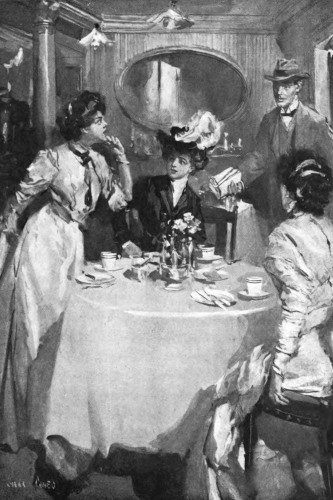
“She was ashy-pale, staring straight before her”
Splendid isolation reigned at Fordwych Castle. The daily papers grew more and more sarcastic at the expense of the Scotland Yard authorities, and the public more and more impatient.
Then it was that the chief grew desperate and sent for Lady Molly, the result of the interview being that I once more made the journey down to Fordwych, but this time in the company of my dear lady, who had received carte blanche from headquarters to do whatever she thought right in the investigation of the mysterious crime.
She and I arrived at Fordwych at 8.0 p.m., after the usual long wait at Newcastle. We put up at the d’Alboukirk Arms, and, over a hasty and very bad supper, Lady Molly allowed me a brief insight into her plans.
“I can see every detail of that murder, Mary,” she said earnestly, “just as if I had lived at the Castle all the time. I know exactly where our fellows are wrong, and why they cannot get on. But, although the chief has given me a free hand, what I am going to do is so irregular that if I fail I shall probably get my immediate congé, whilst some of the disgrace is bound to stick to you. It is not too late—you may yet draw back, and leave me to act alone.”
I looked her straight in the face. Her dark eyes were gleaming; there was the power of second sight in them, or of marvellous intuition of “men and things.”
“I’ll follow your lead, my Lady Molly,” I said quietly.
“Then go to bed now,” she replied, with that strange transition of manner which to me was so attractive and to everyone else so unaccountable.
In spite of my protest, she refused to listen to any more talk or to answer any more questions, and, perforce, I had to go to my room. The next morning I saw her graceful figure, immaculately dressed in a perfect tailor-made gown, standing beside my bed at a very early hour.
“Why, what is the time?” I ejaculated, suddenly wide awake.
“Too early for you to get up,” she replied quietly. “I am going to early Mass at the Roman Catholic convent close by.”
“To Mass at the Roman Catholic convent?”
“Yes. Don’t repeat all my words, Mary; it is silly, and wastes time. I have introduced myself in the neighbourhood as the American, Mrs. Silas A. Ogden, whose motor has broken down and is being repaired at Newcastle, while I, its owner, amuse myself by viewing the beauties of the neighbourhood. Being a Roman Catholic, I go to Mass first, and, having met Lady d’Alboukirk once in London, I go to pay her a respectful visit afterwards. When I come back we will have breakfast together. You might try in the meantime to scrape up an acquaintance with Miss Joan Duplessis, who is still staying here, and ask her to join us at breakfast.”
She was gone before I could make another remark, and I could but obey her instantly to the letter.
An hour later I saw Miss Joan Duplessis strolling in the hotel garden. It was not difficult to pass the time of day with the young girl, who seemed quite to brighten up at having someone to talk to. We spoke of the weather and so forth, and I steadily avoided the topic of the Fordwych Castle tragedy until the return of Lady Molly at about ten o’clock. She came back looking just as smart, just as self-possessed, as when she had started three hours earlier. Only I, who knew her so well, noted the glitter of triumph in her eyes, and knew that she had not failed. She was accompanied by Pegram, who, however, immediately left her side and went straight into the hotel, whilst she joined us in the garden, and, after a few graceful words, introduced herself to Miss Joan Duplessis and asked her to join us in the coffee-room upstairs.
The room was empty and we sat down to table, I quivering with excitement and awaiting events. Through the open window I saw Elliott walking rapidly down the village street. Presently the waitress went off, and I being too excited to eat or to speak, Lady Molly carried on a running conversation with Miss Joan, asking her about her life in India and her father, Captain Duplessis. Joan admitted that she had always been her father’s favourite.
“He never liked Henriette, somehow,” she explained.
Lady Molly asked her when she had first known Roonah.
“She came to the house when my mother died,” replied Joan, “and she had charge of me as a baby.” At Pondicherry no one had thought it strange that she came as a servant into an officer’s house where her own sister had reigned as mistress. Pondicherry is a French Settlement, and manners and customs there are often very peculiar.
I ventured to ask her what were her future plans.
“Well,” she said, with a great touch of sadness, “I can, of course, do nothing whilst my aunt is alive. I cannot force her to let me live at Fordwych or to acknowledge me as her heir. After her death, if my sister does assume the title and fortune of d’Alboukirk,” she added, whilst suddenly a strange look of vengefulness—almost of hatred and cruelty—marred the child-like expression of her face, “then I shall revive the story of the tragedy of Roonah’s death, and I hope that public opinion——”
She paused here in her speech, and I, who had been gazing out of the window, turned my eyes on her. She was ashy-pale, staring straight before her; her hands dropped the knife and fork which she had held. Then I saw that Pegram had come into the room, that he had come up to the table and placed a packet of papers in Lady Molly’s hand.
I saw it all as in a flash!
There was a loud cry of despair like an animal at bay, a shrill cry, followed by a deep one from Pegram of “No, you don’t,” and before anyone could prevent her, Joan’s graceful young figure stood outlined for a short moment at the open window.
The next moment she had disappeared into the depth below, and we heard a dull thud which nearly froze the blood in my veins.
Pegram ran out of the room, but Lady Molly sat quite still.
“I have succeeded in clearing the innocent,” she said quietly; “but the guilty has meted out to herself her own punishment.”
“Then it was she?” I murmured, horror-struck.
“Yes. I suspected it from the first,” replied Lady Molly calmly. “It was this conversion of Roonah to Roman Catholicism and her consequent change of manner which gave me the first clue.”
“But why—why?” I muttered.
“A simple reason, Mary,” she rejoined, tapping the packet of papers with her delicate hand; and, breaking open the string that held the letters, she laid them out upon the table. “The whole thing was a fraud from beginning to end. The woman’s marriage certificate was all right, of course, but I mistrusted the genuineness of the other papers from the moment that I heard that Roonah would not part with them and would not allow Mr. McKinley to have charge of them. I am sure that the idea at first was merely one of blackmail. The papers were only to be the means of extorting money from the old lady, and there was no thought of taking them into court.
“Roonah’s part was, of course, the important thing in the whole case, since she was here prepared to swear to the actual date of the first Madame Duplessis’s death. The initiative, of course, may have come either from Joan or from Captain Duplessis himself, out of hatred for the family who would have nothing to do with him and his favourite younger daughter. That, of course, we shall never know. At first Roonah was a Parsee, with a dog-like devotion to the girl whom she had nursed as a baby, and who no doubt had drilled her well into the part she was to play. But presently she became a Roman Catholic—an ardent convert, remember, with all a Roman Catholic’s fear of hell-fire. I went to the convent this morning. I heard the priest’s sermon there, and I realised what an influence his eloquence must have had over poor, ignorant, superstitious Roonah. She was still ready to die for her young mistress, but she was no longer prepared to swear to a lie for her sake. After Mass I called at Fordwych Castle. I explained my position to old Lady d’Alboukirk, who took me into the room where Roonah had slept and died. There I found two things,” continued Lady Molly, as she opened the elegant reticule which still hung upon her arm, and placed a big key and a prayer-book before me.
“The key I found in a drawer of an old cupboard in the dressing-room where Roonah slept, with all sorts of odds and ends belonging to the unfortunate woman, and going to the door which led into what
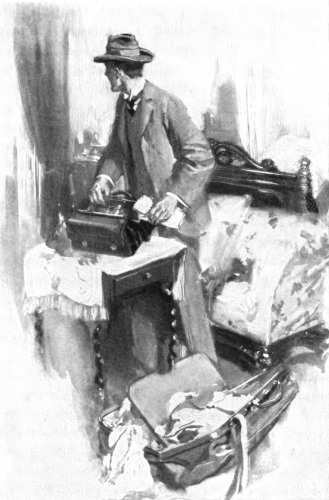
“ ‘I sent Pegram to her room with orders to break open the locks of her hand-bag and dressing-case’ ”
had been Joan’s bedroom, I found that it was locked, and that this key fitted into the lock. Roonah had locked that door herself on her own side—she was afraid of her mistress. I knew now that I was right in my surmise. The prayer-book is a Roman Catholic one. It is heavily thumbmarked there, where false oaths and lying are denounced as being deadly sins for which hell-fire would be the punishment. Roonah, terrorised by fear of the supernatural, a new convert to the faith, was afraid of committing a deadly sin.
“Who knows what passed between the two women, both of whom have come to so violent and terrible an end? Who can tell what prayers, tears, persuasions Joan Duplessis employed from the time she realised that Roonah did not mean to swear to the lie which would have brought her mistress wealth and glamour until the awful day when she finally understood that Roonah would no longer even hold her tongue, and devised a terrible means of silencing her for ever?
“With this certainty before me, I ventured on my big coup. I was so sure, you see. I kept Joan talking in here whilst I sent Pegram to her room with orders to break open the locks of her hand-bag and dressing-case. There!—I told you that if I was wrong I would probably be dismissed the force for irregularity, as of course I had no right to do that; but if Pegram found the papers there where I felt sure they would be, we could bring the murderer to justice. I know my own sex pretty well, don’t I, Mary? I knew that Joan Duplessis had not destroyed—never would destroy—those papers.”
Even as Lady Molly spoke we could hear heavy tramping outside the passage. I ran to the door, and there was met by Pegram.
“She is quite dead, miss,” he said. “It was a drop of forty feet, and a stone pavement down below.”
The guilty had indeed meted out her own punishment to herself!
Lady d’Alboukirk sent Lady Molly a cheque for £5,000 the day the whole affair was made known to the public.
I think you will say that it had been well earned. With her own dainty hands my dear lady had lifted the veil which hung over the tragedy of Fordwych Castle, and with the finding of the papers in Joan Duplessis’s dressing-bag, and the unfortunate girl’s suicide, the murder of the Indian woman was no longer a mystery.
V. A DAY’S FOLLY
I don’t think that anyone ever knew that the real elucidation of the extraordinary mystery known to the newspaper-reading public as the “Somersetshire Outrage” was evolved in my own dear lady’s quick, intuitive brain.
As a matter of fact, to this day—as far as the public is concerned—the Somersetshire outrage never was properly explained; and it is a very usual thing for those busybodies who are so fond of criticising the police to point to that case as an instance of remarkable incompetence on the part of our detective department.
A young woman named Jane Turner, a visitor at Weston-super-Mare, had been discovered one afternoon in a helpless condition, bound and gagged, and suffering from terror and inanition, in the bedroom which she occupied in a well-known apartment-house of that town. The police had been immediately sent for, and as soon as Miss Turner had recovered she gave what explanation she could of the mysterious occurrence.
She was employed in one of the large drapery shops in Bristol, and was spending her annual holiday at Weston-super-Mare. Her father was the local butcher at Banwell—a village distant about four miles from Weston—and it appears that somewhere near one o’clock in the afternoon of Friday, the 3rd of September, she was busy in her bedroom putting a few things together in a handbag, preparatory to driving out to Banwell, meaning to pay her parents a week-end visit.
There was a knock at her door, and a voice said, “It’s me, Jane—may I come in?”
She did not recognise the voice, but somehow thought that it must be that of a friend, so she shouted, “Come in!”
This was all that the poor thing recollected definitely, for the next moment the door was thrown open, someone rushed at her with amazing violence, she heard the crash of a falling table and felt a blow on the side of her head, whilst a damp handkerchief was pressed to her nose and mouth.
Then she remembered nothing more.
When she gradually came to her senses she found herself in the terrible plight in which Mrs. Skeward—her landlady—discovered her twenty-four hours later.
When pressed to try and describe her assailant, she said that when the door was thrown open she thought that she saw an elderly woman in a wide mantle and wearing bonnet and veil, but that, at the same time, she was quite sure, from the strength and brutality of the onslaught, that she was attacked by a man. She had no enemies, and no possessions worth stealing; but her hand-bag, which, however, only contained a few worthless trifles, had certainly disappeared.
The people of the house, on the other hand, could throw but little light on the mystery which surrounded this very extraordinary and seemingly purposeless assault.
Mrs. Skeward only remembered that on Friday Miss Turner told her that she was just off to Banwell, and would be away for the week-end; but that she wished to keep her room on, against her return on the Monday following.
That was somewhere about half-past twelve o’clock, at the hour when luncheons were being got ready for the various lodgers; small wonder, therefore, that no one in the busy apartment-house took much count of the fact that Miss Turner was not seen to leave the house after that, and no doubt the wretched girl would have been left for several days in the pitiable condition in which she was ultimately found but for the fact that Mrs. Skeward happened to be of the usual grasping type common to those of her kind.
Weston-super-Mare was over-full that week-end, and Mrs. Skeward, beset by applicants for accommodation, did not see why she should not let her absent lodger’s room for the night or two that the latter happened to be away, and thus get money twice over for it.
She conducted a visitor up to Miss Turner’s room on the Saturday afternoon, and, throwing open the door—which, by the way, was not locked—was horrified to see the poor girl half-sitting, half-slipping off the chair to which she had been tied with a rope, whilst a woollen shawl was wound round the lower part of her face.
As soon as she had released the unfortunate victim, Mrs. Skeward sent for the police, and it was through the intelligent efforts of Detective Parsons—a local man—that a few scraps of very hazy evidence were then and there collected.
First, there was the question of the elderly female in the wide mantle, spoken of by Jane Turner as her assailant. It seems that someone answering to that description had called on the Friday at about one o’clock, and asked to see Miss Turner. The maid who answered the door replied that she thought Miss Turner had gone to Banwell.
“Oh!” said the old dame, “she won’t have started yet. I am Miss Turner’s mother, and I was to call for her so that we might drive out together.”
“Then p’r’aps Miss Turner is still in her room,” suggested the maid. “Shall I go and see?”
“Don’t trouble,” replied the woman; “I know my way. I’ll go myself.”
Whereupon the old dame walked past the servant, crossed the hall, and went upstairs. No one saw her come down again, but one of the lodgers seems to have heard a knock at Jane Turner’s door, and the female voice saying, “It’s me, Jane—may I come in?”
What happened subsequently, who the mysterious old female was, and how and for what purpose she assaulted Jane Turner and robbed her of a few valueless articles, was the puzzle which faced the police then, and which—so far as the public is concerned—has never been solved. Jane Turner’s mother was in bed at the time suffering from a broken ankle and unable to move. The elderly woman was, therefore, an impostor, and the search after her—though keen and hot enough at the time, I assure you—has remained, in the eyes of the public, absolutely fruitless. But of this more anon.
On the actual scene of the crime there was but little to guide subsequent investigation. The rope with which Jane Turner had been pinioned supplied no clue; the wool shawl was Miss Turner’s own, snatched up by the miscreant to smother the girl’s screams; on the floor was a handkerchief, without initial or laundry mark, which obviously had been saturated with chloroform; and close by a bottle which had contained the anæsthetic. A small table was overturned, and the articles which had been resting upon it were lying all around—such as a vase which had held a few flowers, a box of biscuits, and several issues of the West of England Times.
And nothing more. The miscreant, having accomplished his fell purpose, succeeded evidently in walking straight out of the house unobserved; his exit being undoubtedly easily managed owing to it being the busy luncheon hour.
Various theories were, of course, put forward by some of our ablest fellows at the Yard; the most likely solution being the guilt or, at least, the complicity of the girl’s sweetheart, Arthur Cutbush—a ne’er-do-well, who spent the greater part of his time on race-courses. Inspector Danvers, whom the chief had sent down to assist the local police, declared that Jane Turner herself suspected her sweetheart, and was trying to shield him by stating that she possessed nothing of any value; whereas, no doubt, the young blackguard knew that she had some money, and had planned this amazing coup in order to rob her of it.
Danvers was quite chagrined when, on investigation, it was proved that Arthur Cutbush had gone to the York races three days before the assault, and never left that city until the Saturday evening, when a telegram from Miss Turner summoned him to Weston.
Moreover, the girl did not break off her engagement with young Cutbush, and thus the total absence of motive was a serious bar to the likelihood of the theory.
Then it was that the Chief sent for Lady Molly. No doubt he began to feel that here, too, was a case where feminine tact and my lady’s own marvellous intuition might prove more useful than the more approved methods of the sterner sex.
2
“Of course, there is a woman in the case, Mary,” said Lady Molly to me, when she came home from the interview with the chief, “although they all pooh-pooh that theory at the Yard, and declare that the female voice—to which the only two witnesses we have are prepared to swear—was a disguised one.”
“You think, then, that a woman assaulted Jane Turner?”
“Well,” she replied somewhat evasively, “if a man assumes a feminine voice, the result is a high-pitched, unnatural treble; and that, I feel convinced, would have struck either the maid or the lodger, or both, as peculiar.”
This was the train of thought which my dear lady and I were following up, when, with that sudden transition of manner so characteristic of her, she said abruptly to me:
“Mary, look out a train for Weston-super-Mare. We must try and get down there to-night.”
“Chief’s orders?” I asked.
“No—mine,” she replied laconically. “Where’s the A B C?”
Well, we got off that self-same afternoon, and in the evening we were having dinner at the Grand Hotel, Weston-super-Mare.
My dear lady had been pondering all through the journey, and even now she was singularly silent and absorbed. There was a deep frown between her eyes, and every now and then the luminous, dark orbs would suddenly narrow, and the pupils contract as if smitten with a sudden light.
I was not a little puzzled as to what was going on in that active brain of hers, but my experience was that silence on my part was the surest card to play.
Lady Molly had entered our names in the hotel book as Mrs. Walter Bell and Miss Granard from London; and the day after our arrival there came two heavy parcels for her under that name. She had them taken upstairs to our private sitting-room, and there we undid them together.
To my astonishment they contained stacks of newspapers: as far as I could see at a glance, back numbers of the West of England Times covering a whole year.
“Find and cut out the ‘Personal’ column of every number, Mary,” said Lady Molly to me. “I’ll look through them on my return. I am going for a walk, and will be home by lunch time.”
I knew, of course, that she was intent on her business and on that only, and as soon as she had gone out I set myself to the wearisome task which she had allotted me. My dear lady was evidently working out a problem in her mind, the solution of which she expected to find in a back number of the West of England Times.
By the time she returned I had the “Personal” column of some three hundred numbers of the paper neatly filed and docketed for her perusal. She thanked me for my promptitude with one of her charming looks, but said little, if anything, all through luncheon. After that meal she set to work. I could see her studying each scrap of paper minutely, comparing one with the other, arranging them in sets in front of her, and making marginal notes on them all the while.
With but a brief interval for tea, she sat at her table for close on four hours, at the end of which time she swept all the scraps of paper on one side, with the exception of a few which she kept in her hand. Then she looked up at me, and I sighed with relief.
My dear lady was positively beaming.
“You have found what you wanted?” I asked eagerly.
“What I expected,” she replied.
“May I know?”
She spread out the bits of paper before me. There were six altogether, and each of these columns had one paragraph specially marked with a cross.
“Only look at the paragraphs which I have marked,” she said.
I did as I was told. But if in my heart I had vaguely hoped that I should then and there be confronted with the solution of the mystery which surrounded the Somersetshire outrage, I was doomed to disappointment.
Each of the marked paragraphs in the “Personal” columns bore the initials H. S. H., and their purport was invariably an assignation at one of the small railway stations on the line between Bristol and Weston.
I suppose that my bewilderment must have been supremely comical, for my dear lady’s rippling laugh went echoing through the bare, dull hotel sitting-room.
“You don’t see it, Mary?” she asked gaily.
“I confess I don’t,” I replied. “It completely baffles me.”
“And yet,” she said more gravely, “those few silly paragraphs have given me the clue to the mysterious assault on Jane Turner, which has been puzzling our fellows at the Yard for over three weeks.”
“But how? I don’t understand.”
“You will, Mary, directly we get back to town. During my morning walk I have learnt all that I want to know, and now these paragraphs have set my mind at rest.”
3
The next day we were back in town.
Already, at Bristol, we had bought a London morning paper, which contained in its centre page a short notice under the following startling headlines:
THE SOMERSETSHIRE OUTRAGE AMAZING DISCOVERY BY THE POLICE AN UNEXPECTED CLUE
The article went on to say:
“We are officially informed that the police have recently obtained knowledge of certain facts which establish beyond a doubt the motive of the brutal assault committed on the person of Miss Jane Turner. We are not authorised to say more at present than that certain startling developments are imminent.”
On the way up my dear lady had initiated me into some of her views with regard to the case itself, which at the chief’s desire she had now taken entirely in hand, and also into her immediate plans, of which the above article was merely the preface.
She it was who had “officially informed” the Press Association, and, needless to say, the news duly appeared in most of the London and provincial dailies.
How unerring was her intuition, and how well thought out her scheme, was proved within the next four-and-twenty hours in our own little flat, when our Emily, looking somewhat important and awed, announced Her Serene Highness the Countess of Hohengebirg.
H. S. H.—the conspicuous initials in the “Personal” columns of the West of England Times! You may imagine how I stared at the exquisite apparition—all lace and chiffon and roses—which the next moment literally swept into our office, past poor, open-mouthed Emily.
Had my dear lady taken leave of her senses when she suggested that this beautiful young woman with the soft, fair hair, with the pleading blue eyes and childlike mouth, had anything to do with a brutal assault on a shop girl?
The young Countess shook hands with Lady Molly and with me, and then, with a deep sigh, she sank into the comfortable chair which I was offering her.
Speaking throughout with great diffidence, but always in the gentle tones of a child that knows it has been naughty, she began by explaining that she had been to Scotland Yard, where a very charming man—the chief, I presume—had been most kind and sent her hither, where he promised her she would find help and consolation in her dreadful, dreadful trouble.
Encouraged by Lady Molly, she soon plunged into her narrative: a pathetic tale of her own frivolity and foolishness.
She was originally Lady Muriel Wolfe-Strongham, daughter of the Duke of Weston, and when scarce out of the schoolroom had met the Grand Duke of Starkburg-Nauheim, who fell in love with her and married her. The union was a morganatic one, the Grand Duke conferring on his English wife the title of Countess of Hohengebirg and the rank of Serene Highness.
It seems that, at first, the marriage was a fairly happy one, in spite of the bitter animosity of the mother and sister of the Grand Duke: the Dowager Grand Duchess holding that all English girls were loud and unwomanly, and the Princess Amalie, seeing in her brother’s marriage a serious bar to the fulfilment of her own highly ambitious matrimonial hopes.
“They can’t bear me, because I don’t knit socks and don’t know how to bake almond cakes,” said her dear little Serene Highness, looking up with tender appeal at Lady Molly’s grave and beautiful face; “and they will be so happy to see a real estrangement between my husband and myself.”
It appears that last year, whilst the Grand Duke was doing his annual cure at Marienbad, the Countess of Hohengebirg went to Folkestone for the benefit of her little boy’s health. She stayed at one of the Hotels there merely as any English lady of wealth might do—with nurses and her own maid, of course, but without the paraphernalia and nuisance of her usual German retinue.
Whilst there she met an old acquaintance of her father’s, a Mr. Rumboldt, who is a rich financier, it seems, and who at one time moved in the best society, but whose reputation had greatly suffered recently, owing to a much talked of divorce case which brought his name into unenviable notoriety.
Her Serene Highness, with more mopping of her blue eyes, assured Lady Molly that over at Schloss Starkburg she did not read the English papers, and was therefore quite unaware that Mr. Rumboldt, who used to be a persona grata in her father’s house, was no longer a fit and proper acquaintance for her.
“It was a very fine morning,” she continued with gentle pathos, “and I was deadly dull at Folkestone. Mr. Rumboldt persuaded me to go with him on a short trip on his yacht. We were to cross over to Boulogne, have luncheon there, and come home in the cool of the evening.”
“And, of course, something occurred to disable the yacht,” concluded Lady Molly gravely, as the lady herself had paused in her narrative.
“Of course,” whispered the little Countess through her tears.
“And, of course, it was too late to get back by the ordinary afternoon mail boat?”
“That boat had gone an hour before, and the next did not leave until the middle of the night.”
“So you had perforce to wait until then, and in the meanwhile you were seen by a girl named Jane Turner, who knew you by sight, and who has been blackmailing you ever since.”
“How did you guess that?” ejaculated Her Highness, with a look of such comical bewilderment in her large, blue eyes that Lady Molly and I had perforce to laugh.
“Well,” replied my dear lady after awhile, resuming her gravity, “we have a way in our profession of putting two and two together, haven’t we? And in this case it was not very difficult. The assignations for secret meetings at out-of-the-way railway stations which were addressed to H. S. H. in the columns of the West of England Times recently, gave me one clue, shall we say? The mysterious assault on a young woman, whose home was close to those very railway stations as well as to Bristol Castle—your parents’ residence—where you have frequently been staying of late, was another piece that fitted in the puzzle; whilst the number of copies of the West of England Times that were found in that same young woman’s room helped to draw my thoughts to her. Then your visit to me to-day—it is very simple, you see.”
“I suppose so,” said H. S. H. with a sigh. “Only it is worse even than you suggest, for that horrid Jane Turner, to whom I had been ever so kind when I was a girl, took a snapshot of me and Mr. Rumboldt standing on the steps of the Hôtel des Bains at Boulogne. I saw her doing it and rushed down the steps to stop her. She talked quite nicely then—hypocritical wretch!—and said that perhaps the plate would be no good when it was developed, and if it were she would destroy it. I was not to worry; she would contrive to let me know through the agony column of the West of England Times, which—as I was going home to Bristol Castle to stay with my parents—I could see every day, but she had no idea I should have minded, and all that sort of rigmarole. Oh! she is a wicked girl, isn’t she, to worry me so?”
And once again the lace handkerchief found its way to the most beautiful pair of blue eyes I think I have ever seen. I could not help smiling, though I was really very sorry for the silly, emotional, dear little thing.
“And instead of reassurance in the West of England Times, you found a demand for a secret meeting at a country railway station?”
“Yes! And when I went there—terrified lest I should be seen—Jane Turner did not meet me herself. Her mother came and at once talked of selling the photograph to my husband or to my mother-in-law. She said it was worth four thousand pounds to Jane, and that she had advised her daughter not to sell it to me for less.”
“What did you reply?”
“That I hadn’t got four thousand pounds,” said the Countess ruefully; “so after a lot of argument it was agreed that I was to pay Jane two hundred and fifty pounds a year out of my dress allowance. She would keep the negative as security, but promised never to let anyone see it so long as she got her money regularly. It was also arranged that whenever I stayed with my parents at Bristol Castle, Jane would make appointments to meet me through the columns of the West of England Times, and I was to pay up the instalments then just as she directed.”
I could have laughed, if the whole thing had not been so tragic, for truly the way this silly, harmless little woman had allowed herself to be bullied and blackmailed by a pair of grasping females was beyond belief.
“And this has been going on for over a year,” commented Lady Molly gravely.
“Yes, but I never met Jane Turner again: it was always her mother who came.”
“You knew her mother before that, I presume?”
“Oh, no. I only knew Jane because she had been sewing-maid at the Castle some few years ago.”
“I see,” said Lady Molly slowly. “What was the woman like whom you used to meet at the railway stations, and to whom you paid over Miss Turner’s annuity?”
“Oh, I couldn’t tell you what she was like. I never saw her properly.”
“Never saw her properly?” ejaculated Lady Molly, and it seemed to my well-trained ears as if there was a ring of exultation in my dear lady’s voice.
“No,” replied the little Countess ruefully. “She always appointed a late hour of the evening, and those little stations on that line are very badly lighted. I had such difficulties in getting away from home without exciting comment, and used to beg her to let me meet her at a more convenient hour. But she always refused.”
Lady Molly remained thoughtful for a while; then she asked abruptly:
“Why don’t you prosecute Jane Turner for blackmail?”
“Oh, I dare not—I dare not!” ejaculated the little Countess, in genuine terror. “My husband would never forgive me, and his female relations would do their best afterwards to widen the breach between us. It was because of the article in the London newspaper about the assault on Jane Turner—the talk of a clue and of startling developments—that I got terrified, and went to Scotland Yard. Oh, no! no! no! Promise me that my name won’t be dragged into this case. It would ruin me for ever!”
She was sobbing now; her grief and fear were very pathetic to witness, and she moaned through her sobs:
“Those wicked people know that I daren’t risk an exposure, and simply prey upon me like vampires because of that. The last time I saw the old woman I told her that I would confess everything to my husband—I couldn’t bear to go on like this. But she only laughed; she knew I should never dare.”
“When was this?” asked Lady Molly.
“About three weeks ago—just before Jane Turner was assaulted and robbed of the photographs.”
“How do you know she was robbed of the photographs?”
“She wrote and told me so,” replied the young Countess, who seemed strangely awed now by my dear lady’s earnest question. And from a dainty reticule she took a piece of paper, which bore traces of many bitter tears on its crumpled surface. This she handed to Lady Molly, who took it from her. It was a type-written letter, which bore no signature. Lady Molly perused it in silence first, then read its contents out aloud to me:—
“To H.S.H. the Countess of Hohengebirg.
“You think I have been worrying you the past twelve months about your adventure with Mr. Rumboldt in Boulogne. But it was not me; it was one who has power over me, and who knew about the photograph. He made me act as I did. But whilst I kept the photo you were safe. Now he has assaulted me and nearly killed me, and taken the negative away. I can, and will, get it out of him again, but it will mean a large sum down. Can you manage one thousand pounds?”
“When did you get this?” asked Lady Molly.
“Only a few days ago,” replied the Countess. “And oh! I have been enduring agonies of doubt and fear for the past three weeks, for I had heard nothing from Jane since the assault, and I wondered what had happened.”
“You have not sent a reply, I hope.”
“No. I was going to, when I saw the article in the London paper, and the fear that all had been discovered threw me into such a state of agony that I came straight up to town and saw the gentleman at Scotland Yard, who sent me on to you. Oh!” she entreated again and again, “you won’t do anything that will cause a scandal! Promise me—promise me! I believe I should commit suicide rather than face it—and I could find a thousand pounds.”
“I don’t think you need do either,” said Lady Molly. “Now, may I think over the whole matter quietly to myself,” she added, “and talk it over with my friend here? I may be able to let you have some good news shortly.”
She rose, intimating kindly that the interview was over. But it was by no means that yet, for there was still a good deal of entreaty and a great many tears on the one part, and reiterated kind assurances on the other. However when, some ten minutes later, the dainty clouds of lace and chiffon were finally wafted out of our office, we both felt that the poor, harmless, unutterably foolish little lady felt distinctly consoled and more happy than she had been for the past twelve months.
4
“Yes! she has been an utter little goose,” Lady Molly was saying to me an hour later when we were having luncheon; “but that Jane Turner is a remarkably clever girl.”
“I suppose you think, as I do, that the mysterious elderly female, who seems to have impersonated the mother all through, was an accomplice of Jane Turner’s, and that the assault was a put-up job between them,” I said. “Inspector Danvers will be delighted—for this theory is a near approach to his own.”
“H’m!” was all the comment vouchsafed on my remark.
“I am sure it was Arthur Cutbush, the girl’s sweetheart, after all,” I retorted hotly, “and you’ll see that, put to the test of sworn evidence, his alibi at the time of the assault itself won’t hold good. Moreover, now,” I added triumphantly, “we have knowledge
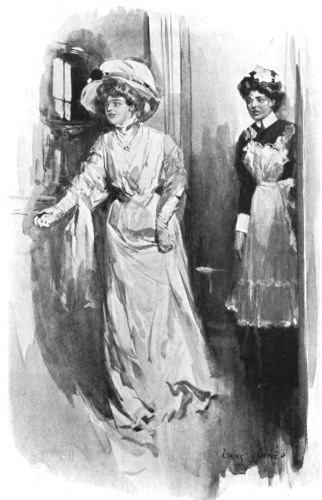
“Ten minutes later the dainty clouds of lace and chiffon were finally wafted out”
which has been lacking all along—the motive.”
“Ah!” said my lady, smiling at my enthusiasm, “that’s how you argue, Mary, is it?”
“Yes, and in my opinion the only question in doubt is whether Arthur Cutbush acted in collusion with Jane Turner or against her.”
“Well, suppose we go and elucidate that point—and some others—at once,” concluded Lady Molly as she rose from the table.
She decided to return to Bristol that same evening. We were going by the 8.50 p.m., and I was just getting ready—the cab being already at the door—when I was somewhat startled by the sudden appearance into my room of an old lady, very beautifully dressed, with snow-white hair dressed high above a severe, interesting face.
A merry, rippling laugh issuing from the wrinkled mouth, and a closer scrutiny on my part, soon revealed the identity of my dear lady, dressed up to look like an extremely dignified grande dame of the old school, whilst a pair of long, old-fashioned earrings gave a curious, foreign look to her whole appearance.
I didn’t quite see why she chose to arrive at the Grand Hotel, Bristol, in that particular disguise, nor why she entered our names in the hotel book as Grand Duchess and Princess Amalie von Starkburg, from Germany; nor did she tell me anything that evening.
But by the next afternoon, when we drove out together in a fly, I was well up in the rôle which I had to play. My lady had made me dress in a very rich black silk dress of her own, and ordered me to do my hair in a somewhat frumpish fashion, with a parting, and a “bun” at the back. She herself looked more like Royalty travelling incognito than ever, and no wonder small children and tradesmen’s boys stared open-mouthed when we alighted from our fly outside one of the mean-looking little houses in Bread Street.
In answer to our ring, a smutty little servant opened the door, and my lady asked her if Miss Jane Turner lived here and if she were in.
“Yes, Miss Turner lives here, and it bein’ Thursday and early closin’ she’s home from business.”
“Then please tell her,” said Lady Molly in her grandest manner, “that the Dowager Grand Duchess of Starkburg-Nauheim and the Princess Amalie desire to see her.”
The poor little maid nearly fell backwards with astonishment. She gasped an agitated “Lor!” and then flew down the narrow passage and up the steep staircase, closely followed by my dear lady and myself.
On the first-floor landing the girl, with nervous haste, knocked at a door, opened it and muttered half audibly:
“Ladies to see you, miss!”
Then she fled incontinently upstairs. I have never been able to decide whether that little girl thought that we were lunatics, ghosts, or criminals.
But already Lady Molly had sailed into the room, where Miss Jane Turner apparently had been sitting reading a novel. She jumped up when we entered, and stared open-eyed at the gorgeous apparitions. She was not a bad-looking girl but for the provoking, bold look in her black eyes, and the general slatternly appearance of her person.
“Pray do not disturb yourself, Miss Turner,” said Lady Molly in broken English, as she sank into a chair, and beckoned me to do likewise. “Pray sit down—I vill be brief. You have a compromising photograph—is it not?—of my daughter-in-law ze Countess of Hohengebirg. I am ze Grand Duchess of Starkburg-Nauheim—zis is my daughter, ze Princess Amalie. We are here incognito. You understand? Not?”
And, with inimitable elegance of gesture, my dear lady raised a pair of “starers” to her eyes and fixed them on Jane Turner’s quaking figure.
Never had I seen suspicion, nay terror, depicted so plainly on a young face, but I will do the girl the justice to state that she pulled herself together with marvellous strength of will.
She fought down her awed respect of this great lady; or rather shall I say that the British middle-class want of respect for social superiority, especially if it be foreign, now stood her in good stead?
“I don’t know what you are talking about,” she said with an arrogant toss of the head.
“Zat is a lie, is it not?” rejoined Lady Molly calmly, as she drew from her reticule the typewritten letter which Jane Turner had sent to the Countess of Hohengebirg. “Zis you wrote to my daughter-in-law; ze letter reached me instead of her. It interests me much. I vill give you two tousend pounds for ze photograph of her and Mr.—er—Rumboldt. You vill sell it to me for zat, is it not?”
The production of the letter had somewhat cowed Jane’s bold spirit. But she was still defiant.
“I haven’t got the photograph here,” she said.
“Ah, no! but you vill get it—yes?” said my lady, quietly replacing the letter in her reticule. “In ze letter you offer to get it for tousend pound. I vill give you two tousend. To-day is a holiday for you. You vill get ze photograph from ze gentleman—not? And I vill vait here till you come back.”
Whereupon she rearranged her skirts round her and folded her hands placidly, like one prepared to wait.
“I haven’t got the photograph,” said Jane Turner, doggedly, “and I can’t get it to-day. The—the person who has it doesn’t live in Bristol.”
“No? Ah! but quite close, isn’t it?” rejoined my lady, placidly. “I can vait all ze day.”
“No, you shan’t!” retorted Jane Turner, whose voice now shook with obvious rage or fear—I knew not which. “I can’t get the photograph to-day—so there! And I won’t sell it to you—I won’t. I don’t want your two thousand pounds. How do I know you are not an impostor?”
“From zis, my good girl,” said Lady Molly, quietly; “that if I leave zis room wizout ze photograph, I go straight to ze police with zis letter, and you shall be prosecuted by ze Grand Duke, my son, for blackmailing his wife. You see, I am not like my daughter-in-law; I am not afraid of a scandal. So you vill fetch ze photograph—isn’t it? I and ze Princess Amalie vill vait for it here. Zat is your bedroom—not?” she added, pointing to a door which obviously gave on an inner room. “Vill you put on your hat and go at once, please? Two tousend pound or two years in prison—you have ze choice—isn’t it?”
Jane Turner tried to keep up her air of defiance, looking Lady Molly full in the face; but I who watched her could see the boldness in her eyes gradually giving place to fear, and then to terror and even despair; the girl’s face seemed literally to grow old as I looked at it—pale, haggard, and drawn—whilst Lady Molly kept her stern, luminous eyes fixed steadily upon her.
Then, with a curious, wild gesture, which somehow filled me with a nameless fear, Jane Turner turned on her heel and ran into the inner room.
There followed a moment of silence. To me it was tense and agonising. I was straining my ears to hear what was going on in that inner room. That my dear lady was not as callous as she wished to appear was shown by the strange look of expectancy in her beautiful eyes.
The minutes sped on—how many I could not afterwards have said. I was conscious of a clock ticking monotonously over the shabby mantelpiece, of an errand boy outside shouting at the top of his voice, of the measured step of the cab horse which had brought us hither being walked up and down the street.
Then suddenly there was a violent crash, as of heavy furniture being thrown down. I could not suppress a scream, for my nerves by now were terribly on the jar.