PART II LETTERS (continued 2)
Theodora Davidson translation
Juliette.
Friday, 2.15 p.m., September 2nd, 1836.
My poor, beloved angel. The nearer the moment approaches, the more I dread the inevitable parting which must follow the few days of happiness you have just given me. I long for delay, but I know very well that, however Providence may interpose in my favour, the day must come when you will have to go to St. Prix. Lucky for me if it is not to-day. But, putting aside all considerations of love and Juju, it would really not be prudent for you to go to the country in this cold, foggy weather; even this morning, in the warmth and repose of home, you felt a warning twinge of rheumatism, which prescribes prudence on your part. I fear your natural desire to kiss Toto on his donkey, and watch the other little rogues at their holiday occupations, may draw you, in spite of rain, wind, and the good counsel of your old Juju, to St. Prix. At any rate, if you do this foolish thing, try to avoid chills, to think of me, and to come back to my care and caresses as quickly as possible.
Juliette.
Saturday, 6 p.m., 29th, 1836.
You torment me unjustly, as usual, my darling beloved. Yet you ought to begin to know me, and not suspect my every action, down to the drinking of a cup of coffee. The awkwardness of my position, the absolute solitude in which I am compelled to live, and the many insults I have to tolerate daily from you, exasperate me so, that I feel I would rather go out of your life, than continue to exist like a woman condemned and accursed.
It is your fault that I am so unhappy. Nobody else will ever love you so well, or be so entirely devoted to you. But one is not bound to put up with impossibilities, and I cannot live longer under a yoke which you make more crushing every day. What am I to do, beloved? Run away from you? I have scarcely enough money for my quiet Paris routine. Remain here? If you have not the courage to abstain from visiting me, I certainly shall never have enough to prevent you from coming.
The wound in my heart is raw and bleeding, thanks to the care you take to keep it in that condition. The slightest additional twinge becomes unbearable torture. I do not know what moral operation I would not consent to, to be cured of it.
For the last three years you have really given me too much pain. I implore you, from the bottom of my heart, to be less offensive with me, or else to leave me for good and all. You may guess from this what I am enduring.
Juliette.
Sunday, 2 p.m., January 1st, 1837.
Your darling, adorable letter has reached me. I have devoured it with caresses. Oh, how I love you! I have just sent my child out of the room, so that I might read it on my knees in front of your picture. These little pranks may seem foolish, but they contain a deeper, more sacred significance, like the devotion that inspires them.
When you come, you will find me joyous and radiant, as I was on that glorious day when you first revealed your love. My beloved, my heart, I am very happy. I am in heaven, for you love me, my Toto ... your dear letter has said it. Your eyes, your mouth, your soul, will tell me so still better, presently. Yes, indeed I am happy, I am surfeited. There is nothing left for me to desire or require—I have your love, a love which God Himself might envy were He a woman.
Thank you, adored one, thank you from my heart and soul. I am as good as gold, believe me.
Juju.
Tuesday, 7.30 p.m., February 21st, 1837.
Do not grieve, my precious, do not lament. I will not attempt consolation, for you have better and more efficacious resources within your own self; but I share your affliction. Whatever saddens you saddens me: where you love, I love; when you mourn, I mourn. If I conjure you not to give way to your grief, it is not because I hesitate to bear my portion of it, but because I believe that your poor brother himself would not now desire a return to this life.[65] I look upon his death more as a blessing than a misfortune. Poor brother!
I love you, my adored Victor. In moments such as these, when sorrow brings you nearer to my level, I feel that my affection for you is absolutely true and purified from all dross. Try to come early this evening. I will lavish caresses upon you silently, with my eyes and my innermost self, without worrying you. You shall rest by my fireside, and lean your dear head upon my shoulder, and read, and I shall be glad.
I am jealous of that woman who has dared to steal your verses; such things are not lost. It was a two-fold wickedness on her part, for she caused you the trouble of rewriting them, and me the torment of jealousy. I will not have you see her again, ever! Do you hear?
Oh, I love you, I love you far too much.
Juliette.
Monday, 7.15 p.m., April 2nd, 1837.

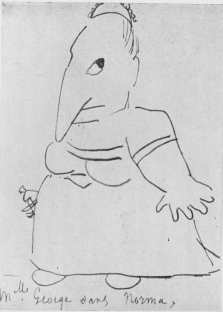
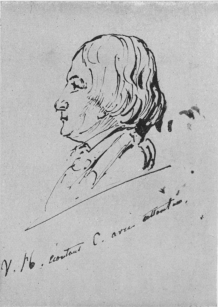
CARICATURE OF MLLE. GEORGE, BY VICTOR HUGO. Victor Hugo Museum. PORTRAIT OF VICTOR HUGO BY HIMSELF.
I have decided to get up, after all, thanks to the laundry-man; but for him, I should have remained in bed, nursing my depression. I am sad beyond everything, yet I cannot tell why—you are kind and affectionate, and I love you with my whole soul; but that does not seem enough. Esteem, the keystone of happiness, is lacking. I have worn myself out in the endeavour to gain it during the last four years, yet it cometh not, nor ever will come, now. I must turn my efforts in another direction. I must try to break with you, tactfully, as you say, by quitting Paris, and perhaps France. Will that be sufficient to stop the tongue of scandal? I wish to leave you before you abandon me, because I do not admit your right to inflict such a fearful blow upon me. There are people, capable of committing suicide, who yet recoil at the thought of being murdered—I am one. I can and will kill myself, but I shrink from the injury you might possibly inflict upon me before long. My courage does not outstrip your cruelty. I love you too much for happiness.
Juliette.
Tuesday, 10.15 a.m., May 2nd, 1837.
Good morning, my well-beloved. Did you have a good night? You looked overstrained and tired yesterday, and indeed there was enough to make you so, you poor dear. I do not know how you can put up with it all. Forgive me for adding to your burthen the exactions of a woman who loves, and fears to recognise in lassitude an evidence of coldness. Forgive me; if I did not occasionally doubt your love I should torment you less, and would show more consideration for your occupations and repose.
You hurt me very much last night by speaking as you did, yet I wanted to know your true opinion of me. I have long been tormented by a mournful curiosity on that point. Last night you satisfied it in full. I know now that you pity without despising me. I accept your compassion, for I need it, and ought to have it; but I should indignantly repudiate a contempt I do not deserve. My past history is sad, but not disgraceful. My life until I met you was the melancholy outcome of a poor girl’s first fault; but at least it was never soiled by those hideous vices that deface the soul still more than the body. Even at the worst moments of my trouble, I cherished within me an inner sanctuary, whither I could betake myself, as to some hallowed spot. Since then, that sanctuary has been open to you only, and you can testify whether you have found it worthy of you; you know whether, since you have occupied its throne and altar, I have ever failed, one single day or minute, to prostrate myself on my knees before you in adoration, or have ever turned my gaze or my soul away from you. This proves, my beloved, that my former backsliding was only superficial, not inherently vicious; that my wound was accidental, not a loathsome, devouring canker; that I love you now, and am thereby made whole.
Juliette.
Tuesday, 10.45 a.m., May 2nd, 1837.
I am following up my letter immediately with another, because I am alone, and the moment is propitious for me to open my heart to you from the very bottom. Racket and pleasure are a hindrance to meditation, and at this moment I am rapt in contemplation of you and your beloved image. I see you as you are, that is to say, a God-made man to redeem and rescue me from the infamous life to which I had so long been enslaved. What Christ did for the world you have done for me: like Him, you saved my soul at the expense of your repose and life. May you be as blessed for this generous action as you are adored by me for it. I should have loved you, devil or angel, bad or good, selfish or devoted, cruel or generous—I must have loved you, for at the mere sight of you my whole being cries out: I love you! Would that I might proclaim it on my knees, with hands clasped and heart on lips: I love you! I love you! The talk we had last night kept me from sleeping, but I do not complain; there are moments when sleep is a misfortune. I needed to rehearse one by one all your words, to collect carefully those which must remain for ever enshrined in my bosom as treasures of consolation and love; the less generous ones you uttered, I have consumed in the flame of my soul; nothing remains of them but ashes, dead as the ashes of my past.
Do not turn away in disgust from the scratches I have sustained in falling from my pedestal, as you might from hideous and incurable wounds. I repeat again, my beloved, because it is the truth: misfortune there has been in my life, but neither debauchery nor moral turpitude. Henceforth there can be nothing but a sacred, pure love for you. I am worthy of pardon and affection. Love me; I crave it of you.
Juliette.
Thursday, 11.15 a.m., May 11th, 1837.
Good morning, my dear little man; I have bad weather to announce: rain, snow, hail, wind, and, in addition, an abominable cold in my head which does not help to resign me to a day already filled with clouds. I love you—do you know that? and I admire you for your beautiful soul. It is splendid of you, my great Toto, to have raised your voice so powerfully in defence of the poor, dead King.[66] You alone had the right, for you only are above suspicion; you only are influential enough to compel the impious, pitiless world to listen to your indulgent and religious voice. If it were possible for me to love you more, I should do so for this; but from the first day I saw you I have given my whole heart and thoughts and soul unreservedly into your keeping.
How I love you, my adored Victor, how I love you! In that short and much-misused word is contained all my soul, all the bloom of a devotion that has opened out under the sun of your gaze. Good-bye, my own.
Juliette.
Friday, 8.30 p.m., June 2nd, 1837.
My little Man,
You must make up your mind to take my love or leave it. Compare my life with yours, and see whether I do not deserve that you should pity and love me with all your might. I am all alone, I have neither family nor fame, nor the thousand and one distractions that surround you. As I say, I am alone, always alone; it even seems probable that I shall not see you to-night, while you will be spending your evening in feasting, talking, and visiting your uncle, whom may the devil fly away with. Everybody can get you except me; the exception is flattering and well chosen. I am so unhappy that I am going to bed and shall probably cry my eyes out—I am more inclined for that than for laughing. If you succeed in cheering me up to-night, I shall know you for a great man, and a still greater sorcerer; but you will not attempt it. I may be as sad and miserable as I like, and I am certain you will never interfere.
Good-night, Toto; I am going to bed. Good-night, be happy and gay and content; your poor Juju will be unhappy enough for both. I love you, Toto.
Juliette.
Wednesday, 1.30 p.m., June 10th.
I love you before all things, and after all things. I love you, love you, love you! I have just written to Mother Pierceau that I shall send Suzanne to her to-morrow. I forgot to ask you exactly how much money you brought me yesterday, and also for cash, for yesterday’s expenses. I will do so to-night. I try hard to keep my accounts accurately, yet I am always in a muddle at the end of the month, and always either above or below what I ought to have. I do my best, but nothing seems to bring my sums out right.
I think there is going to be a big storm. The sky is lowering like yesterday, and the weather still more oppressive. Try not to get wet, and come and fetch your umbrella before it begins to pour.
What a delightful afternoon we spent yesterday! I wish we could have it over again, even if we had to be soaked to the skin. I shall never forget the Bassin du Titan.[67] The pretty turtledove that came to slake its thirst in it seemed to recognise us, and wait for its drink, until you scattered drops of poetry into the mossy, flowery grooves, surrounding its edges.
Heavens! what precious pearls you squandered yesterday in that magnificent garden, at the feet of those peerless goddesses, which seem to come to life when your glance rests upon them—what flowers upon those lawns, peopled with joyous children! How all those gods and goddesses, heroes, kings, queens, women, nymphs, and children, must have quarrelled over the treasure you lavished upon them! I was sorry to go away. I should have liked to go back in the moonlight and gather up all those jewels upon which you set so little store. Oh, I must return there very soon, and we will at the same time revisit our Metz, where we have enjoyed so much bliss. That journey will bring us happiness, and I long to make it. I love you, my great Toto. Forgive this scribble; it looks absurd now, and indeed it must needs be so, for I was inebriated with love when I wrote it. My thoughts stagger and fall upon the paper, because they have drunk too deeply of my soul, and know not where they are.
Juliette.
Thursday, 3.45 p.m., July 27th, 1837.
I must contribute my scribble in acknowledgment for the delightful lines you have just written in my little book.[68] My voice will sound like the cackle of a hen after the song of a nightingale; but that is the law of nature, so I do not see why I should be silent, because I have heard you. It was rash of you, my dear little man, to put down the date you suppose was that of my birth; but, as I am too honest to contradict you, I accept it and affirm that, since those days when you were a little boy studying Quintus Curtius, you have developed, and far outstripped all those you revered and admired when you were an urchin of seven—while I have remained the poor, uncultured girl you know. It is pretty certain that education could have added but little to my barren nature; the weeds of the sea-shore do not gain much from cultivation. On that point, thank Heaven, I have nothing to complain of. No one worried much about me until you appeared upon the scene; but you came, my great and sublime poet, and you did not disdain to cull the little scentless flower prinking itself at your feet, to attract the sunshine of your glance. I bless you for your goodness. I know that a father and mother look down upon you from the realms above, and love you for the happiness you have given to the poor little daughter they left solitary on earth. I weep as I write, for it is the first time I have really looked into my innocent past, and my loving heart. I bless you, my generous man, on earth, as you will be blest in heaven. May all those dear to you participate in this benediction, and in the joys and riches of this world and the next!
Juliette.
Thursday, 9 a.m., September 21st, 1837.
Good morning, my Beloved.
The anniversary of our return to Paris has been sadder still than the day itself, since you have not been with me at all, either last night or this morning. I am upset in consequence. I have not yet taken off my nightcap. I am cross. Shall you be at Auteuil all day? What a disappointment for poor Juju, not to speak of Claire, who has to take her chance of my temper when I am cross, and that idiot Madame Guérard, who has put me to the expense of a stamp merely to say that she thinks she is getting fat, and that she wishes you good morning. How thrilling!
I love you, dearest Toto; I love you too much, for I am miserable when you are away. I wish I could care comfortably, like you, for instance, who feel neither better nor worse, whether I am near or far. You are always the same; love never makes you miss the point of a joke, or a hearty laugh, nor fail to notice a grey cloud, the Great Bear, a frog, a sunset, the earth, water, gale, or zephyr. You see everything, enjoy everything, without a thought for poor old Juju, who is being bored to desperation in her solitary corner. Which of us two is the best lover, eh? Answer that it is I, Juju, and you will be speaking the truth. Yes, I love you. Try not to stay away from me all day. Love me for being sad in your absence.
Juliette.
Saturday, 6.30 p.m., September 23rd, 1837.
You are making yourself more and more of a rarity, my beautiful star, so that I become chilled, and gloomy as an antique, moss-grown statue, abandoned in the wilds of some deserted garden. I am not angry with you, but I do wish you were less busy and more lover-like. You have quickly resumed your fine Paris appearance, my beloved little man, whilst I still cling to my travelling disguise. You ought surely to have waited for me to take the initiative, if only for the sake of manners. Whom are you so anxious to please, my bright boy? Who is the favoured one you aspire to put in my place? In any case, I warn you that I shall not be sly like Granier,[69] but that I shall fall upon your respective carcases with frank blows of a cudgel, mind that! Now you may go in search of your charmer, if you are prepared to see your bones ground to powder for my use.
If you come early this evening I shall be so happy, so cheery, so content and good, that you will never wish to leave me again; but, if you delay, I shall be exactly the reverse, and you will have to coax and love me with all your might to comfort me.
You are letting your letter-box get over-full again. Toto, Toto, I shall make a bonfire of its contents if you do not come quick and secure them. Mind what you are about!
Juliette.
Wednesday, 12.45 p.m., November 22nd, 1837.
I really believe you do it on purpose; but you may be certain that I shall pay you back in the same kind: indifference for indifference; donnant donnant is my motto.
Now let us talk of other things. What do you think of the taking of Constantine? I cannot believe the present Ministry will survive long as at present constituted; Thiers and Barot may be called upon at any moment to form a new cabinet. What is your opinion? The commercial crisis is still making itself felt in the markets; oils of every description have gone down; for instance, rape oil which was at 47 is now only at 45. A recovery is looked for next year, but I have my doubts about it, haven’t you?[70]
. . . . . . . . . . . . . . . . . . . . . . . . . . . . . . . . . . .
Do you not agree with me that all this points to a revolution in the near future, which will entail sinister results for Wailly’s Government? For my part, I view with consternation the removal of the Carlists from St. Jean Pied de Port to Paimbœuf, after a sojourn at St. Ménéhould. I am already sick of the recital of the horrors which disturb the digestion and the tranquillity of the citizens, of whom you are the chief ornament. Pray accept the expression of my distinguished consideration.
Juliette.
December 5th, 5 p.m., 1837.
How kind you are, my Toto, to have come and relieved the suspense I was in as to what had happened in Court.[71] Heavens, how well you spoke! I was so moved and so convinced while I listened, that I forgot even to admire you, yet I have never known you finer or more eloquent. Why must the case be adjourned for a week? Is it to allow time for intrigues against the incorruptible consciences of my lords the judges? I should have given worlds for the verdict to have been delivered to-day; first because it would relieve you of an anxiety as annoying as it is fatiguing, secondly because I myself crave repose, and since this devil of a lawsuit has come on the scene I cannot sleep at night, and lastly because I shall then see you oftener, or at least so I hope.
While I was waiting for you just now I copied a few passages from the letters of Mdlle. de Lespinasse about the C. D.[72] and the S.[73] of her period. Her opinions then, fit our own times absolutely: the same absurdities, the same platitudes, and the same petty triumphs! It would be pitiable were it not so grotesque. Nothing seems to have altered in the last sixty years; there are the identical bourgeois in the identical Rue Saint Denis, the same men and women of the world—nothing is missing. They have not grown old, they are still in good health. Stupidity and bad taste are the best agents for the maintenance of society in all its pristine foolishness. Here am I drivelling on just as if I knew what I was talking about. It would be a nice set-out if I attempted to write! I might just as well present myself as a candidate for the Senate. Please forgive me. Your lawsuit is the cause of my chatter, but I will not transgress again. I love you far too much to go out of my way to make a fool of myself.
Juliette.
Receipts for the Month of December 1837
Dec.Frs.Sous. Liards.
Cash in hand403
1. Money earned by my Toto5140
4. Cash from my darling5100
6. Money earned by my dear one4400
9. Cash from my Toto’s purse1000
12. ” ” ” ” ” ”500
13. ” ” ” ” ” ”700
14. Money earned by my darling4500
17. Cash from my adored one1020
18. ” ” ” ” ” ”420
19. Money earned by my beloved6000
22. Cash from my Toto200
24. ” ” ” ” ”1000
26. ” ” ” ” ”300
28. Money earned by my Toto102120
30. Money earned by my darling10090
Plus the money for the earring and ring200
Total466193
Expenditure for the Month of December 1837
Frs.Sous.Liards.
Food and wine9923
Coal110
Lighting2160
Household expenses and postage1600
Baths, illness810½
General expenditure2980
Incidental expenses and pocket-money580½
Dress4150
Incidental expenses and pocket-money580½
Dress4150
Washing1650
Debts and pawnbroker15160½
Wages20130
To the Lanvins420½
Total413195
Cash in hand5300
466195[74]
To Toto: 9 luncheons.
Dinners to 10 persons.
In all, about 19.
Sunday, 1.45 p.m., January 21st, 1838.
Good-morning, my dear one, good-morning, my big Toto. How did you manage to fit into your bed? You must have curled yourself up into five or six hundred curves. One grows at such a pace in the space of an evening like last night[75] that you must have become gigantic by this morning, though you were already greater than any one else in the world. I have grown, too, for my love equals your beauty, equals the praises and admiration lavished upon you; so, unless one is prepared to state, against all logic, that the container is smaller than the contents, I must have grown and even surpassed you—without vanity. Love exalts as much as glory does, and I love you more than you are great. Yes my Toto, yes my dear Victor, I dare affirm it because it is true. I love you more than you are great.
How did you spend the night, adored one? I hope you did not work, tired out as you were, and in that horrible little icehouse. I cannot think of that room without shivering from head to foot. I shall be very glad when I hear that it is closed and warmed. Unfortunately that does not promise to be soon, and meanwhile you suffer and freeze, and I torment myself about you.
I adore you, my beloved Toto. I would die for you if you would promise always to think lovingly of me; even without that condition I adore you, my Victor.
Juliette.
Sunday, 5.45 p.m., January 21st, 1838.
Must it always be my lot to wait, dearly beloved? I thought I had given proofs sufficient of courage and resignation all this time, to have earned my reward now. Of course I know you must have had the whole of Paris in your house to-day, but if you cared for me as I do for you, you would leave all Paris, and the world itself, for me. What good is the back door, if not to enable you to evade importunate people, and fly to the poor love who awaits you with so much longing and affection? Why carry four keys in your pocket, like the gaoler in a comic opera, if you do not make use of them on the proper occasion? I am very sad, my Toto. I do not think you care for me any more. You are as splendidly kind and generous as ever, but you are no longer the ardent lover of old days. It is quite true although you will not admit it out of compassion for me. I am very unhappy. Some day I shall do something desperate to rid you of me, for I cannot bear to realise the coldness of your heart, and at the same time to accept your generous self-sacrifice.
You know I have always told you that I will accept nothing from you if you do not love me! I love you so much that if I could inspire you with my feelings, there would be nothing left for me to desire in this world.
Juliette.
Monday, Noon, February 12th, 1838.
Good-morning, my dear little man. How are you this morning? I am very well, but I should be still better if I had seen you and breakfasted with you.... I am arranging to go to Hernani to-night. I hope there will be no hitch, and that the promise of the bills will at last be fulfilled. I am longing for the moment. It is such ages since I have seen my Hernani, and it is such a beautiful creation! I wish it were already night, and I were in my little box, with dear little Toto sitting at the back, where I might reward him with eyes and lips for every beautiful line. You are not jealous? Yes, I want you to be jealous! I want you to be jealous, even of yourself, or else I shall not believe that you love me.
Good-morning, Toto. All this nonsense simply means that I dote on you and think you beautiful and great and adorable. You did not come last night—probably because there was to be a rehearsal this morning. Try and behave properly at it, for I have Argus eyes and shall come down upon you myself, like a thunderbolt, in the midst of your antics. Meanwhile, take care of yourself; do not get cold feet or a headache like mine; it would be a great nuisance.
Dear soul, if you had the least regard for your health, you would have your flannel underclothing made at once. I assure you you would find it very comfortable. I am sorry now that I let you take the stuff away, for if I had it still, I should force you to do all this. It is not that I want to worry you, my adored one, for I know how many other important things you have to think of, but this is one of the most pressing; that is why I should like it done. I love you, my Toto, with all my strength, and more yet. I press my lips in spirit upon your eyes and hair.
Juliette.
Wednesday, 12.15 p.m., March 7th, 1838.
Good-morning, my dear little beloved. How are your eyes, my Toto? It torments me to know that you are suffering so much, for however brave and uncomplaining you may be, I can see quite well that you are in pain.
If you knew how I love you, my dear one, you would understand my trouble and grief when you suffer. I suppose you are going to the rehearsal this morning. I wish the first performance[76] was to be this evening, for I am trembling already. Generally, I only begin to shiver on the day itself, but this time my terrors have set in twenty-four hours in advance. I hope my fears will have been vain, like so often before, and that your beautiful poetry will prove all-conquering as ever. To-morrow my soul will animate the spectators. I shall inspire enthusiasm in the discriminating, and strangle, by sheer force of love, the hatred and envy of the scum who would dare criticise your magnificent Marion, for whom I have so special a partiality.
AUTOGRAPH AND DRAWING BY JULIETTE DROUET.
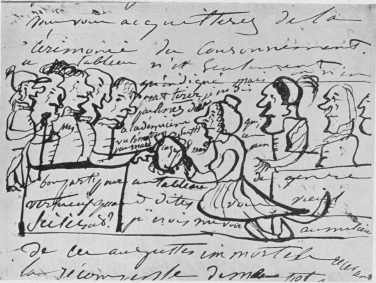
I express myself awkwardly, but I feel all this acutely.
Juliette.
Wednesday, 7.30 p.m., March 7th, 1838.
My Darling,
I see you very seldom, but it is not your fault, I know. I look constantly into my heart, whence you are never absent, and there I see you growing daily nobler, greater, and dearer. So to-morrow is the great day! Ardently as I have desired its advent, I now dread it more than I can say. However, up till now I have always been very frightened, and nothing has happened, so I hope it may be the same this time. Besides, how could the disapproval of a few miserable wretches and idiots affect the magnificent verses of Marion? It will only prompt the sincere and intelligent portion of the audience to do you instant and brilliant justice. I am no longer afraid. I am as brave and strong as love itself. Put me where you like—I do not care—all places are equally good to applaud from, just as all moments are suitable for adoring you. Good-bye, my love.
Juliette.
Thursday, 12.45 p.m., March 8th, 1838.
Good-morning, blessed one. I am quite upset. If your success to-night is in proportion to my fright, you will have the most magnificent triumph of your life. I hardly know what I am doing; I am shaking like a leaf, I cannot grasp my pen. I must try to pull myself together for this evening. It is absurd of me to be such a little craven; besides, what harm can a cabal do you? None! It can only enhance your greatness, if such a thing be possible; so, I am ashamed of my cowardice. I am horribly stupid to dread a thing which certainly will not happen, and if it did, would not injure you. Now that is enough! I will not fear again, and I will admire and applaud my Marion in the very face of the cabal. I will give them a hot time to-night! Bravo! bravo!! bravo!!! I feel as if I were there already, and the happiest of women.
My little darling man, are you not soon coming to me? I do so long for you. I feel as if you had been very cold to me lately. In the old days, a first performance did not prevent your coming to make love to me. Heavens, what torture it is to have to doubt you at a moment when I am so desperately in need of you! I love you!
Juliette.
Friday, 1.45 p.m., March 9th, 1838.
You are adorable, my great Victor. I wish I could express myself as earnestly as I feel, but that is impossible; I am tongue-tied. So the great performance is over! What a fool I was to be frightened, and how rightly I placed my confidence in that great noodle the public, which is so slow and so hard to work up, but when once started, boils over so satisfactorily. What a magnificent success, and how thoroughly justified! What a beautiful piece, what lovely verses! and the fascinating poet! Everything was understood, applauded, admired. It was delightful. My soul was raised heavenward with the Play. Dear God, how magnificent it was!!!!!!!!!!! I must be there again to-morrow, and every night. Surely I have the right!
I love you, my Toto, I adore you with all the strength of my soul. I wish I could go out—it is such a fine day. I kiss your beloved hands.
Juliette.
Sunday, 12.15 a.m., March 11th, 1838.
Good-morning, my beloved one, good-morning, handsomest and greatest of men. I cannot speak as well as some of the people who pay you such beautiful and sincere homage, but I feel from the bottom of my soul that I admire and love you more than any one in the world. All the same, I am sad and discouraged. I can see that you place no reliance on my intelligence, that my last years are flying by without earning what they easily might: a position, and a provision for the future. I am not angry with you. It is not your fault if you are prejudiced against me to the point of allowing me, without regret, to waste the last few years of my youth. Possibly my desire to create for myself an independent position, and to remain ever at your side, has given birth to the delusion that I possess a great talent which only requires scope. However that may be, I am in despair, and I love you more than ever. You are good to look at, my adored one, you are great in intellect, my Victor, and yet I dare proffer my devotion, for it is as genuine as your beauty and as deep as your genius. I adore you.
Juliette.
Tuesday, 11.30 a.m., April 10th, 1838.
Good-morning, my soul, my joy, my life. How are your adored eyes, my Toto? I cannot refrain from asking, because it interests me to hear, more than anything in the world. I am always thinking about them. I long for the 15th of this month, for then I shall have the right to insist upon your resting, and I shall certainly exercise it. My dear love, what joy it will be for me to feel your dear head leaning against mine, to kiss your beautiful eyes, and to make certain that you do not work. The weather is lovely this morning. It carries my thoughts back to our dear little annual trip, when we were so happy and so cosy together. We are not to have that felicity this year, and really I do not know how I shall endure it when the time comes at which we used to start. It will be very hard and difficult, and I doubt whether my courage and reason will suffice to enable me to bear the greatest sacrifice I have ever made in my life. My dear one, it will be sad indeed; I wonder whether I shall be equal to it.
I love you, adore you, admire you, and again I love and adore you.
Juliette.
Tuesday, 7.45 p.m., April 10th, 1838.
My love, I am writing to you with joy and worship in my heart. You were so kind and tender and fascinating to me to-day that I seemed to feel again the savour and rapture of the days of old. My Toto, my adored one, fancy if your love were to flower again like some brilliant, sweet-scented spring blossom! With what ecstasy and reverence I would preserve it fresh and rosy in my breast. Poor beloved, your work has done to our idyll what the winter does to the trees and flowers—the sap has retired deep into the bottom of your heart, and often I have feared it was quite dead; but now I see it was not: it was only lulled to sleep and I shall possess my Toto once more, beautiful, blooming, and perfumed as in those glorious days of our first love.
I who am not a sensitive plant of the sun like you, have yet come better through the trial, and if I bear no blossom, I have at least the advantage of preserving my leaves ever green and alive; that is to say, I have never ceased to love and adore you. Indeed that is true, my own, I love you as much as the first day.
Juliette.
Sunday, 11 a.m., April 22nd, 1838.
You see, darling, by the dimensions of my paper, that I am preparing to go and applaud my Marion this evening. I will not reproach you for not having come this morning. In fact, in future I shall not allude to it again, for nothing is more unsuitable or ridiculous than the solicitations of a woman who vainly appeals for the favours of her lover. Therefore, beloved, as I am to live with you as a sister with a brother, you will approve of my refraining from reminding you in any way of the time when we were husband and wife.
It is still very cold, my maid says; although the sun is shining in at my windows, it has left its warmth in the sky. It resembles the fine phrases of a suitor who no longer loves; his words may be the same, his expressions as tender, his language as impassioned, but love is lacking and those words which scintillate as the sun upon my windows, fail to warm the heart of the poor woman who had dreamt of love eternal.
You will probably see Granier this morning.[77] I hope so, so that you may not be worried any more about that business. I also hope Jourdain will come to-morrow about the chimney. It is unbearable that one should have to wait upon the whim of a workman for a job which might be finished in a few minutes, and that would please you so much. I have read with pleasure the verses that came to you in the newspaper from Guadaloupe; they show that you are admired over there as much as here, and that you have fewer enemies abroad than at the Académie Française. I am furious with that little imp called Thiers, who although he is not a quarter of a man as far as size goes, yet permits himself to cherish the rancour of a giant. Miserable little wretch! If only I were not a woman, I might castigate you as you deserve!
And you, my Toto, so great and so wonderful, I adore you!
Juliette.
Thursday, 10.15 a.m., August 2nd, 1838.
Good-morning, my little beloved. Do you still need a secretary? I am quite ready. Come; it is so delightful to dip my pen into your glorious poetry, and watch the shining and coruscating of those precious gems which take the shape of your thoughts. Dédé could not be more delighted and dazzled than I am, if she were given the diamonds and jewels of the crown of England to play with for an hour. Oh, if I could only have spent the night with my Cæsar and his noble companions, I would have followed him without fatigue wherever he wanted to go, even as far as.... But you would not allow it, you jealous boy; you feared comparison, and you were perfectly right, for I like well-dressed men. Good-morning, my Toto. My left eye is very bad; it is swollen and painful. If this continues I shall no longer be in the position of regretting that I cannot lend you my eyes in exchange for your own. I love you, I adore you. Do not be too long before coming to me.
I am longing for you with all my might.
Juliette.
Wednesday, 9.45 p.m., August 15th, 1838.
My dear little man, I love you. You are the treasure of my heart. I wish we were already in our carriage galloping, galloping far, and farther still, so that it might take us ever so long to get back.
Since you have hinted at the possibility of my playing in your beautiful piece,[78] I am like a somnambulist who has been made to drink too much champagne. I see everything magnified: I see glory, happiness, love, adoration, in gigantic and impossible dimensions—impossible, because I feel you can never love me as I love you, and that my talent, however considerable, can never reach to the level of your sublime poetry. I do not say this from modesty, but because I do not think there exists in this world man or woman capable of interpreting the parts as you conceived them in your master mind.
I love you, my Toto, I adore you, my little man, you are my sun and my life, my love and my soul.
All that, and more.
Juliette.
Monday, 8 p.m., September.
Are you proposing to cut out all the dandies and bloods of the capital? My congratulations to you. I was only waiting for some such sign to give myself up to an orgy of wild and eccentric toilette. Heaven only knows the extravagances I mean to commit in the way of shoes, silk stockings, gowns, hats, light gloves, and bows for my hair! You will, I suppose, retaliate with an assortment of skin-tight trousers, strings of orders, and more or less absurd hair arrangements. Delightful indeed! There only remains for one of us to live at the Barrière de l’Étoile and the other at the Barrière du Trône, to dazzle the dwellers of the town and suburbs, as well as strangers from abroad. Capital!!!
My sore throat has come on again and you are not here to cure it. If you think this pleasant you are quite wrong, and if I followed my own bent I should deprive you of your functions as doctor-in-chief of the great Juju. I am determined to forgive you only if you come to supper with me presently. Seriously, I cannot understand why you keep away, seeing that your Play is in rehearsal, that this is our holiday time, and that I adore you. I am almost tempted to be a little jealous, only unfortunately, when I mean to be only slightly jealous, I become very seriously so; therefore I try as much as possible to spare myself that discomfort. You would be sweet and kind, my Toto, if you would come and eat my frugal dinner with me to-night and ... I am going to concentrate my thoughts upon you, so as to magnetise you and bring you back in the shortest possible time to your faithful old Juju who loves and adores you. My first proceeding is to kiss your eyes, your mouth, and your dear little feet.
Juliette.
Tuesday, 12 noon, October 30th, 1838.
My beloved little man, you are so good and sweet when you see me that it is a pity you should see me so seldom, and that you should forget me as soon as your back is turned. To punish you, I am not going to write you two letters to-day; partly in consideration for your dear little eyes, and partly because it would be unfair to reward indifference and coldness in the same degree as affection and assiduity. Pray do not take the above expression, “dear little eyes,” in an ironical sense—I mean it on the contrary as an endearing diminutive; your “dear little eyes” signify to me my adored, beautiful eyes, the mirrors of my soul, the stars of my heaven, everything that is most beautiful and fascinating, gentlest, noblest, and highest.
I love you, my Toto. I kiss your ripe red lips, your dazzling teeth, your little hands, and your twinkling feet. I am writing only your little daily bulletin, because your eyes are bad, and you have no time to waste; neither do I wish to tire or bore you, but only to make you love me a little bit.
Juliette.
Thursday, 8.30 p.m., November 22nd, 1838.
My little treasure of a man, you were sweet to select my hovel for a resting-place from which to write your laudatory remarks upon Mlle. Atala Beauchêne,[79] commonly called Beaudouin. It gave me a chance to admire your charming profile and kiss your beautiful shining locks. I thank you for that happiness, and I consent to your inditing daily effusions concerning that lady, if only you do so in my room and under my eyes.
As you promised to come back presently, the chances are that you will not return. I have half a mind to undress, light my fire, and set to work to bruise poppy-heads; for my provision is almost at an end, and later on I may be busy at the theatre, if Joly[80] persists in his crazy idea of giving us a whole week’s rehearsals of a piece which is only to be played four months hence. It is an inducement to use the time at my disposal now, to prepare your little daily remedy.
I love you, Victor, I love you, my darling Toto.
Juliette.
Monday, 6 p.m., April 15th, 1839.
Why is it, my little beloved, that you always seem so jealous? You take the bloom off all those scraps of happiness your dear presence would otherwise give me, for nothing chills one’s embraces so much as the vexed, uneasy mien you usually wear. It would not even be so bad if you did not accuse me of that same constrained, annoyed look; but the more suspicious you are, the more you think it is I who am cross, although this is simply the effect of the glasses through which your jealousy views me. Never mind, I love you and forgive you, and if only you will come and take me out a little this evening and show me part of Lucrèce I shall be happy and content. What a beautiful day! I would have given days and even months for the chance of strolling by your side wherever your rêverie led you. Alas, it is I who am sad, and with excellent reason! As for you, you old lunatic, what have you to complain of? You are adored, and you are free to accept and make use of that sentiment as much and as often as you desire; perhaps that is why you desire it so seldom.... But let us talk of other things. Please love me a little, while I give you my whole soul.
Juliette.
Sunday, 6.30 p.m., October 27th, 1839.
Here I am at my scribbling again, my Toto. It is a sad pleasure, if any, after the two months of love and intimacy which have just elapsed. Here I sit again with my ink and paper, my faults of spelling, my stupidity and my love. When we were travelling I did not need all this paraphernalia to be happy. It was enough for me to worship you, and God knows whether I did that! Here I do not love you less—on the contrary—but I live far from you, I long for you, I worry about you, I am unhappy—that is all. Still, I am not ungrateful or forgetful; I fully appreciate that you have just given me nearly two months of bliss. I still feel upon my lips the touch of your kisses, and upon my hand the pressure of yours. But the felicity I have experienced only throws into greater relief the void your absence leaves in my life. When you are no longer by my side, I cease to exist, to think, to hope. I desire you and I suffer. Therefore I dread as much as death itself the return to that hideous Paris, where there is naught for lovers who love as we love—neither sunshine, nor that confidence which is the sunshine of love—nothing but rain, suspicion, jealousy, the three blackest, saddest, iciest of the scourges which can afflict body and heart. Oh, I am wretched, my Toto, in proportion to my love; it is true, my adored one, and it will ever be thus, when you are not with me.
Juliette.
Friday, 10 a.m., November 1st, 1839.
Good-morning, my dear little beloved, my darling little man. You told me so definitely yesterday that my handwriting was hideous, and my scrawl nothing but a horrible maze in which you lose both patience and love, that I hardly dare write to you to-day, and it would take very little to make me cease our correspondence altogether. We must have an explanation on this subject, for it is cruel of you to force me to make myself ridiculous night and morning, simply because I love you and am the saddest and loneliest of women. If my love must be drowned in my ignorance and stupidity, at least do not force me to make the plunge myself. There was a time when you would not have noticed the ugliness of my writing; you would only have read my meaning and been happy and grateful. Now you laugh, which is shabby and wicked of you. This seems to be the fate of all the Quasimodo of this world, moral and physical; they are jeered at: form is everything, spirit nothing. Even if I could constrain my crabbed scrawl to say, “My soul is beautiful,” you would not be any the less amused. Therefore, my dear little man, pending the moment when I can join in the laugh against myself, I think it would be as well to suspend these daily lucubrations. Besides, the moment has come when I must turn all my time and energies towards making my position secure. Nothing in this world can turn me from my purpose, for it is to me a question of life and death, and Heaven knows that in all these seven years I have never failed to tell you so whenever there has been an opportunity. I count upon you to help me, my beloved. I am asking you for more than life—for the moral consummation of our marriage of love. Let me go with you wherever my happiness is threatened, let me be the wife of your mind and heart, if I cannot be yours in law. If I express myself badly, do not scoff, but understand that I have a right to put into words what you yourself have felt, and that I insist upon defending my own against all those women who get at you under pretext of serving you. I will have my turn, for I love you and am jealous.
J.
Friday, 6.30 p.m., November 1st, 1839.
You are good, my adored one, and I am a wretch; but I love you while you only permit yourself to be loved; that is what makes you so tranquil and me so bitter. My heart is weighed down by jealousy this evening and nothing less than your adored presence will suffice to calm me, for I carry hell and all the furies within my soul. I wish I could be sewn to the lining of your coat to-night, for I feel I am about to encounter some great danger that I can only defeat by not leaving your side. If my fears are well-grounded, I shall probably fail in averting the doom that threatens me, for you will not be able to stay with me all the evening. The compliments and flattery you will receive will take you from me. I cannot deny that I am unhappy and jealous, and would much rather be with you at Fontainebleau, at the Hôtel de France, than in Box C. of the Théâtre Français, even when Marion de Lorme is being played. Kiss me, my little man; you are very sweet in your new greatcoat, but you had not told me you had been to your tailor. I shall keep up with you by sending for my dressmaker. I do not mean to surrender to you the palm for smartness and dandyism. Ha! who is caught? Toto! Toto!
Résilieux is beaming, Claire is happy, Suzanne is an idiot; such is the condition of the household. I am all three at the same time, plus the adoration I profess energetically for your imperial and sacred person. Kiss me and be careful of yourself this evening.
Juliette.
Monday, 12 noon, November 4th, 1839.
Good-morning, treasure. It is twelve by my clock, which is several hours fast, but I have been up some little time. I have dressed my child, and she is now practising on the piano. I spent the night thinking over what you said, my adored one. One luminous phrase especially stands out and scorches my soul. Perhaps you only said it idly as one of the compliments one is constrained to make to the woman who loves one? I know not, but I do know, that I have taken the assurance you gave me that you have never really loved any woman but me, as a sacred thing, unalterably true. I adore you and had never felt even the semblance of love until I met you. I love and adore you, and shall love and adore you for ever, for love is the essence of my body, my heart, my life, and my soul. Believe this, my treasure, for it is God’s own truth. Your dread of seeing me re-enter theatrical life will quickly be dissipated by the probity and steadiness of my conduct. I hope, and am certain of this. You have nothing to fear from me wherever I may be. I adore you, I venerate you. If I could do as you wish and renounce the theatre, that is to say my sole chance of securing my future, I would do so without hesitation and without your having to urge it, simply to please you. But, my beloved, I feel that it were easier to relinquish life itself than the hope of paying my creditors and making myself independent by earning my own living. If I were to make this sacrifice I am sure my despair would bring about some irreparable catastrophe that would weigh upon you all your days.
My adored one, do not try to turn me from the only thing that can bring me peace and make me believe in your love. Help me and do not forsake me unless I give you just cause to do so. Spend your whole life in loving me, in exchange for my unswerving loyalty and adoration.
Kiss me, my little man.
I love you.
Juliette.
Friday, 4.45 p.m., November 15th, 1839.
I wrote the date and hour on this half-sheet of paper, thinking it was blank. I explain this, in order that your suspicious mind may not again draw a flood of insulting deductions from a thing that has happened so simply and naturally. You upset me just now when you said good-bye, because you said cruel things. It was a bad moment to choose. Your manner to me is enough to discourage an angel, and I have begun to ask myself whether it is possible to love a woman one does not esteem. If you esteemed me you would not for ever suspect my words, my silence, my actions, my conduct; if you loved me you would know how to appreciate my honesty and fidelity, whereas even in the tenderest moments of our most intimate communion, you never fail to say something cruel and disheartening. I often say one might almost imagine you were under a promise to someone to tire out my love by inflicting pain upon me on every occasion; but I hope you will never succeed in doing this.
I suffer, I despair at heart, but I love you so far, and I hope for both our sakes that I always shall. I cling to my love even more than to your esteem, for the latter is a poor blind thing that cannot distinguish night from day, candle-light from sunshine, or an honest woman from a harlot.
THE BRIDGE OF MARNE. Drawing by Victor Hugo (Victor Hugo Museum).
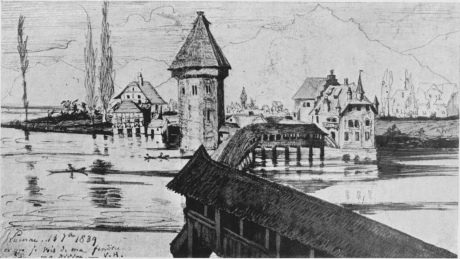
My love is more clear-sighted. It was attracted at once by your physical and spiritual perfection, and has never confused you with any other of the human species. I love you, Toto. Torment me, drive me to desperation if you will, but you shall never succeed in diminishing my affection. My head aches, little man, and the thoughts that fill it at this moment are not calculated to cure its pain. I press my hand upon my brow to crush thought, and I open my heart to all that is good and tender in my love for you. Good-bye, Toto. I adore you. Good-bye. We were very happy this morning; let us try to be so again very soon.
In the meantime I adore you.
Juliette.
Wednesday, 8.45, November 20th, 1839.
I am in despair. I wish I were dead and everything at an end! The more precautions I take, the more I purge my life, the less happiness I achieve. It is as if I were accursed, and I often feel a wild desire to behave as if I were, and crush my love underfoot. I am so unhappy that I lose all courage and hope for the future. You were very good to me when you were going away, but that does not prove that when you come back presently you may not be the most offensive and unjust of men. I sacrifice to you one by one all my actions, even the most insignificant; I am careful inwardly and outwardly to cause you no sort of offence, and yet I am unsuccessful! My struggles only fatigue and dishearten me. On the eve of taking the great step which would bind us to each other even closer than we already are, would it not be better for us to break off our relations, and put a stop to the whole thing instead? I can understand now the generosity of Didier, who elects to die upon the scaffold forgiving Marion with his last breath, rather than live persecuting and torturing her with the recollection of her past, and with suspicions a thousand times more painful than death and oblivion. Ah, yes, I can understand a Didier like that.... I suffer! Ah, God, people who do not love are very fortunate! I love you, and I know that failing some violent remedy I shall continue to suffer and care for you. I admit that all these things I write are absurd, and that it would be wiser to throw this letter into the fire, and keep to myself the thousand and one follies inspired by my despair.
Juliette.
Monday, 5.30 p.m., December 16th, 1839.
You did well, my adored one, to come back after the painful incident we had just gone through. If you had not, I should have been wretched all the evening. Thank you, my beloved Toto, thank you, my love. You looked very preoccupied, my treasure, when you came up the first time. I gathered that Guirault’s letter had something to do with this, and that you were meditating your answer. Beyond that, I did not take much notice, for I was too furious with you to be able to think of anything.
If you knew how much I love you, and how faithful I am to you, my adored one, you would be less suspicious. Suspicion is an insult that makes me frantic, because, it proves to me that you do not believe in either my honesty or my love. Jealousy is another thing: one can be jealous of a face or of a person, because however sure one may be of one’s own superiority, one may still fear that some beast or monster may be preferred to oneself; but jealousy, I repeat, is different from everlasting suspicion of one’s actions and even of one’s negative conduct and inaction. Finally, I differentiate between jealousy and suspicion; I feel there is a great gulf between my jealousy and yours, and yet I love you more than you love me—you cannot gainsay that—if you admit it, I will pardon all your misdeeds and adore you and kiss your dear little feet. Hurrah! I am to have my wardrobe! Hurrah!
You will not be an Academician, but you will always be my dear little lover.
Juliette.
Thursday, 5 p.m., January 16th, 1840.
I love you, my Toto, and am sad at seeing you so seldom. But I know how much you have to do, my little man, so am not angry with you—still that does not prevent me from being horribly sad.
Money melts in my pocket. I was reading yesterday a description of Monsieur de Sévigné, the son, which applies wonderfully to me. “He had no hobbies, did not entertain, gave no presents, wore plain attire, gambled not at all, had only one servant and not a single horse on which to ride out with the King or the Dauphin; yet his hand was like a crucible wherein gold is melted.” I am rather like that. I do not give many presents, I wear the same dress for a year at a time, I only do expensive cooking when you are coming to dine with me, I have only one servant, and yet money disappears in my establishment like snow under the rays of the sun. With me, it is not my hand that is the crucible, but my past life, which is like an abyss that all the money in the world would find it difficult to fill. That is why I am sad. Love me, my Toto, and above all do not kill yourself with working for everybody as you do without respite. I can sell something I do not want, whereas your health and repose are indispensable to my welfare and tranquillity. Remember that, my dear one, and do not be over scrupulous at the expense of the real consideration which makes my happiness. When shall I see you again, treasure?
Juliette.
Sunday, 1.15 p.m., March 22nd, 1840.
Good-morning, my beloved Toto. I read the manuscript of “Didine” over again last night, and I shed all the tears I had restrained in your presence. I am more convinced than ever that you committed an act of unfaithfulness against our love when you composed those lines. I do not see how you can hope to persuade me to the contrary, or wonder that I am wounded to the quick by such a mental and spiritual lapse. Jealousy is not excited only by infidelities of the senses, but primarily by such an infidelity as that which you have committed in writing these verses and concentrating your gaze and your thoughts upon that young girl, while my whole heart and soul were raised in prayer for you in that church at Strasbourg. I will never go back there, either to the church or to the town. There is an end of that. Would to God we had never gone there at all! I should have preserved one illusion more, and suffered one sorrow less. Well, well, it is not your fault. You wished to carry away the memory of that woman, as you could not possess her person, and you have written some very beautiful lines which prove, in the same degree as my pain, what a profound and striking impression she produced upon you. I hope you may never experience a jealousy so well-justified as mine about any woman you may love in the future; for myself I desire a speedy recovery from the most miserable infatuation in all this world.
Juliette.
Monday, 6.45 p.m., June 1st, 1840.
I am writing to you in the company of Résilieux, my love, but that does not restore to me the gaiety I have lost since this morning. That woman and her persistence annoy me more than I can say. When I think of the close confinement in which I live and realise the depth and devotion of the love I bear you, I am indignant to the bottom of my heart that a wretched woman of the street should dare to cast the eye of envy upon a passion which constitutes the religion and adoration of my whole life. If I listened to my own inclination, I should make a terrible example of the hussy and her low caprice, and no other would venture an attempt to capture your affections for many a long day. I am wretched since this morning. I think myself plain, old, stupid, badly dressed—and all because I tremble for the safety of my love, because I am afraid for my poor little slice of happiness. Alas! alas! my Toto, I care too much for you; it is crazy of me. I did so hope that when your family was settled in the country, you would sometimes come and take me out with you—but, on the contrary, in a whole month I have only been out once with you; for I do not count those two evenings at the theatre, when I drove there and back in a carriage. It would be a cruel jest if you considered those as going out with you. I am not well. I have rushes of blood to the head and heart, but you do not care. I shall not do my monthly accounts to-night; my head aches too badly. Perhaps I may try to-morrow. The laundress has been here and I have paid her; I shall probably get the grocer’s bill to-morrow, but I shall certainly not pay it unless you have plundered some passer-by to-night. Meanwhile, I love you, my Toto. Dinner has just been announced; I shall not be as happy as yesterday, for you are not dining with me; but perhaps as I am alone I shall be able to ruminate over my good fortune, for I was hardly able to realise it at all yesterday with all those females about.
Juliette.
January 7th, 9.30 a.m., 1841.
Good-morning, my darling Toto, to whom I dare not yet give his prospective title, for I am very doubtful of the integrity of old Dupaty. I hope you will not keep me waiting too long for the result of the rabid voting of the opposing parties.[81] The contest becomes more and more curious and interesting. I wish it were already four o’clock.
The weather is not very propitious for that moribund scoundrel. It would be difficult to let him down through the window, and still more so to transport him to the place where we do not wish him to be. If the computation is correct, the mortal illness of the old wretch should give you the place by a majority of one vote at the first scrutiny; but what about a black-ball? Perhaps this time it will come from the ignoble creature who walks under the filthy, greasy, hideous hat of that beast Dupaty. I wish we were already at this afternoon, that I might know what the foul old man has dared to do. Until then I shall look at my clock many and many a time. Try, my love, to come at once and tell me the result whatever it may be. I shall at least have the pleasure of seeing you, which will add to the joy of your nomination or console you for your defeat.
By the way, you were so shabby last night that one might suppose you were preparing to contest the palm of bad dressing with that old pickpocket Dupaty. I shall forgive you your untidiness if you are successful. I love you.
Juliette.
Thursday, 6 p.m., January 7th, 1841.
I am enchanted for everybody’s sake, my dear Academician, that at last you are elected. There you are at last, thanks to the seventeen votes of your friends, and in spite of your fifteen adversaries. You are an Academician. Hurrah!
I wish I could have witnessed with my own eyes the grimaces of all those contemptible old things, and heard the profession of faith of that horrible Dupaty; you ought to indemnify me by showing me your own beautiful countenance for a little more than a paltry five minutes as you did just now. I love you, Toto, as much as the first day and more than ever. But, alas, I dare not believe the same of you, for I do not see much proof of it, as my maid would say. The fact is that whether as an Academician, or a candidate, or nothing at all, I hardly see you more than an hour a day. This is neither novel nor consoling; it becomes more and more sad and painful. Think of that, my love, and come very soon after you have read my letter.
I love you.
Juliette.
Sunday, 10.45 a.m., April 11th, 1841.
Good morning, my beloved Toto, my adored little man. How are you, my darling? I am afraid you may have tired yourself last night reading your splendid speech to me. Poor beloved, it would be a calamity that my pleasure should cost you so dear; it would be unjust and cruel. I hope it is not so, my adored one, and that you have not been punished for your kindness.
What a magnificent address! and how stupid it is of me only to appreciate it inwardly, and to be incapable of expressing my feelings better than by inarticulate grunts. It is not my fault, yet since I have learned to love you I have not been able to resign myself to my limitations. Every time the opportunity presents itself to admire you I am furious with myself and should like to slap and kick myself—though my poor body would have no time to recover between the assaults, for every single thing you say and do is as admirable and striking as your written works. So I should be kept busy. Fortunately you do not object to my want of intellect; you realise the quality and proportions of my love. All my intelligence and being have turned to spirit, to idolise you. I may be only a goose outwardly, but inwardly I am sublime with devotion. Which is best? I cannot tell, it is for you to decide. Meanwhile I am the most fortunate of women to have heard the beginning of your beautiful speech, and I love you with all my strength.
Juliette.
Thursday, 4.30 a.m., June 3rd, 1841.
Good morning, my adored little man, my beloved Monsieur l’Académicien! How are you, my Toto? I am very much afraid you will be horribly tired before this afternoon, poor treasure![82] I think you should have had the speech printed a day earlier, and have kept this night free for resting.
I really do not know how you will manage to deliver your address after these several days of grinding fatigue, and a night spent in correcting the proofs at the printing-works. Nobody but you can accomplish these feats of endurance. Still, my beloved, it is time you changed a mode of living which must kill you in the long run. I hope you are going to spend the remaining few hours in your bed.
I already feel as agitated as if I were going to make the speech myself. I shall be in a desperate state of mind until you have finished and Salvandy begins to speak. I shall have this fearful lump on my chest until then.
Whatever happens I adore you.
Juliette.
June 3rd, 5.30 p.m., 1841.
Where shall I begin, my love? At your divine feet or your celestial brow? What shall I express first? My admiration? Or the adoration that overflows my heart like your sublime genius surpasses the mediocre creatures who listened to you without understanding, and gazed at you without falling upon their knees! Ah, let me mingle those two sentiments that dazzle my brain and burn up my heart. I love you! I admire you! I adore you! You are truly splendid, noble, and sublime, my poet, my beloved, light of my eyes, flame of my heart, life of my life! Poor adored beloved; when I saw you enter, so pale and shaken, I felt myself swooning, and but for the support of Madame Démousseaux and Madame Pierceau, I should have fallen to the floor. Happily nobody noticed my emotion, and when I came to myself and saw your sweet smile answering mine and encouraging me, I felt as if I were awaking from a long, painful dream, though only a second of time had elapsed.
Thank you, my adored one, for sparing a thought to the poor woman who loves you, at that solemn moment—I should have said, that supreme moment, if the assemblage had not consisted for the greater part of tiresome blockheads and vile scoundrels.
Thank you, my good angel, my sublime Victor, my illustrious child. I saw all your dear little family;[83] lovely Didine, charming Charlot, and dear little Toto who looked pale and delicate. I kissed them all in spirit as I did their divine father.
I love you.
Juliette.
Thursday, 2.30 p.m., July 8th, 1841.
While you are lording it at the Académie[84] I am weeping and suffering at home. You might have spared me this pain by inviting me to attend the sitting, or else staying away yourself. I must warn you, my Toto, that this sort of sacrifice and torment is unendurable, and if it happens again I do not know what I may do rather than resign myself to it.
We are not living in the East, and you have not bought me, thank Heaven! I am free to cast off the yoke of proceedings which are neither just, nor kind, nor affectionate. I swear by all I hold most sacred in this world, namely my love, that I will not submit a third time to be thus flouted. If you knew how furious and miserable I am feeling at this moment of writing, you would not venture to inflict a third trial of the kind upon me. In any case pray keep my letter as a definite announcement of what I am capable of doing if you are so cruel as to persist in your present line of conduct. Meanwhile I am doing my best to avoid taking any definitely fatal step, but I warn you that I cannot much longer remain mistress of myself.
Juliette.
1 a.m.
Hell in my heart at noon, Paradise at midnight, my Toto. I love you and have full confidence in you.
Friday, 7.45 p.m., November 19th, 1841.
I have it! hurrah!! Fancy, it has been here all the morning, yet nothing warned me! My heart did not beat faster than usual, the earth did not tremble, the skies did not fall, in fact everything remained in its humdrum, normal condition, as if nothing unusual had happened—and it was here all the time! I possessed it in my room, under my eyes! Verily it can hardly be credited, and if anybody but myself said so I should not believe it. But what you must believe, my love, for indeed it is true, is that I love you and that you are the kindest, most charming, best, handsomest, most generous, most noble, and most adored of men. That is what you have got to believe, because it is God’s own truth. The cabinet is fascinating, but what is still nicer is the way you gave it to me. “The manner of the gift is better than the gift itself,” was once said by some one whose name I have forgotten. When you are the donor, the proverb is still more applicable. If you had all the treasures of the universe to bestow, you would do it with a grace that would enhance the value of the gift a thousandfold. As for me I am mad with delight, for I believe you love me. I may tell you now that last night I cried helplessly at the thought of how much younger and handsomer you are than I. I anticipated the moment when you will no longer be able to love me, and my heart contracted so that I should have suffocated without the relief of tears. I feel I shall certainly die the day you cease to care for me, and I know that no other woman can ever worship you as I do. But I trust that day will never dawn, will it, my angel? There are no wrinkles in the heart, and you will see my face only in the reflection of your attachment, eh, Victor, my beloved? The while I wept and mourned, you were thinking of me, my poor sweet, and bringing me the cabinet. We were both performing an act of love, mine gloomy, yours, charming and considerate like everything you do. I hope your present will bring us both happiness, and that you will adore me as long as I shall admire my dear little cabinet—that is, for ever.
I have it! what happiness! I should like to put it in the middle of the room on a golden table, or in my bed, or carry it in my arms, on my heart, anywhere in fact where it could be seen and touched. Meanwhile I will give it a good cleaning to-morrow. It is rather too late to-night. I must do some copying, and dine, and send you back the scribble you entrusted to me yesterday, so I will put off till to-morrow—principally because I shall have a better light then. I will clean it in bed, drawer by drawer. It will be a delightful occupation.
I love you, I love you, Toto, I kiss you and adore you, Toto.
Juliette.
Wednesday evening, 6.30, February 9th, 1842.
Do you really want me to write Toto, even when my heart is breaking, and my soul brimful of discouragement? I obey, but if you would only listen to me, you would allow me to discontinue these daily scrawls, which have never served any purpose but that of betraying the measure of my stupidity and making you tire of a love become absurd by dint of reiteration. I feel you only insist out of kindness, but it seems futile to continue this childish babble, which deceives neither you nor me, and gives me no indication of what is passing in your mind. It would be better, my beloved, to inure me gradually to a catastrophe which may be nearer than I guess, than to make efforts to leave me an illusion which neither of us really shares nowadays. A sad ending to all our past happiness! God grant it may not be altogether buried. This does not prevent me from doing you full justice, my friend. You are kind with a kindness full of pity and divine indulgence, but you no longer cherish for me the love of a man for a woman. Do not pretend otherwise, for you cannot delude me. I bear you no grudge my Victor, neither should you bear me any, for it is no more your fault than mine, that you do not love me while I still love you—not our fault, but God’s, Who distributes unequally the amount of love we may each expend during our lives. Happy he or she to whom the smaller sum is apportioned—so much the worse for him or her whose heart is inexhaustible. Now, my beloved Toto, I will torment you no longer. I will even try to make myself agreeable, though, alas, what woman can be agreeable when she is no longer loved! But I shall do my best, and that, coupled with your natural generosity, may still retard for a few days the greatest misfortune of my life. Fear nothing from me, my Victor. You have to-day received the last expression of my choler. One may strike, and even kill, while one feels oneself beloved, but one must spare the man who no longer cherishes one.
You see, my Victor, that you have nothing to be afraid of, but I beseech you to let me off these daily scribbles about things that have neither point nor reason.
I demand this of your goodness.
Juliette.
Thursday, 2.30 p.m., February 10th, 1842.
My beloved, my adored Victor, thank you! You remove hell from my heart, and replace it with paradise. Thank you! My life, my spirit, my soul, bless and adore you. What a letter, my God! I wanted to read it kneeling; happy tears poured down my cheeks. You love me, my dear one! It must be true, for you declare it in the loveliest, sweetest language of the whole world. You love me although I am ill-tempered, violent, stupid; you love me my good angel, because you know that your love is the breath of life to me, and that without it I could no longer exist. I also love you, but only God and myself know how deeply. Yesterday when you left me, I was on my knees praying and kissing with tears the footsteps I could hear fading away in the street. I could have flung myself out of the window and died at your feet. My despair, then, was as poignant as the bliss I felt just now when I read your adored letter. My Victor, my love, my life, my joy, I love you more than ever! I implore your forgiveness, I throw myself at your feet and embrace them. Thank you, my treasure. You must be very happy, for you have done a lovely thing in writing me the most charming, the kindest, the most wonderful and most adorable letter that ever issued from your heart.
Juliette.
Thursday, 9.30, April 30th, 1842.
Good morning, my adored Toto. How did the little invalid sleep last night? As for you, I do not even ask, my poor dear, for I know you spend all your nights working. I love you, my poor angel. I do not know what else to say, because that is the only thought in my heart and soul; to love you always and for ever. Here comes the bright sunshine that is going to cure our poor little man at once.[85] I have not seen a finer spring since the one we spent strolling about the heights of Montmartre together. I cannot think of it without tears of regret for the days that are gone, and of gratitude to Providence for those few moments of most perfect felicity. I would give half my life to have it again, my beloved Toto; and it depends only upon you—if you wished it, we could easily recover the happiness of those days. Why do you no longer desire it? I know you have to work, but so you did then—Claude Gueux, Philosophie Mêlée, Les Voix Intérieures, Les Chants du Crépuscule, Angélo, Les Rayons et Les Ombres and Ruy Blas, are there to prove it. In those days you loved me better than you do at present. Alas, I love you more than ever, or rather, as much as the first day!—that is, with all my soul.
Juliette.
A DEDICATION BY VICTOR HUGO TO JULIETTE DROUET. The original belongs to M. Louis Barthou.
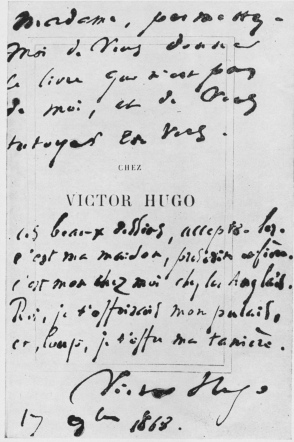
Saturday, 6.30 p.m., August 20th, 1842.
I am a strange creature—at least you think so, do you not, beloved? But what you take for eccentricity, caprice, bad-temper, is really love, but an unhappy love, mistrustful and anxious. Everything is to me a subject of dread almost amounting to despair. Thus this visit to the Duchesse d’Orléans, whither I quite admit you were kind enough to take me, was simply a torment on account of the hour and the circumstances: I, badly dressed, barely clean, and that woman under the prestige of a great sorrow[86] which, next to physical beauty, is the surest way to your heart. I frankly confess that however gallant my love may be, and whatever reliance I may place upon your loyalty, I am not easy when I have to fight and struggle without weapons. This result of a surprise and a hurried rush through Paris in a cab may seem excessive to you, and verging on hysteria; but the fact is, my adored one, that my love, so long repressed, is verily degenerating into a disease, almost into frenzy. Everything hurts me. I am afraid of everything. I am a poor thing needing much compassion for loving you so. If these incoherent expressions do not force upon you the realisation of the depth of my devotion, it must be that you no longer care for me, or indeed have never done so; but if on the contrary you do understand, you will pity and pardon me, and love me all the better, and I am the happiest of women.
Juliette.
February 14th, 11.15 a.m., 1843.
Good morning beloved Toto, good morning adored one. I love you. When I heard you describing last night the impression produced upon you by the rehearsal of Lucrèce and more especially by the singing of the guests, I seemed to feel it all myself. The fact that my love has not grown a day older, that my admiration is still on the increase, that I think you as handsome and as young as ever, makes it easier for me to go back to the feelings of those days. Looking into my heart, I seem to feel that all this adulation and joy and feast of glory and love began yesterday. Alas, those ten years have left traces only upon my poor countenance, and have been as harsh to it as they have been indulgent to your charming features.
I express this somewhat crudely, as I always manage to do, but it is not my fault, my love, nor any one else’s. I love you. Therein consist my intelligence, my wit, my superiority; beyond that I am as stupid as any other animal.
You must be very busy to-day with the two rehearsals,[87] and the Maxime[88] worry which falls upon your devoted head, not to speak of the great business! I dare not expect you to-night till very late. Well, my dearly beloved, I know you do not belong to me, so I will resign myself as cheerfully as may be, and put a good face upon your absence. Try to think of me, my dear little man; that is all I venture to ask at this moment. As for me, there is no more merit in thinking of you and loving you than in breathing.
I love you, Toto, as much as life.
Juliette.
Wednesday, 4.30 p.m., September 13th, 1843.
Where are you? What are you about, my adored one?[89] In what condition is your family? What state are you in yourself? what will happen to us all in our despair, if God be not merciful to us! Since you left me I can think only of your arrival at home. I imagine the scene: the despairing sobs of your children, the expression of your own frightful grief, so long and sternly repressed. All those tears and sufferings fall back upon my heart and rend it. I cannot bear more. My poor head is on fire and my hands burn like live coals. I want to pray and cannot; all my faculties, all my being, turn to you. I would give my life to spare you a single pang. I would have sacrificed myself in this world, and the next to save your adored child. My God, what will become of me if you stay away much longer, when I have refrained with such difficulty from sending to get news of you? I have begged Madame Lanvin to come to me this afternoon and bring her husband, so that if, as I fear, I have not seen you before then, he can go and ask for news of you under the name of Monsieur St. Hilaire. My heart aches, my poor treasure, when I think of all you are enduring. I feel I cannot much longer bear not seeing you. I shall commit some act of folly if you do not come to my assistance. I exhausted my strength and courage on that awful journey, and during last night and to-day. I have none left now to endure your absence. I picture to myself your wife ill, and you also; in fact, I am like a mad thing in the extremity of my anxiety and grief. I am trying to occupy myself mechanically, in order to bring nearer the moment when I shall see you, but my efforts only make every minute of waiting seem like a century, and all the fears my heart anticipates, become frightful realities against which I cannot struggle. My adored Victor, whatever be your despair, mine is greater still; for I feel it through my love, which makes it a hundred times worse and multiplies it beyond all human calculation. Never has man been so idolised by woman as you are by me, and the poor angel we mourn knows it and sees it now, as God knows and sees it, and she will forgive, as He does, I am certain. I think of her, poor beloved, as an angel of heaven. To her I shall direct my prayers, that she may give you the strength and courage you need. To her also I shall address myself in the hour of death, that the good God may take me with all of you into His Paradise.
My adored Victor, it is more than five o’clock, and you have not yet come. What shall I do! What can I think, or rather what am I to fear? We are in a terrible cycle of misfortune, and God only knows when it will end. My Victor, before giving way to despair, think of mine, remember that I love you more than life.
Juliette.
Sunday, 5.45 p.m., October 8th, 1843.
I have been working all the morning my beloved, or rather scribbling on paper—only to please you, for I doubt whether my labour will be of any use to you; still, I am trying hard, and if I cannot do better, I am doing my best. I cannot do more. I am trying more especially to forget no detail, which makes me occasionally note down trivialities, little futile, insignificant things. My search among our memories is like the botanising of a child who is as apt to collect couch grass as the more useful and rarer plants. However, I am doing my best, and better still, I am obeying you. Would you believe that, although I have been writing the whole day, I have not yet reached Auch.[90] My mind and pen rather resemble the fantastic equipage we drove thither, but there is less risk in the present venture. The worst that can happen is that we should tumble promiscuously into a muck heap of absurdities and nonsense which leave no bruises, whereas we risked our necks several times in the course of the thirty-three miles between Tarbes and Auch.
I should love to see you, my Toto. The day, though filled with joyous recollections of our journey, has seemed long and sad to me. Nothing can take the place of one of your embraces. The remembrance of the greatest happiness cannot weigh against one glance from you. I realise it more to-day than ever before; therefore, do try and come, my beloved Toto. It will give me courage and patience to get through the evening. I love you too much, you see, but I cannot help it; it is no fault of mine.
Juliette.
Sunday, 7.15 p.m., November, 1843.
I think of you my beloved, I desire you, I love you. Ah yes, I love you my adored Toto, you may be sure of it, for it is God’s truth. My little Claire and I talk of you and nothing but you. We love you and bless you. The poor little child will not be with me much longer, and I can already see her poor little face wrinkling up with sorrow; but I try to be cheerful and to remind her of the fortnight’s holiday which will soon come. We love the pictures of your dear little Toto, and his pretty home. We gaze at them with eagerness and affection, we are all eyes and heart. At this moment Claire is reading Ulric’s poems,[91] while I am writing to my beloved Toto with a heart full of gratitude and devotion. May the happiness you bestow upon me, be yours also, my love! May a just pride sustain you, for you have saved two souls, the mother’s and the daughter’s! I feel ineffable things I dare not express, for fear of vulgarising them by the mere fact of putting them into words. Do not delay long ere you come, my darling Toto. If you knew the joy and radiance you diffuse in this house, you would indeed hasten your steps. Alas, I am foolish, for have you not children of your own whom you must also make glad! I am envious of them, but not cruel enough to deprive them of their bliss—only I beg of them to hurry with their enjoyment, so that my turn may come.