PART II LETTERS
Theodora Davidson translation
Sunday, 8.30 p.m. (1833).
Before beginning to copy or count words,[59] I must write you one line of love, my dear little lunatic. I love you—do you understand, I love you! This is a profession of faith which comprises all my duty and integrity. I love you, ergo, I am faithful to you, I see only you, think only of you, speak only to you, touch only you, breathe you, desire you, dream of you; in a word, I love you! that means everything.
Do not therefore give way any more to melancholy; permit yourself to be loved and to be happy. Fear nothing from me, never doubt me, and we shall be blissful beyond words.
I am expecting you shortly, and am ready with warm and tender caresses which, I hope, will cheer you.
Your Juju.
(1833).
Since you left me I carry death in my heart. If you go to the ball to-night, it must be at the cost of a definite rupture between us. The pain I suffer at imagining you moving among that throng of fascinating, careless women, is too great for you to be able to inflict it without incurring guilt towards me. Write to me “Care of Madame K....” If I do not hear from you before midnight, I shall understand that you care very little for me ... that all is over between us ... and for ever.
J.
Wednesday, 2.30 p.m. (1833).
I cannot refrain, dearly beloved, from commenting upon the profound melancholy you were in this morning, and upon the doubt you manifest on every occasion as to the sincerity of my love. This unjustifiable suspicion on your part disheartens me beyond all expression. It intimidates me and makes me fear to confide to you the incidents my dubious position exposes me to. To-day, for instance, I concealed from you the visit of a creditor, who presented himself to the porter, but was not shown up. I paid him out of my own resources, without your knowledge, because you are always telling me I do not love you. This expression from you makes me feel that you hold a shameful opinion of me and my character, rendered possible perhaps by my situation, but none the less false, unjust, and cruel.
I love you because I love you, because it would be impossible for me not to love you. I love you without question, without calculation, without reason good or bad, faithfully, with all my heart and soul, and every faculty. Believe it, for it is true. If you cannot believe, I being at your side, I will make a drastic effort to force you to do so. I shall have the mournful satisfaction of sacrificing myself utterly to a distrust as absurd as it is unfounded.
Meanwhile, I ask your pardon for the guilty thought that came to me this morning, and which may possibly recur, if you continue to see in my love only a mean-spirited compliance and an unworthy speculation. This letter is very lengthy, and very sad to write. I trust with all my soul, that I may never have to reiterate its sentiments.
I love you. Indeed I love you. Believe in me.
Juliette.
Wednesday, 8.15 p.m. (1833).
Here is a second letter. Forgive my epistolary extravagance. Honestly, I imagine you must soon tire, to put it as mildly as possible, of this superabundance of letters.
The reason of my writing again is no novel one: it is merely to repeat that I love you every day and every instant more and more; that I feel convinced you are only too eager to return my sentiments, but that between your desire and your capacity there stands a wall a hundred feet high, entitled “suspicion.” Suspicion leads to contempt, and when that exists, no real love is possible. There is no answer to what I have just stated. I feel it, and am crushed by my sorrow. I know not what to do, where to go, what plans to make. I can only suffer, just as I can only love you.
Juliette.
If ever this letter is found, it will be seen that my love was insufficient in your eyes to atone for my past.
2 a.m. (1833).
My Victor,
I love you truly, and neither know, nor can conceive, any personality more deserving of devotion than yourself.
I look up to you as a faithful, reliable friend, as the noblest and most estimable of men.
It hurts me to feel that my past life must be an obstacle to your confidence. Before I cared for you, I felt no shame for it, I made no attempt to conceal or alter it; but, since I have known you, this attitude of mind has changed in every respect. I blush for myself, and dread lest my love have not the strength to erase the stains of the past. I fear it even more, when you suspect me unjustly.
My Victor, it is for your love to sanctify me, for your esteem to renew in me all that once was good and pure.
I care for you so much that all this is possible. I will become worthy of you, if you will only help me.
Farewell. You are my soul, my life, my religion; I love you.
Juliette.
Your appreciation of my letters is one of the best proofs of love you have yet given me. I will set to work to reconstruct them. Nothing has happened since you left me yesterday, except that my love for you has increased.
(1833.)
Before reading this letter, look upon me once more with affection.
My poor friend, I am about to grieve and surprise you greatly. Yet it has to be done. I no longer have the courage to bear up against your unjust and suspicious jealousy, and your continued mistrust of a sentiment as pure and true as that which one cherishes towards God. They wear me out and make me wretched to the last degree. I would rather leave you, than expose myself to fresh grief, which might end in destroying either my reason or my love. This resolve is dictated by the excess of my affection. Even if you suffer, forgive me, and bless me before you leave me for ever. I love you.
J.
(1833.)
Since you insist upon a denial of offences which exist only in your imagination, I owe it to you to make it comprehensive and without restriction. It is not true that I have tried to offend you by reproaches unworthy of yourself and of me. It is not true that I have ever held any opinion of you, but this one, that I esteem you above all men.
The real and irrevocable cause of our estrangement, is the certainty that your love for me is incomplete. I am more persuaded of it every day, and particularly to-day, when you have actually told me that you thought I had misled you as to the state of my affections.
This is a grave offence towards a woman who has never deceived you on the subject of her heart, and whose only fault is to love you too much; for her very excess in this respect, has given her the sad courage to risk losing your esteem, in order to preserve your love one day longer.
But I am unwilling to think you intended to hurt me by allowing me to see the canker in your heart. I prefer to believe that we are equally the victims of a calamity, under which our only resource, is to separate from one another. Possibly our wounds will heal when they are no longer exposed to the continual friction of carping suspicion.
Good-bye. Forgive me if I have offended you. I am loath to hurt you.
J.
I beg you not to attempt to see me again. This is the last sacrifice I will ask of you.[60]
(June 1833.)
My dear Victor, my Beloved,
Do not be anxious! I am as well as a poor woman, who has lost her happiness and the sole joy of her existence, can expect to be. If I could let you know my place of refuge without exposing us both, but more particularly myself, to useless wretchedness, I would do so. Confidence, the indispensable ingredient in a union such as ours, no longer exists in your mind. God is my witness that I have never once deceived you in matters of love, during the past four months. Any concealment I have been guilty of, has only been with the intention of sparing us both unnecessary worry, in view of the attitude of mind we have been in lately.
I may have been wrong; the purity of my intention must be my excuse.
CLAIRE PRADIER. From an unpublished drawing by Pradier.

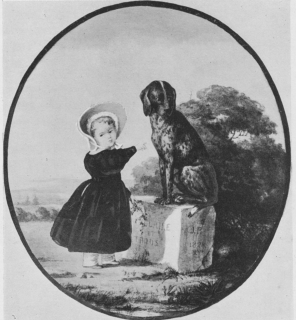
9.45 p.m. Saturday, August 13th (1833).
While you are on your travels, dearest, my thoughts follow you in all love. Though I still feel somewhat sore, I will strive to control myself, and speak only those gentle words you like to hear.
It was dear of you to allow me to come to your house.[61] It was far more than a satisfaction to my curiosity, and I thank you for having admitted me to the spot where you live, love, and work. Yet, to be entirely frank with you, my adored, I must tell you that the visit filled me with sadness and dejection. I realise more than ever, the depth of the chasm that gapes between your life and mine. It is no fault of yours, beloved, nor of mine; but so it is. It would be unreasonable of me to call you to account for more than you are responsible for, yet I may surely tell you, dearly beloved, that I am the most miserable of women.
If you have any pity for me, dear love, you will assist me to rise superior to the lowly and humble position which tortures my spirit as well as my body.
Help me, my good angel, that I may believe in you and in the future.
I beg and implore you.
J.
(1833.)
It is not quite six o’clock in the evening. I have just finished copying the verses you gave me yesterday. I am not very familiar with the forms of compliment in usage in fashionable society. All I can tell you is that I wept and admired when I heard you read them, that I wept and admired when I read them to myself, and that once more I weep and admire in recalling them. I thank you from the bottom of my heart for having thought of me when you were writing them. Thank you, my beloved, for the benign sentiments that inspired you. Your beautiful lines have had the effect you anticipated, for they have acted both as a cordial and a sedative to my sick spirit. Thank you! thank you! and again, thank you! You are not only sublime—you are kind, and, what is better still, you are indulgent, you who have so much right to be severe.
I love you. My heart melts in admiration and adoration. There is more rapture of love in my poor bosom than it is capable of containing. Come then, and receive the superabundance of my ecstasy.
If you only knew how I long for you, and desire you! If you knew more still, you would come, I am very sure! Come, come, I beg you, come! You shall have a kiss for every step, a recompense for every effort, more smiles, and more joy, than you will encounter fog and cold.
Juliette.
I am writing this a little later because, before turning to business, I had to unburthen my heart. I came home yesterday, read your poetry, dined, did my accounts, and went to bed. I read the newspapers you sent, went to sleep, dreamed of you, and woke up this morning at 8 o’clock. I rose almost immediately, did some housework, and mended yesterday’s frock. In the middle of breakfast Lanvin arrived, bringing the newspapers and a letter from M. Pradier and some of Mademoiselle Watteville’s luggage. He asked whether we should want him to see us off. He left again at 1 p.m., taking Claire’s things with him and some of his wife’s. When he had gone, I washed and did my hair, did the same for Claire, and at 2.30 I sat down to copy, and now I am writing to you. This, Colonel, is my report. Are you satisfied? Then, so is the Corporal of the Guard! After dinner I shall hear the children their lessons, and count the lines of Feuilles d’Automne.
After dinner.
I have heard the children’s lessons, and been obliged to punish your protégée, Claire, who is the laziest and idlest of all the pupils. I have just read your poem to Madame Lanvin; she was deeply moved. The poor thing understands you, therefore I need not explain that she loves you. Good-night, until to-morrow, I hope.
I suppose you did not come to-day because you had arrangements to make for our journey; that is why I am able to possess my soul in patience.
J.
Sunday, 4 p.m. (1833).
I have just come in sad and depressed. I suffer, I weep, I wail aloud and moan under my breath, to God and to you. I long to die, that I might put an end once and for all, to this misery and disappointment and sorrow. It really seems as if my happiness had disappeared with the fine weather. It would be folly to expect to see either again. The season is too far advanced for fine weather or for happy days. You poor silly, who wonder that I should deplore so bitterly the loss of one day’s happiness, it is easy to see that you had not to wait for the privilege of loving and being loved till you were twenty-six years old! You poet, who wrote Les Feuilles d’Automne in an atmosphere of love, laughter of children, eyes azure and black, locks brown and gold, happiness in full measure! You have had no cause to notice how one day of gloom and rain, like this, can make the greenest of leaves wither and fall to the ground. You cannot therefore know how twenty-four hours robbed of bliss can undermine one’s self-confidence and strength for the future. It is evident that you do not, for you wonder when I weep; you are almost annoyed at my grief. You see, therefore, that you do not realise the measure of my devotion. Surely I have good reason for regretting that I love you so ardently, when I see that love uncalled for and unwelcome! Oh, yes, I love you, it is true! I love you in spite of myself, in spite of you, in spite of the whole world, in spite of God, in spite even of the Devil, who mixes himself up in it.
I love you, I love you, I love you, happy or unhappy, merry or sad. I love you! Do with me what you will, I still shall love you.
J.
Monday, 1.50 a.m., 1833.
I have been standing at the window all this time, my soul stretched towards you, my ear attentive to every sound, fearing always lest your courage should fail you before the end of your weary walk. It is half an hour since you left; I have listened hard, but no sound has reached me that could make me apprehend you had not the strength to reach your own house. I trust that while I am penning these lines, you are already experiencing the relief that bed and repose will bring to your suffering. No words of mine can suffice to express to you my regret, my sorrow, my despair, for what happened to-night. I do not acquit you altogether of guilt, but I ask you to pardon your own, as well as mine. Forgive me for having yielded to you after what had passed between us. I ought to have foreseen what would happen, and what did happen. God knows, I had resisted as long as I could, and had given way only upon the solemn promise you made me, never to refer to the stains of my former life, so long as my conduct towards you should remain honest and pure.
The last seven months of my life have been absolutely honest and pure! Yet, have you kept your word?
If I were the only one to suffer I should be more resigned, but you are as unhappy as I; you are as ashamed of the insults you heap upon me, as I am, of receiving them.
Now that I perceive fully the canker that lies at the root of our position, it is my part to arrest the progress of the evil by cutting out my soul and my life, to preserve what can still be saved of yours and mine.
Listen, Victor, I urge you not to refuse me your assistance in carrying out the plan I think indispensable for the honour of us both.
If anything can give you courage it must be the knowledge that I have been faithful to you alone, these seven months. Ah, truly I have never deceived you! Truly! truly! Yet in the course of these same months, how many mortifying scenes such as that of to-night have taken place!
Surely you can see that we must no longer hesitate! I will go away by the first Saumur omnibus. The health of my little girl can serve as a pretext. When I am with her, I shall be able to reflect upon my position, and see what I can do in order to render it tolerable. If, as probably may be necessary, I were to leave the theatre, the furniture would cover my debt to Jourdain, and if you were unwilling to be worried, I could request any man of business to sell it, up to the amount of my bill to Jourdain, which is the only one for which you are responsible.
I shall go abroad. Such as I am, I am still capable of earning my living, which is all that is necessary.
But all this is beside the question. The important point is that I ought to start as soon as possible, to-day even, in order to protect us both from ourselves.
Before going, I hope to see you once more, unless your condition should become worse—which is a horrifying thought when I consider that I am the cause of it.
But whether I see you or not, whether you are the victim of my temper or not, I leave with you all my love and all my happiness. I do not reserve even hope; I give into your keeping my soul, my thoughts, my life. I take only with me my body, which you have no cause to regret.
Juliette.
(December 20th, 1833.)
My beloved Victor,
I have been very unjust to you. You have had cause to call me ungrateful and unworthy. You will soon hate me—soon also, you will have forgotten me. I feel it. You see, there can be no thought or sentiment of yours that I do not understand and apprehend. At this moment, even while I am writing to you, you are blaming me for suffering. You are annoyed with me for idolising you with an extravagance which renders me mad and jealous. You are tired of my love. It cramps you, fatigues you. You meditate flying from me. My bad luck frightens you; you fear to share it longer. You dread the responsibility—say, rather, you love me less, perhaps not at all. Oh, what suffering that fear gives me! My head is aching. I wish I could die. It must be my fault. I have been wrong to show you the hideous wound in my heart, the jealousy which lacerates and destroys it. Yes, I ought to have concealed my sufferings from you. I ought never to fly into those rages that betray the depth of my love and grief.
My Victor, do not leave me! I beg you on my knees, not to be daunted before a public responsibility. Who has the right to demand from you an account of the measure of the sacrifices you have made for me? What does it matter if you are denied the justice you deserve? What matter that you should be held responsible in part for my troubles? The point to be considered before all others, is your private relations with me. The responsibility you must accept is towards me only; it concerns only our two selves. If you repudiate it, it will kill me, for my whole life is wrapped up in you and your presence. I breathe only through your lips, see only with your eyes, live only in your heart. If you withdraw yourself from me, I must die.
Reflect! This is not a threat, to keep you near me. I am not exaggerating the extent to which you are necessary to my very existence—I am only telling you what I feel. It is the truth, but the truth under restriction, for I hardly dare acknowledge it in its entirety, even to myself. I need you! Only you! I cannot exist without you. Think of it. Try to love me enough to accept the charge of my life, with all its attendant bad luck.
Juliette.
2 a.m., January 1st, 1834.
To Thee, my Victor!
I dare not say anything. Guess what I am feeling and do with me what you will!
I love you ... the memory of what has gone before, and my fears for the future, prevent me from describing my emotions as freely as formerly. Forget the past, take the future into your own hands, and I shall regain the faculty of saying “I love you,” as earnestly as I mean it.
I love you.... Juliette.
Saturday morning, 1834.
To Monsieur Victor Hugo,
In Town.
JULIETTE DROUET ABOUT 1830. From Champmartin’s picture (Victor Hugo Museum).
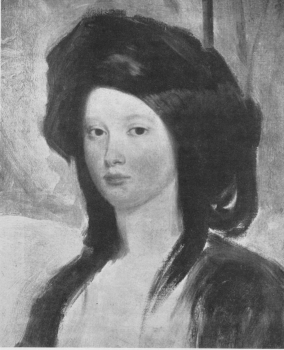
It is a quarter to one. I have been to your printing-works, numbers 16 and 19; you had not been seen. I went on to your house; you had not come in. I wrote you a line; I waited for you.... At last I came home hoping to find you; but you had not been here. My thanks to you for treating me like a vagrant dog. You had informed me that you were going to the printing-works, that you might go back to your house, that you would certainly go to mine.
You forgot your promises at once, and you apparently hold my love very cheap.
If you, indifferent though you may be, could see me in imagination, as I sit writing to you, you would be horrified at the condition your injustice and disdain have reduced me to.
It is evident that you no longer love me, and that you are only bound to me by the fear of causing some great calamity if you desert me. It is indeed grievous that this should be the only sentiment which links you to me, and I am unwilling to accept a devotion so hollow and humiliating. I give you back your freedom. From this moment you have no responsibility towards me, although my heart is broken, although my soul is still fuller of love than it is able to contain, although my eyes, as I write, are drenched with bitter tears. I shall still have the courage necessary to bear my life as it will be, when bereft of happiness and laughter.
You have been very cruel to me. I forgive you. Forgive also my tempests of rage. I am ashamed of them, and thoroughly wretched. I swear to you by that which I hold most sacred in life, namely my child, that I am unable to explain how I can have been guilty yesterday of a thing I utterly disapprove of, and which seems to me the acme of effrontery. I swear I never saw those men. I am innocent of any crime. I can say no more. You have crushed me by referring again to my past life, and even while I am assuring you of my love and repentance, and while I still hope for a reconciliation, I tremble to feel that you can suspect me so unjustly. My heart shrinks from the sorrow still in store for it ... my pen fails me ...
Farewell! May you enjoy greater tranquillity and happiness than will fall to my lot. Do not forget that, for a whole year, we were happy solely by means of our love.
Good-bye! I have indeed received my full meed of punishment for the imaginary crime of yesterday.
Farewell. Think of me without bitterness.
Juliette.
Monday, 2 a.m. (1834).
I returned from the Place Royale about two hours ago. It was ten o’clock when I arrived there, and I left at about midnight. I had hoped to bring you back with me, or, failing to do so, to catch at least a glimpse of you. I waited patiently all that time, hoping that you would become aware of my presence, and reward me for it by one glance. But everything remained dark and gloomy for me, though it was easy to see the lights through the drawn blinds, and the shadows of many people moving about.
It will not be the last time, in all probability, that I shall have the opportunity of seeing that, while I suffer and weep, you make merry. Forgive me, my Victor, forgive me for this comparison of our respective lots. It is the last time I shall make it, perhaps even the last time I shall write to you, for you have said that you will not read any more of my letters for a long time ... a long time signifies “for ever,” for you will forget me and I shall die. Your love was my whole life. To-night I feel as miserable as I should be if you no longer loved me. God, how sorely I need pity!
I have just obeyed your wishes by putting all your works away carefully. As for my own relics of you, I have collected them in an English desk, under lock and key, and hidden them under my bolster, where they shall always remain.
Farewell, the performance of this duty has been a mournful satisfaction to me.
Saturday, 6 p.m., 1834.
To Thee, my Beloved.
You promised that as soon as your work was finished, you would devote all your time to me; you also said, when you were leaving me yesterday, that you would come early this morning. Neither of these promises have you kept; yet I have never longed for your presence and your love more than at this moment, when anxiety seems to have taken up its abode with me. I have been so worried that I do not know whether I could endure another day like this.
I am thankful to leave this house; it is so haunted by ill-luck and sadness, that to be quit of it will be a relief.
My Victor, what is going to become of us? What can we do to avert the misfortune that threatens us?[62] Can you think of any way out of the trouble? Do you love me? I love you so! in prosperity, and still more in adversity. Oh, God be merciful to me! Without your help I am done.
Juliette.
I have no other refuge or I should not go to Madame K. I cannot wander about alone, for that would make you anxious; yet I cannot stay here, I am too miserable. I will wait for you at Madame K.’s house until nine o’clock. I hardly know what I am writing, or have written. My reason and will are in abeyance this morning.
I write because I am wretched, because I must make moan to someone or something. I write because I shall soon be dead. These lines will be the cold remains of my soul and thoughts and love, as my body will be the corpse of my warm flesh and blood.
I write to declare my faith, to obtain pardon of my sins, to weep, because my tears strangle me and will put an end to me.
I shall be in the street to-night. I shall remain there as long as my strength holds out, without hope, but still, near you....
Midnight, Saturday, August 2nd, 1834.
To Victor.
Farewell for ever. You have decreed it thus. Farewell then, and may you be as happy and admired as I shall be hapless and forlorn.
Farewell! This word comprises my whole life, and joy, and happiness.
Juliette.
I am going away with my child. I am just going out to fetch her and take our places. The Comédie Française management has no claim on my services until it has assigned me my parts. My maid has orders to open my letters. If there should be one from the Comédie Française she would let me know at once and everything could be arranged. I need not, therefore, worry about it at present.
(1834.)
Mademoiselle Marie, C/o Madame Drouet, No. 4 bis, Rue de Paradis au Marais, Paris.
Enclosed is a letter for Monsieur Victor Hugo. If he should not come to the house, try and manage to let him know that there is one awaiting him at No. 4, Rue de Paradis au Marais, from Madame Kraftt. If he is still in Paris I expect he will understand what you mean, and will either send for it or fetch it himself. In any case, write to me by every post and tell me about Monsieur Victor Hugo: whether you have seen him, what he has said to you, whether he is still in Paris, or whether he has left; in fact, tell me everything you can find out concerning him.
I am writing from Rennes, where I arrived very ill, with my child. I hope, however, to be able to leave to-morrow and go to my sister. Write to me there and address thus:
Madame Drouet, C/o M. Louis Kock, Saint Renan, By Brest.
Please take good care of the house.
J. Drouet.
(Enclosure)
Rennes, 2.30 p.m., Monday (1834).
My Dear Victor,
I am writing this letter on the chance of its reaching you, but with the sad premonition that you will never read it.
My beloved, I love you more than ever. I cannot do without you. I would willingly die for you, but I cannot consent to accept a devotion which might endanger your health and your life. I was forced to fly from you. It cost me much to resist your supplications and your wrathful glances. I suffered frightfully; and now, alas, I know that, were you with me, I could no longer withstand either your gentle pleading or your terrible anger. I am very wretched. I love and bless you. Be happy!
Juliette.
One portion of your curse has already come to pass. My soul and body have suffered severely. In addition, I have been harried to death by the idiotic authorities, who are suspicious of every woman without a passport. I have been at Rennes about half an hour. It is half-past two. I leave again for Brest to-morrow morning at four o’clock; I expect to arrive on Thursday at five in the evening. My Victor, I love you. I could do anything for you. Have pity upon me. I love you better than anything in life.
August 5th, 1834.
Mademoiselle Marie, Care of Madame Drouet, No. 4 bis, Rue de Paradis au Marais, Paris.
Here is another letter for Monsieur Victor Hugo. Try to get it to him. If he is in the country near Paris, let him know that there is something at my house in the name of Madame Kraftt that will interest him.
I have spent a sad and sleepless night. I am afraid of falling really ill. Answer this at once.
J. Drouet.
(Enclosure)
Rennes, 4 a.m., August 5th (1834).
Victor, I love you. Victor, I shall die of this separation. I need you, to be able to live. Since I told you everything, since the moment when my eyes could no longer rest upon yours, I have felt as if all my veins were being opened, and my life’s blood slowly drained away. I feel myself dying, and I know that I love you the better for every pang. My Victor, can you forgive me? Do you still love me? Is it really true that you hate me, that I am odious in your sight, that you despise me, that you would grind my face to the pavement if I pressed my lips to your feet, pleading for forgiveness? Oh, if you still love me, if you still respect me, if you can forgive everything, only tell me so, and I will do all you wish! Everything, I swear! Will you take me back?
I am very ill.
J.
3 a.m. (1834).
For my Victor.
While I was expecting to see you I could not sleep. Now that the hope is dead I still cannot sleep because I am unhappy. I grieve not to have seen you; I grieve because I was cross and ill-tempered when you were gentle and charming. I rehearse in imagination all the incidents of the evening, and the pain at my heart grows unbearable. It is wicked of me to torment you, yet I cannot help myself. My offence goes by the name of “jealousy.” Much as I dread displeasing you, I yet cannot avoid giving way to that hideous passion. I make you miserable when I should like to saturate you with happiness. Oh, it is horribly wrong of me! I am much to be pitied, for I am jealous, and of whom? The most beautiful, the most gentle, the most perfect of women ... your wife! Heaven forgive me! My torment is surely sufficient expiation for my fault!
God, how I love you! how I love my Victor! All is contained in these words. You do forgive me, do you not? and you love me as much as ever? I hope so ... else, I should prefer to die.
Juliette.
Sunday, 3 p.m. (1834).
I have abandoned hope ... yet love remains. I no longer believe that any happiness is possible for me in the future, but you I love more every day; better than the first day, better than yesterday, better than this morning, better than a moment ago; and still I am not happy.
A PAGE OF JULIETTE DROUET’S NOTE-BOOK IN 1834. The note-book belongs to M. Louis Barthou.
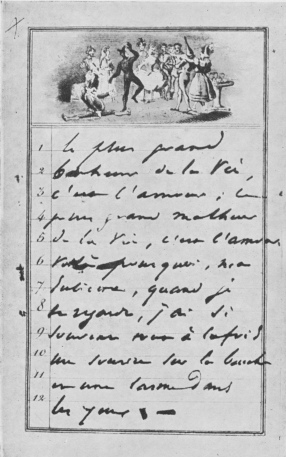
You remember what I used to say to you when Marie Tudor was in rehearsal? “Those wretches have robbed me of my self-confidence; I dare not, cannot rehearse any more; I feel paralysed.”
To-day, it is not a theatrical part that is in question—it is my life. Now that calumny has crushed me, now that my mode of life has been condemned without my having a chance of self-defence, now that my health and reason have been expended in this struggle without profit or glory, now that I have been held up before the public as a woman without a future, I dare not, cannot live longer ... this is absolutely true ... I dare not live. This fear has brought me to the verge of suicide ... a peculiar suicide. I do not propose to kill myself like other people. I mean to sever myself from you, and, to me, such a severance signifies death. Death certainly. I have already made one experiment of the kind, therefore I am sure.
I am confirmed in this project by the reflection that you will thereby be restored to liberty; that you will be free to direct your life and your genius in the way best suited to your happiness; that I shall no longer be an obstacle in your path, but an object of pity and indulgence—pity for what I shall suffer, indulgence and forgiveness for such of my faults as have made you suffer.
If the excess of my love and grief should bring me back to your side, do not notice me ... shut your eyes, stop your ears, remain in your own house ... thus you may learn to forget, while I ... I ... shall die. I shall not suffer long. I shall soon be at rest.
It is raining hard at this moment, and I am in a raging fever. No matter, I shall go out. I do not know whether you propose coming to fetch me. If you do not, I cannot tell what time I shall return home. I don’t care, I am mad! I am in torture such as I have never yet endured! yet I love you even more than I suffer. My love dominates my whole being. I love you!
Juliette.
5.30 (1834).
You wish me to write to you in your absence. I am always unwilling to accede to this desire, for when we are separated, my thoughts are so sad and painful that I should prefer to hide them from you if possible.
You see, my Victor, this sedentary, solitary life is killing me. I wear my soul out with longing. My days are spent in a room twelve feet square. What I desire is not the world, not empty pleasures, but liberty—liberty to act, liberty to employ my time and strength in household duties. What I want is a respite from suffering, for I endure a thousand deaths every moment. I ask for life—life like yours, like other people’s. If you cannot understand this, and if I seem foolish or unjust in your eyes, leave me, do not worry about me any more. I hardly know what I am writing; my eyes are inflamed, my heart heavy. I want air, I am suffocating! Oh, Heaven, have pity upon me! What have I done to deserve such wretchedness? I love you, I adore you, my Victor; have pity upon me. Kill me with one blow, but do not let me suffer as many eternities as there are minutes in every one of your absences.
What am I saying? I am delirious, feverish. Oh God, have mercy on me!
Juliette.
November 4th, 8.30 p.m. (1834).
Yes, you are my support, the stable earth beneath my feet, my hope, my joy, my happiness, my all! I do not know how these halting words of mine can be expected to convey my thoughts to your mind, but this indeed is truly and sincerely meant: that you are to me the noblest, most sincere, most generous of men. I believe this, and have absolute confidence in your power to frustrate the evil fate which holds me in its grip.
My dearly beloved, you were quite charming just now, and you are perfectly right when you say that there is an element of vanity in your nobility of conduct; for nothing could be more becoming than the elegant and dignified manner in which you raised me just now from my knees. You were really great. You were a king!
My darling little Toto, chéri! I am going to bed now, because I am not certain that you will come early enough to take me out; and, after all, you are not the sort of man to be scandalised by finding a woman in bed, especially ...
Juliette.
1834.
My dearly Beloved,
I am always wishing I were a great actress, because, if my soul and intellect were equal to yours, another link would be forged between us; but I wish it still more at such a time as this, for I should then be able to relieve you of the annoyance of being at the mercy of an old woman, whose conceit has made her aggressive.[63]
I need not finish this letter, for here you are!
1835.
It is long after 11 o’clock. I am no longer expecting you for a walk, but I still hope to see you this evening. I write you these few lines as an apology for the disappointment I feel each time you fail me. I am miserable, but not angry; I shed tears, but do not reproach you; I am often much to be pitied, but I never cease loving you to distraction. If only you would believe this, I think I could bear my invidious position with more resignation. I am afraid you misapprehend my love, and this anxiety often makes the days seem long and sad.
But I must not forget that you are working and worn out, and that you have neither strength nor leisure to listen, that is to say, to read of my worries.
11.30 p.m.
Here you are! I am finishing this letter more untidily even than usual. Luckily one’s character, and, more important still, one’s heart, are not exclusively interpreted by one’s handwriting.
Juliette.
Saturday, 3.15 p.m. (1835).
My poor, dear, beloved Toto,
When I see you so preoccupied with important business I am ashamed to add to your fatigues by the reiteration of my devotion, which you already know by heart. Did I not fear that you would misunderstand my silence, I should put an end to these letters, which, after all, are only a cold skeleton, a dull narrative of the generous, tender, passionate feelings which fill my heart. I should stop them, I say, until after the production of your play, reserving to myself the privilege of taking my revenge afterwards by multiplying my words and caresses. This is what I should do if you felt only a quarter as much solicitude for your dear little person as I do.
It is nearly three o’clock. I hope by this time everything has gone off well at rehearsal. It is high time, my admired, beloved, adored poet, you left that wretched den they call the Théâtre Français. You will leave it with full credit to yourself, notwithstanding the ill-will of that jealous old wretch, and the stupidity, hatred, and malice of the cabal against you.
You will see, my splendid lion, whether those hideous crows will dare croak in face of your roaring. As for me, if anything could make me prouder and happier, it would be that I alone understand you.
Juliette.
Saturday, 1.30 p.m., April 11th (1835).
Why were you so smart just now? It makes me dreadfully anxious, especially in conjunction with your early morning walks to the Arsenal. Toto ... Toto ... you do not know what I am capable of; take care! I do not love you for nothing. If you deceived me the least bit in the world I should kill you. But no, seriously, I am jealous when I see you so fascinating. I do not feel as reassured as you would wish me to be. In fact, I insist upon attending these rehearsals. I do not choose to confide my dear lover to the discretion of nobody knows who. I wish to keep my lover to myself, in the face of the nation and of all French actresses.
That is my politic and literary resolve: I shall put it into execution, from to-morrow.
By the way, this is my birthday. You did not even know it—or, rather, I dare say you do not care whether I was ever born or not. Is it true that you do not mind one little bit? That is all the importance you attach to my love! And yet one thing is very certain: that I was created and put into the world solely to love you, and God knows with what ardour I fulfil my mission.
I love you—ah, yes, indeed, I love you—I love my Victor!
Juliette.
Saturday, 8 p.m. (1835).
I am more than ever resolved to separate our lives one from the other. What you say about Mlle. Mars’s increasing age and the impossibility of obtaining a double success through her, literary as well as financial, and about the necessity of securing the services of Madame Dorval or some equally handsome and celebrated actress, makes me determined to sever our connection as speedily as possible, no matter where I may have to go, or under what pecuniary conditions. Your words to-night prove that you have had private intelligence about Mlle. Mars, Madame Dorval, and the theatre generally, that you have concealed from me, although it must completely revolutionise the plans made by you for the first play you were to give at this theatre. The secrecy you have maintained on the subject, contrary to all your promises to conceal nothing from me, grieves me more than the treachery of Monsieur Harel and Mlle. George, more even than the wicked animosity of your enemies and the perfidy of your intimate friends against myself. This silence is proof positive that I am a hindrance to your interests; you dread my ambition and my jealousy; you had already seen the propriety of giving a part to Madame Dorval, but you did not dare tell me so, for fear of encountering resistance and tears from me at this new distribution. You have only partially averted these. I will not attempt to thwart you, on the contrary; as for my tears, they are not worth wiping away, nor even restraining.[64] From this very night we cease our communion of dramatic interests. I go back to the position I ought never to have left: that of a hack actress, who is given any part, and badly paid at that. You resume your liberty without any impediment.
Let us hope this new resolution will conduce to our greater happiness.
Juliette.
Tuesday, April 28th, 1835. Four hours before the production of “Angélo.”
This is just to remind you of my love, and that it will only be purified and augmented by the ill-luck and perfidy to which you are more exposed than others, my noble poet, my king—king, indeed, of us all, though lover only of me: is that not so? I have nothing to fear from you, have I, my darling? You will take care of yourself and resist the advances of that shameless woman. Promise me this. I would not allude to it to-day, only I feel so uneasy at the thought of your spending the whole evening in her society, that I would give my life to prevent it. If you understood the greatness and quality of my love, you would appreciate my alarm.
Think of poor me, sitting at the back of a box to-night, enduring all the anguish of jealousy and love.
Juliette.
Madame Pierceau came at one o’clock, leaving Monsieur Verdier in a cab below. He was desperate at the loss of his stall, which, he hears, was taken from him by your orders. As I did not know what to say about it, I advised Madame Pierceau to send him to you. Monsieur Pasquier, as I anticipated, has not taken Madame Récamier’s box. I wonder what you have done with it. Did it reach you in time?
Midnight, Tuesday, April 28th, 1835. An hour after the triumph of “Angélo.”
My cup is full. Bravo! bravo!! bravo!!! bravo!!!! bravo!!!!! For the first time I have been able to applaud you as much as I wished, for you were not there to prevent it.
Thank you, my beloved! Thank you for myself, whose happiness you increase with every second of my life, and thank you also for the crowd that was there, admiring, listening, and appreciating you.
AUTOGRAPH LETTER FROM JULIETTE DROUET TO HER DAUGHTER CLAIRE.
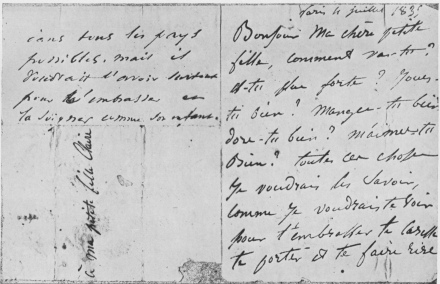
AUTOGRAPH LETTER FROM JULIETTE DROUET TO HER DAUGHTER CLAIRE (continued).
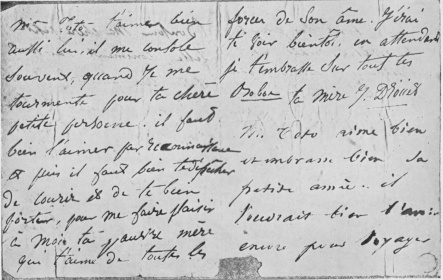
I saw and heard everything, and will tell you all about it; although if the applause, enthusiasm, and delirium could be measured by sheer weight, my load would indeed be heavy. I will give you full details of the performance, to-morrow, for I dare not hope to see you to-night; it would be too much happiness for one day, and you do not want me to go mad with joy!
Till to-morrow, then. If you knew how conscientiously I clapped Madame Dorval, you would hesitate to say or do anything to add to the soreness I already feel at the thought that another than I has been selected to interpret your noble sentiments. There, now I am giving way to sadness again, because you are with that woman!
Good-night, my beloved. Sleep well, my poet, if the sound of the great chorus of praise does not prevent it. To your laurels I add my tender caresses and thousands of kisses.
Juliette.
Friday, 8 p.m. (1835).
If I were a clever woman, my gorgeous bird, I could describe to you how you unite in yourself the beauties of form, plumage, and song! I would tell you that you are the greatest marvel of all ages, and I should only be speaking the simple truth. But to put all this into suitable words, my superb one, I should require a voice far more harmonious than that which is bestowed upon my species—for I am the humble owl that you mocked at only lately. Therefore, it cannot be. I will not tell you to what degree you are dazzling and resplendent. I leave that to the birds of sweet song who, as you know, are none the less beautiful and appreciative.
I am content to delegate to them the duty of watching, listening and admiring, while to myself I reserve the right of loving; this may be less attractive to the ear, but it is sweeter far to the heart. I love you, I love you, my Victor; I cannot reiterate it too often; I can never express it as much as I feel it.
I recognise you in all the beauty that surrounds me—in form, in colour, in perfume, in harmonious sound: all of these mean you to me. You are superior to them all. You are not only the solar spectrum with the seven luminous colours, but the sun himself, that illumines, warms, and revivifies the whole world! That is what you are, and I am the lowly woman who adores you.
Juliette.
If you are coming to fetch me, as you led me to expect, I shall see you very soon now. I have never longed more ardently for you. Lanvin has just come. I will tell you about it when I see you.
Thursday, 7.30 p.m. (1835).
To my dear absent One.
I hardly saw you this morning. I have not seen you this evening, and God knows what time it will be before you come to take me to Angélo—for I do not admit the possibility of a single performance taking place without my presence: besides, I am not sorry to know exactly how much time you spend with these actresses of the sixteenth century, and those of the nineteenth, who are no less dangerous. There, I am nearly as cross as I am sad. I had vowed I would not write at length to-day, just to teach you not to throw my letters aside without reading them. Myself, my letters, forgotten! You certainly manage to be the most worshipped and the least attentive of lovers. Oh, you do not care!
Never mind, I am sad. I am longing for you to-night, as the poor prisoner hungers for his pittance at the hour he is accustomed to receive it.
But you are indifferent—you can calmly let my soul die of inanition—do you not love me, then? Tell me!
Well, I love you. I love you my Victor. I forgive you, because I hope it is not your fault, and also, because I cannot prevent myself from loving you.
Juliette.
Tuesday, 8 p.m., 1835.
You hurt me a little bit just now, my Toto. While I was sacrificing the happiness of being with you one moment longer, to your need of repose, you were worrying about trifles, and not giving me a thought or a farewell. In moments like these I am forced to realise that you do not care for me as I care for you, and I feel wretched in consequence.
Another thing I have observed is that you never allude to my letters. You neither notice the complaints I make nor the love I shower upon you with every word. You have turned my happiness and content into sadness. My Toto, you do not love me as I love you. You have exhausted your faculty of loving. I tell myself that the enthusiastic and passionate devotion you once cherished for me has degenerated into mere partiality—then I mourn and mope, like a woman betrayed.
If you knew how I love you, my Toto, you would understand the anguish of my eagerness, you would pity me, and, instead of leaving my letters unanswered, you would fly to me the moment you have read them, to reassure and comfort me if my fears are unfounded.
Never mind, I give you a thousand kisses. How many will you waste?
Juliette.
Tuesday, 12.30 p.m. (1835).
My dear little Toto,
You have written me a very charming letter. I cannot send you one as fascinating; all I can do is to give you my whole heart and thoughts and life.
You are quite right when you say that I shall soon give myself to you again, regardless of the sorrows that may follow. It is true, for I could sooner dispense with life than with your love.
But let me tell you again the joy, surprise, and happiness, your letter caused me. You are better than I, and you are right when you think me an old idiot. I am in the seventh heaven this morning. You have never given me so much happiness, my dear little Toto. I am so grateful! I cannot love you more in return, for that were impossible; but I can appreciate in a higher degree your worth and the depth of your affection for me.
You are my dear little man, my lover, my god, my adored tyrant! I love you, adore you, think of you, desire you, call upon you!
Juliette.
Which do you like best, quality or quantity?
Monday, 8.20 p.m. (1835).
I adore your jealousy when it gives me the pleasure of seeing you at an unaccustomed hour; but when it simply consists in suspecting me without advantage to ourselves, oh, how I detest it!
You were rather cross to-day, but you atoned so amply by coming as you did, that I would willingly see you a little bit unjust to me every day, if it entailed the pleasure of having you one minute longer in the evening.
If you only knew how true it is that I love you, you could never be jealous, or admit the possibility of my being unfaithful to you; and again, if you knew how much I love you, you would come every moment of the day and of the night, to surprise me in that occupation, and you would ever be welcomed with transports of joy.
Yes, yes, I love you! I do not say so to force you to believe it, but because I crave to repeat it with every breath, with every word, in every tone. I adore you much more than you can ever wish. I love you above all things.
Juliette.
You attach too little importance to my letters as a rule. You forget that fine unguents are contained in small boxes, great love in trivial words.
Friday, 2 p.m. (1835).
You want a huge long letter ... and yet another huge long letter ... you are not very modest in your requirements. What would you say if I asked as much?—you, who write to every one in the world except me. I have a great mind to treat you according to your deserts, and write only as much as you write, love you only as much as you love me. You would be nicely punished if I did this. But do not fear; I should never play you such a scurvy trick. I am too much in need of an outlet for the superabundance of my heart, to venture to close the issue. I am too anxious to tell you every day how much I adore you, to condemn myself to silence. I long too much to get near you, in thought at all events, to afford to cut off the way of communication. Now that you know why I write so often, I will begin my letter.
My dear little Toto, although it is not long since I left you, I desire you with all the impatience and all the inclination that comes of a long separation. I should like to know where you are and what you are doing. I should like to be wherever you are, and, above all, I should like to be in your heart and thoughts, as you are in mine. I should like to be you and you me, in respect of love. The rest becomes you and you only. You are admired; I need to be loved. Are you capable, I ask you, of loving me as much as I love you, or half as much? even that would be immeasurable. If you only knew the extent of my love, you would treasure me, only for that.
I love you, love you, love you, love you, love you!
This short little word, issuing from my heart, has impetus enough to mount right up to the heavens. I love you!
Juliette.
I have received a letter from my daughter. This, combined with the horrible weather, makes me quite happy.
Friday, 9 p.m. (1835).
You gave me a delicious afternoon. How delightfully you talked! I am not alluding to your wit; a fly does not seek to raise an ingot of gold! Neither do I speak of the happiness of leaning upon your arm, listening to your voice, gazing into your eyes, breathing your breath, measuring my steps by yours, feeling my heart beat in unison with yours.
There can be no happiness greater than that I enjoyed this afternoon with you, clasped in your arms, your voice mingling with mine, your eyes in mine, your heart upon my heart, our very souls welded together. For me, there is no man on this earth but you. The others I perceive only through your love. I enjoy nothing without you. You are the prism through which the sunshine, the green landscape, and life itself, appear to me. That is why I am idle, dejected, and indifferent, when you are not by my side. I do not know how to employ either my body or my soul, away from you. I only come to life again in your presence. I need your kisses upon my lips, your love in my soul.
Juliette.
Saturday, 11 a.m. (1835). Good morning, my Victor!
Let me first kiss you. Of all the promises I made you yesterday, when we separated, only one has been broken. I promised to love you as I loved you at that moment—that is to say, more than all the world; but I do not know how it happened, I have come to love you much more! and I feel it will be so as long as I shall live. I beg you, my dear little Toto, to make up your mind to this, as I have already done.
Do you know, my blessed Toto, you are a second little Tom Thumb, far more marvellous than your prototype; for, not merely with pebbles or crumbs of bread do you mark the roads along which you travel, but actually with jewels and precious stones. I shall always recognise the spot where you dropped an enormous ruby as big as a flint, yesterday, with as much indifference as if it had been a piece of grit from Fontainebleau.
What do you suppose must happen to an insignificant creature like myself in the presence of so much wealth, in the midst of the enchantments of your mind? Will she lose her reason? That is already done. As to her heart, you stole it from her very easily, and therefore nothing remains to the poor wight but what is already yours.
Her love, her admiration, her life, belong to you! My glances, words, caresses, kisses, all, are yours!
Juliette.
(1835.)
It seems to be always my turn to write to you now. In the old days your letters called forth my letters, your love mine—and it was meet that it should be so, for, as you have often said, the man should be the pursuer of the woman. It is always awkward when a change of rôles occurs, and I am acutely conscious of it. I feel that a caress from you gives me far more happiness and security than thousands of those elicited by me.
It is already half-past eleven and you have not arrived. Perhaps you are not coming, and the prohibition you laid upon me yesterday against seeking you at the printing works redoubles my anxiety and jealousy. I fear lest some untoward thing may have befallen you, or, worse still, some agreeable invitation reached you. My heart is crushed as in a vice; I think there is no greater suffering in this world than that of loving yet fearing. We arrange our lives very badly. Since you are not a free agent, and may be prevented from seeing me by thousands of circumstances we cannot foresee, you should at least allow me the opportunity of knowing what you are doing and where you are. It would satisfy me and keep me content. Instead of this, I have to wait for you, a prey to fears that tear at my heartstrings. Alas, I am to be pitied for loving you so intensely. It is a superabundance that will surely kill the body which bears it.
If you love me only moderately, I pray God to deprive me of one of two things: either my life, or my love.
Juliette.
Nearly midnight. What a night I have before me! God pity me!
At Metz, September 17th, Thursday, 8.15 a.m., 1835.
Good-morning, my Toto, good morning. It is magnificently fine, and we are going to be enormously happy. We are about to resume our bird-life, our life of love and freedom in the woods. I am enchanted. If only you were here, I should kiss you with all my might and main, as a reminder.
What sort of a night did you have? Did you love me? Have you been writing to me under the old chestnut-tree? I am sure you have not. You scamp, I am afraid I go on loving you in proportion to the decrease of your affection.
I was not able to read last night. I went to bed at a quarter past ten, and had horrid dreams. I trust they will not come true, but I confess I should be glad to get news of my poor little girl, whom we neglect far too much. If two more days go by without a letter, I shall write to Saumur, for I am really worried about her.
My dear little Toto, I am going to dress now, so as to get to you earlier. I love you, I love you with all my strength and all my soul. I kiss you! I adore you! Till this afternoon.
Your Juliette.
At Metz, September 24th, Thursday, 8.45 a.m.
Good-morning, my darling Victor. I love you and am happy, for we are going to be more absolutely together than was possible yesterday, or the day before, when an inconvenient third disturbed our privacy. Also the weather is glorious, and I am madly in love with you; so everything around me glows radiant and beautiful.
I stayed in bed until 8.30, although I woke up at seven o’clock; but I just rolled lazily about, thinking of you, and reading yesterday’s newspapers. I reached home exactly at seven o’clock last night, undressed, tidied my things, dined, wrote to you, did my accounts, and read Claude Gueux till half-past ten. Then I put my hair into curl-papers, and got into bed at eleven o’clock. I went to you in spirit, and dreamt that I was kissing Baby Toto, and making big Toto jealous. This is the complete history of my morning up to date; now I shall dress, breakfast, and go for a walk in the meadows with the maid. Farewell, dearest, until this afternoon’s happiness. Always yours in love and longing.
I love you with all my heart, I embrace you in spirit, I adore you with my whole soul, I admire you with every faculty of my mind. Think of me, come to me, come to me as soon as possible. My arms, my cheek, my whole being, await you.
J.
At Metz, Thursday, 8.45 p.m.
My dear, good Toto,
I should have got back without adventure, had I not met an enormous and horrific toad in the road, which sent me flying home, shrieking as if the devil was at my heels. I was here by ten minutes past seven, began my dinner at five minutes past eight, and am now sitting writing to you, to thank you for all the bliss you lavish upon me. This day, drenched with rain though it was, has been one of the most beautiful and happiest of my whole life. If there had been rainbows in the sky, they would be reflected in our hearts, linking our souls together in thought and emotion.
I thank you for drawing my attention to so many lovely things I should never notice without your assistance and the touch of your dear white hand upon my brow; but there is one beauty greater and nobler than all the combined ones of heaven and earth, for the recognition of which I require no help—and that is yourself, my best beloved, your personality that I adore, your intellect that enchants and dazzles me. Would that I possessed the pen of a poet, to describe all I think and feel! But, alas, I am only a poor woman in love, and such a condition is not conducive to brilliancy of expression!
Good-night, my adored one; good-night, my darling. Sleep well. I send you a thousand kisses.
J.
Metz, Monday, 11.5 a.m., September 24th, 1835.
Great indeed was our misfortune yesterday! I agree with you in that, my Victor, because I love you. For over a year I have suffered much; oftener than not, without complaint. I always trusted that my love and fidelity would engender in you feelings of esteem and confidence, but now that hope is for ever at an end; for, far from diminishing, your suspicion and contempt have grown to terrible dimensions. You love me, I know, and I worship you with all the strength of my being. You are the only man I have ever loved, the only one to whom I have ever given this assurance. Yet I now implore you on my knees to let me go. I cannot urge this too strongly. You see, my dear, I am so wretched, so humiliated, and I suffer so acutely, that I shall have to leave you, even against your will; so it would be kinder of you to give your consent, that I may at least have the sad satisfaction, if I must forsake you, of knowing that I have not disobeyed you.
Farewell, my joy; farewell, my life; farewell, my soul! I leave you, for the very sake of our love—I offer this sacrifice on behalf of us both. Later, you will understand. But before bidding you a last good-bye, I swear to you that, during the last year, I have not committed one single action I need blush for, nor harboured one guilty thought. I tell you this from the bottom of my heart. You may believe it.
I shall go to my child, for I am anxious about her since she has been at Saumur. Perhaps I may bring her back with me. I think I was very wrong to send her away. I mean to repair my fault if there is yet time. The pretext of her health will be sufficient before the world. My heart shall be dumb upon all that concerns you. I will keep everything to myself. I must get work. If you can do anything to help me find some, it will be good of you. I mention this for the first and last time, for, if you were to forget me, you know very well that I should be the last to venture to recall myself to you.
Good-bye again, my friend; good-bye, for ever! I have been copying your little book, hoping you would be generous enough to leave it with me. Good-bye! good-bye! Do not suffer, do not weep, do not think, do not accuse yourself! I love and forgive you.
Juliette.
Metz, Saturday, 7.30 p.m. (October 1835).
You were in a great hurry to leave me to-night, my best-beloved. If consideration for me was your motive, it was high-handed and blundering of you, for I never enjoyed myself more than this evening, and, until the moment you left me so abruptly, I had never so savoured the happiness of being with you in the highways and byways.
I therefore returned home sadly and thoughtfully. I have begun my letter to-night with diminished joy and confidence in the future, for your hurry to leave me weighs upon me, and I cannot explain it satisfactorily to myself.
I came in at a quarter past six, suffering greatly from indigestion. The maid told me some one had called for the dog—two gentlemen, who seemed much attached to it. Poor brute, it was a wrong instinct that led it to follow us. I have no doubt it is expiating its offence in hunger and cold at this very moment. I am somehow unduly interested in the fate of the poor thing. I feel something beyond ordinary pity for it; it makes me think of the fate and future in store for a poor girl we both know. She also follows step by step a master who will have no scruple in casting her adrift when his duty to society proves as pressing and sacred as that which called him away to-night.
I am depressed, my dear friend, and unwell. The oppression on my chest is increasing. I hope your sore throat will diminish in proportion to what I am enduring. Providence is too just to allow such cumulation of suffering. Good-night—sleep well and think of me if you can. As for loving me, that is another question; one’s emotions cannot grow to order. I love you.
J.
Sunday, 8 p.m., 1835.
My dear darling, I cannot describe to you the rapture with which I listened to the two sublime poems you recited to me, one on the first Revolution and the other on the two Napoleons.
But where can your equal be found on earth!... My dear little Toto, do not laugh at me. I feel so many things I cannot express, much less write. I love and revere you, and when I reflect upon what you are, I marvel! Since you left me, I have read again Napoleon the Second. I shall never tire of it. It is going to bed with me now.
You told me to wait for you till 9.30; after that hour I shall go to bed. If you should happen to come later, I will open the door to you myself, as you have forgotten the key. I want to do so, that I may not lose one second of the happiness of having you with me. Sleep well—good-night—do not suffer—do not work—sleep!
Juliette.
Wednesday, 8.30 p.m., 1835.
I am half afraid of taking too literally your request for a daily letter. Tell me seriously how I am to interpret it, so that I may not make myself ridiculous, by overwhelming you with letters you do not want. Tell me the truth once for all, so that I may know where I am, and may give myself up without restraint to the pleasure of telling you, and writing to you, that I love you with all my heart, and that you alone constitute my sole joy, my sole happiness, and my sole future. If you can experience only one quarter of the bliss in reading, that I shall feel in inditing my scribble, you shall receive some of my prose every day, but in limited quantities, calculated not to wear out your patience.
And, in order to demonstrate my powers of self-restraint, I will limit myself to six trillions of kisses for your beautiful mouth. Besides, here you come! I love you.
Juliette.
Wednesday, 8 p.m., December 2nd, 1835.
My Beloved,
When one is ill and feverish, everything tastes bitter to the lips and palate. I am in that position. I am abominably miserable, and all the sweet words you lavish upon me seem tainted. But I have enough sense left to realise that it is my condition that prevents me from relishing the full meed of happiness you are able to give me in one moment. Forgive me for suffering, and for not having the strength or generosity to conceal it from you; it is only because I suffer too much, and love you too much, which is the same thing.
I promise to be very cheerful to-night, and to disguise my feelings. I have read everything concerning you in the papers, and I cannot help suspecting that a passage about you and your work has been purposely cut out. If this is so, you had much better tell me, for I am quite equal to bearing the truth, and even to hearing lies; so I beg you to tell me what was in that newspaper, and thus spare me the trouble of procuring another copy. You must indeed be happy and proud on behalf of the person to whom you are supposed to have dedicated your sublime poem.
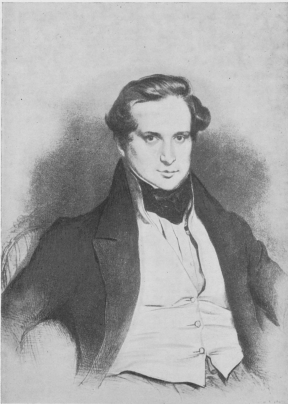
VICTOR HUGO.
The article by Monsieur F. Dugué seems singularly well-informed about your restoration to the domestic hearth. I am apparently not the only one who notices that for the last year you have been changing your habits and feelings, though I am probably the only one who will die of grief in consequence—but what matter, so long as the domestic hearth remains cheerful and the family, happy.
I hope you will do your best to come and see me to-morrow, during the intervals of the performance unless the salutations you have to make, and the compliments and admiration you must acknowledge should detain you against your will; in which case I hope I may be brave enough not to worry about such a trifle, and reasonable enough not to let the magnitude of my love depend upon so slight a pleasure.
You see, my dear angel, I bow to the arguments you impress on me. I am no longer sad, neither do I suffer. I love you; that is the truest word of all.
Juliette.
Tuesday, 8.45 p.m., December 15th, 1835.
Of course, my darling, you did right to come back, whatever your reason might be; but the pleasure of your visit was quite spoilt by your inquiry as to how I spend my time, when it is self-evident that my conduct is irreproachable.
It may surprise you that I should have borne the inquisition you habitually subject me to, with less equanimity to-day than usual. I own, my poor angel, that I do not know why it should be so. Perhaps I am like the cripple, who feels pain in the leg which has been cut off, long after he has lost it. I often suffer over my past life, though the present is so widely different. I suffer, not from variations of temperature, but from the variations of your love, which seems to grow daily colder and more gloomy. If I am mistaken, forgive and pity me; but if, as I fear, I make no error, tell me so frankly, and I shall be grateful for your sincerity. You see, my poor friend, I cannot believe that your jealousy is other than an insulting mistrust of us both. I have watched you carefully for the last six months, and I can see quite well that, although your love is gradually waning, your supervision becomes ever more active and more fidgety. If I were absolutely sure of what I suspect, I should not say this to you—I should go away at once, and you would never hear of me again; but if by chance I were wrong, and you still care for me, such a course would entail frightful sorrow upon us both. Therefore I remain, preferring to incur your hatred and contempt, rather than run the risk of grieving you.
There, my poor angel, is the attitude of mind and heart in which you found me this evening; it will explain why I received your question so badly, although I was grateful for your presence. You see, my head and heart are weary. If you are not careful, some calamity, resulting from this condition, will overtake and crush you, at a moment when neither you nor I will be able to prevent it. I give you this warning in all sincerity, but with the intimate conviction that it will not affect you. As long as you feel I belong to you wholly and entirely, you are as indifferent to my sufferings as to my happiness.
J.
Wednesday, 8.30, February 3rd, 1836.
If I have grieved you, my beloved, I beg you to forgive me, for I know your position is awkward and demands much consideration, especially from me. Besides, why should I complain of my mode of life more to-day, than yesterday? I accept my position without regret; therefore there is no reason for questioning an arrangement which only you can alter.
I cannot help noticing that your love is not what it was. I may say I am sure of it, if I may judge by the impatient words you occasionally utter, half against your will, and by other signs it would take too long to commit to paper. I certainly possess a devoted Victor, but no longer the lover Victor of former days. If it is as I fear, it becomes your duty to leave me at once; for I have never wished to live with you otherwise than as an adored mistress—certainly not as a woman dependent upon a man whose passion is spent. I want no pension. I demand my place in your heart, apart from any feeling of duty or gratitude. That is what I desire, as earnestly as I long to be a faithful woman, submissive to your every whim, whether just or unjust.
If I have hurt your feelings, my dearly beloved, I plead for pardon from the bottom of my heart. If you have to acknowledge a decrease in your love, be brave enough to do so frankly, and do not leave to me the frightful task of guessing it; but if you care for me as much as ever, say it again and again, for I doubt it, alas, and, in love, doubt is more painful a thousand times than the most heartbreaking certainty. Farewell, I worship you.
J.
Wednesday, 8.15 p.m., February 17th, 1836.
You must think me either very cruel or very blind, my beloved. I think, perhaps, it would be best for you to accept the latter hypothesis. I love you, which means that I am jealous; but, as my jealousy is in proportion to my love, my doubts and frenzy are more vivid, more bitter, than those of ordinary women, who are only capable of an ordinary affection. Very well—I am cruel! So be it! I detest every woman upon whom your glances rest. I feel capable of hating all women, young or old, plain or handsome, if I suspect that they have dared raise their eyes to your splendid and noble features. I am jealous of the very pavement upon which you tread, and the air you breathe. The stars and sun alone are beyond my jealousy, because their radiance can be eclipsed by one single flash from your eyes.
I love you as the lioness loves her mate. I love you as a passionate woman, ready to yield up her life at your slightest gesture. I love you with the soul and intelligence God has lent His creatures to enable them to appreciate exceptional men like yourself. That is why, my glorious Victor, at one and the same moment, I can rage, weep, crawl, or stand erect; I bow my head and venerate you!
There are days when one can fix one’s gaze upon the sun itself without being blinded: thus it is with me now. I see you, I am dazzled, entranced, and I grasp your beauty in all its splendour.
Juliette.
Thursday, 8 p.m., August 15th, 1836.
Since you leave me here all by myself, my beloved, I shall think only of you, and in proof of this, I will scribble all over this virgin sheet of white paper. It is barbarous of you to let me grow fatter than I already am, by leaving me to dawdle at my fireside, instead of taking me out to walk and get thin.
I am in love with you, but you do not care a bit. I am very sad not to have you with me, doubly so, when I think that it is on account of a play in which I am to have no part, after all the time I have waited and endured. When I reflect seriously upon this, my despair makes me long to fly to the uttermost ends of the world. It is so necessary that I should think of my future. I have wasted so much time waiting, that it almost spells ruin to me that you should produce a piece in which I may not play. You see, my dearest, I am not as generous as you thought. I am afraid I can no longer disguise from you the injury it does me to be three years out of the theatrical world, while you are bringing out plays. Forgive me, but I have a horror of poverty, and would do anything in reason to evade it. I love you.
Juliette.
Friday, 8.30 p.m., March 11th, 1836.
Dear little Soul,
You are quite happy, I hope, now that you possess the keys of Paradise. I had a few more difficulties to encounter after you went away, but they were of no consequence. Now that our little palace is nearly finished, my soul, I hope we shall celebrate the event in the usual way; but I must first rest a little, and nurse myself up, for I am really quite worn out with the dirt and litter. I am afraid to look at you or touch you in your beauty and purity and charm, while I am so ugly and untidy and exhausted that I hardly know myself as your Juju. But it will not last. My foulness will fall from me, and reveal me dressed, as in the fairy-tale, in garments of blue, bordered with golden stars, and a prince will marry me after tasting of my cooking. Splendid! But meanwhile you must graciously permit me to go on loving you, stains and all! Shut your eyes to the common lamp that guards the flame. If you will wait, you shall see that when we reach the heaven above us, I shall be as resplendent as yourself. Meanwhile, I drop a kiss upon your shoes, even if it entails your having them blacked again.
J.
Wednesday, 7.45 p.m., March 23rd, 1836.
No doubt, dear angel, I ought to disguise in your presence the sadness that overwhelms me when I have to wait too long for you; but the late hour at which you generally come, makes it difficult for me to forget the weary suspense I have already been through, and am to endure again shortly. I love you, my dear—indeed, I love you too much. We often say this lightly, but I assure you that this time I state it in full gravity and knowledge, for I feel it to the very marrow of my bones. I love you. I am jealous. I hate being poor and devoid of talent, for I fear that these deficiencies will cost me your love. Still, I am conscious of something within me, greater than either wealth or intellect; but is it powerful enough to rivet you to me for ever? I ask myself this question night and day, and you are not at hand to soothe my unrest; hence the sadness that wounds you, the jealousy that amazes you, the mental torment you are incapable of understanding.
But I love you all the same, and am happy in the midst of my pain. I smile through my tears, for I love you.
Juliette.
Saturday, 8 a.m., March 26th, 1836.
Good-morning, my little darling Toto.
I am up at cock-crow, though very tired; but I want to be ready to witness your new triumph—for, beloved Toto of mine, you are the great Toto, the greatest man on earth.
How I love you, my Victor! I am jealous. Even your success makes me uneasy with the dread that, amongst so much adulation, you may overlook the humble homage of your poor Juju. I fear that these universal acclamations may drown my lowly cry of—I love you! This apprehension becomes an obsession on such a day as this, when everything is at your feet, caresses, adoration, frenzy. Ah, why are you not insignificant and unknown like myself! I should then have no need to fear that the torch of my love will be eclipsed by that immense illumination.
Try, beloved, to keep a little place in your heart for the love and admiration of your poor mistress, who has loved you from the day she first set eyes upon you, and who will worship you as long as the breath remains in her body.
Juliette.
Saturday, 6.15 p.m., March 26th, 1836.
Let me tell you once again that I love you, my Victor. Presently, thousands of voices will be raised in a chorus of praise. I alone say: I love you. You are my joy, the light of my eyes, the treasure of my life, you are YOU. This evening, my adored one, whatever you say or do, I must be jealous and wretched. Be merciful to me; do not let me suffer too cruelly. If you think of me when you are absent, I shall be conscious of it—if you love me, I shall feel it upon my heart like beneficent balm upon a raw wound.
Farewell, dear soul; it is impossible to wish an increase of beauty to the man, or more glory to the genius; so, if you are happy, so am I. Farewell, then, dearest; I cannot refrain from sending a word of love to the lover, before going to applaud the poet. The heart must have its due share.
Good-bye till later. For ever, for life and until death, love, nothing but love!
J.
Sunday, 7.45 p.m., March 27th, 1836.
I hardly dare speak to you to-night of love. I feel humiliated by my devotion, for all those women seem to be rivals, preferred before me. I suffer, but I do not hold you responsible. I feel worse even than usual this evening. I did not venture to ask what you had written to Madame Dorval, for I was afraid to discover some fresh reason for bitterness and jealousy; so I remained silent.
My dear treasure, you are very lucky not to be jealous: you have no competition to fear with any other celebrity, for there is none besides yourself, and you know that I love you with my whole heart, whereas all I can be sure of is, that I love you far too much to hope to be loved in proportion. In addition, I feel I shall never be capable of raising the heavy stone under which my intellect slumbers.
Forgive me, I am sad. I am worse than sad—I am ashamed, because I am jealous. I am an idiot, and consequently, I am in love!
Juliette.
Thursday, 8.30 p.m., April 14th, 1836.
I love you, my dear Victor, and you make me very unhappy when you seem to doubt it. It is still harder for me when you put your want of confidence into words, for I can only attribute it to the sacrifices you constantly make for me, and which probably cause you to think that an ignoble motive constrains me to remain under your protection. In addition to thus wounding me in the most sensitive part of my love, you exasperate me to a point I cannot describe, because it is true that I have not the wherewithal to live independently of you and your influence. Therefore, my poor angel, when you show your suspicions of my sincerity, I read into them more than jealousy and ill-will: I imagine a reproach against my dependent position. I feel an overwhelming need to prove to you, by any means, that you are mistaken in the woman and her love. Remember your burnt letters! You know what a doubt on your part led me to do on one occasion. Well, angel, I tell you honestly that when you question, not only my fidelity, but also my love, I long to fly to the other side of the world, there to exist as best I can, and never pronounce your name again for the rest of my life. This will be the last proof of love I can give you, and at least you will not be able to accuse me, then, of self-interest and self-love. You hurt me terribly to-night; you often do, and generally when I am most tender and demonstrative towards you.
Yet I love you.
J.
Tuesday, 8 p.m., April 19th, 1836.
Beloved, I am perfectly certain you will not come to fetch me to see Lucrèce, and I am already resigned. There is only one thing I shall never submit to, and that is, the loss of your love. I know you are devoted, that you lavish friendship upon me; but I feel that you have no more love to give me, and I cannot bear it. During the four months I have been alone, ill for the most part, I never knew whether the time would come when you would be impelled to say to me: Take courage, for I love you. I would have given life to find those words in your handwriting at my bedside in the morning, or on my pillow at night. I waited in vain, they never came; my sorrow grew, and now I am certain that you have ceased to care for me.
I know what you will say, Victor—you will tell me that you are hard at work, that you do everything for me, and do not let me want for anything. To that I reply that I have been just as busy or busier than you, yet have always found time to show you the outward signs of my inward love. I may also tell you that, without your love, I do want for everything, and that my life is utterly wretched without it. Lastly, I declare to you that if you continue to be so reasonably kind and attentive, I will release you from your self-imposed burden, at some moment when you least expect it, and for evermore. I must have true love or nothing.
Juliette.
Monday, 7.45 p.m., May 2nd, 1836.
My dear little Beloved,
I am sorry to find that you are not as convinced as I am, of the propriety of giving me your portrait.
I confess I feel the greatest disappointment when I realise, from your daily evasion of my request, that I shall probably never become the possessor of the picture which is so like you, nor even, perhaps, of a copy of the original. I am sad and dejected. I think you do not care enough for me, a poor disinherited creature, to do me the favour you have already bestowed upon another, who already has her full meed of the gifts of life. I am therefore greatly disappointed. I had counted upon having the portrait, and had anticipated much happiness from its possession. The contemplation of it would have so greatly contributed to my courage and resignation, that it is very grievous to have to renounce it thus suddenly, without any compensation.
If I wanted to speak of other things now, I could not; my heart is heavy, my eyes overflow with tears. I can only find bitter words for the expression of my wounded love.
I love you more to-day than I have ever done before, yet I am not happy.
Juliette.
Friday, 7.45 a.m., May 20th, 1836.
Good morning, my dear little Toto.
You failed me again last night, so I shall never count upon you again. I loved you with all my strength, and thought of you even in my sleep. This morning I love you with my whole soul, and heartily long for you, but I know you will not come, so I am cross and sad.
How fine the weather is, my Toto, and how happy we could be in the fresh air, on the high road, in a nice little carriage, with a month of happiness in prospect: it would be Paradise, but ... but ... I dare not set my heart upon it, for I should go crazy with grief if the treat were withheld. At all events, I am ready to start; my foot is well again, and we can set off to-night, or to-morrow morning, at whatever time suits you. I am quite ready, let us, therefore, seize our chance of the fine weather.
My adored one, I am dying to make this expedition.... Do try to get free at the earliest moment possible. I shall be so happy. I still love you, ever so much. I need you terribly. My heart is more than ready for the happiness you will give me during the whole time we shall be together.
Juliette.
Thursday, 12.45 p.m., July 21st, 1836.
Once more I am reduced to writing all that is in my heart, my adored one. It is but a slender satisfaction after the bliss we have been enjoying. Nevertheless, we must take life as we find it, and it would be ungracious of me to complain. A month like the one we have just spent would compensate for a whole life-time of misfortune and worry. Poor angel, since you left me I feel lost and alone in the world. You cannot imagine the utter void, surrounded as you are at this moment by the affection of charming children and devoted friends, while I am alone with my love—that is to say alone in space—for my love has no limits. I seek what consolation I can, by speaking to you, and writing to you. Your handkerchief, breathing of you, lies by my side, with your adored name embroidered in the corner. I caress and talk to it, and we understand each other perfectly. For every kiss I press upon it, it exhales your sweet aroma; it is as if I scented your very soul. Then I weep, as one does in a beautiful dream from which one fears to awake. Heavens, how I love you! You are my life, my joy! I adore you!