PART II LETTERS (continued 3)
Theodora Davidson translation
Did you give Dédé the sachet? Did Toto take back his quince jelly? Meanwhile, I am giving Suzanne a whole evening to herself, and making my little rogue read Le Musée des Familles. I should love to give you a good kiss, but I know you will not come for it. You have not the sense to do so.
Juliette.
Monday, 11.15 a.m., July 22nd, 1844.
Good morning my beloved, my sweet, my darling little Toto. How are you? Are you less sad and painfully pre-occupied than yesterday, my adored one? Alas, it is unlikely ... your grief and sorrow are not of those that time can soften. You have the painful faculty of feeling things far more acutely than do other men. Genius does not only pertain to the brain, it belongs above all to the heart. My poor dear one, I love you; I suffer when you suffer; be merciful to us both, I implore you.
My little Claire went away this morning. She was more resigned than usual, for she has a holiday of three days in prospect, beginning next Saturday. The poor little thing is very devoted to us; her sole happiness is to be with us. She complains of not seeing you often enough, and I back her up in that. You must try to give us at least one evening out of the three she will spend at home. Verily I am not very cheerful company for the poor child when I am alone with her. I am so absorbed in my love that sometimes I do not speak to her twice in the day, however much I try to bring myself to do so.
I have copied Méry’s verses, because I do not wish to deprive Mademoiselle Dédé of his autograph. I can understand her setting store by it, poor darling, so I shall make a point of returning it to her. Only (and it is you I am addressing now) you must give me just as many as you give her. You must not lose your good habits, my darling, for I am sure it would bring us bad luck. Therefore you must bring me all your letters as you used to do. I promise to divide them conscientiously with dear little Dédé, and you know quite well that I am a woman of my word. I adore you.
Juliette.
Thursday, 4.45 p.m., October 20th, 1844.
I have sent to Barbedienne, my adored one, but Suzanne has not yet returned. I am writing to you meanwhile to make the time hang less heavy. I hope to goodness I may be able to procure that lovely medal![92] Since I have glimpsed the chance of possessing it, I feel my disappointment would be greater than I could bear, if I failed to get it. Good God, how slowly that girl walks! Fancy having to trust to legs like those on such an occasion! I could have gone there and back ten times, since she went. May the devil fly away with her, or rather, precipitate her right into the middle of my room with his cloven foot, providing only that she brings the longed-for medal!
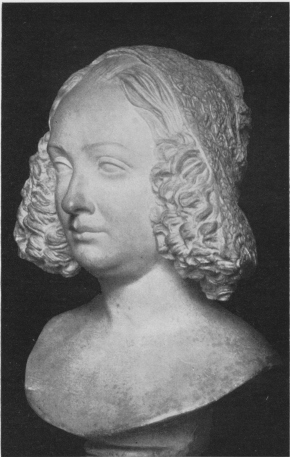
JULIETTE DROUET IN 1846. Bust by Victor Vilain (Victor Hugo Museum).

Here she is! Ah! Victor, do not be angry! Victor, I am at your feet—Victor, I will be reasonable for the whole of the rest of my life if only you will let me add 15 fr. to the sum you promised me. Oh, Victor, I have not time to wait for your answer and yet I fear to annoy you. Ah, no, you are too kind to be angry with your poor Juju who loves you with such absolute admiring, devoted love! You will look at her with your gentle, ineffable smile, and say I was right—surely, yes, you will. Three cheers for Toto! Juju is a clever woman ... at heart. Yes, it is quite true and I am the happiest of women.
Juliette.
Tuesday, 9.30 a.m., September, 1845.
I have just been gardening, beloved. I am soaked with dew and all muddy, but I have spent three hours thinking of you without any bitterness. My eyes were as moist as my flowers, but I was not weeping. While I busied myself with the garden, I reviewed in thought the lovely flowers of my past happiness. I saw them again fresh and blooming as the first day, and I felt close to you, separated only by a breath. As long as the illusion lasted I was almost happy. I should have liked to pluck my soul and send it to you as a nosegay. Perhaps what I am saying is silly, yet it is the sort of nonsense that can only issue direct from the tenderest, most passionate heart that ever lived. For nearly thirteen years past, I have never once written to you without feeling my hand tremble and my eyes fill. When I speak of you, no matter to whom, my heart swells as if it would burst through my lips. When I am dead, I am certain that the imprint of my love will be found on my heart. It is impossible to worship as I do without leaving some visible trace behind when life is over.
My beloved Victor, let your thoughts dwell with me, so that my days may seem shorter and less dreary; and do try to surprise me by coming to-night. Oh, how happy I shall be if you do that!
Meanwhile, I love you more than I can say.
Juliette.
Saturday, 8 a.m., September 27th, 1845.
Good morning my beloved, my soul, my life, my adored Victor. How are you? I hope yesterday did not tire you too much. I forgot until you reminded me that you have been forbidden to walk much, but I do trust it did you no harm; did it, Victor darling? As for me I felt no fatigue, I seemed to have wings. I should have liked to place my feet on all the paths we traversed together eleven years ago, to kiss the very stones of the roads and the leaves on the trees, and to pick all the flowers in the woods, so keenly did I fancy they were the very same that watched us pass together all those years ago. I gazed at you my adored Victor, and in my eyes you were as young and handsome, nay handsomer even, than eleven years ago. I looked into my heart and found it full of the same ecstasy and adoration that animated it the first day I loved you. Nothing was changed in us or about us. The same ardent, devoted, sad and sweet affection in our hearts, the same autumn sun and sky above our heads, the same picture in the same frame; nothing had changed in eleven years. I would have given a decade of my life to stand alone for ten minutes in that house that has sheltered our memories for so long. I should like to have carried away ashes from the fireplace, dust from the floors. I should have liked to pray and weep, where once I prayed and wept, to have died of love on the spot where once I accepted your soul in a kiss. I had to exercise superhuman self-control not to perpetrate some act of folly in the presence of that girl who showed us so indifferently over a house I could have purchased at the price of half the rest of my life. Fortunately, thanks to her profound ignorance of our identity, she noticed nothing, and we were each able to bring away a tiny relic of our former happiness. Mine must be buried with me when I die.
Beloved, did you work late last night? It was very imprudent of you if you did, after the fatigue you underwent during the day. To-day, you must be very careful and not walk much. I shall be extremely stern with you. My antiquarian propensities shall not make me forget, like yesterday, that you are still convalescent and must hardly walk at all. And you will obey me, because little Totos must always obey little Jujus, as you know.
Kiss me, my adored Victor, and may God bless you for all the happiness you give me.
Juliette.
Saturday, 9 p.m., May 2nd, 1846.
I cannot nerve myself to the realisation that I shall not see you this evening my sweet adored beloved; yet it is all too true. This is the first time in fourteen years that I have not slept in a room belonging to you.[93] Consequently I am feeling quite forlorn. Everything conspires to harrow me. Just now when I left you I longed for death, and the tears I drove from my eyes trickled inwardly to my sad heart. If this anxiety about my child, and the separation from you, are to last long, I do not think I shall have strength to endure them. I am vexed and disgusted at the tone of those about me. I am ashamed and indignant at my inability to remove myself from it, however I may try; then when I remember you, so generous, so loyal, so noble, so kind and indulgent, my bitterness evaporates and nothing remains in my heart but admiration, gratitude, and love for your divine and fascinating self.
When I got back, I found my child in a raging fever. I gave her fresh compresses, and now she is sleeping. God grant she may do so all night, and that the change of ideas and surroundings and air may have a good effect upon her health. I shall in that case have less cause to grudge the sacrifices I am voluntarily making to that end. Meanwhile, I am a prey to fearful anxiety, and am suffering the uttermost from the absence of what I love best in this world, above life, above duty, above everything. Good-night, beloved. Think of me. Sleep well, and love me.
Juliette.
Tuesday, 3.45 p.m., 1846.
I love you, my Victor. Between every letter of those five sweet words there lurk depths of maternal anguish and sorrow. Gloomy reflections mingle with my tenderest thoughts. My life at this moment is divided between my poor little daughter whom I already mourn in anticipation, (for I feel that these few days of illness are but snatched from Eternity), and my adoration for you, from which no preoccupation, even of the most terrible and sinister character, can long distract me. On the contrary, my love is all the greater for the trials and sufferings God sends me. I love you selflessly, as if I myself were already over the border. My heart is racked, yet I adore you.
Claire’s condition is the same as yesterday; only the weakness, which, but for the doctor’s plain warning I might have attributed to the heat, has increased. The night was not very bad; the poor little thing suffers hardly at all. She seems to have no firmer hold on life than life has upon her. Apathy and profound indifference characterise her illness. Only her father has the power to rouse her for the few moments he is with her. He came this morning and happened to meet the doctor,[94] who, it appears, is not quite so despondent as Monsieur Triger;[95] but what does that prove?
I have not been able to get her up at all to-day. She lay in bed in a state of profuse and constant perspiration. The various tonics she takes fail to produce any effect whatever. The exhaustion increases hour by hour, which means that death is coming nearer. I pray, but I obtain neither solace nor confidence. The good God disdains my prayers and rejects them, I know—yet I love and admire Him in His beneficent, lofty, noble, generous and beautiful works.
I love Him as His saints and angels in Heaven love Him. What more can I do to find favour in His eyes? He deprived me of my mother at my birth; now He is about to snatch my child from me. Is that His justice? I do not want to blaspheme, but I am very miserable, and if I do not see you, if you cannot come to-day, I do not know what will become of me. Despair fills my soul, but I love you. God may crush my heart if He so wills, but the last breath from it shall be a cry of love for you, my sublime beloved.
Juliette.
April 29th, 9 a.m., 1847.
Good morning, my adored Victor. My thoughts and soul and heart go out to you in this greeting. I hope I shall see you before you go to the rehearsal, for if I do not, I shall have to wait till this evening, which would increase my depression. From now until the anniversary of the terrible day on which I lost my poor child, every hour and minute is punctuated by the recollection of the sufferings of that poor little thing, and of the anguish I went through. They are painful memories, impossible to exclude from my thoughts. Last night while I lay sleepless I seemed to hear her, and in my dreams I saw her again as she looked at the close of her illness. I am worn out this morning. All the pangs and fatigues of the last moments of her life weigh down my heart and limbs. It may be that I shall find comfort in prayer, and I shall pray better by her side, buoyed up by the hope that she will hear me and obtain for me resignation enough to bear her absence without murmur or bitterness. It was you who gave me the courage to live. All that a heart can gain from consolation, I found in your love; but there is a grief surpassing all others and beyond human aid, for which only God can provide, and to Him I must address myself to-day.
Juliette.
Thursday, 8 a.m., May 6th, 1847.
Good morning, my all, my greatly loved Toto. How are you this morning? Did you gather in a good harvest of glances, smiles and flattery yesterday from the women you met? Were you the cause of many incipient passions, or were you yourself ensnared by those females, like any beardless student or bald-headed peer of the realm? Tell me, how are you after your evening at Court? For my part, I have a very sore throat and am feeling fearfully cross. I have a longing to scratch which I should love to vent upon the face of some woman or even upon yours—or better still, upon both. I am sick of playing the gentle, sheep-like woman. I intend to become as fierce as a hyena, and to make your life and everything depending upon it a burthen to you. I mean to make a terrible example of you, so that people shall say as you pass by, that it is a woman who has been outraged, but a Juju who has avenged herself! Meanwhile, to begin with, I am going to wrest from you somehow, two silk dresses, a lovely hat, two pairs of smart shoes; and if you do not confess your crime, I will punish you to the tune of torrents of tea-gowns, pocket-handkerchiefs, and silk stockings. I am capable of anything if you drive me too far.
Juliette.
Tuesday, 12.45 p.m., June 6th, 1848.
The more I think of all that is going on in Paris at this moment, my beloved, the less do I desire the success of your election.[96] We must let this frenzy of the populace which knows not what it wants and is in no condition to distinguish the true from the false, or evil from good, exhaust itself first. When it is worn out with turning in its own vicious circle of disorder, violence, and misery, it will come to heel and humbly crave the assistance of incorruptible, strong, sane politicians, among whom you are the most incorruptible, the strongest, and the sanest. I say this in the simplicity of my heart, without any pretension to be other than a mere woman who loves you above all things, and trembles lest you should enter upon some undertaking that might jeopardise your life without saving your country. Therefore I pray that this candidature, to which you have been driven in self-sacrifice and generosity, may not succeed. If I am unpatriotic, I accept the blame, but I do think that in this instance my feeling is in accord with the best interests of France. It would not be the first time that the heart has proved cleverer than the brain. It has happened too often in my case for me to marvel. Pending our next meeting, I kiss you from my soul, I adore you with all my strength.
Juliette.
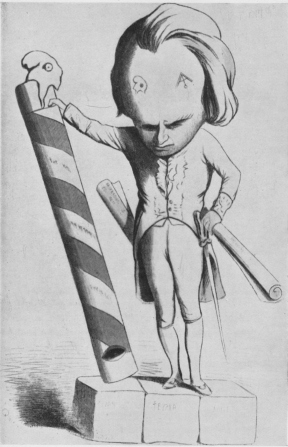
VICTOR HUGO, RÉPUBLICAIN. Political caricature, 1848.
Monday, 9 a.m., July 9th, 1849.
I am hurrying, my love, for I wish to be at the door of the Assemblée at noon precisely, in order to secure a good place.[97] I wish the great moment had arrived, for I am already feeling stage-fright, and it will go on increasing until I see you descend from the tribune. I thought this morning that I could not experience any other sensation than happiness at seeing you, but now I begin to understand what fear is. Yet when I say fear, I am hardly correct; for I mean something more indefinite, which is rather the suspense before a great joy, than the stupid emotion of cowardice or funk. In any case, I am very agitated; I wander aimlessly about the house, and feel as if the longed-for moment would never arrive. My blessed love, my great Victor, my sublime beloved, I kiss in spirit your noble forehead with its generous thoughts, your beautiful eyes so gentle and powerful, your fascinating mouth, which has the happiness of speaking all your divine thoughts. I prostrate myself before the most beautiful and most sublime thing in the whole world, namely, your dear little person and your profound genius.
I do not ask you to think of me before your speech, adored one, but afterwards I entreat you to spare me one glance to complete my happiness.
Juliette.
Wednesday, 12.30, February 6th, 1850.
Think of me, my adored one, and do not permit yourself to be ensnared by the mercenary blandishments of that woman.[98] I am in the throes of a jealousy so terrible, that the hardest heart would be moved to pity, and the most intrepid would fear me; for I am suffering, and I am capable of anything to avenge a despicable treachery. Alas, my poor adored one, this is not what I should like to say, or what I ought to say. I realise that threats are powerless to hold you. I believe if the statistics of infidelity could be drawn up like those of crime, it would be shown that the severe penalties of the code of love are more apt to drive lovers into breaches of its laws than to bind them together. I am sure of it, and I wish I could convert my natural ferocity into bland indifference, in order to remove from you the stimulant of a forbidden Rachel; but it is no good—I shall never manage it. Therefore, I implore you for the sake of your personal safety and mine, to be honourable and prudent in your dramatic relations with that dangerous and perfidious Jewess. Try not to prolong your literary and theatrical consultation beyond the strictly necessary limits, and to come and fetch me before three o’clock.
I should be so grateful to you, my adored little man, for you would thus abridge the moments of my torment. Meanwhile I am very unhappy and anxious and worried. I try to hearten myself up by remembering the last promises you made me. When do you intend to keep them, I wonder? God knows!
Juliette.
Saturday, 8 a.m., April 6th, 1850.
Good morning, my adored one, my sublime beloved. How are you? Did you have a better night, or did fatigue and excitement prevent you from sleeping? When I think of the admirable speech, so religious in character, so noble, self-abnegating, and conciliating, that you delivered yesterday[99] at the risk of your health, and then reflect upon the senseless uproar, and idiotic and violent interruptions it provoked, I feel only hatred, contempt, and disgust, for political life. It is revolting that a man like you should be the butt of the irresponsibility of all the parties. It is hateful, abominable, infamous, that scoundrels without talent, wit, or feeling should dare argue with you and should be accorded an attentive hearing where you only meet with insults. Really, my treasure, the more I see of political life, the more I regret the time when you were simply the poet Victor Hugo, my sublime love, my radiant lover. I revere your courage and devotion, but I am hurt in my tenderest feelings when I see you delivered over to the beasts of an arena a thousand times less discriminating than that of ancient Rome. Therefore, my beloved Victor, I have conceived a loathing, not only for your antagonists, but also for the form of government which imposes this Sisyphus life upon you. If I had the power to change it, I can assure you I should not hesitate, even if I had to deprive you for ever of your rights of citizenship. Unfortunately, I can do nothing beyond cordially detesting those who obstruct your work. I pity you, bless you, admire you, and love you with all my soul.
Juliette.
Saturday, 3 p.m., June 29th, 1850.
I have just watched you go with inexpressible sadness, my sweet and beautiful beloved. With you have departed the sunshine, the flowers, the pleasant thoughts, the hopes that link past happiness with future bliss. Nought remains to me but my love, a poor hermit whose regrets have been her sole bedfellows this long time. When you turned the corner of the street, something luminous, soft, and sweet, seemed to die within me. From that moment I have been as depressed and desolate as if a great misfortune had befallen me. Alas, it is in fact the misfortune that weighs down my whole life, namely, your absence. Since politics have monopolised your time, happiness has eluded my grasp. Will it ever return? I doubt it, hence my despair. I am greatly to be commiserated, my beloved, in that I have constituted your eyes my illumination, your smile my joy, your words my bliss, your love my life—so that when you are away, all these are simultaneously snatched from me. I am not certain of seeing you to-night, still less to-morrow. What is to become of me? What am I to do with this poor body bereft of its soul when you are not by? Tell me if you can. Explain if you dare. Meanwhile, I adore you.
Juliette.
Monday, 10 p.m., July 7th, 1851.
What I had foreseen has happened, my beloved, even sooner and more painfully than I had feared. Does this fresh crisis foreshadow my speedy recovery? I dare not hope it, for I feel that my disease is incurable. I tell you so in the frankness of my despair. I neither can nor will deceive you, beloved, and my anxiety, far from diminishing, augments with every minute. I am suffering the torment of the most humiliating and poignant jealousy. I know that for seven years you have adored a woman you think beautiful, witty and accomplished.[100] I know that but for her sudden treachery,[101] she would still be your preferred mistress. I know that you introduced her into your family-circle, that she is of your world, that you can meet her at any moment, that you promised her you would continue your intimacy with her, at all events outwardly. All this I know—yet you expect me to feel my own position secure! Surely I should need to be idiotic or insane to do that. Alas, I happen to be instead a very clear-sighted, miserable woman.
Midnight.
Beloved, thanks to you and thanks to your tender perseverance and inexhaustible kindness, I am once more, and this time for ever I hope, the sensible, sanguine, happy Juju of the good old days. But if I am to be quite as I was then, you must suffer no longer, my little man—you must be as strong as three Turks, and love me as much as a hundred Swiss-guards. On those conditions I shall be happy! happy!! happy!!!, but pending that great day, try to sleep soundly to-night, not to be unwell to-morrow, and to forgive me for loving you too much.
Juliette.
Saturday, 8 p.m., July 26th, 1851.
I trust you, my beloved, and believe everything you say. I yield my soul to the hopes of happiness you have held out to me. My heart is full of love and security. I love you, I am happy, I am at peace, I forget all I have suffered. I remember only the tender, loyal, encouraging words you uttered just now. Felicity has succeeded despair—I quit hell and enter Paradise. I love you and you love me, nothing can be sad any more. You will see how I shall resume my interest in life, how I shall smile, how happy I shall be, and what confidence I shall have in you. I do not know whether we shall be able to carry out all the adorable plans you sketched just now, but I experienced great happiness in anticipation while I watched you making them, and knew myself so closely associated with them. I felt as if all my past sorrows were transfigured into happiness to come. I listened, and my heart was filled with joy. Thank you, my Victor, thank you, my beloved. Do not be anxious about me any more; now that you love me I shall get well. I shall be happy again, you will see. I am beginning already, so as to lose no time in rewarding you for your goodness and gentleness and patience. I am awaiting you with my sweetest smiles, my tenderest caresses.
Juliette.
Monday, 12.45 p.m., July 28th, 1851.
This is the hour I begin to expect you, my Victor; each second that lags past with the slowness of eternity crushes my hopes as quickly as I conceive them. What is to become of me all this wretched day if I may not see you? Oh, I thought myself stronger, braver, more resigned; but now I see I have used up all my strength in the horrible struggle I have been going through this last month. What will happen to me, shut up here, all alone with that terrible anniversary, the 28th June, 1851? How can I evade its ghastly grip, how keep myself from suicide, from the desperate hankering after death? Oh, God, how I suffer! I implore you, do not leave me alone here to-d....[102]
Midnight.
This letter, which was begun in delirium and mad jealousy has ended, thanks to you my ineffable beloved, in the happy calm of confidence and the sacred joy of love shared. May you be blest, my Victor, as much as you are respected, venerated, adored, and admired by me—then you will have nothing further to desire in this world or the next.
Juliette.
Saturday, 8 a.m., August 2nd, 1851.
Good morning, man that I love; good morning, with all my joy and smiles and soul and happiness and love, if you had a good night and are well. I felt sure your dear Charles’ depression could not stand against an hour of your gentle and persuasive philosophy. You have the marvellous art of extracting good from evil, and consolation from despair, and there is irresistible magic in your eyes and smile; your every word is full of seduction. I, who only linger in this life in the hope of seeing you every day, should know something of that. What the joys of eternity in Paradise may be I cannot tell, but I would sacrifice them all for one minute of your true love. My Victor, my Victor, I love you. You will see how sensible I am going to be, and how I shall give way to all the exigencies of your work, and the consideration required by your position as a political personage. I am ready, my Victor; dispose of me how you will; whether happy or unhappy, I shall bless you. I trust the bad atmosphere you were compelled to breathe for several hours yesterday did not injure your throat. I am eagerly awaiting this afternoon to learn this, and to see you. Until then, I love you, I love you, I love you.
Juliette.
Friday morning, September 12th, 1851.
Good morning, and forgive me my poor sweet beloved, for nothing was further from my thoughts than to torment you as I involuntarily did yesterday. My foolishness does not include malice, and I respect you even in my most violent bouts of despair. Besides, you had just been telling me something that ought to increase my clinging to life, namely, my responsibility for your tranquillity, your fortune, your genius and existence. Without accepting in its entirety this exaggerated view of my own importance in the grave situation you find yourself in, my persecuted love, I have grasped that I should be unworthy of the position, were I to allow my troubles to weigh in the balance, against your safety. Therefore, my Victor, you have nothing to fear from me, so long as my poor brain retains a glimmer of reason, and my wretched heart a scrap of confidence in your loyalty.
I spent part of the night reading over your old letters, especially those of May 1844,[103] and I shed more tears over your desecrated tenderness and sullied affection, than you can have squandered kisses upon that woman, during the seven years of your treachery to me. If life could escape through the eyes, my sufferings would long ere this be terminated; but like sorrow, the soul is not so quickly exhausted, though God only knows where it finds sustenance. As for me, my adored one, I love you without being able either to live or to be healed. I am ashamed of my incurability, and I gratefully compassionate the superhuman efforts you make to restore me to courage.
Juliette.
Thursday, 10.45 p.m., October 23rd, 1851.
You know my dear little man, that I need no encouragement to give way to epistolary intemperance. When time permits, I am always ready to fling myself unrestrainedly into a sea of lucubrations without sense or end. But this time I have more than a mere pretext for giving rein to my harmless mania; I have two days full of the most radiant joy and happiness that could befall a woman who lives only by and for her love. Whole volumes would not suffice to enumerate and describe them, and even your sublime genius would not be too great to express the splendid poetry of them. I felt as if a little winged soul sprang from each one of our embraces and flew heavenward with cries of jubilation and joy. Your love penetrated my soul and warmed it, as the rays of the sun pierce through the fogs and melancholy of autumn, and reach the earth to console it and lay the blessed seed of hope within her womb. I rejoiced in the bliss, watered by tears, that precedes and follows love and sunshine, in that season of life and nature. Though my heart is bestrewn with the dead leaves of past illusions, I feel new sap rising within it, which awaits only your vivifying breath to bring forth the flowers and fruits of love.
My adored Victor, my soul overflows with the accumulated joys of those two days of life by your side under the eye of God. I relieve myself as best I can by pouring out the surplus of my enchantment upon this paper. Sleep well, my adored one, I love you and bless you.
Juliette.
Thursday, 8 a.m., November 6th, 1851.
Good morning, my sweetheart, my adored one. I wish my kisses had wings, that you might find them on your pillow at your awakening. If you only knew how much I love you, you would understand that for me there is life, heart, and soul, only in you, by you, and for you. Yesterday when I passed your old house in the Place Royale, all the memories of our love and happiness awoke again within me. I stood awhile before it, caressing its threshold with my eyes, fingering the knocker, pushing the door ajar to peer in, as I should look at the inside of a reliquary, or touch some sacred object. Then I went into the garden to gaze up at the windows whence you sometimes looked down upon me. I wandered all about the district in the same sweet, sad tremor I experience when I read over your old love-letters. I traced our past happiness upon every stone of the pavement, at every street-corner, on the shop-signs—everywhere I found memories of our kisses among those surroundings where I enjoyed happiness for so long, where you loved me and I adored you—where, eight years ago, I would gladly have lain me down to die if God had left me the choice.
Juliette.
Brussels, Wednesday, 1 p.m., December 17th, 1851.
Beloved one, I wish the first sheet of paper I use, the first word I write, in this hospitable country, to be a message of love from me to you. It is surely the least I can do, since my every thought, my life and heart and soul, pass through you before reaching the common objects of this world and returning to me. Is it indeed possible that you are safe, my poor treasure, and that I have nothing further to fear for your life or liberty? Is it true that you love me, and that you deign to rely upon me in the difficult passages of life? Is it conceivable that I am henceforth happy and blest among women, and that I have the right to raise my head and bask openly in the sunlight of love and self-sacrifice! Ah, God, I thank Thee for all the gifts and joys and blessings Thou dost bestow upon me to-day, in the revered and adored person of my sublime beloved! All my efforts shall be directed towards deserving them more and more. All my gratitude is for Thee, my God!
Juliette.
Brussels, Wednesday, 3.30 p.m., December 17th, 1851.
Do not worry about me, my beloved, for I never love you better or more tranquilly than when I know you are attending to your family duties and busying yourself with securing the peace and comfort of your wife and children. Pray devote yourself entirely to the service of your noble wife for the time of her sojourn here. Do not deny her any of the little pleasures that may divert her mind from the heavy trials she has just undergone. Let my resignation and courage, my consideration and devotion, help to smooth the rough places of life for her as long as she remains with you. Give her all the consolation and joy in your power. Lavish upon her the respect and affection she deserves, and do not fear ever to wear out my patience and trust in you.
I see you coming my adored one. Bless you.
Juliette.
Brussels, Monday, 3.30 p.m., January 19th, 1852.
I had set myself a task, beloved, before writing to you, in order to earn that sweet reward. I have just completed it, and without further delay I proceed with my insignificant vapourings, in the intervals of copying two most interesting stories. I am not writing for your benefit, but for the pleasure it gives me to babble a few tender words to you in default of the kisses and caresses I cannot give you at this distance.
My Victor, as you do not wish me to be sad, and hate to feel that I am unhappy, and dread the sight of my pain, you must adopt the habit of telling me everything frankly and under all circumstances. Your deceptions, however trivial and kindly meant, hurt me far more than the harshest of truths (if you were capable of harshness towards any creature). I declare this without bitterness and in the form of an appeal, my beloved. Do not hide anything from me. Try to manage that your answers to the admiring letters certain women address to you, should be written at my house rather than elsewhere. Do not delay telling me things until I have guessed them for myself, or circumstances have betrayed them. No hints can be unimportant where jealousy is concerned, and there is no happiness without complete confidence. Therefore, my beloved, I implore you with all the urgency my soul is capable of, to tell me everything—even the ownership of those opera glasses, and about the Hügelmann notes, of which I have several here, forwarded from Belle-Île, and certain names and addresses; and about those actresses you protect with so much solicitude, and the machinations of the bluestockings who apply to you for mysterious nocturnal interviews, under pretext of enlisting your pity or your literary sympathy—about Mdlle. Constance, too, in spite of her significant name and reassuring age. I want to know everything—I must know everything, if you are really concerned for my peace of mind, and health, and happiness. Then I shall become calm, patient, happy; my pulse will beat evenly, I shall grow fat and smiling. Does not all that make it worth while for you to be frank, loyal, and ever faithful towards me?
Juliette.
Brussels, Monday, 1 p.m., March 22nd, 1852.
You may give me something to copy for you now if you like. I have nearly finished that foolish scrawl, so if you want to utilise my time, you can send me anything you like. I am quite at your disposal. Meanwhile, I am mending your underlinen and my own, and watching the clouds sail above my narrow horizon. I envy them without having the courage to follow their example and allow myself to be driven by chance winds or caprice. I am too lazy, bodily and mentally, to move. I recline in my chimney corner, cosily humped up, and my soul lies torpid within me. I am not exactly unhappy, neither am I sad in the true meaning of the word—but I am uneasy and depressed. I feel a threatening influence in the atmosphere about me. What it is, I cannot precisely say, but I am under some evil thrall. I am sure there is a mystery between us that you are trying to conceal, and that fate will force me to discover sooner or later. Perhaps it would be safer not to try to hide things from me—it would certainly be more loyal and generous; but as neither prayers nor tears can induce you to give me your full confidence, I will await my fate with resignation. After all, as long as you arrange your life to suit your own feelings and tastes, I have no right to complain. I have never meant to force myself upon you in any case; therefore, my Victor, whatever happens, you may be sure I shall place no obstacle in the way of your happiness and glory. I love you with all the pride of my inferiority.
Juliette.
Brussels, Sunday morning, July 18th, 1852.
Good-morning, my Victor. I will do exactly as you like. So long as my love is not called into question, what does it matter how, and when, my body changes its habitat and moves from Brussels to Jersey? Therefore, my Victor, I make no objection to starting at the same time as you. Between the pain of a twenty-four hours’ separation, and the mortification of travelling with you as a total stranger, my poor heart would find it hard to choose. It is quite natural that I should sacrifice myself to appearances, and respect the presence of your sons by this painful incognito, but it seems cruelly unjust and ironical that it should be required of my devotion and fidelity and love, when it was never thought of in the case of that other woman, whose sole virtue consisted in possessing none. For her, the family doors were always open, the deference and courteous protection of your sons exacted; your wife extended to her the cloak of her consideration, and accepted her as a friend, a sister, and more. For her, indulgence, sympathy, affection—for me, the rigorous application of all the penalties contained in the code of prejudice, hypocrisy, and immorality. Honours for the shameless vices of the society lady—only indignities for the poor creature who sins through honest devotion and love. It is quite simple. Society must be considered. I will leave for Jersey when and how you will.
I am quite ready to copy for Charles. I fear he may find my bad writing more tiresome than useful, but I shall do my best, and I will get some better pens. He had better send me the manuscript as soon as possible. From now till then I am, my Victor, at your absolute disposal.
Juliette.
Jersey, Thursday, 9 a.m., December 2nd, 1852.
Good morning, my divine, adored love. When one considers what the infamous trap laid for you on December 2nd has inspired you to write, one is tempted to give thanks to Providence. It almost seems as if that dastardly crime had been committed for the aggrandisement of your renown, and the better instruction of the nations. I do not think any scoundrel will ever be found bold enough to repeat the offence, after reading your fulminating poems. Just a year ago, on this day and at this hour, I learnt the news of the Coup d’état through poor Dillon. Knowing how closely it concerned me, the worthy creature rushed to my house from the Faubourg St. Germain to warn me, and place her services at my disposal, which meant at yours, for she is a brave, noble woman. From that moment until the day I received your dear letter from Brussels announcing your safety, I lived in a state of nightmare. I only woke again to life and happiness when I found myself in your arms on the morning of December 14th in the Customs shed at Brussels. Since then, my beloved Victor, my sublime Victor, I have never let a day pass without thanking God for rescuing you so miraculously, nor have I ceased for one minute to admire and adore you.
Juliette.
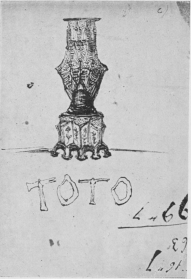
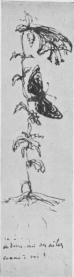
DRAWING BY VICTOR HUGO, SIGNED “TOTO.” Unpublished, belonging to the Author. THE FLOWER AND THE BUTTERFLY. Drawing by Victor Hugo for Juliette (Victor Hugo Museum).
Jersey, Friday, 9 a.m., December 3rd, 1852.
Good morning, my life, my soul, my joy, my happiness.
Dear adored one, from yesterday until the 14th of this month, there is not a moment that does not recall to me the dangers you were exposed to a year ago,[104] and the terrors and inexpressible anguish I endured all through those awful ten days. A year ago, at this very hour of the morning, you stood in the Faubourg St. Antoine, alone, holding and challenging a frantic mob lost to all sense of reason and restraint. I can see you now, my poor beloved, calling upon the soldiers to remember their duty and their honour, threatening the generals, withering them with your contempt. You were terrible and sublime. You might have been the Genius of France witnessing in an agony of bitter despair, the accomplishment of the most cowardly and despicable of crimes. It is an absolute miracle that you escaped alive from that spot which echoed with the solitary force of your heroic fury. When I think of it I still feel terrified and dazzled.
Juliette.
Jersey, Saturday, 8 a.m., November 27th, 1852.
Good morning, my poor flayed, mutilated darling. How I pitied you yesterday during the long-drawn-out massacre of your masterpiece,[105] which however, like an Immortal, emerged from the ordeal finer and in better fettle than ever. As for me, my treasure, I could only admire and envy your heroic impassivity in the face of that frightful profanation. I could hardly sit still, so vexed and irritated did I feel at the audacity of those wretched strolling mountebanks. Yet Heaven knows how hard they must have worked to be even as ridiculous as they were. One cannot be really angry with them, but it is impossible to recall them individually without laughing till the tears run down one’s cheeks. That is what I have been doing ever since I came out of that horrible little theatre, for I did not sleep very much. My thoughts were busy with you, my adored one; I was seeing you again in imagination, handsome, young, triumphant, as you were at the original performance of your Angélo. I felt all the tenderness and adoration of those old days surging up again in my heart.
Juliette.
Jersey, Monday, 8 a.m., December 29th, 1852.
Good morning, my too-dearly loved little man. I am cleverer than you, for I do not need lenses, paper, chemicals, and sunshine, to reproduce you in every form within my heart. Love is a splendid stereoscope; it throws all the photographs and daguerreotypes in the world, into the shade. It can even, if the need exist, convert black jealousy into white confidence, and force into relief the smallest modicum of happiness, the slightest mark of love. That being so, I hardly know why I desire so ardently to multiply your dear little pictures around me, unless it is that I wish to compare them with those of my inner shrine. Whatever be the reason, I do implore you, my dear little man, to give me one as soon as possible; it will be such a pleasure to me. Meanwhile my poor persecuted hero, I cannot tell what trials the future may have in store for you, but as long as a breath of life remains within me, I mean to expend it in defending, guarding, and serving you. My faith in the power of my love amounts to superstition; I feel that so long as I care for you, nothing irretrievably bad can happen to you. This is neither pride nor fatuousness on my part; it is a sort of intuition that comes to me, I think, from Heaven above.
Juliette.
Jersey, 9 p.m., Thursday, January 6th, 1853.
If the soul could take visible shape, you would perceive mine at this moment, my sweet adored one, bending over you and smiling. If kisses had wings, you would feel them swooping about your dear little person in clouds, like joyous birds upon a beautiful flowering bush. Unfortunately, my soul and kisses have to pass and repass before you invisible, and perhaps even unsuspected by you. But that does not deter me, and I am drawn irresistibly to you by the need of living in your atmosphere. My thoughts sit boldly at your side wherever you are. However my chastened personality may bend under the contempt and disdain of the world, my love rears itself proudly in the consciousness of its superiority. While you leave my body standing outside, it enters hardily with you and leaves you not. This may not be very tactful of me, but it is the mark of an ardent and loyal heart. And after all we are living “on an Island.” I can see you, making eyes at your neighbour on the left, and signalling to the one opposite. I want you to be mine absolutely, body and soul, and I do not mean to share one little bit of you with anybody. You must make up your mind to that, and content yourself with enjoying the cosmopolitan cookery of that Hungarian Lucullus.[106] I will allow you to gorge like four Englishmen and drink like one Pole, but I shall not take my eyes off you and shall watch your every movement. I think you laugh a great deal for a grave man with a handsome mouth, and your hands are enough to bring a blush of envy to the paws of all those exiled females! They suffer by comparison—so much the better! Hold your tongue, drink, turn your head my way at once, and keep it there.
Juliette.
Jersey, Tuesday, 12.30 p.m., February 1st, 1853.
I really mean what I said just now, my dear little boy. Instead of posing interminably in front of the daguerreotype,[107] you could quite well have taken me for a walk if you had wanted to. Anyhow, pretexts for keeping away from me will never fail you, and the fine weather will now add many to those already on your list. Therefore I ask you in all good faith, what use am I to you in this island, apart from my functions of copyist? I do not wish to reopen this eternal discussion in which you never tell me the truth, yet I shall never cease to protest against a state of things so foreign to true love, and so little conducive to my happiness. And now, my dear little man, you may amuse yourself, and make daguerreotypes, and enjoy the glorious sunshine in your own way. I, for my part, shall make use of solitude, desertion, and shadow, to bring to a head an attack of depression which will easily develop into a great big sorrow. I shall study how to make the most of it. Meanwhile I smile prettily at you, after the fashion of a stage dancer executing the final pirouette which has exhausted her strength and left her breathless. Brrrr.... Long live Toto! Long live worries and all their kith and kin! Long live love!
Juliette.
Jersey, Thursday, 9 p.m., April 28th, 1853.
I come to you, my beloved, as you are unable to return to me this evening. I come to tell you I love you without regret for the past or fear for the future. I come to you with a smile on my lips and a blessing in my bosom, with my hand upon my mutilated heart and my eyes full of pardon, with my purity restored and my soul redeemed by twenty years of fidelity and love, with my delusions swept away and my faith shining. I come to you without rancour, sustained by divine hope. I come with the maternal devotion and the passionate tenderness of a lover, with a mind instinct with reverence and admiration, a resignation and piety like to those of God’s martyrs, and I constitute you the supreme arbiter of my fate. Do with me what you will in this life, so long as you take me with you in the next. I sacrifice my feelings to the virtue of your wife and the innocence of your daughter, as a homage and a safeguard, and I reserve my prayers and tears for poor fallen women like myself. Lastly, my adored one, I give you my share of Paradise in exchange for your chances of hell, considering myself fortunate to have purchased your eternal bliss with my eternal love.
Juliette.
Jersey, Thursday, 5 p.m., July 7th, 1853.
Whatever you may say, my sweet one, to retard the gradual cessation of my daily yarns, you cannot stay the progress of the natural law, even when assisted by my passive submission to your will. Why continue this custom of writing to you twice a day, when the pretext for doing so has faded from our joint lives? If I were a woman of parts, I could substitute imagination and shrewd observation for love-making; but as these are entirely lacking in me, I have nothing to record in those bulletins where kisses and caresses once occupied the chief place. Now, when I have said good morning and alluded to the state of the weather, I have nothing more to say, because I am stupid. Your influence alone can extract what is in my heart. For this reason, my dear one, these scribbles became blank and aimless, from the moment the happiness that once dictated them began to die away and degenerate into a friendship despoiled of all pleasure and voluptuousness. I do not reproach you, my adored one, any more than I reproach myself for not being still the woman you loved beyond everything—still it might be better to discontinue this daily record of the change, and to give up the piteous babblings which no longer have even the excuse of wit.
Juliette.
Jersey, Saturday, 2.30 p.m., September 24th.
How one’s brain scintillates from living for ever within four walls! What sparkling and varied incidents one experiences in this existence of a squirrel in a cage! For my part I am so inspired by it that I hardly know where to commence. Let us, therefore, proceed in due sequence; my cat, which has been slumbering for the last two hours on its right ear, has just turned over on to its left.
Père Nicotte, abandoning the ploughshare, announces for Thursday, September 29th, the sale by auction of three fat hogs, a sow with her eight sucking pigs, three yearling bulls, another rising two, and other items too numerous and too peculiar to enumerate.
Births: August 5th. Blanche Laura, daughter of Mr. Harper Richard Hugo.
The annual dinner of the Society will take place on the above-mentioned day. Those intending to be present, and those proposing to furnish fruit for the same, are urgently requested to send in their names on or before the preceding Saturday.
What more do you want? Eleven pigs, not including the sow, three yearling bulls, not including the one rising two, a daughter of your own, and permission to invite yourself to a dinner of the Society, and even to furnish the fruit for it. If all this does not attract you and stir the very marrow of your bones, and tempt your appetite, you must be dead to the promptings of sensibility, paternity, and sensuality. In that case, go to bed and to sleep, and leave me to myself—the more so, as I do not happen to possess an accommodating table,[108] to furnish me with ready-made apparitions. Remember, I have to be my own Dante, Æsop, and Shakspere, whereas you catch the dead fish that the spirits of the other world attach to your lines—a proceeding practised in the Mediterranean long before those tittle-tattling tables were thought of. Pray accept my most tender sentiments.
Juliette.
Jersey, Sunday, 10 a.m., January 1st, 1854.
I love you so much, my darling, that I cannot find anything else to say to you. My poor spirit is ready to give way under the weight of too much love, like a bough bending under an abnormal show of fruit; but my heart has strength enough to bear without flinching the infinite tenderness, admiration, and adoration I feel for you.
What a letter, my adored one! I read it with my heart in my eyes. It seemed to penetrate word by word like sun-rays into the very marrow of my bones. My Victor, your hopes are mine, your will, mine, your faith, mine; I am what you deserve that I should be; I live only for you and in you. To love you, serve you, reverence you, adore you, are my only aspirations in this world. Where you are, I shall be; where you struggle, I shall watch; when you suffer I shall pray, when you are threatened I will defend you, save you, or die. I tell you all this pell-mell and anyhow, my adored Victor, for it is impossible for me to discipline my thoughts when they fly in your direction—they are less amenable to common sense than to my heart and soul, which are in ecstasy since this morning. I know not what trials may still be in store for you, my sublime, persecuted love, but I can answer for my own courage and devotion to you. Like you I associate our two angels with all my prayers and hopes and joys and love. I constitute them your guardian angels and to them I confide your life, that is, mine, your heart, that is, my happiness. I send you enough kisses to make a connecting-rod from my mouth to yours.
Juliette.
Guernsey, Monday, 7.30 p.m., July 21st, 1856.
It shall not be said that your adored name ever appeared before me in its dazzling nimbus without being saluted by my heart with a triple salvo of love, oh, my dearly beloved, and without the outpouring of all the perfume of my soul at your divine feet. Although I am very tired, almost ill, I cannot let this day pass without giving you my tenderest, sweetest, most love-laden greetings. Others may bring you flowers and pay you handsome compliments, but I offer you twenty-three years of tried fidelity free of human stain. It is all I have to bestow—it may be insignificant, but it is my all. Such a thing cannot be bought; it is accounted among the treasures of God. In His keeping you will find it, when the gifts of Heaven shall replace those of Earth. Meanwhile, to show you that I still belong to this sphere, I send you my beautiful violet robe brocaded with gold; but I specially stipulate that it should form part of the decoration of your own room, rather than that you should hang it in the gallery. Still, if you prefer to use it elsewhere I leave you free to do as you like, for your pleasure is my sole desire. You must not imagine that my generosity is entirely disinterested, because that would be a great mistake. I am sure you would not wish to remain in my debt, and that you will therefore give me a little drawing for your birthday. This is my request—now bring me your cheeks that I may kiss them without stint, and do be discreet to-night with the women who will come to offer you birthday greetings! Keep your heart entire and intact for me.
Juliette.
Guernsey, Friday, 1.45 p.m., December 12th, 1856.
Adored one, I am sending Suzanne to get news of your dear little sick child.[109] Although night is coming on, I hope I may get a good report; this weather is enough to give an attack of nerves to anybody at all disposed that way. You saw Suzanne yourself, my darling, yet someone is knocking—fancy if it should be you! It is! What happiness!
How good, how ineffably good you are, dear kind father, to have come yourself to reassure me about the little feverish symptoms that are beginning to show themselves to-night in your little girl’s condition. Let us hope they will yield to remedies this time, and that the night may prove more calm and satisfactory than the day just passed. Meanwhile thank you with all my heart, thank you with all my soul, for allowing me to share your family hopes and fears and joys and troubles. Thank you. If God hears and grants my prayers, as I trust with sacred confidence He will, your adored child will soon be restored to health and happiness.
Juliette.
Guernsey, Monday, 7.30 p.m., April 13th, 1857.
If you say another word I shall seize them all,[110] so there! I shall certainly not place my house, my rooms, my old age, my tables, chairs, carpets, water, ink, my virtue, great and small, at your disposal, to be rewarded by seeing masterpieces pass under my very nose on their way to Teleki, Mademoiselle Alix, and other trollops of her calibre. I must have some too; castles, moonlight scenes, sunrises, and fog effects. If you are not prepared for a quarrel, you must give me at least my share. Ah, here you come! I am not sorry to see you....
Juliette.
Jersey, Saturday, 4 p.m., July 1st, 1857.
Darling beloved, I begin my letter in the hope of its being interrupted shortly, and completed this evening with a lighter heart; but I so need to love you that I must take the initiative, my adored one. I have just read the sad, tender poems you gave me to copy. I see you coming....
8.45 p.m.
I have just finished copying those adorable verses, so poignant through their very restraint,[111] and I weep for my own grief as well as yours, my poor afflicted friends. The shadow which has fallen across your lives is black night in my case, for all the radiant joys of family life were wiped out with the death of my only child. When I think of my forlorn infancy bereft of father and mother, and of what my deathbed will be, without the loving tears of a child of my own, I feel as if a curse were laid upon me for the expiation of some hideous crime. Yet, oh God, I am not ungrateful to Thee, far from it; I feel indeed with the deepest gratitude of heart and soul how good Thou art! May you be as greatly blest as you are loved by me, my Victor. You are divinely grand and sublime. I kiss your dear little feet and your angel’s wings. I worship you on my knees.
Juliette.
Jersey, Tuesday, 2.30 p.m., July 2nd, 1857.
Yes, since you wish to hear it, I love you, my little man; but I could demonstrate it much more intelligently by working something for you on canvas, than by daubing this poor little sheet of paper with hieroglyphics. If perchance death should surprise us before you have destroyed these crude ebullitions of my heart, inquisitive folk will experience keen disappointment; they will find it difficult to distinguish the traces of an overmastering passion in such a petty mind as mine. I hope you will be provident enough and generous enough to spare me this humiliation beyond the grave, by burning gradually all those poor letters that are so ineffective the moment they have crossed the threshold of my soul. Meanwhile I continue to obey you with entire submission, and my love for you is greater than your genius—that is to say, I love you, love you, love you, without being able to find anything to compare with the magnitude of my infatuation.
Juliette.
Guernsey, Saturday, 8 p.m., December 19th, 1857.
Although unwell and fatigued, my beloved Victor, I cannot leave this little home where we have loved each other, without penning a grateful farewell for all the felicity it has sheltered during the year I have lived in it. I trust I may be as happy in my beautiful new house as I have been here in my hovel. The sadness I feel to-day is nearer akin to nerves than to real sorrow. Please forgive it, my adored Victor, if you have misunderstood and thought for a single instant that you were to blame for it. Far from reproaching you for the difficulties of my situation, I admire your ineffable kindness and bless you from the bottom of my heart for all the trouble you are taking to house me handsomely. It was difficult, but of what are you not capable when you set your mind to a thing? I think without affecting the false modesty of a collector, that you have succeeded, and I thank you with all the strength of my loving soul, which asks no better than to be happy in the new paradise you have just prepared for me.
Juliette.
Guernsey, Friday, 11 a.m., July 16th, 1858.
My beloved, my beloved, my beloved, what sin have we committed that God should strike us so cruelly in your health and my love! Unless it be a crime to love you too much, I do not feel guilty of aught. What shall I do, my God, what will become of me! Victor ill and away from me! I dread lest, as I write, you should almost hear my sobs and guess at my despair, from these reckless words.
I had anticipated this trouble and thought myself able to face it. I know it is imperatively necessary that you should remain at home, yet my whole being rebels at this separation as at a cruel injustice, and the greatest misfortune of my life. Why, why, why am I like this, oh, my God? Yet I possess courage, Thou knowest! Thou knowest also that I desire his speedy recovery and love him with a devoted, illimitable love. My adored Victor! Why then, is the reason of this gloomy and profound despair which robs me of strength and reason? Oh, God, dost Thou hate me? Have my offences been graver than those of other women like me, that Thou shouldst chastise me so mercilessly! Oh, I suffer, Victor, I love you, I am wretched!
Juliette.
Guernsey, Saturday, Noon, July 24th, 1858.
Another short spell of courage and patience, my poor gentle martyr, and your deliverance will be complete. The doctor has just assured me so. I shall soon be able to rejoice at your convalescence without the poignant dread of a frightful disaster mingling itself with my joy. In the delirious delight this good news gave me, I kissed the doctor’s kindly hands, which have become sacred to me since they have ministered to you. The poor man was surprised and moved by my emotion, and looked quite embarrassed—almost shy of my gratitude—but I was proud of it. Why should not a woman kiss the hands that have saved the life of the man she adores, when so many men kiss the idle fingers of the women who betray them.
Rosalie arrived a few minutes after the doctor, to fetch your egg, and found me weeping and smiling. I explained the reason to her. The girl has surprised me in tears so often that I fear she will take me for a cry-baby by temperament, though God knows, I do not lay claim to hyper-sensitiveness. But how could I have remained calm during your long, painful illness. For, my beloved, one can afford to admit now, that you have been in grave danger the last twelve days. Happily all is over, you are saved and I thank God on my knees and adore you.
Juliette.
Guernsey, Wednesday morning, August 4th, 1858.
At last, at last, at last, beloved, I have reached the blessed moment when I shall see you again! I am so happy that words and breath fail me. Oh, my adored one, how have I managed to live so far away and separated from you for so long! Three weeks ago I should have thought such a sacrifice beyond my strength, yet to-day I am almost afraid I am seeing you too soon; for my solicitude takes fright at the idea of any imprudence that might augment or prolong the sufferings you have only just overcome. The worthy doctor assures me there is no risk for you in the short walk from your house to mine, but I have been so wretched during your illness, and I love you so much, that my heart knows not to whom to hearken. My beloved, my joy, my life, my happiness, be prudent! I adore you, I await you, my love.
Juliette.
Guernsey, Monday, 8 a.m., June 13th, 1859.
JULIETTE DROUET’S HAND.
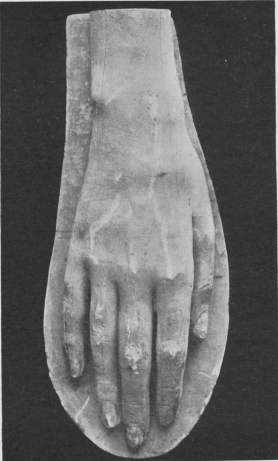
Good morning, my adored one. I say it with all the tenderness which had to be disguised owing to the presence of your kind and charming son, during the lovely fortnight we have spent at Sark. Everything there was a feast for mind and heart. One thing only was lacking for my complete happiness; freedom to love you aloud and in all frankness. Now there need be no obstacle to the passionate expansion of my soul, but it is in the silence and solitude of my house, without the joys, smiles, sparkling wit, and poetical atmosphere you and your son spread before my dazzled eyes, during the splendid fortnight I spent with you both; so true is it that one cannot have everything at the same time here below, and that perfect happiness is attained only in Heaven. But while our two souls are travelling thither, the one assisting the other, I am grateful to God for the radiant fortnight He has just given me. I thank Him with a full heart, and beseech Him to repay you and your dear Charles with as many fruitful and glorious years as you have given me days of happiness in the tender intimacy of Sark. As usual, my words are inadequate to express my feelings, but you will understand, my beloved, and restore the balance between the two.
I hope you spent a good night, my sweet love. I am waiting for you to give you as many kisses as you are able to carry. Until then I adore you with all my soul.
Tuesday, June 14th.
May God preserve you from all evil, my beloved, and permit my love and blessing to constitute the whole happiness of your life.
Juliette.
Guernsey, Thursday, 4.30 p.m., February 16th, 1860.
You sat at this very spot just now, my sweet love, writing in my little red book, (record of our love), the very things my own heart feels and would have dictated to you, could it have spoken aloud—so certain is it that my life belongs absolutely to you, and that my thoughts take birth from your glances. Like you, I have faith in our radiant future in the life beyond; like you, I pray to die as near you as possible, cradled in your arms, whenever it please Heaven. If I hearkened only to the voice of my selfishness, I should plead that it might be now, but I am too conscious of the sublime mission you are called upon to accomplish towards humanity in this world, to dare put up such an impious petition. I will wait bravely, patiently, reverently, in prayer and adoration, until it please God to call us unto Himself.
Thursday evening, 7.30.
I resume my scribble where I left it when you came back this afternoon, my darling beloved—not to add anything of value, but to continue for my own pleasure the sweet dialogue between my heart and my love. I thank you for our dear twenty-seventh anniversary, which you made memorable by words so luminous and a tenderness so penetrating and sacred. I thank you for myself, whose pride and joy and veneration you are; I thank you on behalf of my nephew and his family, for the immense honour you have conferred upon them by writing to their son. Lastly, my beloved, I kiss your feet, your hands, your lips, your eyes, your brow, and I only cease through fear of wearying you by this over-flow of caresses.
I love you.
Juliette.
Mont St. Jean, Monday, 8 p.m., June 17th, 1861.
Dearly beloved. Whilst you are expanding among the tender delights of family life, I am invoking all my physical and moral strength to prevent myself giving way under the sadness of your absence. As long as my eyes could distinguish the omnibus, that is to say, as far as the Betterave Renaissante, I watched your progress along the Gronendael road. Beyond that point, I was forced to relinquish the sweet illusion that I could still see the dear little black speck on the horizon, and to acknowledge that nothing lay before me but the endless void of your twenty-four hours’ absence. So, as I did not know what to do with myself or how to kill time, I walked by a fairly easy field-path as far as the church at Waterloo, and came back by way of the village, without however visiting the church, notwithstanding the pressing invitation of an old woman who called me her dear friend. I got back to the hotel at six o’clock precisely, and spent the half hour before dinner freshening myself up by washing from head to foot; then I put on a dressing-gown and went down to our little dining-room, where I ate without hunger and drank without thirst, so dismal and forlorn am I when you are no longer present. I must have been pretty fully convinced of the impossibility of accompanying you to Brussels without exposing your movements to undesirable criticism, to accept the sad alternative of remaining here alone. But that certainty is no comfort whatever, and I am just as miserable as if it had been in my power to make the expedition with you. Certainly, human respect is a horrid beast, more malevolent and worrying than even midges and their poisonous sting, and all the ammonia in the world is powerless against it.
I am well fitted to make the comparison seeing that my arm is already healed, while my heart suffers more and more. Dear adored one, do try, on your part, to spend profitably this interval which is costing me so dear. Be happy; I love you, bless you, and adore you.
Juliette.
Guernsey, Tuesday, 8 a.m., February 17th, 1863.
Good morning, my beloved. In full daylight and glorious sunshine, in love and happiness, good morning. Again I greet you, like that first day thirty years ago, when my eyes followed you along the Boulevard after you left me. My soul winged flights of kisses to you when you looked round for one more glance at my window before turning into the Rue du Temple. That picture remains for ever graven upon my mind; I can assert with truth that everything remains the same in my heart as the night I first became yours. These thirty years of love have passed like one day of uninterrupted adoration, and I feel now younger, more virile, and more capable of loving you, than ever before—heart, body, soul, all are yours, and live only by you and through you. I smile upon you, bless you, adore you.
Juliette.
Guernsey, Sunday, 10.30 a.m., April 26th, 1863.
Good morning, unutterably dear one. May all the blessings of heaven and earth rest upon you and those you love. I slept very well and hope you did the same. My headache has gone and I feel as sturdy as an oak-tree. I do not in the least desire a great house whence I shall not be able to see you in the mornings, and I should much prefer to keep my own little perch upon which my heart poises so happily while I watch you moving about your home. Having made my protest, beloved, you shall dictate to me the letter I must write to notify the landlord that he need not move out to-morrow. We can settle when you come, what time I must be ready, so as not to lose one second of our little walk up the hill. I am so happy at the thought of remaining near you, that I feel as if I had already substituted youthful wings for my old legs. Even my garden is gay, and cries out to me by the mouths of its lovely flowers: don’t go away! Health is where happiness is, and happiness means loving each other, side by side, eyes upon eyes, soul with soul. Therefore, I shall stay here. That is quite settled.
Guernsey, Friday, 7.30 a.m., October 30th, 1863.
Good morning, good morning, and again, good morning, my dear, wide-awake person. You must be very well to-day, judging by the energy with which you are shaking your rugs to the four winds. I hope that signifies a good night, good health, lively love, and all the rest of it. As for myself, I slept little, but soundly. I got up before gun-fire this morning, and had already finished my dressing when I saw you on your balcony. What a privation it will be for me, my adored man, when I can no longer watch you in the mornings, moving about your house. I do not feel as if I should ever get accustomed to it, and I think of it with apprehension, for there is a proverb that says, “Out of sight, out of mind.” If you gave up loving me, or worse, loved me less, what should I make of life in that great empty drawing-room?
At this moment, I am trying to numb these reflections by the contemplation of the marvels you are creating in that future house of mine; but at the bottom of my heart, I know I shall always mourn this poor little lodging, where my eyes could watch over you, caress you, guard you, preserve you, and adore you. The more I think of it, the more oppressed I feel, and the more I blame myself for having exchanged the happiness of every moment, for a comfort I shall hardly have leisure to appreciate, and for health which did not require amelioration. My poor beloved, forgive these regrets which are only dictated by love, and this anxiety which also means love. Try not to let the separation of our houses entail that of our hearts; try to love me as heartily there as here, and do not let yourself be enticed away from me by anybody. On those conditions I promise to live happily in the splendid rooms you have prepared for me.
J.
Guernsey, Wednesday, 1.30 p.m., June 15th, 1864.
Dearly beloved, I cannot forsake this little home where we have loved each other for eight years, without imprinting a kiss of gratitude upon its threshold. I have just gazed my supreme farewell at your beautiful house, which has so long been to me the polar star of my heart’s wanderings. Alas, I am lengthening out the moments as much as possible; I cannot bring myself to leave this dear little house, which I had made the shrine of my cult for you. I should like to carry away the walls against which you have leaned, the floors you have trodden, and even the dust your feet have spurned. I fear lest my sadness be observed by those who cannot understand it, and the efforts I make to seem unconcerned increase the constriction of my heart, and drench my eyes with tears. Oh, my adored beloved, how you will have to love me and give me all the time at your disposal, to console me for the immense grief I am experiencing to-day in quitting your neighbourhood, that is to say, in losing sight of it! How you will have to double and treble and quadruple your love, to replace the dear memories I leave behind me! May God protect me and may the dear souls of our angels follow us to the new home, and bless us till our last hour!
I adore you.
J.
Guernsey, Thursday, 5.30 a.m., June 16th, 1864.
Where are you, my beloved? My eyes seek you vainly, you are no longer there to smile upon me; it is all over—I shall never again see the little roost whence you used to blow kisses and wave your hand so tenderly. I am alone now in my fine house, alone for ever; for there is no further chance in this life of having you near me. I shall never again live in your immediate intimacy, as I have done for the past eight years.
Loyally as you may endeavour to bridge over the distance between our abodes by coming to me oftener in the day-time, the separation of our two existences must ever endure. I know it by the blank depression I am feeling this morning. I would give a hundred thousand houses and palaces, and the universe itself, for that little slice of horizon where my heart projected itself night and day. I am ashamed of having been so mean-spirited as to barter my daily happiness against a chimerical amelioration of health. I am punished for my transgression, my dearest. I carry death in my heart. Forgive me! I would gladly smile at you, but at this moment I feel incapable of doing so. Forgive me for loving you too much. I hope you had a good night. I hope you gazed upon my dark, empty house and gave it one sigh of regret. I hope you love me and are conscious of my absence. May God preserve you from all evil, dearly beloved, and may your love remain whole and intact in severance as in propinquity. I bless you, and adore you. A kiss to all our dear memories.
J.
Guernsey, Sunday, 8.30 a.m., June 11th, 1865.
It would take very little to make me stay in bed till noon. I am ashamed of myself and well punished, for I have not seen you this morning, and have not yet heard whether you had a good or a bad night. I hope you were clever enough to sleep uninterruptedly from the moment you laid your head on the pillow, till that of your uprising. I shall be very glad if I have guessed right. Meanwhile, my sweet treasure, I send you a smile and a blessing. I am listening at this moment to the joyous cheeping of my tiny chicks over a saucer of milk that has just been put before them. I am also watching two white butterflies darting after each other among my roses, like twin souls in Eden. The flowers are blooming, love-making is going on all around, and my heart is overflowing with tenderness and adoration for you. The further I progress in life, the more I love you; you are the beginning and end of my being. I hope everything of you, and my soul trusts you, all in all. You are my radiant and divine beloved.
J.
Guernsey, Sunday, 7.30 a.m., December 2nd, 1866.
Good-morning, my adored one, bless you. I can afford to smile on this date, abhorred of all worthy folk: December 2nd.—because it is, for me alone, a joyful anniversary. If my gratitude is an offence towards humanity, I humbly ask pardon of God and man. I am tormented at the thought that you may have slept badly. If I could be reassured on that point, I should be quite happy this morning. Unfortunately, I can only find out much later when you come here to bathe your dear eyes. The mention of your eyes reminds me of your poor wife’s sight. Surely, if the doctors were not certain of curing her, they would not keep her so long in Paris, away from all her belongings, in winter weather? My desire for her complete recovery of a sense of which she has made such noble use in her beautiful book Victor Hugo, raconté, makes me look upon her delay in returning, as a happy presage of future recovery. I ask it of Heaven, with love.
J.
Guernsey, Wednesday, 8 a.m., January 1st, 1868.
I thank you, dearest, for letting me have a share in your prayers, when you plead to God not to separate us in life or in death. It is what I pray all day long; it is the aspiration of my heart and the faith of my soul. I am not a devout woman, my sublime beloved, I am only the woman who loves and admires and reverences you. To live near you is paradise; to die with you is the consecration of our love for all eternity. I want to live and die with you. I, like you, crave it of God. May He grant our joint prayers!
I feel as you do, my beloved, that those two dear souls hover above us and watch over us and bless us. I associate them with all my thoughts and sorrows and joys, and I place my prayers under their protection, that they may convey them direct to the foot of the Great White Throne. I bless them as they bless me, with all that is loftiest and holiest and most sacred in my soul. I am stopping at almost every line of this letter to read your adorable one over again, although I already know it by heart. I kiss it, talk to it, listen to it, and then begin all over again. I love you.
J.
Guernsey, Thursday, 7 a.m., May 7th, 1868.
Dearly beloved, I am rather less worried since I have seen you and exchanged a kiss with you; yet I know you slept badly. I can feel that you are ailing and sad. I pray God to give you happiness again as soon as possible, in the form of a second little Georges all smiling and beautiful; meanwhile, I beg Him to let my love be the balm that will heal your wounds, until the day of resurrection of the sweet child for whom you weep.[112]
I hope He will hear and grant my petitions on your behalf, and that you will be restored to some degree of calmness and consolation. When you write to your two dear sons, Charles and Victor, do not forget, I beg, to thank them from me for the little portrait. Tell them I love them and mingle my tears with theirs.
I adore you, my great one, my venerated one, my sublime mourner.
J.
Brussels, Sunday, 7.30 a.m., August 2nd, 1868.
Again I have slept better than ever, beloved. I trust it has been the same with you. I was very proud and pleased at my walk with you and your family last night, but I felt somewhat shy and ill at ease. Please permit me to decline any further invitations of the kind. Should the occasion arise again, which is improbable, I think good taste and discretion demand that I should hold myself aloof from your family affections, and only associate myself with them at a distance, or in my own home. As this feeling, or scruple, whichever you may like to call it, could not be expressed in the presence of your dear children yesterday, I consented to go with you, while intending to call your attention privately to the embarrassment such an incident would cause me, if it should happen again. I think you will probably agree with me, and approve of my sacrificing my pleasure to your tender family intercourse.
J.
Brussels, Wednesday, 8.30 a.m., August 26th, 1868.
My poor beloved, I pray God to spare you and your dear children the misfortune which threatens you at this moment in the loss of your angelic and adorable wife. I hope, I hope, I hope. I pray, I love you, I summon all our dear angels above to her assistance and yours. I pray God to make two equal shares of the days remaining to me, and add one to the life of your saintly and noble wife. My beloved, my heart is wrung, I suffer all you suffer twice over, through my love for you. I do not know what to do. I long to go to you, I should love to take my share of the nursing of your poor invalid, but human respect holds me back, and my heart is heavier than ever. Suzanne has only just come from your house, and I already want to send her back again, in the hope that she may bring me less disquieting news than that which I have just received. Oh, God have mercy upon us and change our anguish into joy!
Brussels, Thursday, August 27th, 1868.
My beloved, in the presence of that soul which now sees into my own,[113] I renew the sacred vow I made the first time I gave myself to you; to love you in this world and in the next, so long as my soul shall exist, in the certainty of being sanctioned and blessed in my devotion by the great heart and noble mind which has just preceded us, alas, into eternity.
Brussels, Friday, 8 a.m., August 28th, 1868.
I placed your sleep last night under the protection of your dear one, my beloved, and implored her to remove from your dreams all painful memories of the sad day just past. I hope she heard me and that you slept well. Henceforth, it is to this gentle and glorious witness of your life in this world, now your radiant protectress in Heaven, that I will appeal for the peace and happiness you require, to finish the great humanitarian task to which you have pledged yourself. May God bless her and you, as I bless her and you.
The more I think over to-night’s mournful journey, the more convinced I feel that I ought not to take part in it. The pious homage of my heart to that great and generous woman must not be exposed to a wrong interpretation by indifferent or ill-natured critics. We must make this last sacrifice to human malignity, in order to have the right to love each other openly afterwards; do you not agree, my beloved? Afterwards, may nothing ever come between us here below, nor above—such is my ardent desire!
J.
Brussels, Friday, 5.30 p.m., August 28th.
My heart and thoughts are with you and your beloved dead. I am sad and heart-broken, not for the angelic and sublime woman who now shines out in the world of spirits while we here below regret her, but for you, my poor sad man, to whom she was a holy and meek companion; for your dear children whose joy and pride she was; for myself, to whom she was ever a discreet and considerate protectress.
My heart is torn by your grief, my poor afflicted ones; my eyes rain all the tears you are shedding. Dear treasure, I beg your wife to obtain for you the courage you need. May her memory remain with you, sweet and gentle and benign as was her exquisite person in life. I entrust you to her as I confide myself to you, and I bless you both.
J.
Guernsey, Tuesday, 2 p.m., February 1st, 1870.
Since I have seen you, my great beloved, I am feeling much better. Your smile has completed my cure. It may be an illusion of my eyes and heart, but at this moment I seem to feel the breath of spring. Perhaps it proceeds from the nearness of the anniversary of the first performance of Lucrèce Borgia, which is to be acclaimed and applauded by an enthusiastic public to-morrow night, just as it was thirty-seven long years ago. Bonaparte may do his best to-morrow against this magnificent play, he will get no good out of his police-engineered cabal. I think he will hardly dare risk such an infamous attempt, but I wish it was already Saturday, that we might be quite easy. Meanwhile, I love you after the fashion of Princesse Négroni.
Juliette.
Guernsey, Monday, 8.30 a.m., February 14th, 1870.
Good morning, my dearest. Did you sleep better last night, my great, little man? Were you warmer? How are you this morning? It is indeed tedious to have to wait until this afternoon to hear all this. I am trying to moderate my impatience by doing things for you. I have already selected your two eggs, put fresh water into your finger-bowl, and a snow-white napkin on your plate. Suzanne is making your coffee, which perfumes the whole house, while I trace these gouty old “pattes-de-mouche,” which are to lay all the tender nonsense of my heart at your feet. I am beginning early, as you see, to be certain that they arrive in time. The thaw has begun. I was quite hot in the night, though I must admit I had taken measures to that end; so I slept excellently, as you can judge by the state of my spirits. But what I really want you to take note of is, that I adore you.
J.
Guernsey, Saturday, 7.45 a.m., May 21st, 1870.
My heart, my eyes, my soul, are bewildered, my beloved, so overwhelmed are they with tenderness, admiration, and happiness! What an adorable letter, and what a marvellous surprise! How good you are to me! How generous and charming! Words fail me, and the best I can say is: I love you! I love you! I threw my arms around old Mariette’s neck, and almost embraced Marquand himself in the delirium of my delight. What a splendid frame for that lovely little mirror! It contains everything: flowers, birds, a shelf, little Georges’ sweet face above, and your beautiful verses for wings. How can I thank you adequately, or describe my gratitude? Fortunate am I to have eternity before me in which to bless you. I kissed my dear little letter before everybody, but I would not read it until just now when I was able to bolt my door. I always read you thus, my adored one. My soul demands privacy for the better understanding of your sublime words, and I never finish the reading of them without feeling transported with love and almost prepared for the next world. I love you!!
Mariette told me you had spent a very good night. Is it really true? I slept capitally, too, and am feeling more than well. I have been looking about for a place for my new treasure, but have not yet decided on one. I shall leave it to you to choose its proper place in my museum of souvenirs. Meanwhile, I have covered it away from the dust and put it in the shady drawing-room. As soon as I have read your adorable little letter again, I shall go back and have another look at it.
J.
VICTOR HUGO, BY RODIN.
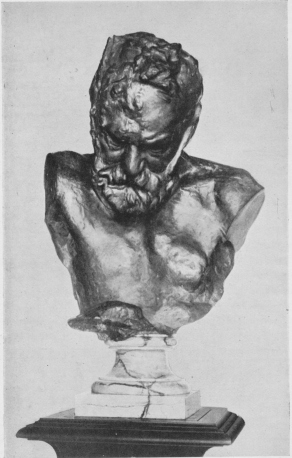
Guernsey, Friday, 5 a.m., August 18th, 1870.
At all hazards I must send you my morning greeting, though I trust you are sleeping too soundly to hear it. You have slept so little and so badly for many nights, that it would be only fair that this night should be long and good. As for me, I hardly slept at all, but I do not mind and am hardly surprised, as it is a habit of mine. But the thing I feel I cannot become inured to, is the apprehension of the perils you are about to encounter on your journey to Paris, ranging from the loss of your wealth to the death of your love for me—either would finish me. I think with terror of the tortures of all kinds I shall undergo there; my courage fails me and craves mercy in anticipation. I have fought all night against the wicked temptation to desert my post in a cowardly manner before even meeting the enemy—not an enemy that can be fought with fire and blood, but one that stabs you smiling. But I have not even the courage of cowardice; I am ready to suffer a thousand deaths if only I can preserve you from a single danger. You must live at any cost, that you may be enabled to complete your glorious task, and be happy, no matter how or with whom. My duty is to devote myself to that end, whatever betide. If I go under in the execution of it, so much the worse for me, or possibly, so much the better. To serve you and love you is my mission in this world—the rest does not concern me.