Front matter
Reading edition
Cover art
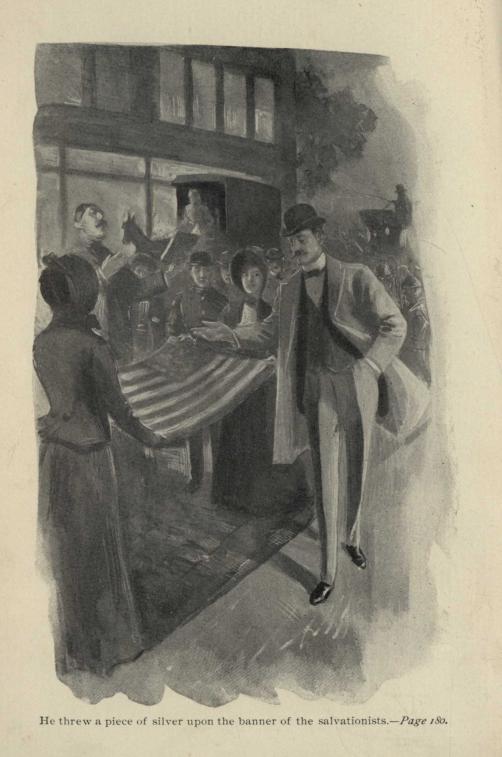
He threw a piece of silver upon the banner of the salvationists.—Page 180
JUDGE ELBRIDGE
BY
OPIE READ
AUTHOR Of "AN ARKANSAS PLANTER," "THE WATERS OF CANEY FORK," "A YANKEE FROM THE WEST," ETC.
CHICAGO AND NEW YORK: RAND, McNALLY & CO., PUBLISHERS. MDCCCXCIX.
Copyright, 1899, by Rand, McNally & Co.
CONTENTS
CHAPTER
THE STUDENT AND THE ORATOR
THE FAMILY JOKE
THE NIGHT CAME BACK WITH A RUSH
STOOD LOOKING AT THEM
SHE SAID THAT SHE WAS STRONG
THE WEXTON CLUB
WENT OUT TO "DIG"
SAW THE BLACK FACE, GRIM, WITHOUT A SMILE
HEARD A GONG IN THE ALLEY
WILLIAM AGREED WITH THE JUDGE
THE OLD OFFICE
WALKED AND REPENTED
WANTED TO SEE HIS SON
A PROPOSITION TO MAKE
DID NOT TOUCH HER
WITH AN EAR TURNED TOWARD THE DOOR
LYING ON THE SIDEWALK
MADE HIS PROPOSITION
THE GIRL AGAIN
THE PREACHER CONFESSES
UP THE STAIRS AND DOWN AGAIN
TOLD HIM GOOD-BYE
THE LIGHT BREAKS
SENT A MESSAGE
ILLUSTRATIONS
He threw a piece of silver upon the banner of the salvationists . . . Frontispiece
"Halloa, Goyle," said he. "Come in."
Goyle began to turn the knob of the safe
"How's everything?" Bodney asked
Bodney took the money
The old man pointed toward the door, and Howard walked slowly out
Bodney struck him in the mouth
The Judge seized the shears and raised them high above his head
JUDGE ELBRIDGE
CHAPTER I.
THE STUDENT AND THE ORATOR.
When John Elbridge retired from the bench, the newspapers said that he had been an honorable judge. He was not a pioneer, but had come to Chicago at a time which we now call an early day, when churches rang their bells where now there is a jungle of trade, when the legs of the Giant of the West were in the ache of "growing pains;" at a time when none but the most visionary dreamed that a mud-hole full of old boots, dead rats, cats, dogs, could ever be worth a million of dollars. Elbridge came from Maryland, with a scant wardrobe, a lawyer's diploma, and the confident ambition of youth. It was not long before he formed a copartnership with a young man named Bodney, a Kentuckian, in whose mind still lived the chimes of Henry Clay's bells—a memory that not so much fitted him to the law as it atuned him to oratory; but in those days the bar could be eloquent without inviting the pitying smile which means, "Oh, yes, it sounds all right, but it's crude." Elbridge was the student of the firm, and Bodney the orator, not a bad combination in the law at that time, for what one did not know the other was prepared to assert. They prospered in a way, but never had the forethought to invest in the magic mud-hole; took wives unto themselves, and, in the opinion of the "orator," settled down to dull and uneventful honesty. The years, like racing horses, flew round and round the track, and a palace of trade grew out of the mud-hole. Bodney and his wife passed away, leaving two children, a boy and a girl. Elbridge had stood at the bedside of his partner, who was following his wife into the eternal shadow. "Don't worry about the children, Dan; they are mine," said the "student," and the "orator" passed away in peace. And they were his. He took them to his home to be brother and sister to his son; and the years raced round and round the track.
At the time of his retirement from the bench the Judge was asked why he refused longer to serve the people. "Because," said he, "I am beginning to be afraid of my judgment; I am becoming too careful—like the old engineer who can't summon the nerve to bring his train in on time."
Mrs. Elbridge had been known as a local "beauty." It was said that the "orator" had rung his Henry Clay bells for her hand, and with philosophy, a rare quality among orators, had accepted defeat, to spur himself into another contest and to win a woman not unknown to "looks." Rachel Fry, afterward Mrs. Elbridge, had written verses to sky tints and lake hues, and the "student" believed that he had won her with a volume of Keats, bound in blue, the color of one of her own lake odes. And in the reminiscent humor of his older days he was wont to laugh over it until he himself was shot through with a metric thrill, when in measure he strove to recall the past; and then she had the laugh on him. It may be a mere notion, but it seems that the young doctor and the old lawyer are much inclined to write verses, for among the papers of many an aged jurist sonnets are found, and editors are well acquainted with the beguiling smile of the young physician. So the "pink fleece of the cloud-sheep," and the "blue, mysterious soul of the lake," inspirations of the "beauty's" earlier years, found sympathy in the "student's" "mellow morning of sunlit hope," penned in the late afternoon of life. But verses, be they ever so bad, are the marks of refinement, and there was no vulgar streak in the mind of the Judge. His weakness, and he possessed more than one, was the doggedness with which he held to a conviction. His mind was not at all times clear; a neighbor said that he often found himself in a cloud of dust that arose from ancient law books; and it is a fact that an able judge is sometimes a man of strong prejudices. At the time of this narration he was still hale, good humored, a little given to the pedantry of advancing years, devoted to his family, impressive in manner, with his high forehead and thin gray hair; firm of step, heavy in the shoulders, not much above medium height, cleanly shaven, with full lips slightly pouting. Following his own idea of comfort, he had planned his house, a large brick building in Indiana Avenue, at first far out, but now within easy reach of the area where the city's pile-driving heart beats with increasing violence. It was a happy household. The son, Howard, was a manly fellow, studious but wide awake, and upon him the old man rested a precious hope. The mother was a blonde, and nature had given her cast to the boy, blue eyes and yellowish hair; and it was said that if he had a vanity it lay in his bronze beard, which he kept neatly trimmed—and it had come early, this mark of the matured man. His foster brother, George Bodney, was dark, inclined to restlessness, over-impressionable, nervous. The old man had another precious hope—Florence, Bodney's sister; but of this he shall tell in his own words. A stranger might not have seen anything striking about the girl; but all acquaintances thought her handsome. At school she had been called a "character," not that she was original to the degree of being "queer," but because she acted in a manner prematurely old, discussing serious questions with her teachers, debating the problems of life. Her hobby was honor, a virtue which a cynic has declared is more often found among boys than among girls. She liked to read of martyrs, not that there was heaven in their faith, but because she thought it glorious to suffer and to die for a principle, no matter what that principle might happen to be.
There was one other member of the family, William, the Judge's brother. He looked like a caricature of the "student," with thinner hair and thicker lips. He had not given his energies to any one calling; shiftless is the word best fitted to set him forth. He had lived in different parts of the far West, had been dissatisfied with all places because a failure in all, and had come to spend the remainder of his days with his brother in Chicago. Here, he declared, a man could not find disappointment, for no man of sense expected anything but permission to breathe and to keep out of the way. Friends knew that he was the Judge's standing joke, a family laughing stock, a humorous burden, a necessary idleness. Of course, it was natural for him to feel that he owned the place.
Howard and George Bodney were bred to the law, and recently had been admitted to the bar. The "starvation period" of the average young lawyer did not arise out of dull prospect to confront them; they were to make their way, it was true, but they could study and wait. Howard was ambitious, and his mind was grasping. It was said that he "gulped" a book. He did not stop at the stern texts which were to serve as a part of his necessary equipment, but gave himself excursions among those graces of half-idle minds which light a torch for souls that may be greater. He peeped into the odd corners of thought. Once he startled his father by declaring that genius was the unconscious wisdom of ignorance.
"It is the reflection of hard work," said the old man. The boy was the corner-stone of his hope; he wanted to feel that his work was to go on, generation after generation, a pardonable vanity, but a vanity nevertheless. He wanted the boy to be practical, for a speculative youth is not a good perpetuator of a father's career. And on one occasion the boy was taken gently to task for reading a decadent book.
"I like to brush up against different minds," said he.
"But nothing is gained by brushing against a diseased mind."
"We might learn something from a mad dog."
"But all of value that we may learn from him," said the old man, "is to keep out of his way. I must request you not to read such books."
Bodney had not distinguished himself. He appeared to be restless and dissatisfied with himself and with his prospects. He thought that the law afforded but a slow and tedious way to make money, and deplored the shortsightedness of his father and his benefactor for not having invested in the mud-hole. Nervousness may inspire force of character, but it more often induces weakness. In many respects Bodney was weak. But the Judge, who should have been a shrewd observer of men as well as of principles, did not see it. In the "youth of old age," a man who, in his younger days, may have been keenly of the world, sometimes turns upon life the goggle eye of optimism.
After his retirement from the bench and the more active affairs of the law, the Judge fitted up an office at his home, with desks, long table covered with green baize, books and safe.
One evening Bodney sat alone in the home office, deeply brooding. The household was at dinner, and he heard the hearty laughter of the Judge. He was joking with a guest, a preacher, a good fellow. The young man's brow was dark. Of late he had formed an association with a man named Goyle, clearly an adventurer, but a man to inflame the fancy of a morbid nature. Bodney and Goyle had been much together, at the house and at the office down town, but no one made any objection. Personal freedom was a hobby with the Judge.
There were two doors leading into the office, one opening into a hall, the other into a passageway communicating directly with the street. Through the door opening into the passage Goyle entered. He carried a valise in his hand. Bodney looked up.
"Halloa, Goyle," said he. "Come in."
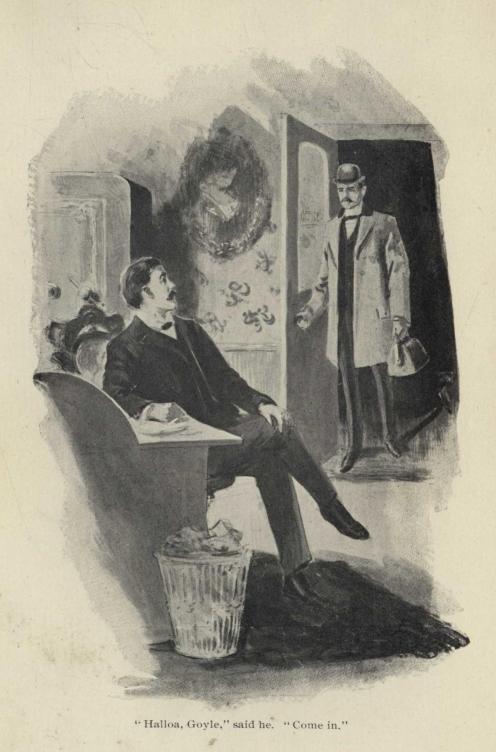
"Halloa, Goyle," said he. "Come in."
"That's what I'm doing," Goyle replied, putting down the valise near the door and advancing toward the desk at which Bodney was seated.
"Sit down," said Bodney.
"That's what I'm going to do," Goyle replied.
He sat down, and for a time both were silent. "Where's everybody?" Goyle asked.
The bass laughter of the Judge and the contralto of a woman's mirth were heard.
"At dinner," said Bodney, nodding toward the dining room.
"Don't you eat?"
"Sometimes," Bodney answered, and then after a short silence he asked: "Did you get my note?"
"Yes."
"What do you think?"
"I think you're scared," said Goyle.
Bodney gave him a quick look. "Who wouldn't be?"
"I wouldn't."
"Yes, you would. It's this way, and there's no other way to it: The old man has missed money from the safe. He hasn't said so, but I can tell by the way he acts."
Goyle smiled. "Well, but no one but himself knows the combination of the safe. He doesn't know that you found a piece of paper with the figures on it, does he?"
"Of course not, but it won't be long before he begins to suspect someone."
"Which, necessarily, fastens it on you. Is that it?"
"Doesn't it look like it?"
"Oh, it might," said Goyle. "That is, if you let it?"
Bodney looked at him with reproach. "If I let it. How the deuce can I help it? You don't suppose he'd suspect his son Howard, do you? No man could trust a son more than he does."
Goyle shrugged his shoulders. "Didn't trust him with the combination of the safe, did he?"
"No, for it's his idea of business not to trust anyone absolutely. He laughs and jokes all right enough, and says that this is a fine old world, but he hasn't quite forgotten that he practiced law among rascals."
"Yes," said Goyle, leaning back and stretching himself. "This soft air makes me lazy. It's not natural, you know, to be comfortable in Chicago. What were we talking about?"
Bodney turned upon him almost fiercely, but the visitor looked at him with the self-command of impudent laziness. He was not given to starts. He was born a rascal, and had cultivated his legacy. Coolness may be a virtue; it is also the strongest weapon of the scoundrel, and Goyle was always cool. He motioned with his hand, bowed, smiled, and Bodney's anger was gone.
"Don't get hot, old man," said he. "Everything is all right. If it isn't, we'll make it so. Oh, yes, we were talking about the old gentleman's suspicions. And we've got to take care of them. If I understand it, Howard is to marry your sister. You are all of a family. Your father and the Judge were law partners years ago, and you and your sister were adopted by—"
Bodney waved his hand impatiently. "We know all about that. Yes, and he has been a father to me and I have been—"
"A villain, necessarily," Goyle broke in. "Villainy is born in us, and for a time we may hide out our inheritance, but we can't get away from it. And it's only the weak that struggle against it. The lamb is born with wool and the dog with hair. No, we can't get away from it."
"But we needn't delight in it," said Bodney, with a faint struggle.
"No, and we needn't lie down on it, either. But, to business. The Judge must know who took the money from the safe."
Bodney started. "What, do you think I am going to tell him?"
Goyle yawned. "No, you must show him."
"Show him!"
"Yes. He must see his son Howard take the money."
Bodney stood up and looked down upon him. "Goyle, are you a fool, or do you take me for one? Must see Howard take the money! What do you mean? Do you think I can bribe Howard to take it? I don't understand you."
"Sit down," said Goyle, and Bodney obeyed, looking at him. Goyle lighted a cigarette, turned and pointed to the valise. "The thief is in that grip, and the Judge must see him take the money from the safe. Listen to me a minute. Among my numerous accomplishments I number several failures—one as an actor. But we learn more from a failure than from a success. All right. I heard Howard say that tonight he is going to a reception. In that grip is his semblance—make-up. At the proper time, after Howard is gone, you must lead the Judge in here and see me, as Howard, take money from the safe. On the mother's account the old man can be made to keep quiet—to hold his tongue, and not even say anything to his son. He changes his combination, the affair blows over—and we've got the money."
"Monstrous!" exclaimed Bodney, jumping up and glaring at Goyle.
"Do you think so? Sit down."
Bodney sat down. "Yes, I do think so," he said.
"What, the crime or the—"
"Both. And the trick! Anybody could see through it. It's nonsense, it's rot."
"Yes? Now, let me tell you, Brother Bodney, that life itself is but a trick. The world worships a trick—art, literature, music—all tricks. And what sort of art is the most successful? Bold art. What sort of scoundrel is the most admired by the world? The bold scoundrel. Bold art, my boy."
"But art has its limits and its rules," Bodney feebly protested.
Goyle dropped the stub of his cigarette upon the floor. "Yes, rules for imitators to follow. Originals break rules. Rules are made by weaklings to hamper the success of the strong. You've got to take the right view of life," he said, slowly lifting his hand and slowly letting it drop upon his knee. "We are living in the nervous atmosphere of adventure and bold trickery. The spirit of this town hates the stagnant; we wipe our muddy feet on tradition. To us the pig squeal of the present is sweeter than the flute of the past. You and I are intellectual failures, and why? The town is against us. Put an advertisement in tomorrow morning's newspaper—'Graduates of Harvard and Yale wanted, fifteen dollars a week,' and see how many answers you'll get. A cartload—and from men who were turned out prepared to fight the battle of life. Think of it. The man who has had his mind trained to failure, whose teaching has made him a refined weakling, with a mind full of quotations and mystic theories—that man has a cause to be avenged upon life, upon society for misleading him. Hear them laughing in there? You don't hear me laughing. I've got nothing to laugh about. You and I know that there isn't any future beyond this infernal life. Then, why hesitate to do anything that works toward our advantage here? I'm talking to your reason now. We have gambled, and we have lost." He turned and shook his finger at the valise. "The thief, I tell you, is in that grip, and he will get us out. If it fails, of course, we are done for, but we are done for if we don't try. I know it's a bold trick, but that's in its favor. It's too bold to be expected or understood. It's no time to think of gratitude. We've got to act. Give me the combination."
They got up, and Bodney stood trembling. He seemed to be struggling to break loose from something that held him in its grasp. Goyle gazed into his eyes. Bodney put up his hand as if to shield them from a dazzling light.
"Give me the combination."
Bodney tore loose from the something that seemed to be gripping him, and started on a run toward the door. Goyle caught him, put his hand on him, held him.
"I hear them coming. Give me that piece of paper."
Bodney gave him a slip of paper. Goyle took up the valise. "Come on," he said, and Bodney followed him out through the door leading into the passage.
CHAPTER II.
THE FAMILY JOKE.
The Judge, his brother William and the Rev. Mr. Bradley entered the office. "Yes, sir," said the Judge, "I'm delighted that you have been called to Chicago. We are full of enterprise here, religious as well as secular. Sit down. And we push religious matters, Mr. Bradley. Here everything takes up the vigorous character of the town. You know that one of our poets has said that when the time comes we'll make culture hum." Bradley sat down, smiling. "William," said the Judge, still standing, "can't you find a chair?"
"Oh, I believe so," William replied, sitting down. "But why do you make everybody sit down and then stand up yourself? Mr. Bradley, my brother John is a browbeater. He forgets that he ain't always on the bench."
The Judge winked at Bradley, and laughed. He was full of good humor, sniffing about on the scent of a prank, and when all other resources failed, he had the reserve fund of his brother, the family joke, the humorous necessity.
"You remember," said Bradley, "I told you, some time ago, that it was my ambition to have a charge here."
The Judge, standing in front of him, began to make convincing motions with his finger, laying down the law, as William termed it. "It's the field, Bradley. You can raise more money in a church here than—"
"Oh, it is not that, Judge," the preacher broke in. "Chicago presents a fertile opportunity for doing good, for making men better, life more worth living, and—"
"Death more certain," William suggested.
"My brother doesn't like it here," said the Judge.
Bradley turned his mild eyes upon the brother and in the form of a question, said, "No?"
William cleared his husky throat. "I have lived further West, where a fellow may make you get out of a stage-coach at the muzzle of a pistol, but he won't sneak up and slip his hand into your pocket."
"My brother took a whirl at the board of trade," said the Judge. He sat down, lighted a cigar, and offered one to Bradley. "Won't you smoke?"
"Not now," Bradley answered. "I am trying to break myself."
"Go down to the board of trade," William suggested. The Judge laughed, and looked as if he were proud of his family joke. "Won't you smoke, William?"
"No," replied the humorous necessity, "I'll wait till I go to my room and then smoke sure enough—a pipe."
"Smoke it here."
"No, I'll put it off—always enjoy it more then. I recollect the tenth of June, sixty-three—was it the tenth or the eleventh? Anyway, a party of us were going—it was the eleventh. Yes, the eleventh. I was only a young fellow at the time, but I liked a pipe, and on that day—no, it must have been the tenth. John, did I say the eleventh?"
"I think you hung a little in favor of the eleventh, William." He winked at Bradley. "And I was sorry to see it, too, for of all the days in June, the tenth is my favorite."
William looked at him and cleared his throat, but the Judge wore the mask of seriousness. The brother proceeded: "Well, I'm reasonably certain it was the tenth. Yes. Well, on the tenth of June, sixty-three, a party of us were going over to—yes, the tenth—over to—"
"Hold on a moment," said the Judge. "Are you quite sure it was the tenth? We want it settled, don't we, Bradley? Of course, you are much younger than we are, Bradley, but you are old enough to enter into the importance of this thing. As far as he can, a preacher should be as exact as a judge." Bradley nodded, laughing, and the flame of William's anger burst forth.'
"Confound it, John, don't you suppose I know?"
"I hope so, William," said the Judge.
William snorted. "You don't do anything of the sort, and you know it."
"Well, if I don't I know it, of course, but—"
"Oh, you be confound. You are all the time—"
"Go ahead with your story."
"I'll do nothing of the sort, sir; I'll do nothing of the sort. You are all the time trying to put it on me, and I'll do nothing of the sort; and the first thing you know, I'll pick up and leave here. I was simply going to tell of something that took place on the—Mr. Bradley, did I say the tenth?"
The preacher had not been able to keep a straight face, but with reasonable gravity he managed to say that the tenth was the final date agreed upon. "By all parties concerned," said the Judge, puffing at his cigar. William scratched his head. "But, after all, it must have been on the eleventh."
"Knocks out my favorite again," the Judge muttered, but William took no notice of the interruption. It is the duty of a family joke to be forbearing.
"Ab Tollivar came to me on that day," William began, "and said that there was to be—"
"On the tenth—came to you on the tenth?" the Judge broke in.
"I said the eleventh."
"William, I beg your pardon," the Judge replied, "but you said the tenth, raising my hopes, for you well know my predilection for that day. In many ways a man may be pardoned for recklessness, but not in the matter of a date. The exact time of an occurrence is almost as important as the occurrence itself. History would lose much of its value if the dates—"
"John, when you get into one of your tantrums you are enough to make a snow man melt himself with an oath. You'd make a dog swear."
"Not before me when I was on the bench. But your story. Ab Tollivar came to you and—"
"I'll not tell it." He got up and glared at the Judge. "Oughtn't I to know what day it was on?"
"Yes, and I believe you do. Sit down."
"I'll do nothing of the sort, sir. I'll not sit here to be insulted by you or anybody else." He moved off toward the door, but before going out, halted, turned, and said: "Mr. Bradley, I'll tell you the story some other time. But John shall never hear it." He gave his head a jerk, intended for a bow of indignation, and strode out.
"He's the dearest old fellow in the world," said the Judge, "and I couldn't get along without him."
"Isn't he somewhat younger than yourself?"
"Yes, two years. Come in."
Mrs. Elbridge entered the dingy room, brightening it with her presence. "Won't you please come into the drawing room?" she said. "It is so dreary in here. Judge, why do you bring visitors to this room? After the Judge retired from the bench, Mr. Bradley, he decided to move the main branch of his law office out here, and I didn't think that he would make it his home, but he has; and, worse than that, he makes it a home for all his clients. They can stroll in from the street at any time."
"A sort of old shoe that fits everybody," said the Judge. "The only way to live is to be comfortable, and the only place in which to find comfort is in a room where nothing can be spoiled."
"But won't you phase come into the drawing room?"
"Yes, my dear, as soon as I am done smoking."
"But you may smoke in there. Do come, please. The girls want to see Mr. Bradley. Won't you make him come?" she asked, appealing to the preacher.
"Yes, very shortly," replied Bradley. "If he doesn't drop his cigar pretty soon we'll have him driven out with Mr. William's pipe."
"The threat is surely dark enough," she rejoined. "Don't be long, Judge," she added, turning to go. "Agnes declares that you shall not drag Mr. Bradley into your den and keep him shut out from civilized life."
Agnes was a Miss Temple, a visitor, bright and full of mischief. And during all the talk the preacher's mind had been dwelling upon her, the mischief in her eyes and the dazzle of her smile.
"Miss Temple is an exceedingly charming woman," he said, when Mrs. Elbridge had quitted the room. "She and Miss Bodney were schoolmates, I believe."
"Yes, and although much separated, have not broken the gauze bonds of school fellowship."
"Gauze bonds, Judge?"
"The beautiful but flimsy friendship of girlhood."
"Younger than Miss Bodney, I fancy."
"Yes, a year or so. She lives in Quincy, and is here for a month, but we shall keep her longer if we can. She is a source of great entertainment. Of course, you have noticed Florence closely—you couldn't help it. She is one of the sweetest creatures that ever lived, and she has character, too. I couldn't think more of her if she were my daughter—and she is to be my daughter. She and my son Howard are soon to be married. It is the prettiest romance in life or fiction. They are near the same age. They went to school hand in hand—sat beside each other at table, year after year, and in innocent love kissed each other good-night. They don't know the time when they made their first vows—upon this life they opened their eyes in love; an infant devotion reached forth its dimpled hand and drew their hearts together. Beautiful."
The preacher was thoughtful for a few moments, and then he said: "The Spirit of God doing the work it loves the best. And they are soon to be married. May I hope to—"
"You shall join them together, Bradley."
"I thank you."
"No, thank the memory of your father. I knew him well. He was my friend at a time when friendship meant something to me."
"And the young woman's brother, Judge. I haven't seen much of him."
"George Bodney? A manly young fellow, sir, quiet and thoughtful. He and Howard are to take up the law when I put it down—indeed, they have begun already."
"You are a happy man, Judge."
The Judge leaned back in his chair and was thoughtful; his cigar had gone out, and he held it listlessly. "Yes, for the others are so happy." He dropped the cigar stub upon the ash tray, roused himself, and said: "Nothing bothers me now. I am out of the current of life; I am in a quiet pool, in the shade; and I don't regret having passed out of the swift stream where the sun was blazing. No, I am rarely worried. Yes, I am annoyed at times, to be perfectly frank, now, for instance, and by a most peculiar thing. I—er—a friend of mine told me a story that bothers me, although it is but a trifle and shouldn't worry me at all. He is a lawyer, situated very much as I am. He has been missing money from his safe. No one but himself knows the combination. He couldn't suspect either of his sons; they didn't know the combination—not to be considered at all. He doesn't keep large sums on hand, of course; just enough to accommodate some of his old-fashioned clients who like to do business in the old-fashioned way. It bothered him, for he took it into his head that he himself was getting up at night and in his sleep taking the money from the safe and hiding it somewhere. For years, whenever he has had anything important on hand, he has been in the habit of waking himself at morning with an alarm clock. And I told him to set the clock in the safe and catch himself. He has done better than that—has fixed a gong so that it will ring whenever the inner drawer of the safe is pulled open. Of course, it is nothing to me, but—ah, come in, Agnes."
"Your wife has sent a bench warrant for you," said the young woman, entering the room and shaking her finger at the Judge.
"To be served by a charming deputy," said Bradley.
She laughed. "No wonder preachers catch women," she replied. "I'm glad I struck you. I was afraid I might miss."
The Judge arose and bowed to her. "We might dodge an arrow but not a perfume," said he.
"Now, Mr. Judge, when did you come from the South?" she cried. "But are you going with me? There are some more people in there; a young fellow that looks like a scared rabbit. But he's got nerve enough to say cawn't. I told him that if he'd come to Quincy we'd make him say kain't."
"Well, Bradley," said the Judge, "we are prisoners. Come on."
Bradley halted a moment to speak to Agnes. The Judge turned and asked if Howard and George Bodney were in the drawing room. She replied that Howard had gone or was going to a reception and that Mr. Bodney was somewhere about the house. She had seen him passing along the hall with Mr. Goyle. Just then, in evening dress, Howard came into the room. "I thought I heard Florence in here," said he, looking about.
"Going to leave us?" said the Judge.
"Yes, to bore and be politely bored. I want Florence to see if I look all right."
"Oh, I wonder," cried Agnes, "if any man will ever have that much confidence in me. There she is now. Florence, here's a man that wants you to put the stamp of approval upon his appearance."
Howard turned to Florence. "I wanted you to see me," he said.
"I've been looking for you," she replied.
Bradley, in an undertone, spoke to the Judge. "I can see the picture you drew of them."
"No," replied the preacher, with the light of admiration in his honest eyes.
Agnes spoke to Howard. "It must have been nearly half an hour since you and Florence saw each other. What an age," she added, with the caricature of a sigh. "But come on, Judge, you and Mr. Bradley." She led the two men away, looking back with another mock sigh at Florence.
"I may not be back till late," said Howard, "and I couldn't go without my good-night kiss."
She smiled upon him. "I knew that you had not forgotten it. And yet," she added, looking at him—"and yet I was anxious."
"Anxious?"
"Yes, but I didn't know why. Howard, within the past few days my love for you has taken so—so trembling a turn. We have been so happy, and—"
"And what, Florence?"
"Oh, I don't know, but something makes me afraid now. You know that there are times when happiness halts to shudder."
He put his arm about her. "Yes, we are sometimes afraid that something may happen because it has not. But it is only a reproachful fancy. We see the sorrow of others and are afraid that we don't deserve to be happy. But I must go," he added, kissing her.
She continued to cling to him. "Do I look all right?" he asked.
"I don't know—I can't see."
"Can't see?"
"No. Love, which they say is blind, has blinded me."
He kissed her again. "But if love blinds, Florence, it would make a bat of me. You are serious tonight," he added, looking into her eyes.
"Yes, I am." The sound of laughter came from the drawing room. "Yes, I am, and I must go in there to be pleased. Howard, do you believe that anything could separate us?"
"Really, you are beginning to distress me. I have never known what it was to live without you, and I couldn't know it. But cheer up, won't you? To-morrow we—"
"Yes, I will," she broke in. "It was only a shadow and it has passed. But I wonder where such shadows come from. Why do they come? Who has the ordering of them?"
As they were walking toward the door opening into the hall, William entered from the passage, smoking his pipe, his thin hair rumpled as if he had just emerged from a contest. Howard and Florence did not see him, and he called to them.
"I say, there, Howard, I thought you were going out."
The young man halted and looked back with a smile. "Don't you see me going out, Uncle Billy?"
"Now look here, young fellow!" exclaimed the old man in a rage, his hair seeming to stand up straighter, "I don't want to be Uncle Billied by you, and I won't have it, either. Your daddy's got it in for me lately, and I'll be hanged if I'm going to put up with it much longer. And Florence, you'd better speak to him about it. I want to give him every opportunity to mend his ways toward me, and you'd better caution him before it's too late. Do you understand?"
"Yes, Uncle William," she answered. "And I will speak to him."
"Well, see that you do. And, mind you, I wasn't certain whether it was on the tenth or the eleventh; I was willing to give either the benefit of the doubt; I—"
"That's all right, Uncle William," said Howard.
The old man glared at him. "It's not all right, sir, and you know it. But go ahead. I don't belong to the plot of this household, anyway. I'm only a side issue." Howard and Florence passed out, and he shouted after them. "Do you hear me? Only a side issue."
Just then Bodney came in. "You are a what, Uncle William?" he asked, looking about.
"I said a side issue."
"What's that?"
"If you haven't got sense enough to know, I haven't the indulgence to tell you."
"Where did you get that pipe, Uncle William?"
"I got it in the Rocky Mountains," said the old fellow.
"It must have come there about the time the mountains arrived. Whew!"
"Now, look here, George Bodney, don't you bring up the tail end of an entire evening of insult by whewing at my pipe. I won't stand it, do you hear?"
Bodney undoubtedly heard, but he did not reply; he went over to the desk and began to look about, moving papers, as if searching for something. "I left my knife here, somewhere," said he. "Must have a little more light." He turned up the gas drop light on the table, went back to the desk, and, pretending to find his knife, turned down the drop light lower than it had been before.
"There's no use to put out the light simply because you've found your knife," said William. "It may be to your advantage to have it dark, but I like to see. I haven't always lived in this soot and smoke; I have lived where I could see the sky from one year's end to another."
"I beg your pardon," said Bodney, "but how long do you expect to stay in this room?"
"Oh, don't pay any attention to me. I don't belong to the plot."
"What plot?" Bodney exclaimed, with a start.
"Why, the plot of this household—the general plot of the whole thing."
"Oh, yes, I see," said Bodney.
"I'm glad you do. And, here, just a minute. The Judge and I had a difference tonight."
"Not a serious one, I hope."
"Devilish serious. Wait a moment. I set out by admitting that I was not exactly certain whether it was on the tenth or the eleventh. But I settled it, finally, I think, on the eleventh. I—"
"Eleventh of what?"
"Of June, sixty-three. On that day, as I started to tell them—now, I want to be exact, and I'll tell you all about it." The old man sat down, crossed his legs, took a few puffs at his pipe, preliminaries to a long recital; but the young fellow, standing near, began to shift about in impatience. "I remember exactly what sort of a day it was. There had been a threat of rain, but the clouds—"
"Oh, I don't care anything about it."
"What!"
"I say, I don't care anything about it."
"The hell you don't! Why, you trifling rascal, I raised you; you owe almost your very existence to me. And now you tell me that you don't care anything about it. Go on out, then. You shan't hear it now, after your ingratitude." Bodney strode out, and the old man shouted after him, "I wouldn't tell you that story to save your life." Laughter came from the drawing room. William grunted contemptuously. "There's John telling his yarns. And that preacher—why, if I couldn't tell a better story than a preacher—" He broke off and got up with sudden energy. "But they've got to hear that story. They can't get away from it." And muttering, he walked out briskly.
Bodney stepped back into the room. He looked at the light, turned it lower, sat down and, leaning forward, covered his face with his hands. But he did not remain long in this position; he got up and went to the safe, put his hand upon it, snatched it away, put it back and stood there, gazing at the light. Then he went to the door and beckoned. Goyle, disguised as Howard, walked in with insolent coolness. In Bodney's room he had dressed himself, posing before the glass, arranging his bronze beard, clipping here and there, touching up his features with paint—and Bodney had stood by, dumb with astonishment. The dress suit, everything, was complete, and when he came out he imitated Howard's walk. Bodney could not help admiring the superb control he had of his nerves; but more than once he felt an impulse to kill him, particularly when, in response to the beckoning, he stepped into the office.
"If it fails, I shoot you," Bodney whispered.
"Rot. It can't fail. Don't I look like him?"
"Yes. You would deceive me—you—"
"Art, bold art," said Goyle. "A man ought to be willing to die for his art. Turn the light a little higher."
"No, it's high enough."
Goyle walked over leisurely and turned up the light. "That's better. We must give him a chance to see."
"Wait a moment," said Bodney, as Goyle took his position at the safe. "Wolf, I want to acknowledge myself the blackest scoundrel on the earth."
"Not necessary. Taken for granted. Go ahead."
Bodney turned to go, but hesitated at the hall door and seemed again to struggle with something that had him in its grasp. Goyle motioned, and said, "Go ahead, fool." Bodney passed into the hall, and Goyle began to turn the knob of the safe, holding his paper to catch the light. He heard the voice of Bodney. "It won't take long. I want you to help me—" The door swung. Goyle pulled open the drawer, and then followed three sharp strokes of the gong, just as loud laughter burst from the drawing room. Goyle jumped back. The Judge rushed in, with Bodney clinging to him. Goyle turned as if he had not seen the Judge and rushed from the room. Bodney struggled with the Judge, his hand over his mouth, and forced him down upon a chair. "Judge, father, not a word—for his mother's sake. You must freeze your heart for her sake." The old man dropped with a groan, Bodney bending over him.
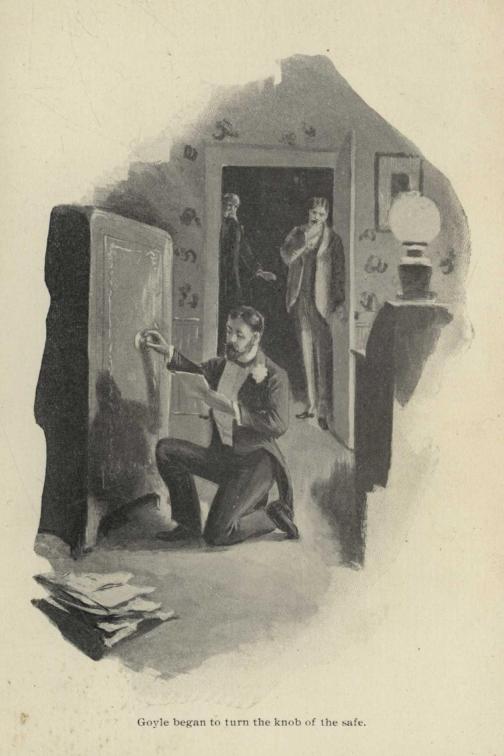
Goyle began to turn the knob of the safe.
CHAPTER III.
THE NIGHT CAME BACK WITH A RUSH.
Bodney led the Judge to his room on the second floor, where he left him almost in a state of collapse. He spoke of calling Mrs. Elbridge, but the old man shook his head, which Bodney knew he would do, and in a broken voice said that he wanted to be left alone. At the time when the Judge left the drawing room with Bodney, Bradley was bidding the family good-night, but lingered a moment longer to join the company in a laugh at William, who, having settled his date to his own satisfaction, had forgotten the point of the story.
Bodney's room was on the first floor, off the passage, and, going thither, he found Goyle sitting on the side of the bed, not as Howard, but as himself. The scoundrel declared that it had worked like a charm, but that the clang of the gong had prevented his getting any money. That, however, was a minor consideration. He needed money, it was true; he had not expected much, but even a little would have helped him greatly. A lower order of mind might have brooded over the disappointment, but his mind was exultant over the success of his art. He argued that if his impersonation of a son could deceive a father, he might bring forth a Hamlet to charm an audience.
"How is he?" Goyle asked, as Bodney stepped into the room.
"Don't talk to me, now," said Bodney, sitting down. He took up a newspaper and fanned himself. "For a time I wished that I had killed you."
"Yes? And now?"
"I wish that you had killed me. Tell me, are you a human being? I don't believe you are. I don't believe that any human being could have the influence over me that you have had—that you still have, you scoundrel. I wish I could stab you."
"Can't you?"
"No. My arm would fall, paralyzed. I used to scout the idea of a personal devil, but I believe in one now. He is sitting on my bed. He has compelled me to do something—"
"It worked like a charm, George; and now, old fellow, don't hold a grudge against me. I have taught you more than you ever learned before; I have shown you that a man can do almost anything—that men are but children to be deluded by trickery. There, for instance, is a judge, a man who was set up to pass upon the actions of men. What did I do? Convinced him that his own son is a robber. Was that right? Perhaps. Why should such a man have been a judge? What wrongs may not his shortsightedness have caused him to commit? We can't tell. He may have committed a thousand unconscious crimes. But an unconscious crime may be just as bad as a conscious one. He has been sitting above other men. Now let him suffer; it is due him. And his son! What does he care for you or me? He reads, and thinks that he is wise. He has stuffed himself with the echo of feeble minds; and now let him wallow in his wisdom. Look at me. Are you sorry for what we have done? Look at me."
Bodney made an effort to get up, but his strength seemed to fail him, and he remained as he was, gazing at Goyle. "George," Goyle continued, his eyes glittering, "I was the hope of a father, a better man than Judge Elbridge. But he was ruined by honest men and died of a broken heart. That was all right; it was a part of life's infamous plan. Everything is all right—-a part of the plan. My friends called me a genius; they believed that I was to astonish the world, and I believed it. I bent myself to study, but one day the bubble burst and I felt then that nothing amounted to anything—that all was a fraud. The world is the enemy of every man. Every man is the natural enemy of every other man. Evil has always triumphed and always will. The churches meet to reform their creeds. After a while they must revise out God—another bubble, constantly bursting. Then, why should there be a conscience? That's the point I want to make. Why should you and I suffer on account of anything we have done? Everything you see will soon pass away. Nothing is the only thing eternal. Then, let us make the most of our opportunities for animal enjoyment. The animal is the only substance. Intellectuality is a shadow. Are you sorry for what I have done?"
He fixed his glittering eyes upon Bodney, and, gazing at him, Bodney answered: "No, I am not. It was marked out for us, and I don't suppose we could help it; but somehow—somehow, I wish that I had killed you."
"What for? to cut off a few days of animalism—to make of me an eternal nothing? That wouldn't have done any good."
"It would have prevented the misery—"
Goyle stopped him with a snap of his fingers. "For how long? For a minute. It will all pass away. Be cheerful, now. We haven't any money as a reward of our enterprise and art, but we have let the life blood out of all suspicion attaching to us. Let us go to bed."
"You go to bed. I will lie on the floor."
"No use to put yourself out, George. I'll lie on the floor."
"No," said Bodney, and Goyle let him have his way. The hours passed, Bodney lying in a restless stupor, but Goyle slept. Sunlight poured into the room and Bodney got up. He went to the window and stood to cool his face in the fresh air. He looked back at the bed. Goyle was still sleeping, breathing gently. The horror of the night came in a rush. And there was the cause of it, sleeping in peace. Bodney snatched open a drawer and seized a razor. Goyle turned over, with his face toward the window.
"Ah, up? What time is it, George?"
Bodney dropped the razor and sat down. "It is time to get up," he said. Goyle got out of bed and began to exercise himself by striking out with his fists. He had passed, he said, a night of delicious rest, with not a dream to disturb him. He whistled merrily as he dressed himself. Bodney stood with his elbow resting on the marble top of the "bureau," his face yellow and haggard. Glancing down into the half closed drawer, he saw the razor and shuddered at the sight of it. With his left hand he felt of his right arm, gripping it from shoulder down to wrist as if in some strange manner it had been deprived of strength. Goyle moved toward him and he pushed against the drawer to close it, but the keen eye of the "artist" fell upon the open razor, and glittered like the eye of a snake. But he showed no sign of fear or even of resentment.
"I will stay to breakfast with you," he said, putting his hand on Bodney's shoulder.
"I wish you wouldn't," Bodney feebly replied.
"Oh, no you don't. Come, brace up now. My part of the work is done, but yours is just beginning. I have saved you from suspicion, but you must keep yourself saved. That's right, brighten up. Now you are beginning to look like yourself. Why, nothing so very bad has been done. We have enacted a little drama, that's all. Such things, or things on a par with them, are enacted every day. The newspapers are full of stranger things. We haven't hired a 'castle' and entered upon a career of wholesale murder; we haven't cut up a woman and made her into sausage."
The voice of William was heard in the passage, scolding a housemaid for disturbing his papers. The old man tapped on the door and Goyle opened it.
"Ah, you here?" said the old man, stepping into the room. "You'd better go in to breakfast. Well, sir, I never saw anything like it in my life. I can't put a thing down and find it where I left it. George, what's the matter with you this morning?"
"Nothing at all, sir. I had a headache and didn't sleep very well. That's all. Is the Judge up yet?"
"I believe not. And when he does get up I want to have a talk with him. I'll be hanged if he didn't get that preacher to laughing at me last night—laughing at me right here in my own house. I can stand a good deal, but when a preacher laughs at me, why things have gone too far."
Goyle smiled upon him. "But, Mr. Elbridge, a preacher means quite as little when he laughs as when he talks."
This pleased the old man, and he chuckled, his fat sides shaking. Bodney smiled, too, and Goyle gave him a look of approval and it appeared to brighten him. He dressed himself hastily, turning occasionally to heed a remark made by Goyle or the old man, and when he stepped out of the room to go with them to breakfast, his face was not so yellow, nor his countenance so haggard.
CHAPTER IV.
STOOD LOOKING AT THEM.
About two hours later Florence was sitting alone in the drawing room when Howard entered. She asked him if he had seen his father that morning. He sat down on a sofa beside her and said, after a moment's reflection:
"Yes, I have seen him? Why did you ask?"
She seemed worried and did not immediately answer him. He repeated his question. "Because he spoke of you at breakfast," she said. "He didn't appear at all well—sat staring about, and—"
"That explains it," said Howard.
"Explains what?" she asked.
"His treatment of me."
"Treatment of you? Has anything gone wrong?"
"Yes, in the office, just now. When I went in he jumped up from his desk, threw down a hand full of papers, and stared at me—muttered, seemed to struggle with himself, sat down, and asked me to leave him alone. He never acted that way toward me before. I'm afraid he's ill. Why, he's the most jovial man in the world, and—I'm worried. I don't understand it. If he's sick, why didn't he say so?"
"I don't know, but don't let it worry you, dear," she said.
"But it does, Florence, to be turned upon in that way. What did he say about me at the table this morning? He surely wasn't angry because I didn't get up in time for breakfast."
"Surely not. He didn't say anything, only asked where you were, and kept staring at the place where you sit."
"And is that the reason you asked me if I had seen him?"
"Yes, that and the fact that he didn't appear to be well."
"I don't understand it. Why, he has joked with me all my life, sick or well. It hurts me." And, after a slight pause, he added: "I wonder if he turned on George, too."
"It wouldn't seem so, for as he was going out of the breakfast room he put his hand on brother's shoulder and leaned on him."
Bodney came in at that moment, and, looking about, asked if they had seen Goyle. As he was going out, Howard called him.
"Oh, George, just a moment. Have you noticed anything strange about father this morning?"
And Bodney was master of himself when he answered: "Nothing much. Only he didn't seem to be as well as usual. It will pass off. I wonder where that fellow is?" He strode out, and they heard him talking to Goyle in the hall.
"Put his hand on George's shoulder and leaned on him," Howard mused, aloud. "Then he is not well. George knows it and doesn't want to distress me by telling me. Did he sit up late?"
"No. Mr. Bradley had to go early, and just as he was taking his leave brother stepped in and asked your father to help him with an important matter—some abstract of title, or something of the sort, and they went out and he didn't come back. I don't want to distress you, but your mother said that he walked the floor nearly all night."
"Did she? And George knows more than he is willing to tell. But why do they try to shield me? It would be all right to shield mother if anything were wrong, but if there's a burden, I ought to help bear it."
She besought him not to be worried, assuring him that nothing had gone very far wrong and that everything would come right. The clearness and the strength of her mind, her individuality, her strength of character, always had a quick influence upon him, and he threw off the heavier part of his worry and they talked of other matters, of the reception which he had attended the night before. He repeated a part of a stupid address delivered by a prominent man, and they laughed at it, he declaring that nearly all men, no matter how prominent or bright, were usually dull at a reception. And, after a time, she asked: "What sort of a man is Mr. Goyle?"
"Oh, he's all right, I suppose; smart, full of odd conceits. I don't know him very well. He comes into the down-town office quite frequently, but he rarely has much to say to me. George seems to be devoted to him."
Florence shook her head, deploring the intimacy. "I don't like him," she said. "And Agnes says she hates him. She snaps him up every time he speaks to her." She looked at Howard, and saw that his worry was returning upon him. She put the hair back from his forehead, affection's most instinctive by-play, and said that he must not be downcast at a mere nothing, a passing whim on the part of his father. "And it was only a whim," she added.
"But whims make an atmosphere," he replied.
"Not ours, Howard—not yours, not mine. Love makes our atmosphere."
"Yes," he said, putting his arm about her, "our breath of life. Florence, last night you were depressed, and now I am heavy." Their heads, bent forward, touched each other. "And your love is dearer to me now than ever before." Their faces were turned from the hall door. The Judge silently entered, and, seeing them, started toward them, making motions with his hands as if he would tear them apart. But Howard, after a brief pause, spoke again, and the old man halted, gazing at them. "Florence, you asked me, last night, if anything could separate us, and now I ask you that same question. Could anything part us?"
"No," she said, "not man, not woman, nothing but God, and he has bound us together."
"With silken cords woven in the loom of eternity," he replied; and the Judge wheeled about, and, with a sob, was gone, unseen.
"What was that?" Florence asked, looking round. "It sounded like a sob."
"We were not listening for sobs and should not have heard them," he replied. "It wasn't anything."
William came in, clearing his throat. "Don't let me disturb you," he said, as they got up. "I don't belong to the plot at all." He began to look about. "I left my pipe somewhere."
"I don't think it's here, Uncle William," said Howard. "You surely wouldn't leave it here; and, besides, I don't hear it."
There came a sort of explosion, and upon it was borne the words, "What's that? You don't hear it? You don't? Now what have I ever done to you to deserve such an insult? Ha! What have I done?"
"Why, nothing at all, Uncle William."
"Then why do you want to insult me? Haven't I been your slave ever since I came here? Haven't I passed sleepless nights devising things for your good? You can't deny it, and yet, at the first opportunity, you turn upon me with an insult."
"Why, Uncle Billy," said Florence, "he wouldn't insult you. He was only joking."
Howard assured him that he meant no insult, whereupon the old man said: "All right, but I know a joke as well as anybody. I have joked with some of the best of 'em in my time, I'll tell you that. But it's no joke when you come talking about not hearing a man's pipe. It's a reflection on his cleanliness—it means that his pipe is stronger than a gentleman's pipe ought to be. But I want to tell you, sir, that it isn't. It's as sweet as a pie."
Howard said that he knew the import of such an accusation. "But," he added, "I was in hopes that it was strong, not to cast any reflection, you understand, but to show my appreciation of what you have done for me. I was going to give you that meerschaum of mine."
The old man's under jaw dropped. "Hah? Well, now, I do believe that it has got to be just a little nippy; just a little, you understand."
"I wish it were stronger than that, Uncle Billy."
"You do? Howard, you have always been a good friend to me; our relations have been most cordial and confidential, and I don't mind telling you—to go no further, mind you—that my old pipe is as strong as—as a red fox. Yes, sir, it's a positive fact. Er—where is your pipe?"
"In my room. You may go and get it as soon as you like."
"All right, and I'm a thousand times obliged to you. Florence, did that preacher go away so suddenly last night because I settled the fact that it was on the tenth?"
"Oh, no, he left because he had an engagement."
"Well," drawled the old man, "I don't know about that. Why, confound him, I've got a right to settle it as my memory dictates. Does he think that I'm going to warp my recollection just for him?"
"What was it all about, Uncle Billy?" Howard asked.
"About a story I was going to tell."
"Did you tell it?"
"Did I tell it! Well, after a fashion; after they had badgered me. Then I made a mess of it. How do you expect me to tell a story when—look here, ain't you trying to put it on me? Hah, ain't you?"
"I don't know what you mean, Uncle William."
"Oh, you don't. The whole kit of you are devilish dull all at once."
"You surely don't include me," said Florence.
"No, not you, Florence, but all the men about the house. Why, I went up to John, just a while ago, and I'll be hanged if he didn't snap at me like a turtle—told me to get out of his office. Shall I tell you what he said? He said that last night he went to hell and was still there. There's something wrong with him, as sure as you live."
Howard turned away and began to walk up and down the room. "There it is again," said he. "I no sooner convince myself that it might have been a mere whim when something comes up to assure me that it is something worse. And the look he gave me, Florence. It hurts me." He walked toward the door. Florence asked him if he were going to his father. He turned and stood for a moment in silence. "No, I am going down town. I don't feel right. I am hurt. But don't say anything to him, please. I am going to wait and see what comes of it. And please don't say anything to mother." He took his leave, and Florence went to the window and looked after him as he passed down the street. She spoke to William. "I wonder what the trouble is," she said.
"I don't know," William replied, ruffling his brow, "but as for that preacher—the first thing he knows, I won't let him come here. John has insisted on his dropping in at any time, because he used to know his father, but I'll attend to that. Why does a great, strong fellow as he is want to throw away his time? Why doesn't he get to work?" He sat down and, looking toward the piano, asked Florence to play something. "I'd like a tune quick and high-stepping," he said. She told him that she was in no humor. "In that event," he insisted, "you might play the Maiden's Prayer."
"Not now, Uncle William. Here's Agnes. She'll play for you."
"No, I won't," said Agnes, coming into the room. Florence expected the old fellow to snort his displeasure at so flat a refusal, but he did not. He bowed to her and said: "Now, that's the way to talk. I like to have a woman come right out and say what she means. Well," he added, getting up, "I am not in your plot, anyway, so I'll bid you good morning."
As soon as William was gone, Agnes went to the piano, seated herself on the stool and began to ripple on the keys. "There are times when we feel like dabbling in water but don't want to swim," she said.
"And you are dabbling now," Florence spoke up.
"Only dabbling. Oh, I forgot; your dressmaker is out there, and I came in to tell you."
"I'm glad you didn't forget it entirely. Oh, and I must tell you something. Brother says that Mr. Goyle is smitten with you."
Agnes, still rippling, turned half way round, sniffed and turned back. "I hate him so hard that it's almost second cousin to love," she declared.
"Don't let it be any closer kin, Agnes. There is always danger in a first cousin."
Agnes, still rippling, sniffed contemptuously. "He's been following me around all the morning. How I love to hate him."
The voice of Mrs. Elbridge was heard, calling Florence, who answered that she was coming, but she halted long enough to say to Agnes, mischievously, that she might learn to love him if she loved to hate him. Both love and hate were kindred passions, with but a thin partition between them. As she was going out, Agnes shouted after her that, if she ever loved him she would hate herself, and then, just as Goyle and Bodney entered the room, she added: "We tar and feather such fellows in Quincy."
"You do what in Quincy?" Bodney asked.
And Agnes, without looking round, repeated: "Tar and feather such fellows."
Goyle knew that she meant him, but instead of kindling resentment, her words aroused in him an additional interest in her. He looked at her as in the rhythmic sway of her graceful form, the nodding of her shapely head, she kept time with a tune, half remembered, half improvised; and, turning to Bodney, he asked in tones too low for the girl to hear: "Has she got any money?"
"I think she has."
"Leave me alone with her."
"Do you want to snatch her purse?"
"Do you suppose I want a hair pin, a pearl button, a scrap of verse, and a three-cornered piece of silk that no man can match? I mean, has she got any money in her own name?"
"I haven't asked her, but I think she has."
"Then leave me alone with her."
Bodney stood looking at him. There was a continuous fascination in the fellow's affrontery. "All right," he said, but quickly added: "We've got to go down town, you know. I'll step into the office and wait till she gets through with you. You may hypnotize me, but—"
Goyle cut him off with a gesture. "Nonsense! When she gets through with me! Cool, coming from a man whose honor I have saved at the risk of my own. But no cooler than the bullet you threatened me with."
"I wish I had given it to you," said Bodney.
"Do you? It's not too late, if you are bent on murder. But that's all right," he broke off, with a wave of the hand. "Leave me alone with her."
Bodney went out and Goyle sat down on a sofa, gazed at the girl, cleared his throat, coughed; but she did not look round. "What are you playing? May I ask?"
"You have asked," she replied, without looking round.
"But you haven't told me."
She left off playing, and slowly turned on the stool to face him. "A tune they played in Quincy one night, when they tarred and feathered a man," she said. And then, with a smile of sweet innocence, she added: "You were never in Quincy, were you?"
"Well, I was never tarred and feathered there."
"Possibly an acknowledgment that you were never in the town. Oh, somebody told me that you were once connected with opera."
"Then somebody flattered me. I couldn't sing in a chorus of scissors grinders."
"A sort of Chinese opera, I inferred," she said.
"Well, that's about the only sort I could sing in. Chinese opera, eh?"
"Yes, that's what I inferred. It was something about Sing-Sing. Isn't that Chinese?"
"Oh, it sounds like a joke," said he.
"And it wasn't?" she asked, in surprise. "Then it was serious opera instead of comic. They call serious opera grand, I believe. And is that the reason they call larceny grand—because it is serious?"
For a time he sat in a deep study of her. How different from the nervous and impressionable weakling who had just left the room; and in looking at her he felt that his eyes refused to glitter with a snake-like charm; they were dull and flat, and he drew his hand across them. "Do you know that I like you?" he said.
"Then I do not bring up an unpleasant recollection."
"No, a beautiful vision." And now he had more confidence in his eyes, for he got up and moved toward her. She slipped off the stool and stood looking at him.
"Won't you play something for me?" he asked.
"I don't want to play. I don't feel like it."
"Let your fingers dream over the keys."
"My hands aren't asleep." She moved off from him.
"You aren't afraid of me, are you?".
She looked him in the eye. "My grandmother killed a panther," she said.
He drew his hand across his eyes; he recalled what Bodney had said—about her getting through with him. In the dictionary of slang there is a word to fit him: the resources of his "gall" were boundless. "Why don't you like me?" he asked. "Am I ugly in your sight? Do I look like a villain?"
"If you looked more like a villain you'd be less dangerous."
"That's cruel. We may not see each other again. Won't you shake hands with me?"
"What is the use of shaking hands with a stranger we are never to see again," she said.
"But if we shake hands," he persisted, "we may not be strangers."
"No? Then, we'll not shake."
William strolled through the room, halting just long enough to assure them that he was not trying to break into the plot. "He's a queer duck," said Goyle.
"I wish there were more of his feather," she replied. "He can pass through without stopping."
"And so could I but for you," he rejoined.
She snapped her eyes at him. "What nerve tonic do you take?"
"Nature's. She gives me a tonic whenever I look at you."
She laughed at this, and she said: "I am woman enough to like that sort of talk, but I don't like you."
"You like my talk, but don't like me. Why this discrepancy? Why don't you like me?"
"Oh, I don't know. You give me the creeps."
"You are very frank."
"Oh, the creeps would make anybody frank."
Bodney appeared at the door and cleared his throat to attract attention, and he was bold enough to ask her if she had got through with him. "Long ago," she answered. "And now you may have him."
Goyle bowed to her. "Mr. Bodney and I may go out of town for a day or two—or, at least, I may. Will you permit me to hope to see you upon my return?"
"Oh, certainly," she said, and he felt that at last he was making some sort of progress. "I thank you," he replied.
But there was something more to follow. "You can hope that you may, and I will hope that you may not," she said.
Goyle bowed, and looked at her, admiringly. "Miss Needle-tongue," he said. "But you catch me."
Bodney told him to come on, but he lingered a moment longer. "May I tell you good-bye?" he said, and she replied that she hoped so. As the two men were going out the Judge came in. Goyle glanced at him, but Bodney averted his eyes. The old man's face smote him with reproach.
CHAPTER V.
SHE SAID THAT SHE WAS STRONG.
Agnes, accustomed to joke with the Judge, now looked at him in astonishment; his face was haggard and his eyes appeared hot with suffering. But he had not forgotten his dignified courtesy. He bowed to her, bade her good morning, as if he had not seen her earlier in the day, said that he was looking for Florence, and asked if she would please find her, that he desired to see her—alone. Agnes went out at once to find Florence, wondering what could have happened to throw so serious a cast upon the countenance of the Judge; and, left alone, the old man walked slowly up and down the room, talking to himself. "I don't know how to tell her, but she must know of it. It is my duty to tell her." He paused, looked toward the door, and continued: "I am striving to master my heart by smothering it; I must be the master of a dead heart." He paused again and resumed his walk. "Yesterday the world was a laugh, but today it is a groan. I wonder if he saw me. No, and toward him I must bear the burden of silence. A mother's heart would see the accusation in his face, and I must protect her. To keep her shielded is now my only duty in life. That decadent book! It was a seed of degeneracy. Ah, come in," he said, as Florence appeared at the door. Howard had called her eyes the searchlights of sympathy; and she turned those lights upon the old man's face as she came into the room, slowly approaching him.
"Did you send for me—father?"
"Father," he repeated with a catch in his breath that sounded like a sob. "My dear, it comes sweet from your lips, but it falls upon me with reproach." He stood with bowed head, and Florence put her hand on his arm.
"What is the matter, father? Why, you need a doctor. Let me call—"
"No!" came from him like a cry of pain, as he stepped back from her. "You must call no one. Wait a moment. Oh, I've got iron in me—but it is cold, Florence—cold. Wait a moment. Wait."
She stood looking at him, wondering, striving to catch some possible forecast of what might follow, but in his face there was no light save the dull hue of agony. Gradually he became calmer, and then he said: "I am going to tell you something; it is my duty."
"Yes, sir, I am listening."
"But are you strong enough to hear what I have to say?"
"Does it take strength to hear?"
"In your case—yes."
"Then I am strong." She moved closer and stood resolutely before him, looking into his eyes.
"Florence, I know your character; I know that your word is too sacred to break, but this is—is an unparalleled case, and you must be put under oath."
"Judge, instead of administering an oath, you ought to take medicine. Why, I never saw you this way before."
She was about to turn away from him, but he took her by the arm. "Look at me. You never saw me this way before. No. In all my experience I have never heard of a man being so situated. I am a novelty of distress. And you must know what my ailment is, but you must take an oath, a sacred oath, not to speak of it to any human being."
"But if it is so awful, why should I know it? Tell it to a physician."
"It is my duty to tell it to one human being, and you are the one."
"Then I will take the oath."
"Hold up your right hand." She obeyed him. "You swear never to repeat what I tell you."
"Yes, I swear."
"By the memory of your mother?"
"Yes, by the memory of my mother."
"And you hope that the Eternal God may frown upon you if you do not keep your oath?"
"Judge, this is awful."
"Are you going to back out now? Are you afraid?"
"I am not afraid. I hope that the Eternal God may frown upon me if I do not keep my oath."
He took her hand, the hand held high, and said to her, "You will keep your oath. It was disagreeable to take it, but the measure was necessary. And now comes the agonizing part of my duty—and I wish I had died before being compelled to discharge it. Florence, you know that I love you."
"Yes, sir, I know it—could never have doubted it. But why do you speak of it? What has it to do with—"
"Wait. This shall be explained. You must not marry my son."
She stepped back from him and from her clear eyes, always so sympathetic, there came a flash of anger. "You are mad, Judge," she said.
"I grant it. He drove me mad—he sent me to hell."
"And you would drag me there."
"I would save you. It is a duty I owe to the memory of your father and to my own love for you. Yes, it is my duty."
"And it is my duty," she said, with now the light of sympathy in her eyes, "to send for a doctor."
"Wait. You have not heard. Remember you have sworn."
"Yes, and I will keep my oath. No, I have not heard. You have told me nothing. You have simply been mad enough to say that we must not marry." The sympathy had gone from her eyes. "You must know that Howard and I have all our lives lived for each other. I owe you nearly everything, I would make almost any sacrifice for you, but when you even intimate—but I will not reproach you," she said, softening again. "You have not told me why," she added, looking into his eyes.
"My child, it would break your heart."
She straightened and put her hand upon her bosom. "I offer my heart. Break it."
"Florence, my son Howard is a thief."
She snatched her hand from her bosom and raised it as if to strike him, but one look of agony from his eyes, and her hand fell. "Judge, how can you say such a thing? Something has tripped your mind, but how could it fall so low?"
"My mind has not been tripped. It is as firm as a rock. And you cannot doubt my word. Last night I saw him stealing money from the safe, as if I had not always supplied all his wants, and at an alarm which I had fixed, little dreaming who the thief might be, he ran away—a thief. You cannot doubt my word."
Stern of countenance and with her eyes piercing him, regal as the barbaric queens we find in ancient fiction, she stood, and the moment of her silence seemed an age to him. "I pity your word and I doubt your eyes."
"You may pretend to, but you cannot in your heart. You must believe me when I say that I saw him."
"You saw a vision. Your eyes have lied to you."
"I saw no vision. My eyes told a heart-breaking truth. Florence, would you marry a thief?"
"Sir, I would marry Howard if I knew that he had stolen a hammer to nail a god to the cross."
The old man wheeled away from her with a cry. "Oh, crumbled hope—"
Mrs. Elbridge swept into the room, gazing at the Judge. "Why, what is the matter?"
The old man gripped himself together. "Why, I—I have just received a dispatch, telling me—telling me that my brother Henry is dead. Don't tell William—brother Henry is dead."
Mrs. Elbridge went to him and put her arm about him. "And you loved him so," she said. "Poor, dear man, but we must bow to it, and pray for consolation. Don't—don't grieve so, dear. Where is the message?"
The old man looked at Florence. "It distressed him so that I tore it to pieces and threw it away," she said.
The Judge gave her a grateful look. "I thank you," he muttered.
CHAPTER VI.
THE WEXTON CLUB.
When Goyle and Bodney left the house they went to a place known as the Wexton Club. This institution was not incorporated under the laws of the state, but its affairs were conducted under a law, the law that governs the game of poker. The public dinner pail gaming house, the pickpocket of the laborer, had been closed; the grave-countenanced faro dealer and the sad-eyed man who turned the roulette wheel; the hoarse-voiced "hazard" operator, and the nimble and enterprising thief of the "stud poker" game, now thrown out of visible employment, stood at the mouth of the alley waiting for "good times" to return. "Bucket-shops" broke out in new places, once in a while, and there was the occasional raid of a poolroom, but it was agreed that public gambling was a thing of the rough and disgraceful past. But the poker clubs! They were not traps set for the man in overalls. His pennies and dimes were not solicited. Of course, if he saved up capital to the amount of five dollars, and came with a reasonable appearance of respectability, he could get into the game, but he was not wanted. The board of trade men, the race horse man, the merchant, doctor, lawyer, and particularly the fool with money, furnished the life blood of the enterprise. Shrewd gamblers risked their money and pronounced the game "straight." And it was "straight." The "house" could not afford to permit any "crooked" work. Its success, the "rake off," depended upon its own fairness to everyone playing in the game. But the "sucker" does not need to be cheated to lose. His own impulses will sooner or later rob him of all the money he can borrow, beg or steal. The man who plays for recreation wants it, not after a long season of waiting for a good hand, but at once; and putting in his money he draws to "short" pairs or to every four straight or four flush. He may have an encouraging spurt; he may make a hardened player wince and swear under his breath or even above it, but in the end, and it comes on apace, he shoves it back, broke, and the old-timer rakes in the money. Within recent years several fine young fellows of good standing and of bright prospects have looked for diversion in poker and have found state's prison. The road to the penitentiary is paved with four flushes.
At the Wexton, Goyle had introduced Bodney as his friend, Mr. Ramage, and out of that familiarity which comes of constantly gazing into a man's countenance, in the effort to determine what he holds in his hand, they shortened his name to Ram. The young lawyer had played with friends, and had won, not because his friends were kind to him, but because they were as experimental in drawing cards as himself, and because they were possessed of equally as much curiosity. The "gentleman's game" is a trap door, and it is easy enough to fall from "Billy" and "George" and "Tom," down into a hell on earth. This is not a tirade against gambling, for the horrors of that vice have engaged the ablest of pens, but to give life in poker clubs as it really exists, the attractive with the distressful. Indeed, the distress is not seen in the club. The victim gets up with a jocular remark, and silently goes out, wishing that he were dead, and resolving deep within his disconsolate heart that he will never enter the place again. Then his heart lightens. He is saved. He has lost money that he could not afford to lose, the very bread of his family; but he will do so no more. He has strength of purpose, an object in life, a position to maintain. He is now grateful to himself for his own strength of will. The next morning he goes dull and heavy to his business. He shudders as he enumerates the amount of money that he has lost within the past few weeks; counts it all up, and then, with a sickening pang, recurs a forgotten sum, borrowed from a friend and not yet returned, though he had promised to "hand" it back the next day. The details of his business are wearisome. At noon he goes out. At the "Club" they serve a meal, better than he can get at a restaurant. He will go there, but not to play. He plays, to get even—will try it once more; and at evening he sends a message to his wife—"detained on important business." He has several checks, and one by one they melt away in the pot. He is broke. He wants more chips. He has money in the bank, he declares; but the man at the desk is sorry to inform him that it is a rule of the "house" not to take personal checks. He is angry, of course. He wants to know why a check which he offered earlier in the evening was accepted, and is told that the other check was different, that it was signed by a name better known than his. Then he tries to borrow from the men who have won his money; he knows them well, for he has played with them day after day. They have laughed at his jokes, when with the fool's luck he has drawn to "short" pairs and won. They have no money to lend—would really like to accommodate him, but have obligations to meet. And so he goes heavily down the stairs again, with murder in his heart. But his heart lightens after a time. He will never, so help him God, play again. But he does. Ah, it is less bad to be bitten by a mad dog.
Goyle was but an indifferent player. He well knew the value of a hand, but was too impatient to wait. But no despair fell upon him when he lost. He did not look forward to a time when circumstances or the force of his own resolution might set him beyond the temptations of the game, but to the time when luck might give him enough money to put him in the game. Bodney, however, was bound soul and body. He could hardly think of anything else. Dozing to sleep he saw aces and kings; asleep, he drew to flushes and straights. In his sleep he might win, but only in his sleep. His soul seemed to have been created for this one debasing passion. It was his first, for though impressionable, no enthusiasm had ever mastered him, and love had never set his heart aflame. But now he was an embodiment of raging poker, not for gain, but for the thrill, the drunkenness of playing. His bank account, never large, was gone. For himself and for Goyle he had taken small sums of money from the Judge's safe, and had lived in the terror of being confronted with the theft. And he actually believed that had the old man accused him or even strongly suspected him he would have killed himself. Suspicion was now averted, but at the cost of what infamy! He could face Howard; he could endure with a show of self-control the agonized countenance of the old man; but remorse gnawed him like a rat. It was not to be supposed that Florence would be enlightened as to the coolness which, of necessity, must fall between Howard and the Judge, but it could not be otherwise than a grief to her. He could look forward and see the wonder in her eyes, and then the sorrow that must come to her. It is one of the misfortunes of a weak man to have a strong conscience, a conscience with not enough of forecast to prevent a crime, but one which agonizes when a crime has been committed. His only solace was to play. Then his mind was chained to the game, the dealing of the cards, the scanning of his hand, to the thrill of winning, the dull oppression of losing. Upon entering the club he had been surprised to see so many old and venerable looking men sitting about the tables. One had been a prominent lawyer; another, a doctor, had turned from a fine practice to waste his substance and the remainder of his days. There was good humor, an occasional story of brightness and color, but upon the whole the place was sad, everyone seeming to recognize that he was a hopeless slave. The scholar turned poker-player, thinks and talks poker. He forgets his grammar, and puts everything in the present tense. "How did you come out last night?" someone asks, and he answers, "I lose." Many of those men would not have gone to a "regular" gaming house; they would not have played faro or roulette, but the blight of poker fell upon them, to weaken them morally, to make them liars. Sometimes an old fellow, getting up broke, would turn moralist. One said to Bodney: "The chips you see on the table don't belong to anyone. You may go so far as to cash them and put the money into your pocket, but it isn't yours. You may spend it, but you will borrow or steal to make it good to the game." Among those daily associates engaged in the enterprise of "wolfing" one another there was a fine shade of courtesy. No one can be politer or more genial than a winner, and a loser is expected to shove over the pot which he has just lost, in case the winner cannot reach it. In return for this the loser is permitted to swear at his victor, but etiquette demands that it shall be done in a mumble, as if he were talking to himself. The winner can stand a great deal of abuse. In the game there were usually two or more players put in by the "house," cool fellows, educated to know the value of a hand or the advantage of a position. They were the "regulars," the others the militia. The dash and the fire of the militiaman sometimes overrode the regular, but there was no question as to the ultimate result. The regular knew when to put down a bad hand; he could be "bluffed" by the militiaman. But he could afford to wait; he was paid to sit there; it was his business. Bodney, however, could not wait. With him, impulsive hope was leaping from deal to deal, from card to card, from spot to spot.
When Goyle and Bodney arrived the members of this family of interchangeable robbery were ranged at a long table in the dining room, eating in hurried silence or talking about the game. Occasionally someone would venture an opinion of a race horse or a prize fighter, but for the most part the meal was solemn and dull. Laughter was not unknown, but it was short, like a bark. This does not mean that there was a want of fellowship in the club, but eating was looked upon as a necessary interruption.
"You are just in time," said the proprietor of the house, not a bad fellow, a business man, accommodating as far as he could be, yielding sometimes to the almost tearful importunity of a fool to the extent of lending him money never to be returned. "Sit down. Fine weather we're having."
"A champagne day," said Goyle, sitting down and spreading a napkin across his knees. "How's the game going?"
"Oh, fairly well. We've got a good run of customers. They know that they are perfectly safe here."
"What's become of that fellow they called Shad?" asked a man at the end of the table.
"Oh, that fellow from Kansas City? He's gone. I didn't want him. I think he'd snatch a card."
Bodney was silent. He could hear the rat gnawing at his conscience, and he yearned for the moral oblivion of the game. Leaving Goyle at the table, he arose, and walked up and down, then went into the room where the game was forming. He had but fifteen dollars, but with this amount he felt that he could win. He bought ten dollars worth of chips, musing upon the fact that he had a reserve fund of five dollars. The game was all jackpots, twenty-five cent ante, and three dollar limit, except when the pot was doubled, and then the limit was five dollars. While a man at his side was shuffling a deck of new cards, Bodney began to meditate upon the policy which he intended to pursue. He would not draw to a flush or straight except when there were several "stayers," for then the percentage would warrant the risk. He would not draw to a pair below kings, nor open on jacks next to the dealer. If the pot were opened and came around to him, even without a raise, he would not stay on a pair of queens. If he opened on one pair and was raised, he would lie down. He would not stand a raise under kings up. Goyle came in, bought twenty dollars worth of chips, and took a seat on the opposite side of the table; and the game proceeded, with seven players. Bodney opened on a pair of kings. All passed around to Goyle. He looked at his hand a moment, and said: "Only one in? Well, I've got to stay. Give me that one," he said to the dealer, meaning that he wanted one card. "Got two little pairs here, and I won't raise you unless I help." Bodney drew three cards and did not help his kings. He bet a white chip. "Now I'll go down and look," said Goyle. "Bet you three dollars," he added. Bodney was smoking. He puffed at his cigar. "I don't know about that," he said. "What do you want to raise me for?"
"Got to play my hand, haven't I?" Goyle replied.
Bodney put his cigar on the table and thought. "Well, you've got 'em or you haven't. I'll call you." He threw in three blue chips, and Goyle spread a flush. "Thought you said you had two little pairs," said Bodney, as Goyle raked in the pot.
"I hadn't looked at my hand very close."
"You knew what you had all the time. Stayed on a four flush with only one man in. Of course you can always make it against me."
The deal went round and round, and occasionally Bodney won a pot, once a large one, and now as he stacked up his chips he felt at peace with the world. He laughed and joked with a man whom he had never met before; he did not see how he could lose. He threw off the rigor of his resolution, and drew to a pair of sixes, caught the third, raised the opener three dollars, and won the pot against aces up. Then his senses floated in a limpid pool of delight. Goyle opened a pot. Bodney raised him, having kings up. "I've got to stay," said Goyle. "Give me one card." Bodney drew one and made a king full. His heart leaped with joy. "What do you do?" he asked.