Front matter (continued 3)
Reading edition
"Am I ever to know, sir?"
The old man pointed toward the door, and Howard walked slowly out. His mother stood in the hall. Her eyes were tearful, and taking his arm she held it as if she would say something, but liberated him, motioned him away, and went into the office. The Judge got up, forcing a change upon his countenance, smiled at her, took her hand and led her to a chair. "Now, don't be worried," said he. "I merely reprimanded Howard, as I had a right to do, for sending an old fool, who calls himself a doctor, out here to see me. That's all."
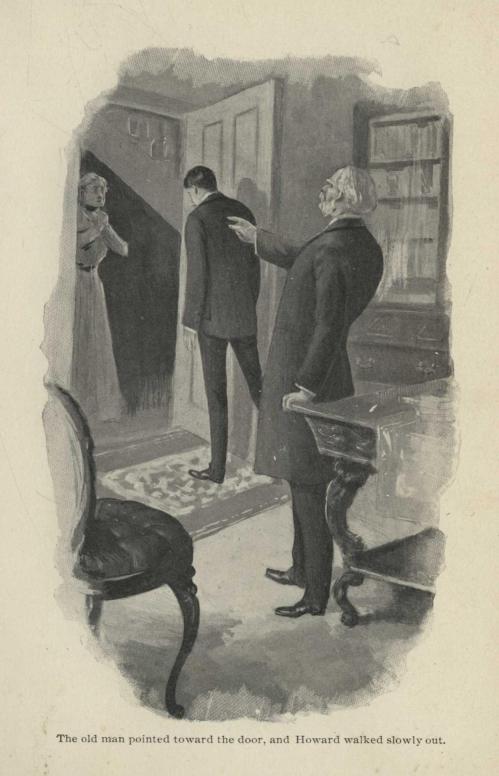
The old man pointed toward the door, and Howard walked slowly out.
"But what did you mean by calling him an actor? What has he done that he should be acting now?"
"Nothing—nothing at all, I assure you."
"You said he was acting," she persisted.
"Perhaps I did, but I didn't mean it. Oh, yes, acting as if he didn't care for the memories of the old office."
"But, dear, something has come between you and Howard. What is it?"
"Between us, my dear? Surely not. We don't agree on all points; he has his opinions and I have mine; but there is no serious difference between us. Come, I will show you. He and I will eat dinner together."
He led her to the dining room, where Howard sat moodily looking at the table. He glanced up, and the Judge waved his hand with something of his old-time graciousness. "Any callers today, Howard?" he asked, sitting down.
"Goyle, whom I am beginning not to like, and Mr. Bradley."
"Whom you cannot help but like. A good man, conscientious and yet not creed-bound."
"He is building up a great church," said Mrs. Elbridge. "It is almost impossible to get a seat."
"Ah, I don't attend as regularly as I should," remarked the Judge, "but I am going to mend my ways. Howard, shall we go together soon?"
"I shall be delighted, sir."
"Then let us appoint an early day."
The father and the son laughed with each other, and to the mother it was as if new strings, to replace broken ones, had been put upon an old guitar, and she was happy merely to listen; but soon she was called away, attendant upon some duty, and then a darkness fell upon the old man's countenance. "Enough of this," he said. And there was more than surprise in the look which Howard gave him—there was grief in it. "Then your good humor was assumed," he replied.
"We may assume good humor as we assume honesty—for policy," the Judge rejoined.
"I swear I don't understand you."
"Then don't strive to do so when your mother is present. At such times, take me as you find me."
"My pleasure just now was real. It is a grief to know that yours was not. I was in hopes that our difference, whatever it is, for I don't know, was at an end. You led me to believe so."
"Lay no store by what you suppose I lead you to believe. When our difference shall reach an end, if such a thing is possible, I will tell you."
"Then you acknowledge a difference."
"I have not denied it."
"And you will not tell what it is?"
"Now, you are mocking me. Ah, come in, my dear." Mrs. Elbridge had returned. "Yes, we will go to hear Bradley preach. And I warrant I can remember more of the sermon than you."
"Mr. Bradley is here now," said Mrs. Elbridge.
"Ah, is he? Did you tell him I would be in pretty soon?"
"He has come to see Agnes, I think. He asked for her."
"Ah, the sly dog. Well, he couldn't ask for a better girl. Are you going, Howard?"
"Yes, sir, to take a walk with Florence, if she cares to go."
The Judge frowned, but his wife did not notice it. Howard did, however, and was sorry that he spoke of his intention, but he had no opportunity to apologize, if indeed he felt an inclination to do so. It was a sorrow to feel that his father was set against him, but to know that he was trying to influence the girl was more than a sorrow—it was a grief hardened with anger. He found Florence and they went out together, walking southward.
"How soft the air is," she said.
"Nature is breathing low."
They walked on in silence beneath the cottonwoods and elms. Laughter, the buzz of talk and tunes softly hummed came from door-steps and porticos where families and visitors were gathered, to the disgust of Astors and flunkies from over the sea.
"Florence," said Howard, "before I came home this evening I was determined to move out of that old building down town, and to get an office in a modern building. But now I have decided upon something else."
"To remain there out of respect for your father and his memories?"
"No. To get away from this town—out West, to build a home for you. I hope you don't object."
"Object. I am pleased. I think it is the very wisest thing you could do. And as soon as you are ready for me, I will go."
He took her hand and held it till, passing under a lamp, near a group of persons on a flight of steps, he gently let it fall. "Yes, it is the wisest thing I can do. The law is altogether different from what it was when father was in his prime—the practice of it, I mean—and I don't believe I could ever build up here. Oh, I might. The fact is, I don't want to practice here. I am disheartened. The idea of a man, at his age, turning against—do you know what he holds against me, Florence?"
"Howard, you must not ask me."
"Must not ask you? Then you know."
"Please don't ask me."
They were in the light, amid laughter and the humming of tunes, and he waited till they reached a place where there was no one to hear, and then he said: "If you know and love me, it would be unnatural not to tell me."
"Howard, Peter may have denied his Lord, martyrs may have denied their religion, but you can't deny my love."
"No, I can't; but how can you keep from me a secret that concerns me so vitally? Do you suppose I could hold back anything from you?"
"Not if your mother were dead and you had taken an oath upon her memory?"
"Not if God were dead and I had sworn—"
"Howard, you must not talk that way."
He was holding her hand and he felt the ripples of her agitation. "I think I know your secret," he said. "You have cause to believe that his mind is giving way and you don't want to distress me by confessing it—have been sworn to silence, as if it could be kept hidden from me."
She admitted that she did not believe that his mind was sound, and he accepted it as the secret which she had at first held back, but her conscience arose against the deception of leaving him so completely in the dark. "Howard, you have often said in your joking way that I have the honor of a man."
"Yes, the honor of the Roman famed for honor. But honor can be cool, and I need something warmer, now—love. I am, as you know, deeply distressed at father's condition; it has changed nearly all my plans—every plan, in fact, except the one great plan—our plan. Mother begs me to be patient. But for what end, if there is to be no improvement in his treatment of me? I took a hint from Uncle William, not intended for me, that there has been insanity in the family. That's a comforting thought, now, isn't it? Why do you tremble so?"
"Because I believe that there is truth in Uncle William's hint."
"But it should not have any effect upon our plans—our marriage."
"I would marry you, Howard, if you were a maniac."
They were in the dark, and he put his arm about her. "Then, let the whole world go insane," he said.
The soft air murmured among the leaves of the cottonwood. A band of happy children danced about an organ grinder in the street. A fraudulent newsboy cried a murder in Indiana Avenue, and from afar came as if in echo, "All about the murder on Prairie Avenue."
"Howard, knowing me as you do, and supposing that I had not told all I know, and I were to ask you to wait, what would you say?"
"Not knowing you so well I would say, 'out with it,' but knowing you, I would say, 'wait.' But what do you mean?"
"I mean to wait four weeks and no longer."
"Now you begin to mystify me. But we'll not think about it. I wonder what's the trouble with George. I never saw a fellow change so. I believe that fellow Goyle is having a bad influence on him. There is something uncanny about that chap. Did you ever notice his eyes? They have a sort of a draw, like a nerve. Have you noticed it?"
"I have noticed that I don't like him. He looks like a professional spiritualist."
"I guess he is in one sense—in slate writing—guess he has most everything put down on the slate."
"I don't know what you mean."
"Has everything charged that he can. He's a fraud, no doubt."
"Agnes says so."
"Oh, well, what Agnes says couldn't be taken as evidence. She sees a man and has a sort of flutter. If the flutter's pleasant the man's all right; if it isn't, he's all wrong."
"But there might be intuition in a flutter," she said.
"Yes, or prejudice. But George has always been a good judge of men. He has excellent business sense—has invested in lots and can make a fair profit on them at any time he cares to sell. Shall we turn back here?"
Agnes and the preacher sat in the drawing room, she flouncing about on a sofa, and he dignified on a straight-back chair. It is rather remarkable that a preacher is more often attracted by a mischief-loving girl than by a sedate maiden; and this may account for the truth that ministers' sons are sometimes so full of that quality known, impiously, as the devil. In the early days of the English church, when the meek parson, not permitted to hope that he might one day chase a fox or drink deep with the bishop, and who was forced to retire to the servants' hall when the ale and the cheese cakes came on, had cause in secret to offer up thanks that not more than two of his sons were pirates on the high seas. And Bradley sat there watching a cotillion of mischief dancing in the eyes of the girl.
"You have never been connected with any church, have you?"
"Once," she replied, with a graceful flounce. "But I danced out."
"Danced out, did you say?"
"Yes. I got religion in the fall and lost it in the winter—by going to a ball and dancing."
"Why," said the preacher, slowly, patting his knee, "that did not cause you to lose it."
"Well, that's what they said, anyway. And I know I cried after I got home because my religion was gone."
"It is a crime to teach such rubbish."
"Then you don't think I lost it?"
"Surely not."
"Then I must have it yet," she cried, clapping her hands.
"Miss Agnes, your purity is of itself a religion."
"I don't know about that. I am wicked sometimes—I say hateful things."
"But there is no bitterness in your soul."
"I don't know, but I think there is, sometimes. I know once I wished that a woman was dead; but she was the meanest thing you ever saw. And she did die not long after that and I was scared nearly to death—and I prayed and sent flowers to the funeral. Wasn't that wicked?"
The preacher admitted that it was wayward, but he could not find it in his inflamed heart to call her wicked. She was too engaging, too handsome to be wicked. Nature could not so defame herself, he thought, though he knew that there was many a beautiful flower without perfume. But while settled love condemns, love springing into life forgives. "Wayward," said the preacher, "Perhaps thoughtless would be a better word."
"No, it wasn't thoughtless, because I was thinking hard all the time. Don't you get awfully tired studying up something to preach about?"
He smiled upon her. "All work in time becomes laborious, and that is why congregations desire young men—they want freshness. An old man may continue to be fresh, but his brain must be wonderful and his soul must be a garden of flowers. The wisdom of the old man often offends the young and tires the middle-aged; human nature demands entertainment, and the preacher who entertains while he instructs is the one who makes the most friends and the one who indeed does the most good. The unpoetic preacher is doomed; the gospel itself is a poem. The practical man may not read poetry, may not understand it; but he likes it in a sermon, for it breathes the gentleness and the purity of Christ. But poetry cannot be laborious, cannot be dry with studied wisdom, and therefore, when a preacher becomes a great scholar, he forgets his simple poetry and the people begin to forget him."
"My!" exclaimed the girl, "what a sermon you have preached. And it's true, too, I think. I know we had an old man at our church—one of the best old men you ever saw—but they got tired of him. He—he couldn't hold anybody. Even the old men gaped and yawned. He was giving them dry creed. Well, a young man came along and preached for us. And it was like spring time coming in the winter. He made us laugh and cry. People like to cry—it makes them laugh so much better afterward. Well, the old man had to go."
"And after a time, the young man, grown old, will have to go. We must keep this life fresh; we must look for incentives to freshness. A preacher ought to be the most genial of men. And his wife ought to be genial; indeed, innocent mischief would not ill become her."
He looked at her, but she did not look at him. She was leaning back with her eyes half closed. "I hear Mr. Howard and Agnes coming," she said.
CHAPTER XIV.
A PROPOSITION TO MAKE.
Two weeks passed, and during the time Howard busied himself with the writing of letters to numerous real-estate men and postmasters in the West. Sometimes he would put down his pen to muse over what Florence had said, that she might tell him something after the lapse of four weeks, and more than once had he spoken to her with regard to what seemed to him as her vague information, but she had told him to wait. He knew her well enough not to persist. One of his earliest memories was a certain sort of stubbornness which formed a part of her character. She was gentle and lovable, but strong. He fancied that had she been reared in a different sphere of life she would have become a leader in the Salvation Army.
Bodney came to the office every day, but was so restless that he rarely remained long. Once he came to the door, saw the preacher within, and stole away without speaking. And one afternoon Howard heard him and Goyle tossing high words in the hall, but a few moments later they went out, arm in arm. One morning the Judge came in. "I didn't know but you had left this place," he said, standing near the door and looking about to search for the old memories, Howard mused.
"No, sir. The fact is I may not move to any other office in this town."
"In this town!" the old man repeated. "What other town is there?" To a Chicago man that ought to have established his complete soundness of mind. "I can give you credit for all sorts of—let me say, weakness—but I cannot see why you should be so foolish as to leave this city."
"You came at an early day," said Howard. "I might better my prospects by going to a town that is still in its early day."
"Um, and come back broke. You haven't stuffed that old suit of clothes yet."
"There's time enough for that, sir?"
"What! Then you really intend to do it?"
"Didn't you command me?"
"None of your banter." The Judge walked over to the old iron safe, with the names Elbridge & Bodney slowly rusting into the invisible past, put his hand upon it and stood there with his head bowed. From the street came the sharp clang of a fireman's gong, and the old man sprang back.
"There is a fire somewhere," said Howard.
"There is, sir; it is here," the Judge replied, putting his hand on his breast. Yes, it was now only too evident that his mind was diseased. The young man went to him, took his hand, looked into his eyes. "I beg of you to believe that my love for you is as strong as ever. I don't know how to humble myself, for you have taught me independence, but I would get down on my knees to you if—" The old man threw his hand from him and hastened from the room. In the hall he encountered the opium eating doctor. "Why, my dear Judge, I am surprised to see you out."
"And you will be still more surprised if you don't get out of my way."
"But won't you stop a while for old-time's sake?"
"I will do nothing, sir, but attend to my own affairs, and I request you to do the same."
"Of course, yes, of course. Well, drop in when you are passing."
The old doctor stepped up to the door of Howard's office. The young man stood confronting him. "I have thought over what you said the other day concerning your father, and have come to the conclusion that you are right," said the doctor. "There is something wrong with him."
"But I wish you wouldn't irritate him. And, by the way, why did you tell him that I told you to go out to the house?"
"Didn't you request me to go?"
"I certainly did not."
"Well, really, I misunderstood you. By the way, someone told me that you intended to give up this office. It is a better one than mine, having the advantage of a better view, and I don't know but I might take it."
"I am not going to give it up yet a while."
Bodney came into the hall and the old doctor shuffled into his own den. "I guess he wants to poison someone," said Bodney, nodding toward the doctor's office. "Anybody with you?" he asked.
"No," Howard answered, as they both stepped into the office. "Why?"
"Oh, I am getting so I don't want to see anybody. I feel as if I were a thousand years old," he added, dropping upon a chair.
"You don't look well, that's a fact. What seems to be the trouble?"
"I don't know. Liver, perhaps. Goyle been here today?"
"No, and I don't want him to come again. Now, look here, George, I believe that fellow has a bad influence on you. You are not the same man since you became so intimate with him. What's his business? What does he do?"
"I'd rather not talk about him, Howard."
"Then his influence must be bad. Turn him over to me the next—"
"No," Bodney quickly interposed. "Let everything go along as it is till the proper time and then—then I will attend to him. I am not in a position now to do anything, but one of these days I am going to tell you something that will open your eyes to the perfidy of man—man close to you. Don't say anything more now; I am crushed. I am—"
He leaned forward with his arms on a table and his head on his arms, his eyes hidden from the light. "Why, my dear boy," said Howard, going to him, touching him gently, "don't look at it that way. It is not so bad as that."
"It is worse," said Bodney, in a smothered voice. "It is worse than you can possibly picture it. And when I tell you, you will hate me as you never hated a human being on the earth. Don't ask me now, for I can't tell you. Just simply don't pay any attention to me. But I beg of you not to say a word at home. I have been led into hell, Howard, and there is no way out."
"Oh, yes, there is, my boy. There is the door through which you went in. Go out at it."
"I can't. You don't know."
"Are you in financial trouble? Has that fellow led you—"
"Worse than that, Howard. But I can't tell you now."
Once his long-delayed confession flowed to the very brim of utterance, but he forced it back and sat in silence. Howard went out and Bodney was thankful to be alone with his own misery; but he was not to be long alone—Goyle came in.
"Why, what's the matter, old chap? You seem to be in the dumps. Come, cheer up now. You've got no cause to be so blue? You don't see those fellows over yonder in the bank blue, do you? I guess not. And they are the biggest sort of robbers. I beat the horses today. And here's thirty of what I owe you. Oh, it's coming around all right. You can't keep a squirrel on the ground, you know."
"That's all right," replied Bodney, brightening as he took the bank notes. "Can't keep a squirrel on the ground, but you can shoot him out of a tree."
"But we haven't been shot out of the tree yet. Things will begin to come our way now, you see if they don't. I've got a proposition to submit to you that will make us both rich—regular gold mine, with not a dull moment in it—life from beginning to end. I can't, tell you now, but hold yourself in readiness for it. You can take that thirty and maybe win a hundred at the Wexton. In the meantime I'll be perfecting my plans. We shall need four or five agents, but I can get them all right, and if we don't live in clover a bumble bee never did. Now, don't you feel better? Look at me."
"Yes, I feel better."
"And don't you believe we'll pull out all right? Hah?" He put his hand on Bodney's shoulder and looked into his eyes.
"Yes, I do."
"Of course you do. We have been living in the night, but the sun is rising now. Let's go over to the Wexton and eat dinner."
"I ought to stay here till Howard comes back."
"Why, just to tell him you are going out? If you go out he'll know you are gone, won't he?"
"You go on and I will come pretty soon. I said something to Howard just now that I want to correct."
"All right," said Goyle. "But come over as soon as you can."
When Howard returned he found Bodney idly drawing comic pictures on a sheet of paper. He looked at him in astonishment. "Why, what has happened?" Howard asked.
"My fit's passed, that's all. I must have talked like a wild man."
"I rather think you did. You alarmed me—said you were worse than ruined. What has occurred to change it all?"
Bodney laughed as he looked about, making ready to take his leave. He was beginning to be restless, for the fever was rising fast. He turned his eye inward to look for full hands and flushes.
"Nothing has occurred," said he. "The fit of melancholy has simply passed. That's all." He was moving toward the door.
"Don't be in a hurry," said Howard. "There is something I want to talk about."
"I haven't time now," Bodney replied. "I have thought of something that must be attended to at once."
"Just a moment, George. Hasn't Goyle been here?"
"Goyle? No, not today. And, by the way," he added, turning toward Howard, "I think I must have spoken rashly about him just now. There is nothing wrong in his make-up; he may appear queer, but he's all right when you come down to principle. He thinks the world of you."
"I don't want him to think anything of me."
Bodney did not stay to reply. His fever was now so strong that it would have taken two giants to hold him. He fought his way through the crowd, and, panting, rushed into the poker room. They greeted him with the complimentary encouragement usually poured out upon the arrival of the "sucker." "He'll make you look at your hole card." "Cash my chips." "None of us got any show now." It was nearly dinner time when Bodney sat down to the game, and when the meal was announced he was winner. Goyle came in and sat beside him at the dinner table. "The scheme I spoke to you about is a sure road to fortune," he said, in a low tone.
"Bank robbery?" Bodney asked, smiling with the brightness of a winner.
"No, it's not the robbery of the robbers. It is less dangerous and more profitable—almost legitimate."
"Almost!"
"Yes—but full of sauce."
"Don't you think you'd better tell me what it is?"
"Not now. I want to see you alone—tomorrow. In the meantime make up your mind."
"How can I make up my mind to do something that hasn't been proposed?"
"Make up your mind to agree to my plan no matter what it may be. We are going to ride in carriages."
"Or in a police van, which?" said Bodney, smiling.
Goyle put his hand on Bodney's shoulder. "I see you are in a hurry to get back to the game. All right, but keep your mind on my proposition."
"A proposition that hasn't been made," replied Bodney, getting up from the table. The game was re-forming, for the poker player does not dawdle over a meal; he eats just as a pig does—as fast as he can.
It seemed that Bodney's luck had come to stay. "You make your third man every time," said a losing wretch whose rent was past due. A kindlier eye might have seen through him his ragged children, but the eye of the winner looks at his stack—no poverty and no wretchedness softens its glitter.
The offensive fellow was there, sitting to the left of Bodney, but he was not offensive now; defeat had subdued him; and the Professor was present, in the darkness of hard luck, and with his air of mystery. "You either made your hand or you didn't," he said to a man who had drawn one card.
"You ought to know," the man replied, looking at him with a steady eye. "You are a mind-reader."
"Yes, when there is a mind to read. I will call you." He did so and lost his money.
"You knew what I had in my note," said Bodney. "Don't you remember, when I met you on the corner? You said it was written with a pencil. Why couldn't you tell what that man held—whether or not he had made his flush?"
"Both science and psychology stop and grow dizzy when they come to cards," the Professor replied.
Goyle came in and put his hand on Bodney's shoulder. "Slaughter 'em," he said. "You've got everything coming your way."
"But I don't know how long it will last," Bodney replied.
"Don't scare away your luck with mistrust. And above all, don't forget that I have a proposition to make. Well, I'll see you tomorrow." He went out, humming a tune. Bodney looked round to see whether he was gone, and seemed to be relieved upon seeing him pass out. Now it was time to quit, the slave thought. He had not counted his chips, for that was bad luck, but he must have won nearly sixty dollars. Still the cards kept coming, two pairs holding good, and to quit was an insult to the goddess of good fortune. He remembered hearing a gambler say, speaking of an unlucky player: "He stays to lose, but not to win." At ten o'clock he felt that he had reached his limit, and counted his chips—eighty-seven dollars. "I'll have to quit you," he said, shoving back. And now how bright and spirited the streets were. He threw a piece of silver upon the banner of the Salvationists.
CHAPTER XV.
DID NOT TOUCH HER.
As Howard was going out he met Bradley coming up the stairs. "I have caught you in time," said the preacher. "I want you to go to dinner with me—at a place off Van Buren Street, where they cater to the poor."
"It is rather a tough neighborhood for a dinner," Howard replied. "Wouldn't you rather go to a better place?"
"No, I would rather like to see how the unfortunate dine."
They went to a restaurant that opened into an alley. The long room was furnished with plain tables, without cloths, and not clean. There was sand on the floor, and on the whitewashed walls, together with Scriptural texts, against one of which some brute had thrown a quid of tobacco, were placards which read, "Lodging ten cents." They took seats at a table and a girl came up and put down a piece of paper, scrawled upon with a pencil. It was a bill of fare. The price set opposite each dish was five cents, and at the bottom it was announced that any order included bread. The place was gradually filling up with a mottled crowd, negroes, a sprinkle of Chinamen, Greeks, Polish Jews, tramps—and off in a corner sat an American Indian. "The air is bad," said the preacher.
"No worse than the bill of fare," Howard replied. "Let us get out. Don't you see how they are eyeing us?"
"Let us at least make a pretense of eating. I like to watch these odd pieces of driftwood."
"Washed from the wreck of humanity," said Howard.
The preacher looked at him with a sad smile. "Yes, and perhaps not all of them are responsible for the wreck. They couldn't weather the storm."
The crowd was noisy and profane. The preacher spoke to a waitress, a girl with a hard, unconcerned face. "I thought that this place was under the auspices of the gospel," said he.
She did not look at him as she replied: "I believe some sort of a church duck did start it, but a feller named Smith runs it now."
"Then services are not held here."
She looked at him. "What sort of services?"
"Church services."
"Well, I guess not. These guys don't want services—they want grub."
"I believe I will address them," the preacher said to Howard.
"On the subject of foreign missions?" Howard asked.
"A merited sarcasm," the minister replied. "Let us go."
In the alley near the door a woman and a ruffian were quarreling. The woman held a piece of money in her hand and the ruffian was trying to take it from her. A policeman passed down the alley, but paid no attention. The ruffian demanded the money. The woman refused. He knocked her down, took it from her hand and was walking off when Bradley touched him on the shoulder. "Give her back that money," he said. The man drew back his ponderous fist. At that moment Howard ran up. The ruffian looked at him and let his arm fall. Bradley called the policeman. He turned and came walking slowly back, swinging his club. "What's wanted?" he asked. Bradley told him what had occurred. "It's a lie!" exclaimed the woman, stepping forward. "You never hit me, did you, Jack?"
"Never touched her," said Jack, and a group about the door of the restaurant roared with laughter. "Move on," said the policeman, and Howard and the preacher moved on, the crowd jeering them.
"What put it into your head to go there?" Howard asked.
"I thought it was my duty."
"A man's duty lies mostly among his own people," said the young lawyer.
"No, among stricken humanity."
"A heroic idea, but fallacious. The Lord takes care of His own. These people are evidently not His own. Pardon my slang, but here is a genuine gospel shop. Let us go in."
At the door of a room forbiddingly neat to the class which it intended to feed, they were met by a cool young woman and a ministerial man. It was a coffee house established to offset the influence of the saloon. At the rear end of the room a young fellow played upon a wheezing melodion. Girls were serving coffee. On the walls were pictures of the Prodigal's Return, Daniel in the Lion's Den, Jacob before Pharaoh, The Old Home, several cows, a horse with his head over a barred gate, and a child lamenting over a broken doll. Howard called attention to the fact that the sandwiches were thin and that the coffee looked pale. "It is charity," said he, "and charity is pale. Now, let me take you to the enemy—the den against which these mild batters are directed."
They went to a saloon. The place was ablaze with light. The walls were hung with paintings, some of them costly, some modest, others representing figures as nude as Lorado's nymphs. On a side counter was a roast of beef, weighing at least a hundred pounds. "Look at that," said Howard. "Vice sets us a great roast—and for five cents, a glass of beer, the vagabond may feast."
"The devil pandering to the drunkard and the glutton," replied the preacher.
"But the devil is not pale; he is not niggardly—he is bountiful. To cope with him, Virtue must be more liberal—give more beef and better coffee."
"Good," said the minister. "I am going to preach a sermon on the Virtue of Vice."
"Red beef versus pale coffee," Howard said, as they stepped out. "And now," he added, "let us get something to eat and then go home."
"Home," repeated the preacher. "I have no home—I have lodgings.
"I know, and I mean that you must go home with me."
Bradley muttered a protest, but was delighted at the thought of seeing Agnes again so soon. He had spent the afternoon at the Judge's house, had left to unite in marriage a servant girl and a hackman, and now wanted an excuse to return, not that he needed one, for the Judge had urged upon him the freedom of the house; but timid love must show cause, or rather must apologize to appearances. And, though the cause now was not strong, yet he argued that the fact of meeting Howard would make it valid enough. He felt that his secret was not known to the Judge, as if that would have made any difference; and he was sure that the girl did not more than suspect him. He wanted her to suspect him, for there was a sweetness in it, but he wanted it to be as yet only a suspicion. He did not acknowledge that he had quite made up his mind regarding her fitness as a wife; and when a man thus reasons he is hopelessly entangled. When a man decides that a woman is not fitted to be his wife he may have arrived at reason but has stopped short of love.
They went to a place that makes a specialty of crabs and sat down in the cool breath of an electric fan. "Quite a difference in our bill of fare," said Bradley, taking up a long card framed in brass edged wood.
"And quite as much difference in our company," Howard replied.
"The old saying, Howard: 'One half the world doesn't know how the other half lives.'"
"Doesn't know how the other half dies," said Howard.
"You are sententious tonight. I have led you into a place that has sharpened your wits."
"But not into a place that sharpened my appetite. But it makes a meal all the more enjoyable afterward. Do you find anything that hits your fancy?"
During the meal the preacher talked of the vices of a great city. A truthful farmer could have told him that there are almost as many vices in the country, and an observant moralist could have assured him that the great mass of women parading the sidewalks at night were sent thither by the rural reprobate, proprietor of a horse and buggy.
"Vice is in man," said Howard.
"Ah, but how are we to eradicate it?"
"By educating woman."
"I don't know that I fully comprehend you."
"Were you ever in a place where women are shameless?"
"No," said the preacher. "The only shameless women I ever met are those who accost me in the street."
"And if," said Howard, "you were to go into a thousand such places you would not meet a well-educated woman. Some of them are bright; some speak several languages, but I have yet to find one who speaks good English. But we are on a subject that is as old as the ocean. It is, however, always new to one in your profession, I suppose. You preach about it, and innocence wonders at your insight, but the young fellow who reports your sermon laughs in his sleeve."
"But, my gracious, Howard, what must we do, ignore it all?"
"I give it up."
"You are young to take so gloomy a view."
"Oh, I don't view it at all," said Howard. "I shoulder my way through it."
An elderly woman, handsomely dressed, came up and held out her hand to the preacher, who arose, bowed over it and declared his pleasure at meeting her. Then he introduced her to Howard, a woman noted for her work in the slums. A part of her labor was to talk morality to the girls in department stores, to make them pious and virtuous on three dollars a week. She kept a house of refuge which she visited once a day, to talk to the women who had been gathered in from the streets and the dens rented to vice by the rich. Her register showed that within the past ten years thousands of women had been reclaimed. But the register did not show how many had gone back to loud music and shame, preferring the glare of infamy, tired out with the simmer of the tea-kettle and the shadows of the kitchen. The preacher had visited her place and had complimented her upon the work she was doing.
"Oh, what has become of Margaret, the blonde girl?"
The matron shook her head. "She became dissatisfied and left us."
"And the one called Fanny. Where is she?"
"Oh, she was too pretty and went away."
"And Julia?"
"Didn't you hear about her? Well, well. Why, the newspapers were full of it. She left us and shortly afterward married a rich man. He took her to his mansion and gave her everything that heart could wish, but it did not suffice. He returned home after an absence from the city to find a drunken crowd in his house, and he turned her out. I am so glad to have met you again. Good-bye."
Bradley began to talk of something foreign, to lead Howard's mind away, but the young man looked at him with a smile and said: "You see that a palace is not even sufficient.'
"Her moral nature had not been trained," Bradley replied.
"It is not that, Mr. Bradley. Her miserable little head had not been trained. Morality without intellectual force is a weakness waiting for a temptation."
"Don't say that, Howard; it is a monstrous thought. Brain is not the whole force of this life. There is something stronger than brain. Love is stronger."
"Yes, it overturns brain. And I will not argue against it, though it might be the cause of thousands of wretched feet on our thoroughfares tonight. It is a glory or a disgrace. But we have been moralists long enough. Let us go home."
CHAPTER XVI.
WITH AN EAR TURNED TOWARD THE DOOR.
Mrs. Elbridge met Howard and the preacher in the hall. She told them that the girls had gone to a meeting of the Epworth League, a short distance away. They had gone to a religious gathering held in the interest of the young, but the preacher felt a deadening sense of disappointment. "They will be back soon," said Mrs. Elbridge, seeming to divine the effect her information had made upon him. Howard heard his father and Uncle William talking in the office. "We will wait for the girls in here," he said, leading the way into the drawing room. Mrs. Elbridge went in to tell the Judge, and shortly afterward entered the drawing room with him. The old gentleman paid no attention to Howard, but warmly shook hands with Bradley, as if he had not seen him only a few hours before.
"Delighted to see you, Mr. Bradley."
Howard glanced at his mother and she read a communication in his eye. It was that in the old man's enthusiasm there was added evidence of mental weakness. The Latin may express delight at seeing one a dozen times a day, but with an Anglo-Saxon more than one "delight" within twenty-four hours is an extreme.
Bradley looked embarrassed. He said that he was glad to see the Judge, which was hardly true, as he was not prepared at that moment to be glad or even pleased. His heart had gone over to the Epworth League, not to worship God, but one of God's creatures, which, after all, is a pardonable backsliding. He remarked that he and Howard had encountered quite an adventure, giving it in detail, but to avoid any moralizing, having had enough of that for one evening, hastened to change the subject, asking if Mr. William had become any nearer settled as to his dates. This brought a flow of good humor. The Judge looked toward the door. "He has so far improved," said he, "as to admit that at times he may possibly be wrong. I asked him if it were possible to be right, and then we had our battle to fight over again." He offered the preacher a cigar, but ignored his son. The mother noticed it and sighed. Howard smiled at her sadly, and shook his head. Bradley took the cigar abstractedly and after holding it for a time, offered it to Howard, who declined it. The Judge glanced at him but said nothing. William came in. "John," said he, after speaking to Bradley, "I saw old Bodsford this morning."
"Not old Bill Bodsford."
"Yes, sir, old Bill."
"I thought he died years ago."
"No, he has been out in Colorado. I haven't seen him since seventy-eight."
"Are you sure?" the Judge asked, winking at Bradley.
"I ought to know. I met him in St. Louis in seventy-eight—seventy-eight or seventy-nine—in July, about the fifth."
"About the fifth. How can a date be about the fifth?"
"I mean that it was either the fourth, fifth or sixth. He told me then that he was on his way to New Orleans, by boat. It was during that intensely hot weather when so many people were sun—but that was in seventy-nine, wasn't it?"
"I don't remember," said the Judge, winking at Howard by mistake and then frowning to undeceive him.
"Yes, I think it was."
"Seventy-nine," said the preacher, at a venture.
"Then I couldn't have seen old Bill in seventy-eight. But I saw him today—and he looks like a grizzly bear. And he didn't seem to be in very good circumstances. But the last time I saw him before that—"
"In seventy-nine," interrupted the Judge.
"Well, I'm not so sure about that, John. Let me see. I was in St. Paul and went from there directly to St. Louis. Yes. Now, I haven't been in St. Paul but once since seventy-eight and that was year before last. Went directly to St. Louis. It must have been seventy-eight, John. Yes, it was."
"Well, go ahead with your story," said the Judge.
"Oh, it's no story. I was simply telling you when I met old Bill the last time."
"And is that all there is to it?"
"All! Isn't it enough? I didn't start to tell a story and you know it well enough. Look here, Howard," he added, turning upon the young lawyer, "are you fixing to jump on me, too?"
"Not at all, Uncle Billy."
"Oh, Uncle Billy, is it? Then I know you've got it in for me. Mr. Bradley, I studied for the ministry—not very hard, I admit—but I studied, and I am sorry sometimes that I didn't go so far as to put on the cloth. It would have at least protected me from ridicule."
Bradley smiled upon him in a lonesome sort of way, with his ear turned toward the front door, listening for the coming of Agnes. The family joke, so eternally green for the Judge, was but dry grass to him. His soul was panting for the sweet waters of love, the babbling brook of a girl's delightful mischief. But the mind can talk shop while the soul is panting. "You no doubt would have added strength to our profession," he said. "I call it profession in want at the present moment of a better term. Why did you give up your intention? Not want of faith, I hope."
Mrs. Elbridge shook her head as if to imply that there could be no want of faith in one connected with her family. "Well, I don't know," said William. "But the scheme, if I may so express it, struck me as being not exactly useless, but, let us say, hopeless."
"Hopeless," echoed the preacher.
"Yes. The warfare has been going on nearly two thousand years, and the victory is not yet in sight."
"At what date did it begin?" the Judge asked.
William began to puff up. "Now, look here, John, this is a serious discussion. Is it possible that there is nothing serious except in the law, in the names of your old clients? Do you keep everything serious shut up in your safe?"
The Judge's countenance changed, like the sudden turning down of a light, and he made a distressful gesture. "Don't, William; don't say that."
"Why, what did I say to shock you so?"
The Judge got up and slowly walked back into his office. William looked at Mrs. Elbridge. "Rachel, did I say anything?"
"He isn't well, William, and we never know what is going to displease him. But he means nothing by it, Mr. Bradley," she added. "Sometimes he begins to joke in its old way, but it has been long since we heard his laugh in its old heartiness. I wish you would talk to him, Mr. Bradley. I know he is not well, but he won't permit a doctor to come near him."
The preacher assured her that he would. He did not believe that there was any serious trouble; it was the strain of former years now claiming its debt of his constitution. "Nature does not forget," said he. "But nature may be humored. I have noticed a change in him, but I am inclined to think that he is gradually improving."
Howard was silent, though the minister looked at him at the conclusion of his speech as if expecting some sort of reply. "He doesn't forget about my dates, no matter how much of a change he has undergone," said William. "But, as to our discussion: I read some little in those days, and my mind led me into bogs and swamps—into doubts, if I may say so. It seemed to me that the whole plan was marked out and couldn't be changed. I remember having come across this startling question: 'If man can make his own destiny; if he can, by his own free will, arrest the accomplishment of the general plan, what becomes of God?' That struck me, sir, like a knockout blow."
"And yet," said Howard, "you say that the French have a slop which they call literature."
"What! I said so? Well, what if I did?"
"You have quoted Balzac."
"Have I? But, sir, do you appoint yourself to preside over my conscience?"
"I didn't say anything about your conscience, Uncle Billy."
"Oh, no, but you Uncle Billy me into a broil, that's what you do."
The preacher's mind had caught the quotation, relating as it did to the shop, and he smiled as he said: "I am afraid, Uncle William, that the young man has read too much for us. In an argument he is a porcupine with sharp quills."
"A pig with the bristles of impudence," said William, and smiled an apology to the mother.
"Nevertheless," remarked the preacher, returning to the subject, "I don't see how the eye of faith could have been dimmed by such a mote. Conscience—"
"Meaning education," Howard interrupted.
The minister bowed to Howard, but continued to address himself to William. "Conscience ought to have pointed out the good you could do. You could at least have gone to a foreign country—"
"Or off Van Buren Street," said Howard.
Bradley braced himself for a debate. Alone with Howard he might have said, "let it pass," but in the presence of a woman, a believer in his faith, a preacher must not shun a controversy. It would be an acknowledgment of the strength of the doubt and of the weakness of faith. So he braced himself against the wall of creed, and with polemic finger raised was about to proceed when he heard the front door open.
"The girls," said Mrs. Elbridge, glad enough to break in.
"So soon?" remarked Bradley, looking at his watch and meaning so late. Florence and Agnes came in, laughing. Bradley got up with a bow. "You here?" said Agnes, and then corrected herself by saying that she was pleased to see him there. "I never know how anything is going to sound," she continued, throwing her hat on a sofa. "It's all improvisation with me. I never saw as awkward a man in my life—" Bradley looked at her with such a start that she hastened to exclaim: "Oh, not you, Mr. Bradley—the young man who walked home with us. I couldn't for the life of me get it out of my head that he wasn't on stilts." She sat down on the sofa. Bradley made bold to go over and sit down beside her, taking up her hat, looking about for some place to put it and ending by holding it on his knees, awkwardly pressing them together. He felt that Howard was laughing at him; he knew that Agnes was. But she didn't offer to take the hat. Florence, however, relieved him, and then everyone laughed except William. The preacher had been placed in an awkward position, though anyone might have made a grace of it—anyone but a man whom custom almost forces to adopt solemnity as a badge of office; and William gave Howard credit for it all. In certain humors he would have charged the young man with a rainy day, a frost or a cold wind. He looked at him in his reproachful way and cleared his throat.
"What is it now, Uncle William?" Howard asked.
"Oh, don't ask me. You ought to know."
"But I don't. I haven't said a word or done a thing that you should give me the bad eye."
"Rachel," said the old man, "it seems to me that the more he reads the more slang he uses. The 'bad eye!' That belongs to the police court."
"Then it is not a quotation from Balzac."
"Never you mind about quotations. I have quoted before you were born—and I knew, sir, from what source. But I won't stay to be browbeaten. I will leave you."
"By the way," Howard called after him, "if you want a pipe of good tobacco step into my room. You'll find a fresh can on the table."
"I don't want any of your tobacco, sir; I don't want anything you've got."
Bradley might have thought that in this family the joke was overworked, that is, had he been prepared to think anything. But he was not. His mind was aglow from the light beside him, and his ideas, if at that moment he had any, were as gold fishes in a globe, swimming round and round.
Florence went to the piano. Howard stood beside her. Mrs. Elbridge went out. It was time, and she knew it. William appeared at the door. "I thought you said that your tobacco was on the table in your room. What right have you got—what cause have I ever given you to deceive me in that way?"
"You said you didn't want any of my tobacco."
"You said it was on the table. Of course I don't want it—I wouldn't have it."
"You just wanted to see where it was."
"I don't care anything about it, sir. I want you to understand that as you go along."
"All right, but the can of tobacco, I remember now, is in the closet on the shelf."
William went away, and the young man knew that in the morning his tobacco can would be empty. Florence played the air of a slow, old love song, and between the notes fell the soft words, her own and Howard's; they looked into each other's eyes, eyes so familiar to both, eyes they could no more remember first seeing than we can remember the first sky, the first star—love as old as recollection and as young as the moment.
There is one thing we can always say, and Bradley said it: "I shall miss you when you are gone."
"I'm not gone yet," Agnes replied.
"I hope you are not getting tired of us."
"Tired?" She raised her eyes and he looked into them, into the depth of their blue mystery. "No, I am having lots of fun."
"Fun! Is that all?"
"Isn't that enough? That's all I want."
"But life is not all fun."
"No?" She raised her eyes again.
"Life is serious," he said. "The greatest joy is serious; the greatest happiness comes to the heart when the heart is solemn."
"Oh, I don't think so. I cry when I'm serious."
"There is joy in a tear."
"Not in mine."
He did not hear the front door open. For him all the world had come in. He did not hear a step at the door. Bodney came in. Florence left off playing and turned about on the stool. Bradley arose and shook hands with him, said that he was glad to meet him, and lied. He would not at that moment have been glad to see the glory promised to the faithful. But he lied, as we all of us are compelled to lie, for to lie at times is the necessary martyrdom of the conscience. Bodney's face was bright and his laugh was gay. "You are as merry as a serenade," said Florence.
"As happy as a lark," he replied. The love-making was spoiled. Bradley said that it was time to take his leave. Bodney followed him to the door, and beneath the hall light handed him a bank note, apologizing for not having sooner returned the loan of ten dollars.
"But you have given me twenty," said Bradley.
"Have I? Then give the extra ten to the church."
CHAPTER XVII.
LYING ON THE SIDEWALK.
Bradley lived in Aldine Square. By the light of the first gas lamp he looked at his watch and found that it wanted but three minutes to midnight. At the corner of the street he waited for a cross-town car, but as none was within sight, he walked on, thinking little of the distance home, which was not great, for his mind was on Agnes. He had not decided that she would make a good wife, but he knew that he would ask her to marry him. He believed that his happiness depended upon her decision. This is a conclusion reached by nearly every man. His salary was not large, for his church was poor, but it was growing rich in numbers and that meant a popularity insuring larger pay. But why should he consider his income? They could live happily in Aldine Square. It was a charming place, and so romantic that one would scarcely expect to find it in Chicago. It might have been a part of Paris. It was come upon suddenly, its gate, with two great posts of stone, opening into the street. There was a plastered wall, and it looked as if it had been built for ages. Through the gate, which was always left open, the view was attractive—there were trees, shrubbery, flowers, a pool, a fountain and a carriage drive. It would charm Agnes.
The street was deserted, with the exception of a straggler here and there, turned out of a saloon. "Vice shutting its red eye," he mused, as one place closed its door. Looking ahead he saw a man leaning against a lamp post. As Bradley came up the man, stepping out, said: "Mister, will you please tell me what time it is?"
Bradley halted and took out his watch, and, holding it so as to catch the light, was about to tell him when the man snatched the watch, broke the chain and fled down an alley. The preacher shouted after him, ran a short distance down the alley, but, realizing that pursuit was folly, if not dangerous, returned to the street and continued his way homeward, the piece of chain dangling from his pocket. He thought of going to the nearest station to report the robbery, but his mind flew back to Agnes. How delicious it would be to have her all to himself, sitting by the fountain in the summer air. The perfume of the flowers would be sweeter, the falling of the water more musical. They would read together till the twilight came, read silly books, if she preferred them; and in the twilight they would read a book in which God had written—the book of their own hearts. And in cold weather they would sit in the warm light, at the window, and look out upon the little park, the shrubbery covered with snow, the statuary of winter. He would never seek to change the current of her mind. Nature had fashioned it a laughing rivulet and it should never be a sighing wave. With her in the congregation he could be more eloquent, touch more hearts through his love for her; he would be more akin to the young, for her love would be as a stream of youth constantly flowing into his life. Nature might have shown her power in the creation of man, but surely her glory in the creation of woman. He drew a contrast between Florence and Agnes. Florence was stronger, and had more dignity; but, of course, he believed that Agnes was more affectionate, and love was more beautiful than strength.
He turned into the street leading to the Aldine gate. And how quiet everything was. It was a love night, the leaves murmuring. But, what was that lying on the sidewalk in front of the gate? A woman. He stood looking down at her. Could she have been murdered. The light was not strong, but he could see that she was not ill dressed. She was lying on her right side. He touched her shoulder and she turned upon her back with a moan. He leaned over her and caught the fumes of liquor. But he got down upon his knees, raised her head and spoke to her.
"What are you doing here, poor girl?" he said. The light falling upon her face showed that she was young. She moaned and mumbled something. He asked her where she lived, but she could not tell him.
"I don't know what to do with you," he said.
"Don't leave me," she mumbled.
"I will be back in a moment," he said, placing her with her back against the wall. Then he ran to the fountain, wet his handkerchief, and returning with it dripping, bathed her face. It was hot and feverish. The cold handkerchief appeared somewhat to revive her.
"Don't you know where you live?"
"I can't—don't know the number."
"Nor the street?"
"Nothing."
Again he bathed her face, and taking his hat fanned her with it. "How did you come here?"
"They must have left me."
"Then you were with someone."
"Yes—three."
"Where had you been?"
"Wine room. Don't turn me over to the police. I won't go there again."
"Can't you remember now where you live?"
"It is a long ways from here—over on the West Side. I won't go there in this fix. I would rather die."
"Then I don't know what to do."
"Don't turn me over to the police," she moaned.
He stood with his hat in his hand, looking up and down the street. From the corner came the whack of the policeman's club against a lamp post. Not far away the fountain splashed its music. "Can you walk?" he asked.
"I'll try. But where are you going to take me?"
"To my home."
"No," she cried piteously. "I don't want a woman to see me this way."
"No woman is there to see you. Come on."
He led her along, supporting her with his arm. He did not look to see if there were any windows lighted about the square; he did not think of scandal; he thought of the poor thing heavy upon his arm, not as a preacher, but as a man. He carried her up the stone steps, unlocked the door and went into the hall, into the red light falling from the lamp. Up the stairs he led her, into a front room, striking a match as he entered, lighted the gas and eased her down upon a chair. She was deathly pale.
"Let me lie down," she said.
He pointed to the bed, stepped out into another room and drew the portières. Then he lay down upon a sofa, not to think of what he had done, but of Agnes.
He was awakened by the housekeeper's tap upon the door. "Come in," he called, and as she entered he thought of the woman. The housekeeper was fat and full of scandal. She walked straightway to the portières and drew them aside to enter the room, and started back with a gasp of surprise.
"My sister," said Bradley. "She came on a late train, and is going out early. Don't disturb her. She brought me bad news from home, and must go on further to see my other brother. She could not explain by telegraph. It involves the settling of an estate."
He was now standing beside the housekeeper and could see into the adjoining room. The girl, with a remnant of modesty, had drawn the covering over her.
Two days later, Sunday, at the close of services, a woman came forward, held out her hand to Bradley and said: "I want you to pray for me."
Her face was pale and there was true repentance in her eyes. "You are my sister," Bradley replied, and this time he did not believe that he had told a falsehood. She went out, with tears on her cheeks; and a lady who had come up to compliment the preacher on his sermon, asked:
"Who is that girl?"
"I don't know her name."
"She met me just as I was coming in," said the lady, "and was anxious as to whether or not this was your church. She was evidently not looking for denominations."
She was not. She was looking for something nearer God—a man.
CHAPTER XVIII.
MADE HIS PROPOSITION.
The farmers have a saying to illustrate restlessness: "Like a hen on a hot griddle." And Bodney thought of it the next day, as he sat about the office waiting for the noon hour, for the game did not start before then. He tried to read, but the words were as the echo of a pot that had been played. He attempted to write, but called it a misdeal. How swift was life, viewed from the window, and yet how slow time was, limping, halting, standing still, boulders between minutes and mountains between hours. Surely his watch was slow. No, for a bell confirmed it in its record of the forenoon's slothfulness. He thought of Goyle, and wondered why he did not come to make his proposition, if it were so important. He went out to walk in the cool air blowing from the lake, and the Wexton stairs arose before him. He rang the bell, and, standing there waiting for the grim face of the porter, reminded himself of an old horse at a stable door. Inside they were cleaning up, sweeping, dusting, getting ready for another day and another night. From off in a bedroom came the snoring of a man who had gone to sleep, drunk and broke; but the porter would bid him a pleasant good-morning and would give him a drink from a bottle kept in ice all night. Bodney sat down at a window and took up a newspaper and glanced at the report of a committee appointed to investigate gambling in Chicago. Numerous witnesses had been summoned, some of them connected with the poker clubs; and in a vague way they admitted under oath that they might have seen men playing cards for money, but could not recall exactly where. "I am looking for a fool," said the Legislature. "What do you want with him?" the Governor asked. "I want to put him on an investigative committee," the Legislature replied. "For the city?" the Governor inquired. "Yes," answered the Legislature. "Then," said the Governor, "take the first countryman you come to."
Men with borrowed money burning in their pockets began to arrive, and each one was asked by an earlier comer if he wanted to play poker, and though he had shouldered his way through the crowd to get there, fearing that he might not find a vacant seat, he answered in a hesitating way, "Well, I don't know; haven't got much time—might play a little while." It was a part of the hypocrisy of the game, recognized by all and practiced by all.
The noon meal was munched and the game began. Opposite Bodney sat a man whose liquor lapped over from the previous day. One eye was smaller than the other, and on one cheek, red and flaming, was a white scar. He drew to everything, won from the start and was therefore offensive. Bodney opened a pot on a pair of aces. All passed but the man with the white scar, who said that he would stay. "You are a pretty good fellow," he remarked to Bodney. "I'll help you along." Bodney drew three cards and caught his third ace. The white scar drew two cards. Bodney, to lead him on, bet a chip.
"Well," said the scar, "I had a pair of sixes and an ace here. I'll go down now and see if I helped, and I won't bet you unless I have. Well, I'll have to raise you three dollars."
"Raise you three," said Bodney.
"You must have helped. Still, we never know. Ain't that so, Jim?"
Jim said that it was so, and the scar, as if pleased and reassured in thus finding his view confirmed, raised Bodney.
It was wrong to take a drunken man's money; it was robbery, but it was poker, and Bodney raised him.
"Well, you play two pairs pretty hard, and I don't believe you can beat three sixes. Raise you." Then Bodney began to study. "I'll call you," he said.
"I drew to three little diamonds," said the fellow, "and caught a flush." He spread his hand. Bodney swore. "I never played with a drunken man that he didn't beat me."
The fellow looked up at him as he raked in the pot. "Have to do it. My pew rent's due. Ain't that right, Jim?"
"That's right," said Jim.
Bad ran into worse and rounded up in a heap of disaster. At three o'clock, just as the game was getting good, as someone remarked, Bodney went out, feeling in his pockets. This becomes a habit with the poker fool. He continues to search himself long after he has raked up the lint from the bottom of his pockets. In the street the air was stagnant and the sunshine was a mockery. At several places he tried to borrow money, but failed; his former accommodater, the druggist, told him that he had a note to meet and could not spare it. He was sorry, he said. Bodney went out, muttering that he was a liar. He went to the office and found the door locked. Howard was not there, and he could hide himself, the peacock whose tail feathers had been pulled out. But before going into the office he thought of the old doctor across the hall, and hesitated. Perhaps he had money, and, having ruined his mind, might be fool enough to lend it. The doctor was pleased to see him. He was astonished to find Bodney so much interested in his affairs, and he wondered if a spirit of reformation had come upon the youth of the land. Bodney said that of late he had begun to hear much of the old man's skill as a physician. The old man turned a whitish smile upon him and listened like a gray rat, bristles resembling feelers sticking out on his lip. And after a time Bodney asked if he would be so kind as to lend ten dollars till the following morning? He was sorry, but could not. That part of the mind which takes account of money is the last to suffer from disease.
Bodney went into the office to wait for something, he did not know what. He thought of Bradley, and wondered if he could find him. Just then he discovered the something he had been waiting for. Goyle came in.
"Halloa, old man," said Goyle. "I went up to the club just now to look for you and they told me that you had gone down stairs."
"Down stairs broke," Bodney replied.
"That's all right," said Goyle.
"It's not all right. I'm broke, I tell you; and a man that's broke is all wrong."
"He may think so. I'm glad you are broke." He put his hand on a table, leaned forward, and gazed into Bodney's eyes.
"Glad," said Bodney, blinking.
"Yes, glad. It teaches you the need of money. You are forced to shove back your chair, to give your place to a brute standing behind you. You see the deal go on. You are frozen out, but no one cares. That game is life, the affairs of man epitomized; you put in your last chip, you lose, and you have failed in business. A fellow who hasn't one-tenth the education has succeeded. He stacks up the chips that you have bought, and for consolation he says that chips have no home. Am I right?"
"Yes, you are. But I want to get back into the affairs of man. Let me have ten dollars."
"Two weeks from now I can give you ten thousand. Listen to me. Wait a moment." He closed the door, came back, drew a chair in front of Bodney, sat down and leaned forward. "Now, I will submit my proposition."
"I don't know that I can entertain any proposition. I am in too desperate a fix to go into any sort of an enterprise. My blood is full of fever. I've got this gambling mania on me and I'm tempted to cut my throat. One evening you took me to a supper that was not to cost anything. It has cost everything, all the money I had, my honor, my future, my—"
"That's rot, George. I introduced you to a supper that gave you experience—real knowledge of the world. You have met men without their dress-coats—you know man as he is and not as he says he is. You were blind and I opened your eyes to the fact that money is not the reward of the honest and industrious. It is the agent of hell, and must be won by means of the devil. You ought to have been a rich man. If there'd been any foresight you would have been. And whose fault was it that the opportunity slipped? Not yours. Now to my plan. Look at me. Child stealing."
"What!" Bodney exclaimed.
"I have laid my wires. We will steal children and gather in thousands of dollars in reward for restoring them to their parents. Hold on. Look at me. We will steal from the rich, for that is always legitimate. We will have our agents stationed here and there—we will—"
"Infamous scoundrel, I could cut your throat. I wish to God I had."
"Sit down and listen to me."
"I won't sit down. I will stand and look you in the eye, you scoundrel. Don't put your hand on me. Stand back, or I'll knock you down."
Goyle sneered at him. "You can't hit me. I am your master. Now, listen to me. I am going over into Michigan to establish a—post, I'll call it. And when I come back, you will join me. I present a plan by which you can get out of all your difficulties, and you turn on me. Is that the way to treat a benefactor? I have settled upon our first enterprise. Every day a nurse and child are at a certain place in Lincoln Park. The father is dead and the mother is rich. The child, I have found from the nurse, is a boy. I am engaged to marry her. While I am walking with her you steal—"
Bodney struck him in the mouth—struck him with all the force of disgrace and despair. He fell and the blood flowed from his mouth. He did not get up; he lay with his head back, and Bodney thought that he saw death in his half-closed eyes. He touched him with his foot and spoke to him, but he did not move. Someone knocked at the door, and without a tremor Bodney opened it, expecting to find Howard. The old doctor stood in the hall. "I am sorry I refused to let you have the money," he said. "And now, if you assure me that—"
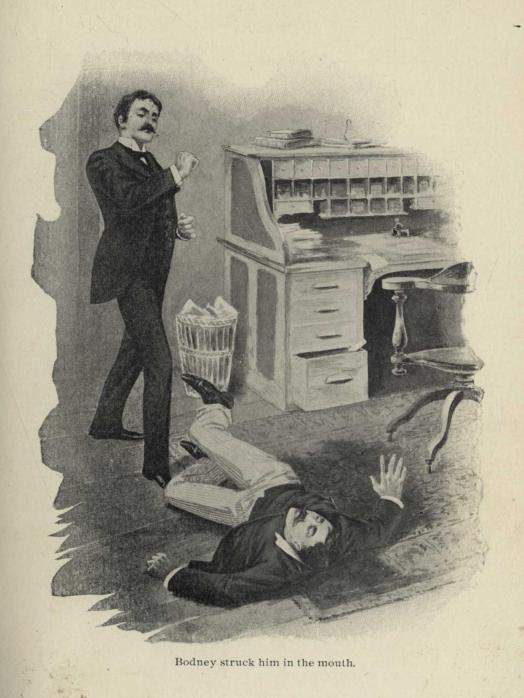
Bodney struck him in the mouth.
"I am obliged to you," Bodney broke in, "but I do not need it. I wanted to gamble with it, but I have quit gambling. I have overthrown the evil. Here," he added, taking the old man's arm and leading him into the room. "There it lies bleeding," he said, pointing. "Perhaps it needs your assistance. I must bid you good day." He walked out, leaving the old man alone with Goyle.
"What are you smiling at?" asked an acquaintance who met him in the street.
"Was I smiling?"
"Yes, like a four-time winner."
"I am at least a one-time winner," Bodney replied. He stepped into a drug store to get a cold drink, his friend's place, he noticed after entering. The druggist came forward and thus spoke to him: "I was sorry after you went out that I didn't let you have ten dollars. I found that I had more than enough to meet the note. I can let you have it now."
Bodney shook his head. "No, I thank you—I don't care for it. I have quit borrowing."
"I hope you don't feel offended."
"Not at all. I am grateful to you for not lending it to me."
Late in the evening he went back to the office. No one was there, but soon the negro janitor came in and pointed to a damp spot on the floor. "I have washed up the blood where the man fainted and fell," he said. "The doctor brought him to all right, and there's a note on the table he left for you."
Bodney opened the note and read: "I leave for Michigan, and will be back within a few days. I don't blame you as much as I do myself. I permitted you to break away from me, but you will come back and at last be thankful. Goyle."
CHAPTER XIX.
THE GIRL AGAIN.
Bodney's "breaking away" from Goyle had taken place on the day following the night when Bradley had been robbed of his watch, and two days before the girl appeared in church to ask for prayers. On the Monday following, about noon, she appeared again, this time at Bradley's lodgings. The housekeeper answered her ring at the bell. "Ah," she said, "come in. You are Mr. Bradley's sister, I believe. I didn't see you but a moment, but I think I recognize you."
"Is Mr. Bradley here?" the girl asked.
"No, your brother has gone out. I think you can find him over at Judge Elbridge's. I don't know exactly where it is, but some place on Indiana Avenue. Anyone can tell you. I hope you haven't any more bad news for him."
The girl was shrewd and did not betray herself. "No," she said, and went away. Bradley was in the Judge's drawing room with Agnes when a servant came in to tell him that a young woman at the door wished to see him.
"Oh, a young woman," cried Agnes, pretending to pout. "Some girl you have been talking sweet to, I warrant." He had risen to go out, but he halted to lean over and say to her, "I have never talked sweet, as you term it, to anyone—except—"
"This one," Agnes broke in. "Oh, go on. Don't let me detain you."
"Probably someone connected with the church—"
"Of course, they always are. Go on, please."
"I will tell you all about her when I come back."
"Oh, don't mind me. Here's Florence. She knows I don't care. Do please go on."
Bradley went out, and not with a light heart, for his love had now entered into the stew and fretful state. The girl stood in the hall, and in the dim light he did not recognize her till she spoke. She handed him a small package.
"What is this?" he asked.
"It is yours."
"My what?"
"Your watch."
It was some time before he could speak. All ideas were as dust blown about his mind. "You don't mean to say that—you couldn't have taken it—you—"
"Let me go where I can talk to you—outside."
He went out with her and together they walked along the street. Looking back, he saw Agnes at the window, and he waved his hand at her. She made a face at him, he thought. "Now, what is it you have to say?"
"You know a man named Goyle?" she said.
"Yes, I have met him at the Judge's house."
He waited for her to proceed. "I was with him and two others the night you found me. They left me on the sidewalk because I could not go further, I have been told. Goyle went away alone and snatched your watch."
"But, my gracious, how do you know? Did he tell you?"
"For some time he has been coming to see me. He was the first man I ever went with to—a place where I should not have gone. I blush to own it, but I was fascinated by him. He asked me to marry him, and I consented. The last time he came after that night was yesterday evening. But you had taught me to despise him. I could not drive him away, however, so I sat in the room with him. His mouth had been hurt—two of his teeth were gone. He said he had fallen off a car. He said also that as soon as he got a little better he was going to Michigan. He took out his watch, one that I had never seen him have before, and I noticed that it had a broken chain. Then I remembered seeing a broken chain hanging from your pocket; and the next morning before I left your house I thought I heard you tell someone that your watch had been snatched from you. I asked him to let me see the watch, and in it I found your name. I did not return it to him—I jumped up and ran out. He called after me, and tried to catch me, but I slammed a door in his face and locked it. Then, my mother, who never did like him, ordered him out of the house."
"What is your name?"
"Margaret Frayer."
"Then, Margaret Frayer, I am sorry you brought me the watch."
"Sorry?"
"I did not wish a reward for what I had done for you."
"Oh, that—the watch is not your reward. You have saved a soul. In my heart I believe that I have found peace. I went to sleep with a prayer on my lips, and I awoke with such a joy in my heart that I was frightened. I called mother and she came running into the room, and there must have been a spirit there, for before I said a word, and before mother had seen me, for it was dark, she cried out that I was saved. She had always been worried over me; she feared that my soul was lost. And she put her arms about me and sobbed in her happiness. That is your reward, Mr. Bradley."
"Come back to the house with me," he said.
He led her into the drawing room and introduced her to Florence and Agnes. "I wish to present a young woman whom God has smiled upon," he said, and they looked at him in astonishment. He told them that he had found her wandering and had led her home. Florence took her hand.
"I may not be worthy, yet," said Margaret Frayer. "You don't know me well enough to take my hand."
"I know that you must have suffered, and that is enough," Florence replied. The preacher looked at Agnes. He wondered why she did not come oftener to his church. He wondered what she would say to the young woman.
"You are my sister," said Agnes, as if inspired, and Bradley clasped his hands and pressed them to his bosom. His heart was full.
Margaret Frayer did not remain long. "You may meet me again," she said.
"She is to become a member of my church," Bradley spoke up.
"My heart and my prayers will be with your church, Mr. Bradley," she said; "I shall remember you and be grateful to you as long as I live, but my soul tells me to go with the Salvation Army, among girls, and persuade them to work in the street when they have the time. It is not goodness alone that saves us, Mr. Bradley; goodness may be selfish—it is saving others that saves us. You know how that is. You have saved others."
"You are right," he said. "Go with the army; you can do more there."
"And, do you say so?" Florence cried. "I thought you too orthodox for that."
"Not too orthodox for the truth," he replied, bowing.
"Then," said Florence, "I think more of you than I did. I thought it was your ambition to build up a church, but I find that you have forgotten your creed to save a woman. I am coming oftener to hear you preach."
During this time Margaret Frayer stood near the door, waiting, it seemed, for an opportunity to go. The preacher looked at her, and mused upon the change that had come over her face since he had first seen her, only a short time, but a great change. The Salvation Army has a countenance and a complexion peculiarly its own, serene and pale; and so quick, it seems, is the transformation that the coarse-featured, evil-eyed woman of today may, to-morrow, have a striking refinement. "I hope you will come frequently to my church," said Bradley, taking her hand.
"Whenever I am selfish," she replied.
"You young ladies have done yourselves credit," said Bradley, when Margaret Frayer had taken her leave.
"Why so?" said Agnes. "Because we treated her kindly? Did you take us for heathens?"
"Oh, no, but women—women are so slow to forgive."
"Forgive? Why, what has she done? She simply wanted religion, and you have helped her. Oh, she might have done wrong, I don't know. But women are more forgiving now that they have taken more of man's privileges. They may become quite generous after a while." With Agnes it was innocence; with Florence it was knowledge. She divined the history of the girl; and in giving her hand felt that it was to one who had gone astray, who had suffered, and who had turned back. The Judge came in, to the disappointment of the preacher, who feared that, soon to be followed by William, the old jurist would begin anew to stir up the old straw of family humor. But William did not come, and the Judge was in no mood for joking. He had been brooding, and his brow was dark. "Florence," he said, after exchanging a few words with Bradley, "I wish you would walk out with me." She said nothing, but went out and came back with her hat. They walked in the shade of the elms, and he remarked upon different objects, but she said nothing.
"Why don't you talk, Florence?"
"Because I haven't anything to say."
"You mean that you have nothing to say to me."
"I mean that it is useless to say anything to you. Shall I say something? I will. You are an unnatural father."
"No, I have an unnatural son."
"That is not true, Judge. Anyone to see him, to hear him talk, to know him, would feel that he could not commit such a crime. Why, sometimes when I am alone it almost exasperates me to think about it; and to realize that I am in a conspiracy against him. It is cruel, and at times I fancy that I am almost as unnatural as you are."
"To be bound by an oath? Is that unnatural? Is it unnatural to have honor? I told you in the first place to protect you; I bound you by oath to protect her, his mother. That is simple enough."
"But you don't know how near I have come to the violation of that oath. More than once I have had it in my heart to tell him—but I couldn't," she broke off. "I couldn't. But he is going away, and I will write it to him, every detail of it; and I know that he will forgive me."
"You make me the criminal when I am the injured. Let us go back."
CHAPTER XX.
THE PREACHER CONFESSES.
Bradley had argued with himself that at the proper time it would be simple enough to tell the girl that he loved her, and no doubt he was right, but the time did not come. He sat beside her on the sofa, when the Judge and Florence had quitted the room, and he looked into her eyes, and the proper words arose like a graceful flight of birds, rich in bright feathers, but they scattered and flew away. He could have delivered an oration upon beauty and love, and he did; but he feared to surprise her by telling her that he loved her. He did not dream that she had discovered it coming before he felt it. It was not possible for so innocent a creature to know so much. He was a large man, and large men may have sentiment, but sometimes they lack sentimental nerve.
"You don't believe now that I talked what you termed sweet to that poor girl, do you?"
"Oh, I don't know. But I don't see why she should look at you that way even if you did—did lead her. It must have looked nice, you going along leading her. What do you suppose people thought?"
"No one—one saw me lead her," Bradley stammered.
"Oh, then it was in the dark. Led her in the dark."
"She didn't mean that I really took her by the hand and led her. I led her spiritually."
"Is that all? Where did you find her—spiritually?"
"Going—shall I say?"
"Why, of course."
"Going to the devil."
"Oh, and did she say so, or could you see for yourself?"
"I could see. Agnes—Miss Agnes, if I were not afraid of lowering myself in your esteem, I would tell you something."
"Don't tell me anything dreadful," she cried, stopping her ears. "I know it must be something awful."
He waited for her to unstop her ears, which she did very soon, and then he spoke, but on another subject. She replied listlessly, leaning her head on the back of the sofa. He told her about his church and she yawned. He had been delighted to see her in the congregation, and she yawned again. "I thought you were going to tell me about that woman," she said.
"But you stopped your ears."
"And don't you know that when a woman stops her ears it's the time when she wants to hear?"
"I didn't know that."
"You didn't? Then you needn't tell me anything."
"Yes, I believe I ought to tell you—only you."
"Why only me?" she asked, her eyes half closed.
"I don't know, but—"
"Then, why did you say only me?"
"Because I—I think more of you than of anyone else."
"Oh, if you think it's your duty you'd better tell me."
He told her, and she sat up straight, looking at him; she got up and walked slowly to the opposite side of the room, he gazing at her. He reproached himself for telling her. She was young, lived apart from the great crowd, and could not understand. He could not see her face, for she stood with her back toward him, but displeasure has many countenances, and he could see that his story had offended her. Her head was slightly bowed, and she was no doubt weeping; he heard her sob. Then she had loved him, and her love was dying. But he did not dare to go to her, to the death of the love he had murdered. Suddenly she turned about. Her face was radiant, and she was laughing. He stared at her in amazement.
"It is exactly what you ought to have done," she said.
"And I am not lowered in your estimation?"
"For being a truer man than any man I have ever known? Oh, no."
Yes, she had turned round, laughing, but there were tear stains on her checks. He did not know that she had passed through a struggle of doubt to reach laughter. Surely she was a strange creature, worthy of being loved and capable of loving; but he did not tell her that he loved her. The words were warm in his heart, but felt cool upon his lips, and he did not utter them. He talked in a round-about way, in an emotional skirmish, he afterward said to himself, and then took his leave, as the Judge and Florence had returned. Just outside he met Bodney coming in. "Oh, by the way, the very man I want to see, Mr. Bodney. I want a talk with you."
Bodney thought that the preacher was going to thank him again for the money sent to the church, to tell him how much good it had done. "I will walk along with you," he said.
"This is a peculiar world," remarked the preacher, as they strode along, side by side.
"You might almost say a damnable world," Bodney replied.
"No, not quite so bad as that." They walked on in silence, Bodney wondering what the preacher wanted to talk about, the preacher wondering how he could best get at what he intended to say. "You are well acquainted with Mr. Goyle," said Bradley.
"Why do you speak of him? Why didn't you say I am well acquainted with the devil?"
"I suppose I might as well. Do you believe him desperate?"
"In his milder moods, yes; at other times he goes beyond that—he is inhuman."
"Ah. Do you believe that he would snatch a man's watch?"
"He would snatch a woman's child. He is a beast. But you have something to tell me. What is it?"
"I will, but as I do not wish to bring someone else into the glare of scandal, you must keep it to yourself. The other night, as I was going home, a man standing under a lamppost asked me the time. I took out my watch and he snatched it and fled down an alley. I didn't notice his face, or at least I could not see it very well, and I did not recognize him, but I have recovered the watch and have been told that it was Goyle who snatched it. And you do not suppose that there is any question as to his being bold enough to do such a thing."
"Mr. Bradley, that man would do anything; he is a footpad or a sorcerer, just as the humor takes him. Now, I will tell you something. He made himself my master, so completely that at times I could not resist him. But the other day he made me an infamous proposition and I struck him in the mouth and knocked him senseless upon the floor. Blood ran out of his mouth, and it was black—black, I will swear. I left him lying there, and when I returned he was gone, but he had written a note to me, a note in which there was not a word of reproach or resentment. He said he was going away and would see me upon his return. That note frightened me, and I have been scared ever since, dreading to meet him, for I feel that he has some sort of reserve power to throw over me. I would go away, but the thought that he knows all my movements is constantly haunting me. You may smile at this and say that I ought to be stronger, that it is superstition, and that we are not living in a superstitious age, but I tell you that in his presence I feel a weakness come over me to such a degree that when I am with him I have only one strength—a passion for gambling. I have let him ruin me, soul and body; I—"