Front matter (continued 4)
Reading edition
"I will pray for you," said Bradley.
"You might as well pray for rain, and nothing could be more foolish than that."
"What, you doubt the spirit of God?"
"I believe in the spirit of the devil. But this is jugglery. If he had left me a note full of resentment, or had even left no word at all, I should have felt that I had conquered him; but, as it is, I know that I am his slave."
"My dear young man," said the preacher, "you ascribe to him supernatural powers; you have permitted him to take you back into the middle ages. Such a thing is absurd, in this great, progressive city. See," he added, pointing at an electric car rushing by. "There goes the nineteenth century, and yonder," he broke off, waving his hand at a cart shoved by an Italian, "is the sixteenth century. You have let the Italian put you into his wretched cart. Get out—get on the electric car."
"Your illustration is all right, Mr. Bradley; but he has me in his cart bound hand and foot. But we have both said enough, and what we have said is not to be repeated to others. I'll turn back here."
After knocking Goyle down, Bodney had fully determined to make a confession to Howard and the Judge, but upon finding the note his will resolved itself into fear and indecision. He felt, however, that the gambling germ was dead—"germ," he muttered to himself. "Giant!" he cried aloud. It must be, though, that he would gradually gain strength, and the time for the confession was surely not far off. But he would bring disgrace upon himself and be driven out of the house. He could not bear the thought of seeing hatred in the eye of the Judge. The old man was unforgiving; had not forgiven his son, and would surely send Bodney to the penitentiary. "I can't tell him yet," he mused. "I must wait for strength. That scoundrel is thinking of me at this moment, and I know it." In the night he awoke with a feeling that Goyle was in the room, and he sprang out of bed and lighted the gas. Thus it was for three nights, and on the third morning came a letter from Goyle, not a letter, but an envelope directed by his hand, and in it was a newspaper cutting, set in the large type of the village press. "Last night, at Col. Radley's, the guests were entertained in a most novel, not to say startling, manner, by Prof. Goyle, of Chicago, who gave several feats of mind-reading. Miss Sarah Mayhew, daughter of our leading merchant, stuck a pin in the door-facing as high as she could reach, while the Professor was out of the room, and then hid the pin under the carpet. The Professor was brought in blindfolded, amid the silence which the Colonel had enjoined. He took Miss Mayhew by the hand, fell into deep thought for a few moments and then went straightway and took the pin from under the carpet, and then, marvelous to relate, ran across the room and leaping off the floor stuck the pin in the exact hole which it had occupied at the hands of the handsome Miss Mayhew. George Halbin, one of our leading lawyers, said that the feat would have seemed impossible to even a man with both eyes open. The Professor will appear at the opera house tomorrow night, and our citizens who appreciate a good thing when they see it should turn out."
"What have you got there?" William asked, standing in Bodney's door.
"Just a clipping from a newspaper telling of Goyle's wonderful mind-reading."
"Let me see it."
William read the paragraph and handed it back. "I don't believe a word of it," he said. "Those fellows will write anything if they are paid for it. It's all a lie."
"It's all true," said Bodney.
"What, have you turned spiritualist? Is the whole family going to pieces? Howard has ruined himself with French books and John is so snappish that no one can speak to him. Is that the sort of home I've found? Give me that cigar sticking out of your packet. You don't need it. Thank you. A man who believes the stuff you do don't know whether he's smoking or not. Is that John, roaring at Howard? I want to tell you that there's something wrong here. What do you keep holding that thing for? Why, you shake like a sifter at a sawmill. You are all going crazy."
CHAPTER XXI.
UP THE STAIRS AND DOWN AGAIN.
When Bodney went into the hall he found the Judge walking up and down, waiting for breakfast. His brow was troubled and dark, for Howard had just announced his determination to leave on the following day. He had acknowledged to himself that there was nothing left to hope for, and yet he had continued to hope that it all might be, as Florence believed, a vision, a nightmare, to be relieved by a sudden start. He knew that it was unreasonable thus to hope, but hope was born before reason, and will exist after reason has died of old age. As Bodney approached the old man stood with his hand pressed against his forehead. Bodney's heart smote him, but his fear was stronger than his remorse. The piece of paper, still in his hand, seemed to burn his palm, as poker money had burned in his pocket; and he felt that he was but a pin hidden under a carpet and that Goyle could find him and thrust him back into obedience. The Judge noticed the grip with which he held the slip of paper. "What have you there, George?" he asked.
"A—a—thing cut out of a newspaper." He opened his hand and the Judge looked at the slip of paper.
"But why did you grip it that way?" He took the cutting, smoothed it out, and, putting on his glasses, read it. "Ah," he said, handing it back, "that fellow. I have seen him in my sleep—last night. Tell him not to come here again."
"It has been some time since he was here."
"Don't apologize for him. Tell him that he must not enter this house again."
William came out and saw the Judge hand the cutting to Bodney. "Is it possible, John, that you believe in that nonsense, too?"
"I don't believe in anything," said the Judge.
"That's putting it rather strong," replied William. "That is to say, that when I tell you I elected Governors and Senators, you don't believe it." Bodney passed on, leaving the brothers walking up and down the hall, shoulder to shoulder.
"Did I say that I didn't believe you? What difference does it make anyway?"
"What difference does any man's record make? If a man isn't proud of his record, what should he be proud of? You are proud of your decisions—they go to make up your record. I elected Governors, and—"
"Why didn't you elect yourself?"
"That's a nice way to come back at a man—your own brother. Haven't you heard me say that there is something higher than a desire for office? Hah, haven't you heard me say that?"
"Yes, there is something higher—the roof of the board of trade."
"John, that is an unfair thrust at my speculations. But, sir, at one time I could have closed out for millions. Do you understand, for millions."
"Why didn't you?"
"Now, just listen to that. Reproaches me for not being a money grabber, for not joining the robbers to crush the weaklings. I have suffered a good deal at your hands lately, but I didn't expect that stab. It wounds me here." He halted, and placed his hand on his breast. But he went in to breakfast and ate with the appetite of a man who, if wounded, must have marvelously recovered; he joked with Agnes about the preacher; he told her that it would be her duty to take care of his numerous slippers, presented by women. "And when you have a pound party at your house I will contribute a—"
"Senator," said Howard.
"Oh, so you have broken out, have you? I thought you were too deep in the study of French literature to pay any attention to such trifles. And you have got on a reddish necktie. You'll be an anarchist the first thing you know."
"He is going away, William," said Mrs. Elbridge, and the Judge did not look up. The sadness of her voice stirred William to repentance. "Going away? I don't see how we can get along without him. He and I joke, but we understand each other, don't we, Howard?"
"Perfectly, Uncle William; and when I open my ranch out West, you may look on it as your home."
"Thank you, my boy; but I don't care to go out there again. I was once a power there, but the country is now overrun with a lesser breed, and I am afraid that I might not get along with them. I want men, such as there used to be. Man will soon be a thing of the past. The scorcher is running over him—and I want to say right here, that if one of those fellows ever runs over me, he'll get a bullet just about the size of a—a—about the size of that." He held up his thumb and measured off the missile intended for the scorcher. "You hear what I say. Why, confound 'em, if they see a man, a real man, they bow their necks and make at him, but if one of them ever runs into me, the coroner will have a job."
Howard and Bodney went down town together and opened the office, as usual, for clients who did not come, and who, if they had come, would have shaken their heads and gone away.
"Howard," said Bodney, "I told you that I was financially ruined."
"Yes, I remember, but afterward you said that everything was all right, that your fit had passed. Has it come again?"
"It didn't go away. A sort of drunkenness made it appear so. The fact is, I am in need of ten dollars, to pay a man I owe. He keeps harassing me."
"I need every cent I've got, old man, but here's ten."
Bodney took the bank note and went out. The poker microbe was not so easily to be exterminated. It had suggested to Bodney that the only way to replace the money taken from the Judge's safe was to play poker. And, why not play? He might win—he had won once, and what the cards had done they would do again. He remembered the courtesies that had been shown him at the club, the congratulation of the man at the desk when he won and the sympathy when he lost. "Couldn't make 'em stick, eh? When a man gets the hands beaten you do, he's got to lose his money. There's nothing to it. But you'll get 'em yet—you play as good game as any of them." A man of sense could see that it was a losing game from the start, no matter how honestly conducted. And Bodney, going to the club before business put on its cheerful countenance, had seen them counting the swallowings of the ever hungry box, the rake-off, the unsatisfied maw. A fairly active game would average for the house at least eight dollars an hour, so that in the end every man must be a loser. He knew all this as the others knew it, but the microbe squirmed and made him itch.
He walked toward the Wexton Club, not in a rush, for he was still fighting. Speculation urged him to play one more time, and to realize during the game that it was the last. The hunger for play was surely dying; then, why kill it? why not let it die of its own accord? Then came the memory of nights of distress, the nervous sweat of anxiety in the street, scanning faces, looking for money. He turned aside, went into a hotel and sat down. Two men were talking of a defaulter. "Yes, sir," said one of them, "everybody had confidence in him—the firm trusted him implicitly; but he embezzled and must go up for it." He mentioned the embezzler's name, and Bodney recognized it as that of a gentlemanly young fellow well known at the Wexton. He had come under an assumed name, but had thrown off this weak disguise, to indorse a check. So the players, who gossip among themselves, knew his real name, but addressed him as Jones. Bodney continued to listen. "I understand," said one of the men, "that the place where he went is a regular robbers' den." Bodney knew better than this; he knew that in the fairness, the courtesy, the good nature of the place lay its greatest danger. Men swore, it was true; cursed their luck and called upon a neighbor to testify to the fact that he had never seen such hands beaten; but for the most part, the atmosphere was genial, the talk bright and with a crispness rarely found in society. He resented this misrepresentation, and was even on the point of speaking when the men walked off. Soon afterward he went out, though not in the direction of the club; he circled round and round, like a deer, charmed by a snake; but after a time he saw the stairway, dusty and grim, rise before him. In the hall above, just as he was about to ring the bell, he thought of his short resources, only one ten dollar note, and he took out the crumpled paper and held it in his hand for a moment and looked at it, not to find the ten dollars, but the newspaper cutting. He started as if stung, stepped back and stood with his hand resting on the balustrade. The door opened and a man came out. Bodney spoke to him, and he halted. It was the offensive fellow with the white scar.
"How did you come out?"
The man opened both hands and raised them. He was not drunk now. He was sober and desperate. "They have ruined me," he said; "ruined me, and I don't know what in the name of God to do. I'll never play again as long as I live—I'd swear it on all the bibles in the world. Are you going to play?"
"I was thinking about it."
"I could have quit big winner. Say, have you got enough to stake me?" His eyes brightened, but the light went out when Bodney shook his head. "I've got just ten dollars."
"Then you won't last as long as a feather in hell." He went down the stairs, and Bodney continued to stand there, fighting against himself, with the newspaper cutting still in his hand. Suddenly, with his teeth set and both hands clenched, he ran down the stairs. At the door opening out upon the street he met the master of the game. "Won't you come back and eat with us?"
"No, I am in a hurry."
The master of the game was astonished. The idea of a poker player being in a hurry to get away from the game was almost new to him—and it was new to Bodney. But he hastened on, not daring to look back lest he might find some new temptation beckoning him to return. Passing beyond the circle wherein the lodestone seemed to draw the hardest, he felt, upon looking back, that he had escaped and was beyond pursuit. It was now eleven o'clock, and the victory must have been won at about ten minutes to eleven. He had cause to remember this afterward, on the following day, when he believed that the cause of this sudden strength had been revealed to him.
Howard was in the office when Bodney returned. "Well, did you pay your persistent creditor?"
"There was none. Here is your money; I don't need it now."
"But you will, so you'd better keep it."
"That's a fact, and I don't know how soon."
"But you say there was none."
"None. I'll explain sometime, but I can't now."
Howard did not pursue the subject further, for his mind was on his own affairs. He had settled upon taking his departure the next morning, and now he looked about the old room with a feeling of sadness. He had consulted another physician who knew his father well, and had been informed that the old man might improve rapidly in the absence of his son. This made the young man wince, but he had told the doctor that his father seemed to have an especial antipathy to him. "It is one of the freaks peculiar to diseased minds to turn upon one who has been nearest," said the physician. Howard had repeated this to his mother, and frequently she remarked it as a discovery of her own.
That evening when the young men went home there was a great hub-hub in the hall. William had just come in, covered with dust and was blowing like a hippopotamus. "If I live, I'll kill him; mind what I tell you."
"What's the trouble?" Howard asked. William had been knocked down by a scorcher.
CHAPTER XXII.
TOLD HIM GOOD-BYE.
At the breakfast table the next morning the Judge paid no attention to Howard, though he knew that his departure was to take place that day. He had striven to be genial when Mrs. Elbridge was present, and for a time had succeeded, but all effort was thrown off now.
Howard went to his room to make ready, and his mother went with him. The Judge was walking up and down in his office as they passed his door. Florence entered, and the Judge bowed to her.
"Are you going to tell Howard good-bye?" she asked.
"That's easy enough," he answered.
"He will come in here to see you before he goes."
"How do you know?"
"I know because it is not possible for him to prove so unnatural as—"
The Judge raised his hand. "Don't say it, please."
She stood looking at him. "Don't you think you ought to tell him why you have hardened your heart against him?"
"I shall tell him nothing."
"And is that the part of a true man? Is it not almost inhuman to let him suffer in ignorance?"
The Judge raised his hand and looked toward the door. "I tell you, it is to protect her. Can't you see?"
"It is well enough to protect her, but you ought to give him an opportunity to defend himself."
"There is no defense. Mind, your oath."
"Oh, I am sick of that," she said. "Every time I say a word in his behalf you remind me of a foolish vow. Judge, I am weary of this senseless and insane drama, seeing the others stumble about in the dark while you and I stand in the light. No, you do not stand in the light, I alone am in the light of truth; and if I did not think that the trip out West would be good for him. I would not let him go; I would stop him short with what you have told me and made me swear by the memory of my mother not to repeat. No wonder you put your hand to your head. It must ache. But, there, I won't reproach you."
He had sat down. She went to him and put her hand on his shoulder. He looked up, and then looked down again. "I believe something is going to clear it all up one of these days," she said. He got up and resumed his walk. Howard's voice came down the hall: "Has the trunk gone yet?"
"I think he is coming," she said.
"Stay with me, Florence."
"No, you must face him, the injured, alone."
"I have not injured him; he has injured me."
She went out and the Judge stood there waiting for Howard. He came in, more serious now that everything had been made ready. "I am about to start for the West, sir," he said. "I can't stand it here any longer. You frown at me, and when I beg you to tell me—"
"How long do you expect to be gone?" the Judge interrupted.
"Till the day when I am to marry almost in secret, or when you send for me."
The Judge was walking up and down. He turned and replied. "I shall not send for you."
"Do you still deny us the right to be married in a church?"
"You shall never marry her at all with my sanction, and if you marry her without it, you marry out West or in there," he added, waving toward the drawing room. "There must be no guests."
"I should like to marry in my father's house, but on the prairie or in the woods will do as well; it makes no difference." He looked hard at his father, and, after a time, added: "I didn't think that a man could change so much—be so unnatural."
"None of that, sir!" the Judge exclaimed, turning upon him. "It is not for you to call me unnatural."
"Father, if I have committed a crime in your eye, why don't you tell me what it is?"
"In my eye! You must have studied long to frame that speech."
"But why don't you tell me?"
"Don't mock me, sir."
Howard looked at him, as if trying to study out something in his countenance, in his eye. "May I ask you something?"
"Why should you desire my permission since you would pay no attention to my refusal? What is it that you wish to ask?"
"May I ask if there has ever been any insanity in our family?"
The Judge started. "In our family—in my family there has been something worse than insanity."
Howard slowly nodded his head as if admitting a sad fact. "Yes, there has been the death of affection—in your family."
"Ah," cried the Judge, "the shrouding of a hope."
"The murder of a jovial spirit," said Howard.
"Don't shoot your poisonous arrows at me. Go on, away. Good-bye." He waved his hand. Howard turned toward the door, but halted, faced about and looked at the Judge with troubled tenderness. "Father, I don't know exactly where I am going, but out in the wilds somewhere to find a place for me and mine. I did not believe—couldn't have foreseen such a moment as this. It seems to me that my father is gone." He paused, and the Judge stood with his face turned away. "Shall I write to you?"
"No," said the Judge, without looking round.
Mrs. Elbridge came in and found them standing apart, the Judge still with his back toward Howard. "Howard," she said, "the cab is waiting. Judge, Howard is going away from us."
The old man turned slightly, looked at her, nodded his head, said "yes," and walked to the opposite side of the room. Mrs. Elbridge touched her forehead. "You must bear with him," she whispered. "You can see where the trouble lies."
"Yes, and it is a sorrowful thought. I can hardly believe it. And to think that he should select me as the object of his contempt."
"He will get over it soon and send for you," she said in a low voice. "A disordered mind turns against the loved one—nearly always." Then, advancing toward the old man, she said: "Judge, tell him good-bye."
"I have," replied the old man, standing with his face turned from her. She went to him and, touching his arm, said: "But not in your old way—not as you would have told him good-bye before—before you were ill."
"I am not ill," he said, without turning his eyes toward her. "I never was better in my life."
"But, tell him good-bye, please."
"I tell you I have!" he exclaimed, stamping upon the floor; and turning with his hand uplifted, he cried: "Can't you see—no, you cannot," he broke off, his hand shaking, and slowly falling to his side. "No, you cannot see, must not see. I beg your pardon for speaking so impatiently, but I am worried, Rachel; worried, and—"
"Yes, I know," she said, taking the arm which he had raised from under her gentle touch. "But, you must tell him good-bye."
The Judge struggled against her, though not with violence; the struggle, indeed, was more against himself. She led him toward Howard, who stood looking on, sorrowfully.
"Put your arm about him," she said to the Judge. "For me, please."
"For you," he said, and suffered her to put his arm on Howard's shoulder. She raised his other arm, and now he stood with both arms about the boy's neck.
"Good-bye, father," said Howard.
For a moment the old man's countenance was aglow with the light of love and sympathy; convulsively he pressed Howard to his bosom—but a horror seemed to seize him, the light of sympathy went out as if blown by a cold wind, and, stepping back, he said:
"There. Go. Not another word. Why do you continue to stand there gazing at me? Rachel, can't you take him away? I have told him good-bye to please you—now, why don't you oblige me by taking him away?"
"But, dear, have you no word for him?"
"Word, yes. Good-bye."
"No word of advice?"
"Advice! Don't mock me. Go away, please. Can't you see—no, you cannot, and why should I expect it? Now go."
"We are going," she said.
"Yes, but—I beg your pardon—but why don't you?"
She took Howard's arm and walked out, looking back as if she hoped that the Judge might repent and follow, but he did not; he resumed his walk up and down the room. Suddenly he turned. "Now, what are you doing, William?" The brother had entered and was turning over papers on the desk.
"I am looking for a slip of paper I dropped out of my pocket-book."
"You didn't leave anything here."
"That may be," said William, "but I don't know whether I did or not till I find out. A man never knows—"
"Some men never know," the Judge broke in, going over to the desk and taking a paper out of William's hand. "Go away, please." William stepped back, shocking himself from the storage battery of his dignity. "Oh, I can go, if that's what you want."
"That's what I want."
"It is? All right. John, I'll be hanged if I know what's the matter with you." The Judge was paying no attention. He was listening to a cab driving off from the door. "I say, sir, I'll be hanged if I know what's the matter with you."
"I heard what you said."
"I don't know whether you did or not. There's no living in the house with you. And last night, after I had been knocked down in the street—and I'm going to kill him if detectives can find him—last night when I merely intimated that something had taken place on the fourteenth of September, you—"
"William, are you going to begin all that over again?"
"I don't know what you mean by again. John, you talk in riddles. I can't for the life of me get at your meaning. Yes, sir, and last night you flew off like a jug handle when I told you that Carl Miller—"
"Oh, damn Carl Miller."
"That's all right. I don't care how much you damn him. He deserves it—broke a pair of boots for me and made 'em so kidney footed that I couldn't walk in 'em. But I am positive about that other date, John. It was the tenth."
The Judge looked at him, drew a long breath, and said: "William, you are an old fool."
"An old fool, John—old? Did you say old?"
"That is what I said. Old."
William sighed. "Then, that settles it. It isn't so bad to be simply a fool—for we may grow out of that as time goes on—but to be an old fool—John, I'll leave your house. I can't stand your abuse any longer. I am without means, broke, you might say, and I don't know which way to turn, except to turn my back on your ill-treatment of me. I may starve to death or be killed in the street or on some freight car, stealing a ride from misery to misery, but I am going."
"William, sit down and behave yourself."
"Never again will I sit down in your house. I have joked with you, I know, and have said a great many things that I didn't mean, but I am in deadly earnest this time. I am going away."
The Judge put his hand on William's shoulder. "Look at me," he said. "Don't leave me. I need you. I am mean, and I know it, but I beg of you not to leave me."
"Mean!" William cried. "Who the deuce said you were mean? Show the villain to me. Show him to me, I tell you."
"There, now, sit down; it is all right."
"No, sir, it is not all right, and it never will be till I find the scoundrel that called you mean. Was it Bradley? Tell me, and I'll choke him till his eyes pop out. Was it Bradley?"
The Judge smiled. "Bradley," said he, "is one of my props. He is the son of my old friend, and I think the world of him."
"Well, let him congratulate himself on his escape, for before the Lord I would choke him. It is all right, yes, sir—but, really, John, if I tell you earnestly it was on the tenth won't you believe—"
"Yes, yes; let it be the tenth."
"Let it be! Why, confound it, I tell you it was the tenth."
"All right. When you go out I wish you would tell Florence to come here."
William grunted. "Oh, I can go out. By the way, John, Howard asked me a pertinent question this morning. And it staggered me a little. He wanted to know whether there had ever been any insanity in our family."
The Judge showed signs of coming agitation, but he fought with himself as it was his custom to fight. "What did you tell him?"
"I lied, I told him no. John, do you remember the night when they came from the mad-house and told us children that father was dead?"
"Don't, William; don't. Please tell Florence to come here."
William went out and the Judge resumed his walk up and down the pathway of trouble. Yes, he did remember the night when they came from the mad-house, two men in a doctor's gig; he remembered the lamps on each side of the vehicle, eyes of a great bug, they seemed. But his father's malady had not come of inheritance, but of fever. But other men had fever and did not go mad. Could it be that he himself had been touched with the disease—touched in the eye with a vision? No, for there was Bodney. He had seen it. "My mind is sound, even in distress," he mused. "But wouldn't it have been better if I had talked to him kindly about his crime? I ought to have let him know that I saw him. No, his mother would have drawn it out of him—love sucking poison from a wound."
Florence entered the room, advanced a few paces, halted, and stood, looking at him. "Well, you sent for me and I am here."
"Yes, sit down, please."
"No, I thank you."
The Judge looked at her sorrowfully. "Did Howard tell you where he intends to go?"
Florence looked at him with a smile, but in the smile he saw bitterness. "Does it concern you?" she asked.
"I am not a brute, Florence."
"No," she said. "A brute is not unnatural."
"Don't, please. I am trying not to be unnatural. There can be a broken heart shielding a heart to keep it from breaking."
"You were a judge, a man of justice. And was it just to let him suffer in the dark? Was it right to lock your own lips and put a seal on mine. Judge, I ought to have told him in your presence."
"Don't say that."
"But I do say it. You presume upon what you are pleased to think is my strength of character. I am beginning to believe that I was weak instead of strong. Yes, I ought to have told him in your presence. I ought to have said: 'Your father, who has been a judge, has passed sentence upon you without giving you a hearing. He says you are a thief.'"
"Hush," said the Judge, in a loud whisper, motioning toward the door. "Don't talk that way to me. Ah, I have killed all the love you ever had for me."
"You have choked it and it is gasping."
"I am grieved—but it cannot be undone—the fingers are stiffened about your gasping love." He walked up and down for a time, and then turned again to her. "When you get a letter from him will you let me read it?"
"No. His heart will write to mine, and your eye would blur the words."
"Don't say that. I am not without a heart. I had a heart—it is broken." He walked off again, but turned quickly. "Florence, I sometimes wonder if my eye could have deceived me—could have lied to me."
She moved toward him, her hands uplifted, hope in her face. "A man's mind lies to him, and why not his eyes?" the Judge continued. Florence caught him by the arm and looked appealingly at him. "But your brother, Florence—your brother. He saw him, too."
"What!" she cried, stepping back. "Brother saw him! You didn't tell me that."
"I promised him I would not tell you."
"Ah, you break your promises and expect me to keep mine. I will go this moment and tell his mother."
He caught her arm and poured out a distressful imploration, a prayer. "I would rather you'd stab me," he said, concluding. "I would rather you'd kill us both. But I didn't swear, Florence. You have taken an oath."
"Judge, that is cowardly."
"Yes, it is. I am a coward—but only for her. A bitter word, Florence."
"Yes, forgive me. I didn't mean that. You are not a coward, but you are blind." He held forth his hands. She stepped back, shaking her head.
"All gone," said he, "all respect, all confidence. And you were my daughter."
"I was."
"In love and in duty," he said.
"In both," she replied. "In both, yes, and now love is gasping and duty has become a hard master." Suddenly she sprang toward him. "Brother saw him! I am just beginning to realize what you said. I don't believe it. His eyes lied, too."
"Oh, beautiful faith, it would move a mountain."
"It would pluck a mote from an eye. May I go now?"
"I am not on the bench to discharge or restrain you. But, just a moment. You feel that I am a tyrant. That could not have been possible with your former self. What is so cold as frozen gentleness? And now it is only through the frost-crusted windows that I can catch a glimpse of your other spirit."
"In the hall, yesterday," she said, "I thought that I heard a lurking echo of your old laughter."
He made a gesture of distress. "Don't remind me of it," he said.
"May I go?"
"Yes. But let me ask you one more favor. Don't tell your brother that I mentioned him."
"Another chain," she said.
CHAPTER XXIII.
THE LIGHT BREAKS.
The Judge turned and saw Bradley in the door. His appearance at any moment was not in the nature of a surprise. Agnes said that she expected him at most unexpected times. He no doubt regarded himself as a brave man, and perhaps he was; it required courage to be so timidly persistent.
"I hope I don't intrude," said the preacher.
"Oh, not at all. Come in."
"Miss Agnes is out for a walk, I understand," said Bradley, sitting down.
The Judge stood looking at him absent-mindedly. "Ah, yes, I suppose so. But I don't know why I suppose so. The truth is, I don't know anything about it. I beg your pardon, Bradley. I am—am greatly disturbed. The fact is, I hardly know what I am about. I am a mystery unto myself. I was just thinking of it as you came in. It does not seem possible for a man, with a mountain of sorrow upon his heart, to turn squarely about and speculate upon trivial things—to jest, if I may say so, and I must for it is a fact. I am glad you came."
"I am always delighted to come, Judge. Here I find the shade of a palm tree in a great desert of trade. And I came in the hope of finding you better."
"Better!" The Judge looked at him almost sternly. "Better, why I am not sick. What put that into your head, Bradley?"
"Why, I understood from what you have said that your health was not of the best."
"But it is of the best, I assure you. But I brood, yes, I brood, and that is worse than ill-health—it is the ill health of the mind, the soul."
"I am afraid you work too hard."
"Um, work, I hardly know what that is. I am trying to rest, but it is like a man seeking sleep on a bed of thorns. Work is all right, for we can put it aside, but worry rides us till we are down, and then sits on our breast, waiting for us to get up."
William came in, shying a little upon seeing Bradley, but shook hands with him. "I am glad to see you looking so well, Mr. William," said the preacher.
"Oh, I'm a pine knot. Ain't I, John?"
The Judge looked at him inquiringly. "What did you say?"
"I said I was a pine knot."
"Did you?"
"Did I? Didn't I just say I did?"
"If you did, you did. That's all. But who accused you of not being a pine knot?"
Bradley chuckled, and William frowned at him; then, addressing himself to the Judge, the old fellow said: "You did. You disputed it. You call me a liar every time I open my mouth."
"William, you have often declared that you are not in the plot, but the first thing you know you may break into it."
"No, I won't!" William exclaimed, shaking his finger. "And I won't break into your intellectual atmosphere, either." He turned to Bradley. "Why, sir, John is a regular professor, browbeating his class. He expects everybody to talk book. I say, damn a book. I beg your pardon. It is the first time I ever said that in the presence of a preacher."
Bradley laughed. "It's all right, Mr. William, if you feel that way."
"Is it? Then, I say, damn a book. What I want is action."
"I subscribe to your doctrine concerning much of our literary output," said the preacher.
William was so delighted at this that he seized the preacher's hand and shook it with more of vigor than he was wont to put forth. "Good for you, Bradley. I am half inclined to come to hear you preach."
A twinkle in the Judge's eye showed that again he was playing in the midst of his sorrow. "You'd never get there, William. You could never settle on the date."
"Oh, you be confound, John. I have settled on more dates than you ever saw." He arose, went to the table and took up a pair of long shears. "Let me take these to my room, will you? I want to clip out something for my scrap-book."
"Oh, I thought you damned a book. No, sir, put those shears right down where you found them. You took my mucilage off yesterday and I had to go after it—down where you found them."
William put down the shears and looked angrily at the Judge. "Oh, I can put them down."
"Thank you."
"May I have a cigar, John?"
"Help yourself."
"Much obliged." He went to the desk, took up a box of cigars and walked out unnoticed by the Judge, who had turned his back, following a strand of his sorrow, intertwined with a strand of humor, the two phases of himself which he could not comprehend. He walked slowly to the wall, and, turning, remarked, as he walked toward the preacher, "Bradley, I feel as one waiting for something—some shadow."
"I'm not a shadow," Agnes cried, skipping into the room. Bradley arose with a bow. "No, for shadows may be dark," he replied.
"Did you hear that, Mr. Judge? Did you hear him say that shadows may be dark? Of course, for if they were bright they wouldn't be shadows. May I sit here?" She sat on a corner of the long baize table swinging her feet, as if the music in her soul impelled her to dance, Bradley mused. "Why do you people stick in here all the time?" she went on. "Oh, I see," she added, lifting her hand with a piece of paper adhering to it. "You glue yourselves in here." She plucked off the paper, took out a handkerchief, a dainty bit of lace, and wiped her hand. "Have you just got here, Mr. Bradley? What's the news? Who's murdered on the West Side? They have murdered somebody every day since I came, first one side and then the other, and it's the West Side's turn today. Anybody killed today?"
"I don't know," Bradley replied, "but I hear that a prominent citizen was sand-bagged last night—in front of a church."
"Oh, for pity sake. And had he came out of a church fair? Did the robber get any money?"
"Bradley," said the Judge, "as William would say, she is putting it on you."
Bradley smiled, and said that it seemed so. Bodney stepped into the room, halted as if confused, and as Bradley got up to shake hands with him, hurriedly went out. Agnes spoke in an undertone to the preacher. "Mr. Bodney is worried, too. And it makes me awfully sorry to see the Judge so distressed at times. Can't you do something for him?"
"I can simply advise him not to worry, that's all."
"Beg him not to be so sad. I don't see how he can be. Everything is so bright."
The Judge went to the desk to get a cigar. "That rascal has taken every one of my cigars. Now, I've got to find him to recover my property." He went out, and they heard him calling William.
"They have to watch Mr. William all the time," said Agnes. "He carries off everything he can get his hands on. They say his room looks like a junk shop."
Bradley nodded in acknowledgment, and after a short silence, full of meditation, he said: "You seem still to enjoy your visit. And I hope you are not thinking of going home."
"Ah, ha, I am having a lovely time. Isn't it a nice place to visit. They make you feel so much at home, snap at each other if they want to, just as if you weren't here. That's the way for people to do; make you feel at home. But they are just as good as they can be, and their little spats are so full of fun to me, only it makes me sad to see the Judge worry. Yes, I am having a lovely time. I went to the vaudeville yesterday, and tomorrow I am going to your church."
"Oh, you are?" Bradley laughed.
"Ah, ha. Oh, do you know what I heard about you? I heard you were seen walking along the street with a drunken man."
"Yes, a friend of mine. And if a preacher shouldn't support a staggering brother, who should?"
"Oh, how human. I like you for that?"
"Do you?"
"Yes, I do."
"And for that alone?"
"Oh, no, I like you for that and for a good many other things. I think I could have lots of fun with you."
"Fun with me?" The preacher was thinking of a summer evening in Aldine Square, the music of the fountain, the sweetness of the flowers.
"Ah, ha. There's something about you that makes me feel like a little girl. And I dreamed that you took me by the hand and led me along."
"Agnes, let me lead you."
She slid off the corner of the table and stood with her hands flat together, like a delighted child, but suddenly she looked up with seriousness in her eyes. "But now you make me feel like a woman."
The Judge came in. Bradley spoke almost in a whisper. "But a woman might be led by a man." And then to the Judge he remarked, striving to hide his annoyance at the interruption: "I see you have recovered your property."
The Judge sat down on a chair near the table. "Yes, some of it. William is a good grabber, but he gives up after an argument, and there is some virtue in that."
"What was in the paper that worried Mr. Bodney so?" Agnes asked, speaking to the Judge.
"I don't know. Has anything worried him?"
"Yes, I saw him grabbing the paper as if he would tear it to pieces."
"Ball game, probably," said the Judge, and then looking at Agnes he added: "Nothing seems to bother you, little one."
"No, sir. I won't let it. When I am worried something jumps this way," she said, making an upward motion with her hands, indicating the sudden rise of spirits, "and the bother is gone."
The Judge spoke to Bradley. "The heart of youth jumps up and says boo to a trouble and frightens it away."
"Ah," replied Bradley, "and couldn't an older heart learn to boo a trouble away?"
The Judge shook his head. "The old heart crouches, but cannot jump."
"Make it jump," Agnes cried. "Let me hear you laugh as you used to."
"The saints laugh with an old man," said Bradley.
"Don't," the Judge interposed, with a slow gesture. "Your roses are pretty, but you bring them to a funeral. No, I don't mean that. I mean that I am simply worried over a little matter, but I am getting better and will be all right pretty soon. I shall be my old self in a very short time." Bodney entered, and stood looking fixedly at the Judge. "What is it, George?"
Bodney nodded to Bradley and Agnes. "I beg your pardon, but I must see the Judge alone."
Bradley asked Agnes if she would accept of banishment with him. "Yes," she said. "Come on."
"It is not necessary," the Judge spoke up. "We can—"
"I beg your pardon," Bodney broke in, "but it is necessary."
"Of course it is," Agnes declared. "As Mr. William would say, we are not in the plot."
"No," said Bodney, bowing to her.
As they were going out, the Judge called to the preacher. "Don't go away without seeing me again, Bradley. I want you to spend the day with me."
Bodney leaned against the table, stepped off, came back, and stood looking down upon the Judge. The old man glanced up. "Well?"
It was some time before Bodney could speak. His words seemed dry in his mouth. At last he began: "I carried half of a heavy load. Something has thrown the other half on me, and I can't stand up under it—dispatch—railroad wreck—"
The Judge jumped out of his chair. "What!"
Bodney continued. "Yes. Goyle is dead."
"Oh, Goyle. I was afraid—where?"
"In Michigan, at fifteen minutes to eleven, yesterday. I have cause to note the time. The load—"
"Well, go ahead. But let me tell you now, George, you have no cause to regret the broken association. I deplore the man's death, of course, but I begun to feel that his influence upon you was bad. I had begun to dream about him, and to fear that he had a strange influence upon me. But go ahead."
"Half of it was crushing me, and I can't stand it all. I—"
"Why, what's the matter? What are you trying to tell. Go ahead."
"Judge, Goyle robbed the safe—Goyle and I—wait—I gave him the combination—he made up for Howard—I—"
The Judge seized the shears and raised them high above his head, his eyes fixed on Bodney's breast. Bodney did not flinch. The old man raised his eyes, to meet a steady gaze; and he stood with the shears high in his hand. He had uttered no outcry, no sound came from him, no sound that could have been heard beyond the door—only a low groan, like the moan of a fever-stricken man, turning over in his sleep.
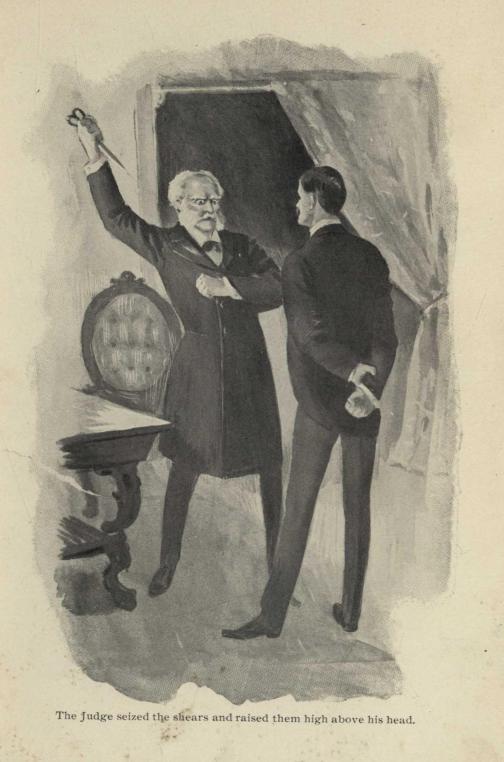
The Judge seized the shears and raised them high above his head.
"Kill me, Judge, I deserve it."
The shears fell from the old man's hand, and he dropped upon the chair, his arms upon the table and his face upon them.
"I wish you had struck me."
With a slight motion of the hand the Judge waved him off. Bodney continued: "For your heart there is a cure. There is none for mine. I was a fool, I was caught, I gambled, I couldn't quit, that snake held me, charmed me, hypnotized me. I knocked him down and he bled black on the floor, and I left him lying there, but I could not break loose from him."
The Judge waved him off. "Don't tempt me to look upon your face again."
Bodney did not move. "The old laugh that they have spoken so much about may return; old confidences and an old love will be restored, but there must be a wanderer that can never come back, a fool whom nature made weak. But I feel that if you would give me your hand—I am not deserving of it—but I feel that if I could once more touch that honorable hand, I could go forth an honest man. I would try."
The Judge slowly raised his head. Tears were in his eyes. He held forth his hand. Bodney grasped it, and—was gone.
CHAPTER XXIV.
SENT A MESSAGE.
William went to the office door and found it locked. This was so singular a happening that the old fellow stalked about the house, marveling over it and complaining against an innovation that shut a man out of an apartment that had served so long as a sort of public domain. It was like the closing of a park or a county road. Everyone laughed at him and he snorted. In the vocabulary of William's contempt, the snort was the strongest expression. "It is all right to laugh," said he, "but I want to tell you that there has got to be a change here." He returned to the office door and knocked upon it, but his knuckles aroused no heed within. He could hear the Judge walking up and down. Bodney had been gone nearly half an hour. But the Judge had not noted the time. To him, life was but a conflicting, mental eternity, and he was in the whirling midst of it. For a long time he sat with his head on the table, one arm stretched out before him, the other hanging limp; then he staggered about the room, and then sat down with his head in his hands. To the eye turned inward all was black, till gradually a light appeared, seeming softly to shine upon a hideous shape, crouching in a dark corner. He gazed upon it, and it spoke, shrinking further back from the soft light. "I am your injustice," it said. He got up, raised a window, and stood looking out upon the sunlight in the street. But he shivered as if with cold, and his lips moved as if he were talking and swallowing his words down into deep silence. A gladness began to form in his heart. His son was innocent, but in that innocence there was a reproach. He had been unnatural as a father, and might he not many a time have been unjust as a judge? He acknowledged to himself that he must have decided in favor of error while on the bench. His retirement was a sort of unconscious justice. He realized that his mind had not been sound. He had felt a coming weakness. But now he felt a coming strength. The trial through which he had passed must have served as a test. It was to restore or ruin his mental life. But why should there have been such a test, and why should the innocent have suffered? It would not do to reason, and he banished the test idea, fighting it off. Still, he acknowledged that his mind had sickened and that now it was gaining strength. He remembered his frivolity and loathed it, his jokes with William at a time when his heart was heavy and swollen. "Unnatural as a father and inconsistent as a man," he muttered. "But who is to judge of man's naturalness? One kink in the mind and the entire world is changed." William knocked again, and now the Judge opened the door. The old fellow looked at his brother and exclaimed:
"Why, what has happened, John?"
"Nothing, except that I have been really ill. But I am almost recovered. My mind has passed through a sort of crisis, William. I can now look back and see that I was not right. My present strength tells me of my former weakness. I am soon to be entirely well."
"Well, I am glad to hear that. It is particularly gratifying to me. And I suppose that you are, or, at least, soon will be, willing to concede that I am sometimes correct with regards to my dates."
"Yes, but we won't mention that. It is of no importance."
"What! No importance? Take care, John, you'll get back where you were, for when a man says that a date is of no importance, he's in danger."
"William, I want you to do me a favor. I am almost afraid to trust myself to go out just now. Wait a moment." He went to his desk, found a telegraph blank, and upon it wrote the following message: "The light has broken. Come back at once." William read the words and looked at him. "Go to the station," said the Judge, "and send this to Howard, in care of the conductor. It is not a secret, mind you, but don't stay to show it. They would delay you with puzzling over it."
"All right, I'll jump into a cab and go right over. I know the station. It's only a few blocks from here. He didn't go all the way down town. I heard him tell his mother. By the way," William added, "I found one of Howard's French books—"
"Put it back where you found it."
"What, you haven't flopped, have you?"
"I don't know what you mean."
"Why, you said that French literature was the—"
"It is the civilizing force of the modern world. Go on, please. Just a moment. Tell Florence that I wish to see her."
When Florence came in her face was radiant. William had spread the news of Howard's recall. "Ah," said the Judge, "you know that I have sent for him."
"Yes, father," she replied, going up to him with outstretched hands. He took her in his arms and kissed her. "What has happened?" she asked.
"The atmosphere is cleared, my dear."
"But, what cleared it?"
"The truth. You were right. I saw a vision."
She looked at him. "But what was it that brother saw?"
"Ah," said the old man, shaking his head, "you are shrewd. You are not willing to let it pass. Florence, we both saw Goyle disguised with his devilish art as Howard."
She gazed at him. "Is that all?"
"All? Is not that enough for us to know, my child?"
"But, why did brother happen to lead you into the office just at that time?"
"There, I have told enough, and what I have told you must not repeat. If there is anything to come, Howard may tell you, but my wife must never know that I have been so weak and unnatural a father."
"But she can see that something must have occurred to change your bearing toward Howard. Mr. William has told her that you have sent for him, and she is in her room with tears of joy in her eyes."
"Florence, I am striving to be calm, the master of myself. I don't deserve to be happy—not yet. How could I have been so blind? And how at times could I have indulged in levity with such a sorrow upon my heart?"
"It was the truth, father, striving to break through."
He nodded his head. "Yes, and now we must tell her something. Ah, tell her that a man came and brought me word that my brother is not dead. Keep her from coming to me with any sort of demonstration. I can't stand it. I must recall my old self and become gradually accustomed to it. I must realize that it was all a dream and that it is passing away. Tomorrow, with Howard, we may make a joke of it."
"It will never be a joke with me."
"No, my child, I did not mean that. It was a nightmare—a breath-shape breathed upon us by the devil while we slept. But we are awake now, and God's sun shines. Go to her and tell her that my brother is not dead."
"I will. But, father, do you realize how resourceful you have made me—how replete with falsehood? And must I not go into the closet and pray for forgiveness?"
"It was done for love, my dear; and love, which is the soul of all up yonder, has forgiven already."
Florence and Mrs. Elbridge entered the drawing room. "Who brought that news that his brother was not dead?" Mrs. Elbridge asked.
"A man. He was in a great hurry to catch a train and could not stop long. He brought direct word from Mr. Henry himself."
"Then there can be no doubt about it."
"No. And I did not believe it in the first place."
"Who is in there with him?"
"I think Agnes and the preacher have just gone in."
"This is a happy day," said Mrs. Elbridge, looking toward the door.
"A day when falsehood may be told, but when truth is revealed," Florence replied. "It is one of God's days."
"All days are His, my dear."
Florence slowly shook her head. "No, not all."
The Judge came in. He put his arms about Mrs. Elbridge. "Rachel," he said, "you shall never see my face gloomy again. I will go laughing down into green old age, into the very moss of time." He motioned toward the office. "In there is a beautiful picture of sweet distress."
Mrs. Elbridge looked upon him with a trembling lip. "But, my dear, it is not more beautiful than the fact that you sent for your son and that you yourself have come back to us all."
The Judge smiled. Florence could see that he was growing stronger, that his mind was clearing. "He returns like a lost child suddenly finding the path home," she said.
"Faith has its wisdom and its reward," replied the Judge, looking at her. "In the days of the New Testament, you would have been one of the followers. You would have wiped His feet with your hair." And, looking at his watch, he added: "I wonder why William doesn't come back."
"It is not time," Mrs. Elbridge replied, glancing at the clock.
"The minutes are hours, but clearing and strengthening hours," said the Judge. He turned about and began to walk up and down the room, with all the simpleness of his nature in his face. He did not look like a man who had sat in judgment upon the actions of men. His heart had cried for pardon, and a belief that it had come lighted his countenance. A man who has been shrewd in the affairs of the world, sharp in practice, suspicious, sometimes becomes simple and trustful in the love of a grandchild. And at this time, the Judge might have reminded one of such a man.
Mrs. Elbridge stood in the door looking down the hall. The Judge halted to speak to Florence. "Forgiveness," said he, "is the essence of all that is noble in life. And do you forgive me?"
"Yes," she said. "And I hope that I shall be forgiven all the falsehoods I have been forced to tell."
"They were for her, Florence, and there is a virtue in an untruth that shields a heart." He moved closer to her and added: "I wonder at your strength and marvel at my weakness."
"You were groping in the dark. It was not your fault, but your nature."
"And you are my daughter again."
"Yes," said Florence, "in love and in duty."
Mrs. Elbridge went out. The Judge and Florence sat down to wait for William. He was a sort of way-station which must be reached before they could arrive at Howard. The Judge told her of the darkness through which he had passed, throwing new light upon it, as if she had not seen it, as she stood by, holding a torch. He spoke of Goyle, of his strange power; he told her of the newspaper cutting that gave account of his mind-reading, and finally he told her of Bodney's confession. She was prepared, and showed no agitation. But there was grief on her face. Then he told her that he could not find it in his heart to condemn him. "In your own words, Florence, it was not his fault, but his nature. I will take him back, and not even Howard must know of his part in—in my darkness."
"Howard ought to know everything," she said. "But not now, my dear; by degrees, as he shall be able to bear it. He is generous, and I believe he will forgive."
Mrs. Elbridge returned and stood in the door. "Here comes William," she said. The Judge arose. William came in puffing. "We were looking for you," said Mrs. Elbridge.
"Well, now," replied the old fellow, "you don't have to look long for me, I'll tell you that. I made the driver whip his horses all the way there and back."
"And are you sure that your message caught the train?" said the Judge.
"Oh, I always fetch 'em whenever I go after 'em."
"Are you sure you sent it all right?" the Judge asked.
"John, I thought you'd get well. But, sir, you exhibit the most alarming sign of sickness I have ever seen in you. Sure I sent it all right! What other way do I ever do a thing? Of course I sent it all right. The train wasn't far out, and there's one back every few minutes."
"It seems that he has been gone a year instead of two hours," said the Judge.
Florence smiled at him. "And are we to be married in secret?" she asked, speaking low.
"My dear, that shall be as you please. I have only one wish—that it shall be one of the happiest days of my life, and I believe that it will be."
"What day of the month is this?" William asked.
"The fifth," the Judge answered.
"Are you sure?"
"I am sure it is not the tenth of June, sixty-three," said the Judge, and was in deep regret at his levity at such a time, when his wife spoke up, "Judge, please don't get him started."
"Started!" William snorted. "Now—now, that's good. A man races all the way to the station and back, and they talk about getting him started." Suddenly he thrust his hands into his pockets and stood staring at the wall. "Well, if that don't beat anything I ever saw."
"What is the trouble?" the Judge asked.
"Why, I dated that telegram the fourth."
"You did!" Mrs. Elbridge cried. The Judge looked hard at his brother. "It won't make any difference," said Florence. "He will know that it was a mistake."
"He will undoubtedly know who sent it," the Judge added.
"I wonder why Mr. Bradley and Agnes stay in that dingy place," said Mrs. Elbridge, always anxious to change the talk from William's dates.
"The place may be dingy," replied the Judge, "but there are no cobwebs hanging from the rafters in the abode of love."
"Judge!" she said, giving him a smiling frown.
"To some eyes," remarked Florence, half musingly, "there may be cobwebs hanging from the rafters in love's abode, but to love they are strands of gold."
"Let us go out and watch for his coming," said Mrs. Elbridge, taking Florence by the arm. They went out, leaving William staring at the Judge.
"By the way, what's this I happened to hear about brother Henry being dead? I didn't know he was dead till he wasn't."
"You didn't?"
"I mean I heard the news of his death and the contradiction about the same time. Why did you keep it from me?"
"Oh, I knew there wasn't any truth in the report, and there wasn't anything to be gained by telling you."
"Anything to be gained. Do you only tell a man a thing when there is something to be gained by it?"
The Judge looked at the clock and then at his watch. "He ought to be here pretty soon. I want everybody to keep away from me. I want to see him first alone—in here."
"But what's all this mystery about? I'll be hanged if you haven't put my light under a bushel."
"No, William, it is my light that has been under a bushel."
"Everything may be all right, John, but I don't understand it. There was something I wanted to say. Yes. In case I forget it, tell him the date was a mistake."
"You won't forget it, William. You never forget a mistaken date."
"There you go again. Can't a man make a request?"
"I believe a man can, William."
"You don't believe anything of the sort, and you know it. But I won't be left in the dark. I refuse to stumble in ignorance." He started toward the door.
"What are you going to do?"
"I am going to get the morning paper and settle that date."
"All right," said the Judge, as William went out. "And tell them out there that I must see him here alone. Don't forget that." He walked up and down the room and then stood at the door. "Do you see anything of him yet?" he called to his wife.
"Not yet. It isn't time. But here's a cab. It's going to stop—no, it's gone on."
"Let me get there," said the Judge, as if the others were responsible for the fact that the cab had not halted and put Howard down at the door. A moment after he went out Bradley and Agnes entered the room. "They are gone to watch for him. Shall we go, too?" the girl asked, looking at him with a mischievous quiz in her eyes.
"No, let us stop here a moment. Strange, isn't it, his going away and coming back so soon?"
They sat on a sofa, looking at each other as if new interests were constantly springing up.
"We have talked all over the house," she said. "I feel as if I have been on an excursion. Yes, it is strange. Don't you think they have quarreled?"
"Perhaps—but it will bring them closer together."
"Yes," she said, "but I wouldn't like to quarrel just to be brought closer together. I wonder why Mr. Bodney went away, too."
"And you ask?"
"Yes, didn't you hear me? I heard him muttering as he went out. And I understood him to say that he wasn't coming back any more."
"I thought you knew why he went."
"Thought I did? How was I to know?"
"I could not help but think—"
"What did you think?" she broke in.
"That he had asked you to be his wife and—"
"Oh, he never thought of such a thing."
"And if he should?"
"I'd tell him no, of course."
"You may have to say yes sometime, Agnes."
She looked down. "I won't have to—but I may."
"Agnes, do you know what love is?"
"What a question. Of course I do."
"What is it?"
"Oh, it's er—er—don't you know what it is?"
"Yes, Agnes, it is a glorious defeat of the heart."
"Oh, I don't think so. It's more a victory than a defeat."
"No, the heart surrenders." They heard the Judge exclaim, "No, it is not going to stop."
"Agnes, did your heart ever surrender?"
"You must not ask me that."
"Why not? Did your heart ever fight till it was so tired that it had to give up—surrender?"
"You mustn't ask me that. You'll make me cry." She hid her eyes.
"In sorrow, Agnes?"
"No—no, in happiness."
He put his arms about her, kissed her, pouring forth his dream of the fountain and the evening in summer. The Judge startled them. "Don't let me disturb your tableau," he said, laughing, "but I must see my son in here alone, not in the office where—where the safe is."
"Come," said Bradley, taking Agnes by the hand, "Let us watch with them."
As they arose the Judge looked at Agnes. "Ah, I see happiness in your face, little one. Keep it there, Bradley, for it is God-given." He took the preacher's hand. "God bless you, Bradley. You are a good fellow."
"Don't call him fellow, Mr. Judge," said the girl, pretending to pout.
"Yes, fellow," Bradley replied. "It is closer to the weakness of man."
"Closer to his heart, Bradley," said the Judge.
"Yes," said Bradley, and then he spoke to Agnes. "Come with me."
"Anywhere with you," she replied, taking his arm and looking up into his face. They passed out, and the Judge stood, waiting. William appeared at the door. "It's all right now, John."
"What's all right?"
"That date—the one that caused so much trouble one night. It was on the tenth."
"Is it finally settled?" the Judge asked, listening.
"Yes, sir, finally, and nothing can throw me off. Here comes Howard." The Judge motioned, and William withdrew. Howard's footsteps were heard. The old man stood with his face turned from the door, striving to master himself. He felt that surely he should break down. Howard stepped into the room. "Father," he said. The Judge turned, and, perfectly calm, held forth his hand. Howard grasped it. "My son, let us be masters of ourselves. Let us be strong, for you will have need of strength. I have something to tell you."
"No," Howard replied. "You have nothing to tell. George met me at the station and told me. I have forgiven him. I know how he has suffered. I have seen his struggles. He must not be sent away. I have brought him back with me. He is out there."
"Howard," said the old man, "you are a noble fellow."
Howard stepped to the door and called Bodney. When he entered the Judge said: "George, I am going to rent an office in a modern building. That old place is worn out. We are going to start new. Ah, come in, Florence."
"I have simply come to tell you that dinner is ready," she said, with tears in her eyes.
"Yes," said the Judge. "Come, boys." Florence led the way, looking back, smiling, and the old man went out between Bodney and Howard, with his hands resting on their shoulders. In the hall stood Agnes, the preacher and William. The preacher was speaking. "If there were but one word to express all the qualities of God, I should select the word forgiveness," he said.
THE END.