Front matter (continued 2)
Reading edition
"Bet three dollars," said Goyle, putting in the chips, and Bodney was almost smothered in exultation.
"I raise you three."
"Raise you three," said Goyle.
"Are you as strong as that?" Bodney remarked, striving to hide the delight that was shooting through him. "Well, I'll have to raise you three."
Goyle began to study. "Well, if you can beat a jack full, take the money." He put in his three dollars. "King full," said Bodney, and Goyle threw down his cards with an oath. "Of course you couldn't make that against anybody but me. It's what a man gets for not playing his hand before the draw. I ought to have raised you back. Had three jacks all the time. But I didn't want to beat you."
"Looked like it when you made that flush."
"That's ancient history."
Bodney did not reply. He was behind a bulwark of chips, and his heart beat high. He began to tell a story. The winners were interested; the losers did not hear it. In the midst of the story, just below the climax, he had a hand beaten for six dollars, and the story, thus broken, fell into silence.
"What was that story you were going to tell?"
"It didn't amount to anything," said Bodney, but not long afterward he won a ten dollar pot, found the fragments of the story, lying at the bottom of silence, and gave them voice. The winners laughed; the losers did not hear it.
A minute legitimately employed may seem an hour; an hour at a poker table may be but a minute.
Someone asked the time. Bodney looked at his watch, and said that it was five o'clock. He was nearly seventy dollars ahead, with the reserve fund still in his pocket, and was resolved to quit very soon. Just then Goyle emerged from a contest, broke. "Let me take ten," said he. Bodney hesitated a moment. "Say, I've got to pay for—"
"Oh, I'll give it to you tomorrow. Let me take ten."
He passed over the chips, but with a feeling of depression. "I may be broke pretty soon," said he. "And I can't let you have any more."
"Broke pretty soon! Why, you're even on your whole life. You got all my money."
"I haven't won as much from you as you have from me."
"That's all right. My day may come."
Bodney was determined to play no longer than dinner time. Then he would cash in. Goyle's stack grew to the amount of thirty dollars. Bodney was glad to see it grow; ten dollars of it belonged to him. He did not care for ten dollars; he had loaned Goyle ten times ten, and did not expect to recover the sum, but chips were different, and especially now that they fed his passion and dulled his conscience. Goyle got up. "Let me have that ten till tomorrow," said he, and Bodney did not say anything, but his spirits felt a sudden weight. He was pleased, however, when Goyle went out, for there were to be no more raids upon his stack. Dinner was announced. He motioned to an attendant upon the game, and his chips were taken over to the desk.
"Going to quit us?" a man asked.
"Yes. This is the first time I've won," he added, by way of apology.
"Have dinner before you go," said the proprietor, coming forward.
"I don't know that I've got the time."
"Just as well. You've got to eat anyway."
He went out to dinner, and was permitted to be vivacious. An old fellow, sitting on his right, remarked: "I'm glad to see you win." Others said that they were glad to see him win. It was surely a very genial company.
CHAPTER VII.
WENT OUT TO "DIG."
After dinner, when the game was reorganized, Bodney looked on for a few moments, still alive to the keen pleasure of winning; and just as he was about to go out, a thought struck him. What was the use of quitting now that he had luck? He had waited for it a long time, and now that it had arrived he was going to throw it away. He might just as well win a hundred and seventy as seventy. He could at least try ten dollars, and quit if he found that fortune was against him. There was one vacant seat and he took it. Ten dollars and not a cent more. That would leave sixty to the good, enough to play on for a long time. So he bought ten dollars worth of chips and was again forgetful of the Judge, of Howard, of Florence, of the world. After a few hands he picked up a straight, seven high. He raised the opener, who promptly raised him in return, giving him the other barrel, as the saying went. Bodney raised again. He was to get action on all the money in front of him. The dealer said "cards," and the opener, tapping the table with his cards, replied, "Help him."
"Don't you want any?" Bodney eagerly asked.
"Didn't hear me call for any, did you?"
"Well, I don't want any either," said Bodney, in faltering tones. A seven high straight looked weak against a pat hand.
"Turn 'em over, boys," said the man in the look-out chair.
Bodney tremulously spread his hand. "Only seven high."
"Just top you. Mine's eight high. You had me scared, and if you'd have more money and bet me after the draw I don't think I call."
That might have been true, but it offered no consolation to Bodney. "Just my luck," he said.
"When a man gets them sort of hands beaten he's got to lose his money," said the "look-out." "There's nothing to it." A man standing near was waiting for Bodney's seat. He shoved back and was about to get up, pursuant upon the resolution which he had formed when, it occurred to him, as it always does, that with ten more he could win back the ten just lost. It was simply an accident that the fellow held over him. He would try ten more. His luck was gone, but he expected every moment to see it return. He opened a pot on aces and tens. A fool stayed on deuces, caught his third, and slaughtered him. He bought ten more. His spirits were heavy and he sighed distressfully. It was not the loss of the money; it was the harassing sense of being beaten. He opened another pot on queens up. One of the regulars raised him. He began to reason. "He would raise it on two pairs smaller than queens up. I saw him raise just now on sevens up. I'll stand it." He put in his money and drew one card. The regular drew one. The prospect was not bright, still it was not so bad. He did not help. He bet a white chip; the regular raised him three dollars and he called. Then the regular had recourse to a joke, new to Bodney, but old to the game. "I have the waiter's delight," said he.
"The what?"
"The waiter's delight," and he spread a tray full.
At ten o'clock, Bodney's capital, including the reserve fund, amounted to twenty dollars. "You beat me every time," he said, to an offensive fellow who sat opposite. It was the stranger with whom he had laughed early in the game.
"That's what I'm here for."
"That's all right. I'll get you yet."
He won several pots, and then opened a double pot for five dollars. He had a king high flush, and he intended the heavy opening to operate as a reverse bluff, to argue a small hand. The offensive fellow stayed and drew one card. He made a small full and Bodney felt his heart stop beating. At eleven o'clock he had simply the five dollar reserve fund. And he saw it melt away—saw his last chip go in. He drew, having a show for the pot, and made jacks up. The opener had queens up. Heavy of heart, Bodney went down the stairs. He cursed himself for playing after dinner. "If I only had ten dollars I might win it all back," he mused. "They can't possibly beat me all the time. I played as good cards as anybody. I wonder where I can get ten dollars. Everybody that knows me has gone home by now. Let me see. I know a fellow over at that drug store. But I've forgotten his name. Wonder if he'd let me have ten. I'll try him." He went into the drug store, saw the man standing behind the counter, walked up, reached over and shook hands with him.
"How's everything?" Bodney asked.
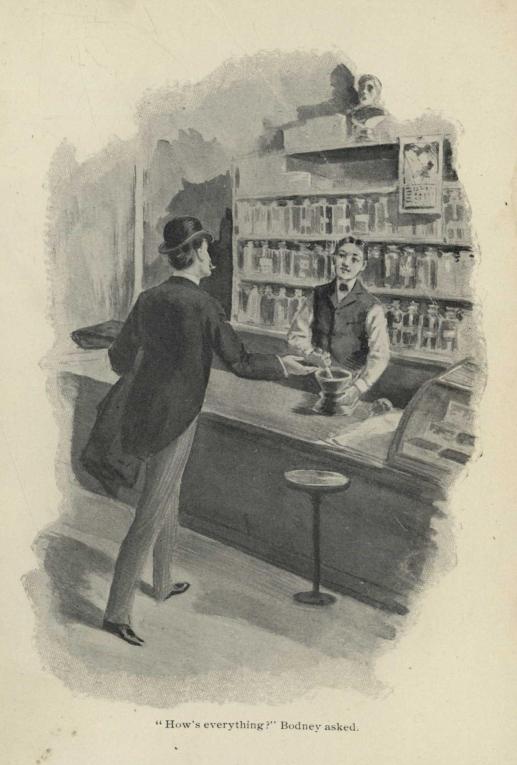
"How's everything?" Bodney asked.
"Oh, pretty fair. How is it with you?"
"All right. Say, old man, a college chum of mine, devilish good fellow, came in just now on a train and happened to catch me at the office—"
"Yes?" said the druggist, looking at him.
"Yes, and the fact is, he got here broke and has called on me to help him out. He's a devilish good fellow, and I don't exactly know what to do. Every one I know has gone home, and—could you let me have ten till tomorrow? You can count on it then."
"Oh, I guess so, but I'm rather short."
"I'll give it to you tomorrow without fail."
He went out with a ten dollar note crumpled in his hand. A man may fail to get rent money, clothes money, bread money; he may meet with obstacles that he cannot overcome; his self-respect withholds him from asking favors of certain men. But the fool in hot quest of poker money knows no self-respect, recognizes no embarrassments that might stand in modesty's way. Bodney bounded up the stairs, afraid that the game might have broken up. Panting and tremulous, he pressed the electric button. A negro porter pulled aside a blue curtain, peeped through the glass and opened the door. The game had not broken up. Every seat was taken, the regulars, with chips stacked high before them, the "suckers" squirming with "short money." How dull and spiritless everything had looked when Bodney went out, and now how bright it all was, the carpet, the window curtains, the pictures on the walls. The room was large, affording ample space for a meditative walk up and down, and as he was too nervous to sit still, he walked.
"Think there'll be a seat pretty soon?" he asked of the man at the desk.
"Very soon, I think. Sit down and make yourself comfortable. Have a cigar." He lighted the cigar and resumed his walk. Passing the table he saw a man in the death throes of a "show-down." Some one had opened a pot and he had been compelled to stay. Bodney eagerly watched the draw. The opener drew one card. The "show-down" man had to draw four, presumably to an ace. This was encouraging to Bodney. He was the next in line; he would get the seat. He leaned forward to catch the result. The opener had tens up. The four-card draw yielded a better crop, aces up, and with a sense of disappointment and injury Bodney resumed his walk. But pretty soon a man cashed in, and the young lawyer bought five dollars worth of chips, and took his seat. He won the first pot, the second and the third, but without stayers. Surely his luck had returned. Again he felt a current of pleasure flowing through his mind. He laughed at a stale joke. It had never sounded so well before. A man, the offensive fellow, now quite a gentleman, began to tell a story, and Bodney encouraged him with a smile. "I knew a man once, a preacher, by the way," said he, "who got into the habit of playing faro; I guess he must have played before he began to preach, and found that he couldn't quit. Some fellow that was kin to him croaked, and left him a lot of money. Then he knew he wouldn't play any more. Well, one day he went by the bank where he had his money, and pretty soon he says to himself: 'Believe I'll draw out just a small sum and try my luck once more—just once.' Well, he kept drawing on that money till it is all gone. Nothing to it, you know. Then one night he gets down on his knees and prays. 'Lord,' says he, 'if I ever play again I hope you'll make me lose.'"
"Did he play again?" Bodney asked.
"Yes; he keep right on."
"And did he lose?"
"No. He coppers his bets."
Bodney was immensely tickled at the idea of the fellow "coppering" his bets to offset the influence of the Deity, and he laughed uproariously, but just then he lost a pot, and his mirth fell dead. And after this every time he opened a pot someone would raise him. After a while he dragged out his last five dollars and invested in chips. Then he sank into the condition known as "sifting," anteing and never getting a pair. Behind him stood a man waiting for his seat. He saw his last chip melt away and he got up, so heavy that he could hardly stand. The fellow who had told the story, and to whom Bodney had paid the tribute of most generous laughter, dealt the cards and skipped Bodney without even looking at him. But Bodney looked at him, and how offensive he was. "I'd like to cut his infamous throat," he mused. Down the stairs again he went, heavier and more desperate than before. It was now past midnight. "Now what?" he said, halting on a corner and wiping his hot face. "I don't know what to do, but I almost know I could win out if I had ten more. But I don't know where to get it. There's no use to look for Goyle. I wonder if that fellow at the drug store would let me have another ten. I'll go and see." He crossed over, went into the drug store, and asked the squirter of soda water if his friend was there. No, he had gone home. "Is there anything I can do for you?"
"Well, I don't know. By the way, you've seen me in here a number of times, haven't you?"
"Oh, yes. And I used to see you over at the other place."
"Yes, I remember, now. And your name is—"
"Watkins."
"Yes, that's a fact. I remember you now. How are you getting along, Watkins?"
"All right."
"Yes, sir, I used to know you," said Bodney. "And I guess you are about the best in your line."
The man smiled. "Well, that's what they say."
"Yes, I've heard a good many people say it. Well, you understand your business. Say, can you do me a favor? I need ten dollars till tomorrow morning, and if you'll let me have it, I'll—"
The man shut him off with the shake of the head. "I haven't got ten cents," he said.
Bodney stepped out. "Come in again," the fellow called after him. He did not reply, except in a mumble, to hurl imprecations back over his shoulder at the soda-water man. "He's a liar, and I'll bet he's a thief. Now what?" he added, halting on the corner. He looked up and down the street, and scanned the faces of the passers-by, hoping to recognize an acquaintance. Presently a man rushed up and with a "helloa, old fellow," grasped him by the hand. Bodney gripped him; he did not recall his name, but he held him close. "I haven't seen you for some time," said Bodney.
"No, not since we were out on Lake Geneva, fishing for cisco."
"That's a fact. Say, everybody has closed up, and I need ten dollars till tomorrow morning. Can you—"
"I was just going to ask you for five," said the cisco fisherman. "I went over here at three sixty-one, and got into a little game of poker and got busted. Ever over there? Now, there's a good game, only two dollars limit, but it's liberal. There ain't a tight wad in the house. Come up some time."
Bodney got on a car to go home. He had just five cents. The talking of two women and the frolicking of a party of young fellows annoyed him. And then arose before him the sorrowful face of his sister. The rat had come back with his teeth sharpened, and he felt his heart bleeding. He fancied that he could hear the dripping of the blood. Then came upon him the resolve never to play another game of poker. It was a sure road to ruin, to despair. He would confess to Howard and the Judge. The car stopped and Bradley, the preacher, got on, sitting down opposite Bodney, who, upon recognizing him, arose and warmly shook his hand. "I am delighted to see you, Mr. Bradley. You are out thus late for the good of humanity, I suppose, or rather I know."
"I can only hope so," replied the preacher.
"Some sort of meeting of preachers for the advancement of morals, Mr. Bradley?"
"No, a dinner."
"Well, a good dinner contributes to good morals."
"If not over-indulged in."
"Yes, if there is a virtuous lack of wine, such as must have been the case tonight." He continued to stand, holding a strap, and meditating upon future procedure, for there was a purpose in the cordiality with which he had greeted the minister, a purpose now fully developed. "By the way, I must come down again tonight—am going home to get some money. Late this evening I received a note, telling me that a friend of mine, a divinity student, was exceedingly ill. I hastened to the number given and found him in a poverty-stricken room, lying upon a wretched bed, without a nurse, almost delirious with suffering. I knew that he was poor, that he had bent his energies to study to the neglect of material things, but I had not expected to find him in so deplorable a condition. So I am now on my way home to get ten dollars. I went to several places, hoping that I could borrow, but failed to find any one whom I knew well enough to ask for a loan, even for so short a time as tomorrow. But perhaps you could let me have it."
"Why, I'll go with you—at once. What is the young man's name?"
"Patterson. But he's so peculiar that he might not like to see a stranger. He begged me not to say anything about his condition."
Bradley gave him ten dollars, and he did not wait to reach the next street crossing, but jumped off the car, sprang upon a cable train going north, and was soon climbing the stairs leading to the Wexton Club. The same negro admitted him, and again he was afraid that the game might have dissolved, merely to cheat him of victorious reprisal, but it was still in progress, with one vacant seat. This time he invested his entire amount. The feeling of security, inspired by a reserve fund, favored an over-confidence, he fancied; it was better to know that there was nothing in reserve; it enforced caution. He played with varying luck till about twelve o'clock, till a regular smote him, hip and thigh; and then, like the captain, in the version of the poem, not recited to ladies, he staggered down the stairs.
CHAPTER VIII.
SAW THE BLACK FACE, GRIM, WITHOUT A SMILE.
It was nearly daylight when Bodney reached home. As he stood on the steps, after unlocking the door, he looked toward the east and said aloud: "The sun will soon draw to his flush. But he always makes it. God, what a night I've had. It is the last one, for here at the threshold of a new day I swear that I will never touch another card. And Goyle—I'll have nothing more to do with him." He went in, still repeating his vow, and as he passed the door of the office, was surprised to see a light within; and halting, he heard footsteps slowly pacing up and down. He stepped in and stood face to face with the Judge.
"Why, Judge, are you up so soon, or haven't you gone to bed?"
"I haven't been to bed. And you?"
"I have been sitting up with a sick friend. Don't you think you'd better lie down now?"
"No, I think nothing of the sort. It is better to stand in hell, sir, than to wallow in it." Bodney sat down and the old man stood facing him. "But I can hardly realize that it was not a nightmare, George. Go over it with me; tell me about it. How did it happen?"
"Why, we simply came in here together and found—him. That's all."
"Yes, that's all, but it is enough."
"Was there very much money involved?" Bodney asked, not knowing what else to say.
"Money! I haven't once thought of the amount. It is the fact that I have been shot with an arrow taken from my own quiver, and poisoned. And yet, when I look at him, as I did today at dinner, I can hardly bring myself to believe my own eyes."
"You haven't—haven't said anything to him, have you?"
"In the way of accusation? No. It would leap from him to his mother. And I charge you to breathe it to no one."
"Not even my sister, who is to be his wife?"
"No. I will take her case in hand."
"But will you permit them to marry?"
"Not in a house of God; not in the presence of a guest. If she is determined to marry him against my protest, it must be in secret, as his deed was."
"I hope, sir, that everything may—may come out right."
"What do you mean by that?"
"Why, I hope that you may forgive him. I don't think that he's dishonest at heart."
"Then you are a fool."
"I admit that, Judge. I am a fool, an infamous fool."
"But you are not a scoundrel, not a thief."
"I might be worse."
"Enough of that. You are trying to debase yourself to raise him. Don't do it. You can't afford it. You have an honest living to make, and through you I must now look to the future." He turned away, and for a time walked up and down in silence; then, coming back, resumed his place in front of Bodney. "It all comes from my over-confidence in modern civilization. I did not presume to instruct or even advise him as to a course of reading, permitting him to exercise his own fancy; and it led him to that running sore on the face of the earth—Paris. He read French books, the germs thrown off by diseased minds. He lived in a literary pest house, and how could he come out clean? He was prepared for any enormity against nature, and why then should he have drawn the line between me and any of his desires?" He turned away, walking up and down, sometimes rubbing his hands together, as if washing them, then putting them behind him; halting at the desk to gaze down at something; going once to the safe and putting his hand upon it, but snatching it away as if the iron were hot. Bodney followed him about with his eyes, seeing him through cards, hearts and spades. His mind flew back to the game, and he could see the players sitting just as he had left them, the offensive fellow and the regular, behind a redoubt of chips. Only ten dollars more would have saved him; he had fancied so before, but now it was not fancy but almost a perfect knowledge. Why had he not asked the preacher for twenty instead of ten?
"'But it is so strange," said the old man, sitting down with one arm straight out upon the green baize table; and the wretch with his mind on the game thought that it would be but an ungainly position for a player to take; he ought to sit facing the table with his hands in front of him. "Stranger than truth," said the Judge, and Bodney looked at him with a start. For a moment the game vanished and darkness fell upon the players, but soon a blue curtain was pulled aside, a black face, grim, without a smile, showed glistering behind the glass, the door was opened, and there again were the players in the light, the offensive fellow drawing one card, the regular solemn and confident with a hand that was pat. "Stranger than the strangest truth that I have ever encountered," the Judge went on, turning his back to the table and looking over Bodney's head at something on the wall. "But I brood too much."
"One card," said Bodney, in a thick muse.
"What's that?"
The young man started. "Nothing."
"You said something about a card."
"Yes, sir; it was sent in to me tonight while I was with my sick friend—man wanted to see him on business and insisted upon coming in, and it was all I could do to put him off."
"Brood too much," the Judge repeated, after a brief interval of silence. "The mind mildews under any one thing that lies upon it long. A continuous joy might be as poisonous as a grief." He leaned forward with his head in his hands, and talked in a smothered voice.
"The sun is coming up," said Bodney. "Don't you think you'd better lie down?"
"You go to bed. Don't mind me."
"Believe I will. I am worn out, and I don't see how you can stand it as well as you do."
"In worry there is a certain sort of strength. Go to bed."
Bodney got up and went to the door, but turned and looked at the old man, bowed over with his fingers pressed to his eyes. The coming of the sun had driven the game further off into the night, and now the wretch's heart smote him hard. He could lift that gray head; into those dull eyes he could throw the light of astonishment, but they would shoot anger at him and drive him out of the house. If he could only win enough to replace the money taken from the safe, to give himself the standing of true repentance, he would confess his crime. Win enough! He could not conceive of getting it in any other way; all idea of business had been driven from his mind. He had no mind, no reason; what had been his mind was now a disease on fire, half in smoke and half in flame, but he felt that if he could get even, the fire would go out and the smoke clear away. The old fellow who turned moralist could have told him that he had for more than half a life-time struggled to get even, that the poker fool is never even but twice, once before he plays and once after he is dead. And the scholar who had forgotten his grammar in the constant strain of the present tense would have assured him that the hope to get even was a trap set by the devil to catch the imaginative mind.
The Judge groaned, and Bodney took a step toward him, with his hands stretched forth as if he would grasp him and shake him into a consciousness of the truth, but the old man looked up and the young man faltered. "I thought you were going to bed, George."
"I am, sir."
"Then, why do you stand there looking at me?"
"I—I don't know," he stammered, in his embarrassment.
"Yes, you do know," said the Judge, giving him a straight and steady look. "You know that you are hanging about to plead the cause of your—your friend; but it is of no use. Friend! I would to God he had been my friend. Confess, now; isn't that the reason you are standing there?"
"You read my mind, Judge," said the wretch.
"Do I? Then read mine and go to bed."
As Bodney turned toward the door, he met William coming in. The old fellow carried his coat thrown across one arm and was trying to button his shirt collar. It was his custom to begin dressing at his bedside, grabbing up the first garment within reach, and to complete his work in the office, the basement, or even the back yard. "Hold on a minute," he said to Bodney. "Button this infernal collar for me." Bodney halted to obey. "Can't you take hold of it? Is it as slick as all that? Do you think I wear an eel around my neck? Confound it, don't choke the life out of me. Get away. I can do it better myself. Didn't I tell you to quit? Are you a bull-dog, that you have to hang on that way?"
Bodney trod heavily to his room. The old fellow threw his coat on the table and began to walk about, tugging at his collar.
"Do you think you can button it here better than in your own room?" the Judge asked, straightening up and looking at him. "Has this office been set aside as a sort of dressing parade ground for you?"
William was muttering and fuming. "I was Judge Lynch out West, once, and was about to set a horse-thief free, but just then I incidentally heard that he had sold collars and I ordered him hanged. Did you speak to me, John?"
"I asked you a question."
"I knew a Universalist preacher that changed his religion on account of a collar—swore that its inventor must necessarily go to the flames. What was the question you asked me, John?"
"One that would have no more effect on you than a drop of water on the back of a mole."
William buttoned his collar, tied his cravat, took a seat opposite his brother and looked hard at him. "John, I see that your temper hasn't improved. And you have got up early to turn it loose on me. Now, what have I done? Hah, what have I done?"
"I have never heard of your doing anything, William."
"That's intended as an insult. Oh, I understand you. You never heard of my doing anything. You haven't? You never heard of my electing two governors out West. You bat your eyes at the fact that I sent a man to the United States Senate. Why, at one time I owned the whole state of Montana, and a man who had never done anything couldn't—couldn't make that sort of showing."
"What did you do with the state?"
"What did I do with it? A nice question to ask a man. What did Adam do with the Garden of Eden?"
"You were not driven out of Montana, were you?"
"Driven out? Who said I was driven out?"
"But Adam was driven out of the garden."
"Oh, yes, of course. I merely spoke of the Garden of Eden for the reason that Adam's claim on it was only sentimental, if I may call it such. I mean that I owned the good opinion of every man in the state. I could have had anything within the gift of the commonwealth."
"Then, why didn't you go to the Senate, or elect yourself governor? Why were you so thoughtless a prodigal of your influence?"
"That's a nice question to ask a man. Why didn't you buy an acre in this town that would have made you worth millions? Why didn't I go to the Senate? I had something else on my mind. Every man is not ambitious to hold office. There's something higher than politics. I was educated for a different sphere of action. I was, as you know, educated for a preacher, but my faith slipped from under me. But it is of no use to talk to you."
"Not much, William, I admit."
"But can't you tell me why this peculiar change has come over you? It worries me, and you know why."
The Judge made a gesture. "Don't—it's not that. My mind is perfectly sound."
"Then, what's the trouble?"
"I can't tell you."
"Am I ever to know?"
"I hope not."
"I don't see why you should give me the keen edge of your temper and not tell me the cause that led you to whet it against me."
"I have not whetted it against you—it has been whetted on my heart. Go away, William, and leave me to myself."
"I would if you were yourself, but you are not. There is something the matter with you."
"I grant that."
"And in it there is cause for alarm, both for you and for myself."
"Now, please don't allude to that again. My mind is perfectly sound, I tell you."
"And so one dear to us often declared."
The Judge got up. "I shall have to command you to leave this room."
"Then, of course, I'll go. Here comes your wife. Rachel, there is something radically wrong with John, and I advise you to send for the best physician in this town."
CHAPTER IX.
HEARD A GONG IN THE ALLEY.
More than once during the night had Mrs. Elbridge looked in upon her husband, to urge upon him the necessity for rest. But he had told her that he had on hand the most important case that ever came to him, declared that the life of a man depended upon his meditation; a new point in law was involved, and it would be a crime to sleep until his work was done. The governor of the state had submitted the question to him. And thus had she been put off, having no cause to doubt him; but now she caught William's alarm. "My dear," said the Judge, when she approached him, "it seems that both you and my brother are struggling hard to misunderstand me. You know that I have never deceived you—you know that I would tell you if there were anything wrong. It is true that the death of my brother Henry has shocked me greatly—"
"But why don't you tell William? He ought to know. And it is our duty to tell him."
The old man, looking toward the door, held up his hand. "No, he must not be told—nor must anyone else. I have an object."
"But, my dear, I don't see—"
"I know you don't. And I cannot tell you—I can—can merely hint. It is a question of life insurance, and the company must not hear of his death till certain points are settled. William, as you know, while one of the best men in the world, has a slippery tongue. And, besides, he is in no condition now to hear bad news. It is a secret, but he is having trouble with his heart—under treatment. Let us wait till he is stronger."
"But, dear, is that a cause why you should frown so at Howard, and treat him with such contempt?"
He walked away from her, but she followed him and put her hand on his arm. They halted near the safe and stood in silence, he looking at the iron chest, she looking at him. The sound of a peddler's gong came from the alley, and he sprang back from the safe and dropped heavily down upon a chair. Florence was heard talking to someone, and Mrs. Elbridge called her, and at this the old man brightened. Florence was his recourse, his safeguard, and when she came in he greeted her with something of his former heartiness.
"Florence, they are worried about me. Tell them that they have no cause."
The young woman's face was bright with a smile, but it was a light without warmth, a kindly light intended to deceive, not the Judge, but his wife. Mrs. Elbridge looked at her husband and was astonished at the change in him. She could not understand it, but she was not halting to investigate causes. "You are our physician, Florence," she said. "But you must bring your patient under better discipline. He didn't go to bed at all last night."
"Then I shall have to reprimand him. Sir, why do you disobey my orders?"
The old man's attempt at a smile was but a poor pretense, but it deceived the eye of affection. "Because, Doctor, I had a most important case on hand; but it is about worked out now, and I will in the future have more regard for your instructions."
They talked pleasantly for a time, and then Mrs. Elbridge went out, leaving the Judge and Florence in the office; but no sooner was the wife gone than the husband began to droop; and the light of the forced smile faded from the countenance of the young woman. She looked at the Judge and her face was stern. "We are hypocrites for her," she said, nodding toward the door through which Mrs. Elbridge had just passed.
"Yes, to protect the tenderest nature I have ever known. She could not stand such a trouble. It would kill her."
"She would not believe your story."
"Yes, she would. Unlike you, she could not be infatuated with the blindness of her own faith. She loves her son, but she knows me—loves me. She could not doubt my eyes. What," he said, getting up with energy and standing in front of Florence, "you are not debating with yourself whether or not to tell her, are you? Can you, for one moment, forget your oath—an oath as solemn and as binding as any oath ever taken? You, surely, are not forgetting it."
"No, but I ought to. My heart cries for permission to tell Howard. His distress reproaches me."
"But your oath."
"Oh, I shall not forget it, sir," she said, almost savagely. "But, it was not generous of you—not generous."
"What wasn't?"
"Swearing me to secrecy. You took advantage of what you conceive to be my honor, my strength of character; and you would have me break his heart by refusing to marry him. You have a far-reaching cruelty."
"Florence—my daughter, you must not say that. You know why I would keep you from marrying him. Have I been a judge all these years, to find that I am now incapable of pronouncing against my own affections and my own flesh and blood? I am broader than that."
"You mean that you are narrower than that. It is noble to shield those whom we love."
"No, it is selfish. You are a woman, and therefore cannot see justice as a man sees it."
"My eyes may not be clear enough to see justice, but they have never beheld a vision to—"
"Don't, Florence—now, please don't. You know how I held him in my heart; you know that no vision could have driven him out. But it is useless to argue. I have knowledge and you have faith. Knowledge is brightest when the eye is opened wide; faith is strongest when the eye is closed."
And thus she replied: "Ignorant faith may save a soul; knowledge alone might damn it."
"Very good and very orthodox, my child; a saying, though, may be orthodox, and yet but graze the outer edge of truth."
"But if there be so little truth in things orthodox, why should there be such obligation in an oath?"
"Ah, you still have that in your mind. Look at me. I hold you to that oath. Will you keep it?"
"Yes, but if I did not believe that within a short time something might occur to clear this mystery, I would break it in a minute."
"And let your soul be damned?"
"Now, you are orthodox. Yes, I would break it. But I will wait, in the belief that something must occur."
"There is no way too tortuous for a faith to travel," the old man murmured, but then he bethought himself that to encourage waiting was a furtherance of this humane plan of protection, and then he added: "Yes, wait; we never know, of course. Something might occur. But make me a promise, now in addition to your oath—that if, finally, when nothing does occur and you are resolved to break it, that you will first come to me."
"I will make that promise."
Agnes tripped in with a tune on her lips. The Judge wondered why George Bodney had not fallen in love with her. She was bright enough and pretty enough to ensnare the heart of any man. But Bodney was peculiar, and susceptibility to the blandishments of a bewildering eye was not one of his traits; his nature held itself in reserve for a debasing weakness. Agnes asked Florence why everyone seemed to drift unconsciously into that mouldy old office. Florence did not know, but the Judge said that it was attractive to women because it was their nature to find interest in the machinery of man's affairs. Business was the means with which man had established himself as woman's superior, and there was always a mystery in the appliances of his work-shop.
"What nonsense, Mr. Judge," said Agnes. "It is because there is so much freedom in here. You can't soil anything in here—never can in a place where men stay." Howard passed the door, and the Judge's face darkened. Florence looked at him and her eyes were not soft.
"Now, what are you frowning at, Mr. Judge?" said Agnes. "Do you mean that I haven't told the truth?"
"You always tell the truth, Agnes."
"No, I don't. I told Mr. Bradley a fib—a small one, though; a little white mouse of a fib. But you have to tell fibs to a preacher."
"It is the way of life. Fibs to a preacher and lies to a judge," said the old man.
"Lies for a judge," Florence spoke up.
"What's the matter with everybody!" Agnes cried, looking from one to another. "You people talk in riddles to me. I'm not used to it. And, Florence, you are getting to be so sober I don't know what to do with you. You and the Judge are just alike. What's the matter with everybody? Mr. Howard mumbles about the house and Mr. Bodney acts like a man with—with the jerks, whatever that is, for I don't know. There, I'm glad breakfast is ready. Come on, Mr. Judge."
CHAPTER X.
WILLIAM AGREED WITH THE JUDGE.
The Judge took his accustomed seat at the head of the breakfast table, Howard on his right and Bodney's vacant chair at his left; but there was no disposition on the part of the worry-haunted father to enter into conversation with the son. Howard was talkative; his mind might have been termed dyspeptic instead of digestive. The books, stories, sketches, scraps that he read, ill-stored, appeared as a patchwork in his talk. He spoke of a French author, and Florence saw the Judge wince. She was sitting beside Howard, and she pulled at his coat sleeve as a warning to drop the disagreeable name. He understood and changed the subject, but the fire had been kindled.
"It is no wonder that the French could not whip the Germans," said the Judge, not addressing himself to Howard, but to the table. "It was the literature of France that weakened her armies. Morality was destroyed, and without morality there can be no enduring courage."
"I think Victor Hugo is just lovely," said Agnes. The Judge nodded assent. "A great genius—and, by the way, he said that there were but three men worthy to be estimated as memorable in all the history of this life—Moses, Shakespeare and Homer. He belonged to older and better France, at the dying end of her greatness. And you will observe that he did not include a Frenchman in his list."
"But I warrant you," said Howard, "that in his secret mind he put himself at the head of it."
The Judge looked at him. "Warrants issued by you, sir, are not always returnable accompanied by the facts."
"No, I wouldn't issue a warrant for the arrest of a fact. Truth ought to be at large."
Florence glanced at the Judge and saw him slowly close his eyes and slowly open them. "You think Hugo lovely," said the old man, speaking to Agnes. "But what do you think of Zola?"
"I don't know anything about him. But some of the girls said he was horrid," she answered.
"It is a good thing for you that you don't know anything about him, and it reflects credit upon the judgment of the girls who pronounced him horrid," said the Judge. "His influence upon his own country, and upon this country, too, has been most pernicious."
William was usually most prompt at meal time, but now he was for some unaccountable reason delayed; but he came in just as the Judge closed his remark concerning Zola, sat down and began to tuck a napkin under his chin. The Judge had more than once hinted his displeasure at this vulgarity, but his brother continued to practice it, not without heeding the hint, but with a defense of his custom. He had elected governors, and was not to be ruled into discomfort by a woman who had written a book on etiquette. He knew politeness as well as the next man or next woman, for that matter. Many a time had he seen Senator Bascomb, who owed his election to him, sit down to table in his shirt sleeves, with a napkin tucked into his bosom, and Washington City was compelled to acknowledge him a man of brains. The Judge stared at William, and was doubtless about to repeat his hint, when Florence said something to attract his eye, and shook her head at him.
"What have we under discussion this morning?" said William, squaring in readiness to defend himself, for he ever expected an attack.
"French literature," Howard answered.
"French fiddlesticks," William replied. "There is no French literature. They have slop that they call literature."
"I thank you, William," said the Judge, forgetting the napkin. This was received by the former owner of Montana as proof that the Judge's ill-nature had been cured; and, bowing, he pulled the napkin from about his jowl and spread it upon his knees. And then arose a spirited discussion between the political Warwick and Howard, the former snatching a cue from his brother, affirming that the influence of France had always been bad, the latter maintaining that France had civilized and cultivated the modern world. Florence pulled at Howard's coat sleeve; and the Judge, observing her, and irritated that she was moved to employ restraint, threw off all attempt at an exercise of his patience. "Let him proceed!" he roared, and everyone looked at him in surprise. "Let him proceed to the end of his disgraceful advocacy of corruption. But I will not stay to hear it." And, getting up, he bowed himself out.
"Howard," said Mrs. Elbridge, "you ought not to talk about things that irritate your father. He is not well."
"You are wrong, Howard, to oppose him," Florence spoke up.
"I suppose I am," the young man admitted, "but he has always taught me to form an opinion of my own and to hold it when once well formed, and until recently he seemed pleased at what he termed my individuality and independence. But now I can't do or say a thing to please him. I'm no child, and not a fool, I hope; then, why should I be treated as if I had no sense at all? What have I done that he should turn against me? He treats everyone else with consideration and respect. He even has toleration of Uncle William's dates," he added, mischievously thrusting at the old fellow for the recent stand he had taken, knowing that, with him, it was the policy of the moment rather than the conviction of the hour.
"What!" exclaimed William, with a bat of eye and a swell of jaw. "Turned loose on me, have you? Well, I want to tell you, sir, that I won't stand it. I am aware that my forbearance heretofore may have misled you with regard to the extent of my endurance, but I want to say that you have made a mistake. I am treated with consideration and respect everywhere except in this household, and I won't stand it, that's all."
"Thank you," Howard replied.
"Thank me! Thank me for what?"
"You said, 'that's all,' and I thank you for it."
Mrs. Elbridge interposed with a mild and smiling admonition. She shook her finger at Howard. "Let him go ahead, Rachel," the old fellow spoke up. "Let him go ahead as far as his strength will permit him. He's—he's set himself against us, and as he runs riot in the privilege of the spoiled heir, why, I guess we'll have to stand it—as long as we can. Of course, there'll come a time when all bodily and moral strength will fail us, but until then let him go ahead. Yes, has set himself against us."
"Us, did you say, Uncle Billy? You are evidently one of the us. Who's the other?" Howard asked, immensely tickled, for the warmth of the family joke was most genial to him.
"I don't want any of your Uncle Billying. I always know what to expect when you begin that."
"I began it the other night and ended by giving you a meerschaum pipe, didn't I?"
"Oh, meerschaum. Chalk—if there ever was a piece used by a tailor to mark out the angles of a raw-boned man—that pipe's chalk. You could no more color it than you could a door-knob."
"A friend of mine brought it from Germany, Uncle Billy."
"Did he? He brought it from a German beer garden, where they peddle them in baskets and sell them by the paper bag full, like popcorn. I had my suspicions at the time."
"But you were willing to run the risk of acceptance because your pipe was so strong."
The old fellow put down his knife and fork and, straightening up, looked at Howard as if he would bore him through. "I deny your slander, sir."
"So do I," said Howard.
"You do what?"
"Deny the slander—unless there is slander in truth."
"Howard, you remind me of a cart-horse, treading on his trace chains. You remind me—I don't know what you remind me of."
"Of a cart-horse, you said."
Again Mrs. Elbridge admonished him not to irritate the old fellow, but did it so laughingly that he accepted it more as a spur than as a restraint; and Florence pulled at his sleeve, but more in connivance than in reproof. Agnes laughed outright. She declared that it was better than a circus. The old man turned his eyes upon her, giving her a long and steady gaze, and she whispered to Florence that even the pin-feathers of his dignity had begun to rise. "Better than a circus," he replied. "I don't see any similarity except that we have a clown." He winked at Mrs. Elbridge, as if he expected her to rejoice in what he believed to be a victory over the young man. Marriage may cripple a man's opportunities—in some respects it may restrict his range of vision, but it renders his near view much more nearly exact. Having never known the repressions of the married state—ignorant of the intellectual clearing-house of matrimony—William was blind to many things, and particularly to the fact that the mother hated him at that moment, though she smiled when he winked at her.
"Not much like modern circuses," Howard admitted. "They have a whole group of clowns, while we have but two, at most."
"Howard," said the old fellow, "do you mean to call me a clown?"
"Not a good one, Uncle William."
"Not a good one. Well, sir, I want to say that I'd make a deuced sight better one than you." When emphasis was put upon the word, it meant, with Uncle William, not the opprobrious, but the commendable. During his boyhood, to be a clown was to be greater than a judge, greater, if possible, than the driver of a stage-coach. In the old day, it was a compliment to tell a boy that he would make a good clown.
"I don't doubt you'd make a good clown, Uncle Billy. Aspiration is, within itself, a sort of fitness."
"What do you mean by that?"
"There is a certain genius in mere ambition," Howard went on. "If we yearn—and yearn, only, we come nearer to an achievement than those who don't yearn. Who knows that genius is not desire—just desire, and nothing more. I know a man over at St. Jo that can eat more cherries than any man in Michigan, not because he is larger than any of the rest, but because he has a broader appetite for cherries—more yearning."
William turned to Mrs. Elbridge. "Rachel, do you think he's lost what little sense he ever had."
"William," she said, "you must not talk to me that way. I won't put up with it, sir. I am sure he has as good sense as any—"
"Oh, if you are going to turn against me I guess I'd better go," he broke in, getting up. "I'll go to my brother. He at least can understand me."
The Judge was in the office. William entered, and, going up to the desk, began to rummage among some papers. "Trying to swim?" the Judge asked, looking up from a document spread out before him on the table.
"No, I'm looking for a cigar."
"I thought you were trying to swim."
William stepped back from the desk. "John, I didn't expect such treatment after our hearty agreement at the breakfast table. But it's what I get for taking sides. The neutral is the only man that gets through this life in good shape."
"And is that the reason, William, that you didn't preach—didn't want to take sides against the devil?"
"If I'm not wanted here, I can go to my own room."
"I wish you would. I am expecting an old client."
"Oh, I can go."
"Can you?"
"John, your irritability has irritated everybody on the place. You have poisoned our atmosphere. I will leave you."
"Thank you," said the Judge, examining the document before him. After a time, and still without looking up, he added: "Still here?"
"I have just come in, sir," said Howard. The Judge looked up.
"I thought it was William."
"He has just gone out. And I have come to beg your pardon for what I said at breakfast. I didn't mean to worry you; I—"
"It is unnecessary to beg my pardon, sir."
"I hope not." He moved closer, with one hand resting upon the table. "Father, something is wrong, and—"
"Most decidedly."
"But won't you please tell me what it is? If the fault is in me and I can reach it I will pull it out. I could bear many crosses, but your ill-opinion is too heavy."
The old man looked up at him. "To your lack of virtue you have added silly reading."
"But I am playing in a farce worse than any I have ever read. Be frank with me. You have taught me frankness."
"And tried to teach you honesty."
"Yes, both by precept and example. But what is to come of it all when you treat me this way? Why don't you go to some springs?"
"Why don't you leave me to myself?"
"I am almost afraid. You rake up enmities against me when you are alone, it seems; and you pour them out upon me when we meet. Why is it?"
The Judge waved him off. "Go away," he said.
CHAPTER XI.
THE OLD OFFICE.
The office in La Salle Street was in an old-fashioned building, with heavily ornamented front. The room was large, high of ceiling, with a grate and a marble mantlepiece. It was on the first floor, after the short flight of iron steps leading from the pavement. Once it had been active with business, but now few clients found their way into its dingy precincts. Occasionally some old-timer would come in, but upon seeing Howard or Bodney, faces offensively young to him, would go out again, sighing over the degeneracy of the day. The young men had often advised a change of quarters, apartments in a steel building, but the Judge would not consent. The old room was sentiment's heritage. Many a famous man had trod the rough carpet on the floor; many a time had the dry eye of the tired lawyer watered at the wit of Emery Storrs; and Ingersoll, warm with fellowship and wine, walking up and down, had poured out the overflow of his magic brain. How intellectual were its surroundings then, and now how different! The great advocate was gone, and in his stead sat the real-estate lawyer, emotionless, keen-eyed, searching out the pedigree of a title to a few feet of soil—narrow, direct, dyspeptic, money-dwarfed.
After leaving home, Howard went straightway to the down-town office, and there, amid the dust raised by the negro who was sweeping, he found Goyle, waiting for Bodney. "I have taken possession," said Goyle.
"All right. And you are taking more dust than is good for you."
"I don't mind that. Where is Bodney?"
"He hadn't got up when I left home. He was up all night with a sick friend, I believe, and is not likely to be down before the afternoon."
Goyle looked at his watch. "I will come in again about three o'clock. How is business with you?" He did not get up.
"The business of waiting is good. It is about all a young lawyer need expect." Howard sat down, telling the negro to leave off sweeping; and Goyle, leaning back, put his feet upon the window ledge. He was never in haste to leave. It was one of his sayings that he was looking for a soft seat, and he appeared now to have found one. He gazed out into the rumbling thoroughfare, at men of all ages passing one another, pushing, jamming, limping, some on crutches, some tottering, some strong of limb, all with eager faces. "Rushing after the dollar," said Goyle.
"Or fleeing from necessity," replied Howard.
"Yes, and hard pressed by the enemy. But they have made their enemy powerful—have built up their necessities. Once a shadow lay upon the ground, a harmless thing; but they breathed hot breath upon it and it became a thing of life, jumped up and took after them. I hate the whole scheme." He waved his hand, and Howard sat looking at him—at the hair curling about his forehead, at his Greek nose; and he wondered why one so seemingly fitted for the chase should express such contempt for it. He spoke of it, and Goyle turned toward him with a cold smile. "You have heard," said he, "of the fellow who would rather be a cat in hell without claws. Well, that's what I am, and where I am when thrown out there." He nodded toward the street, and then lazily taking out a cigarette, lighted it.
"I don't believe that," said Howard. "I believe that you are well fitted, except, possibly, by disposition. You lack patience."
"Patience! It doesn't admit of patience. Do those fellows out there look patient?"
"A man may run and be patient."
"And he may also run and be a fool."
"Or be a bigger fool and not run. I am a believer in the world—in man."
"I'm not," said Goyle. "I know that the world is a trap and that man is caught. Puppies play, but the old dog lies down. He knows that life is a farce."
"The old dog lies down, it is true," Howard replied, "but he dreams of his youth and barks in his dream."
"And calls himself a fool when he awakes. It is the same with the old man. There comes a time when he loses confidence even in those who are nearest him." Out of the sharp corner of his eye he shot a glance at Howard and saw his countenance change. An old man, shriveled and wretched, with feather dusters for sale, came shambling into the room. Goyle glanced at him, and when he was gone, turned to Howard and said: "Ask his opinion of the world. He is your old dog who dreamed and barked in his dream."
"Goyle, I don't like the position you take. My experience and my reading teach me better."
Goyle glanced at him again. "Your reading, because what you read was written to flatter hope—to sell. Your experience is not ripe. It is not even green fruit. It is a bud. Oh, of course there are some old men, your father, for instance, who—"
"Well, what about him?"
"Nothing, only he is by nature fitted to smile at everything."
Howard got up, went over to a bookcase, took down a book, put it back, went to the open door, and stood there looking at a doctor's sign, just across the hall. Goyle got up with a yawn, came walking slowly toward the door, and Howard, hearing him, but without looking round, stepped aside to let him pass out. In the hall he halted to repeat that he would return during the afternoon.
"You have the privilege to come and go as often as you like, being George's friend," said Howard, "but, so far as you and I are concerned, I don't think we are suited to each other."
Goyle laughed and stepped back a pace or two. "Why, on account of my nonsense just now? That was all guff; I didn't mean it. It is the easiest thing in the world for a man to condemn the whole of creation, and I talk that way when my mind is too dull to act. Why, I am going out now to knock an eye tooth out of the wolf."
"And you didn't mean what you said about old men?"
"Not a word of it."
"Why did you happen to speak of my father?"
"Merely to refute what I had said about old men in general. Well, so long."
Howard went into the doctor's office, as musty a den as ever a fox inhabited. The physician was an old man, who had no future and who prescribed in the past. During the best years of his life he had dozed or talked under the influence of opium, so given to harmless fabrication when awake that it followed him into his slumber, snoring a lie; now cured of the habit but not of the evil it had wrought. When Howard entered the old man was reading a medical journal of 1849, and he glanced up disappointed to see the visitor looking so well. He had met Howard many a time, but his memory was short.
"Ah, come in, sir. Have a seat. You are—let me see.
"My office is just across the hall."
"Yes, yes, I remember. You are in the—the brokerage business. And your name is—"
"I am trying to be a lawyer. Elbridge is my name."
"Of course it is. I used to know your father—was called in consultation just before he died."
"Then it must have been since I left the house this morning."
"Ah, let me see. Elbridge—the Judge. I'm wrong, of course. It was Elsworth. How is your father?"
"That's what I wanted to talk about, and I am sorry that you do not recall him more vividly. I wanted to ask your opinion."
"Why, now I know him as well as I know myself. What is it you wish to consult me about? His health?"
"Well, I hardly know how to get at it. You know he has been a very busy man—working day and night for years; and I wanted to ask if a sudden breaking off isn't dangerous—that is, not exactly dangerous, but likely to induce a change in disposition?"
The doctor looked wise, with his hand flat upon the medical journal, and as it had been printed in the drowsy afternoon of a slow day, seemed to inspire caution against a quick opinion.
"I hold, and have held for years," said he, "that a complete revolution in a man's affairs, sudden riches or sudden poverty—the er—the withdrawing of vital forces necessary to a continuous strain, is a shock to the system, and therefore deleterious. It is unquestionably a fact, not only known to the medical fraternity, but to ordinary observation, that incentive in the aged is a sort of continuance of youth, in other words, to make myself perfectly clear, the impetus of youth when unchecked, goes far into old age—when the pursuit has not been changed; and therefore a sudden halting is bad for the system. Is your father's health impaired?"
"I can't say that it is. He appears to be strong, but his temper is not of the best—toward me. Toward the others he is just the same."
"Ah, not unusual in such cases. It so happened that a sudden change must have taken place in him, and as you were doubtless the first one to come in contact with him after the change, his—his displeasure, if I may be permitted the term, fell upon you."
"But I was not the first one."
"Um, a complication. I shall have to study that up a little. Perhaps I'd better see him."
"Oh, no, don't do that. It really amounts to nothing. I consulted you because you were well acquainted with him. And I am now inclined to think that I have made more of it than it really is. How are you getting along?" Howard asked, to change the subject.
"Never better, sir, I am pleased to say. Of course medicine has degenerated, splitting up into all sorts of specialties, but there are a few people who don't want to be humbugged. Well, I am glad you called," he added as Howard turned to go. "Give my regards to your father."
Howard returned to the office, took up a book which held in closer affinity the laws of verse than the laws of the land, and lying down upon a leather lounge, was borne away by the gentle tide of a rhythmic sea.
CHAPTER XII.
WALKED AND REPENTED.
A man can be more repentant when he walks than when he rides. The world's most meditative highway is that road which we are told is paved with good intentions; and strolling along it, our determination to reform becomes stronger at each step until—until something occurs to change it all. Bodney walked down town. And for the first time in his life he fancied that he found the very bottom of his mind, and thereon lay a resolution, an oath self-made, self-sworn to tell Howard the truth and to take the consequences no matter what they might be. He had intended, upon getting out of bed to make his confession to the old gentleman, and he would have done so, he fully believed, had not the Judge been engaged with a client. But perhaps after all it would better serve the purposes of justice to confess to Howard. He was the one most deeply injured. Yes, he would go at once to Howard and tell him the truth. It would of course involve Goyle, but he ought to be involved; he was a scoundrel. Perhaps they might both be sent to the penitentiary. No matter, the confession must be made. He passed the building wherein the night before he had agonized under the frown of hard luck; he halted and looked into the entry-way, at the stairs worn and splintered by the heavy feet of the unfortunate. Some strange influence had fallen upon him, some strength not gathered by his own vital forces had come to him, and now he knew that no longer could he be a slave held by chains forged in that house of bondage. As he turned away he met a man who had been in the game the night before. His face was bright and he did not look like a slave.
"How did you come out?" Bodney asked.
"I was ninety in when you left, and I pull out sixty winner."
"You did? You were losing when I left."
"Yes, but they can't beat a man all the time. I tell you it would put me in the hole if I didn't win. I owe at three or four places, and I go around today and pay up."
Then, with a feeling like a sudden sickness at the stomach, came the recollection of the druggist and the preacher, obligations not to be discharged that day. Long after the moral nature has been weakened, the poker player may continue to respect his own word, or rather he may not respect it himself but may desire others to do so. Unless his income is large he must operate mainly upon borrowed capital, and breaking his word cripples his resources. And then, after having lost, there is a self-shame in having borrowed, a confession of weakness. He condemns himself for not having had strength enough to quit when he found that there was no chance to get even. "There never is a chance to get even," Bodney mused as he walked on toward the office. "The old fellow who has worn himself out at the cursed game says so and I believe it. I will tell Howard—nothing shall shake my resolution. I will simply cut my throat before I'll sink myself further in this iniquity. By nature I am not dishonest. If I hadn't met that fellow Goyle I might—but I'll not think of him. Now that fellow didn't play any better cards than I did, was nearly a hundred in and pulled out sixty ahead. And he has paid his debts while I must dodge. I wonder how much I have lost within the past two months. On an average of fifty dollars a sitting. That won't do. I had money enough to—but I won't think about it—won't do any good, and besides it is over with now."
He found Howard in the office writing. "A brief?" said Bodney, sitting down.
"In one sense—short meter," Howard replied.
"What, poetry?"
"Rhyme. I come by it naturally, you know. Have you heard from your friend today, the one you sat up with?"
"Yes, he's better."
"Goyle was here—said he'd be back this afternoon."
"Didn't leave any money—didn't say what he wanted, did he?"
"No. I think he wants to talk more than anything else. He is a smart fellow, George, but I am beginning to find fault with him. I don't like his principles."
"Perhaps he has none," Bodney replied.
"What, have you begun to—"
"Oh, no, I merely said that."
"That's the way he talks—makes a statement and then declares he didn't mean it. By the way, I'm going to get out of this office. There's no use staying here. If father wants to keep it, let him; but you and I ought to be in a more modern building. We have played at the law long enough. What do you say?"
"I don't know but you are right. I would like to do something. Has anyone else called?"
"Yes, Bradley was here."
"Bradley! What did he want?"
"He didn't say what he wanted."
"What did he say?"
"He inquired about your friend—the divinity student."
Bodney was silent, and to him it seemed that he was groping about in his own mind, searching for his resolution, but he could not find it. The preacher might have asked about the divinity student, the wretch mused, but of course he wanted ten dollars; and what if it should be known at the house that he had borrowed the money?
"Howard, can you let me have twenty-five dollars?"
"What, haven't you—you any money?"
"None that I can get hold of. I haven't said anything about it, but the fact is, I have invested in suburban lots, and can make a good profit any time I care to sell out, but I don't want to sell just now."
"Ah, business man, eh?" said Howard, crumpling the paper which he had covered with rhymes and throwing it into the waste basket. "Well, I am going to do something of that sort myself. I am glad you told me. Yes, I'll let you have twenty-five. I have just about that amount with me."
Bodney took the money and seized his hat. "If Goyle comes in, tell him I don't know when I'll be back. By the way, do you suppose Bradley went home?"
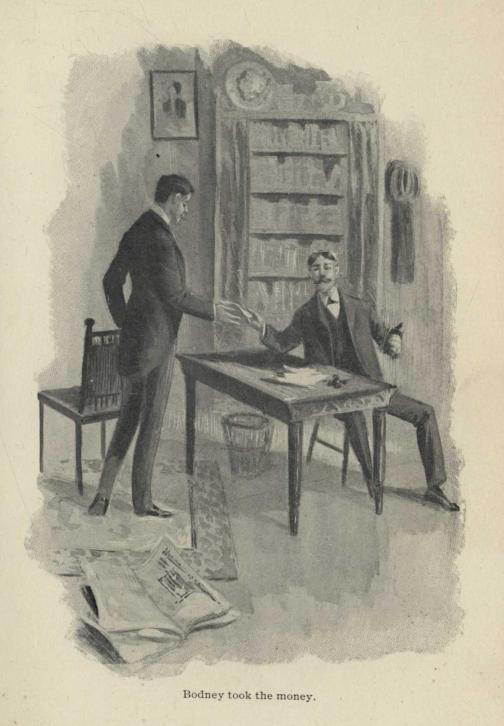
Bodney took the money.
"Yes, I think so—in fact, he remarked that he was going home to do some work. Why?"
"Nothing, only he seemed interested in the young fellow I sat up with—wanted to go with me to see him, in fact."
With a determination to pay the druggist and to go at once to Bradley's house, Bodney left the office, still wondering, though, what had become of his resolve to make a confession to Howard. But he would fortify himself against trivial annoyances and then, morally stronger, he could confess. As he was crossing the street he thought of the fellow who had won sixty dollars. "No better player than I am," he mused. "He hung on, that's all. Now, when I pay the preacher and the druggist I'll have five dollars left. And with that five dollars I might win out. If I had held to my resolution not to stay in on so many four flushes I might have won out anyway. But the other fellows filled flushes and straights against me. Why couldn't I against them? Simply because it wasn't my day. But this may be my day. My day must come some time. As that fellow said, 'they can't beat a man all the time.' Why not go to the club first? Then, if I win, I can easily meet my obligations."
He went to the club. The game was full, but a "house" player got up and gave him a seat. He bought ten dollars' worth of chips, and the first hand he picked up was three queens. The pot was opened ahead of him and another man came in. Bodney raised; they stood it, and drew one card each. To disguise his hand, Bodney drew one, holding up a six. He caught a six. The opener bet a white chip. The next man raised him three dollars. Bodney raised all he had. The opener laid down; the other man studied. "Is it that bad?" he asked, peeping at the tips of his cards. Bodney said nothing; his blood was tingling, but in his eyes there was a far-away look.
"It's up to you, Griff," said an impatient fellow.
"Yes, so I see; but I'm playing this hand. Raised it and drew one card, then raised a one-card draw. Well, I've got to call you."
"Queen full."
"Beats a flush. Take the hay."
And now Bodney's troubles all were luminous. The wine of the game flowed through his veins and made his heart drunk with delight. He held a pat flush, won a big pot and felt a delicious coolness in his mind, the chamber wherein he had groped through darkness, searching for the lost resolution. But now it was light, and was crowded with charming fancies. He bubbled wit and simmered humor, and the look-out man said, "you bet, he's a good one." His stack was building so high that he could hardly keep from knocking it over—did overturn it with a crash, and a loud voice called to the porter: "Chip on the floor." The man attendant upon the desk came over, put his hand on Bodney's shoulder and said: "Give it to 'em; eat 'em up."
In the game there was a mind-reader, and they called him Professor. In his "studio" he told marvelous things, brought up the past and read the future. Hundreds of persons consulted him, race-track men looking for tips, board of trade men wanting to know the coming trend of the market; and in the twilight came the blushing maiden to ask if her lover were true. In deepest secret you might write a dozen questions, put them in your pocket and button your coat, but the Professor could read them. He was unquestionably a mind-reader—till he sat down to play poker—and then his marvelous powers failed him. The most unintuitive man at the table could beat him. Bodney slaughtered him. "Can you make those things every time?" said the Professor, calling a three-dollar bet.
"Not every time," Bodney replied, spreading a straight, "but I made it this time."
"You can make them every time against me. You are the luckiest man I ever saw. Do you always win?"
"I have lost more within the last two months than any man that comes up the stairs."
"That's right," said the look-out.
One wretched fellow, who had been struggling hard, got up broke. He strove to appear unconcerned, but despair was written on his face. As he walked across the room toward the door the man at the desk called to him. He turned with the light of a vague hope in his eye. In consideration of his hard luck was the house about to stake him? "Have a cigar before you go," said the man at the desk. The light went out of the wretch's eye. He took the cigar and drooped away, to beg for an extension from his landlord, to plead with the grocer, to lie to his wife.
At six o'clock Bodney cashed in one hundred and four dollars. He would eat dinner with them, but he would not play afterward. He had tried that before. His eye-tooth had not only been cut; it had been sharpened to the point of keenest wisdom. While he was at the dinner table Goyle came in and took a seat behind him.
"Understand you sewed up the game," said the master.
"I've got just about enough to pay up what I owe," replied the slave.
"Come off. Let me have twenty."
"I can't do it—swear I can't. I owe all round town. I let you have ten yesterday, you know."
"That's all right. You'll get it again—you know that. Let me have twenty."
"I can't possibly do it."
But he did. Goyle got up and walked out into the hall with him, put his hand on his arm and stood a long time, talking, gazing into his eyes. So Bodney gave him the money and hastened away, his spirits somewhat dampened. But his heart was still light enough to keep him pleased with himself. Luck had surely turned. He would win enough to replace the money taken from the safe, and then he would make a confession. But, that fellow Goyle! What was the secret of his infatuating influence? How did he inspire common words with such power, invest mere slang with such command? But his influence could not last; indeed, it was weakening. And when thus he mused his heart grew lighter. "He couldn't make me aid and abet a robbery now," he said. "I would turn on him and rend him. Let him take the money. The debt is now large enough to make him shun me." With a smile and a merry salutation he stepped into the drug store, and handed the druggist ten dollars, apologizing for not having called during the day, but he had been busy and did not suppose that it would make any particular difference. The druggist assured him that it did not. Good fortune in its many phases may be taken as a matter of course, but the return of borrowed money is nearly always a surprise. The druggist gave him a cigar.
"Thank you," said Bodney. "By the way, have you an envelope and stamp?"
He found an envelope, but no stamp. A young woman who had held his telephone for ten minutes had bought the last one. It was of no consequence; Bodney could get one at the next corner. Tearing a scrap of paper out of his notebook and putting it upon a show case, he scribbled a few lines upon it, folded a ten dollar note in the paper, enclosed it in the envelope and directed it to Bradley.
"I guess that ought to be safe enough," he said.
"I don't know," replied the druggist.
"Well, I'll risk it. Again let me thank you for your kindness. It isn't often that I am forced to borrow, and wouldn't have done so last night but for—"
"Oh, that's all right. Come in again," he added, as Bodney stepped out. At the next corner he stamped his letter and went out to drop it into a box, but before reaching it was accosted by someone, the Professor whom he had slaughtered in the game.
"How did you come out?" Bodney asked.
"You broke me."
"Didn't you sit in after dinner?"
"For about three minutes—first hand finished me. I see you have a letter there with ten dollars in it."
"What! How do you know?"
"And a note written with a pencil."
"Why, that's marvelous. How do you do it?"
The Professor smiled. "It is the line of my business. Why don't you come up to my place some time? I can tell you many things."
It flashed through Bodney's mind that he might tell him many things, and he shrank back from him. "I will, one of these days," he said, and strode off without dropping his letter into the box. He put it into his pocket, intending to stop at the next corner, but forgot it. "Now, what?" he mused. "Believe I'll go home." He got on a car, but stepped off before it started. He went to a hotel, into the reading room, and took up a newspaper, but found nothing interesting in it. His thoughts were upon the game. In his mind was the red glare of a pat diamond flush. He could see it as vividly as if it had been held before his eye. Was it prophetic? He strolled out, not in the direction of the Wexton Club; but he changed his course, and was soon mounting the stairs. There was no seat, but the man at the desk said that there were enough players to start another game. The game was organized with four regulars, Bodney and another fool. The regulars took twenty dollars' worth of chips apiece; the two fools took ten, and within ten minutes Bodney was buying more. A man got up from the other table, and Bodney returned to his old seat, where he knew that luck waited for him. The desk man came over to him. "That other gentleman is number one," said he. Just then a new arrival took the seat which Bodney had vacated and number one called out: "Let him go ahead. I'll stay here." And there, sure enough, was the pat diamond flush. Wasn't it singular that he should have seen it glowing upon the surface of his mind? And wasn't it fortunate that the pot was opened ahead of him? He raised and the opener stayed and drew one card. He bet a white chip and Bodney raised. The opener gave him what was termed the "back wash," re-raised. Then the beauty of the flush began to fade. Could it be that the fellow—the very same offensive fellow, who had beaten him before—could have filled his hand? Or, had he drawn to threes and "sized" Bodney for a revengeful "bluff?"
"Well, I'll have to call you," said Bodney. He put in his money and the offensive fellow showed him a ten full.
"You always beat me."
"I do whenever I can."
"But you make it a point to beat me."
"Make it a point to beat anybody."
"Well, I don't want any abuse and I won't have it."
"Play cards, boys," said the look-out.
"What's the matter with you, worms?" said the offensive fellow, looking at Bodney.
"Play like brothers," spoke up the look-out.
At a little after eleven o'clock Bodney came down as heavy as a drowned man. His heart was full of bitterness. He cursed the world and all that was in it. He called on God to strike him dead. Then he swore that there could be no God; there was nothing but evil and he was the embodiment of it. But if he had only ten dollars he could win out. He had won, and it was but reason to suppose that he could win again. Any old player, imbued with the superstitions of the game, would have told him that to go back was to lose. "I'll go over and see that druggist again," he mused. "Strange that I have lived in this town all my life and don't know where to get money after eleven o'clock at night. I ought to have set my stakes better than that. And now, what excuse can I give for coming back to borrow again so soon? Perhaps he isn't there." Nor was he there. Bodney looked in with anxiety toward the show case behind which he expected to see his friend, and with contempt at the soda-water man. He thought of the envelope. He pictured himself standing there, smiling, a few hours before—and like an arrow came the recollection of the note directed to the preacher. He wheeled about, rushed across the street, jostling through the crowd which was still thick upon the sidewalk, raced around the corner, swam through another crowd, bounded across another street just in front of a cable train, and, breathless, panted up the stairway leading to the Wexton. Before touching the electric button he tore open the envelope, took out the money, destroyed the note; he touched the button and wondered if the black porter would ever come. Undoubtedly the game must have broken up. No, there was the black face, grim in the vitreous light. And there was a vacant seat, his old, lucky seat.
"Bring me ten," he called, as he sat down. And addressing the look-out, he asked if Goyle had been there. He had played a few pots after dinner, but had quit early.
"Did he win?"
"I think he win a few dollars. Said he had an engagement on the West Side."
"Leave me out," said a man, counting his imposing stack of chips. "Never mind, I'll play this one." A hand had been dealt him. "But I've got to go after this hand; oughtn't to stay as long as I do. Got to catch a train. Who opened it?"
"I did," replied a regular.
"Raise you."
"So soon? Well, I'll have to trot you. Tear me one off the roof."
"I'll play these," said the man who had to catch a train.
"You'd better take some. He won't come round again. Well, I'll chip it up to you."
"Raise you three."
The regular raised him back. The man who had to go raised, and the regular fired back at him, nor did the contest end here, but when it did end the regular spread an ace full to overcast with the shade of defeat three queens and a pair. And the man who had been in a hurry continued to sit there. At short intervals, during half an hour or more, he had snapped his watch, but he did not snap it now. Trains might come and trains might go, but he was not compelled to catch them; he lost his last chip, bought more, lost, and, finally, accepted carfare from the man at the desk. Bodney won, and the world threw off its sables and put on bright attire, and at two o'clock he thought of cashing in, though not quite even. He lacked just seventy-five cents—three red chips. He would play one more pot. He lost, and now he was two dollars behind, the pot having been opened for a dollar and twenty-five cents. Pretty soon he had a big hand beaten.
"I see my finish," he said.
"You can't win every pot," replied a railway engineer, who had failed to take out his train. "I have four pat hands beat and every set of threes I pick up. Serves me right. Pot somebody for a bottle of beer."
"You're on," replied the dealer, a comical-looking countryman, known as Cy. "Deal 'em lower, I can see every card," someone remarked; and just at that moment Cy turned over a deuce and replied: "Can't deal 'em much lower than that, can I?"
But who is this going down the stairs just as daylight is breaking? And why is he making such gestures? It is Bodney, and he is swearing that he will never play again.
CHAPTER XIII.
WANTED TO SEE HIS SON.
Howard had shared his father's sentiment with regard to the old office, for then the sky was clear, but now a cloud had come the atmosphere was changed. And on his way home to dinner, after a day spent without progress, he formed a resolve to tell the old gentleman that he needed a fresher and a brisker air than that blown about the ancient temple of lore. It ought not to hurt him now since he had begun to look upon his son with an eye so dark with censure. Even if his affection had been withdrawn his blood-interest must surely still remain, the young man mused; even though sentiment were dead, there must remain alive a desire to see him prosper, and to prosper in that old place was impossible. He believed that his father was losing his mind; years of dry opinion, of unyielding fact and the dead weight of precedent growing heavier, smothered his mental life.
The household, with the exception of the Judge, was at dinner, and when Howard entered the dining room his mother arose hastily and came to meet him. "Your father wants to see you in the office," she said, and putting her hand on his arm, she added: "I don't know what he wants, but no matter what it is, please bear with him—don't say anything to annoy him."
"Has anything happened?" Howard asked.
"Something, but I don't know what. Someone called, I heard loud talking in the office, and after the caller had gone, your father came out and said that he wanted to see you as soon as you arrived. Be gentle with him, dear."
The old gentleman was sitting at his desk when Howard entered the office. He got up and for a time stood looking at the young man with no word of explanation. "Well, sir," he said, after a time, "what will you do next?"
"What have I done now?"
"No quibbling, sir. You know what you have done."
"I pledge you my honor I do not."
"Pledge me your what! Pledge me your old clothes, but not your honor."
"You wanted to see me, so mother says, and now I should like to know why."
"I suppose that you are so innocent that you can't even guess. Or is it that you are so forgetful of your deeds that you cannot remember? Why did you send that old fool out here?"
"Send an old fool out here! I didn't send anyone."
The old man took a step toward him with his finger uplifted. His eyes were full of anger and his finger shook, a willow in the wind. "How can you deny it? You sent old Dr. Risbin, the morphine eater, out here to see me."
"Oh, did he come out here? But I swear I did not send him. In fact, I told him not to come."
"Ah, and is that the reason he came—because you told him not to? He was never here before in his life, and why should he say that you sent him?"
"Because he is a poor old liar, I suppose. I admit that I saw him in his office and—"
"A gradual acknowledgment is better than no acknowledgment at all. Why did you see him in his office, or why did you speak of me?"
"Father, if you'll only be patient with me I will tell you. Your bearing toward me has been distressful. I was afraid that your mind—"
"Enough of that. My mind is sounder, sir, than yours will ever be. But, suppose something were wrong. Is he the physician to consult? Why, his mind has been dead for years. Why did you consult him if it were not in contempt of me? I ask you why?"
"I was standing in the door of our office and happened to notice his sign just across the hall; and I thought that as he knew you well, I would speak to him. I soon saw that he didn't know what he was talking about, and when he suggested that he ought to see you, I told him no, and changed the subject. That's my offense, and I beg your pardon."
"I will try to believe you," said the Judge, sitting down. "Your office is down town. This one is mine."
"Yes, sir, and I will not intrude. I wouldn't have come in but you wanted—"
The Judge waved his hand. "Our business has been transacted."
"Yours has, but I have something to say. I don't want to occupy that musty old den any longer. It doesn't make any difference to me if there are a thousand javelins of wit sticking in the walls, or a thousand ghosts of oratory floating in the air, I can't make a living so long as I stay in it. I don't want to be of the past, but of the present. Your success was not a past but a present, and my present is as valuable to me as yours was to you."
"You are at liberty to get out of that office as soon as you like. But before you go, put up some sort of emblem expressive of your contempt of all its memories. Stuff out a suit of old clothes with straw, a scarecrow of the past, set it at the desk and call it—me."
"Please don't talk to me that way. I don't mean any disrespect—I want to establish myself on a modern footing. You know that Florence and I—"
"Don't speak of her."
"Why not? She is to be my wife."
"Not with my consent."
"Your consent is desirable, but not absolutely necessary. I don't mean this in impudence; I mean it merely to show my—our determination. I don't know why you should oppose our marriage, and I have no idea as to what extent you will oppose it, but I wish to say that no extreme will have any effect. You say that you are not ill; you swear that your mind is not affected, and yet you refuse to tell me the cause of your change toward me. I must have done something, either consciously or unconsciously, and now again I beg of you to tell me what it is."
The old man leaned forward with his eyes bent upon the floor. "I have seen great actors, but this—go away, Howard. Leave me alone."