SECOND VISIT TO BRAZIL.
Reading edition
Before I begin the Journal of my Second Visit to Brazil, from which I was absent a year and three days, it will be necessary to give a short account of the principal events which took place during that year, and which changed the government of the country.
The Prince Regent had in vain sent the most pressing representations in favour of Brazil to the Cortes. No notice whatever was taken of his despatches; and the government at Lisbon continued to legislate for Brazil as if it were a settlement on the coast of savage Africa. The ministers who had served Don John had seen enough of the country, during their residence in it, to be persuaded that Brazil, united, was at any time competent to throw off all subjection to the mother country; the object, therefore, became to divide it. Accordingly a scheme for the government of Brazil was framed, by which each captaincy should be ruled by a junta, whose acts were to be totally independent on each other, and only recognisable by the authorities in Portugal; and the Prince was ordered home in a peremptory and indecent manner. I have mentioned in my Journal the reception those orders had met with, and the resolution His Royal Highness had adopted of staying in Brazil. As soon as this resolution became known to the provinces, addresses and deputations poured in on all sides from every town and captaincy, excepting the city of Bahia and the province of Maranliam, which had always had a government independent of the rest of Brazil.
In December, 1821, the King had appointed General Madeira governor of Bahia and commander of the troops. He entered on his office in February; and shortly afterwards the first actual warfare between the Portuguese and Brazilians began in the city of St. Salvador, on the 6th of the month, when the Brazilians were defeated with some loss.[95] Meantime, the province of St. Paul's had made every exertion to raise and arm troops; and early in February 1100 men marched towards Rio, to put themselves at the disposal of the Prince. Some recruits for the seamen and marine corps were raised, and a naval academy established, the object of all which was to prevent the carrying away the Prince by force. It was now thought advisable that the Prince should visit the two most important provinces, St. Paul's and the Mines; and on the 26th or 27th of March he left Rio for that purpose, leaving the executive government in the hands of the minister José Bonifacio. His Royal Highness was received every where with enthusiasm, until he arrived at the last stage, on his way to Villa Rica, the capital of the province of Minas Geraes; there he received intelligence of a party raised to oppose his entrance by the Juiz de Fora, supported by a captain of one of the regiments of Caçadores. He immediately caused some troops to be assembled and joined with those which accompanied him, and then remained where he was, and sent to the camara of the town, to say he was able to enter by force, but had rather come among them as a friend and protector. Several messages passed; the conspirators discovered that the Prince was, indeed, sufficiently strong to overpower them; and besides, they met with no support, as they had hoped, from the magistrates or people. His Royal Highness, therefore, entered Villa Rica on the 9th of April, and on the magistrates and people attending to compliment him, he addressed them thus:—
"Brave Mineros! The shackles of despotism, which began to be loosened on the 24th of August in Porto, are now bursting in this province. Be free,—be constitutional! Unite with me, and proceed constitutionally. I rely entirely on you. Do you depend on me. Let not yourselves be deluded by those who seek the ruin of your province, and of the whole nation.
Viva, The Constitutional King! Viva, Our Religion! Viva, All honest men! Viva, The Mineros!"
The next day the Prince held a general court, and remained eleven days at Villa Rica. The only punishment inflicted on the conspirators, was suspension from their offices; and this royal visit attached this province to him, as firmly as those of St. Paul's and Rio.
He returned to Rio de Janeiro on the 25th, where he was received in the most flattering manner, and where he became daily more popular; and on the 13th of May, King John's birth-day, the senate and people bestowed on him the title of Perpetual Defender of Brazil, and thenceforward his style was, Constitutional Prince Regent, and Perpetual Defender of the Kingdom of Brazil.
The impossibility of continuing united to Portugal had become daily more apparent. All the southern provinces were eager to declare their independence. Pernambuco and its dependencies had long manifested a similar feeling, and the province of Bahia was equally inclined to freedom although the city was full of Portuguese troops under Madeira, and receiving constant reinforcements and supplies from Lisbon.
The Cortes seemed resolved on bringing matters to extremities; the language used in their sessions, with respect to the Prince, was highly indecent. Such commanders either by sea or land as obeyed him, unless by force, were declared traitors, and he was ordered home anew within four months, under pain of submitting to the future disposition of the Cortes; and they decreed that the whole means of government should be employed to enforce obedience. The Brazilian members did indeed remonstrate and protest formally against these proceedings; but they were over-ruled; and the spectators in the galleries, on one occasion, went so far as to cry, "Down with the Brazilian!"
In the months of June and July, Madeira began to make sallies into the country around Bahia, as if it had been possessed by an enemy; and, indeed, he quickly found one most formidable. The town of Cachoeira, large and populous, and intimately connected with the hardy inhabitants of the Certam, soon became the head-quarters of crowds of patriots, who assembled there, and resolved to expel the Portuguese from their capital.
They began to form regular troops; but though they were abundantly supplied with beef and other provisions, they were in want of arms and ammunition, and sent to Rio de Janeiro to represent their situation to the Prince, and request assistance. They were also in great distress for salt to preserve their provisions; and as to accoutrements, raw hides supplied the place of almost every thing. An apothecary, in Cachoeira, shortly began to boil sea-water in sugar-coppers, to make salt, and soon reduced the price of that article, so that the quantity at first sold for ten pataccas (eighteen shillings) fell to seven vintems (seven pence). The same apothecary, collecting all the salt-petre in the neighbourhood, applied himself to making of gunpowder, and a fortunate discovery of some hundred barrels smuggled into Itaparica by some English, was of essential use to them. But they had no cannon, no lead for ball for their muskets and matchlocks; the lead, indeed, and a quantity of gun-locks, their friends within the city contrived to smuggle to them; and their guns were supplied in the following manner. In each engenho, there was an old gun or two for the purpose of balancing some part of the machinery; these were at once sent to Cachoeira, where, being cleaned and bushed by an ingenious blacksmith, they were rendered serviceable; and the patriots ventured to take the field against Madeira's parties, even before the arrival of any assistance from Rio.
Meantime, news of these transactions arrived at Rio, as well as notice of the decrees of the Cortes at Lisbon. The Prince and people no longer hesitated. His Royal Highness, together with the senate, issued proclamations on the 3d of June, calling together a representative and legislative assembly, to be composed of members from every province and town, to meet in the city of Rio; and on the first of August he published that noble manifesto, by which the independence of Brazil was openly asserted, the grounds of its claims clearly stated, and the people exhorted to let no voice but that of honour be heard among them, and to let the shores, from the Amazons to the Plata, resound with no cry but that of independence. On the same day, a decree was put forth to resist the hostilities of Portugal, containing the following articles:—1st, All troops sent by any country whatever, without leave obtained from the Prince, shall be accounted enemies: 2d, If they come in peace, they shall remain on board their ships, and shall not communicate with the shore; but, having received supplies, shall depart: 3d, That in case of disobedience, they shall be repulsed by force: 4th, If they force a landing in any weak point, the inhabitants shall retire to the interior, with all their moveables, and the militia shall make war as guerillas against the strangers: 5th, That all governors, &c. shall fortify their ports, &c.: 6th, Reports to be forthwith made of the state of the ports in Brazil, for that end.
This last decree had been anticipated by the Pernambucans, who had marched a body of troops to the assistance of the patriots of Cachoeira, and a most harassing warfare was commenced against the Portuguese in St. Salvador: these last had received a reinforcement of seven hundred men on the 8th of August; but they had hardly had time to exult in their arrival, when a squadron from Rio Janeiro disembarked at Alagoas 5000 guns, six field-pieces, 270,000 cartridges, 2000 pikes, 500 carbines, 500 pistols, 500 cutlasses, and 260 men, chiefly officers, under Brigadier-general Lebatu[96], who soon joined the patriots, and fixed his head-quarters at Cachoeira, having stretched a line of troops across the peninsula on which the town is placed, and thus cut it off from provisions on that side; but the sea being still open, supplies were abundant, not only from abroad, but from the opposite island of Itaparica. That fertile district, however, was soon occupied by the Brazilians; and Madeira had only his supplies from seaward, unless he could by force dislodge the Brazilians from their quarters on that island.
The cabinet of Rio became sensible that it was necessary to provide a naval force, if they wished to preserve the kingdom from the farther attacks of Portugal, or to dislodge the enemy from his strong-hold in Bahia. Accordingly, the agents of the government in England were employed to engage officers and men: some were collected on the spot; others, such as Captain David Jewet, from Buenos Ayres and America, were instantly employed; and all exertions were made to repair such of the ships left behind by King John as would bear the repairs.
At length, on the 12th of October, the birth-day of the Prince, the troops being, as usual, assembled in the great square of Santa Anna, and a great concourse of people attending, the Prince was suddenly hailed Emperor of Brazil, and the kingdom changed in style and title, and all dependence on, or connection with Portugal, for ever abjured.
This event seemed to give new spirit to the war of Bahia: as it exasperated the Portuguese, so it encouraged the Brazilians, now assured of independence. Madeira, resolved, if possible, to gain a communication with Nazareth on one of the rivers of the Reconcave, which is most fertile, and furnishes abundance of farinha, sent one hundred men of the Caçadores, under Colonel Russel, to attempt to gain possession of the Ulha do Medo, which commands the Funil, or passage between the mainland and Itaparica leading to Nazareth; but their boats grounded, and they were obliged to wait for the tide, while the Brazilians, who are excellent marksmen, and were concealed among the bushes ashore, picked them off at leisure. Another expedition, equally unfortunate, was sent with a large gun-vessel to Cachoeira, and arrived off the public square, just as it was filled with people proclaiming the Emperor. The guns began to play on the mob; but the tide was low, and the shot, instead of reaching the people, only struck the quays, and did little damage. The Brazilian soldiers now crowded to the wharfs, and thence commenced so brisk a fire on the enemy, that the commander of the vessel retreated hastily without killing a man, though he lost many. In this action Dona Maria de Jesus distinguished herself; for the spirit of patriotism had not confined itself to the men.[97]
The most considerable expedition sent by Madeira from Bahia was to the Punto de Itaparica, the possession of which was becoming daily more important, as the provisions in the town diminished. For this purpose 1500 men were embarked on board the Promtadao, and two other brigs of war; they were to land half on one side and half on the other of the little peninsula forming the Punto, on which there is a small fort and town, which the troops were to attack while the brigs fired on the fort. The passage from Bahia to this point is usually of six or seven hours at most, allowing for a contrary wind; but these vessels were two days in reaching it, by which time the Brazilians had thrown up heaps of sand; behind which they lay concealed, and deliberately fired on the Lusitanians as they passed, and committed great slaughter, without the loss of a man, though they had several wounded. This action, if it may be called so, took place on the 2d of January, 1823, and lasted from noon till sunset.
Meantime the land side of the city had been harassed by continual attacks, and the troops worn out with constant watching; for the Brazilians were continually riding about in the woods, and beating marches, and causing their trumpets to sound to charge in the night, and by the time the enemy could reach the spot they were fled. On the 18th of November, 1822, however, Madeira made a sortie, and was met by the Brazilians at Piraja, between two and three leagues from the city, when a severe action took place, with some loss on both sides, and both claimed the victory; but as the Lusitanians retired to the town, and the Brazilians took up new positions close to the city gates, the advantage must undoubtedly have been on the side of the latter. Meantime the scarcity of fresh provisions was such, that all the foreign merchants who had families, and who could by any means remove, did so. All the country-houses were abandoned, and the people crowded into the town. The heaviest contributions were levied on all natives and foreigners, and the misery of a siege was coming upon the city.
Rio de Janeiro presented a very different spectacle. The inhabitants were decorating their town with triumphal arches for the coronation of their Emperor, who, on the 1st of December, was solemnly crowned in the chapel of the palace, which serves as the cathedral; and it is no exaggeration to say, that the whole of southern Brazil presented one scene of joy.
The ministers, no less than the monarch, were beloved. The finances began to assume a flourishing aspect: large subscriptions flowed in from all quarters for the equipment of a fleet; and an invitation had been sent to Lord Cochrane to command it. The Emperor had accepted the most moderate income that ever crowned head was contented withal[98], in order to spare his people. He visited his dock-yards and arsenals himself; attended business of every kind; encouraged improvements in every department, and Brazil had begun to assume a most flourishing aspect. Such was the state of things when I arrived for the second time in Brazil, along with Lord Cochrane, on the 13th of March, 1823.
March 13th, 1823. On board the Col. Allen, at anchor in Rio de Janeiro.—One of the most windy and rainy days that I ever remember seeing in Brazil; so that the beautiful landscape of the harbour is entirely lost to the strangers from Chile, and I cannot get ashore either to provide lodgings for myself and my invalid[99], or to assist my friends in any way. When the officer of the visiting boat came on board, the captain of the ship showed him into the cabin, and left him with me. I found he spoke English, and immediately began to enquire of him concerning the news of Rio. And first he mentioned the coronation of the Emperor, and then the war at Bahia; on which I questioned him very closely, on the ground of having formerly visited the place. It appears that last night only His Imperial Majesty's ships Unaŏ, (now Piranga,) Nitherohy, and Liberal, with a fleet of transports, had returned from Alagoas, where they had landed reinforcements for General Labatu; whose head-quarters are at Cachoeira, and who is investing the city of Bahia closely. General Madeira has a strong force of Portuguese soldiers, besides 2000 seamen which occasionally do duty ashore, and a considerable naval force.[100] But it appears, that the seamen are on the point of mutining for want of pay. Having told me so much, the officer began to question me in my turn,—Did I come from Chile? Did I know Lord Cochrane? was he coming to Rio? for all eyes were turned towards him. When he found that His Lordship was actually on board, he flew to his cabin door, and entreated to kiss his hands; then snatched his hat, and calling to the captain to do as he would, and anchor where he pleased without ceremony, jumped over the side to be the first, if possible, to convey to the Emperor the joyful intelligence. Nearly the same scene was acted over when Perez, the port-captain, came on board; and in a few minutes Captain Garçaŏ of the Liberal came to pay his respects, and shortly afterwards Captain Taylor of the Nitherohy, from whom we learned something more of the state of His Imperial Majesty's fleet. The Pedro Primeiro, formerly the Martim Freitas, had been left by the King in want of thorough repair; this she has had, and came out of dock yesterday; she is said to sail well. The Caroline is a fine frigate, but not commissioned, for want of men. The Unaŏ is a very fine ship, wants copper, and is commanded by Captain Jewitt. The Nitherohy is a corvette, well found, and in good repair, but a heavy sailer; and the Maria da Gloria, a fine corvette, is commanded by a French officer, Captain Beaurepair. The great difficulty the navy here has to dread is the want of men.[101] Portuguese sailors are worse than none; few Brazilians are sailors at all, and French, English, and Americans are very scarce. The Emperor is fond of the navy, and very active in looking into every department. He is often in the dock-yards by daylight, and the Empress generally accompanies him.
Their Majesties appear by all accounts to be highly popular. Their youth, their spirit, the singular situation in which they are placed, are all interesting. It is seldom that a hereditary prince, ventures to stand forth in the cause of freedom or independence; and a son of the house of Braganza, and a daughter of that of Austria, leading the way to the independence of this great empire, cannot but excite the love as well as the admiration of their fortunate subjects.
The weather cleared up in the afternoon, and I went ashore to see if I could find any of my old friends, or hear any news; but all the English were gone to their country-houses, and the opera, the proper place for gossip, is shut, because it is Lent; so I returned to the brig, and found Lord Cochrane ready to go ashore to wait on the Emperor, who had come in from San Cristovaŏ to meet him at the palace in town. His Lordship and Captain Crosbie, who went with him, did not return till late, but then well pleased with their reception.
March 14th.—Another day of such heavy rain, that I have no chance of landing my invalid. Mr. May came on board, and told me I might have Sir T. Hardy's house for a few days, till I can get one for myself. He also gives us good accounts of the government, its finances, &c.
An embargo has been laid on all vessels to-day, to prevent the news of Lord Cochrane's arrival from reaching Bahia.
15th.—I went early ashore to prepare for leaving the brig. I observed two of the arches, under which the Emperor had passed on the day of coronation, designed in extremely good taste, and well executed. They are of course only temporary. Some more solid works have been executed, since I last saw Rio; new fountains opened, aqueducts repaired, all the forts and other public works visibly improved, and the streets new paved. There is besides every where an air of business, I carried Glennie ashore in the afternoon, and was foolish enough to feel very sorry to leave my fellow-passengers, and still more foolish to be vexed at the perfect indifference with which they saw me go: both perhaps natural enough. I, am once more without any one to lean to, and alone in the world with my melancholy charge; they, have business and pleasure before them.
It was a fine evening, and the little voyage in the boat to Botafogo seemed to do Glennie good; but we had the mortification to find that neither the provisions I had bought in the town had arrived, nor the servant one of my friends had promised to procure me. So we were alone and supperless,—but, thank God, not helpless. I have learned so much in my wanderings as not to be dependent; and so, after a time, I had from the huckster’s shop in the neighbourhood a tolerable tea to give my invalid, and sent him to bed in pretty good spirits, and took time afterwards to be pretty miserable myself.
March 20th.—These past days I have employed in looking about for a house, and have succeeded, in receiving and returning the visits of my old acquaintance, and in being very unwell.
I hear there is nothing yet settled about Lord Cochrane’s command. The world says that he was asked to serve under two Portuguese admirals and for Portuguese pay. Of course, these are terms he could never accept. I have not seen him, so am not sure about this. I suppose, however, it is true; or he would not still be living on board that dirty little brig in which we arrived.
21st.—Whatever difficulties were in the way of Lord Cochrane’s command, they are over. I have a note from him announcing that he hoists his flag at four o’clock this afternoon, on board the Pedro Primeiro.[102]
22d.—Captain Bourchier of His Majesty’s ship Beaver kindly lent me his boat to-day, to convey me with my cousin and my goods to my cottage on the Gloria hill, close to Mr. May's, and not very far from the house the government has given as a temporary residence to Lord Cochrane. It is pleasant to me on many accounts: it is cool, and there is a shady walk for the sick. It is almost surrounded by the sea, which breaks against the wall; and not being near any road, we shall be perfectly quiet here.
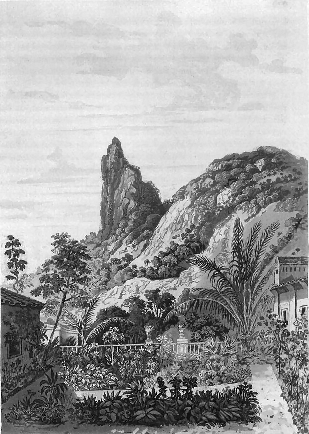
View of the Corcovado.
Friday, 28th.—This has been a busy week, both to me and to my friends, who are hurrying every thing to get to sea as quickly as possible; as it is of the utmost consequence to free Bahia of the enemy.
Saturday, 29th.—His Majesty's ship Tartar, Captain Brown, arrived to-day from England, bringing no good news of any kind. In the first place, Lord Cochrane suffers extreme distress on learning that Lady Cochrane and her infant daughter are on their way to Chile, so that they will have to perform the rough passage round Cape Horn twice before he sees them;—and in the next, Captain Brown gives a most formidable account of a Portuguese fleet bound for Bahia, which he met on this side of the line. I trust he is mistaken in the last, and I try to comfort Lord Cochrane as to the first piece of intelligence, by suggestions, of the probability, if not certainty, that the ship Lady Cochrane will sail in, must touch in this port; however, his natural anxiety is not to be overcome.
Monday, March 31st.—Yesterday the Pedro Primeiro dropped down the harbour, as far as Boa Viage, and to-day I went with Lord Cochrane on board of her. We found that the Emperor and Empress had been on board at daylight. On some of the Portuguese officers complaining that the English sailors had been drunk the day before, the Empress said, "Oh, 'tis the custom of the North, where brave men come from. The sailors are under my protection; I spread my mantle over them." The Pedro Primeiro is a fine two-decker, without a poop. She has a most beautiful gun-deck; but I could not see her to advantage, as she was still taking in stores, and receiving men. Her cabins are beautifully fitted up with handsome wood and green morocco cushions, &c.; and I am told the Emperor takes great pride in her. Captain Crosbie commands her; and three lieutenants who came with us from Chile are appointed to her.
April 1st.—I had expected the Admiral to breakfast with me; but, to my great disappointment, I saw the ship get under weigh, and sail. I afterwards learned that the Emperor and Empress were on board, and accompanied him out of the harbour as far as the light-house, so that he could not leave them. The morning was dull and grey when the Pedro Primeiro, the Maria da Gloria, the Unaŏ, and the Liberal got under weigh; but just as the little squadron came abreast of Santa Cruz, and the fort began to salute, the sun broke from behind a cloud, and a bright yellow flood of light descended behind the ships to the sea, where they seemed to swim in a sea of glory; and that was the last sight I had of my kind friend.
10th.—Nothing of any note or variety has taken place during these ten days. Glennie is gaining ground: I write and read, and attend to him. The Nitherohy sails to-morrow to join Lord Cochrane off Bahia, with three mortars on board, two 10, and one 13-inch. I find, with surprise, that the cartridges are still made up here in canvass, not flannel; and I fear that the ships are not so well found as I wish them: great part of the canvass and cordage have been seventeen years in store, and, I should fear, partly rotten. But all this is nothing to the evil attending the having Portuguese among the crews. 'Tis not natural they should fight against their countrymen.
I have had the pleasure of reading Peveril of the Peak within these few days. 'Tis a sort of historical portrait, like Kenilworth, where the Duke of Buckingham, he who
"In one revolving moon Was hero, fiddler, statesman, and buffoon,"
is the principal figure: Charles II. and the rest of the court serve for the black boy and parrot in costume; while the story of Peveril is nothing more than the carved-work frieze of the very pleasant apartment he has been placed in.
14th.—The Fly sloop of war, and the packet from England, came in and brought the news of the war between France and Spain. This news is, of course, interesting here, as Portugal is considered to be implicated in the disputes in Europe; and then, the part England may take, and how that may affect this country, is a subject of anxious speculation. The more domestic news is not quite agreeable. The Imperial General Lecor, in the south, has suffered some loss in an action with the Portuguese: however, it is not considerable enough to give any serious uneasiness. The same vessel that brought the news from Lecor, also gives intelligence that the head of the Buenos Ayrian government, Rodriguez, having taken the field against some Indian tribes, who have lately committed great ravages in his territories, an attempt was made by one of the ex-chiefs to subvert his government; happily, without success. I say happily, because I am convinced that every week and month passed without change, is of infinite consequence both to the present and future wellbeing of the Spanish colonies. While they had still to struggle for their independence, while they had to amend the abuses of their old government, frequent changes were unavoidable, but natural; but now that they are independent, and that they have constitutions, which, if not perfect, contain the principles of freedom and greatness, those principles should have time and peace to grow, and to suit themselves to the genius of the people.
15th.—Glennie has been gaining so much strength lately, that he has determined on joining the Commodore at Bahia; and this day he left me, to sail in His Majesty's ship Beaver.
After having had him to attend to for six months, and being used to constant intercourse with an intelligent inmate, I feel so very lonely, that I believe I must leave off some of my sedentary habits, and visit a little among my neighbours.
25th.—A French brig of war came in to-day from Bahia. We learn that the ships seen by the Tartar were only a frigate, with a convoy of transports, on board of which was a reinforcement for Madeira of 1500 men. They will but increase the distress of the garrison, which is represented as very great, as they have brought no provisions.
28th.—I spent the day with Miss Hayne, and accompanied her in the evening to compliment Dona Ana, the wife of Senhor Luis Jose de Carvalho e Mello, on her birth-day. The family were at their country-house at Botafogo; and a most excellent house it is, very handsomely built and richly furnished. The walls are decorated with French papers in compartments, with gold mouldings, and every thing corresponds. But the best decoration, was this night, the presence of a number of the handsomest women I have seen in Brazil, most of them sisters, or cousins, or nieces of the lady of the house, whose mother, the Baronesa de Campos, may boast of one of the finest families in the world. The daughter of the house, Dona Carlota, is distinguished here by talent and cultivation beyond her fellows. She speaks and writes French well, and has made no small progress in English. She knows the literature of her own country, draws correctly, sings with taste, and dances gracefully. Several of her cousins and aunts speak French fluently; so that I had the pleasure of conversing freely with them, and received a good deal of information on subjects that only women attend to. Soon after all the company was assembled, the ladies sitting all together in a formal circle, the gentlemen walking about generally in other rooms, the ceremony of tea-drinking commenced, and was conducted pretty much as in England; the servants handing round tea, coffee, and cakes, on broad silver salvers. But we all sat and took our refreshments at leisure, instead of standing with cups in our hands, and elbowing our way through crowds of persons, who all look as if they were bound on some particular business, and could scarcely afford time to recognise their passing acquaintance. We then adjourned to the music-room, where the music-master[103] attended to accompany the ladies, many of whom sang extremely well; but when it came to Dona Rosa's turn, I was ready to exclaim with Comus—
"Can any mortal mixture of earth's mould Breathe such divine enchanting ravishment?"
The music ended, and who was not sorry at its conclusion? the dancing commenced, and then those who like myself were not dancers sat by to gossip. An Englishman who has been in this country many years, seeing me full of admiration of the beautiful and gay creatures before me, began to give me such a picture of the private morals in Brazil, as was beginning to darken their countenances and to dim their eyes, when luckily he went a step too far, and offered to wager, (the true English way of affirming,) that there were in that room not less than ten ladies, each provided with her note to slip into the hand of her gallant, and that the married and unmarried were alike; and referred me to my friend M——, who has long been here, and knows the people well. He looked slowly round the room, and I began to fear,—but he said, "No, not here; though I do not deny that such things are done in Rio. But, Mrs. G., do not you know, as well as I, that in all great cities, in your country and in mine as well as in this, a certain portion of every class of society is less moral than the rest? In some countries immorality is more refined indeed; and when manners lose their grossness, they are stripped apparently of half their vice. But suppose the fact, that women, even the unmarried, are less pure here than in Europe, remember that with us, besides the mother, there is the nurse of the family, or the governess, or even the waiting-maid of every young woman, who is supposed to be well brought up, and of good character and morals. These are all checks on conduct, and form a guardianship only inferior to a mother's. But here the servants are slaves; therefore naturally the enemies of their masters, and ready and willing to deceive them, by assisting in the corruption of their families." Here then is another curse of slavery; and this view of the subject has opened my eyes on many points, on which I have hitherto been wondering ignorantly.
There were several very pleasant French naval officers here to-night, and a few, very few English. I conversed with some sensible and well-bred Brazilians, so that I was scarcely aware of the lateness of the hour, when I left my younger friends dancing at midnight.
While at the ball, the tragic story of two lovely girls was told me. When mere children, they had accompanied their mother to some gala, and on returning at night, just as the mother advanced from the carriage, she was shot from the veranda of her own house. All search for the murderer was vain: but conjecture points to two possible causes of the crime. One, the jealousy of a woman, who it seems had been injured, and who hoped to succeed her rival as the wife of the man she loved; but he has not married again. Another conjecture is, that she was acquainted with some political secrets, and that fear caused her death. However it was, the girls have ever since lived with their grandmother, who cannot sleep if they are not both in the room with her. The family attachments here are quite beautiful; they are as close and as intimate as those of clanship in Scotland: but they have their inconveniences, in the constant intermarriages between near relations, as uncles with their nieces, aunts with their nephews, &c.; so that marriages, instead of widening connections, diffusing property, and producing more general relations in the country, seems to narrow all these, to hoard wealth, and to withdraw all the affections into too close and selfish a circle.
30th.—I went early to town, and found that the English packet had arrived. She fell in with Lord Cochrane's squadron near Bahia, so that His Lordship must be there long ere this time; she brings reports that the royalist party are becoming too strong for the Cortes at Lisbon.
I spent the day with Madame do Rio Seco. Her house is really a magnificent one; it has its ball-room, and its music-room, its grotto and fountains, besides extremely handsome apartments of every kind, both for family and public use, with rather more china and French clocks than we should think of displaying, but which do not assort ill with the silken hangings and gilt mouldings of the rooms.
The dinner was small, as we were only three persons, but excellently dressed. Soup of wild-fowl, a variety of small birds, and sweetmeats of the country, were rarities to me: the rest of the dinner might have been English or French; it was served in plate. I heard a great many anecdotes to-day of a great many persons of all degrees, for which M. Dutems would have given any price to enrich the souvenirs of the voyageur qui se repose withal, but which I will not write, because I think it neither honest nor womanly to take the protection of the laws and the feelings of a foreign country, and—record the foibles of its inhabitants so as to give others the opportunity of laughing at them. We know well enough the weak parts of human nature: if they are treated tenderly, they may mend. Vice indeed may require the lash, but weakness and folly should meet with indulgence. In a society rising like this, I am persuaded that men may be flattered into virtue. If a general calls his soldiers brave before the battle, it becomes a point of honour to prove so. And were it in my power, I had rather persuade the Brazilians that they have every virtue under heaven, than make them so familiar with the least of their failings, as to lose the shame of it.
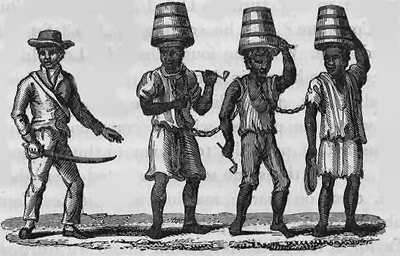
May 1st.—I have this day seen the Val Longo; it is the slave-market of Rio. Almost every house in this very long street is a depôt for slaves. On passing by the doors this evening, I saw in most of them long benches placed near the walls, on which rows of young creatures were sitting, their heads shaved, their bodies emaciated, and the marks of recent itch upon their skins. In some places the poor creatures were lying on mats, evidently too sick to sit up. At one house the half-doors were shut, and a group of boys and girls, apparently not above fifteen years old, and some much under, were leaning over the hatches, and gazing into the street with wondering faces. They were evidently quite new negroes. As I approached them, it appears that something about me attracted their attention; they touched one another, to be sure that all saw me, and then chattered in their own African dialect with great eagerness. I went and stood near them, and though certainly more disposed to weep, I forced myself to smile to them, and look cheerfully, and kissed my hand to them, with all which they seemed delighted, and jumped about and danced, as if returning my civilities. Poor things! I would not, if I could, shorten their moments of glee, by awakening them to a sense of the sad things of slavery; but, if I could, I would appeal to their masters, to those who buy, and to those who sell, and implore them to think of the evils slavery brings, not only to the negroes but to themselves, not only to themselves but to their families and their posterity.
After all, slaves are the worst and most expensive servants; and one proof of it is this, I think. The small patch that each is allowed to cultivate for his own use on many estates generally yields at least twice as much in proportion as the land of the master, though fewer hours of labour are bestowed upon it.[104] I have hitherto endeavoured, without success, to procure a correct statement of the number of slaves imported into all Brazil. I fear, indeed, it will be hardly possible for me to do so, on account of the distance of some of the ports; but I will not rest till I procure at least a statement of the number entered at the custom-house here during the last two years. The number of ships from Africa that I see constantly entering the harbour, and the multitudes that throng the slave-houses in this street, convince me that the importation must be very great. The ordinary proportion of deaths on the passage is, I am told, about one in five.
May 3d.—Early this morning the French naval captain, La Susse, called on me to take me in his boat to town, for the purpose of going to Senhor Luis Jose's house in the Rua do Ouvidor, to see the Emperor go in state to the opening of the Constituent and Legislative Assembly. All the great officers of state, all the gentlemen of the household, most of the nobility, and several regiments accompanied him. First marched the soldiers, then the carriages of the nobility and other persons having the entree, nobody driving more than a pair, such being the express order of the Emperor, in order that the rich might not mortify the poor; then the royal carriages, containing the household, the ladies of honour, and the young Princess Dona Maria da Gloria; the Emperor and Empress followed in a state-coach with eight mules. The crown was on the front seat. The Emperor wore the great cape of state, of yellow feathers, over his green robes. The Empress, much wrapped up on account of a recent indisposition, was seated by him, and the procession was closed by more troops.
The carriages displayed to-day would form a curious collection for a museum in London or Paris. Some were the indescribable sort of caleche used here; and in the middle of these was a very gay pea-green and silver chariot, evidently built in Europe, very light, with silver ornaments, silver fellies to the wheels, silver where any kind of metal could be used, and beautiful embossed silver plates on the harness of the mules. Many other gala carriages seemed as if they had been built in the age of Louis XIV. Such things! mounted on horizontal leathern bands, and all other kind of savage hangings; besides paint and gilding, and, by-the-bye, some very handsome silver and silver gilt harnesses. Then there were splendid liveries, and all manner of gaudiness, not without some taste.
The houses were hung with all the damask and satin of every colour that they could supply; and the balconies stored with ladies, whose bright eyes rain influence, dressed in gala dresses, with feathers and diamonds in profusion; and as the royal carriages passed, we waved our handkerchiefs, and scattered flowers on their heads.
When the procession had passed, I found it was expected that we should await its return, which I was well pleased to do. My young friend Dona Carlota improves on acquaintance; and as I begin to venture to speak Portuguese, I am becoming intimate with the elder part of the family. I was taken into the study, and for the first time saw a Brazilian private gentleman's library. As he is a judge, of course the greater part is law; but there are history and general literature, chiefly French, and some English books. I was introduced to several Portuguese authors; and Don Carlota, who reads remarkably well, did me the favour to read some of Diniz's fine verses to me, and to lend me his works. We then returned to our station at the window, and saw the procession return in the order in which it came, when our pleasant party dispersed.
Yesterday, the assembly having finished its preliminary sittings, sent a deputation, headed by Jose Bonifacio, to His Imperial Majesty, to entreat that he would honour the assembly with his presence at their first sitting as a legislative body, and he was pleased to name half past eleven o'clock to-day for that purpose.[105]
This morning, therefore, the people of Rio de Janeiro had strewed the way with evergreens, sweet herbs, and flowers, from the bridge without the town by the street of St. Peter's, the Campo de Santa Anna, now Praça da Acclamaçaŏ, the Theatre Square, and the streets Do Ouvidor and Direita to the palace; troops lined the whole space; the houses were decorated, and the bands of the different regiments relieved each other as their Imperial Majesties passed. I observe the Brazilians never say the Emperor, but our Emperor, our Empress; and seldom name either, without some epithet of affection.
In the House of Assembly, a throne had been prepared for the Emperor, and on his right hand a tribune for the Empress, the Princess, and their ladies. As soon as it was known that the Imperial party had arrived, a deputation from the assembly went to the door of the house to meet them, and conducted the Emperor, with his crown[106] on his head, to the throne; the Empress, Princess, and ladies, being at the same time placed in the tribune.
The Emperor having deposited the crown and sceptre with the proper officer, and received the oaths of several of the deputies, spoke as follows; and it was remarked, that so far from the speech having the air of a thing read from a paper or studied, that it was spoken as freely as if it was the spontaneous effusion of the moment, and excited a feeling as free in his favour.
"This is the greatest day that Brazil has ever seen; a day on which, for the first time, it may show that it is an empire, and a free empire. How great is my delight, to behold real representatives from almost every one of its provinces, consulting together on its true interests, and on these founding a just and liberal constitution to govern them! We ought long since to have enjoyed a national representation. But either the nation did not in time perceive its real interests, or, perceiving them, was unable to declare them, on account of the forces and ascendancy of the Portuguese party; which, perceiving clearly to what a degree of weakness, littleness, and poverty, Portugal was reduced, and to how low a state it had fallen, would never consent (notwithstanding their proclamation of liberty, fearing a separation,) that the people of Brazil should enjoy a representation equal to what they themselves then possessed. They had miscalculated their plans for conquest, and from that miscalculation arises our good fortune.
"Brazil, which for upwards of three hundred years had borne the degrading name of a colony, and had suffered all the evils arising from the destructive system then pursued, exulted with pleasure when my Lord Don John VI., King of Portugal and Algarve, my august father, raised it to the dignity of a kingdom, by his decree of the 16th of December, 1815; but Portugal burned with rage, and trembled with fear. The delight which the inhabitants of this vast continent displayed on the occasion was unbounded; but the politic measure was not followed up, as it ought to have been, by another, that is, by the convocation of an assembly to organise the new kingdom.
"Brazil, always frank in her mode of proceeding, and mortified at having borne the yoke of iron so long, both before and after that measure echoed the cry for the constitution of Portugal, immediately on the proclamation of liberty in Portugal; expecting that after this proof of confidence given to her pseudo brethren, they would assist her to deliver herself from the vipers that were consuming her entrails, and little thinking she should be deceived.
"The Brazilians, who truly loved their country, never intended, however, to subject themselves to a constitution in which all had not a voice, and whose views were to convert them at once from free men into vile slaves. Nevertheless, the obstacles which, before the 26th April, 1821, opposed the liberties of Brazil, and which continued to exist, being maintained by the European troops, caused the people, fearing that they should never enjoy a representative assembly of their own, even for the very love of liberty, to follow the infamous Cortes of Portugal, and they even made the sacrifice of submitting to be insulted by the demagogue party which predominated in this hemisphere.
"Even this availed not. We were so oppressed by the European forces, that I was obliged to send them to the opposite shore of the Rio; to blockade them; to force them to embark and pass the bar, in order to save the honour of Brazil, and to procure that liberty which we desire and ought to enjoy; but in vain shall we labour to procure it, if we permit to exist among us a party inimical to our true cause.
"Scarcely were we well free from these enemies, when in a few days arrived another expedition, which Lisbon had sent for our protection; but I took upon myself to protect this empire, and I refused to receive it. Pernambuco did the same. And Bahia, which was the first place to unite with Portugal, as a reward for her good faith, and because she perceived too late the track she ought to have followed, now suffers under a cruel war for those Vandals; and her chief city, occupied only by them, is on the point of being rased, for they cannot maintain themselves there.
"Such is the freedom Portugal sought to bestow on Brazil: it was to be converted into slavery for us; and would have ruined us totally if we had continued to execute her commands; which we must have done, but for the heroic remonstrances conveyed by petitions, first from the junta of government of St. Paul's, then from the camara of this capital, and afterwards from all the other juntas of government and camaras, imploring me to remain here. It appeared to me that Brazil would be ruined, if I did not attend to the petitions; and I did attend to them. I know that this was my duty, though at the risk of my life; but as it was in defence of this empire, it was ready, as it is now, and ever, when it shall be requisite.
"I had scarcely pronounced the words, As it is for the good of all, and the general happiness of the nation, tell the people that I remain, recommending to them at the same time union and tranquillity, when I began to take measures to put ourselves in a state to meet the attacks of our enemies, then concealed, since unmasked; one part among ourselves, the rest in the Portuguese democratic Cortes; providing for all the departments, especially those of the treasury and foreign affairs, by such means as prudence dictated, and which I shall not mention here, because they will be laid before you in proper time by the different officers of state.
"The public treasury was in the very worst state, as the receipts had been much reduced; and, principally, because till within four or five months they had been solely those of this province. On this account it was not possible to raise money for all that was necessary, as we had already too little to pay the public creditors, or those employed in effective service, and to maintain my household, which cost one-fourth of that of the King, my august father. His disbursements exceeded four millions; mine did not amount to one. But although the diminution was so considerable, I could not be satisfied when I found that my expenses were so disproportioned to the reduced receipts of the treasury; and therefore I resolved to live as a private man, receiving only 110,000 milrees for the whole expenses of my household, excepting the allowance of the Empress, my much-beloved and valued wife, which was assigned to her by her marriage contract.
"Not satisfied with these small savings in my household with which I commenced, I examined into every department, as was my duty, in order to regulate its expenditure, and to check its abuses. Yet, still the revenue did not suffice; but by changing some individuals not well affected to the cause of the empire, but only to that of the infamous Portuguese party, and who were continually betraying us, for others who loved Brazil with all their hearts,—some from birth and principle, others from the intimate conviction that the cause is that of reason,—I have caused, and I say it with pride, the bank, which was on the point of losing its credit, and threatened bankruptcy every moment,—as on the day of the departure of my august father, Don John VI., there only remained the sum of two hundred contos in money,—to discount its bills, to re-establish its credit so completely, that no one can imagine that it can ever fall again into the wretched state to which it had been reduced. The public treasury, which, on account of the extraordinary expenses which should have been borne in common by all the provinces, but which fell solely upon this, was totally exhausted, and without credit, has gained such credit, that it is already known in Europe; and so much cash, that the greater part of the creditors, and they were not few, or for trifling sums, have been so far satisfied, as that their houses have not suffered; that the public servants have no arrears due any more than the military on actual service; that the other provinces that have adhered to the holy cause,—not by force, but from conviction, for I love just liberty,—have been furnished for their defence with warlike stores, great part of which are newly purchased, besides those already in the arsenals; and, moreover, they have been assisted with money, because their funds did not cover their necessary expenses.
"In a word, the province now yields from eleven to twelve millions; its produce, before the departure of my august father, having been at most from six to seven.
"Among the extraordinary expenses are, the freights of the ships on board of which the different expeditions sent back to Lisbon were embarked; the purchase of several vessels; the repair of others; pay to civil and military officers who have arrived here on service, and to those expelled from the provinces for their private sufferings in the tumults there raised.
"The expenditure has certainly been great: but hitherto, nevertheless, there remain untouched, the gratuitous contributions; the sequestrated property of the absentees on account of political opinions; the loan of 400,000 milrees for the purchase of ships of war indispensably necessary for the defence of the empire, and which exists entire; and the exchequer of the administration of diamonds.
"In every department there was an urgent necessity for reform; but in this of finance still more, because it is the chief spring of the state.
"The army had neither arms, men, nor discipline: with regard to arms, it is now perfectly ready; the men are increasing daily in proportion to the population; and in discipline it will soon be perfect, being already in obedience exemplary. I have twice sent assistance to Bahia: first 240 men, then 735, forming a battalion called the Emperor's Battalion; which in eight days was chosen, prepared, and sailed.
"Besides these, a foreign regiment has been raised, and a battalion of artillery of freed men, which will shortly be completed.
"In the military arsenal they have wrought diligently to prepare every thing necessary for the defence of the different provinces; and all, from Paraiba of the North to Montevideo, have received the assistance they have requested.
"The walls of the fortifications of this city were totally ruined: they are now repaired; and important works necessary in the arsenal itself have been finished.
"As to military works, the walls of all the fortresses have been repaired, and some entirely new-constructed. These are formed in the different points fittest to oppose any enemy's force approaching by sea; and in the defiles of the hills, to oppose the approach of an enemy already landed, (which would not be easy,) entrenchments, forts, redoubts, abatis, and batteries. The barracks of the Carioca are built, and the other barracks are prepared. That in the Praça da Acclamaçaŏ is almost finished, and that ordered for the grenadiers will shortly be so.
"The fleet consisted only of the frigate Piranga, then called the Union, not fitted; the corvette Liberal, only a hull; and of a few other small and insignificant vessels. Now we have the ship of the line, Pedro Primeiro; the frigates Piranga, Carolina, and Netherohy; the corvettes Maria da Gloria and Liberal, ready; a corvette, in Alagoas, which will soon be ready, named the Massaió: of the brigs of war, Guarani ready, and the Cacique and Caboclo under repair; besides several ships in ordinary, and various schooners.
"I expect six frigates of fifty guns, manned and armed, and completely formed for action, for the purchase of which I have already given orders; and according to the information I have received, they will not cost above thirteen contos of rees.
"In the dock-yard, the works are the following:—all the ships now actually employed have been repaired; gun-boats, and others of small size, which I need not name, have been built; and many others, which, altogether, are numerous and important.
"I intend this year, in the same place, where for thirteen years back nothing has been done but caulking, rigging, and careening vessels,—swallowing immense sums, which might have been more usefully employed for the nation,—to lay down the keel of a forty-gun frigate; which, if the calculation I have made, the orders I have given, and the measures I have taken do not fail, I hope will be finished this year, or in the middle of the next, and will be called the Campista.
"As to public works, much has been done. The police office in the Praça da Acclamaçaŏ has been rebuilt: that large square has been drained of the marsh water, and has become an agreeable walk, with paved paths on all sides, and others across, and we are still continuing to embellish it. The greater part of the aqueduct of Carioca and Maracanaŏ, have been repaired; besides the numerous bridges of wood and stone which have been renewed, several new ones have been made, and a great extent of roads has been mended.
"Besides what I have mentioned, and much more which I have not touched on, the funds for these works, which in April, 1821, owed 60 contos of rees, now is not only out of debt, but possesses upwards of 600,000 crusadoes.
"In different departments we have made the following progress. We have greatly increased the national typography; the public gardens have been put in order; the museum repaired, and enriched with minerals and a gallery of good pictures,—some of which were purchased, some were already in the public treasury, and others were my private property, which I have ordered to be placed there.
"Every exertion has been made on the Caes da Praça de Commercio, so that it is nearly finished; the streets of the city have been new-paved; and in a very short time this house for the assembly, with all the rest adjoining, were properly fitted for their purpose.
"Many works which are of less importance have been undertaken, begun, and finished; but I omit them, that I may not render my speech too long.
"I have encouraged the public schools, as far as I could; but this will demand some peculiar provision of the legislature. What has been done is this:—In order to augment the public library I have bought a large collection of choice books; I have augmented the number of schools, and increased the salary of some of the masters, besides licensing innumerable private schools; and, aware of the benefits of the method of mutual instruction, I have opened a Lancasterian school.
"I found the college of San Joaquim, which had been designed by its founders for the education of youth, employed as the hospital of the European troops. I caused it to be opened anew, for the purposes originally intended; and having granted to the Casa de Misericordia, and the foundling hospital, of which I will speak farther, a lottery for the better maintenance of those useful institutions, I assigned a certain portion of the said lottery to the college of San Joaquim, that it might the better answer the useful end which its worthy founders had in view. It is now full of students.
"The first time I visited the foundling hospital, I found (and it seems incredible) seven infants with only two wet-nurses; no beds, no clothing: I called for the register, and found that in the last thirteen years nearly 12,000 children had been received, but scarcely 1000 were forthcoming, the Misericordia not knowing in fact what had become of them. Then by granting the lottery, a house proper for the establishment was built, where there are upwards of thirty beds, almost as many nurses as children, and on the whole, much better management. All these things of which I have now spoken merit your particular attention.—After this province was settled, and important provisions made for the rest, I felt it necessary to call together a council of state; and, therefore, by the degree of the 16th of February of last year, I convoked one, composed of procurators-general, chosen by the people, being desirous that they should have some persons near me to represent them, and who might at the same time advise me, and demand such things as should be conducive to the good of each of the respective provinces. Nor was this the only end and motive for which I called such a council together: I wished particularly that the Brazilians might know my constitutional feelings. How I delighted to govern to the satisfaction of the people, and how much my paternal heart desired (though at that time secretly, because circumstances did not then permit me to manifest such wishes,) that this loyal, grateful, brave, and heroic nation, should be represented in a general constituent and legislative assembly; which, thank God, has been brought about in consequence of the degree of the 3d of June of the last year, at the request of the people conveyed through their camaras, their procurators, and my counsellors of state!
"It has been very painful to me that, till now, Brazil should not have enjoyed a national representation, and to be forced by circumstances to take upon myself to legislate on some points: but my measures cannot appear to have arisen from ambition to legislate, arrogating to myself the whole power, of which I only could claim a part—for they were taken to save Brazil,—because when some of them were adopted the assembly had not been convoked, and when others were necessary it had not yet met; therefore, as Brazil was totally independent of Portugal, the three powers then existed in fact and by right in the person of the supreme chief of the nation, and much the more as he was its perpetual defender.
"It is true that some measures appeared extremely strong; but as the peril was imminent, and the enemies who surrounded us were innumerable (and would to God they were not even now so many), it was necessary they should be proportionate.
"I have not spared myself; nor will I ever spare toil, however great, if from it the smallest portion of happiness can be derived to the nation.
"When the people of the rich and majestic province of Minas were suffering under the iron yoke of their mistaken governors, who disposed of it as they pleased, and obliged the pacific and gentle inhabitants to disobey me, I marched thither, only attended by my servants: I convicted the government and its creatures of the crime they had committed, and of the error in which they seemed desirous of persisting; I pardoned them, because the crime was more an offence against me, than against the nation, as we were then united to Portugal.
"When a party of Portuguese and degenerate Brazilians attached to the Cortes of miserable, worn-out Portugal, arose among the brave people of the beautiful and delightful province of St. Paul's, I instantly repaired thither, and entered the province fearlessly, because I knew the people loved me. I took the measures that appeared to me to be necessary; and there, before any other place, our independence was declared, in the ever-memorable plain of Piranga.
"It was at the country seat of the most faithful, and never-enough praised Amador Bueno de Rebeira, that I was first proclaimed Emperor.
"My soul itself was grieved that I could not go to Bahia, as I had intended, but which I did not do on the remonstrance of my privy council, to mingle my blood with that of those warriors who have so bravely fought for their country.
"At all hazards, at that of life itself, if necessary, I will maintain the title that the people of this rich and vast empire honoured me with on the 13th of May, of the past year—Perpetual Defender of Brazil. That title engaged my heart more, than all the splendour I acquired by their spontaneous and unanimous acclamation of me as Emperor of this desirable empire.
"Thanks be to Providence, that we now see the nation represented by such worthy deputies! Would to God it could have been so earlier! But the circumstances preceding the decree of the 3d of June did not permit it; and since that time, the great distance, the want of public spirit in some, and the inconveniences of long journeys, especially in a country so new and extensive as Brazil, have retarded this much-wished and necessary meeting, notwithstanding all my repeated recommendations of speed.
"At length the great day for this vast empire has arisen, which will be the grand epocha of its history. The assembly is met to constitute the nation: what joy—what happiness for us all!
"As Constitutional Emperor, and most especially as Perpetual Defender of this vast empire, I told the people on the 1st of December, the day when I was crowned and anointed, 'That with my sword I would defend the country, the nation, and the constitution, if it were worthy of Brazil and of me." I this day, in your presence, most solemnly ratify this promise, and I trust you will assist me in fulfilling it, by framing a wise, just, and practicable constitution, dictated by reason, not caprice; and having solely in view the general happiness, which can never be great if the constitution be not founded on solid grounds, grounds which the wisdom of ages has shown to be just, in order to give true liberty to the people, and sufficient strength to the executive power. A constitution in which the limits of the three powers shall be well defined, that they may never arrogate rights not their own; but shall be so organised and harmonised, that it shall be impossible for them, even in the lapse of time, to become inimical to each other, but shall every day jointly contribute to the general happiness of the state. In short, a constitution which shall oppose insuperable barriers to despotism, whether royal, aristocratic, or democratic; defeat anarchy; and plant that tree of liberty under whose shadow the honour, tranquillity, and independence of this empire, which will become the admiration of the Old and New World, must grow.
"All the constitutions which have modelled themselves upon those of 1791 and 1792, have been shown by experience to be entirely theoretical and metaphysical, and therefore impracticable. Witness those of France, Spain, and Portugal: they have not, as they ought, produced public happiness; but after a licentious freedom, we see that in some countries there has already taken place, and in others there is on the point of doing so, a despotism of one, after that of many; and, by a necessary consequence, the people are reduced to the wretched state of registering and suffering all the horrors of anarchy.
"But far from us be such melancholy reflections: they darken the joy and exultation of this happy day. You are not ignorant of them; and I am sure, that firmness in those true constitutional views, which have been sanctioned by experience, will characterise every one of the deputies who compose this illustrious assembly. I trust, that the constitution which you will frame will merit my Imperial assent; that it will be as wise and just as suited to the local situation and to the civilisation of the Brazilian people: also that it may be praised among the nations, so that even our enemies may imitate the sanctity and wisdom of its principles, and at length practise them.
"So illustrious and patriotic an assembly will have in view no object but to cause the empire to prosper, and to fill it with happiness: it will wish its Emperor to be respected, not only at home but among foreign nations; and that its Perpetual Defender should exactly fulfil his promise of the first of last December, solemnly ratified to-day, in the presence of the nation legally represented."
When the Emperor had done speaking, the bishop of the diocese, acting as president of the assembly, made a short answer of thanks, praise, and promise; after which, the whole of the members, the spectators in the galleries, and the people without doors, cheered His Imperial Majesty enthusiastically, and the procession returned to San Cristovaŏ in the order in which it came.
The theatre of course concluded the ceremonies of the day; and my friend, Madame do Rio Seco, having kindly offered me a seat in her box, I went thither, for the first time since my return to Brazil. She was in high spirits, because that day the Emperor had conferred on her husband the order of the Cruzeiro; and therefore she went really in grand gala to the opera. Her diamonds worn that night may be valued at 150,000l sterling, and many splendid jewels remained behind in the strong box. For my part, I had gone to town in my morning dress; therefore I sent to a milliner's, and bought such a plain crape head-dress as the customs of the place warrant, in deep mourning; and wrapping myself in my shawl, accompanied my magnificent friend. The house appeared very splendid, being illuminated and dressed, and the ladies one and all in diamonds and feathers. Some decorations have been added since last year, and an allegorical drop-scene has been painted. The Empress did not come, on account of her recent illness; but the Emperor was there, looking pale, and a little fatigued. He was received with rapturous applause. The members of the assembly were seated one-half on his right, and one-half on his left, in boxes handsomely fitted up for them; and as soon as they had all taken their places, a poem on the occasion was recited by the Prima Donna, in which there were some good points, which called forth great applause. I think it is Gresset who, in one of his odes Au Roi, says,
"Le cri d'un peuple heureux est la seule éloquence Qui sait parler des rois."
And indeed this night that eloquence was powerful. I cannot conceive a situation more full of interest to both prince and people.
There was nothing in the principal piece played to-night, for it was a clumsy translation of Lodoiska, without the songs. But the after-piece excited much emotion: it was called "The Discovery of Brazil." Cabral and his officers were represented as just landed: they had discovered the natives of the country; and, according to the custom of the Portuguese discoverers, they had set up their white flag, with the red holy cross upon it, whence they had first named the land. At the foot of this emblem they kneeled in worship, and endeavoured to induce the wild Brazilians to join them in their sacred rites. These, on their part, tried to persuade Cabral to reverence the heavenly bodies, and dissension seemed about to trouble the union of the new friends, when by a clumsy enough machine, a little genius came down from above, and leaping from its car, displayed the new Imperial standard, inscribed Independencia o Morte. This was totally unexpected in the house, which, for an instant, seemed electrified into silence. I believe I clapped my hands first, but the burst of feeling that came from every part of the house was long ere it subsided. Now I know nothing so overpowering, as that sort of unanimous expression of deep interest, from any large body of men. It overset me; and when I ought to have been waving my handkerchief decorously from the great chamberlain's box, I was hiding my face with it, and weeping heartily. When the house was quiet again, I looked at Don Pedro: he had become very pale, and had drawn a chair close to his own; on the back of which he leaned, and was very grave to the end of the piece, having his hand before his eyes for some time; and, indeed, his quick feelings could not have escaped what affected even strangers.
At the close of the piece there were loud cries of "Viva la Patria!" "Viva o Emperador!" "Viva a Emperatriz!" "Vivaŏ os Deputados!" all originating in the body of the house; when Martim Francisco de Andrada stepped to the front of one of the boxes of the Deputies, and cried "Viva o povo leal e fiel do Rio de Janeiro!" a cry that was extremely well seconded, especially by the Emperor, and kindly taken by the people; and so this important day ended.
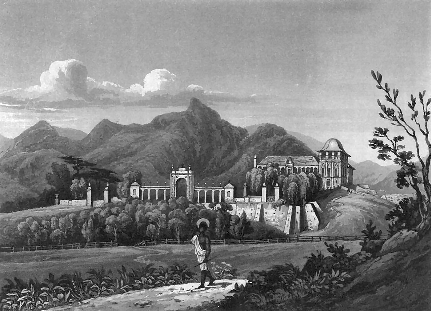
May 6th.—To-day I rode to San Cristovaŏ, through a very beautiful country. The palace, which once belonged to a convent, is placed upon a rising ground, and is built rather in the Moresco style, and coloured yellow with white mouldings. It has a beautiful screen, a gateway of Portland stone, and the court is planted with weeping willows; so that a group of great beauty is formed in the bosom of a valley, surrounded by high and picturesque mountains, the chief of which is the Beco do Perroquito.[107] The view from the palace opens to part of the bay, over an agreeable plain flanked by fertile hills, one of which is crowned by the very handsome barracks that were once a Jesuit establishment. I rode round by the back of the palace to the farm, which appears to be in good order; and the village of the slaves, with its little church, looks more comfortable than I could have believed it possible for a village of slaves to do. The Imperial family now live entirely here, and only go to town on formal business or occasions of state.
May 12th.—I have been too unwell to do any thing; and only write to-day to notice the arrival of the Jupiter frigate, with Lord Amherst on his way to India, and the rumour that he has some official character at this court.
16th.—Lord Amherst and suite went to court in such ceremony as induces people to believe he really has a diplomatic character here. The Alacrity has arrived from Valparaiso, and has brought me some old letters from England that have helped my sickness to depress my spirits. 'Tis after all a sad thing to be alone and sick in a foreign land! The Doris also is arrived from Bahia. She has had no direct communication with Lord Cochrane's little squadron; but it seems, that with his six ships, he keeps the enemy's fleet of fifteen sail in check. The town of Bahia is said to be in a dreadful state for want of provisions. The slaves are daily dying in the streets. Some houses, after appearing shut up for some days, have been opened by the police officers, who have found the masters escaped, and the slaves dead.—Twice a day the gates have been opened to allow the women and children to leave the town. Some of the officers of the Doris had the curiosity to attend on one of these occasions, and saw 500 persons, laden with as much furniture and clothes, as in their weak hungry state they could carry, leave the city. The little fresh provision that finds its way into the town is exorbitantly dear. General Madeira has proclaimed martial-law in the place; he has seized some corn and flour out of a neutral ship, and has raised forced loans from all classes, both native and foreign.
San Cristovaŏ.
The ship has brought two or three newspapers from Bahia. As might be expected, they breathe the most violent, and inveterate spirit against the Imperial government, and every body employed by it; calling the Emperor a Turkish despot, a sultan, &c., and José Bonifacio a tyrannic vizier. Lord Cochrane, of course, does not escape; and to all old calumnies against him, they now add that he is a coward, for which agreeable compliments they are likely to pay dearly I should think. The Supplement to the Idade d'Ouro of the 25th of April gives lists of the two squadrons, drawn up for the purpose of inspiring confidence in the Portuguese, under-rating the force of Lord Cochrane's ships, and representing them as so ill manned,—although, according to them, the most oppressive measures were adopted to man them,—as not to be able to face the Portuguese. However, they have thought fit to call in all their vessels from the Funil and other stations where they had their small ships placed, in order to reinforce their fleet.[108] They have published a circular letter, calling on all officers and crews to exert themselves, promising them the destruction of the Brazilian fleet. And, on the same day, the 24th of April, the Admiral Joaŏ Felix Pereira de Campos, under pretence of indisposition, turns over the command to another officer.
These measures were adopted, in consequence of the news of Lord Cochrane's arrival in Brazil having been conveyed to General Madeira by His Britannic Majesty's ship Tartar, the only vessel that sailed from Rio during the time of the embargo. We are becoming very anxious indeed for news from His Lordship: many rumours are afloat; but as there has been no direct communication from the squadron, they only increase the general anxiety.
May 17th.—Soon after I arrived here, in March, or rather as soon as my patient Glennie left me, I felt that, as a stranger here, and situated as I am, I was peculiarly unprotected, and therefore I spoke to the minister José Bonifacio, telling him my feelings; and saying, that from the amiable character of the Empress, I should wish to be allowed to wait on her, and to consider her as protecting me while I remain in the empire. She accordingly promised to fix a day for me to see her; but a severe indisposition has hitherto confined her to her room. Now, Lady Amherst having requested to see Her Imperial Majesty, the day after to-morrow is fixed on for the purpose; and I have an intimation that I shall be received on the same day, as the Empress wishes not to receive any other foreigner before me. This is polite, or rather it is more; it is really kind.
19th.—Though I was suffering exceedingly this morning, I resolved nevertheless to attend the Empress at noon, at San Cristovaŏ. I was obliged to take a quantity of opium, to enable me to do so. However, I arrived at the appointed time; and, as I had been desired to do, asked for the camarista môr, Jose Bonifacio's sister, and was shown into the presence-chamber, where I found that lady and Lady Amherst, Miss Amherst, and Mrs. Chamberlain. The Empress entered shortly after, in a handsome morning dress of purple satin, with white ornaments, and looking extremely well. Mrs. Chamberlain presented Lady and Miss Amherst; and Her Imperial Majesty spoke for some minutes with Her Ladyship. After which she motioned to me to go to her, which I did. She spoke to me most kindly; and said, in a very flattering way, that she had long known me by name, and several other things that persons in her rank can make so agreeable by voice and manner; and I left her with the most agreeable impressions. She is extremely like several persons whom I have seen of the Austrian Imperial family, and has a remarkably sweet expression.
The corridor through which I passed from the palace steps, and the presence-room, are both plain and handsome. As it might be called a private audience, there were neither guards, officers, nor attendants, excepting the camarista môr.
The Emperor is at present at his country-house of Santa Cruz; so that San Cristovaŏ appeared like a private gentleman's seat, it was so still.
Saturday, June 7th.—Since the day I was at San Cristovaŏ, I have been confined to my room, and totally unable to exert myself, either mind or body, from severe indisposition. The Creole is come in from Bahia, to get provisions, preparatory to going home. The Commodore has offered me a passage in her, and has written to that purpose; but I am in no state to embark for a long voyage. The accounts from Bahia are sadder than ever: as to the Bahians, though favourable to the Imperial cause the misery, of the poor inhabitants is great indeed.
12th.—We have been for three days kept in a state of agitation, by reports that Bahia has fallen, and various rumours attending those reports: they all turn out to have arisen from a russe de guerre of Madeira, who contrived to despatch a small vessel to a port on the coast for flour, pretending that it was for Lord Cochrane, and spreading that report to cover its real purpose.
23d.—A brig, prize to the squadron, arrived, and also the Sesostris, a merchant ship bound to Valparaiso, on board of which were Lady Cochrane and her family going to Chile. Thank God, by putting in here, she has learned where Lord Cochrane is, and is thus spared the tedious voyage, and her excellent husband much anxiety on her account.
14th.—At length we have true news both from and of Lord Cochrane. I wrote to Lady Cochrane, excusing myself on account of illness from going to her, and she kindly called on me as she landed; and a few minutes afterwards I received letters from the Admiral, and from some others in the squadron.
As might have been expected, from the haste in which the squadron was equipped, the ships had to encounter some difficulties at first. Some of the sails and cordage, which had been seventeen years in store, were found almost unserviceable; the guns of some of the ships were without locks, as the Portuguese had not adopted them: the cartridges were mostly made up in canvass: but the real evil was the number of Portuguese, both men and officers, among the crews, which kept them in a continual state of discontent, if not mutiny.
Lord Cochrane had chosen as head-quarters for the squadron, the harbour behind the Moro of San Paulo, about thirty miles south of Bahia, and commanding the channel behind Itaparica; a country well watered and wooded, and in the neighbourhood of all supplies of fresh necessaries. There is good and sheltered anchorage in from seven to twenty fathoms water, and on the whole it was well adapted for its purpose. As soon as it was known that His Lordship was off Bahia, the Portuguese squadron came out, and spread itself along the shore north of the bay. Lord Cochrane, who had waited in vain at the place of rendezvous at sea for the two fire-ships, which he expected from Rio, had fitted one of his small vessels, the schooner Real, as a fire-ship, and had intended to run into Bahia on the 4th of May; when he fell in with the Portuguese fleet, in number thirteen[109], he having with him five ships, a brig, and the fire vessel. He instantly ran through their line, cutting off the four sternmost ships; and had the men done their duty, nothing could have saved the ship they were first alongside of: but they fired too soon; and though the fire did great execution, wounding and killing many, both on board that ship and the Joam VI., which was immediately to the windward of the Pedro, yet the Admiral was disappointed. The slow sailing of the Piranga and Netherohy kept them farther behind the Pedro than their brave commanders wished; the others were forced to keep aloof, it is said, by the conviction that their crews could not be trusted against the Portuguese. As to the crew of the Admiral's ship, two of the Portuguese marines went into the magazine passage, and with their drawn swords impeded the handing up the powder. The squadrons separated after this. Lord Cochrane determined to attack the Portuguese again next day. Captain Crosbie, Lieutenant Shepherd, and eleven others were wounded; but no other damage was sustained by the Imperial squadron, while that of the Europeans had suffered much both in crews and rigging.
On the morning of the 5th, Lord Cochrane looked in vain for the enemy. He had apparently been satisfied with the skirmish of the 4th, and had taken refuge in the harbour; so that His Lordship returned to the Moro de San Paulo, with only the satisfaction of having driven the enemy from the open sea.
Meantime the Brazilian Imperial force that was posted behind the city, taking advantage of the absence of the fleet, and consequently of the two thousand seamen who served the artillery ashore, advanced from the sitio of Brotas, where their centre was quartered, towards the town. Madeira marched out to meet them, and an action took place entirely in favour of the Imperialists; and it is said that the King's fleet was recalled in consequence of this disaster.
Lord Cochrane had no sooner returned to San Paulo than he made such provisions with regard to his squadron, as he judged most prudent for the public service. The vessel that has arrived here has brought down some of the ill-affected Portuguese. All, I believe, from the report of the officer who arrived in the prize, have been dismissed from the Pedro Primero.
Lord Cochrane has taken the officers and English seamen of the Piranga and Nitherohy on board the Pedro, so that now he has one ship he may depend on: he has exchanged the eighteen-pound guns of the main-deck, for the twenty-four pounders of the Piranga, and has placed guns along his gang-ways; and we trust the next news we have from him, we shall learn something favourable to the cause of independence.
As far as the government here could supply every thing to the squadron to insure its success, it was done in the most liberal manner; and the failures, where they occurred, were owing to the peculiar circumstances of the times and country, which admitted of no controul. That some things should have been imperfect was to be expected: that so much should have been done, and well done, excites admiration. But the Emperor appreciates the brave man who commands his fleet; and while that is the case, a difficulty as soon as felt will be obviated.
19th.—My health grows worse and worse. The Creole sailed to-day. I have amused myself for two days with some English newspapers. If any thing can rouse me to health it surely ought to be news from England.
Lord Althorp has, I see, made a spirited but ineffectual effort for the repeal of the foreign enlistment bill; a most interesting subject in this country: and I see with pleasure a virtual acknowledgment from the English ministers of the independence of Spanish America.
22d.—This is the eve of St. John's, whereon the maidens of Brazil practise some of the same rites as those of Scotland do at Hallowe'en, to ascertain the fate of their loves. They burn nuts together; they put their hands, blindfold, on a table, with the letters of the alphabet; and practise many a simple conjuration. I think I recollect long ago, to have seen the maid-servants of a house in Berkshire place an herb, I think a kind of stone-crop, behind the door, calling it Midsummer men, that was to chain the favoured youth as he entered. For me I only wish for the nucca drop of the Arab to fall this night, so I might catch it, and be relieved from my weary sickness.
June 26th.—My friend, Dr. Dickson, who has attended me all this time with unvarying kindness, having advised change of air for me, he and Mr. May have pitched on a small house on Botafogo beach, having an upper story, which is considered as an advantage here, the ground-floor houses being often a little damp; and to-day Captain Willis of the Brazen brought me in his boat to my new dwelling. My good neighbours, Colonel and Mrs. Cunningham, try by their hospitality to prevent my feeling so much the loss of my friends Mr. and Mrs. May, who were every thing kind to me while at the Gloria.
Botafogo bay is certainly one of the most beautiful scenes in the world; but, till of late years, its shores were little inhabited by the higher classes of society. At the farthest end there is a gorge between the Corcovado mountain and the rocks belonging to what may be called the Sugar-loaf group, which leads to the Lagoa of Rodrigo Freites, through which gorge a small rivulet of fine fresh water runs to the sea. Just at its mouth, there has long been a village inhabited by gipsies, who have found their way hither, and preserve much of their peculiarity of appearance and character in this their trans-atlantic home. They conform to the religion of the country in all outward things, and belong to the parish of which the curate of Nossa Senhora da Monte is pastor; but their conformity does not appear to have influenced their moral habits. They employ their slaves in fishing, and part of their families is generally resident at their settlements; but the men rove about the country, and are the great horse-jockies of this part of Brazil. Some of them engage in trade, and many are very rich, but still they are reputed thieves and cheats; and to call a man Zingara (gipsy) is as much as to call him knave. They retain their peculiar dialect; but I have not been able, personally, to get sufficiently acquainted with them to form any judgment of the degree in which their change of country and climate may have affected their original habits.
His Majesty's ship Beaver arrived, two days since from Bahia. It seems that Madeira, unable to hold the place any longer, is resolved to leave it. He is pressed to the utmost by Lord Cochrane's squadron, which cuts off his provisions, and by continual alarms kept up on the coast, by His Lordship's own appearance from sea, and by the preparations he is making in the Reconcave for an attack with fire-ships and gun-boats on the town. It is expected, therefore, that Madeira will abandon the place as soon as he can get shipping together to embark the troops. It is asserted even that he has fixed the day, that of San Pedro, for evacuating the place. The following proclamation is certainly preparatory to his doing so; but as the time must depend on contingencies, it cannot be so certain:—
"Inhabitants of Bahia!
"The crisis in which we find ourselves is perilous, because the means of subsistence fail us, and we cannot secure the entrance of any provisions. My duty as a soldier, and as governor, is to make every sacrifice in order to save the city; but it is equally my duty to prevent in an extreme case the sacrifice of the troops that I command, of the squadron, and of yourselves. I shall employ every means to fulfil both these duties. Do not suffer yourselves to be persuaded that measures of foresight are always followed by disasters. You have already seen me take such once before: they alarmed you; but you were afterwards convinced that they portended nothing extraordinary. Even in the midst of formidable armies, measures of precaution are daily used; because victory is not constant, and reverses should be provided against. You may assure yourselves, that the measures I am now taking are purely precautionary: but it is necessary to communicate them to you, because if it happens that we must abandon the city, many of you will leave it also; and I should be responsible to the nation and to the King, if I had not forewarned you. (Signed)
"Ignacio Luiz Madeira de Mello. "Head-quarters, Bahia, May 28. 1823."
This proclamation increased the general alarm to the highest pitch. The editors of even the Portuguese newspapers use the strongest language. One of them says, "The few last days, we have witnessed in this city a most doleful spectacle, that must touch the heart even of the most insensible: a panic terror has seized on all men's minds," &c.[110] And then goes on to anticipate the horrors of a city left without protectors, and of families, whose fathers being obliged to fly, should be left like orphans, with their property, a prey to the invaders. These fears abated a little on the 2d of June, when a vessel entered Bahia, having on board 3000 alquieres of farinha; and the spirits of the troops were raised by a slight advantage obtained on the 3d over the patriots. But the relief was of short duration. On a rigorous search there were found in the city no more than six weeks' provisions besides those necessary for the ships, and the General proceeded in his preparations for quitting Brazil. He now allowed the magistrates to resume their functions suspended by the declaration of martial-law, and produced a letter from the King, naming five persons to form a provisional government; and though some of them were unwilling to accept of the office, he caused them to take the oaths, and enter directly on their functions.
Madeira's preparations for his departure were accelerated by an attack made by Lord Cochrane on the night of the 12th of June, with only the Pedro Primeiro. The Portuguese Admiral was ashore, dining with General Madeira; when, at ten o'clock at night, a shot was heard. "What is it?" exclaimed the latter to the messenger, who, in alarm, entered the room.—"'Tis Lord Cochrane's line-of-battle ship, in the very midst of our fleet."—"Impossible!" exclaimed the Admiral; "no large ship can have come up with the ebb tide." And there was as much consternation and as much bustle of preparation, as if the fleet of England had entered in a hostile manner. The Pedro Primeiro was indeed close alongside of the Constituiçaŏ; but the Admiral disdained so small a prize, and pushed on to the Joam VI.; had he reached her, he might have carried the whole squadron out with him; but just as he seemed on the point of doing so, the breeze that had brought him in over the tide failed, and it fell a dead calm: by this time every ship was in motion, the forts began to play, and, reluctantly, the Pedro dropped out of the harbour with the tide, untouched by the enemy.
The daring of this attempt has filled the Portuguese with astonishment and dismay, and they are now most willing to abandon Bahia. The church plate, and all the cash that can be collected, are believed to be on board the British ships of war.[111]
July 1st.—A good deal of sensation has been excited to-day of rather a painful nature: the Emperor has fallen from his horse, and has broken two of his ribs, and is otherwise much bruised; however, his youth and strength prevent any serious apprehension from the consequences of his accident. There is no public news, and I am much too ill to care for any other. A foreigner, and alone, and very sick, I have abundant leisure to see the worth to the world of riches, or the appearance of them, and show and parade; and to feel that if I had them all, they could neither relieve the head nor the heart of the suffering or the sorrowful.