SECOND VISIT TO BRAZIL. (continued 2)
Reading edition
I think I am grown selfish: I cannot interest myself in the little things of other people's lives as I used to do; I require the strong stimulus of public interest to rouse my attention. It is long since I have been able to go out among the beautiful scenery here, to enjoy the charms of nature.
11th.—Once more I begin to feel better, and to go out of doors a little. All sorts of people crowd daily to visit the Emperor, who is recovering, but is still confined to the house. For the first time for these many weeks, I took a drive to-day; and went, as far as San Cristovaŏ, to enquire after His Imperial Majesty, and leave my name. The road, both as I went and returned, was crowded with carriages and horsemen, on the same errand. Besides that the people do love him, his life is of the utmost importance to the very existence of Brazil as an independent nation at present, at any rate in peace.
13th.—I have become acquainted with two or three pleasant Brazilians, and one or two of the better kind of Portuguese, who have adopted Brazil.[112] There are not above five Fidalgos of the number, and these ancient nobles are objects of jealousy to the new, in number about a dozen, who infinitely surpass them in riches; so that we have the usual gossip and scandal of courts and cities, in which, as the women are usually the most active, so they suffer most: nor are our English one whit behind them. There is not much formal visiting among the English, but a good deal of quiet tea-drinking, and now and then parties formed to dine out of doors in the cool weather.
In short, my countrywomen here are a discreet sober set of persons, with not more than a reasonable share of good or bad. They go pretty regularly to church on Sundays, for we have a very pretty protestant chapel in Rio, served by a respectable clergyman; meet after church to luncheon and gossip: some go afterwards to the opera, others play cards, and some few stay at home, or ride out with their husbands, and instruct themselves and families by reading; and all this much as it happens in Europe. However, they are all very civil to me; and why should I see faults, or be hurt at the absurd stories they tell of me, because they don't know me? Besides, 'tis no great affront to be called wiser than one is.
14th.—Several prizes have arrived from the Moro of San Paulo. One of these vessels has brought news from the Moro that I only half like. After Lord Cochrane's visit to Bahia on the night of the 12th of June, he had been employed for the eight ensuing days in maturing a plan for a farther attack, which seemed sure of success; when, on the 20th[113], "some careless or malignant person set fire to a cask of spirits, which communicated to other casks, and created such terror, that more than a hundred persons jumped overboard; some of whom were drowned. It is calculated that we should have been blown up if the fire had raged only three minutes longer; and its extinction is chiefly to be ascribed to the presence of mind and personal exertion of His Lordship himself; who, I am grieved to add, was so overheated by the blaze and his own exertions, as to be too ill this morning to leave his bed."
17th.—At length Bahia has fallen. Madeira, in pursuance of the plans announced in his proclamation of the 28th, had prepared all his ships of war, and a great number of merchantmen, with provisions, and ammunition, and stores: the plate, money, and jewels, were transhipped from the English vessels to his own, and it was believed he was to sail on the 3d of July. Lord Cochrane, having intelligence to that effect, had come alone in the Pedro Primeiro to look into the harbour, on the morning of the 2d, when he saw the Portuguese squadron loose all their topsails and prepare to move. This manœuvre was not considered by the English within the bay as decisive, because it had been practised daily for some time. His Lordship, however, immediately made signals to the Maria de Gloria and Nitherohy to join him with all despatch. The Piranga, useless from her bad sailing, owing to the state of her copper, had been ordered to Rio; and she and the Liberal, who both arrived to-day, are the bearers of the official intelligence. Lord Cochrane, whose kindness is never-failing, writes to me as follows. I do not like to quote, even in my journal, private letters; but this is short, and tells in few words all that can be said:—
"My Dear Madam,
"I have been grieved to learn your indisposition; but you must recover, now that I tell you we have starved the enemy out of Bahia. The forts were abandoned this morning; and the men of war, 13 in number, with about 32 sail of transports and merchant vessels, are under sail. We shall follow (i.e. the Maria da Gloria and Pedro Primeiro) to the world's end. I say again expect good news. Ever believe me your sincere and respectful friend,
Cochrane. 2d July, 1823. Eight miles north of Bahia."
I learn from the officers of the ships arrived, that the guns were all spiked, and the magazines blown up in Port Pedro, but otherwise every thing was left in good order in the town; and on the marching in of the Brazilian troops not the smallest disorder took place, nor was a life lost; a circumstance highly honourable to all parties.
Though the Admiral mentions only forty-five vessels, it appears that there were many more, amounting to at least eighty, who took the opportunity of getting out with the fleet. When the Piranga left the Moro, a reinforcement of men had arrived there for the Admiral; and the Nitherohy was manning herself, and preparing to follow him in a few hours.
This news is highly acceptable here, except among a class either secretly attached to, or interested in, Portugal. These are murmuring, and saying, "Is it not enough for Lord Cochrane to have driven the poor soldiers out of Bahia, without following to persecute them?" &c. And others are affecting to despise what they call an easy service. But the government knows that it was not an easy service to keep the sea with so small a squadron, so recently formed, against a fleet completely armed and manned,—vessels of the best class; far less to cut off the provisions of the enemy, so as to reduce him to the necessity of abandoning his city.
There are illuminations and a gala opera to-night; but as the Emperor is not yet able to go, his picture, and that of the Empress, will appear instead. It is an old Portuguese custom, I believe, to display the picture of the monarch in his absence on occasions of ceremony.
18th.—The city has been thrown into considerable agitation to-day, by the knowledge, that yesterday the ministry of the Andradas ceased. It appears that a few days ago, I believe on the 16th, an unknown person presented a letter at the palace-door, and told the servant who received it, that his life should not be safe if he did not deliver it into the Emperor's own hand. The letter was delivered accordingly, and read; upon which His Imperial Majesty sent for Jose Bonifacio: they remained closeted for a length of time, and the result of the conference was, that Jose Bonifacio resigned his employment; and Brazil has lost an able minister, and the Emperor a zealous servant. It is rumoured that the letter was written from St. Paul's, and contained at least 300 signatures of persons complaining of the Andradas' tyrannical conduct in that province; particularly imprisoning persons who had opposed the election of certain members of the assembly, and ordering others, on various pretexts, to repair to Rio, where they had been kept away from their families.
These things, however, are capable of a favourable interpretation; and, in such stormy times, some severity may have been necessary, or, indeed, the zeal of the minister may have carried him too far.[114]
However that may be, the resignation of Jose Bonifacio is certain; and not less so that of his brother, Martim Francisco, whose unimpeachable integrity at the head of the treasury it will not be easy to supply. The conjectures, reasonings, and reports, on these subjects, are, of course, very various. The most general idea is, that the Andradas are overpowered by a republican party in the assembly; which, though small, has a decided plan, and works accordingly; and, oddly enough, their fall is said to have been brought about by an attempt, on their part, to get rid of old monarchy men. Monis Tavares, a clever man, whose name will be remembered in the sittings of the Lisbon Cortes as an advocate for Brazil, proposed in an early sitting of the assembly, May 22, the absolute expulsion from Brazil of all persons born in Portugal. The proposal gave rise to a warm discussion, and was negatived. This defeat was the signal for all the Portuguese party, and they are not weak, to join with the republicans to overthrow the Andradas; and they have succeeded. Such is the view taken of this business by many intelligent persons. However the fact may be, the Emperor's feeling to disclaim all tyranny or connivance at tyranny, is praiseworthy; but a well-wisher to Brazil may be permitted to desire that such able men had proved their innocence to his satisfaction, and had retained their situations. This evening the Emperor has circulated the following address to his people:—
"Inhabitants of Brazil,
"The government which does not guide itself by public opinion, or which is ignorant of it, must become the scourge of humanity. The monarch who knows not this truth will precipitate his empire into a gulf of misfortunes, each more terrible than the preceding. Providence has granted to me the knowledge of this truth. I have founded my system on it, and to that system I will be faithful.
"Despotism and arbitrary acts are detested by me. It is but a short time since that I gave you one among many other proofs of this. We may all be deceived; but monarchs rarely hear the truth: if they do not seek it, it seldom appears to them. When once they know it, they should follow it. I have known it, and I do act accordingly. Although we have not yet a fixed constitution to govern ourselves by, we have at least those foundations for one, built on reason, which ought to be inviolable. These are the sacred rights of personal security, property, and the inviolability of the home of every citizen. If these have hitherto been violated, it was because your Emperor knew not that such despotism and acts of arbitrary power, improper at all times, and contrary to the system we profess, were exercised. Be assured that henceforth they shall be religiously supported: you shall live happy and safe in the bosoms of your families, in the arms of your tender wives, and surrounded by your beloved children. In vain shall imprudent men try to belie my constitutional principles; they will always triumph, as the sun breaks through the darkest clouds. Rely upon me, as I on you, and you will see democracy and despotism annihilated by rational liberty.
The Emperor."
The address has been well received; and perhaps those incidents, which, in a time like the present, bring the monarch and people more together, are really conducive to the harmony and stability of the whole political system. Meantime, Jose Joaquim Carneiro de Campos is prime minister, and Manoel Jacintho Noguerra de Gama is at the head of the treasury; a man so rich as to be above temptation, and whose character for integrity is scarcely lower than that of his predecessor.
July 23d.—I had for some time promised to paint a sketch of San Cristavaŏ for the Empress, and to-day I resolved to carry it to her. So I went, and on my way breakfasted at my good friend the Viscondeça do Rio Seco's; I then proceeded to the palace, and went up first to enquire after the Emperor's health: while I was writing my name, he, having perceived me arrive from the window, politely sent to say he would see me, and accordingly I was ushered into the presence-chamber by the Viador Don Luiz da Ponte; there I saw ministers and generals all in state. The Emperor was in a small inner room, where were his piano, his shooting apparatus, &c.; he was in an undressed cotton jacket with his arm in a sling, but looking well, although thinner and paler than formerly: he sent for the little picture, with which he seemed much pleased; and after speaking for some time very politely in French, I made my courtesy and retired. I then went to the Empress's apartment: she was out, but I was asked to wait for her return from her walk; and in the meantime I saw the young Princesses, who are extremely fair, and like Her Imperial Majesty, especially the eldest, Dona Maria da Gloria, who has one of the most intelligent faces I have seen. The Empress came in soon, and talked to me a good while on a variety of subjects, and very kindly of my late illness. Setting aside the consideration of her high rank, it is not a little pleasing to me to meet so well-educated and well-bred a woman; and I felt quite sorry to leave her without telling her so: she is in all respects an amiable and respectable woman. No distressed person ever applies to her in vain; and her conduct, both public and private, justly commands the admiration and love of her family and subjects: her personal accomplishments would adorn the station of a private gentlewoman; her temper, prudence, and courage, fit her for her high situation. On my way back to town I stopped at a country-house belonging to M. do Rio Seco: it is called Rio Comprido, and is remarkable for its garden; the outer hedge of which is like a fairy bower, or rather might adorn the gardens of Armida. A fence, breast-high, of myrtle and other evergreens, is surmounted by arcades of ever-blowing roses; among which a jessamine, or a scarlet or purple creeper, twines itself occasionally, enriching the flowery cornice of the pillars between which the paths of entrance lie. The inner part one might indeed wish less stiff; but then all is kept in such order, and filled with such rich flowers and shrubs, that one knows not how the change might be made with advantage. The house is low, and pleasant for the climate; the orchard, kitchen garden, and grass fields behind, delightful; and the whole is surrounded by beautiful views. The Padre Jose, who is the chaplain, is also the overseer of the estate; a combination of offices that I find is usual here.
After passing some hours there with my hospitable friends, I returned to town, and spent an hour with my friend Dona Carlota de Carvalho e Mello, and met a number of the ladies of her family; and among the rest, her aunt, the wife of Manoel Jacintho, the new minister of finance, one of the most pleasing women I have seen in Brazil. I had the pleasure of complimenting Dona Carlota's father, on having just received his commission as member of the assembly for Bahia, now it is free: I might, with truth, have complimented Bahia on so judicious a choice. I returned home early, notwithstanding the entreaties of my young friend that I would stay, as she considered the evening scarcely begun: the family is so large, that, at the house of one or the other, there is always a pleasant evening society. The men converse apart till tea-time, after which music or dancing brings at least the younger part to join the ladies; and it is seldom that they separate before midnight.
July 25th.—Our society at Botafogo is enlivened by the arrival of Commodore Sir T. Hardy, who occupies the house of the disembargador França, and who is not only cheerful and sociable himself, but causes cheerfulness around him. The officers of his own ship, and those of the rest of the squadron, are of course great acquisitions to the parties at Rio; but I see little of them: my dull house, and duller self, offering nothing inviting except to the midshipmen of my old ship, who visit me very constantly. I have bought a small horse[115] for the sake of exercise, and sometimes accompany the boys on their evening rides. Last night I went with two of them to the Praya Vermelha; and finding the officer of the guard at the gate of the fort, we asked leave to go in, which being granted, we entered, and walked about admiring the views. It was the first time I had seen the little bay Vermelha from the land side, the fort being built quite along the isthmus that unites the Sugar-loaf with the mainland. We remained without thinking of the time till the sun was fairly set; and then, on returning to the gate, we found it shut, and that the keys had been carried to the governor. So I had to go to the officer of the guard, who understanding what had happened, ordered the guard under arms, and went himself for the keys, and conducted us out of the fort with great politeness. Wherever I have met with Brazilians, from the greatest to the meanest, I must say I have always experienced the greatest politeness: from the fidalgo who calls on me in full court costume, to the peasant, or the common soldier, I have had occasion to admire, and be grateful for, their courtesy.
August 1st, 1823.—The English packet arrived to-day; and brings news that the royal party in Lisbon have overpowered that of the Cortes. This intelligence is looked on as very important here, because it is hoped that the court may be more easily induced to acknowledge the independence of Brazil; and it is said that the authorities in Madeira have already orders to receive, and treat amicably, ships under the Brazilian flag. The general tone of politics here is less pleasing than it has been. There have been some disagreeable discussions in the assembly: a vote has passed refusing the veto to the Emperor; and it is said that the republican party is so elated on the occasion, that they think of proposing to refuse him the command of the army. The Imperialists are of course indignant at all this. However, we shall see what will happen when the deputation of the assembly carries up the notice of the vote, as it is said will be done next week, when the Emperor will be strong enough to receive it. He is now so well that he intends in ten days to return thanks at the church of Santa Maria da Gloria, and means on the same day to review the troops at San Cristovaŏ. They are collecting there for that purpose; and I saw the artillery marching that way to-day while I was in town, whither I went to purchase some newspapers, particularly the Diario da Assemblea. I take it very ill that ladies may not attend the sittings of the assembly, not that I know there is any formal prohibition; but the thing is considered as so impossible, that I cannot go. It is provided with a gallery? scarcely larger in proportion than that of the English House of Commons, for strangers; and the proceedings are published. The members speak standing in their places: they are something more dressed than the Commons in England; but they have no peculiar costume. The President or Speaker is changed monthly.
3d.—I drank tea at the Baronesa de Campos'; and met a large family party, which always assembles on Sundays to pay their respects to the old lady. The tea was made by one of the young ladies, with the assistance of her sister, just as it would be in England. A large silver urn, silver tea-pots, milk-jugs, and sugar-dishes, with elegant china, were placed on a large table; round which several of the young people assembled, and sent round the tea to us, who sat at a distance. All sorts of bread, cakes, buttered toast, and rusks were handed with the tea; and after it was removed, sweetmeats of every description were presented, after which every body took a glass of water.
6th.—Sailed to-day, H.M. ship Beaver, with my friend Mr. Dance as acting captain; the world says she takes some very important despatches relating to the commerce of England with the independent provinces of La Plata; but as the world often tells what is not true, and as what is true is never confessed by those who know officially, I never trouble myself to ask about these things. I am sorry to see almost my last friend leave the station before me: but I am now so used to losing, one way or another, all who from any motive have ever acted or felt kindly to me, that I hope soon to grow callous to the pain such loss still gives. It is in vain that I flatter myself that I have recovered the tone of my mind. I am affected even to weakness by every little incident, and am obliged to take refuge from my private feelings, in the interest that I have lately forced myself to take in the affairs of this country; and surely, where the happiness of millions of its fellow-creatures is at stake, the human heart may unblamed busy itself.
This morning Sir T. Hardy, who is always anxious to do kind offices, carried me to call on Mrs. Chamberlain: I can truly say, if I had known her ideas on the subject of etiquette, I should have called on her before; and therefore I am glad to do what is expected.[116] She seems to be a well-informed woman, with pleasant manners.
After I returned, I joined a party in a pleasant ride to the Copa Cabana, a little fort that defends one of the small bays behind that of Vermelha, and whence there are to be seen some of the most beautiful views here. The woods in the neighbourhood are very fine, and produce a great deal of the excellent fruit called the Cambucá; and among the hills the small oppossum and the armadillo are frequently found.
8th.—The discussions and vote concerning the Emperor's veto have excited a great commotion, of words at least; and the English fetchers and carriers of news have agreed that there will be some serious insurrection on the part of the soldiers, to defend the Emperor from some indefinite oppression of the Assembly. I believe it is true that the Assembly itself, being convinced that their vote concerning the veto is impolitic and unjust, have determined to cancel it; and it is equally true, that there have been some military clubs, whose language has been rather violent on the subject. But that there are the slightest grounds for expecting any serious disturbance, I cannot think. The Emperor appears too sincere in his desire to see the greatest possible prosperity in Brazil, to encourage any violent proceedings to overawe the Constituent Assembly; and at the same time he has too much spirit to submit to terms, from any quarter, derogatory to his dignity and rights. I have just received his proclamation on the occasion, which I doubt not will produce a good effect. These proclamations are agreeable to the taste of the people; and in fact are the only channels through which they can learn any thing of the disposition of the Emperor in the present state of the country. To-day's is as follows:—
"Brazilians!
"On not a few occasions have I laid open to you my mind and my heart: on the first you will always find engraven constitutional monarchy, on the last your happiness. I am now desirous of giving you a fresh assurance of my sentiments, and of my detestation of despotism, whether exercised by one or by many.
"Some of the municipalities of the northern provinces have given instructions to their deputies, in which the spirit of democracy predominates. Democracy in Brazil, in this vast empire, is an absurdity; and not less absurd is the pretending to give laws to those who are to make them, threatening them with the loss or diminution of powers which the constituents neither have given nor have power to give.
"In the city of Porto Alegre, the troops and the people, the junta of government and the civil and ecclesiastical authorities, have also just committed an error, which they have confirmed, or rather aggravated, by solemn oath. Troops which ought to obey the monarch holding a council; incompetent authorities defining an article of the constitution, which is the business of the General Constituent and Legislative Assembly (and such is the veto, whether absolute or suspensive);—are most scandalous absurdities, and crimes which would merit the severest punishment, but for the consideration that they were suggested by ignorance, or produced by base deceptions.
"Listen not therefore to those who flatter the people, or to those who flatter the monarch: they are equally base, and moved by personal and low interests; and under the mask of liberality or that of servility, seek alike, only to rear their proud and precarious fortunes on the ruins of their country. The times in which we live are full of melancholy warnings. Let us use the catastrophes of foreign nations as beacons.
"Brazilians! confide in your Emperor and Perpetual Defender, who seeks no legal powers; nor will he ever suffer those to be usurped which belong to him of right, and which are indispensable in order that you may be happy, and that this empire may fulfil the high destinies suited to its boundaries of the wide Atlantic, and the proud floods of the Plata and the Amazons. Let us await reverently the constitution of the empire, and let us hope that it may be worthy of us.
"May the Supreme Disposer of the Universe grant us union and tranquillity, strength and constancy; and the great work of our liberty and independence will be accomplished.
The Emperor."
9th August.—The day on which the Pes de Chumbo predicted an insurrection has passed in perfect tranquillity, excepting for one melancholy accident. Their Imperial Majesties, as had been appointed, went to the Gloria church to return thanks for the Emperor's recovery. They were attended by the officers of state, and of the household, and as many officers of the different regiments as could attend. While the company were all on their knees, and just as the sacring-bell announced the elevation of the Host, the Chamberlain, Magalhaens, was struck with apoplexy, and died.
12th.—This day, as well as yesterday and the day before, there have been illuminations and dressed operas on account of the Emperor's recovery; and to-night a vessel, prize to the squadron, arrived, bringing news of their wellbeing, and of the arrival of many prizes at Bahia and Pernambuco. As officers and men from the Imperial ships cannot be spared in sufficient numbers to work the prizes into port, Lord Cochrane makes sure of their going thither by starting the water, excepting what is sufficient for a certain number of days, and cutting away the main and mizen masts, so that they must run for the ports to leeward. Seamen will appreciate this.
August 14th.—I went with M. Plasson, a very intelligent Frenchman, to whom I am indebted for a good deal of information about this country, to the museum, which I had seen in a hurried way, on my first visit to Rio. It is greatly improved since I was here, both externally and internally. The minerals of the country form the richest part of the collection. The diamonds, both colourless and black, surpass any thing I have seen; but I believe the crystals of gold to be the most precious articles here: there are several pieces of native gold, weighing three or four ounces; and some beautiful specimens of silver, as fine and as delicate as a lady's aigrette. I confess that the fine coloured copper, and the beautiful grained iron, pleased me as well as most things: some of the latter specimens yield 99 parts of iron. These are from the mines of St. Paul's, and I was shown some specimens of coal, as fine as Scotch coal, that has been recently discovered in the immediate neighbourhood of those very mines. The amethysts, topazes, quartzes of all colours, are innumerable: there are beautiful jaspers with veins of gold, and all manner of gorgeous works of nature, fit for Aladdin's cave, and the insects, especially the butterflies, fit to flit about in it. But the other branches of natural history are not rich here. Of birds there are few of note, beyond a splendid set of toucans; and of quadrupeds, a few monkies, two fawns like the roe-deer[117], and some very curious armadillos, are all I remember. The collection of Indian weapons and dresses is incomplete, and wants arrangement: this is a pity; for by-and-by, as the wild natives adopt civilised habits, these will be unattainable. The African curiosities are scarcely better kept, but some of them are very curious in their kind. One very remarkable one is a king's dress made of ox-gut, not in the state le valliant des cubes, but carefully cleaned and dried, as we do bladders. It is then split longitudinally, and the pieces sewed together, each seam being set with tufts or rather fringes of purple feathers; so that the vest is light, impervious to rain, and highly ornamental from its rich purple stripes. There is another entirely of rich Mazarine blue feathers; a sceptre most ingeniously wrought of scarlet feathers; and a cap of bark, with a long projecting beak in front, and a quantity of coloured feathers and hair behind, ornamented with beads. Besides all these things, there is the throne of an African prince of wood, beautifully carved. I could wish, since the situation of Brazil is so favourable for collecting African costume, that there were a room appropriated to these things, as they are curious in the history of man.
15th.—The feast of Our Lady of the Assumption, called here Nossa Senhora da Gloria, the patroness of the Emperor's eldest child, is celebrated to-day, and of course the whole of the royal family attended Mass in the morning and evening. I was spending the day with Mrs. May, at her pleasant house on the Gloria hill, and we agreed to go in the afternoon to see the ceremony. The church is situated on a platform, rather more than half way up a steep eminence overlooking the bay. The body is an octagon of thirty-two feet diameter; and the choir, of the same shape, is twenty-one feet in diameter. We entered among a great crowd of persons, and placed ourselves within the choir; and shortly afterwards the Imperial party entered, and I was not disagreeably surprised at being most pleasantly recognised. The salutation, as this evening's service is called, was well performed as to music, and very short: after it, for the first time, I heard a Portuguese sermon. It was of course occasional. The text, 1 Kings, chap. ii. ver. 19.—"And the king rose up to meet his mother, and bowed himself unto her, and sat down on his throne, and caused a seat to be set for the "king's mother, and she sat on his right hand." The application of this text to the legend of the Assumption is obvious, and occupied the first division of the discourse. The second part consisted in an application of the history of the early part of Solomon's reign to the present circumstances of Brazil; the restoration of the kingdom, the triumph over faction, and the institution of laws, forming the grounds of comparison. The whole people of Brazil were called upon to join in thanksgiving and prayers to the Virgin of Glory: thanksgiving that she had given to her people, as rulers, the descendants of the Emanuels, the Johns, and the Henrys of Portugal, and of the Maria Theresas of Austria; and prayers that she would continue her gracious protection, and that most especially to the eldest hope of Brazil, named after her and dedicated to her. The whole was gravely and properly done, with as little of the appearance of flattery to the illustrious persons present as possible, and did not last above fifteen minutes. On this occasion, the veadors, and other persons attendant on the Imperial family, wore white silk surplices, and bore torches in their hands.
I went in the evening to a ball and concert at the Baronesa de Campos: on entering, I was met by the young ladies of the family, and led up to their grandmother; and after paying my compliments to her, I was placed among the division of the family where I had most acquaintance. There were only two Englishwomen besides Lady Cochrane and myself, and these were the wives of the consul and the commissioner for the slave business. A foreign gentleman present remarked, that though we were but four, we hardly conversed together. This was perfectly true: I like, when I am in foreign society, to talk to foreigners; and think it neither wise nor civil to form coteries with those of one's own nation in such cases. Several rooms were open, for cards; the stakes, I fancy, were high. The tea-room was no sooner full, than tea was handed round; and I perceived that some of the older servants, with great respect indeed, spoke to such of the guests as they were acquainted with. After tea, I had the pleasure of again hearing Dona Rosa sing, and almost grudged my gayer companions their ball, which broke in upon that "sober certainty of waking bliss," which music inspires into all, and especially to those who have known sorrow. I am no musician; but sweet sounds, especially those of the human voice, whether in speaking or singing, have a singular power over me.
After the first dance was over, we walked all about the house, and found a magnificent dining-room as to size, but scarcely furnished to correspond with the rest of the house; the bed-rooms and dressing-rooms of the ladies are neat and elegantly fitted up with English and French furniture; and all as different as possible from the houses I saw in Bahia. I am told that they are likewise as different from what they were here twenty years since, and can well believe it; even during the twelve months of my absence from Rio, I see a wonderful polishing has taken place, and every thing is gaining an European air.
I took the liberty of remarking to one of the ladies, the extreme youth of some of the children who accompanied their mothers this evening; and saying, that in England we should consider it injurious to them in all respects. She asked me what we did with them. I told her that some of them would be in bed, and others with their nurses and governesses. She said we were happy in that: but that here, there were no such persons, and that the children would be left to the care and example of the slaves, whose manners were so depraved, and practices so immoral, that it must be the destruction of the children; and that those who loved their children must keep them under their own eyes, where, if they were brought too forward in company, they at least could learn no ill. I love to collect these proofs of the evils of slavery—even here where it exists in a milder form than in most countries.—I left the dancers busily engaged at twelve o'clock, and I heard that they continued the ball until three. There is no peculiarity in the dancing here; the ladies of Rio being like ourselves, the pupils of the French, in that branch of the fine arts.
19th.—Sir T. Hardy gave a ball and supper to English, French, and Brazilians: where every thing was handsome, and well-ordered; and every body pleased.
20th.—I had long wished to see a little more of the neighbourhood of Rio than I have hitherto done; and had resolved on riding at least to Santa Cruz, about fourteen leagues from hence, and as the road is too well travelled to fear extraordinary accidents, and I am not timid as to common inconveniences, I had determined to hire a black attendant and go alone. This determination, however, was over-ruled by Mr. and Mrs. May, whose brother, Mr. Dampier, kindly offered to escort me. I confess I was very glad to be relieved of the absolute charge of myself, and not a little pleased to have the society of a well-bred, intelligent young man, whose taste for the picturesque beauties of nature agrees with my own.—I think that if there is one decided point in which fellow-travellers agree, however different in age, temper, or disposition, there may always be peace and pleasant conversation, more especially, if, as is our case, they travel on horseback. A difference of opinion is so easily evaded by a reference to one's horse, which may always go too fast or too slow, or exercise one's tongue or one's whip without any offence to one's two-legged companion.—We were well tried to-day. I had taken it into my head, that after having postponed our journey from week to week on one account or an other, if we did not begin it this day we never should go at all: and, therefore, though the afternoon was most unpromising, we left Mr. May's at half-past four o'clock, that we might reach Campinha, the first stage, to sleep; for, alas! these horses are not like my Chilian steeds, that would carry me twenty leagues a day without complaining. We mounted then, Mr. Dampier on a tall bay horse high in bone, with a brace of pistols buckled round him, in a huge straw hat, and a short jacket; I on a little grey horse, my boat-cloak over my saddle; otherwise dressed as usual, with a straw riding hat, and dark grey habit; and our attendant Antonio, the merriest of negroes, on a mule, with Mr. Dampier's portmanteau behind, and my bag before him.—We proceeded by the upper part of the town, and along the well-trodden road to San Cristovaŏ, and after crossing the little hill to the left of the palace, entered on a country quite new to me. From the western side of the entrance to Rio Janeiro, a high mountainous ridge extends close to the sea, as far as the Bay of Angra dos Reyes, formed by Ilha Grande and Marambaya. On the northern side of this ridge there is a plain, here and there varied by low hills, extending quite to the most inland part of Rio de Janeiro, and reaching in a winding direction to the bay of Angra dos Reyes: itself having probably at no very remote period been covered with water, connecting these two bays, and insulating the mountains above mentioned. Along this plain our road lay between grand scenery on the one hand, and soft and beautiful landscape on the other; but to-night all was dark and louring; the tops of the mountains were wrapped in mists, that rushed impetuously down their sides, or through their clefts, and every now and then a hollow sound of wind came from out of them, though the blast did not quite reach us. Under this sort of cloud we passed the picturesque Pedragulha, and the little port of Benefica, formed by a creek of the Rio. By the time we reached Praya Pequena, where a good deal of produce is embarked for the city, the clouds had closed dully in, and the grand mountain mists had lost their character. Still we went on, leaving the bay entirely: and first we passed the Venda Grande, where every necessary for horse or man travelling, is to be sold; then the Capon do Bispo, a pretty village, which the rain clouds made me long to stop at; and then the stone bridge of Rio de Ferreira, where the rain at length began to fall in large cold drops; then tremendous gusts of wind came out of the mountain gaps, and long before we reached the Casca d'ouro, the protection of cloaks and umbrellas had ceased to avail. There we might have stopped; but having been told that the Venda of Campinha was the best resting-place, we resolved to proceed, and with some pains prevailed on my horse to go on: we reached the venda. But if it be delightful, after a long wet ride in a dark and boisterous night, to arrive at a place of rest, it is at least as wretched to be turned from the door where you hope to find shelter, with dripping clothes and shivering limbs; yet such was our fate. There was nothing at the venda to eat, no place for us, none for our horses, and so we set out again to brave the pitiless storm; a few yards, however, brought us to a low cottage on the road side, and there we knocked. A mulatto serving-man came round cautiously to reconnoitre from the back of the house, when having ascertained that we really were English travellers benighted and wet, the front door was opened, and we found within a middle-aged very kind-looking woman, and her little daughter; her name is Maria Rosa d'Acunha. Her husband and son were absent on business, and she and the little girl were alone. As soon as we had changed our wet clothes, and had provided for the horses, which our hostess put into an empty building, she gave us warm coffee, bread and cheese, and extended her hospitable care to the negro. She gave Mr. Dampier her son's bed, and made up a couch for me in the room where she and the child slept. These people are of the poorest class of farmers, not possessing above four or five slaves, and working hard themselves. They appear happy however, and I am sure are very hospitable.
21st.—This morning looked at least as threatening as yesterday, but we determined to go as far as the Engenho dos Affonsos, for whose owner, Senhor Joam Marcus Vieira, we had letters from a friend in town. Accordingly we took leave of our kind hostess, who had made coffee early for us, and proceeded along a league of very pretty road to the Affonsos. Where that estate joins Campinha there is a large tiled shed where we found a party of travellers, apparently from the mines, drying their clothes and baggage after the last night's storm. A priest, and two or three men apparently above the common, appeared to be the masters of the party; the baggage was piled up on one side of the shed, and the arms were stuck into the cordage which bound it. There was a great fire in the middle, where a negro was boiling coffee, and several persons round drying clothes. Generally speaking, the men we met on their way from the mines are a fine, handsome race, lightly and actively made. Their dress is very picturesque. It consists of an oval cloak, lined and bordered with some bright colour such as rose or apple green, worn as the Spanish Americans wear the poncho. The sides are often turned up over the shoulders, and display a bright coloured jacket below. The breeches are loose, and reach to the knee, and loose boots of brown leather are frequently seen on the better sort, though it is very common to see the spurs upon the naked heel, and no boot or shoe of any kind. The higher classes have generally handsome pistols or great knives, the others content themselves with a good cudgel. A short league from the last house of Campinha, brought us to Affonsos, where we presented our letter, and were most kindly welcomed.—The estate belongs in fact to the grandmother of Senhor Joaŏ Marcus, who is a native of St. Catherine's, and a widow. His mother, and sister, and brother, and two dumb cousins also reside here, but he is only an occasional visitor, being married, and living near his wife's family. The dumb ladies, no longer young, are very interesting; they are extremely intelligent, understanding most things said in Portuguese by the motion of the lips, so that their cousin spoke in French, when he wished to say any thing of them; they make themselves understood by signs, many of which, I may say most, would be perfectly intelligible to the pupils of Sicard or Braidwood. They are part of a family of eight children, four of whom are dumb, the dumb and the speakers being born alternately. One of them made breakfast for us, which consisted of coffee, and various kinds of bread and butter.
After breakfast, as the day continued cold and showery, we were easily prevailed on by our host to remain all day at Affonsos. I was indeed glad of the opportunity of spending a whole day with a country family. The first place we visited after breakfast was the sugar-mill, which is worked by mules. The machinery is rather coarse, but seems to answer its purpose.
The estate employs 200 oxen and 180 slaves as labourers, besides those for the service of the family. The produce is somewhere about 3000 arobas of sugar, and 70 pipes of spirits. The lands extend from Tapera, the place where we met the travellers, and where 200 years ago there was an aldea of reclaimed Indians, about a league to Piraquara. There are about forty white tenants who keep vendas, and other useful shops on the borders of the estate near the roads, and exercise the more necessary handicrafts. But a small portion of the estate is in actual cultivation, the rest being covered with its native woods; but these are valuable as fuel for the sugar-furnaces, and timber for machinery, and occasionally for sale. The owners of estates prefer hiring either free blacks, or negroes let out by their masters[118], to send into the woods, on account of the numerous accidents that happen in felling the trees, particularly in steep situations. The death of an estate negro is the loss of his value, of a hired negro, only that of a small fine; and of a free black, it is often the saving even of his wages, if he has no son to claim them.
Wheat does not grow in this part of Brazil, though in the southern and inland mountainous districts it thrives admirably. The luxury of wheaten bread is introduced everywhere, North America furnishing the flour. Wherever one travels in this neighbourhood, one is sure of excellent rusk at every venda, though soft bread is rare.
The sugar-canes are planted here during the months of March, April, May, and even June and July. In the ridges between them maize and kidney-beans are planted, the cultivation of which is favourable to the sugar-cane: first the beans are gathered in, when the ground is weeded, and cleared, and loosened around the roots of the canes; then the maize is pulled, when a second weeding and clearing takes place; after which the sugar is tall enough to shade the ground, and prevent the growth of weeds. The first canes are ripe about May. The Cayenne cane yields best, and thrives in low grounds, the soil a mixture of sand and loam. The Creole cane takes the hill, and, though less productive, is supposed to yield sugar of a better quality. The cool months from May to September are the properest for boiling sugar. After October, the canes yield less juice by one-eighth, sometimes by one-fourth, and nearly as much more is lost in claying by the lightness of the sugar, the pots of three arobas not returning after the operation more than two and a half at most. The clay used in refining the sugar is dug close to the mill; it feels soft and fat in the fingers. It is placed in a wooden trough, with a quantity of lie made by steeping the twigs of a small shrub, which has a taste of soda[119], and worked up and down with a machine, something like a churn-staff, until it is of the consistence of thick cream, when it is ready for use. I suppose that the main business of expressing the juice, boiling it, and drying the sugars, as well as cleansing them, are carried on here as in every part of the world, though probably there may be some difference in every country, or even in every sugar-work; nor can the distilling the spirits be very different. Nothing is wasted in a sugar-house; the trash that remains after the canes are pressed, when dried, assists as fuel in heating the furnaces; the sweet refuse water that runs off from the still is eagerly drank by the oxen, who always seem to fatten on it.
By the time we had examined the sugar-work, and seen the garden, it was two o'clock, and we were summoned to dinner. Every thing was excellent in its kind, with only a little more garlic than is used in English cookery. On the side-table there was a large dish of dry farinha, which the elder part of the family called for and used instead of bread. I preferred the dish of farinha moistened with broth, not unlike brose, which was presented along with the bouillie and sliced saussage after the soup. The mutton was from the estate, small and very sweet. Every thing was served up on English blue and white ware. The table-cloths and napkins were of cotton diaper, and there was a good deal of plate used, but not displayed. After dinner some of the family retired to the siesta; others occupied themselves in embroidery, which is very beautiful, and the rest in the business of the house, and governing the female in-door slaves, who have been mostly born on the estate, and brought up in their mistress's house. I saw children of all ages and colours running about, who seemed to be as tenderly treated as if they had been of the family. Slavery under these circumstances is much alleviated, and more like that of the patriarchal times, where the purchased servant became to all intents one of the family. The great evil is, that though perhaps masters may not treat their slaves ill, they have the power of doing so; and the slave is subject to the worst of contingent evils, namely, the caprice of a half-educated, or it may be an ill-educated master. Were all slaves as well off as the house slaves of Affonsos, where the family is constantly resident, and nothing trusted to others, the state of the individuals might be compared with advantage to that of free servants. But the best is impossible, and the worst but too probable; since the unchecked power of a fallible being may exercise itself without censure on its slaves.
One of the dumb ladies made tea, and afterwards we passed a couple of hours at a round game of cards, where the sisters felt themselves quite on an equality with the speakers, and enjoyed themselves accordingly. I remember an account given by Bishop Burnet in his Travels, of a dumb lady who had invented a way of communicating with her sister, even in the dark, before the instruction of such unfortunate persons had become an object of public attention. Some such method these ladies possess of discoursing together, and of making themselves understood by their young cousin, an intelligent girl, who is always at hand to interpret for them. They have also invented arbitrary signs for the names of the flowers and plants in their garden, which signs all the family know; and I was delighted with the quickness and precision with which they conversed on every subject within their knowledge.
The cards made way for the supper, a meal almost as ceremonious, and quite as constant, as the dinner. After it, toasted cheese was introduced, with girdle cakes of farinha freshly toasted, and spread with a very little Irish butter; they are the same as the Casava bread of the West Indies, but prepared here are more like Scotch oat-cakes. On retiring to my room at night, a handsome young slave entered, with a large brass pan of tepid water, and a fringed towel over her arm, and offered to wash my feet. She seemed disappointed when I told her I never suffered any body to do that for me, or to assist me in undressing at any time. In the morning she returned, and removing the foot bath, brought fresh towels, and a large embossed silver basin and ewer, with plenty of tepid water; which she left without saying a word, and told her mistress I was a very quiet person, and, she supposed, liked nobody but my own people, so she would not disturb me.
Friday, August 22d.—The day as fine as possible; and after breakfast we pursued our journey to Santa Cruz, the road improving in beauty as we proceeded.
"Here lofty trees to ancient song unknown, The noble sons of potent heat, and floods Prone rushing from the clouds, rear'd high to heav'n Their thorny stems, and broad around them threw Meridian gloom."
And above all these the mountains rose in the distance, and lower hills more near, between which, long valleys stretched themselves till the eye could follow them no farther; and the foregrounds were filled up with gigantic aloes, streams, and pools, and groups of passing cattle and their picturesquely clad conductors. Near Campo Grande, the scenery is diversified by several little green plains, with only an insulated tree here and there, decorated with air plants in bloom, and scarlet creepers. Beyond this lies one of the most beautiful spots I ever saw, namely, Viaga; where the rocks, trees, plains, and buildings, seem all placed on purpose to be admired. Having loitered a little to admire it, we rode on to the New Freguezia of Sant Antonio, where we stopped at a very neat venda to rest and feed our horses. The church is on a little hill, overlooking a very pretty country and a neat village, but the greater part of the parish is very distant. While the horses were eating their maize, we procured for ourselves some rusk, cheese from the province of Minas exactly like Scotch kebbuck, and port wine from the cask of excellent quality. These provisions are always to be had, with beans, bacon, and dried beef. But the hospitality of a Brazilian inn does not extend to cooking food for travellers, who generally carry the utensils for that purpose with them, and who in some shed attached to the inn cook for themselves, and generally sleep in the same shed. At Sant Antonio there are decent sleeping-rooms provided with benches and mats, to which the guests add what bedding they please; but travellers commonly wrap themselves in their cloaks, and so rest. As soon as our horses were ready, we rode on to Mata Paciencia, the engenho of Dona Mariana, the eldest daughter of the Baroness de Campos, and to whom we had a letter of introduction. Here we met with a most polite reception from a handsome ladylike woman, whom we found attending to her engenho, which is indeed an interesting one. We were received at first by the chaplain, a polite and well-informed person; and with him was the chaplain of Santa Cruz, who having been formerly a professor in the college at Rio, is commonly known by the name of the Padre Mestre.
Dona Mariana led us into the engenho, where we had seats placed near the rollers, which are worked by an eight-horse power steam-engine, one of the first, if not the very first, erected in Brazil. There are here 200 slaves, and as many oxen, in constant employ. The steam-engine, besides the rollers in the sugar-house, moves several saws; so that she has the advantage of having her timber prepared almost without expense. While we were sitting by the machine, Dona Mariana desired the women, who were supplying the canes, to sing, and they began at first with some of their own wild African airs, with words adopted at the moment to suit the occasion. She then told them to sing their hymns to the Virgin; when, regularly in tune and time, and with some sweet voices, the evening and other hymns were sung; and we accompanied Dona Mariana into the house, where we found that while we had been occupied in looking at the machinery, the boilers, and the distillery, dinner had been prepared for us, though it was long after the family hour. On our departure, we were hospitably pressed to return on our way back to Rio, which we, "nothing loath," promised to do.
It was quite dark long before we reached Santa Cruz, and exceedingly cold: when there, we easily found the house of the gentleman to whom we had a letter of introduction, the Capitaŏ de Fragata Joam da Cruz de Reis, who is the superintendant of the palace and estate. The Visconde do Rio Seco had kindly furnished us with this letter, and mentioned that the object of the journey was mere curiosity, so that the Capitaŏ told us that he would next day do all he could to satisfy us. Soon after our arrival, several persons dropped in to converse half an hour; among the rest, a surgeon, who comes from Rio once a year to vaccinate the children born in the twelve-months on the estate. The Padre Mestre and another friar also came in; and I soon found that Santa Cruz has its politics and gossip as well as the city, all the difference being in a little more or less refinement. Nothing can exceed the good-humoured hospitality of our host and hostess, who soon made us feel quite at home; and by the time tea was over, we were quite initiated into all the ways of the house and the village.
Saturday, 23d.—The morning was excessively cold but clear, and the view of the extensive plains of Santa Cruz, with the herds of cattle upon it, most magnificent. The pasture, which extends many leagues on each side of the little hill on which the palace and village are situated, is here and there varied by clumps of natural wood; the horizon extends to the sea in one direction, and every where else the view is bounded by mountains or woody hills. The palace itself occupies the site of the old Jesuits' college. Three sides are modern: the fourth contains the handsome chapel of the very reverend fathers, and a few tolerable apartments. The new part was built for King John VI., but the works were stopped on his departure. The apartments are handsome, and comfortably furnished. In this climate hangings, whether of paper or silk, are liable to speedy decay from damp and insects. The walls are therefore washed with a rich creamy white clay, called Taboa Tinga[120], and cornices and borders painted on them in distemper. Some of these are exceedingly beautiful in design, and generally very well executed, the arabesques of the friezes being composed of the fruits, flowers, birds, and insects of the country. One of the rooms represents a pavilion; and between the open pilasters, the scenery round Santa Cruz is painted, not well indeed, but the room is pleasant and cheerful. The artists employed were chiefly mulattoes and creole negroes.
After breakfast, we rode along the causeway that crosses the plain of Santa Cruz, to the Indian aldea of San Francisco Xavier de Itaguahy, commonly called Taguahy, formed by the Jesuits not very long before their expulsion. The situation of the aldea and church is extremely fine; on the summit of a hill overlooking a rich plain, watered by a navigable river, and surrounded by mountains. We entered several of the huts of the Indians, whom I had understood to be of the Guaranee nation. I enquired of one of the women, in whose hut I sat down, if she knew whence her tribe came: she said no; she had been brought, when a mere child, from a great distance to Taguahy, by the fathers of the company; that her husband had died when she was young; that she and her daughters had always lived there; but her sons and grandsons, after the fathers of the company went, had returned to their fathers, by which she meant that they had resumed their savage life. This is not surprising. The Indians here must work for others, and become servants; a state they hardly distinguish from slavery. Besides, slaves are plentiful; and as the negro is hardier than the Indian, his labour is more profitable; therefore, a willing Indian does not always find a master. The produce of his little garden, or his fishing, is rarely sufficient for his family; and without the protection of the priest, whose chief favour was procuring constant occupation, the half-reclaimed savage droops, and flies again to the liberty of his forest, to his unrestrained hunting and fishing. The Chilian Indians rarely or never return to their forests when their villages are once formed; but that depends on circumstances, which have nothing in common with the state of Brazil. Many of the Indian women have married the creole Portuguese; intermarriages between creole women and Indian men are more rare. The children of such couples are prettier, and appear to me to be more intelligent, than the pure race of either. The Indian huts at Taguahy are very poor; barely sufficient in walls and roof to keep out the weather, and furnished with little besides hammocks and cooking utensils; yet we were every where asked to go in and sit down: all the floors were cleanly swept, and a log of wood or a rude stool was generally to be found for a seat for the stranger, the people themselves squatting on the ground.
At the foot of the hill of Taguahy there is a very fine ingenho, sold by King Joam VI. to one de Barros; the rollers are worked by a horizontal water-wheel about twenty-two feet in diameter, turned by the little stream Taguahy. The quantity of sugar made in a given time is something more than that produced by the steam-engine at Mata Paciencia, the number of slaves employed being the same.
After we had admired the neatness of the engenho and the beauty of the situation sufficiently, we left Taguahy to return to Santa Cruz, and re-crossed the river Guandu, where there is a guard-house by the bridge, where passes from the police are required from ordinary travellers; but as we had a servant from Santa Cruz with us, we were not questioned. The Guandu rises in the mountain of Marapicu, in the barony of Itanhae; and having received the Tingui, it passes to the engenho of Palmares, occupied by the Visconde de Merendal; where there is a wharf where the produce of the neighbouring estates is embarked, and conveyed to Sepetiva, a little port in the bay of Angra dos Reyes, where it is shipped for Rio, the passage thither being generally of twenty-four hours.
In 1810 there was an intention of uniting the Guandu with the Itaipu by a short canal; by which means the produce, not only of this district, but of the Ilha Grande, would have been conveyed directly to Rio, without the risk of the navigation outside of the harbour: I know not why the project was abandoned.
Every time I pass through a grove in Brazil, I see new flowers and plants, and a richness of vegetation that seems inexhaustible. To-day I saw passion-flowers of colours I never observed before; green, pink, scarlet, and blue: wild pine apples, of beautiful crimson and purple: wild tea, even more beautiful than the elegant Chinese shrub: marsh-palms, and innumerable aquatic plants, new to me: and in every little pool, wild-ducks, water-hens, and varieties of storks, were wading about in graceful pride. At every step I am inclined to exclaim with the minstrel—
"Oh nature, how in every charm supreme! Whose votaries feast on raptures ever new: Oh, for the voice and fire of seraphim To paint thy glories with devotion due!"
After dinner I walked about a little in the village of the negroes. There are, I believe, about fifteen hundred on the estate, the greater part of whom belong to the outlying farms or feitorias, of which there are, I believe, three; Bom Jardin, Piperi, and Serra: these yield coffee, feijoă, and maize. The immediate neighbourhood of Santa Cruz is appropriated to the rearing of cattle, of which there are this year about four thousand head; and a good deal of pasture land is annually let. The negroes of Santa Cruz are not fed and clothed by the Emperor, but they have their little portions of land; and they have half of Friday, all Saturday and Sunday, and every holiday, to labour for themselves; so that they at most work for their master four days, in return for their house and land; and some even of the external marks of slavery are removed, as the families feed and clothe themselves without the master's interference. The Emperor has appropriated great part of a very commodious building, erected by his father for the royal stud, to the purpose of an hospital. I visited it, and found a white surgeon and black assistant; decent beds, and well-ventilated apartments: the kitchen was clean, and the broth, which was all I found cooked at the time of night when I was there, good: there were about sixty patients, most of them merely for sores in their feet, some from giggers, others a sort of leprosy from working in damp grounds, and a few with elephantiases; fevers are very rare; pulmonary complaints not uncommon. Several of the inmates of the hospital were there merely from old age; one was insane; and there was a large ward of women, with young children: so that, on the whole, I consider the hospital as affording a proof of the healthiness of the negroes of Santa Cruz.
Sunday, 24th, presented a very respectable congregation on its way to the chapel of Santa Cruz. There were all the officers belonging to the palace, with their wives and families; also the shopkeepers of the village and neighbourhood, besides a good many of the negro people; all of them, I think, better dressed than persons of the same class elsewhere in this part of Brazil.
I walked up to the tea-gardens, which occupy many acres of a rocky hill, such as I suppose may be the favourite habitat of the plant in China. The introduction of the culture of tea into Brazil was a favourite project of the King Joam VI., who brought the plants and cultivators at great expense from China. The tea produced both here and at the botanic gardens is said to be of superior quality; but the quantity is so small, as never yet to have afforded the slightest promise of paying the expense of culture. Yet the plants are so thriving, that I have no doubt they will soon spread of themselves, and probably become as natives. His Majesty built Chinese gates and summer-houses to correspond with the destination of these gardens; and, placed where they are, among the beautiful tea-shrubs, whose dark shining leaves and myrtle-like flowers fit them for a parterre, they have no unpleasing effect. The walks are bordered on either hand with orange trees and roses, and the garden hedge is of a beautiful kind of mimosa; so that the China of Santa Cruz forms really a delightful walk. The Emperor, however, who perceives that it is more advantageous to sell coffee and buy tea, than to grow it at such expense, has discontinued the cultivation.
Our hospitable friends the Capitaŏ and his lady would not allow us to leave them till after dinner, having invited several persons to do honour to us, and to a sumptuous feast they had prepared, where every good thing that can be named was present. However, due honour having been done to the table, we took our leave; and at about four o'clock or a little earlier set off for Mata Paciencia, where we arrived a little before sunset.
On our arrival we went with Dona Mariana and the chaplain into the garden, which unites the flower, kitchen-garden, and orchard in one. Oranges and roses, cabbage and tobacco, melons and leeks, neighboured each other, as if they belonged to the same climate; and all were thriving among numbers of weeds, of which the wholesome calliloo and the splendid balsam attracted my eye most. A side-door in the garden let us into a beautiful field, whither chairs were brought, that we might sit and enjoy the freshness of the evening. Overhanging that field there is a steep hill, on whose side a great deal of wood has been cleared away, and the gardens and coffee plots of the negroes occupy the ground. This day—and blessed be the Sabbath!—is the negroes' own: after morning Mass they are free to do their own will; and then most of them run to the hill to gather their coffee or maize, or prepare the ground for these or other vegetables. They were just beginning to return from the wood, each with his little basket laden with something of his own, something in which the master had no share; and again and again as they passed me, and displayed with glistening eye the little treasure, I blessed the Sabbath, the day of freedom to the slave. Presently the last few stragglers dropped in. The sun by this time was only the tops of the hills. The cattle flocked in from the pasture, and lowed impatiently at the gate of the corral: we opened it, and passed in with them, and crossed the court where the negroes live. All was bustle there: they were bargaining with a huckster, who, knowing the proper hour, had arrived to buy the fresh-picked coffee. Some sold it thus; others chose to keep it and dry it, and then to take the opportunity of one of the lady's messengers to town and send it thither, where it sells at a higher price. I do not know when I have passed so pleasant an evening.
After supper I had a great deal of conversation with Dona Mariana concerning the sugar-work, the cultivation of the cane, and the slaves, confirming what I had learnt at Affonsos. She also tells me, as I had heard before, that the Creole negroes are less docile and less active than the new negroes. I think both facts may be accounted for without having recourse to the influence of climate. The new negro has the education of the slave-ship and the market, the lash being administered to drill him; so that when bought he is docile from fear, active from habit. The creole negro is a spoiled child, till he is strong enough to work; then, without previous habits of industry, he is expected to be industrious, and having eaten, drunk, and run about on terms of familiar equality, he is expected to be obedient; and where no moral feelings have been cultivated, he is expected to show his gratitude for early indulgence by future fidelity. Dona Mariana tells me, that not half the negroes born on her estate live to be ten years old. It would be worth while to enquire into the cause of this evil, and whether it is general.
I conversed also a good while with the chaplain on the general state of the country. He is a native of Pernambuco; of course a staunch independent. * * * It is needless to say that every thing in the manner of living at Mata Paciencia is not only agreeable but elegant. And if the stories of older travellers concerning the country life of the Brazilians be true, the change has been most rapid and complete.
25th August.—- I was very sorry to leave Mata Paciencia this morning when it was time to return; however, the hour came, and we departed for Affonsos.
On the road we stopped to make some sketches, and at Campo Grande to refresh our horses; and were glad ourselves, as the day was pretty cool, to partake of a beef-steak which the good woman of the house cooked according to our directions, the first she had ever seen, regretting all the time that their own dinner was over, and that there was not time to boil or roast for us. But hospitality seems the temper of the country.
On our arrival at Affonsos we were received as old friends, and much pressed to stay a couple of days, in order to make excursions to some picturesque spots in the neighbourhood, which I would fain have done, but my young friend, Mr. Dampier, could not spare the time; so I was obliged to content myself with only hearing of the beauties of the lake of Jacarepagua, and N.S. da Pena, &c.
26th.—We left Affonsos by times this morning, and shortly afterwards met an original-looking group of travellers. First came rather a handsome woman, in a blue joseph and broad black hat, riding astride; then three gentlemen in Indian file, all natural Falstaffs, in enormous straw hats, and mounted on good well-groomed horses; next followed the lady's maid, also astride, with her mistress's portmanteau buckled behind her; and behind her the valet, with three leathern bags hanging to his saddle by long straps, so as to swing as low as the stirrups, and whose size and shape denoted the presence of at least a clean shirt; and, lastly, a bare-headed slave with two mules, one laden with baggage and provisions, and the other as a relay. They all saluted us gravely and courteously as they passed; and I thought I had gotten among some of Gil Blas' travellers in the neighbourhood of Oviedo or Astorga, so completely did they differ from any thing usual with us.
We stopped, of course, at Campinha, to call on our hospitable hostess, Senhora Maria Rosa, and found her at a neighbour's house; whither we followed her, and found her surrounded by four of the prettiest women I have seen in Brazil. From the veranda, where we sat talking with them for some time, we had leisure to admire the country about Campinha, which was totally obscured the first time we passed by rain. It is of the same beautiful character with the rest we have seen, being distinguished by a new mud fort, now building on a little insulated knoll, which commands the road through the hills, and by the plain to the capital. The want of some such point of defence was felt when Du Clerc landed in the bay of Angra dos Reyes, at the beginning of the last century, and marched without stop to the city.
After feeding our horses at the very pretty station of Rio Ferreira, we proceeded homewards; and arrived at Mr. May's in good time to dinner, having had a very pleasant excursion, and, on my part, seeing more of Brazil and Brazilians in these few days, passed entirely out of English reach, than in all the time I had been here before.
On my arrival at home I found news from Lord Cochrane of the 9th July, in latitude 6° S., longitude 32° W.; when half the army, colours, ammunition, and stores of Madeira had fallen into his hands, and he was in pursuit of the rest, intending afterwards to follow the Joaŏ VI. and frigates. Should he be able to separate them, no doubt he will capture them; but alone, under his circumstances, against them, so armed and manned, I fear it will be impossible.—He has already effected more than could have been expected, or perhaps than any commander besides himself could have done. He attributes much to the imprudence, or imbecility of the enemy, whose plan of saving an army he likens to Sterne's marble sheet. However, others are just enough to him, to feel that no faults of the enemy's commander lessen his merit, or obscure the courage necessary to follow up, attack, and take half at least of a fleet of seventy sail,[121] well found and provisioned, and full of veteran troops.
There is a letter from Lord Cochrane to the magistrates of Pernambuco published in the gazette. His Lordship, after mentioning his success, and stating his want of seamen, says, "We must have sailors to end the war. If Your Excellencies will give 24 milrees bounty, as at Rio de Janeiro, drawing on government for the same, you will do a great service to the country. I do not say Portuguese sailors, who are enemies; but sailors of any other nation."
His Lordship mentions farther in his letters to Pernambuco, that his reasons for rather following up the transports at first, instead of the ships of war, which were the objects he had most at heart, were, lest the troops should land, as they had threatened, in some other port of Brazil, and commit new hostilities in the empire. And he concludes with announcing that he sends several flags taken from the enemy.
August 29th.—To-day I received a visit from Dona Maria de Jesus, the young woman who has lately distinguished herself in the war of the Reconcave. Her dress is that of a soldier of one of the Emperor's battalions, with the addition of a tartan kilt, which she told me she had adopted from a picture representing a highlander, as the most feminine military dress. What would the Gordons and MacDonalds say to this? The "garb of old Gaul," chosen as a womanish attire!—Her father is a Portuguese, named Gonsalvez de Almeida, and possesses a farm on the Rio do Pex, in the parish of San José, in the Certaŏ, about forty leagues inland from Cachoeira. Her mother was also a Portuguese; yet the young woman's features, especially her eyes and forehead, have the strongest characteristics of the Indians. Her father has another daughter by the same wife; since whose death he has married again, and the new wife and the young children have made home not very comfortable to Dona Maria de Jesus. The farm of the Rio do Pex is chiefly a cattle farm, but the possessor seldom knows or counts his numbers. Senhor Gonsalvez, besides his cattle, raises some cotton; but as the Certaŏ is sometimes a whole year without rain, the quantity is uncertain. In wet years he may sell 400 arobas, at from four to five milrees; in dry seasons he can scarcely collect above sixty or seventy arobas, which may fetch from six to seven milrees. His farm employs twenty-six slaves.
The women of the interior spin and weave for their household, and they also embroider very beautifully. The young women learn the use of fire-arms, as their brothers do, either to shoot game or defend themselves from the wild Indians.
Dona Maria de Jesus.
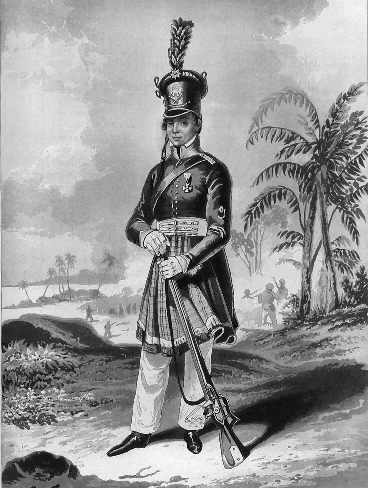
Dona Maria told me several particulars concerning the country, and more concerning her own adventures. It appears, that early in the late war of the Reconcave, emissaries had traversed the country in all directions, to raise patriot recruits; that one of these had arrived at her father's house one day about dinner time; that her father had invited him in, and that after their meal he began to talk on the subject of his visit. He represented the greatness and the riches of Brazil, and the happiness to which it might attain if independent. He set forth the long and oppressive tyranny of Portugal; and the meanness of submitting to be ruled by so poor and degraded a country. He talked long and eloquently of the services Don Pedro had rendered to Brazil; of his virtues, and those of the Empress: so that at the last, said the girl, "I felt my heart burning in my "breast." Her father, however, had none of her enthusiasm of character. He is old, and said he neither could join the army himself, nor had he a son to send thither; and as to giving a slave for the ranks, what interest had a slave to fight for the independence of Brazil? He should wait in patience the result of the war, and be a peaceable subject to the winner. Dona Maria stole from home to the house of her own sister, who was married, and lived at a little distance. She recapitulated the whole of the stranger's discourse, and said she wished she was a man, that she might join the patriots. "Nay," said the sister, "if I had not a husband and children, for one half of what you say I would join the ranks for the Emperor." This was enough. Maria received some clothes belonging to her sister's husband to equip her; and as her father was then about to go to Cachoeira to dispose of some cottons, she resolved to take the opportunity of riding after him, near enough for protection in case of accident on the road, and far enough off to escape detection. At length being in sight of Cachoeira, she stopped; and going off the road, equipped herself in male attire, and entered the town. This was on Friday. By Sunday she had managed matters so well, that she had entered the regiment of artillery, and had mounted guard. She was too slight, however, for that service, and exchanged into the infantry, where she now is. She was sent hither, I believe, with despatches, and to be presented to the Emperor, who has given her an ensign's commission and the order of the cross, the decoration of which he himself fixed on her jacket.
She is illiterate, but clever. Her understanding is quick, and her perceptions keen. I think, with education she might have been a remarkable person. She is not particularly masculine in her appearance, and her manners are gentle and cheerful. She has not contracted any thing coarse or vulgar in her camp life, and I believe that no imputation has ever been substantiated against her modesty. One thing is certain, that her sex never was known until her father applied to her commanding officer to seek her.
There is nothing very peculiar in her manners at table, excepting that she eats farinha with her eggs at breakfast and her fish at dinner, instead of bread, and smokes a segar after each meal; but she is very temperate.
Sept. 8th, 1823.—I went with Mr. Hoste and Mr. Hately, of His Majesty's ship Briton, to Praya Grande, to see a party of Botecudo Indians, who are now there on a visit. As it is desired to civilise these people by every possible means, whenever they manifest a wish to visit the neighbourhood of the city, they are always encouraged and received kindly, fed to their hearts' content, and given clothes, and such trinkets and ornaments as they value. We saw about six men, and ten women, with some young children. The faces are rather square, with very high cheek-bones, and low contracted foreheads. Some of the young women are really pretty, of a light copper-colour, which glows all over when they blush; and two of the young men were decidedly handsome, with very dark eyes, (the usual colour of the eyes is hazel,) and aquiline noses; the rest were so disfigured by the holes cut in their lower lips and their ears to receive their barbarous ornaments, that we could scarcely tell what they were like. I had understood that the privilege of thus beautifying the face was reserved for the men,[122] but the women of this party were equally disfigured. We purchased from one of the men a mouth-piece, measuring an inch and a half in diameter. The ornaments used by these people are pieces of wood perfectly circular, which are inserted into the slit of the lip or ear, like a button, and are extremely frightful, especially when they are eating. It gives the mouth the appearance of an ape's; and the peculiar mumping it occasions is so hideously unnatural, that it gives credit to, if it did not originally suggest, the stories of their cannibalism.[123] The mouth is still more ugly without the lip-piece, the teeth appearing, and saliva running through.
When we entered the room where the savages are lodged, most of them were lying in mats on the floor; some on their faces, and some on their backs. Three of the women were suckling their infants, and these were dressed only in coarse cotton petticoats; the rest of the females had cotton frocks, the men shirts and trousers, given them on their arrival here. As they are usually naked in the woods, their garments seemed to sit uneasily on them: their usual motions seemed slow and lazy; but when roused, there was a springy activity hardly fitting a human being, in all they did. They begged for money; and when we took out a few vintems, the women crowded round me, and pinched me gently to attract my attention. They had learned a few words of Portuguese, which they addressed to us, but discoursed together in their own tongue, which seemed like a series of half-articulate sounds.
They had brought some of their bows and arrows with them of the rudest construction. The bow is of hard wood, with only two notches for the string. The arrows are of cane; some are pointed only with hard wood, others with a flat bit of cane tied with bark to the end of the hard wood: these arrows are five feet long; and I saw one of them penetrate several inches into the trunk of a tree, when shot by an Indian from his bow. I purchased one bow and two arrows. Most of these people had their hair closely clipped, excepting a tuft on the fore part of the head; and the men, who had slit their lips, had also pulled out their beards. The two handsome lads had cut their hair; but they had neither cut their lips nor pulled their beards. I tried to learn if this was a step towards civilisation, or if it was only that they had not reached the age when the ceremony of lip-slitting, &c. is practised, the interpreter attending them not being able to explain any thing but what concerns their commonest wants and actions.
September 9th.—I took two very fine Brazilian boys, who are about to enter the Imperial naval service, to spend the day at the botanical garden, which appears in much better order than when I saw it two years ago. The hedge-rows of the Bencoolen nut (Vernilzia Montana) are prodigiously grown: the Norfolk Island pine has shot up like a young giant, and I was glad to find many of the indigenous trees had been placed here; such as the Andraguoa, the nut of which is the strongest known purge; the Cambucá, whose fruit, as large as a russet apple, has the sub-acid taste of the gooseberry, to which its pulp bears a strong resemblance; the Japatec-caba, whose fruit is scarcely inferior to the damascene; and the Grumachama, whence a liquor, as good as that from cherries, is made: these three last are like laurels, and as beautiful as they are useful. I took my young friends to see the powder-mills, which are not now at work, being under repair; but they learned the manner of making powder, from the first weighing of the ingredients to the filling cartridges: and then we had our table spread in a pleasant part of the garden, under the shade of a jumbu tree, and made the head gardener, a very ingenious Dutchman, partake of our luncheon; which being over, he showed us the cinnamon they have barked here, and the other specimens of spice: the cloves are very fine, and the cinnamon might be so; but the wood they have barked is generally too old, and they have not yet the method of stripping the twigs: this I endeavoured to explain, as I had seen it practised in Ceylon. The camphor tree grows very well here, but I do not know if the gum has ever been collected. The two boys were highly delighted with their jaunt, and I not less so. Poor things! they are entering on a hard service; and God knows whether the two cousins da Costa may not hereafter look back to this day passed with a stranger, as a bright "spot of azure in a stormy sky."
Sept. 13th.—I rode again to the botanic gardens with Mr. Hoste and Mr. Hately. Our chief object this time was the powder-mills. After walking round the garden, we proceeded along the valley of the mills; and so beautiful and sequestered a place, in the bosom of the mountains, was surely never before chosen as a manufactory for so destructive an article: I suppose the great command of water for the machinery is the chief inducement to fix it here. The powder is mixed by pounding, the mortars being of rosewood, and the pestles of the same shod with copper; yet the mortar-hoops are iron, which seems to me to be a strange oversight. I do not understand these things, however; but the machinery interested me: it is extremely simple, and the timber used in the construction very beautiful. The principal mill blew up a few months since, and is now under repair; so that we had an opportunity of seeing the watercourses, dams, wheels, &c., which we could not otherwise have enjoyed. We could not learn the relative strength of the powder. I have heard, however, that it is good. What I have seen is about as fine in grain as what we call priming powder in the navy. While we were walking about we were invited into several houses, by the overseers and other persons employed in the works, and pressed to eat and drink with great hospitality. The greatest liberality to strangers, indeed, exists in all public establishments here. For instance, at the botanic garden there is a constant nursery of the rare and the useful plants, which are given away, on application, to strangers and natives alike; so that not only the gardens of Brazil are stocked with the rarer productions of the East, but they are carried to different countries in Europe, prepared by this cooler climate for their farther transplantation.
14th.—I observed on the beach to-day a line of red sandy-looking matter, extending all along the shore, and tinging the sea for several feet from the edge. At night this red edge became luminous; and I now recollect when on the passage to India in 1809, that on observing a peculiar luminous appearance of the sea, we took up a bucket of water, and on examining it next morning, we observed a similar red grainy substance floating in it. It is the first time I have seen it here, and I cannot find that any body has paid any attention to it. Perhaps it is not worth noticing; but I am so much alone, that I have grown more and more alive to all the appearances of inanimate nature. Besides, I must make much of the country, as in a few days I have to take up my abode in one of the narrow close streets of Rio; and this not from choice. It is the custom here, and a very natural and pleasant one it is, for every family that can, to live in the country all the summer: so that the houses of every kind, in the country, are in great request. The term for which that I live in was hired is expired, and I am therefore obliged to leave it. My going to town, perhaps, might be avoided, but there are some things I shall probably learn more perfectly by living there; and, besides, does not Lord Bacon advise that in order to profit much from travel, one should not only move from city to city, "but change his lodgings from one end and part of the city to another?"
The last fortnight has been extremely foggy, and rather cold; and we have had some fierce thunder-storms, that seem almost to rock the mountains, and threaten to bring them down upon us.
16th.—At length I am fixed in No. 79., Rua dos Pescadores, in the first floor of an excellent house, belonging to my kind friend Dr. Dickson, who himself inhabits a villa out of town; where he has a farm, a garden, a collection of minerals and insects, and all sorts of agreeable and profitable things, which he dispenses to others with the greatest good-nature. I am obliged to Sir Thomas Hardy for a pleasant passage to town from Botafogo, his carriage conveying me, and his boats my goods: so in a few hours I have changed my home, and have probably taken my leave of all English society, every body has such a dread of the heat of the town. However, as I look forward to going to England in a few months, perhaps in a few weeks, the more time I have for Brazil the better. My private affairs have so occupied me that I have scarcely had time to think of the public. Yet in the course of the last week the project of the constitution for Brazil, framed by the committee appointed, was sent from the Assembly to the Emperor; and yesterday the discussion of it, article by article, began in the full assembly.
17th.—One advantage has already arisen from my removal into town. I have received the very first news of the arrival of a ship from Lisbon with commissioners on the part of the King to the Emperor. I find, too, that at Lisbon they can publish false news, as well as in some other countries in Europe. That city had illuminated in consequence of news that Lord Cochrane had been beaten, and the Imperial navy destroyed by the Bahia squadron; and this illumination must have taken place just about the time that Madeira was evacuating the city, and flying before the Imperial Admiral's flag. As to the reception the commissioners are to meet with, it is doubtful. Some days since the brig 3° de Maio arrived here, having on board Luiz Paolino as successor to Madeira; who, finding he could not get into Bahia, came hither, to present, it is said, his commission as governor of Bahia to His Imperial Majesty as Prince Regent; and it is also said that he was the bearer of some letters. But as none of these acknowledged the title, or independence of the empire of Brazil, they were not received; and the vessel has already sailed on her return to Lisbon. It is believed that the same fate will attend the present commissioners, Vieira and his colleague, if indeed the ship should not be condemned as a prize. But hitherto of course nothing is known.