JOURNAL.
Reading edition
At about six o'clock in the evening of the 31st of July, 1821, after having saluted His Majesty, George IV., who at that moment went on board the Royal George yacht, to proceed to Dublin,—we sailed in the Doris, a 42 gun frigate, for South America. After touching at Plymouth, and revisiting all the wonders of the break-water and new watering place, we sailed afresh, but when off Ushant, were driven back to Falmouth by a heavy gale of wind. There we remained till the 11th of August, when, with colours half-mast high, on account of the death of Queen Caroline, we finally left the channel, and on the 18th about noon came in sight of Porto Santo.
We passed it on the side where the town founded by Don Henry of Portugal, on the first discovery of the island, is situated, and regretted much that it was too late in the day to go in very near it. The land is high and rocky, but near the town there is a good deal of verdure, and higher up on the land, extensive woods; a considerable quantity of wine is made there, which, being a little manufactured at Funchal, passes for true Madeira. As usual in Portuguese colonial towns, the church and convent are very conspicuous. When we passed Porto Santo, and the Desertas, and anchored in Funchal roads, I was disappointed at the calmness of my own feelings, looking at these distant islands with as little emotion as if I had passed a headland in the channel. Well do I remember, when I first saw Funchal twelve years ago, the joyous eagerness with which I feasted my eyes upon the first foreign country I had ever approached, the curiosity to see every stone and tree of the new land, which kept my spirits in a kind of happy fever.
"Sweet Memory, wafted by thy gentle gale, Oft up the stream of time I turn my sail, To view the fairy haunts of long lost hours, Blest with far greener shades, far fresher flow'rs." Rogers.
Now I look on them tamely, or at best only as parts of the lovely landscape, which, just at sunset, the time we anchored, was particularly beautiful. Surely the few years added to my age have not done this? May I not rather hope, that having seen lands whose monuments are all history, and whose associations are all poetry, I have a higher taste, and more discriminating eye? One object never palls—that ocean where the Almighty "Glasses himself in tempests," or over which the gentle wings of peace seem to brood. The feeling that there was a change, however, either in the scene or in me, was so strong, that I ran to my cabin and sought out a sketch I had made in 1809. I compared it with the town. Every point of the hill, every house was the same, and again Nossa Senhora da Monte, with her brilliant white towers shining from on high through the evening cloud, seemed to sanctify the scene, while a few rough voices from the shore and the neighbouring ships chaunted the Ave Maria.
Early in the morning of the 19th, we took a large party of the midshipmen on shore to enjoy the young pleasure of walking on a foreign land. To them it was new to see the palm, the cypress, and the yucca, together with the maize, banana, and sugar-cane, surrounded by vineyards, while the pine and chesnut clothe the hills. We mounted the boys on mules, and rode up to the little parish church, generally mistaken for a convent, called Nossa Senhora da Monte. My maid and I went in a bad sort of palankeen, though convenient for these roads, which are the worst I have seen; however, the view made up for the difficulty of getting to it. The sea with the Desertas bounded the prospect: below us lay the roadstead and shipping, the town and gardens, and the hill clothed with vineyards and trees of every climate, which deck the ashy tufa, or compact basalt of which the whole island seems to be composed. Purchas, who like Bowles, believes the story of the discovery of Madeira by the Englishman Masham and his dying mistress, says, that shortly after that event, the woods having taken fire burned so fiercely, that the inhabitants were forced out to sea to escape from the flames. The woods, however, are again pretty thick, and some inferior mahogany among it is used for furniture. The pine is too soft for most purposes. In the gardens we found a large blue hydrangea very common: the fuschia is the usual hedge. Mixed with that splendid shrub, aloes, prickly pear, euphorbia, and cactus, serve for the coarser fences; and these strange vegetables, together with innumerable lizards and insects, tell us we are nearing the tropics.
We spent a very happy day at the hospitable country house of Mr. Wardrope, and our cavalcade to the town at night was delightful. The boys, mounted as before, together with several gentlemen who had joined us at Mr. W.'s, enjoyed the novelty of riding home by torch-light; and as we wound down the hill, the voices of the muleteers answering each other, or encouraging their beasts with a kind of rude song, completed the scene. The evening was fine, and the star-light lovely: we embarked in two shore boats at the custom-house gate, and, after being duly hailed by the guard-boat, a strange machine mounting one old rusty 6 lb. carronade, we reached the ship in very good time.
20th. We walked a good deal about the town, and entered the cathedral with some feelings of reverence, for a part of it at least was built by Don Henry of Portugal, who founded and endowed the college adjoining. The interior of the church is in some parts gaudy, and there is a silver rail of some value. The ceiling is of cedar, richly carved, and reminds me of some of the old churches at Venice, which present a style half Gothic half Saracenic. Near the church a public garden has lately been formed, and some curious exotic trees placed there with great success.
In rambling about the town, we naturally enquired for the chapel of skulls, the ugliness of which had shocked us when here formerly, and were not sorry to find that that hideous monument of bad taste is falling fast to ruin. I cannot imagine how such fantastic horrors can ever have been sanctified, but so it is; and the Indian fakir who fastens a real skull round his neck, the Roman pilgrim who hangs a model of one to his rosary, and the friar who decks his oratory with a thousand of them, are one and all acted upon either by the same real superstition, or spiritual vanity, craving to distinguish itself even by disgusting peculiarities.
Of late years superstition has been used as an instrument of no small power in revolutions of every kind. Even here it has played its part. A small chapel, dedicated to St. Sebastian, had been removed by the Portuguese government in order to erect a market-place, where all articles of daily consumption were to be sold, a small tax being levied on the holders of stands. This innovation was of course disagreeable to the people, and on the night of the revolution, in November last, some of their leading orators accused the market-place of having, by rudely thrusting out St. Sebastian, occasioned the failure of the vineyards, and threatened the ruin of the island. The market-place was instantly devoted; it was down in a few seconds, and a chapel to St. Sebastian begun. Men, women, and children worked all night, and the walls were raised to at least two-thirds of the intended height; but day brought weariness, and perhaps the morning breeze chilled the fever of enthusiasm. The voluntary labourers worked no more, and no subscription adequate to the hire of workmen to complete it has yet been raised: so that the new St. Sebastian's stands roofless, and the officiating priest performs his masses with no other canopy than the heavens.
Other and better consequences have, however, arisen from the revolution of November. The grievances of the inhabitants of Madeira were severe. The sons of the best families were seized arbitrarily, and sent to serve in the armies of Europe or Brazil: scarcely any article, however necessary, or however coarse, was permitted to be manufactured; the very torches, made of twisted grass and resin, so necessary for travelling these mountain roads after sunset, were all sent from Lisbon, and every species of cultivation, but that of the grape, discountenanced. Thus situated, every class joined heart and hand in the revolution: deputies were sent to the Cortes; petitions respecting the state of agriculture, manufactures, and commerce, were presented; and many, perhaps most, of the grievances were redressed, or at least much lightened.
Till the year 1821, there had never been a printing-press in Madeira; but the promoters of the revolution sent to England for one, which is now set up in Funchal; and on the 2d of July, 1821, the first newspaper, under the name of Patriota Funchalense, appeared. It contained a well written patriotic preface; and the first article is a declaration of the rights of citizens, and of the pretensions of the Portuguese nation, its religion, government, and royal family, as adopted by the Cortes for the basis of the constitution to be formed for its government. The paper has continued to be published twice a week: it contains a few political addresses and discourses; all foreign intelligence; some tolerable papers on distilling, agriculture, manufactures, and similar topics; some humorous pieces in prose and verse; poems on several occasions; and, at the end of the month, a table of the receipts and expenditures of government. Among the advertisements I observe one informing the public where leeches may be bought at about two shillings and sixpence a piece.
I thought it curious to observe this first dawning of literature and interest in politics in this little island. There are certainly enough anglicisms in the paper, to point out the probable country of some of the writers; and there are, as might be looked for, some traces of the residence of British troops in the colony; but on the whole, the paper is creditable to the editors, and likely to be useful to the island. I hear the articles on the making of wines and brandies very highly spoken of. Madeira, lying in the finest climate in the world, beautiful and fertile, and easy of access to foreigners, ought not to be a mere half civilised colony.
23d.—We sailed yesterday from Funchal, and soon lost sight of the
"Filha do oceano Do undoso campo flor, gentil Madeira." Diniz.
At night, I sat a long time on the deck, listening to the sea songs with which the crew beguile the evening watch. Though the humorous songs were applauded sufficiently, yet the plaintive and pathetic seemed the favourites; and the chorus to the Death of Wolfe was swelled by many voices. Oh, who shall say that fame is not a real good! It is twice blessed—it blesses him who earns, and those who give, to parody the words of Shakspeare. Here, on the wide ocean, far from the land of Wolfe's birth, and that of his gallant death, his story was raising and swelling the hearts of rough men, and exciting love of country and of glory by the very sound of his name. Well may he be called a benefactor to his country who, by increasing the list of patriotic sailors' songs, has fostered those feelings and energies which have placed Britain's "home upon the mountain wave, and her march upon the deep."
The charms of night in a southern climate have been dwelt upon by travelled poets (for I call Madame de Stael's writings poetry), and even travelled prose writers; but Lord Byron alone has sketched with knowledge and with love, the moonlight scenery of a frigate in full sail. The life of a seaman is the essence of poetry; change, new combinations, danger, situations from almost deathlike calm, to the maddest combinations of horror—every romantic feeling called forth, and every power of heart and intellect exercised. Man, weak as he is, baffling the elements, and again seeing that miracle of his invention, the tall ship he sails in, tossed to and fro, like the lightest feather from the seabird's wing—while he can do nothing but resign himself to the will of Him who alone can stay the proud waves, and on whom heart, intellect, and feeling, all depend!
25th.—Nothing can be finer than the approach to Teneriffe[39], especially on such a day as this; the peak now appearing through the floating clouds, and now entirely veiled by them. As we drew near the coast, the bay or rather roadstead of Oratava, surrounded by a singular mixture of rocks, and woods, and scattered towns, started forth at once from beneath the mists, which seemed to separate it from the peak, whose cold blue colour formed a strong contrast to the glowing red and yellow which autumn had already spread on the lower grounds.
We anchored in forty fathoms water with our chain-cable, as the bottom is very rocky, excepting where a pretty wide river, which, though now dry, rolls a considerable body of water to the sea in the rainy season, has deposited a bed of black mud. There are many rocks in the bay, with from one to three fathoms water, and within them from nine to ten. The swell constantly setting in is very great, and renders the anchorage uncomfortable.
26th.—- I went ashore with Mr. Dance, the second lieutenant, and two of the young midshipmen, for the purpose of riding to the Villa di Oratava, which is situated where the ancient Guanche capital stood. We landed at the Puerto di Oratava, several miles from the villa: it is defended by some small batteries, at one of which is the very difficult landing-place, sheltered by a low reef of rocks that runs far out, and occasions a heavy surf. I took my own saddle ashore: and being mounted on a fine mule, we all began our journey towards the hill. The road is rough, but has evidently once been made with some pains, and paved with blocks of porous lava; but the winter rains have long ago destroyed it, and it does not seem to be any body's business to put it in repair.
The first quarter of a mile on either hand presented a scene so black and stony, that I was surprised to learn that we had been passing through corn land; the harvest was over, and the stubble burned on the ground. The produce here is scanty; but being so near the port, it repays the labour and expense of cultivation. We saw the botanical garden so much praised by Humboldt; but it is in sad disorder, having been for some time entirely neglected. However, the very establishment of such a thing brings in new plants, and perhaps naturalises them. Here, the sago-palm, platanus, and tamarind, as well as the flowers and vegetables of the north of Europe, flourish so well as to promise to add permanently to the riches of this rich island. As we ascended towards the villa the prospect improved; the vineyards appeared in greatest beauty, every other crop still standing in the luxuriant valleys, the rocky cliffs of the mountains clothed with wood, and every thing glowing with life. Wheat, barley, a few oats, maize, potatoes, and caravansas, all grow freely here. The food of the common people consists chiefly of Polenta, or maize flour, used nearly as the Scotch peasants use their oatmeal, in cakes, brose, or porridge, which last is suffered to grow cold, and then most commonly cut in slices and toasted. After the maize, potatoes are the favourite food, together with salt fish. The potatoe is always in season, being planted every month, and consequently producing a monthly crop. The fishery employs from forty-five to fifty vessels of from seventy to ninety tons' burden, from the island of Teneriffe alone; the fish are taken on the coast of Africa, and salted here.
To a stranger the sight of the long walls of black porous lava, built terrace-wise to support the vegetable mould, is very striking; but the walls cannot be called ugly, while the clustering vine and broad-spreading gourd, climb and find support on them: these, however, soon disappeared, and were replaced by field and garden enclosures. After a pleasant but hot ride, we arrived at the villa about noon, and went to the house of Señor Don Antonio de Monteverde, who accompanied us to M. Franqui's garden, to see one of the wonders of the island, the famous Dragon Tree. Humboldt has celebrated this tree in its vigour; it is now a noble ruin. In July, 1819, one half of its enormous crown fell: the wound is plaistered up, the date of the misfortune marked on it, and as much care is taken of the venerable vegetable as will ensure it for at least another century. I sat down to make a sketch of it; and while I was drawing, learned from Mr. Galway the following history of the family of its owner, which a little skill in language and a little adorning with sentiment might convert into a modern novel.—About the year 1760, the Marquis Franqui, upon some disgust, made over his estates in trust to his brother, and emigrated to France, where he remained until 1810, regularly receiving the proceeds from his estates in Teneriffe. Meantime, during the early period of the revolution, he married; and his only child, a daughter, was born. This marriage, however, was only a civil contract, such being then the law of France, and with a woman divorced from another, who was still living. But neither the validity of the union nor the legitimacy of the child was ever questioned; and the Marquis Franqui returning to his native country, brought with him his daughter, introducing and treating her as his heiress. She appeared to be received as such by his family; and at his death he appointed trustworthy guardians to her and her estates, one of whom is her husband's father. No sooner, however, was the Marquis dead, than his brother claimed his property, alleging that the church had never sanctioned the Marquis's marriage, and that the daughter consequently, as an illegitimate child, could have no claim on his estates. He therefore commenced a lawsuit against her and her guardians, and the suit is still pending. Meantime the court receives the rents; the garden, the chief ornament of the town, is running wild, and the house is deserted.
Dragon Tree and Peak of Teneriffe.
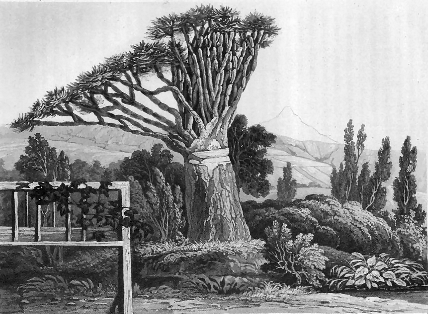
The dragon tree is the slowest of growth among vegetables; it seems also to be slowest in decay. In the 15th century, that of Oratava had attained the height and size which it boasted till 1819. It may have been in its prime for centuries before; and scarcely less than a thousand years must have elapsed, before it attained its full size. Excepting the dragon trees at Madeira, the only many-headed palm I had seen before was that at Mazagong in Bombay. It is crowned, however, with a leaf like that of the palmetto; but the tufts of the dragon tree resemble the yucca in growth. The palm tree at Mazagong, like the adansonia in Salsette, is reported to have been carried thither by a pilgrim from Africa, probably from Upper Egypt, where late travellers mention this palm.
On our return from the garden to Don Antonio's house, we were most kindly received by his wife and daughter, the latter of whom played a long and difficult piece of music most excellently. It was, however, English, in compliment to us, though we should have preferred some of her own national airs. After the music, we were conducted to a table spread in the gallery that surrounds the open court in the middle of the house, and covered with fruits, sweetmeats, and wines, which were pressed upon us most hospitably; till finding it time to return, the ladies both embraced me, and we began our journey down the hill, having first looked into the churches, which are spacious and handsome, a good deal in the style of those of Madeira, but finer.
As we rode along, we observed a large Dominican convent, the only one now on the island. The recent law passed by the Spanish Cortes for the suppression of religious houses, has been strictly enforced here. No more than one convent of each denomination is allowed to subsist, and great checks are put on the profession of new members. As to the revolution here, the inhabitants had known from authentic though not official authority of what had taken place in the mother country, three weeks before they received any notification from either court or cortes. When notice did arrive, the magistrates assembled the people, read their orders, and took their oaths to support the cortes; the people shouted, and made a bonfire: next day the forms of law and justice were declared to be changed, the tribunals proceeded accordingly, and all was over and quiet.
The Canary Islands boast of two bishoprics, both of which are now vacant, yet have not one newspaper. The only printing press has been so long in disuse that there is nobody who can work it in the country. I could not learn that there are any manufactures in Teneriffe; if there are, I conclude they must be in the neighbourhood of Laguna or Santa Cruz. Oratava appears to be the district of corn and wine.
We returned to the port by a longer road than that by which we left it. In the hedges, the boys, with no small delight, gathered fine ripe black-berries, which were growing among prickly pear and other tropical plants. The fields, vineyards, and orchards we had seen from the former road we now passed through; and as it was a fiesta, we saw the peasants in their best attire, and their little mud huts cleanly swept and garnished. They seem gentle and lively, not much darker than the natives of the south of Europe; and if there be a mixture of Guanche blood, it is said to be traced in the high cheek-bones, narrow chins, and slender hands and feet which in a few districts seem to indicate a different race of men. I regret that I had not time to see more of the people and the country; but not being travellers from curiosity, and belonging to a service that may not swerve from the strictest obedience, we dared not even think of a farther excursion.
Halfway down the hill, we entered a ravine, the dry bed of a winter torrent, where there were rue, lavender, prickly pear, hypericum, and spurge; but not a blade of grass had survived the summer's drought. We passed a heap of black ashes, which anywhere but at the base of the peak would be called a respectable mountain. It has not been cold long enough to be disguised by vegetation; and though on one side the vine is beginning to clothe its rugged surface, yet the greater part is frightfully barren. Shortly after we passed it, we arrived at Mr. Galway's garden-house, and found his lady, a Spaniard of Irish extraction, ready to receive us. As I had seen in some old Scotch houses, the best bed-chamber served as drawing-room; but the dressing-room is apart, and from the front there is an opening to a pleasant terrace, commanding a charming view. Our dinner was a mixture of English and Spanish cookery and customs: the Spanish part consisted of part of a Darter, a very fine fish, white, but resembling a salmon in taste, with sauce made of small lobsters, oil, vinegar, garlic, and pimento; some excellent stews, and mixtures of vegetables and quails roasted in vine leaves; the rest were all English; and the wines, the growth of the island, and ices[40] were delicious. Neither the pine-apple nor water-melon grow in Teneriffe, but abundance of the latter are brought from Grand Canary. All the common garden fruits of Europe flourish here; but too little attention is paid to horticulture. This island, or at least the part I have seen, evidently belongs to a state that has once been great; but is now too poor or too weak to foster its foreign possessions. Some fine houses begun are in an unfinished state, and appear to have been so for years; others, though falling, are neither rebuilt nor repaired; and the only things like present prosperity, are the neat English country-houses.
It was sunset before we reached the boats that were to convey us to the ship; and we had some difficulty both in getting off and in going alongside of the frigate, owing to the great swell. The night, however, was fine, and the scene enlivened by the lights in the fishing boats, which, like those in the Mediterranean, are used to attract the fish. On shore, the lights of the ports and villa, and the fires of the charcoal burners shining from amidst the dark hanging forests of pine, and those of the limekilns in the direction of Laguna, appeared like a brilliant illumination; and there being not a cloud, the outline of the peak was well defined on the deep blue of the nocturnal sky.
27th August. To-day, some of our new friends, both Spanish and English, came on board; but the swell was so great, that only one escaped sea-sickness. Mrs. Galway was fearful of suffering, so did not come, but she sent me some of the beads found in the sepulchres of the Guanches: they are of hard baked clay. Mr. Humboldt, whose imagination was naturally full of South America, has conjectured that they might have been used for the same purpose as the Peruvian quipos, but they are inconveniently large for that use. They are not unlike the beads Belzoni found in the mummy pits in Egypt, and they closely resemble some of the many kinds of beads with which the Bramins have counted their muntras time immemorial. The Oriental custom of dropping a bead for every prayer having been adopted by the Christians of the west, and still continuing in Roman Catholic countries, appears, on that account, too common to deserve the notice of a philosophical traveller; and therefore the Guanche shepherds, or goatherd kings, are rather supposed, like the polished Peruvians, to have recorded the annals of their reigns with clay beads, than allowed to tell them with their orisons, like the Bramins of the Ganges, the shepherds of Mesopotamia, or the anchorets of Palestine and Egypt, because the modern monk does the same. The Guanche mummies are now of very rare occurrence. During the early times of the Spanish government of the island, their sepulchres were carefully concealed by the natives; now, intermarriage with their conquerors, and consequent change of religion and habits, have rendered them careless of them, and they are, generally speaking, really forgotten, and only discovered accidentally in planting a new vineyard, or ploughing a new field.
28th. This morning left the "still vext" bay of Oratava, and before sunset saw Palma and Gomera. The Canary Islands, supposed to be the Fortunate Islands of the ancients, were discovered accidentally in 1405. Betancour, a Frenchman, took possession of them for Spain; but the natives were brave, and it cost both the Spaniards and Portuguese, who possessed them by turns, much blood and treasure to conquer the country and exterminate the people, for their wars ended in nothing less. Purchas complains that he could not obtain the reading of some travels by an Englishman who had visited the Peak; the good pilgrim's curiosity had been strongly excited by the particulars he had learnt from books, and the journals of some of his friends who had travelled, which he has carefully related: they are such as to make me regret that he has not recorded more, and that I cannot see more. We brought with us from Oratava one of the finest goats I ever saw; I presume she was a descendant of the original flock which the supreme deity of the Guanches created to be the property of the kings alone: she is brown, with very long twisted horns, a very remarkable white beard, and the largest udder I ever saw.
29th. Passed the island of Hierro or Ferro, the old first meridian; which honour, I presume, it enjoyed from having been considered as the most western land in the world until the discovery of America. We were very close to it, and all agreed that we never saw so hard-looking and inaccessible a place. We saw some fine woods, a few scattered houses, and one village perched upon a hill, at least 1500 feet above us. The Peak of Teneriffe still visible above the clouds.
Sept. 1st. The flying-fish are become very numerous, and whole fleets of medusæ have passed us; some we have picked up, besides a very beautiful purple sea-snail. This fish has four horns, like a snail, the shell is very beautifully tinted with purple, and there is a spongy substance attached to the fish which I thought assisted it to swim: it is larger in bulk than the whole fish. One of them gave out fully a quarter of an ounce of purple fluid from the lower part of the fish. A fine yellow locust and a swallow flew on board; and as we believe ourselves to be four hundred miles from the nearest land, Cape Blanco, we cannot enough admire the structure of the wings that have borne them so far.
Our school for the ship's boys is now fairly established, and does Mr. Hyslop, our school-master, great credit; that for the midshipmen is going on very well, being kept in the fore-cabin under the captain's eye. The boys have his presence, not only as a check to idleness or noise, but as an encouragement to industry. He is most anxious to make them fit to be officers and seamen in their profession, and good men and gentlemen both at sea and on shore. Happily they are all promising; but if G—— should disappoint us, I never will believe in youthful talent, industry, or goodness more. Our days pass swiftly, because busily. The regular business of the ship, the school, astronomical observations, study of history and modern languages, and nothing permitted to pass without observation, fill our time completely.
Lord Bacon says, "It is a strange thing that in sea voyages, where there is nothing to be seen but sky and sea, men should make diaries; but in land travel, wherein so much is to be observed, for the most part they omit it, as if chance were fitter to be registered than observation." However, for once, his lordship has only seen, or perhaps only spoken, in part. Sea and sky must be observed before we can know the laws by which their great changes or chances are regulated. Observations on the works of man, as cities, courts, &c. may be omitted, for we know their authors, and can have recourse to them, their motives, and their history, whenever we please; but the great operations of nature are so above us, that we must humbly mark them, and endeavour to make their history a part of our experience, in order that we pass safely through their vicissitudes. Hence it is, that the commonest details of the early navigators, their sunrise and sunset, their daily portionings of food and water, are read with a deeper interest than the liveliest tour through civilised countries and populous cities; that Byron's passage through Chiloe continues to excite the most profound sympathy; while Moore's lively view of society and manners in France or Italy, are now seldom or languidly read. The uncertainty, the mystery of nature, keep up a perpetual curiosity; but I suspect that if we knew the progress and dependance of her operations, as well as we do those of an architect or brick-layer, the history of the building of a theatre or a dwelling-house might vie in interest with that of a sea voyage.
The books we intend our boys to read are,—history, particularly that of Greece, Rome, England, and France; an outline of general history, voyages, and discoveries; some poetry, and general literature, in French and English; Delolme, with the concluding chapter of Blackstone on the history of the law and the constitution of England; and afterwards the first volume of Blackstone, Bacon's Essays, and Paley. We have only three years to work in; and as the business of their life is to learn their profession, including mathematics, algebra, nautical astronomy, theory and practice of seamanship, and duty as officers, with all the technicalities belonging to it,—this is all we dare propose.
5th. We have begun to look forward to that festival of the seamen, the crossing the line. I know not whence the custom is derived, but the Arabs observe it with ceremonies not very unlike those practised by our own sailors. To-day a letter, containing a sketch of the intended festival, with thanks for permission to keep it, was sent into the cabin. I shall copy it with its answer. I find that some captains have begun to give money at the next port, instead of permitting this day of misrule. Perhaps they may be right, and perhaps in time it may be forgotten; but will it be better that it should be so? It is the sailors' only festival; and I like a festival: it gives the heart room to play. The head in one class, and the limbs in another, work every day, and in divers, if not opposite directions; but on a festival, the hearts of all beat the same way: yet I would not have them too often, for
"If every day were playing holiday, To sport would be as tedious as to work;"
the converse of the proverb, "All work and no play, makes Jack a dull boy." But to our letters.
"The sons of Neptune, of His Majesty's ship Doris, commanded by Captain T.G., return their most grateful thanks for his kind condescension for granting them the favour that has been allowed to them from time immemorial, in crossing the Equinoctial, on our Old Father Neptune's dominions, when we hope the characters will meet your Honour's approbation, which will appear in the margin.
Thomas Clark, quarter-master, — Neptune.
J. Ware, forecastle, — Amphitrite.
W. Knight, — Amphitrite's Son.
W. Sullivan, 2d captain main-top, — Triton.
C. Brisbane (negro), — Triton's Horse.
J. Thompson, gunner's mate, — High Sheriff.
J. White, forecastle, — Sub Sheriff.
W. Sinclair, captain forecastle, — Barber.
J. Smith, J. Forster, Michael Jaque, — Barber's Mates.
J. Gaggin, — Clerk.
W. Bird, captain fore-top, — Chief Constable.
Nine assistants.
J. Duncan, boatswain's mate, — Coachman.
J. Clark, — Postilion.
J. Leath, — Footman.
J. Speed, — Painter.
W. Lundy, — Bottle-holder.
W. Williamson, — Satan.
J. Williams, — Judge Advocate.
Eight Sea-horses.
"So we have given you as good a relation as possibly our weak abilities afford us; and, honoured Captain, believe us when we say, we wish you every happiness this life can afford, and your honoured lady entirely included, and believe us yours, &c. &c. &c.
"Britton's Sons."
Answer.
"I received your letter with the list of characters that are to appear in Father Neptune's train on our crossing the line, of which I completely approve. I have to thank you for your kind wishes both for Mrs. G—— and myself, and to assure you, that the greatest pleasure I can feel in the command of this ship, will be in promoting the happiness and comfort of the whole of Britain's sons on board the Doris.
"Believe me your sincere friend, Thos. G——,
"H.M.S. Doris, at Sea, Sept 5th, 1821. To Britain's Sons, H.M.S. Doris."
It would be worth while to enquire into the origin of the merry-making on crossing the line. As the Arabs, an astronomical people, have it, it has probably some reference to their now-forgotten worship of the heavenly bodies. Like us, they set on fire some combustible matter or other, and let it float away, but they add some food to it, as if there had once been a sacrifice accompanying the festival. Such, at least, I have been assured by several gentleman well acquainted with the Arab traders in the Eastern sea, is their practice.
18th. We have done nothing but sail on with very variable weather, for the last thirteen days.
"From world to world our steady course we keep, Swift as the winds along the waters sweep, Mid the mute nations of the purple deep."
One night we observed that luminous appearance of the sea so often described, but it was not so brilliant as I remember to have seen it near the same latitude. The next morning we found the temperature of the sea, at the surface, two degrees higher than that of the atmosphere. Last night at 8 P. M. we crossed the line: to-day, accordingly, our Saturnalian festival took place.
About six o'clock P. M. yesterday, the officer of the watch was informed that there was a boat with lights alongside, and begged to shorten sail. The captain immediately went on deck, and Neptune hailed from the fore part of the rigging, "What ship?" "Doris." "Who commands?" "Captain T. G." "Where from?" "Whitehall." "Where bound?" "A man of war's cruize." Upon which Triton mounted upon a sea-horse, admirably represented, appeared as bearer of a letter containing the names of all who had not yet crossed the line, and who were consequently to be initiated into the mysteries of the Water God. Triton having thus executed his commission, rode off, and was seen no more till 8 o'clock this morning, when Neptune being announced, the captain went on deck to receive him.
First came Triton mounted as before, then a company of sea-gods or constables dressed in oakum and swabs, but having their arms and shoulders bare, excepting the paint which bedaubed them. Neptune with trident and crown, Amphitrite by his side, and their son at their feet, appeared in a car drawn by eight sea-horses, and driven by a sea god: the train followed in the persons of the lawyers, barbers, and painters. The whole pageant was well dressed, and going in procession, fully as picturesque as any antique triumphal or religious ceremony; the fine forms of some of the actors struck me exceedingly. I never saw marble more beautiful than some of the backs and shoulders displayed; and the singular clothing to imitate fishes instead of legs, and seaweed skirts, which they had all adopted, carried one back for centuries, to the time when all this was religion.
After the progress round the decks, a conference with the captain, and a libation in the form of a glass of brandy, to which the god and goddess vied with each other in devotion, the merriment began. Mock-shaving, or a fine paid, was necessary to admit the new comers to the good graces of their watery father; and while he was superintending the business, all the rest of the ship's company, officers and all, proceeded to duck each other unmercifully. None but women escaped, and that only by staying in my cabin. The officer of the watch, sentries, quartermasters, and such as are absolutely necessary to look after the ship, are of course held sacred; so that some order is still preserved. It seemed really that "madness ruled the hour;" but at the appointed moment, half past eleven, all ceased: by noon, every body was at his duty, the decks were dried, and the ship restored to her wonted good order. The whole of our gunroom officers dine with us, and we flatter ourselves that we shall end the day as happily as we have begun it.[41]
20th. The long tiresome calms, and the beautiful moonlight nights near the equator, have been talked of, and written of, till we know all about them. Mention but passing the line, and you conjure up a wide, apparently interminable, glassy dull sea: sails flapping, a solitary bird sinking with heat, or a shark rising lazily to catch a bait; or, at best, a calm warm night, with a soft moonlight silvering over the treacherous deep, and rendering the beholders, who ought to be lovers if they are not, insensible of the rocks that may lurk below.—But our's was not the beau idéal of crossing the line: we had fresh breezes in the day, and thunder and lightning at night; saw few tropic birds, and those very vigorous, and fish more nimble than sharks, or even sun-fish, of which, however, we met a due proportion. I had once been in a tropical calm, and I really, after trying them both, prefer the breezes and thunder-storms. The other night we had one, such as Milton talks of:
"Either tropic now 'Gan thunder, and both ends of heav'n: the clouds From many a horrid rift abortive poured Fierce rain with lightning mixt, water with fire In ruin reconciled; nor slept the winds Within their stoney caves, but rush'd abroad From the four hinges of the world, and fell On the vext wilderness."
I never see a thunder-storm at sea, but it reminds me of the vision of Ezekiel:
"The sapphire blaze, Where angels tremble while they gaze."
It is awful and grand every where: fearful in the plain, sublime among the mountains; but here, on the ocean, with nothing to intercept its bolt, the horrible is superadded, and he must be more or less than man that does not at least take thought during its continuance.
Friday, September 21st. At length we are in sight of the coast of Brazil, which here is low and green, about two degrees to the northward of the point first discovered by Vincente Pinzon, in 1500.[42] The weather is very squally, and there is a heavy swell: we are anchored about eight miles from Olinda, the capital of Pernambuco, in fifteen fathoms water, but though we have fired more than one gun for a pilot, none seems to be coming off.
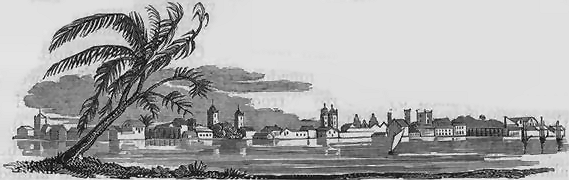
Pernambuco, September 22. 1821.—At nine o'clock the commodore of this place, whose office is a combination of port-admiral and commissioner, came on board with the harbour-master, and the ship was guided by the latter to the anchorage, which is about three miles from the town, in eight fathoms water. The roadstead is quite open, and we find here a very heavy swell. It is not wonderful that our guns were neither answered nor noticed last night. Mr. Dance, having been sent on shore with official letters to the governor and the acting English consul, found the place in a state of siege, and brought back with him Colonel Patronhe, the governor's aide-de-camp, who gave us the following account of the present state of Pernambuco:
Besides the disposition to revolution, which we were aware had long existed in every part of Brazil, there was, also, a jealousy between the Portuguese and Brazilians, which recent events had increased in no small degree. On the 29th of August, about 600 men of the militia and other native forces had taken possession of the Villa of Goyana, one of the principal places in this captaincy, and had forcibly entered the town-house, where they had declared the government of Luiz do Rego to be at an end. They proceeded to elect a temporary provisional government for Goyana, to act until the capital of the province should be in a condition to establish a constitutional junta; and in order to accelerate that event, they had collected forces of every kind, and among them several companies of the Caçadores who had deserted from Luiz do Rego; with these troops, such as they are, they had marched towards Pernambuco, and last night they had attacked the two main points of Olinda, to the north, in four different places, and Affogados to the south. They were, however, repulsed by the royal troops, under the governor, with the loss of fourteen killed and thirty-five prisoners, while the royalists had two killed, and seven wounded. This morning the alarm of the town's people was increased by finding several armed men concealed in the belfreys of the churches, whither also they had conveyed several stands of arms. Luiz do Rego is a soldier, and attached to the royal cause. He served long with the English army in Portugal and Spain, and, if I mistake not, distinguished himself at the siege of St. Sebastian's. He is rather a severe man, and, especially among the soldiers, more feared than loved.—Great part of the regiment of Caçadores has left him to join the patriots, and formed the most efficient corps in the attack last night. The towns-people have been formed into a militia, tolerably armed and trained. The town is pretty well supplied with mandioc flour, jerked beef, and salt fish; but the besiegers prevent all fresh provisions from coming in. All shops are shut, and all food scarce and dear. Most people who have property of value, in plate or jewels, have packed it up, and lodged it in the houses of the English merchants. Many persons with their wives and families have left their homes in the out-skirts of the town, and have taken refuge with the English. The latter, who, for the most part, sleep, at least, in country houses in the neighbourhood, called sitios, have left them, and remain altogether at their counting-houses in the port: every thing, in short, is alarm and uncertainty.
23d.—The night passed quietly, and so indeed did the day. Many messages have passed between us and the land, but I could not go on shore: we have excellent oranges, and tolerable vegetables from the town, and have been quite enough amused in observing the curious little boats, canoes, catamarans and jangadas, that have been sailing, and paddling, and rowing round the ship. The jangada resembles nothing I have ever seen before; six or eight logs are made fast together by two transverse beams; at one end there is a raised seat, on which a man places himself to steer, for they are furnished with a sort of rudder; sometimes the seat is large enough to admit of two sitters, another bench at the foot of a mast, immense for the size of the raft, holds clothes and provisions, or an upright pole is fixed in one of the logs, to which these things are suspended, and a large triangular sail of cotton cloth completes the jangada, in which the hardy Brazilian sailor ventures to sea, the waves constantly washing over it, and carries cargoes of cotton or other goods, or, in case of necessity, letters and despatches, hundreds of miles in safety.
About three o'clock a large canoe with two patriot officers came along side, to ascertain if we were really English; if we had come, as was reported, to assist the royalists, or if we would assist them: so apt are men, under the influence of strong feeling themselves, to doubt of perfect indifference in others, that I question much whether they believed in the strict neutrality we profess. They left us, however, without betraying any particular anxiety, and made a very circuitous passage home, in order to avoid the Recife cruizer, which was looking out for straggling boats or vessels of any description belonging to the patriots.
Monday the 24th.—Col. Patronhe arrived early this morning, to request that the English packet might put into Lisbon with the Government despatches. We felt glad that the strict rules of service prevented the captain from giving any such order to the master of the packet. It would be at once a breach of that neutrality we profess to observe, and, in my opinion, an aiding of the worst cause. The colonel, adverting to the town being in a state of siege, and the uncertainty of the next attack as to time and place, advised me strongly to stay altogether on board; but I had never seen a town in a state of siege, and therefore resolved to go ashore. Accordingly, Mr. Dance, being the only officer on board who speaks either Portuguese or French, was commissioned to accompany me; and I took two midshipmen, Grey and Langford, also to call on Madame do Rego.
The name of Pernambuco, which is that of the captainship, is now generally applied to the capital, which consists of two parts; 1st, the city of Olinda, which was founded by the Portuguese, under Duarte Coelho Pedreiro, about 1530 or 1540, and, as its name implies, on a beautiful spot, where moderate, but abrupt hills, a fine river, and thick wood, combine to charm the eye; but the approach to it by sea must always have been difficult, if not dangerous: and, 2nd, the town of Recife de Pernambuco, or the Reef of Pernambuco, built by the Dutch, under Maurice of Nassau, and by them called Maurice Town. It is a singular spot, well fitted for trade; it is situated upon several sand banks, divided by salt water creeks and the mouth of two fresh water rivers, connected by three bridges, and divided into as many parts; Recife, properly so called, where are the castles of defence, and the dock-yard, and the traders; Sant Antonio, where are the government house, the two principal churches, one for the white and one for the black population; and Boa Vista, where the richer merchants, or more idle inhabitants, live among their gardens, and where convents, churches, and the bishop's palace, give an air of importance to the very neat town around them.
All this I knew before I landed, and thought I was pretty well prepared for Pernambuco. But no previous knowledge could do away the wonder with which one must enter that very extraordinary port. From the ship, which is anchored three miles from the town, we see that vessels lie within a reef on which the sea is perpetually breaking, but till I was actually within that reef, I had not the least idea of the nature of the harbour: the swell going ashore would have seemed tremendous, had we not been prepared for it, and made our passage of three miles a very long one. We approached the sandy beach between Recife and Olinda so nearly, that I thought we were going to land there; when coming abreast of a tower on a rock, where the sea was breaking violently, we turned short round, and found ourselves within a marvellous natural break-water, heard the surf dashing without, and saw the spray, but we ourselves were sailing along smoothly and calmly, as if in a mill-pond. The rock of which the reef is formed, is said to be coral; but it is so coated with barnacle and limpet above barnacle and limpet, that I can see nothing but the remainder of these shells for many feet down, and as deep into the rock as our hammers will break. It extends from a good way to the northward of Paraiba to Olinda, where it sinks under water, and then rises abruptly at Recife, and runs on to Cape St. Augustine, where it is interrupted by the bold granite head, that shoots through it into the ocean: it then reappears, and continues, interruptedly, towards the south. The breadth of the harbour here between the reef and the main land varies from a few fathoms to three quarters of a mile; the water is deep close to the rock, and there the vessels often moor. There is a bar at the entrance of the harbour, over which there is, in ordinary tides, sixteen feet water, so that ships of considerable burden lie here.[43] His Majesty's brig Alacrity lay some time within the reef; and two feet more water on the bar, would have enabled the Doris to have entered, though, as far as I have seen, there would be no room to turn about if she wished to go out again. The reef is certainly one of the wonders of the world; it is scarcely sixteen feet broad at top. It slopes off more rapidly than the Plymouth break-water, to a great depth on the outside, and is perpendicular within, to many fathoms. Here and there, a few inequalities at the top must formerly have annoyed the harbour in high tides or strong winds, but Count Maurice remedied this, by laying huge blocks of granite into the faulty places, and has thus rendered the top level, and the harbour safe at all times. The Count had intended to build warehouses along the reef, but his removal from the government prevented his doing so. A small fort near the entrance defends it, and indeed always must, so narrow and sudden is the passage. Near it, a light-house is in a fair way of being soon finished, at the very extremity of the reef, and these are the only two buildings on this extraordinary line of rock. We rowed up the harbour among vessels of all nations, with the town on one side, and the reef on the other, until we came to one of the wide creeks, over which the Dutch built a fine stone bridge, now in decay. We were a a good deal struck with the beauty of the scene; the buildings are pretty large, and white; the land low and sandy, spotted with bright green tufts of grass, and adorned with palm-trees. A few years ago a violent flood nearly destroyed the greater part of the centre of the bridge, yet the arches still serve to support light wooden galleries on each side of it, and the houses and gateways are still standing at either end. We landed pretty near the bridge, and were received by Colonel Patronhe, who apologised for the governor, who could not come to receive us, as he was in the council room.[44] The colonel conducted us to the government house, a very handsome building, with a square in front, and a tower, and we entered what had evidently been a splendid hall. The gilding and painting still remained on some parts of the ceiling and walls; but now it is occupied by horses standing ready saddled; soldiers armed, and ready to mount at a moment's warning; every thing on the alert; guns in front with lighted matches by them, and an air of bustle and importance among the soldiers, that excites a sort of sympathetic curiosity as to their possible and immediate destination. On going up stairs we found almost as much confusion: for the governor has hitherto lived in the very out-skirts of the town, and has but just come to the house in Sant Antonio, which was formerly the Jesuits' college, partly to be in the centre of business, and partly to secure his family, in case of accident, as the besiegers' out-posts are very near his former residence. I found Madame do Rego an agreeable, rather pretty woman, and speaking English like a native: for this she accounted, by informing me that her mother, the Viscondeça do Rio Seco, was an Irish woman. Nothing could be kinder and more flattering than her manner, and that of General do Rego's two daughters, whose air and manner are those of really well-bred women, and one of them is very handsome. After sitting some little time, refreshments were brought in, and shortly after, the governor himself appeared; a fine military-looking man. He appeared ill, being still suffering from the effects of a wound, he received some months ago, while walking through the town with a friend. It has since been ascertained, that the instigator of the crime was a certain Ouvidor (judge) whom he had displaced shortly after he assumed the government. The assassin fired twice; Luiz do Rego received several shots and slugs in his body, but the most severe wound was in his left arm. His friend's life was for some time despaired of, but both are now nearly well. At the time the crime was committed, the perpetrator was seized more than once by some of the bye-standers; but as often, a baker's basket was pushed in between him and whoever seized him; he threw away his pistols and escaped.[45]
Having paid our visit, we proceeded to walk about the town. The streets are paved partly with blueish pebbles from the beach, partly with red or grey granite. The houses are three or four stories high, built of a whitish stone, and all are white-washed, with door-posts and window-frames of brown stone. The ground floor consists of shops, or lodging for the negroes, and stables: the floor above is generally appropriated to counting-houses and ware-rooms; and the dwelling-house still higher, the kitchen being universally at the top, by which means the lower part of the house is kept cool, I was surprised to find it so possible to walk out without inconvenience from the heat, so near the equator; but the constant sea-breeze, which sets in here every day at ten o'clock, preserves a temperature, under which it is at all times possible to take exercise. The hot time of day is from eight, when the land breeze fails, to ten. As we were to pass the stone bridge on our way back to the boat, which was ordered to meet us at the point of Recife, because the receding tide would have left it dry in the creek where we landed; we left it on one hand, and walked through Sant Antonio towards Boa Vista. When we came to the wooden bridge, 350 paces long, connecting it with Sant Antonio, we found that it had been cut through the middle, and is only now passable by means of two planks easily withdrawn, in case the besiegers should get possession of Boa Vista. Nothing can be prettier of its kind than the fresh green landscape, with its broad river winding through it, which is seen on each hand from the bridge, and the white buildings of the treasury and mint, the convents, and private houses, most of which have gardens. The verdure is delightful to an English eye; and I doubt not that the flat meadows, and slowly-flowing water, were particularly attractive to the Dutch founders of Recife. We walked back by the stone bridge, 280 paces long, as we intended; in vain did we look for shops; not one was open, the shopkeepers being all on military duty. They form the militia, and, as many of them are from Europe, and as they all expect to be plundered should the country Brazilians take the town by force, they are most zealous in their attendance as soldiers.
At each end of every street we found a light gun, and at the heads of the bridges two, with lighted matches by them, and at each post we were challenged by the guard. At the end of the stone bridge, at the ponte dos tres pontes[46], next to Recife, the guards are more numerous and strict. In this quarter, the chief riches of the place are lodged, and that is the point most easily defended. It is very nearly surrounded with water, the houses are high, strongly built, and close together, the streets being very narrow, and the strong gateways at each end of the bridge might secure time to demolish it entirely, and thus render that part of the town secure, except by the sand bank communicating with Olinda, and that is guarded by two considerable forts.
We had hardly gone fifty paces into Recife, when we were absolutely sickened by the first sight of a slave-market. It was the first time either the boys or I had been in a slave-country; and, however strong and poignant the feelings may be at home, when imagination pictures slavery, they are nothing compared to the staggering sight of a slave-market. It was thinly stocked, owing to the circumstances of the town; which cause most of the owners of new slaves to keep them closely shut up in the depôts. Yet about fifty young creatures, boys and girls, with all the appearance of disease and famine consequent upon scanty food and long confinement in unwholesome places, were sitting and lying about among the filthiest animals in the streets. The sight sent us home to the ship with the heart-ache: and resolution, "not loud but deep," that nothing in our power should be considered too little, or too great, that can tend to abolish or to alleviate slavery.
27th.—I went on shore to-day to spend a few days with Miss S., the only English lady in the town. She is now living in her brother's town-house, where the office and warehouses are, because the country-house is within reach of the patriots. I do long to walk or ride out to the tempting green hills beyond the town; but as that cannot be, I must content myself with what is within the lines. To-day, as we were coming in from Boa Vista, we met a family of Certanejos, who had brought provisions into the town some days ago, returning home to the Certam, or wild country of the interior. These Certanejos are a hardy, active set of men, mostly agriculturists. They bring corn and pulse, bacon and sweetmeats, to the sea-coast, hides and tallow also at times. But the sugar, cotton, and coffee, which form the staple exports of Pernambuco, require the warmer, richer lands, nearer the coast. Cotton is, however, brought from the Certam, but it is a precarious crop, depending entirely on the quantity of rain in the season; and it sometimes does not rain in the Certam for two years. The party we met formed a very picturesque groupe, the men clad in leather from head to foot, of which their light jerkin and close pantaloons are fitted as closely as the clothing on the Egina marbles, and have something of the same effect: the small round hat is in the form of Mercury's petasus; and the shoes and gaiters of the greater number are excellently adapted to defend the legs and feet in riding through the thickets. The colour of all this is a fine tan brown. I was vexed that the woman of the party wore a dress evidently of French fashion: it spoiled the unity of the groupe. She was mounted behind the principal man, on one of the small active horses of the country; several sumpter horses followed, laden with household goods and other things in exchange for their provisions: cloths, both woollen and cotton, coarse crockery, and other manufactured articles, especially knives, are what they chiefly take in barter; though I saw some furniture, with pretensions to elegance, among the stuff of the family I met. After the horses came a groupe of men, some walking and keeping pace with the amble of the beasts; others riding and carrying the children; the procession being closed by a very stout good-looking man, smoking as he went along, and distinguished by a pair of green baize trowsers.
In the evening we rode out; whether it was because we had been so many weeks on board ship, and without horse-exercise, or because of the peculiar sweetness and freshness of evening after the sultry tropical day we had just passed, I know not, but I never enjoyed an hour in the open air so much. We rode out of the town by some pretty country-houses, called sitios, to one of the out-posts at Mondego, which was formerly the governor's residence. The tamarind, the silk-cotton tree[47], and the palm, shaded us, and a thousand elegant shrubs adorned the garden walls. It is impossible to describe the fresh delicious feel of such an evening, giving repose and health after the fiery day. We were very sorry when obliged to return home; but the sun was gone, there was no moon, and we were afraid that the guards at the various posts of defence might stop us. As we came back, we were challenged at every station; but the words, amigos ingresos were our passport, and we got to Recife just as the evening hymn was singing, harshly and unmusically enough, by the negroes and mulattoes in the streets; but yet every thing that unites men in one common sentiment is interesting. The church doors were open, the altars illuminated, and the very slave felt that he was addressing the same Deity, by the same privilege with his master. It is an evening I can never forget.
Gate and Slave Market at Pernabucoo.
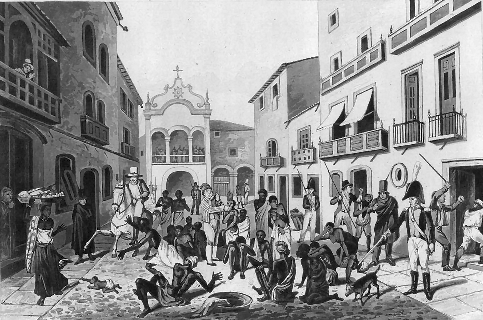
28th.—This morning before breakfast, looking from the balcony of Mr. S.'s house, I saw a white woman, or rather fiend, beating a young negress, and twisting her arms cruelly while the poor creature screamed in agony, till our gentlemen interfered. Good God! that such a traffic, such a practice as that of slavery, should exist. Near the house there are two or three depôts of slaves, all young; in one, I saw an infant of about two years old, for sale. Provisions are now so scarce that no bit of animal food ever seasons the paste of mandioc flour, which is the sustenance of slaves: and even of this, these poor children, by their projecting bones and hollow cheeks, show that they seldom get a sufficiency. Now, money also is so scarce, that a purchaser is not easily found, and one pang is added to slavery: the unavailing wish of finding a master! Scores of these poor creatures are seen at different corners of the streets, in all the listlessness of despair—and if an infant attempts to crawl from among them, in search of infantile amusement, a look of pity is all the sympathy he excites. Are the patriots wrong? They have put arms into the hands of the new negroes, while the recollection of their own country, and of the slave-ship, and of the slave-market, is fresh in their memory.
I walked to-day to the market-place, where there is but little;—beef scarce and dear, no mutton, a little poultry, and a few pigs, disgusting, because they feed in the streets where every thing is thrown, and where they and the dogs are the only scavengers. The blockade is so strict, that even the vegetables from the gentlemen's private gardens, two miles from the out-posts, are detained. No milk is to be had, bread of American flour is at least twice as dear as in England, and the cakes of mandioc baked with cocoa nut juice, too dear for the common people to afford a sufficiency even of them. Fire-wood is extravagantly high, charcoal scarce. The negroes keep the markets: a few on their own account, more on that of their masters. The dress of the free negroes is like that of the creole Portuguese; a linen jacket and trowsers, or on days of ceremony one of cloth, and a straw hat, furnish forth either a black or a white gentleman. The women, in-doors, wear a kind of frock which leaves the bosom much exposed. When they walk out they wear either a cloak or mantle; this cloak is often of the gayest colours; shoes also, which are the mark of freedom, are to be seen of every hue, but black. Gold chains for the neck and arms, and gold ear-rings, with a flower in the hair, complete a Pernambucan woman's dress. The new negroes, men and women, have nothing but a cloth round their loins. When they are bought, it is usual to give the women a shift and petticoat, and the men at least trowsers, but this is very often omitted.
Yesterday the motley head-dresses of the Portuguese inhabitants were seen to great advantage, in a sally through the streets, made by a kind of supplementary militia to enforce the closing of all shop-doors, and the shutting up of all slaves, on an alarm that the enemy was attacking the town to the southward. The officer leading the party was indeed dressed en militaire, with a drawn sword in one hand, and a pistol in the other. Then followed a company that Falstaff would hardly have enlisted, armed in a suitable manner, with such caps and hats as became the variety of trades to which the wearers belonged, the rear being brought up by a most singular figure, with a small drum-shaped black cap on the very top of a stiff pale head, a long oil-skin cloak, and in his left hand a huge Toledo ready drawn, which he carried upright. The militia are better dressed, and are now employed in regular turn of duty with the royal troops, who are going over to the patriots daily.
Calling at the palace this forenoon, we learned that a hundred Indians are expected in the town, by way of assistance to the garrison. They wear their aboriginal dress, and are armed with slings, bows, and arrows. We are told their ideas of government consist in believing that implicit obedience is due both to king and priests. Brandy is the bribe for which they will do any thing; a dram of that liquor and a handful of mandioc flour being all the food they require when they come down to the port.
This evening, as there are no horses to be hired here, we borrowed some from our English and French friends, and rode to Olinda by the long sandy isthmus, which connects it with Recife. This is the isthmus fortified with a palisade, by Sir John Lancaster, during his stay at Recife, which he plundered.[48] The beach is defended by two castles, sufficiently strong when their situation is considered; on one side a furious surf breaking at their base, on the other a deep estuary and flat ground beyond, so that they cannot be commanded. The sand is partially covered by shrubs; one is very splendid with thick leaves and purple bell-shaped flowers; many are like those of the eastern world; many are quite new to me. I was surprised at the extreme beauty of Olinda, or rather of its remains, for it is now in a melancholy state of ruin. All the richer inhabitants have long settled in the lower town. The revenues of the bishopric being now claimed by the crown, and the monasteries suppressed for the most part, even the factitious splendour caused by the ecclesiastical courts and inhabitants is no more. The very college where the youths received some sort of education, however imperfect, is nearly ruined[49], and there is scarcely a house of any size standing.
Olinda is placed on a few small hills, whose sides are in some directions broken down, so as to present the most abrupt and picturesque rock-scenery. These are embosomed in dark woods that seem coeval with the land itself: tufts of slender palms, here and there the broad head of an ancient mango, or the gigantic arms of the wide spreading silk-cotton tree, rise from out the rest in the near ground, and break the line of forest: amidst these, the convents, the cathedral, the bishop's palace, and the churches of noble, though not elegant architecture, are placed in stations which a Claude or a Poussin might have chosen for them; some stand on the steep sides of rocks, some on lawns that slope gently to the sea-shore: their colour is grey or pale yellow, with reddish tiles, except here and there where a dome is adorned with porcelain tiles of white and blue. Just as we reached the highest point of the town, looking across the woody bason round which the hills are grouped, the smoke from one of the out-posts caught our sight. The soldiers were standing or lying around, and their arms piled by them: they were just shadowed by tall trees behind, between whose trunks the scattered rays of the setting sun shed such a partial light as Salvator Rosa himself would not have disdained. These same soldiers, however, circumscribed our ride: we had intended to return by the inland road, but were not allowed to pass into it, as part, at least, lies without the posts, therefore we were obliged to return by the way we came.
At the spot where the present guard is placed, and where indeed a strong guard is peculiarly necessary, the river Bibiriba falls into the æstuary, which was formerly the port of Olinda. A dam is built across with flood-gates which are occasionally opened; and on the dam there is a very pretty open arcade, where the neighbouring inhabitants were accustomed in peaceable times to go in the evening, and eat, drink, and dance. It is from this dam that all the good water used in Recife is daily conveyed in water-canoes, which come under the dam called the Varadouro, and are filled from twenty-three pipes, led so as to fill the canoes at once, without farther trouble. We saw seven-and-twenty of these little boats laden, paddle down the creek with the tide towards the town. A single oar used rather as rudder than paddle guides the tank to the middle of the stream, where it floats to its destination.
The sun was low, long before we reached even the first of the two castles on our way back to the fort. The dogs had already begun their work of abomination. I saw one drag the arm of a negro from beneath the few inches of sand, which his master had caused to be thrown over his remains. It is on this beach that the measure of the insults dealt to the poor negroes is filled. When the negro dies, his fellow-slaves lay him on a plank, carry him to the beach, where beneath high-water mark they hoe a little sand over him; but to the new negro even this mark of humanity is denied. He is tied to a pole, carried out in the evening and dropped upon the beach, where it is just possible the surf may bear him away. These things sent us home sad and spiritless, notwithstanding the agreeable scenes we had been riding among.
29th. The feast of St. Michael's has drawn out the Portuguese gentlewomen, of whom we had not yet seen one walking in the streets. The favourite dress seems to be black, with white shoes and white or coloured ribbons and flowers in the hair, with a mantle of lace or gauze, either black or white. We have seen a few priests too for the first time. I think the edict desiring them to keep within their convent walls, is in consequence of their being among the fomentors of the spirit of independence. The appropriation of so much of the church revenue by the court of Lisbon is of course unpopular among the clergy of the country; and it is not difficult for them to represent, what indeed is truth, to the people, that the drawing of so much treasure from the country to support Lisbon, which can neither govern nor protect them now, is a rational ground of complaint. It is said, that the morals of the clergy here are most depraved. This is probably true. Men cut off by vows like those of the Roman clergy, from the active charities of social life, have only the resources of science and literature against their passions and vices. But here the very names of literature and science are almost unknown. The college and library of Olinda are in decay. There is not one bookseller in Pernambuco, and the population of its different parishes amounts to 70,000 souls! A tolerably well written newspaper, of which I have not been able to procure the first number, was set up in March, under the title of "Aurora Pernambucana," with the following motto from Camoens:
Depois da procellosa tempestade, Nocturna sombra e sibilante vento, Tras a manha serena e claridade, Esperança de porto e salvamiente:
alluding to the arrival of the news of the revolution in Portugal, on the 26th of that month, and the swearing of the governor, magistrates, &c. to adhere to the constitution as established by the Cortes. I am sorry to say that this only paper has been discontinued for the two last months, the editor having, as it seems, become a secretary of government, and having no longer time to superintend the press.[50]
30th.—Last night the patriot troops attacked the line of defence at Olinda for four hours, but I do not believe there was any loss on either side. This morning a Portuguese frigate, the Don Pedro, with troops from Bahia, arrived. The reinforcement of 350 men, partly European, partly Bahian, has put the inhabitants, from the governor downwards, into the highest spirits; so that for once we see Pernambuco active, and cheerful, and alive. Men and women are out in their gayest habits, and the military are running and riding in all directions, not a little pleased to have some to relieve them in their constant watch and ward.
Among other things which I learned by looking on, while the elders of families were engaged in the streets with the new-comers, was that the young Pernambucans are as dexterous in the use of signs as the Turkish lovers themselves, and that often a courtship is carried on in this way, and a marriage settled, without the parties having ever heard each other's voices. However, the general mode is for parents to settle their children's nuptials, without consulting any thing but pecuniary convenience.
This day several of the officers and midshipmen of the Doris accompanied us to dine at the governor's, at half-past four o'clock. Our welcome was most cordial. His excellency took one end of the table, and an aide-de-camp the other: I was seated between M. and Madame do Rego. He seemed happy to talk of his old English friends of the Peninsula, with many of whom I am acquainted; and she had a thousand enquiries to make about England, whither she is very anxious to go. They apologised for having so little plate, but their handsome services were packed up in an English store-house, together with her excellency's jewels and other precious things. The cookery was a mixture of Portuguese and French. After the soup, a dish was handed round of boiled lean beef, slices of fat salt pork, and sausages, and with this dish, rice boiled with oil and sweet herbs. Roast beef was presented, in compliment to the English, very little roasted. Salads, and fish of various kinds, were dressed in a peculiar manner; poultry and other things in the French fashion.
The dessert was served on another table. Besides our European dessert of fruit, cakes, and wine, all the puddings, pies, and tarts, formed part of it. It was decorated with flowers, and there was a profusion of sugar-plums of every kind. The company rose from the dining-table, and adjourned to the other, which Madame do Rego told me should have been spread in a separate apartment; but they have so recently taken possession of their house, that they have not one yet fitted up for the purpose. The governor and his guests proposed many toasts alternately—The King of England, the King of Portugal, the navy of England, the King of France[51], Luis do Rego, and the captaincy of Pernambuco, &c.—When we all rose at once from table; some of the company went on board ship, but most adjourned to the drawing-room, a comfortable apartment, furnished with blue satin damask, where we were joined by the French naval officers of His Most Christian Majesty's ship Sappho, and several ladies and gentlemen of the city. We had some excellent music. Madame do Rego has an admirable voice, and there were several good singers and players on the piano. It was a more pleasant, polished evening than I had expected to pass in Pernambuco, especially now in a state of siege.
Wednesday, 3d October.—I went on board on Monday, and, provokingly enough, the patriots chose that very night to make an attack upon the out-post of the Affogadas, so I did not see the governor, at the head of his troops, march out to meet them; nor did I hear the national hymn sung by the regiments as they filed along on their return from a successful sally.[52] Yesterday, nothing occurred worth noting; we had the consul and British merchants on board to dinner, and the day passed as such days usually do.
Having learned that the patriots have refused to allow the linen belonging to the ship, which had been sent to the country to be washed, to return to the town, it was determined that we should send to their head-quarters, and remonstrate against this very inconvenient mode of annoying the port. I obtained leave to accompany the messengers, and accordingly we all went on shore immediately after breakfast. Our first business was to procure passports, and to learn the countersigns; after which Capt. Graham, with Col. Cottar, the governor's principal aide-de-camp, rode with us to the out-posts, where we left them, with an intention of returning to dine at Mr. Stewart's, to meet Luis do Rego's family. Our party consisted of M. Caumont, to act as interpreter, Mr. Dance, bearing the letter, my cousin Mr. Glennie as my cavalier, and myself. It was the first time we had had an opportunity of passing the lines, and we felt like school-boys who had stolen beyond bounds, and well we might; the scenery was fresh and lovely, and the day as fine as possible.
Pernambuco is not a walled town, but broad rapid rivers and æstuaries surround it, and it is only approachable by the roads and causeways; the banks thrown up across these, for present defence, are such as might stop the Brazilian cavalry for a few minutes, or afford cover for musketry; but their best defence is the swamp at the mouth of the Capabaribe, which is flooded at high water, and which extends nearly to the Bibiribi. At the edge of the swamp there is a wooden palisade, where we left the last post of the royalists, and took leave of our friends, who had accompanied us so far. After riding across the marsh, which by the by is very fit for rice ground, and is surrounded by cocoa-nut and tamarind trees, we came to the main stream of the Capabaribe, a deep, broad, and very rapid river; its sides are steep, and the water beautifully clear[53]: its banks are studded with country-houses, and adorned with groves and gardens, for the present abandoned by their owners, who have taken refuge in Recife.
The hedges on each side of the road are woven of palm-leaves, and where not quite new, are covered with all splendid creeping plants; the common and winged passion-flower, white, blue, and yellow clematis, jasmine, china-rose, and many others, both gay and sweet. The ditches, too, were full of colour, but we rode too fast to stay to collect plants; and I could only promise myself, at some future time, to gather one that appeared like a bog bean, but its colour bright purple.
About two miles from Do Rego's last out-post, we came to the first post of the patriots, at a country-house on a rising ground, where arms piled at the door, and a sort of ragged guard, consisting of a merry-looking negro with a fowling-piece, a Brazilian with a blunderbuss, and two or three of doubtful colour with sticks, swords pistols, &c., told us an officer was to be found. After a few minutes parley, we found he was not authorised to receive our letter, so we rode on under the direction of the old Brazilian with his blunderbuss, who, being on foot, threatened to shoot us if we attempted to ride faster than he walked. The slow pace at which we advanced gave us leisure to remark the beauties of a Brazilian spring. Gay plants, with birds still gayer hovering over them, sweet smelling flowers, and ripe oranges and citrons, formed a beautiful fore-ground to the very fine forest-trees that cover the plains, and clothe the sides of the low hills in the neighbourhood of Pernambuco. Here and there a little space is cleared for the growth of mandioc, which at this season is perfectly green: the wooden huts of the cultivators are generally on the road-side, and, for the most part, each has its little grove of mango and orange-trees. At one of these little homesteads, we found a pretty large guard-house, established where four roads meet, and there our foot guide left us, and a gentlemanlike young officer, of the Brazilian Caçadores, rode with us, and entertained us by calling Luis do Rego a tyrant, and attributing the siege of Pernambuco entirely to the governor's obstinacy, in not joining the people of the province in throwing off the dominion of his master. Round the guard-house a number of negro girls, with broad flat baskets on their heads, were selling fruit and cold water: they had decked their woolly hair, and the edges of their baskets, with garlands of the scarlet althaea; their light blue or white cloaks were thrown gracefully across their dusky shoulders, and white jackets, so that it was such a picture as the early Spaniards might have drawn of their Eldorado.
After riding a few miles, we came suddenly to the foot of an abrupt hill, on whose sides there were scattered groups of the most magnificent trees I ever beheld. There we were met by a small military party, which, after a parley with our guide, rather ordered, than invited us to ride up. In a few seconds, we came to a steep yellow sandstone bank, shaded on one side by tall trees, and open on the other to a lake surrounded by woody hills, on the most distant of which, the white buildings of Olinda sparkled like snow. On the top of the bank, and in the act of descending, was a group of forty horsemen, one of the foremost of whom bore a white banner; several were dressed in splendid military habits, others in the plain costume of the landed proprietors. These were deputies from Paraiba on their way to propose terms to Luis do Rego; they had just left the head-quarters of the besieging army, where the provisional government of Goyana is stationed, and were accompanied by a guard of honour: after exchanging civilities, part of the guard turned back with us, and the deputies went on their way. Having reached the top of the hill, we found about a hundred men, tolerably well armed, but strangely dressed, awaiting us; and there we were detained till our guide rode forward to ask leave to bring us to head-quarters. I was sorry I had no means of sketching any part of the beautiful landscape, which, besides the striking features I have mentioned before, now displayed a broad river, over which there is a white stone bridge of several arches; at one end, a large house, more like a palace, with its arches and corridors, and the encampment of the army and the horse picquets, and, in short, a bustle and animation that seldom happen to adorn so fine a scene. Our guide soon returned with eighteen or twenty mounted soldiers, whose appearance was rather wild than military: the guard presented arms as we parted from them, and we soon cantered down the hill towards the main body of the troops. Not above two hundred had the arms or accoutrements of soldiers; but there were dresses and weapons of every kind, leather, cloth, and linen; short jackets and long Scotch plaids, and every tint of colour in their faces, from the sallow European to the ebony African. Military honours were paid us by these ragged regiments, and we were conducted to the palace square, where Mr. Dance and Mr. Caumont dismounted, and I determined to await the issue of their conference, with my cousin in the court.
This, however, was not permitted. In a few minutes, a smart little man, speaking tolerable French, came and told me the government desired my company. I suspected a mistake of the word government for governor, and endeavoured to decline the honour; but no denial could be taken, and the little man, who told me he was secretary to government, accordingly assisted me to dismount, and showed me the way to the palace. The hall was filled with men and horses, like a barrack stable, excepting a corner which served as an hospital for those wounded in the late skirmishes, the groans of the latter mingling uncouthly with the soldiers' cheerful noisy voices. The stairs were so crowded, that we got up with difficulty, and then I found that I was indeed to be confronted with the whole strength of the provisional government. At the end of a long dirty room, that had once been handsome, as the form of the windows and carving of the panels on which there were traces of colour and gilding, indicated, there was an old black hair sofa, on the centre of which I was placed, with Mr. Dance on one side, and Mr. Glennie on the other; by Mr. Dance sat the little secretary, and next to him our interpreter, in old-fashioned high-backed chairs; the rest of the furniture of the room consisted of nine seats of different sizes and forms, placed in a semicircle fronting the sofa, and on each of these sat one of the members of the junta of the provisional government, who act the part of senators or generals, as the occasion may require. To each of these I was introduced; the names of Albuquerque, Cavalcante, and Broderod, struck me, but I heard imperfectly, and forget most of them: some wore handsome military coats, others the humbler dress of farmers. They politely told me they would not read the letter while I was waiting below, but as soon as we were seated, the secretary read it aloud. Instead of taking any notice of its contents, the secretary began a long discourse, setting forth the injustice of the Portuguese governor and government towards Brazil in general, and the Pernambucans in particular; that in order to resist that injustice, they had formed the present respectable government, pointing to the junta, without intending the least detriment to the rights of the king. That surely they could not be called rebels, as they marched under the royal flag of Portugal; but Luis do Rego might be reasonably stigmatised as such, for he had fired on that banner. He then went off into a long harangue upon the general principles of government; but as I understood little of the language, much of it was lost upon me, as well as on my companions; but I have no doubt that it served to impress the respectable junta with a higher idea of their secretary's understanding and eloquence: altogether, the speech reminded me of some of the best written of the Carbonari addresses of Italy; and there was something in the air, manner, and scene, not unlike what one imagines of the Barraca meetings of those ill-guided, misused people.[54] We then talked a great deal in French to the secretary, who repeated every word to the respectable junta, and at length got him to attend to a proposal for releasing our linen, and another for supplying the ship with fresh provisions. We had been paying forty dollars per bullock in the town; they agreed that their price should not exceed ten, if we sent boats to the Rio Doce, or Paratije[55] for them. This is the mouth of a small stream on the northside of Olinda. And I must not omit to mention, that they offered to allow us to take off fresh provisions for our English or French friends in the town.
The junta was extremely anxious to learn if there was a probability of England's acknowledging the independence of Brazil, or if she took part at all in the struggle; and many were the questions, and very variously were they shaped, which the secretary addressed to us on that head. They are of course violent in their language concerning Luis do Rego, in proportion as he has done his military duty, in keeping them at bay with his handful of men: and like all oppositions they can afford to reason upon general principles, because they have not to feel the hindrances of action, and the jarring of private interests in the disposal and fulfilment of office.
I was sitting opposite to one of the windows of the council-room, and had been remarking for some time, that the sun was getting very low, and, therefore, rose to go, having received a note from the secretary, ordering the officers at their advanced posts to offer no hindrance to the passing of any thing belonging to His British Majesty's frigate, Doris. But we were not suffered to depart without a hearty invitation to sup and spend the night: and a stirrup-cup (a huge glass) was brought, and a bottle of wine, with about half as much water, poured into it; it was then handed to me to begin, and all fourteen received it in turn. By this time the guard was drawn out, the band played the national hymn, to which we all listened bare-headed, and so we mounted among those wild-looking men, in that strange, yet lovely landscape, just as the evening mist began to veil the lower land, and the bright red evening sun to gild the topmost branches of the forest.
Our journey home was much more rapid than our journey out. The evening was cool, and the horses eager to return; but we did not reach Mr. S.'s till two hours after sunset, when we found that, after the party had waited till six o'clock, Captain Graham had insisted on their dining. The governor was uneasy, and offered to send a party of Caçadores in search, as he kindly said, of me,—but this, of course, was refused; the captain assuring his excellency, that if the patriots detained his lieutenant, he would take him back with his own men, and that as to me, while I was with my two companions, he had not the least fear concerning me. We were accompanied by the same officer, who had been our companion on the latter part of the ride to head-quarters, back almost to the town lines; and when we told this to the governor, he was sorry we did not know his name, that in case he should ever have it in his power to show him kindness, he might do so. A pleasant chat on the adventures of our ride, a hearty supper, and a little concert closed the day, which, upon the whole, was to me a most agreeable one.
Thursday, 4th.—Received Madame do Rego, one of her daughters, Miss S., and several gentlemen, on board. Most of the party were sea-sick, from the rolling of the ship, caused by the heavy swell at the anchorage. They were, however, highly charmed with their visit, particularly with the fireworks with which we saluted the ladies, who had never been on board a British frigate before, on their departure.
Friday, 5th.—According to the agreement made with the patriot officers, on Wednesday, one launch and the second cutter went to Rio Doce to receive bullocks and other provisions. The officers and men were most kindly received, and returned with many presents of fresh stock and vegetables, which the patriots forced upon them. A military band attended them on landing, and conducted them to the place of meeting with the chiefs.