JACK CHANTY (continued 5)
Reading edition
Issuing out of the forest at last, the Spirit River valley was spread before them, with the big stream winding among its wide, naked bars. The abandoned camp lay below them, a village of bare tepee poles in a rich meadow surrounded by an open park of white-stemmed poplars. As they approached it a fresh anxiety struck at Jack's breast, for he saw the three pack-horses picketed to the trees with their packs on their backs. He knew that only an emergency would have taken Mary and Davy away without unloading them. The animals had been rolling, to the no small detriment of their baggage. Jean Paul laughed at the sight.
Jack had no recourse but to possess his soul in patience until they came back. Meanwhile he unpacked the horses, and pitched their four little tents, two on each side of the fire. He bound Jean Paul securely as before, and put him in his own tent. He hung the gag from the ridge-pole with significant action. Jean Paul's lips were already bruised and blue as a result of the previous application.
Not until late afternoon was Jack's anxious breast relieved by the sight of the three horses single-footing it across the meadow. Davy rode first, then Etzeeah, looking crestfallen and sullen, and Mary bringing up the rear, her rifle across her arm, and determination making her girl's face grim. Evidently there had been trouble; but the three of them, and uninjured! Jack could have shouted with relief.
"He ran away," Mary explained briefly. "Davy and I had hobbled two of the riding horses, when he suddenly jumped on the third and headed north. He got a couple of minutes' start before we could get the hobbles off and after him. When he got in the timber, he turned the horse adrift, and we lost more time following its tracks. But I guessed he would make back to the trail as soon as you had passed, so we patrolled it, and we nabbed him at last."
"Good work!" said Jack briefly. It did not occur to him that there was something rather extraordinary in a mere girl and boy bringing in the headman of the Sapi Indians by themselves. He expected it of their white blood.
There seemed to be nothing for it now but to bind Etzeeah hand and foot also, and to convert Jack's tent into a cell for him. The two prisoners lay in their separate shelters on one side of the fire, while their captors watched them from the other. Jack was to sleep with Davy, and except for Mary's rifle, all the weapons in camp were stowed in that tent. The long-threatened rain set in steady and cold, and the night threatened to be as dark as winter.
They ate their supper inside Davy's tent, while the fire sputtered and sulked in the rain. A heavy silence prevailed; for one thing, they were dead weary, and their difficulties were pressing thick upon them. The rain did not lighten them. Jack, looking at Mary and Davy, thought with softening eyes:
"They're clear grit! But if I only had another man!"
The instant they had finished eating he ordered the two youngsters to bed. "I'll feed the two of them," he said, nodding across the fire, "and clean up. It will help keep me awake."
"You need sleep more than either of us," Mary objected.
"If I once let myself go I'd never wake," he said with a laugh. "I'll call you at midnight." It was tacitly understood between them that Davy was not to keep watch.
His work done, Jack sat down inside the door of Davy's tent to smoke, and if he could, to keep the fire going in spite of the rain. He found that it required too great a blaze to be proof against the downpour. He had not nearly enough wood to last throughout the night, so he let it out in order that Mary might enjoy what remained of the fuel. When the fire went out he could no longer see into Jean Paul's tent, so he crossed over and sat down beside him. Throughout the weary hours he sat smoking to keep himself awake, until his mouth was raw. From the adjoining tent issued the reassuring sound of Etzeeah's snores; Jean Paul, too, never stirred, and his breathing was deep and slow.
Midnight had passed before Jack had the heart to waken Mary. He first took advantage of a lull in the rain to start the fire again. As he threw back the curtain of her little tent, the firelight shone in her face, rosy and serene in sleep, her cheek pillowed on her round arm. The sight stirred him to the very core of his being. He knelt, gazing at her breathlessly. He forgot everything, except that she was lovely. He suddenly bent over her with a guilty air, and lightly kissed her lips.
She opened her eyes. He sprang away in a panic at the thought of her scorn. But she awoke with an enchanting smile. "Jack I dreamed——" she began, as if it were the sweetest and the most natural thing in the world for her to find him bending over her at night—and caught herself up with a burning blush. Jack hastily retreated outside. Neither of them referred to it again.
Jack was asleep as soon as he stretched himself beside Davy. The next thing he knew, something had happened, what it was he could not tell. He staggered to his feet, and out into the open, drunken, paralyzed with sleep, and fighting for consciousness.
"Jack, he's gone!" cried Mary.
That awakened him. He saw her on her knees before Jean Paul's tent, and ran to her. The tent was empty. The rain poured down on their heads unheeded. The fire was out.
Mary was in great distress. "My fault," she said. "It rained harder than ever, and the fire went out. I could not bear to sit beside him as you did. It made me sick to be so near him! I thought I could watch from my tent. The wind came up and it was hard to see. He fixed the blanket to look as if he was still under it. He must have slipped out of the back!"
"But tied hand and foot!" cried Jack.
"The cords are here," she said, displaying them.
"But how?" demanded Jack.
Mary's searching hand found two small stones in the blanket that she showed Jack; one had a sharp, jagged edge, and the explanation was clear. Throughout the hours when Jack sat beside him, and he seemed to be so sound asleep, the wily breed had been patiently rubbing at the cords until they frayed apart.
"No more your fault than mine," said Jack grimly.
Simultaneously the thought of Etzeeah occurred to them, and they sprang to look under the adjoining shelter. At first glance in the darkness, the Indian seemed to be safely there, but when Jack put out his hand the puffed-up blanket collapsed, and there was nothing under it. At that, for the first, their strong young breasts were shaken by awe.
"Good God!" Jack gasped. "He's got him, too! How could he? With you not twenty feet away. And not a sound. Is it a man or a devil?"
The pegs that held down the back of Jack's lean-to were drawn, showing how Jean Paul had entered, and how he had removed his prey.
"Etzeeah—" said Mary tremblingly, "do you suppose Jean Paul has—
"He would hardly take him alive," said Jack grimly, "without a sound."
"But he had no weapon, we know that."
"His hands!"
They were silent.
"But if he did," faltered Mary, "why would he take—take the body away?"
Jack shook his head. "They are always mysterious," he said.
"He may be near," whispered Mary. "What's to be done?"
"He's not dangerous to us until he gets a weapon," said Jack. "Wake Davy, and you two watch our guns. I'll bring in the horses."
It was near four, and beginning to be light. The rain ceased, and a thick white mist clung to the river-meadows. It was not easy to find the horses. Jack satisfied himself that two of them were missing. Why two? he thought. He did not find the body of Etzeeah, as he half expected.
He had to wait for better light before he could look for tracks. He found them at last, leading back up the Darwin valley, the fresh hoof-prints of two horses superimposed on the confusion of tracks they had made coming and going. The horses had been ridden at a gallop. Jack returned to tell Mary.
"He's gone all right," he said. "And alive or dead, he's taken Etzeeah with him. The second horse carried a load too. He's gone back to the Sapis for grub and a gun."
Mary searched Jack's face with a poignant anxiety to see what he intended to do. "Let him go," she suggested. "We know that Garrod is near here somewhere."
Jack stood considering with bent brows and clenched hands. He finally shook his head. "He could come back to-night, and pick us off one by one around our fire. We'll have no peace or security until I get him, Mary. I'll have to leave Garrod to you and Davy. You know how much finding him means to me!"
"But you," she faltered, her eyes wide with terror for him, "you can't go back alone to the Sapis. They shot at you!"
Jack's uncertainty was gone. He raised a face, transfigured.
"Pshaw! That mongrel crew!" he cried. "They're the least of my difficulties. I'll drop on them before Jean Paul can work them up to mischief. I've got to get that breed! No murder can be done in my camp, and the murderer get away! No redskin shall ever live to brag of how he bested me! I'll get him if I have to ride to hell and drag him out!"
XVIII THE END OF ASCOTA
Two hours later Jack rode into the Sapi village for the second time, and flung himself off his tired and dripping mount. The horse stood with hanging head, and feet planted wide apart, fighting for breath. This time Jack's arrival created little visible sensation. The people were otherwise and terribly preoccupied. A strange silence prevailed, extending even to the children and the dogs. Many of the people were gathered around the entrance to Etzeeah's lodge. They merely turned their heads with a scowl, and the men drew on the walled look they affect in the presence of whites. In the faces of the women and children awe and terror were painted.
"Ascota, where is he?" Jack demanded.
Hands were silently pointed up the valley.
"How long?"
"Half an hour," one said.
Outside the square Jack saw two more dead weary horses still wet from their punishing ride.
"Where is Etzeeah?" he asked.
There was no answer. All the heads turned as one toward the tepee.
Jack threw back the blind that hangs over the entrance, and, stooping, entered. He was prepared for what he saw. The body of the old man sprawled on its back beside the fire. All around the tepee squatted his wives and his sons in attitudes of sullen mourning. Etzoogah, the best-beloved, eyed the body askance with scared eyes, and chewed the tassel of his red sash. Etzeeah was not a comely sight. Death was in his face, but none of the majesty of death. His grimy, wrinkled skin was livid and blackened. The marks on his scrawny throat showed how he had met his end.
Stooping, Jack picked up his hand, and let it fall. It was significantly cold and stiff. He decently composed the dead man's limbs, and signed to one of the women to cover the body with her shawl.
Rising, he looked grimly around the circle. "This is murder!" he said.
None showed in any way that they heard.
"Who will ride with me to catch the murderer?" he demanded.
None moved. The faces of the women showed a start of terror.
Jack went outside again, and looked over the silent crowd. Seeing Charlbogin, one of the deserters, among them, he went to him.
"Did Ascota speak?" he demanded.
The sulky boy could not resist the command. "Ascota throw Etzeeah on the ground, so!" he said with a striking gesture. "He say: 'This is a man who betrayed me! Bury him!'"
A shudder passed through the crowd. Children wailed and whimpered.
"Then what?" asked Jack.
"He take a gun and a blanket, and moose meat from the fire; he catch a horse and ride west."
"And you let him go!" exclaimed Jack.
"Ascota is not a man like us," the young man muttered. "He does what he likes."
"More woman's talk!" cried Jack. "Are there any men among you? Come with me, and I'll show you stronger magic than Ascota's."
Some of the men affected to smile contemptuously as at an idle boaster. None moved to follow him. The obstinacy of their terror faced Jack like a wall, and he saw the futility of trying to move it.
He cursed them roundly. "I'll go alone then," he cried. "Bring me the best horse there is. I'll pay."
They shrugged as much as to say: "Let him, as long as he pays." One went to get the horse. In five minutes Jack was pounding the trail again.
Beyond the village the valley narrowed, and the roar of the plunging stream rose from the bottom of it. The bordering hills rapidly became steeper and higher. The trail did not follow the course of the river, but found an easier route along the face of the hills a hundred feet or so above. The sides of the hills had been burned over, here, and the forest was only a wilderness of naked, charred sticks. Many of these had fallen in the trail, making slow going for the horse. Occasionally the little river paused for a while in its headlong descent to wander back and forth through a green meadow. The trail came down to cross these easy places, and it was only here that Jack could extend his horse.
The plain tracks of Jean Paul's horse led him on. Jack could read that the breed was riding recklessly and distancing him steadily mile by mile, but he would not on that account risk his own horse's legs through the down timber. "I'll get him," he said to himself coolly, with the terrible singleness of purpose of which he was capable. In such a mood he was no longer a man, but an engine.
Jack had come across the mountains from Fort Erskine by this trail, and he knew it well. It was evidently for Fort Erskine, where he was not well known, that Jean Paul was making. Ahead, through the forest of bare sticks that hemmed him in, Jack could see the gateway to the mountains, the magnificent limestone pile of Mount Darwin on the right. He had worked around the base of Darwin, and all this was familiar ground.
It was about noon when Jack and his horse, rounding a spur of the hill, were brought up all standing by the sight of a dark body lying in the trail ahead. Dismounting, and tying his trembling animal to a tree, Jack went forward to investigate. It was a horse, Jean Paul's horse, with a broken foreleg, and abandoned to its fate. Jack's heart beat high with hope; the end of this thing was in sight now. The poor brute raised agonized eyes to him. Jack could not put a bullet through its head without betraying his whereabouts, but he mercifully cut its throat.
He proceeded warily. He was covered from above by the very steepness of the hill and the impenetrable barriers of the fallen timber. The prints of Jean Paul's moccasins led him ahead. The trail dropped steeply to a little stream that he knew well; it drained the easterly slope of Mount Darwin. It marked the edge of the burned-over tract, and on the other side the trail plunged into virgin forest again.
Jack went forward as cautiously as an Indian, taking advantage of every scrap of cover. At the brook he lost Jean Paul's tracks. It was clear the breed had waded either up or down. Jack was pretty sure he would not be far away, for the redskin of Jean Paul's type has no love for long journeys afoot. But it promised to be a somewhat extended stalk and his horse was no use to him. He therefore went back, cached his saddle, and turned the beast out hobbled, trusting that it would find its way back to the last river-meadow they had passed. Blanket and grub Jack strapped on his back, and his gun he carried under his arm.
He spent an hour searching up and down the shores of the creek for tracks, without success. Neither was there any evidence of Jean Paul's having returned to the trail farther along. If Jack was well skilled in reading tracks, the breed was adept in hiding them. Jack's only recourse was to climb. There is a little eminence abutting on the base of Mount Darwin and on the top of it a knoll of naked rock that overlooks the valley for miles up and down. Knowing the natives' deep-rooted aversion to drinking cold water, Jack guessed that Jean Paul would have to build a fire, and from this point of vantage a fire, however small, would almost surely betray his whereabouts.
Taking his bearings, he made a beeline up the steep slope through the heavy, old timber that reached up from the valley, and through a dense light growth of poplar above. This part of the mountain offered no special difficulties in climbing, and in half an hour he threw himself down on the flat top of the knoll, with the valley spread before him.
Mount Darwin reaches a long promontory down the valley it has given its name to. The promontory consists of seven little peaks in a row, each one rising over the head of the one in front, and the seventh is the actual summit of the mountain. It was on number one of these little summits that Jack now lay, looking down the valley up which he had ridden that morning. A mile or so away was a patch of green with a black dot upon it, that he guessed was his horse.
Off to his left, hidden in the forest, the creek came tumbling down from the snows above; on his right hand the river washed the rocky base of the monarch. The easiest way to the summit is right on up over the succeeding peaks; indeed on this side there is a mountain goat trail direct to the top. Darwin can also be climbed, but not so easily, by ascending the creek for a couple of miles, thence up a steep slide to a long hogback that leads back to the sixth peak. On the river side the rocky cliffs tower six thousand feet into the air, sheer and unscalable. Such was the theatre of the pursuit of Jean Paul Ascota.
In all the wide space opened to Jack's eye there was not a sign of life, except the black pin-point that he supposed was his horse, and a pair of eagles, sailing and screaming high above the forest. Nowhere in the brilliantly clear air was there the least sign of smoke. He ate some of his bread and meat while he watched, and smoked his pipe. He marked a place around to the right below where the trail passed over a rocky spur. On the other side it was open to him through the down timber; so that Jean Paul could not pass either way on the trail without his seeing him.
It was hard on the engine of retribution to be obliged to sit and wait. When his pipe went out he moved restlessly up and down his little plateau or shelf of rock. Behind him, the forest grew close and high, hiding the rest of the mountain. He never knew quite how it happened, but at one end of the rock, near the place where he had come up, he suddenly found himself staring at the perfect print of a moccasined foot in a patch of moss! His breast swelled with satisfaction at the sight; at the same time he frowned with chagrin to think of the valuable time he had wasted sitting within twenty feet of Jean Paul's trail.
Jean Paul's path up through the thickly springing poplar saplings was not more than two yards from Jack's own. Such are the caprices of the Goddess of Chance! He had crossed the rock, and continued on up the mountain by the mountain goat trail, which first became visible here. Evidently believing that he had shaken off pursuit, and that no one would dream of looking for him on the mountain, he was no longer taking any care to cover his tracks.
Jack hastened after, as keen and determined as a high-bred hound whom nothing short of a cataclysm could divert from his purpose. The rough track followed the top of a stony ridge, which dropped steeply to the river on one side, and sloped more gradually into a forested hollow on the other. A thick growth of pines afforded him perfect cover. Like all animal paths, the trail wound like a tangled string among the trees. The growth ended abruptly on the edge of a shallow rocky cut athwart the ridge. On the other side of the cut rose the steep face of the second little peak in the series.
Jack paused within the shelter of the trees to reconnoitre. The great slope of rock opposite, with its wide, bare ditch, made a well-nigh perfect natural fortification. He watched the top of it lynx-eyed, and presently he was rewarded by the sight of a wisp of smoke floating over the edge. Jack drew a long breath and grimly smiled. So that was where he was!
He had chosen admirably. The growing timber ended at the spot where Jack was, but up above there was enough down timber to keep the breed in fire until the judgment day, if he wished to stay, and his fire would be invisible from any point in the valley. For water, all the ledges and hollows on the northerly side were heaped with snow; for food there were mountain goats and ptarmigan; for defence he had only to roll a stone down on the head of any one who tried to climb to his aerie.
While Jack watched, carefully concealed, Jean Paul suddenly showed himself boldly on the edge of the cliff. The distance was about three hundred yards, a possible shot, but at a difficult angle. Jack held his hand. It was all important not to put the half-breed on his guard just yet. Jean Paul carelessly surveyed the approaches to his position, and went back out of sight.
Any attack from in front was out of the question. Only one thing suggested itself to Jack: to climb the mountain by the other possible route, and come down on Jean Paul from above. As soon as it occurred to him he started to retrace his steps, without giving a thought to the enormous physical exertion involved. This way was beset with difficulties; the bed of the creek was heaped with the tangled trunks brought down by the freshets. But Jack set his teeth doggedly, and attacking these obstacles, put them behind him one after another.
The sun was three hours lower before he stood at the edge of the timber line on the other great spur of the mountain. He hesitated here. Above him extended a smooth, steep slide of earth and stones at least two thousand feet across, and without so much as a bush or a boulder for cover. At the top of this slide was the hogback that led back to the sixth peak. If Jean Paul was watchful he could scarcely fail to see Jack mounting the naked slope. True, nearly half a mile separated them, but a moving black spot, however small, would arrest his attention if he saw it. He would not mistake it for an animal, for the only animal on the upper slopes is the snowy mountain goat.
However, Jack had to chance it. His principal fear was that Jean Paul, seeing him, might climb down from his rock and gain a long start of him to the valley. But he reassured himself with the thought that the Indian could not guess but that there were others waiting below. It would require a stout heart to climb down that rock in the face of possible fire from the trees.
Jack started his climb. Occasionally he could see Jean Paul moving around on his distant rock. Sometimes he thought the black spot seemed to stand and watch him, but this was his fancy. However, when he was halfway up, he saw him without doubt begin to climb the face of the third peak, and Jack knew that he had been discovered. Jean Paul was going up instead of down. "I'll get him now," Jack told himself.
Thus began a strange and desperate race for the summit of the mountain. Until near the end it was anybody's race; Jean Paul was the nearer, but he had the steeper way to go; he was also the fresher of the two, but Jack was insensible of fatigue. The Indian kept himself out of sight for the most part, but occasionally the configuration of the rocks obliged him to show himself, and Jack marked his progress keenly. Meanwhile his own climb was nearly breaking his heart. He found that it was only a heart after all, and not a steam-chest. One cannot run up a mountain with impunity.
Jean Paul mounted the fourth peak about the same time that Jack reached the hogback, and threw himself down to ease his tortured breast for a moment. Jack had now to turn at right angles, and every step brought them nearer to each other. Jack had cover behind the summit of the ridge all the way to the foot of the last climb. It was impossible for either to guess the outcome. Jean Paul was still the nearer, but Jack was making better time. He ran along the slope on a level line and gained a hundred yards.
When he looked over the top again he was encouraged to see that Jean Paul was labouring hard. He had often to throw himself down in full sight to give his heart a chance. Meanwhile they were coming very close. They were already within gunshot when the peak they were both striving for intervened between them. The breed was aiming for one side, Jack for the other. Jack wondered, should their heads rise over the top simultaneously, which would have the strength to lift his gun.
Toward the base of the peak of rock the ridge became steep and broken. Excruciating pains attacked Jack's legs, and his sinews failed him. He dropped to his hands and knees, and crawled on. He had almost reached the little peak, when suddenly a dark face looked down on him from over the top, and he had just time to drop behind a jutting shoulder of rock to escape the bullet that whistled overhead. The race had gone to Jean Paul.
Jack lay debating his next move. Meanwhile it was grateful to rest, and to feel the strength steal back. His case was not yet hopeless, he decided. The rounded cone of rock that Jean Paul held was easily accessible from any point of the arc visible to Jack, and from the speed with which the breed had gained the summit, he guessed that it must be even easier from the other side. With darkness to aid him he ought to be able to surprise his enemy. The sun was setting now. At close quarters Jack's revolver would give him an advantage.
But this same train of reasoning must have passed through the breed's mind, for later, upon peeping around his rock, Jack saw that Jean Paul had retreated from his peak, and was running off to the right across the flat battlement that connected it with the slightly higher cone that was the true summit of Mount Darwin. He had started to scramble up the face of the rock. Springing up, Jack fired at him, but it was too far, and there was cover behind the jutting ledges. Jean Paul gained the top in safety.
Jack promptly seized the position he had abandoned. Rising cautiously over the side farthest from Jean Paul, he built himself, stone upon stone, a little parapet upon the summit, behind which he could lie and watch his enemy through the interstices. Presently he saw that Jean Paul was following suit, covering himself behind his wall while he raised it. A shot or two was exchanged, but without effect, and as if by mutual consent they left off. Their lead was too precious to be splashed on the rocks.
So they watched, each holding alone, as it were, a heaven-piercing tower of the same castle, with the battlement between. It was a dizzy perch. The whole world was spread beneath them, a world of confused gray, and brown mountain peaks like vast stalagmites pointing fingers toward heaven. It was like a nightmare sea suddenly petrified with its waves upheaved. In the whole vast wilderness there was no suggestion of mankind or of life. Up there the thin, cold air sharpened the senses; one seemed to become aware of the great roll of our planet to the east, and instinctively clung to the rock to keep from being flung off into space.
About two hundred yards separated the white man and the breed. Jean Paul's position was some fifty feet higher than Jack's, and Jack had therefore to build the higher parapet. Nevertheless Jack's heart beat strong; he had him trapped now. At the same time it was a well-defended trap, and there he might sit watching him until starvation took a hand in the fight. Jack had only full rations for one day more; he suspected Jean Paul might be better provided. A red man starves slower than a white. Each could reach plenty of snow to quench his thirst, but there was nothing to burn up there. Jack looked through his peepholes, and considered how he might bring matters to an issue.
On his right in the corner between the hogback and the final peak there was a bowl a thousand feet deep or more, with a little lake in the bottom of a colour between sapphire and emerald. The sides of the bowl were steep slopes of rubble. Jack could not see all this from where he lay, but he had marked it on the way up. After dark he thought it might be possible to crawl around the rim of the bowl to the base of Jean Paul's tower of rock, and scale it from that side. This he could see, and he scanned it hard. It was a staggering climb—say, two hundred feet of precipitous limestone. But it was scarred and ridged and cracked by centuries of weather; and it was not absolutely perpendicular. It might be done.
Having made up his mind, he coolly rolled up in his blanket to sleep behind his parapet until dark. Small chance of Jean Paul's venturing across the battlement.
When he awoke it was as dark as it would get. He fortified himself with bread and meat washed down by snow-water. He left his gun rolled in the blanket—the revolver would serve better—and he propped his hat an a stone so that the crown would peep above his little wall. If it should become light before he reached him, it might serve to occupy Jean Paul's attention for a little. If he succeeded in knocking it off its stone, so much the better.
The passage around the rim of the bowl offered no special difficulty, except the danger of starting a miniature avalanche down the slope, and putting the breed on his guard. He took it a foot at a time. In an hour he drew himself up the first steps of his rocky tower, with the stars looking over his shoulder. Stars, too, seemed to be glancing up at him out of the depths of the black gulf. He would not let himself look down. With the faculty he had, he closed his brain to any thought of failing or of falling. "I'm going to get him! I'm going to get him!" it beat out like a piston, to the exclusion of everything else. Darkness aided him in this, that it prevented the awful hazard from forcing itself on him through his eyes.
His hands had to serve him for eyes, groping, feeling for the ledges and cracks like the antennae of an insect. He gave himself plenty of time; he did not wish to arrive at the top until there was light enough to make sure of his man. He had it figured out in his odd, practical way: three hours, a hundred and eighty minutes; a foot and a half a minute was ample. He could afford to rest and to steady himself on every wide enough ledge.
The face of the rock unrolled itself like a map under the eyes of his hands, and he remembered each foothold as he put it behind him. When he came, as he did more than once, to a smooth, blind face of rock that barred further progress, he patiently let himself down again, and hit off at another angle. His aim was to work himself gradually around to the back of Jean Paul's tower of rock, and fall on him squarely from the rear.
He became aware of the approach of dawn through a slight change of colour in the rock on which his eyes were stubbornly fixed. He could not tell how far he had yet to climb, but he had confidence in his calculations. Only once was his nerve shaken. A ptarmigan suddenly flew out from a cranny above his head with a soft whirring of wings. He wavered for a second, and the sweat sprung out all over his body. But he gripped the rock hard, and grimly forced the rising tide of hysteria down. "Twenty feet more and I'll have him!" he told himself.
At last, above his head, the face of the rock receded under his exploring hand, and he knew he had come to the top. This was the difficult moment, for how was he to know upon drawing himself over the edge that he would not find himself looking into the grinning face of his enemy. A little push back would be enough! He paused for a while, listening. Suddenly his heart was gladdened by the sound of a shot. Jean Paul had fallen into his trap, and was popping at the hat. Jack called on all the forces of his body, and with a great effort drew himself silently over the rounded edge of the rock.
Jean Paul was ten yards away, and a few feet above him. His back was turned. He was exposing himself boldly over the top of his parapet, wondering perhaps why his shots had drawn no reply. Against the vast expanse of sky the silhouette still had the neat and ministerial outline; the Testament still peeped out of the side pocket. Jack sprang over the rock. Jean Paul turned, and Jack had an impression of blank eyes, fixed as by a blinding flash at night. Jack's rush bore him down before he could raise his arms; the gun exploded in the air. Jack wrenched it out of the man's hands and sent it spinning over the edge. They never heard it fall.
Drawing his revolver, Jack got up from the breed. Jean Paul lay motionless. Jack watched him warily. It was dimly borne in on him that after all he had been through his difficulties were only now beginning. He had got his man and so kept his vow to himself; but, richly as he deserved death, he couldn't shoot him disarmed. What was he to do with him then?
"Get up," he said harshly, "and over the wall with you."
Jean Paul raised himself to a sitting position. He had not yet fully recovered from the shock of surprise. He stared at Jack with a kind of stupid wonder. "In a minute," he muttered.
Jack was willing enough to take the breathing-space himself. Both men were near the point of physical exhaustion. After the excitement of the chase the actual capture was tame.
"Well, 'ere we are," said Jean Paul with an odd start of laughter. "W'at you goin' to do?"
"I've told you," said Jack. "I'll take you to the fort or bury you on the way. I keep my word."
There was a silence between them. They were motionless on their little platform of rock, remote in the great spaces of the upper air. Jean Paul looked straight ahead of him with his hard, flat black eyes, in which there lurked something inhuman and inexplicable, and he idly plucked bits of moss from between the stones. What thoughts were passing through his head only God who made the redskins knows. When he turned his eyes again to Jack, it was with the old vain, childish, sidelong look.
"You t'ink you one brave man, huh, to climb up the rock las' night?"
"Never mind that," said Jack coolly. "You don't know yet what white men can do."
Jean Paul sprang up with an extraordinary display of passion. "White men!" he cried, flinging up his arms. "You are not the only men! I am a man as much as you! I am half white and I hate the whites! My fathers were white as well as yours. They beget us and they spit on us. Is it my fault that my blood is mixed? Am I your brother? No, your dog that you kick! Very well. I will do something no pure white man ever did. You go back and tell them!"
On the side of the river, the rock they were on ran up and ended in a row of jagged points like the jaw of a steel trap, overhanging a well nigh bottomless void. With his last words Jean Paul ran out on one of these points of rock, and stood there, with arms flung up, like a diver before he makes his cast.
Jack's heart contracted in his breast. "Come back!" he gasped.
"Come and get me, white man!" cried Jean Paul over his shoulder. Exaltation was in his face.
"Come and get me, white man!" cried Jean Paul, over his shoulder
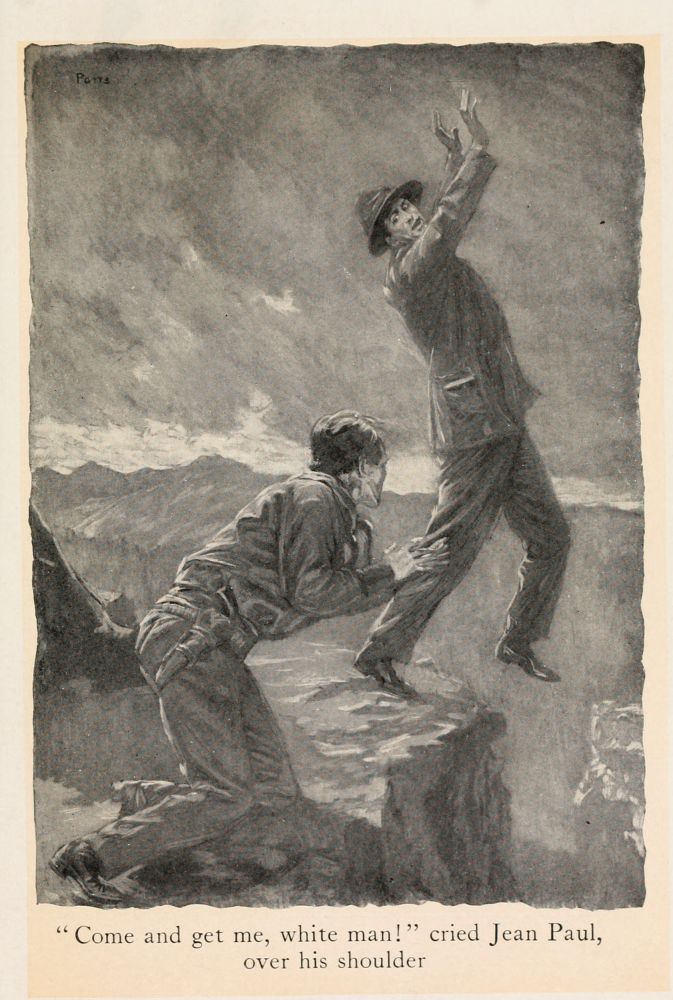
Jack put up his revolver and, crouching, made to seize the man's legs. Jean Paul, with a strange, loud cry, stepped off, and was no more. No sound of any fall came up. Jack had not the stomach to look over.
Four hours later he found the thing below. He had no tools to dig a grave, and he heaped a cairn of stones over it. On the face of a great boulder that overlooked the cairn he scratched an epitaph with the point of his knife:
JEAN PAUL ASCOTA Killed by leaping from the summit of Mount Darwin August — 19— A bad man and a brave one.
Then Jack lay down and slept around the clock.
XIX AN OLD SCORE IS CHARGED OFF
Drawing near to the Sapi village on his return, Jack first came upon a group of children picking wild strawberries in the meadow, who fled screaming in advance of him into the compound. There, every task was dropped, and every dark face turned toward him. Fairly startled out of their affectation of stolidity, they streamed toward him from under the sun shelters and from out of the tepees with cries of astonishment. Jack was not deceived by the apparent warmth of their welcome; they were not glad to see him, only amazed that he should have come back at all.
He pulled up his horse in the centre of the square, and remembering the last time he had addressed them, looked them over with a kind of grim scorn. Just now he was unable to feel any of the kindness for these feather-brained children of the woods that Mary had. He knew the value of scant speech with them, and he made them wait for his announcement.
At last he said: "Ascota is dead!"
They stirred, and softly exclaimed, but one man laughed. His example was infectious; incredulity showed openly in their faces.
"Big talk!" one said insolently. "Where's the proof?"
Jack quietly untied a little bundle from the back of his saddle, and unrolling the flour bag in which he had carried his grub, produced a little book and held it up. It was Jean Paul's Testament, that they all knew. There was a dark and swollen blotch on the leather cover. The absolute silence with which it was received was more impressive than their cries.
Jack handed it to the man who had spoken. It opened in his hands. There was a crimson stain around the edges of the printed page—wet crimson. The man who held it started back, and those looking over his shoulders gasped. The book was passed among trembling hands. Finally it came back to Jack.
"I will tell you where his body is hidden," said Jack. "A mile beyond the crossing of the creek out of Mount Darwin there is a big spruce on the right-hand side of the trail. On it I made a blaze with the sign of the cross in it. One hundred and ten paces from that tree as you walk toward the mountain he lies under a pile of stones. There is a big rock above, with his name and his story cut upon it."
It was very clear that none of them had any desire to seek out the spot; indeed, from that time the Fort Erskine trail was closed to the Sapis by reason of Ascota's grave being upon it.
"Who is the head man now?" Jack demanded.
They turned toward Etzeeah's eldest son, a sullen broad-shouldered brave, the best physical specimen among them.
"Take warning," said Jack clearly, "you and your people! Ascota was a bad man, a big mouth, a trouble-maker, who tried to stir you to evil, while he kept himself clear. He dared to speak against the great white father across the sea. It was the chickadee piping at the eagle. He is dead. We are all the children of the white father; his children and his servants. His police are now at the fort. You will do well to ride in and make your peace, before they come to punish you. That is all I have to say."
One silently brought him the horse he had left there, and, leading it, he rode through the quadrangle and away by the trail, without looking back. There was no demonstration against him now. The awe that Ascota had inspired in them was transferred to the man who had brought about his death.
Three hours later, as Jack's horse sidled down the hill into the Spirit River valley, his rider looked with a beating heart for the four little tents he had left in the meadow below. They were not there. A great disappointment filled him, and a sharp anxiety. What he had been through had made greater inroads on his reserve forces than he knew, and in Mary's deep eyes his weary spirit was unconsciously seeking harbourage.
However, as he rode up to the ashes of their fire he saw that he had not been forgotten. In the forks of two little sticks driven into the ground was laid a peeled wand roughly shaped like an arrow, and pointing northeast. On it had been printed with a piece of charcoal: "7 miles."
Riding in the direction it pointed he found a freshly blazed trail through the trees. It led him among the poplars along the foot of the bench to the opening of a coulee, up which it turned. It took him north through a narrow valley wooded with great spruce trees. Through openings in the trees on either hand he could see the steep, naked, uncouth forms of the foothills that hemmed the valley in. A trickle of water flowed musically in the bottom of it.
It was difficult going for the horses over the fallen and rotting trunks of the untrodden forest, with its treacherous, moss-hidden pitfalls. The seven miles seemed to stretch out into thrice that distance before he came to the end of his journey. He smelled the smoke of a campfire long before he could see it. Finally the trail turned at right angles, and started to climb. He issued out of the trees, and there on a terrace of grass above him he saw the little tents and the fire; he saw Mary turning toward him with harassed, expectant face.
A little cry escaped her, and she came flying to meet him. Jack slipped off his horse. A little way from him she caught herself up, and her body stiffened. The action brought to Jack's mind all that he had forgotten, and he turned a dull red. It had been in his heart to seize her in his arms. A horrible constraint descended on them both. They did not touch hands; they could not meet each other's eyes; speech was very difficult and painful.
"You are all right?" she murmured. "Not hurt?"
"Not a scratch."
"And Jean Paul?"
"He is dead."
She started with horror, and in spite of herself glanced at Jack's hands.
"He killed himself," Jack added quickly.
Her hands betrayed a movement of relief. There was a silence.
"What about you?" mumbled Jack, scowling. "What are you doing up here? Where is Davy?"
"I have something to show you," she said, with a strange look.
He followed her up the slope. He wondered why there were three tents pitched. The third was Jean Paul's A-tent. Mary threw back one of the flaps, and he saw a blanketed form inside.
"The kid!" he murmured, full of anxious concern. But even as he said it, he saw that it was not Davy. Stooping, and looking farther within, he saw a gaunt travesty of the face of Frank Garrod. The eyes were closed.
Something clutched at Jack's heart. He fell back. "Good God!" he muttered. "You've got him! Is he dead?"
She shook her head. "Sleeping," she said. "Come away a little."
They sat on the other side of the fire. "Davy has gone back to the cache," she said, taking care to avoid Jack's eyes, "for milk powder, if there is any, and whiskey, and any medicines he can find. He will be back before dark."
"Has he said anything?" asked Jack, looking toward the tent.
Mary shook her head. "Nothing you could understand. He is very low. We will not get him back to the fort. He was four days in the bush. He had only berries."
"Then it's too late after all," said Jack apathetically.
"Who can tell?" said Mary. "They say often they get their full senses back for a little while before they die."
Jack shrugged. "Who would believe what he said at such a time?"
Mary was silent. Her capacity for silence was greater perhaps than Jack's.
"Tell me about finding him," Jack said.
"We started out as soon as you left," she said, carefully schooling her voice. "It was clear Jean Paul would take him among the hills to lose him, so we struck up the coulee at once. Too many days had passed for us to find their tracks, and it had rained. But I was sure we would find him in the valley. The hills were too steep; besides, even a madman stays by the water. We looked all day without finding anything until near dark. Then we came on some tracks in the mud by the stream. We camped right there the first night. There were many coyotes on the hills, both sides, and I thought he must be near and they were—waiting." She shuddered.
"In the morning we found him," she went on in a low voice. "Just below here. He had fallen down beside the water. His face was in the mud, but the mosquitoes had not left him. So I knew he was not dead. Davy and I carried him up here where it was dry. I fed him a little bread soaked in water. Davy went back for the other horses and the dunnage, and to leave a sign for you. That was yesterday. This morning Davy went to the cache."
"Oh, Mary! what a woman you are!" Jack murmured out of the deeps of his heart.
She rose with an abrupt movement, and went to look at the sick man. She came back presently with a pale, composed face, and quietly set to work mixing dough for their evening meal. There was a long and sufficiently painful silence.
"It's a funny situation, isn't it?" said Jack at last, with a bitter note of laughter.
"Better not talk about it," she murmured. "Let us just wait and see."
Being forbidden to talk about it, the desire to do so became overmastering. "Suppose he doesn't say anything," he began.
"It won't make any difference to your friends," she said. "They know you're not a thief."
"It's a queer business this having a good name and not having one," Jack went on, plucking blades of grass. "As if anybody cared who took the money."
Mary offered no comment.
"I'd lose my claims," Jack went on. "I couldn't go out to file them. But the governor would never put the police on to me, now. He'd be too jolly glad to get rid of me."
Mary refused to raise her eyes from the dough.
Jack thought she hadn't understood what he was driving at. "You see it would let me out there," he went on. "This would be my country for ever and ever, and the people up here my only friends."
There was another silence. He looked at her hungrily. The hard young face was soft enough now.
"Mary," he murmured hoarsely at last; "I don't give a damn if he never speaks."
The dough-pan was dropped at last. She lifted a tortured face. "Don't," she murmured low and swiftly. "Don't you see what it means? Don't you see how you're hurting me? You mustn't wish it. Maybe our thoughts are influencing his sick brain this minute. He must speak! He must tell the truth and clear you. Nothing else matters. You must be able to go wherever you choose. You must be able to look any man in the face. I couldn't bear anything else."
Jack scowled, very much hurt—and a little ashamed perhaps. "I didn't think you were so anxious to send me outside," he muttered.
She threw him the look of pity and despair that women have for the men they love who will not understand them, and, springing up, went to look at her patient again.
By and by Davy arrived. His greeting to Jack supplied the warmth that Mary's had lacked. Jack hugged the boy with a sidelong look at his sister. Afterward Jack briefly and baldly told his story by the fire. Our hero had no talent for description.
"I slept until dark, and then just crawled around the edge of the slide below the ridge, and climbed up the back of the rock."
Davy's and Mary's eyes were big. "Climbed up the back of the summit at night?" murmured Mary.
"Sure," said Jack. "I took it slow and easy. As soon as I got light enough I dropped on him from behind. That was one surprised redskin!"
"Then what happened?" demanded Davy, breathlessly.
Jack frowned. "He jumped off," he said shortly.
"Jumped?" they cried. "Was he killed?" asked Davy.
"Quite," said Jack grimly. "And some to spare." That was all they could get out of him.
They ate their supper, and the sun went down. Mary, leaving the boys smoking by the fire, took up her vigil within the door of the little A-tent. Davy chattered about the prairie chicken that had flown across the trail, about the squirrels that had broken into the cache, about the moose he had seen swimming the river. Jack with an unquiet breast sat listening for a sign from Mary.
Suddenly she came out of the tent, dropping the flaps behind her. "Jack!" she whispered breathlessly.
He sprang to her.
Her clenched hands were pressed hard to her breast. "He's awake," she murmured.
"Is he—sane?"
"I—I don't know," she said a little wildly. "He looked at me so strangely. Oh, Jack!"
He took her trembling hand in his firm one. There was no selfish passion in him now. "Steady, Mary," he said deeply. "We've done the best we could. Whatever will happen, will happen. Better go away for a little."
She gave his hand a little squeeze, and shook her head. "I'm all right," she murmured. "I must know."
Jack threw back the flaps, and, stooping, entered. "Hello, there!" he said quietly.
The sick man turned his head. His eyes were unnaturally bright, and a feverish colour suffused his face; his lips were swollen. "Macgreegor," he whispered. He passed a hand across his eyes. "It is Macgreegor, isn't it?"
Something melted in Jack's breast at the sound of the old boyish nickname. "Sure thing," he said, kneeling beside him.
Garrod reached out his hand, and Jack took it. "Thank God, you're here," he murmured in the soft, hurried accents of the fever patient. "I'm going, Macgreegor. I've made a rotten mess of it, haven't I? I'll be glad to go if I can square myself with you first. Where are we? It doesn't matter. Can anybody take down what I want to say?"
Mary's eyes were big with tears. She produced the pencil Jack had given her, but it appeared there was not a scrap of blank paper in the outfit, not a scrap of paper except the little Testament with its ugly stains. Davy handed it to her. On the fly leaves, with their damp, red borders, Mary prepared to write as Garrod dictated.
"Lift me up a little, Macgreegor," Garrod said. "I can breathe easier. Your arm under my shoulders. That's good. It's like the day at Ste. Anne's when I fell out of the tree. We were seventeen then. You were always holding me up one way and another, Macgreegor. You never knew what you were to me. It was quite different from your feeling for me. I can say it now, anyway. I was a bit cracked about you."
"You'll wear yourself out talking," said Jack with gruff tenderness.
"It won't take me long," Garrod said. "I'll have time."
He expressed no further curiosity as to where he was, or how Jack had come there. He referred to no recent happening. His attention was fixed on the all-concealing gray curtain ahead, through which he must presently pass, and he hurried to get what must be said, said in time. There was something uncanny in the perfect clearness of his thoughts, after what had passed.
"You wonder how I could do as I did if I felt like that toward you," he went on. "Well, sometimes I hated you too. I was jealous of you, you were so much cooler and stronger than I, so much more of a man. I don't suppose you understand. We're not supposed to be like that. I guess I was born with a queer streak."
On the other side of Garrod sat Mary, ready with the pencil and the book. Davy, large-eyed and solemn, filled the doorway.
"I, Francis Garrod, being about to die, do desire to make my peace with God if I may, and with my friend Malcolm Piers, whom I have deeply wronged. It was I who took the money from the Bank of Canada that he was accused of stealing. None but I knew before-hand that he was going away, nor his reasons for going. The morning after he went the sight of the money in the vaults tempted me. He had influential friends and relatives, and I knew there would be no scandal. I took the money in old bills that could not be traced. I have not known a minute's peace since then. It drove me mad by degrees, and it is the cause of my death.
"Should any doubt be cast on this confession, it is easy to verify it. Within a month of the theft I opened accounts in the following banks and branches of banks in Montreal." A list of the banks followed. "In each I deposited a small sum. The total will be about forty-five hundred dollars. The rest I kept by me. Furthermore, among the papers in my desk will be found a letter from Malcolm Piers dated from Winnipeg a few days after his disappearance. The post-mark is intact. In every sentence of this letter there is proof that the writer had no theft on his conscience when he wrote it, and no money. So help me God!"
Garrod signed the page with a sufficiently firm hand, and Davy and Mary wrote their names beneath for witnesses. Jack gave Mary the grim little volume to keep for him, and she and Davy went away.
"That's done," murmured Garrod with a sigh. His fictitious strength seemed to ebb with the sigh. He slipped down on Jack's arm a little. "Don't leave me, Macgreegor," he murmured. "It's all right with us now, isn't it?"
"Sure, I won't leave you," said Jack.
The voice came in a whisper now with many breaks and pauses. "The lights of Ste. Catherine's street, Macgreegor, on a Saturday night, and the crowds, and the stairs up to the gallery of the old Queen's, how they echoed under our feet! We saw the 'Three Musketeers!' ... 'Member the rink in the winter? And the old Park Slide? ... And Ste. Anne's, with the sun shining on the river? There's another pair of kids winning the tandem paddles now, eh? ... How good it is to have you here, old fel'! 'Member the first day I came to work at the bank! You blacked Husky Nickerson's eyes because he blotted my ledger. We nearly all got fired, but you saved us with your pull. Husky, too! How I admired you, with your crooked eyebrow, and your curly hair, and your straight back!
"Well, it's all over for me, old fel' ... and nothing to show! I'll be twenty-six next month.... Life's a sad thing ... and empty! ... I wish—I wish I had done differently. It's good to feel your arm, Macgreegor! ... What time is it, old fel'? Pretty near closing-time? ..."
Three days later Jack, Mary, and Davy rode into Fort Cheever in the evening. On the fourth horse was lashed a significant looking bundle neatly wrapped in canvas, the canvas of the other dead man's tent. A heartfelt welcome awaited them. David Cranston showed no anger at his children. He only looked from Mary to Jack and back again with a kind of wistful, inquiring scowl.
During the interval of their absence the steamboat had arrived, and after waiting twenty-four hours, had returned down river only that morning, taking Sir Bryson and his party. Since nothing could be guessed of the probable return of Jack, the captain had not felt justified in waiting. Jack guessed, furthermore, that Sir Bryson had not exerted his authority to delay the steamer. The lieutenant-governor had had his fill of the North. The steamboat had brought up Sergeant Plaskett of the mounted police, and a trooper from the Crossing.
Garrod was buried at dusk on the hillside behind the fort. Sergeant Plaskett read the burial service. Afterward Jack told his story, and at daybreak the policemen started west to interview the Sapi Indians. Before noon they had returned with Ahcunazie, the eldest son of Etzeeah, and the members of his immediate family. He was on his way in to make peace with the authorities, as Jack had advised.
David Cranston learned something more from Mary, and something from Jack. The situation was too much for the honest trader. He shook his head dejectedly, and had nothing to offer. Measles broke out again among the Indians at Swan Lake—at least Mary said it had. At any rate, she rode away with Angus, Davy's next younger brother, the following day, and Jack did not see her again.
Cranston had a letter for Jack. Thus it ran, the paper blistered with tears, and the headlong words tumbling over each other:
MY OWN JACK: You are mine, aren't you? I am nearly crazy. I don't know where you are or what has happened, and they're taking me away! How could you go without saying a word to me? How can you be so hard? As soon as you get this, come to me! Come to me wherever you are, or whatever has happened! I'll bring father around! Only come! I can't live unless you come! When I think of your failing me, I am ready to do anything! I have no one but you. They all look at me coldly. I am disgraced. Only you can save me. I love you! I love you! I love you! ...
And so on for many pages. Older heads can afford to smile, but to the inexperienced Jack it was terrible.
The police hearing was concluded two days later. At evening that day Jack, declining a lift down the river in Plaskett's canoe, pushed off alone on the same little raft that had brought him to Fort Cheever a month before.
XX THE LITTLE GREAT WORLD
Mr. Malcolm Piers stood before the mirror tying a white bow at the top of an effulgent shirt bosom. It was a room in Prince George's best hotel, and it had been his room for six weeks. His brown ruddiness had paled a little, and his face looked harder and older than the wear of only two months warranted. Unhappiness or perplexity, or indeed any emotion, caused Jack to look like a hardy young villain. Only the eyes told a tale; a profound discontent lurked in their blue depths.
He finished dressing and took down his overcoat and topper. Evening dress became him well, and he knew it, and took a certain satisfaction in the fact, for all that the world was going badly. His abounding health and his hardness marked him out from the usual dancing man. Hunching into his overcoat, he put out the light, and with the act the night out-of-doors leaped into being. Struck by it, he went to the window and flung it up.
The stars were like old friends suddenly brought to mind. So they shone over his own country where there were no grosser lights to outface them impudently; so they shone nights he had lain well-wrapped on the prairie, counting them while he waited for sleep; so they shone through the spruce branches in the valleys. The town of Prince George is built on top of the bench, and his window looked into the deep valley of the river. It brought to mind his own river, the serene Spirit; his and Mary's; Mary's whose eyes were as deep and quiet and healing as the stars.
Leaning against the window-frame, he lost count of time. He thought of the nights he had careered over the prairie on horseback under the stars. He had called his new horse Starlight, a thoroughbred. How the beast would love the prairie! How his knees ached for him this minute, to bear him away from all this back to her! How her eyes would shine at the sight of Starlight! Never had such a horse been seen north of the Landing. How he would love to give him to her! How fine she would look on Starlight! He fell to picturing her under all the different circumstances he remembered. Sweetest and most painful was the recollection of how he had kissed her sleeping in the light of the fire, and how her soft, warm lips had smiled enchantingly under the touch of his.
He was brought back to earth by the ringing of the telephone bell in the room behind him, and a summons from below. He went down stairs cursing himself. "You fool! To let yourself get out of hand! What good does it do?"
It was the night of the hospital ball in Prince George. The provincial parliament had reassembled, the courts were sitting, and the little western capital was thronged with visitors more or less distinguished. The ball was held under the largest roof in town, that of the armory; the band had been imported all the way from Winnipeg, and the decorations and the gowns of the women would have done credit to Montreal itself. To the women the particular attraction of the occasion was the presence of an undoubted aristocrat, Lord Richard Spurling, seeing Canada on his grand tour.
Linda was radiant, the greatest little lady there! There was nothing here to suggest the frightened child who had left such a desperate note for Jack. Her world had not turned its back on her; on the contrary, she had made a grand reéntrée with the halo of adventure around her pretty head. She was wearing a dress of rose-madder satin straight from Paris, a marvel of graceful unexpectedness, hanging from her thin, alluring shoulders by a hair, and clinging about her delicate ankles. She was wearing all the pearls that had shared her adventures, besides some new ones, and a jewelled aigrette in her dark hair. A whole company of cavaliers dogged her footsteps, including the lordling himself, a handsome and manly youngster, irrespective of the handle to his name.
Jack was not one of the company that surrounded her. Jack and Linda had been leading a kind of cat and dog life the past few weeks. Their engagement was admitted, but had not been announced. Jack did not shine in Linda's world; glumness is the unpardonable sin there. Moreover, Jack was a perpetual reminder of things she was ashamed of now. And there were so many other men! At the same time she kept a tight hold on him by the means that such little ladies know so well how to employ.
Jack kept out of her way until it was time for the first of the two dances she had vouchsafed him. As he approached her she could not but acknowledge his good looks, she was a connoisseur, but a good-looking thundercloud! The dance was not a success; they were out of harmony; they stepped on each other's toes!
"Let's stop," said Linda fretfully.
As soon as they were out of earshot of the crowd she opened on him: "You haven't been near me all evening!"
"You know I'm at your disposal," Jack said stiffly. "But I will not make one of that train of young asses that follow you around."
"You don't have to," retorted Linda. "And you needn't be rude. Follow whoever you please around, but for heaven's sake don't stand against the walls with a face like a hired mute!"
This stung. Nevertheless, Jack doggedly admitted the justice of it to himself, and "took a brace," as he would have said. "I'm sorry, Linda," he said manfully; "I'm a bit off my feed to-night. You know I'm no good at this sort of thing."
She was merciless. "It's not only to-night. It's all the time; ever since you've been here. It's not very flattering to me to have you go round with me as if you were dragged against your will."
Jack pulled in his lip obstinately. He had made his apology; she had rebuffed him; very well. Linda, glancing sideways under her lashes, saw that she would get no more out of him in this connection. She made another lead.
"Take me to the north end of the gallery," she drawled. "I promised to meet Lord Richard there at the end of this dance."
Jack obeyed without comment.
"He's an awfully good sort, isn't he?" she went on, with another sidelong glance at Jack. "I was surprised to find out how well he dances. Englishman, you know! He likes Canada better every day, he says. He's going to stay over for the golf tournament if I will let him. He is looking for a ranche somewhere near town."
Jack woke up. "First-rate head," he said heartily. "We've talked a lot about the North. He wants to make a trip with me."
Linda bit her lip.
Later Jack sought out Kate Worsley, with whom he had a dance. These two had made great progress in intimacy.
"Shall we dance?" she said.
"No, please," said Jack. "Linda says I dance like her grandfather. One gets rusty in five years!"
"To sit out then," said Kate. "Let's get in the first row of the gallery, where we can hang over and watch the giddy young things!"
Their conversation did not flourish. The night outside still had Jack by the heartstrings; loping over the prairie under the stars, the far-off ululation of a wolf, a ruddy campfire in the dark, and beside it, Mary!
"You're not exactly garrulous to-night," remarked Kate.
Jack turned a contrite face to her. "I'm sorry. I wouldn't be rude to you, Kate!"
"Bless your heart! you don't have to talk unless you are moved to it. I don't like to see a pal looking so down, that's all."
"Down?" said Jack with a laugh. "I'm living in hell, Kate!"
"Tell me about it, old man. You can, you know."
He shook his head. "I can't talk about it. I only sound like a fool. It only makes matters worse to talk about it."
Kate knew her men. "Change the subject then," she said cheerfully. "How are business matters going?"
"All right," said Jack. "I have sold my claim and the other one to Sir Bryson's company for twenty-five thousand—a fair price."
"Cash or stock?" asked Kate.
"Cash. I have no talent for business. I don't want to be in the company."
"The other claim?" she asked.
"Miss Cranston's?" he said self-consciously:
"I thought there were three."
"The third belongs to Linda."
"Well, what are you going to do now?" she asked.
He looked at her in surprise. "What do you mean?"
"You're too good a man to hang on here in town," she said off-hand.
"Do you think I'm staying because I want to?" he burst out. "Good heavens, I'm mad to get away! I hate all this! I'm fighting myself every minute!"
She looked at him inscrutably. "My young friend, you're blind!"
"You don't understand," muttered Jack miserably.
"Don't I?" she said, wistful and smiling. "I've thought quite a lot about your case, but I wasn't sure that I had the right to speak."
"Oh, Kate!" he said turning to her quickly; "you know I'd take anything from you!"
She smiled at the way he put it. "I'm not going to abuse you. My advice to you is simply—to go!"
Jack stared at her.
"Go!" she repeated. "Ride away! Ride back to your own work in your own country, the place you suit, and that suits you. You'd never be any good here. Look at Linda in her finery! This is the breath of her nostrils. She has her eye on Montreal—London eventually. How could you two ever hope to pull together? Mind you, I'm her friend too, and I believe that I'm doing her a service in advising you to ride. Girls get carried away temporarily like men, though they're not supposed to. Girls often get hysterical, and write much more than they mean. Letter-writing between the sexes ought to be made a felony."
"She has my word," muttered Jack.
Kate shrugged. "There's the man of it! It is a fetich! Would you spoil Linda's life for the sake of keeping your word, not to speak of your own life and—perhaps a third!"
Jack's face was obstinate. "I'll see Linda and put it straight to her," he conceded.
Kate's eyebrows went up. "These men!" she said helplessly. "You ought to know her a little by this time. That will do no good. Much better go without. It's a thing that ought to be broken off. What matter who does it, or how it's done? The result will be good."
"I couldn't go unless she releases me," Jack said.
Kate got up smiling. "We must go back," she said. "A man must do as he will. You are an awfully nice boy, Jack. I believe I love you for your very mulishness. Write to me sometimes out of the North."
"I haven't gone yet," he said grimly. "You must promise to forget every word that has been said if I ask you to."
"I promise, dear old man."
For Jack to think of a thing was to put it into instant execution. He set off in search of Linda. One of the likeliest places to find her was on the balconies. There was a suite of rooms across the front of the armory, the officers' club, with a long narrow balcony overhanging the street. For the occasion of the ball, potted palms had been placed at intervals down the balcony, making a series of little nooks, each with two chairs, and each reached through its own window. The largest of the rooms with the balconies outside had been set apart for Sir Bryson and his party.
Dancing was in full swing below, and Jack found the room empty. None of the little nooks outside were occupied. In one of them Jack sat down to wait for the end of the dance. Almost immediately two people entered the next bower to his. Their voices were pitched low, and at first he did not recognize them.
"Now for a cigarette," said the man.
"Lucky man," said the girl. "I'm dying for a puff!"
"Have one," he said. "I'll take it from you, if any one comes."
There was a silence, and the striking of a match. Then a long-drawn feminine "Ah-h!" which was undoubtedly Linda's. Jack stood up to speak to her over the dividing palms. It was not a thing to do, but Jack was a man of one idea at a time; he had to speak to her, and his other dance was at the tail of the evening. He wished merely to make an appointment to speak with her later.
As his head rose over the palms he was just in time to see the blond head of the English boy and Linda's darker, bejewelled head draw close together, and their lips meet and linger. They did not see him.
Jack dropped back as if he had been shot, blushing and furious with himself. To be a peeping Tom! a thing he loathed. He silently cut across the room within the balconies, praying that they might not hear him. Wild horses would never have dragged any admission from him of what he had seen.
But when he got his breath again, as one might say, oh! but he found his heart was beating blithely! He felt as if he had burst out of a hateful chrysalis. Life was full of joy after all! A little song rang in his ear: "It's all right! It's all right!" Laughter trembled in his throat.
He waited about on the stairs for Linda to come down. She finally appeared, cool and scornful, her heels tapping on the stairs, the thing in her hair nodding and sparkling. Who would ever guess that her little Mightiness had just been kissed! The spring of laughter bubbled up inside Jack. He presented a bland face to her, but he could not hide the shine in his eyes, nor the smirk about the corners of his lip.
"What is it?" asked Linda, staring at the change in him.
"Whom have you the next dance with?"
She named a name.
"I know him," said Jack. "Wait for me upstairs, and I'll see if I can't make an exchange. I want to talk to you."
Linda's curiosity was aroused, and she went back upstairs with Lord Spurling. In five minutes Jack had rejoined her, and the two of them went out on the balcony again, in the same nook Linda had shared with the Englishman.
"Well, what is it?" she asked.
"Linda," he said, "we've done nothing but quarrel since I came. Let's cry quits!"
"It hasn't been my fault," she said, all ready for another.
"Never mind whose fault," he said. "Let's cut it out!"
"What's come over you?" she asked curiously.
"Look here," he said, "up North I promised that I'd come and claim you as soon as I cleared myself. Well, I came, and I've been here long enough to show us both that it's no go. We're not suited to each other. We only get on each other's nerves. Give me my word back again, Linda. Let's shake hands on it, and say good-bye!"
Linda started, and looked at him with big eyes. "Jack!" she murmured. "You'd desert me? You can't mean it? What would I do?"
She got no further. The great eyes, the plaintive tremulo, the threatened tears, all the old tricks after what he had just seen, struck Jack as too funny! His laughter broke its bonds. He threw back his head, and gave it way. There was nothing mocking or bitter in it; it was pure laughter from the relief of his heart. He laughed and laughed. He had had no laughter in weeks. He was obliged to lean against the window-frame and hold his ribs as at a vulgar farce.
Linda's expression graduated from amazement to pale fury. She sprang up. The jewelled aigrette fairly bristled with rage. "How dare you!" she cried. "Shut up! I hate you! You make me feel like a perfect fiend! I'd like to scratch your eyes out! Go back to your squaw! It's all you're fit for. I was going to speak to you myself. Understand, I'm throwing you over! I despise you!" She stamped her foot. "Go back to her, and be damned to you both!"
She vanished. Such was the end of that affair.
Jack went in search of Kate, and found her on a man's arm bound supperward. "Could I have a word with you urgent and private?" he whispered.
Kate looked at his happy eyes and nodded. "Front balcony, five minutes," she murmured back.
The balcony again.
"Kate, I'm off!" he cried. "This very night. In an hour I'll be pounding the North trail on Starlight. I'm so happy I can't keep the ground. If the boats have stopped running, I'll ride the whole way through. Kate, dear, you've been a powerful good friend to me. I'd like to kiss you good-bye."
"You may," she said, smiling and lifting her face.
"There!" he said. "There! and there! and there!"
"Mercy!" said Kate. "I'll have to retire to the dressing room for repairs! Good-bye, and God bless you!"
After the family had gone to bed, Mary and Davy Cranston stole back into the living-room, and quietly blowing up the fire, put on fresh sticks. They sat down before it, nursing their knees. Nowadays there was a stronger bond than ever between Mary and Davy. In that disorganized household in the winter this was the only chance they had to talk together.
"What do you suppose he's doing to-night?" said Davy.
"Who knows?" said Mary. "A party of some kind, or the theatre."
"If father had let me go out with him," said Davy, "I could have written and told you everything he did."
"Father was right," said Mary. "He'll let you go when the time comes. But that sort of thing would only unsettle you. We're not society people."
"I don't see why you're not," said Davy stoutly.
"It's too complicated to explain," she said in a level voice. "Anyway, I wouldn't like it."
"Whatever Jack does is all right, isn't it?" demanded Davy.
"He was born to it," said Mary. "That makes the difference. Besides——"
"Well?"
"I don't think he likes it either. But it's necessary for him just at present."
"I wish I could see him!" cried Davy.
Mary was silent.
"I mean to be just like him," Davy went on. "Do you think I'll ever be as strong as that?" he asked anxiously.
"It doesn't matter," said Mary, staring into the fire. "You can be as brave and honourable."
There was a knock at the front door. Brother and sister looked at each other in surprise.
"A sick Indian," said Mary.
Davy went to see. He closed the door of the room after him. Presently Mary heard a little cry, quickly smothered. Davy came in again breathless, and with shining eyes.
"There's—there's some one wants to see you!" he said shakily. "Oh, Mary!"
She ran out into the hall. The front door was open, and he stood there, broad-shouldered and bulky with much clothing, dark against the field of snow. He was bareheaded, and the moonshine was making a little halo around the edges of his curly pate. He held out his arms, and in a twinkling she was in them.
"Mary! My love!" he murmured. "I nearly went out of my mind wanting you. I've come back for you! Never to leave you again!"
Their lips met, and their tears ran together. Mary was the only woman who ever saw those hard blue eyes fill and overflow.
THE END
THE COUNTRY LIFE PRESS GARDEN CITY, N.Y.