JACK CHANTY (continued 2)
Reading edition
"I say, wait behind and ride with me," he said to Garrod. "We've scarcely had a chance to say anything to each other."
Garrod's start and the wild roll of his black eyes suggested nothing but terror at the idea, but there was no reasonable excuse he could offer. They rode side by side in the grass at some distance behind the last Indian.
"Do you know," said Jack, "I've never heard a word from home since the night I cleared out five years ago. Tell me everything that's happened."
"That's a large—a large order," stammered Garrod. "So many little things. I forget them. Nothing important. I left Montreal myself soon after you did."
"Why did you never answer my letter?" asked Jack. "You know I had no one to write to but you."
"I never got a letter," said Garrod quickly.
"That's funny," said Jack. "Letters don't often go astray."
"Don't you believe me?" demanded Garrod sharply.
Jack stared. "Why, sure!" he said. "What's biting you? You're in a rotten state of nerves," he went on. "Better chuck the life you're leading, and stay up here for a year or two. What's the matter with you?"
Garrod passed the back of his hand across his weary eyes. "Can't sleep," he muttered.
"Never heard of a man up here that couldn't do his eight hours a night," said Jack. "You'd better stay."
Garrod made no answer.
"You're not still hitting the old pace?" asked Jack.
Garrod shook his head.
"Gad! what a pair of young fools we were! Trying to cut a dash on bank-clerks' salaries! That girl did me a mighty good turn without meaning it when she chucked me for the millionaire. What's become of her, Frank?"
"She married him," Garrod said; "ruined him, divorced him, and married another millionaire."
Jack laughed carelessly. "Logical, eh? And that was what I broke my young heart over! Remember the night I said good-bye to you in the Bonaventure station, and blubbered like a kid? I said my life was over, 'member?—and I wasn't twenty-one yet. You were damn decent to me, Frank. You didn't laugh."
Garrod kept his head averted. His lips were very white.
"We went through quite a lot for a pair of kids," Jack went on. "We always stood by each other, though we were such idiots in other respects. What we needed was a good birching. It takes a year or two of working up here to put an only son straight with himself. Life is simple and natural up here; you're bound to see the right of things. Better stay, and get your health back, old man."
Garrod merely shook his head again.
"My uncle is dead," Jack went on. "I saw it in a paper."
"Yes," said Garrod.
"And left his pile to a blooming hospital! That's what I lost for clearing out, I suppose. Well, I don't regret it—much. That is, not the money. But I'm sorry the old boy passed out with a grouch against me. I thought he would understand. He had a square head. I've often thought there must have been something else. You were quite a favourite of his, Frank. Was there anything else?"
All this time Garrod had not looked at Jack. At the last question a wild and impatient look flashed in his sick eyes as if some power of endurance had snapped within him. He jerked his head toward the other man with desperate speech on his lips. It was never uttered, for at the same moment an exclamation broke from Jack, and clapping heels to his horse, he sprang ahead. One of the packs had slipped, and the animal that bore it was sitting in the trail like a dog.
After the pack had been readjusted, other things intervened, Garrod regained his own place in the procession, and Jack for the time being forgot that his question had not been answered.
Jack's dignity as the commander of the party often sat heavily upon him, and he was fond of dropping far behind in the trail, where he could loll in the saddle, and sing and whistle to his heart's ease. His spirits always rose when he was on the move, and the sun was shining.
Jack had a great store of old English ballads. On one such occasion he was informing high heaven of the merits of "Fair Hebe," when upon coming around a poplar bluff he was astonished to see Linda Trangmar standing beside her horse, listening with a smile of pretty malice. She had a bunch of pink flowers that she had gathered. Jack sharply called in the song, and blushed to his ears.
"Don't stop," she said. "What did Reason tell you about Fair Hebe?"
Jack made believe not to hear. Our hero hated to be made fun of. "It's dangerous to be left behind by the outfit," he said stiffly.
"I knew you were coming," she said coolly. "Besides, I got off to pick these flowers, and I couldn't get on again without being helped." She thrust the flowers in her belt. "Aren't they lovely? Like crushed strawberries. What are they called?"
"Painter's brush," said Jack laconically.
He lifted her on her horse. She was very light. It was difficult to believe that this pale and pretty little thing was a woman grown. She had a directness of speech that was only saved from downright impudence by her pretty childishness.
"Now we can talk," she said as they started their horses. "The truth is, I stayed behind on purpose to talk to you. I wish to make friends."
Jack, not knowing exactly what to say, said nothing.
She darted an appraising look at him. "Mr. Vassall says it's dangerous to ask a man questions about himself up here," she went on. "But I want to ask you some questions. May I? Do you mind?"
This was accompanied by a dazzling smile. Jack slowly grew red again. He hated himself for being put out of countenance by her impudence, nevertheless it cast him up high and dry.
She took his assent for granted. "In the first place, about your name," she chattered; "what am I to call you? Mr. Chanty would be ridiculous, and without the Mister it's too familiar."
"You don't have to bother about a handle to my name," he said. "Call me Jack, just as you speak to Jean Paul or Charlbogin, or any of the men about camp."
"That's different," she said. "I do not call Mr. Garrod, Frank, nor Captain Vassall, Sidney. You can make believe what you choose, but I know you are my kind of person. If you are a Canadian, I'm sure we know heaps and heaps of the same people."
Jack began to find himself. "If you insist on a respectable name call me Mr. 'Awkins," he said lightly.
"Pshaw! Is that the best you can invent?" she said.
It was a long time since Jack had played conversational battledore and shuttlecock. He found he liked it rather. "'Awkins is an honorable name," he said. "There's Sir 'Awkeye 'Awkins of 'Awkwood 'All, not to speak of 'Enery 'Awkins and Liza that everybody knows about. And over on this side there's Happy Hawkins. All relatives of mine."
The girl approved him because he played the foolish game without grinning foolishly, like most men. Indeed his lip still curled. "You do not resemble the 'Awkinses I have known," she said.
It appeared from this that the little lady could flatter men as well as queen it over them. Jack was sensible that he was being flattered, and being human, he found it not unpleasant. At the same time he was determined not to satisfy her curiosity.
"Sorry," he said. "For your sake I wish I would lay claim to Montmorenci or Featherstonehaugh. But 'Awkins is my name and 'umble is my station. I don't know any of the Vere de Veres, the Cholmondeleys or the Silligers here in Canada, only the toughs."
She did not laugh. Abandoning the direct line, she asked: "What do you do up here regularly?"
"Nothing regularly," he said with a smile. "A little of everything irregularly. I have horses across the mountains, and I make my living by packing freight to the trading posts, or for surveyors or private parties, wherever horses are needed. When I get a little ahead of the game like everybody else, I do a bit of prospecting. I have an eye on one or two things——"
"Gold?" she said with shining eyes. "Where?"
"That would be telling," said Jack, flicking his pony.
"Do you know anybody in Toronto?" she asked suddenly.
He smiled at her abrupt return to the main issue, and shook his head.
"In Montreal?"
His face changed a little. After a moment he said slyly: "I met a fellow across the mountains who was from Montreal."
"A gentleman?"
"More or less."
"What was his name?" she demanded.
"Malcolm Piers."
She looked at him with round eyes. "How exciting!" she cried.
"Exciting?" said Jack, very much taken aback.
"Why, yes," she said. "There can't be more than one by that name. It must have been Malcolm Piers the absconder."
Her last word had much the effect of a bomb explosion under Jack's horse. The animal reared violently, almost falling back on his rider. Linda was not sufficiently experienced on horseback to see that Jack's hand had spasmodically given the cruel Western bit a tremendous tug. The horse plunged and violently shook his head to free himself of the pain. When he finally came back to earth, the actions of the horse seemed sufficient to account for the sudden grimness of Jack's expression. His upper lip had disappeared, leaving only a thin, hard line.
"Goodness!" said Linda nervously. "These horses are unexpected."
"What did you call him?" asked Jack quietly.
"Absconder," she said innocently. "Malcolm Piers was the boy who stole five thousand dollars from the Bank of Canada, and was never heard of afterward. He was only twenty."
He looked at her stupidly. "Five thousand dollars!" he repeated more than once. "Why that's ridiculous!"
"Oh, no," she said eagerly. "Everybody knows the story. He disappeared, and so did the money. I heard all the particulars at the time, because my room-mate at Havergal was the sister of the girl they said he did it for. She wasn't to blame, poor thing. She proved that she had sent him about his business before it happened. She married a millionaire afterward. She's had heaps of trouble."
Jack's horse fretted and danced, and no answer was required of him.
"Fancy your meeting him," she said excitingly. "Do tell me about him. They said he was terribly good-looking. Was he?"
"Don't ask me," said Jack gruffly. "I'm no judge of a man's looks." He scarcely knew what he was saying. The terrible word rang in his head with a clangour as of blows on naked iron. "Absconder!"
"Do tell me about him," she repeated. "Criminals are so deadly interesting! When they're gentlemen. I mean. And he was so young!"
"You said everybody knows what he did," said Jack dully. "I never heard of it."
"I meant everybody in our world," she said. "It never got in the newspapers of course. Malcolm Piers's uncle was a director in the bank, and he made the shortage good. He died a year or so afterward, leaving everything to a hospital. If Malcolm Piers had only waited a little while he wouldn't have had to steal the money."
"Then he would have been a millionaire, too," said Jack, with a start of harsh laughter.
She didn't understand the allusion. She favoured him with a sharp glance. "Funny he should have told you his real name."
"Why not?" said Jack abstractedly. "He didn't consider that he had done any wrong!"
How ardently Jack wished her away so that he could think it out by himself. Little by little it was becoming clear to him, as if revealed by the baleful light of a flame. So that was why his uncle had cut him off? And Garrod had not answered his question. Garrod knew all about it. Garrod was the only person in the world who knew in advance that he had been going to clear out, never to return. Garrod was deep in debt at the time. Garrod had access to the bank's vault. This explained his strange, wild agitation at the time of their first meeting, and his actions ever since.
"What's become of him now?" Linda desired to know. She had to ask twice.
Jack heard her as from a great distance. He shrugged. "You can't keep track of men up here."
"Did he tell you his story?"
He nodded. "It was different from yours," he said grimly.
"Tell me."
"It is true that he was infatuated with a certain girl——"
"Yes, Amy——"
"Oh, never mind her name! It was difficult for him to keep up the pace she and her friends set, but she led him on. Finally she made up her mind that an old man with money was a better gamble than a young one with prospects only, and she coolly threw him over. It broke him all up. He was fool enough to love her. Everything he had known up to that time became hateful to him. So he lit out. But he took nothing with him. Indeed, he stripped himself of every cent, sold even his clothes to pay his debts around town before he went. He came West on an emigrant car. Out here he rode for his grub, he sold goods behind a counter, he even polished glasses behind a bar, until he got his head above water."
This was a long speech for Jack, and in delivering it he was betrayed into a dangerous heat. The girl watched him with a sparkle of mischievous excitement.
"A likely story," she said, tossing her head. "I know that old Mr. McInnes had to put up the money, and that he altered his will." She smiled provokingly. "Besides, it's much more interesting to think that Malcolm Piers took the money. Don't rob me of my favourite criminal."
Jack looked at her with his handsome brows drawn close together. Her flippancy sounded incredible to him. He hated her at that moment.
A horseman dropped out of his place in the train ahead and came trotting back toward them. It was Garrod. Seeing him, a deep, ugly red suffused Jack's neck and face, and a vein on his forehead stood out. But he screwed down the clamps of his self-control. Pride would not allow him to betray the secrets of his heart to the light-headed little girl who was angling for them. They were riding around another little poplar wood.
"Look!" he said in as near his natural voice as he could contrive. "In the shade the painter's brush grows yellow. Shall I get you some of those?"
"No, thank you," she said inattentively. "I like the others best. Tell me about Malcolm Piers——"
Garrod was now upon them. His harassed eye showed a new pain. He looked at Linda Trangmar with a dog's anxiety, and from her to Jack. Jack looked abroad over the prairie with his lips pursed up. His face was very red.
"Oh, Mr. Garrod, what do you think!" cried the girl. "This man met Malcolm Piers across the mountains. The boy who absconded from the Bank of Canada, you know. You used to know him, didn't you?"
There was a pause, dreadful to the two men.
"Oh, the little fool! The little fool!" thought Jack. Out of sheer mercifulness he kept his head averted from Garrod.
"What's the matter?" he heard her say sharply. "Help him!" she said to Jack.
This was too much. Making sure only that Garrod was able to keep his saddle, Jack muttered something about having to speak to Jean Paul, and rode away. His anger was swallowed up a pitying disgust. His passing glance into Garrod's face had revealed a depth of despair that it seemed unfair, shameful, he—the man's enemy—should be allowed to see.
VI THE PRICE OF SLEEP
They camped for the night on a grassy terrace at the edge of a deep coulee in the prairie, through which a wasted stream made its way over a bed of round stones toward the big river. The only full-sized trees they had seen all day grew in the bottom of the coulee, which was so deep that nothing of the branches showed over the edge.
The horses were herded together, and unpacked in a wide circle. Each pack and saddle under its own cover was left in its place in the circle, against loading in the morning. As fast as unpacked the horses were turned out to fill themselves with the rich buffalo grass. The old mares who had mothered most of the bunch were hobbled and belled to keep the band together.
Jack, Jean Paul, and the Indian lads saw to the horses. Jack also directed Vassall's and Baldwin Ferrie's inexpert efforts with the tents, and between times he showed Humpy Jull how to make a fire.
Sir Bryson, Linda, and Mrs. Worsley, in three of the folding chairs which were the object of so much comment in the country, looked on at all this.
"I feel so useless," said Linda, following Jack's diverse activities, without appearing to. "Don't you suppose there is something we could do, Kate?"
"It all seems like such heavy work, dear," said Mrs. Worsley.
Sir Bryson, folding his hands upon his comfortable centre, beamed indulgently on the busy scene. "Nonsense, Linda," he said. "They are all paid for their exertions. You do not concern yourself with household matters at home."
"This is different," said Linda, a little sulkily. She was sorry she had spoken, but Sir Bryson would not let the matter drop so easily.
"How different?" he inquired.
"Oh! up here things seem to fall away from you," said Linda vaguely. "You get down to rock bottom."
"Your metaphors are mixed, my dear," said Sir Bryson pleasantly. "I don't understand you."
"It doesn't matter," she said indifferently.
"Now, for my part, I think this the most agreeable sight in the world," Sir Bryson went on. "All these people working to make us comfortable, and dinner coming on presently. It rests me. Fancy seeing one's dinner cooked before one's eyes. I hope Jull has washed his hands. I didn't see him do it."
Sir Bryson had no intention of making a joke, but Mrs. Worsley laughed.
"Speaking of dinner," continued Sir Bryson, "I hope there won't be any awkwardness about our guide."
"Jack Chanty?" said Linda quickly. "What about him?"
"My dear! I wish you wouldn't be so free with his vulgar name! Do you suppose he will expect to sit down with us?"
"Why not?" said Linda warmly. "It's the custom of the country. The whites eat together, and the Indians. Can't you see that things are different up here? There are no social distinctions."
"Then it is high time we introduced them," said Sir Bryson with the indulgent smile of one who closes the matter. "I shall ask Mr. Garrod to drop him a hint."
"You'll only make yourself ridiculous if you do," said Linda.
Mrs. Worsley spoke but seldom, and then to some purpose. She said now: "Do you know, I think the matter will probably adjust itself if we leave it alone."
And she was right. Nothing was further from Jack's desires than to sit down with the party in the big tent. Apart from other considerations he knew which side his bread was buttered on, and he chummed with the cook. Jack and Humpy slung their little tents side by side behind the fire, and Jack waited to eat with Humpy after the others were through.
It was Humpy Jull's debut as a waiter, and Sir Bryson was thereby likewise provided with a new experience. Humpy was very willing and good-natured. He was naturally a little flustered on this occasion, and with him it took the form of an increased flow of speech. To his simplicity, waiting on the table obligated him to play the host.
"Walk in, people," he said genially. "Sit down anywheres. You'll have to excuse me if I don't do things proper. I ain't had no experience at the table with ladies. I never did have no face, anyway. A child could put me out."
Sir Bryson became turkey red, and looked at his aide-de-camp. Vassall made believe not to see.
"I'll just set everything on the table," Humpy went on innocently, "and you dip right in for yourselves. The bannock ain't quite what it ought to be. I didn't have the time. When we get a settled camp I'll show you something better."
"How far have we made to-day?" Sir Bryson asked pointedly of Vassall to create a diversion.
Humpy took the answer upon himself. "Eighteen miles, Governor," he said. "We would have stopped at Mooseberry Spring two miles back, but Jack said there was no firewood thereabout. So we're late to-night."
"We have everything, thank you," said Sir Bryson icily. "You needn't wait."
"I don't mind, Governor," said Humpy heartily. "Jack and me ain't going to eat till you are through. I want to make sure you folks gets your fill."
"I think the bannock is very good, Mr. Jull," said Linda wickedly. "The raisins are so nice."
"I had 'em and I thought I might as well put 'em in," said Humpy, highly pleased. "Some finds it hard to make good baking-powder bannock, but it come natural to me. Jack, he baked it for me."
Sir Bryson ceased eating. It was Jack who prevented an explosion. Possibly suspecting what was going on within the tent, he called Humpy. Linda pricked up her ears at the sound.
Humpy ducked for the door. "If there's anything you want don't be afraid to sing out, Governor," he said.
Sir Bryson slowly resumed his normal colour. He made no reference to what had happened except to say severely: "Belinda, I'm surprised at you!"
"Oh! don't be stuffy, father," returned his daughter, inelegantly.
The members of Sir Bryson's suite were accustomed to these little passages.
When they issued from the tent Jack Chanty and Humpy were to be seen supping cheek by jowl beside the fire, and Linda said with a flash of intuition:
"I'll be bound, they're having a better supper than we had!"
She was only guessing, but as a matter of fact, in the case of a party as large as this, there are bound to be tidbits, such as a prairie-chicken, a fish or a rabbit, not sufficient to furnish the general table, and these naturally fall to the share of the cook and his chum.
Afterward, while the Indians washed the dishes, Jack smoked and Humpy talked. Humpy was the kind of innocent braggart that tells tall tales about nothing at all. He was grateful to Jack for even the appearance of listening, and Jack in turn was glad of the prattle that enabled him to keep his face while he thought his own thoughts.
"Last winter when the steamboat was laid up," said Humpy Jull, "I was teaming for the company down to Fort Ochre. Say, it's wild country around there. The fellers advised me not to leave my gun behind when I druv into the bush for poles. One day I was eatin' my lunch on a log in the bush when I hear a grizzily bear growl, right behind me. Yes, sir, a ding-gasted grizzily. I didn't see him. I didn't wait. I knew it was a grizzily bear because the fellers say them's the on'y kind that growls-like. Say, my skin crawled on me like insec's walkin' on my bare bones. I never stop runnin' till I get back to the fort. The hosses come in by themselves. Oh, I let 'em laugh. I tell you I wa'n't takin' no chances with a grizzily!"
Meanwhile Jack, for the first time in his life, was obliged to face a moral crisis. Other threatening crises hitherto he had managed to evade with youth's characteristic ingenuity in side-stepping the disagreeable. The first time that a young brain is held up in its happy-go-lucky career, and forced to think, is bound to be a painful experience.
Up to now Jack had taken his good name for granted. He had run away when he felt like it, meaning to go back when he was ready. Now, when he found it smirched he realized what an important thing a good name was. He raged in his mind, and justly at the man who had destroyed it; nevertheless a small voice whispered to him that it was partly his own fault. For the first time, too, he realized that his name was not his exclusive property; his father and mother had a share in it, though they were no longer of the world. He thought too of the streets of the city that was so dear to him, now filled with people who believed that Malcolm Piers was a thief.
The simplest thing was not to think about it at all, but go direct to Frank Garrod, and "have it out" with him. But Jack was obliged to recognize that this was no solution. Every time he had drawn near to Frank since the afternoon, Frank had cringed and shown his fangs like a sick animal, disgusting Jack, and making it impossible for him to speak to Frank in any connection. A look in Frank's desperate eyes was enough to show the futility of an appeal to his better feelings. "Besides, I couldn't beg him to set me right," Jack thought, his hands clenching, and the vein on his forehead swelling.
Force then suggested itself as the only recourse, and the natural one to Jack's direct nature. This was no good either. "He's a sick man," Jack thought. "He couldn't stand up to me. If I struck him——" A cold fear touched his heart at the thought that he had no way in the world of proving himself honest, except by means of a free and voluntary statement from a man who was obviously breaking, and even now scarcely sane.
The problem was too difficult for Jack to solve. He found himself wishing for an older head to put it to. More than once his thoughts turned to the wiser and older lady in Sir Bryson's party, to whom he had not yet spoken. "I wish I could make friends with her," he thought.
The second day on the trail was largely a repetition of the first. The routine of making and breaking camp proceeded more smoothly, that was all. On this day as they rose over and descended the endless shallow hills of the prairie, the snow-capped peaks of the Rockies rose into view off to the west.
Jack and Frank Garrod held no communication throughout the day. Garrod showed an increased disorder in his dress, and a more furtive manner. On the trail there were no secretarial duties to perform, and he kept out of the way of the other white members of the party. He had always been considered queer, and his increased queerness passed unnoticed except by Jack, who held the clue, and by Jean Paul Ascota. The half-breed watched Jack, watched Garrod, and drew his own conclusions.
Jean Paul on the face of things was turning out an admirable servant, capable, industrious, and respectful. The white men, including Jack, would have been greatly astonished could they have heard the substance of his low-voiced talk to the Indian lads around their own fire.
"I held my hand," he said in Cree, "because the time is not come to strike. One must suffer much and be patient for the cause. But I have not forgotten. Before I am through with him, Jack shall be kicked out of camp, and then he shall die. My medicine works slowly, but it is very sure.
"Jack is only one white man," he went on. With an ignorant, easily swayed, savage audience Jean Paul was superb in his effect of quiet intensity. "I will not let him spoil my plans against the race. The time is almost ripe now. I have visited the great tribe of the Blackfeet in the south. They are as many as the round stones in the bars when the big river is low. I have talked with the head men. They are ready. I have visited the Sarcees, the Stonies, the Bloods, and the Piegans; all are ready when I give the word. And are we not ready in the North, too? the Crees, the Beavers, the Sapis, the Kakisas, and all the peoples across the mountain. When Ascota sends out his messengers a fire shall sweep across the country that will consume every white man to soft ashes!"
Thus it went night after night. The four lads listened scowling, a hot sense of the wrongs of the red race burning in each breast. But it was like a fire in the grass, blazing up only to expire. They fell asleep and forgot all about it until Jean Paul talked again. Perhaps they sensed somehow that Jean Paul talked to them largely for the satisfaction he got out of his own eloquence.
To-night Jean Paul was watching Garrod. By and by Garrod wandered away from the campfires, and Jean Paul followed. Garrod mooned aimlessly around the tents with his head sunk on his breast, zigzagging to and fro in the grass, flinging himself down, only to get up and walk again. For a long time Jean Paul watched and followed him, crouching in the grass in the semi-darkness. Finally Garrod sat down at the edge of the coulee, and Jean Paul approached him openly.
"Fine night," he said with an off-hand air.
Garrod murmured an indistinguishable reply.
"Me, I lak' to walk in the night the same as you," Jean Paul went on in a voice indescribably smooth and insinuating. He sat beside the other man. "I lak' sit by one black hole lak' this and look. It is so deep! You feel bad?" he added.
"My head," murmured Garrod. "It gives me no rest."
"Um!" said Jean Paul. "I cure you. With my people I what you call doctor."
"Doctors can't do me any good," Garrod muttered.
"Me, I not the same lak' other doctors," said Jean Paul calmly. "First, I tell you what's the matter. Your body not sick; it's your, what you call, your soul."
Garrod looked at him with a start.
Jean Paul lowered his voice. "You hate!" he hissed.
"What damn nonsense is this?" said Garrod tremblingly.
"What's the use to make believe?" said Jean Paul with a shrug. "I doctor—conjuror they call me. I know. You know what I know."
Garrod weakened. "Know what?" he said. "How do you know?"
"I know because same way I hate," said Jean Paul softly.
Garrod breathed fast.
"Shall we put our hates together?" murmured Jean Paul.
But there was still life in Garrod's pride of race. "This is foolishness," he said contemptuously. "You're talking wild."
Jean Paul shrugged. "Ver' good," he said. "You know to-morrow or some day. There is plentee time."
"Keep out of my way," said Garrod. "I don't want to have anything to say to you."
The darkness swallowed Jean Paul's smile. He murmured velvetly: "Me, I t'ink you lak' ver' moch sleep to-night. Sleep all night."
Garrod partly broke down. "Oh, my God!" he murmured, dropping his head on his knees.
"You got your pipe?" asked Jean Paul. "Give me, and I fill it."
"What with?" demanded Garrod.
"A little weed I pick," said Jean Paul. "No hurt anybody."
"Here," said Garrod handing over his pipe with a jerk of bitter laughter; "if it does for me, so much the better!"
Jean Paul drew a little buckskin bag from an inner pocket, and filled the pipe with herb leaves that crackled as he pressed them into the bowl. Handing it back, he struck a match. Garrod puffed with an air of bravado, and a subtle, pungent odour spread around.
"It has a rotten taste," said Garrod.
"You do not smoke that for taste," said Jean Paul.
For several minutes nothing was said. Garrod nursed the pipe, taking the smoke with deeper, slower inhalations.
"That's good," he murmured at length. There was unspeakable relief, relaxation, ease, in his voice.
Jean Paul watched him narrowly. Garrod's figure slowly drooped, and the hand that carried the pipe to his mouth became uncertain.
"You got enough," said Jean Paul suddenly. "Come along. You can't sleep here."
Garrod protested sleepily, but the half-breed jerked him to his feet, and supporting him under one arm, directed his wavering, spastic footsteps back to the tents. Garrod shared a small tent with Vassall and Baldwin Ferrie. One end opened to the general tent, the other was accessible from outdoors. Jean Paul looked in; it was empty, and the flap on the inner side was down. In the big tent they were playing cards.
Garrod collapsed in a heap. Jean Paul deftly undressed him, and, rolling him in his blanket, left him dead to the world. Before leaving the tent he carefully knocked the ashes out of the pipe, and dropped it in the pocket of Garrod's coat. Immediately afterward Jean Paul in his neat black habit showed himself in the light of the fire. Sitting, he was seen to gravely adjust a pair of rimmed spectacles (his eyes were like a lynx's!) and apply himself to his daily chapter of the Testament before turning in.
In the morning Garrod awoke with a splitting head and a bad taste in his mouth. However, that seemed a small price to pay for nine hours of blessed forgetfulness.
There followed another day of prairie travel. Sir Bryson, when he wished to communicate with Jack, made Garrod his emissary, so that the two were obliged to meet and talk. On the approach of Garrod, Jack merely sucked in his lip, and stuck closely to the business of the day. These meetings were dreadful to Garrod. Only an indication of what he went through can be given. In the condition he was in he had to avoid the sharp-eyed Linda, and he was obliged to stand aside and see her ride off with Jack out of sight of the rest of the train. By nightfall his nerves were in strings again.
On this night after supper Jean Paul took pains to avoid him. Garrod was finally obliged to go to the Indians' fire after him.
"Look here, Jean Paul, I want to speak to you," he said sullenly.
Jean Paul, closing the book and taking off the spectacles with great deliberation, followed Garrod out of earshot of the others.
"I say give me another pipeful of that dope, Jean Paul," Garrod said in a conciliatory tone.
The half-breed had dropped his smooth air. "Ha! You come after it to-night," he sneered.
"Hang it! I'll pay you for it," snarled Garrod.
"My medicine not for sale," replied Jean Paul.
"Medicine?" sneered Garrod. "I'll give you five dollars for the little bagful."
Jean Paul shook his head.
"Ten! Twenty, then!"
Jean Paul merely smiled.
A white man could not possibly humble himself any further to a redskin. Garrod, with a miserable attempt at bravado, shrugged and turned away. Jean Paul stood looking after him, smiling. Garrod had not taken five paces before a fresh realization of the horrors of the night to come turned his pride to water. He came swiftly back.
"You said you were a doctor," he said in a breaking voice. "Good God! can't you see what it means to me! I've got to have it! I've got to have it! I can't live through another night without sleep!"
"Las' night you tol' me to kip away from you," drawled Jean Paul.
"Forget it, Jean Paul," begged Garrod. "I'll give you all the money I have for it. A pipeful for God's sake!"
Jean Paul continued to smile, and, turning, went back to the fire, and took out his Testament.
Garrod did live through the night, and the day that followed, but at the approach of another night, white man as he was, he delivered himself over to Jean Paul Ascota, the half-breed, body and soul.
VII AN EMOTIONAL CRISIS
Toward the end of the fourth day the pack-train wound down a hill to Fort Geikie, and they saw the great river again, that they had been following all the way, but at some distance from the bank. Fort Geikie was no more than a couple of log shacks maintained during the winters as an outpost for trading with the Indians. At present the shacks were boarded up, and the Indians ranging away to the north and the west.
The prairie came to an abrupt end here, and immediately before them rose the steep foothills, with the mountains proper looking over their heads behind. Around a point off to the left the river issued foaming from between grim, hewn walls of rock. Up and down river it was called significantly, "Hell's Back door." "Hell's Opening," it followed, was at the other end of the canyon. For upward of twenty miles between the river roared down in unchecked fury, grinding the drift-logs to shreds.
The log shacks stood in the middle of another grassy esplanade, but here elevated high above the river. The party camped on the edge of the steep bank, with a lovely prospect visible from the tent openings. The river was swifter and much narrower here; far below them lay a thin island, and beyond, the river stretched away like a broad silver ribbon among its hills, the whole mellowed and glowing in the late sunshine.
As soon as the horses were turned out Jack made his way to Sir Bryson.
The governor led him into the tent. "Well?" he said, seating himself, and carefully matching his finger-tips.
"My instructions were to take you to the big canyon," said Jack. "Here we are at the lower end of it. Do you want to make a permanent camp here, or to push farther on?"
"Let me see," said Sir Bryson. Producing a paper from his pocket, he spread it on the table. Jack saw that it was a handmade map. "The lower end of the canyon," he repeated to himself. "That will be here," and he put his finger on a spot.
Jack's natural impulse was to walk around the table, and look at the map over Sir Bryson's shoulder. As he did so, Sir Bryson snatched it up, and held it against his breast like a child whose toy is threatened by another child.
Jack, with a reddening face, retired around the table again. "I beg your pardon," he said stiffly. "I didn't know it was private."
Sir Bryson reddened too, and murmured something indistinguishable.
Suddenly it came to Jack that he had seen the map before, and a smile twitched the corners of his lips. Since Sir Bryson wished to make a great secret of it, all right—he, Jack, was not obliged to tell all he knew.
Sir Bryson did not see the smile. He was studying the map again. "How far is it to the top of the canyon?" he asked.
"Twelve miles," said Jack. "The trail, as you see, cuts across a bend."
"Is there a good place to camp?"
"Better than here. First-rate water, grass, and wood."
"Can we cross the river if we wish to?"
"There are any number of boats cached along the shore. Everybody bound downstream has to leave his boat there."
"Very well," said Sir Bryson. "Let's move on to-morrow."
When Jack joined Humpy Jull he said briefly: "I was right. The old boy is travelling by Beckford and Rowe's map."
"Did you tell him what they were?" asked Humpy, all agog.
"No," said Jack coolly. "He wouldn't have thanked me. He'll find it out himself in a couple of days."
"The nerve of it," said Humpy, tremendously impressed, "to play the governor himself for a sucker! There'll be the deuce to pay when it all comes out!"
It was impossible for Jack's spirits to remain permanently depressed. To-night, after a long silence, the banjo and the insinuating baritone were heard for a while by the fire. At the sound, Linda, in the big tent, changed colour. The ladies still dressed for dinner as far as they could, and Linda, with her elaborate hair arrangement, the pearls in her ears, and the rings on her fingers, made an odd urban figure to be here on the lonely plains.
Her attention wandered, and finally she committed the capital crime of bridge.
"You've revoked!" cried Sir Bryson aghast, "when the game and the rubber were ours!"
She was not much cast down by her parent's reproaches. "Kate, take my hand," she said cajolingly. "I've no head for the game to-night."
They changed places, and Linda carried her chair outside the door of the tent. The cook-fire was only some twenty paces distant, and she saw Jack in his favourite attitude, the small of his back supported against a log, and the banjo across his thighs. The admiring Humpy Jull sat on the other and of the log, whittling a stick.
Jack saw her come out, and he felt the call that she sent him. He drew in his upper lip a little, and stayed where he was. He would have been glad enough to go of his own volition, but the hint of coercion made him stubborn. Linda was finally obliged to retire beaten.
Next morning the pack-train climbed the steep hill that barred the way, traversed the ancient portage around the canyon, and finally camped beside the river again in a little clearing that has been a camping-place since before the white men found America. Looking across to the left, a smooth wall of rock seemed to bar the river's progress; an ominous hoarse roar issued from its foot. All around them rose moderate mountain heights green to their summits; farther upstream were the first-class peaks.
After lunch a riding-party to High Rock, down the canyon, was talked about. Long afterward Jack remembered that it had first been suggested by Jean Paul, who volunteered to put the camp in order while they were away. All the whites set out except Humpy Jull. Garrod accompanied the others.
A change had come over Garrod, a comfortable daze taking the place of the wild, harassed look in his eyes. He rode apparently without seeing or caring where. He and Jean Paul had ridden together all morning, and it was observable that the white's man eyes followed all the movements of the Indian in a mechanical way. The two were rapidly becoming inseparable. No thought of danger to himself from this connection occurred to Jack. By this time he had forgotten the scene at Fort Cheever.
They first visited "Hell's Opening" on foot, having to climb over a tangle of great trunks cast high on the rocks by the freshets. One of the great sights of earth rewarded them. The mighty river, a thousand feet wide above, plunged through a cleft in the rock that a child could have tossed a stone across, and, pent within its close, dark walls, swept down with a deep, throaty roar.
The beholders remarked upon it according to their several natures.
"Very pretty," said Sir Bryson. "Let's get on."
"By Jove!" said Sidney Vassall.
"Tertiary rocks of the Cambrian period," said Baldwin Ferrie, or whatever they were.
Garrod looked with lack-lustre eyes, and said nothing.
Linda looked at Jack. Seeing that he was genuinely moved by the sight, familiar as it was to him, she began to enthuse. It sounded overdone to Jack, and he turned on his heel.
Mrs. Worsley looked at it with shining eyes, and said nothing.
As they rode on it commenced to rain softly, and Sir Bryson was for returning. His daughter opposed him, and all the others rallied to her support. Garrod in particular, though he seemed to have no interest by the way, was dead set against giving up the expedition. They rode through a magnificent, untouched forest. The cool gloom, the slow drip of the leaves, and the delicious fragrance of the wet greenery created an effect the impressionable ones in the party were not soon to forget. Sir Bryson grumbled.
In one of the various rearrangements of the party Jack found that Mrs. Worsley was riding next behind him. Swinging around, he talked to her, hanging sideways over his saddle.
"No one has passed this way this year," he said, glancing at the trail.
"I don't see how you know the path at all," she returned. "I can see nothing."
Jack explained the blazes on the trees. "Beyond the next creek I blazed a trail myself last year," he said. "The old trail was too steep for white men's horses."
"You know the country well."
"I feel as if this bit was my own," he said, with a look around.
Crossing a little stream he pointed out the remains of a sluice and cradle, and explained their uses to her. "Joe Casey had his camp on that little hill two years ago," he said.
"What luck did he have?" she asked.
Jack shook his head. "But we all know the stuff's somewhere about," he said.
Kate Worsley was able in turn to tell Jack something about the showy plants they passed, and a bird or two. Jack's knowledge of the flora and fauna was limited strictly to what would serve a man for fuel or food.
"I believe this life would suit you, too," he said, approving her strongly.
"I believe it would," she said with a smile, "if there was any place for such as I."
"You would soon make a place," he said.
Linda, following Mrs. Worsley in the trail, wondered jealously why Jack never unbent with her like that.
Though they were never out of hearing of its thunderous voice, they had no sight of the canyon again until they suddenly issued out on the High Rock, five miles from camp. A superb view arrested them. The trail came out on a flat, overhanging table rock two hundred feet above the water. The spot was in the middle of a wide bend in the walls of the canyon, and they could therefore see both up and down, over the ragged white torrent in the bottom.
This was their destination. To dismount they had to cross the rock to a stretch of grass beyond. They instinctively lingered first for a look. Jack, Mrs. Worsley, Linda, Vassall, Sir Bryson, and Baldwin Ferrie lined up in that order, taking care to hold their horses in a safe eight or ten feet back from the naked edge. Looking down river afforded the finest prospect; here the steep, brown walls fell back a little, and in the middle of the torrent rose a tall rock island, like a tower, crowned with noble spruce trees.
Garrod, who had dropped behind the others, now came out from among the trees on to the flat rock. His horse appeared to be fretting.
"Better dismount and lead him across," Jack flung over his shoulder.
If Jack had looked squarely at Garrod the look in the man's eyes would surely have caused him to draw back himself and dismount. But he was intent at the moment in pointing out a seam of coal in the face of the rock opposite.
None of them could ever tell exactly what happened after that. Garrod did not dismount, but attempted to ride across behind the others through the narrow space between their horses and the thickly growing trees. Jack was sitting loose in his saddle with an arm extended. Suddenly his horse shrank and quivered beneath him. With a snort of pain and terror the animal sprang forward, reared on the edge of the rock, attempted desperately to turn on his hind legs—and, with his rider, disappeared.
They heard breaking branches below, and a moment later a dull crash on the rocks far beneath. No sound escaped from any member of the party. The awful silhouette of the rearing horse on the edge of nothing had frozen them into grotesque attitudes of horror, and they looked at the empty place as if they saw it still. Finally Vassall swore in a strange, soft voice, and Sir Bryson began to babble. Their horses, infected by the terror of their riders, suddenly turned of one accord, and shouldered each other off the rock to the grassy terrace at one side. Garrod slipped out of his saddle and lay inert. The horses that followed jumped over his body.
One by one the others half-rolled, half-slipped out of their saddles. Linda Trangmar was the first to reach the ground, and it was she who crawled back over the rock like a lithe little animal, and looked over the hideous edge. She saw that several spruce trees grew out obliquely from a ledge beneath the rock, and that horse and rider had fallen through the tops of these. Far below she saw the lump of dead horseflesh on the rocks. It had struck, and rolled down a steep incline to the water's edge.
The three men watched her, trembling and helpless. Sir Bryson's legs failed him, and he sat abruptly in the grass. Kate Worsley crawled toward Linda on her hands and knees, and attempted to draw her back.
"Come away, come away," she whispered. "It's too horrible!"
"Let me be!" said Linda sharply. "I haven't found him yet!"
Suddenly a piercing scream broke from Linda. Kate, by main force, snatched her back from the edge of the rock.
"He's safe!" cried Linda. She clung to Kate, weeping and laughing together.
They thought it was merely hysteria. Vassall, extending his body on the rock, looked over. He got up again, and shook his head.
High Rock was the highest point of the cliff on the side where they stood. The stretch of grass where the horses were now quietly feeding inclined gently down from the flat table.
"There he is!" screamed Linda, pointing.
Following the direction of her finger, they saw Jack's head and shoulders rise above the edge of the grass. Pulling himself up, he came toward them. He sat in the grass and wiped his face. He was terribly shaken, but he would never confess it. His pallor he could not control. All this had occurred in less than a minute.
The men gathered around him, their questions tumbling out on each other.
"I am not hurt," said Jack, steadying his speech word by word. "I slipped out of the saddle as we went over, and I caught a spruce tree. I had only to climb down the trunk and walk along the ledge to the grass."
Their questions disconcerted him. He got up, and coolly throwing himself down at the edge of the rock, looked over.
"Come back! Come back!" moaned Linda.
"Poor brute!" Jack said, turning away.
As he came back, Linda, straining away from Kate's encircling arms, bent imploring eyes on him. Jack looked at her and stopped. Instead of the worldly little coquette he had thought her up to now, he saw a woman offering him her soul through her eyes. The sight disturbed and thrilled him. It came at a moment of high emotional tension. He gave her his eyes back again, and for moments their glances embraced, careless of the others around. Had it not been for Kate's tight clasp, Linda would have cast herself into his arms on the spot.
"What could have startled your horse?" Sir Bryson asked for the dozenth time, breaking the spell.
Jack shrugged. "Where's Garrod?" he said suddenly.
Garrod had completely passed out of their minds. They found him lying in the grass a little to one side. He had fainted. It provided a distraction to their shaken nerves, and gradually a measure of calmness returned to them all. Kate Worsley and Vassall worked over Garrod. Jack, who felt a strong repugnance to touching him, rode back for water to the last stream they had crossed.
When Garrod returned to consciousness the shock to his confused faculties of seeing Jack standing in front of him, and his mingled remorse and relief, were all very painful to see. He babbled explanations, apologies, self-accusations; none of them could make out what it all amounted to.
"Don't," said Jack turning away. "I don't blame you. I should have made everybody dismount at once. It was my own fault."
At the time he honestly believed it.
It was a very much sobered procession that wound back to camp. As they climbed the side of one of the steep gullies, leading their horses, Jack and Linda found themselves together.
"I tell you, it gives you a queer start to fall through space," said Jack with a grim smile. "I never lived so fast in my life. Down below I saw every separate stone that was waiting to smash me. And in that one second before I grabbed the tree I remembered everything that had happened to me since I was a baby."
"Don't talk about it," she murmured, turning away her head. At the same time a little spring of gladness welled in her breast, for it was the first time that he had ever dropped his guard with her.
"Do you care?" he said, off-hand. "I thought you were the kind that didn't."
She flashed a look at him. "Would you have me the same to everybody?" she said.
He lifted her on her horse in the way that had suggested itself to him as most natural. It was not according to the fashionable conventions of riding, but Linda liked it. Her hand fell on his round, hard shoulder under the flannel shirt, and she bore upon it heavier than she need. They rode on with beating hearts, avoiding each other's eyes.
It signified only that their combined ages made something less than fifty, and that each was highly pleasing in the eyes of the other sex. His scornful air had piqued her from the first, and he had seen her hard eyes soften for him at a high-pitched moment. Young people would be saved a deal of trouble if the romantic idea were not so assiduously inculcated that these feelings are irrevocable.
In camp after supper they found each other again.
"Too bad about the mosquitoes," said Jack a little sheepishly.
"Why?" she asked, making the big eyes of innocence.
"There's no place we can go."
"Let's sit under your mosquito bar."
Jack gasped a little, and looked at her with sidelong eyes. True, his tent had no front to it and the firelight illumined every corner, still it was a man's abode. Linda herself conceived a lively picture of the consternation of Sir Bryson and his suite if they knew, but they were good for an hour or more at the card-table, and, anyway, this was the kind of young lady that opposition, even in prospect, drives headlong.
"Humpy Jull will chaperon us," she said demurely. "You can sing to me."
"All right," he said.
Linda sat in the middle of the tent, with a man on either hand, and the fire glowing before them. Jack reclined on the end of his spine as usual, with the banjo in his lap. The spirit of at least one of his hearers was lifted up on the simple airs he sung. An instinct prompted him to avoid the obviously sentimental.
"Exact to appointment I went to the grove To meet my fair Phillis and tell tales of love; But judge of my anguish, my rage and despair, When I found on arrival no Phillis was there."
Between songs Linda, in the immemorial way of women, made conversation with the man of the two present in which she was not interested.
"Don't you like to look for pictures in the fire, Mr. Jull?"
"Sure, I like to look at pitchers," returned Humpy innocently. "But there ain't never no pitchers in camp. I like the move-'em pitchers best. When I was out to the Landing last year I used to go ev'y night."
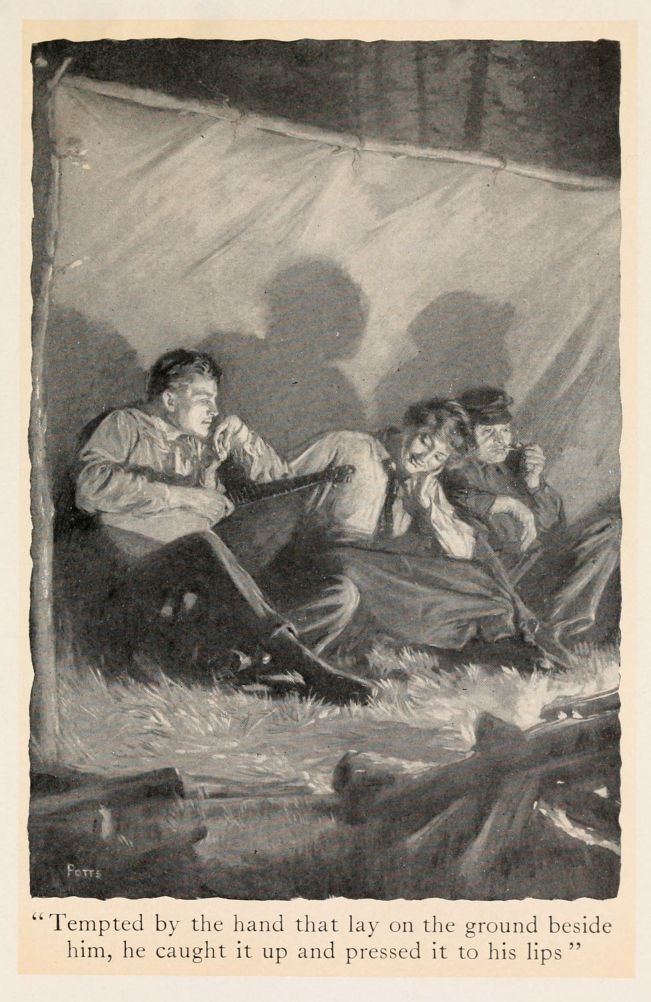
Jack was partly hidden from Humpy by Linda. Tempted by the hand that lay on the ground beside him, he caught it up and pressed it to his lips. When he sang again, the same hand, while its owner looked innocently ahead of her, groped for and found his curly head. At the touch of it Jack's voice trembled richly in his throat.
"Tempted by the hand that lay on the ground beside him, he caught it up and pressed it to his lips"
When she thought the rubber of rubbers would be nearing its end Linda made Jack take her back. Walking across the narrow space their shoulders pressed warmly together. They walked very slowly.
"I ought to have told you my name," murmured Jack uncomfortably.
"I know it, Malcolm, dear," she breathed.
"Who told you?" he demanded, greatly astonished.
She twined her fingers inside his. "I guessed, silly."
"Well, I didn't take the money," he said.
"I don't care if you did," she murmured.
"But I didn't," he said frowning.
"All right," she said, unconvinced and uncaring.
"What are we going to do?" he said.
"Oh, don't begin that," she said swiftly. "This is to-night, and we're together. Isn't that enough?"
They had reached the tents. Of one accord they turned aside, and in the shadow of the canvas she came naturally into his arms, and he kissed her, thrilling deliciously. The delicate fragrance of her enraptured his senses. It was light love, lightly sealed.
"Kiss me again," she murmured on her deepest note. "Kiss me often, and don't bother about the future!"
VIII THE FEMININE EQUATION
Jack turned in filled with a nagging sense of discomfort. He felt dimly that he ought to have been happy, but it was very clear that he was not. It was all very well for her to say: "Don't bother about the future," but his stubborn mind was not to be so easily satisfied. It was true he had not committed himself in so many words, but with girls of Linda's kind he supposed a kiss was final. So the future had to be considered. It was now more than ever imperative that his name be cleared. She didn't seem to care much whether he were honest or not. There was the rub. He scowled, and rolled over to woo sleep on the other side.
In the end he fell asleep, and dreamed a fantastic dream. He was King David, wearing a long gray beard and a white gown. He was at sea in a motor-sailboat of extraordinary construction, having a high, ornate cabin, over which the boom had to be lifted whenever they came about. There was a beturbaned lascar at the tiller, whom he, King David, treated with great contumely. Linda was along, too, also clad in biblical costume with a silver band around her brow. She was strangely meek, and she plucked continually at his sleeve.
A great storm came up; the waves tossed, the boat was knocked about, and he couldn't get a spark in his engine. He suspected that the lascar knew much better than he what to do, but out of sheer, kingly wilfulness he went contrary to everything the brown man suggested. Nor would he heed the insistent plucking at his sleeve.
Then suddenly a mermaid uprose beside the boat, and the sea was miraculously stilled. Her long, black, silky hair hung before her face, and streamed over her deep bosom and her lovely arms. All would be well if he could but distinguish her face, he felt. He leaned farther and farther over the rail, while the fretful plucking at his sleeve continued. He implored the mermaid to push back her hair.
Then he awoke. Some one was pulling at his sleeve, and a voice was whispering: "Jack, wake up!"
He sprang to a sitting position, throwing out his arms. They closed around a bony little frame encased in a rough coat. He recoiled.
"It's only me," said the small voice.
The fire had burned down to dull embers, and Jack at first could see nothing. "Who are you?" he demanded.
"Davy Cranston."
"Davy Cranston?" repeated Jack. It was a moment or two before his dream-muddled brain conceived the identity that went under this name. "What does this mean? What do you want? How did you get here?" he demanded in great surprise.
"It was Mary said we had to come," the boy replied abashed.
The girl's name had the effect of ringing a bell in Jack's understanding. "Mary? Where is she?" he asked quickly.
"We're camped up on the bench," the boy replied. "She's waiting for us. Come to our camp, and we can talk."
Jack was ready in a moment, and they set off. The afterglow was under the north star, and by that Jack knew it was midnight. The camp was wrapped in perfect stillness. When they got clear, and began to climb the trail, a little fiery eye beckoned them ahead.
In answer to Jack's further questions the boy could only reply that "Mary had a warning," which only heightened the questioner's wonder and curiosity.
The camp was pitched on the edge of the low bench above the river-flat, and they saw her, from a little distance, crouching by the fire that made a little crimson glory under the branches. She was listening with bent head to hear if there was one pair of footsteps approaching or two. Behind her the two little A-tents were pitched side by side, their open doors like mouths yawning in the firelight.
As they came within radius of the light she lifted her face, and Jack without knowing why he should be, was staggered by the look in her deep eyes, an indescribable look, suggesting pain proudly borne, and present gladness.
"You're all right?" she murmured, searching for what she might read in his face.
"Surely!" said Jack wonderingly. Further speech failed him. The sight of her threw him into a great uneasiness that he was at a loss to account for. She was nothing to him, he told himself a little angrily. But he could not keep his eyes off her. She had changed. She looked as if her spirit had travelled a long way these few days and learned many difficult lessons on the road. She had an effect on him as of something he had never seen before, yet something he had been waiting for without knowing it. And this was only Mary Cranston that he thought he knew!
"There was a danger," she said quietly. "I did not know if we would be in time to save—to help you."
"Danger? Save me?" Jack repeated, looking at her stupidly. "Good God! How did you know that?" he presently added.
Mary's agitation broke through her self-contained air. To hide it she hastily busied herself picking up the dishes, and packing them in the grub-box. Fastening the box with its leather hasp, she carried it into her tent. She did not immediately reappear.
"Where have you come from?" Jack demanded of Davy.
"Swan Lake."
"Have you been there ever since you left the fort?"
The boy nodded. "Tom Moosehorn's three children got the measles," he explained. "They are pitching at Swan Lake. Tom came to the fort to ask my father for medicine, and when Mary heard that his children were sick, she said she would go and nurse them, because Tom's wife is a foolish squaw, and don't know what to do for sickness. And I went to take care of Mary."
"Where is Swan Lake?" asked Jack.
"Northwest of the fort, two days' journey," said Davy. "We were there a week, and then the kids got well. On the way back home Mary had a warning, She said she felt a danger threatening you." Shyness overcame the boy here. "You—you were friendly to us," he stammered. "So we wanted to come to you. We didn't know where you were, but Mary said the warning came from the south, so we left the trail, and hit straight across the prairie till we came to the river trail. There we found your tracks, and followed them here."
"A warning!" said Jack, amazed. "What do you mean?"
"I don't know," the boy said simply. "Mary has them."
Mary returned to the fire with a composed face. All three of the youngsters were embarrassed for speech. How could they find words to fit the strange feelings that agitated them.
Jack, gazing at Mary's graceful pose, on her knees by the fire, suddenly exclaimed: "Why, it was you, all the time!"
"What was?" asked Mary.
"The mermaid."
"What's a mermaid?" Davy wanted to know.
Mary answered before Jack could. "An imaginary creature, half woman, half fish."
"Why, how did you know?" asked Jack unthinkingly.
"Do you think I know nothing?" she said, with the ghost of a smile.
He had the grace to redden.
They made Jack tell them his dream. They laughed, and the tension was relieved. They were all grateful for something else to talk about. There was one thing in the dream that Jack left out.
"Who was the woman who kept pulling at your sleeve?" asked Mary.
Jack lied. "Nobody I know," he said lightly. "One of King David's five hundred wives, I suppose."
Davy laughed, but Mary looked affronted. "You're confusing David with Solomon," she said coldly.
Jack looked at her uneasily. This was she whom he had dismissed merely as one of the girls of the country!
"And he sat up and hugged me as if I was a girl," Davy put in with relish.
Jack and Mary looked away from each other and blushed, but for different reasons.
They could not long keep away from the subject that filled their minds. "Blest if I can understand it," murmured Jack.
They knew to what he referred. "Nobody can," said Mary.
"You must have had this warning several days ago."
"Three days," said Mary.
"Nothing happened to me three days ago. Nothing until to-day——"
"Ah!" she said sharply.
"That was an accident," said Jack. "My horse shied on High Rock, and jumped over the ledge. I caught on a tree."
Mary's eyes brooded over him, and her hands went to still her breast. "Was there any one behind you?" she asked quickly.
"Yes, Garrod."
"Perhaps it was no accident."
Jack stared at the fire. "Perhaps not," he said slowly. After a while he added. "Still I don't understand."
"Many of the people have such warnings," Mary said quietly.
Jack frowned. "You are not a savage," he said.
"We are one fourth Indian," Mary said with a kind of relentless pride. "It is silly to make-believe that we're not."
Jack went on to tell them in detail what had happened during the day, suppressing, however, all that related to Linda. One thing led to another; he could hardly have explained how it came about, but Mary's eyes drew out what he had believed was locked deep in his heart, the story of his early days, and of Garrod's treachery that he had just found out. Sister and brother had little to say to the story, but their shining eyes conveyed unquestioning loyal assurance to him. It needed no words to tell him they knew he was no thief. Jack experienced a sense of relief such as he had not felt since the moment of his making the ugly discovery. When he considered the net of circumstance that bound him round sometimes he was almost ready himself to doubt his honesty.
"I knew there was something behind," Mary murmured. "It was the day you found him out that I had my warning. I'm glad we came. Maybe we can help you"—she looked at him questioningly—"if you will let us stay."
"As long as you like," said Jack. "It's my idea we'll all be turning back in a couple of days. In the meantime Davy can help with the horses. We're short-handed."
"Couldn't we camp here by ourselves?" asked Mary quickly.
Jack shook his head. "It would look queer," he said. "You had better ride into our camp in the morning as if you'd just come."
Mary presently sent him home. The fire had paled, and the trees began to rise out of the graves of darkness at the touch of the ghostly wand of dawn. The youngsters' pale and slightly haggard faces had a strange look to each other like things that had been left over from yesterday by mistake, and were hopelessly out of place this morning.
Jack lingered awkwardly. "Look here," he blurted out, "I haven't thanked you for coming. I don't know how. But you know what I feel!"
Sister and brother looked exquisitely uncomfortable, and absurdly alike. "There's nothing to be thanked for," murmured Mary. "Of course we came! That's what I had the warning for."
They shook hands. Mary's hand lay for an instant in Jack's passive and cold. But later she pillowed her cheek on that hand because he had touched it.
The permanent camp, that Sir Bryson had graciously permitted to be called Camp Trangmar, had been laid out with considerably more care than their nightly stopping-places. The main tent, with its three little wings, was erected at the top of the clearing, facing the river. A canvas had been stretched in front to make a veranda. On the right-hand side of the open square was Humpy's cooking outfit under another awning, with Humpy's tent and Jack's lean-to beyond. Across the square was Jean Paul's little tent and the ragged brown canvas that sheltered the Indians. The camp was ditched and drained according to the best usage, and around the whole was stretched a rope on poplar posts, to keep the straying horses from nosing around the tents in their perpetual search for salt.
After breakfast next morning Sir Bryson issued a command for Jack to wait upon him. As Jack approached, Linda and Mrs. Worsley were sitting under the awning, each busy with a bit of embroidery. Jack, who had been for a swim in the river, looked as fresh as a daisy. As he passed inside Linda smiled at him with a frankness that disconcerted him greatly. If she was going to give the whole thing away to everybody like this! However, Mrs. Worsley gave no sign of having seen anything out of the ordinary.
It transpired that Sir Bryson wished to make a little exploration up the river. He inquired about a boat, and Jack offered him his own dugout that he had cached at this point on his way down the river. Sir Bryson was very much concerned about the speed of the current, but Jack assured him the Indians were accustomed to making way against it.
Sir Bryson cast a good deal of mystery about his little trip, and made it clear that he had no intention of taking Jack with him. Jack, who had a shrewd idea of his object, had no desire to be mixed up in it. He swallowed a grin and maintained a respectful air. He had discovered that there was more fun to be had in playing up to the little governor's grand airs than in flouting him. Afterward he would enact the scene by the fire, sure of an appreciative audience in Humpy Jull.
It was arranged that Sir Bryson should start in an hour, and that his party should take a lunch against an all-day trip.
As Jack came out Linda rose to meet him. "We will have the whole day to ourselves," she said softly.
Jack was nonplussed. Somehow, such a frank avowal dampened his own ardour. He glanced at Mrs. Worsley to see if she had heard, and his face stiffened. At this moment a diversion was created by the sound of horses' hoofs on the trail.
They looked around the tent to see Mary and Davy trotting down the little rise that ended at the camp, followed by two pack-ponies. Linda had not seen Mary before. Her eyes widened at the sight of another girl, and a very pretty one, riding into camp, and quickly sought Jack's face. A subtle and unbeautiful change passed over her at what she fancied she read there.
Sir Bryson, attracted by the sound, came out of the tent. "Who are they?" he asked Jack.
"The son and the daughter of the trader at Fort Cheever."
"Very pretty girl," said Sir Bryson condescendingly. "Pray bring them to me that I may make them welcome," he said as he went back.
Jack vaulted over the fence, and the three youngsters shook hands again with beaming smiles. Jack forgot that in order to keep up their little fiction he should have appeared more surprised to see them. Linda looked on with darkening eyes. Jack led the horses around the square to the place next his own tent, where they were unpacked, unsaddled, and turned out. He then brought Mary and Davy back. Linda was not in evidence.
Within the tent Sir Bryson welcomed them as graciously as a king. "Very glad to see you," he said. "Which way are you travelling?"
Davy's adolescence was painfully embarrassed in the presence of the great man, but as the man of his party he blushed and faced him out. "We are going home," he said. "My sister has been nursing some sick Indians at Swan Lake."
Sir Bryson did not know of course that Camp Trangmar was not on the direct road between Swan Lake and Fort Cheever. "Ah!" he said, "most worthy of her, I'm sure. I trust you will remain with us a few days before you go on."
"If I can help around," said Davy. "Jack Chanty said you were short-handed."
"Excellent! Excellent!" said Sir Bryson.
Jack made a move toward the door, and Davy and Mary promptly followed. Sir Bryson fussed among his papers with an annoyed expression. As much as anything pertaining to his official position he enjoyed dismissing people. Consequently when they left before they were sent he felt a little aggrieved.
Outside, Sidney Vassall and Baldwin Ferrie were now with the two ladies. Linda was reclining languorously in the folding chair, with her little feet crossed in front of her. She was pale and full of fine lady airs. Any one but Jack would have known that there was trouble brewing.
"Introduce your friends," she said to Jack in a clear, high voice.
Jack was only conscious of an extreme discomfort. He was oppressed by a sense of guilt that he resented. The air seemed full of electricity ready to discharge on some one's head. He looked very stiff and boyish as he spoke the names all round: "Miss Cranston, Davy Cranston; Miss Trangmar, Mrs. Worsley, Captain Vassall, Mr. Ferrie!"
They all smiled on the embarrassed newcomers, and made them welcome. In particular Linda's smile was overpoweringly sweet. Without changing her position she extended a languid little hand to Mary.
"So nice of you to come and see us," she drawled. "I hope you will remain with us until we go back."
To Jack this sounded all right. He felt relieved. Even yet he did not see what was coming. Mary's perceptions were keener. With a slightly heightened colour she stepped forward, took the hand with dignity, and let it fall.
"Thank you," she said quietly. "Not more than a day or two."
"But we need you," Linda insisted, "both of you. Your brother can help the men who are nearly worked to death, and if you would only help Mrs. Worsley and me with our things, you know, and other ways——"
Mrs. Worsley looked quickly at Linda, astonished and indignant, but Linda affected not to see. As Jack realized the sense of what she was saying, a slow, dark red crept under his skin, and his face became as hard as stone.
Mary took it smilingly. Her chin went up a little, and she drew a slow breath before she answered. "I'm sorry," she said quietly, "but I have no experience with ladies' things."
There was a faint ring of irony in the last two words, and excepting Jack, who was too angry to see anything, it was evident to the others that Mary had returned just a little better than she got. Linda evidently felt so, for naked malice peeped out of her next speech.
"We would be so glad to teach you, wouldn't we, Kate? And it would be so useful for you to know!"
Mrs. Worsley bent over her work, blushing for her young friend.
Mary continued to look at Linda steadily, and it was finally Linda's eyes that were obliged to stray away. "Thank you," said Mary, "but we will be expected at home in a few days."
"Oh, sorry," said Linda casually. She nodded at Mary, and smiled the inattentive smile that women mean to stab with. "Kate, do show me this next stitch," she said, affecting a sudden absorption in her work.
Mrs. Worsley ignored the question. Her face was now almost as red as Jack's. What passed between these two ladies when they presently found themselves alone may be guessed.
Jack, Mary, and Davy crossed the little square. There was a commotion going on inside Jack that he could not in the least analyze. He was furiously angry, but his sidelong glances at Mary dashed his anger, and made him fall to wondering if he had rightly understood what had happened. For Mary, instead of being humiliated and indignant as one might suppose, was actually smiling. She carried her head high, and the shine of triumph was in her eye. What was a man to make of this? Jack could only long in vain for a head to knock about.
The explanation was simple. "How silly I was to be so afraid of her," Mary was thinking. "To give herself away like that! She's a poor thing! I'm a better woman than she, and she knows it now. She can be jealous of me after this." Behind these thoughts another peeped like an elf through a leafy screen, but since the maiden herself refused to see it in its hiding-place it is not fair to discover it to the world.
Mary refused to refer in any way to what had happened, and Jack was therefore tongue-tied. All he could do was to show his sympathy in the ardour of his muscular efforts on her behalf. He put up their two tents, and stowed their baggage; he cut a wholly unnecessary amount of balsam for Mary's bed, and chopped and carried wood for their fire, until she stopped him. All this was observable to Linda watching from afar under her lashes, and in the meantime Kate was not sparing her.
Jack forgot all about Sir Bryson's order until a peremptory message recalled it. After he had embarked the governor, Baldwin Ferrie, and three Indians in the dugout, he swung an axe over his shoulder, and set off up the trail to chop down a tree or two, and "think things out," as he would have said. The operations of the human consciousness that go under the name of thinking differ widely in the individual. Meanwhile it should be mentioned that Jean Paul and Garrod had started on horseback with the object of finding a camp of Sapi Indians that was said to be not far away. They were gone all day. Jack hardly thought of them.
In a grove of pines beside the trail Jack swung his axe, and the blows rang. His design was to make a flagstaff for the centre of the camp. There was an immense satisfaction in stretching his muscles and planting the blade true. The blood coursed through his veins, and he tingled to his finger-tips. He felt so much better that he thought he had solved his problems. This was what Jack called "thinking things out."
He was engaged in chopping the limbs from a trunk with the stern air of concentration that was characteristic of him, when something caused him to look up, and he saw Linda standing near with an appealing aspect. He frowned and went on chopping. Linda sat down on a stump and looked away with an unsuccessful attempt at unconcern. How astonished Vassall or Baldwin Ferrie would have been could they have seen their imperious little mistress then.
There was a long silence except for the light strokes of Jack's axe as he worked his way up the stem. Jack enjoyed a great advantage because he was busy. It was Linda who was finally obliged to speak.
"Haven't you anything to say?" she murmured.
"No," said Jack promptly. The light branches did not offer him a sufficient outlet for his pent-up feelings, and he wantonly attacked the bole of the biggest tree in sight. Linda watched the swing of his lithe body with a sort of stricken look. There was another silence between them.
"Jack, I'm sorry," she said at last in a small voice.
Jack was not so easily to be appeased. "You shouldn't come away from camp alone with me like this," he said. "Followed me," was what he had in mind, but he spared her pride that.
"I don't care what anybody thinks," she said quickly.
"I do," said Jack.
"Afraid of being compromised?" she asked with a little sneer.
"That's a silly thing to say," he answered coolly. "You know what I mean. I don't intend to give your father and the other men a chance to throw 'thief' in my teeth. When I've cleared myself I'll walk with you openly."
"I was sorry," she said like a child. "I couldn't rest until I had told you."
Jack was silent and uncomfortable. Whenever she sounded the pathetic and childlike note, the male in him must needs feel the pull of compassion and he resented it.
"Don't you care for me any more?" she murmured.
Jack frowned, and aimed a tremendous blow at the tree.
Real terror crept into her voice. "Jack," she faltered.
"I don't take anything back," he said stubbornly. "I'll tell you when I feel like telling you, but I won't have it dragged out of me."
He returned to his tree, and she prodded the pine needles with the toe of her boot. After a while she returned to the charge.
More like a child than ever, she said: "Jack, I acted like a little beast. But I said I was sorry."
"That's all very well," said Jack, "but you can't expect to make me so mad I can't see straight, and then have it all right again just for the asking."
"You're ungenerous," she said, pouting.
"I don't know what you mean," he said obstinately. "I have to be what I am."
There was another silence. They were just where they had started. Indeed no progress was possible without an explosion and a general flare-up. It was Jack who brought it on by saying:
"It's not to me you should be saying you're sorry."
Linda sprang up pale and trembling, and the flood gates of invective were opened. It is no advantage to a jealous woman to be a governor's daughter. Linda in a passion lacked dignity. Her small face worked like a child's preparing to bawl, and her gestures were febrile. What is said at such moments is seldom worth repeating. Jack did not hear the words; it was her tone that stung him beyond endurance. But at last a sentence reached his understanding.
"How dare you bring her here, and install her under my eyes?"
"Bring her here? What do you mean?" he demanded in a voice that forced her to attend.
"Oh, you know very well what I mean!" she cried. "You knew she was coming this morning. I saw it in your face. You didn't even pretend that you were surprised. And you took her part against me all the way through."
There was enough truth in this to make Jack furiously angry in turn. His voice silenced hers.
"I did take her part!" he cried. "And I'd do it again. What have you got to complain of? Just like a girl to fly into a rage and blame everybody all around, just to cover her own tracks! What did you mean by offering to engage her as your maid? You don't want a maid. You only did it to insult her! I was ashamed of you. Everybody was ashamed of you. If you're suffering for it now, it's no more than you ought."
Under all this and more she sat with an odd, still look from which one would almost have said she enjoyed having him abuse her.
And so they both emptied themselves of angry speech, and the inevitable moment of reaction followed. Both Linda and Jack began to feel that they had said too much.
"I'm sorry," she said humbly. "It's true, I was only jealous of her, because you seemed so glad to see her."
"If it's any good to you to hear it," said Jack sheepishly, "she's nothing to me—that way." Even as he said it his heart accused him.
"Besides," said Linda irrelevantly, "she's mad about you."
"That's nonsense!" said Jack. Nevertheless he quickly turned to pick up his axe in order to hide the telltale red that crept into his face.
"It's all right now, isn't it?" said Linda coaxingly. "Come and kiss me."
He obediently went, and, stooping, kissed her upturned lips. But for both of them the delicious sweetness had flown. Jack could not forget how ugly her face had looked in a passion, and Linda remembered how he had worked for Mary.
"You didn't do it like that last night," she said, pouting.
"I felt differently last night," said Jack doggedly. "How can I get up any enthusiasm when you make me do it?"
Her breast began to heave again. "You said you had forgiven me," she said.
"Oh, don't let's begin that again," said Jack with a dismayed look. "I haven't anything to forgive you. If you want to make things really all right, you can do it in a minute!"
She sprang up again. "I won't! I won't!" she cried passionately. "It's her coming that has made the difference since last night! How dare you suggest that I apologize to her! I'd die rather! I hate you! Don't ever speak to me again!"
Of a sudden she was gone like a little tempest among the trees. Jack sat down on the trunk he had cut, and rested his chin in his palms, terribly troubled in his mind. This sort of thing was new to him, and it seemed of much greater moment than it was.
Pretty soon she came flying back again, and casting herself in his arms, clung to him like a baby, weeping and whimpering.
"Take care of me, Jack! I don't know what I'm doing or saying!"
His arms closed about her, and he patted her shoulder with an absurd, sheepish, paternal air of concern. What else could he do? "There, it's all right!" he said clumsily. "Don't distress yourself. It'll be all right!"
"And you won't make me apologize to her?" she implored.
"No," he said with a shrug. "I don't suppose it would do any good if you did."
Linda lay perfectly still. A sense of sweet satisfaction stole into her breast. It had been a hard fight, but she had made him do what she wanted.
"Hanged if I know what's going to become of us," thought Jack gloomily.
IX YELLOW METAL
The fiction that coal was the objective of Sir Bryson Trangmar's expedition was scarcely maintained; indeed, once they got away from Fort Cheever the word was never heard again. On the other hand, a little word that resembled it circulated continually with a thrilling intonation. Stories of gold and gold-hunters were told over the fires in English and Cree. Baldwin Ferrie, the geologist, kept the subject agitated by cracking every likely looking stone he came to with his little hammer, and by studying the composition of the mountain tops all day with his powerful glasses.
We are told that the essence of comedy lies in the exposure of pretentiousness. That being so, the comic spirit is highly developed up North. In town pretentiousness is largely a matter of give and take; we are all pretending to something, and we are obliged to seem to allow the pretences of our neighbours in order to get them to allow ours. But up North they are beholden to no man, and, sardonic jesters that they are, they lie in wait for pretentiousness. Woe to the man who goes up North and "puts on side."
One like Sir Bryson was therefore bound to be considered fair game. His official position was no protection to him. There is a story current about a governor-general, and another about an actual prince of the blood, who did not escape. All of which is to say that Jack, notwithstanding his perplexities in other directions, was looking forward with keen relish to the return of Sir Bryson's "exploring-party." He only regretted that there was none at hand but Humpy Jull with whom to share the joke.
They landed toward the end of the day, Sir Bryson and Baldwin Ferrie looking very glum. Jack was sent for. He found Sir Bryson alone at his table, looking more than usually important and puffy.
"Do you know two men called Beckford and Rowe?" he asked.
Jack adopted an innocent-respectful line. "Yes, sir," he said. "They were working in the pass here at the same time I was."
"Are you, or have you ever been, associated with them?"
Jack shook his head. "I'm on my own," he said. "Always."
"What kind of a reputation do these men bear?" asked Sir Bryson.
"Bad," said Jack.
Sir Bryson frowned, and squeezed his pointed beard. "How, bad?" he wanted to know.
"Confidence men. They were square enough up here. They had to be. They saved their game to work outside."
"How do you know all this?" demanded Sir Bryson.
"It's no secret," said Jack. "Beckford bragged about what he'd do."
"And did no one take any steps to stop them?"
"It was none of our business," said Jack. "And if it had been we couldn't very well follow them all over, and warn people off, could we?"
Sir Bryson snorted. "Where have they staked out claims?" he demanded.
"Oh, all over," said Jack. "Anything good they keep dark, of course."
"Did you ever hear of Dexter's Creek?"
Jack bit his lip. "Oh, yes," he said with an innocent stare. "Those were what they called their sucker claims."
Sir Bryson swelled like a turkey-cock, and turned an alarming colour, but he said nothing. What could he say?
Your Northern humourist is merciless. Jack was not nearly through with him. He went on full of solicitude: "I hope you didn't fall for anything on Dexter Creek, Sir Bryson. If you'd only mentioned it before, I could have warned you, and saved all this trip!"
"I have nothing to do with Dexter's Creek," said Sir Bryson quickly. "I have other objects. I merely promised the attorney-general of the province to do a little detective work for him."
Jack could appreciate quick wits in a victim. "Well turned," he thought, and waited for Sir Bryson's next lead.
"Well, well," said the little man testily. "Explain what you mean by—by this vulgar expression."
"Sucker claims?" said Jack wickedly. It really pained him that there was no one by to benefit by this.
"You needn't repeat the word," snapped Sir Bryson. "It is offensive to me."
"It's this way," said Jack: "Most of the prospectors in the country are staked by bankers and business men outside. And when they at last make a strike, after years of failure, maybe, their backers generally step in and grab the lion's share. Consequently the men up here are sore on the city fellows; they have none of the hardships or the work they say; they just sit back comfortably and wait for the profits.
"Beckford said that he and his partner had been done a couple of times in this way, and they were out to get square with the bankers. When they found anything good they kept it dark, and went outside and sold some fake claims to raise the coin to work the good ones. Beckford said it was just as easy to sell fake claims as good ones, if you went about it right.
"I said," Jack went on, "they'll set the police after you. Beckford said: 'They can't. We don't make any misrepresentations. We're too smart. We make a mystery of it, and the sucker gets excited, and swallows it whole. We do the innocent game,' he said; 'we're the simple, horny-handed sons of soil from the North that ain't on to city ways. We make 'em think they're putting it all over us, and we sell out cheap. Two of us can work it fine!"
"I said," Jack continued, "'I don't see how you can get anybody to shell out real money unless you offer to come back and show them the place.' 'We always do offer to come back,' Beckford said, 'and we get all ready to come. But at the last moment one of us is took real sick, and the other refuses to leave his dyin' pardner. By that time the come-on is so worked up he comes across anyway!'"
During this recital Sir Bryson's face was a study. A kind of shamed chagrin restrained him from a violent explosion. Jack "had" him, as Jack would have said. The little beard was in danger of being plucked out bodily.
"You can go now," he said in an apoplectic voice.
"There was one thing more," Jack said at the door. "Beckford said that if you picked your man right there was no danger of a prosecution. 'Choose one of these guys that sets an awful store on his respectability,' he said, 'and he'll never blow on himself.'"
A deeper tinge of purple crept into Sir Bryson's puffing cheeks.
Jack lingered for a parting shot. "Any man who did get let in for such a game," he said with a great air of innocence, "hardly deserves any sympathy, does he, Sir Bryson?"
Sir Bryson was now beyond speech. He got to his feet; he pulled at his collar for more air, and he pointed mutely to the door.
Jack embraced Humpy Jull by the fire, and moaned incoherently. No amount of laughter could ease his breast of the weight of mirth that oppressed it. Never was such a joke known in the North.
During the rest of the evening Jack was in momentary expectation of an order to break camp and turn back, but none came. On the contrary, Humpy reported, from the scraps of conversation he had overheard at the dinner-table, that Sir Bryson, being convinced there was gold somewhere in the pass, was determined, with Baldwin Ferrie's assistance to do a little hunting on his own account. Jack smiled indulgently at the news. It was not long, however, before he had to change his superior attitude.