JACK CHANTY (continued 3)
Reading edition
Early on the following morning he was fishing in the backwater below camp, while Baldwin Ferrie sat on a projecting point of the bank above, patiently searching the mountainsides with his glasses.
"I say," Ferrie suddenly called out, "how far is that peak over there, the pointed one?'
"About nine miles in a line from here," said Jack. "Fifteen, up the river and in."
"What's it called?"
"Tetrahedron," said Jack. "A surveyor named it."
"Do you know it at all?" asked Ferrie.
"Pretty well," said Jack, off-hand.
"The slope on this side," asked the geologist, "I suppose there is a stream that drains it? Could you take us to it?"
Jack looked at him hard, and reeled in his line before he answered. "There is a little stream," he said, approaching Ferrie. "It has no name. It empties into Seven-Mile Creek above here. Anybody could find it. Why do you ask?"
Ferrie was an amiable soul, and not at all secretive, like his master. He went into a detailed explanation of the geological formation of Tetrahedron peak. "You see, it's different from the others," he said, offering Jack the glasses. "There's a good chance of finding free gold in the bed of the creek that drains the slope on this side."
Jack whistled in his mind, as one might say, and looked with a new respect at Baldwin Ferrie and his field glasses. For it was on that very little stream he had washed his gold, and there his claims were situated. It had taken him months of strenuous labour to find what the geologist had stumbled on in half an hour sitting still.
Baldwin Ferrie toddled off to report to his master, and Jack sat down to do some quick thinking. This discovery came of the nature of a thunderclap. The possibility of their finding his claims had occurred to him, but he had counted at least on having time to prepare against it, and here it was only the third day. Jack had made sure of the choicest claim on Tetrahedron Creek for himself, and that, of course, they could not touch. But the two adjoining claims, practically as rich, were still vacant, and Jack meant to have at least the bestowal of those himself.
Sir Bryson presently ordered Jean Paul to get the dugout ready for another all-day trip. In excluding Jack from any share in the preparations he saved that young man from an embarrassing position, for had he been officially informed of the destination of the river party, Jack would have had to make explanations on the spot.
As it was, even before Sir Bryson was ready, he became busy on his own account. Finding Davy, he said: "Catch two horses, and saddle them for you and Mary. You've got to do something for me, and for her to-day. There's not a minute to lose. While you're saddling up, I'll explain everything to Mary."
Davy, who would have gone through Hell's Opening itself at Jack's command, raced away to find the horses.
Mary was at the door of her tent sewing. At the sound of Jack's step she lifted her quiet eyes. There was something in the uplift of Mary's eyes that stirred Jack queerly, seeing that he was as good as engaged to another girl, but he put that aside for the present.
Before he could speak she asked quickly: "What's the matter?"
He sat beside her on the ground. "Something doing," he said, "something big! Listen hard, and don't give it away in your face. Go on sewing as if I was just passing the time of day."
"I'm listening," she said quietly.
"You know I told you I'd been prospecting," Jack began. "Well, I made a rich strike on the little creek that comes down from Tetrahedron peak. I staked my claim there, and two claims adjoining mine for whoever I might want to go in with me on it. The names and dates aren't entered on the two stakes yet, and of course if these people find them they have a right to enter their own names. Baldwin Ferrie has doped it out that there's gold on that creek, and that's where they're off to now. You and Davy must get there first."
"But how can we?" she said. "They're starting."
"It will take them three hours to make the mouth of Seven-Mile Creek against the current," he said. "You can ride it in one. Davy is getting the horses. If you can get yourselves across the river before they come up, the claims are saved."
Mary went on with her quick, even stitches without a break. "Tell me exactly how to go," she said.
"Six miles west by the Fort Erskine trail, and then down to the river. You leave the trail where it turns to the north, under three big pines that stand by the themselves on the bench. Look sharp and you will find a trail that I blazed down to the river. At the end of it I left a little raft for crossing back and forth. If it has been washed down you'll have to knock another one together. Cross the river, and land at the lower side of Seven-Mile Creek. You'll find my landing-place there, and a good trail back to the little creek, and my old camp. The first square post is a hundred feet upstream from the campfire. You can't miss it. Keep on going until you come to the second post, and the third one."
"What must we do when we find the posts?" she asked.
"Read the notice on the first one, and that will show you. It reads: 'I, Malcolm Piers, hereby give notice of my intention to file a claim,' and so forth. And signed and dated at the bottom. The inscriptions are all written on the other two. All you have to do is to fill in your name on the second one, 'I, Mary Cranston,' and so on, and on the third post Davy writes, 'David Cranston, Junior.'"
Mary stopped sewing. "My name," she said, "and Davy's?"
"The second claim is yours in your own right," said Jack. Seeing her expression, he hastily added: "It was a deal that I made with your father before we started. As to the other, Davy can sign that back to me."
"So will I sign mine," said Mary quickly. "I couldn't take it."
"We can argue that out when you come back," said Jack. "There's not a minute to lose. Davy's got the horses. Make sure you have a lead pencil to write on the posts. After you've signed them get back without running into the governor's party if you can. I don't want the storm to break until I am there to receive it."
Ten minutes after Sir Bryson with Baldwin Ferrie and three Indians, had pushed off from the bank, Mary and Davy Cranston sauntered inconspicuously away from camp, and, mounting their horses outside, set off at a dead run west on the Fort Erskine trail.
X A CRUMBLING BRAIN
Jack set about to fill his anxious day as full as possible with small tasks. Along the shore toward the mouth of the canyon he found another dugout sticking out from among the bushes, and he pulled it out to put it in repair in case a second boat should be required. It needed new cross-pieces to hold the sides from spreading.
While he was seated on a boulder whittling his little braces out of snowy poplar, Garrod came shambling over the stones toward him. Jack, seeing the high-powered rifle he carried, turned a little grim, and while apparently going on with his work, watched the other man narrowly. His ideas covering Garrod had taken a new direction since he had talked with Mary.
Garrod came slowly, pausing, starting jerkily, fluctuating from side to side. When he thought Jack's eyes were upon him he turned his back like a child, and made believe to look off up the river. His eyes were blank and lustreless, but close-hid under the thickened lids glimmered a mean furtive sentence. There was no striking change in him; the canvas suit was still in fair condition; he shaved every morning from force of habit; and when he was spoken to he could still answer with sufficient intelligence. But any one experienced in diseased mental states would have recognized at once that this man was in no condition to be trusted at large with a gun.
Among the members of Sir Bryson's party there existed an entire absence of formality together with an entire absence of intimacy. They were not curious about each other, consequently Garrod's state excited no remark. True, Mrs. Worsley wondered a little, but she had always felt an antipathy to Garrod; as for the others, they merely said, "Queerer than ever," and dismissed him with a shrug.
Jack, watching the wavering figure approaching him now, thought of the reckless, hawk-eyed youth of five years before, and was made thoughtful by the change. "Gad! Life has had him on the toaster," he thought.
When Garrod came close enough to be heard he stammered, avoiding Jack's eyes: "I—I want to talk to you, Malcolm."
"Put down the gun," said Jack coolly. "Out of reach."
Garrod immediately laid it on the stones. "You don't think that I——" he mumbled.
"I don't think anything," said Jack, "but I'm taking no chances."
Garrod's eyes strayed everywhere, and his voice maundered. "I suppose you think I'm an utter cur. I know it looks bad. But not that—— Maybe you think that I—your horse—on the cliff——"
"I'm not accusing you," said Jack.
Garrod sat down near him. "I—want to talk to you," he said, forgetting that he had said it before.
"All that you and I have to say to each other can be put in one question and answer," said Jack. "Are you going to square me?"
"I—I'd like to," stammered Garrod.
Jack looked up surprised. There was more in the answer than he had expected. "You will?" he cried, bright-eyed. "You've come to tell me that! By Gad! that would be a plucky thing to do after all these years. I didn't think you had it in you!"
"I—I'd like to," murmured Garrod, as before.
"Easy enough if you want to," said Jack. "You only have to speak the truth."
"That wouldn't do you any good," said Garrod.
"What do you mean?" Jack demanded.
"It's not what you think," said Garrod. "I didn't take the money."
"Who did then?"
"The bank was robbed," said Garrod. "The morning after you went away. Three men broke in during the night, and hid until morning. When Rokeby and I opened the safe, they overpowered us and got away with the money. We had no business to open up until the others came, and we were afraid to tell. I thought it wouldn't do you any harm as long as you were away. If you had come back I would have told."
There was a glib tone in all this that caused Jack's lip to curl. "Well, what's to prevent your telling now?" he asked.
"They wouldn't believe me," said Garrod. "They'd think I was just trying to shield you, my old friend."
"But there's Rokeby to back you up!"
"He's dead," muttered Garrod.
A harsh note of laughter broke from Jack.
"I suppose you don't believe me," said Garrod.
"Hardly," said Jack. "It fits in a bit too well."
Garrod's voice rose shaky and shrill: "It's true! I swear it! Three men; French, they were. I can see them now! One was young; he had a scar across his forehead——'
"Oh, cut out the fine touches," said Jack contemptuously. "Any fool could see you were lying." He went on whittling his brace.
Garrod's voice sunk to a whimper. "It's true! It's true!"
Jack began to perceive that it was scarcely a reasonable being he had to deal with. He took a different line. "I guess you've led a dog's life these last few years," he said quietly.
Garrod looked at him queerly. "Oh, my God," he said in a flat voice. "Nobody knows."
"I suppose you know what's the matter with you," said Jack. There was no answer.
"It's what the story-books call remorse," said Jack. "You can't go to work and ruin your best friend without having bad dreams afterward."
"I never took the money," Garrod murmured.
Jack ignored it. "Your friend," he repeated with a direct look. "Do you remember, as we stood waiting for my train to pull out, you put your arm around my shoulders, and said: 'Buck up, old fel'! We've got in many a hole together, and we always saw each other out! Count on me—until death!' Do you remember that?"
"Yes," murmured Garrod.
"And next morning you took the money to pay your debts, to get you out of your hole, knowing they would put it off on me. You pushed me into a hole as deep as hell, and left me to rot there."
Garrod put up a trembling hand as if to fend off a blow. "I didn't take it," he murmured still.
"Look me in the eyes, and swear it," demanded Jack.
He could not.
"Now, look here," said Jack. "You're in a bad way. You can't stand much more. There's going to be a grand show-down to-night. Do you think you can go through with that?"
"Eh?" asked Garrod, dully and anxiously.
"Listen to me, and try to understand," said Jack impatiently. "Sir Bryson has gone to look at my claims. He will read the name Malcolm Piers written on the post, and when he comes back he will know who I am, and there'll be the deuce to pay. Do you think you're in any state to face me down? Why, man, the very look of you is enough to give you away!"
Garrod merely looked at him with dull, frightened eyes. "Suppose you could face me down," Jack continued, "what then? You can't face yourself down. You were born a decent fellow at heart, Frank, and you can't get away with this sort of thing. It's got you. And every new lie you tell just adds to the nightmare that's breaking you now. You've reached the limit. Anything more, and you'll go clean off your head."
"You'll tell Sir Bryson everything," muttered Garrod.
"When I am accused I defend myself," said Jack.
"I couldn't go through with it. I couldn't," Garrod said like a frightened, stupefied schoolboy.
"Sure, you couldn't," urged Jack, pursuing his advantage. "Make a clean breast of it before Sir Bryson comes home, and you won't have to face him at all. By Gad! think what a load off your mind! You'd be cured then; you'd sleep; you'd be a man again!"
But Garrod murmured again: "I didn't take the money."
Jack fought hard for his good name. His need lent him an eloquence more than his own. In all this he never stooped by so much as a word to plead for himself. "Why shouldn't you tell the truth?" he persisted. "What good is this life you're leading to you? It'll kill you in a month. Chuck it all, and stay in this country, and win back your health, and your brains, and your self-respect."
Garrod wavered. He half turned to Jack with a more human look. "Would—would you be friends with me again?" he murmured.
"I'd stand by you," said Jack quickly. "I've got my start up here, and I could give you a good one. As long as I stood by you no one could rake up old scores. But it couldn't be just the same as it used to be," his honesty forced him to add.
Jack waited with his eyes fixed compellingly on the other man. Garrod's eyes struggled to escape them, and could not. Suddenly he broke down, and buried his head in his arms. "I'll do it!" he sobbed.
Jack sprang up. "Good!" he cried with blazing eyes. "The whole truth? You took the money, and spent it, and let them fasten the theft on me?"
"I took the money, and spent it, and let them fasten the theft on you," repeated Garrod.
Jack drew a long breath, and, sitting again, wiped his face. Not until he felt the sense of relief that surged through him did he realize how much this had meant to him. He could look almost kindly on the stricken figure in front of him now, and the sobs inspired him with none of the disgust he would have felt at any other time. He waited patiently for Garrod to recover himself. When the man at last became quiet he said, not unkindly:
"Are you ready now?"
"For what?" asked Garrod, lifting a terrified face.
"Let us go back to camp. Vassall is there. You can tell him."
Garrod desperately shook his head. "Linda—Miss Trangmar is there. I couldn't—I couldn't have her hear me!"
"But we could take Vassall away."
"No," he said. "Don't you understand? Vassall is after her. He'll be glad of this. I couldn't tell him."
"What if he knew about Linda and me," thought Jack with a sidelong look. "Gad! but life's a rum go!"
"I'd rather face Sir Bryson," stuttered Garrod. "Wait till Sir Bryson comes back. I swear I'll tell him the whole truth, and you shall be there."
"You're right, I'll be there," said Jack grimly. He considered, frowning. It might be better to confront Sir Bryson with Garrod direct, but Sir Bryson would not be back for five or six hours, and who could tell what contradictions of mood would pass over this half-insane man in the interval.
As if reading his mind, Garrod said: "I won't take anything back. You needn't be afraid—if you let me stay with you. You're my only hope. Let me stay with you. Give me something to do all day."
Jack rubbed his chin in perplexity. "Will you write out a confession?" he finally asked.
Garrod eagerly nodded his head.
"Wait here, then," commanded Jack.
Jack ran to his tent, where he got a pen and his note-book, and returned to the dugout. He was gone but two minutes, nevertheless as he sprang down the bank he saw that Garrod was no longer alone. Jean Paul had joined him.
It did not occur to Jack that the half-breed had any concern in this affair, but he was annoyed by his intrusion just at this minute. He looked at him sharply. Jean Paul stood idly chewing a grass-stalk, and looking out over the river with a face as expressionless as brown paper. Garrod was sitting as Jack had left him, looking at Jean Paul. A change had passed over his eyes.
Jack's temper got a little the better of him. "What do you want here?" he demanded.
Jean Paul turned with an air of mild surprise. "Not'ing," he said. "Wat's the matter? I saw you and Garrod here, and I came. I got not'ing to do."
"Go find something," said Jack. "Clear out! Make yourself scarce! Vamoose!"
Jean Paul, with a deprecatory shrug, walked slowly on up the beach.
"I have pen and paper," Jack said eagerly to Garrod.
Garrod's dazed eyes were following Jean Paul's retreating figure. He paid no attention. It was only too evident that his mood had changed.
Jack's face grew red. "Have you gone back on it already?" he said with an oath.
"I must go," muttered Garrod, struggling to rise.
Jack thrust him back. "You stay where you are!"
But as soon as Jack took his hands off him Garrod endeavoured to get up and follow Jean Paul, who by this time had climbed the bank. Garrod's wasted strength was no match for Jack's but Jack could hardly see himself sitting there holding the other man down until Sir Bryson returned. He looked around for inspiration. There was a length of rope fastened to the bow of the dugout. Cutting off a piece of it, he tied Garrod's wrists and ankles, and let him lie.
Jack sat down and filled his pipe, watching Garrod grimly meanwhile, and trying to puzzle out a solution. The man spoke no articulate word except to mutter once or twice that he must go. Occasionally he struggled feebly in his bonds like a fish at the last gasp. Still it did not occur to Jack to connect this new phase of his sickness with the appearance of the half-breed. Jack's heart was sore. "Of what use was the confession of a man in such a state?" he thought. In Jack's simple system of treatment there was but one remedy for all swoons or seizures, viz., cold water. Upon thinking of this he got up and, filling his hat in the river, dashed the contents in Garrod's face.
It had the desired effect. Garrod gasped and shivered, and looked at Jack as if he saw him for the first. He ceased to struggle, and Jack untied the ropes. Garrod sat up, a ghastly figure, with the water trickling from his dank hair over his livid face.
"I'm all wet," he said, putting up the back of his hand. Without expressing any curiosity as to what had happened, he dried his face and neck with his handkerchief.
"Do you remember what we were talking about?" asked Jack, concealing his anxiety.
"You wanted me to write something," Garrod said dully.
"Are you willing?"
Garrod nodded, and held out his hand for the pen and the little book.
Jack breathed freely again. The blade of a paddle served Garrod for a writing table. The man was entirely submissive.
"But do you know what you're doing?" demanded Jack frowning.
Garrod nodded again. "You want me to write out a confession," he said. "What shall I write."
Jack dictated: "I, Francis Garrod, desire to state of my own free will that on the morning of October ninth, nineteen hundred and six, I took the sum of five thousand dollars from the vault of the Bank of Canada, Montreal. I knew that Malcolm Piers had gone away, and I allowed the theft to be fixed on him."
He signed the page, and dated it. Taking the book, Jack slipped it in the breast pocket of his flannel shirt. Jack was genuinely moved. It was borne in on him dimly that though he was technically the injured party, it was the other man who showed the wound.
"You'll feel better now," he said gruffly.
Garrod lay back on the stones, and covered his face with his arm. "I suppose you loathe me, Malcolm," he muttered.
"You've gone a long way to make it up," Jack said, in the keenest discomfort. "Just give me a little time."
Garrod's thoughts strayed in another direction. "What will she say?" he whispered.
Considering everything, this was a poser for Jack. "You've got no business to be thinking about girls in your state," he said frowning. "Put her out of your mind, man, and go to work to win back what you've lost."
Garrod reverted to the night five years before. "I didn't mean to take the money," he murmured. "I couldn't sleep after you went, that night, and all night I played with the idea as if it was a story. Supposing I did take the money, you know, how I would cover my tracks, and so on. But I never meant to. And next morning when I went to the bank I was alone in the vault for a moment, and I slipped the package in my pocket just to carry out the idea, and Rokeby came in before I could put it back. Then the money was counted, and the shortage discovered. I had plenty of other chances to put it back, for the money was counted twenty times, but I was always afraid of being seen, and I kept putting it off, and at last the alarm was given and it was too late. They were old bills and they couldn't be traced.
"I don't know how I lived through the time that followed. I was afraid to put it back then, because the fellows talked about my changed looks, and I knew if the money turned up they would suspect me. As it was, they thought I was grieving on your account. I was, too, but not the way they thought. I set a store by you, Malcolm. I didn't mean to injure you. I just drifted into it, and I was caught before I knew. The thought of meeting you brought the sweat pouring out of me. I thought you would come back. I bought a revolver, and carried it always. If I had come face to face with you it would have nerved me to turn it on myself, which I couldn't do alone.
"You didn't come. The thing was quickly hushed up. I left the bank, and my life went on like anybody's. I didn't think about the money any more. But something had changed in me. I was nervous and cranky without knowing why. I couldn't sleep nights. I was full of silly terrors, always looking around corners, and over my shoulder. And it kept getting worse."
Garrod's voice never varied from the toneless half-whisper that was like a man talking in his sleep. "Then I came up here," he went on, "and ran into you without any warning. It was like a blow on the temple. It all came back to me. Then I knew what was the matter. I didn't kill myself on the spot, because I found you didn't know. I wish I had. I've died a thousand deaths since. It was like little knives in my brain thrusting and hacking. I could have screamed with it——"
Jack's increasing discomfort became more than he could bear. "For heaven's sake, don't tell all this," he burst out. "At least not to me. I'm the one you injured. Pull yourself together!"
"It is a relief to get it out," Garrod murmured with a sigh. "I can sleep now."
Jack got up. "Sleep, that's what you need," he said. "Come back to your tent, and lie low for the rest of the day."
"I—I don't want to be alone," stammered Garrod.
"Well, stretch out here in the grass," suggested Jack.
"You won't go away without waking me?" Garrod said anxiously.
"All right," said Jack.
Above the stones of the beach extended a narrow strip of grass, shaded from the sun by thickly springing willows. Behind and above the willows the trail skirted the escarpment of the bank. Garrod crawled into the shade and stretched himself out. Once or twice he started up to look rather wildly if Jack were still there; finally he slept.
Meanwhile Jack, returning to the dugout, took up his poplar braces again, with the instant concentration on the job in hand of which he was capable. Jack's highly practical temperament was at once the source of his strength and his weakness. On the one hand, he conserved his nervous energy by refusing to worry about things not immediately present; on the other hand, his refusal to track these same things down in his mind often left him unprepared for further eventualities. At this moment, while his attentive blue eyes directed his sure hands, he had not altogether ceased to think of the strange things that had happened, but it was only a subconscious current. There was evidence of it in the way his hand occasionally strayed to the pocket of his shirt to make sure the little book was still there.
Jack had pushed the dugout partly into the water. The stern floated in a backwater on the lower side of a little point of stones that jutted out. On this point impinged the descending current, which was deflected out, straight for the opening in the wall of rock, a thousand feet or so downstream. Little could be seen of this opening from above; the first fall hid the white welter below, and the bend in the walls of rock closed up the prospect. It was as if the river came to an end here in a round bay with a stony beach, and rich, green-clad shores. Only the deep, throaty roar from under the wall of rock gave warning that this was really "Hell's Opening."
Jack thought of no reason for watching Garrod now, and his back was turned to him as he worked. He therefore did not notice that the leaves of the willows above Garrod's head were occasionally twitched on their stems in a different way from the fluttering produced by a current of air. Only a sharp and attentive eye could have spotted it, for the movement was very slight, and there were long pauses between. After a while the leaves low down were parted, and for an instant a dark face showed, bright and eager with evil. It was Jean Paul. Marking Jack's position and Garrod's, he drew back. Garrod was immediately below him.
More minutes passed. The patience of a redskin is infinite.
Finally Garrod began to twitch and mutter in his sleep, and presently he rolled over on his back, wide awake. Jack threw him a careless glance, and went on working. As Garrod lay staring at the leaves over his head, a change passed subtly over his face; the lines of his flesh relaxed a little, a slight glaze seemed to be drawn over his eyes. In the end he slowly raised himself on one elbow, and looked at Jack with an exact reproduction of the cunning, hateful expression Jean Paul had shown. He quickly dropped back, and lay, waiting.
Presently, Jack having finished the shaping of his braces, picked up hammer and nails, and with another off-hand glance at the apparently sleeping Garrod, climbed into the dugout. He put in the stern thwart first, sitting on his heels in the bottom of the dugout, with his back toward the shore.
Garrod raised his head again, and seeing Jack's attitude, drew himself slowly up, and came crawling with infinite caution down over the stones. Back among the leaves a fiery pair of eyes was directing him. This was where Jack's faculty of concentration proved his undoing. Driving the nails as if his soul's fate rested on the accuracy of his strokes, he never looked around. Garrod covered the last five yards at a crouching run. Seizing the bow of the dugout, and exerting all his strength, he heaved the craft out into the stream.
The force and the suddenness of the shove threw Jack flat on his back. By the time he recovered himself, the dugout fairly caught in the current and, gradually gaining way, was headed straight for Hell's Opening.
If Jack allowed the moment to take him unawares, it must be said he wasted no time when it came. His faculties leaped in the presence of danger. His bright, wary, calculating eyes first sought for the paddle, but it lay back on the stones where Garrod had used it. He looked at Garrod. The man had picked up his gun, and was running toward him. He kept pace with the moving dugout along the edge of the stones. Not more than fifty feet separated the two men. Jack measured the distance to the backwater. Ten swimming strokes would have carried him to safety.
"If you jump overboard I'll shoot," Garrod murmured huskily. "I'll get you easy in the water!"
Jack saw that it was madness he had to deal with, and he wasted no words with him. Garrod, crouching, stumbling over the stones, with his strained, inhuman eyes fixed on Jack, was an ugly sight. He muttered as he went:
"I've got to kill you. I can't help it. I've got to!"
Jack stood up in the canoe. The blue eyes were steady, and the thin line of his lips was firm, but the rich colour slowly faded out of his sunburned face, leaving it like old ivory. All this had happened in a moment; the dugout was not yet fully under way, though it seemed to Jack as if it were flying down. The harbouring backwater still stretched between him and the shore. He had a minute or longer to make his choice. The roaring canyon that ground its great tree-trunks into shreds was vividly present before his eyes; on the other hand, he could jump overboard and make his bobbing head a mark like a bottle for a madman to shoot at. A minute to decide in, and there he was tinglingly alive, and life was very sweet.
A woman's frightened voice rang out: "Jack! what are you doing out there? Come ashore!"
He looked and saw Linda standing in the trail by the bank's edge. Garrod was hidden from her by the intervening bushes. She came flying down, regardless. Garrod heard the voice, and, turning toward it, stopped dead. His muscles relaxed, and the butt of the gun dropped on the stones.
Jack laughed, and jumped overboard. Half a dozen strokes carried him into the backwater; twenty landed him hands and knees on the stones. Rising face to face with Garrod, he snatched the gun from his nerveless hands and sent it spinning into the bushes. Without looking at the girl he ran and caught up the paddle, ran back along the stones, plunged in and, heading off the dugout, wriggled himself aboard. It became a question then of his strength against the sucking current. The dugout hung in the stream as if undecided. Finally it swung around inch by inch, swept inshore, and grounded with perhaps five yards to spare.
As he landed the second time Linda cast herself weeping and trembling on his dripping bosom. "What did you frighten me like that for?" she cried, beating him with her small fists.
Jack laughed, and held her off. "It's a good boat," he said; "besides, the hammer was in it, the only one we have."
"How did you get adrift?" she demanded.
Jack looked at Garrod with a hardening eye. Garrod still stood where he had stopped. His eyes were blank of sense or feeling. Linda flew toward him, her slight frame instinct and quivering with menace.
"You coward!" she hissed.
Jack held her off. "Let him alone," he said. "His wits are clean gone!"
He started to lead Garrod, unresisting, back to camp. Suddenly he remembered the note-book, and his hand flew to his pocket. It was gone.
XI THE SHOWDOWN
Sidney Vassall, wondering what had become of Linda, wandered about camp covertly looking for her. The amiable young aide-de-camp had his dull heartache too, these days. An instinct warned him that the humble attitude he displayed toward her would never succeed in focussing the little beauty's attention on himself, but he was unable to change it. He was the victim of his own amiability.
Coming to the edge of the bank, he met the odd little procession coming up; Garrod with his wild, blank stare; Jack with his hand twisted in Garrod's collar, and Linda following at a little distance, pale, angry, and frightened.
Vassall's jaw dropped. "What's the matter?" he stammered.
Jack let go his hold on Garrod, and scowled at him, angry and perplexed. "He's mad," he said shortly. "Clean daft!"
Vassall fell back a step. "Easy, for God's sake," he murmured. "She'll hear you."
"Oh, she knows," Jack said carelessly. "The question is, what are we to do with him?"
The first command in Vassall's highly artificial code was: "Keep it from the women!" Turning to Linda with a shaky imitation of his polite smile, he said: "Mrs. Worsley has been wondering where you were. You'll find her in the big tent."
To which Linda's impatient rejoinder was: "Don't be silly."
"This is no place for you," Vassall went on earnestly; "I beg that you will go to Mrs. Worsley, and let us attend to this."
"No place for me?" Linda burst out. "What do you think I am, a doll? I can be as much help to Jack as you can!"
Vassall turned pale at the sound of the familiar name on her lips.
Garrod stood motionless, apparently neither seeing nor hearing.
"He's quiet enough now," said Jack rubbing his chin; "but you can't tell when he may break out again. A tent is no place to keep a madman. We'll have to tie him up, Vassall."
"Oh, we can't do that," murmured the other man. He all but wrung his hands. "This is too dreadful! Miss Linda, I beg of you! What will Sir Bryson say?"
Linda's eyes passed contemptuously over him. "What is there I can do?" she asked Jack.
"Find Jean Paul," he said.
As if evoked by the sound of his name, the half-breed issued at that moment from among the trees on their left, and approached them. If his designs had miscarried, he gave no sign of it. One could hardly have guessed that he harboured designs. His face was as smooth as velvet, his manner calm, respectful, inquiring.
"Wat's the matter?" he asked. He looked at Garrod and appeared to comprehend with a start. "Ah, weh-ti-go!" he said, using the Cree word for madness. He shook his head in sober compassion. "I t'ink so me, before; many days he is act fonny."
It was perfection, and Jack was completely taken in. It seemed good to him to find some one quiet and capable. "He will have to be tied up and watched," said Jack. "He tried to launch me into the canyon."
"Wah! Wah!" exclaimed Jean Paul, holding up his hands at the thought. "I put him in my tent," he went on. "You and I all time watch him."
Thus Garrod was given in charge of Jean Paul, as Jean Paul had designed. He led him away, looking rather amused. White men were so easy to fool.
Jack went back for the gun, and to search up and down in case he might have dropped the precious note-book on the shore. Linda tagged after him, and Vassall followed Linda, because he could not support his bewilderment and dismay alone.
"What are you looking for?" Linda kept asking.
"Something I lost out of my pocket," Jack said; "a note-book." He could not bring himself to tell her more.
It was not there of course. The canyon had it long before this. When they returned to camp Humpy Jull was carrying lunch into the big tent. Linda commanded Jack to change his clothes and come and eat with them. He shook his head.
She stamped her foot. "You must come! Kate has to be told. We need you to hold us together. Kate!" she called out. "Make him come and have lunch with us."
Mrs. Worsley nodded and smiled from the door of the tent.
"Very well," said Jack. "One minute."
Then Linda perversely frowned and bit her lip because Kate could bring him with a nod, where she was unable to command.
It was not a cheerful meal that followed. Jack told Mrs. Worsley briefly what had happened, Vassall supplying a lamentable chorus. Mrs. Worsley took it with raised eyebrows and closed lips. Afterward Jack relapsed into silence. He had difficult matters of his own to think of. None of them knew of his intimate connection with Garrod, and it was impossible for him to speak to them of what concerned him so closely. Meanwhile the three talked as people always talk, of Garrod's strange behaviour during the last few days, and how anybody could have seen what was going to happen, if anybody had thought.
After they had come out of the tent, Jack saw Mary stroll through the trees on the westerly side of camp. His eye brightened. Since they were back so soon they must have been successful. Mary quietly set to work to prepare their dinner. In a little while Davy appeared dragging the saddles.
"What have they been up to?" Linda said curiously. "They've been gone all morning."
"I suppose they have their own matters to attend to," Mrs. Worsley said, relieving Jack of the necessity of answering.
When a decent interval had elapsed Jack strolled over to the Cranston's fire. "Were you in time?" he asked casually.
Mary raised a face as controlled as his own. "Yes," she said. "We did what you told us."
"Did you meet the other party?" he asked anxiously.
She shook her head. "We found your raft," she said; "so we had plenty of time. We landed above Seven-Mile Creek, so they could not see the raft when they came up. After we had marked the posts we crossed the little stream, and came back on that side, as they went up the other. We heard them. The Indians would see our tracks of course, but Sir Bryson pays no attention to them."
"Good!" said Jack. "That has turned out all all right, anyway."
Mary searched his face, and a flash of anxiety appeared in her quiet eyes. "Something has happened here?" she said.
Jack nodded. His constricted breast welled up. Here was somebody he could tell. He did not reflect on the ambiguity of the situation. He only knew instinctively that he needed help, and that help was to be had in those deep eyes. However, he stuck to the bare facts of his narrative.
"There's a good deal beneath that," said Mary.
"Yes," he said. "I'll tell you when I can."
"You must let me help you," she said earnestly. "I understand the people so much better than you can."
"The people?" he said surprised.
"The natives," she said. "I think that Jean Paul is at the bottom of this."
Jack stared at her. This was quite a new thought to him. It required consideration.
Their further talk was prevented by the customary shrill hail from up river, announcing the return of the boat party. Travelling downstream, they were able to make ten miles an hour, consequently they arrived close on the heels of the Cranstons, who had left Seven-Mile Creek an hour before them.
Jack went back to the others at the door of the big tent. Linda received him sulkily, but he made believe not to be aware of it.
"Who will tell Sir Bryson?" murmured Vassall.
"I will," said Jack firmly. "I have to talk to him anyway."
"What about?" demanded Linda.
"Mining claims," said Jack "and other things! There has to be a general showdown to-night." He spoke with affected carelessness, nevertheless his heart was beating at the thought of what he must go through with.
They looked at him questioningly.
"You may as well all know it," said Jack. "I am Malcolm Piers."
Before Mrs. Worsley and Vassall had time to recover from their stupefaction at this announcement, Sir Bryson and Baldwin Ferrie came striding from the river-bank. It appeared as if all Sir Bryson's river expeditions were doomed to disappointment. Again he was in a furious temper, and trying without success to conceal it. He passed inside the tent without noticing anybody. Baldwin Ferrie followed him. Jack, without waiting for a command, went in after them.
Sir Bryson flung himself into a chair, and opened up on Jack without any preliminaries. "You say you have worked up and down this pass," he said. "Did you ever hear the name Malcolm Piers?"
"Yes, sir," he said.
Sir Bryson leaned forward in his chair, and peered at Jack through squeezed-up eyes in a way that he intended to be magisterial and intimidating. "Where is this fellow now?" he barked.
Jack smiled a little grimly. "He is before you," he said quietly. "I am Malcolm Piers."
Sir Bryson fell back in his chair, and puffed. He appeared to have suffered a sudden loss of motive power. "Well, well, I knew that," he said flatly. "But I didn't expect you to have the assurance to admit it to my face."
"I have no reason to conceal my name," said Jack.
Sir Bryson gradually worked himself up again. "No reason?" he cried. "You young blackguard! It was an honourable name until it descended to you! I ought to have guessed the truth from your intimacy with the details of these swindling operations. No reason? We'll see what the law has to say to that!"
"The law?" said Jack, quickly. "The money which I did not take has been paid into the bank. What has the law to do with it?"
Sir Bryson smiled disagreeably. "Apparently you do not know," he said, "that you are under indictment for grand larceny, and that your uncle, Mr. McInnes, directed his executors to see that you were prosecuted whenever you should be found."
This was a staggerer for Jack.
"Aha! that touches you!" said Sir Bryson. "That shakes your impudence, eh? Moreover, I do not think the province of Athabasca, of which I have the honour to be chief executive, will raise any obstacles to giving you up to the province of Quebec!"
Jack felt a little sick with helpless rage. He drew the mask of obstinacy over his face, and held his tongue. What could he say? It would only draw down their ridicule for him to confess that the only witness to his innocence was an insane man.
He submitted to receive a long moral lecture in Sir Bryson's best vein. "Do you realize," the governor said in conclusion, "that as the head of this province it is my duty to put you under arrest, and hand you over to the authorities?"
Jack by this time had been goaded pretty far. "And so prevent me from filing my claim?" he said with a dangerous light in his eyes.
Sir Bryson swelled and puffed. "Tut!" he said. "Naturally the government does not intend that its valuable mining privileges shall fall into the hands of felons."
"I am not yet a felon," said Jack quietly; "and the three claims are not yet yours."
It was Sir Bryson's turn to grow red. There were no papers handy, and he fussed with his watch charm. "As to the other two claims," he said finally, "you have overreached yourself there. The notices on the posts are dated to-day, and it will be easy to prove that your friends could not have got there before we did to-day."
Jack found a momentary pleasure in describing to Sir Bryson how it had been done.
Naturally Sir Bryson was infuriated. "So it appears I have been harbouring a conspiracy!" he shouted.
"Nothing of the kind," said Jack. "The three claims were staked out before you came into the country. Isn't the rest of the creek enough for you? There's plenty of pay dirt. I have worked for five years to find this place, and the best of it belongs to me by right."
"Hold your tongue!" cried Sir Bryson tremblingly. "Don't attempt to bandy words with me! You can go until I decide what is to be done with you!"
It occurred to Jack dimly that he was scarcely acting the part of prudence in thus exasperating his judge to the highest degree, and he cooled down. So they were not going to put him under restraint immediately. It would have been rather difficult anyway. With all his anger there was an uncandid look in the little governor's eye. Jack wondered what he was getting at. Suddenly the idea went through his mind that Sir Bryson hoped he might ride out of camp that night, and never show his face again. In other words, the unspoken proposal was: his liberty in exchange for his claims. Jack smiled a little at the thought, his fighting smile.
"What are you waiting for?" demanded Sir Bryson.
"I have something to tell you," Jack said, mildly. "Garrod——"
"What about him?"
"He is very sick. He appears to have gone out of his mind."
"What nonsense is this?" puffed Sir Bryson.
"Mad, insane, crazy; whatever word you like," said Jack.
The little governor was startled out of his pomposity. He turned to Baldwin Ferrie, plucking at his beard. For the moment he forgot his animosity against Jack, and asked him innumerable questions.
"Set you adrift?" he said, when Jack had told his tale. "What could have led him to do that?"
This was the moment Jack had been dreading. He drew a long breath, and, looking Sir Bryson in the eye, told him the whole story of himself and Frank Garrod. Sir Bryson, as Jack expected, sneered and pooh-poohed it throughout. On the face of it, it was a fantastic and improbable tale, but a disinterested person seeing Jack's set jaw and level eyes, and hearing his painstakingly detailed account, could scarcely have doubted he was telling the truth. Baldwin Ferrie was impressed, and he was not altogether disinterested.
"Lost the note-book, eh?" sneered Sir Bryson. "And you expect me to believe this on your unsupported word! Garrod's life has been exemplary!"
"Miss Trangmar saw me when I was cast adrift," said Jack patiently. "As to the rest, I think Garrod will bear me out, if he ever comes to his right senses. Why not have him in here now, and look him over? He may be better."
Sir Bryson was very much excited. He called Vassall into the tent, and the three men held a whispered consultation. Presently Linda came in, pale and charged with emotion. She headed directly for Jack. He fended her off with a look.
"If you give anything away, it will queer me for good with this crowd," he swiftly whispered.
She could not but perceive the force of this. A spasm passed over her face. Turning, she sat in a chair near the door, doing her best to look unconcerned.
When Sir Bryson saw her, he said: "We have important matters to discuss, my dear."
"It's only a tent," said Linda. "You can hear every word outside anyway."
"My dear——" began Sir Bryson.
"I'm going to stay," said Linda tempestuously, and that was the end of it.
The upshot of the consultation was that Jack should be confronted with Garrod. Sir Bryson was opposed to it, but the other two overruled him. Vassall went off to get Garrod, and they waited.
Sir Bryson's table was toward the top of the tent, and as he sat he faced the door. He frowned, and tapped on the table and pulled his beard. Occasionally, in spite of himself, his eyes bolted. It was as if a horrible doubt kept recurring to him that the situation was getting too much for him; that he had stirred up more than he was able to settle. Jack stood to the right of the table, with his upper lip drawn in, his face as hard as a wall. Poor Jack had no ingratiating ways when he was put on the defensive. Mrs. Worsley stole into the tent, and, sitting beside Linda, took her trembling hand. Baldwin Ferrie bent over them, and with a pale face whispered soothing things that they made no pretence of listening to.
At last Vassall pulled the tent flap back, and Garrod came in. He was well-brushed and tended. He walked without assistance, and his face was composed. Manifestly another change had taken place in him during the last few hours, a change for the better. Jack's heart began to beat more hopefully. There was still something queer about Garrod's eyes. Jean Paul Ascota and Vassall followed him in.
The half-breed constituted himself the sick man's nurse. Seeing a chair, he placed it for him at Sir Bryson's left, and Garrod sat down. Garrod had not greeted anybody on entering. Jean Paul stood over him watchful and solicitous. Mary's warning occurred to Jack, but what was he to do? The half-breed's attitude was irreproachable.
"I am sorry to hear that you have been very sick, Mr. Garrod," Sir Bryson began.
"Yes, sir," said Garrod composedly. "My head has been troubling me very much."
There was a curious, stiff quality in Garrod's voice, but that might easily have been accounted for by what he had been through. In spite of the man's apparent recovery, a dull anxiety that he could not explain, began to shape itself in Jack's breast.
"You are quite yourself again?" continued Sir Bryson.
"Yes, sir," said Garrod.
"Do you remember what happened this morning?"
"Yes, sir, up to a certain point. I had a shock."
"Um!" said Sir Bryson. "This man," pointing to Jack, "accuses you of setting him adrift in the current. Is it true?"
There was a slight pause before each of Garrod's answers. This time his hearers held their breaths.
"There is some mistake," he said composedly. "He was working in the boat, and it must have drifted off. I was asleep."
The pent-up breaths escaped. Jack turned a little paler, and set his teeth. He was not surprised; something had warned him of what was coming. Sir Bryson looked at his daughter.
"Linda, I understand that you were present," he said. "Did you see Mr. Garrod push the boat off?"
"He did it," she began excitedly. "I know he did it."
"I asked you if you saw him do it?" Sir Bryson said severely.
"No," she said sullenly. "It was already adrift when I came."
Sir Bryson, with a satisfied air, turned back to Garrod. "Do you know this man?" he asked.
"Yes, sir," said Garrod. "It is Malcolm Piers. We were friends years ago, before he ran away."
Jack looked at him with a kind of grim surprise.
"He claims," continued Sir Bryson, "that you were the only person who knew of his intention to leave Montreal for good, and that after he had gone you took the money and let the theft be fastened on him. Is that true?"
There was the same tense pause while they waited for the answer.
"It is not true," said Garrod. "I knew he was going away, but I knew nothing about the money until the shortage was discovered." There was a pause, and then Garrod went on in his level, toneless voice, "I never accused him of taking it. I was the only one who stood up for him. You can ask anybody who worked in the bank."
A note of bitter laughter escaped from Jack.
Sir Bryson frowned. "He says," he went on, "that you wrote a statement this morning confessing that you took the money."
There was a longer pause before Garrod spoke. "Before or after the accident of the boat?" he asked.
Sir Bryson looked at Jack.
"Before," said Jack indifferently.
"It is not true," said Garrod. "I remember everything that happened up to that time."
Sir Bryson appealed to the company at large. "Surely we have heard enough," he said. "We have laid bare an impudent attempt on the part of this young man to fasten his crime on one whom he thought incapable of defending himself." He looked at Jack with the most terrible air he could muster. "Have you anything to say for yourself now?" he barked.
Jack screwed down the clamps of his self-control. "No," he said.
"Take Mr. Garrod back to your tent, then, Jean Paul," Sir Bryson said graciously. "Tend him well, and we will all be grateful."
Before any move was made the company was electrified by a new voice: "May I speak if you please, Sir Bryson?" They turned to see Mary Cranston standing within the door, resolute in her confusion.
Linda half rose with an exclamation. At the touch of Kate's hand she sank back, twisting her handkerchief into a rag, her lips trembling, her pained eyes darting from Mary's face to Jack's and back again.
Sir Bryson sneered. "Eavesdropping?" he said.
"I was listening," said Mary firmly. "It is good that I was. You are all blind!"
"Indeed!" said Sir Bryson jocularly, looking all around to share the joke. "Is it possible?"
Nobody laughed, however. Mary was not put out by his sneers. She pointed at Garrod. "He doesn't know what he's saying," she said. "His lips are speaking at the command of another mind! It is hypnotism! If you don't believe, look at him!"
The seven faces turned toward Garrod with a simultaneous start. Jean Paul's astonishment was admirably done.
"See by his eyes, his voice, the whole look of him!" Mary went on. "He doesn't even hear what I am saying now!"
None of those who looked could help but be struck by Garrod's extraordinary apathy. He sat, as he had continued to sit since he came in, looking before him with eyes devoid of all expression.
"Garrod!" said Sir Bryson sharply.
After the usual pause Garrod replied like an automaton without moving his eyes: "Yes, Sir Bryson?"
The governor was very much shaken. "Well, well," he stammered. "If it's hypnotism, who's doing it?"
Mary looked squarely at the man she accused. "Ask Jean Paul Ascota, the wonder-worker, the conjurer, the medicine man!"
Jean Paul started, and looked at her with a deprecating smile. From her he looked at Sir Bryson with the hint of a shrug, as much as to ask him to excuse her for what she was saying. It was almost too well done. Mary's eyes clung to him steadily, and any one who looked hard enough could have seen uneasiness behind the man's smiling mask. Sir Bryson, however, wished to be deceived.
He puffed and blew. "Preposterous!" he cried, casting his eyes around the little circle for support.
"Send Jean Paul away out of sight and hearing, and we will see if I am right," said Mary.
"I'll do no such thing," said Sir Bryson irritably. "We all know what your interest is in this case, my young lady. You are one of the beneficiaries of this young rascal's generosity!"
Jack suddenly came to life. He turned red, and leaned threateningly over Sir Bryson's table. "Sir Bryson——" he began with glittering eyes.
"Stop!" cried Mary in a voice that silenced Jack's own. "It is nothing to me what he thinks of me. I only want to see the truth come out!"
Only Kate Worsley's restraining arm kept Linda from jumping up. She was trembling all over.
"If there is any justice here you can't refuse to do what I ask," Mary continued, with her eyes fixed on Sir Bryson. It appeared that the quiet eyes could flash at need.
The little governor desired strongly to refuse. He pished, and pshawed, and fussed with his watch-chain, avoiding the disconcerting eyes. But the others in the tent were dead against him. They were of Anglo-Saxon stock, and an appeal to justice had been made. Sir Bryson could not support the silent opposition of his whole party.
"Very well, I suppose we must go through with the farce," he said pettishly. "Jean Paul, will you oblige me by stepping outside for a moment?"
"He must go as far away as the river bank," said Mary. "And some one must go with him."
"I'll go," said Vassall.
The two men went out.
"Now ask him questions," said Mary.
Garrod's eyes looked after Jean Paul uneasily. He half rose as if to follow. There was something inhuman in his aspect. Baldwin Ferrie laid a restraining hand on his shoulder. All their hearts were beating fast as they watched and listened.
"Garrod, can—can you remember what happened this morning?" stammered Sir Bryson.
"I want to go," muttered Garrod.
"Frank, don't you know me?" asked Jack.
No reply.
"Frank, didn't you tell me you took the money?" Jack persisted.
Garrod's fingers pulled at his hanging lip, and the vacant eyes remained turned toward the door.
"Garrod, can't you hear me?" demanded Sir Bryson sharply.
"I must go," muttered Garrod.
It was a painful exhibition. The beholders were a little sickened, and none of them wished to prolong it. Baldwin Ferrie went to the opening to call Vassall and Jean Paul back.
"Are you satisfied?" asked Mary of Sir Bryson.
"Satisfied of nothing!" he snapped. "The man is out of his wits. I knew that before. We are just where we started!"
Mary's cheeks reddened with generous indignation. "Not quite," she said quickly. "You were going to believe what he said before. I have shown you that he was irresponsible then as well as now. Let me take care of him," she pleaded. "Perhaps I can nurse him back to his senses."
"Thank you," said Sir Bryson with a disagreeable smile, "but I will see that Mr. Garrod has disinterested care."
Mary's eyes widened with alarm. "Not Jean Paul! After what I have shown you!"
Jean Paul had come in, and was bending solicitously over Garrod.
Sir Bryson glanced at them. "You have shown me nothing to his discredit," he said.
"You won't see anything but what you wish to see!" cried Mary indignantly. "Is this your justice, your disinterestedness?"
Sir Bryson lost his temper. "That will do!" he snapped rapping on the table. "I am the master here and I will do as I see fit. The truth is clear to all reasonable people," he went on, his eyes travelling around the circle again. "Of course I understand that to you and your lover——"
He got no further. Linda sprang up like a released bowstring. "It's a lie!" she cried, her small white face working with passion.
"Linda! Linda!" implored Mrs. Worsley, following her aghast.
Linda thrust her away with a strength more than her own. "Let me alone!" she cried. "I won't be quiet any longer! I can't stand it!" She ran across the grass, and clung to Jack's arm, facing Mary. Gone were all the pretty affectations and refinements; this was the primitive woman. "He's not hers!" she cried hysterically. "He's mine! He's mine! She's trying to take him from me by making believe to defend him. I can defend him as well as she can. I don't believe he's guilty either. I don't care if he is or not. I love him, and he loves me!"
"He's not hers!" she cried hysterically.
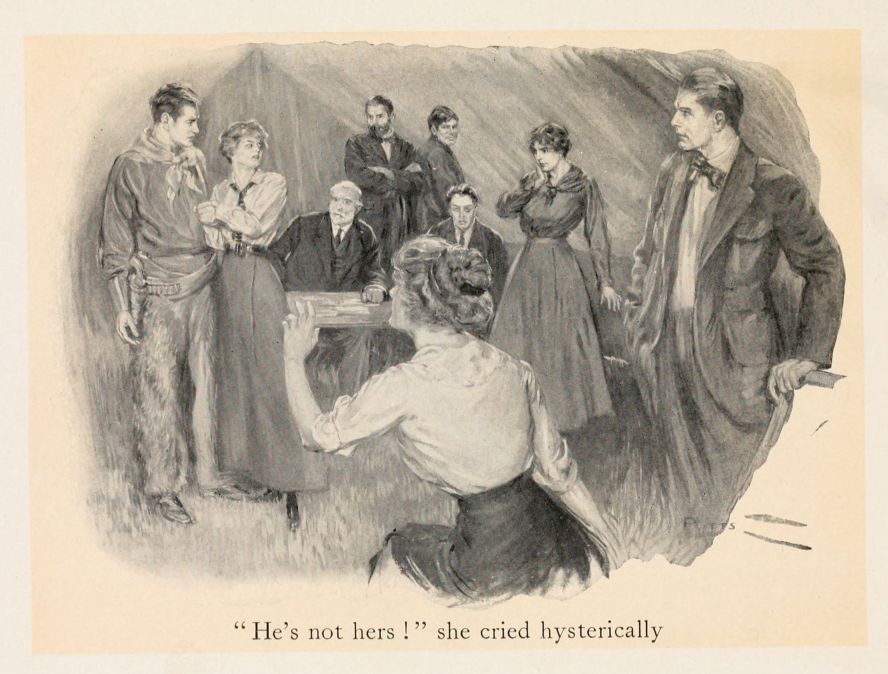
A dreadful silence in the tent succeeded this outburst, broken only by Linda's tempestuous sobs. She hid her face on Jack's shoulder. His arm was around her; a man could do no less. Vassall and Ferrie turned away their heads, shamed and sick at heart to see the lady of their dreams so abase herself. Mrs. Worsley sank back in her chair, and covered her face with her hands.
Mary Cranston, just now all alive, and warm and eager, turned to ice where she stood. Jack was fiery red and scowling like a pirate. For a second his eyes sought Mary's imploringly. Seeing no hope there, he stiffened his back, and drew on the old scornful, stubborn mask, letting them think what they chose. If he had had a moustache he would have twirled it in their faces. Sir Bryson was staring at his daughter clownishly.
Mary broke the silence. "I am sorry," she said, smoothly and clearly, "that the young lady has misunderstood my reasons for mixing myself in this. She need not distress herself any further. Malcolm Piers is nothing to me, nor I to him. If she still thinks I have any share in him, I cheerfully give it to her here and now."
With that she was gone. David Cranston would have been proud of her exit. Not until after she had gone did any of those present realize the wonder of it, that as long as she had remained in the tent this native girl of less than twenty years had dominated them all.
Sir Bryson's faculties were completely scattered. His eyes were almost as blank as Garrod's; his hands trembled; his breathing was stertorous. Whatever his absurdities and weaknesses, at that moment the little man was an object worthy of compassion. Gradually his voice returned to him.
"Linda! How can you shame me so!" he murmured huskily. Then in a stronger voice: "Leave that man!" He turned to Kate Worsley. "Take her away."
The storm of Linda's passion passed with the departure of the other woman. She was now terrified by what she had done. She allowed herself to be led away, weeping brokenly.
Sir Bryson turned to Jack. "As for you, you young blackguard," he said tremulously, "you needn't expect to profit by this. If she persists in her infatuation she is no daughter of mine. But I'll save her if I can."
Jack's chin stuck out. He said nothing.
Jean Paul had listened to all this, outwardly shocked, but with the hint of a smirk playing around the corners of his lips. Fate was unexpectedly playing into his hands! He now looked at Sir Bryson for orders, and Sir Bryson, as if in answer, rose and said:
"Jean Paul, I order you to arrest this man. Secure him, and keep him under guard until we can reach the nearest police post. Mr. Vassall and Mr. Ferrie will assist you."
The other two men who, up to the moment of Linda's avowal, had been well enough disposed toward Jack, now turned hard and inimical faces against him, and hastened to lend Jean Paul their aid. All this while Garrod sat in his chair staring dully before him.
Jack's hands clenched, and his eyes shot out cold sparks. "Keep your hands off me," he said. "All of you!"
Jean Paul with an air of bravado motioned Vassall and Ferrie back. To outward appearances he was fully Jack's match. Lacking an inch or two of his height, he more than made it up in breadth of trunk, and length of arm. He slowly approached the white man, alert and smiling evilly. For a moment they measured each other warily, Jean Paul crouching, Jack upright. Then the half-breed sprang forward. Jack drew off, and his fist shot out. There was the crack of bone on bone, and Jean Paul measured his length on the grass. He twisted a few times, and lay still.
"Good God!" cried Vassall and Ferrie, falling back. They were not muscular men.
"He's not dead," said Jack off-hand. "A bucket of water will bring him to."
Jack walked to the door with none to hinder. Holding up the flap, he faced them. "You needn't think that I'm going to run," he said. "I don't mean to do anything that would suit you so well. I'm going to fight for my good name, and my claims, and my girl, and the whole government of Athabasca can't stop me!"
XII JACK FINDS OUT
Dinner-time came and went at Camp Trangmar without any one's feeling much interested except the four Indian lads who ate largely, to the accompaniment of chatter and laughter by their own fire. It was nothing to them what high words were passed, and what tears were shed in the big tent. They were making the most of such a time of plenty as had never come their way before, and was not likely to be repeated.
By the cook-fire Humpy Jull exerted himself to tempt his hero's appetite—not wholly without success, it must be said; for what had happened could not check the coursing of the blood through Jack's veins. Twenty-five years old must be fed though the heavens fall. Gabriel's trumpet had better not be sounded for the young until after dinner. Jack ate silently and scowlingly. To one of his nature it was galling when there was so much to be overcome, not to be up and doing, not to be able to strike a blow.
Afterward the trees up the trail suffered for his wrath. Having eased his breast a little, he sat down to find a way out. Here, being a hewer instead of a thinker, he was at a disadvantage. He was conscious of an anomaly somewhere. He was in perfect condition; to fill his chest, and to stretch his muscles afforded him a keen sting of pleasure, but wind and limb availed him nothing against the subtle moral complications that beset him. It was one thing to defy the government of Athabasca in a bold voice, and another thing to find a vulnerable spot to hit the creature.
He was sitting with his chin in his palms, considering this, when Kate Worsley approached him from behind, and spoke his name. He sprang up, scowling. Linda was waiting a little way off. "Good heavens!" he thought. "Another scene to go through with!"
Mrs. Worsley was always simple in manner, and direct of speech. "Jack," she said at once, "Linda has told me everything that has happened between you, and I do not blame you as much as I did at first."
"Thanks," he said, looking away, and speaking gruffly as he was obliged to do when he was moved. "I value your good opinion, Mrs. Worsley. I don't think of you like the others."
"I am taking you into my confidence," she went on. "I am in a difficult position. Linda is terribly distressed by what has happened. She begged so to be allowed to see you for a moment, that I was afraid if I refused—well, I have brought her on my own responsibility. You will not say anything to her to make me sorry I brought her, will you?"
"You needn't be afraid," said Jack. "Nor Sir Bryson. I can't say it properly, but I shall not have anything to do with her until I can come out in the open."
"I knew you felt that way," she said quietly. "Of course it's no use telling Sir Bryson in his present state of mind."
"He hates me," said Jack frowning. "His kind always does. He won't give me a chance, and I say things that only make matters worse." He rubbed his furrowed forehead with his knuckle. "It's a rotten, mixed-up mess, isn't it?" he said with an appealing look.
Her eyes softened. His strength and his weakness appealed alike to the woman in her. Her hand went out impulsively. "You boy!" she said. "It's no wonder!"
Jack, wondering what was no wonder, grabbed her hand, and pressed it until she winced.
"If I can help you, come to me," she said.
"Thanks, anyway," he said. "But nobody can, I suspect."
"Now talk to Linda," she said. "Be gentle with her."
Jack frowned. "I told her not to say anything," he began.
"I know, I know," she said cajolingly. "But you are strong; be merciful with her weakness. Make allowances for women's nerves and emotions. It was a terrible scene on us all; most of all on her. She was foolish; but there was a kind of bravery, too, in avowing you before them all. Think of that!"
"If she only had your sense," said Jack.
Kate smiled and turned away. "What do you expect?" she said over her shoulder. "I'm thirty-eight years old, and I was always plain! Linda!" she called. "Three minutes only, remember." She walked away.
Linda came running, and cast herself in Jack's arms, weeping, protesting, scarcely coherent. "Oh, Jack! I had to see you! I was terrified, thinking of your anger! That woman enrages me so! I can't think! What did you give her a mining-claim for? If you'd only love me more, I wouldn't be so jealous of her. I didn't mean to injure you! You know I'd never do that! Don't be angry with me. I've disgraced myself forever with them, and if you go back on me too, what will I do?"
What was he to do with the helpless, contrite little thing but comfort her? His arms closed around her. "Who says I'm going back on you?" he muttered gruffly.
"It's no more than I deserve after disobeying you," she went on. "I was such a fool! I'm so sorry! Say you forgive me, Jack. I'll do better after this!"
"I can't forgive you right away," he said with his awkward honesty. "But I'm not going back on anything. Don't distress yourself like this. Everything will come right."
"But love me a little," she begged, lifting her tear-stained face.
He put her away not ungently. "We mustn't," he said.
"Why?" she asked, gripping his arm.
"I promised Mrs. Worsley."
"What did you promise?"
"Oh, you know," he said uncomfortably. "Don't you see that if there is any—well, love-making between us, it makes me out a villain to them?"
"No, I don't see it," she said. "Not if I make you."
Jack began to sense that father and daughter had an exasperating trait in common, the inability to see a thing they did not wish to see. "I should be blamed, anyway," he said.
"But I'll tell everybody the truth," she said. "I'm not ashamed of you. They shall see that I have chosen you of my own free will."
"You have done harm enough," said Jack grimly. "Better not say anything more."
"I don't care," she whimpered. "I've got to love you."
Jack's face became hard. "I do care," he said. "Understand, we have got to cut all this out. No one, not even a woman, can make me do what I don't choose to do."
"Jack, don't speak to me like that," she murmured terrified.
"You brought it on yourself," he said miserably. "You always seem to make me stubborn and hateful."
"But you do love me?" she said desperately.
He inwardly groaned. "I'm not going back on anything," he said lamely.
"That's not enough," she said, beginning to tremble again. "It would kill me if you didn't. They'll never have anything to do with me again. I have no one but you. You must love me. You do love me, don't you?"
"Of course I love you," he said with a strange sinking of the heart.
"Then I'll do whatever you tell me," she said submissively.
"No more talks off by ourselves," said Jack. "And around camp you must treat me exactly the same as the other men."
"But if you shouldn't succeed in proving——" she began.
"I will," said Jack.
"Time's up, Linda," said Kate, coming back.
Linda kissed him in spite of himself, and hurried away. Jack breathed a sigh of relief, and took up his axe again.
At the top of the bench a few hundred yards from where Jack was working, the trail from over the portage divided. One branch came down to Camp Trangmar and the river; the other turned west along the edge of the bench, and became the Fort Erskine trail. A mile or two up the valley the latter was joined by the trail that led directly west from Camp Trangmar.
As Jack stood breathing himself after a spell of chopping, he became aware of the sound of horses' footfalls coming along the Fort Erskine trail. There was no sound of a bell. Struck by this fact, he bent his head to listen attentively. It is exceptional for the horses to stray away from the one of their number who is belled. Moreover, to Jack's experienced ears, these had the sound of laden horses. He could not guess who it might be, but Indians or whites, they would hardly ride so near to Camp Trangmar without coming in, unless they had a reason to avoid observation. He therefore dropped his axe, and ran up the hill to intercept whoever was coming, and make them account for themselves.
At the forks of the trail to his astonishment he came face to face with Mary and Davy mounted, and leading their two pack-horses. The bell of the leading horse had been silenced with a wisp of grass. At the sight of Jack they pulled up in obvious embarrassment. Jack's heart went down like a stone in deep water.
"You're pulling out?" he faltered.
"What else was there for us to do?" said Mary coldly.
"Without telling me?" cried Jack reproachfully.
"I didn't want to," put in Davy eagerly. "Mary said we had to."
Pride, indignation, and exquisite discomfort struggled in Mary's face. "It seemed easier," she said. "I'm sorry we met you. There's nothing to say!"
"But Mary—Mary!" urged Jack, scarcely knowing what he said, but filled with his need of her. "Not like this! Wait until to-morrow. Who knows what may happen to-morrow!"
"What can happen?" said Mary. "More humiliating scenes?"
Jack caught her bridle rein. "I swear to you," he said, "if Sir Bryson or any of the men——"
"I'm not thinking of them," Mary interrupted. "You can't stop her tongue. You've given her the right to speak that way."
Jack hung his head. Like a man under the circumstances he muttered: "You're pretty hard on a fellow."
"Hard?" cried Mary sharply. "What do you think I——" She checked herself with an odd smile.
Jack was determined to be aggrieved. "It's unfriendly," he burst out; "stealing out of camp by a roundabout way like this and even muffling your bell."
"That's what I said!" put in Davy.
Mary flashed a hurt look at Davy that forgave him while she accused. That he should take sides against her at such a moment—but of course he was only a child. She was silent. Swallowing the lump in her throat, she looked away over the little valley and the river for support. All three of them looked at the lovely scene below them, softened and silvered in the creeping twilight, each wondering miserably what had happened to the joy of life.
At last Mary said quietly: "It wasn't easy to decide what to do. I have to think of myself. I have to think of father, what he would like. There is nothing else. I am sorry. You and I cannot be friends. We might as well make up our minds to it."
"Why can't we be?" demanded Jack.
"Because you have chosen a girl that will not allow you to have another woman for a friend," she said.
This was unanswerable. Jack could only hang his head again.
"I will not be friends with you secretly," Mary went on. "Nor can I lay myself open to her abuse. So we must not see each other any more."
"I need you!" Jack blurted out. His pride was hauled down. It was the first appeal for help that had passed his lips.
"I—I'm sorry," she faltered, but without relenting. "Watch Jean Paul well," she went on. "He can't keep the man hypnotized always. Get Garrod away from him if you can."
Jack scarcely heard. "I'm under arrest," he said. "You're leaving me without a friend in camp."
"You have her," said Mary softly, with an indescribable look; compassion, reproach or disdain—or all three.
"Mary!" he burst out.
She jerked her bridle rein out of his hand, and clapped heels to her horse's ribs. "This does no good," she muttered. "And it hurts! Come, Davy." She loped out of sight among the trees.
Davy lingered. Leaning out of the saddle he put his arm around Jack's shoulders. The boy was near tears. "Jack, what's the matter?" he begged to know. "I want to stay. I feel so bad about it. I don't understand. Why can't we be friends like we were before? Mary won't tell me anything. We think such a heap of you, Jack. The other girl—she's nothing to you, is she? Mary's worth a dozen of her. There's nobody like Mary. Why can't you and Mary——"
This was like a knife turned in Jack's breast. "Get along with you!" he said harshly. "You don't know what you're talking about." Disengaging himself from the boy's arm, he clapped the horse's haunch, and the animal sprang ahead. The pack-horses lumped after.
When they were out of sight Jack flung himself full length in the grass with his face in his arms. Now he knew. This pain in his breast was the thing they called love. Blind fool that he had been, he had dismissed her with the light term "native girl," and had not seen that it was a woman in a thousand, the woman his manhood had always been unconsciously yearning for, generous, true and lovely. She rode away, dragging his heart after her. He was tied fast. The pain of it was insupportable.
"Good God! how did I ever get into it!" he groaned. "What a price to pay for a kiss in the dark!"
XIII THE RETREAT
Two days passed at Camp Trangmar. There was little outward evidence of the several storms that agitated the breasts of the company. The men left Jack severely alone, and Jack for his own part took care to keep out of Linda's way. He made it his business to watch Garrod, visiting him night and day in Jean Paul's tent, careless of the owner. There was no change in Garrod's condition. Jean Paul sheered off at Jack's approach like the wary animal he was. Meanwhile Sir Bryson, Baldwin Ferrie, and the Indians were busy staking out additional claims along Tetrahedron creek.
On the third morning the camp was plunged into a fresh agitation. Jack and Humpy Jull were breakfasting by the cook-fire, Jack looking like a sulky young Olympian in the morning sunlight, and Humpy naïvely trying to cheer him up.
"Gosh!" he said. "If I had your looks and figger I wouldn't care about nothin'."
Jack, who disdained the false modesty that disclaims such tributes with a simper, merely held out his plate for porridge.
Suddenly Vassall came quickly across the grass. His face was pale and streaked from the effects of nervous emotion.
"Sir Bryson wants you," he said to Jack.
Jack continued to eat leisurely. "What about?" he asked, coolly. "I've no mind to stand up and be abused again."
"Garrod is gone," said Vassall.
Jack's indifference vanished like sleight of hand. He sprang up. "Gone!" he echoed.
He headed straight for the big tent, Vassall following, and Humpy Jull looking after them both with round eyes.
The inside of the big tent presented evidences of confusion. Breakfast was spread on the two little tables pushed together, and Linda, Mrs. Worsley, and Baldwin Ferrie were seated, playing with their food. Sir Bryson's chair was pushed back, and his napkin lay on the grass. The little man was agitatedly walking up and down. Jean Paul stood by with a deferential air.
This time Linda gave no sign at Jack's entrance except for an access of self-consciousness.
"What do you know about this?" Sir Bryson immediately demanded.
"I know nothing," Jack said. "I have come to find out."
"Garrod has escaped," said Sir Bryson.
"Why not?" said Jack bitterly. "He ought to have been secured."
Jean Paul spoke up. "I get no order to tie him," he said smoothly. "He all time ver' quiet. I mak' him sleep inside me, and I tie a buckskin lace from him to me. If he move a little I wake. This morning when I wake, the lace cut and him gone."
"Did you let him keep a knife, too?" asked Jack, sneering.
Jean Paul looked confused. "He got no knife w'en I look on him," he said.
"It sounds fishy," said Jack scornfully.
"Do you mean to imply——" began Sir Bryson.
"Jean Paul sleeps like a cat," Jack went on. "If so much as a stick turns in the fire he wakes and looks to see. Follow it out for yourselves. He can't keep the man hypnotized forever. And once Garrod comes to his senses, the truth comes out!"
"These are empty accusations," puffed Sir Bryson. "The poor fellow has wandered away in his distraction."
"Or been carried," Jack amended.
"By whom?" said Sir Bryson. "We're all here."
"There are Sapi Indians a few miles west," said Jack. "Jean Paul is a power in the tribe."
"Excuse me, your excellency," purred Jean Paul, "if I do this, I not stay be'ind myself me, to get your punishment."
"Make you mind easy, Jean Paul," said Sir Bryson graciously. "This fellow attempts to twist everything that happens, to his own advantage. I commend your ingenuity, young sir," he added sarcastically.
"We're wasting time!" cried Jack with an impatient gesture. "He's got to be found! Whatever you choose to think of me, you can safely leave that in my hands. It means more to me than to any one else. It means everything to me to find him."
"Jean Paul says the horses have strayed——" Sir Bryson began.
"The horses, too?" cried Jack. The half-breed's eyes quailed under the fiery question that Jack's eyes bent on him. Without another word Jack turned and ran out of the tent.
In half an hour he was back—with a grim face. The occupants of the big tent were much as he had left them, but Jack sensed from the increased agitation of their faces, and from Jean Paul's sleekness, that the half-breed had not failed to improve the interval.
"It's true," said Jack shortly. "They've been driven off."
It had a terrifying sound to them. They looked at him with wide eyes.
"I found their tracks on the Fort Erskine trail," Jack went on. "They were travelling at a dead run. The tracks were six hours old."
Sir Bryson stopped his pacing. "Driven off?" he said agitatedly. "Are you sure? Couldn't they have run off by themselves?"
"They could," said Jack, "but they didn't. Five of the horses were hobbled when we turned them out. The hobbles had been removed."
"Well, well," stammered Sir Bryson, "what are we to do?"
"Let me take ten days' grub from the store," said Jack. "I'll undertake to bring Garrod back, and at least some of the horses."
"You'd follow on foot?" Linda burst out.
Jack answered to Sir Bryson. "They can't travel fast with their families and baggage."
It was not Jack's safety that Sir Bryson was concerned about. "But—but, leave us here without horses?" he faltered.
Jack smiled a little. "What good am I to you? I'm under arrest. Jean Paul has your ear. Why won't he do?"
Sir Bryson gave no sign of hearing this. "We must return," he said nervously. "We can't stay here—without horses."
Jack's heart sank. "What have the horses got to do with it?" he asked. "You're safe here. You've grub enough for months."
Sir Bryson looked at the half-breed. "Jean Paul says perhaps it is the Indians," he said. "He thinks they may have driven off the horses as a preliminary to attacking us."
"I not say that, me," put in Jean Paul quickly. "I jus' say best to be ready."
"So that's his game," cried Jack scornfully. "He's fooling you! It's an old redskin trick to drive off the horses to prevent pursuit. But as to standing up to white men—well, I'm willing to go and take my man and my horses away from the whole village of them."
Sir Bryson violently shook his head. Jack saw that the fate of Garrod had little weight with him. "We are quite defenceless!" he cried. "And with the women to look after! It is my duty to start back!"
Jack's lip curled.
Sir Bryson's voice scaled up shrilly. "How will we ever get back?" he cried.
"That's easy," said Jack. "Twelve miles walk over the portage to Fort Geikie, then by raft down the river. We'll make it in two days."
"Can we start this morning?"
Jack flushed. "No!" he cried. "Abandon our outfit! That would be disgraceful. It would be the joke of the country. I won't be a party to it! We'll cache the stuff to-day, and you can start to-morrow."
"Very well," said Sir Bryson nervously. "In the meantime we must keep a sharp lookout!"
Before Jack left him he made another appeal to be allowed to go after Garrod. He might as well have saved his breath. Sir Bryson and those with him, except perhaps Mrs. Worsley, were in the grip of panic. It was futile to try to reassure those whose notions of Indians had been gathered from the Wild West fiction of a preceding generation.
Jack came out of the tent sore all the way through. Taking them down to the Fort would cost him five precious days. True, he could get horses there, and perhaps assistance if he needed it, but the waste of five days was maddening.
Jack thought for a moment of defying Sir Bryson, and going anyway. But he put it from him. Any white man who abandoned a party that he had bound himself to guide, no matter what the circumstances might be, would be disgraced forever in the North. It is a situation which simply does not admit of argument. This sense of guide-responsibility is strong among white men, because the natives are without it. They are prone to shuffle off disagreeable burdens on the slightest provocation.
Jack set to work with a sullen will. He took out his soreness in hard work and in making the Indian lads work. Hard and long-continued exertion was a disagreeable novelty to them; before many hours had passed they were sullen too.
An axe party was immediately dispatched into the bush, and by noon enough stout poplar logs were cut and trimmed and drawn into camp to make a small shack. By supper-time the walls were raised, and the roof of poles laid and covered with thick sods. The remaining hours of daylight were occupied in storing everything they possessed inside. It was ten o'clock before they knocked off work. Meanwhile Sir Bryson, to Jack's scornful amusement, had insisted on posting Vassall and Ferrie as outposts against a surprise.
Next morning the governor was plunged into a fresh panic by the loss of the four Indian lads. No one saw them go. They melted out of camp, one by one, and were seen no more. Jack was not greatly surprised; he had seen premonitory symptoms the day before. It was additional evidence to him that the other Indians were still in the neighbourhood, and he was more than ever chagrined to be obliged to retreat without even an attempt to recover Garrod.
Jack kept out of Sir Bryson's way. In spite of themselves, however, the white men leaned on Jack more and more. Their imaginary redskin peril strengthened the race feeling, and Jack's energy and resourcefulness were indispensable to them. They came to him sheepishly for aid, but they came.
"What do you make of this desertion?" Vassall asked anxiously.
"Nothing serious," said Jack. "I don't think Jean Paul has a hand in it, because it's his game to get us out as quickly as he can. They probably vamoosed of their own accord. When we lost the horses, they saw the end of their good times. They've been fed too high. It makes 'em beany, like horses."
"But what'll we do without them?" Vassall asked.
Jack guessed that the question came from Sir Bryson.
"Tell the old gentleman to keep his shirt on," he said. "They're no great loss. It means that we'll all have to carry a little more across the portage, that's all."
After breakfast the tents were taken down and stored with the last of the camp impedimenta in the cache. When everything had been put inside, the door was fastened with a hasp and staple removed from one of the boxes, and Jack pocketed the key. The loads were then apportioned and packed, a long job when six of the eight were totally inexperienced. Sir Bryson was still looking over his shoulder apprehensively. At eleven o'clock they finally set out.
It was a quaintly assorted little procession that wound in single file along the firmly beaten brown trail through the willow scrub and among the white-stemmed poplars. There was a lieutenant-governor carrying a pack, and striving ineffectually to maintain his dignity under it; and there was his daughter likewise with a blanket strapped on her shoulders, and an olive-wood jewel-case in her hand, with a gold clasp. Jack smiled a little grimly at the idea of a jewel-case being toted through the bush.
Everybody carried a pack conformable to his strength. Since the two women and Sir Bryson could take so little, the others were fairly well laden. Jean Paul at the head, and Jack bringing up the rear, toted the lion's share. Besides blankets, the outfit consisted of food sufficient for five days, cooking and eating utensils, guns, ammunition, and axes. Jack had a coil of light rope to aid in building his raft.
Jack put Vassall next behind Jean Paul, with a word in his ear to watch the half-breed. Jack felt, somehow, that no serious harm was likely to befall Garrod so long as he had Jean Paul safely under his eye. After Vassall the others strung along the trail, with Humpy Jull, the oddest figure of all, marching in front of Jack, looking like an animated tinware shop with his pots and pans hanging all over him.
They started in good enough spirits, for the sun was shining, and the packs felt of no weight at all. But on the little hills their legs inexplicably caved in; their breath failed them, and the burdens suddenly increased enormously in weight. It was a long time since hard labour had caused Sir Bryson to perspire, and the novel sensation afforded him both discomfort and indignation. Two miles an hour was the best they could do, counting in frequent pauses for rest. The twelve miles stretched out into an all-day affair.
Once, toward the end of the afternoon, they came to the bank of a small stream, and throwing off their burdens, cast themselves down in the grass beside it, all alike and equal in their weariness. Sir Bryson was no longer a knight and a governor, but only the smallest man of the party, rather pathetic in his fatigue. They were too tired to talk; only Jack moved about restlessly. The slowness of the pace had tired him more than the seventy-five pounds he carried.
As Jack passed near Kate and Linda the latter said petulantly: "I'm tired, Jack. I want to talk to you."
Jack's heart sank, but nothing of it showed in his face. The little thing's look of appeal always reproached him. To a man of his type there is something shameful and wrong in not being able to give a woman more than she looks for. "Lord! it's not her fault," he would tell himself; and "As long as I'm going through with it, I must make a good job of it!" So he plumped down beside her.
"Go as far as you like," he said with a kind of hang-dog facetiousness. "Everybody can see, and Mrs. Worsley is standing guard."
"But I'm tired," she repeated. "I want to put my head on your shoulder." She looked at the spot she had chosen.
Jack became restive. "Easy there," he said uncomfortably. "You're forgetting the compact!"
Linda's eyes slowly filled with tears. "Hang the compact," she said. "I'm tired."
"I'll carry your blanket the rest of the way," Jack said gruffly.
"I won't let you," she said. "You've got a perfectly enormous load already."
"Pshaw! that featherweight won't make any difference," he said, and tied it to his pack.
"My feet hurt me," wailed Linda.
Jack frowned at the elegant little affairs Linda called her "sensible" shoes. "No wonder," he said. "Trying to hit the trail on stilts. Put out your foot."
His axe lay near. Firmly grasping her ankle, with a single stroke he guillotined the greater part of the elevating heel. Linda and Kate both screamed a little at the suddenness of the action, and Linda looked down horrified, as if she expected to see the blood gush forth. Jack laughed, and performed a like operation on the other foot. For the next hundred yards she swore she could not walk at all, but the benefit of the amputation gradually became apparent.