JACK CHANTY (continued 4)
Reading edition
Never was such a long twelve miles. Finally, when most of them had given up hope of ever making an end to this journey, they debouched on the grassy esplanade surrounding the shacks of Fort Geikie. Humpy Jull set about getting dinner, while Jack and Jean Paul cut poplar saplings and constructed a leafy shelter for Linda and Kate. The business of camp had to be carried on; no one seeing these people travelling, and eating together, and sleeping around the same fire, could have guessed how their hearts were divided.
They were ready for sleep immediately after eating. Linda and Kate disappeared, and the men rolled up in their blankets, Sir Bryson grumbling. He felt that another little shelter should have been made for him. He found it very trying to be obliged to snore in public among his servants.
Sir Bryson insisted that a watch be maintained throughout the night, and Jack, who would have laughed at any other time, fell in with the idea, because he had a notion that Jean Paul might try to slip away. Jack arranged therefore that the half-breed keep the first watch, and, at no little pain and difficulty, he remained awake himself to watch Jean Paul. At eleven Jean Paul wakened Humpy Jull; at one, Vassall took Humpy's place.
Jack had left instructions that he was to be roused at three. It was already broad day at this hour. Upon Vassall's touch he staggered to his feet under the burden of sleep and walked blindly up and down until he had shaken it off. He went to the edge of the bank to take a prospect, Vassall at his elbow. A better understanding was coming about between these two. Vassall made no pretence that he had forgiven Jack for burglarizing Linda's affections, as he thought, but granting that, he, Vassall, was doing all he could do to bear his share of their common burden.
A lovely panorama of river, islands, and hills lay before them in the cool, pure, morning light.
"I'm going to cross to the island," Jack said, pointing. "In the drift-pile on the bar there, there's dry wood enough for a dozen rafts."
"How will you get over there?" asked Vassall.
"Swim," said Jack.
"I'll go along, too."
Jack stared at the slender, pale young city man. "You!" he said with a not very flattering intonation.
"Hang it, I'm not going to let you do everything," Vassall said, frowning. "I can swim. It's one of the few things I can do that is useful up here."
"It's not so much of a swim," said Jack. "The current carries us. I'll tow the axe on a stick or two. But the water's like ice."
"I can stand if it you can," Vassall said doggedly.
Jack looked at him with a gleam of approval. "Come on and feed then," he said off-hand.
They wakened Baldwin Ferrie to stand the last watch, and sat down to the cold victuals Humpy had left for them. In front of them the other men still slept, an odd sight, the three of them rolled up like corpses in a row in the morning light: lieutenant-governor, half-breed, and cook, as much alike as three trussed chickens.
While Jack ate, he issued his instructions to Ferrie: "Wake Humpy at five, and tell him to get a move on with breakfast. As soon as Vassall and I knock the raft together, we'll cross back to this side, but the current will carry us down about a third of a mile. When the rest of you have finished eating, pack up and come down to the shore. You'll have to walk along the stones to the first big point on this side. Bald Point, they call it, because of the trees being burned off. Lose no time, because we must be started by eight, if we mean to make Fort Cheever by dark."
Jack and Vassall, clad only in shirt, trousers, and moccasins, scrambled down the steep bank to the water's edge. Vassall looked at the swirling green flood with a shiver.
"Tie your moccasins around your neck," Jack said. "Leave your other things on. They'll soon dry as we work around. Head straight out into midstream, and you'll find the current will ground you on the point of the bar below."
The water gripped them with icy fingers that squeezed all the breath out of their lungs. Vassall set his teeth hard, and struck out after Jack. They were both livid and numb when they finally landed, and Jack forced Vassall to run up and down the bar with him, until the blood began to stir in their veins again. Then they attacked the tangled pile of drift logs.
Eight bleached trunks as heavy as they could pry loose and roll down to the water's edge provided the displacement of the raft. Jack chopped them to an equal length, and laced them together with his rope. On these they laid several cross-pieces, and on the cross-pieces, in turn, a floor of light poles, the whole stoutly lashed together. The outfit was completed by two roughly hewn sweeps and a pair of clumsy trestles in which to swing them. They were greatly handicapped by the lack of an auger and of hammer and nails, and the result of their labour was more able than shipshape. Four strenuous hours went to the making of it.
"She'll hold," said Jack at last, "if we don't hit anything."
They pushed off, and each wielding a sweep, pulled her back toward the shore they had started from. They both watched her narrowly, not a little proud of their handiwork. At least she floated high and dry, and answered, though sluggishly, to the sweeps. Their common feeling made Jack and Vassall quite friendly for the moment.
The little group was already waiting for them on the stones, with the slender baggage. Apprehension is quicker than the physical senses. Before he could see what was the matter, Jack sensed that something had happened, and a sharp anxiety attacked him. As he and Vassall drew near the shore he scanned the waiting group closely; he counted them, and then it became clear! There were only five waiting instead of six!
"Where's Jean Paul?" he cried out.
The people on the shore looked at each other uncomfortably. There was no answer until the raft grounded on the stones. Then Sir Bryson drew himself up and puffed out his cheeks.
"He asked my permission to remain to search for poor Garrod," he said in his most hoity-toity manner. "And I thought best to accede to his request."
Jack's jaw dropped. For an instant he could not believe his ears. Then he slowly turned white and hard. So this was what he got for spending his strength in their service! This was what he had to deal with: folly and self-sufficiency that passed belief! He was angrier than he had ever been in his life before. He was much too angry to speak. He stepped ashore, and walked away from them, struggling with himself.
Sir Bryson strutted and puffed and blew for the benefit of all observers. His secret dismay was none the less apparent. None looked at him. They were gazing fearfully at Jack's ominous back.
He came back with a set, white face. "Sir Bryson," he said in a voice vibrating with quiet, harsh scorn, "I say nothing about myself. Apart from that I've shown you clearly, and these people are witnesses to it, that this half-breed means Garrod no good. So be it. If he does for him now, it will be on your head."
In spite of his bluster, Sir Bryson began to look like a frightened small boy.
Linda was weeping with anger and fright. "I told him," she said, "but he wouldn't listen to me."
Kate, fearful of another outburst, laid a restraining hand on her.
"Here's your raft," Jack went on harshly. "All you have to do is to sit on it and keep it in the middle of the river and you'll be at Fort Cheever before dark. After letting the breed go, the least you can do is to let me stay and watch him."
They all cried out against this, even Kate and Vassall, whom Jack thought he could count on a little. They all spoke at once in confused tones of remonstrance and alarm. "What would we do without you? We don't know the river. We can't handle a raft," and so on.
Above all the others Sir Bryson's voice was heard trembling with alarm and anger: "Would you desert us here?"
The word brought the blood surging back into Jack's face. "Desert nothing," he said. "I asked your permission. I do not desert. Get aboard everybody, and hand on the bundles!"
They scrambled at his tone, a good deal like sheep. Jack launched the raft with a great heave of his back, running out into the water, thigh deep. Clambering on board, he picked up a sweep, and brought her around in the current. Sir Bryson and the others stole disconcerted sides glances at his hard and bitter face. There is something very intimidating in the spectacle of a righteous anger pent in a strong breast. The spectator is inclined to duck his head, and wonder where the bolt will fall.
XIV BEAR'S FLESH AND BERRIES
Jack propelled the raft into the middle of the current, and, taking the sweep aboard, sat down on the end of it with his back to the others, and nursed his anger. They sat or lay on the poles in various uneasy positions. Sir Bryson, who, until the the day before, had probably not been obliged to sit in man's originally intended sitting position for upward of thirty years, felt the indignity keenly.
Every one's nerves were more or less stretched out of tune. Linda, watching Jack's uncompromising back with apprehensive eyes, was exasperated past bearing by her father's fretful complaints.
"What do you want?" she burst out. "A padded chair? Don't be ridiculous, father!"
Sir Bryson swelled and snorted. "That is no way to speak to your father, Belinda. Because you see me robbed of my outward and visible dignity is no reason for your forgetting the respect you owe me. I am surprised at you."
Linda's muttered reply was forcible and inelegant. None of the others paid any attention. Sir Bryson, feeling perhaps that a magisterial air accorded ill with his tousled hair and his cross-legged position, made a bid for sympathy instead.
"My feet are going to sleep," he said plaintively.
Jack, overhearing, was reminded again of the resemblance between father and daughter. "You don't have to sit still," he said, speaking over his shoulder. "You can move about as long as you don't all get on the same side at the same time."
Sir Bryson, who would not have been robbed of his grievance for any consideration, continued to sit and suffer dramatically.
Vassall's head was heavy. Stretching himself out, and watching Linda wistfully, he finally fell asleep. Humpy Jull, up at the bow—if a raft may be said to have a bow—constructed a fishing line out of a bent pin and a moccasin lace, and baiting it with a morsel of bacon, fished for hours with the trusting confidence of a child. Discouraged at last, he fell asleep beside Vassall.
Thus the morning passed. Left to its own devices, the raft swung around and back in the eddying current, and a superb panorama was ceaselessly and slowly unrolled for any who cared to see. The river moved down through its vast trough in the prairie, and an ever-changing vista of high hills, or seeming hills, hemmed them in. On the southerly side the hills were timbered for the most part. On the northerly side, where the sun beat all day, the steep slopes were bare, and the rich grass made vivid velvety effects darkened in the hollows and touched with gold on the knolls. The whole made a green symphony, comprising every note in the scale of green from the sombre spruce boughs up through the milky emerald of the river water to the high verdancy of the sunny grass and the delicate poplar foliage.
Of them all only Kate Worsley watched it as if the sight was enough to repay one for the discomfort of sitting on poles. Her quiet eyes were lifted to the hills with the look of one storing away something to remember.
Now and then a momentary excitement was created by the sight of a bear grubbing about the roots of the poplar saplings, homely, comical beasts with their clumsy ways and their expression of pretended cuteness. Something still wild in the breasts of domesticated creatures like ourselves never fails to answer to the sight of a real wild thing at home in his own place. Since they had no time to go ashore in case of a hit, no shots were fired.
Once in the middle of the day they landed long enough for Jack to build a hearth of flat stones on Humpy's end of the raft, and cover it with clay. Then, gathering a little store of wood, they pushed off again, and Humpy built his fire, and boiled his kettle while they floated down.
After lunch Jack's anger was no longer sufficient to keep his neck stiff. He had been up since three that morning, and in spite of himself he began to nod. Vassall volunteered to keep watch while he slept.
"There's nothing to do as long as she keeps the middle of the stream," Jack said. "If she drifts to one side or the other wake me."
He stretched himself out, and in spite of the cobbly nature of his bed, immediately fell asleep. Linda watched him with the tears threatening to spring. He had not spoken to her since they started, and indeed had scarcely seemed to be aware of her. She glanced at the others with rebellious brows. If it were not for them, she thought, the tawny head might be pillowed in her lap.
Another hour dragged out its slow length. Kate Worsley out of pity for Sir Bryson's increasing peevishness proposed a game of bridge. It was hailed with alacrity. A sweater was spread for a cloth; Sir Bryson, Kate, Baldwin Ferrie, and Vassall squatted around it, and the cards were dealt.
"Fancy!" exclaimed Vassall, looking around. "Rather different from a game in the library at Government House, eh?"
"And different looking players," suggested Kate with a smile.
"I feel it very keenly, Mrs. Worsley," said Sir Bryson tearfully. "I have always attached great importance to the little details of one's personal appearance. Perhaps it is a weakness. But that is the way I am."
"We're all in the same boat—I mean raft," said Mrs. Worsley cheerfully. "Look at me!"
"I will make it no trumps," said Baldwin Ferrie.
Linda, seeing the others fully occupied, moved nearer to Jack, and lay down where, making believe to be asleep herself, she could watch his face, calm and glowing in sleep, the lashes lying on his cheeks, the thin nostrils, the firm, red line of his lips. If he had only slept with his mouth open, or had snored, it might have broken the spell that held her, and a deal of trouble been saved. Unfortunately he slept beautifully; and if that was not enough, once he smiled vaguely like a sleeping baby, and changed his position a little with a sigh of content. The sight of her strong man in his helplessness affected the girl powerfully; when he moved, her heart set up a great beating, and the alarmed blood tingled to her finger-tips.
During this time but an indifferent watch was kept. Humpy Jull had fallen asleep again. There seemed little need to watch on such a voyage. True, they had passed little reefs and stretches of broken water where the swift current met obstructions inshore, but there had been no disturbance that extended out into midstream. The raft was carried down squarely in the middle of the channel.
Once when it came to Vassall's turn to be dummy, he stood up to stretch his legs and look about him. A short distance ahead he saw that the invariably earthy slope of the hills was broken by an outcropping of rock on either side. The band of rock evidently crossed the river, for in the middle a ragged islet of rock stuck its head out of the water.
Vassall debated on which side of the rock they ought to pass with the raft. To a riverman the "middle of the stream" means the main sweep of the current of course. Vassall was not a riverman and he did not observe that the greater body of water made off to the left and around that side of the island. The channel on the right-hand side stretched straight ahead of them, wide and apparently smooth, and to Vassall this looked like the "middle of the stream." If he had left the raft alone the current of its own accord would have carried it around to the left, but he ran out a sweep and pulled her to the other side. He saw no occasion for waking Jack.
A new hand was dealt and he returned to the game. It was a critical hand, and the attention of all four of the players was closely fixed on the cards until the last trick was taken. Not until then did they become aware of the grumble of broken water ahead. They had heard the sound before on the reefs they had passed. Vassall, looking up, saw only a kind of smudge like a thumb-mark drawn across the smooth face of the river ahead. The next time he looked he saw darkish spots here and there between the island and the shore.
The noise became louder. Finally he got up, and in the act of rising the ominous white leaped into his view. It was a reef extending all the way across. The dark spots were rocks covered by an inch or two of water.
For an instant Vassall looked at it stupidly. The others were arranging their cards in ignorance of any danger. Before Vassall could wake Jack, the hoarse roar of the reef reached the subconsciousness of the sleeping man, and he sprang up, all standing. A glance told him everything.
"What are we doing on this side?" he cried.
He ran out one sweep, and motioned Vassall to the other. They pulled with a will. The others watched, not fully understanding the nature of the danger yet, but alarmed by Jack's grimness. He was heading the raft for the main channel. They had not reached the island yet, but Jack soon saw that at the rate they were being carried down he could not make the other side, nor could he land his clumsy craft on the shore above the reef.
"Save your strength," he said to Vassall. "We'll have to chance it. Everybody sit still and hold on."
A breathless few minutes succeeded. Jack steered for the widest space he could see between the rocks. Those who were sitting down still could not see much of what was ahead, but the roar of the water was now sufficiently terrifying. Moving of a piece with the current as they were, it seemed as if they were not moving, but that the broken rocks were striding to meet them, not very fast, but inexorably. It was hard to sit and wait.
Then as they came close they saw how the water slipped silkily over the reef with the dark shadows showing like teeth beneath, and boiled up below. The women cried out sharply, and the men turned pale. It suddenly became evident how fast the heavy raft was moving.
"Throw yourselves flat and hang on!" Jack shouted.
They obeyed. There was a dreadful moment of waiting, while the roar of the water filled their ears. Then she struck. One side of the raft slid up on a submerged shelf, the floor tilted at a steep angle, and the current surged over the lower side, sweeping everything movable off. Jack stood up to his knees in the torrent, pushing desperately at the heavy sweep. He budged her inch by inch.
"Lie still!" he shouted. "For your lives! We'll make it yet!"
But panic seized upon his passengers. Somebody scrambled for the high side of the raft, and the rest followed. The strain was too great for the lashings. A rope parted somewhere, and the floor instantly heaved up beneath them. There was a brief, wild confusion of thrashing, tangled logs and feeble human bodies. Then the whole thing, logs, bodies, baggage, and playing cards was swept over into the deep, rough water below.
When Jack came to the surface he had a confused impression of bobbing heads and logs on every side. He seized the nearest log, and unstrapping the cartridge belt and the gun that were drowning him, buckled it on. Meanwhile, he was looking for the long hair of the women. He reached one of them in six strokes. A pair of clutching arms reached for him, but he dived, and seizing her by the collar, towed her to the nearest log. It was Linda.
Leaving her supported, he trod water looking for Kate. He saw more streaming hair not far away, and reached the spot as she rose again. There was sterner stuff here; her face was white and wild, but her arms were under control. She put her hands on Jack's shoulders as he commanded, and he brought her likewise to a log. A little brown box came bobbing by, Linda's jewel-case. Kate coolly put out her hand and secured it.
All this had taken but a minute. Jack looked about him. Everything was being carried down of a piece with the current, and they were all close together. It seemed to Jack as if the whole face of the river was littered with playing cards. He had a particular impression of the deuce of clubs. Vassall was helping Baldwin Ferrie to a log, and Humpy Jull had secured the log that bore Jack's cartridge belt. Only Sir Bryson was missing. Farther out Jack saw a feeble commotion, and no log near.
"See to the women!" he called to Vassall. "There's a backwater inshore. Humpy, save that belt as you value your life!"
The struggling figure sank before he reached it. Jack swam about the spot. It rose again, but out of his reach. He dived for it. They came together, and a pair of frantic arms closed about Jack's neck. They sank together, Jack struggling vainly. They rose, Jack got a breath, and broke the hold. The struggling ceased.
Swinging the inert figure over his back, Jack struck out for the shore. It was a desperately hard pull. They had been carried too far to obtain any advantage from the backwater. The logs he passed were of no aid to him, because the current tended to carry them into midstream. For a long time the shore seemed only to recede as he struggled toward it. More than once fear touched him and he was on the point of going down. He rested, breathing deep, and set to it again. Finally he ceased to think or to feel, but he continued to struggle automatically, and he still clung to his burden.
It was with a kind of surprise that he finally felt the stones under his feet. He staggered ashore, and putting down the limp figure he carried, flung himself on the shore utterly exhausted. How long he lay there he hardly knew. As soon as a little strength began to stir in him, with the man-of-the-wilds instinct he set to work collecting sticks to make a fire.
He had been carried nearly a mile below the reef. By and by, far up the shore he saw some wavering, uncertain little figures. He was able to count five of them, so he knew all were safe. He hailed them shrilly after the way of the country. After his little fire sprang up, he could see that they were coming toward him slowly, the men helping the women.
They came, a distressed little company, drenching wet, silent and dazed. They moved like automatons, as if their limbs were independent of them, and they looked at each other dully, as if not with full recognition. Reaching Jack, they stood around in an uncertain way; none of them spoke. It was as if they had lost the faculty of speech also. Linda was roused by the sight of her father; with a cry, she cast herself on his body.
"He's not drowned," Jack said quickly. "Only stunned a little."
The helplessness of the others had the effect of rousing Jack to an ardour of activity that transformed him. His gnawing anger was forgotten; his black looks were flown. Their situation was well-nigh desperate, but here the opposing forces were purely physical, such as he thoroughly understood, and loved to attack. His exhaustion passed, and his eyes became bright.
"Has anybody dry matches?" he sang out.
The dazed ones looked a little amazed at his spirits. It appeared that no one's match-safe was waterproof but Jack's own.
"Spread 'em out to dry on a rock," he said. "They may work. I have seventeen good ones. That's enough at a pinch. Everybody scatter for dry wood. Keep on the move, and get your circulation going. Humpy, you build another fire behind the willows for the ladies. Light it from this one. We can have all the fire we want, anyway. Vassall, help me here with Sir Bryson. We must take his wet things off." He glanced up at the sun. "Rest for an hour," he said; "then on the march! Red Willow Creek to-night; Fort Cheever to-morrow afternoon!"
"But how are we going to support life on the way?" stammered Baldwin Ferrie.
Jack pointed to the belt Humpy Jull had brought along. His gun and his hunting-knife hung from it. This, with Linda's jewel-case, was the sum total of what they had saved from the wreck.
"We have the cannon," Jack said with a laugh. "About forty cartridges, and the seventeen matches. We'll make out."
An hour later they started to climb the steep, high hill to the prairie. They took it very slowly on account of Sir Bryson, who was still white and shaky. But he complained no more. Jack's example had had its effect on all, and a more cheerful feeling pervaded the party. They were at least dry and warm again. The men still regarded Jack's high spirits a little askance. It did not fit their settled convictions about him; they resented it slightly while forced to admire.
"Where are we heading for?" Vassall asked.
"There's a trail down this side of the river as well as on the other," Jack said. "I've never been over it, but if we strike straight back we must hit it."
"How will we get back across the river?"
"Nothing easier," said Jack. "When we arrive opposite the fort, if it's daylight, we'll wave a shirt; if it's night, we'll build a fire, and they'll send a canoe over for us."
Once having accomplished the difficult hill it was easy enough going over the prairie. Taking his bearings from the sun, Jack led them in a line at right angles back from the river. Linda walked beside him. Vassall and Ferrie helped support Sir Bryson. Half an hour's walking brought them to a trail, as Jack had promised, and their hearts rose. It was a less well-beaten track than the main route on the north side of the river, but easy enough to follow.
Jack called a halt. "Here we are," he said. "The first good water that I know of is Red Willow Creek. I've camped on the river at the mouth of it. It will be about seven miles. Are you good for it?"
They said they were. No one dreamed of opposing Jack now. They hung on him like defenceless merchant-men on their man-o'-war convoy.
"Vassall, you lead the way from here," Jack went on. "You'll find the creek in a big coulee. We'll camp for the night in the bottom of it. If by any chance you should lose the trail before you get there, just climb to the highest place you see, and sit down and wait till I come along."
"But where are you going?" they demanded.
"To hunt for our supper," said Jack.
He issued two of the precious matches to Humpy to make a fire on arrival. "There ought to be berries in the coulee," he said. "Collect all you can."
Linda clung to him. "Can't I go with you?" she begged.
He shook his head. "The hunter must hunt alone."
"Don't be long. Be very careful. If we lost you we'd simply lie down and die."
"Easy!" he said uncomfortably.
Linda glanced at the others. "Why should I hide it now?" she said. "I'm proud of you. They know now why I chose a man like you, a real man."
Jack had the feeling that additional turns of rope were being taken around his body. He blushed and scowled together. "Linda! for heaven's sake!" he burst out. Under his breath, "Wait until I pull you out of this before you begin to talk." He turned and fled.
A word of sympathy may be dropped here for Vassall and Ferrie. It is hard to have to stand by while your rival has the opportunity to save the lives of all and sundry, including your own, just because he is in his own element and you are out of yours. And then to be publicly scorned by the girl in the case—for that is what Linda's speech amounted to. Linda had no mercy for men; that is why, if you look into it far enough, she was bound to suffer on her own account. It was much to their credit that the two men took it generously.
It was four hours before they saw Jack again. They had reached the rendezvous some time before, and Humpy had built a fire on the shore of the creek, around which they sat in silence, trying not to look as hungry as they felt, and trying to conceal the common anxiety that gnawed at each breast: "What will we do if he doesn't come!"
But at last his hail came over the hill, and Jack himself came running and sliding down the grassy slope, covered with feathers it appeared. They sprang up with glad cries. Never did man receive a more heartfelt welcome. They were like his hungry children waiting to be fed and cheered. It is sweet to be so necessary to one's fellow-beings, but indeed it was a startling transformation. At one bound Jack had risen in their estimation from a disgraced felon to the saviour and preserver of them all. Jack felt this, and it was his revenge.
He kissed Linda—he had to—and flung his burdens down. "Prairie chicken," he said. "Sorry to keep you waiting so long, but I hated to come in until I had got one all round, and I couldn't take any chances. They're too expensive, anyway; a shell apiece and two misses. To-morrow I'll try to bring in something more substantial."
Thus they dined off roasted prairie chicken and saskatoon berries, strictly after Nature's first intention without artificial aids. And when one wanted a drink he had to scoop it out of the creek in his hand. It was remarkable how easy all this came to them, even to a lieutenant-governor when he was hungry and thirsty.
The night was harder. Jack built a sort of lean-to, or wind-break, of poplar, with a long fire close across in front. The heat was partly reflected down by the sloping roof, and in this pleasant oven they lay in a row on heaped spruce boughs. The men arranged to take turns in keeping up the fire throughout the night. But the ground was cold, and there was not much sleep to be had. Jack sat up and told cheerful yarns of worse nights that he had managed to live through.
At sun-up he was away again. An hour's patient waiting at the edge of a berry thicket two miles up the coulee brought him what he sought, a young black bear. He brought the hams into camp. The women looked askance at his prizes, and elected to breakfast off berries alone. But baked in its hide in a pit with hot stones the meat was not to be despised, and after a few miles on the trail they were all glad to share it.
All that day Jack convoyed his little company slowly, with many a rest beside the trail. They had about twenty miles to cover. Alone, Jack would have made it in five hours, but he saw that it would be a great feat for some of the others if they got through at all that day. In spite of what he could do, in the middle of the afternoon Linda gave out, and Sir Bryson was on his last legs. The indefatigable Jack then contrived a litter out of two poplar poles thrust through three buttoned coats, and Linda and her father took turns in riding the rest of the way.
Jack was considerably embarrassed by Sir Bryson's attitude toward him during this day. The little gentleman, as has been said, was much chastened. He was quiet; he issued no orders, nor uttered complaints, and was unaffectedly grateful for whatever was done for him. Here was a change indeed! Whenever Jack approached him his confusion became visible and acute. At the same time he often sought Jack out, and began conversations which petered out to nothing. Manifestly he had something on his mind that his tongue balked at uttering.
It came out at last. During one of the rests they were all sitting in the grass, Jack among the others, busily intent upon cleaning the precious "cannon" with a sleeve of his shirt that he had sacrificed to the purpose. Sir Bryson suddenly moved closer to him.
"Young man," he began, and his lofty tone could not hide the genuine feeling, "they tell me you saved my life yesterday. I don't remember much about it myself."
Jack looked up, alarmed and frowning. "That's all right," he said hurriedly. "Everybody did what he could."
"And Linda and Mrs. Worsley too," Sir Bryson went on. "It was very gallantly done."
"Vassall would have done it, only I was nearer," Jack said gruffly. "Please don't say anything more. It makes me feel like a fool!"
"It must be spoken of," Sir Bryson persisted. "But it's difficult—I hardly know——"
Jack did not perceive the exact nature of the old gentleman's difficulty. He got up. "It was all in the day's work," he said awkwardly. "You don't need to feel that it changes the situation at all."
Sir Bryson rose too. All tousled, creased and bedraggled as he was, the little governor was never more truly dignified. "You do not understand me," he said. "I—I am very grateful. Moreover, I am sorry for things I said. I desire to acknowledge it here before our friends who were present when I said them."
Jack looked away in acute embarrassment. "Very handsomely said, Sir Bryson," he muttered.
This ended the incident for the present. The air was much cleared by it. However, it gave rise to something it was necessary for Jack to unburden himself of. He waited until he could get Sir Bryson away from the others.
"Sir Bryson," he said doggedly. "I wanted to tell you that I understand my being useful to you doesn't clear my name, doesn't make me any more a desirable suitor for your daughter."
Sir Bryson made a deprecating gesture.
"Under the circumstances," Jack continued, "I don't want her any more than you want me. It is agreed between Miss Linda and I that we are to have nothing to do with each other until I succeed in clearing myself."
They shook hands on it. Later Vassall and Baldwin Ferrie took opportunity to follow in the lead of their master and ask to shake Jack's hand. For the rest of the day Jack moved in an atmosphere warm with their gratitude and admiration. It was not unpleasant in itself of course, but somehow he felt as if everything that happened tended to tighten little by little the coils in which he found himself. Mile by mile as they neared the end of the journey, and the obstacles retreated, his spirits went down. He was elevated into Sir Bryson's good graces, but not into his own. This was his ingenious difficulty: that the girl he didn't want was attached as a rider to the good name he had to have.
At the day's close he led his bedraggled and dead weary little company stumbling down the hill to the river bank opposite Fort Cheever. There, a fire built on the shore, with its mounting pillar of smoke, soon brought over Davy in a dugout to investigate. Great was the boy's astonishment at the sight of them.
Jack burned with a question that he desired to ask him, but he could not bring his tongue to form Mary's name. His heart began to beat fast as they approached the other shore. He wondered if he would see her. He hoped not, he told himself, and all the while desiring it as a desert traveller longs for water.
XV AN EXPEDITION OF THREE
Mary was not in evidence around the fort. Jack spent half the night talking things over with David Cranston in the store. In the sturdy Scotch trader he found a friend according to his need. He experienced an abounding relief in unburdening himself to a man who merely smoked and nodded understandingly, without making any fuss.
"You don't have to explain to me that you're no thief," Cranston said coolly.
That was all to be said on the subject. As to the feminine element in his difficulties, Jack was necessarily silent.
"If my sons were a year or two older," Cranston said strongly. "As it is I am tied here hand and foot!"
Jack swore at him gratefully. "This is my fight," he said. "I couldn't let you give up your time to it."
"I suppose you'll take some of the men out of Sir Bryson's party back with you," said Cranston.
Jack shook his head. "Humpy Jull's all right, but he can't ride, and I have to ride like sin. Vassall's a square head too, in his way, but either one of them would only weaken me. They don't know the people. They couldn't face them down. They couldn't walk into their tepees and tell the beggars to go to hell."
Cranston smiled grimly. "Is that what you calculate to do?"
"You know what I mean. It's a way of putting it."
Cranston considered a moment. "Take Davy," he said. "The boy has pluck. He would be wild to go."
Jack was more moved than he cared to show. "Damn decent of you, Cranston," he growled. "I won't do it," he added aloud. "It's too much of a responsibility. Jean Paul is clever enough to see that he could always get at me through the boy."
"What's the alternative then?" asked Cranston.
"I'm going it alone," said Jack doggedly.
Cranston struck the counter with his fist. "No, by Gad!" he cried. "I'm the boss around here. You know as well as I that it's foolhardy for a man to ride alone at any time—the police don't do it—let alone into a village of redskins in an ugly mood. That's tempting them to murder you. And if they did, how could we convict them?"
Jack's face hardened. "They wouldn't murder me," he said, "because I'm not afraid of them."
"That's all right. It's too big a chance."
"You'd think nothing of taking it yourself."
"Never you mind that. I'm the boss here, and I forbid it!"
"You're not my boss," muttered Jack.
"Just the same, I can prevent you, my lad," said Cranston grimly. "You'll get no outfit from me for such a purpose."
Jack shrugged, and appeared to let the matter go. Cranston might have taken warning from his tight lips, but the trader thought, as he said, that he commanded the situation.
"We'll talk to Sir Bryson in the morning," Cranston went on.
"Pshaw! Sir Bryson!" muttered Jack.
"I'll get him to send Vassall down to the Crossing in a canoe with a letter to the police. I'll send my boy Angus and an Indian along. The steamboat will be up in a few days, and they can bring back the police on her. If she leaves the Crossing before they get there, the captain will turn back for the policemen. With luck they'll all be back in a week."
"A week!" thought Jack. "What would I be doing all that time? Biting my thumbs?"
By morning Jack had made his plan. He was only prevented from putting it into instant execution by his great desire to see Mary, though he would not acknowledge to himself that that was the reason he hung about the fort all morning. He waited until after the middle of the day, thinking that Cranston would surely ask him home to dinner, but the invitation was not forthcoming. Jack did not know it, but the trader for many years past had been obliged to give up dispensing hospitality at his own board. Mrs. Cranston seized on such occasions to assert her most savage and perverse self.
Meanwhile Jack showed himself assiduously in front of the trader's windows. The ladies of Sir Bryson's party did not appear all morning out of the warehouse where they were quartered, so Jack was at least spared Linda's surveillance. His pertinacity was in vain; Mary never once showed herself. By afternoon he had worked himself up to a towering, aggrieved anger. "She might at least have a word of welcome for a white man," he thought bitterly, choosing to forget her side of the case, that she had made plain to him. At last he gave up in a passion, and strode away from the fort.
Taking care that he was not observed by Cranston, Jack headed for the Indian village, which lay on the river-flat, a half mile west of the fort. Reaching it, he sought out the head man, and by degrees brought the talk around to the subject of horses. Presently a deal was in progress, and in an hour Jack found himself the owner of two fairish ponies, with a saddle for one and a pack-saddle for the other. Some of the Indians had been trading with Cranston, and by going from tepee to tepee and offering a premium on the company's prices, Jack was able to collect the grub he required, together with blankets and a Winchester and ammunition. He paid for all this with an order on Cranston, and with the order he sent back a note:
DEAR CRANSTON: I hope you won't lay this up against me. I feel as if you are the only friend I have, and I don't want to make you sore, but I've got to go. If I had to hang around the fort doing nothing for a week I'd go clean off my nut. You needn't bother your head about me. I know exactly what I'm going to do, and I'm not going to get murdered either. I'll bring you back your horses in a few days, also Garrod and Jean Paul, unless I have to bury them.
Tell Sir Bryson and his people.
Remember me to Mary.
JACK.
By nine o'clock he had ridden fifty miles, and he camped then only because his grass-fed beasts could go no farther. He turned them out, and ate, and crawled between his blankets by the fire; but not, in spite of his weariness, to sleep. He found that he had not succeeded in galloping away from the ache in his breast: "Mary! Mary! Mary!" it throbbed with every beat.
Wakefulness was a novel sensation to Jack. Cursing at himself, he resolutely closed his eyes and counted sheep, but in vain. He got up and replenished his fire. He lit his pipe, and, walking up and down in the grass of the prairie, gazed up at the quiet stars for peace. If he could have inspired his horses with some of his own restlessness he would have ridden on, but the poor beasts were standing close by with hanging heads, too weary to eat.
He did fall asleep at last, of course, only to be immediately wakened, it seemed to him, by a distant thudding of hoofs on the earth. It is a significant sound in a solitude, and, sitting up, he listened sharply. By the movement of the stars he saw that several hours had passed since he fell asleep. It could not be his own horses, because they were hobbled. In any case there were more than two approaching. They were coming from the direction of the fort. Jack, frowning, wondered if Cranston would go so far as to attempt to prevent him from carrying out his purpose. With instinctive caution he drew back from his fire and crouched in the shadow of a clump of willows.
Four horses came loping up. Jack's two came hobbling toward them out of the darkness, whinnying a welcome. The fire blazed between Jack and the new-comers, and he could not see them very well. He sensed that there were two riders, and as they slipped out of the saddles it appeared that one of them was skirted. For a moment they stood outlined against the dim light of the eastern sky, and Jack's heart began to thump against his ribs. Surely there could be but one such graceful head poised on such beautiful shoulders, but he couldn't believe it. Then they approached his fire, and he saw for sure: it was Mary and Davy.
She saw his tumbled blanket by the fire, and looked across toward where he crouched, with the firelight throwing up odd, strong shadows on her wistful face. "Jack!" she called softly. The voice knocked on his naked heart.
His hardihood failed him then. He came slowly toward them, trembling all over, ashamed of his trembling, and horribly self-conscious. "What are you doing here?" he asked in a shaky voice.
"We are going with you," murmured Mary. Her voice, too, was suffocated as if her heart was filling her throat.
There was a little pause. Jack looked at her like an unworthy sinner, who nevertheless sees Heaven opening before him.
"Aren't you glad to see us?" demanded Davy, coming up.
Glad! Jack was quite unable to speak. Suddenly flinging an arm around the boy's shoulders he squeezed him until Davy cried out. It was meant for Mary. She saw. Dropping to the ground, she made a great business of building up the fire.
They fell to babbling foolishly without any one's caring how foolishly; they laughed for no reason, and asked the same questions over again without heeding the answers. Jack sprang to unpack and unsaddle their horses. When they were finally hobbled and turned out, he came back to Mary. She was setting out the grub-box and making tea. Davy went away to cut poles for their two little tents.
"You do wish to be friends?" Jack said pleadingly; "after what you said!"
Mary had recovered her self-possession. "I couldn't let you go alone," she parried. "That is such a foolish thing to do. I couldn't have slept or sat still for thinking of it. Other things are not changed at all."
"But you came!" murmured Jack a little triumphantly, and moving closer to her.
She drew away. "You shouldn't say that," she murmured stiffly. "It wasn't easy for me to come. And it may cost me dear."
Jack wondered like a man why she was offended. "I know," he said, "and I'm not going to let you come. But I'm glad you wanted to."
This made matters worse. "I didn't want to," she threw back at him sharply. "I came because I was the only one who could help you. I know the Indians; they like me; they're a little afraid of me. And you can't make us go back. We have our own outfit. If you won't let us ride with you, we'll follow after!"
Jack stared, perplexed and wondering at her hurt tones. Certainly girls were beyond his comprehension. Though so different in other respects, it seemed they were alike in this: their perfect inconsistency. He tried another tack.
"Did your father let you come?"
"No," she said unwillingly. "He was very angry with you."
"He offered to let Davy come," Jack said idly.
"That's different," she said, wondering at men's stupidity.
Jack's brain moved only about a third as fast as hers. He frowned at the fire. "If you lit out without telling him," he began, "he'll think that I—what will he think of me! After I promised."
It was Mary's turn to be surprised. "Promised what?"
Jack turned stubborn. "I can't tell you," he said.
"But something that concerns me," said Mary. "I think I have a right to know it."
Jack merely pulled in his upper lip. "You do lots of things without explaining them to me. I have the same right."
Mary dropped the inquiry. "You needn't be anxious about what father is thinking," she said coldly. "I left a letter for him, telling where we were going, and I told him you didn't know we were coming."
They were silent. Jack stared at the fire, wondering unhappily what was the matter. After they had come, and he had been so glad to see them, to be near a quarrel already! To heal this inexplicable breach he put out his hand, and took Mary's.
She snatched it away with astonishing suddenness. "Don't you dare to touch me!" she muttered, low and quivering.
He was blankly surprised. "Why, Mary! What did you come for then?"
"Not for that!" she cried, with eyes full of anger and pain. "You asked me to be friends with you. All right. Nothing else!"
"Friends shake hands, don't they?" muttered Jack sulkily. "One would think I had the leprosy!"
"You know what I mean," said Mary more quietly.
Jack scowled at the fire. "I don't see how a man and a woman—if they're young—like you and I, can be just friends."
"They can," said Mary eagerly. "I'll show you."
Jack looked at her, eager, wistful, self-forgetful as she was, and a great irresponsible longing surged up in him. Passion darkened his eyes; his breast began to heave. "I couldn't," he said hoarsely, "not with you, Mary!"
She avoided him warily. "Then I must go back," she said sadly.
Jack forgot that he had intended to send her. "No! Not now," he said sharply.
She looked at him with the extraordinary look she had for him, proud, pitying, and relentless all at once. "Listen," she commanded quietly. "Somebody has got to speak plainly. I will do it. I like you very much"—her voice faltered here—"I—I wish to be friends with you—very much. But if you are so weak and dishonourable as to make love to me when you are bound to another woman, I shall despise you, and I shall have to go!"
Jack recoiled as if she had struck him, and sat staring at her, while the two hideous words burned their way into his soul. In all his life he had never been hurt like this. She had dealt a blow at the twin gods of his idolatry: Strength and Honour. It is true he did not distinguish very clearly between physical strength and moral. Strength, none the less, was the word that made his breast lift up, and Honour, scarcely less. Honour to Jack meant telling the truth.
The worst of the hurt was that he knew she was right. It was very true that some one had to speak plainly. This was the disconcerting thought he had been thrusting out of sight so determinedly. Now that it had been put into harsh speech it could never be ignored again.
Mary was busying herself with shaking hands among the supper things. Obviously she could scarcely see what she was doing. Davy came back with his poles.
"Go, go help him," she murmured tremulously.
Jack obeyed.
They ate as dawn began to break over the prairie, supper or breakfast, whichever it was. Davy's light-hearted chatter kept the situation from becoming acute again. There was no further suggestion of their going back. Afterward they turned in for a few hours to let the horses rest out.
Jack took refuge from the mosquitoes in Davy's tent. He could not talk, and he turned his back on the boy, but Davy, creeping close, wound an arm over Jack's shoulder, and, like an affectionate spaniel, thrust his head in Jack's neck.
"Say, I'm glad I'm here," he murmured sleepily. "Everything's all right again. I'd rather be with you than anybody, Jack. Say, I'm glad I'm a friend of yours. You and I and Mary, we'll make a great team, eh? What a good time we'll have!"
He fell asleep. Meanwhile Jack lay staring through the mosquito netting at the prairie grass in the ghostly light, and the low-hung, paling stars, thinking of how a woman had been obliged to remind him of Strength and Honour.
Admitting the justice of it, he took his punishment like a man. It was a much-chastened Jack that issued from the tent into the early sunshine. And although he did not know it, he was tenfold more in love with the hand that had chastised him. His glance sought hers humbly enough now. And Mary? There was none of the disdain he feared; on the contrary, her telltale eyes were lifted to his, imploring and contrite for the hurt she had dealt him.
They looked at each other, and the skies cleared. Nothing was said; nothing needed to be said. It was enough for Jack that Mary did not despise him, and it was enough for Mary that he did not hate her. They were together, and the sun was shining on a sea of green grass. Their spirits soared. Troubles and heartaches vanished like steam in the sunshine. Breakfast became a feast of laughter, and Davy was enraptured.
"Blest if I can understand you two," the boy said with an unconscious imitation of his hero's casual manner that made Mary laugh again. "One minute you're as dumb as owls in the daytime, and the next you're laughing like a pair of loons at nothing at all."
They justified it by laughing afresh. "Oh, the loon's a much-abused bird, Mr. Davy," sang Jack. "He's not nearly as loony as his name. I think I'll adopt a loon for my crest."
"What's a crest?" Davy wanted to know.
"Oh, it's what you have on your note-paper," Jack said vaguely. "And they carve it on rings for you to seal your letters with."
Davy looked blank.
"It's a gentleman's private sign," said Mary. "His totem."
"Sure," said Jack with a surprised look. "How clever you are!"
Mary blushed to the eyes.
They packed and rode on, a cheerful trio on the trail. Jack to all appearances was his old, off-hand self, but he had stored away his lesson, and he never looked, or seemed never to look, at Mary. From her glance at him when she was unobserved one would have said she was sorry he obeyed her so well.
Mary and Davy rode with the unconscious ease of those who are born to the saddle. Mary, who had never seen a riding-habit, had contrived a divided skirt for herself, as she contrived everything for herself, cunningly. With it she wore a blue flannel shirt out of the store, that she had likewise adapted to her own figure. She had a man's felt hat, but, except when it rained, it was hanging by its thong from her saddle-horn. Her plentiful dark hair was braided and bound close round her head. Tied to her saddle she carried a light rifle, which upon occasion she used as handily as Jack himself.
Thus she was totally without feminine aids and artifices. With that firm, straight young figure, that well-set head and those eyes, she was finer without. For all he was making believe not to look at her, she stirred Jack's deepest enthusiasm, like the sight of distant hills at evening, or a lake embowered in greenery, or anything wholly beautiful and unspoiled from the hand of Nature.
The slender Davy showed none of his sister's trimness. Davy was a little nondescript. He possessed "Sunday clothes," but he detested them, and was only truly happy in his ragged trousers, his buttonless shirt, and his blackened apologies for moccasins. Davy was apparently insensible to cold, and it was all one to him whether he was wet or dry.
At ten o'clock they rode past the little boarded-up store at Fort Geikie. Two hours later they reined in at the edge of the bench on the other side of the portage. This was the spot where they had parted so unhappily. No one referred to that now. Casting his eyes over the valley, Jack pointed to a number of dark objects in the river meadows to the west.
"The horses," said Davy.
One of the little objects reared, and moved forward in a way that was familiar to them.
"And hobbled again," said Jack with a laugh.
"Of course as soon as you went away they would drive them back," said Mary. "They wouldn't want to be found with company horses in their camp."
Riding down the hill they made their noon spell on the site of Camp Trangmar. Jack opened the cache for an additional supply of grub, and what else he needed: his cherished leather chaps, his canvas lean-to, and mosquito bar.
"You won't need that," Davy said. "Sleep with me."
"For Garrod," said Jack. "We can't let the mosquitoes eat the poor devil."
Davy caught sight of the banjo inside. "Bring that," he begged.
Jack shook his head. "No time for tingle-pingling on this trip," he said, unconsciously using the trader's word.
Davy begged hard. "I'll look after it myself," he said.
Jack hesitated. His fingers itched for the strings. "Do you think we had better take it?" he asked Mary.
Mary was only human. "Why not?" she said.
One could not always be dwelling on one's troubles. The banjo was brought out, and while Mary, with veiled eyes, busied herself mixing bannock, and Davy listened with his delighted mouth open, Jack filled his chest and gave them "Pretty Polly Oliver."
"That's great!" said Davy with a sigh of pleasure.
Mary said nothing.
"Do you like it?" Jack asked, very off-hand.
"Very pretty," she said.
"Would you dress up as a drummer-boy and follow your lover to the wars, like Polly did?" Jack asked.
"No," she said promptly.
"Why not?" he demanded, taken aback.
"She was a poor thing," said Mary scornfully. "She couldn't live single, she said. When she did get to the wars she was only in the way, and put him to the trouble of rescuing her; but it makes a pretty song of course."
"You're not very romantic," grumbled Jack.
Mary smiled to herself, and attended to the bannock. After a long time, when Jack had forgotten all about Polly, she said: "I think romances are for people who don't feel very much themselves."
After lunch, leaving Mary and Davy to finish packing, Jack circled wide over the river-meadows to round up the horses, and reconnoitre generally. Mary and Davy were to follow him. He found that two of the horses were still missing; the others were in good condition. Riding on up the trail, he dismounted at a little stream to read what was to be seen in the tracks. He saw that the horses had been driven back two days before, and that none of them was hobbled when they crossed the stream.
At this moment all Jack's senses were suddenly roused to the qui vive by the sound of the hoof-beats of two horses approaching along the trail from up the valley. Here was a new factor entering the situation. Quickly mounting, he held his horse quiet under the bushes beside the trail. The newcomers trotted around a bend; all the horses whinnied, and Jack found himself face to face with Jean Paul Ascota.
XVI THE TEPEES OF THE SAPIS
The breed betrayed no surprise, and Jack reflected that he must have seen the smoke of their fire from up the valley. He was riding one of the missing horses, and the other followed with a light pack. He smiled blandly, and, bringing his horse close to Jack's, held out his hand.
"I glad you come back," he said. "I need help, me."
Jack ignored the hand. "We're not friends, Jean Paul," he said grimly, "and we won't make believe."
Jean Paul shrugged like an injured and forgiving person.
"You've got to give an account of yourself," Jack went on.
A spark shot sidewise out of Jean Paul's black eyes. "To you?" he asked.
"To me," said Jack coolly, and the blue eyes faced the black ones down.
Jean Paul thought better of his threatened defiance. "You all time think bad of me," he said deprecatingly. "I work for you. I get the horses back."
Jack laughed in his face. "You're not dealing with Sir Bryson now. You know as well as I do that the Indians are not stealing company horses. They might be persuaded to drive them away, but they'd be glad enough to drive them back when they thought it over. The horses are nothing to me. Where's Garrod?"
Jean Paul shrugged again. "I don't know," he said. "I no can find!"
"That's a lie," said Jack. "You can find anything that you wish to find in this country."
"Maybe you tell me 'ow?" Jean Paul returned with an ill-concealed sneer.
"We'll find him, with or without you," Jack said.
The horses whinnied again, and presently Jack's little train was heard approaching along the trail.
Jean Paul started. Apparently he had supposed that Jack was alone. "Who you got?" he asked sharply.
Jack ignored the question. Jean Paul watched the bend in the trail, lynx-eyed. When Mary and Davy rode into view his angry chagrin peeped out. He immediately put on the ordinary redskin mask, but Jack had had a look beneath.
"A boy and girl!" sneered Jean Paul.
"Exactly," said Jack. "The boy and the girl speak the native talk as well as you do. They will interpret for me."
As Mary and Davy joined them, Jean Paul greeted them politely, shaking hands with each, according to custom. Mary's face was as bland and polite as Jean Paul's own. Jack frowned to see her put her hand into the breed's, but he said nothing.
"What we do now?" asked Jean Paul of all and sundry. Thus he gracefully adopted himself into their party.
"Where is the Sapi camp?" asked Jack.
The breed pointed west. "One day," he said, "thirty mile."
"We'll sleep there to-night."
Jean Paul shrugged. "My horses tire'."
"Change 'em," said Jack. "We'll wait for you."
Jean Paul rode after the horses, and Jack sent Davy back to the cache for the half-breed's tent.
"Wouldn't it be better if we didn't let him see we were suspicious," Mary suggested.
"He'll give us the slip again, if I don't watch him."
She shook her head decisively. "Not now. He'll never let us talk to the Sapis without his being there."
Jack frowned. "My stomach rises against him! I can't hide it!"
"It would be better," she said gently.
"You're always right," he grumbled. "I'll try."
Jean Paul and Davy came back and they proceeded. Their pack-animals were but lightly laden, and they rode hard all afternoon with very little speech. Twelve miles from Camp Trangmar they came on the site of the abandoned Indian camp. At this point the Fort Erskine trail, leaving the Spirit River valley, turned northwestward to ascend beside a small tributary, the Darwin River. This stream came down a flat and gently ascending valley, heavily timbered for the most part, and hemmed in by mountains wooded almost to their summits. It was a gloomy way, for they could see but little through the trees. Now and then from a point of vantage they had a glimpse of the magnificent bulk of Mount Darwin blocking the valley at the top.
They spelled once to eat and to rest the horses. Riding on, Mary kept asking Jean Paul how far it was. At length he said: "Two miles."
They rode a little farther, and came to a brook. "Let's us camp here," said Mary suddenly. "I'm tired."
Jack stared and frowned. Mary tired! "It's less than a mile," he began. "We have plenty of time to ride in and see this thing through before dark——" He was stopped by a look from Mary. He was learning to answer quickly to suggestions from that quarter.
"Oh, well, if you're tired," he said hastily.
When he had a chance apart with her he asked: "What's the game?"
"Don't let's be seen talking together," she said swiftly. "It's nothing much, only I think maybe he will steal away to the tepees to-night to tell them what to say to us. If he does I'll follow and listen."
Jack looked his admiration. "Good for you!" he said.
The invariable routine of camping was gone through with, the horses unpacked and turned out, the little tents pitched, the supper cooked and eaten. Jack pitched his own little lean-to, because lying within it he could still see all that passed outside. After eating they sat around the fire for a while, and Jack sang some songs, that Jean Paul might not get the idea they were unduly on the alert. The half-breed complimented Jack on his singing.
Afterward Jack lay within his shelter, one arm over his face, while he watched from beneath it. When it became dark he saw Jean Paul issue boldly out of his tent and move around as if inviting a challenge. None being forthcoming, he went back. A moment later Jack saw a shadow issue from behind the little A-tent, and steal away into the bushes.
He waited a minute or two, and got up. He met Mary outside. "I'm going too," he announced.
"It will double the risk," she objected. "There's no need. Nothing can happen to me."
"You're wasting time," he said. "I'm going."
Arousing Davy, and putting him on watch, they set off on the trail. Crossing the stream, they plunged anew into the fragrant forest of old pines. It was a close, still night; the sky was heavily overcast, and it became very dark for that latitude. The trail stretched ahead like a pale ribbon vanishing into the murk at half a dozen paces. In the thicker places they had literally to feel for it with their feet. They had not very far to go. After about fifteen minutes' walking the stillness was suddenly shattered by a chorus of barking from a few hundred yards ahead.
"That will be Jean Paul getting into camp," Mary said.
The forest ended abruptly, and they found themselves at the edge of a natural meadow reaching down to the Darwin River. Below them was a quadrangle of tepees, faintly luminous from the little fires within, as if rubbed with phosphorous. The dogs were still barking fitfully.
"Wait for me here," Mary commanded.
He unconsciously put out his hand toward her. "Mary——"
She lingered. "Well—Jack?"
"Let me go instead. I can't stay quiet here."
"You must. You don't know their talk as well as I do. Nothing can happen to me. If they do find me out, they are my friends."
"But the dogs——"
"They bark at nothing. No one minds them."
Her eyes beamed on him softly, like stars through the night; her soft voice was of the night too; and so brave and tender! She was adorable to him. He abruptly flung himself down in the grass to keep from seizing her in his arms.
"Go on," he said a little thickly. "Hurry back."
Hours passed, it seemed to him; it was perhaps half of one hour. The dogs barked and howled, and finally fell silent. A partridge drummed in the depths of the forest, and an owl flew out from among the trees with a moan that rose to a shriek of agony. Down the valley a fox uttered his sharp, challenging bark, and the dogs returned with a renewed infernal clamour. A band of horses stampeded aimlessly up and down between the tepees. It was a heavy, ominous night, and every creature was uneasy.
At last quite suddenly he saw her crouching and running up the grassy slope toward him. His heart bounded with relief.
"Be quick," she whispered. "Jean Paul has started back."
They set off at a run through the black forest, with warding hands outstretched in front of them. Their flying feet gave little sound on the thick carpet of needles. In a few minutes she slowed down, and caught Jack's arm.
"All right now," she said. "He'll take his time. He suspects nothing yet."
"What did you learn?" Jack asked.
Following him in the trail, she put her hand on his shoulder to keep in touch with him in the dark. The light contact warmed Jack through and through. "Jean Paul came to Etzeeah, the head man, to tell him what to say to us to-morrow. I listened outside with my ear at the bottom of the tepee. They spoke softly. I couldn't hear everything. It seems Jean Paul's talk is always for the people to stand together and drive the white men out of their country."
"The old story," said Jack.
"He is clever and they are simple. He tells them my father cheats them, and gets their furs for nothing. He says all the redmen are ready to rise when he gives the word. He makes them think he is not a man like themselves, but a kind of spirit. They are completely under his influence. They are excited and ugly, like bad children."
"What about Garrod?"
"Nothing," she said sadly. "I think they know, but I heard nothing."
"One thing is certain," said Jack; "if we wish to get anything out of them to-morrow, we'll have to leave Jean Paul behind."
"How can we prevent him from coming with us?"
"I'll have to think about that," Jack said grimly.
Next morning Jean Paul issued out of his tent as demure and smooth-faced as a copper-coloured saint. Looking at him they were almost ready to believe that he had never left it. He did his full share of the work about camp, did it cheerfully and well. He even had the delicacy—or whatever the feeling was—to retire with his breakfast to a little distance from the others, that they might be relieved of the constraint of his company.
"He's a wonder," Jack said to Mary with a kind of admiration.
When they had finished eating, Jack spoke a word to Davy, and the two of them got a tracking line out of the baggage, a light, strong cord that Jack had included because of the thousand uses to which it lends itself. He gave the coil to Davy to carry, and they returned to Jean Paul. Jack covertly made sure that his six-shooter was loose in its case. The half-breed, having finished eating, was sitting on the ground, lighting his pipe. Jack stood grimly waiting until he got it going well. Jean Paul flipped the match away with an air of bravado, and a sidelong sneer.
"Put your hands behind you!" Jack suddenly commanded.
Jean Paul sprang up astonished. Jack drew his gun.
"Don't move again," he harshly warned him. "Put your hands behind you."
Jean Paul slowly obeyed, and Davy twisted the cord around his wrists.
"Wat you do?" Jean Paul protested, with an eye on the gun and an admirable air of astonished innocence. "I your man, me. I all time work for you. You always moch bad to me. No believe no'ting."
"Next time you leave camp at night tell us where you're going," said Jack with a hard smile.
It did not feaze Jean Paul. "Mus' I tell w'en I go to see a girl?" he demanded, highly injured.
Jack laughed. "Very clever! But the girl was Etzeeah, and I know all you said."
Jean Paul fell suddenly silent.
"Kneel down," commanded Jack. "Tie his ankles together, Davy, with his wrists between."
Jack finished the job himself, going over all the knots, and taking half a dozen turns around Jean Paul's body, with a final knot on his chest, out of reach of both hands and teeth. He and Davy then picked him up and laid him inside his own tent. His pipe dropped out of his mouth in transit. Jack, with grim good-nature, picked it up and thrust it between his teeth again. Jean Paul puffed at it defiantly. Jack fastened the tent flaps back, affording a clear view of the interior.
"I'll have to leave him to you while we're gone, Davy. Keep away from him. Don't listen to anything he says. Above all, don't touch him. I don't see how he can work loose, but if he should"—Jack raised his voice so it would carry into the tent—"shoot him like a coyote. I order you to do it. I take the consequences."
Jean Paul lay without stirring. His face was hidden.
"God knows what poisonous mess is stewing inside his skull," Jack said to Mary, as they rode away.
When the two of them cantered into the quadrangle of the tepees, with its uproar of screaming children, yelping curs, and loose horses, it needed no second glance to confirm the report that the redskins were in an ugly temper. An angry murmur went hissing down the line like the sputtering of a fuse. Every one dropped what he was doing; heads stuck out of all the tepee openings; the little children scuttled inside. Men scowled and fingered their guns; women laughed derisively, and spat on the ground.
Jack and Mary pulled up their horses at the top of the quadrangle, and coolly looked about them. Filth and confusion were the keynotes of the scene. This was the home-camp of this little tribe, and the offal of many seasons was disintegrating within sight. All their winter gear, furs, snowshoes and sledges, was slung from vertical poles out of harm's way. Between the tepees, on high racks out of reach of the dogs, meat was slowly curing.
As for the people, they were miserably degenerate. Their fathers, the old freebooters of the plains, would have disowned such offspring. The mark of ugliness was upon them; pinched gray cheeks and sunken chests were pitifully common; their ragged store clothes hung loosely on their meagre limbs. A consciousness of their weakness lurked in their angry eyes; in spite of themselves the quiet pose and the cold, commanding eyes of the whites struck awe into their breasts. They saw that the man and the girl had guns, but they hung in buckskin cases from the saddles, and they made no move to reach for them. They saw the two speak to each other quietly. Once they smiled.
It was upon Jack's calling Mary's attention to the absurdity of it, this little company of tatterdemalions seeking to defy the white race. There were eighteen tepees, small and large, containing perhaps ninety souls. It was absurd and it was tragic. Remote and cut-off even from the other tribes of their own people, they had never seen any white men except the traders at Fort Cheever and Fort Erskine, and the rare travellers who passed up and down their river in the summer.
"I'm sorry for them," Mary murmured. "They don't know what they're doing."
"Don't look sorry for them," Jack warned. "They wouldn't understand it."
An old man issued from the largest tepee, and approached them, not without dignity. He was of good stature, but beginning to stoop. He wore a dingy capote, or overcoat made out of a blanket, and to keep his long, uncombed gray hair out of his face, he had a dirty cotton band around his forehead. Not an imposing figure, but there was a remnant of fire and pride in his old eyes.
"Etzeeah, the head man," Mary whispered to Jack.
Etzeeah concealed his feelings. Approaching Jack's horses he silently held up his hand.
Jack's eyes impaled the old man. He ignored the hand. Jack had enough of their talk for his purpose. "I do not shake hands with horse thieves," he said.
Etzeeah fell back with an angry gesture. "I am no horse thief," he said. "All the horses you see are mine, and my people's!"
"You drove away the governor's horses," said Jack. "And drove them back after he had gone. They are company horses. It was a foolish thing to do."
"It is Ascota who speaks me ill," cried Etzeeah with a great display of anger. "He comes here, and he makes trouble. He calls us thieves and bad men. What do I know of white men, and white men's horses?"
"This is what Jean Paul told him to say," Mary murmured in English. "They were going to make believe to quarrel before us."
"Since when has the chief of the Sapis learned to lie?" demanded Jack coldly.
"I, no liar!" cried Etzeeah, taken aback.
"You told a different tale when Ascota came to your lodge last night."
Etzeeah was silenced. His jaw dropped, and his black eyes looked old and furtive.
"I have come for the sick white man, Garrod," said Jack. "Where is he?"
"I have seen no sick white man," muttered Etzeeah. "Ascota ask me already."
"Your women hear you lie," said Jack scornfully. "They are laughing behind you. I have had enough lies. Call everybody out of the tepees!"
Etzeeah stood motionless and scowling.
"Call them out!" repeated Jack, "or I will pull them out by the hair."
Etzeeah raised his voice in sullen command, and the rest of the women and the children issued out of the tepees, the little children scurrying madly to hide behind their mothers, and clinging to their skirts.
Jack pointed to the bottom of the square. "All stand close together!" he ordered.
The men scowled and muttered, but obeyed. There was no reason why any one of them should not have put a bullet through Jack's breast, sitting on his horse before them empty-handed—no reason, that is, except the terrible blue eyes, travelling among them like scorching fires. Many a little man's soul was sick with rage, and his fingers itching for the trigger, but before he could raise his gun the eyes would fall on him, withering his breast. It was the white man's scorn that emasculated them. How could one fire at a being who held himself so high?
"Go through the tepees as quickly as you can," Jack said to Mary. "I will hold your horse and watch them."
Dismounting, she made her way to Etzeeah's lodge.
A hundred pairs of black eyes watched their every movement. Etzeeah made to edge back toward the crowd.
"Stand where you are!" Jack commanded. "I am not through with you."
Etzeeah lowered his eyes, and stood still.
"Etzeeah, you are a fool," said Jack, loud enough for all to hear. "Ascota feeds you lies, and you swallow them without chewing. Do you think you can fight all the white men with your eighteen lodges? To the south there are more white men than cranes in the flocks that fly overhead in the spring. When your few shells are spent, where will you get more bullets to shoot the white men?"
"Ascota will give us plenty shells!" cried a voice in the crowd.
"Why isn't Ascota here now to help you?" asked Jack quickly. "He said he would be here to show you how to fool me? Why? Because I tied him like a dog in his tent, with a boy to watch him."
They looked at each other and murmured.
"If you did drive the white men away," Jack went on, "how would you kill the moose for food without their powder? Who would buy your furs? Where would you get flour and tea and tobacco, and matches to light your fires? Wah! You are like children who throw their food down and tread on it, and cry for it again!"
What effect this had, if any, could not be read in the dark, walled faces that fronted him.
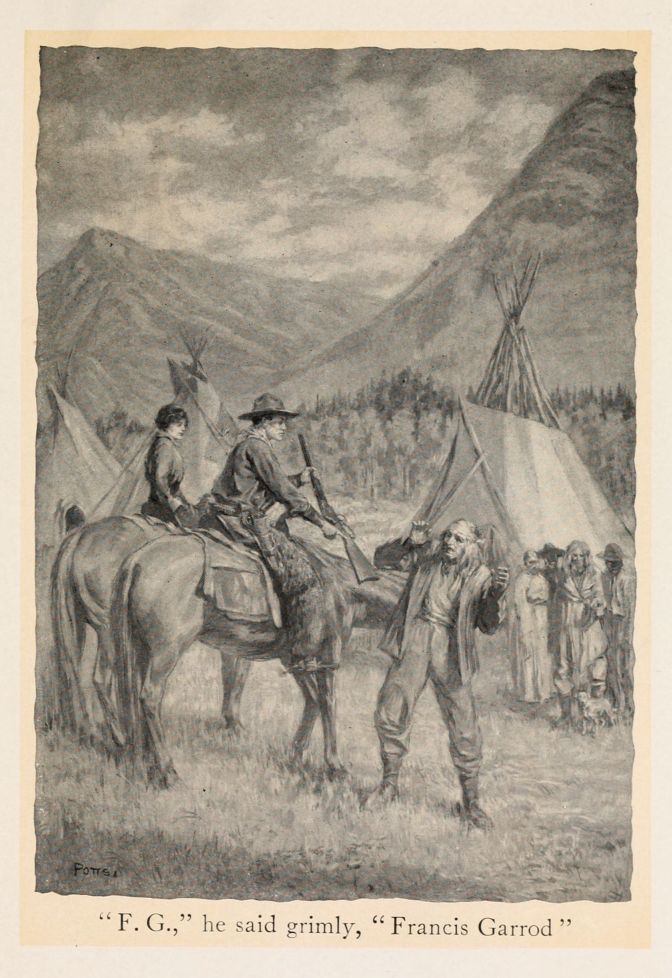
Mary returned to Jack, bringing a gun, which she handed him without comment. He recognized it. It was a weapon that had lately been aimed at him.
"This is the sick man's gun," he said, looking hard at Etzeeah.
The chief threw up his hands. "A Winchester thirty-thirty, like all our guns," he protested. "There are twenty here the same."
Other men held up their weapons to show. Jack merely turned the gun around, and pointed to initials neatly scratched on the stock.
"F. G.," he said grimly; "Francis Garrod."
"F. G.," he said grimly, "Francis Garrod"
"How do I know?" said Etzeeah excitedly. "I have no letters. If it is the white man's gun, Ascota left it."
"Ascota does not leave a gun," said Jack. "Where is Garrod?"
"I don't know," muttered Etzeeah. "I have not seen him."
"You are lying," Jack said coldly. "For the last time I ask you, where is Garrod?"
Etzeeah fell back on a sullen, walled silence.
Jack turned to Mary. "Is there a woman or a child that he sets great store by?" he asked swiftly in English.
"Etzoogah, his son, the pretty boy yonder," she answered.
Following her glance, Jack had no difficulty in picking out the one she meant. He was a handsome, slender boy, a year or so younger than Davy. Where the other children were in rags, he was wearing an expensive wide-brimmed hat from the store, a clean blue gingham shirt, new trousers, and around his waist a gay red sash. Moreover, he had the wilful, petulant look of the spoiled child; plainly the apple of the old man's eye.
"Get me a horse and a rope bridle," Jack whispered to Mary.
There were several horses picketed within the square, handy to their owners' uses, and Mary made for the nearest.
"You take my horse?" Etzeeah demanded, scowling.
"It is for your son to ride," Jack said with a grim smile. "Etzoogah, come here!" he commanded.
The boy approached with an awed, scared air. Etzeeah started to his side, but Jack coolly separated them by moving his horse between. Mary returned with the other horse, and the boy fell into her hands. She smiled at him reassuringly.
"Get on," she said. "Nobody's going to hurt you. Come with us to our camp. Davy is there."
All the children knew Mary and Davy. Moreover, there were always good things to eat in a white man's camp. The boy was well pleased to obey. Etzeeah shrilly commanded him to dismount, but the apple of his eye merely laughed at him. The old man began to break. His eyes dulled with anxiety; his hands trembled.
"What you do with my boy?" he demanded. "We shoot if you take him."
Jack laughed. "A red man can't shoot a white man," he said. "His hand shakes too much. We will take the boy to our camp. We will keep him until you bring the sick white man to us. If you don't bring him back, well, maybe we will send the boy outside and make a white man of him."
Jack gave him a moment. There was no sign from Etzeeah, except his trembling.
"Ride on," Jack said to Mary.
They wheeled their horses, and Etzeeah broke down.
His hand went to his throat. "Stop!" he muttered thickly. He did not cry out or protest. He merely shrugged. "So be it," he said stoically. "I will find Garrod if I can. Ascota took him away from camp two days ago, and came back without him."
"Killed him?" cried Jack.
Etzeeah shook his head. "He was mad. Madmen are not harmed. He took him into the bush and left him."
"Left him to starve?" cried Jack. "Good God!"
"He was mad," repeated Etzeeah. "The beasts and the birds will bring him food."
Jack shrugged impatiently. "Very well," he said. "I'll have no more lies. You come back and show me the place now, or I take the boy."
"I come," he said. "Etzoogah, get down. Get my blanket!"
The boy obeyed, none too willingly, and Etzeeah mounted in his place. "You feed me?" he asked.
"There is plenty," said Jack. To Mary he said in English. "Make him ride ahead of you out of camp. I'll stay and hold the crowd. Sing out when you reach the trees, and I'll come."
In spite of herself, fear for him transfixed her eyes. "Jack," she murmured.
He frowned. "No weakness. You must do as I say."
Etzeeah got his blanket, and he and Alary rode out of the square. The Indians stirred and muttered angrily, but the blue eyes still held them chained. When Mary's "All right!" reached his ears, Jack turned his horse, and, swinging himself sidewise with a thigh over the saddle, walked out of the square, watching them still. The theatrical instinct of a young man suggested rolling a cigarette to him. Slipping his arm through the bridle rein, he got out the bag of tobacco and the papers.
At a hundred yards distance the spell that held the Indians began to break, and they moved forward between the tepees, cursing Jack, and brandishing their arms. Jack's horse started forward; pulling him in, he moistened the cigarette, watching them still. Guns were raised at last—and fired. Still Jack walked his horse. He could see that as yet the gun-play was merely to save themselves in the eyes of their women. No bullets came in his direction. But he could not tell how long—— He lit his cigarette.
A bullet whined overhead. Another ploughed up a little cascade of earth alongside, and his horse sheered off. A chorus of maniacal yells was raised behind him. It was only fifteen yards to the trees. Jack threw away the cigarette, and gave the horse his head. They gained the forest, with the bullets thudding deep into the trunks on either side.
XVII ASCOTA ESCAPES.
When Etzeeah caught sight of the little tents through the trees, he pulled up his horse. Extending a trembling forefinger, he asked hoarsely:
"Ascota, is he there?"
"Yes," said Jack. "He can't hurt you. He's tied up."
Etzeeah slipped from his horse. "I wait here," he said. "I not go where he is."
"Are you afraid?" asked Jack with curling lip.
Etzeeah had turned pale; his eyes darted from side to side, and he moistened his lips. "I am afraid," he muttered doggedly. "He is more than a man. He has made the beasts speak to me; the porcupine, the bear, the beaver, each after his own nature. He has made men mad before my eyes, and brought their senses back when it pleased him. He mastered the white man, and made him kneel before him, and bring him his food. This I saw. The like was never known before. Who would not be afraid? What if he is tied? He will wither me with his eyes!"
Jack and Mary looked at each other in perplexity.
"Blindfold Jean Paul," Mary suggested.
"Good," said Jack with clearing brow. "Watch him," he added in English, "and come over when I wave my hand."
Jack led his horse across the brook. Here another evidence of Jean Paul Ascota's evil power awaited him. Davy at sight of Jack sprang up with an odd, low cry, and came running to meet him, running waveringly as if his knees were sinking under him. He cast himself on Jack, trembling like aspen leaves.
"Oh, Jack!" he gasped. "I'm glad—oh, Jack! Jean Paul—"
"He's safe?" demanded Jack.
"He's safe. Oh, Jack!—he said—he's a devil, Jack. He made me want to let him go! He said—oh! it's horrible! He said—oh! I can't tell you! Jack!——"
The boy's agonized voice trailed off; he sighed, and, his slender frame relaxing, hung limply over Jack's arm. Jack let his horse go, and waving to Mary to keep back, he bent, and dashed the cold brook water in Davy's face.
He revived in a moment or two, and clung to Jack. "Oh, Jack!" he murmured, "I thought you'd never come! I was near crazy. He said—oh! I can't tell you!"
"Never you mind, old boy," said Jack gruffly. "Forget it! Mary and I are both here. It's all right now."
He carried him up the bank, and put him down by the fire. A sip from Jack's flask further restored him. Then Jack turned with grim eyes and clenched fists toward Jean Paul's tent.
"You devil!" he muttered. It was the word they all used.
"I want to smoke," Jean Paul said impudently.
"Lie there and want it, damn you!" said Jack. He had much ado to restrain himself from kicking the beast. As it was he flung him over none too tenderly, and taking the handkerchief from the breed's neck, tied it tight round his eyes.
"There's somet'ing you don't want me to see, huh?" sneered Jean Paul.
Jack was a little staggered by his perspicacity.
He waved his hand to Mary. She brought Etzeeah across, and flew to comfort and restore Davy. They never did learn exactly what Jean Paul had said to him. At any mention of the subject the boy's agitation became painful to see.
Etzeeah after coming into camp never once opened his mouth. He regarded Jean Paul's tent as nervously as if its flimsy walls confined a man-eating grizzly. He sat down at some distance, and at the side of the tent where Jean Paul could not have seen him even had his eyes not been blindfolded.
Jack brought wood, and Mary started to prepare a meal for them all, before taking to the trail again. At a moment when there was comparative silence a loud voice suddenly issued from the tent, speaking the Sapi tongue.
"Etzeeah is there!"
They all started violently. It was uncanny. Etzeeah paled, and sprang up. Jack laid a heavy hand on his shoulder.
"I smell him!" the voice of Jean Paul went on, full of mocking triumph. "Nothing can be hidden from me! Etzeeah has betrayed me! Bound and helpless though I am, don't think you can escape me, old Etzeeah! My medicine travels far! Your son, your fine boy Etzoogah, shall pay. He's paying now! He falls and twists on the ground with the frothing sickness—the fine boy! He curses his father!"
Jack was struggling with the frantic father. "For God's sake, stop his mouth!" he cried to Mary. "A gag!"
She flew to the tent, and presently the voice was stilled. The last sound it uttered was a laugh, a studied, slow, devilish laugh, frightful to untutored ears. We are accustomed to such tricks on our stage.
Etzeeah lay moaning and wailing, clawing up handfuls of earth to put on his matted gray head. Jack arose from him white and grim, and with a new light in his eyes.
"We've had about enough of this," he muttered between his teeth.
Mary, divining what was in his mind, flew to him.
"Jack! Not that! Not that!" she gasped, breathless with horror.
"I'm not going to do it here," Jack said harshly. "I'll take him away. What else can I do? Look at Davy! Look at the Indian! This breed is like a pestilence among us! He'll have us all stark mad if I don't—"
"No! No!" she implored, clinging to him. "You and I are strong enough to stand it, Jack. We'll come through all right. But we never could forget"—her voice sunk low—"not his blood, Jack!"
His purpose failed him. He caught up her hand and pressed it hard to his cheek with an abrupt, odd motion. Dropping it, he turned away. "All right," he said shortly. His eyes fell on Etzeeah. "Get up!" he cried scornfully. "This is old woman's talk! If he can send sickness through the air, why doesn't he strike me down, who bound him, and blinded, and gagged him?"
Etzeeah, struck by the reasonableness of this, ceased his frantic lamentations.
In an hour they were ready for the trail again. Jack sent Mary and Davy on ahead with Etzeeah and the pack-horses. It was arranged that as soon as they reached the site of the former Indian camp, where Etzeeah said Jean Paul had turned Garrod adrift, they were to drop the baggage and go in search of the missing man.
As soon as the others had ridden out of sight, Jack removed the blind and the gag from Jean Paul and cut the cord that bound his ankles and his wrists together. He freed his wrists; his ankles he left bound. The half-breed stretched out, and rolled on the ground in an ecstacy of relief. Finally he sat up, and Jack put the food that had been left for him where he could reach it. Jack stood back, watching him grimly, a hand on the butt of his revolver.
"Are you goin' to shoot me?" Jean Paul demanded coolly.
"I wouldn't waste good food on you if I were," returned Jack. "Hurry up and put it away."
"You not got the nerve to shoot me," sneered Jean Paul.
"Try to hypnotize me and you'll see," Jack said with a hard smile. "I'd be glad of an excuse."
"Why don' you shoot me now?" Jean Paul persisted, with a look like a vain and wilful child, experimenting to see how far he can go against a stronger force.
"I'd rather see you hang," said Jack.
"The police can't touch me. I do not'ing against the law, me."
"There's a thing called treason in this country," said Jack. "You can hang for that."
Jean Paul laughed. "Fort Cheever long way," he said. "You not bring me there, never."
"Then I'll bury you on the way," said Jack with his grim start of laughter.
When Jean Paul had eaten, Jack bound his hands in front of him this time, and liberated his feet.
"Get on," he said, pointing to the horse.
"You can't make me," Jean Paul said with his sidelong look.
"Shan't try," said Jack coolly. "You can run along at my horse's tail if you'd rather."
Jean Paul scowled at the suggested indignity, and climbed on without more ado. Jack tied his hands to the saddle horn.
It was seventeen miles down the forested valley back to the site of the former Indian camp. This, the ancient route between Forts Cheever and Erskine, was a good trail, and they covered the distance without stopping. Jean Paul rode ahead, Jack following with his revolver loose in its holster. It may be said that he almost hoped the breed would try to escape, to give him a chance to use it, but perhaps Jean Paul guessed what was in his mind. At any rate he rode quietly.