ITER BOREALE.
Reading edition
IN the year 1725, I travelled over the western and northern parts of England, in company of Mr. Roger Gale, a gentleman well known to the learned world; as his father, Dr. Thomas Gale, dean of York. I was requested, by some lovers of antiquity, to transcribe those notes which I wrote day by day during our journey; and though I had visited several of the places, through which we passed, in my former journeys, yet a second view (especially in company of a person so well versed in antiquities) gave me an opportunity of making some farther remarks, which I flatter myself may be of use to those who are fond of studying the antiquities of our own country.
I shall begin with Dunstable, the MAGIOVINIVM of the Romans. Many large brass coins, and many silver, are found in ploughing the fields here, and when digging in the ruins of the old priory by the church: I got a Nero of Corinthian brass, and a Faustina. The downs here are but a rib or narrow ridge of chalk; or northward is sand or clay.
Madan castle is circular, perhaps oval: the space within is a fine plain: the vallum is small, and the ditch much smaller; so that I am persuaded it was made rather for spectacle than defence. Tethill castle is a little further westward, a strong little camp upon one of the many north-west precipices of chalk exceeding steep: a village underneath, and springs of water: it is a double camp, both square; in one a round keep, or large tumulus ditched about, which shows it is a Saxon work.
The prospect all along the steep northern sides of the Chiltern hills is lovely; the Icening-street goes at the bottom; it is corn-field for the most part. These hills are all steep westward and northward.
Brick hill, or more properly Brink hill, stands on a very high sandy hill, steep north-west: the Watling-street, just before it arrives here, winds a little eastward, to avoid a deep valley, and passes above it.
Stone begins beyond Brick hill; and we enter a country of long-extended ridges, with large valleys and rivulets at bottom.
DAVENTRY.
The country here, which is probably the highest in England, is a quarry of reddish stone, in small strata; the uppermost very full of shells, especially belemnites. The air must needs be exceeding good, as in the centre of England; the soil is a reddish clay. This is a neat pleasant town, well situate: two springs of the Avon run close by it. Eastward the great hill whereon is Borough-hill camp: a very pretty spring arises in the inner ditch, probably the highest in England; it is on the north-east side, which way the hill declines. This camp is on that end of the hill which it fills up, and conforms to its shape; double ditched, but toward the entrance the ditches separate, and meet at the entrance obliquely, after a manner I have not seen elsewhere. All round the mid-way of the hill it is boggy and springy: the whole hill is stone. Upon it are many more works of great compass; I suppose, some later camps of the Danes, Saxons, or Britons against them: there seem to have been some entrenchments round that part of Daventry town where the church stands: the inner ditch of the first-mentioned camp is very broad, and the vallum proportionable. Spellwell is the name of the spring on Borough hill; it looks blue: they say it is good for sore eyes, and is a great dryer.
It is a stony and clayey soil all the way from Daventry to Warwick: the country is open and full of corn-fields. The river divides countries of different nature; for on the other side it is a very good sort of large rocks: the country is very woody.
PRAESIDIVM. Warwick.
There seem to be signs of a camp on the east side of the river, over-against the castle, in a close where is an old chapel now become a barn: a spring riles a little above it: if so, then this was the garrison before the Romans built the city on the west side. Warwick is a very neat and beautiful town; many fine houses and public buildings of good stone, dug up at hand. The old castle is very perfect, and a noble seat: many fine pictures of the Greville family, and others, particularly an original of Sir Philip Sidney: the whole length of the place is one suite of rooms very magnificent; one wainscotted with cedar: they all look over the river. One may see here much of the ancient manner of fortification: their methods of defence, two gates, two portcullices at the entrance; with hole to drop down poles, and an immense strength of stone-work: before the towers at the gates are iron hooks fastened into the wall, which they told us were for hanging wool-sacks on in a siege: a tower in the corner of each wing, very high; that at the corner next the river they call Cæsar’s tower, made of three circular segments; that at the corner next the town is twelve-angled, called Guy’s tower: the keep is very high, now made with a circular walk to the top. At the priory, in two galleries which seem to be part of the first building, are some paintings on glass, of religious stories. The chapel at Guy’s cliff is double, having two arches within, that divide its length into two ailes or chapels. Under the castle-walls, by the river side, upon the rock grows much liver-wort, thriving in so agreeable a place. I observed the lowermost rocks are perpetually dripping, which gathering together in a channel underneath, makes a small rivulet. This seems to indicate, that fountains are the effect of exudation from the most elevated protuberances into some internal cavity; which though by drops only, yet the sum amounts to enough to make a spring run perpetually; as the alembic distills the vapors. Now the tops of the hills are kept always moist by the natural ascent of the water below. I know nothing against this doctrine, but springs arising in very large quantity from narrow apexes, and where no other higher ground is near, if any such springs there be: but we want sufficient number of instances and data to determine this great question. People since the creation have been very negligent, or very injudicious, in making observations for this purpose. This is not an useless inquiry; for if we found out Nature’s method in this affair, it would assist in making artificial springs, or finding out natural ones, to the great enrichment of barren lands, and watering all in a dry season; water being the universal instrument of all increase and nutrition.
Warwick bridge has twelve arches. The potamogeiton majus grows in the river; a large yellow flower, tripetalous, with an apple like the Egyptian lotus.
COVENTRY.
Dr. Philemon Holland, who translated Camden’s Britannia, is buried in the choir of Trinity church. In the window is a piece of painted glass of Leofric earl of Chester, lord of this place, and Godiva his wife: he holds a charter in his hand with this writing, I Luryche for love of thee grawnte Covetre tol fre. Stichell, a mile south of Coventry, has its name from the clays. The road here is paved very broad for a great length. St. Michael’s church is a very stately and magnificent building: the spire is very fine, and the highest of any I have seen for its base, but built of a mouldering stone. Over-against it is the town-house, a large stone building, and old, like a church: a very old wooden chair there, said to be that wherein king John was crowned; much old rusty armour; pictures of several kings of England, and other benefactors; and many inscriptions, Latin and English, relating to them. A vintner bought some ground north of St. Michael’s, and built a house upon it: he dug up great ruins of the old convent, and many coffins, and among the rest (as they say) that of Leofric and Godiva. This is a very large and populous city, but narrow irregular streets; and the houses chiefly of wood, and very old, hanging over the streets. The gates are many and stately: no doubt the walls were answerable, but now demolished for the most part, after the rebellion: in some places, where parcels are left, it is very thick, and so strong, that they only undermined it, and threw it down flat; as particularly in the meadows north of St. Michael’s, where it passed over the brook by an arch. Between that and the church stood the priory, founded by Leofric before the Conquest: some old walls of it remain. Here have been many elegant brasses in the churches, but broke up. The famous Cross is of a pretty model, but of perishing stone. The basis of St. Michael’s steeple is but twelve yards from outside to outside of the buttresses. Every road hence is paved with a broad high-raised causeway, from every gate a mile.
Griff coal-works here, forty ells deep, of vast compass. No sort of fossils found in them. Griff, from grave, grooff, digging. The soil sandy from Coventry hither, then black earth. The coal-mine runs from Coventry to Tamworth in a line: here are such breaches that intercept the strata, and such trapping and dipping as in Somersetshire: the fissures, upon breaking the track and parallelism of the strata, make them diverge generally. Great old toads are often found in the solid coal, leaving a cavity of their own shape. They draw away the water from the mines by an invention originally of the earl of Worcester, improved by Captain Savery and others: it works with a vast power from the atmosphere pressing into a receiver exhausted of air, by vapor, and then condensed. I saw the ruined chapel of Nuneaton. Many religious houses thereabouts, and remains of camps, castles, &c. and nothing else can make amends for the badness of the roads.
MANDVESSEDVM.
Dugdale says, divers Roman coins of brass and silver have been found here. It stands on the river Anker. The first syllable of the name remains, Man-castle or ’cester. At Oldbury a square fort of thirty acres, with very high rampires, situate on an eminence: this, no doubt, was a camp: to the north of it have been found frequently flint axes of the old Britons, about four inches and a half broad, ground to an edge: there are no flints within forty miles of the place. Either our maps are wrong, or the Roman road goes very much winding, perhaps to avoid the great Arduen forest. The name of this forest left in divers places, Weston in Arden, Henly in Arden, Ardbury, &c.
I called on Mr. Henry Beighton, an ingenious gentleman, who is making a map of this county; and we visited this station. South a little of the bridge, under which the Anker passes the Watling-street, I found the old city: it lies on both sides the road, and is of a square form: the road passes exactly through the middle of its length, which is 600 foot, its breadth 200, on each side the road. The field in Leicestershire is called Old-field banks; that in Warwickshire, Castle banks. The ditch is very perfect quite round, and the bank whereon stood the wall. The people know of great stones, and mortar work exceeding strong, being dug up; much Roman brick, iron, and great numbers of coins brass and silver, and some gold: in sinking wells the like things found. Several vaults go quite through, and cattle have sometimes dropt into them. A spring at the north-east gate. Oldbury is a great camp upon a high hill, west of the place; whence a most delightful prospect. The hill whereon stands the church of Mancester, which is a field or two off the bridge, seems to have been a camp too: it is intrenched very deeply, but I cannot say with so much regularity, as to its present appearance, that will ascertain it to the Romans: it is in the way to Oldbury. The houses reached from the castle to the bridge; for in the ploughed piece between, called the Furlong, foundations have been discovered, and many bridges. A great family has lived at Mancester, and of that name, who probably made, or altered, the ditches there. Geo. Astley esq. of Wolvey, near High-cross, has a great collection of coins found at High-cross, and all the neighbouring places; as Monks Kirby, where urns and ashes have been often found. The prospect from Oldbury is exceeding extensive all over the country; the camps of Shugbury, Arbury, and Borough, all in view, and the country that way, where the Watling-street runs, as far as Watford gap; so all into Nottinghamshire, and westward to a great distance. Withersley, and several villages round, parish to Mancester as their mother-church. The church there is a pretty large building with a tower-steeple. The country there is all a rock, and abounds with springs: the rock is of very hard stone, and dips westward, as the adjacent coal-mines. Mancester stands on much higher ground than the road and old city. More coal-mines about Dudley, Wolverhampton in Staffordshire. Sometimes the ends of the coal at those breaches bend the contrary way: this shows the breaches were made before the coal was perfectly hardened. When the damps exanimate a man at these coal-pits, they draw him up instantly, and make a round hole in the earth, put his head in, and cover it with fresh mold, which infallibly restores him. Between Wormleighton and Stanton they found, in a pit, a trunk of a tree hewn into a coffin, with bones in it; and many coins, particularly of Constantine. At Wolfencote, upon the Leam, in sinking a well they came to a vault with urns and coins: in digging at the priory at Coventry they found the old cloysters, with many grave-stones of monks; and in the old walls, which were very thick, bones and skulls with teeth, &c. were laid in, as fillings-up, from ruins of the older monastery.
BIRMINGHAM.
A large rich town, the very shop of Vulcan. The vicinity of the coal-mines has made it the chief place in England for all sorts of iron work, sent hence throughout the whole world, in great abundance: it is a pleasant, woody, plentiful country hereabouts: they have repaired an old church, and built a new one: the streets are large and good buildings: there is a pretty square, inclosed and planted like Soho: the town lies on a declivity. In the old church are tombs, in alabaster, of a Jerusalem knight, two other knights, and some others. Deritend chapel built of timber, 5 R. II. by the river side. Here is a large school-house founded by Edward VI. not long since rebuilt: they have marked out large tracts of ground on the hill round the new church for buildings.
I find the Rigning-street way comes from Alcester, directly north and south, by Moseley, over a heath where the road appears now very broad, on the east side of the rivulet Rea: it descends Camp hill, and passes the river by the present bridge, and the valley where the low and old part of the town stood: it makes an angle in order to pass this broad meadow, directly as the Icening-street does at Newbury, or ad Spinas. No doubt but here was a station in the time of the Romans, because a convenient distance, ten miles from Etocetum: but of its name I know no footsteps. I imagine the present name derived from the great quantity of broom growing all round. Ingham signifies the dwelling upon the meadows; for the town has advanced itself but by degrees up the hill. When the Roman road has passed the valley, it turns up the first street on the right hand (Park street) to take the most convenient rise up hill, and at the end of the town falls into the present road, with its former direction to Etocetum. Probably upon Camp hill has been a camp, being by the road side, and having a fine prospect: what with the deep roads to Coventry and Warwick, here meeting the Ricning; and the inclosures, and digging for brick and tile, I could discern no signs of it. At this town is a considerable manufacture for thread. Beyond Birmingham, the Rigning-way runs upon the division between the counties of Stafford and Warwick, by Aldston.
In the forges here, three men beat together with successive strokes; which brought into my mind Virgil’s
Brontesque, Steropesque, ac nudus membra Pyracmon.
ETOCETVM.
A little to the west of where the Rigning crosses the Watling-street, south-west of Litchfield stands a little village, called Wall; south of that a quarter of a mile is Chesterfield. This is said to be the oldest city in England, by the inhabitants; and the Watling-street the oldest road. The Itinerary of Antoninus sufficiently evinces the place to be Etocetum. Part of the Rigning-way, northward hence, is very fair, with a high strait bank; part very mirey and bad. The country is sandy, clay, and full of round coggles, of which the road was composed. The Watling-street eastward hence about half a mile is inclosed in fields; but westward it appears very strait and broad. They call the Rigning the Hickling street at this place; and likewise Port-lane: it goes to Burton upon Trent. Many Roman coins found here, both great and small. Mr. Quintin, living here, has many: he owns the field called the Butts, where I saw great ruins of walls equidistant twelve foot, and twelve high, like square cellars. I saw bits of pavement there, Irish slate, Roman bricks, some pieces thus marked . The walls are a yard thick, of strong mortar, rubble stone, &c. The Watling-street parts the two villages, Chesterfield south, and Wall north. By the side of a road going northward thence to Pipe hill, I immediately espied the Roman walls, notorious by the manner of their structure; of rag-stone, a course laid sloping this way, a course that way, with very strong and white mortar: this lies under a hedge, and the roots of old oak-trees for the length of a hundred yards, till intercepted by a dwelling-house. They say the building in Butt’s close was a temple; and probably they are not mistaken. The Watling-street at this old city goes precisely east and west: some mile-stones found by the brook running west of the city: a pretty spring there; ruins upon digging all the fields round: the brook has a broad marsh along it westward. A little below the temple, we saw the crown of a subterraneous arch in the hedge. They showed me where the Rigning-way went through a corn-field south of the castle, and passed the river west of Shenston: it is a field way still southward, and an open road north. The castle stood in the north-west angle, between the Watling and another road, going to Litchfield, upon a gentle southern declivity: the old walls are founded upon the solid rock, and much more of them was left within memory: now they pull them down to build withal. There is a gate crosses the Watling-street at the castle end, by the side of the other road. That called the Temple is upon the western declivity, much lower in elevation than the castle, which is upon the highest ground in the neighbourhood, and somewhat raised above the common level, by heaps of rubbish, and foundations, which I could discern above ground in the orchard. The place of this old city is an elevation, and has a good prospect, especially southward: Oldbury castle and Mancester are in view. Wm. Milner, at the Swan, is an antiquary, and knows the old name of the place: he showed me a Roman wall in his cellar, and says it goes far backward by the garden. No doubt there were houses all the way, on both sides the road, from the castle to the brook, which is a sweet descent westward. There was a Roman coin of gold found near Hales-Owen. Many floors, pots, and other antiquities, found on the south side the Watling-street, in the ploughed fields called Chesterfield Crofts; and a very fine red earthen ware, with figures of bucks upon them. The circumference of the castle is hardly to be found; the ground has not been dug in the yards hereabouts. The Rigning-way goes by Lyn-lane, and so passes the river west of Shenston, at Shenston nether town. This country lies upon a rock here and there interspersed, but not a good stone; but there is a quarry of good free-stone, of a brown colour, by Swinfield. I saw a Nero of Corinthian brass, and some square Roman pavements found there.

The Rigning runs on the east side of an eminence called Mawcop hill, as it passes northward hence. The building in Butts close is level at top with the pasture, except toward the declivity, where they have dug away the earth, and the great wall that ran along it. Two miles beyond Etocetum, on the top of a hill is Knave’s castle, on the south side the Watling-street: it is a large tumulus inclosed within three ditches; an entrance on the south side: it has been hollowed at top. This is in a vast moor, or common full of heath, as the nature of the soil is all the way. The Watling is very fair and strait, and in many places the ridge is perfect for a great length. A little west of the bridge, under which the river Penk crosses the Watling, are a few houses belonging to Stretton, upon an eminence. This is thought to be the
PENNOCRVCIVM.
And, no doubt, it was hereabouts, to answer the miles in the Itinerary. The village of Stretton lies a little to the north of the road; and a mile south is Brewood, another village, which they say has been an old city: it lies upon the Penk. Upon ploughing the fields they find Roman coins frequently, and much other antiquities. In that great old city, king John kept his court. A little brook runs a pasture or two below the road, and parallel to it, into the Penk, called Horse brook: it is a very full river, and the bridge is broad it runs through. The Watling-street is here east and west. Three large stone bridges cross the river in two miles. The old Roman city, no doubt, was by the road-side somewhere near here, and perhaps by Horse brook. Brewood may have been a Roman town, but it is too far out of the road for the convenience of travellers; and Penkridge is two miles and a half off, so that it can put in no claim. This town must have borrowed its name from the river, as that from the Roman city. Penkridge stands by the side of a large marsh made by the river: the church is built of good stone; a remarkable stone cross in the street. The healthiness of this country favours Mr. Baxter’s conjecture of the derivation of Pennocrucium.
The prospect hence southward is noble, and very comprehensive. Dudley castle, and many of the steep summits of the hills in Worcestershire, are in view; together with the mighty height of the Wrekin, which, from a plain, rises like a sugar-loaf to a narrow tip, and of very difficult ascent. The Watling-street runs under it. It is good land here, warm and woody, being just beyond the moor.
STAFFORD.
The castle here to the north west, a mile and half off, stands on a tip of rising ground very steep to the north-west; on which they have raised a keep, or high mount of earth: on that stood a square tower of stone, part of which remains. Here is the most magnificent prospect quite round, that one can imagine; the Malvern, the Wrekin, and many Welsh mountains, lift up their narrow heads beyond the utmost horizon, and above the clouds, as it seems. To the eastward is room for the castle, fenced too with a deep ditch. This was the work of Edward the elder, in the Saxon times; or rather his sister, the virago Elfleda, A. D. 913. A little church stands near the castle, called the Castle church, with a house or two near it. The situation of Stafford is low, in a broad marshy vale, where several rivers meet; and it has been fortified quite round, the waters of the rivers favouring that purpose. Two miles directly eastward is Beacon hill, a large parcel of rocks laid upon a level eminence, and covered with grass, having a steep ascent on every side, like a camp: it has a very pleasant prospect. The town-house here is a handsome large building. Upon St. Amor heath, under Beacon hill, a battle was fought in the civil wars.
We passed through Uttoxeter, where I could find nothing Roman, notwithstanding its name, cester; only heard of three gold coins found by the river side, not far off, some time since: it stands in a very fine country, watered by the Dove, a fruitful river, running through large meadows. Thence, in our way to Derby, we saw several large, flat Celtic barrows, upon a common at Sidbury. We rode over the meadows under Tutbury castle, famous for the bull-running on Aug. 10. where the people of two counties meet according to ancient usage, and contend for the honour of their counties, sometimes to bloodshed. The castle, once the seat of the dukes of Lancaster, stands on a very high precipice, looking north and west, strong by nature and art; very probably a Roman camp originally, as its name, bury, imports: it is not far from the Rigning-way. Tot signifies an eminence. Underneath it we went through Hilton. The lord of the manor there held of the dukes, by a ridiculous appearance before him, on the day after Christmas, whilst Jack of Hilton blowed the fire. Of this, of the king of the fidlers, of the bull-running, &c. see a large account in Dr. Plot. Mr. Gale says, this Jack of Hilton was a Saxon idol, called Pouster: it was made of brass, hollow, with a little hole, which when filled with water, and set before the fire, as an æolipile, vented its contents in vapor, rarified with great force. This was a good philosophical trick to delude the vulgar, and would appear like magic to them, ignorant of the cause.
Mr. Prescot of Chester showed us the impression of an intaglia found at Uttoxeter.
A mile and half off Derby we fell into the Rigning-street coming from Burton; which, leaving Derby a little on the east, passes over Nun-green to Derventio: there it crossed the river on a bridge, and thence went to Chesterfield.
DERVENTIO.
I find the Rigning proceeds over the common, by the mill and brook at the west end of Derby, and falls into a valley, which gives a gentle descent to the river side, every where else steep, over-against the old city: this, no doubt, is the reason why the Romans placed it in that very spot. The river is very broad and deep, equal to the Medway at Maidstone; the sides steep, so that a ford was not at all practicable: it is six or seven foot deep here at least. Darley slade is the name of the valley where the descent of the road is: they call the road the Foss hereabouts; which shows that no more is meant by the name, than that it is an artificial work: the Foss and Rigning therefore are but synonymous terms. A little up the river, beyond the city, was the bridge: in time of a frost, when there is clear ice, they can see the foundation of the piers very plainly, and a piece of one is still left. Thence the road proceeds over the pasture, where, after a fortnight’s dry weather in summer, they can distinguish it by the parched grass: it goes up the valley north of Bradsal, by Priory Hall, so to Chesterfield. Another such way, they say, went up the hill directly from the street of the city by Chadsden: part of it has been dug up near the town by the Crown ale-house, and its ridge is still visible. In the pasture over-against the house two square Roman wells were opened by a violent flood in Sir Simon Degg’s time: they were made of very broad flat stones, let into one another, and were paved at bottom with bricks set edge-wise, as they tell me. Roman coins are found in every road, foot-path, and ditch, about the town: they never dig in the gardens, or pastures, but they find them, together with rings and other antiquities. A man who kept the Duke’s-head ale-house found seven score at a time in digging a hole to set a post in but they are all dispersed. The city of Derventio is in possession of the deanery of Lincoln: the city walls were dug up in great quantities to mend the ways with but they were so strong, they were forced to blow them up with gunpowder. There is much painted glass in Morley church, a mile beyond Bradsal, and tombs of the Sacheverels. A piece of the wall of Derventio is left under Mr. Hodgkinson’s garden-house. I saw a piece of a vase of coral-coloured earth found there, also several pieces of pillars; and they meet with foundations wherever they dig. Mrs. Hodgkinson showed us a gold Anastasius, victoria aug. g. g. said to be found near Leicester and a silver Arcadius. I saw a large brass coin, found at Derventio, Diva Faustina. I find this city is exactly of the same dimensions as Manduessedum, 120 paces long, 80 broad.
I rode to the hill south of Littleover, upon the Rigning-way, which lies in a strait line under the eye as far as Etocetum, and the hills beyond it. Litchfield cathedral appears a little to the west of it. The valley of the Trent, by Burton, is bounded on each hand by great heights. Repton, the burial-place of Ethelbald and other Mercian kings, is in view. From the other side of the hill, north of Littleover, the road butts upon the valley of Bradsal, by Priory hall, directly over Derventio. The Rigning is the common road from Burton to Derby, till a little north of Littleover it descends the hill to the left of the common road, which there is drawn to the right on account of Derby. I saw a great number of coins found here; Trajan, Carausius, pax aug. Victorinus, Magnentius, Dioclesian, Valens, &c. Mr. Hodgkinson gave me a Constantine, soli invicto comiti, struck at London. I measured the castrum with exactness: it is 600 foot long, 500 broad. We saw the wall on the outside Mr. Lord’s house: the mortar is full of pebbles as big as nuts, but excessively hard. Darley Slade is a fine descent for the road. We saw the admirable silk-looms again: there is a large additional building to them. The five churches here have all tower-steeples: the new one, a spacious and neat pile; the tower belonging to it, of old work, is stately. There is an old chapel on the bridge. A weak chalybeat water was found out lately, two miles off. The market-place is a pretty square.
Entering the Peak country, where the rocks begin, we saw two tumuli on the edges of two opposite hills. We came by the great rock called Radcliff, where the hermitage is: these and the neighbouring rocks have a frightful appearance: on the back of them are some stones set upright, two and two, as if the remains of a Celtic avenue. All around, the hills are big with lead ore. The cattle drinking the water here are liable to a distemper called the belon: it is owing to the mercury that falls in the smoak of the smelting-mills: they become asthmatic, and frequently run mad. Cats, dogs, and poultry, are seized with it.
BAKEWELL.
This town seems to be Roman, and possibly its name was Braciaca, because of the inscription found near here in Camden, DEO MARTI BRACIACAE. There is a large tall stone in the church-yard, raised on a pedestal, as a cross, with engravings, very ancient, of George and the dragon, a crucifix and other things, with flower-work: it is eight foot high, besides the pedestal. The church is a large handsome building, but in very bad repair; a spire-steeple upon an octagonal tower, and that set on a square one; the whole in the middle of the church; the choir large: an alabaster tomb before the altar, of one of the family of Vernon: the south transept has, in a large chapel, many tombs of the Vernons, and Manners’s, ancestors of the duke of Rutland, but in a ruinous condition: many other old tombs; a knightly one of Colepepper, one of Foljamb, &c. a very ancient font with images, as rudely cut as those on the cross. The church stands much higher than the town. The Wye is a very rapid river; it never overflows, so great is the descent from it. The castle is a square plot of high ground, with a large tumulus hollow at top. I cannot affirm there is any thing Roman. This town stands in a flat valley, where the river passes in meanders; and the prospect every way is very romantic. A cold bath at the Angel inn, arched over, and made very convenient. Derbyshire marble wrought here, very beautiful, bears a good polish, full of belemnites and other curious shells petrified together.
CHATSWORTH.
We reviewed this noble seat of the duke of Devonshire’s. The front of the house is a fine design; the colour of the stone agreeably overcast with a faint redness. Several antique marbles: upon the pedestal of a busto this inscription, P. Ælius Aug. libertus. Lycus fecit Solusæ libertæ suæ. a sepulchral urn.
Another, Dis manibus Ti. Claudi thalliani Vix. Ann. XX. dieb. XX. Claudia felicula Mater filio piissimo.
The canal hewn out of the rock is made where a great hill was: now it opens a beautiful prospect towards Winster: it is 325 yards long, 25 broad: the hill was 44 foot high: the cascade is 212 yards long, with 23 breaks. There is an admirable antique Plato in the duke’s library, like that at Wilton; and a cast of Hobbes from the life: also an antique ram’s head. The painting about the house is by Verrio, la Guerre, Thornhill: the gallery is a curious room, painted by Cheron. Vast quantities of Derbyshire marble, of all colours, and beautiful.
BUXTON.
Just before we come to this place, on the right hand is a square vallum, ditch inward; both small, about fifty feet each side: eastward adjoins a roundish space, marked out in the same manner. There are barrows upon the tips of the hills hereabouts. We found infinite quantities of shells among the stone: but the belemnites are most frequent; they are dropped as it were into the superficies of the stone, while soft, with the points downwards. The soil of this country is sandy and rock: the whole superficies of it is a rock, whose strata lie every where parallel to the declivity of the ground: it is lime-stone, like that at Bath; but the layers of it are much thicker. One may guess hence, that this sort of stone by some means procures the warmth of the waters.
We saw Mam Torr from hence seven miles; a steep huge rock elevated above the hills. There is a great yawning between two rocks split as it were from top to bottom: on the precipice of one jaw is an old castle, whence the adjacent town Castleton. Between it is the great cavern called the Devil’s Arse. A few little houses under the very rock. This country is fruitful in what we may call the magnalia naturæ. By these wonders of the Peak, and the warm waters, people are tempted to visit these wild wastes. At a place called Hope I learnt there are some stones, called Marvel-stones, which cannot be numbered: I guess them to be a Celtic temple. I could not hear of those at Chelmerton, though I fancy there must be such, because of some barrows on the hills looking that way: it requires some time, labour, and hazard, to hunt them out, by reason of the rockiness of the country. The sides of the hills, where the villages are, are divided into closes by stone walls, as in other places by hedges.
We went into Pool’s Hole again. This cavern rises, as we go farther in, with the hill: the stones within are covered over with petrifaction, from the water distilling down: some of the icicles are three or four yards long, hanging from the roof; the slow accretion of ages: the springs dribble down every where, as draining through the strata into this cavity. I fancy there are such in most rocky hills, and they cause springs: for we may conceive that after the harder shell of a hill was condensed, and first, as being outermost and more exposed to the external heat, in the infant globe; the internal parts, when they came to harden afterwards, by attraction of so much solidity, cracked and shrunk (as we see clay does in the open air) and so left casual fissures every where: the water then by degrees found or made an outlet from many meeting together; and this created fountains, most commonly toward the bottom of hills. This reasoning is strengthened by springs running in less quantity in summer than winter, because the sun exhales the dew and moisture, not suffering it so freely to sink down into the earth.
Escaped from this Stygian cave, I revisited the antiquity called the Round Fold, by the road side from Chelmerton hither, at Stadon; and under the hill called Stadon Hoe. I take it to be a curious Celtic antiquity, much of the nature of those which in Anglesey and Wiltshire we call Druids houses: so in Dorsetshire circles of stones they call Folds. The country people say it was cast up in war-time long since. It consists of a square vallum, 100 feet each side: the ditch whence it came is on the inside: eastward from this is a circle of 160 feet diameter, of like manner: the whole stands on an open plain, which declines northward: the square is upon a level; but the circular part declines gently from thence: on that point of the circle farthest from the square is a little semicircular cove of earth, like the place of a tabernacle. It is hard to say whether it was for a private use, or for judicature, or religious affairs; but in the pasture behind it is a barrow, and several more barrows in view, on the hill-tops. At Stadon I saw a large square intrenchment, now divided into pastures; and upon the top of the hoe, where the hawthorn stands, seem to have been some works. This circle of ours, by sinking the ditch within, seems well contrived for shows: five or six tire of people may stand commodiously round it, and look over one another’s heads. Both vallum and ditch are but small, much inferior to that of a camp.
In the field by the garden at Buxton are two springs close together, one hot, the other cold. Little flint arrow-heads of the ancient Britons, called Elfs arrows, are frequently ploughed up here. Roman plaster found here, mentioned in Thoresby’s Ducat. Leodiens. p. 558. A Roman road is said to go hence to Burgh, beyond Elden park.
Journeying hence over the remainder of these Alpine regions, we come to Goyt house, in the very centre of desolation. The most western of these hills are more barren and difficult than the others, and fuller of springs. At length we entered the pleasant country of Cheshire, as into a new world; wondering that people are found who can content themselves with the poverty and horror of the Peak, so near riches and delight.
MACCLESFIELD
Is a pretty large and pleasant town, sheltering itself from eastern blasts by its vicinity to these high hills: it stands upon an eminence, and is famous for manufactures of silk twisting, mohair, making buttons, &c. The church is placed upon the edge of the hill. South is a large chapel of the ancient family of Rivers (Ripariis) another of the Leighs, where, for saying a small number of Ave-marys and Paternosters, we obtain 26,000 years and odd days of pardon: to such a degree of extravagance was the superstitious folly of our ancestors advanced!
Stockport is built on a hill of rock. The church is spacious. A place called the Castle-yard, walled in. The Tame, Mersey, and other rivers, meet here, falling from the Derbyshire hills: united they pass swiftly through a rocky channel under a bridge of a single arch, large and well turned: they cut themselves houses in the rock here, as at Nottingham. Sometimes the floods reach the top of the bridge.
MANCVNIVM.
The Roman castrum was on the west side of the Roman road going from Chester, by Stretford, and on the northern bank of the river Medloc. It is a small piece of level ground, somewhat higher than that around it: it does not cover the whole piece, but is a square, 500 foot one way, 400 the other: nor can it well be said to be ditched about; but the ground near it, for some distance, is manifestly removed into the castle, and spread along its verge, not as a regular vallum, but sloping inward: by this means the area of it is higher on the sides than middle, and the external ground is lowered all around, to the foot of the castle, which is steep like the side of a vallum. Upon this edge there has been a wall quite round: the foundations of it are to be discerned almost every where; in some places large parcels of it left, but not above ground. Now they call it the Castle croft. The river Medloc runs near it, but is no security to it, as being not close enough: nor are its banks steep hereabouts, though its channel is rock, as is the whole country near. This is a quarter of a mile from the present town of Manchester. The Irwell river, coming through the town, runs on the west side the castle, and there the Medloc joins it. I look upon Manchester to be no ancient town; and even the hundred is denominated from Saltford, the village on the other side the bridge, therefore older: but Manchester is a much better situation, as higher; placed too between two rivers, having rocky and precipicious banks, with a good prospect: it is a very pleasant, large, populous, and thriving town; new buildings added every day: the roads are mending about it, and the river is making navigable; which will still contribute to its prosperity. The old church is very spacious and handsome, and enlarged still with numbers of large chapels and oratories; but the monuments, which were many, are destroyed and obliterated: a priest, of the name of Huntingdon, lies before the altar. It is a collegiate church, and the stalls in the choir are of very good carved work in the old manner.
This country is very woody, and affords a fine prospect every where, bounded by high and distant hills. A conflux of the many roads at this place gave origin to the town. Saltford is a large town; a broad and very strait street leading to Warington, probably Roman: a very good bridge over the river. Ten yards west from the castle is a natural precipice, which the Romans disregarded, trusting to their walls, but more to their own valour. A cavity cut in the rock by the river, under the south-west angle. The natural track of this road is north-east, but towards Manchester it trends a little more northward; I suppose, with an intent to come to the bridge, where it met the road from Veratinum.
I saw the altar at Holm house, lady Bland’s: it is 16 Roman inches broad, one front; a foot on the sides; 28 inches high: it is now removed out of the garden into coverture. They call the castle the Giant’s castle. Probably there was a town at the river Medloc in Roman times: an annual fair is still kept there. The castle stands parallel to the road. The river Irke comes in here under the college-walls: the castle-walls were pulled up to mend and build the churches and bridges.
I find the Roman road went across the church-yard originally, and so by the common street to the bridge over the Irke, called Scotland bridge: then it ascends the hill, and proceeds with its original direction north-east to Rochdale, which way the old Coccium was. Edward the elder by our monkish authors is said to have built a castle here, which probably was by the church and college; and the church may be founded on its ruins: this drew the town that way: the meeting of the two rivers there, and the steep rocks upon them, rendered it a convenient situation for such a work.
The college founded by Chetham, a tradesman, has a very good library, and good salary: here are about fifty boys maintained.
Mr. Prescot of Chester has a gold Otho found here. I saw a Celt found in the mosses.
CONDATE.
We rode all the way upon the Roman road from Manchester to this place: it is the common road throughout, except a little near Altringham: that market-town has caused it to be left, by a common; but we recover it again at Bowden hill, whence we had the prospect of it a long way before us, in a strait line: it leaves Altringham a little to the east, passes west of Rotherston mere, close on the west of North Tabley house, and so directly to Northwich, which therefore must be of necessity the Condate of Antoninus. The Britons called these wiches, or places of salt-works, Hellath, from heli, salsugo: the last syllable seems to be in Condate: then it will signify the principal salt-work, cond, caput. Part of the road hither, by the Bollin river, they call Wash-way, from its wateriness; which shows the derivation of our country washes. This town stands in an angle made by the Weaver river and the Dane, both which are passed by bridges, sometimes overflow with great fury. South of the bridge, upon the high ground by the Chester road, is a great tumulus, or keep, of Saxon work, called the Castle. This is a pretty large town, but meanly built, depending intirely upon the salt trade: here are the strongest springs of brine, and the wonderful mines or rocks of salt, 60 yards under ground, which they work like coal-mines: how far they extend, is not known. I doubt not but there are many more all over this country: these are found out by chance, not many years since: they carry it into Ireland, Wales, and other places; and boil it up afresh with seawater. It is a most liberal gift of Nature, a compendious way of making salt; these springs being stronger than the ocean: the rock salt stronger than they; for it is perfect salt, transparent like crystal: it lies not in veins, or strata, as other minerals, or metals; but a solid rock, of unknown dimensions, which they hew away with steeled pick-axes, leaving pillars and spaces, as big as a cathedral. Poplar-trees are plentiful in this country: they all lean eastward, as continually pressed by the west winds from the sea.
The country from Northwich to Chester is intirely sand, and very deep: a barren view; once a forest. They dig up the turf every where for fewel; which prevents for ever its being capable of cultivation, otherwise not impracticable: the oaks are all gone. Mid-way is the Chamber in the forest, as called, upon a very high hill of sandy stone. Here they say Edelfleda, the great Mercian princess, built a city; I rather believe, a fortress, and that probably one of the Romans originally, to guard this road. We can scarce affirm any thing of the Roman way is visible, except at first setting out from Northwich, and near Chester, where it falls into the original Watling-street, half a mile off the city, by the river side: but there can be no manner of doubt but that a Roman way was drawn here, to that we rode on before: how it was done by that people, I cannot guess; for it was impracticable to raise a bank; and it would be wholly vain in this sand, unless they dug it away to the bottom, which is impossible: I suppose it was by stones set on both sides at proper distances, for a direction only, which are since carried away, or buried by the sands; for now and then we saw a stone seeming to be milliary. There is a horse-race, with a very good course; which shows the turf is well consolidated, where not skimmed off for the purposes aforesaid. When we draw near to Chester, we see on the left the Welsh mountains: on one, which is a very steep precipice on all sides, stands Beeston castle: before us, they rise one above another, and leave the clouds below their summits. Mr. Gale gives us several instances of Condate, and the like words, signifying a place where is the union of some rivers: and such is the situation of Northwich, where the Dane and the Weaver meet at the town; and the Pever a little below it, by the salt-rock. At Tarvin, where the road passes over a river approaching to Chester, is Stanford, so called from it.
DEVA. Chester.
This is a noble old city, the work of the victorious 20th Legion, the conquerors of these western regions. It is manifest at first sight, that they regarded, in the plan of it, the known form of their camps: it is a parallelogram set to the four quarters of the heavens; the longest side north and south: suburbs are extended eastward, and a new gate called the bars, where the Watling-street, and the road from Condate, enters: the Roman walls take in exactly the space of 10,000 foot, or two miles. The soil is sandy, upon rock of a red colour and sandy composure, with small pebbles intermixed. The soil has been more or less sandy ever since we left the Chiltern hills at Dunstable.
65·2
d
.
The outside
Front
of the
Roman Gate
of the
Watling-street
call’d
East Gate
at
Chester,
as standing 2. Aug. 1725.
The Ichnography.
Stukeley delin.
Sturt sc.
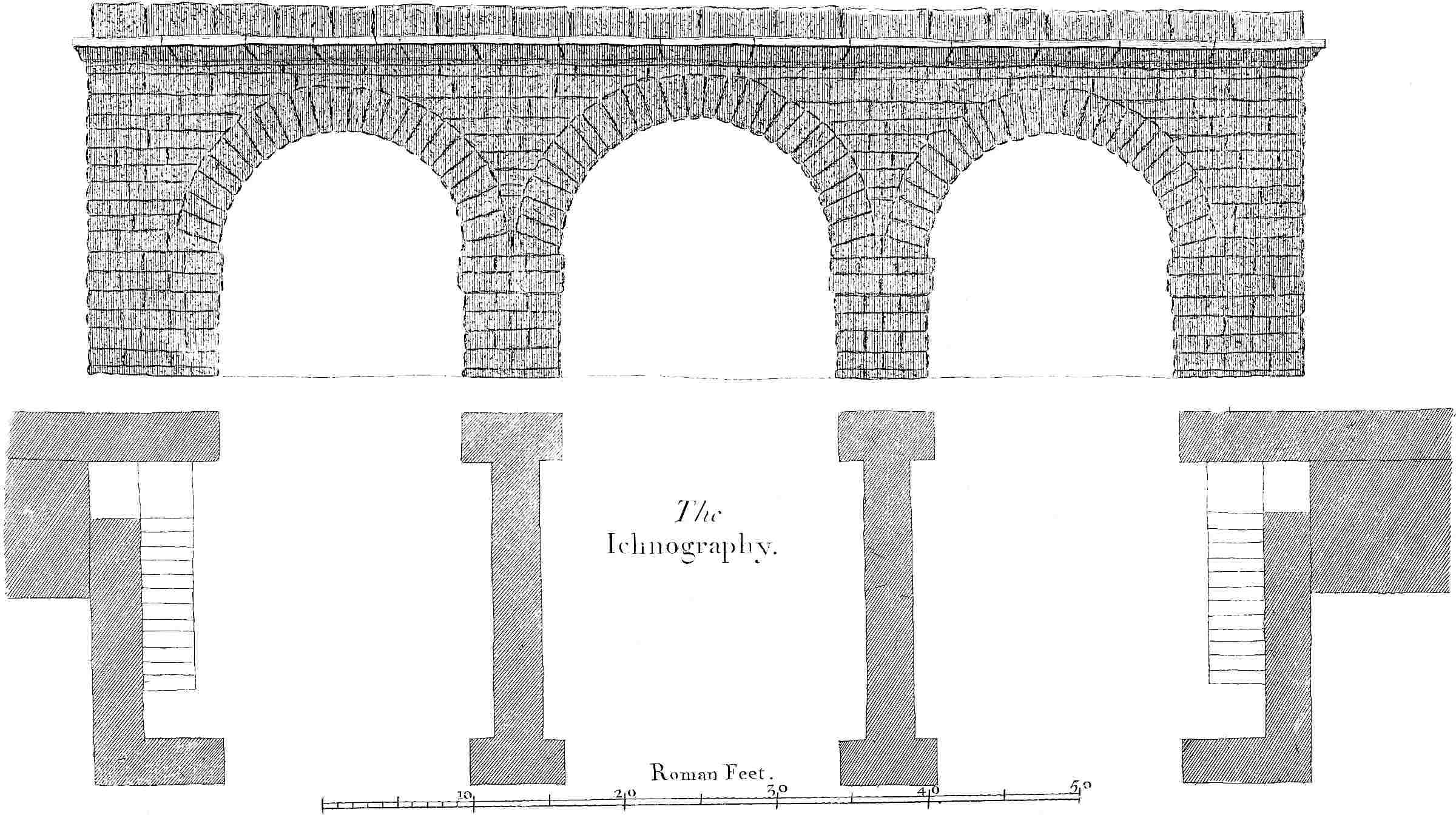
TAB. LXV.Riding under the gate where the Watling-street enters, I observed immediately two arches of Roman work. I was overjoyed at sight of so noble an antiquity, which has never been mentioned. It was a square of twenty foot within; for so far are they distant from each other, and of so much diameter: they are exactly of the same manner as those at Lincoln; the stones not quite so large, nor so good: the breadth is 2½ foot. On each side was a portal, of a lesser arch, and lower, for foot-passengers; for part of the arch is left, and people now alive remember them open quite through; though now both these, and part of the great arch, are taken up by little paltry shops: or, rather, the lesser ones are quite pulled down, and even the great ones are in the utmost danger of falling; for the occupants of those places cut away part of the bottom of the semicircle to enlarge their shops. The portals answered to the Rows (as they call them) so remarkable in this city, being portico’s quite through on both sides the streets, undoubtedly continued in a manner from the Roman times. It is admirable that these vast arches, made of stones of so large dimensions, and laid without mortar, can stand at all when their proper butment is destroyed: that which regards the city has a key-stone: in both, below the lowest stone of the arch, the two next courses downward project a little inward, in nature of imposts; and over the crown of the arches runs a course of projecting stones moulded a little, but coarsely: the stones are artfully, though rudely cut; to which it is owing that they are not fallen, as depending wholly on their own principles, and the manner of their masonry, or geometry. Here terminates the famous Watling-street, whose beginning in Dover valley I walked over in May last. The road is here preserved, going by the river side to Aldford.
The ancient subterraneous canals are perfect still; their outlets into the river under the city-walls are visible; and they say that they are so high, that a man may walk upright their whole length. Wherever they dig, they find subterraneous vaults and arches, and all manner of antiquities; many of which were collected by the late Mr. Prescot, prebend of the cathedral here, and now remain in the hands of his son.
The city is commodiously placed in an angle of the river, which washes and protects two sides of it. As I said, it is an oblong square, 600 paces one way, 400 the other; that is, 3000 feet by 2000. Two principal streets run its length at equal distances from the walls and each other: one may be called Principium, having the gates at each end; the other is Quintana: they are crossed in the middle by the via prætoria, where are the gates Decumana and Prætoria. Another principal street runs on each side it, equidistant from it, and the walls of the ends: these may be called strigæ. Other lesser streets, or hemistrigæ, subdivide some of the squares made by the principals. Thus must the original scheme be understood, when the military and civil citizens first founded and inhabited the place. The little difference now is caused by the cathedral and the castle: the castle, the seat of Hugh Lupus, count palatine, and his successors, is built, for the most part, beyond the limits of the Roman walls, in that angle next the flexure of the river; consisting of a great court, and keep, strongly walled, and fenced with a ditch: the city-wall carried still round without it. To the north of the castle is some small remnant of a nunnery. The meadow between the walls and the river here is called Rood-eye, from a cross there, the stump whereof remains: upon this they keep a horse-race. The city-walls are carefully repaired by the corporation, and make an agreeable walk quite round: they are founded intirely on the rock. The churches have every where, as in other places, deformed the streets, which are originally the most noble and spacious I have seen. The whole city has a descent every way from the centre. The castle is rendered strong as the nature of the place will allow of: here the earls called their courts of parliament, and administered all affairs of state and judicature with regality.
Last year, digging in the chapter-house, they found the bodies of some of the old earls palatine, wrapped up in leather sewed; but within that, they were laid in woolen, like what we call wadding: the bones are pretty perfect, but the flesh is gone. They showed us one, thought to be Randulf Demeschin, the last earl, laid in a stone coffin; a place left for his head: he lies on the right hand of Hugh Lupus, the first earl.
They have built a large handsome exchange over-against the front of the cathedral, with pillars of one stone. The city is not set precisely east and west, though pretty near it. The ancient Roman gate at the Watling-street was larger than the rest, because of the entrance of the Roman ways there from Condate, Bonium, and the greatest part of the kingdom; likewise for readier passage of the soldiers upon occasion, most requisite that way; two of the other gates being fenced by the river: therefore this extends in front to 80 foot. This city in Roman times must have appeared admirably beautiful, with such spacious streets: the tradesmens shops and houses I suppose then to have been next the piazza’s of the streets; the soldiers tenements backwards, with gardens into the squares, as it is at present. The river, which once washed the city-walls, is now thrown off to some considerable distance by salt-marshes: a dam too is made across it by the bridge, for the sake of the mill; and by other mismanagements it grows worse every day, so that ships cannot come up near the place; whence the only little trade they have accruing from the passage into Ireland, is in danger.
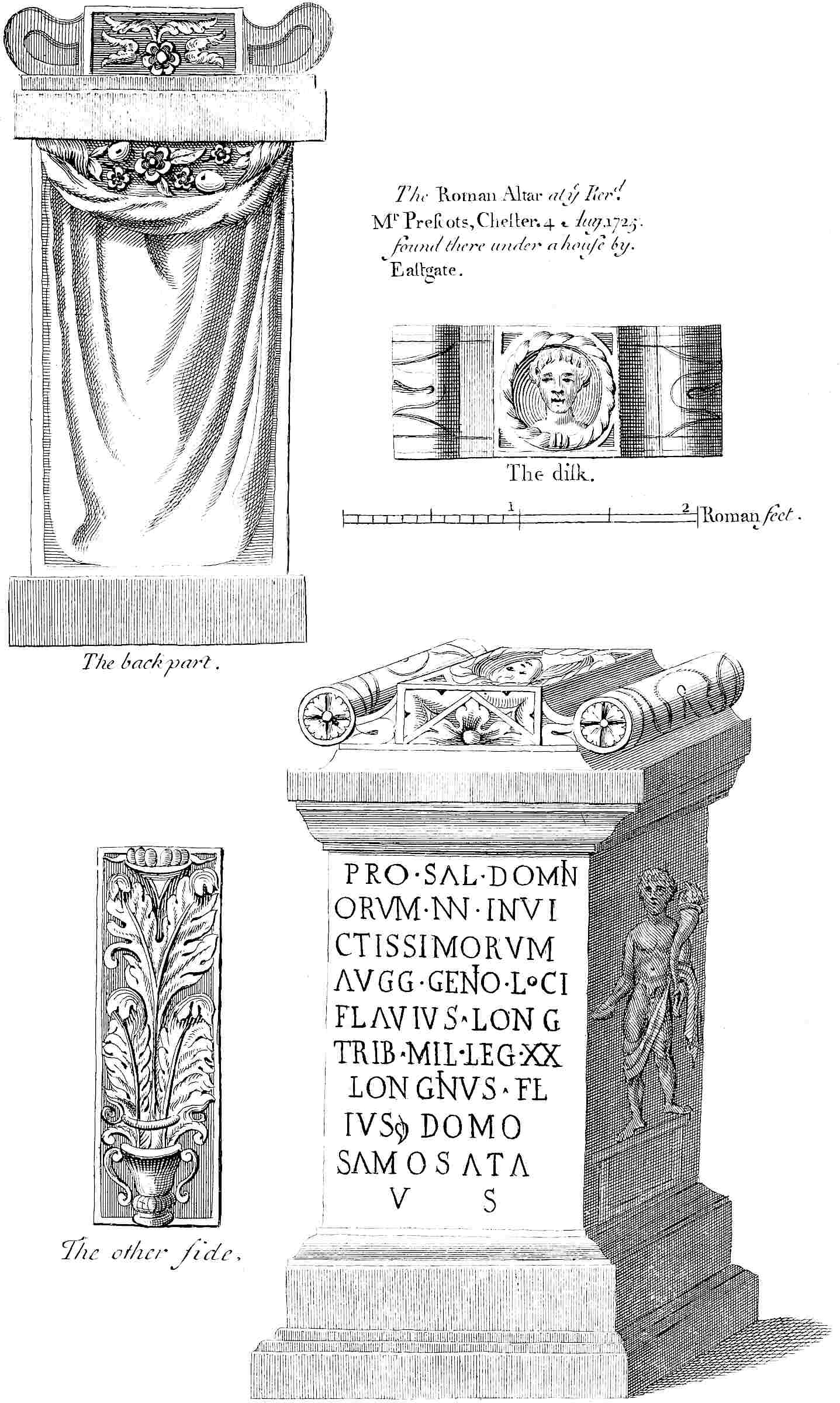
TAB. LXVI.I saw at Mr. Prescot’s the Roman altar of Flavius Longus: it is very intire, and very prettily ornamented. On the top where the discus usually is, is cut the head of a Genius within a garland: on one side is a Genius with a cornucopia; on the other, a flower-pot with leaves of brank-ursin. It was found under a house by east-gate. He has more fragments of antiquity; Roman bricks, square for paving, a foot each side ; some marked LEG. XX. V. two inches and an eighth high; some hollow bricks with a double cavity for hypocausts. He has likewise a curious statue of the god Mithras with the Phrygian bonnet, and a torch in his hands, standing cross-legged: it was found under a niche of the wall, between east-gate and the river. Some of the bricks are thus marked, LEG. XX. V. V. which demonstrates they mean the legio vicesima valeria victrix. The altar has a square pedestal of one stone, which it stood on: the back of the altar is carved with drapery, and a festoon. Along with it was found a little earthen pot like a lamp; a brass winged Genius, small; two brass fibula’s; all in Mr. Prescot’s possession: he has likewise a brass camp-kettle, with two rings, 21 Roman inches high, found near here. The other inscription, which his father had, of PRAESENGVNTA, is sent to Oxford. He has also a very large collection of coins, brass, silver, and gold, most found at Chester. A golden British bracelet weighing 19 guineas, found lately in Wales, was melted down by a goldsmith here.
66·2
d
.
The
Roman Altar
at y
e
Rev
d
.
M
r
Prescots, Chester. 4
Aug. 1725. found there under a house by
Eastgate.
Stukeley design.
Sturt sc.
67·2
d
.
A Roman carving on a rock by the bridg at Chester.
3 Aug. 1725.
Stukeley delin.
68·2
d
.
Found at Risingham.
Stukeley del.
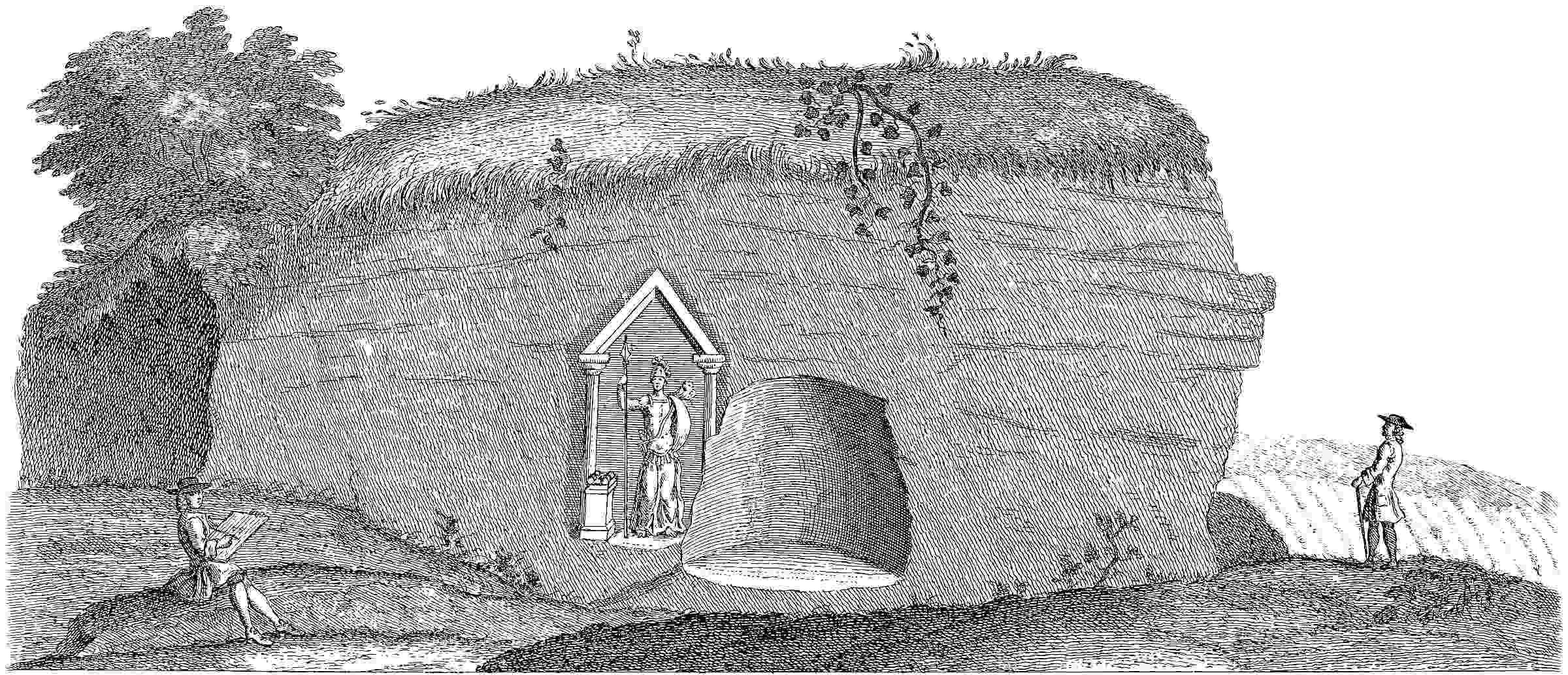
Walking beyond the river, I found the Roman way going to Bonium: it answers precisely to the great street of the city, which I call principia, and is extremely strait: it goes through Eccleston, Easton, &c. Examining where it passed down by the bridge on the west side, I was led to visit a rock hard by, over-against the castle: there I discovered a Roman carving of a goddess,TAB. LXVII. in a tabernacle, with an altar: it was not in the least difficult to see the traces of a Roman hand, through so many years, rubbing of cattle, and ill usage. There is a seat hollowed out close by it, and which has taken away part of a pillar, supporting the pediment. It is a figure of Pallas, with a shield on her left arm: a belt from her left shoulder holds a sword tied under her right arm, after the Roman mode: she has a spear supporting her right hand: her under garments reach down to her feet. The altar stands against one of the pillars, and has a little hole at top of it. I wonder it has escaped ruin so long, placed so near a great city, and so low that it is subject to all manner of injuries.
This city is of a most charming situation; the prospect around it every way is august. The walls were repaired by queen Edelfleda. They talk of king Egbert’s palace by St. John’s. Between Eastgate and the river the Roman wall is pretty perfect for 100 yards together, made of squarish-cut stones, the length inwards, with little mortar appearing on the outside: I suppose they run it in along the inside liquid. This was an admirable contrivance for strength: as the wall of the gate was but one stone in thickness throughout; so by this means the city-wall consisted of few stones in thickness. Mr. Prescot showed us some urns, great and small, many fragments of patera’s of fine red earth, found here; some with embossed work of flowers, animals, &c. some with the potters’ marks at the bottom, particularly MACRINV and CARAIED OFF. likewise many horns of little deer and other animals found by the altar.
The village beyond the bridge is called Henbury, denoting its antiquity. Many fragments, seemingly of pillars and capitals, set for sitting-stones before the doors about the city, particularly in Parson’s lane.
To the east of the cloisters is the building called the Chapter-house, from the use it was put to; but I suppose it a mausolæum of the earls of Chester: it is on the north side of the choir; it is of an odd and ancient kind of building: there is a vestibulum to it, of a very pretty model, which I have not seen elsewhere: the pillars are cabled, without capitals, so that they resemble palm-trees. In the gateway between this and the mausolæum they showed us a coffin of stone, or rather vault, of the length of a man, and proper depth (about six foot): at the head was cut a cross; in the bottom lay the skeleton; probably the first abbot made by the earls: they guess that to be Hugh Lupus’s remains, which are buried in the very middle of the place. There were found seven of these graves, correspondent to the number of earls. Bishop Ripley, who built the body of the church, lies under a brass in St. Mary’s chapel: behind the clock is a painting of him, with Christ, St. Peter, and other figures, and much writing in Latin verse, but defaced. St. Werburg’s shrine, foundress of the cathedral, was an elegant structure of stone carved: little niches with gilt statues of saints, men and women of the Saxon nobles, their names wrote upon each, some still legible, all defaced, their heads broke off, &c. the bishop’s throne is built upon it. There has been an ancient monastery at St. John’s, much ruins of which remain. The cloysters have been built since the mausolæum. They have a report that king Edgar’s palace was upon that rock, by the river side, where the image of Pallas is cut; but I think erroneously: it seems to have been a Roman villa and gardens of some learned commander. There are but two chief streets of the city wanting, as plotted by the founders; on one stands the cathedral: that answering it, on the opposite side of the city, at present is but a foot-path, and lane across gardens, which have encroached upon it on both sides. There are some Roman bricks in the wall of the Friery, as observed by Mr. Gale. In one quadrangle by the cloysters is a wall with Gothic arches, very much pointed, like that at Peterburgh, engraven by Mr. Sparkes, V. p. 130. Edesburg was the name of the Chamber in the Forest. At the great house over-against the shambles is a hypocaust of the Romans, made of bricks all marked with the twentieth legion. It is now the floor of the cellar.
LEVERPOOL.
Leaving this famous seat, and the antique monuments of the renowned twentieth legion, we directed our course northward through the Chersonese, between the mouths of the Dee and the Mersey; a flat, sandy, clayey country, not much unlike the best part of the Lincolnshire levels. To the east of the old church of Bevington is added a spacious choir, and side-ailes. We ferried over the great bay to Leverpool. In the visto upward, the huge mountain whereon stands Beeston castle is very entertaining: it appears, though at the distance of above twenty miles, as a great rock emerging from the water. The novelty of Leverpool forbad us to hope for antiquities: it is a large, populous, busy town, placed upon the edge of the water, in a sandy soil, and open country, arisen from the commodiousness of its situation, with a spacious harbour. Quarry hill, a delf of stone of the red sort, and sandy, but not a brown red; so that in building it has a pleasant colour; and that fetched deep is lasting, and a good sort of stone: the new church is built of it; a neat building, by a good architect. I observed in this quarry, that the workmen make for themselves artificial springs at pleasure; for, though the strata here are very close together, and of a considerable breadth, yet there is a small dripping between some of them, especially those not far from the ground: here they cut a little bason, which is never empty. This confirms my former sentiments about springs.
Near the new church is a most magnificent charity-school. Here was a great castle, or tower, which they are pulling down; and a new church is building upon its ruins. The wet dock is a most capacious bason, with a broad street round it: the custom-house, a very neat building, fronts the dock. This town seems to be as big as Manchester; and they are building new streets every where. The process of the delf ware made here is very curious. There is a scarcity of good water here. From this place I first beheld the Irish sea.
We paid a visit to lord Derby at his seat at Knowsley, who may be truly said to be a person antiquæ fidei, grown old in wisdom: he has left the vanities of courts and cities for a retirement, which his lordship diversifies and makes still more agreeable with the greatest judgement. This is one of his seats: it stands on very high ground with a delicate prospect, and abounds with canals and fish-ponds: it has a park ten miles in circumference. The whole is newly refitted and adorned by my lord, and rendered very delightful. There is a great range of new building, with fine apartments full of admirable pictures, of antique marbles, and good furniture. The pictures are by the most celebrated masters, as M. Angelo, Caravagio, Veronese, Luca Jordano; a fine stag-hunting by Snyders, engraved by Sympson; sea-pieces by Vandeveld: many of Vandyke, Rubens, (one painted on paper, as Dr. Mead’s) and the story of Ulysses and Achilles; the Triumph of Industry, the original sketch of which I have: many of Salvator Rosa, and two great drawings of his upon boards; Titian, Carlo Maratti, and an infinity more. The bustoes are, young Geta; a coloss one of Faustina; a lesser one of the same, with one breast naked, very beautiful; Caligula; Gallienus; Alba Terentia, Otho’s mother; one that seems to be Pompey when young, or one of his sons: a brass head, said to be Michael Angelo; a lesser bust of Flora; a fine bust of Homer in Parian marble, of curious Greek work; another, a philosopher, of like work and materials; with several more. A statue of Hercules, two foot and a half high; two fine statues of Venus rising from the sea, somewhat less than life; a little statue of a Faunus; one of Bacchus; a lesser one of Ceres; another Venus with a dolphin, and a Mercury, both less than life.
Among the portraits, that of the famous countess of Richmond and Derby, foundress of St. John’s and Christ’s colleges in Cambridge; a full-length picture of a man born near here, called the Child of Hale, 11 foot high.
My lord has in his library a great collection of drawings, particularly the whole collection of the late Cheron, after Raphael; one of Hans Holbein, Henry VII. Henry VIII. &c. the original of the painting at Whitehall.
Near Knowsley are coal-pits. From the summer-house on the top of the hill in the park may be seen six counties in England, three in Wales; the Wrekin. The tower at Liverpool, by the water-side, was built by Sir John Stanley, ancestor to my lord.
West-Derby, near here, is the place whence the title of the earldom. The trees here universally bend very much to the east, owing to the continual breezes from the Irish sea. This country is observed to have much rain all the year round, owing to the same cause; and were it not so, it would be very barren, as confiding wholly of sand upon solid rock, as all this western country is.
Ormskirk is said to be named from a church built by one Orme in former times: one of his name, still left, is wrote upon the font as churchwarden. This belongs to lord Derby; and here is the burial-place of the family, a deep vault filled up to the very church-floor with coffins: some old fragments of alabaster monuments of the family of Stanley; others of the Scaresbricks. The church consists of two buildings at different times; and two steeples, one a spire, the other a large square tower; and both are crowded together in an unseemly manner.
From thence we travelled toward Preston, over a boggy, flat and black level, called a Moss. On the right, at a distance, we saw Houghton castle upon a high hill; before us, the vast Lancashire mountains, on the tops of which the clouds hung like fleeces; till we forded the famous Belisama, now the Ribel; I suppose, Rhe bel, the river Bel. Vide Selden de diis Syris.
RIBLECHESTER.
I went to view this old station: it is prettily seated on a rising knoll upon the river; at some distance all round inclosed with higher ground, well clothed with wood and hedge-rows: beyond which the barren mountains, or Fells, as they generally call them here, from the Cimbric fala. The soil hereabouts is gravel with clay and sand by spots. The river Rible is very broad at this place, rapid and sonorous, running over the pebbles, and, what is much to be lamented, over innumerable Roman antiquities; for in this long tract of time it has eaten away a third part of the city. I traced out the old ground-plot, and where the wall and ditch went round it: it lay in length east and west along the north side of the river, upon its brink, 800 foot long, 500 broad: originally, I apprehend, two streets ran along its length, and three crossed them on its breadth. This place has been long famous for old monuments found therein; and some fragments still remaining I had a sight of. At the door of the Red-lion ale-house I saw the base of a pillar, and a most noble shaft, seven foot long, handsomely turned; which was fished out of the river: it is undoubtedly Roman originally, though the base has, I guess, been used as the stump of a later cross, in which this country abounds: there is a scotia and two torus’s at the bottom, though not very elegantly formed; perhaps it was never finished: the whole piece is 2½ foot high, 22 inches in diameter: the frustum of the column lay in the ale-house yard, where the weather, and other accidents, have obliterated an inscription consisting of three or four lines, towards the top: it is 17 inches diameter at top. One corner of this house is a Roman partition-wall, built of pebbles and hard mortar, as usual. This house now is by the brink of the river, leaving only a scanty road between; but within memory a great many houses opposite, and among them the chief inn of the town, were washed away. Farther on, down the river, a great part of an orchard fell down last year; and the apple-trees still grow in their own soil at bottom. Viewing the breach of the bank exposed thereby, I saw the joists and boards of a floor of oak, four foot under the present surface, with many bits of Roman bricks, potsherds, and the like; and such floors are to be seen along the whole bank, whence most antiquities are found in the river. The late minister of this place, Mr. Ogden, collected all the coins, intaglia’s, and other antiquities, found here in great quantities; but his widow, as far as I could learn, disposed of them to Mr. Prescot of Chester: I was shown the top of a great two-handled amphora, or wine-jar, taken out of the river, of whitish clay: I saw another like fragment; and among antiquities he took up a very large piece of corallium tubulatum, bigger than a man’s head; an admirable curiosity of nature. By symmetry I find the whole channel of the river, at present, lies within the precincts of the old city: the original channel on the other side being filled up with the city-walls, and rubbish; for it bends with a great elbow toward the city. The eastern limit of the city, or that upward of the river, lies against a brook there falling in; and the two streams playing against that angle, have carried it away, and still threaten them. At the western end of the city, or down the stream, a whole road, and some houses too, by a barn, are absorbed; and great quantity of ashler, the remains of the wall, has been carried off for building: much remains in the ground, and on the edge of the stream. Farther up the land, and all along the west side of the church-wall, the ditch is perfect, and the rampire where the wall stood pretty high, and the foundation of the wall a little apparent. They tell me the ashler stone still lies its whole length. They call this Anchor hill; and, when digging by the house that stands upon part of it, they found anchors, and great quantities of iron pins, of all sizes, for ships or barges; for they say this river was navigable so high formerly, at least for smaller vessels. The north-west angle of the city is manifest, and where the northern wall turned round the north side of the church: a little way down a lane at that angle, a great bank runs westward, made of stone, like a Roman road. There is a lane goes down, north of the city, to the brook, called the Strand; which confirms their having some sort of navigation here. At the end of this lane is the street which is the Roman road, running directly northward up the fell, called Green gate: it passes over Langridge, a great mountain so named from it, so through Bowland forest: it appears green to the eye. In this street, over-against the Strand, is an old white house, where they say Oliver Cromwell lay, when going to Preston in pursuit of the Scots, after the battle of Marston-moor. The eastern wall over the brook stood likewise on a sort of precipice. I saw a large coin of Domitian, of yellow brass, very fair, found in the river, Imp. cæs. domit. aug. germ. cos. xvi. cens. per pp. reverse, Jupiter sitting in a curule chair, the hasta pura in his left, an eagle on his right hand, Jovi victori; exergue S. C. another pedestal of a pillar found in the river. Just under the Red-lion a subterraneous canal comes into the river, so high that one may walk upright in it, paved at the bottom. Many urns have been found hereabouts, but all lost and disregarded since Mr. Ogden died, who collected such things. They know the track of the Roman road all the way over the hills. In a garden by the Unicorn’s head a gold finger was found, and another brass finger as large as a man’s; two intaglia’s of Mercury with wings on his feet, the caduceus, &c. found near Anchor hill: much ashes and bones found about the city. Up the river, eight miles off, is Pendle hill, a vast black mountain, which is the morning weather-glass of the country people: upon it grows the cloud-berry plant. Digging in the church-yard, silver coins have been frequently turned up. The river hither is open and deep; but at Salesbury, a mile higher, rocks begin: therefore it is likely this place was chosen by the Romans because at the extent of navigation. Half of one longitudinal street, and of two latitudinals, are consumed. Horses and carriages frequently fall down the steep from the street, because it is narrow, and but factitious ground.
Panstones, up the hill, by the Green-moor lane, or Roman road, is a place much talked of; but they know not for what. I suppose it is either some Roman building, or a road eastward, or some terminus. They told me of an altar thereabouts with an inscription, axes, and the like, carved on it: it is on Duttonley, by Panstones. Haughton tower is within view; a great castle upon a precipicious hill.
Many are the inscriptions found here from time to time: Dr. Leigh has seen them all. Now they are removed, lost, or spoiled: one great altar they told me was carried to Dunkin hall, the seat of lady Petre, with an inscription, a ram, and a knife; many taken away by the family of Warrens, living lately at Salesbury hall. I saw the fragment of a stone, in the corner of a house by the mill, cut with very fair large letters: under the next house is the frustum of a pillar, 20 inches diameter, made into a horse-block: I saw another flat stone at the town’s end, laid over a gutter, with a monumental moulding upon it.
Above the town half a mile is a noble bridge of four very large arches, built lately by the country: over this I went to Salesbury; but all the inscriptions are carried away, probably to Mr. Warren’s other seat, near Stockport in Cheshire. I found a large stone in the corner of the house, which has been a Roman monumental stone, foolishly placed there for the sake of the carving: there are three large figures upon it, sweetly performed, and good drapery, though half worn way by time; a man and woman holding hands, both half naked; somewhat roundish in the woman’s hand: at the end is Apollo resting on his harp, his head leaning on his hand, as melancholy for the loss of a votary; for such we may guess the deceased, either a poet, physician, or musician: probably there was more carving on those sides within the wall. This has been a very large seat, with a park. They told me there were some carved stones at Dinkley, another seat of Mr. Warren’s, a mile farther; but I found they were all carried elsewhere, save two altars, both obliterated, but well cut: one stood in a grass-plot in the garden, covered over with moss and weeds; another used in the house as a cheese-press. This is a romantic place, hanging over the river purling across the rocky falls, and covered with wood. The late Mr. Warren was very careful of these learned remnants. They told me that Ribchester was destroyed by the Scots. These are all the memoirs I could pick up in about five hours I staid there, & antiquum tenuerunt flumina nomen. Ovid. Met.
Dr. Leigh, in Lancaster, says a Roman way goes from Manchester to Ribchester by strange ways towards Bury: he gives a cut of a ruby found here; on it a soldier with spear and shield. I take the two altars I saw at Salesbury to be those described in Dr. Leigh’s Lancaster.
At Langho, Ardulf king of Northumberland gained a victory, anno 798.
LANCASTER.
Between Preston and this place we had the vast hills that part Yorkshire and Lancashire, all the way on our right. This is all sandy country to within three miles of Lancaster; then rock begins: the other has rock under it, but red and sandy; this is white. Where the castle and church stand is a high and steep hill, length east and west: this was the Roman castrum. I found a great piece of the wall at the north-east, in the garden of Clement Townsend; and so to Mr. Harrison’s summer-house, which stands upon it: it is made of the white stone of the country, and very hard mortar, and still very thick, though the facing on both sides is peeled off for the sake of the squared stone, which they used in building. A year or two ago a great parcel of it was destroyed with much labour. This reached quite to the bridge-lane, and hung over the street at the head of the precipice in a dreadful manner: from the summer-house it went round the verge of the close north of the church, and took in the whole circuit of the hill. The ditch on the outside of it is now to be seen. I suppose it originally inclosed the whole top of the hill where the church and castle stand, which is steep on all sides, and half inclosed by the river Lune; so that it was an excellent guard to this part of the sea-coast, and commands a very great prospect both by sea and land. Here was this great convenience too in the situation, that on the south side of the castle walls, under the tower, is a spring. All the space of ground north of the church is full of foundations of stone buildings, Roman, I believe; and much stone has been taken up there. To the west of the church is part of a partition wall left, of that time. This is a navigable river. The castle built since on this spot has been very strong; it suffered in the civil wars. The prospect hence takes in all the western sea, and sometimes reaches the isle of Man. The Cumberland and Westmorland hills are of such a nature as I never saw before: I took them for clouds at first, not only from their height, but figure; consisting not of long ridges, but pens, or sugar-loaves, suddenly breaking off. Eastward is Ingleborough, a very strange hill, having a flat place at top, like a table: they say there are some works upon it, and some stones placed like a bower: Camden takes notice of it as rising gradually eastward. Upon some of these hills it was that George Fox ascended to converse with the Holy Ghost, as he pretended; which he revealed to Nailor, and so began the sect of the Quakers, about sixty years ago.
There is a friery in the town, and the church of it was standing within memory. When they pulled down the Roman wall, they found many great toads alive in the thickness of it, and where in all appearance there could be no passage for them from without. The town of Lancaster lies upon the eastern declivity, before the castle.
CONCANGIOS. Water-crook.
Through a very hard road, but not an unpleasant country, we entered Westmorland. The river Can is very rapid, and full of cataracts, as running chiefly over the rock, and having a great descent. It is strange that the salmon coming up these rivers from the sea to lay their spawn, when obstructed by these places, leap over them with a surprizing force; and there they lie in wait to catch them with nets laid on the upper edge. A mile below Kendal this river takes a circling course, and makes a sort of peninsula, called Water-crook, where I found the old city: its name signifies the valley upon the water Can. It is a fine large valley, and very pleasant. Either with a cut, or by nature, the river ran quite round the city. Mr. Tho. Guy is the possessor of it. As soon as I came into the yard, I saw a large altar placed by some steps: I believe it dedicate to Bacchus, because of grapes and festoons on it: it is above three foot high: the festoons are on three sides; the back is plain. All the house and out-houses are built of Roman stone, dug up in the old city. The top of an altar is put into a corner of that stable where the altar stands. At the end of the house is a large statue or bas relief of Cupid: the gavel end fell down some time ago, and knocked off his head and arms; but it is well cut. In the garden, at the end of an out-house, is a very long inscription on a stone. He showed me a little portable altar, but 7-1/4 Roman inches high: the dedicatory inscription is obliterated by using it as a whet-stone; but it is prettily adorned, has two scrolls and the discus at top. Innumerable antiquities have been found here; great arches and ruins of buildings: they never plough but somewhat is found. The father of Mr. Guy saved many, which are since lost: this gentleman found many brass, silver, and gold coins here; but all are dispersed, except a large brass Faustina: he showed me an intaglia of Mercury set in gold for a ring: another with three faces to a head; the foremost, Mars with a helmet on; a woman’s face on each side: a paste of a light onyx colour, with a head: a sepulchral lamp. He told me of a large brass urn with bones in it found here: it had two ears to it, and was used forty years ago, in the family, as a kettle, and is now at his sister’s, Mrs. Herring, at Wall near Hexam.
The town of Kendal is very large, lying under a great hill to the west; the river to the east. Upon the rise of the hill is a place called Castle-low hill, which has been a castle raised in Saxon times, fortified with a ditch where not naturally steep, and a keep or artificial mount; a sorry way of encampment: the keep is narrow at top, and cannot contain above forty people: they are much too high to offend an enemy, and have no ground to defend. Above this are great scars, or mountains, of a hard kind of stone like porphyry, that will yield to no tool: they break it up in small shivers, for building, by the force of a heavy gaveloc and sledge-hammer. I saw several pretty springs running out of little hollows of the rock, especially toward the upper part; and most of the strata thereabouts drip continually: the workmen told me, that those cracks where the springs are go a great length into the mountain; and that the strata all round the hill lie declining with the side of the hill; that some strata are soft and porous, which lets the water strain through them; whilst others by their hardness stop it, and turn it all into the cracks and fissures; that these springs run very sparingly in dry weather: this shows that they are made only of the rain and dews falling upon the hill, and collected into these channels, which being generally perpetual, and in sufficient quantity one time with another, render the springs so. There is a spring on the top of Penigent hill, the highest in these parts. In this country vast stones like the grey weathers in Wiltshire, lie upon the surface, and by the sides of the hills, which are no part of the quarry, being of a different stone. On the other side of the town eastward, and over the river, is Kendal castle; a large stone building on a solitary apex, but not extraordinary high: it is fenced with a wall and ditch: they report that queen Catharine Parr was born here. This town has been built mostly with pent-houses and galleries over them all along the streets, somewhat like Chester. The carts or carriages of this country are small machines, with two wheels each, made of three pieces of timber, fastened to a cross axle-tree, which turns with the wheels: the cart is laid upon these wheels pro tempore, kept from slipping off the axle-tree by two pins underneath: they are drawn by one horse.[1] They say these carriages, of a light burthen and with one horse, answer better in this stony country than heavier, which are shook to pieces presently: hence Nature makes the horses of this country small in bulk. Here is an anchorite’s house with a very fine spring: near was a chapel of St. Mary, Abbot’s hall, and some other ruins of religious places. The church is a handsome and very large structure, consisting of five ailes: a good organ: several ancient chapels in it, with the tombs of the founders; one of Roos. The parishes of this country are generally of great extent, having several chapels of ease. This was, I believe, the county-town before Appleby, as rising immediately after the destruction of the Roman city. In the church is a monument of a judge, who died at the Assizes here in queen Elizabeth’s time.
The city of Concangios is much better situate than Kendal in several respects; because good land for a considerable way quite round it, as far as the valley reaches: the river, which may well be called spumosus, incompasses it like a horse-shoe: it is deeper, broader, and smoother, here than any where else: it is indeed a place incomparably well chosen for a small city: the ground is sufficiently high, even in floods; but floods render it an island, for it is low ground before the entrance, but not marshy. Across the entrance there are plain marks of a ditch north of the house; and Mr. Guy told me there was a wall all along, an apparent rampire on the inside of it; that his father dug up vast quantities of stone there: he showed me a place in the city, where a hypocaust was found, all arched with Roman brick, and paved with square bricks; that they covered it up again without demolishing it. I saw a brass Antoninus, found here; and a stone, somewhat like the capital of a small pillar, hexangular. Beyond the low ground which lies before the entrance of the city, is a Roman tumulus. Upon a slope of high ground, and in a pasture behind it, is another very large hill, partly natural, and partly artificial, by cutting away the roots of it, and rendering it more steep, as it appeared to me: there is an ash-tree planted on it: when it was ploughed, they discovered stones with mortar on them. I conjecture there was a building upon it; probably an outguard, or lodge, for the soldiers that stood upon the watch: for here was placed the numerus vigilum in the Notitia; and this place takes in a larger view than the city, as being higher. The city contains about 14 acres of ground, or more: it consists of two closes, one of twelve acres, another of four; but the fortified part took not in intirely the twelve acres: the ditch goes along the partition-fence visibly enough; the remainder was suburbs to the castle, which was 500 foot one way, 600 another. The inscription I spoke of at the end of the barn has not yet been described. Thus Mr. Gale read it.
Publius Ælius Publii filius Sergio Basso Decurioni legionis vicesimæ valeriæ Victricis vixit annos et privatus libertis et herm miles emeritus legionis sextæ victricis fecerunt. Si quis sepulchro alium mortuum intulerit mulctam ferat fisco Dominorum nostrorum, &c.
A great woollen manufactory at Kendal, especially of such stuffs as are proper for hangings. Winander meer, near here, is ten miles long, remarkable for a fish called char, which they pot, and send all over the kingdom. This country is exceedingly obnoxious to rain, and some of the hill-tops on one side or other are perpetually covered with clouds: I imagine the vast solidity of the stone that composed them attracts the clouds big with water at some considerable distance, and then the winds break and dash them into rain. This is another furtherance of hills being supplied with fountains.
The city of Concangios is placed on the highest plot of the Chersonese: the four acres westward are more meadow-like, but far from low. A great ridge of hills runs north and south-eastward of this place, called Hag-fell, of a fine downy nature, and good riding on the southern point of it. About a mile and half off the city was the castrum exploratorum, or watch-tower: it is a mere tip of very high ground, like a narrow tongue, and very steep, especially side ways: it is called Castle-steed: it is sixty foot broad, 120 long: the sides being thus steep needed no ditch; but on the south end are two ditches, on the north three: I suppose it was walled about: it is of the common cliff of the country; and in one place the ditch has been cut through the rock. At the bottom of this hill is a large spring, which immediately falls into a cavity of the earth again, and so I suppose rises lower in another place. From hence is a fine prospect to the mouths of the rivers Can and Lune, and all over this coast. The Westmorland hills raise themselves into a new and more romantic appearance than before, and the place well answered the purpose of an espial.
About a mile north of Kendal is a cave in the rock near a wood, called Hells-fell Nab, or the Fairy-hole: they talk of organs, pillars, flitches of bacon, and the like matters here, as at Poole’s Hole in Derbyshire.
SHAP.
On the south side of the town of Shap, six miles south of Penrith, we saw the beginning of a great Celtic avenue, on a green common. This is just beyond the horrid and rocky fells, where a good country begins. This avenue is seventy foot broad, composed of very large stones, set at equal intervals: it seems to be closed at this end, which is on an eminence, and near a long flattish barrow, with stone works upon it: hence it proceeds northward to the town, which intercepts the continuation of it, and was the occasion of its ruin; for many of the stones are put under the foundations of houses and walls, being pushed by machines they call a betty, or blown up with gunpowder. Though its journey be northward, yet it makes a very large curve, or arc of a circle, as those at Abury, and passes over a brook too. A spring likewise arises in it, near the Greyhound inn. By the brook is a little round sacellum, composed of twelve stones, but lesser ones, set by one great stone belonging to the side of the avenue: the interval of the stones is thirty-five foot, half the breadth of the avenue: the stones, no doubt, did all stand upright, because three or four still do; but they were not much higher then, than now as fallen, because of their figure, which is thick and short: they are very large, and prodigiously hard, being nothing else but a congeries of crystals of very large sizes, of a flakey nature. Houses and fields lie across the track of this avenue, and some of the houses lie in the inclosure: it ascends the hill, crosses the common road to Penrith, and so goes into the corn-fields on the other side of the way westward, where some stones are left standing; one particularly remarkable, called Guggleby stone. The people say these were set up by enchantment: and the better sort of folks, as absurdly affirm, they are made by art. I doubt not but they are gathered somewhere off the surface, among the fells, and that here was a great temple of the old Britons, such as that at Abury, which it resembles very much, as far as I can judge at present; for the rainy weather, which in this country is almost perpetual, hindered me from making at this time a thorough disquisition into it. The ground it runs over consists of gentle risings and fallings, but in general declines toward the west: it is here, and for a great way further north, east and west, a very fine downy turf, and pleasant hills; or at least they seemed so after the rugged and barren views and roads we had just passed: but the country under this turf is a lime-stone, quite different from the stones of the avenue. In our journey hither the country is far worse than the peaks of Derbyshire, and nothing to entertain the eye but the numerous and rare cataracts; whole rivers, and the whole continuance of them, being nothing else; the water every where running among the rocks with great violence and rapidity: even the springs burst out of the ground, and rise into the air with a surprising push: therefore the Britons erected this laborious work very conveniently, beyond that uncultivated frontier, and in a country where they might range about in their chariots at pleasure. I guess, by the crebrity and number of the stones remaining, there must have been two hundred on a side: near them in several places are remains of circles to be seen, of stones set on end; but there are no quantity of barrows about the place, which I wonder at. Though these stones are not of such a flat form as those at Abury, nor so big as some there; yet they are very large, and as heavy as any of those in the avenues there. The site of the place is pretty much bounded eastward by the hill that way adjacent; but there is a large prospect west ward, and the country descends that way to a great distance. At a place called in the maps Stone-heaps, we saw a cairn or barrow made of stones: all the tops of the fells, I am told, abound with these crystallised stones.