ITER BOREALE. (continued 2)
Reading edition
90·2
d
.
The Devils arrows near Burrowbridg. 14 Sep.
tr
1725.
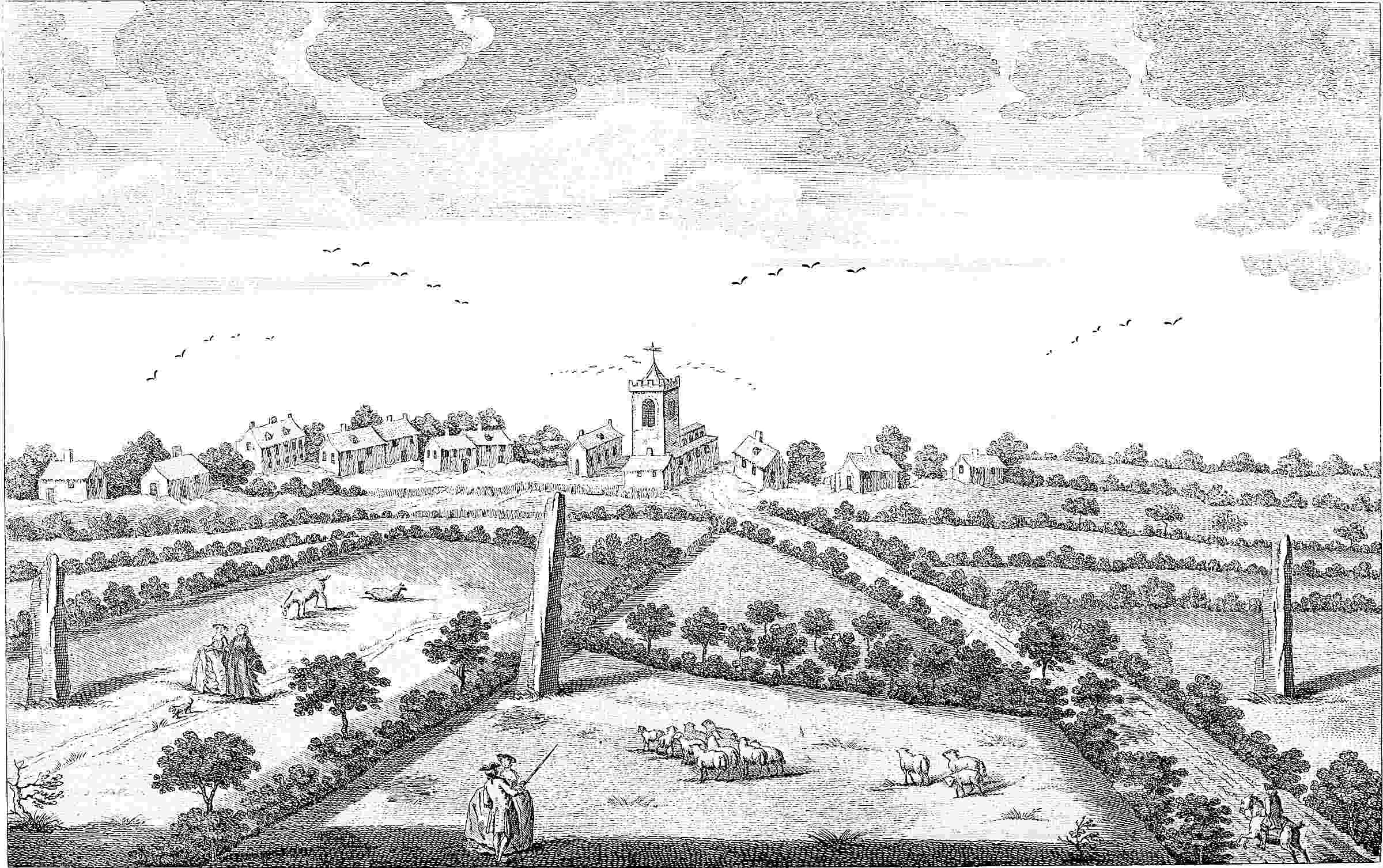
Stukeley Desig.
Hulett Sculp.
89·2
d
.
GER CHAW
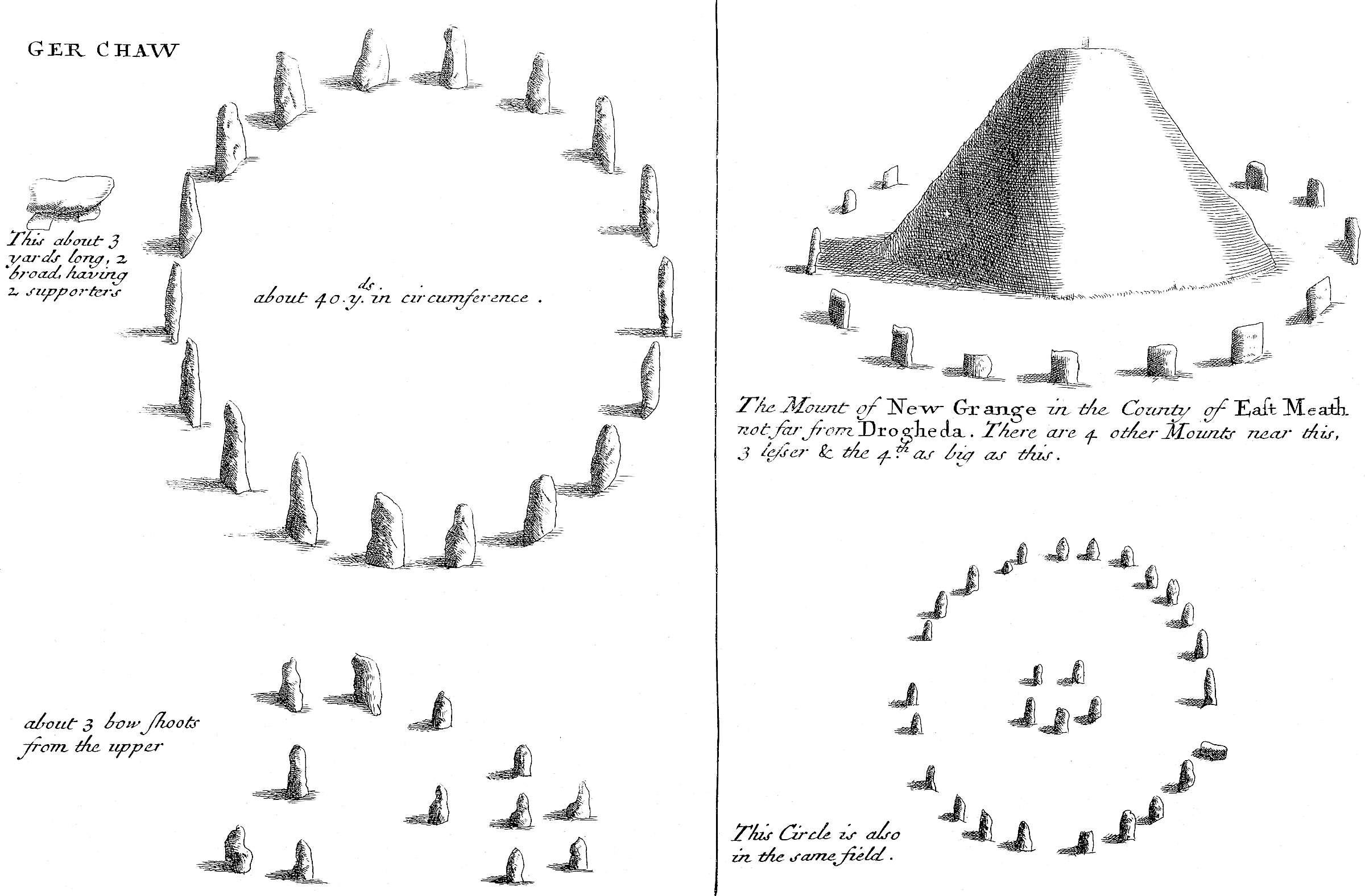
This about 3 yards long, 2 broad, having 2 supporters ds about 40 yᵈˢ. in circumference. about 3 bow shoots from the upper
The Mount of New Grange in the County of East Meath, no far from Drogheda. There are 4 other Mounts near this, 3 lesser & the 4th. as big as this. The Circle is also in the same field.
88·2d.
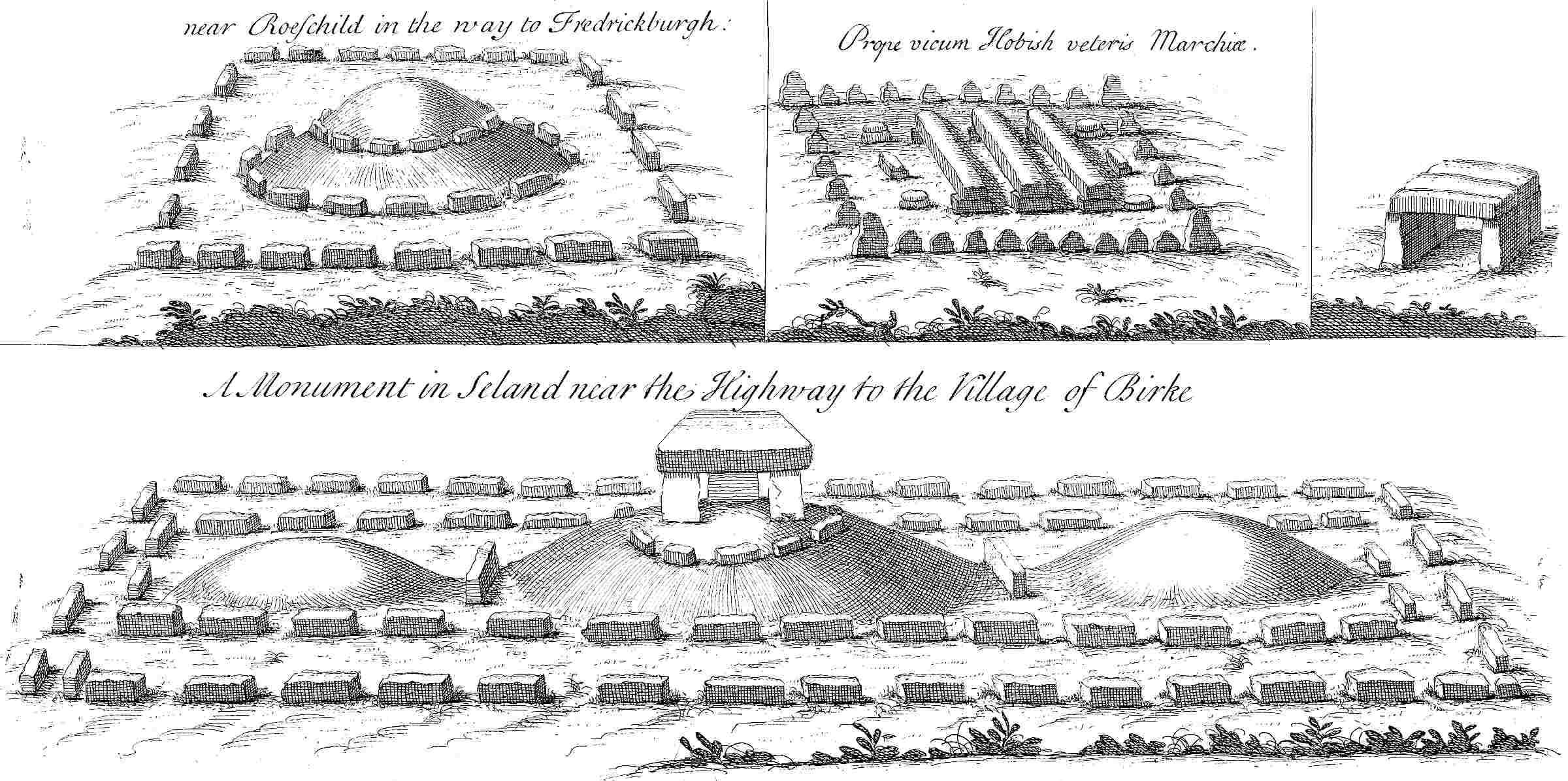
near Roeschild in the way to Fredrickburgh.
Prope vicum Hobish veteris Marchiæ.
A Monument in Seland near the Highway to the Village of Birke.
Stukeley delin.
87·2d.
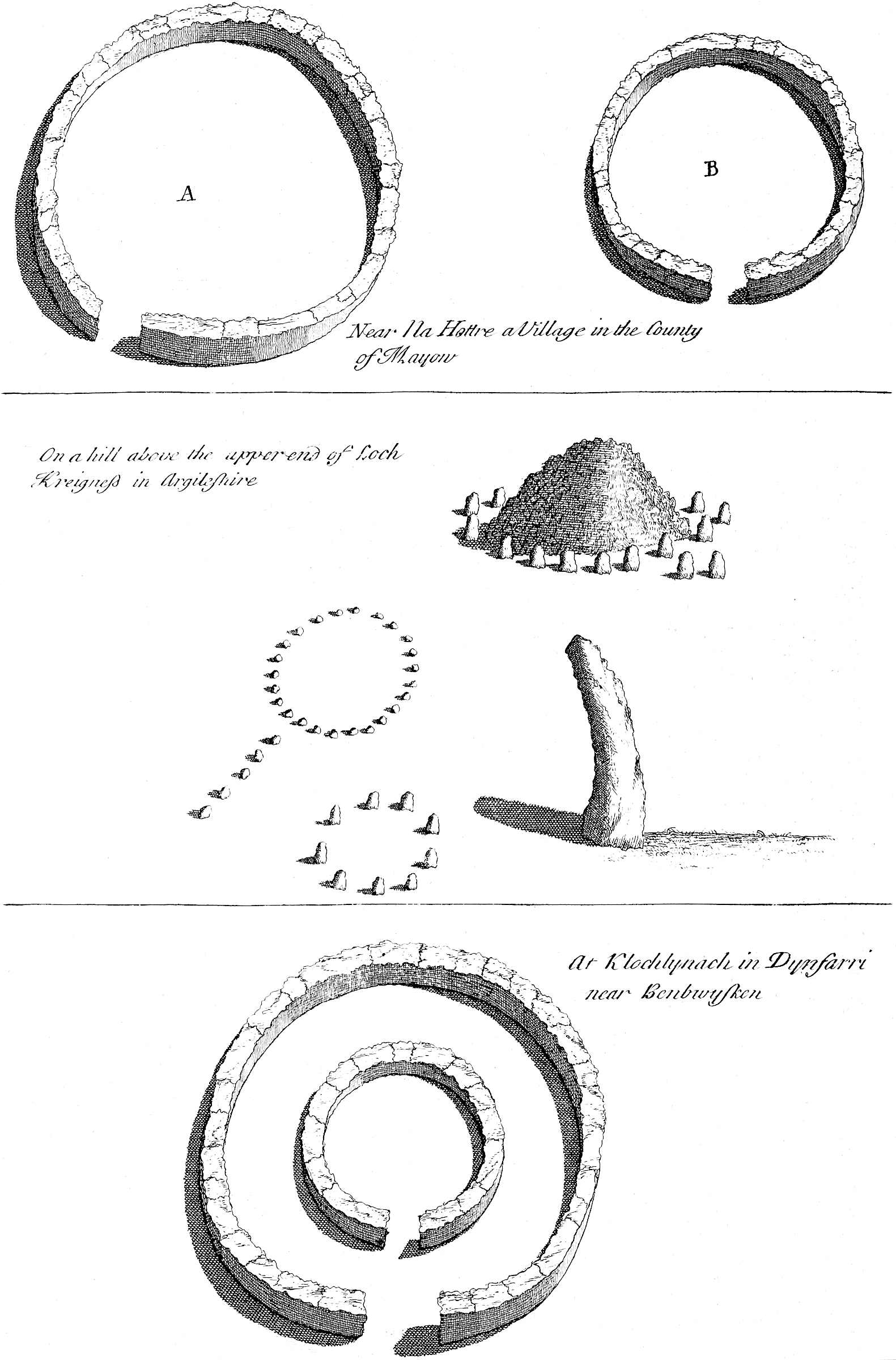
Near Na Hottre a Village in the County of Mayow
On a hill above the upper end of Loch Kreigness in Argileshire
At Klochlynach in Dynfarri near Benbwysken
Stukeley delin.
Harris sculp.
86·2
d
.
Celtic Monuments in Germany
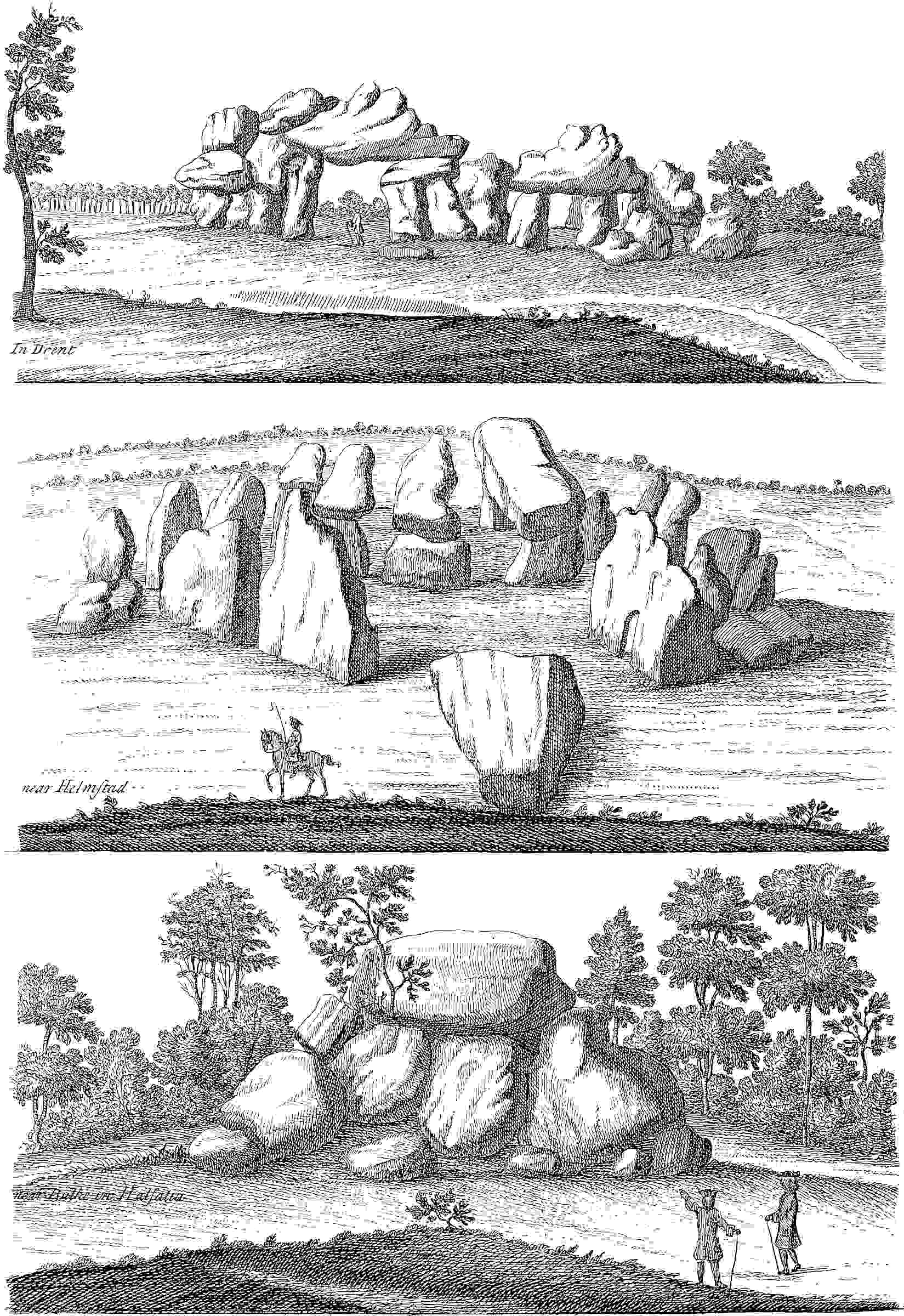
In Drent near Helmstad near Bulke in Halsatia Doctissimo Viro Joħi Keysler Amico plurimum æstimando Tabulam Jure & Lubentissime d. d. W:m Stukeley
Stukeley delin.
Tom’s Sculp.
85·2
d
.
The 6 Barrows near Stevenage 10 July 1724.
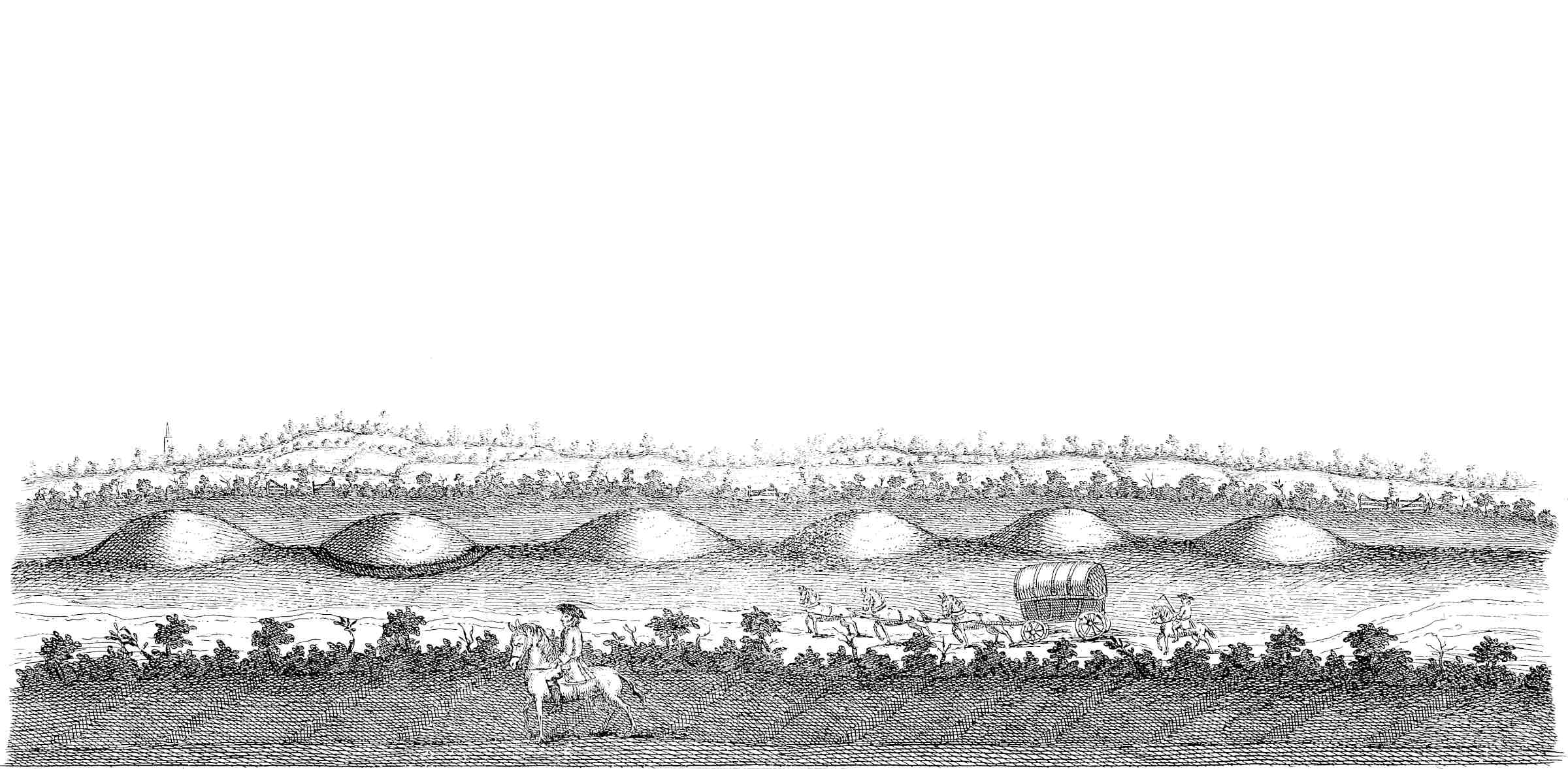
Stukeley del.
I. V.der Gucht Sculp.
84·2
d
.
Celtic
Temples.
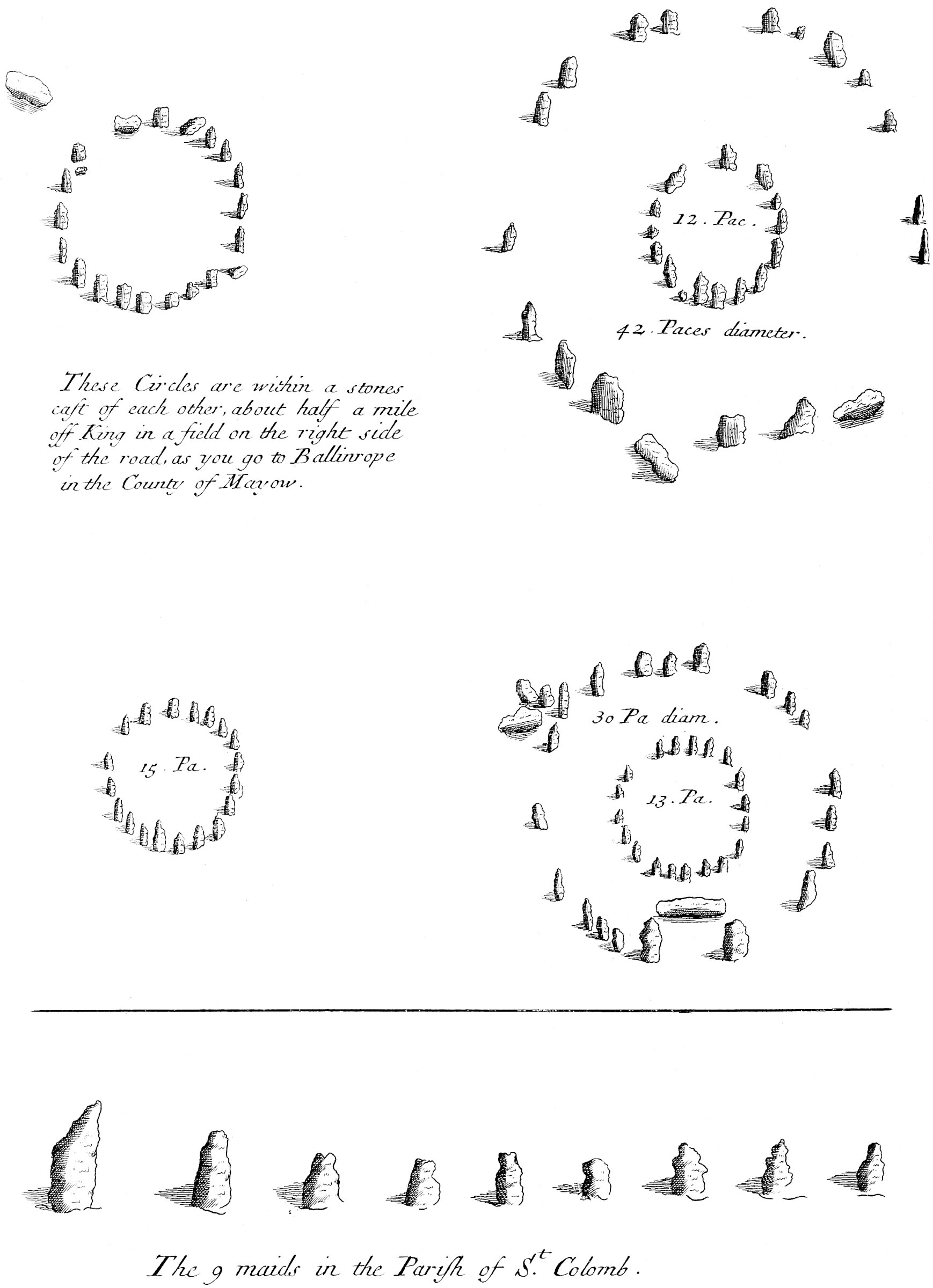
These Circles are within a stones cast of each other, about half a mile off King in a field on the right side of the road, as you go to Ballinrope in the County of Mayow. The 9 maids in the Parish of S.t Colomb.
PENRITH.
At the conflux of the rivers Louther and Eimont there is a remarkable curiosity, that illustrates the method of the religious solemnities of the old Britons, as much as any I have seen. Upon the edge of the Louther, where the bridge now passes it, is a delicate little plain, of an oblong form, bounded on the other side by a natural declivity: this is used to this day for a country rendezvous, either for sports or military exercises, shooting with bows, &c. On this plain stands the antiquity commonly called King Arthur’s Round Table, and supposed to be used for tilts and tournaments: it is a circle inclosed with a ditch, and that with a vallum. At first sight we may see that it was intended for sports, but not on horseback, because much too little: the vallum on the outside lies sloping inward with a very gradual declivity, on purpose for spectators to stand around it; and it would hold at least 10,000 people. The outside of the vallum is pretty steep: it was high originally, as may be seen now in some parts; but it is worn down, as being by the side of the common road; and the inhabitants carry it away to mend the highways withal. There are two entrances into the area, north and south, or nearly so: one end is inclosed into a neighbouring pasture: the area had a circle within, somewhat higher in elevation than the other. The outer verge of the vallum is a circle of 300 foot: the composition of it is intirely coggles and gravel, dug out of the ditch. Upon part of the plain are marks of the tents of the Scots army, that accompanied King Charles II. in his way to Worcester: they encamped here for some time, and drew a small line across part of the southern circle: this was done within memory.
Just 400 foot from the verge of the south entrance is another circle, 300 foot in diameter, made contrarywise to the former: the vallum is small, and the ditch whence it was taken is outermost. Thus these two circles and the interval make 1000 foot in length; and there is just room enough without them, next the river and next the bank, for a circus or foot-race, according to the old manner of the Grecian, which were always celebrated by the sides of rivers.
Centum ego quadrijugos agitabo ad flumina currus, &c. Virg. and probably British chariots had here their courses. On the southern end it is manifest they contrived it just to leave room enough for the turn; and it required good skill to drive a chariot so as not to fall there, or into the river. It must be understood, that the bridge at present, and another of wood formerly a little below it, have impaired the banks by the more southern circle. This is the most delightful place that can be imagined for recreation: the rapid river Louther runs all along the side of it; the Eimot joins it a little way off, in view: beyond is a charming view of a vast wood, and of Brougham castle; beyond that, the ancient Roman city, and the Roman road going along under the high hill whereon is the beacon. But these are things later in time than our antiquity.
Though upon first sight of the place I knew its purport, yet I was more fully convinced thereof when I went to see Mayborough, as called, which is a little higher up the hill, on an eminence higher than any near it, and full west from this place, or circus: it is a vast concavity, of the same diameter as the circles just mentioned, viz. 300 foot: it is made with an artificial vallum of loose stones, without any ditch, carried with great labour from some other place, and here orderly piled up, so as to make a rampart as high and as broad as that at Abury: in some places the turf, with which it was covered originally, is peeled off: it slopes inward with a gentle descent on account of spectators; outwardly it is as steep as the nature of the materials would suffer, and now covered over with great timber-trees: the entrance is wide, and opens full east, and to the circus. Within this fine plain, which is now ploughed up, have been two circles of huge stones; four remaining of the inner circle till a year or two ago, that they were blown to pieces with gunpowder: they were of a hard black kind of stone, like that of the altar at Stonehenge: one now stands, ten foot high, seventeen in circumference, of a good shapely kind; another lies along: this inner circle was fifty foot in diameter. One stone, at least, of the outer circle remains, by the edge of the corn; and some more lie at the entrance within side, others without, and fragments all about. Just by the entrance, along the road runs a spring, full eastward.
This I suppose to be a great British temple, where the country met on solemn days to sacrifice. After the religious duties were over, they went down to the circus to celebrate their games: and I could not but admire the fine genius of these people in chusing places for their sports; for upon the verge of the acclivity, along the circus, an infinite number of people might stand to see the whole without the least inconvenience, besides those in the plain between the two circles; and these two circles admirably well executed the intent of the meta’s, but much better than those in the Roman circus’s. In ploughing at Mayborough they dug up a brass Celt. On the other side of the Eimot, upon a high ground overlooking all, is a very fine round tumulus, of a large size, and set about with a circle of stones: this in all probability was the funeral monument of the king that founded the temple and circus. Somebody has lately been digging away part of the barrow, and carried off some of the stones, and demolished others.
There is another Celtic monument in the fields beyond the Louther, and south-east of Countess pillar, upon a fine dry spot of ground near the moors: this is in sight of the temple. It consists of many burial-places, marked out with stones set at equal distances. One points eastward, and is what I take to be an arch-druid’s; being above 100 foot long, not a raised tumulus, but a pyramidal form designed by two sides of stones like an avenue. A little way above the head of this is another longish burial, and on a sort of barrow: it points differently from the former. Farther on is the arc of a circle, consisting of four large stones equidistant, opening south: I believe this to be part of another: one of the stones is of the same nature as those at Shap. Further on is one side of another long burial, like the first. There are many more such-like hereabouts, but ruinous; for the stones are carried away for building the adjacent moor-houses and walls. In the pasture on the eastern bank of the Louther, in the way to Clifton, are several cairns, or carracks, as the Scotch call them, made of dry stones heaped together; also many other monuments of stones, three, four, five, set upright together. They are generally by the country people said to be done by Michael Scot, a noted conjuror in their opinion, who was a monk of Holm abbey in Cumberland: they have a notion too that one Turquin, a giant, lived at Brougham castle; and there is a tower there, called Pagan tower; and Sir Lancelot de Lake lived at Mayborough, and slew him. Near Clifton is a famous spring, where the people go annually on May-day to drink, by a custom beyond all remembrance: they hold it an earnest of good luck the ensuing year, to be there and drink of the water before sun-rise. This, no doubt, has been continued from the British times, and is a remain of the great quarterly festival of the vernal equinox. So at Sidbury, on Palm Sunday.
Old Penrith is Petrianis, on the river Peterel: it signifies the warth over the river Petria; so that Penrith, its successor, is but a corruption of Petterith.
GALAVA.
The Roman city lies on the east side of the Louther, just by Brougham castle, whose walls, and those of the park, are for part built of the stones from the old city, being manifestly of a Roman cut. The trace of the place is very easily discovered, where the ditch went between the Roman road and the river. I saw many fragments of altars and inscriptions at the hall nearer the bridge, all exposed, in the court-yard, to weather, and injuries of every sort. In the wall by the Roman road beyond Brougham castle, and near the countess of Pembroke’s pillar, is a pretty busto, part of a funeral monument; the bulla of the mantle most conspicuous, though much injured. Farther on, in the same dry wall, nearer the corner, is another basso relievo, but so defaced, that I could not make any thing of it. The Roman road coming from Carlisle, very apparent as they tell me, passes above or north of the town of Penrith, under the beacon-hill; then passes the river just under the castle; then went by the south side of the city, where its pavement is now firm and good; then where Countess pillar now stands: here it is visible as far as the horizon in a very strait lane, going full east to Appleby. Vast quantities of Roman stone, taken up in the city, have been burnt into lime. Coins, Mosaic floors, and every sort of antiquity, are daily found: they cannot strike a stroke into the ground but inscriptions, pillars, and some sort or other of ancient remains, appear. The site of the city is an elevated piece of ground by the river side; a woody country about it: a vast hill, or fell, of an immense height, goes all along the partition of this county from Durham, in sight here; and by the side of it, three remarkable lesser hills, or pikes, as they call them deservedly; being extremely sharp and conical, and very regularly so.
On the corner of Clifton house is an inscription with carving on it: it is an admirable fine stone, or rather two joined together in the middle; placed at the very top of a gable end: two winged Victories, with garlands and palm-branches in their hands, stand on their sides.
I saw at Lowther, the seat of lord Lonsdale, an ugly brass figure with wings, and somewhat like a laurel-garland about his head, found in the Picts wall near Drumburg castle.
The square plot of the city is very perfect, on the south side of Brougham castle: it had a broad ditch round it. The castle stands on the north end of it, and was built of its wall; the track of which is visible upon the edge of the vallum. The high ground by Countess pillar, where most of the inscriptions were found, seems to have been the site of the city, and this the castle or fort; the Roman road lying between. A good way farther on the road toward Kirkby, there is a hawthorn-tree with a buck’s horns fastened upon it: this stands by one of great note and antiquity, now decayed, where was a brass plate of
“Hercules kill’d Hart of Greece, And Hart of Greece kill’d Hercules.”
They say the bark of the tree had covered the bottom of the horns for a great many inches.
In the church-yard of Penrith is a monument of a giant, Sir Owen Cæsarius, a knight, I suppose, of their king Arthur; two pyramidal stones with rude carvings and letters on them, seemingly Runic. This church is new built, and fitted up very handsomely. Selden speaks of an image at Lowther. There is a castle at Penrith in the upper part of the town. Over-against Brougham is Isanparles, an odd rock.
The Madan-way goes over Cross-fell very perfect: an inscription on the side of a house built upon it: it goes to Barwic on the Wall. Cross-fell is the highest ground hereabouts; they can see the Irish sea from thence. A fine meadow by the river side over-against the Roman castrum. The stones of the city are of a different sort from those of the country.
Mr. Gale says there is such a work as the round table near his house in Yorkshire, with many barrows near it. Mayborough is finely incircled by the river Eimot, which is very deep. Dr. Hugh Todd, minister of Penrith, has a great collection of antiquities.
Many Roman inscriptions have been found lately at Netherhall, by the sea side near Workington, which are placed on the stable-wall at lord Lonsdale’s there. The fine inscription at the end of Clifton house has been there for 300 years, exposed to the rain and weather; so that the inscription is worn away; only it seems that imper. legat. aug. in Africa, is just visible. Another inscription is on the inside of the barn there. Some Roman carvings on the quarry whence the pillars of Penrith church were taken. I saw a Roman vessel of copper found near Clifton: it is deep, with a handle to it like a skillet, on which is stamped the maker’s name, TALIOF: within this is placed a cullender, and within that another: the use of it, I guess, was to carry lighted charcoal in, at the sacrifices. The spring below Clifton is a pretty grotto, much talked of, where, as I said, the anniversary meeting is on May-day. The great barrow incompassed with stones, by the Eimot side, is called Haransley hill.
LONG MEG.
Mr. Patten and I went to view that famous monument of antiquity called Long Meg and her Daughters, in the parish of Addingham, between Little Salkeld and Glasenby. It stands upon a barren elevated plain of high ground, under the vast hill called Cross-fell, to the east. This plain declines to the east gently, or rather north-east, for that I find to be the principal line observed by the founders. It is a great Celtic temple, being a circle of 300 foot diameter, consisting of 100 stones: they are of unequal bulk; some are of very large dimensions: many are standing, but more fallen, and several carried away; but lately they have destroyed some by blasting, as they call it, i. e. blowing them in pieces with gunpowder; others they have sawed for mill-stones: but the major part remaining, gives one a just idea of the whole; and it is a most noble work. The stones are not all of the same kind; some made of square crystallisations, of the same sort as those at Shap; and I saw many of that sort of stone scattered about the country; others of the blue, hard, flaky sort, like those of the temple at Mayborough. The intervals are not exactly equal, but judiciously adapted to the bulks of the stones, to preserve as much as possible a regular appearance. This large ring, thus declining north-east, is now parted through by a ditch; so that the larger half lies in an inclosure, the other in a common; and the road lies by the side of it, that goes from Little Salkeld to Glasenby. South-west from it, seventy foot, stands a very great and high stone, called Long Meg, of a reddish girt, seeming to have been taken from the side of some quarry of the country: I think it leans a little north-east: it is about fifteen foot high. In the middle of the circle are two roundish plots of ground, of a different colour from the rest apparently, and more stony and barren; which probably were the immediate places of burning the sacrifices, or the like. Not far hence toward Glasenby is a very fine spring; whence, no doubt, they had the element of water, used at their religious solemnities: and higher up the field is a large spring, intrenched about with a vallum and foss, of a pretty great circumference, but no depth. Full south-west from this work, in the next inclosure and higher ground, is another circle of lesser stones, in number twenty: the circle is fifty foot diameter; and at some distance above it is another stone placed, regarding it, as Meg does the larger circle. In that part of the greater circle next the single stone called Meg, are two stones standing beyond the circle a little, and another fallen; which I believe were a sort of sacellum, perhaps for the pontifex to officiate in: and westward is another stone or two, perhaps of a like work; but the ruinous condition of the work would not admit of any certainty about it.
KESWICK.
We continued our journey through this rough country, and passed half round the bottom of the famous Skidhaw, a high mountain named from its fancied likewise to a shoe (yscyd.) Penruddoc, a town near it, with a Welsh name. These desolate and hilly regions were the retiring places of the Britons from the power of the Romans; which perhaps is the reason of the great number of temples scattered throughout the country; for a mile before we came to Keswick, on an eminence in the middle of a great concavity of those rude hills, and not far from the banks of the river Greata, I observed another Celtic work, very intire: it is 100 foot in diameter, and consists of forty stones, some very large. At the east end of it is a grave, made of such other stones, in number about ten: this is placed in the very east point of the circle, and within it: there is not a stone wanting, though some are removed a little out of their first station: they call it the Carsles, and, corruptly I suppose, Castle-rig. There seemed to be another larger circle in the next pasture toward the town.
The ascent to this hill (Skidhaw) is from the east; for the west side of it is exceeding steep, and drawn down into frightful ribs, like the roots of a tree. There is a place on the top called Skidhaw maen; a kind of sea-mark, by what information I could get: it seems to be a kist-vaen. Cnut-berries grow a-top of it, a delicious fruit.
There is no doubt, that when the globe of the earth received its motion round its axis, all the solid parts of metals, minerals and stone, flew to the outward parts at farthest distance from the centre, contrary to the assumption of our theorists, and the laws of Nature; for which reason we find the most hard materials on the highest mountains: these by time, and the heat of the external air, consolidated, and left great cavities lower down, when the matter underneath came closer together, and could not bring down these arch-like bodies: at length, when the parts of the globe became accustomed to this motion, the remainder of its internal matter I will allow to sink according to its specific gravity; and questionless the central constituents are heavier than that between it and the present surface; and probably this is fluid. Supposing then the matter of iron-stone fell to the centre, it formed a great magnet, according to Dr. Halley’s hypothesis, and may have a liberty of turning round itself with a slow motion, the intermediate fluid giving it that liberty; though, as to a subterraneous world, as that famous mathematician would suggest, I cannot believe the least of it: but this internal magnet, being not fastened to the whole earth, will naturally, as he supposes, have a motion of its own, somewhat different from that of the earth, and retain a regular revolution of that motion; which solves the famous variation of the magnetic needle.
Keswick is placed in a narrow bottom, under these vast mountains, which seem to hang over our heads. There is a place called Castle-head, a great rock, which has, no doubt, been a castle, I fancy in British times, and called a caer, whence the name of the town, Caerswic, as Keston in Kent, from the camp there, originally Caerston. Here are variety of mines hereabouts; some of lead, some of copper, and others of black-lead, which is no contemptible manufacture: there are scarce any other black lead mines, but what are here; they use it for glasing pots: it lies pretty much above ground. In our way hither we had sight of that vast receptacle of water called Ulles lake; and, when going hence to Cockermouth, we rode all along the side of a great lake upon the river Derwent. These collections of fluid element are owing to the rocks, which suffer not the water thoroughly to drain out of the valleys. When one stands at the end of these lakes, the prospect: is exceeding delightful; the mountains on each side rising to a great height, one behind another the whole length, and broke off into short ones, like the scenes at a playhouse: nor need a painter go to Italy for variety and grandeur of prospects. Though the sides of these hills are very stony, and even rocks of marble, yet the valleys every where look very green, and produce great crops, in years when they have a reasonable share of dry weather: but that, I believe, is not very frequent; for the hills will scarce suffer any clouds to pass over from any quarter, but dash them in pieces; so that the frequency of springs and cascades, and the rapidity and force of the brooks and rivers, is wonderful.
70·2
d
.
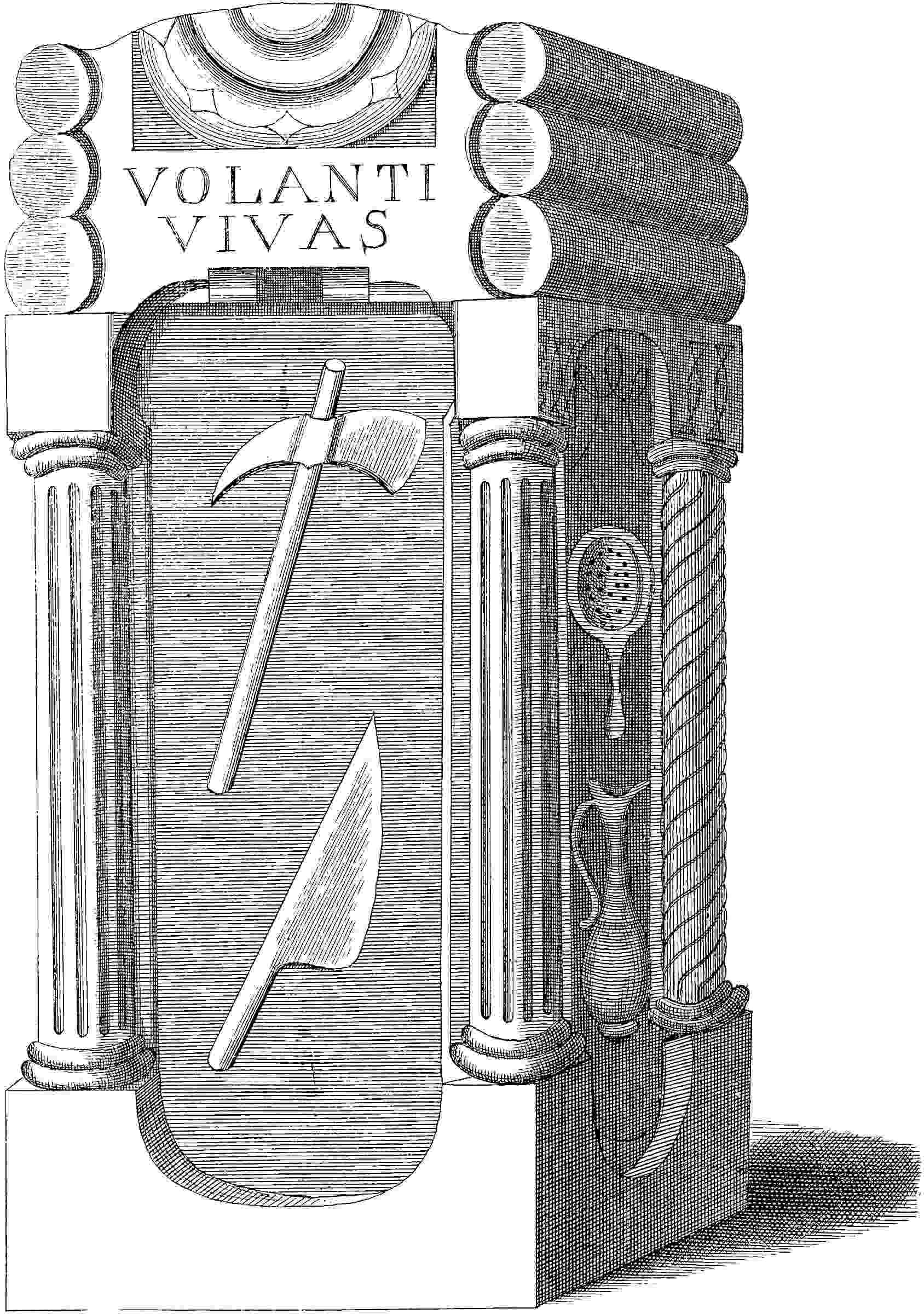
The roman Altar found at Elenborough now at Whitehaven in the seat of James Louther Esq
r
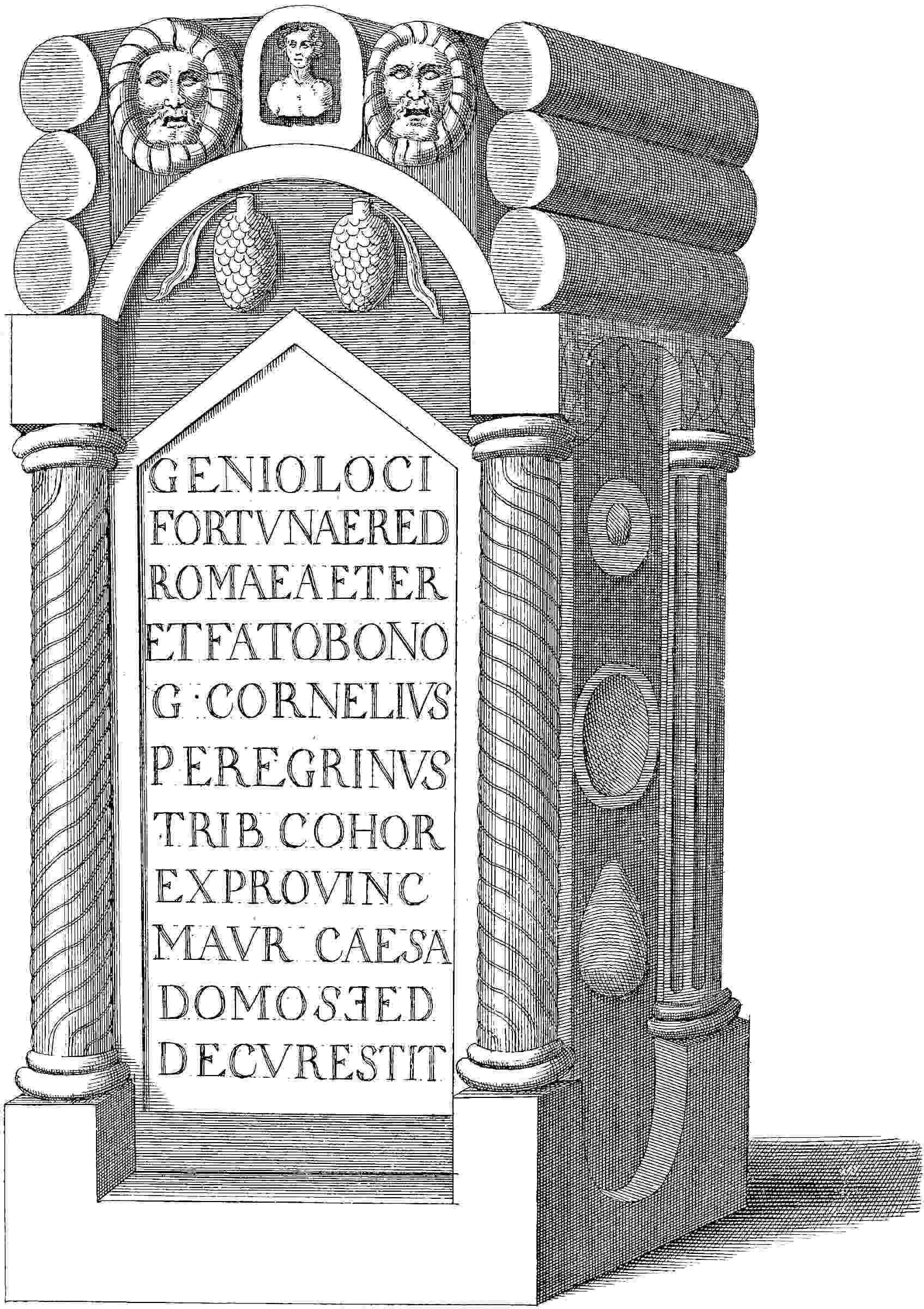
Stukeley. delin.
71·2
d
.
The back view of the Altar at M
r
Louthers, Whitehaven.
Stukeley. delin.
72·2
d
.
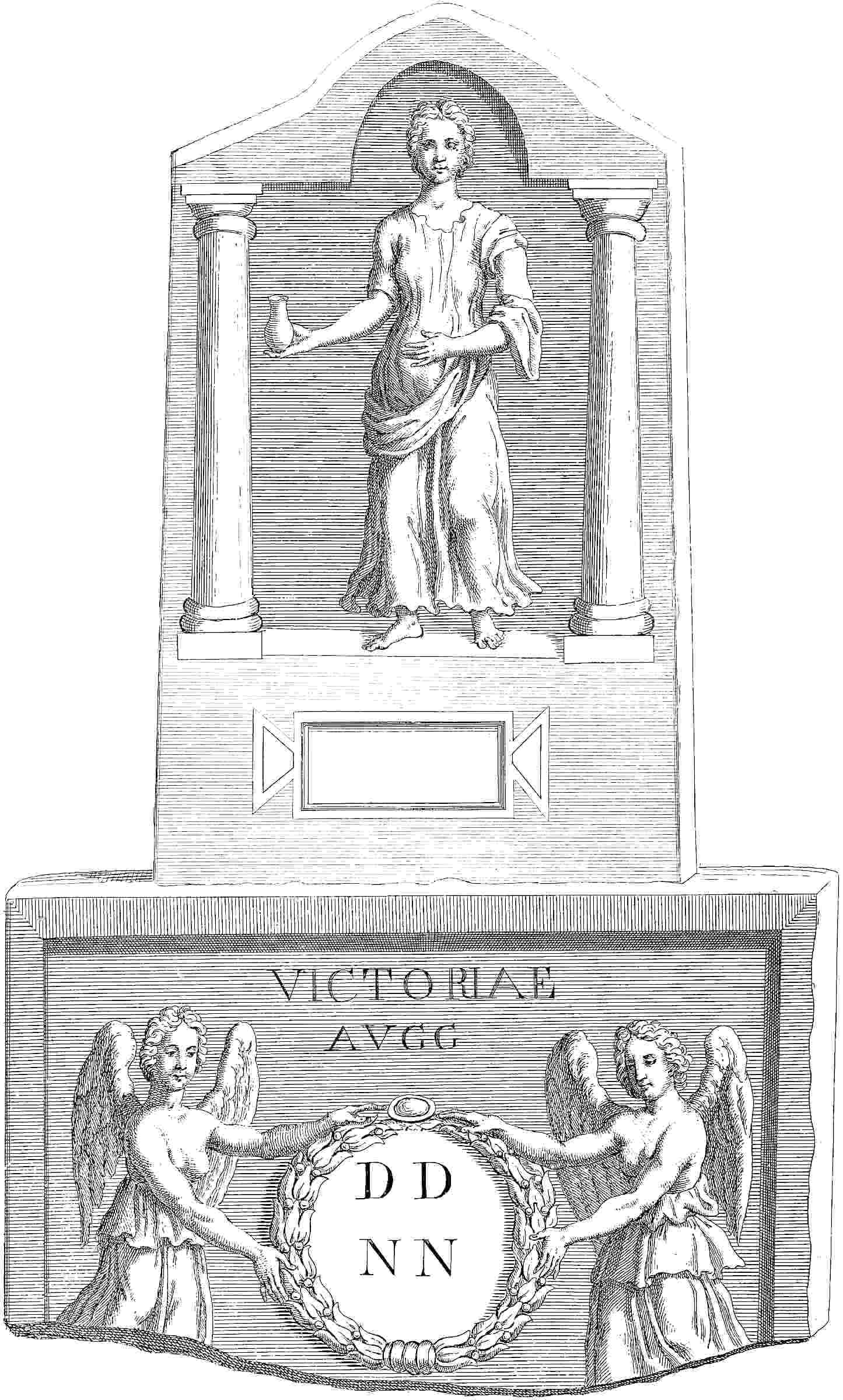
Two basso relievo’s in the house wall at Elenborough.
Stukeley delin.
73·2
d
.
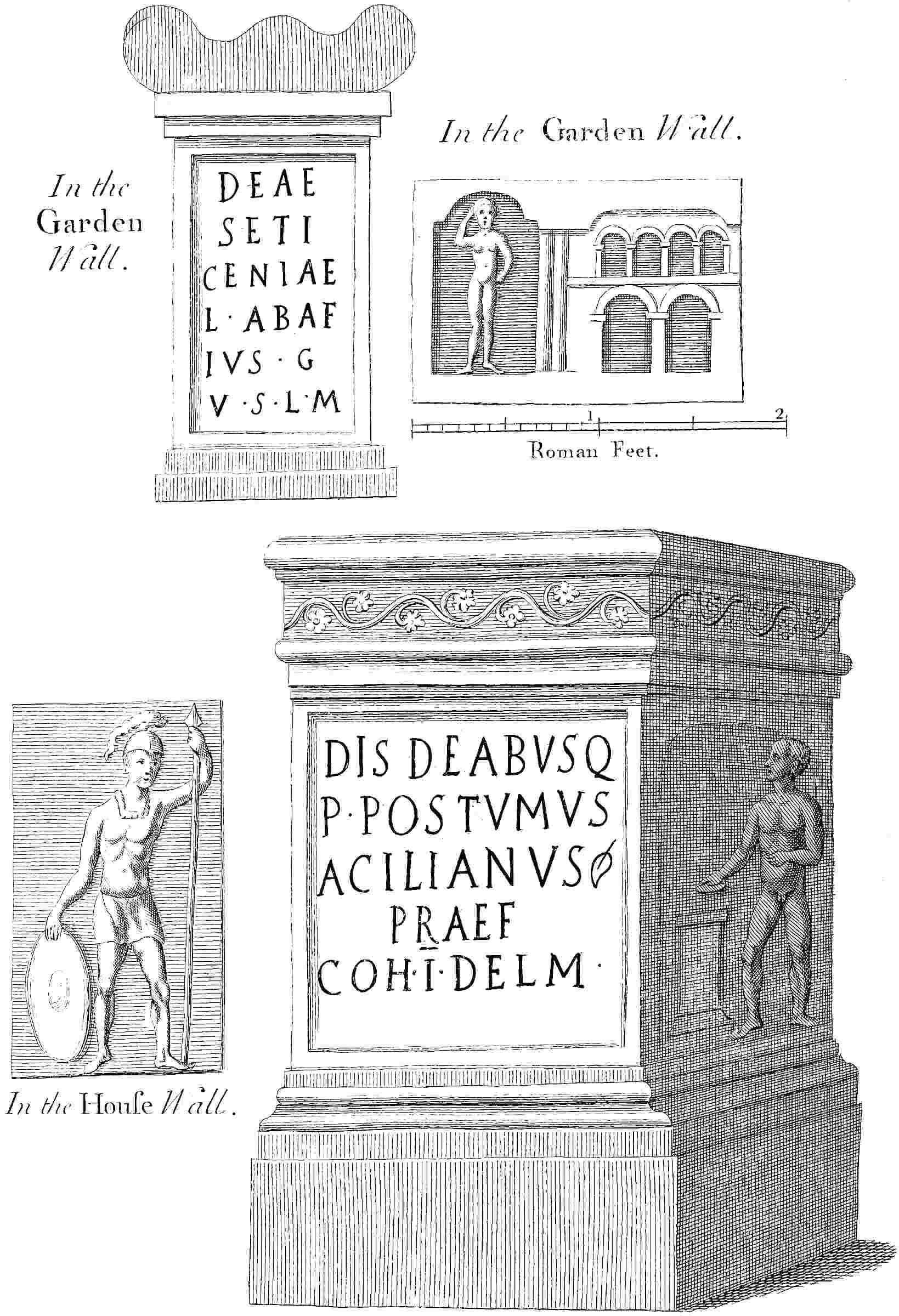
Roman Monuments
found at
Elenborough
now in the house of
Humphry Senhouse
Esq
r
.
Stukeley delin.
Sturt sc
COCKERMOUTH.
At this place they manufacture cotton yarn for candlewicks. It owes its name to the river Cocker, here emptying itself into the Derwent. The castle belonging to the dukes of Somerset stands in the angle of union, and very pleasantly: the valley is rich ground: it was a stately building, and strong in the old manner; but now they daily pull it down for the sake of its materials. They report that the earth of the vallum on the outside the walls was fetched from Ireland, whence no venomous creature can pass over it. A fine vault here, which they call the Chapel.
OLENACVM. Elenborough.
Going toward this Roman station, we passed the river Derwent, and over a moor not far from the sea, where are coal-mines. Elenborough is a little village on the river Elen, the daughter of a great Roman city, which has produced a copious and instructive harvest of antiquities; as may be seen in Mr. Camden, p. 826. I quote Dr. Gibson’s first edition; for his second does disgrace this most excellent author, by mixing the notes with his masterly text. Here that great genius of old Britain, with Sir Robert Cotton, was entertained by the ancestor of the present possessor, Humphrey Senhouse, esq; who inherits a true love for these studies. His seat is on the other side the river: the walls of the house are incrusted over,TAB. LXIII. as we may say, with inscriptions, carvings, and bas reliefs, taken from the ruins of the Roman city. The first cohort of the Dalmatians, the first cohort of the Spaniards, and the first cohort of the Bœtasians, here kept garrison; as appears by the inscriptions.
TAB. LXX. LXXI.That noble altar now at Sir James Lowther’s, at Whitehaven, belongs to this place; the grandest yet seen in Britain: it is five foot and a half high: on the back, VOLANTI VIVAS import a sacred wish for the prosperity of his friend Volantius, hoping to see him again. Mr. Gale has observed several of this sort in Gruter.
In the wall of Mr. Senhouse’s dwelling is a curiosity seldom to be met with; a very large stone, whereon a man on horseback is designed to be carved, but left unfinished: it is a pleasure to see only the sketch of a Roman artist; and we are not to suspect these works here are so barbarous as our authors make them, for want of proper skill in drawing.
TAB. LXXII.There is another relievo of a lady sacrificing, which by the compartment of the inscription at bottom, though worn out, seems to have been fixed upon a temple by the founders. A most stately altar is placed in the middle of the garden, with a sun-dial on the discus. Some are somewhat more securely set up within the porch: many given away; as, one to the bishop of the Isle of Man; another, to Wm. Kirkby esq; at Ashlec in Kirkby, Lancashire: two altars lately found are placed upon a farm-house, which is now commonly known by the name of Volantium, falsely fixed upon this station: this is by the sea-side in Mr. Senhouse’s demesnes. It is much to be lamented that these fine remains should now be exposed to the weather.[2]
The castrum is just 400 foot square, two ditches about it, and three entrances: it had likewise a stone wall on the high vallum. On the north side of this castrum lay the city OLENACVM, of a great extent, as is plain from the ruins of it, but dug up all about. The family of the Senhouses, and the Eaglesfields whose heiress they married, have been continually digging here; and the ruins are still inexhaustible: the dwelling-house and all the out-houses are built from it, as from a quarry: hundreds of cart-loads of hewn stone now lie there.
One may trace many square plots of the houses, and of the streets, paved with broad flag-stones, that are visibly worn with use. All the walls that divide the pastures are made of these squared stones: I saw innumerable of them upon the spot, with mouldings on them of various sorts, gutter-stones, architraves, cornices, &c. The faces of the squared stones are generally not perfectly smoothed, but have the mark of the axe upon them; and I see many such sort of masonry in the old gates of London. Coins innumerable have been found formerly, now but seldom; urns, and other antiquities, which it is endless to particularise.
Mr. Senhouse told me there is a paved military way, besides the streets of the city, going hence northward along the sea-coast; another, to Papcastle by Cockermouth. Most of the inscriptions are found in the city and precincts; bits of altars, and fragments. In the castle are many vaults still left. The altar at Sir James Lowther’s was found in the north-west angle of the castle, on the vallum.
Here is a most magnificent prospect of the Scotch coast of Galway, and of the great sea between the two kingdoms. In the evening, when the sun shines, and it is clear weather, the lights and shadows of those lofty hills are extremely entertaining. The Isle of Man appears perfectly.
The river Elen did not empty itself, formerly, directly into the ocean, as at present, but went northward under the cliff, till it came under the castle: the old channel of it is visible: the sea has eaten away a large quantity of marsh and high ground between it and the castle. To this elbow of land, which made the mouth of the river, is the name OLENACVM owing. They talk likewise of anchors being found thereabouts: many Roman hand-mill stones found at Elenborough. I imagine this river is one of the Alaunas. Toward Cockermouth the western roots of the Cumbrian hills being very steep, exhibit a most curious spectacle; the declining sun shining on them from over the Irish sea; so that we need not travel to the Alps for magnificent views of this nature.
PAPCASTLE.
A mile off Cockermouth, on the north side of the river, lies this Roman station. The river water is very clear, according to its name, notwithstanding the floods here, owing to its running through rocky ground. The Roman castrum lies upon the top of the hill, above the village. I soon traced out its whole circumference, though the inhabitants had not the least notion of where it stood, supposing it to be lower down. I saw a bit of the Roman wall, which they wonder at, because it strikes fire when struck upon with a pick-axe, by reason of the hardness of the mortar: it lies by the road-side going to Wigton; and there the ditch is plainly visible, though half filled up with the rubbish of the wall. The whole town, and perhaps Cockermouth castle and town, are built out of it; likewise the walls of all the pastures and corn-fields adjoining. Free-stone cut is very common, which they say must have been fetched a good way off, because there is none such in the neighbourhood; and a great deal of ashler is still left in the ground. The field upon the top of the hill, the highest part of the castrum, is called the Boroughs. A man told me he found a hand mill-stone about the bulk of his hat, which he admired for its prettiness: he found a Roman coin too of Claudius, and others; but they are lost. Several other people told me they found coins upon the side of the hill; and the children pick them up after a shower of rain. Mr. Senhouse showed me a silver Geta, pont. reverse, princeps juventutis, among others found here. The famous font, now at Bridekirk, was taken up at this place, in the pasture south of the south-east angle of the city, by the lane called Moor-went. In the same place lately they found a subterraneous vault, floored with free-stone, of very large dimensions; the top of it made with the same sort of stone, all brought a distance off. The name of Boroughs includes both closes where the old city, or rather castrum, stood; for they find stones and slates with iron pins in them, coins, and all other matters of antiquity, upon the whole spot below the castrum, toward the water side. This was a beautiful and well-chosen place, a south-west side of a hill, a most noble river running under it, and a pretty good country about it, as one may judge by the churches; for that I find generally a good criterion of the goodness of a country, as Mr. Senhouse observed, who accompanied me hither. On the side of the hill are many pretty springs: at one of them we drank a bottle of wine, to the memory of the founders; then poured some of the red juice into the fountain-head, to the Nymph of the place. A person told us he had dug up, in the Boroughs, the foundation of a wall where the stones were laid slanting side by side, and liquid mortar poured upon them, as was often the Roman method; likewise several floors made of cement. The kind of slates dug up here, are brought too a good way off. Mr. Senhouse says he can trace the remains of the Roman road between this place and Elenborough in many places. This certainly was a town thoroughly peopled; and perhaps its name was Derventio, because standing upon this river Derwent. Fitz-house is on the south side of the river. Mr. Gilpin of Whitehaven has seen many Roman coins found at Papcastle, especially of Adrian.
WHITE-HAVEN.
This is a new sea-port town, standing in a little bay, sprung up from its conveniency for the coal-mines hard by. There are many salt-works upon this coast. Rock-samphire grows here. This western country, left beyond the monstrous hills, is sand and clay. Skidhaw is in view from hence, and with the rest deceives one exceedingly in its distance; for one of these hills, which we should be apt to compute a mile off, is seven; the eye judging according to the angle it makes from the horizon in such objects as it has been accustomed to. Here is but a small rivulet, which is a detriment to the haven, for want of scowering. They transport great quantities of coals to Ireland and other places. We walked two miles in these coal-works, the stratum of pure coal being all the way about ten foot thick, declining gradually, about one foot in five, till we got 300 foot below the surface; a rock of stone over head all along. Their method of digging is generally to run the grooves in a strait line, others going out on both sides at right angles; so that square pillars of coal are left to support the incumbent rock: hence some roads are made along the descent, the others parallel to its declivity. There are trappings now and then, but not very frequent, nor great; and those are both along the declivity, and sideways. Their methods of conveying the coal to the shafts where they are drawn up, and of conveying air from one passage to the other, to prevent damps and stagnations, and of drawing up the water from one height to another, are very dextrous, and worth seeing. At last the famous fire-engine discharges the water, which is a notable piece of machinery working itself intirely: it creates a vacuum by first rarifying the air with hot steam, then condenses it suddenly by cold water; whence a piston is drawn up and down alternately, at one end of a beam: this actuates a pump at the other end, which, let down into the works, draws the water out: it makes about 14 strokes in a minute; so that it empties 140 hogsheads in an hour, with moderate working. With this quantity of declivity it goes toward the sea, and below its level at present; and so, no doubt, proceeds under the sea as far as the outward shell of the globe reaches. From this it is most indisputable, that the convex thereof is formed into a spiral figure of layers of different materials; and it must be owing to the first rotation of the earth upon its own axis.
Here is likewise a great copperas work, which is effected by laying a great quantity of sulphurous and ferruginous earth into a great yard, walled about. This stuff is partly got out of the coal-mines, and out of the adjacent hills; in long tract of time the rains falling here, and passing through this earth, drain into a receptacle; into that they put all the old iron they can get, which it eats up presently: this is boiled to a proper degree of evaporation, then is let into leaden cisterns, where it crystallises against the sides of the vessels in pure copperas: it shoots into figures of regular surfaces, some triangular, others hexangular, &c.
MORBIVM,
Moresby, a mile north of Whitehaven. Here is a Roman castrum, notorious enough, at some distance, by its elevation above the plain of the field it stands in. This is one of the castles built at convenient intervals along this coast, to guard against the depredations of the Scots by sea: it lies upon a piece of high ground in a valley, bounded by higher all around, except seaward. Parton haven, where they are now making a new pier, is on one side; and a large creek, or little bay, on the other. The wall that stood on the edge of the vallum was just 400 foot square, as that at Elenborough. There is a great dry wall of stones now stands in its place, the stones taken originally from it: they are all squared: the stones of all the pastures, fences, and houses round about, and the stones of Mr. Brome’s house, and the churches, are most evidently taken thence; being of the Roman cut, as the inhabitants take notice, and wonder at it: they own the stone is of a different grit from that of the place.
The site of the Roman castle has been ploughed up. Many coins and urns found about the place; stones in great quantities still within the place: I saw one squarish, of a very large bulk. A reddish sort of slate to cover houses is dug here; they do not know of any such nearer than Scotland: such was the indefatigable labour of the Romans. There is no ditch about this castle; but the vallum is pretty high quite round. The church stands on the east side of it: in the church-yard is an ash-tree, that bends eastward fifty foot from the stem, by the force of the westerly winds continually pressing on it.
The new front of the hall is of an excellent model; I doubt not but it is from some of the admirable Inigo Jones’s designs: the inside is of the same relish. The Isle of Man is very clearly discerned from this place; and the Scotch coast quite to the mull of Galway: it is about thirty miles off.
In some pastures a little east of the place I saw a flat stone set upright by the road-side, and converted into a stile: it was a monument of some young Roman, but pretty much worn: he is robed with a toga, and holds a scroll in his right hand, to denote his being a scholar, perhaps a pleader, a disciple of the famous Papinian. I could not see to the bottom of it, where probably is an inscription. The man that rents the ground says it was found in the ditch, under the hedge, a little lower down.
At the next stile of the same pasture is another monumental stone of an old man; for such seems to be the head cut in the tympanum above. The inscription upon it is scarce legible: it was poorly cut at first, and has been thus long exposed with the face upwards; and because it is somewhat broader than the wall, and was apt to fall down, the man knocked off all one side of it: he has been courted with money and fair words to part with it, but in vain. Thus, as well as I can judge, the inscription should be read:
Dis Manibus sacrum Mertio Maximo, militum phractariorum equestori, stipendiorum decem, vixit triginta quinque annos.
There are evident signs of a Roman road from Morbium to Papcastle all the way, especially over the moor. The soil all along to the west of the Cumbrian hills, between them and the sea, is sandy, with rock underneath, sometimes lime-stone, sometimes of the red stone. Morbium, in the Notitia, is said to be the station of the numerus cataphractariorum; and the inscription above proves it.
There were six Roman castles against this western shore in Cumberland; a cohort in each took up half a legion to garrison: they are ten miles distant from each other; Mawborough, ten miles from Boulness; Elenborough; Morbium; another at Egremont; Maglove, Ravenglass. I suppose they were made by Stilico, who is celebrated for it in Claudian.
Me quoque vicinis pereuntem gentibus inquit, Munivit Stilico totam cum Scotus Hiernem Movit & infesto spumavit remige Thetis. Illius effectum curis, ne bella timerem Scotica; nec Pictum tremeres ne littore toto Prospicerem dubiis venientem Saxona ventis.
He was general to Theodosius.
CASTRVM EXPLORATORVM.
Now called Old Carlisle; a mile off Wigton, upon an eminence: the fairest show of foundations I ever yet saw: one might almost draw an intire plan of it, and of every dwelling. The castrum was double-ditched, 500 foot from south-east to north-west, 400 the other way: the wall has been dug up to the foundations; but the hollow where it stood on the edge of the rampart appears quite round, and the track of all the streets and buildings obvious. A street of forty foot wide quite round the inside of the wall. From the north-east entrance two Roman roads depart; one full north, as far as we could see, paved with coggles; on each side of it are the square plots of houses: the other road marches north-east, paved in like manner; it passes over two great moors, and there it is very apparent: we travelled along it to Carlisle. I saw a group of barrows near it. Many antiquities have been found at Old Carlisle, and inscriptions; one on the side of a house a mile off Wigton, as Mr. Gilpin told me: others are at Ilkirk.
There are several springs all round the bottom of the hill, and quarries; and an extensive prospect, especially toward the sea-shore. Some coal-works in our journey from Cockermouth hither. I doubt not but the Romans had knowledge of this subterraneous treasure, though they neglected it, because there was wood enough in their time: but Solinus mentions it among the wonders of Britain, that they burnt globos saxeos into ashes. I saw a silver Antoninus Pius found here; reverse, rector orbis.
Latius arctoi præconia persequar amnis. Addam urbis tacito subterlaveris alveo Mœniaque antiquis te prospectantia muris. Addam præsidiis dubiarum condita rerum. Ausonius.
LVGVVALVM. Carlisle.
At the gates are guard-houses of stone, built by Cromwell from the demolished cathedral; and in the middle of the market-place, a fort with four bastions, roofed like a house, with holes for the gunners to shoot out at with small arms. At the south-east end of the city is a citadel built by Henry VIII. as is plain from its conformity to Deal, Walmer, &c. In levelling the ground of the fish-market they found many coins, which we saw in Mr. Goodman’s hands: he has an altar found in the river Irthing, by the Picts wall: also in Mr. Stanwix’s summer-house wall is an inscription of the sixth legion, and a pretty altar, but the inscription worn out. Fragments of Roman squared stones appear in every quarter of the city, and several square wells in the streets, of Roman workmanship. A great quantity of Roman coin dug up under St. Cuthbert’s church. Probably the city stood chiefly on that spot where the castle now is, as the highest ground, but did not reach so far eastward as the present city. One may walk about the walls of this city, as at Chester: there was a double ditch round it.
There are many hollowed stones found hereabouts, much like the marble mortars of apothecaries, with a notch in them. I take them to be the hand-mills of the Roman soldiers, wherein they ground their corn with a stone, and sometimes perhaps became their urns; making their chief instrument in sustentation of life, their inseparable companion in death.
This is a very pleasant and fertile country, rendered more sightly to us by passing so long through the mountainous stoney tracts of Lancashire, Westmorland, and Cumberland. About this country we observe many mud-wall houses, thatched with flat sods or hassocks shaved off the moors; which I suppose the old British custom continued. Here too they use the little carts, as about Kendal.
We saw, in Mr. Gilpin’s hands, a silver Otho, found here; reverse, SECVRITAS R. P. also a middle brass of C. Marius; reverse, VICTORIA CIMBRICA: together with many more, which his father collected. In the cathedral are many remains of the tombs of bishops, I suppose, between the pillars of the choir; every one of which was a little chapel, but now pulled in pieces. A large brass of bishop Bell is left in the choir. The bottom of the steeple, and the west end of what remains of the structure, is of William Rufus’s time: the choir is later.
The road to Bramton is manifestly Roman, by reason of its straightness; and in two places, as I walked up the first hill, I saw the original, made of a bed of stone: it goes precisely south-east; and looking towards Carlisle, I saw it passed through the citadel, and along a narrow street; so through the cathedral to the castle-gate; all in a strait line. To the castle-gate the road over the river Eden came: that from the wall on the west came to the same point; into which falls that from castrum exploratorum.
The VALLVM.
The military virtue of the Romans outlived the spirit of their learning, or excelled it, seeing there is no author that deservedly celebrates this stupendous work of theirs in Britain: they just mention it: no coins struck upon it. I am not afraid to set it in competition with the wall of China, which necessarily occurs to our thoughts upon this occasion: that we readily acknowledge to be a structure of greater bulk and length, which we esteem the least part of the wonder in ours: the Romans intended no more, by their walls around their forts and castles than to prevent a sudden surprise: their strength lay in a living arm and head: in the open field they never refused fighting, without much regard to opposite numbers; the additional security of a little wall was all they asked, against emergencies.
Therefore the beauty and the contrivance of this wall consisted mostly in the admirable disposition of the garrisons upon it, at such proper stations, distance, strength and method, that even in times of profound peace, as well as war, a few hands were sufficient to defend it against a most bold and daring people, redundant in numbers, strong and hardy in body, fierce in manners, as were the old North Britons, who refused subjection and a polite life.
The Romans, tired out with the untractable disposition of these people, whose country they judged not worth while wholly to conquer, resolved to quit their strengths northward, and content themselves with the desirable part of Britain, and, by one of the greatest works they ever did, seclude the Caledonians, and immortalise their own name by an inexhaustible fund of monuments, for posterity to admire. These people, who had the true spirit of military discipline, did not lie idle under arms, but were ever at work, even whilst they lay pro castris; making and repairing public roads; setting up milliary pillars; building and repairing castles, cities, temples, and palaces; erecting altars, inscriptions; striking medals, and the like works, which we here find in such surprising quantities.
If we consider the great numbers of their works now to be seen, more that have been lost and destroyed, or put into new buildings of our own, most that are still left for future times to rake out of their vestiges, we may entertain a true notion of their genius, which subdued the fiercest and most populous nations in the world. Worthily may we propose them for examples of virtue and public spirit. This is no little use and advantage of disquisitions of this sort.
Alliances, treaties, and negotiations, are of small value to a nation always in arms, and ready to meet an injurious enemy; who strengthen, fortify, and enrich themselves at home, protect the people, and make the expences of government sit easy upon them; encourage industry, frugality, temperance, virtue; a few plain easy laws; administer justice with expedition, and without expence; but especially encourage a due sense of religion and morality: and how much easier and more effectually that is to be done now, than possibly could be done by the Romans, will appear notorious, when we consider, that under the Christian dispensation we make a much stronger impression on the hearts and minds of people, than before: the full certainty, which all reasonable consciences must now have, of a future retribution and account to be made before an omniscient judge, lays an infinitely greater restraint on our actions, than possibly can be had from the terror of rods and axes.
The Roman wall is called by the people Pights wall, with a guttural pronunciation, which we of the south cannot imitate; and which the Romans called Picti; but not from any fancied painting of their bodies, though it gave a handle to it.
At Stanwick, which hence has its name, just over-against Carlisle beyond the river, I saw the ditch very plain: the blacksmith there, told me he had taken up many of the stones of the foundation of the wall: it passes the river over-against Carlisle castle. At Stanwick was an arched gate through the wall: Mr. Goodman showed us a cornelian intaglia found there, of Jupiter sitting. I followed the wall to Taraby, where, a little beyond, it makes an angle, going more south-east; so to Draw-dikes, which was a fort, about 100 foot square: it is on the edge of the meadows, and moist in situation. Here I found an inscription upon the house-wall.
In building the wall, I observed evidently, the intent of the projectors was to conduct it, all along, upon the northern edge of the high ground, as near as might be. All about Carlisle, this most noble monument of Roman power and policy is pulled up; first, perhaps, by William Rufus, when he built the castle; then for the cathedral: and I suppose all the church walls of the city, and houses of it, and the villages near it, are of the pillage: hence most of the churches along the wall are set upon it, for the convenience of having stone near at hand, ready cut. The farmers and inhabitants are daily taking away the small remains.
The track of the ditch on the north side of the wall is visible enough all the way, though sometimes corn grows in it. The line where the wall stood, is generally a foot-path. The valley between the end of the wall at Stanwick, and the castle of Carlisle, is not above 300 yards broad, and is guarded too by the stream of the river Cauda. Westward, on the south side of the river Eden, it went toward Drumburgh, and ended at Boulness. Why the Romans carried it so far, on the south side the bay, was because of its being a flat shore, where an enemy might land in boats. It goes up the hill at Newton, from Carlisle; and so marches in a strait line up the next hill, to Beaumont, one of the old forts. All this way it is turned into a street: the ridge of the wall is the foundation of it, as a pavement; the ditch pretty much filled up by rubbish. Mr. Goodman says, he remembers two forts near Carlisle, now demolished, and ploughed over; one on the north side the river; the other on the south. I cannot suppose the stone work of the wall went across the meadow; rather a wood work with towers, which made up the communication between the two ends of the wall, over the river.
The fort on the north side of the river was on the high plat of ground, between the road up to Stanwick, and the wall. At the place where the ditch ends over the river, has been some little fortification work; and thereabouts is a pretty little spring, faced with stone, and having a stone bason. Hitherto the wall was carried; because directly opposite to the union of the Cauda and Eden rivers, running close under the bank; and directly opposite to the western steep of Carlisle castle, which was the Roman castrum, but somewhat larger than this castle of William Rufus: perhaps it took in most of the present city. In a tower of the walls of Carlisle castle, on the outside, between it and the Irish gate, I saw a Roman carving of a boar, which was the cognisance of the legion here in garrison, and that built it.
We visited Scaleby castle, Mr. Gilpin’s seat, about half a mile from the wall, and built of its stones. This was a strong place with a circular mote, well beset with wood, which is not very common hereabouts. In the garden we copied many Roman altars: they showed us two Roman shoes, found in the bog hereabouts. The church too of this place was built out of the wall. Mr. Gilpin says, in taking up the foundation of the wall at a boggy place, they found a frame of oak timber underneath, very firm.
From hence, over a most dismal boggy moor, an uncultivated desert, we travelled to Netherby. We passed by a Roman fort upon the river Leven, where antiquities have been found. They tell us, that, for sixty miles further up northward, there is scarce a house or tree to be seen, all the way. This was the march, or bound, between the two kingdoms. The land might be drained and cultivated, and how much a greater argument of national prudence would it be to have it done, by those we transport to America!
The foundations of the Roman castrum at Netherby appear round the house, or present castle: it stood on an eminence near the river. Many antiquities are here dug up every day. The foundations of houses, and the streets, are visible. They pretend, most of the space between the vallum and ditch is vaulted. A little lower down has been some monumental edifice, or burial-place, where they find many urns and sepulchral antiquities.
In the garden here, are some altars; and a carving of a female head, in a lion’s skin; I suppose, Omphale; and an admirable carving of a Genius sacrificing. We saw a gold Nero found here: a cornelian with a woman’s head, flowing hair. This valley by the river side is very good land, with some shadow of Nature’s beautiful face left; but every where else about us, is the most melancholy dreary view I ever beheld, and as the back-door of creation; here and there a castellate house by the river, whither at night the cattle are all driven for security from the borderers: as for the houses of the cottagers, they are mean beyond imagination; made of mud, and thatched with turf, without windows, only one story; the people almost naked.
We returned through Longton, a market-town, whose streets are wholly composed of such kind of structure: the piles of turf for firing are generally as large and as handsome as the houses.
Quanta Calydonios attollet gloria campos Cum tibi longævus referet trucis incola terræ Hic suetus dare jura parens: hoc cespite turmas Affari: nitidas speculas, castellaque longe Aspicis? Ille dedit, cinxitque hæc mœnia fossa Belligeris hic dona deis, hæc tela dicavit Cernis adhuc titulos: hunc ipse vacantibus armis Induit: hunc regi rapuit thoraca Britanno. Statius V. Sylvar.
After this excursion northward, we set out from Carlisle eastward, withinside of the Roman vallum. Warwick, thought a Roman station, upon the river Eden, pleasantly seated in a little woody valley. We left the Roman road going strait from the citadel of Carlisle to Petrianis. To the right a little is Corby castle, where are many monuments of antiquity preserved; as likewise at Caercaroc near it.
Upon the river Gelt, a little before we came to Bramton, we went up the river to see a Roman inscription, cut upon the natural rock; a most odd and melancholy place: the river runs through a canal of rock all the way. Upon the great ridge of fells coming hither from Cross fell by Penrith, are many circles of stones, and circular banks of earth, the temples of the Druids of the patriarchal mode. There are likewise square works set round with stones, which were their places of judicature.
Beyond Bramton, just over the town, is a keep ditched about, called the Mount, on the top of a hill. Hence to Thirlwal castle we rode upon the foundation of the wall, the river Irthing accompanying us. We visited Knaworth castle. Near here is a great house of the Howard family, built of stone, and castellated: among many family pictures, the great earl of Arundel’s, the reviver of learned curiosity among us; a library once well stored with books and manuscripts: here is the famous Glassonbury-abbey book, or rather screen, for it is big enough; an account of the saints buried in that place. In the garden are many altars and inscriptions: I copied all those tolerably fair: with much regret I saw these noble monuments quite neglected and exposed; some cut in half to make gate-posts. A fine park here, and much old timber. The country hereabouts good land and pleasant. Above the house upon a hill, a circular work double trenched; the outer ditch broadest.
About Thirlwall we rode along the side of the wall: here was a gate through the wall, for the great Roman road called Madan-way. The name Thirlwal retains a memory of the gate here; foramen: we use it now to drill, and nostrill. All the fences of the inclosures, the houses, church, and Thirlwal castle, built out of the ravage of the wall. At the castle was a head of Roman carved work, which they have put into the blind wall of a little ale-house.
VOREDA. Caer Voran.
A little upon the south side of the wall was a great Roman city and castle. We traversed the stately ruins: it stood on a piece of high ground, about 400 foot square; had a wall and ditch; vestiges of houses and buildings all over, within and without. We observed the Madan-way coming over the fells from the south, where it passes by a work, or labyrinth, called Julian’s bower. We saw too the Roman road passing eastward along the wall. The country hereabouts is a wild moory bog; and the wall itself climbs all along a crag, and is set upon the southern edge of it; the steepness of the cliff northward performing the part of a foss. Near Haltwistle is Baliol castle, corruptly Belister castle, said to be founded by a king of Scotland.
I suppose this wall, built by Severus, is generally set upon the same track as Hadrian’s wall or vallum of earth was; for, no doubt, they then chose the most proper ground: but there is a vallum and ditch all the way accompanying the wall, and on the south side of it; and likewise studiously chusing the southern declivity of rising ground. I observe too the vallum is always to the north. It is surprising, that people should fancy this to be Hadrian’s vallum: it might possibly be Hadrian’s work, but must be called the line of contravallation; for, in my judgement, the true intent both of Hadrian’s vallum and Severus’s wall was, in effect, to make a camp extending across the kingdom; consequently was fortified both ways, north and south: at present the wall was the north side of it; that called Hadrian’s work, the south side of it: hence we may well suppose all the ground of this long camp, comprehended between the wall and the southern rampire, was the property of the soldiery that guarded the wall.
I remarked, that where the wall passes over a little rivulet, the foundation of it is laid with broad, flat stones, square, having intervals between, sufficiently large for the passage of the water.
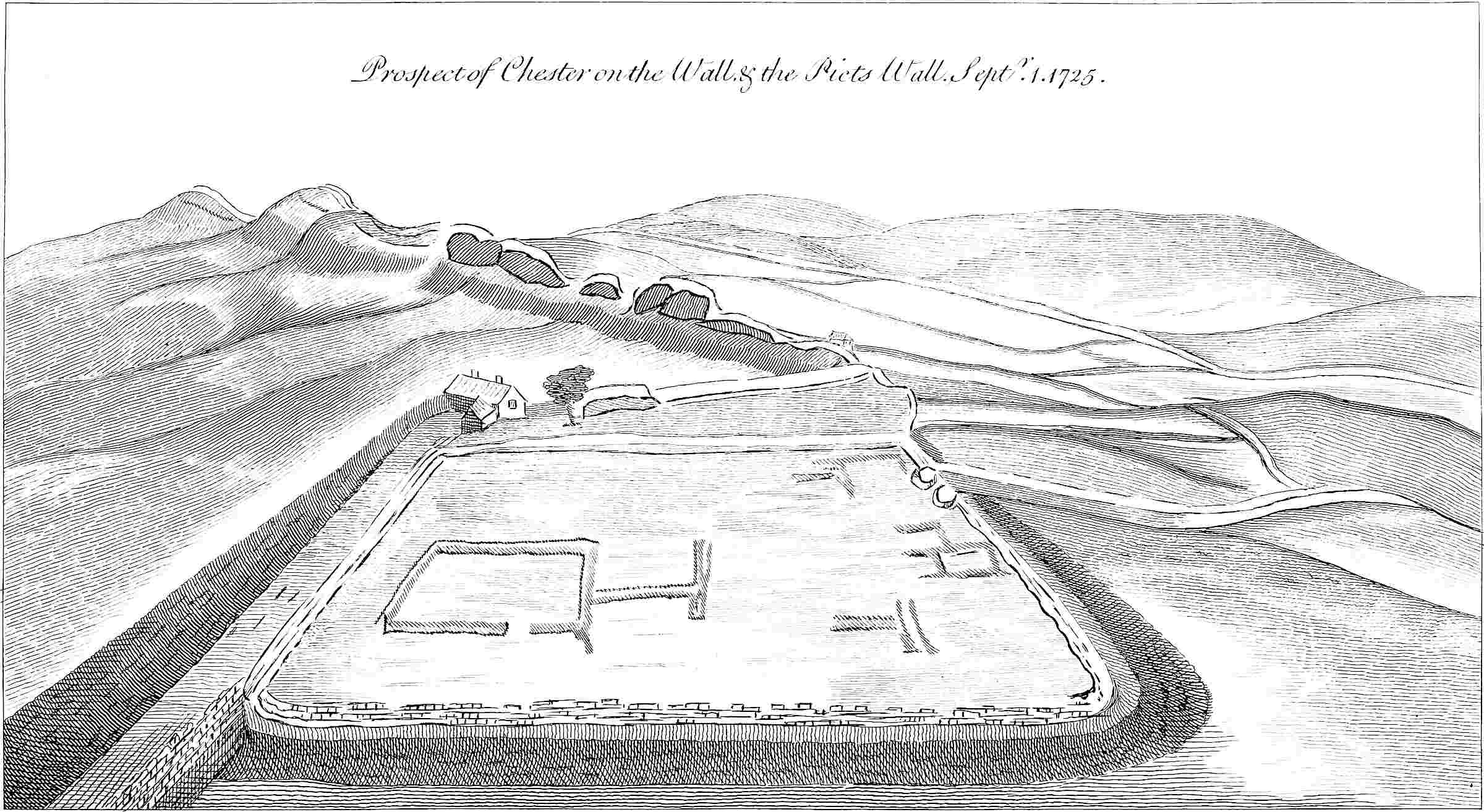
At Haltwistle I got an altar of, DEO SOLI INVICTO. We took the wall again at Chester on the Wall, about two miles east from Caer voran, Wall town, lying between the Roman way paved with broad stones, which led us over the low boggy ground up to the castle. It is a square of 400 foot close to the wall, which makes one side of it; 350 foot less than those on the east and west. Great marks of buildings all over it, and even side-walls of houses left. At the south entrance were two round towers within side, and the cheeks of the gates. Last year one of the iron hinges taken away. All around this castle were houses built. An altar lies in the fields a little way off, but quite obliterated.
The Picts wall continues still on the southern verge of the cliff. Eastward hence we saw, here and there, the vestiges of the square towers, built on the inside of the Wall, and close to it: that called Hadrian’s ditch runs still on the southern verge of the hill, with a large vallum on the north.
We came again upon the Roman road, which goes on the inside of the wall, but not near it, chusing the best ground and shortest cut all the way through this boggy waste country. Upon it is the compass of an inn, or little station for lodging of travellers or soldiers. This road continues very strait and bold to Little Chester, the next station, on a brook, and somewhat better land. A mile before we came to it, on a hill stands a great stone, and a little one, called the Mare and Foal. A little west of that, over-against Chester, is a barrow which Mr. Warburton dug through, and found bits of urns, ashes, and other like marks of its being British. A little farther westward is a large group of British barrows.
Before we come to Little Chester is a most noble column, or milestone, set upon the road: it is of a large bulk and height, with an inscription, but only not quite defaced. Mr. Gale thought he could read TVNG. upon it: it is the finest stone of this sort I have seen, and would have informed us who made the road.
LITTLE CHESTER.
TAB. LXXV.We saw the castrum here, of a square figure, hanging on a precipice over a little river on the south side of the Roman road, and at some distance from the Wall: it had been walled about, as others: great vestigia of buildings, altars, carved stones and antiquities innumerable, have been found here, but now dispersed and gone. We saw the mouths of vaults with great stones lying over them. The fences of the pastures are made of the stones of the castle-wall. The man who lives here showed us a few fragments of Roman work; a pine-apple, which had been a pinacle on the top of a circular tholus; a piece of an inscription within a civic garland, finely cut; a brick, with LEG. VI. V. He has found many coins; but his children threw them away.
In a corner of a field below, by the side of the brook, and as the military way turns, up the hill, is another such milliary stone, but no inscription legible.
The moory country hereabouts has coal under it. Upon the tops of the hills are several cairns, or sepulchral heaps of stones, made by the old Britons.
A little eastward of Great Chester, where the ditch ends, at the bottom of a cliff, we saw the foundation of the Wall, which the country people are digging up for building: we measured the true breadth of it, just seven Roman feet.
HOUSESTEEDS.
TAB. LXXVI.The next station we visited, about two miles from the former, and by the Wall, is deservedly called Housesteeds, from the vestigia of the houses therein, which are as easy to be seen and distinguished as if ruined but yesterday. Approaching the farmer’s house there, I saw a mill or two, i. e. the recipient stones of the hand-mills which the Roman soldiers used to grind their corn with; likewise some tops of altars: over the door of the house, a large carved stone, but defaced. Going a little further, in a corner of a dry wall is a large stone that has been curiously cut, but now broken and much injured: three figures in it, in high relievo; two with sacrificing cups in their hands: I believe it has belonged to some temple, and means the Genii of three cities: it is in my learned friend Mr. Horsley’s 20th table, but poorly represented: they seem to stand before steps. Near it, in the wall, is the bottom part of a very large altar, or pedestal of a pillar, a yard square: near that a long carved stone, somewhat like the shaft of our later crosses.
75·2
d
.
Prospect of Chester on the Wall & the Picts Wall. Septr. 1. 1725.
Stukeley delin.
76·2
d
.
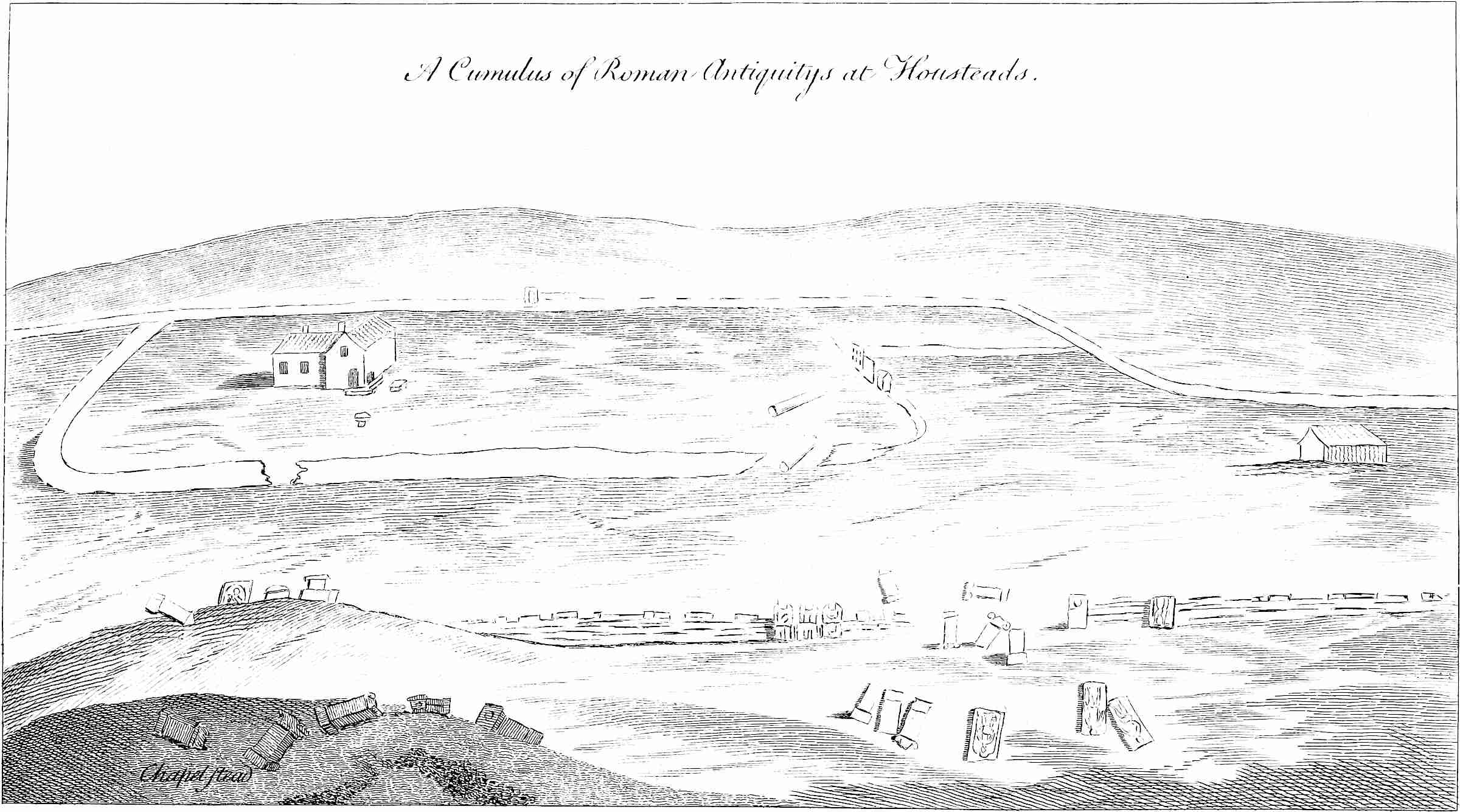
A Cumulus of Roman Antiquitys at Housteads.
Stukeley delin.
74·2
d
.
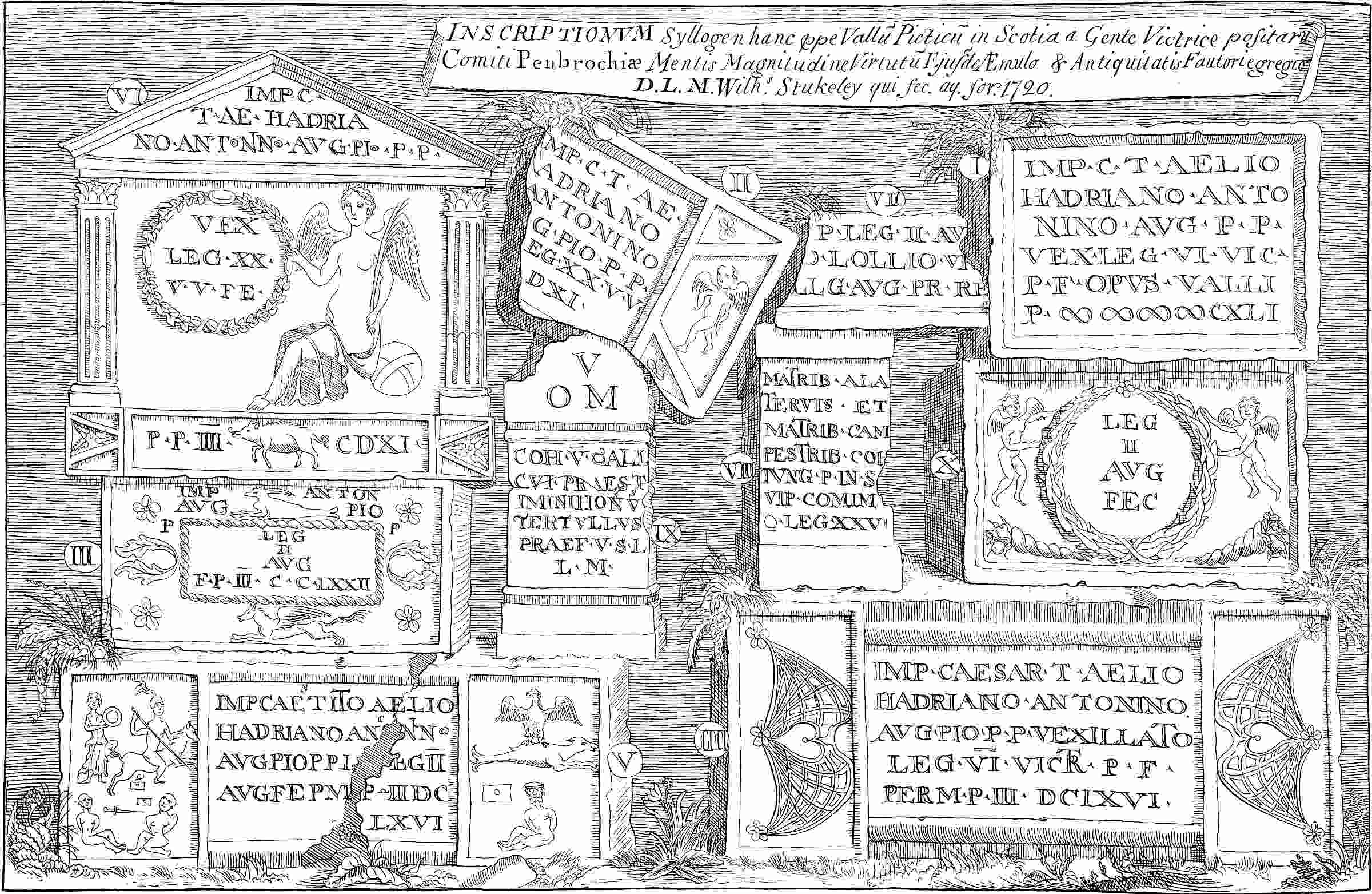
INSCRIPTIONVM Syllogen hanc ꝓpe Vallũ Picticũ in Scotia a Gente Victrice positarũ Comiti
Penbrochiæ
Mentis Magnitudine Virtutũ Ejusdẽ Æmulo & Antiquitatis Fautori egregio
D.L.M.
Wilh
s
.
Stukeley qui fec. aq. for. 1720.
Above the house, upon the Picts wall is an altar; the legend gone. As for fragments of pillars, or rollers, as they call them, they lie scattered all over the place. A large part of a Doric capital lies by the door, consisting of two thori, or swelled mouldings in architectonic language.
But when we were led lower down into the meadow, we were surprised with the august scene of Romano-British antiquities, in the most neglected condition: a dozen most beautiful and large altars; as many fine basso relievo’s, nearly as big as the life, all tumbled in a wet meadow by a wall side, or one on the top of another, to make up the wall of the close: the basso relievo’s, some with their heads down the hill; particularly an admirable image of Victory, both arms knocked off: one large soldier, a sepulchral stone, with his short sword hanging at his right side, the man told us, was condemned to make a pig-trough on; but some gentlemen, full timely, with a small sum, for the present reprieved him: many soldiers with heads broke off; mutilated by the middle: three ladies sitting close together, with globes in their hands; their heads all gone.
Mr. Gale and I laboured hard at the inscriptions, and made out what we could of them under all disadvantages. Along the same wall, as we walked on further, we found more altars and carved stones of various sorts: but at length the farmer carried us up to a knoll in the middle of the meadow called Chapel-steed, where undoubtedly was the Roman temple: there we saw three or four most beautiful altars; and a little further, under another wall, a pretty sepulchral carving of an old soldier’s upper part in a niche.
With great regret we left the place, deserving to be accounted the Tadmor of Britain. The inscriptions being mostly of the captains of the first cohort of the Tungrians, shows they were chiefly stationed here; and then they had piety enough generally to erect such an altar, when they took possession of their post.
We passed through Newborough. Just before the church, on the middle of the street, stands an altar; but the legend vanished. I am informed, that where the Roman wall passes the north Tyne, it is by a wonderful bridge of great art, made with very large stones linked together with iron cramps, fastened with molten lead.
We do not wonder at the great quantity of antiquities here to be seen, when all the workmen of the Romans were generally got into Britain: as is evident from the Panegyrist to Maximian, sub finem.
Devotissima civitas Heduorum ex hac Britannicæ facultate victoriæ plurimos quibus illæ provinciæ redundabant, accepit artifices, et nunc extructione veterum domorum, et refectione operum publicorum et templorum instauratione resurgit.
Two remarks are naturally inferred from this testimony. 1. How fond the Romans were of this island; whence the cities, castles, roads, temples, altars, sculptures, and in general the whole face of the country here, vastly exceeded that of the continent. 2. When I returned home from this journey, and compared my drawings of the antiquities here exhibited, taken from the things themselves, with those that have been published before or since, by Mr. Alexander Gordon, or Mr. Horsley; it grieved me that, for want of a tolerable skill in design, they have given us such poor and wretched pictures of these elegant antiquities; so that the reader may not wonder when he views them both together: and indeed it gives foreigners a mean idea of the Roman works in our island; but very injuriously. I have therefore caused a good many of these to be engraven, to show the just difference.
At Chesters an admirably carved stone was dug up lately, very large: the tenant of the farm caused it to be planed and turned into a grave-stone for himself; and it is now laid over him at the parish church.
HEXAM.
Hexham has a fine appearance every way; stands on a hill in a pleasant woody vale by the river Tyne; once a bishop’s see: the church dedicate to St. Andrew by the great Wilfred, who was the occasion of bringing my native country of Mercia to embrace christianity: he founded the priory of St. Leonard’s, between Stamford and Uffington, the first of the kingdom of Mercia: part of the church of his building remains, though turned into a barn: he built St. Peter’s church in Stamford, the first church there.
By Mr. Gale’s persuasion I wrote the whole primordia of Stamford, which I have by me. At Tickencote, hard by, is the most venerable church antiquity extant, the intire oratory of prince Peada, who founded Peterborough abbey. But return we to Hexam.
The cathedral is a large, lofty structure; but the body or west end, and the two towers, are intirely demolished: it was collegiate: a great building, called the College. Between it and the church are cloisters, now a garden. In the choir two knightly monuments of stone cross-legged; by the arms on their shields, Vernon and Umfrevile; they either went a warfare into the Holy Land, or vowed it: a tomb of one of the Northumbrian kings: two oratories over sepultures unknown: a tomb of a woman with a veil over her eyes.
Here has been much old-fashioned painting, upon wainscot and stucco, of bishops, saints, kings and queens; but, to the loss of history, defaced. This town was undoubtedly Roman. We judged the castrum was where the castellated building now stands, east of the market-place; which is the brow of a hill, and has a good prospect. The market-place, which is a square, lies between this and the cathedral.
On the site of the cathedral once stood a Roman temple. Digging for a foundation of a buttress to be built on the west side of the steeple, they opened a vault, which descends under the church to a subterraneous oratory, like that under the cupola of St. Peter’s at Rome, called limina apostolorum. Here I suppose were kept the reliques of saints. This place is built out of the ruins of the temple. Over the inward entrance to the vault is laid flat a fine Roman inscription; the report of which led us down thither, though the passage to it was as bad as that of Poole’s hole, Derbyshire. We found it a noble large stone of the emperors Pertinax and Aurelius: we could not transcribe the whole, because part of it is still within the wall. Over the next door lower down, a large stone is set perpendicular, and half of it cut away, in nature of an arch: the mouldings likewise chopped off; the whole so defaced, that nothing to any purpose could be made out of it, all the words being imperfect. Upon the walls of the crypt we saw many Roman fragments of mouldings, and carved work, with bits of fluted and cabled pilasters.
In searching about the oratory we found a very fine altar almost intire, laid sideways into the very foundation. We dug away the earth and bones underneath, and discovered thereby a new Legatus Augusti Q. Calpurnius Concessinius; and a new troop of horse in Britain, of which he was the captain, the equites Cæsareani Corionototarum.
The ground-plot of this town is much like that of Caster in Lincolnshire; four streets going diagonally from the angles of the market-place. Some silver and other Roman coins were found not long since near the church. This church is a very venerable and noble Saxon structure, and may serve for a specimen of the manner of raising those fabrics at that time of day. The workmen were but lately then brought from Rome, by the great Benedict bishop of Weremouth, who may truly be called the Arundel of that time: he was a nobleman of Northumberland, minister to king Oswy: he travelled to Rome twice, some say five times; and brought home a fine collection of books, of which the venerable Bede made so good use: he also brought hither architects and artificers in building, carving, painting on glass, and the like; so injurious are the notions of some modern antiquaries, who think we had no stone buildings before the Norman kings.
Our Wilfred was likewise a great genius: he travelled first to Rome in Benedict’s retinue: he was a great promoter of building cathedrals and religious houses: besides this of Hexam, he rebuilt that of York, before raised by Paulinus: he built a cathedral in the old Roman city of Cambodunum, Almondbury, in Yorkshire: he built Rippon cathedral: he had a great hand in founding the cathedrals of Peterborough, Ely, Litchfield, Leicester, and Chichester. He died in a good old age, 12 Oct. anno Dom. 709, in his little monastery at Oundle, Northamptonshire: the room still remains, and the church in ruins, but later than his time.
The Corionototarum, in the inscription, is probably the Coriolopocarium in anonymus Ravennas; as Mr. Gale conjectures: and I add, probably it was the neighbouring Corbridge.
The Roman castle was situate near the present Corbridge westward, and on the northern banks of the river: it is called Corchester. They tell us with some sort of wonder, that it is the richest and best hereabouts for ploughing: they discern not that it is owing to the animal salts left in a place that had been long inhabited. Corbridge is built out of its ruins, which are scattered about there in every house. Before the doors we saw many mills, pieces of shafts of pillars, capitals, bases, many pieces of basso relievo, and carvings: a fine large picture of Victory, holding a great parma, which belonged to the horse: two carvings of lions tearing bulls; their heads knocked off: several bits of inscriptions. The foot of the cross in the market-place is an intire Roman altar, of a large size; the inscription worn out: on one side, the head of a goat; a pitcher on the other. In the outer wall of the chancel is a fragment of the fourth cohort of the second legion. In the church-yard is the remarkable altar, in Greek character, to the Tyrian Hercules: another imperfect one set up for a grave-stone.
In Mr. Tod’s house a fragment of a most noble inscription of the emperor M. Aurelius, cut in very large and handsome letters: the date of the tribunicia potestas lost. I have endeavoured to do justice to these elegant sculptures; whereas they are generally by others so very ill done, as to be disgraceful both to Romans, and to Britons, and to antiquity in general.
Over the door of a house, is a poor carving of a Northumbrian king, with a sceptre in his hand, of the same style as their coins. There is a fine bridge here over the river. From hence we travelled all along upon the Roman road, on the northern banks of the Tyne, to Newcastle. We saw Prudhoe castle on the other side of the river, standing on an eminence; and a green mount, keep or tumulus, by the church of Ryton. In the choir upon the ground lies the sepulchral monument of the founder, probably; a lion at his feet; in his hands a square piece like a book, with an eagle upon it.
At Newburn, as we passed, I saw a stone over a stable-door, next to the sign of the boat; a tablet of the Roman fashion, ansated, cut in, but the inscription worn out, as being exposed to the weather over the river side.
The Roman wall leaves the common road about a mile east of Newburn, and passes northward to recover the northern edge of the high ground; the counter-guard ditch, called Hadrian’s, accompanying it pari passu. I saw some more carved stones at Newburn, not worth reciting.
We leave Benwell on our right hand, a Roman station. The road two or three miles west of Newcastle is very broad and strait, and enters the west gate directly.
At East Denton, three miles west of Newcastle, is an inscription, in a stable-wall, of the eighth cohort of the second legion.
NEWCASTLE.
This is a very large and populous town. The Picts wall ran along by the north side of the road from Corbridge hither, upon a northern declivity all the way, and in a strait line, on the north side of Newcastle. The present castle was built where the Roman castrum was, and the Roman bridge: that and the walls of the town, the churches, and oldest houses, are raised from the plunder of the Roman wall, which ought to have been preserved as the noblest monument in Europe: it seems to have gone across the present town, from the west gate to Pandon gate; and lately, about the meeting-house, they dug up foundations of it: near Pandon gate was found a seal-ring, now in Mr. Warburton’s possession.
One of the church steeples in this town is of a very ingenious model, the original of one near London bridge. The bridge here is very long, has houses on it: the arches and piers are rather larger than those of London bridge. There is a ground-plot of this town lately made by an artist. In some parts of this country, the ordinary people make a good sort of ale called hather, that is, ling ale, by boiling the tops of the Hather plant to a wort: then I suppose they put wormwood to it, and ferment it.
The coal in this country, and which is universally diffused through it, dips many ways, as the falls of valleys, or ducts of rivers, occasionally divert its primary bent; but the main dip of it is to the south-east. Sometimes here are fissures, or interruptions of some considerable quantity, being coaled strata, stone, and other materials jumbled together: this proves that there has been such a partial disruption of the strata of the earth, as we all along suppose was effected by the Deluge; but not such a hotch-potch, or total mixture and confusion, as others would pretend. It is objected against our scheme, that the fishes in this deluge would be destroyed, and so the renewal of them prevented; for, whether the water of the flood was salt or fresh, or compound, yet this consequence must follow: and indeed I allow it; but I suppose the eggs of these fishes renewed the species, which, like the seeds of plants, would in an immense quantity escape the storm, and provide for the succeeding world. Immense are the quantities of coals transported from this focus of the kingdom; and the trade thereof is a perpetual source of seamen for our navy. They speak very broad; so that, as one walks the streets, one can scarce understand the common people, but are apt to fancy one’s self in a foreign country. The perpetual clouds of smoke hovering in the air makes every thing look black, as at London; and the falling of it down must needs inrich all the ground round about.
It is an old proverb in this country, “As old as Pandon gate;” which shows that there were formerly some ancient remains thereabouts; and I believe the Picts wall went from thence, or rather somewhat above it, i. e. north of it, directly across the town, to West gate; though now the town is enlarged beyond it: nor was the old city, which stood within the Wall, so broad to the east and west, as the present town, but only filled up one of the eminences on which it now stands, having deep valleys with brooks running through them on the sides. Again, it may be inferred, there was a city or castrum at Newcastle, because the Wall on both sides runs in toward a point somewhat this way; otherwise they ought to have carried it on by a straiter line north of the town, and above it at some distance, and where it would better the northern side of a declivity than at present; which was not so very necessary when there was a city or castle here, beside Gabrocentum on the other side of the water. Further, the ferry over the river here would naturally erect a city for travellers northward.
Thus I conceive the intention and management of this famous work, the Roman wall. It reaches 90 Roman miles: this is distributed into nine parts by one of the largest castles, or cities: that interval has six lesser castles. The names of the larger, till I am better informed, are thus: 1. Blatum Bulgium, Boulness; 2. Drumabon, Drumburg castle; 3. Luguvallum, Carlisle; 4. Amboglauna, Castlesteeds; 5. Voreda, Caer Voran; 6. Borcovicus, Housesteeds; 7. Procolitia, Caerhaw brough; 8. Hunnum, Portgate; 9. Vindolana, Ruchester; 10. Banna, Newcastle. The great castles were generally 400 foot square: these held a cohort; the lesser held a maniple, or century: the first consisted of 600, the other of 120 men; for the Romans, in their military affairs especially, reckoned by dozens. Thus the great castles contained a full legion, 6000 men; the lesser, or centuries, a legion and half: the cohorts were the standing garrison; the centuries were the watch: for the Romans did not, as at present, set a single man to watch over an army; but they watched by centuries, whence we have got the word of standing century, without the thing. This I suppose the primary disposition, whence it was provided that two legions and a half should be a sufficient force to render this wall impregnable; and no doubt it was so, as long as the Romans continued here. Further, upon the mouths of the rivers were the fleets and galleys, to prevent the enemy from passing them in their boats, as the Cohors Ælia classica at Tunnocelum, or Tynmouth, as the Notitia Imperii in the last times informs us. As also, of the disposition of the other troops along the Wall, and castles adjacent at that time. Notwithstanding the foregoing method of planting these castles, as the regular and primary intention of the Romans, in such regular distances that they may relieve one another as occasion requires; yet it must be understood with allowance, and accordingly we find it so: they were not so strict as to plant their castles at the alligned distances indiscriminately, for that would be ridiculous; but chose out all along the nearest ground to those distances, which by situation, on hills and the like, best suited the end, for strength, prospect, water, and all other conveniencies: they likewise placed them thinner, or more frequent, as the more or less defensible parts of the Wall required.
I pursued the Picts Wall beyond Pandon gate to Baker-mill hill, two miles off eastward: it is very plain thither from Sandgate mill, both the ridge of the wall, and ditch, the common road going beside it, and many stones in the foundation left: it passes a very deep valley at Euxburn, so ascends the opposite western hill very steep; a rivulet running now in the ditch. Having mounted the hill, a coal-shaft is sunk in the very ditch, and here is a square fort left upon the Wall: some of the foundation of the wall of the fort, and of the Picts Wall, is visible. This is upon an eminence, and sees from Newcastle one way beside Benwell hill beyond it, where was another fort; and to Baker-mill hill the other way, where no doubt was another; but a mill and some farmhouses, standing thereon, have obliterated it. Between here and Baker-mill hill both wall and ditch are very plain, the ditch being deep, with a rivulet running along it: the present common road to Tynmouth passes on its north side. The foundation of the wall is yet intire within the pastures, and a considerable ridge of it is left. Without the ditch is a coal-work lately set on fire, which vomits out smoke continually, like a volcano: many more coal-works all about it. From Baker-mill hill I observe it goes still forward eastward, in a right line, upon the northern verge of the hills, as it has done hitherto, till it comes pretty near the Tyne.TAB. LXXVII. From this hill I took a prospect of its course Newcastle-ward; and the rather, because in all probability, if, not from the fired coal-work at present, yet from some others hereabouts, the country being intirely undermined, it may some time or other sink, and disorder the track of this stately work.
Afterward I pursued the Wall westward out of west gate. As soon as I passed the houses, I espied the ditch on my left hand, and the bank whereon stood the Wall: the common road goes all the way on its north side. I followed it for two miles up the hill by Eswic, going along the road side as before. Many shafts of the coal-mines are sunk upon it. When we are got into the closes, the foot-way goes along that called Adrian’s ditch; both bank and ditch plainly visible, the bank north. It runs parallel to the Wall, but upon the declining ground south, as the other north: this confirms me in my suspicion, that both works were made at the same time, and by the same persons, and with intent that this should be a counter-guard to the other, the whole included space being military ground. When arrived at the highest ground, is Benwell hill, a military work, one of the larger castra; being 400 foot along the wall, i. e. east and west; not quite so much north and south, 350: this is intrenched with a foss, and had a stone wall, the vestiges whereof are sufficiently distinguishable; as also great tracks of buildings within it, as at the others. It commands a great prospect every way: I doubt not but they could see hence to the next castrum westward; to the east, over Newcastle to the late-mentioned little fort beyond Euxborn; so to Baker-mill hill: southward is a most delightful prospect up two fine valleys over the Tyne; so up the hills south of Gabrocentum, or Gateshead: the eye reaches too the sea-coast to Tunnocelum, or Tynmouth, and the mouth of the river. The village of Benwell subjacent was built out of the ruins of this place, and great quantity of stone is still left. I saw much fragments of Roman bricks, pavings, and gutter-tiles. Two urns were dug up near here; sent to Durham college. I transcribed some altars too, found in this place, at Mr. Shaftoe’s of Benwell tower.
77·2
d
.
View of the track of the Picts wall, Newcastle Ward, from baker mill hill. 4 Sept. 1725. West.
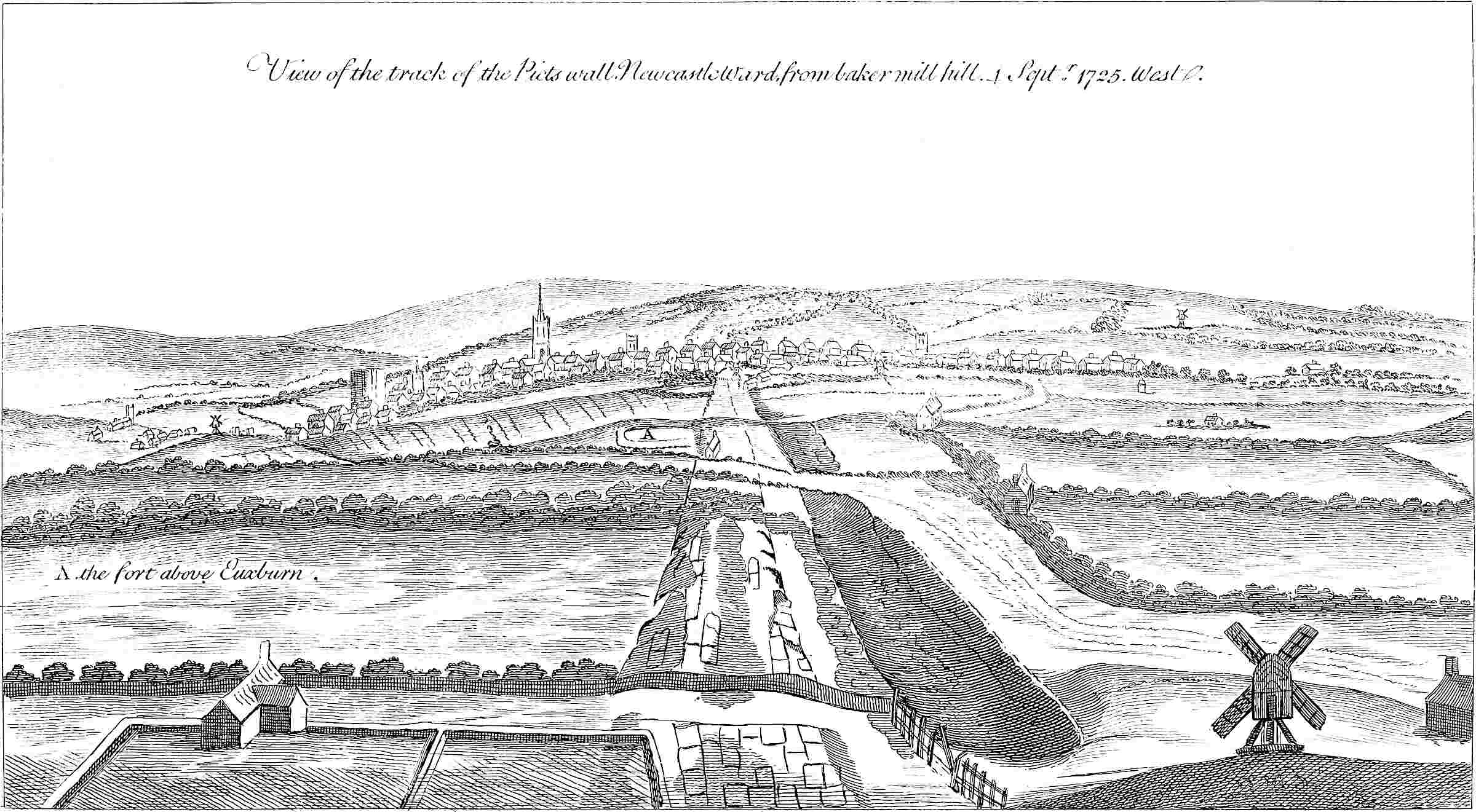
Stukeley delin.
It was a refined piece of management, and great knowledge of things, the Romans showed in the method of this wall; and a matter worthy of remark, that they chose all along to raise this work on the north side of the two rivers, that partly cross the island hereabouts, the Eden and Tyne. Many are apt to wonder at it, and think it was injudicious, imagining the rivers, with a very slender work on the south side of them, would have been sufficient security, and saved them much labour: but, if we consider this matter, we must confess it was not done without great consideration, and a master-stroke of military policy; for by this means the Romans took in all the fine rich ground lying upon the rivers for the sustentation of their troops, encouraged thereby to cultivate it, and build towns near, and make possessions to themselves and families, that they might live easy, and think themselves at home in these distant regions: here too trade and navigation might be carried on, and supplies of corn, wood, and other materials, conveyed from garrison to garrison; and in the times of the perfection of this work it must be looked upon as the best planted spot of ground in the island: and we may imagine the glorious show of towns, cities, castles, temples, and the like, on the south side of this Wall, by contemplating the prodigious quantities of their ruins and memorials beyond that of any other part of Europe, scarce excepting imperial Rome: and we have reason to think this will continue to be a source of entertainment for the curious and learned, when that is exhausted. Hither let the young noblemen and gentry travel, to admire the wonders of their native country, thick sown by that great, wise and industrious people, and learn with them how to value it.
Cæsar tells us the warlike nation of the Germans, the Suevi, gloried most in laying waste all the bordering countries around them, in destroying every thing that might administer sustenance to an enemy in approaching to their quarters. It was certainly equally political in the Romans to leave on the north side of the Wall that huge tract of waterless and dismal moor, a great barren solitude, where in some places you may walk sixty miles endwise without meeting with a house, or a tree: to ride it is impracticable. Thus, as much as in them lay, without the horror of barbarity did they remove the barbarians from their territories; whilst within the Wall, either naturally or by their industry, all things smiled like the garden of Eden: and indeed, toward both sea-coasts, about Carlisle and Newcastle, it is a very desirable and delightful country: and even in the midland moory tracts, by their great roads made every where, it was very good travelling; and in the worst parts, where their castra stood, and upon the valleys, it is now tolerably good, and was much better in their days, in the hands of those who could almost conquer Nature herself.
One of the Benwell inscriptions is plainly to be filled up at top thus; Jovi O. M. Dolicheno & numinibus Aug. Mr. Gale says, there is an inscription in Gruter, with Jovi Dolicheno ubi ferrum nascitur: there is another inscription, to Jovi Dolicheno, found in Wales: whence he infers with verisimilitude, that Dolichenus signifies not a topical deity; rather, some that presided over iron-works: but I cannot imagine what language it is. In the town I found three more inscriptions, though endeavoured to be concealed from me with a rudeness I never met before, even among the most unbred rustics. The fort at Benwell hill goes north of the road too, with an equal bulk; so that the Wall takes a circuit northward to inviron it: it is full of ruins too; so that it was really a city, induced probably by the extreme pleasantness of the place. A well was lately filled up there.
I find very plainly that the Picts wall, east of the town, came from Red Barns all along the street, so to Pandon gate, there being a great declivity, and a brook running without: then it crossed the valley within the town, where the brook runs, and went up the next hill to All-Saints church, which no doubt stands upon the Wall, out of which it was built: here is still a descent, where Silver-street is; and northward then it went directly to the lane called Panter-haugh, (probably from the old name, Panna, corrupted) with a descent still northward; so to the brow of the hill where the castle stands: here it met the Wall coming from West gate; and no doubt the site of the present castle was the ancient Panna, and this castle was built out of the ruins of the old one, and the adjacent parts of the Wall together. I suspect much, that a piece of the outer wall of the present castle, which stands on the west side in a tattered condition, may be Roman, at least built with Roman stone: this going upon the slope of the hill, the courses of the stone slope too, parallel with the declivity: but, be that as it will, at the foundation of it, a little lower, I saw a bit of the true old Roman wall, and indubitably so, made of white lime-stone, with mortar prodigiously hard, and ringing like a bell when struck upon. This castle has a great precipice eastward over Sand hill, and southward toward the river.
In the fields eastward, between Pandon gate and Red Barns, the counter-guard as I call that (vulgarly Adrian’s vallum) is plain, running all along parallel to the Wall; which method it observes where the ground leaves it that liberty. I suppose the city that belonged to this castle of Panna lay about Sand hill, at the end of the ferry. The south-west part of the town-wall to the postern was built on the counter-guard of that side. This town stands on three lingulas sloping toward the river. Probably William Rufus rebuilt this castle too, as that at Carlisle, and with the same purpose, as a guard against the pillaging Scots.
The manner of conveying the coals down to the river side from the pits, is very ingenious: a cart-way is made by a frame of timber, on which the wheels of the carts run without horses, with great celerity; so that they are forced to moderate their descent by a piece of wood like a lever applied to one of the wheels. The manner of rowing their great barges here is also very particular, and not unworthy of remark: four men manage the whole; three to a great and long oar, that push it forward; and one to another such a-stern, that assists the other motion, but at the same time steers the keel, and corrects the biass the other gives it. They observe that horses kept under ground in the coal-mines for two or three years, as sometimes they do, have their hair very fine and sleek, and as short almost as that of a mouse. We saw Col. Lyddal’s coal-works at Tanfield, where he carries the road over valleys filled up with earth, 100 foot high, 300 foot broad at bottom: other valleys as large have a stone bridge laid across: in other places hills are cut through for half a mile together; and in this manner a road is made, and frames of timber laid, for five miles, to the river side, where coals were delivered at 5s. the chaldron.