PART I
Reading edition
ITALY IN THE EIGHTIES
To G. K. S.[1]
31, rue Dumont d'Urville, Paris, January 10, 1880.
Well, dear, here I am back again in my little hotel, and very small and uncomfortable it looks—like a doll's house after the enormous rooms of the Quai d'Orsay—however I am very glad to be a private individual once more (no longer a "femme publique" as our friend used to say). Our departure was hurried, as once W.[2] had made up his mind and resigned he wanted to get away at once. We got off in two days, which I thought quite wonderful. Of course ever since the opening of the session in November it was evident that he couldn't stay. He and his Ministers were hardly ever agreed on any point, and it wasn't worth while for him to spend his energy and intelligence in trying to carry out a policy which neither the Chamber nor the country apparently desired. There were endless conferences all through December, but it was clear that it was time for him to go.
The weather was something awful—bitterly cold—the Seine frozen tight, booths and games established, and everybody sliding about and trying to skate—but that was under difficulties as the ice was rough and uneven. I walked over with Francis,[3] that he might say he had walked across the Seine. We had great difficulty in warming the house—many trains with wood and coal were blocked just outside Paris, and nothing could get in. I don't know what we should have done, but happily the Ministre de la Guerre gave us an order to take some wood from some dépôt in Paris where they had a provision; so for the two days before we moved in great fires were going in the calorifère. I really think the only person who hated to leave the Quai d'Orsay was Francis. He was furious at seeing all his things packed up, and was carried out to the carriage kicking and screaming—"veux pas quitter ma maison—veux pas aller vilaine petite maison." The huissiers (6, all standing solemnly in a row to say good-bye) were much impressed, and the old grey-headed Pierson who has been there for years and seen many Ministers depart, remarked—"au moins Monsieur Francis est désolé de partir." It seemed funny to drive out of the big gates for the last time. I wonder if I shall ever go through them again. Things go so quickly in France now.
You can't conceive anything more uncomfortable than this house to-day—no carpets down nor curtains up; all the furniture, books, rugs, dumped in the middle of the rooms, and the hall and corridors full of trunks and boxes. W. has had a steady stream of people ever since we arrived—some to condole—some (old friends) to congratulate him upon no longer serving such an infecte government—some a little embarrassed to explain that, though they regret him extremely, still ... they must serve their country, and hope he won't take it amiss if they make up to the rising sun (in the shape of Freycinet, who has taken W.'s place). I expect we shall have some curious experiences. When one is no longer in power it is surprising how things change their aspect. I had to settle the salons as soon as I could as I had invited a big party for Francis's Christmas Tree, thinking it would be at the Quai d'Orsay. I didn't want to put the people off—particularly the diplomatists who have all been most civil and proper—so after a consultation with Kruft—(chef du matériel at the Quai d'Orsay) who had already begun to make his preparations, I decided to have it here, and Kruft and one of his men came and helped dress it. Of course the tree had to be cut at the top—our rooms are fairly high, but nothing like the Quai d'Orsay naturally—but it looked rather prettier, quite covered with toys and shiny ornaments. Francis had beautiful presents—a hand-organ with a monkey on top from Madame Sibbern, the wife of the Swedish Minister, from which he can't be extracted. He can't turn it alone, but some of the bigger children helped him, and we had the "Cloches de Corneville" and "Niniche" almost all the afternoon. There were about 100 people, children and parents, and the rooms looked pretty. All the people and lights warmed them too—it wasn't quite so Siberian. We couldn't attempt cooking of any kind as the kitchen range was out of order, and besides we hadn't fuel enough—l'Oncle Alphonse[4] who lives next door feeds us. W. and I go to him for breakfast and dinner, and his chef (a very distinguished artist and well dressed gentleman—quite a superior person—Monsieur Double) submits Francis's menu every morning to Nounou, as he says he has no experience with children.
We have decided to go to Italy for two or three months, and shall make Rome our headquarters. W. has never been there, and says it wouldn't be worth while going for less than three months. What fun it will be to be there together—I can hardly believe it is true. I am sure we are wise to get away. There must always be little jarring things when one has been in office some time—and it would be rather a bore to W. to take his place as senator and be in opposition to the present Ministry. If he stayed in Paris he would have to take part in all the discussions, and would certainly be interviewed by all sorts of people to whom he would say nothing (he never does—he hates newspaper people) but they would say he did all the same, and so many people believe implicitly whatever they see in a paper. The Minister has offered W. the London Embassy, but he won't take it, doesn't wish to have any function of any kind at present. He is looking forward to long, happy hours in Rome, deciphering all the old inscriptions, and going over the old city with Lanciani[5] and some of his literary friends.
January 12, 1880.
After all I have been back to the Quai d'Orsay. W. said I must go and make a formal visit to Madame de Freycinet (who is a very nice woman—a Protestant, and has one daughter—a charming intelligent girl). Henrietta and I went together, taking Francis with us, who was delighted as soon as he got to the Place de la Concorde and crossed the bridge—"C'est Paris—C'est Paris." Poor little boy—the rue Dumont d'Urville is so quiet, nothing passing and nothing to see when he looks out of the window. He was always at the window at the Quai d'Orsay looking at the boats, the soldiers, and the general liveliness of a great thoroughfare. It was a funny sensation to go and pay a visit to Madame de Freycinet in the little blue salon where I had received her so often, and to be announced by my own pet huissier, Gérard, who spent his life all the time I was at the Quai d'Orsay sitting outside the door of any room I happened to be in. He knew all my visitors—those I wanted to see and those I didn't—kept all the cards, and books, and remembered every quête I had given to—and the bills that had been paid. I don't remember that he ever occupied himself with my garments, but I am sure that he could have found anything that I asked for.
The house is gradually getting warm and comfortable, and the furniture settling into its place; but I have a curious feeling of smallness—as if I hadn't room to turn. We hope to get off in three or four days. We leave Francis of course, but Nounou and Hubert will look after him, and he will go to breakfast every day with Mother, where of course he will be well spoiled and have everything he asks for.
To G. K. S.
January 18, 1880.
I hope we shall get off now in a day or two—W. really needs the rest, which he never will get here as all day long people come to see him and suggest various plans. We have written to the Hôtel de Londres. You or Eugene might go there some day and see the rooms they propose. It will be nice to be back in our old quarters Piazza di Spagna. We had a pleasant small dinner last night at the British Embassy—Lord Lyons is always so nice and cordial. He was a little surprised and not quite pleased that W. hadn't accepted the London Embassy, he would have been so entirely a "persona grata" with his English education, connections, etc. All the Diplomates seem to regret us (but I think they will like the Freycinets just as much) and really here, where Ministers are such passing figures in the political world, they would have a hard time if they set their affections on any particular man.
I am becoming very philosophical—though the attitude of some of my friends has rather surprised me (not W.; he is never surprised at anything). L'Oncle Alphonse keeps us well informed of what is said on the other side. He is quite a Royalist, a great friend of the Orléans Princes, and a great deal at the club where they always call him "l'oncle du gouvernement"—and when the "gouvernement makes a 'bêtise'" (which sometimes happens) they criticize freely, and he tells it all to us. I fancy he always defends W. in public—but of course in private pitches into him well.
I rather miss the big life—seeing so many people, and being as it were behind the scenes—also our conversations at night when W. had finished his signatures, and Pontécoulant[6] came up from his quarters with the report of the day, and got his instructions for the next morning. W. is not at all "matinal" and hates doing any kind of business early—must always have his ride first. We used to sit in W.'s cabinet until two in the morning sometimes, telling our experiences—some of mine were funny. I hated an official reception day, but the gentlemen of the protocol department thought it absolutely necessary, so I was obliged to give in—and certainly nothing I did tired me so much as those long Fridays in the big yellow drawing-room. From 3 to 6 streams of people—women mostly—of all nationalities—and of course no conversation possible—however it wasn't always banal, as you will see. Our last Friday one of my friends had been in, very much taken up with the journey to Rome—her clothes, the climate, which hotel was the best, etc. When she went out in a whirl of talk and excitement I turned to one of the 14 women who were seated in a semicircle on each side of me, and by way of continuing the conversation said: "Il me semble qu'on serait très bien à l'Hôtel de Londres à Rome en plein soleil," to which she replied haughtily "Je n'en sais rien, Madame, je n'ai jamais quitté Paris, et je m'en vante." W. wouldn't believe it, but as I told him I couldn't have invented it. I was rather sorry I hadn't pursued the conversation, and asked her why she was so proud of that particular phase of her life. I suppose she must have had a reason, which naturally I couldn't understand, having begun my career so very far away from either Rome or Paris. It is a real pleasure though to be back in my own salon, and have my nice little tea-table, and three or four of my friends, and talk about anything and everything, and even do a little music occasionally.
January 20, 1880.
I didn't find my tea quite so pleasant the other day. I was sitting in the little salon talking to one or two ladies, and receiving their congratulations at being no longer of the official world, and obliged to associate with the Government people, when the footman appeared with his eyes round, to announce that "La Présidente" (Madame Grévy) was coming upstairs to pay Madame a visit. I flew to the door and the top of the stairs (I couldn't get any further) and received "ma Présidente" in proper style. I ushered her into the salon where I had left my friends (mad Royalists both). They were much disgusted—however they were too well-bred to make things disagreeable for me in my own house—and rose when we came in. I named Madame Grévy—and as soon as she had taken her seat, and declined a cup of tea, they went away. Of course they hated getting up for Madame Grévy, but there was nothing else to be done as she and I were both standing. Happily no one else came in but Prince Orloff, Russian Ambassador, who of course knew Madame Grévy and talked easily enough. She didn't stay long—it was the classic "visite de condoléance" to the wife of the ex-Minister (if she only knew how glad this Ex was to return to private life and her own house, and to be no longer "logée par le gouvernement"). This is the second visit of condoléance I have had. When Marshal MacMahon dismissed (suddenly) all his cabinet presided by Jules Simon, 16th of May, 1877, Madame de MacMahon came also to see me—and at the same time—5 o'clock on my reception day—so I knew precisely what the conversation would be—and Madame Grévy and I both said exactly the same things that the Maréchale and I had said two or three years ago. I suppose everybody does say the same thing on certain occasions. After she had gone Orloff asked me if I remembered those two ladies meeting (for the first time in their lives) at the Quai d'Orsay on one of my Fridays. Just after the Marshal resigned Madame de MacMahon came to see me. She was announced by all the servants and I had plenty of time to get to the door of the first drawing-room, not quite to the anteroom, to receive her. When her husband was President she was received always like Royalty—at the door of the apartment. She was very simple and easy, quite pleased evidently at still having all her honours. Prince Orloff came in to pay a visit, and we were having a very pleasant talk, when I heard quick footsteps in the second salon, and again appeared my faithful Gérard (I had also visions of numberless doors being opened all down the enfilade of salons) announcing Madame Grévy. I was embarrassed for a moment as I didn't like to leave the Maréchale, and yet I knew I must go and meet Madame Grévy—all the ceremony of course was for the official position, and one Présidente was just the same as the other. Madame de MacMahon was most amiable—said at once—"Je vous en prie, Madame, ne pensez pas à moi"—and "au fond" was rather curious to see her successor. I went as quickly as I could (Orloff giving me a funny little smile, almost a wink, as I passed him) and got my other Présidente just at the door. She was rather astounded I think at her reception—she hadn't been long in her exalted position. We proceeded majestically through three or four salons, and when we arrived at my drawing-room Madame de MacMahon got up at once, saying quite simply "Voulez-vous me présenter, Madame, à Madame Grévy?" She was quite at her ease—Madame Grévy rather shy and embarrassed—however Madame de MacMahon talked at once about some of the great charities, artists, etc., and it really wasn't too stiff—Orloff of course always helping and making jokes with the two ladies. One or two visitors came in and gasped when they saw the situation—also one of the young men of the Cabinet, who instantly disappeared. I always thought he went to tell W. what was happening upstairs so that he might come to the rescue in case I wasn't up to the mark ... but he swears he didn't. When the Maréchale got up to go there was again a complication as I wanted to accompany her to the door, and I didn't like to leave Madame Grévy. She wouldn't hear of my going through all the salons—took leave of me at the door—and then Orloff came to the rescue—gave her his arm and took her to her carriage. It was a curious meeting, and, as Orloff said just now, "je lui devais une fameuse chandelle."[7]
February 6, 1880.
We are starting to-night, straight for Florence, where we shall stay a week or ten days with the Bunsens before going on to Rome. W. is much pleased at the Roman prospect—and I can hardly believe that I am going to see Rome again. We have our lit-salon straight through to Florence, and I hope we shall be warm enough. It is bitterly cold to-day—even walking I was glad to have my sealskin coat. Nounou is rather tearful at being left in sole charge of Francis, but as that young gentleman is perfectly well, in roaring spirits, and will be given everything his heart desires by his Grandmother and Aunts, I don't feel very unhappy about him. It seems incredible that we should be going to meet soon. How we will prowl about Rome. I suppose I shall find it absolutely changed—so many more people—not our dear old dead Rome.
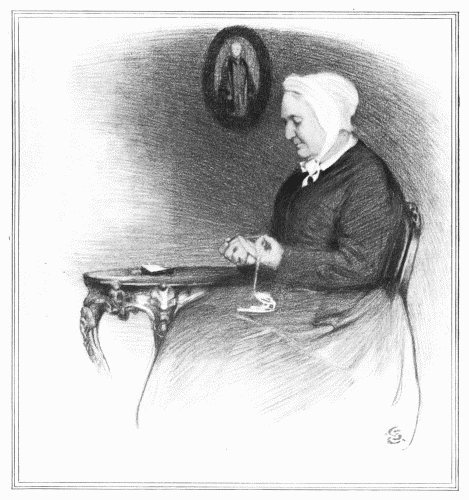
Mrs. Charles King.
To H. L. K.[8]
Florence, Via Romana, Villa McDonnell, February 8, 1880.
We arrived quite comfortably, dear mother, but almost frozen, particularly W. He has not been extracted from the fire since we got here. Henrietta will have told you of our start. Pontécoulant and one or two men were at the station to see us off—also the Chef de Gare, most civil, and saying we should not be disturbed at the frontier—and that our coupé-lit would take us straight through to Florence. We had a perfectly easy journey, and I slept quite peacefully—waking up merely when we passed through the tunnel, as the guard came in to shut all the windows. It was a beautiful, cold, starlight winter night. The great mountains covered with snow looked gigantic as we approached—"sinistres" as Madame Hubert[9] said. She was much impressed and rather nervous. There were very few people in the train. When we arrived at Modane the Chef de Gare was waiting for us—he had been telegraphed from Paris to expect us. We had breakfast in the private room, and a nice woman was waiting for us upstairs in the ladies' room with hot water, towels, etc. I made quite a toilet—she carried off my dress and jacket to brush—and then we went down to a nice little breakfast which tasted very good, as I hadn't had anything since our 7 o'clock dinner. They offered us coffee somewhere—Dijon I think—but I didn't want anything then. All the first part of the road—in fact all the road to Turin was lovely. It was a bright, cold morning, and the snow mountains looked beautiful. It was such a pleasure to hear Italian once more—even the names at the stations "capo stazione"—"grande velocità"—"uscita," etc., also the shrill "partenza" when we started. The last time I crossed the Mont Cenis was by the Fell railway when we all started together from Aix. That was certainly very beautiful—but rather terrifying—particularly as we neared the top and looked at the steep places and the various zigzags we were to follow going down. One couldn't help feeling that if a brake or chain broke there would be a terrible catastrophe. I remember so well some of the women who were quite sea-sick—the swaying motion, I suppose, as we rounded the curves, of which there were many. I can see one now stretched out on the floor on a rug in the small salle d'attente at Susa, quite exhausted and absolutely indifferent to the outside world.
We had quite a wait at Turin. Our coupé was detached and put on the Florence express. They locked the doors, and we left all our things—books, shawls, bags, etc.—and had a very fair dinner at the buffet. We had so much time that Madame Hubert and I went for a little walk. There was not much to see close to the gare—but it was delightful to me to hear Italian again, and to see the idle, placid crowd standing about—nobody in a hurry apparently, and nobody jostling and pushing through, though there were trains starting or coming in all the time. W. was too cold to move—he really should have had a fur coat—which he utterly despises—says that will do when he is 70, and can't walk any more. It was warm and fairly light in the buffet so he established himself there with a paper and was quite happy. We got here about 6.30—Charles de Bunsen was at the station with a carriage—so we came off at once, leaving Madame Hubert and Francesco with the trunks. How she will get on in Italian I don't know, but she is very active and débrouillarde, and generally makes herself understood. Mary[10] was waiting for us with tea and those crisp little grissini[11] we always used to have in Casa Guadagni. They have a charming "villino"—part of the McDonnell villa. One goes in by a small door (in one of the narrow grey streets of old Florence, with high walls on each side—Via Romana) and straight up a fine broad staircase to a good palier with large high rooms opening out on it. All the bed-rooms and small salon open on a loggia overlooking the garden—a real old Italian garden. I shall never be dressed in time for anything in the morning, as I am always on the loggia. The flowers are all coming out—the birds singing—the sky bright, deep blue—and the whole atmosphere so soft and clear—and in fact Italian—different from everything else.
Mary has arranged the small salon (which they always sit in) most prettily and comfortably—with bibelots and quantities of books about in all languages—there are usually four going in the establishment—Charles and his daughter speak always German to each other—the rest of us either French or English—it depends rather upon what we are talking about—and always an undercurrent of Italian with the servants and "parlatrice" (such a sweet, refined looking girl who comes every day to read and speak Italian with my belle-mère). Mrs. Waddington strikes at the mixture at meals and insists upon one language, either English or French. There is also a charming German girl here, Mlle. de Sternberg, a niece of Charles de Bunsen—so we are a most cosmopolitan household. The life is utterly different from the one I have been leading for the last two years.
To H. L. K.
February 10, 1880.
I try and write every day, but am so much taken up and so tired when I come in that I don't always find the moment. W. is all right again. He really got quite a chill from the cold night journey—and for two or three days sat in the fire. Francesco, the Italian servant, took excellent care of him—was so sympathetic the night we had some music and W. couldn't appear. It was a pleasant evening—a Russian Prince (I forget his name, and couldn't probably spell it if I remembered), a great friend of Mary's, an excellent musician and a great Wagnerian offered to come and play some of the Nibelungen. I was delighted as I only know Tannhäuser and Lohengrin. I remember now your sigh of relief when Seilern and I finished playing à 4 mains the Walpurgis Night years ago in the Champs Elysées. I daresay it was trying for the public—but we enjoyed ourselves immensely. The big drawing-room looked very pretty, with plenty of flowers, and I think there were about 50 people—almost all (except Lottie and Madame de Tchiatcheff) ardent admirers of the great man. One lady appeared in a sort of loose, red gown (it seems red is the only colour Wagner admits), her hair, very pretty, blonde, hanging down her back, just tied with a ribbon—and carrying two partitions. Mary said, "Wouldn't you like to sit by her, and she will explain it all to you?"—but I said there was nothing I would like so little. I knew enough of the legend to be able to follow, and moreover I had always heard that Wagner's descriptive music was so wonderful that one understood everything without any text, etc. The great man appeared—the grand piano was opened all over to give as much sound as possible—and he requested absolute silence. He played beautifully—it was enchanting—one quite heard the little waves in which the Rhein-Töchter were disporting themselves. It was wonderfully melodious and delicate—I should have liked it to go on forever. He played for about three-quarters of an hour—all Rheingold—then suddenly pushed back his chair, and rushed to the anteroom, exclaiming "de l'air—de l'air," followed by all the red and musical ladies. It is a pity there must always be such a pose with Wagner—for really the music was a joy. I met of course quantities of old friends, and agreed to go to Lottie Van Schaick's ball.
February 12, 1880.
W. and I had a lovely long flânerie this morning. He is quite well again, and the sun was tempting. It seems quite a different Florence living over here, and I must say much more old-world and Italian than the Lungarno, with all the modern hotels and apartments, and evident signs of forestieri[12] everywhere. As soon as we cross the bridge it is quite different—a gay, bustling, northern city. W. was so much amused the other day—we were in a fiacre and the driver put on the brake to go down the almost imperceptible descent on the other side of the bridge. We went straight across to the Piazza del Duomo to-day, where the market was held, and wandered in and out among the stalls. It was all so familiar—little green cucumbers, almonds, and strings of fried fish, with a good healthy smell of "frittura." The people were all most smiling, and so pleased when I spoke Italian to them, and said I was so happy to be back in their country again. W. has no opinion of my Italian. He came to my room this morning followed by the Italian servant to tell me to tell him that his razor must be sharpened. I began, and came to a dead halt—hadn't the slightest idea what razor was in Italian. W. was much disgusted, but I explained that when I was living in Italy before as a girl, I hadn't often had occasion to ask for razors—all the same he has evidently lost confidence, and thinks my reputation as a linguist "surfaite."
This afternoon we had a lovely drive up the Fiesole hill with Mary and Beatrice. Their man, who goes on the carriage, is called "Bacco" and is so Italian and sympathetic—takes a lively interest in all our proceedings—knows everybody we meet, and talks cheerfully with any of his friends we happen to cross. The view from Fiesole was divine—the long slopes of cyprus and olive trees—with Florence at the bottom of the valley, and the Arno just visible—a streak of light. I am so fond of the grey green of the olives. It all looked so soft and delicate in the sunset light.
February 13, 1880.
We are getting dreadfully mondain. The other night we had a pretty, typical Florentine party at Edith Peruzzi's.[13] We went a little after ten and thought we would be among the first, but the rooms were already full—quantities of people (not many of my old friends) and splendid jewels. It was much more real Florentine society than the people we used to see when we lived in Casa Guadagni. They were generally the young, sporting, pleasure-loving set, with a good dash of foreigners, artists, diplomatists, etc. These were the real polite, stiff Italians of the old régime. Many people were introduced to us, and W. enjoyed his evening immensely—found many interesting people to talk to. He was delighted to meet Bentivoglio again, and they immediately retired into a corner, and plunged into Asia Minor and coins. Edith looked very well, did the honours simply and graciously; and Peruzzi really not changed—always the same tall, handsome, aristocratic type.
Last night was Lottie Van Schaick's ball, very gay and handsome. Mary wouldn't go—so I chaperoned the two girls—Beatrice and Rosa Sternberg. They made a very pretty contrast—Rosa von Sternberg is fair and slight, a pretty, graceful figure. Beatrice on rather a larger scale, with a very white skin, and beautiful dark eyes. W. and Charles Bunsen came too, but didn't stay very long. We went late as the Florence balls always last so long. I met quantities of old friends, and made a tour de valse with Carlo Alessandri for the sake of old times. W. was much amused to see all the older men still dancing. At the Paris balls the danseurs are all so young—few of the married men dance—only the very young ones. I didn't wait for the cotillon—it hadn't begun at 3.30. The supper is always before the cotillon which of course prolongs the festivity.
I was lazy this morning, as we came in so late last night, so W. and I only went for a turn in the Boboli Gardens. The shade was so thick it was almost black—but it was resting to the eyes. There are very few flowers, one had a general impression of green. This afternoon we have been driving about leaving cards, and ending with a turn in the Cascine. There everything seemed exactly the same as when we lived there ten years ago. The same people driving about in the same carriages, and everybody drawing up on the Piazza, and talking to their neighbours. It amused me to drive down the Lungarno to our bridge. There were quantities of carriages and people lounging on the pavement, and looking at the river. The instant one crosses the bridge it is perfectly different—narrow streets, high walls, few carriages, no loiterers.
Our garden was beautiful to-night—a splendid moon just rising over the black trees, and a soft delicious air. We have had a quiet evening, talking and reading in the small salon. Charles was very interesting, talking about old Italy and their beginnings in Turin. It seems the etiquette of that Court was something awful. Mary told us that she was talking one day to the Marchesa S. (a lively little old lady who took snuff) who had been in her time a famous wit and beauty, dame d'honneur to the wife of Carlo Alberto. Mary was rather complaining of the inconvenience of going to the winter reception of the Duchess of Genoa (she had only one in the year) where all the ladies of the Corps Diplomatique were obliged to go in full dress décolletée at about 4 in the afternoon. "Ah, ma chère," said the old Marchesa, "what would you have said in our time?" She told her that when the Queen-Mother was ill in the winter at the Château of Stupinigi, some miles from Turin, all her ladies had to go and inquire for her in full dress and manteaux de cour, and that when they knew she was in bed, and could see no one. Mary has splendid Italian lace which she bought from one of the ladies of the old Queen after her death. It would cost a fortune now, and in fact could not be had unless some private individual in reduced circumstances was obliged to sell. I had a nice visit from Alberti to-day—just the same—gay, impossible, saying the most risqué things in a perfectly natural way, so that you can hardly realize the enormities you are listening to. They don't sound so bad in Italian—I think the language veils and poetizes everything. He is very anxious we should go out and spend the day at Signa—his most lovely place—and I wish we could, I should like W. to see it—so much natural beauty—and, with our northern ideas, so absolutely neglected—splendid rooms, painted ceilings—no practical furniture of any kind, and a garden that was a dream of wild beauty—flowers everywhere, climbing up over the roof, around bits of grey wall, long grass that almost twisted around one's feet, and such a view from the terrace. I told W. afterward of our great day there long ago, when we started at 10 in the morning and got back at 2 a.m. I wonder if you remember the day? We were a large party—Van Schaicks, Maquays, Coxes, and others whose names I forget and pretty much every man in Florence (of all nationalities). We started by rail—the women all in light muslin dresses and hats. We were met by carriages of all kinds—Alberti's own little pony-trap—and a collection of remarkable vehicles from all the neighbouring villages. The drive was short, but straight up a steep hill—the villa most beautifully situated at the top, with a background of green hills. Two or three rooms had been arranged for us—so we took off cloaks—a nice, sympathetic Italian woman brushed off the dust—and we went at once to breakfast in the state dining-room—the big doors on the terrace open. Some of the men had their breakfast out there. After breakfast we all wandered about the garden—such thick shade that it was quite comfortable. It was pretty to see the white figures flitting in and out among the trees. About 3 I got into a riding skirt and loose jacket, and went for a ride with Alberti and a Frenchman, Brinquant, a friend of Alberti—very gay, and entrain, and perfectly amused at the entertainment—so sans façon and original. We had a lovely ride—through such narrow roads—branches of the orange trees and roses nearly coming into our faces as we cantered along the little steep paths. I had a pretty little mare—perfectly sure-footed, which was an absolute necessity as the hill paths were very steep, with many curves, and full of rolling stones. We pottered about for an hour, and when we got home I thought I would retire to one of the rooms and rest for half an hour before I got back into my afternoon dress, but that was a delusion. They all came clamouring at the door, and insisted upon my coming out at once, as the whole party were to be photographed. As I was perfectly confident that they would all come in if I didn't come out, there was nothing to be done, and I joined the group. It was rather a long affair, but at the end seemed satisfactory. Then we had tea on the terrace, and sat there watching the sun go down behind the Signa hills, leaving that beautiful afterglow which one only sees in Italy—the green tints particularly.
Three or four men came out for dinner who hadn't been able to get off early (diplomates, I fancy, for they were certainly the only men in this gay city who had any occupation), also a tapeur[14] and little objets for the cotillon. We did have about an hour before dinner to rest and make ourselves look as nice as we could—but naturally a long, hot day wandering about in a garden, and sitting on half-ruined crumbling stone walls doesn't improve muslin dresses. The dinner was very gay and good, and the hour on the terrace afterward with coffee, enchanting. One or two of the men had brought guitars, and there were scraps of songs, choruses, "stornelli," going on all the time. One man, with a lovely tenor voice, sat on the lower step singing anything—everything—the rest of us joining in when we knew the song. The terrace was quite dark—the house brilliantly lighted standing out well; and every now and then the Italian servants would appear at the door with their smiling faces—black eyes and white teeth—evidently restraining themselves with difficulty from joining in the choruses. I really don't think Mary's "Bacco" could have resisted. I always hear him and Francesco singing merrily over their work in the morning. They certainly are an easy-going, light-hearted race, these modern Florentines. One can hardly believe that they are the descendants of the fierce old Medici who sit up so proud and cold on their marble tombs at San Lorenzo.
We began the cotillon about 10, and it lasted an hour and a half. There were 10 couples, plenty of flowers and ribbons, and, needless to say, an extraordinary "entrain." We ended, of course, with the "Quadrille infernal" (which Alberti always leads with the greatest spirit), made a long chain all through the house down the terrace steps (such a scramble) and finally dispersed in the garden. I shouldn't like to say what the light dresses looked like after that. We started back to Florence about midnight in two coaches—such a beautiful drive. The coming out of the gates, and down the steep hill with a bad road and a narrow turn was rather nervous work—but we finally emerged on the broad high-road looking like a long silver ribbon in the moonlight winding down the valley. We had the road quite to ourselves—it was too late for revellers, and too early for market people, so we could go a good pace, and galloped up and down the hills, some of them decidedly steep. It was a splendid night—that warm southern moon (so unlike our cold white moonlight) throwing out every line sharply. It was just 3 o'clock when we drew up at Casa Guadagni.
I didn't intend to write so much about Signa, but I had just been telling it all to W., and I think it will amuse the family in America.
To H. L. K.
Villa McDonnell, February 15, 1880.
I try and write every day, but it is not easy. We are out all the time. The weather is divine, and it seems wicked to stay indoors. W. and I go out every morning, and we do a good deal of sight-seeing in a pleasant, idle way. I go sometimes to the Boboli Gardens and wait for him there when he has letters to write. It is all so unlike our Florence of ten years ago; I love the quiet grey streets. The gardens are delicious; dark and cool; you see no one, hear nothing but the splash of the fountains, and the modern busy world doesn't exist. I am becoming quite intimate with the custode—he is most friendly—smiles all over when W. appears—and remarked the other day casually when he was late and I was waiting at the gate, "Il marito si fa aspettare." This morning we pottered about the Ponte Vecchio, where all the shops look exactly the same, and apparently the same old wrinkled men bending over their pearls and turquoises. So many foreigners have bought pearls that the prices have all gone up. There has been a great influx of strangers these last days as Easter is early, and we hear English on all sides. Two pretty fair-haired English girls were loitering about the bridge and shops, attracting much attention and admiration, quite freely expressed, from some of the numerous young men who are always lounging about; but the admiration is so genuine and so open that no one could be angry or consider it an impertinence.
Do you remember one of my first Italian experiences in crossing the Piazza di Spagna one afternoon with my white kitten on my shoulder, and one of the group of "paini"[15] standing at the door of the bank remarked smilingly, "Che gatto fortunato!" I was rather taken aback but pleased certainly. At Doney's in the Via Tornabuoni, there is always the same group of men on the pavement about tea-time, when every one goes in for a cup of tea or chocolate—all much interested in the pretty girls who go in and out—also the society men standing at the door of the Club making remarks and criticising, with rather more reserve perhaps.
We took a fiacre when we had crossed the bridge and drove to Santa Maria Novella. The black and white façade looked like an old friend, also the spezeria where we used to buy the sachets of iris powder in the old days. We wandered all over the church, looked at the frescoes and the wonderful Cimabue Madonna, and then through the cloisters. A monk (one of the few left) in the long white robe of the Dominicans was working in the garden. He looked very picturesque in the little square of green, and was apparently engrossed in his work as he didn't even turn his head to look at us. He wasn't at all an old man as we saw when he raised himself—was tall and broad-shouldered. What a life it must be for a man in the full force of strength and health. One can understand it in the old days before books and printing, when the Dominicans and Benedictines were students and their parchments made history, but now when everybody reads and discusses everything it seems incredible that a man should condemn himself to such an existence.
We dined at the Tchiatcheffs, and on our way home crossed a procession of "la Misericordia"; all the men with long cloaks and cowls drawn tight over their faces, with slits for the eyes. One could see nothing but bright, keen eyes, impossible to recognise any one. I believe men of all classes belong to the society, and we had probably various friends among them. I suppose they were going to get a corpse (which is always done at night in Florence, or, in fact, everywhere in Italy) and their low, melancholy chant rather haunted me. They say they do a great deal of good when there is an accident or a case of malignant fever, in transporting the patient to a hospital; but it was an uncanny sight. They tell me they went to get a young Englishman the other day who had fever, and was to be moved from the hotel to a private hospital. It was the doctor's suggestion, and I am sure they carried him quite well and gently, but it seems his poor wife went nearly mad when the procession arrived, and she saw all those black eyes gleaming from behind the cowls.
We have been this afternoon to tea at "Camerata," the Halls' Villa. The drive out was charming, the day beautiful and bright, flowers everywhere. Quantities of peasant children ran alongside the carriage as we toiled up the hills, chattering volubly (many Inglesi thrown in) and holding out little brown hands filled with yellow flowers. The Camerata garden and terrace were lovely. It was still a little cool to sit out, so we had tea inside. The lawn was blue with violets, and there were quantities of yellow flowers, crocuses, narcissi everywhere, roses just beginning. We met various old friends there—principally English—among others Miss Arbuthnot, looking quite the same; and the two Misses Forbes who have a charming apartment in Florence—we went there to tea the other day. Our friend and compatriot, Mrs. K., was also there; very dressy and very foolish; poor dear she never was wise. She was glad to see me, was sure I was enjoying the change and rest after my "full life"; then "Did you live in Paris?" I felt like saying, "No, French Cabinet Ministers usually live in Yokohama," but I desisted from that plaisanterie as I was sure she would go away under the impression that W. had been a member of the Japanese Cabinet. W. doesn't like my jokes—thinks they are frivolous.
February 17, 1880.
Our Talleyrand dinner last night was handsome and pleasant. He was for years French Ambassador at Petersburg (Baron Charles de Talleyrand-Périgord), and is the type of the clever, old-fashioned French gentleman and diplomatist. He married a Russian, Mlle. Bernadaky. She is very amiable, has a beautiful voice and beautiful jewels. I had Carlo Alessandri next to me, and we plunged into old times. After dinner Talleyrand and W. talked politics in the fumoir. He is of course quite "d'un autre bord" and thinks Republican France "grotesque," but W. said he was so moderate and sensible, not at all narrow-minded, understanding that a different opinion was quite possible, that it was interesting to discuss with him. Talleyrand confided to Mary afterward that he couldn't understand a man of her brother's intelligence and education being a Republican.
Madame de Talleyrand didn't sing, had a cold. I was very sorry as I told her I should have liked to hear her sing again "Divinité du Styx." It will be always associated in my mind with the French-German war when we were all at Ouchy together hearing fresh disasters every day.
This afternoon we went to have tea with "Ouida"[16] at her villa outside Florence. She was most anxious W. should come to her—which he agreed to do—though afternoon visits are not much in his line. As we were rather a large party we went out in detachments, and Madame de Tchiatcheff drove me. We arrived before the Bunsens and W. Ouida came to the gate to meet us, and Madame Tchiatcheff named me. She was civil, but before I had time to say that M. Waddington was coming in another carriage, she looked past me, saying, "Et Monsieur Waddington—il ne vient donc pas," with such evident disappointment and utter indifference to the presence of Madame Waddington that I was rather taken aback; but I suppose geniuses must not be judged like other people. I was rather disappointed in her appearance. I expected to see her dressed either in "primrose satin with trails of white lace," or as an Italian peasant, and she really looked like any one else—her hair cut short and a most intelligent face. She was interesting when she talked about Italy and the absolute poverty of the people. She spoke either French or English, both equally well. When the visit had been talked of at home we had told W. he must read, or at any rate look over one of her books. I didn't think he could undertake one of her long novels, "Idalia" for instance, where the heroine wanders for days through wood and dale attired in a white satin dress, and arrives at her destination looking like "a tall, beautiful, pure lily"; but I think he might like one of her short Italian stories, which are charming, such beautiful descriptions. I always remember one of her sentences, "There is nothing in the world so beautiful as the smile of Italy to the awakening Spring." One felt that to-day in the garden, every bud was bursting, everything looked green and fresh and young.
Our dinner at home to-night was most agreeable. We had Mlle. de Weling, a great friend of the Bunsens, a clever, interesting woman whose girlhood was passed at the old Nassau castle at Bieberich on the Rhine. Her mother was one of the Duchess's ladies. I know the place well, and used often to walk through the beautiful park to the Rhine when I was staying with Mary. It is quite shut up and deserted now. The old Duke held out against United Imperial Germany, and never lived in his Schloss after Nassau was annexed. It is a grand old house with all its great windows and balconies facing the Rhine. One could quite imagine an animated court life (small court) there, with music, and riding, and excursions on the river. It is rather melancholy to see such a fine old place deserted.
We had, too, Comandi, an Italian who occupies himself with orphan boys, and has a home for them near here somewhere in the country which we are going to see some day. Anna de Weling, too, has founded one or two small homes in different parts of Germany. She read us a letter the other day from one of her boys, quite grown up now, whom she had placed. It began "Wir brauchen Beinkleider" (we need trousers)—so naïf. The conversation was almost entirely in Italian as Comandi speaks no other language. All the Bunsens speak of course perfectly—they lived in Italy for so many years at the beginning of their diplomatic career. Mrs. Waddington is quite wonderful, speaks and reads it perfectly. Her nice little parlatrice is devoted to her.
February 19, 1880.
We have had two nice days. Yesterday we walked straight across the bridge to the Piazza del Duomo—walked about the Cathedral and the Baptistery trying to make out the Saints' processions, and figures on the marvellous bronze doors—but it would take weeks of study to understand them. I was tired, and sat (very uncomfortably) on a sort of pointed stone near the gates while W. examined them. I really think I like the Piazza and the open air and the street life as much as anything else. There was so much movement, flower stalls, fruit, cakes, those extraordinary little straw bottles of wine, children playing and tumbling all over the place (evidently compulsory education doesn't bother them much), and always quantities of men standing about doing nothing, wrapped up in their long cloaks, but what a wonderful cadre for it all. The Duomo, Palazzo Vecchio, Loggia, etc.—one can't imagine now the horrors that have been perpetrated in that very square. I told the family the other day I wanted to read "Nicolo dei Lapi" over again, and they all jeered at me; but I must get it somewhere; it will take me straight back to Frascati and the long hot days of the cholera summer when I was reading it, and trying so hard with my imperfect and school-girl translation to make you understand the beauty and horrors of the book.
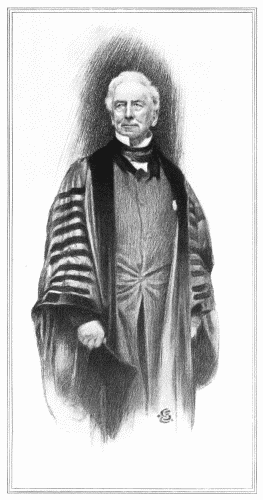
President Charles King of Columbia College, New York City.
I was telling Mrs. Waddington the other day of our life at Frascati—the great cholera year at Albano (1869), when so many people died—the Dowager Queen of Naples, Princess Colonna, and Cardinal Altieri, who came straight out to his villa as soon as the cholera broke out (which it did quite suddenly). He was wonderful—went about everywhere in all the poor little houses, relieving and encouraging the sick and dying, holding up the cross to the poor dim eyes when life was too nearly gone for any words to avail; and finally was struck down himself and died in two days. How terribly lonely and cut off we felt—Dr. Valery was the only person we saw. He was allowed to come out every day from Rome, but was fumigated at the station at Frascati, and again in Rome when he got back, obliged to change his clothes outside the gate before coming into the city. We were never at all nervous about the cholera. I don't think there was one case at Frascati, and of course all our thoughts were centred in that great big room with its pink walls and mosaic floor where father[17] lay desperately ill. It seems like a dream now, those hot summer nights, when we used to go out on the terrace (upon which his room opened) to get bouillon, ice, etc., and we fancied we could see the cloud of disease hovering over the Campagna. When it was moonlight, and such moonlight, that beautiful golden, southern moon, we saw a long white line in the distance—the sea. Circulation was very difficult, all the roads leading to Albano were barred, and guarded by zouaves; and of course we heard tales of horror from the Italian servants, always most talkative and graphic in their descriptions. However on the whole they behaved well. We used to ride every day, and always passed a little chapel on the way to Castel Gandolfo, which was filled with people kneeling and praying—a long line stretching out quite across the road to a little shrine just opposite. They used to make way for us to pass without getting off their knees, only stretching out their hands for anything the Principesse americane would give them.
Some of the women were quite absorbed, looking hard at the Madonna in her shrine as if they expected some visible sign of pity, or promise of help. I rather envied them their simple faith; it must help them through many moments of trial and discouragement.
As usual I seem to have wandered from my original subject, but Italy is so full of memories. We were too tired to walk home, besides were a little late, so we took a fiacre with a most friendly coachman, who saw at once that we were strangers, pointed out all the places of interest, and said it would be a delightful afternoon for Fiesole, and he would come and get us if we would name the hour.
We found lots of letters and papers at the house, and W. plunged into Paris and politics after breakfast. I went for a drive with Mary and Beatrice to the Villa Careggi. The house is nothing remarkable—a large square building with enormous rooms, deep fireplaces, and very high ceilings. Some good frescoes on the walls. The garden and terraces were enchanting—the sun really too warm on the terrace—always a divine view; blue-purple hills rolling away in the distance, and funny, crooked little roads shut in between high walls, with every now and then a gap, or a gate, which gave one glimpses of straggling, unkempt gardens, with a wealth of flowers and vines.
We had a quiet dinner and evening, which we all enjoyed. W. smoked and talked a great deal of the past year and the last days at the Quai d'Orsay. He doesn't miss the life in the least, which rather surprises me; I thought he would be so bored with suddenly nothing to do, and no part to play in the world's history; but I see that the absolute rest and being with all his family is doing him so much good. It is extraordinary how soon one forgets, and takes up a quiet life again. Already the whirl and fatigues of the Exhibition year seem so far away I feel as if somebody else had lived that life. I cannot imagine myself now dining out (and not ordinary dinners, official banquets) 19 nights in succession, but I suppose I should begin again quite naturally if we returned to public life.
Did you see the article in the "Français" saying "M. Waddington will now have all the rest of his life before him to consecrate to his studies"? I wonder! This morning we had our usual walk—as W. was ready at ten o'clock I didn't make my regular station in the Boboli Gardens. We went to Vieusseux about a book W. wanted, and then into the bank to pay George Maquay a visit. He was most cheerful, and showed us a nice article in the "Times" regretting very much W.'s departure from the Foreign Office, "one of the few men who could look ahead a little, and who was independent, not limited in his views by what the Chamber of Deputies would think." I was rather pleased, but W. is very calm about all newspaper articles. He always has a "mauvaise presse" as we don't soigner any paper. I fancy, though, Henrietta is right when she says the next time he takes office she means to buy one—so many people believe implicitly all they see in a paper, especially when it says what you want to believe.
We did a little shopping, I wanted some veils, and W. remained outside looking at the grim old Strozzi Palace, standing like a great fortress with its huge stones and heavy doors in the middle of all the busy, bustling life of the Tornabuoni. I think it is the one street in Florence where people move about quickly, and as if they were going somewhere. Everywhere else there are crowds of people, men especially, doing nothing but sitting all day in the sun looking at the passers-by.
We hadn't time to walk over to San Lorenzo, so hailed a fiacre, and wandered about there for some time. I was delighted to see the Medici Chapel again and the famous monument of Lorenzo. He does look as if he were thinking out some great problem—I wonder what he would think of our go-ahead, unartistic world, and of our politicians, so timorous and afraid of responsibility—at least the men of that race were strong for good or for evil. When they wanted anything they did all they could to get it. I don't know that the women were behindhand either in energy when one thinks of Queen Catherine and of all the Huguenots she disposed of one summer evening in Paris. Do you remember our friend Mrs. A., a converted Catholic, whom we overheard one night at the Opera when they were shooting all the Huguenots in the last act, telling her daughter (remained a Protestant) that the Saint Bartholomew had nothing to do with Catholics and Protestants; was entirely a political move.
We have had a long drive this afternoon with Mary and Charles, up the Poggio Imperiale—a stiff climb but such a beautiful road—villas, cypresses, olive trees, and roses everywhere. We went up to the Certosa, where a nice old monk, in his white dress, showed us the church and monastery. It was dark and rather cold in the church, and nothing particular to see—good frescoes and many coloured marbles—but the terrace outside was delightful. There were not too many beggars on the road considering that it is the favourite drive in Florence, and of course the carriage people are at a disadvantage as they must go slowly up the hill, and are escorted by a long troop of children singing, dancing with a sort of tambourine, turning somersaults, and enjoying life generally, whether they get a few pennies or not. It is very difficult to resist the children with their smiling faces and evident desire to amuse the "forestieri."
We went to Casa Guadagni before we came home, and paid a visit to the Marchesa, who was at home. The same old porter was at the door, and greeted me most warmly, much pleased to see W. "bel uomo, il marito"—had I any children, and where were all the rest of the family?—that simple, natural Italian manner, without a thought of familiarity. W. was delighted with Madame Guadagni. She talked about everything and really didn't look any older. I asked about our old apartment (piano nobile—first floor); she said it was always let—generally to foreigners. I didn't ask if she had made any modern improvements since we lived there. Shall you ever forget that cold winter with the doors that wouldn't open, and the windows that wouldn't shut, and the chimneys that always smoked, and the calorifère, which John never would light, as he was afraid it would warm the Guadagni rooms below? I should have liked to go over the apartment and see the rooms again—the big ball-room where we danced so often and had so much music. We wound up with a turn in the Cascine, drawing up in the Piazza alongside of Lottie's carriage, which was of course surrounded by all the gilded youth of Florence. Maquay came to talk to us, Carlo Alessandri and Serristori, whom I hadn't yet seen. He was just the same (laughing and criticising) as in the old days when some of the swells appeared in so-called Worth garments, which he said were all made in a little room over his stables, by the wife and daughters of one of his men.
I was glad to get in and have a quiet hour to write before dinner. I am at my table close up to the open window. The air is soft and delicious—the garden just beginning to look dark and mysterious in the waning light. The group of cypresses (I don't know how to write that in the plural, it looks funny) always black. I was called off various times, and must finish now as we are going to dine at the Maquays—we being ourselves, Mary, and Charles. We generally go about a family party.
Sunday, February 21, 1880.
We are making our pacquets as we have decided to leave for Rome on Monday (22). The Schuylers are clamouring for us, and though I hate to leave here I really think we ought to go. As W. has never seen Rome two months will not be too much. We shan't have much more as he wants to get home for the Conseil Général. The Schuylers want to have a big reception for us, and would like next Sunday week, so I think we really shall get off this time. The longer we stay the more invitations we have. It has been all quite charming. Our Maquay dinner was very easy and pleasant; the Tchiatcheffs, Lottie, Alessandri, Talleyrands, Mrs. Fuller, and one or two stray men. The house looked so natural—of course the ball-room wasn't open as we were a small party, but they lighted it after dinner. I wanted W. to see how pretty it was and how light—white with red seats all around. How it took me back to old times? I seemed to see everybody settling for the cotillon—the stairs too, where we all used to sit waiting for the cotillon to begin. How we amused ourselves that winter in Florence, and how scattered all that little band is now. The Florentines amuse themselves still—there must be something in the air which makes people light-hearted—one can't imagine a serious, studious life in Florence.
We spent two hours in the Uffizi yesterday looking at all the old friends again. I was delighted to see the dear little "St. John in the Wilderness" hanging just where it did before, on one side of the door in the Tribuna; also the Peruginos—I like them so much—his Madonnas with their wooden faces, but a pure, unearthly expression all the same, and the curious green colour one sees in all his pictures. We saw as much as we could in the two hours, but as it was the second visit we found our way about better. I never rested until I found the corridor with Niobe and all her children—it used to fascinate me in the old days. One realized perfectly all those big sons and daughters, so terrified, and the last little one clinging to his mother's skirts.
We went to tea, Mary and I, with Edith Peruzzi—quite quietly—as she wanted to show me her children—and fine specimens they are; a duck of a boy, quite sociable and smiling. Nina and Louisa Maquay came in—Louisa looked lovely. This morning I went to the English church with Mary and Beatrice. We didn't go out again till late—after tea—as we had various visitors, among others Schuyler Crosby, who had asked us to dine but we had no evening left. I saw him riding the other day in the Cascine, and recognised him some way off by his seat. I don't know what it is, but whatever the Americans do, whether riding, dancing, or tennis, they do it differently from any one else. I was talking about it the other day to an Englishman who had seen some of the Anglo-American boat races, and he quite agreed with me, said their rowing was very good, but quite another thing from the English sport.
We drove out again Fiesole way. It was enchanting—more roses come out every day. There was a perfect fringe of pink roses hanging over some of the old grey walls. As it was Sunday, and a lovely day, there were quantities of people about. There are scarcely any costumes left, but all Italians like bright colours, and the red and green fichus and aprons looked pretty and gay as the various groups passed us. Some of the old women were terribly bent, with such brown, wrinkled faces—one could quite see that they had toiled up and down hills under the Italian scorching sun all their lives, with baskets and bundles of fagots on their backs—but the old eyes were keen and smiling. They don't look so utterly starved and wretched as Ouida (and others) say they are. I suppose they live on nothing, and go on quite simply, leading the same lives that their fathers and mothers did before them, without knowing of anything better.
Tell Henrietta I haven't made much progress in the travelling work she presented me with. I did take it out into the drawing-room one evening, but the immediate result of that was disastrous. I took it out of the bag proudly, to show that I had silk, embroidery, scissors, needles, etc., like everybody else, but left it on the table. Somebody wanted a book or a newspaper also on the table; turned everything upside down, and the work, silk, needles, thimble, etc., went rolling all over the floor. When you think of the crevasses of an old parquet floor in an Italian Palace, you can imagine how difficult it was to find anything again. The two girls were hours on their knees looking for my thimble which never turned up—however, that will be an excellent reason for buying a pretty little gold thimble with a row of turquoises that I saw the other day in a shop on the Ponte Vecchio. There is evidently a fate against my becoming an accomplished needlewoman, and I am afraid the "clumsy little fingers," which used to worry you so in the old days of music lessons, have not improved with advancing years. Perhaps I shall take to work in my old age. Isn't it George Sand who says (and I don't believe she ever took a needle in her hand), "Don't despise our less ambitious sisters who work. Many great resolutions and silent abnegations have been woven into the bright flowers and delicate tracings of the embroidery in the long hours spent over the frame."
Monday Night, February 22, 1880.
We really are starting to-morrow morning—trunks are packed, compartment engaged, and we have said good-bye to everybody. I made a last little turn this morning in the Boboli Gardens. I didn't see the custode—I wanted to say good-bye to him. Then we went to the Pitti gallery, W. wanted to see one particular Botticelli, "la bella Simonetta" I think, which he and Mary had been talking about, and which we had missed the other day. It is quite impossible to see everything. I had remembered pretty well the principal pictures. Then we took a fiacre and went out to San Marco to see the Fra Angelicos and Savonarola's cell. We had never once got there, there is always so much to do. We walked through the cloisters first—the frescoes are perfectly well preserved—some of Fra Angelico's and others less interesting. I wanted to see the cells, and was quite pleased to recognise the "Coronation of the Virgin" and the "Madonna and Child" surrounded by angels, all in their long green-blue robes with wings and musical instruments of all kinds. As usual people were copying them, and I will try and find a pretty one and bring it back. I want the one in a sort of light green dress blowing a trumpet. The faces are quite beautiful, so pure. He must have had a wonderful imagination—I wonder if he believed angels look like that? Somehow or other I always think of an angel in a white robe. We saw of course Savonarola's cell, and they showed us his rosary, and a piece of wood which is supposed to have been taken from his funeral pile. It all looked so peaceful and smiling to-day, one could hardly realize the long hours of doubt and self-torture passed in these solitary cells. There is a fine description in one of the numerous books the Bunsens have on Florence, of Savonarola's preaching—all the people congregated in the great square before the church, when there was no longer any room inside, leaving their shops and their work to come and listen to him. That is one of the delightful things in this household, you can always find a book in almost any language about any subject that interests you, religion, music, politics, everything.
Beatrice has a delightful German magazine, "Monatsheft," very well illustrated, with all the modern German literature, stories, essays, criticisms, etc. One could almost wish for a rainy day or a quiet evening to read a little.
W. went off by himself the other night and had a very pleasant evening. First to the Piccolellis' where he found a small party and his old friend Bentivoglio, with whom he had travelled in the East. Of course they instantly got into a corner and talked shop (medals). Then to Lottie Van Schaick who had a few friends, where he amused himself very much.
Gertrude writes that our rooms are very nice, and the man at the hotel delighted to have us. I wonder what Rome will be like. It will seem funny to be back there again, a respectable middle-aged lady. I think one should always be young and gay to live in Italy.
We had a fine musical evening Saturday with the Landi family—five; mother, father, daughter, son, and grandfather. Madame Landi sang anything, everything, delightfully. Some of the stornelli and peasant songs, those particularly of the Abruzzi mountains, were charming. I wonder what Italians have got in their "gosier" that we haven't, that gives such a charm to their simplest song. I sang once or twice in French, and then Madame Landi and I did some duos in Italian which went very well. She was very complimentary over my Italian (I told it triumphantly to W., but he remains under the impression of the razor), said it was evident I had learnt in Rome; the language is so much softer, or rather the pronunciation "Lingua toscana in bocca romana."
The old father was killing, knew everything, was wildly interested, and criticised freely. I think the daughter will have a very pretty voice, like her mother's, a rich, low mezzo.
I was called off by some visits, and will finish now. My letter will go to-morrow morning. We don't start very early—9.30—but I shall not have time to write anything more.
To H. L. K.
Hôtel de Londres, Rome, February 24, 1880.
We arrived last evening for dinner, dear mother, and are most comfortably settled. We have a nice apartment on the second floor—a large bright salon with a good bed-room on either side of it for me and W., and a very fair anteroom where Madame Hubert has just had another wardrobe put up. She interviewed the gérant and made it clear to him that it was impossible for her to unpack her mistress's dresses until she had something suitable to put them in. We found flowers and papers on the table from the Schuylers, Mrs. Bruce, and the proprietor of the hotel.
I thought we should never get away from Florence. We were so happy there with the Bunsens and Mrs. Waddington, and every day there was something to see or do. The weather was divine the last days—the hills were quite a pink-purple sometimes as we drove home after sunset, and quantities of roses climbing up all the old grey walls. We had a very easy journey—they had reserved a carriage for us, which was a good precaution, as the train was crowded. We got to Rome about six. W. was quite excited as we approached (it is too funny to think that he had never been here), and very anxious for the first glimpse of St. Peter's. I can't say we saw the dome from a great distance—I fancy it depends upon which way you enter Rome. We found the Schuylers at the station with a carriage, and drove at once to the hotel, where Gert had ordered tea and a pannettone. If I hadn't known I was coming to Rome I should never have believed it on arriving at the station. It was so unlike the little old Termine of our Roman days—the funny little station so far away, with few porters or cabs, and comparatively few voyageurs. I was quite bewildered with the rush into this great, modern station, with porters and officials of all kinds, and all the bustle of a great city.
I looked in vain for some familiar landmarks as we came along. Nothing. The new streets, Via Garibaldi and Nazionale—an abomination, tall ugly maisons de location and official buildings so new and regular—awful! It wasn't until we got into the town and near the Piazza di Spagna that I really felt that I was back in Rome; that of course was unchanged. It brought back such a flood of memories as we passed 20, and all the first happy days in Rome came back to me, before father's illness, when he enjoyed everything so much, and wrote to Uncle John that "the hours were golden." The "barca" looked just the same, with boys and women leaning up against the stones, flower-girls on the Spanish Steps, and even old Nazzari's low, dark shop opposite looked picturesque. W. was quite surprised to see me so sentimental, though I had warned him that for me there was no place in the world like Rome.
The Schuylers stayed talking some little while, then had to go, as they were dining out, but promised to come in after dinner. W. asked me if I was too tired to go for a little stroll (the tea had refreshed us), so we started up the Spanish Steps to the Villa Medici, where we had that beautiful view of Rome. I showed him the stone pines of the Doria-Pamphili, which stood out splendidly against the last bright clouds of the sunset—it was quite lovely. We stayed out quite late, and were received with respectful, but decidedly disapproving greetings from the gérant when we came in. It was not at all prudent for "Eccellenza" and Madame to remain out late, particularly as they must be very tired after a long journey. We dined downstairs in the big dining-room. There was a long table d'hôte full—people about half through their dinner—and at the extreme end of the room five or six small tables, one of which had been reserved for us. I didn't see any one I knew, but two men got up and bowed as we passed. The dinner was good—the head waiter hovering about us all the time, and of course always addressing W. as "Eccellenza." We had coffee upstairs. W. smoked and I read the paper and one or two notes. About ten the Schuylers appeared, very cheerful and full of propositions of all kinds. They have got a big reception for us on Sunday night—Roman and diplomatic—and we agreed to breakfast with them to-day. Gert looked very well in blue, with her diamond necklace and feathers. They don't seem very pleased with Marsh—our Minister. Always the same old story and jealousy—the ministers consider themselves so far above a consul. But really when the Consul-General happens to be Schuyler and his wife King, one would think these two names would speak for themselves—for Americans, at any rate.
We told Schuyler how many compliments we had had both in Paris and Florence for his "Peter the Great"—so much in it, and yet the subject one that had been written about so often. They went off about eleven, and I was glad to go to bed; could hardly believe I was sleeping again in the Piazza di Spagna. I certainly never imagined when I left Rome tearfully so many years ago that I would come back as the wife of a French statesman.
I was busy all the morning unpacking and settling myself, and of course looking out of the window. It is all so delightfully familiar—all the botte standing in the middle of the street, and the coachman trying so hard to understand when some English or American tourists give them some impossible address in Italian—you know the kind of people I mean, conscientious tourists who think they must always speak the language of the country they are in, learned out of a phrase-book. We have various invitations, from our two Embassies, Quirinal and Vatican, also the Teanos, and W. had a nice visit from Lanciani, who wants to show him all Rome. We took a botta to go to the Schuylers. It isn't far, but I wasn't quite sure of finding my way the first time. They have a charming apartment in Palazzo Altemps, near the Piazza Navona, not at all far really from our hotel, and now that I know the way I can often walk over in the mornings when W. is off sight-seeing seriously with some of his learned friends. It is a fine old palace with a large open court and broad stone staircase. San Carlo Borromeo is supposed to have lived there. Their apartment belongs to Mrs. Terry, wife of the artist, who had arranged it very comfortably, and the Schuylers have put in all their Turkish rugs, carpets, and bibelots, so it really looks very pretty. There are quantities of green plants and flowers about (they are both fond of flowers and are always making experiments and trying something new) and of course books, papers, reviews, and a piano.
I told Gert I thought I would write to Vera and have some singing lessons—I have done so little singing since I have been married. Eugene is a charming host, and he and W. had plenty to talk about. I inspected Gert's wardrobe while they were smoking. Her dresses are all right, and I think her maid is good. I wrote all this after I came in. The man of the hotel had engaged a carriage for us—a nice little victoria with a pair of greys. It comes from Tomba's stables—do you remember the name? The same loueur we had when we lived here. The coachman said he remembered me perfectly, had often driven the "signorine" to the meets, and hoped la maman was well. We were lucky to get such a nice little carriage. The d'Aubignys, a French couple, had just given it up, as they were leaving the Embassy here for Berlin.
We drove about a little—left cards for the Noailles, Desprez, Cairolis, and wound up in the Villa Borghese, which was again quite changed—such quantities of carriages and people walking, also Italian officers riding, and soldiers, bersaglieri, etc., about. We crossed the Wimpffens, looking very smiling, and saw in the distance, as we were coming out, the royal red liveries, but the carriage was too far off to see who was in it. Now we are going to dinner, and I shall be glad to get to bed early. I think I am more tired than yesterday.
Hôtel de Londres, February 26, 1880.
I will begin again this afternoon, as I have a little time before dinner. The weather is divine, quite the same deep-blue sky and bright sun of our first Roman winter. We have had an enchanting drive out of Porta San Sebastiano and along the Via Appia as far as Cecilia Metella—everything exactly the same as when we were there so many years ago. The same peasant carts blocking up the narrow gateway, everybody talking at once, white teeth gleaming, and quantities of little brown children with black eyes and jet black hair tumbling down over their eyes and outstretched hands for anything the forestieri would put into them. W. was a little disappointed at first. The road is narrow, an atrocious pavement, and high walls almost shutting out the view. However, as we got farther out there came gaps in the walls through which one saw the whole stretch of the Campagna with the Claudian Aqueduct on one side, and when we finally emerged into the open fields, he was delighted. How extraordinary all these old tombs and pyramids are, most of them falling in ruins, with roses and creepers of all kinds holding them together. On one of the largest round tombs there was a peasant house with a garden and vines, and smoke coming out of the chimney, perched quite on the top, with a steep, stony path winding down, where the coachman told me the donkey went up and down, as he too lived in the house with the family. Some of the tombs are very high—real towers. There is hardly a trace of marble or inscription left, but the original building so strong that the walls remain.
The queer old tombs, towers, and bits of ruins all along the road interested W. immensely; though he has never been here he knows them all from photographs and reproductions, and could tell me a great deal more than I could tell him. We went as far as the round tomb of Cecilia Metella, and then got out and walked a little. I wanted to show him the low wall which we used to jump always when the meet was at Cecilia Metella. Do you remember the first time you came out to see us jump, not at a hunt but one afternoon with Dyer practising to see what the horses and riders would do? You saw us start at a canter for the wall, and then shut your eyes tight until we called out to you from the other side.
This morning W. and I had our first regular turn at sight-seeing. We took a nice little botta on the Piazza, had our Baedeker—a red one, like all the tourists—and were quite happy. Some of the old colleagues were highly entertained seeing us driving about with our Baedeker; said it was W. under a wholly different aspect. We wandered about the Vatican for two hours, seeing quantities of things—Sistine Chapel, Stanze Raphael, Apollo Belvedere, etc., and always a beautiful view over the gardens. Later, he says, he must do it all regularly and intelligently with one of his men friends, as I naturally could not stand for hours recognising and deciphering an old inscription. I left him from time to time, sat down on one of the stone benches, talked to the custode, looked at the other people, and gave them any information I could. It interested me to see the different nationalities—almost entirely English, American, German, very few Italian, and no French—yes, one artist, a rather nice looking young fellow who was copying something on the ceiling of one of the "Stanze," rather a difficult process apparently. There were many more women than men—groups of English spinsters doing their sights most thoroughly—the Americans more casual. The Apollo looked splendid, so young and spirited. We walked some little distance, coming home before we could get a fiacre, and I had forgotten how cruel that Roman pavement was. I don't believe any of my boots will stand it; I shall have to get somewhere here a pair of thick-soled walking shoes.
We had a quiet hour after breakfast. I have arranged a ladies' corner in the drawing-room. I was in despair the first two days over the room. I had never lived in small hotel quarters with a man, and I had no idea how disorderly they are. The table was covered with pens, papers—piles of them, three or four days old, thick with dust—cigars, cigar ashes over everything, two or three large, bulky black portfolios, very often a pot hat, etc. So we compromised; W. took one end of the room and I the other. I obtained from the gérant (thanks to Madame Hubert, who is very pretty and on the best of terms with him) a small table, large china vase for a plant, a nice arm-chair, and a cushion for the sofa, borrowed a table-cloth from Gert, also some small things for my table, and my end looked quite respectable and feminine. The room is large, so we can really get on very well. We had a pleasant visit from the Marquis de Noailles, French Ambassador to the Quirinal, before we went out. He has a charming, easy manner. We are to breakfast at the Embassy, Palazzo Farnese, to-morrow for me to make Madame de Noailles's acquaintance. I wonder what I shall think of her? The men all say she is a charmeuse. She is Polish born, was a beautiful woman—I think all Poles have a great charm of manner.
Trocchi came in, too—so pleased to see me again and to make W.'s acquaintance. The two senators talked politics, and Noailles put me a little au courant of Roman society and the two camps black and white. We went out at 3.30, as I said before, to Cecilia Metella, and stopped at Gert's for tea. W. walked home, and I stayed a little while with her talking over the arrangements for their reception on Sunday. Every one—Romans, diplomats, and Americans—they have asked has accepted; but their rooms are fairly large and I don't think they will be crowded.
Hôtel de Londres, Monday, February 29, 1880.
I am still tired from the quantity of people we saw last night at the Schuylers. Their reception was most brilliant; all the world——However, I will begin at the beginning. We went to church on Sunday, as Dr. Nevin came to see us Saturday afternoon and said he hoped we would not fail to come. W. found him clever and interesting. He said he thought I should hardly recognise him in his new church. It is very pretty—English style, built by an English architect (Street) in the new quarter, Via Nazionale, utterly unlike the bare little room outside the Porta del Popolo, where we used to go and do the music. It makes me laugh now when I think of the congregation all embarked on a well-known hymn, when suddenly Henrietta would lower the tune one note—if I was tired, as often happened, as one of the gayest balls in Rome was Princess Sciarra's on Saturday night. When I had danced until four o'clock in the morning (the test of the ball was how late it lasted) it was rather an effort to be at church at 10.30 Sunday morning and sing straight through the service. Henrietta had the harmonium and I led the singing. I will say that the effect of the sudden change was disastrous from a musical point of view. However, we did our best. I am afraid Henrietta was not always faithful to Bach and Beethoven in her voluntaries. We had no music, and she played whatever she could remember, and occasionally there were strains of "Araby's Daughter" or "When the Swallows Homeward Fly," which were quite perceptible even through the minor chords. I liked doing it all the same, and like it still. I am so fond of the old hymns we used to sing as children, and should like to hear "Shout the Glad Tidings" every Christmas. I never have since we left America and Oyster Bay, where also we did the music, and where, when we were late sometimes for church, Faust, the big black Newfoundland dog would come and bark when the bell had stopped, telling us quite plainly we were late—he knew all about it.
We made the regular Sunday turn in the afternoon—Villa Borghese and Pincio—sent the carriage away and walked home by the Villa Medici. W. loves the view from the terrace. We met Mrs. Bruce, also looking at the view, and walked home together. She told W. Cardinal Howard wanted to see him, had known him in England in the old days, also a young English monsignore—called English oddly enough. She will ask us all to dine together some night next week. I asked her if she remembered her famous dinner long ago with Cardinal Howard and Dean Stanley. The two divines were very anxious to cross swords. They were such a contrast. Dean Stanley, small, slight, nervous, bright eyes, charming manners, and a keen debater. The Cardinal, tall, large, slow, but very earnest, absolutely convinced. The conversation was most interesting—very animated—but never personal nor even vehement, though their views and judgments were absolutely different on all points. However, both were gentlemen and both large-minded. W. was much interested, as he knew Dean Stanley and his wife Lady Augusta well; they came often to Paris, and were habitués of Madame Mohl's famous salon, where the literary men of all creeds and countries used to meet. It was there, too, that Dean Stanley and Renan used to meet and talk, the two great intellects finding points in common. I was taken there once or twice after I was first married. It was a curious interior; Madame Mohl, a little old lady, always dressed in white, with a group of men standing around her chair—many more men than women, and never more than twenty or thirty people. I suppose it was the type of the old French literary salon where people went to talk. I naturally listened in those days, not being sufficiently up in all the political and literary questions, and not pinning my faith absolutely on the "Revue des Deux Mondes." Mrs. Bruce, too, was often at Madame Mohl's.
We stopped in a few minutes at the Trinità de' Monti, where there was a service of some kind going on. The nuns were singing a low, monotonous chant behind their grating; the church was quite dark, lights only on the altar, a few women kneeling and absorbed, and a few irreverent forestieri looking about and talking in whispers. We came down the Spanish Steps, which were quite deserted at that hour—models, beggars, flâneurs, all resting from their labours.
I was glad to rest a little before dinner, and only dressed afterward, as I couldn't well go down to the public dining-room in a low red satin dress and diamonds. We went rather early—ten o'clock—to Palazzo Altemps, but found many people already there. The apartment looked very pretty, quantities of flowers and plants wherever they could be put. Gert looked very well in yellow satin, and Eugene is always at his best in his own house—very courteous and receiving people as if it were a pleasure to him (which I think it is). We found quantities of old friends—Pallavicinis, Teanos, Lovatellis, Calabrinis, Bandini, Pagets, Mrs. Bruce, Hooker, Grants, etc., and quantities of people we didn't know, and whose acquaintance we made of course—Mesdames Minghetti, Cairoli, Despretis, and almost the whole of the Corps Diplomatique.
W. enjoyed it very much, did his manners very well, and never looked stiff or bored. I was delighted to see the familiar faces once more. I almost felt as if we had never been away. Madame de Noailles was astounded at the number of people I knew—I think she hadn't realized how long I had lived in Rome as a girl. She had heard W. say it was his first visit to Rome, and thought I, too, was here for the first time, and she was naturally surprised to hear me talking to Calabrini about the hunts, cotillons, his coach, and tempi passati generally.
I have accepted so many invitations that I never can remember them, but the ladies promised to send a card. Aunt Mary Gracie was rather put out with me because I wore no necklace (which couldn't be said of the Roman ladies, who all wore splendid jewels), but I told her it was the last chic in Paris to wear your necklace on your bodice, not on your neck.
We stayed on after all the beau monde had gone with Aunt Mary, Hooker, a Russian friend of Schuyler's, and Count Palfy, had a nice little supper, champagne and sandwiches, and talked over the party, saying of course (as they say we Kings always do) how pleasant our party was. W. was much interested in the various talks he had. He found Minghetti charming—so intelligent and well up in everything. Cairoli, too, he had been anxious to see; also Visconti Venosta. He was naturally (like all the men) charmed with Madame Minghetti. She must have been beautiful, and has an extraordinary charm of manner. The Cairolis are a very big couple. He is tall and broad, fine eyes—she, too, on a large scale, but handsome. Of course there were many inquiries from all the old friends for la maman and the family generally. Mrs. Bruce says she never drives in the Doria-Pamphili without thinking of you driving about in your plain black dress and bonnet, with two or three daughters (not quite so plainly dressed) in the carriage, and all always talking and laughing, and enjoying life together. I told her about Florence, where the King of Italy always bowed to you in the Cascine, evidently taking you for the superior of some religious order (he must have thought the novices were lively), and the children in the street used to run up to you and kiss your hand. "He was quite right, to bow to you," she said, "my grand old Republican."
The Spanish Steps. In the Piazza di Spagna, Rome.
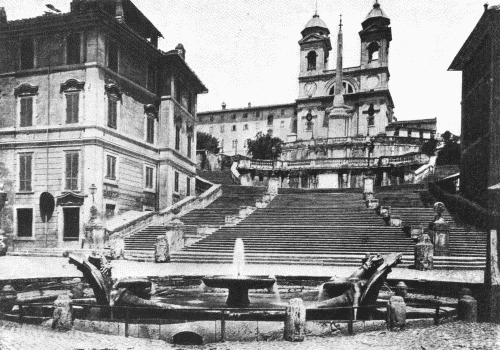
March 4, 1880.
Yesterday we went again to the Vatican. W. is quite happy, I thought I should never get him away. It is most amusing to walk about old Rome with him, for suddenly over a gateway or at the bottom of an ordinary little court he discovers an inscription or a slab, or an old stone which he knows all about, and we stop. He reads, and recognises, and translates to me, and is wildly interested. It is all so good for him, and puts politics and little annoyances out of his head. It is quite new for me to see Rome from a classical point de vue, but I suppose one enjoys things differently as one grows older. I certainly enjoyed the mad gallops over the Campagna in the old days; do you remember Mrs. S. who was so severe with us—first because we were Americans (she was English) and then because we knew everybody and enjoyed ourselves?—"when she was young people came to Rome to educate themselves and enjoy the pictures, museums, historical associations, etc. Now one saw nothing but American girls racing over the Campagna with a troop of Roman princes at their heels." Poor dear, she really thought it was a calamity not to be born under the British flag. I suppose that makes the great strength of the English, their absolute conviction that England is the only country in the world.
They are funny, though—I was discussing something one day with Lady S., and we didn't quite agree; upon which she remarked she supposed I couldn't understand her ideas—she came from a big country where one took broad views of things. I said I thought I did too, but perhaps it is a matter of appreciation—I think, though, I have got geography on my side.
After breakfast we drove about paying visits. We found Princess Teano (who has asked us to dine on Wednesday) and she showed us her boys—the eldest one a beauty. She looked very handsome with her pure Madonna face. She told us her beau-père (the blind Duke of Sermoneta) had been so pleased to meet W. in Florence. They had a long talk somewhere, and W. was so amused with the Duke's politics and liberalism—all so easy-going, half chaffing, but very decided too, no sounding phrases nor profession de foi; simply accepting (what he couldn't really like very much) the inevitable, de bonne grâce; and seizing and ridiculing all the weak points.