Part 2 — ITALY REVISITED
Reading edition
To H. L. K.
Rome, Friday, February 12, 1904.
It seems so strange to be back here, dear, after twenty-four years, and to find Rome so changed, so unchanged. The new quarter, an absolutely new modern city, might be Wiesbaden, or Neuilly, or any cheerful resort of retired business men who build hideous villas with all sorts of excrescences—busts, vases, and plaques of bright-coloured majolica—and the old city with the dirty little winding streets going toward St. Peter's exactly the same; almost the same little ragged, black-eyed children playing in the gutters.
We had a most comfortable journey down. Hardly any one in the sleeping-car but ourselves, so we all had plenty of room. It was a bright, beautiful morning when we got to Modane—the mountains covered with snow, and the fresh keen wind blowing straight from the glaciers was enchanting after a night in the sleeping-car. They are frightfully overheated. I had some difficulty in persuading the attendant to open my window for the night; however, as I was alone in my compartment, he finally agreed, merely saying he would come and shut it when we passed through the great tunnel. We dined at the buffet at Genoa, and it didn't seem natural not to ask for the Alassio train. The station was crowded, the Roman train too—they put on extra carriages. We got to Rome about 9.30. I had been ready since 6.30, eagerly watching to get a glimpse of St. Peter's. I had visions of Cività Vecchia and running along by the sea in the early morning.
I was quite awake, but I didn't see St. Peter's until we were quite near Rome. We ran through long, level stretches of Campagna, with every now and then a great square building that had been probably a mediæval castle, but was now a farm—sheep and cattle wandering out of the old gateway, and those splendid big white oxen that one sees all over the Campagna—some shepherds' huts with their pointed thatched roofs dotted about, but nothing very picturesque or striking. We passed close to San Paolo Fuori le Mura, with the Testaccio quite near. We paid ourselves compliments when we arrived at the station for having made our long journey so easily and pleasantly. No one was tired and no one was bored. Between us all (we were four women) we had plenty of provisions and Bessie[30] and Mme. de Bailleul were most successful with their afternoon tea, with delicious American cake, that Bessie had brought over in the steamer.
After all, Josephine[31] finds she has room for me and my maid, which of course is infinitely pleasanter for me than being at the hotel. Her house is charming—not one of the old palaces, but plenty of room and thoroughly Italian. The large red salon I delight in; it couldn't exist anywhere else but in Rome, with its red silk walls, heavy gilt furniture, pictures, and curious bits of old carving and majolica. It opens into a delightful music-room with fine frescoes on the walls (a beautiful bit of colour), and beyond that there is a small salon where we usually sit. She has a picture there of her husband, Don Emanuele Ruspoli (late syndic of Rome), which has rather taken possession of me. It is such a handsome, spirited face, energetic and rather imperious—he looks a born ruler of men, and I believe he was. They say Rome was never so well governed as in his time. He was one of the first of the young Roman nobles who emancipated themselves from the papal rule. As quite a youth he ran away from college and entered the Italian army as a simple soldier, winning his grade as captain on the battle-field. He was a loyal and devoted servant of the House of Savoy, and took a prominent part in all the events which ended in proclaiming Victor Emanuel King of Italy, with Rome his capital.
This quarter, Piazza Barberini, is quite new to me. It used to seem rather far off in the old days when we came to see the Storys in the Barberini Palace, but now it is quite central. The great new street—Via Veneto—runs straight away from the Piazza, past the Church of the Cappucini—you will remember the vaults with all the dead monks standing about—the Palace of the Queen Mother, and various large hotels, to Porta Pinciana. Just the other side of the road is the new gate opening into the Villa Borghese. I rather lost myself there the first day I prowled about alone. It was raining, but I wanted some air, and turned into the Via Veneto, which is broad and clean. I walked quite to the end, and then came to the Porta Pinciana, crossed the road, and found myself in a beautiful villa. I didn't come upon any special landmark until I got near the Museum, which, of course, looked quite familiar. However, I was bewildered and hailed a passing groom to inquire where I was, and even when he told me could scarcely believe it. I had never gone into the Villa Borghese except by the Piazza del Popolo. They have made extraordinary changes since the Government has bought it—opened out new roads and paths, planted quantities of trees and flowers, and cleaned up and trimmed in every direction. It will be a splendid promenade in the heart of the city, but no longer the old Villa Borghese we used to know, with ragged, unkempt corners, and little paths in out-of-the-way places, so choked up with weeds and long grass that one could hardly get through.
I haven't quite got my bearings yet, and for the first three or four mornings I took myself down to the Piazza di Spagna, and started from there. There, too, there are changes—new houses and shops (I was glad to see old Spithoever in the same place) and a decided look of business and modern life. There were not nearly so many people doing nothing, lounging about, leaning on the "barca," or playing mora on the Spanish Steps. All the botte were still standing in the middle of the street, the coachmen smiling, cracking their whips, and making frantic little dashes across the piazza whenever they saw an unwary stranger who might want a cab.
The Spanish Steps looked beautiful, glowing with colour—pink, yellow, and that soft grey tint that the Roman stones take in the sunlight. All the lower steps are covered with flower stalls (they are not allowed any longer scattered all over the piazza), and most picturesque they looked—daffodils, mimosa, and great bunches of peach-blossoms which were very effective. There were very few models in costume sitting about; a few children playing some sort of game with stones, which they interrupted to run after the forestieri and ask for a "piccolo soldo" (a penny), and one or two old men with long white beards—might have done for models of the apostles or Joseph in the flight into Egypt—wrapped in their wonderful long green cloaks, sitting in the sun. There is one novelty—an "ascenseur." I haven't been in it yet, but I shall try it some day. One must get accustomed to many changes in the Rome of to-day.
I recognised some of the houses at the top of the steps—the corner one between Vias Sistina and Gregoriana, where the Rodmans used to live one year, and where we have dined so often, sitting on the round balcony and seeing the moon rise over the Pincio.
I walked home the other day by the Via Sistina to the Piazza Barberini, and that part seemed to me absolutely unchanged. The same little open mosaic shops, with the workmen dressed in white working at the door—almost in the street. In one shop they were just finishing a table, putting in countless bits of coloured marble (some of them very small). It was exactly like the one we brought from Rome many years ago, which stands now in Francis's smoking-room. There was of course the inevitable jeweller's shop, with crosses and brooches of dull yellow Roman gold and mosaic, and silk shops with Roman silk scarfs, and a sort of coarse lace which I have seen everywhere. In the middle of the street a miserable wrinkled old woman, her face mahogany colour, attired in a red skirt with a green handkerchief on her head, was skirmishing with a band of dirty little children, who had apparently upset her basket of roast chestnuts, and were making off with as many as they could find, pursued by her shrill cries and "maledizioni."
We went out in the open carriage yesterday, and drove all around Rome leaving cards—finished with a turn in the Villa Borghese and Pincio. It was too late for the Villa—almost every one had gone, and one felt the chill strike one on going into the thick shade after coming out of the bright sun in the Piazza del Popolo. We crossed Queen Margherita at the gate. She looked so handsome—the black is very becoming and threw out well her fair hair and skin. She was driving in a handsome carriage—the servants in mourning. One lady was with her—another carriage and two cyclists following. All the people bowed and looked so pleased to see her, and her bow and smile of acknowledgment were charming.
We made a short turn in the Villa and then went on to the Pincio, which was crowded. There were some very handsome, stately Roman equipages, plenty of light victorias, a few men driving themselves in very high phaetons, and the inevitable botta with often three youths on the one seat. The carriages didn't draw up—the ladies holding a sort of reception as in our days, when all the "gilded youth" used to sit on the steps of the victorias and surround the carriages of the pretty women. They tell me the present generation comes much less to the Villa Borghese and Pincio. They are much more sporting—ride, drive automobiles and play golf. There are two golf clubs now—one at Villa Pamphili Doria, the other at Aqua Santa. Every time we go out on the Campagna we meet men with golf clubs and rackets.
Monday I prowled about in the morning, always making the same round—Via Sistina and the Spanish Steps. The lame man at the top of the steps knows me well now, and we always exchange a cheerful good morning. Sometimes I give him some pennies and sometimes I don't, but he is always just as smiling when I don't give him anything.
In the afternoon Madame de B. and I went for a drive and a little sight-seeing. She wanted a bottle of eucalyptus from the monks at Tre Fontane, so we took in San Paolo Fuori le Mura on our way. The drive out is charming—a few dirty little streets at first—past the Theatre of Marcellus, which looks blacker and grimmer, if possible, than when I last saw it—and then some distance along the river. There are great changes—-high buildings, quays, boats, carts with heavy stones and quantities of workmen—really quite an air of a busy port—busy of course in a modified sense, as no Roman ever looks as if he were working hard, and there are always two or three looking on, and talking, for every one who works—however, there is certainly much more life in the streets and the city looks prosperous.
The great new Benedictine Monastery of Sant' Anselmo stands splendidly on the heights (Aventine) to the left, also the walls and garden of the Knights of Malta. The garden, with its long shady walks, between rows of tall cypress trees, looked most inviting. We left the Testaccio and Protestant Cemetery on our right and followed a long file of carriages evidently going, too, to San Paolo. That of course looked exactly the same—an enormous modern building with a wealth of splendid marble columns inside. The proportions and great spaces are very fine, and there was a brilliant effect of light and colour (as every column is different). Some of the red-pink was quite beautiful, but it is not in the least like a church—not at all devotional. One can't imagine any poor weary souls kneeling on that slippery, shining marble pavement and pouring out their hearts in prayer. It is more like a great hall or academy. We went out into the quiet of the cloisters, which are interesting, some curious old tombs and statues, but small for such a huge basilica—always the square green plot in the centre with a well.
We had some difficulty in making our way to the carriage through a perfect army of boys and men selling photographs, postal cards, mosaic pins with views of the church, etc., also bits of marble, giallo antico, porphyry and a piece of dark marble, almost black, which had come from the Marmorata close by.
We went on to the Tre Fontane, about half an hour's drive—real country, quite charming. We didn't see the churches until we were quite close to them—they are almost hidden by the trees. I never should have recognised the place. The eucalyptus trees which the monks were just beginning to plant when we were here before have grown up into a fine avenue. They were cutting and trimming them, and the ground was covered with great branches making a beautiful green carpet with a strong perfume. Various people were looking on and almost every one carried off a branch of eucalyptus. We did too, and one is now hanging over the bed in my room. It is supposed to be very healthy. It has a very strong odour—to me very agreeable.
A service was going on in one of the churches, the monks singing a low monotonous chant, and everything was so still; one was so shut in by the trees that the outside world, Rome and the Corso might have been miles away. We went into the church to see the three fountains built into the wall. Tradition says that when St. Paul was executed his head bounded three times and at each place a fountain sprang up. A tall young monk was going about with some seminarists explaining the legend to them. They were listening with rapt attention and drinking reverently at each fountain.
We went into the little farmacia and found there a German monk who was much pleased when he found we could speak German. He told us there were 90 monks there, and that the place was perfectly healthy—not as when they began their work, when many died of fever. We each bought a bottle of eucalyptus, and were sorry to come away. The light was fading—the eucalyptus avenue looked dark and mysterious, and the low chant of the monks was still going on.
We went to a beautiful ball in the evening at the Brancaccios'. They built their palace—which is enormous—has a fine marble staircase (which showed off the women's long trailing skirts splendidly) and quantities of rooms filled with beautiful things. I didn't take them all in as I was so much interested in the people, but Bessie has promised to take me all over the palace some morning.
To-day we have been to the Brancaccio garden. It was a beautiful bright morning, so Bessie Talleyrand proposed we should drive up and stroll about there. We telephoned to Brancaccio, who said he would meet us in the garden. You can't imagine anything more enchanting than that beautiful southern garden in the heart of Rome. We drove through the court-yard and straight up the hill to a little bridge that connects the garden with Mrs. Field's old apartment. Mrs. Field really made the garden (and loved it always). When they bought the ground it was simply an "orto" or field, and now it is a paradise filled with every possible variety of trees and flowers. It seems that wherever she saw a beautiful tree she immediately asked what it was and where it came from, and then had some sent to her from no matter where. Of course hundreds were lost—the journey, change of soil, transplanting them, etc., but hundreds remain and the effect is marvellous. Splendid tall palms from Bordighera, little delicate shrubs from America and Canada all growing and thriving side by side in the beautiful Roman garden. There is a fine broad allée which goes straight down from the winter garden to the end of the grounds with the Colosseum as background. It is planted on each side with green oaks, and between them rows of orange and mandarin trees—the branches heavy with the fruit. We picked delicious, ripe, warm mandarins from the trees, and eat them as we were strolling along. It was too early for the roses, of which there are thousands in the season—one saw the plants twining around all the trees. There are all sorts of ruins and old walls in the garden, baths of Titus, Sette Celle, and one comes unexpectedly, in odd corners, upon fine old bits of carving and wall which have no name now, but which certainly have had a history.
The sky was a deep blue over our heads, and the trees so thick, that the ugly new buildings which skirt one side of the garden are almost completely hidden. It was a pleasure just to sit on a bench and live—the air was so soft, and the garden smell so delicious.
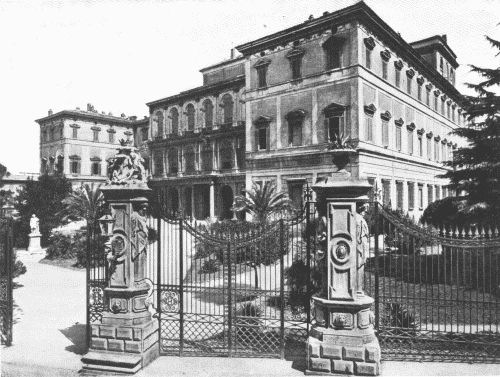
The Barberini Palace. The residence of the Storys.
After breakfast I went out early with Josephine—leaving of course some cards first—after that we took a turn on the Pincio, which was basking in the sunshine (but quite deserted at that hour except by nurses and children), and then drove out toward the Villa Pamphili. The road was so familiar, and yet so different. The same steep ascent to the Janiculum with the beggars and cripples of all ages running alongside the carriage and holding out withered arms and maimed limbs—awful to see. The road is much wider—more of a promenade, trees and flowers planted all along. The fountains of San Pietro in Montorio looked beautiful—such a rush of bright, dancing water. We drove through the Villa Corsini—quite new since my time—a beautiful drive, and drew up on the terrace just under the equestrian statue of Garibaldi from where there is a splendid view—the whole city of Rome at our feet, seen through a warm, grey mist that made even the ugly staring white and yellow houses of the new quarter look picturesque. They lost themselves in a charming ensemble. St. Peter's looked very near but always a little veiled by the haze which made the great mass more imposing. We looked straight across the city to the Campagna—all the well-known monuments—Cecilia Metella, aqueducts and the various tombs scattered along the Via Appia were quite distinct. The statue of the great revolutionary leader seemed curiously out of place. I should have preferred almost the traditional wolf with the two little boys sucking in her milk. We couldn't stay very long as we had a tea at home. We met many people and carriages going up as we came down, as it was the day for the Villa Pamphili, which is open to the public twice a week.
We went to a ball at the Storys' in the evening, and as we went up the great staircase of the Barberini Palace (the steps so broad and shallow that one could drive up in a light carriage) finishing with the steep little flight quite at the top which leads directly to the Story apartment, I could hardly realize how many years had passed since I had first danced in these same rooms, and that I shouldn't find the charming, genial maître de maison of my youth who made his house such an interesting centre. I think one of Mr. Story's greatest charms was his absolute simplicity, his keen interest in everything and his sympathy with younger men who were still fighting the great battle of life which he had brought to such a triumphant close. His son, Waldo Story,[32] who has inherited his father's talent, keeps up the hospitable traditions of the house.
The ball was very animated—all the young dancing Rome was there.
Monday, February 15th.
I am alone this morning—the others have gone to the meet at Cecchignola fuori Porta San Sebastiano. I should have liked to go for the sake of old times, but I was rather tired, and have the court ball to-night.
Last night I had a pleasant dinner at Count Vitali's. He has bought the Bandini palace, and made it, of course, most comfortable and modern. The rooms are beautiful—the splendid proportions and great space one only sees now in Rome in the old palaces. The dinner was for M. Nisard (French Ambassador to the Vatican), but it wasn't altogether Black. There were one of the Queen's ladies and one or two secretaries from the Quirinal embassies. The line between the two parties is not nearly so sharply drawn as when I was here so many years ago. A few people came in the evening. Among the first to appear was Cardinal Vincenzo Vannutelli, whom I was delighted to see again. It is long since I have seen a cardinal in all the bravery of his red robes and large jewelled cross, and for the first time I felt as if I were back in old Rome. We had a nice talk and plunged into Moscow and all the coronation festivities. I told him I was very anxious to see the Pope, which he said could easily be arranged. Nisard, too, was charming—said I should have an audience spéciale as ancienne ambassadrice. I waited to see the cardinal go with all the usual ceremonies for a prince of the Church. Two big footmen with flambeaux and tall candles escorted him to his carriage. The cardinal came alone, which surprised me. I thought they always had an attendant—a sort of ecclesiastical aide-de-camp.
Saturday Marquise de Bailleul and I were received by the Queen. Our audience was at four. I went for her a little before. We drove straight to the Quirinal, the great entrance on the piazza. Two swell porters were at the door, but no guards nor soldiers visible anywhere. We went up the grand staircase, where there was a red carpet and plenty of flowers, but no servants on the steps. The doors of a large anteroom at the top of the stairs were open, and there were four footmen in powder, culottes, and royal red liveries, and three or four men in black. We left our wraps. I wore my grey velvet and Marquise de Bailleul was in black with a handsome sable cape (which she was much disgusted at leaving). We went at once into a large room, where the dame de palais de service was waiting for us. She had a list in her hand, came forward at once and named herself, Duchesse d'Arscoli, said she supposed I was Madame Waddington. I introduced Marquise de Bailleul. The gentleman also came up and said a few words. There were one or two other ladies in the room, evidently waiting their turn. In a few minutes the door into the next room opened and two ladies came out. The duchess went in, remained a second, then coming back, waved us in. She didn't come in herself, didn't announce us, and shut the door behind us. We found ourselves in a large, rather bare room, with no trace of habitation—I fancy it is only used for official receptions. The Queen was standing at a table about the middle of the room. She is tall, dark, with fine eyes and a pretty smile. We made our two curtseys—hadn't time for the third, as she advanced a step, shook hands, and made us sit down. The visit didn't last very long. I fancy she was rather tired, as evidently she had been receiving a good many people, and was probably bored at having to make phrases to utter strangers she might never see again. We had the usual royal questions as to our children. As I only had one child my conversation on that subject soon came to an end, but Marquise de Bailleul has three small ones, so she got on swimmingly. The Queen talked very prettily and simply about her own children, and the difficulty of keeping them natural and unspoiled; said people gave them such beautiful presents—all sorts of wonderful mechanical toys which they couldn't appreciate. One thing she said was rather funny—that the present they liked best was a rag doll the American Ambassadress had brought them from America.
As soon as we came out other people went in. I fancy all the strangers asked to the ball had to be presented first to the Queen. I think the London rule was rather simpler. There the strangers were always presented at supper, when the Princess of Wales made her "cercle."
We went to a ball in the evening at Baron Pasetti's (Austrian Ambassador to the Quirinal). They have a fine apartment in the Palazzo Chigi. I remembered the rooms quite well, just as they were in the old days when Wimpffen was Ambassador. The hall was most brilliant—all Rome there. The Pasettis are going away, and will be much regretted. I think he is rather delicate and has had enough of public life. I hadn't seen him since Florence, when we were all young, and life was then a succession of summer days—long afternoons in the villas, with roses hanging over the walls, and evenings on the balcony, with nightingales singing in the garden and the scent of flowers in the air, "der goldener Zeit der jungen Liebe" (the golden days of young love).
Sunday Bessie and I went to the American church. Dr. Nevin is still away. The church is large, but was quite full—there are evidently many Americans in Rome. The great mosaics over the altar were given by Mrs. Field.
Wednesday, February 17th.
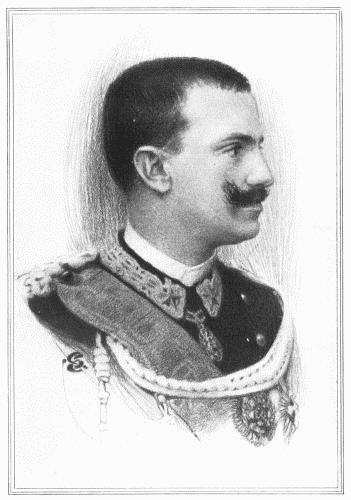
Monday night we went to the court ball. It was very amusing, but extraordinarily simple, not to say democratic. Bessie and I went together early, so as to get good seats. If I hadn't known we were going to the palace I should have thought we had made a mistake in the house. The square of the Quirinal was so quiet, almost deserted—no troops nor music, nor crowd of people looking on and peering into the carriages to see the dresses and jewels—no soldiers nor officials of any kind on the grand staircase. Some tall cuirassiers and footmen in the anteroom—no chamberlains nor pages—nothing like the glittering crowd of gold lace and uniforms one usually sees in the anteroom of a palace. We walked through two or three handsome rooms to the ball-room, where there were already a great many people. The room is large, high, but rather too narrow, with seats all round. There was no raised platform for the court—merely a carpet and two large gilt arm-chairs for the King and Queen and a smaller one for the Comte de Turin. It was amusing to see all the people coming in, the different uniforms and jewels of the women giving at once an air of court. The entrance of the royal cortège was quite simple. They played the "Marcia Reale," which I don't at all care for. It is a frivolous, jumpy little tune, not at all the grave, dignified measure one would expect on such an occasion. There were no chamberlains walking backward with their great wands of office in their hands. The master of ceremonies, Count Gianotti, looking very well in his uniform and broad green ribbon, came first, and almost immediately behind him the King and Queen, arm in arm, the Count of Turin, and a small procession of court functionaries. The Queen looked very well in yellow, with a splendid tiara. She took her seat at once; the King and Comte de Turin remained standing. What was charming was the group of young court ladies who followed the Queen—tall, handsome women, very well dressed. There was no "quadrille d'honneur," none of the royalties danced. The dancing began as soon as the court was seated—any little couple, a young lieutenant, an American, any one, dancing under the nose of the sovereigns. The Queen remained sitting quite alone, hardly speaking to any one, through three or four dances; then there was a move, and she made her "cercle," going straight around the room, and speaking to almost every one. The King made no "cercle," remained standing near the "corps diplomatique," who were all massed on one side of the thrones (or arm-chairs). He talked to the ambassadors and étrangers de distinction (men—they say he rarely speaks to a woman). We all moved about a little after the Queen had passed, and I found plenty of old friends and colleagues to talk to. Neither the Russian Ambassador, Prince Ourousoff, nor any of his staff were present, on account of the war.
Tuesday it poured all the morning, so I didn't get my usual walk, and I tried to put some sort of order in our cards, which are in a hopeless confusion. The unfortunate porter is almost crazy. There are four of us here (as Madame de Bailleul's cards and invitations also come here), all with different names, and it must be impossible not to mix them.
Victor Emanuel III., King of Italy.
It stopped raining in the afternoon and Josephine and I walked up to Palazzo Brancaccio after tea, to ask about Bessie, who has been ill ever since her ball. The streets were full of people, a few masks (as it was Mardi Gras), but quite in the lower classes. I should think the Carnival was dead, as far as Society is concerned. We got very little information about Bessie—the porter would not let us go upstairs, said the Princess was in the country, or perhaps in Paris. It seems he is quite a character, well known in Rome. When Mr. Field was ill, dying, of course everybody went to inquire, which seemed to exasperate him, as he finally replied, "ma sì, è malato, va morire, ma lasciarlo in pace—perchè venir seccar la gente?" (yes, yes, he is ill, dying, but leave him in peace—why do you come and bore people?).
We stepped in at a little church on our way back, where a benediction was going on. It was brilliantly lighted, and filled with people almost all kneeling—princesses and peasants—on the stone floor. It was a curious contrast to the motley, masquerading crowd just outside.
Thursday, 18th.
It is still showery and the streets very muddy to-day. This morning I made a solitary expedition to St. Peter's—armed with an Italian guide-book M. Virgo lent me (it was red, like Baedeker, so I looked quite the tourist). I went by tram—M. Virgo and the children escorted me to the bottom of the Via Tritone, and started me. The tramway is most convenient. We went through the Piazza di Spagna, across the Piazza del Popolo, and turned off short to the left. It was all quite different from what I remembered—a fine broad road (Lungo Tevere) (along the Tiber) with quantities of high, ugly modern buildings, "maisons de location," villas, and an enormous Ministère, I forget which one, Public Works, I think, which could accommodate a village. Some of the villas are too awful—fancy white stucco buildings ornamented with cheap statues and plaques of majolica and coloured marble. The tram stopped at the end of the piazza facing the church, but one loses the sense of immensity being so near. I saw merely the façade and the great stone perron. I wandered about for an hour finding my way everywhere, and recognising all the old monuments—Christina of Sweden, the Stuart monuments, the Cappella Julia, etc. There were quite a number of people walking about and sitting on the benches, or in the stalls of the little side chapels, reading their Baedekers. I came home in a botta for the sum of one franc. I wanted to cross the St. Angelo Bridge and see the crooked dirty little streets and low dark shops I remembered so well—and which will all disappear one day—with new quarters and all the old buildings pulled down. They were all there quite unchanged, only a little dirtier—the same heaps of decayed vegetables lying about in the corners, girls and women in bright red skirts and yellow fichus on their heads, long gold earrings, and gold pins in their hair, standing talking in the doorways, children playing in the gutter, a general smell of frittura everywhere. The little dark shops have no windows, only a low, narrow door, and the people sit in the doorway to get all the light they can for their work.
We paid some visits in the afternoon, winding up with Princess Pallavicini. Her beautiful apartment looked just the same (only there, too, is an ascenseur) with the enormous anteroom and suites of salons before reaching the boudoir, where she gave us tea. I remembered everything, even the flowered Pompadour satin on the walls, just as I had always seen it.
Saturday, February 20th.
These last two days have been beautiful—real Roman days, bright blue sky, warm sun, and just air enough to be pleasant. Yesterday I trammed over again to the Vatican (a trolley car is an abomination in Rome, but so convenient). I wanted to see the statues and my favourite Apollo Belvedere, who hasn't grown any older in 24 years—the same beautiful, spirited young god. As I was coming downstairs I saw some people going into the garden from a side door, so I stepped up to the gardien, and said I wanted to go too. He said it was quite impossible without a permesso signed by one of the officers of the Pope's household. I assured him in my best Italian that I could have all the permessi I wanted, that I knew a great many people, was only here de passage and might not be able to come back another day, and that as I was alone he really might let me pass—so after a little conversation he chose a time when no one was passing, opened the door as little as he could and let me through. There were two or three parties being conducted about by guides, but no one took any notice of me, and I wandered about for some time quite happy. It is a splendid garden—really a park. I seemed to have got out on a sort of terrace (the carriage road below me). There were some lovely walks, with cypress and ilex making thick shade, and hundreds of camellias—great trees. The view toward Monte Mario was divine—everything so clear, hardly any of the blue mist that one almost always sees on the Campagna near Rome. The sun was too hot when I had to cross an open space, and I was glad to get back to the dark cypress walks. It was enchanting, but I think the most beautiful nature would pall upon me if I knew I must always do the same thing. I am sure Léon XIII. must have pined often for the green plains and lovely valleys around Perugia, and I don't believe the most beautiful views of the Alban hills tipped with snow, and pink in the sunset hues, will make up to the present Pope for the Lagoons of Venice and the long sweep of the Grand Canal to the sea.
Tuesday, 23d.
Yesterday Josephine and I drove out to the meet at Acqua Santa, out of Porta San Giovanni. There were quantities of carriages and led horses going out, as it is one of the favourite meets—you get out so soon into the open country. There was such a crowd as we got near that we got out and walked, scrambling over and through fences. It was a much larger field than I had ever seen in Rome—many officers (all in uniform) riding, and many women. The hounds broke away from a pretty little olive wood on a height, and stretched away across a field to two stone walls, which almost every one jumped. There were one or two falls, but nothing serious. They were soon out of sight, but we loitered on the Campagna, sitting on the stone walls, and talking to belated hunters who came galloping up, eager to know which way the hunt had gone.
Sunday we had a party and music at the French Embassy (Vatican). Diemor played beautifully, so did Teresina Tua. When they played together Griegg's sonata for piano and violin it was enchanting. All the Black world was there, and a good many strangers.
Thursday, February 25th.
We dined last night at the Wurts', who have a charming apartment in one of the finest old palaces (Anticci Mattei) in Rome. The staircase beautiful, most elaborately carved, really reminded me of Mont St. Michel. Their rooms are filled with all sorts of interesting things, the collection of years. The dinner was very pleasant—half Italian, half diplomatic.
I have just come in from my audience with the Pope. I found the convocation when I got home last night. Bessie was rather disgusted at not having received hers, as we had planned to go together; but she said she would come with me. She would dress herself in regulation attire—long black dress and black veil—and take the chance. We had a mild humiliation as we got to the inner Court. The sentries would not let us pass. We had the small coupé, with one horse, and it seems one-horse vehicles are not allowed to enter these sacred precincts. We protested, saying we had a special audience, and that we couldn't get out on the muddy pavement, but it was no use; they wouldn't hear of our modest equipage going in, so we had to cross the court—quite a large one, and decidedly muddy—on foot, holding up our long dresses as well as we could.
It seemed so natural to go up the great stone staircase, with a few Swiss guards in their striped red and yellow uniform standing about. We spoke to one man in Italian, asking him the way, and he replied in German. I fancy very few of them speak Italian. We passed through a good many rooms filled with all sorts of people: priests, officers, gardes nobles, women in black, evidently waiting for an audience, valets de chambre dressed in red damask, camerieri segreti in black velvet doublets, ruffs and gold chains and cross—a most picturesque and polyglot assemblage; one heard every language under the sun.
We were passed on from one room to another, and finally came to a halt in a large square room, where there were more priests, one or two monsignori, in their violet robes, and two officers. I showed my paper, one of the monsignori, Bicletis (maestro di Casa di Sua Santità), came forward and said the Pope was expecting me; so then I presented Bessie, explained that her name had been sent in at the same time with mine, and that if she could be admitted (without the convocation) it would be a great pleasure to both of us to be received together. He said there would be no difficulty in that.
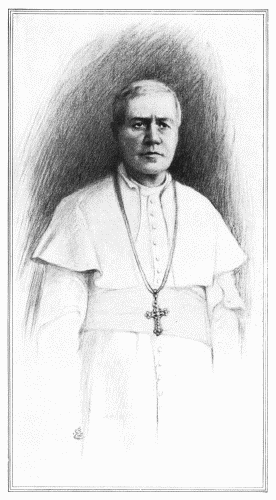
While we were talking to him the door into the audience chamber was opened, and a large party came out—the Comte and Comtesse d'Eu and their sons, with a numerous suite. We had barely time to exchange a few remarks, as Monsignor Bicletis was waiting for us to advance. We found the Pope standing in the centre of rather a small room. The walls were hung with red damask, the carpet also was red, and at one end were three gold chairs. We made low curtseys—didn't kneel nor kiss his hands, being Protestants. He advanced a few steps, shook hands, and made us sit down, one on each side of him. He was dressed, of course, entirely in white. He spoke only Italian—said he understood French, but didn't speak it easily. He has a beautiful face—so earnest, with a fine upward look in his eyes; not at all the intellectual, ascetic appearance of Léo XIII., nor the half-malicious, kindly smile of Pius IX., but a face one would remember. I asked him if he was less tired than when he was first named Pope. He said, oh, yes, but that the first days were very trying—the great heat, the change of habits and climate, and the change of food (so funny, one would think there needn't be any great change between Rome and Venice—less fish, perhaps). He talked a little—only a little—about France, and the difficult times we were passing through; knew that I was a Protestant and an "old Roman"; asked how many years since I had been back; said: "You won't find the old Rome you used to know; there are many, many changes."
Pope Pius X.
He was much interested in all Bessie told him about America and the Catholic religion in the States—was rather amused when she suggested that another American cardinal might perhaps be a good thing. He asked us if we knew Venice, and his face quite lighted up when we spoke of all the familiar scenes where he had spent so many happy years. He was much beloved in Venice. He gave me the impression of a man who was still feeling his way, but who, when he had found it, would go straight on to what he considered his duty. But I must say that is not the general impression; most people think he will be absolutely guided by his "entourage," who will never leave him any initiative.
As we were leaving I said I had something to ask. "Dica, dica, La prego" (Please speak), so I explained that I was a Protestant, my son also, but that he had married a Catholic, and I would like his blessing for my daughter. He made me a sign to kneel and touched my head with his hand, saying the words in Latin, and adding, "E per Lei et tutta la sua famiglia" (for you and all your family). He turned his back slightly when we went out, so we were not obliged to back out altogether.
We talked a few moments in the anteroom with Monsignor Bicletis, but he was very busy, other people going in to the Pope, so we didn't stay and went down to Cardinal Mery del Val's apartment. He receives in the beautiful Borgia rooms, with Pinturicchio's marvellous frescoes (there was such a lovely Madonna over one of the doors, a young pure face against that curious light-green background one sees so often in the early Italian masters). The apartment was comparatively modern—calorifère, electric light, bells, etc. While we were waiting the Comte and Comtesse d'Eu and their party passed through.
The Cardinal received us standing, but made us sit down at once. He is a tall, handsome homme du monde, rather English looking, very young. He told us he was not yet forty years old. He speaks English as well as I do (his mother was English), and, they tell me, every other language equally well. He seemed to have read everything and to be au courant of all that was said and thought all over the world. He talked a little more politics than the Pope—deplored what was going on in France, was interested in all Bessie told him about America and Catholicism over there. They must be struck with the American priests and bishops whom they see in Europe, not only their conception, but their practice of their religion is so different. I had such an example of that one day when we asked a friend of ours, a most intelligent, highly educated modern priest, to meet Monsignor Ireland. He was charmed with him—listened most intently to all he said, particularly when he was speaking of the wild life out West, near California, and the difficulty of getting any hold over the miners. (He started a music hall, among other things, to have some place where the men could go in the evenings, and get out of the saloons and low drinking-shops.) Our friend perfectly appreciated the practical energy of the monsignor, but said such a line would be impossible in France. No priest, no matter how high his rank, would be allowed such initiative, and the people would not understand.
He didn't keep us very long, had evidently other audiences, and not time to talk to everybody. I am very glad to have seen him. He is quite unlike any cardinal I have ever met—perhaps because he is so much younger than most of them, perhaps because he seemed more homme du monde than ecclesiastic; but I daresay that type is changing, too, with everything else in Rome. We had a most interesting afternoon. After all, Rome and the Vatican are unique of their kind.
Friday, February 26th.
I had my audience from Queen Margherita alone this afternoon. Bessie and Josephine have already been. Her palace is in the Veneto (our quarter) and very near. It is a large, fine building, but I should have liked it better standing back in a garden, not directly on the street. However, the Romans don't think so. There are always people standing about waiting to see her carriage or auto pass out—they wait hours for a smile from their beloved Regina Margherita. I went up in an ascenseur—three or four footmen (in black) and a groom of the chambers at the top. I was ushered down a fine long gallery with handsome furniture and pictures to a large room almost at the end, where I found the Marquise Villa Marina (who is always with the Queen), the Duchesse Sforza Cesarini (lady in waiting), and one gentleman. There were three or four people in the room, waiting also to be received. Almost immediately the door into the next room opened, and the Duchesse Sforza waved me in (didn't come in herself). I had at once the impression of a charming drawing-room, with flowers, pictures, books, bibelots—not in the least like the ordinary bare official reception room where Queen Elena received us. The Queen, dressed in black, was sitting on a sofa about the middle of the room, and really not much changed since I had seen her twenty-four years ago at the Quirinal, when the present King was a little boy, dressed in a blue sailor suit. She is a little stouter, but her blonde hair and colouring just the same, and si grand air. She was most charming, talked in French and English, about anything, everything—asked about my sister-in-law, Madame de Bunsen, and her daughter Beatrice, whom she had known as a little girl in Florence. She is very fond of automobiling, so we had at once one great point of sympathy. She had read "The Lightning Conductor" and was much amused with it. We talked a little about the great changes in Rome. I told her about our visit to the Pope, and the impression of simplicity and extreme goodness he had made upon us. I can't remember all we talked about. I had the same impression that I had twenty-four years ago—a visit to a charming, sympathetic woman, very large-minded, to whom one could talk of anything.
Sunday, 28th.
It has poured all day, but held up a little in the afternoon, so we went (all four) to see Cardinal Mathieu, who lives in the Villa Wolkonsky. He had asked us to come and walk in his beautiful garden (with such a view of the Aqueducts) but that was of course out of the question. He is very clever and genial, and was rather amused at the account we gave him of our discussions. We are two Catholics and two Protestants, and argue from morning till night—naturally neither party convincing the other. He told us we should go to the Vatican to-morrow—there was a large French pèlerinage which he presented. We would certainly see the Pope and perhaps hear him speak.
Monday.
We had a pleasant breakfast this morning with Bebella d'Arsoli,[33] in their beautiful apartment in his father's (Prince Massimo's) palace. The palace looks so black and melancholy outside, with its heavy portico of columns (and always beggars sitting on the stone benches under the portico) that it was a surprise to get into their beautiful rooms—with splendid pictures and tapestries. The corner drawing-room, where she received us, flooded with light, showing off the old red damask of the walls and the splendid ceiling. We went to see the Chapel after breakfast, where there are wonderful relics, and a famous pavement in majolica.
About 3 we started off for St. Peter's. We had all brought our veils with us, and retired to Bebella's dressing-room where her maid arranged our heads. We left a pile of hats which Bebella promised to send home for us, and took ourselves off to the Vatican, taking little Victoria Ruspoli with us, who looked quite sweet in her white dress and veil—her great dark eyes bright with excitement. We found many carriages in the court, as we got to the Vatican, and many more soldiers on the stairs, and about in the passages. The rooms and long gallery were crowded—all sorts of people, priests, women, young men, children (some very nice-looking people) all speaking French. We went at first into the gallery, but there was such a crowd and such a smell of people closely packed that we couldn't stay, and just as we were wondering what to do, Monsignor Bicletis came through and at once told us to come with him. He took us through several rooms, one large one filled with people waiting for their audience, into the one next the Pope's, who he said was with Cardinal Mathieu, and would soon pass. We were quite alone in that room, except for three or four priests. In a few moments the Pope appeared with Cardinal Mathieu and quite a large suite. The Cardinal, who had promised to present Madame de B. (there had been some delay about her convocation), came up to us at once. We all knelt as the Pope came near, and he named Madame de B. and little Victoria, who asked for his blessing for her brothers. He recognised me and Bessie, and said we were welcome always at the Vatican. He only said a few words to Madame de B. as he had a long afternoon before him. Cardinal Mathieu told us to follow them, so we closed up behind the suite, and followed the Pope's procession.
There must have been over a hundred people waiting in the next room, and it was an impressive sight to see them all—men, women, and children—kneel as the Pope appeared. Some of the children were quite sweet, holding out their little hands full of medals and rosaries to be blessed—almost all the girls in white, with white veils, like the little first communiantes in France. The Pope made his "cercle," speaking to almost every one—sometimes only a word, sometimes quite a little talk. We followed him through one or two rooms to the open loggia, which was crowded. We were very hot, but he sent for his cloak and hat. We waited some little time but the crowd was so dense—he would have spoken from the other end of the loggia—and we couldn't possibly have got through—so we came away, having had again a very interesting afternoon.
It is most picturesque driving around the back of St. Peter's and the Vatican. There are such countless turns and courts and long stretches of high walls with little narrow windows quite up at the top. Always people coming and going—cardinals' carriages with their black horses, fiacres with tourists looking eagerly about them and speaking every possible language, priests, women in black with black veils, little squads of Papal troops marching across the squares—and Italian soldiers keeping order in the great piazza. A curious little old world in the midst of the cosmopolitan town Rome has become.
Rome, March 2d.
Yesterday Madame de B. and I made an expedition to the Catacombs of San Calisto fuori Porta San Sebastiano. It was decidedly cold and we were very glad we hadn't taken the open carriage. The drive out was charming—first inside the gates, passing the Colosseum, the two great arches of Constantine and Titus, and directly under the Palatine Hill and Baths of Caracalla, and then going out through the narrow little gateway, and for some little distance through high stone walls, we came upon the countless towers, tombs and columns standing alone in the middle of the fields, having no particular connection with anything, that mark the Appian Way, and make it so extraordinarily interesting and unlike any other drive in the world. I was delighted when we came upon that funny little stone house, built on the top of a high circular tomb—I remembered it perfectly.
The Catacombs stand in a sort of garden or vineyard. There were people already there, and a party just preparing to go down as we appeared. They had asked for a guide who spoke French, as they knew no Italian, and a nice-looking, intelligent young monk was marshalling his party and lighting the tapers. I thought they were rather short (I am rather nervous about subterraneous expeditions and one has heard gruesome tales of people lost in the Catacombs, not so very long ago) but they lasted quite well.
It was curious to see all the old symbols again—the fish, the pax (cross) and to think what they represented to the early bands of Christians, when the mere fact of being a Christian meant persecution, suffering, and often a terrible death in the arena of the Colosseum.
Some of the frescoes are wonderfully preserved—we saw quite well the heads of saints, martyrs, and decorations of wreaths of flowers or a delicate arabesque tracery; the most favourite subjects were Jonah and the whale, a shepherd with a lamb on his shoulders, and kneeling women's figures. The ladies in our party were wildly interested in the mummies (terrible looking things), particularly one with the hair quite visible. We saw of course the niche where the body of Ste. Cecilia was found—but the body is now removed to the church of Ste. Cecilia in the Trastevere. They have put, however, a model of the body, representing it exactly, in the niche, so the illusion is quite possible.
We walked about for an hour, following quantities of narrow passages, coming suddenly into small round rooms, which had been chapels, and still seeing in some of the stone coffins bits of bones, and inscriptions on the walls. It was rather weird to see the procession moving along, Indian file, holding their tapers, which gave a faint, flickering light. The guide had rather a bigger one—on the end of a long stick. We stopped at San Clemente on our way back, hoping to see the underground church, but it was too late. The sacristan said we should have come yesterday—there was a fête, and the two churches were illuminated.
Friday, 4th.
It has been another beautiful day. I trammed over to the Vatican to see the Sistine Chapel this time and the Stanze and Loggie of Raphael. It is a good pull up to the Sistine Chapel, by a rather dark staircase, but the day was so bright I saw everything very well when I once got there. The Vatican was very full—people in every direction—almost all English and German—I didn't hear a word of French or Italian. Two young men were stretched out flat on their backs on one of the benches, trying to get a good look at the ceiling through their glasses. I was delighted to see the Stanze again with many old friends. Do you remember the "Poesia" on the ceiling of one of the rooms—a lovely figure clad in light blue draperies, with a young, pure face? I wandered up and down the Loggie, but I think I was more interested looking down into the Court of San Damaso, filled with carriages, priests, women in black with black veils coming and going (I should think the Pope would be exhausted with all the people he sees) and the general little clerical bustle. The striped Swiss guard were lounging about in the gateway, and a fine stately porter in cocked hat and long red cloak at each door.
Josephine had a dinner in the evening—Cardinal Mathieu, the Austrian Ambassador to the Vatican and his wife, and other notabilities. There was quite a large reception after dinner, among others the Grand Duchess of Saxe-Weimar, who is very easy, charming—likes to see everybody. When I came downstairs to dinner I found all the ladies with lace fichus or boas on their shoulders, and I was told that I was quite incorrect—that one couldn't appear décolletée in a cardinal's presence. I could find nothing in my hurry when I went back to my room, but a little (very little) ermine cravat, but still even that modified my low body somewhat, and at least showed that my intentions were good. The big red salon looks charming in the evening and is a most becoming room—the dark red silk walls show off the dresses so well. The cardinal had his whist, or rather his bridge, after dinner, for even the Church has succumbed to the universal craze—one sees all the ecclesiastics in Black circles just as intent upon their game and criticising their partner's play quite as keenly as the most ardent clubmen. I suppose bridge is a pleasure to those who play, but they don't look as though they were enjoying themselves—their faces so set and drawn, any interruption a catastrophe, and nobody ever satisfied with his partner's play.
We had very good music. An American protégé of Josephine's with a good high barytone voice sang very well, and the young French trio (all élèves du Conservatoire de Paris) really played extremely well. The piano in one of Mendelssohn's trios was quite charming—so sure and delicate. It was a pleasure to see the young, refined, intelligent faces so absorbed in their music, quite indifferent to the gallery. The young violinist played a romance (I forget what—Rubinstein, I think) with so much sentiment that I said to him "Vous êtes trop jeune pour jouer avec tant d'âme," to which he replied proudly, "Madame, j'ai vingt ans." C'est beau d'avoir vingt ans. I wonder how many of us at fifty remember how we thought and felt at twenty. Perhaps there would be fewer heart-burnings in the world if we older ones did remember sometimes our own youth.
Sunday, March 6th.
Yesterday I walked up to Santa Maria Maggiore and San Giovanni in Laterano. I took the Scala Santa on my way to San Giovanni. Several people were going up—some priests, Italian soldiers, two or three peasants and two ladies—mother and daughter, I should think, their long black cloth dresses very much in their way evidently. I watched them for some time. I wonder what it means to them, and if they really believe that they are the steps from Jerusalem which our Saviour came down. I stayed some little time in San Giovanni. It is magnificent certainly, but there is too much gilding and mosaic and modern decoration. The view from the steps was enchanting when I came out; the air was delicious, the sun bright in a bright blue sky, and the mountains soft and purple in the distance.
We had an interesting breakfast—two Benedictine monks from the great abbaye of Solesmes. They talked very moderately about their expulsion, and the wrench it was to leave the old monastery and begin life again in new surroundings. The older man especially seemed to feel it very much. I suppose he had spent all his life inside those old grey walls—reading and meditating and bound up in the interests and routine of his order. They had come to Rome to see the Pope, and consult with him about suppressing secular music in the churches, and substituting the Gregorian chants everywhere. It is a very difficult question; of course some of the music they have now in the churches is impossible. When you hear the "Méditation de Thaïs" played at some ceremony, and you think what Thaïs was, it is out of the question to admit such music in a church—on the other hand the strict Gregorian chant is very severe, particularly sung without any organ. I daresay educated musicians would prefer it, but to the ordinary assemblage, accustomed to the great peal of the organ with occasionally, in the country for instance at some festa, the national anthem or some well-known military march being played, the monotonous, old-world chant would say nothing. We shall hear them at the great festival at St. Peter's for San Gregorio.
Thursday, 10th.
It was warm and lovely Tuesday. Bessie, Josephine and I walked down to J.'s work-room in the Convent of St. Euphemia, somewhere beyond Trajan's Forum, before breakfast. It was too warm walking along the broad street by the Quirinal. We were thankful to take little dark narrow side streets. The "ouvroir" (work-room) was interesting—quantities of women and girls working—some of the work, fine lingerie, lace-mending, embroidery beautifully done. It is managed by sisters, under Josephine's direction, who gives a great deal of time and thought to her work. They take in any child or girl from the street, feed them and have them taught whatever they can do. It was pretty to see the little smiling faces and bright eyes as Josephine passed through the rooms.
We went to a pleasant tea in the afternoon at Countess Gianotti's (wife of Count Gianotti, Master of Ceremonies to the King). There were quite a number of people—a very cosmopolitan society (she herself is an American) and she gave us excellent waffles.
Yesterday we had a delightful excursion with Countess de Bertheny in her automobile. She came to get me and Bessie about 11. We picked up two young men and started for Nemi and the Castelli Romani. We drove straight out from Porta San Giovanni to Albano. It was quite lovely all the way, particularly when we began the steep ascent of Albano, and looked back—the Campagna a beautiful stretch of purple, the aqueducts standing well out all around us, and the statues of San Giovanni just visible and looking enormous, in the mist that always hangs over Rome, St. Peter's a great white spot with the sun full upon it. We rattled through Albano. The streets looked animated, full of people, all getting out of our way as fast as they could.
The door into the Doria Villa was open; we just had a glimpse of the garden which looked cool and green, with a perspective of long walks, ending in a sort of bosquet, but we passed so quickly that it was merely a fleeting impression. We drove through Ariccia to Gensano—a beautiful road, splendid trees, making a perfect shade, the great Chigi Palace looking just the same, a huge grim pile—quite the old château fort, built at the entrance of the little village to protect it from invading enemies. If stones could speak I wonder what they would say to modern inventions, automobiles, huge monsters certainly, but peaceful ones, rushing past, trains puffing and smoking along the Campagna, great carts drawn by fine white oxen going lazily along, the driver generally asleep under his funny little tent of red or blue linen, and nobody thinking of harm.
We drove through Gensano, then turned off sharp to the left to Nemi—a fairly good road. We soon came in sight of the lake, which looked exactly as I remembered it—a lifeless blue, like a deep cup surrounded by green hills. They used to tell us, I remember, that there were no fish, no living thing in the lake, but Ruspoli says there are plenty now—very good ones.
We followed a beautiful winding road up to Nemi, which is a compact little village on the top of a hill—the great castle standing out well. It has just been bought by Don Enrico Ruspoli, and he and his charming American wife are making it most picturesque and livable. We breakfasted at the little Hôtel de Nemi—not at all bad—the dining-room opening on a terrace with such a view—at our feet the Campagna rolling away its great waves of blue purple to a bright dazzling white streak, the sea—on one side a stretch of green valley leading to all the different little villages; on the other the lake with its crown of olive-covered hills.
Just as we were finishing breakfast Ruspoli appeared to ask us if we would come and see the castle. We entered directly from the little square of the town—the big doors face the church. There is a fine stone staircase, and halls and rooms innumerable. They have only just begun to work on it—have made new floors (a sort of mosaic, small stones, just as I remember them at Frascati in Villa Marconi) and put water everywhere, but there is still a great deal to do. The proportions of the rooms are beautiful, and the view divine. As in all old Italian castles some of the village houses were built directly into the wall of the castle. They have already bought and knocked down many of these (giving the inhabitants instead comfortable, clean, modern houses which they probably won't like nearly as well) and are arranging a beautiful garden in their place. They have also a terrace planted with trees about half-way down the slope to the lake, which would be a divine place to read or dream away a long summer's day. I don't think there are ten yards of level ground on the place.
Great New Bridge from Albano to Ariccia. Built by Pope Pius IX.
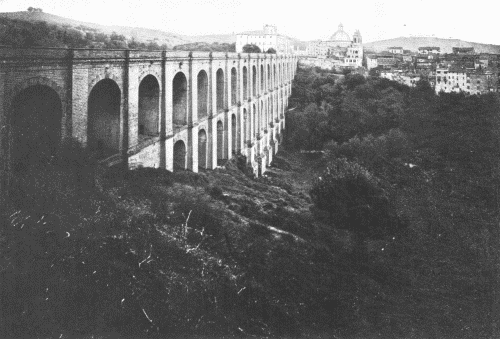
We couldn't stay very long as we were going on to Frascati and Castle Gondolfo. They gave us tea, and when we came out on the piazza we found the whole village congregated around the automobiles (another had arrived from Rome—I am so cross I didn't bring mine with Strutz, it would have been so convenient for all the excursions). It is a wild beautiful spot, but I should think lonely. We went back to Albano, saw the great bridge built by Pio Nono, with its three tiers of arches, the famous tombs—Horatii, Curiatii and Pompey, and then drove along the beautiful "galeria di sotto" to Castle Gondolfo, the old crooked ilex trees nearly meeting over our heads, and the Campagna with lovely lights and shades flitting over it, far down at our feet. There everything looked exactly as I remembered it. It seemed to me the same priests were walking about under the trees, the same men riding minute donkeys, with their legs nearly touching the ground; the same great carts, lumbering peacefully along, the driver usually asleep until the horn of the automobile close behind him roused him into frantic energy; however they were all most smiling, evidently don't hate the auto as they do in some parts of France.
We stopped at the Villa Barberini at Castle Gondolfo—such a beautiful garden, but so neglected—great long dark walks, trees like high black walls on each side, and big bushes of white and red camellias almost as tall as the trees, roses just beginning. In every direction broken columns, vases, statues (minus arms and legs) carved benches, all falling to pieces. We went into the Villa which is usually let to strangers, but it was most primitive—brick floors everywhere (except in the salons, where there was always the mosaic pavement), and the simplest description of furniture—ordinary iron bed-steads, and iron trépieds in the master's bed-rooms, but a magnificent view of sea and Campagna from the balcony, and a beautiful cool, bracing air.
We drove on through Marino and Frascati. We passed the little chapel on the road where we used to see all the people praying the great cholera year. It was open, and one or two women were kneeling just inside. The atmosphere was so transparent that Rocca di Papa and Monte Cavo seemed quite near. The Piazza of Frascati was just the same, the Palazzo Marconi at one side with the great Aldobrandini Villa overtopping it and the Villa Torlonia opposite. We didn't go into the town, but took the steep road down by the railway station. There everything is changed—it didn't seem at all the Frascati we had once lived in—quantities of new, ugly villas, and an enormous modern Grand Hotel.
We got home about 6.30—the Campagna quite beautiful and quiet in the soft evening light. There were very few people on the road, every now and then a shepherd in his long sheepskin cloak, staff and broad-brimmed hat appearing on the top of one of the many little mounds which are dotted all over the Campagna, and occasionally in the distance a dog barking.
March 17th.
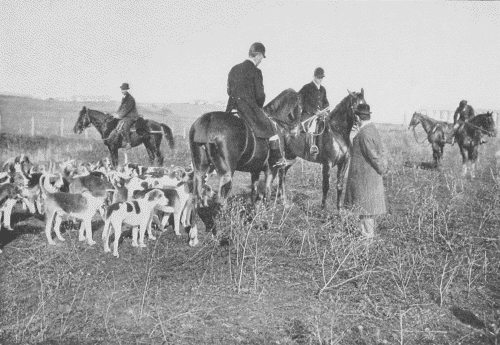
Bessie and I have just come in from the last meet of the season at Cecilia Metella. It is such a favourite rendezvous that there is always a great crowd, almost as many people walking about on the Campagna as riding. It was a very pretty sight. There were quantities of handsome horses, but I don't know that it was quite comfortable walking when the hunt moved off. Some of the young men—principally officers—were taking preliminary gallops in every direction, and jumping backward and forward over a large ditch. One of them knocked down an Englishwoman—at least I don't think he really knocked her, but he alighted so near her that she was frightened, and slipped getting out of his way. We stopped to speak to her, but she said she wasn't at all hurt, and had friends with her. The master of the hounds—Marchese Roccagiovine—didn't look very pleased, and I should think a large, motley field, with a good many women and careless riders, would be most trying to a real sportsman, such as he is. Giovanni Borghese told me there were two hundred people riding, and I can quite believe it.
Roman Huntsmen on the Campagna. Ancient Roman aqueduct in the background.
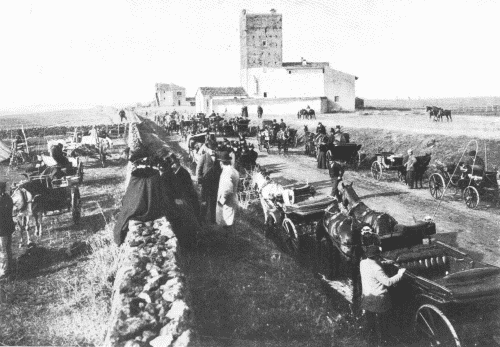
We had a delightful day yesterday, but rather a fatiguing one—I am still tired. We made an excursion (a family party—Bessie, Josephine, her two children, Mr. Virgo and two of his friends—a Catholic priest and a student preparing for orders—all Englishmen). We went by train to Frascati, and from there to Tusculum, carrying our breakfast with us. We passed the little Campagna station (Ciampino) where we have stopped so often. Do you remember the old crazy-looking station, and the station-master, yellow and shivering, and burned up with fever. Now it is quite a busy little place, people getting on and off the trains and one or two brisk porters. The arrival at Frascati was a sight. We were instantly surrounded by a crowd of donkey-boys and carriages—nice little victorias with red flowers in the horses' heads and feathers in the coachmen's hats—all talking at the top of their voices; but between Mr. Virgo and Pietro, Josephine's Italian footman, who had charge of the valise with the luncheon, we soon came to terms, and declined all carriages, taking three or four donkeys.
It isn't a long walk to Tusculum, and Josephine and I both preferred walking—besides I don't think I should have had the courage to mount in the piazza with all the crowd looking on and making comments; however, Bessie did, and she sat her donkey very lightly and gracefully, making a great effect with her red hat and red parasol. Perhaps the most interesting show was Pietro. He was so well dressed in a light grey country suit that I hardly recognised him. He stoutly refused to be separated from his valise, put it in front of him on the donkey, sat well back himself and beamed at the whole party. He is a typical Italian servant—perfectly intelligent, perfectly devoted (can neither read nor write), madly interested in everybody, but never familiar nor wanting in respect. I ask him for everything I want. He does it, or has it done at once, better and cheaper than I could, and I am quite satisfied when I hear his delightful phrase "Ci penso io"—I am sure it will be done.
We went up through the Aldobrandini garden. It looked rather deserted; no one ever lives there now, but it is let occasionally to strangers. Men were working in the garden; there were plenty of violets and a few roses—it is still early in the season for them. In a basin of one of the fountains a pink water-lily—only one—quite beautiful. The fountains were lovely—sparkling, splashing, living—everything else seemed so dead.
As we wound up the steep paths we had enchanting views of the Campagna, looking like a great blue sea, at our feet, and Rome seemed a long, low line of sunlight, with the dome of St. Peter's hanging above it in the clouds. The road was very steep, and decidedly sunny, so I mounted my donkey, Father Evans walking alongside. Monte Cavo, Rocca di Papa, the Madonna del Tufo, all seemed very near, it was so clear and the air was delicious as we got higher. I recognised all the well-known places, the beginning of the Roman pavement, the Columbarium, Cicero's house, etc.
We were quite ready for breakfast when we got to Tusculum, and looked about for a shady spot under the trees. There are two great stones, almost tables, in the middle of the "amfiteatro," where people usually spread out their food, but the sun was shining straight down on them; we didn't think we could stand that. We found a nice bit of grass under the trees and established ourselves there. It was quite a summer's day, and the rest and quiet after toiling up the steep paths was delightful.
Waiting for the Hounds.
After breakfast Josephine and I walked quite up to the top of the hill, the trees making a perfect dome of verdure over our heads. There was no sound except our own voices, and the distant thud of horses' feet cantering in a meadow alongside, an absolute stillness everywhere. Such a view! Snow on the Sabine Mountains, sun on the Alban Hills, the Campagna on either side blue and broken like waves, and quite distinct, a long white line, the sea.
While we were walking about we noticed two carabinieri, very well mounted, who seemed to be always hovering near us, so we asked them what they were doing up there. They promptly replied, taking care of the "società." We could hardly believe we heard rightly; but it was quite true, they were there for us. They told us that when it was known that a number of people were coming up to Tusculum (there were two other parties besides us) they had orders to come up, keep us always in sight, and stay as long as we did. We gave them some wine and sandwiches, and they became quite communicative—told us there were brigands and "cattiva gente" (wicked people) about; that at Rocca di Papa, one of the little mountain villages quite near, there were 500 inhabitants, 450 of whom had been in prison for various crimes, and that people were constantly robbed in these parts. I wouldn't have believed it if any one had told us, but they always kept us in sight.
We decided to go home through the Villa Ruffinella. Donkeys are not allowed inside, and we thought probably not horses either, but the carabinieri came in and showed us the way down. The grounds are splendid—we walked first down through a beautiful green allée, then up, a good climb. The villa is enormous—uninhabited and uncared for—a charming garden and great terrace with stone benches before the house looking toward Rome. The garden, of course, wild and ragged, but with splendid possibilities. Just outside the gate we came upon a little church. Three or four girls and women with bright-coloured skirts and fichus and quantities of coarse jet-black hair were sitting on the steps working at what looked like coarse crochet work and talking hard. The carabinieri were always near, opened two or three gates for us, and only left us when we were quite close to the town, well past the gates of the Aldobrandini Villa.
As we had some little time before the train started, I went off with Bessie to have a look at Palazzo Marconi. It is now occupied by the municipio and quite changed. We found a youth downstairs who couldn't imagine what we wanted and why we wanted to go up; however, I explained that I had lived there many years ago, so finally he agreed to go up with us. The steps looked more worn and dirty—quite broken in some places—and the frescoes on the walls, which were bright blue and green in our time, are almost effaced. It was all so familiar and yet so changed. I went into father's room and opened the window on the terrace, where we had stood so often those hot August nights, watching the mist rise over the Campagna and the moon over the sea. There was very little furniture anywhere—a few chairs and couches in the small salon that we had made comfortable enough with our own furniture from Rome. The great round room with the marble statues has been turned into a salle de conseil, with a big writing-table in the middle, and chairs ranged in a semicircle around the room. There was nothing at all in our old bed-rooms—piles of cartons in one corner. The marble bath-tub was black and grimy. We couldn't see the dining-room, people were in it, but we went out to the hanging-garden—all weeds, and clothes hanging out to dry. The fountain was going at the back of the court, but covered with moss, and bits of stone were dropping off. It all looked very miserable—I don't think I shall ever care to go back. There seemed just the same groups of idle men standing about as in our time—dozens of them doing nothing, hanging over the wall looking at the people come up from the railway station. They tell me they never work; even when they own little lots of land or vignas they don't work themselves—the peasants from the Abruzzi come down at stated seasons, dig and plant and do all the work. One can't understand it, for they look a tall, fine race, all these peasants of the Castelli Romani, strong, well-fed, broad-shouldered. I suppose there must be a strong touch of indolence in all the Latin races.
It was after six when we got back to Rome. We had just time to rush home, get clean gloves and long skirts, and start for the Massimo Palace to see the great fête. Once a year the palace is opened to the general public, and the whole of Rome goes upstairs and into the chapel. It is on St. Philippe's day, when a miracle was performed in the Massimo family, a dead boy resuscitated in 1651. There was a crowd assembled as we drove up, tramways stopped, and the getting across the pavement was rather difficult. The walls of the palace and portico were hung with red and gold draperies, the porter and footman in gala liveries, the old beggars squatted about inside the portico, the gardes municipaux keeping order, and a motley crowd struggling up the grand staircase—priests, women, children, femmes du monde, peasants, policemen, forestieri, two cooks in their white vestons, nuns, Cappucini—all striving and jostling to get along. We stopped at Bebella's apartment, who gave us tea. She had been receiving all day, but almost every one had gone. We talked to her a few moments, and then d'Arsoli took us upstairs to the chapel (by no means an easy performance, as there were two currents going up and coming down). The chapel was brilliantly lighted, and crowded; a benedizione was going on, with very good music from the Pope's chapel—those curious, high, unnatural voices. All the relics were exposed, and Prince Massimo, in dress clothes and white cravat, was standing at the door. It was a most curious sight. D'Arsoli told us that people had begun to come at seven in the morning. When we went home there was still a crowd on the staircase, stretching out into the street, and a long line of tram-cars stopped.
Friday, March 18th.
It rained rather hard this morning, but we three got ourselves into the small carriage and went down to the Accademia di Santa Cecilia to hear the Benedictine monk Don Guery try the Gregorian chants with the big organ. The organ is a fine one, made at Nuremberg. An organist arrived from St. Anselmo to accompany the chants. They sounded very fine, but I thought rather too melodious and even modern, but Don Guery assured me that the one I particularly noticed was of the eleventh century.
Tuesday, 22d.
We seem always to be doing something, but have had two quiet evenings this week. Friday night we went to the Valle to see Marchesa Rudini's Fête de Bienfaisance. The heat was something awful, as the house was packed, and as at all amateur performances they were unpunctual, and there were terribly long intervals. The comédie was well acted, a little long, but the clou of the evening was the ballet-pantomime, danced by all the prettiest women in Rome. The young Marchesa Rudini (née Labouchère) looked charming as a white and silver butterfly, and danced beautifully, such pretty style, not a gesture nor a pas that any one could object to. The rest of the troop too were quite charming, coming in by couples—the Princess Teano and Thérèse Pécoul a picture—both tall, one dark, one fair, and making a lovely contrast. I should think they must have made a lot of money.
Saturday I had a pleasant afternoon at the Palazzo dei Cesari with Mr. and Mrs. Seth Low. He is an excellent guide, had already been all over the palace with Boni and knew exactly what to show us. It was a beautiful afternoon and the view over Rome, the seven hills, and the Forum was divine. These first Roman Emperors certainly knew where to pitch their tents—what a magnificent scale they built upon in those days. The old Augustus must have seen wonderful sights in the Forum from the heights of the Palatine.
Josephine had a large dinner in the evening for the Grand Duchess and Cardinal Vannutelli. It was very easy and pleasant, and we all wore our little fichus most correctly as long as the Cardinal was there (they never stay very long), but were glad to let them slip off as soon as he went away, for we had a great many people in the evening and the rooms were warm. I had rather an interesting talk with an old Italian friend (not a Roman) over the tremendous influx of strangers and Italians from all parts of Italy to Rome. He says au fond the Romans hate it—they liked the old life very much better—they were of much more importance; it meant something then to be a Roman prince. Now, with all the Northern Italians, Court people and double Diplomatic Corps Rome has become too cosmopolitan. People amuse themselves, and dance and hunt, and give dinners at the Grand Hotel and trouble themselves very little about the old Roman families (particularly those who have lost money and don't receive any more). The Romans have a feeling of being put aside in their own place.
It was beautiful this morning, so I took my convenient tram again and went over to see the pictures of the Vatican. Such a typical peasant couple were in the tram, evidently just down from the mountains, as they were looking about at everything, and were rather nervous when the tram made a sudden stop. The woman (young and rather pretty) had on a bright blue skirt, a white shirt with a red corset over it, a pink flowered apron, green fichu on her head, and long gold ear-rings with a coral centre. The man, a big broad-shouldered fellow, had the long cloak with the cape lined with green that the men all wear here, and a slouched hat drawn low down over his brows. They got out at St. Peter's and went into the church. I went around by the Colonnade as I was going to the pictures. There were lots of people on the stairs. It certainly is a good stiff pull up.
I stayed about an hour looking at the pictures—all hanging exactly where I had always seen them, except the Sposalizio of St. Catherine, which was on an easel near the window; some one evidently copying it. I was quite horrified coming back through the Stanze by some English people—three women—who were calmly lunching in one corner of the room. They were all seated, eating sandwiches out of a paper bag, and drinking out of a large green bottle. Everybody stopped and looked at them, and they didn't mind at all. The gardien was looking on like all the rest. I was so astounded at his making no remarks that I said to him, surely such a thing is forbidden; to which he replied smilingly: "No—no, non fanno male a nessnno—non fanno niente d'indecente" (No, they are doing no harm to any one, they are doing nothing indecent). That evidently was quite true; but I must say I think it required a certain courage to continue their repast with all the public looking on, giggling and criticising freely.
I dined this evening with Malcolm Kahn—Persian Minister—and an old colleague of ours in London. It was very pleasant—General Brusatti, one of the King's Aides-de-Camp, took me in, and I had Comte Greppi, ancien Ambassadeur, on the other side. Greppi is marvellous—really a very old man, but as straight as an arrow, and remembering everybody. Tittone, Minister of Foreign Affairs, was there, but I wasn't near him at table, which I regretted, as I should have liked to talk to him.
Palm Sunday, March 27th.
Bessie and I went to the American church this morning, and afterward to the Grand Hotel to breakfast with some friends. The restaurant was crowded, so many people have arrived for Easter, and it was decidedly amusing—a great many pretty women and pretty dresses. It poured when we came away. We had all promised to go to an amateur performance of the Stabat Mater at the old Doria Palace in Piazza Navona. It was rather damp, with draughts in every direction, so Mrs. Law and I decided we would not stay to the end, but would go for a drive until it was time to go back to tea at the Grand Hotel (it is rather funny, the first month I was here I never put my foot in the Grand Hotel, and I was rather disappointed, as tea there in the Palm Garden with Tziganes playing, is one of the great features of modern Rome, and now I am there nearly every day). It was coming down in torrents when we came out of the concert, and a drive seemed insane, so I suggested a turn in St. Peter's (which is always a resource on a rainy day in Rome). That seemed difficult to accomplish, though, when we arrived at the steps—we couldn't have gone up those steps and across the wide space at the top without getting completely soaked. However I remembered old times, and told the man to drive around to the Sagrestia. He protested, so did all the beggars around the steps, who wanted to open the door of the carriage. We couldn't get in—the door was shut, etc., but I thought we would try, so accordingly we drove straight to the Sagrestia. The door was open—a man standing there who opened the carriage door and told the coachman where to stand. I don't think I ever saw rain come down so hard, and so straight. It was very interesting walking through all the passages at the back of St. Peter's, and into the church through the sacristy, where priests and children were robing and just starting for some service with tapers and palms in their hands. We followed the procession, and found ourselves just about in the middle of the church. There were still draperies hanging on the columns and seats marked off. There had been a ceremony of some kind in the morning, and a great many people were walking about. We stopped some little time at the great bronze statue of St. Peter. I was astounded at the quantity and quality of people who came up and kissed the toe of the Saint. Priests and nuns of course, and old people, both men and women, but it seemed extraordinary to me to see young men, tall, good-looking fellows, bend down quite as reverently as the others and kiss the toe. They were singing in one of the side chapels—we listened for a little while—and all over the church everywhere people kneeling on the pavement.
We went back to the Grand Hotel for tea, and dined with the young Ruspolis, who have a handsome apartment in the Colonna Palace. The dinner was for the Grand Duchess, and was pleasant enough. There was a small reception in the evening, and almost every one went afterward to Princesse Pallavicini's who receives on Sunday evening. I like the informal evening receptions here very much. It is a pleasant way of finishing the evening after a dinner, and so much more agreeable than the day receptions—at least you do see a few men in the evening—whereas they all fly from afternoons and teas. As every one receives there is always some house to go to.
Monday, March 28th.
I have had a nice solitary morning in the Forum, with my beloved Italian guide book, a little English brochure with a map of the principal sights, and occasional conversations with the workmen, of whom there are many, as they are excavating in every direction, and German tourists. The Germans, I must say, are always extremely well up in antiquities, and quite ready to impart their information to others. They are a little long sometimes, but one usually finds that they know what they are talking about.
There are of course great changes since I have seen the Forum. They are excavating and working here all the time. The King takes a great interest in all that sort of work, and often appears, it seems, early in the morning and unexpectedly, when anything important is going on. The Basilica Julia (enormous) has been quite opened out since my day; and another large temple opposite is most interesting, with splendid bits left of marble pavement—some quite large squares of pink marble that were beautiful; and in various places quantities of coins melted and incrusted in the marble which looks as if the temple had been destroyed by a fire.
There was little shade anywhere. I hadn't the courage to walk in the sun as far as the Vestals' house, which is really most interesting. The recent excavations have brought to light so many rooms, passages, frescoes, etc., that the ordinary, every-day life of the Vestal Virgins has been quite reconstructed. One could follow them in their daily avocations. From where I was sitting I could see some of the great statues—some of the figures in quite good preservation, two of them holding their lamps. I found a nice square stone, and sat there lazily taking in the enchanting views on all sides—the Palatine Hill behind me, the Capitol on one side, on the other the three enormous arches of the Temple of Constantine; at my feet the Via Sacra running straight away to the Colosseum, the sky a deep, soft blue throwing out every line and bit of sculpture on the countless pillars, temples and arches that spring up on all sides. From a height, the Palatine Hill, for instance, the Forum always looks to me like an enormous cemetery—one loses the impression of each separate building or ruin. It might be a street of tombs rather than the busy centre of a great city.
There were plenty of people going about—bands of Cook's tourists being personally conducted and instructed. If the gentleman who explains Roman history gives the same loose rein to his imagination as the one we used to hear in Versailles conducting the British public through the Historical Portrait Gallery, the present generation will have curious ideas as to the deeds of daring and wonderful rule of all the Augustuses and Vespasians who have made the Palace of the Cæsars the keystone of magnificent and Imperial Rome; and again "unwritten history" will be responsible for many wonderful statements. However, I wasn't near enough to hear the explanations. People were still coming in when I left, and all the way home I met carriages filled with strangers.
We went out again rather late. I went for tea to Marchesa Vitelleschi, and before I came away Vitelleschi came in. I wanted to see him to thank him for sending me his book, a Roman novel, "Roma che se ne va."[34] It is very cleverly written, and an excellent picture of the Rome of 35 years ago, as we first knew it. I should think it would interest English and Americans very much, I wonder he hasn't translated it.
I found quite a party assembled in the little green salon when I got back—Don Guery, the Benedictine monk, who wishes to arrange a concert with Josephine for her charities, and M. Alphonse Mustel, who has just come from Paris with his beautiful organ. He arrived this morning early and hadn't yet found a room anywhere—all the hotels crowded. They say that for years they haven't had so many strangers for Holy Week. He is coming to play here Thursday afternoon.
We had a quiet evening, and after dinner Mr. Virgo read to us the book I am so mad about, "The Call of the Wild." He read extremely well, and I liked the book even better hearing it read. It is a marvellous description of that wild life in the Klondyke, and a beautiful poetical strain all through. The children listened attentively, were wildly interested, particularly when poor Buck was made to drag the sledge so heavily loaded, for his master to win his bet. We also want to read Cardinal Mathieu's article in the "Revue des Deux Mondes," "Les derniers jours de Léon XIII."; but we have so rarely a quiet evening, and in the daytime every one is out in the beautiful Roman sunshine.
We have all come upstairs early (ten o'clock) so I am profiting of a quiet hour to write, as I can't go to bed so early. This street is rather noisy. It is on the way to the station and some of the big hotels. Cabs and big omnibuses go through it all day and all night. I don't mind the noise. I rather like the roar of a big city—it means life.