PART I (continued 2)
Reading edition
In France they are frightfully logical, must always argue and discuss everything—I think they are born debaters.
We left cards on various people, Princess Bandini, Cenci, Countess Lovatelli, and then went for a little turn out of the San Lorenzo gate, but not far, as we wanted to go to Princess Pallavicini, who received that afternoon. W. was much struck with the apartment—so many rooms, all very high ceilings, that we passed through before getting to the boudoir where the Princess was sitting. It all looked so natural, I remembered the hangings—bright flowers on a light satin ground—as soon as I got into the room, and some of the pictures. She was very cordial and friendly, told W. how long she had known me, and recalled some of our rides at Frascati with her and Del Monte. She asked us to come on Friday evenings, she was always at home. No one else was there but a Princesse de Thurn and Taxis (née Hohenlohe) who was introduced to us, and the talk was pleasant enough. She was quite interested in our two audiences—Pope and Quirinal—but we told her we had heard nothing from either court yet. W. walked home, and I went on to Gert as it was her reception day. She gave me a cup of tea, and I found various friends there, including Father Smith who was quite pleased to see me again. He doesn't look any older, and is apparently quite as energetic as ever. He told me he had enjoyed his talk with W. very much, and they had made a rendezvous for two days—the Catacombs and San Clemente. He remarked casually that W. wasn't at all what he expected to find him; not at all his idea of a "French Republican." I wonder what sort of trade-mark he expected to see? If he had pictured W. as a slight, nervous, black-eyed, voluble Frenchman, he must naturally have been surprised.
We have heard people discussing us sometimes in English as we pass down the long dining-room to our table—"There goes Waddington, the late French Premier." "Never—that man is an Englishman." "I have seen pictures of Waddington—he doesn't look at all like that, etc." The head waiter always points us out as distinguished strangers.
I found quantities of cards when I came home—one from Lily San Vito with a nice little message of welcome. (We crossed her in the Corso the other day and she looked lovely.) Also Valerys, Middletons, Pantaleones, etc. After I had gone to my room to dress W. had a visit from Desprez, the French Ambassador to the Vatican. He has just arrived, his wife not yet come, and he feels a little strange in this very divided society. We are going to meet him at dinner at the Portuguese Embassy. He told W. there would be several Cardinals at the dinner—a regular black assemblage. It will be a funny experience for W.
March 6, 1880.
I will finish this long letter to-night. We have just come in from the Teano dinner, which was pleasant. Teano looked quite the same (I hadn't seen him for years) with his tall, slight figure and white lock. (I forgot to look if the boy had it.) She looked very handsome. We had the Minghettis, a Polish Countess—sister-in-law of the Duc de Sermoneta, the Calabrinis, and M. Heding, a German savant. Minghetti was delightful, telling us his early experiences with the old Pope, Pio Nono. He was killing over the entente between the government and the monks for the suppression of the monasteries. The gendarmes arrived, found barred doors and resistance. There was a sort of halt and parley—one father came out, then another—a little livret of the Caisse d'Epargne was put into their hands, and all went off as quietly as possible. Heding seemed to think things wouldn't go so easily in Germany, and they certainly wouldn't in France.
Madame Minghetti and I talked for a long time after dinner exchanging our experiences of the official world, which I fancy is always the same in all countries. Calabrini was of course his same courteous self—so absolutely free from pose of any kind—rather unusual in a man who has always had such a success.
This morning we went to Trajan's Forum, walked, W. as usual quite at home, everywhere recognising old friends at every step. We looked at all manner of inscriptions and basso-rilievos, and enjoyed ourselves very much. This afternoon W. and Schuyler went off together to see some churches and the Palazzo dei Cesari. I backed out, as I can't stand two sight-seeings the same day with a dinner in prospect in the evening. I went over to get Gert, and we drove about together, winding up at the Comtesse Wimpffens, Austrian Ambassadress, who has a charming apartment in the Palazzo Chigi (where Odo Russell used to live when we were in Rome). There were various ladies there, the Marquise de Noailles, French Ambassadress (who immediately asked me who made my dress, the blue velvet that did all my visits the last year of the Quai d'Orsay), Lady Paget, Madame Minghetti, and a sprinkling of secretaries and attachés. Comtesse d'Aulnay, looking very pretty, very well dressed, came in just as we were leaving. We wound up with a turn in the Villa Borghese. There were grooms waiting at the gate with saddle horses, just as our old Carmine used to wait for us. It is all so curiously familiar and yet changed. I can't get accustomed to the quantities of people in the streets where there never used to be any one—occasionally a priest, or a few beggars, or a water-carrier. Now there are soldiers, people carrying parcels, small employees, workmen, carts, carriages, life in fact. There were quantities of people in the Villa Borghese. Some of the carriages very well turned out, again very different from our days when we knew every carriage, and when a new equipage or a new face made a sensation.
W. has had a delightful afternoon looking at some of the very old churches with Eugene. He had, too, a note from Desprez saying our audience from the Pope would be to-morrow at one o'clock, and giving me the necessary instructions for my veil, long black dress, etc. To-morrow night we dine at the Noailles. The breakfast there the other day was pleasant—no one but ourselves and Ripalda. Of course it is a magnificent Embassy—the Farnese Palace—and they do it very well, but it would take an army of servants to "garnish" these long anterooms and passages, in fact ordinary servants are quite lost there; there ought to be Swiss guards or halberdiers with steel cuirasses and lances which would stand out splendidly from the old grey walls. One could quite imagine an Ambassador of Louis XIV arriving with 100 gentlemen and armed retainers in his suite. The famous room with the Caracci frescoes must be beautiful at night. Ripalda asked us to come to tea one afternoon at his palace on the Tiber, the "Farnesina." Marquise de Noailles was charming.
Now I will say good-night, dear, for I am tired, and we have a busy day to-morrow. I wonder if Leo XIII. will impress me as much as Pio Nono did.
To H. L. K.
Rome, Hôtel de Londres, Thursday, March 8, 1880.
The Piazza is delightful this morning, dear mother; it is bright and warm, and there are lots of people starting for excursions with guide-books, white umbrellas, and every variety of wrap. The coachmen of the little botte look so smiling and interested, so anxious to make things easy and comfortable. Vera came to see us yesterday, and told me he was hailed by one of the coachmen from the top of his box, just as he was crossing the Piazza, who said to him: "Sai Maestro, una di quelle signorine King è tornata col marito?" (Do you know, master, one of those King young ladies has come back with her husband?) He was much amused—told him he was quite right, and that he was going to see that same signorina. I dare say he had driven us often to one of the gates to meet the saddle horses.
Yesterday was our udienza particolare (special audience), and most interesting it was. Madame Hubert was madly excited dressing me. I wore my black satin, long, with the Spanish lace veil I had brought in case I should be received by his Holiness, and of course no gloves, though I had a pair with me and left them in the carriage. We started at 12.30, as our audience was at one, and got there quickly enough. I had forgotten all the queer little courts and turns at the back of the Vatican. Everything was ready for us; we were received really in royal state—Swiss Guard, with their extraordinary striped yellow uniform (designed, some one told us the other day, by Michelangelo), tall footmen attired in red damask, Guardia Nobile, chamberlains, and two monsignori. The garde noble de service was Felice Malatesta. He really seemed much pleased to see me again, and to make W.'s acquaintance—swore he would have known me at once, I was so little changed; but I rather suspect if he hadn't known we were coming he wouldn't have recognised me. We had a nice talk the few minutes we stood waiting in the room adjoining the one where the Pope received us, and he gave me news of all his family—Emilio (still unmarried), Francesco, etc.; then a door was opened, a monsignore came out, bowed, and said his Holiness was ready to receive us. We went in at once, the monsignore closing the door behind us and leaving us alone with the Pope, who came almost to the door to receive us, so that the three regulation curtseys were impossible. There were three red and gold arm-chairs at one end of the room, with a thick, handsome carpet in front of them. The Pope sat on the one in the middle, put me on his right and W. on his left. He is a very striking figure; tall, slight, a fine intellectual brow and wonderfully bright eyes—absolutely unlike Pio Nono, the only Pope I had ever approached. He was most gracious, spoke to me always in Italian, said he knew I was an old Roman, and that we had lived many years in Rome; spoke French to W., who, though he knows Italian fairly, prefers speaking French. He asked W. all sorts of questions about home politics and the attitude of the clergy, saying that as a Protestant his opinion would be impartial (he was well up in French politics, and knew that there were three Protestants in W.'s ministry: himself, Léon Say, and Freycinet). W. was rather guarded at first (decidedly "banale," I told him afterward), but the Pope looked straight at him with his keen, bright eyes, saying: "Je vous en prie, M. Waddington, parlez sons réserves."
We stayed about three-quarters of an hour, and the talk was most interesting. The Pope is very anxious to bring about a better state of feeling between the clergy and the people in France, and tries so hard to understand why the priests are so unpopular; asked about the country curate, who baptizes the children and buries the old people—surely there must be a feeling of respect for him; said, too, that everywhere in town or country the priests do so much for the sick and poor. W. told him the women all went to church and sent their children to the catechism, but the men are indifferent, if not hostile, and once the boys have made their first communion they never put their foot in a church. "What will keep them straight and make good men of them, if they grow up without any religious education?" The answer was difficult—example and home teaching, when they get it. Evidently he had been curious to see W., and I think he was pleased. It was quite a picture to see the two men—the Pope dressed all in white, sitting very straight in his arm-chair with his two hands resting on the arms of the chair, his head a little bent forward, and listening attentively to every word that W. said. W. drew his chair a little forward, spoke very quietly, as he always does, and said all he wanted to say with just the same steady look in his blue eyes.
Pope Leo XIII.
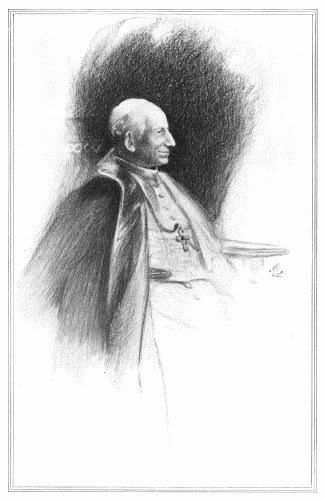
From time to time the Pope turned to me and asked me (always in Italian) if politics interested me—he believed all French women were keen politicians; also if I had found many old friends in Rome. I told him I was so pleased to see Felice Malatesta as we came in, and that we were going to meet Cardinal Howard one day at breakfast. I shouldn't think he took as much interest in the social life of Rome as Pio Nono did. They used always to say he knew everything about everybody, and that there was nothing he enjoyed so much as a visit from Odo Russell, who used to tell him all sorts of "petites histoires" when their official business was over.
He also talked a good deal to W. about his uncle, Evelyn Waddington, who lived in Perugia, where he was "sindaco" (mayor) for years. He married an Italian lady, and was more than half Italian—curious for a man called Evelyn Waddington. The Pope had known him well when he was Bishop of Perugia.
We both kissed his hand when we took leave, and he said again to W. how much he had been interested in all he told him. We lingered a few minutes in the anteroom, as there was some idea Cardinal Nina would receive us, but it had not been arranged. It seemed strange to be in those high, bare rooms again, and reminded me of our visit to Cardinal Antonelli years ago with father, when he showed us his collection of gems. I remember so well his answer to Bessie Curtis (now Marquise de Talleyrand-Périgord), who was looking out of the window, and said it was such an enchanting view, would help one in "des moments de découragement." "On n'est jamais découragé, mademoiselle."
I imagine Leo XIII has very difficult moments sometimes.
W. wouldn't come out again as he had letters to write, so I stopped for Gert, and we had a lovely turn in the Villa Pamphili. Quantities of people—it looked very gay. We got home about six, and had visits until it was time to dress for our dinner at the Wimpffens. D'Aulnay came first, very anxious to hear about our audience at the Vatican; and Tagliani, the auditeur of the old "nonce"; also Dr. Nevin.
Our dinner at the Wimpffens was very pleasant. Their apartment looks very handsome lighted. There was a fine, pompous old porter at the door downstairs, and plenty of servants and a "chasseur" upstairs. We had all the personnel of the Embassy, the Calabrinis, Bibra (Bavarian Minister), Van Loo (Belgian), and an Austrian whose name I didn't master, who had been a minister in Andrassy's Cabinet. After dinner we all adjourned to the smoking-room, which is very large and comfortable, lots of low arm-chairs. The Austrian ladies smoked, and I talked to Bibra and Van Loo, who told me all the diplomats had been rather struck with the cordiality of our reception—that in general the Romans troubled themselves very little about strangers. W. talked to Wimpffen and his Austrian friend, who was much interested in hearing about our audience with the Pope, and a little surprised that W. should have talked to him so freely, both of them saying that his being a Protestant made things much easier.
The Romans went off early, so W. went to Geoffroy (director of the École de Rome—French Archæological Society), who receives Thursday evenings at the Farnese Palace. He has an apartment quite up at the top of the palace over the Noailles, and I went to Gert, who also received Thursday. I found a good many people there—principally Americans, and some young diplomats. So many people were introduced to me that I was quite exhausted, and went and sat down by Aunt Mary, who looked very handsome.
Sunday, March 10, 1880.
I shall not go out this morning. It is a little foggy—the first time since we came here—and I was also lazy. We are going so perpetually. Yesterday W. was off at nine in the morning with Geoffroy and Lanciani for a classic tournée. I wrote one or two letters, and then Madame Hubert and I walked over to Gert's and breakfasted. After breakfast Monsignor English came in and had much to say about the Pope, and the impression W. had made which he had heard from high personages of the Vatican. I told him all about the interview, and he was much surprised when I said we all sat down. W. came while he was still there, and of course he wanted to hear his account, and was so pleased with all W. said about the Pope, his marvellous intelligence and comprehension of the present very difficult state of affairs in France. English also said the Pope had been pleased with me (I did nothing but listen) so I plucked up my courage, and asked him if he thought his Holiness would give me a photograph signed—I should like so much to have one. He said it would be difficult, as the Pope never signed a photo—but perhaps——. I should like one so much—I hope he will make an exception for this heretic.
W. and I walked home, and then I dressed, and we started again for some visits. We found Princess Bandini, who was most amiable—very pleased to make W.'s acquaintance, also rather curious about the Vatican visit. There were quantities of people there, principally diplomats and English. W. thought the apartment very handsome.
We tried to find Madame Calabrini, but she was not receiving. We dined at the Noailles. I wore my blue satin and all the diamonds I possess. The apartment looked very ambassadorial—the great gallery lighted, superb. The dinner was handsome—Wimpffens, Pagets, Uxkulls (Russian Ambassador, you will remember him in Florence the year we were there), Cairolis, Geoffroys, Schuylers, and various young men. Maffei, the Under-Secretary of State, took me in, and I had Cairoli on the other side. I didn't find him very easy to talk to. He doesn't speak French very well, so I changed into Italian (which I am gradually getting back) and then we got on better. I shouldn't think he was much of a ladies' man, and never a brilliant talker. Maffei is very clever and amusing. Gert sat just opposite, looking very well in yellow.
During the dinner Maffei called my attention to the menu "Cotelettes à la Waddington," and asked me if W. was as much of an authority in cooks as he was in coins. I disclaimed any such knowledge for him, and was rather curious to see what the "cotelettes" would prove to be. They were a sort of chaud-froid, with a thick, white envelope, on which was a large W. in truffles. The whole table was rather amused, and Madame de Noailles gave us the explanation. Her chef had been some time with us at the Quai d'Orsay, and when he heard W. was coming to dinner was much excited, and anxious to do honour to his old master—so he consulted Madame de Noailles, and that was the result. I will keep the menu for you.
After dinner we adjourned to the beautiful Carracci gallery, and there I was presented to various ladies—Madame d'Uxkull (ci-devant Madame Gheka), very handsome; and Madame Visconti Venosta, an attractive looking woman with charming manners. I had quite a talk with Lady Paget, who looks always very distinguished with her beautiful figure. She told me Mrs. Edwards's baby had arrived—a little girl—to be called "Gay" after her daughter.[18] I hope she will grow up as pretty as her mother. I talked some time to Madame Cairoli who was very amiable and expansive, called me always "Madame la Comtesse"; and offered me anything I wanted from cards for the Chamber to a presentation to the Queen.
There was quite a reception in the evening—not many of the Roman ladies. Marc Antonio Colonna came up—recalled himself, and introduced me to his wife—very pretty, with splendid jewels. She is the daughter of the Duke of Sant-Arpino, a very handsome man. Her mother, the Duchess, an English woman, also very handsome, so she comes fairly by her beauty. I walked about the rooms with Wimpffen, and he showed me all the notabilities in the parliamentary world. Lady Paget asked us to go to her on Sunday afternoon, and I promised Nevin we would go to his church, but we didn't.
W. has just received an intimation that King Humbert will receive him to-morrow at one o'clock, and I have told Madame Hubert to get out his Italian decorations, as he always forgets to put them on, and it seems in all courts they attach much importance to these matters. We are starting now for a drive; first to the Villa Wolkonsky—I want to show it to W., and we shall probably go in late to the British Embassy.
Monday, March 11, 1880.
The King gave W. his audience to-day at one. He went off most properly attired, with his Italian ribbon. He generally forgets to put on his orders, and was decidedly put out one day in Paris when he arrived at a royal reception without the decoration the sovereign had just sent him. The explanation was difficult—he could hardly tell the King he had forgotten. W. got back again a little after two, and said the interview was pleasant enough—the King very gracious, and he supposed, for him, talkative; though there were long pauses in the conversation—he leaning on his sword, with his hands crossed on the hilt as his father always did—spoke about the Queen, said she was in Rome, and he believed Madame Waddington had known her when she was Princess de Piedmont. I never was presented to her—saw her only from a distance at some of the balls. I remember her quite well at a ball at the Teanos in a blue dress, with her beautiful pearls. I hope she will receive us. He talked less politics than the Pope; said France and Italy, the two great Latin races, ought to be friends, and deplored the extreme liberty of the press; knew also that W. was in Rome for the first time, and hoped he would have fine weather. He did not ask him anything about his interview with the Pope. W. said the reception was quite simple—nothing like the state and show of the Vatican. There was a big porter at the door of the palace, two or three servants on the stairs, and two officers, aides-de-camp, in the small salon opening into the King's cabinet.
Soon after he came in we had visits—Hooker, Monsignor English, a French priest, head of St. Louis des Français, and Del Monte, whom I hadn't yet seen. He was so nice and friendly—doesn't look really much older, though he says he feels so. I told him it seemed unnatural not to have a piano. He would have brought his cello, and we could have plunged into music and quite forgotten how many years had passed since we first played and sang the "Stella Confidente."
King Humbert of Italy.
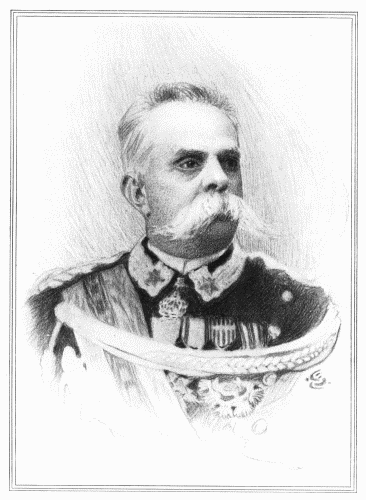
After they had all gone we started out to the "Tre Fontane," taking Gert with us to see the establishment of the French Trappists who are trying to "assainir" the Campagna by planting eucalyptus trees. It is an interesting experiment, but rather a dangerous one, as several of the fathers have died. The summer here, with that deadly mist that rises from the Campagna, must be fatal, and the two monks we saw looked yellow and shrivelled with fever. However, they will persevere, with that extraordinary tenacity and devotion of the Catholic priests when they undertake anything of that kind. I carried off a bottle of Elixir of Eucalpytus, for I am sorry to say these last bright days have given me an unpleasant souvenir in the shape of a cold chill every now and then between the shoulders, and evidently there is still truth in the Roman proverb "Cuore di donna, onde di mare, sole di Marzo, non ti fidare." (Don't trust a woman's heart, the waves of the sea, nor the March sun.)
We got home about half-past six, had tea and more visits—Calabrini, Vitelleschi, and Princess Pallavicini, who was most animated, and talked politics hard with W. We dined at home and had a little talk, just as we were finishing dinner, with Menabrea, who was dining at a table next ours. They say he will go to the Paris Embassy in Cialdini's place. W. wouldn't go out again, so I went alone to Gert's, who had a few people—Mrs. Van Rensselaer, clever and original; Countess Calice, an American; her husband, a cousin of the Malatestas; Vera; young Malatesta, a son of Francesco; a Russian secretary, and one or two others. It was rather a pleasant evening. They had tea in the dining-room—everybody walked about, and the men smoked.
Tuesday, March 13, 1880.
Yesterday morning W. and I had a good outing, wandering about the Capitol. First we walked around Marcus Aurelius, then up the old worn stone steps to the Ara Cœli. I told W. how we used to go there always on Christmas Eve to see the Crèche and the Bambino. It was very well done, and most effective. The stable, beasts, shepherds, and kings (one quite black with a fine crown). There were always children singing the "storia di Gesù" and babies in arms stretching out their hands to the lights. Yesterday the church was quite empty, as there is not much to attract the ordinary tourist. We made our way slowly, W. stopping every moment before an inscription, or a sarcophagus, or a fresco, to the room of the "Dying Gladiator," which he found magnificent—was not at all disappointed; afterward the faun—and then sauntered though all the rooms. I had forgotten the two skeletons in one of the sarcophagi—the woman's with rings on her fingers, most ghastly.
After lunch Countess Wimpffen came in to know if I would drive with her to the Villa Borghese, and do two teas afterwards—Madame Cairoli and Madame Westenberg (wife of the Dutch Minister, an American and a great friend of Gert's); but I couldn't arrange it, as W. wanted to come with me to the Affaires Etrangères—so we agreed to go another day. I always liked both Wimpffens so much when they were in Paris that it is a great pleasure to find them here. Wimpffen likes to get hold of W. and talk about France and French politics.
Our dinner at Mrs. Bruce's was very gay. I told her I didn't find her salon much prettier than in our days when we lived on the first floor of Perret's house (she on the second), and she always said we made Perret send up to her all the ugly furniture we wouldn't have. What we kept was so bad, that I think the "rebut" must have been something awful. We had the Minghettis, Vitelleschis, Wurts, Wilbrahams, Schuylers, and one or two stray Englishmen. Vitelleschi took me in, and I had Minghetti on the other side, so I was very well placed. It is killing to hear them talk politics—discussing all the most burning questions with a sort of easy persiflage and "esprit de conciliation" that would astound our "grands politiques" at home. Minghetti said the most absolutely liberal man he had ever known was Pio Nono—but what could he do, once he was Pope.
It was really a charming dinner—Mrs. Bruce is an ideal hostess. She likes to hear the clever men discuss, and always manages to put them on their mettle. We all came away about the same time, and W. and I went on to the opera "Tor di None." Bibra had invited us to come to his box. The house was much less "élégante" than the Paris house—hardly any one in a low dress, no tiaras, and few jewels. The Royal box empty. Princess Bandini was in the next box with Del Monte and Trochi. The Minghettis opposite with the Wimpffens. The "salle" was badly lighted—one could hardly make the people out.
W. had rather a shock—we had scarcely got in—(Bibra not yet come) when the door opened and in came Maurizio Cavaletti—enchanted to see me—seizing both my hands—"Maria mia adorata—cara regazza, etc.," utterly oblivious of "cara Maria's" husband, who stood stiff and cold (an icicle) in the background, with Anglo-Saxon written all over him; waiting for the exuberant demonstration to finish, and a presentation to be made. As soon as I could I presented Monsieur le Marquis in proper form, and explained that we were very old friends, had not met for years, etc., but W. hardly thawed all the evening.
When he went out of the box to pay a visit to our neighbours I remonstrated vigorously with Maurizio, but he was so unfeignedly astonished at being taken to task for greeting a very old friend warmly, that I didn't make much impression. The ballet was pretty, and of course there was an influx of young men as soon as it began—a handsome, rather stout "ballerina" being evidently a favourite.
To-day we breakfasted with the Schuylers to meet Mrs. Bruce and Cardinal Howard—no one else. We had a pretty little breakfast, most lively. I didn't find the Cardinal much changed, a little stouter perhaps. He was quite surprised at W.'s English; knew of course that he had been educated at Rugby and Cambridge, and had the Chancellor's medal, but thought he would have lost it a little having lived so many years in France, and having made all his political career in French. I asked him if he was as particular as ever about his horses. He always had such splendid black horses when we lived in Rome, but he said, rather sadly, that times were changed. W. and he talked a long time after breakfast. He was very anxious to know whether all the religious orders were threatened in France or merely the Jesuits. Comte Palfy (Austrian) came in just as we were leaving. He is so attractive—a great friend of l'Oncle Alphonse—knows everybody here and loves Rome.
W. and I went off to the Villa Albani—out of Porta Salara. We walked through the rooms—there are principally busts, statues, bas-reliefs, etc.—and then loitered about the gardens which are fine. Fountains, vases, and statues in every direction, and always that beautiful view of the hills in the soft afternoon light.
I will finish when I come home from our Black dinner. We are asked for seven, so of course will get back early, as we do not go anywhere afterward. I shall wear black, as I hear so many Princes of the church are to be there. Madame Hubert is very sorry I can't wear the long black veil that I did for the Pope—she found that most becoming.
Tuesday, March 12, 1880, 10.30 p.m.
We are just home from our dinner at the Portuguese Embassy, so I have got out of my gauds and into my tea-gown, and will finish this long letter. It was most interesting—a great deal of couleur locale. We arrived very punctually—three or four carriages driving up at the same time. There was of course a magnificent porter downstairs, and quantities of servants in handsome liveries; a good deal of red and powder. Two giants at the foot of the staircase, with the enormous tall candles which are de rigueur at a Black embassy when cardinals or ambassadors dine. They were just preparing to escort some swell up the staircase as we arrived; there was a moment's halt, and the swell turned out to be M. Desprez, the new French Ambassador to the Vatican (replacing the Marquis de Cabriac). He was half embarrassed when he recognised us; W. had so lately been his chef that he couldn't quite make up his mind to pass before him—especially under such novel and rather trying conditions. However, there was nothing to be done, and he started up the great staircase between the tall candles, W. and I followed modestly in his wake. We found several people, including two or three cardinals, already there. The apartment is very handsome. The Ambassador (Thomar) looked very well—"très grand seigneur"—standing at the door of the first salon, and one saw quite a vista of large, brilliantly lighted rooms beyond. All the guests arrived very quickly—we had hardly time to exchange a word with any one. I saw the Sulmonas come in. I recognised her instantly, though I hadn't seen her for years. She was born Apponyi, and they were married when we were living in Rome. Also Marc Antonio Colonna and the d'Aulnays. Almost immediately dinner was announced. Sulmona took me in and I had a cardinal (Portuguese) on the other side. I didn't say much to the cardinal at first. He talked to his neighbour, and Sulmona and I plunged, of course, into old Roman days. He was much amused at the composition of the dinner, and wondered if it would interest W. He asked me if I remembered the fancy ball at the Palazzo Borghese. He had still the album with all the photos, and remembered me perfectly as "Folie" with short skirts, bells, mirror, etc. I remember it, of course, quite well. Some of the costumes were beautiful, particularly those copied from portraits. After a little while the cardinal turned his attention to me. He was a nice old man, speaking either French or Italian (both with a strong accent), and much interested in the guests. He asked me if I belonged to the corps diplomatique. I said no—we were merely strangers spending the winter in Rome. He thought there were a good many strangers at table—he didn't know half the people, not having been long in Rome; but he knew that there was one man dining whom he had a great desire to see, Waddington, the late French Premier; perhaps I knew him, and could point him out. He had always followed his career with great interest, but there were some things he couldn't understand, "par exemple son attitude dans la question—" Then as I didn't know what he might be going to say, I interrupted, and said no one could point out that gentleman as well as I, as I was Madame Waddington. He looked a little uncomfortable, so I remarked, "Il diavolo non è tanto nero quant è dipinto" (The devil is not so black as he is painted), to which he replied, "Eh, no punto diavolo" (no devil)—was rather amused, and asked me if I would introduce him to W. after dinner. We then, of course, talked a little about France, and how very difficult the religious question was. He asked me where I had learned Italian, so I told him how many years we had lived in Rome when my brother was the last Minister from the United States to the Vatican. Sulmona joined in the talk, and we rather amused ourselves. Sulmona, of course, knew everybody, and explained some of the people, including members of his own (Borghese) family, who were very Black and uncompromising. Still, as I told him, the younger generation is less narrow-minded, more modern. I don't think they mean to cut themselves off from all participation in the nation's history. After all, they are all Italians as well as Romans. The foreign marriages, too, make a difference. I don't think the sons of English and American mothers could settle down to that life of inaction and living on the past which the Black Party means in Rome.
As soon as I could after dinner I got hold of W. (which was difficult, as he was decidedly surrounded) and introduced him to my cardinal, whose name I never got, and I went to recall myself to Princess Sulmona. We had a nice talk first about her people—her father, Count Apponyi, was Austrian Ambassador in Paris when Marshal MacMahon was President, and their salon was very brilliant, everybody going to them; the official world and the Faubourg St. Germain meeting, but not mingling. Then we talked a little about Rome, and the future of the young generation just growing up. Of course it is awfully difficult for families like Borghese and Colonna who have been bound up in the old papal world, and given popes to Italy, to break away from the traditions of centuries and go in frankly for "Italia Unita." Do you remember what they used to tell us of Prince Massimo? When some inquisitive woman asked if they really called themselves Fabius Maximus, he replied that it had been a family name for 1,400 years.
The present Prince Massimo is one of the most zealous supporters of the Pope. The great doors of his gloomy old palace have never been opened since the King of Italy came to Rome. One can't help admiring such absolute conviction and loyalty; but one wants more than that in these days of progress to keep a country alive.
The evening wasn't long; the cardinals never stay late, and every one went away at the same time. We again assisted at the ceremony of the big candles, as of course every cardinal and the Ambassador had to be conducted downstairs with the same form. It was altogether a very interesting evening and quite different from any dinner we had ever been at. I don't think the French cardinals ever dine out in France; I don't remember ever meeting one. Of course the "nunzio" went everywhere and always had the "pas"—but one looks upon him more as a diplomatist than a priest.
W. enjoyed his evening very much. He is now settled in his arm-chair with his very disreputable pipe, and has been telling me his experiences. He found my old cardinal very intelligent, and very well up in French politics, and life generally. He liked Sulmona, too, very much; made her acquaintance, but didn't have a chance to talk much to her, as so many people were introduced to him. There is certainly a great curiosity to see him—I wonder what people expected to find? He looks very well, and is enjoying himself very much. I am so glad we did not stay in Paris; he would have had all sorts of small annoyances, and as it is, his friends write and want him to come back. He is quite conscious of the sort of feeling there is about him. First his appearance—a great many people refuse to believe that he is a Frenchman; he certainly is not at all the usual French type, with his fair hair, blue eyes, and broad shoulders; and when they realize that it is he the cautious, doubtful way in which the clericals begin a conversation with him, as if they expected red-hot anarchist declarations to fall from his lips, is most amusing. Cardinal Howard always seeks him out for a talk—but then he doesn't mince matters—goes straight to the subject he wants to discuss, and told him the other day he couldn't understand how a man of his English habits and education should ever have dropped (he didn't say degenerated, but I think he thought it) into a French republican government.
W. is very pleased to see the cordial way in which everybody meets me, and I must say I am rather touched by it myself. I have never had a moment's disappointment, and I was a little afraid, coming back in such changed circumstances after so many years. Everybody asks after you, and some one the other day—Countess Malatesta, I think—asked if you still wore in Paris your plain black dress and bonnet. I suppose she thought that even you couldn't have resisted the Paris modiste. It would seem strange to see you in a hat and feathers.
Good-night, dearest; W.'s pipe is out, and we are going to bed.
Hôtel de Londres, March 14, 1880.
Cannons are firing, drums beating, flags flying in all directions to-day, dear mother. It is King Humbert's birthday and there is to be a great revue on the Piazza dell' Indipendenza. We are invited to go and see it by Turkam Pacha, Turkish Minister, who has an apartment on the Piazza; but as he told us that we should meet Ismail Pacha (the ex-Khedive) we thought we had better remain at home. I hardly think it would be a pleasure to Ismail to meet the man who was one of the chief instruments in his downfall. My sympathies were rather with the Khedive—I never quite understood why France and England should have politely but forcibly insisted upon his leaving his throne and country—but whenever I raised the question I had always that inert force the "raison d'état" opposed to me. We crossed him the other day driving. The carriage full of red-fezzed men attracted my attention, and our Giuseppe told us who they were. He looked very fat and smiling, evidently was not rongé by his disasters. Turkam suggested that I should come alone, but that of course I could not do.
Mrs. Bailey, who has also an apartment on the Piazza, has asked us to come to her, but I think I shall stay quietly at home and look out of the window. I see lots of officers and functionaries, in uniform, passing in fiacres and riding, and a general migration of the whole city including the beggars and flower girls of the Spanish Steps toward the Piazza. W. says he will smoke his cigar walking about in the crowd, and will see very well.
Queen Margherita of Italy.
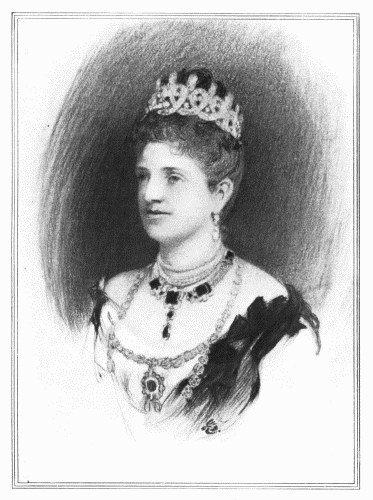
I was interrupted by a message from Gert begging me to come to her at once. Her maid was in such an extraordinary state of violence she thought she was crazy—and as Eugene was away for a day or two she was really afraid. I questioned the little footman who brought the note but he was very non-committal. W. was already off to see the review and I left him a note explaining where I was and asking him if I didn't get back to breakfast to come and get me at Gert's. I then started off with the little footman who had a fiacre waiting. As I entered the court of the Palazzo Altemps a glimpse of a white, frightened face at the window told me what Gert's state was. Poor dear, she was terribly upset, and Eugene's being away is a complication. Her two men-servants are very devoted, but they evidently feel uncomfortable. She asked me if I would go with her and see the woman. We found her sitting in a chair in Gert's dressing-room looking certainly most unpleasant, sullen, and an ugly look in her eyes. She is a great big Southern woman (French), could throw Gert out of the window if she wanted to. Gert spoke to her very gently, saying I had come to see her as I had heard she was not well. She didn't answer nor move but gave Gert a nasty look—she evidently has got something against her. I looked at her very steadily—said we were very sorry she was suffering, which was most evident, and that the best thing for her would be to rest, attempt no service of any kind and go to her own room—that we had sent for Dr. Valery who would certainly be able to relieve her. She didn't answer at first, and looked as if she would like to spring upon us both, then burst into screams of abuse—"She would go to her room of course—would leave the house at once and never come back, etc." I told her I should certainly advise Mrs. Schuyler to send her away—that evidently the climate did not suit her, and she would be happier in France. She didn't answer, relapsed into her sullen silence, and almost immediately Valery appeared. He insisted very quietly that she should go to her own room (at the other end of the apartment), and she went off with him, giving an ugly look at Gert as she passed. It seems she already had had such an attack, less violent, when they were at Birmingham, but once it was over went on quite peaceably and didn't seem to realize how ill she had been. Valery came back to tell us the result of his examination—said she had already calmed down and was anxious to beg her mistress's pardon, but that she was of a nervous, dangerous temperament, and at any moment might have a relapse. Of course she must go, but it is very uncomfortable. I took Gert out for a drive. W. sent me a line to say he was busy all the afternoon and would not come unless I wanted him. I think the air and distraction did her good. The streets had a decidedly festive appearance. There were a good many flags everywhere, and soldiers still passing on their way back to their various barracks. We were kept some time in the Corso seeing a battalion of "bersaglieri" pass. They had good music and looked very spirited as they moved along with all their feathers flying. They were rather small, but well set up, and marched in beautiful time with a light, quick step. We saw some cavalry too, but I didn't care so much for them. I thought the men looked too tall for the horses—their legs too near the ground.
We went to Nazzari's for tea, and the man was so smiling and pleased to see me that I asked him if he knew me—"Ma sì, certamente, la Signorina King"—had seen me various times in the Piazza or driving, and hoped I would come in some day for tea. I went upstairs with Gert when I took her home, and left every possible instruction with the maître d'hôtel to look after her, and above all to look after Louise, and not let her leave her room. The cook's wife will help her dress, as the poor thing has a dinner.
We have dined quietly at home. W. was tired, having been out all day. There is a reception at the French Embassy, but we shan't go. I told W. about the maid and the exciting morning we had had. He said of course the woman must go at once—that she had evidently a grudge of some kind against Gert, and might do her some injury. He had had rather a pleasant day. He walked about in the crowd seeing everything very well. He was rather favourably impressed with the Italian soldiers—said they were small as a rule, but light and active—marched very well. The King looked well, and was very well received. He thought him a striking figure on horseback in uniform, that curious type of all the Savoy Princes. They don't look modern at all, but as if they belonged to another century. I don't know exactly what it is—one sees the same sort of face so often in old Spanish and Italian portraits.
He had breakfasted alone, as I was over with Gert, and then started off with Monsignor English to meet Father Smith at the Catacombs, where they had a long delightful afternoon. He says Father Smith is a charming guide, knows and loves every corner of the Catacombs. His brogue, too, is attractive, sounds so out of place in that atmosphere of Latin and old-world tombs and inscriptions. He also told me what pleased me very much, that the Pope will give me his photograph, signed. Monsignor English told him to tell me, and he will come and see us to-morrow. Among our cards was one from the Cardinal Di Pietro—Doyen of the College of Cardinals—coming first to see W. What would the Protocole say?
March 16, 1880.
Schuyler has got back, and the maid is a lamb, but is going all the same. The doctor and the other servants advise it strongly, and I am sure Gert will find a nice Italian maid here to replace her. W. and I have done a fair amount of sight-seeing these days, and yesterday he paid a long visit to Cardinal Nina—Secretary of Foreign Affairs for the Vatican. He found him reasonable and interesting. I tell him he is getting quite a "papalino"—he finds the Cardinals so pleasant. He came and got me after his visit and we went off to the Chambre des Députés. Visconti Venosta was going to make a great speech attacking the Ministry on their foreign policy, and they thought there would be a lively séance. We were in the Diplomatic box—all the Ambassadors were there, and he had just got up to speak as we got there. They don't speak from the tribune, as in France. Every man speaks from his own place—and as he had his back to us we didn't hear very well. He spoke very easily, and was very well listened to. Occasionally there would be a sort of growl of disapproval, but on the whole the house was much quieter than ours. Cairoli looked quite composed when Visconti was pitching into him, smiling even when he remarked he didn't understand the Italian character, nor how to use the great powers his position gave him, etc. Various people came up and spoke to me, among others Countess Celleri, who seems to be taking up politics now. She has grown a little older, but is very handsome still, and was evidently a great attraction to all the young diplomatists who were in the box. W. admired her appearance and manner very much. We stayed there till 5.30 hoping that Cairoli would answer, but he didn't, the discussion rather trailed on, so we went for a turn in the Villa Borghese to get a little air before our dinner at the British Embassy. It was very crowded, all the swells driving—King, Queen, and Khedive all in separate carriages. The King in a small victoria with one aide-de-camp—the Queen in her big landau with one lady and the red royal liveries; the Khedive in an ordinary carriage, but conspicuous, as he and his gentlemen all wore the red fez.
Our Paget dinner was pleasant. They have got a big villa in the Venti Settembre out toward Porta Pia. There is a large garden with fine trees, and the entrance and staircase are handsome. We were 36—Italians chiefly—but a few Diplomatists. I knew almost every one, Calabrinis, Minghettis, Somaglias (you will remember her name, she was Gwendoline Doria, and married when we lived in Rome), Serristori, Castagneta and some Deputies and gentlemen of the Palace who, of course, were strangers to me. The dining-room is large with a quite round table which must be very difficult to cover, there were such spaces. I think there must have been hundreds of roses on the table. The Marquis de Villamarina, head of the Queen's household, took me in, and I had Uxkull on the other side, Lady Paget next to him. We all talked together, and I complimented Lady Paget on the quickness of the service. It was always one of our preoccupations at the Quai d'Orsay to get through these long official dinners as soon as possible. W. took in Madame Visconti Venosta, and they seemed to be getting on swimmingly. After dinner I talked some time to Countess Somaglia, and asked to be introduced to the Marquise Villamarina. She told me the Queen would certainly receive us, but couldn't quite fix the day yet as she had many official rendezvous these days. When the men came in from smoking I had a few words with Calabrini, and one or two Deputies were presented, Sella, Lanza, etc., but I really only talked to Sir Augustus Paget. He said they were going to have a small ball after Easter, and hoped we should still be here. I hope we shall, I should like to see the ball-room—they say all the decoration, painting, flowers, cupids, etc., has been done by Lady Paget herself. The party broke up early, no one stays late at dinner. There is always a reception somewhere to which everybody goes.
We came home as I get tired at night. We begin our day early, and are never in the house. This morning Gert and I went out shopping in the Piazza della Minerva and Campo Marzo—it was most amusing. We got two dresses for her—one of that coarse Roman linen, and a very pretty Roman silk from Bianchi, the same man who existed in our days. He looked most smiling and evidently recognised the familiar faces, though he could not put a name to them. We got the linen in a funny little old shop, low, and as dark as pitch. I never should have dreamed of going there for anything, but some one told us it was the place for linen, and we found at once what we wanted. I bought two Roman sashes—one for Alice and a ribbon for Nounou. We pottered about for some time looking at the bits of old brocade and embroidery, some pieces stretched out on the pavement with a stone at each end to hold them down. There were two pieces of old rose brocade which looked very tempting, but when I took them up I saw there were thin places in the silk, and spots—so I resisted these "occasions." The woman was amusing, tried to make us buy, but knew quite well her silk was not first-rate. She evidently attached no importance to the spots (è vecchia), but allowed that the frayed bits were not encouraging.
This afternoon we have been again to the Chambre des Députés—Cairoli was speaking. He has a good voice, we heard him much better than Visconti Venosta. I didn't find his speech very interesting. There were all sorts of details and references to despatches and blue books which were Greek to me, but of course W. liked it and knew the question thoroughly so he said he would stay and I had much better go and get some fresh air. The heat was something awful and the box full, so I took myself off. One of the Austrian secretaries came down with me to look for the carriage and I started for a solitary turn in the Villa Borghese. I hadn't gone very far when I met Comtesse Wimpffen alone in her carriage. We drew up for a little talk, and she proposed I should send my carriage away and come into hers, which I was delighted to do. We went for a little walk, and met various friends—Marchesa Theoduli[19] looking lovely. She was very amusing over the divided state of society—says she is not allowed to bow to the Queen, and as they meet almost every day driving and neither of them can pass inaperçue it is rather awkward. Mrs. Lorillard Spencer came up too, she was walking with her daughter, Princess Vicovaro, whose husband was "le beau Cenci" of our days. It was delicious lounging about on the grass under the trees, after the heat of the Chamber. We stopped at Nazzari's for tea, met Bibra at the door and invited him to come with us—also Cornélie Zuylen,[20] who had seen us from the street and rushed in to have a little talk. She is in Rome for a few days—sight-seeing hard. We had tea and very good cakes—and I was glad to have a few minutes before dressing for the Calabrini dinner.
We started off again at 8, and had really a very pleasant evening at Calabrini's. Their house is not large—they can't dine easily more than 10 people. I was the only lady—the men were Vitelleschi, Sella (their rising political man) whom W. was delighted to see, a Ruspoli whom I had never seen before, a brother of the late Prince; and Alphonso Doria who looks like a tall English boy. Stella is clever enough, decidedly un homme sérieux, and Calabrini was much pleased to have him for my homme sérieux. He told us all sorts of stories about "Italia Unita" and Cavour, and his profound distrust of Louis Napoleon; how, until the very last moment when the French troops were really at the gates, he was afraid they wouldn't come. We stayed fairly late, as the talk was interesting. I don't think there is much real sympathy between the French and Italians. They are very unlike though they are of the same race. The Italians seem very excitable when they talk fast and gesticulate and their eyes flash, but au fond they are calmer than our people—at least the upper classes; I don't know about the bas peuple. They say knives play a part in their discussions. Certainly in France there are always rows when the Italian workmen arrive. They are generally terrassiers and come in bands when railroads or bridges are being made. One recognises them at once with their black eyes, white teeth, red sashes and slouched hats. There is usually a coup de couteau before the season ends. They work well enough, are light and active, but always stop to talk—don't keep up a sort of desultory talk over their work as our men do.
Queen Margherita and King Humbert.
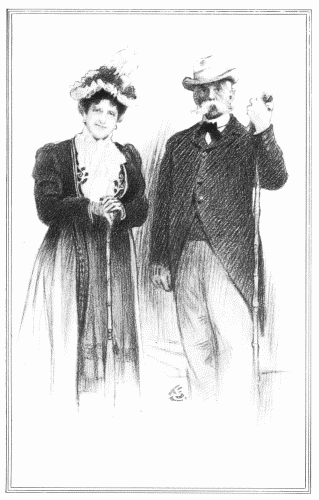
March 18, 1880.
Last night we went to the Wimpffens' grand official "ricevimento." All the street in front of the house was crowded just as it used to be in the old days—people coming close up to the carriages (going of course at a foot's pace) and peering in to see the diamonds. There was nothing like the display of carriages, diamonds, and liveries there used to be—many fiacres, and many uniforms. Countess Wimpffen looked very well in white satin, pearls, and diamond tiara, Wimpffen of course in uniform and his broad ribbon, Cenci (now Prince de Vicovaro) attached to the Court, was standing at one side of the Ambassadress presenting all the Court people. The Princess, his wife, stood near by looking very well, beautifully dressed, with diamonds and large pearl pendants. She was wearing for the first time her decoration of dame de palais. All the "White" Roman ladies were there. I saw quantities of people whom I knew. W. also begins to know the people. He thought the Roman women very distinguished looking, and the jewels splendid, particularly the pearls. We stayed quite late, and decidedly amused ourselves. I was rather interested in seeing when Madame de Wimpffen shook hands and when she merely bowed. When W. was at the Foreign Office and we had big receptions I was puzzled sometimes. My impulse was not to shake hands with the men. W. and Richard thought I ought to shake hands with all the Deputies, but that seemed a great undertaking and would, I think, have surprised them, as Frenchmen as a rule are formal, don't shake hands usually with ladies, but make rather a stiff bow, so I compromised by shaking hands only with those I knew.
This afternoon W. and I went out together. We left several cards and wound up in the Villa Borghese, where we walked about for some time. It was lovely under the cypress trees, long dark avenues with a fountain at one end—large vases—bits of half-ruined gateways, columns, and unexpectedly a sort of rond or opening with fountains, statues, big stones, all in a heap, and then long stretches of lawn with anemones, violets, and a pretty little yellow flower I didn't know, all perfectly neglected and growing wild, but with a wonderful charm. Such a contrast when we emerged again into the regular promenade and the gay modern life of Rome of to-day. There were quantities of carriages, three or four four-in-hands with women in light dresses on the tops of the coaches; men, principally officers, riding (in uniform, which always makes a gay note), lots of victorias and open carriages. The Prince of Naples (with the Royal red liveries) driving with one gentleman. He was dressed in sailor dress, looked smiling and interested, and bowed all the time. Three or four carriages filled with pretty girls—English or American—looking hard at everything, and always bands of black-robed students, seminarists from the various colleges which abound in Rome. It is a curious motley crowd—I don't think one would see it anywhere else. The clerical element is always well to the fore, and in spite of the changes the Monarchy established, with all the train of courtiers, deputies, soldiers, and endless functionaries that it brings, one feels that it is the great centre of Catholicism, and that the long arm of the Church still retains her hold on her children scattered all over the world.
I will finish now as we have come home fairly early from the Pallavicini reception. We dined at home and started off about 10. We went to get Gert, and on arriving about 10.30 found ourselves almost the first people. Felice Malatesta was there, also Del Monte. Both being "Gardes-Nobles" they can only come early and not run the risk of meeting any of the Court people nor diplomatists to the Quirinal. Princess Pallavicini is one of the Queen's ladies, but she is such an old friend of both gentlemen that they always go to her. Among the first arrivals was Massari. He and W. and Prince Pallavicini had a nice talk, and it amused me to see the people come in. There were about 30 (I knew a good many of the Romans, but of course the Court people and Deputies were strangers to me), Wimpffens, Noailles, St. Asilea, Somaglias, and a sprinkling of young diplomatists. As soon as the White diplomatists began to appear Del Monte and Malatesta departed. I had a talk with Villamarina who is very musical, also with Vitelleschi. The party broke up early—there was no music nor dancing (not even the little informal "tour de valse" there used to be in our days) and we were home before 12 o'clock. W. enjoyed his evening—talked principally to the men.
Saturday, March 20, 1880.
W. is off this morning with Father Smith to San Clemente. I was lazy as I was out all day yesterday. In the morning W. and I walked to the Palazzo dei Cesari, and stayed there two hours walking about and sitting down in the nice sunny places. It was beautifully bright, a splendid blue sky, but cold, a sharp wind, very unusual they say for the end of March. One gets a very fair walk on the Palatine Hill. There is so much to see, and the little irregular paths running up and down from the various temples and ruined buildings of all kinds give one plenty of exercise. It needs a good deal of imagination to reconstruct all the temples, tribunes, porticoes, and palaces which existed in the days of Imperial Rome, but there are still bits of coloured marble, faded frescoes, mosaics, tops of columns and broken statues in every direction. W. was quite happy—he had already spent a morning there with Lanciani, and so could show me what was still well enough preserved for me to understand. The view from the terrace over Rome and the Campagna was beautiful—the mountains seemed so near. We didn't walk home as we found a botta which had just brought up a party of forestieri—French this time, with a young priest, who was evidently the guide.
Sunday, March 21, 1880.
We went to the American church this morning as Nevin was so anxious we should see it. There is no very interesting French church—a sort of Vaudois chapel—so we preferred the Capella Americana. It is a pretty little church, very full—I should think a good many English as well as Americans—very good singing and a good sermon, not too long. We had visitors after lunch, and about 4 started for a drive out to Ponte Nomentano. We got out and walked about the Campagna for some time. The view was divine—Frascati and Rocca di Papa on one side, Tivoli on the other. W. thought the old bridge most picturesque. He recognised it instantly from the aquarelle that is in the dining-room at home. As it was Sunday all the country people were out; carts filled with women and children, boys on donkeys, sitting well back, almost on the tails of the animals, and all the little courts in front of the various osterias quite full. There were not exactly costumes, but there was a general impression of colour. The men had bright coloured sashes and shirts—the women nearly all red and blue skirts striped, and a coloured handkerchief on their heads—almost all with long gold ear-rings (some of the men too had ear-rings—large gold hoops) and a string of coloured beads around their necks. Everybody talking, laughing, and enjoying themselves. We stopped at the British Embassy for tea. Lady Paget receives always Sunday afternoon. There were various carriages at the door, and the villa looked pretty. The tea-table was on a broad palier at the head of the stairs. It was very well arranged with screens "cassoni," plants, arm-chairs—very original and attractive. I went in first to the drawing-room and had a talk with Lady Paget, then adjourned to the palier with Princess Sciarra and Countess Wimpffen, and we had a very pleasant hour. It was amusing to see all the people coming up the broad staircase. There were of course a great many I didn't know, as besides all the Court set and political people there were many English, all arriving for Holy Week. Mrs. Bruce, Madame Visconti Venosta, Gert, Marquise Chigi came and joined us. I was quite horrified when I found how late it was. We had just time to dress and go and dine with the Geoffroys at the Palazzo Farnese. The evening was very pleasant; decidedly archeological and scientific, but the men were all clever and talked so well that they would have made any subject interesting. We had Visconti, de Rossi, Lanciani, and some of the young men of the École Française. They all love Rome and know every stone. W. was quite in his element, talked a great deal himself, and was much interested in their excavations and all the curious things they are finding all the time. I meant to leave early and go to Gert who had a few people at dinner, but it was eleven o'clock before any one moved, and we went quietly home.
Good Friday, March 26, 1880.
I was too tired to-day to do anything, as yesterday we were out all day. W. and I walked about in the morning, going into all sorts of churches whenever we saw one open. There were always people, and in the smaller churches they looked devout and absorbed, but the crowd of strangers in the large, better known basilicas took away any religious feeling. It all seemed a great show, which is practically what Holy Week is in Rome. They say they have not had so many foreigners in years. Last night the "gérant" begged us not to come downstairs until 8 o'clock, or even a quarter past, as they needed all the small tables for the table-d'hôte. It was not so very crowded this morning as we breakfast at 12.30, much earlier than the foreigners, who are usually English and come in for luncheon at 1.30.
Yesterday afternoon we went to St. Peter's and found ourselves in a long file of carriages going the same way; also all kinds of pedestrians, priests, nuns, soldiers, artists, Cook's tourists, etc. W. was rather horrified at the crowd in the church, and the regular "bousculade" at the big doors. There was to be very good singing at one of the small chapels, but it was already so full that we couldn't get in, though we had cards from one of the Monsignori. We tried to make our way in but it was utterly impossible, and then stood outside, thinking we might hear; but the people all talked so much that we heard nothing except every now and then a few notes in that curious, high, unnatural voice of the Papal Choir. Two young German priests, with keen intelligent faces, were so put out—begged the people near not to talk—"in zehn Minuten ist alles vorüber" (in ten minutes it will be all over). All Rome was walking about the church, talking and looking about as if they were in a great hall of some kind—a crowd of strangers pushing, jostling, and trying to get up to the High Altar, or the statue of St. Peter where all the faithful were kissing the toe. It was certainly not solemn nor edifying, except when we came upon a quiet corner, with some old chapel filled with tombs of dead Romans, Popes or Princes, who had played a great part in their day. That took us back into the past, and we could realize that we were really in St. Peter's. I tried to show W. the part that was shut off for the great Ecumenical Council under Pio Nono, but I couldn't remember exactly. We shall come back another day with Father Smith who will know all about it. I did find the Stuart monument with the busts of Charles Edward and Cardinal York. People kept pouring into the church, but it is so enormous that, except at certain places, it was quite easy to circulate. All the women (except a few stray tourists) were in black, and every now and then one saw a long file of séminaristes, also in black, but with a coloured sash to mark their nationality. I think the Americans wear blue—the French are quite black—no colour. We talked to quantities of people—it was like an enormous reception. I was very tired when we finally came out, as of course we were walking and standing about all the time. There is no aisle with regular seats as in most churches—merely a few prie-Dieu inside the side chapels. The drive home was lovely—we went at a walk almost all the time, there were so many carriages.
I went out after all this afternoon with W. and Monsignor English to St. John Lateran, where they were singing a Miserere of Cappoci's. It is most strange, weird music, and the voices of the men are so unlike anything one hears elsewhere. There was always the same crowd. I will say Cook does his business thoroughly—wherever there is anything to see or hear he pilots all his band. After the Miserere was over we stood some time at the foot of the Scala Santa. It was black with people going up on their knees, saying a prayer at each step (I think there are 30) and some of them did look serious and absorbed. They were principally peasants—every now and then some well-dressed bourgeois. Monsignor English told us we would be surprised at the class of people (society) who come early, before the great crowd of sight-seers.
We went back to the Palazzo Altemps, picking up Count Palfy on the way, where Gert had promised us tea and hot cross buns from Spillman's (very good they were).
We found a note from the Quirinal when we came home saying the Queen would receive us to-morrow at 2.30. Desprez came and sat some time. He told W. all that was going on in Paris—the Ministry as usual struggling against the Radicals who are always wanting to suppress the French Embassy at the Vatican. It doesn't make the position of the Ambassador very pleasant, but Desprez is very wise, has had long training at the Foreign Office, and will certainly do all he can to conciliate and keep things straight.
To H. L. K.
Saturday, March 27, 1880.
It was raining this morning and I was very glad. The dust was getting most disagreeable in one's eyes and throat, and covering everything. I am glad, too, that it is cool, decidedly, as I wanted to wear my blue velvet. If it had been a bright warm day it would have looked dark and heavy. It is four o'clock—we have just come in from our audience, and I will write at once while the impression is fresh. W. has a "rendezvous" with some of the French Institute people, and I shall not see him again until dinner time. We got to the palace (a great ugly yellow building, standing high) quickly enough, as there was no one in the streets at that hour, and drove into the court-yard to a handsome entrance and staircase. There were a few soldiers about, but not much movement. A carriage came in behind us, and just as we were going upstairs some one called my name. It was Bessie Brancaccio,[21] who had also an audience with the Queen. She had come to thank her for her appointment as dame de palais. I was glad to have just that glimpse of her, as they are not in Rome this winter. Their beautiful house is not ready for them, so they have been spending the winter in Nice. We walked through a large anteroom where there were three or four servants and an "écuyer," and in the first salon we were received by the Comtesse Marcello, one of the Queen's ladies, a Venetian and a great friend of Mary's, and the gentleman-in-waiting, whose name I didn't master. We talked for a few minutes—she said a lady was with the Queen. The room was handsome, prettily furnished and opened into another—three or four, in fact, all communicating. After about ten minutes we saw a lady come out of the end room, the door of which was open, so Comtesse Marcello ushered us through the suite. We went to the corner room, quite at the end, where the Queen was waiting standing. We went through the usual ceremony. The Comtesse Marcello made a low curtsey on the threshold, saying, "I have the honour to present his Excellency, M. Waddington and Madame Waddington," and instantly retired. The Queen was standing quite at the end of the room (a lovely, bright corner room, with lots of windows and a magnificent view over Rome—even on a dull day it looked cheerful and spacious). I had ample time for my three curtseys. She let us come quite close up to her, and then shook hands with us both and made us sit down—I next to her on the sofa, W. in an arm-chair in front. I found her rather changed since I had seen her. She has lost the girlish appearance she had so long, and her manner was nervous, particularly at first. When she began to talk and was interested and animated she was more like what I remembered her as Princess Marguerite. She was dressed in bronze satin, with a flowered brocade "casaque," and one string of splendid pearls. She told W. she was very pleased to see him, remembered that I had lived in Rome before my marriage, and asked if I still sang, Vera had talked so much about the music in Casa Pierret, and the trios we used to sing there with Lovatelli and Malatesta. The talk was most easy, about everything, generally in French, but occasionally breaking into English, which she speaks quite well. W. was delighted with her—found her most interesting and "très instruite"—not at all the banal talk one expects to have with sovereigns—in fact, I quite forgot we were having a royal audience. It was a very pleasant visit to a charming woman, in a pretty room with all sorts of beautiful pictures and "bibelots" about. While we were still there the Prince of Naples[22] came in. We both got up; she told him to shake hands with W. and to kiss me, and to ask me how old my little boy was, which he did quite simply and naturally. He told his mother he was going to ride. I asked him if he had a nice pony, to which he replied in English, "Oh, yes, jolly," and asked if my little boy rode. I said not yet; he was only two years old. The child looked intelligent, but delicate. They say his mother makes him work too much, is so ambitious for him; and he has rather that look. The Princes of Savoy have always been soldiers rather than scholars, but I suppose one could combine the two. The Queen also spoke about the Bunsens, and "little Beatrice";[23] said she was very fond of Mary. I was very sorry when the audience was over and she dismissed me, saying she had people waiting.
Queen Margherita and the Prince of Naples (Present King of Italy) in 1880.
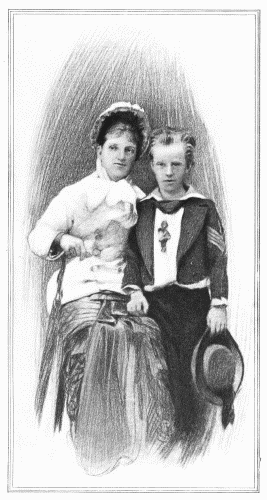
We found Bessie and one or two other ladies in the first salon when we came out, waiting their turn. Comtesse Marcello was delighted with all W. said about the Queen. He was very enthusiastic, for him, as he is not generally gushing. I told her she had remembered that I had lived some years in Rome as Mary King, and she said: "Oh, yes, she remembered you and all your family perfectly, and knew that you had married M. Waddington."
Tuesday, March 30, 1880.
It is much pleasanter to-day—quite Spring-like, and the Piazza is full of people. I have drawn my little writing table close up to the window, and I am afraid my correspondence will suffer, as there is always so much to see. Almost all the little botte have departed, in fact W., who has just started off with Visconti for the Vatican to look at the coins, took the last one. Cook's two big omnibuses have also just started for Tivoli—crammed. Some of the people dashed into Nazzari's, and reappeared with little paper bags, filled evidently with goodies.
Yesterday W. and I breakfasted again at the Noailles', and they took us over the palace (Farnese) which is quite splendid, such enormous rooms and high ceilings. The great gallery with the famous Carracci frescoes looked beautiful in the daylight, and we saw them much better. The colours are still quite wonderful, hardly faded, some of the figures so graceful and life-like. Madame de Noailles' bed-room and dressing-room are huge. The enormous bedstead hardly took up any room at all. She said it took her some little time to accustom herself to such very spacious apartments, she almost had the impression of sleeping in the streets.
We went for a drive afterward out of Porta Maggiore to look at the Baker's tomb—do you remember it, a great square tomb with rows of little cells? We wandered about on foot for some time, looked at the bits that remain of the old Roman road, and then drove out some distance toward the arches of the Claudian Viaduct. It is the road we shall take when we go to Tivoli. It was not quite clear, so the hills hadn't the beautiful colour they have when the sun is on them—but the grey atmosphere seems to suit the Campagna, which is after all a long stretch of barren, desolate country broken at intervals by the long lines of aqueducts—every now and then a square tower standing out straight and solitary against the sky, and hardly visible until one comes close upon it, and a few shepherds' huts, sometimes with a thatched roof, sometimes what remains of an old tomb, with a dried-up old woman apparently as old as the tomb spinning in the doorway. We met very few vehicles of any description.
We dined at the Palazzo della Consultà where Cairoli, Foreign Minister, lives. There were not many women—Madame de Noailles, Gert, Madame de Sant' Onofrio (wife of one of Cairoli's secretaries), and quantities of men. They divided the honours—Cairoli took in Madame de Noailles—Madame Cairoli, W. The Préfet of Rome, Gravina, took me and put me on Cairoli's left. We all talked Italian, and I rather enjoyed myself. I told Gravina how much I preferred "Roma com' era," that the new buildings and the boulevards and the bustle and the quantities of people had spoiled the dear, dead, old Rome of our days—to which he replied "but you, Madame, are an American born, you surely can't be against progress." Oh, no, I like progress in my own country, but certainly not here. Rome was never intended to be modern and go-ahead—it didn't go with the monuments and the ruins and the traditions of old Rome. However he answered me quite seriously that not only every country, but every individual, must "marcher," or else they would "dépérir." Cairoli joined in the conversation, others too, and there was rather an interesting discussion as to how much could be left to sentiment, association of the past, etc., when an old historic city was being transformed into a busy, modern, political centre.
After dinner Madame Cairoli came and sat down by me, and was pleasant enough. She looked handsome—very wide awake—still continues to call me Madame la Comtesse, so I have given up correcting her. She is well up on all subjects, particularly art, music, pictures, etc. She was rather amusing over the state of society and all the great Roman ladies whom she didn't know (there is such a division between the Government people and the old Romans) but said she had a very pleasant entourage with all the diplomatists and the distinguished strangers (with a little bow to me) and really didn't notice the absence of the grandes dames. She asked me about my audience with the Queen—had we been able to talk to her at all. She had been so tired lately and nervous that any attempt at conversation was an effort. I told her that on the contrary she talked a great deal, and that I didn't find her changed.
Maffei came up and talked—asked me if I really liked Rome better as it used to be—I must surely prefer life to stagnation. He speaks English well, and likes to speak. They tell me that all the present generation of Romans speak English perfectly—much better than French. There was a small reception after dinner, some of the young diplomatists and political men. We came away early—10.30, and plunged into our Paris letters, of which we found quantities.
Friday, April 2, 1880.
It is raining quite hard this morning, so I will write and not go out until after breakfast. Yesterday was beautiful, and we had a charming day at the races. I drove out with Madame de Wimpffen in her victoria—W. and Wimpffen together. I wore my brown cloth with the coat trimmed with gold braid and a great bunch of yellow roses on my hat, but I was sorry I hadn't sent for something lighter, as almost all the women were in white. I had thought of having two dresses sent by the "valise" (I hadn't time to have them sent by ordinary express). I consulted Noailles, who was very amiable, and said he would do what he could, but that the rules were very strict now for the "valise," as there had been such abuse. I rather protested, so he remarked with a twinkle in his eye that I had better speak to my husband, as he was the Minister who had insisted on a reform being made—he added that it was Princess Lise Troubetzkoi who made the final scandal—that when St. Vallier was French Ambassador to Berlin she was always sending things to Petersburg, via Berlin, by the "valise." When the "petit paquet" she had spoken of turned out to be a grand piano there was a row, and W., who was then Foreign Minister, decreed that henceforth no "paquets" of any kind that were not on official business could be sent by the "valise." I suppose a pink tulle ball dress would hardly come under that head.
The Queen was there looking very well and bright, dressed in light grey with a big black hat—very becoming. There were a great many pretty women. We came away before the end and drew up a little distance from the gate where a long string of carriages was waiting to see the Queen pass. The cortège was simple—first two dragoons, then a "piqueur" and her carriage with four horses, postillion and two servants behind in the scarlet liveries. The Countess Marcello was seated alongside of the Queen—two gentlemen (I couldn't make out who they were) facing her; a second carriage with two horses with two gentlemen in it followed, all very well turned out. The scarlet liveries make a great effect, one sees them from such a distance. The crowd was very respectful—not particularly enthusiastic. The Queen bowed right and left very prettily. I talked to lots of people at the races—among others to Madame Alphonse Rothschild who is here for a few days, and to Mesdames Somaglia, Rignano, Celleri, etc. I walked about a little with Sant' Asilea, but it was not easy to move—most of the ladies stayed quietly in the tribunes. We stopped at Nazzari's coming back and W. treated us all to tea—then we sent our carriage away as we wanted it at night for the Teano ball, and we walked about in the Corso, looking at all the turn-outs. The Teano four-in-hand was very handsome, and there were one or two others we couldn't make out which were very well turned out—some of the victorias, too, very smart, with handsome stepping horses. The Corso was full of people waiting to see the "retour"—it looked so gay. About eleven we went off to the Teano ball, which was most brilliant—all the société there. Again I was sorry I hadn't sent for another dress as my red satin looked heavy and wintry. Princess Teano in white, with a diamond tiara, looked charming. Of course all the young generation who were dancing were strangers to me, but I met many old friends. I had quite a talk with Doria who wanted to be introduced to W. whom he had not yet seen. We stayed until 1.30, and when we came away they were just beginning the cotillon. In the old days we used to arrive at the balls about 12.30 or 1 o'clock just so as to have one waltz before the cotillon which was usually the best of the evening, as all the serious people had gone, and the mammas were at supper fortifying themselves for the long hours before them, so the ball-room was comparatively empty and one could get a good turn.
Saturday, April 3, 1880.
It is a beautiful morning, so was yesterday, an ideal Roman day—the sky so blue and just a soft little air that makes the awnings over the shops opposite flap lazily and indisposes one to any exertion. We walked about a little before breakfast, inspected the Fountain of Trevi where Neptune sits in state, looking at the rush of water falling over the rocks and splashing into the great marble basin. The water is beautifully clear, and sparkled and glistened in the sunlight. There were a good many people about—girls with pitchers on their heads, old men and women with pails and cans, all after water. The Trevi water is considered the best in Rome and is in great demand. We loitered about in the small narrow streets that branch off in every direction, always seeing something interesting. I think we lost our way as we found ourselves down by Trajan's Column and Forum, but we managed to get back to the Piazza di Spagna in good time for breakfast.
We started again in the afternoon for tea at the Farnesina Palace with the Duke di Ripalda. We stopped at the Farnese Palace to pick up Madame de Noailles, who was coming too, and we had a charming afternoon. Ripalda took us all over the Palace, and W. was delighted with the frescoes, particularly Sodoma's. The garden was lovely, though they have cut off a great piece for their quays and works along the river. They are enlarging the Tiber, making great walls, etc. The City of Rome gave Ripalda a large sum of money, but he is much disgusted as it had taken a good bit off his garden. More people came in—the wife of the Peruvian Minister, a very pretty woman, and one or two men. We had tea in the long gallery with all Raphael's and Carracci's beautiful gods and cupids over our heads. How many different scenes they must have looked down on—not always so peaceful as this quiet party.
Saturday evening, April 3, 1880, 10 p.m.
We went to the German Embassy on our way home to write ourselves down for the German Crown Princess, who had just arrived there for a short stay. I hope I shall see her—W. admires her so much. He saw her often when he was in Berlin for the Congress, and found her most sympathetic and charming. Turkam Bey came in just before dinner and had a great deal to say about the Khedive, and what France would have done if he had resisted, retired up the country, and obliged the French and English to depose him by force. It was evident that the suite had been talking to him, and talking very big—he was very anxious to have a categorical answer. W. said very quietly they had never considered that emergency, as it was quite evident from the beginning that the Khedive had no intention of resisting. "Cependant, monsieur, s'il avait voulu," etc., so W. could only repeat the same thing—that they had never been anxious on that point.
We dined quietly at home, and in the course of the evening there came a note from Keudell, the German Ambassador (whom we don't either of us know), saying that "par ordre de Son Altesse Impériale la Princesse Héréditaire d'Allemagne" he had the honour to ask M. and Madame Waddington to dine to-day at 7.30 at the Embassy "en petit comité." We should find a small party—the Wimpffens and Pagets. The Princess only arrived on Thursday, and W. is much pleased that she should have thought of us at once. Keudell has been ill with gout ever since we have been here. We have never once seen him, but various people told W. he regretted so much not seeing him, that the other day we tried to find him, but the porter said he was still in his room.
Sunday, April 4, 1880.
Our dinner was charming. I was not a bit disappointed in the Princess. W. had talked so much about her that I had rather made up my mind I should find her very formal and German—and she isn't either one or the other. We left a little after seven (I wearing black satin). I am so bored with always wearing the same dresses. If I had had any idea we should go out every night I should have brought much more, but W. spoke of "a nice quiet month in Rome, sight-seeing and resting." We were the first to arrive. Keudell was at the door, introduced himself, and took us into the large salon, where Madame Keudell was waiting. She looked slight and rather delicate, and he really ill, so very white. He said he had had a long, sharp attack of gout—had not been out for some time, and was in the salon for the first time the day the Princess arrived. While we were waiting for the others to come he showed us the rooms and pictures. I recognised at once one of those pretty child's heads by Otto Brandt like the one we have. He was much interested in knowing that we had bought one so long ago, he thought Brandt had so much talent. There was a grand piano, of course, as he is a fine musician. The Pagets and Wimpffens came together almost, and as soon as they were there the Princess came in. She had one lady with her and a "chambellan"—Count Seckendorff. She was dressed in black, with a handsome string of pearls. She is short, and rather stout, carries herself very well and moves gracefully. We all made low curtseys—the men kissed her hand, Sir Augustus Paget just touching the floor with his knee, the first time I had seen a man kneel to any one in a salon. She received W. most charmingly, and was very gracious to me—asked me at once why I didn't accompany my husband to Berlin. I said, "Principally because he didn't want me," which was perfectly true. He said when he was named Plenipotentiary that it was all new ground to him, that he would have plenty to do, and didn't want to have a woman to look after. He rather protests now, but that is really what he said, and I certainly didn't go. The dinner was pleasant enough. The Princess talked a great deal, and as the party was small, general conversation was quite easy. The talk was all in French, which really was very amiable for us—we were the only foreigners present, and naturally if we hadn't been there every one would have spoken German. After dinner she made a short "cercle," standing in the middle of the room, all of us around her, then made a sign to W. to come and talk to her, sat down on the big sofa, he on a chair next, and they talked for about half an hour. We all remained standing. I asked Keudell about his piano. He told me that he liked the Erard grand very much, but that they didn't stand travelling well. In a few moments the Princess told us all to sit down, particularly Keudell, who looked quite white and exhausted. I sat by Madame Keudell, and as she is very fond of Italy, and Rome in particular, we got on very well. When the Princess had finished her talk with W. she came over and sat down by me—was most charming and easy. She has the Queen's beautiful smile, and such an expressive face. We spoke English; she asked me if I had become very French (I wonder?)—that she had always heard American women were so adaptable, taking at once their husband's nationality when they married foreigners. She had always remained very fond of England and English ways—the etiquette and formality of the German Court had tried her at first. She asked me, of course, how many children I had—said one was not enough. "If anything should happen to him, what would your life be?" and then spoke a great deal about the son she lost last summer by diphtheria, said he was the most promising of all her children, and she sometimes thought she never could be resigned. I said that her life was necessarily so full, she had so many obligations of all kinds, had so many to think about, that she would be taken out of herself. "Ah, yes, there is much to do, and one can't sit down with one's sorrow, but the mother who has lost her child carries a heavy heart all her life." It was all so simply said—so womanly. She said she was very glad to meet W. again, thought he looked very well—was sure the change and rest were doing him good. She regretted his departure from the Quai d'Orsay and public life generally. I told her he was still a Senator, and always interested in politics. I didn't think a few months' absence at this time would affect his political career much, and that he found so much to interest him that he really didn't miss the busy, agitated life he had been leading for so long. She said she intended to spend a quiet fortnight here as a tourist, seeing all she could. She then talked to all the other ladies, and about ten said she was tired and would go to her own rooms. She shook hands with the ladies, the men kissed her hand, and when she got to the door she turned and made a very pretty curtsey to us all. We stayed on about a quarter of an hour.