PART I (continued 4)
Reading edition
The Schuylers came in for a cup of tea and Gert was rather sorry she hadn't come, as her headache wasn't very serious. I think they will take themselves out to Albano for a little stay as soon as the heat begins.
Friday, April 17th.
This morning we went for a last turn in the Vatican. That is what W. likes best. There is so much to see in that marvellous collection. He wanted to copy one or two inscriptions, so I wandered about alone and talked to the custode, who has become an intimate friend of ours. He hovers about W. when he is taking notes or examining things closely, and is evidently much gratified at the interest he takes in everything—quite like a collector showing off his antiquities. We saw a little commotion at one end of the long gallery, and he came running up to say "His Holiness" was walking in the garden, and if we would come with him he would take us to a window from where we could see him quite distinctly. This of course we were delighted to do, as one never sees the present Pope, except in some great ceremony when he is carried in the "sedia gestatoria," but so high over the heads of the people that one can hardly distinguish his features. We walked down the gallery, through two or three passages, up a flight of stairs, and came upon a window looking down directly on the gardens. They are beautiful, more like a park than a garden, and one can quite understand that the Pope can get a very good drive there, the days he doesn't walk. The custode says he only walks when it is quite fine, is afraid of the damp or wind, but that he goes out every day. There is a wood, flowers, long alleys stretching far away bordered with box and quite wide enough for a carriage, various buildings, a casino, tower, observatory, etc., also fountains and a lake (I didn't see a boat upon it). In the middle of one of the alleys a little group was walking slowly in our direction—about 10 people I should think. The Pope, dressed always in white, seemed to walk easily enough. He carried himself very straight, and was talking with a certain animation to the two ecclesiastics who walked on each side of him. He stopped every now and then, going on with his conversation and using his hands freely. He was talking all the time, the others listening with much deference. The suite seemed to consist of three or four priests and two servants. I didn't see either a Suisse or Garde-Noble, but they may have been following at a distance. Our glimpse of him was fleeting, as he turned into a side alley before he got up to our window—still it was enough to realize his life—think of never going outside those walls, walking day after day in those same alleys, cut off from all the outside world and living his life in the stillness and monotony of the Vatican. However it certainly doesn't react in any way upon his intellect. They say he is just as keen and well up in everything as when he was Bishop of Perugia, and that his indomitable will will carry him through.
We thanked our old custode very warmly (and in many ways) for having brought us to the window, and also said good-bye to him, as this of course was our last visit to the Vatican. He begged us to come back, but it must be soon, or he wouldn't be there, as he was as old as the Pope.
When we got to the hotel we found Monsignor English in the salon with the Pope's photograph, very well framed with a gilt shield with the Papal arms on the top. It is exactly like him, sitting very straight in his chair, his hand lifted a little just as if he were speaking, and the other hand and arm resting on the arm of the chair. He is dressed in his white robes, red cape and embroidered stole, just as we saw him; and his little white cap on his head. He has written himself a few words in Latin, of which this is a free translation: "The woman who fears God, makes her own reputation. Her husband was celebrated in his country when he sat with the Senators of the land." I am so pleased to have the photograph—so many people told me I should never get it, that the Pope rarely gave his picture to anybody and never signed one. Monsignor English, too, was much pleased, as he had undertaken the whole thing. He said again that the Pope was glad to have seen W., found him so moderate, and yet very decided, too, about what the church mustn't do. Leo XIII. has an awfully difficult part to play—the ultra-Catholics disapprove absolutely his line—can't understand any concession or compromise with Republican France, and yet there are very good religious people on the liberal side, and he, as Head of the Church, must think about all his children, and try to conciliate, not alienate. It is wonderful that that old man sitting up there by himself at the top of the Vatican can think out all those perplexed questions and arrive at a solution. They say he works it all out himself—rarely asks advice. I daresay it wouldn't help him if he did, for of course there are divisions, too, in the clerical party of Rome, even among the Cardinals, where the difference of nationalities must have a very great influence. I should think there was almost as much difference between an American and an Italian Cardinal as between Protestants and Catholics. The American must look at things from a different point of view. Monsignor English quite understood that—said Americans were more independent—still when a great question came they must submit like all the rest.
We then had a most animated discussion as to how far it was possible for an intelligent man (or woman) to abdicate entirely his own judgment, and to accept a thing which he was not quite sure of because the church decided it must be. I think we should have gone on indefinitely with that conversation, never arriving at any solution, so it was just as well that breakfast put a stop to it.
We went for a lovely drive in the afternoon, out of the Porta del Popolo, across Ponte Molle, and then along the river until we came to that rough country road, or lane, leading across the fields where we have gone in so many times on horseback, to the Villa Madama. We drove as far as we could (almost to the gate) and then walked up the hill to the Villa itself. There everything was quite unchanged—the garden neglected, full of weeds, and grass growing high. The oval stone basin was there still, the sides covered with moss, and a few flowers coming quite promiscuously out of walls, stones, etc. We went into the loggia to see the paintings and frescoes, all in good condition, and then sat some time on the terrace looking at the view, which was divine—everything so soft in the distance, even the yellow Tiber looked silvery—at least I saw it so; I don't know that W. did. He generally finds it sluggish and muddy. We came home by the Porta Angelica and drove through the Square of St. Peter's. There are always people on the steps, not a crowd of course as on fête days, but enough to give animation, priests, beggars, and the people lounging and looking at whatever passes in the Square. It is so enormous, the Piazza, when one sees it empty, one can hardly realize what it used to be in the old days for the great Easter ceremony when the Pope gave his blessing from the balcony of St. Peter's. I can see it now, packed black with people, the French soldiers with their red caps and trousers making great patches of colour, and Montebello (who commanded the French Armée d'Occupation in Rome) with a brilliant staff in the centre of the Square—he and his black charger so absolutely motionless one might have thought both horse and rider were cast in bronze. There were all sorts of jokes and chattering in the crowd until the first glimpse of the waving peacock plumes, and banners, passing high, high up, and just visible through the arches, showed that the Pope's procession was arriving on the balcony; and when at last one saw distinctly the white figure as the old man was raised high in his chair there was an absolute stillness in all that great mass; every one knelt to receive the blessing, and the Pope's voice rang out clear and strong (one could hear every word). As soon as it was over cannon fired, bells rang, and there fluttered down over the crowd a quantity of little white papers (indulgences) which every one tried to grasp. It was a magnificent cadre for such a ceremony—the dome of St. Peter's towering above us straight up into the blue sky, the steps crowded with people, the red umbrellas of the peasants making a great show, and women of all conditions and all nationalities dressed in bright, gay colours; uniforms of all kinds, monks and priests of every order; the black of the priests rather lost in all the colour of uniforms, costumes, etc. The getting away was long—we might have had our carriage with the American cockade in one of the back courts of the Vatican, but we wanted to see everything and come home by the Ponte St. Angelo. It was a great show all the way—the long line of carriages and pedestrians streaming back to Rome, cut every now and then by a detachment of troops. Everybody was cheered, from Charette and his Zouaves to Montebello and his staff. The crowd was in a good humour—it was a splendid day, they had had a fine show, and politics and "foreign mercenaries" were forgotten for the moment. Everybody had a flower of some kind—the boys and young men in their hats, the girls in their hair. One heard on all sides "buona festa," "buona Pasqua." How we enjoyed it all, particularly the first time, when we were fresh from America and our principal idea of a fête was the 4th of July. That seemed a magnificent thing in our childish days, when we had friends on the lawn at Cherry Lawn, a torch-light procession with a band (such a band) from the town, and father's speech, standing at the top of the steps and telling the boys that if they worked hard and studied well, any one of them might become President of the United States, which statement of course was always received with roars of applause.
Last Benediction of Pope Pius IX. from the Balcony of St. Peter's.
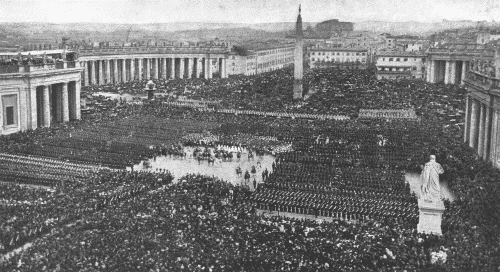
We went back to the Piazza always at night to see the "Girandola" fireworks, and there was almost the same crowd waiting for the first silvery light to appear on the façade of St. Peter's. It was marvellous to see the lines of light spread all over the enormous mass of stone, running around all the cupolas and statues like a trail of silver, in such quantities that the stone almost disappeared, and the church seemed made of light—quite beautiful. The illumination lasted a long time—gold light came after the silver, and I think it was perhaps more striking when they began to go out one by one, leaving great spaces in darkness—then one saw what an enormous edifice it was.
I have written you a volume—but every turn here recalls old, happy days—"Roma com'era"—and I must come back to the present and our farewell dinner at the Noailles'.
We were a small party—all the French Embassy, the Duc de Ripalda, the Chilian Minister and his wife, Maffel, Visconti Venosta, and Lanciani. W. and Noailles retired to the fumoir and talked politics hard. We shall soon be back in the thick of it now, and W. will take his place again in the Senate. It will seem funny to be quietly settled in the rue Dumont d'Urville—riding in the Bois in the morning and driving over to the Senate in the afternoon, with the boy, to get W. Ripalda and I had a long talk. He tells me he still holds the same opinion about American women—they are the prettiest and most attractive in the world. There is something—he doesn't know what—that makes them different from all the others. I asked him if he remembered Antoinette Polk; to which he promptly replied, "Ah, qu'elle était belle—une déesse." I must tell her how she lives in his old memory. I always find Noailles pleasant—so grand seigneur.
We found all sorts of cards and invitations when we came in, and a surprise for me from Father Smith which pleased me greatly, a silver medal of Leo XIII. in a case. It is about the size of a five-franc piece—rather larger if anything, and so like, the small head, and fine, sharply cut features, such a nice note, too, from Father Smith; he was very glad to be able to offer me something which he knew I would prize, and that it wasn't necessary to be of the same religion to admire and appreciate a great intellect and a good man. I am very proud of my two pictures, and shall show them triumphantly to some of my Catholic friends and relations who can't understand a Protestant and a heretic caring for such souvenirs.
We can't accept any more dinners as we leave on Monday, W. for Naples and I for Florence. I wanted very much to go to Ostia, I should like W. to see that desolate, sandy shore with the pines coming down almost to the water's edge, and the old castle rising up in the distance; but it is an all-day excursion and we haven't time. We will try and do Vei, which is an easy afternoon's drive. I must stop now—W. is deep in Baedeker, looking out Ostia and Vei, and must also write a note to Geoffroy about something they want to see to-morrow. I shall go and see something with Gert.
Sunday, April 19, 1880.
Yesterday we had an enchanting day at Tivoli, W., Gert and I. Schuyler was detained in Rome, much to his disgust, on business. He loves a day in the country and is most amusing to go about with. He talks to everybody, priests, peasants, soldiers, and always gets odd bits of information about old customs, legends, family histories—all that makes the story of a nation. Tomba gave us a light carriage and a pair of strong horses (our little ones were not up to the long day). We started at 8 in the morning and didn't get back until 8.30. There is a steam tram now all the way out but we preferred driving, as we wanted to stop at Hadrian's Villa. We went out by Porta San Lorenzo, crossed the Arno (the river which makes the falls of Tivoli) at Ponte Mammolo, and had a good two hours' drive (rather more, in fact) to Hadrian's Villa. I didn't find that part of the Campagna very interesting (it was much finer after one left the Villa). We left the carriage at the entrance of a sort of lane (one doesn't see much before getting actually inside) between high banks covered with every description of vine and creepers; and wild flowers and weeds in a tangle at our feet (it was really difficult walking sometimes), and found ourselves in an open space, with ruins in every direction—a half-crumbling wall, weeds choking it up; part of a theatre with broken columns and steps, a few bits of mosaic but not much colour of any kind; some bas-reliefs very well preserved; but one felt that everything of value had been taken away, and what was left was so hidden in long grass and weeds that it was difficult to understand all the former magnificence of the famous Villa.
The custode was most conscientious, explained everything—the arena, theatre, baths, temples, etc., but my impression was a mass of grey, broken bits of stones and columns. There were one or two splendid stone pines standing up straight and tall, looking like guardians of past splendour, and in every direction the crooked little grey-green olive trees and fields full of flowers. Gert and I sat on the wall in a shady corner, while W. and the custode went off some little distance to look at a fountain, and we were not sorry to have the rest. The last part of the drive, winding up the hill to Tivoli, was beautiful—such splendid views all the time, either toward Rome (St. Peter's standing out, a faint blue dome at the end of the long, flat plains of the Campagna; or on the other side the Sabine Hills, Soracte, Frascati, etc.).
We went straight to the little old hotel of the Sybilla, which looks exactly the same as in our day, and ordered breakfast. We were quite ready for it, having had our "petit déjeuner" at 7.30. The padrone said he wanted half an hour to prepare it, as the regular table-d'hôte was over. Of course the railway tourists got out much quicker than we did and we met them all over the place, when we went out to see the famous Temple of Vesta. It is perched on the top of the cliff, looking as if it would take very little to precipitate it into the mass of rushing, leaping water tumbling itself over the rocks far below at our feet. We had a very good breakfast, capital trout for which Tivoli is famous, and a most talkative landlord who came to superintend the meal and give us any information we wanted. He said we must have donkeys to make the "giro," which would take us about two hours, and we could finish at the Villa d'Este, where the carriage would come and get us.
We walked about a little in the town after breakfast through narrow, dirty streets with curious old bits of architecture, and into the church, or cathedral as they grandly call it, of San Francesco; but there was really nothing to see; and at two we started for our tournée to the grottoes of Neptune and the Sirena. We all walked at first, two donkeys with the usual pretty little black-eyed boys at their heads following (W. of course wouldn't have a donkey but took a cane which the padrone of the Sybilla strongly recommended as the steps going down to the grotto were steep and slippery). I wondered how the donkeys would get on, but made no remarks as I knew I could always get off. We walked through the little town under a nice old arch and up a path which was pleasant enough at first, but when we wound round the side of the hill Gert and I were glad to mount our beasts as the sun was very hot and there wasn't an atom of shade. It was a beautiful excursion, always something to see—ruins of old castles, temples, gateways—so much really that one couldn't take in details. From certain "points de vue" the Temple of Vesta seemed almost standing on air—one lost the cliff, which disappeared in a sort of mist. As soon as we began to go down the noise of the rushing water was quite overpowering; we couldn't hear ourselves speak, and the glimpses we had of the quantities of little falls leaping over big rocks and stones were quite enchanting.
Our little donkeys were perfectly sure-footed and the path good though steep. We dismounted before getting quite down to the grottoes and the steps certainly were rough and slippery. The guide took charge of Gert, and I followed in W.'s wake very carefully. It was icy cold when we got all the way down. I am generally impervious to that sort of thing, but I felt the cold strike me and didn't stay long. The chill passed entirely as soon as we came out and began the ascent, leaving the dark, deep pool behind us.
The road back was, if possible, more beautiful; great ravines with olive trees half way down their sides, mountain streams in every direction making countless little cataracts, all dancing and sparkling in the sun—rocks covered with bright green moss, and fields carpeted with wild flowers. The guide pointed out various ruins—the Villa of Mæcenas—a great square mass on the top of a hill—but we didn't care to make a long détour to go up to it. We were quite satisfied with all the natural beauty we saw around us—one old bridge, the arches covered with moss and flowers, and every now and then through the olive trees one had glimpses of arches, columns, temples—quite beautiful. The only drawback was the Cook's tourists who were riding and walking and talking all over the place, making jokes with the guides and speaking the most execrable Italian. However they had already done the Villa d'Este, so we lost them there, which was a relief.
The Villa was enchanting after the heat and glare of the road, and at first we sat quite quietly on a grassy bank and enjoyed the thick shade of the enormous cypresses. The custode was very anxious we should make the classic tour with him but we told him we knew the place—it was by no means our first visit. I explained to him in Italian that I was a "vecchia Romana" (old Roman), to which he replied with true Italian gallantry, "non tanto vecchia—son to vecchio" (no, not at all old—I am old), and old he was, his face all yellow and wrinkled like the peasants who live on the Campagna and are poisoned with malaria.
I should think, though, the Villa d'Este was healthy, it stands so high. It is almost uninhabited, belongs now to Cardinal Hohenlohe, but they tell me he never lives there, never sleeps—comes out for the day from Rome and goes back at night. It is sometimes let to foreigners. The garden is quite beautiful, perfectly wild and neglected but a wealth of trees, fountains, statues, terraces—it might be made a paradise with a little care. There are few flowers (like most Italian gardens) except those that grow quite wild. There is still the same great arch at one end of the terrace which just frames a stretch of Campagna, making a beautiful picture.
We had a delicious hour wandering about, stopping to rest every now and then, and sitting on some old bit of wall or column—no one there but ourselves and not a sound except the splashing water of the fountains. W. was delighted, and we were very sorry to leave. The afternoon light was so beautiful, penetrating through the black cypress avenue, however, we had a long drive back, longer even than coming, as we wanted to make a détour to look at the sulphur lakes. Our coachman was evidently anxious to leave. We heard an animated parley at the gate of the Villa, and the custode appeared to say the carriage was there and the coachman said it was time to start if we wanted to get back to Rome before nightfall. I think he didn't want to be too late on the road.
It was still warm when we started back, but we hadn't gone very far when it changed completely and I was very glad to put on my jacket and a shawl over it. It is a long, barren stretch of Campagna toward the sulphur lakes; one smelt the sulphur some time before arriving. They were not particularly interesting, looked like big, stagnant ponds, with rather yellowish water. Our man was decidedly uncomfortable. The road was absolutely lonely—not a person nor a vehicle of any kind in sight, the long straight road before us, and the desolate plains of the Campagna on each side. He fidgeted on his box, looked nervously from side to side, whipped up his horses, until at last W. asked him what was the matter, what was he afraid of. "Nothing, nothing, but it was late. We were strangers and one never could be quite sure what one would meet." It was not very reassuring, and when we saw once or twice a figure looming up in the distance, a man or two men on horseback, who might be shepherds or who might be bandits, we were not very comfortable either; we seemed to feel suddenly that it was getting dark, that we were alone in a very lonely road in a strange country, and we didn't mind at all when the coachman urged his horses to a quick gallop, and got over the ground as fast as he could.
We didn't say much until the little twinkling lights of the first "osterias" began to show themselves, and as we got nearer Rome and met the long lines of carts and peasants, some walking, some riding, we felt better and agreed that it wasn't pleasant to feel afraid, particularly a vague fear that didn't take shape.
When we drew up at the door of the hotel, after having deposited Gert at her Palazzo, we asked the coachman what he had been afraid of—was there any danger; to which he (safe on his box in the Piazza di Spagna) replied with a magnificent gesture that a Roman didn't know what fear meant, but he saw the ladies were nervous. It seems absurd now this morning, sitting at the window with the Piazza full of people, that we should have felt so uncomfortable. I asked W. if he was nervous. He said rather, for from the moment of starting he saw the coachman didn't want to take the side-road to the sulphur lakes, which was certainly wild and lonely, also that he was most anxious to get on. If the carriage had been merely stopped to rob us it would have been very disagreeable as we had no means of defence, nothing but our parasols, and of course nobody near to come to our rescue. I don't think our Giuseppe would have made a very vigorous resistance. After all, adventures do happen, and it would have been unpleasant to return to Paris minus one ear or one finger or any other souvenir of a sojourn in a bandit camp.
As we didn't get home until nearly nine I proposed no dinner, but "high tea" upstairs in our salon. W. demurred at first, like all men he loathes that meal dear to the female mind, but upon reflection thought it would be best. The gérant came up to speak about some boxes we want to send to Paris direct from here, and we told him of our return and the coachman's evident terror. He said he could quite understand it, that it was a very lonely, unfrequented bit of road leading to the sulphur lakes, and that we had chosen our time badly; all the tourists went first to the lakes before going to Tivoli, and it would have been a temptation to some of the wild shepherds and Campagna peasants to stop the carriage and insist upon having money or jewels. He didn't think there was any danger to our lives, nor even to our ears. They wouldn't have made much of a haul—I had no jewels of any kind, except my big pearl earrings—and W. very little money—three or four hundred francs. It was a disagreeable experience, all the same. I don't like being afraid, and I was. We went a swinging pace for about three-quarters of an hour—the horses on a good quick gallop.
I went to church this morning. It is a nice walk from here and the day is enchanting—warm, but just air enough to make exercise pleasant. W. was off early with Geoffroy. They put off yesterday's excursion until to-day, as W. was very anxious to see Tivoli.
The trunks are being packed, the gérant apparently superintending operations, as I hear a great deal of conversation in the anteroom. Madame Hubert has an extraordinary faculty for getting all she wants—an excellent quality in a travelling maid. As you know she is very pretty, which again carries out my favourite theory that beauty is the most important gift for a woman. I daresay it won't bear discussion, and I ought to say "goodness," but my experience points the other way. I have so often heard father quote Madame de Staël (who was very kind to him when he was a young man in Paris) who, at the very height of her triumph as the great woman's intelligence of her time, said to him one evening at a big party in Paris, looking at Madame Récamier, who was beautiful, and surrounded by all that was most distinguished and brilliant in the room, "Je donnerai toute mon intelligence pour avoir sa beauté."
I am so sorry to go—though of course I shall be glad to see you all, but we have enjoyed ourselves so much. I wonder when I shall see it all again, and I also wonder what makes the great charm of Rome. It appeals to so many people of perfectly different tastes. W. has been perfectly happy and interested (and in many things, not only in inscriptions and antiquities) and I am sure such an absolute change of life and scenes was the best rest he could have after the very fatiguing life of the last two years.
Sunday, April 19, 1880, 10 o'clock.
We have just come in from our farewell dinner with Gert, our last in Rome, or rather my last. I go to Florence to-morrow morning, but W. stays on till Tuesday. He is going to dine at the Wimpffens to-morrow night with some colleagues and political people. He has stopped downstairs to finish his cigar and give directions about some books he wants sent to Paris, and I will finish this letter. I have nothing to do—the trunks are all packed, some already downstairs, and the salon looks quite bare and uncomfortable, notwithstanding some flowers which Mrs. Bruce and Trocchi have sent for good-bye.
Gert and I had a nice afternoon. It was so beautiful that we went for a last drive in the country, and I shall carry away a last summer impression almost, all blue sky, bright flowers, deep shadows, and a warm light over everything. It is wonderful how the Campagna changes—almost from day to day (not only with the change of seasons), quite like the ocean. To-day, for instance, was enchanting, the air soft and mild, a smell of fresh earth and flowers everywhere, the old towers and tombs standing well out, rising out of a mass of high grass and wild flowers, and taking a soft pink colour in the warm sunlight—so clear that one could see a great distance—and all the little villages made white spots on the hills. It is quite different from the winter Campagna, which stretches away—miles of barren, desolate plains; the rocks look quite bare, the hills are shrouded in mist, and one has a feeling of solitude and of dead nature which is curious. I suppose history and all the old legends work upon the imagination and incline us to idealize the most ordinary surroundings; but there are always the long lines of ruined aqueducts, the square, massive towers, and great memorial stones that one comes upon in most unexpected places; and an extraordinary feeling of a great dead past which I don't think one has anywhere else.
We passed through the Piazza Montanara, and by the old theatre of Marcellus on our way out. I wanted to see the little, dark, dirty corner I was always so fond of. The fruit-stall was still there, jammed up against the wall, half hidden by the great stones, remains of balconies, and arched windows that jut out from the great black mass—all that remains of the once famous theatre. The piazza was very full—peasants, donkeys, boys selling fruit and drinks, and in one corner the "scrivano" (public letter-writer) with his rickety little old table, pen, paper, and ink, waiting for any one who needed his services. Thirty years ago, it seems, he did a flourishing trade, Sundays particularly, and there would be a long string of people patiently waiting their turn. Much chaffing and commenting when some pretty girl appeared, smiling and blushing, wanting to have a letter written to her sweetheart away with his regiment in foreign parts or high up on some of the hills with his sheep or cattle. To-day there was hardly any one—a wrinkled old woman dictating something about a soldier and apparently not making it very clear, as the writer (not the classic old man with a long beard, but a youth) seemed decidedly impatient. We had quite time to take it all in, as the people (donkeys too) were all standing in the middle of the street and didn't hurry themselves at all to move apart and let the carriage pass. We were evidently near the "Ghetto," as we saw some fine types of Jewish women, tall, handsome creatures, carrying themselves very well; quite unlike the men, who were a dirty, hard-featured lot, creeping along with that cringing, deprecatory manner which seems inherent in the race.
We crossed the bridge and drove through part of the Trastevere, which certainly looked remarkably dark and uninviting on this lovely summer afternoon. There are of course fine buildings, churches, and old palaces, some half tumbling down, and all black with dirt and age. The streets were dirty, the children (quantities of them playing in the streets) dirty and unkempt; clothes of all kinds were hanging out of the windows, falling over sculptured balconies and broken statues, in what had been stately palaces—every now and then flowers in a broken vase. There were some fine old arched gateways with a rope across on which clothes and rags were drying, and dreadful old men and women sitting under them on dirty benches and broken chairs. There was a smell (not to use a stronger word) of dirt and stale things, fruit and vegetables, also a little "frittura," which one always perceives in the people's quarter in Rome. I had forgotten how wretched it all was, and we were glad to get away from the smells and the dirt and find ourselves on the road along the river which leads to Ponte Molle. It was too late to think of Vei, but we drove some distance along the road. The Campagna looked quite beautiful, and every group we passed a picture in the soft evening light. Sometimes a woman with a baby on her shoulder (the child with a red cap) standing well out against the sky—sometimes one or two shepherds on their shaggy mountain ponies seeming quite close to us, but really far away on the plains (always wrapped in their long cloaks, though it was a summer evening). Every now and then a merry band of girls and soldiers. The "bersaglieri" with their long feathers and the girls with bright, striped skirts swinging along at a great pace, always singing and laughing; of course the inevitable old woman carrying a heavy load of fagots or dried grass on her poor bent back; and equally of course the man with her lounging along, a cigar in his mouth and hands in his pockets, evidently thinking that to carry a heavy burden was "lavoro di donna." Poor old women! I daresay they hardly remember that they were once straight, active girls, singing and dancing in the sunlight with no thought of old age nor fears for the future.
As soon as we crossed the bridge going back there were many more people on the road. There are "osterias," gardens, and small vineyards on each side of the road almost up to the Porta del Popolo, and as it was Sunday, the whole population was abroad. Many of the women carry their babies perched on their shoulders (not in their arms) and steady them with one hand. The little creatures, their black heads just showing out of the sort of bag or tight bands they are wrapped in, look quite contented—some of them asleep.
St. Peter's from the Pincio.
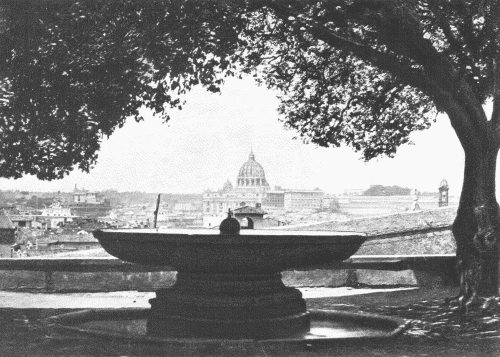
We went up to the Pincio, to have a last look at St. Peter's and the Doria pines before the sun went down. There were few people; it was late, and we had the terrace to ourselves. The dome stood out, quite purple, against a clear blue sky, and seemed almost resting on the clouds. There was a slight mist, which detached it from the mass of buildings. Rome hardly existed—we only saw the dome. I was sorry W. was not there to have that last beautiful picture in his mind. Del Monte, who was also lingering on the terrace, joined us and said he would walk back with me along the terrace of the Villa Medici, so I sent Gert back to her palazzo in the carriage and he and I strolled along and talked over old times; so many recollections of things done together—rides on the Campagna, hours of music of all kinds, particularly at the Villa Marconi at Frascati. I asked him if he had ever gone back there since we left. The villa was often let to forestieri. One year there was an English family there, father, mother, one son, and eight daughters. They used to go about always in three carriages. He said he had never known any one there since us. He remembered so well all the music we did in the big room. When it was a fine night all the mezzo ceto (petite bourgeoisie) who were in "villegiatura" at Frascati would congregate under our windows, whenever we were singing and playing. If they liked our music they applauded; if they didn't (which happened sometimes, when the strains were not melodious enough) they were too polite to express disapproval, and would remain perfectly silent. We used to hear them singing and whistling our songs when they went home. We amused ourselves often trying them with music they couldn't possibly know—plantation songs or amateur music which had never been published. We would sing them one evening; the next they would come back and sing all our songs perfectly well (no words, of course). They had an extraordinary musical facility. Often when we stopped, or on some of the rare occasions when we didn't do any music, they would sing some of their songs—many of them ending on a long, sustained note quite charming.
It was pleasant to recall all the "tempi passati." We lingered a few moments at the top of the Spanish Steps, quite deserted at this hour of the evening, and when he left me at the door of the hotel I had barely time to talk a little to W. before dressing for dinner. He was rather wondering what had become of me. He had had a delightful afternoon with his friends. They had walked along the banks of the Tiber on the way to Ostia. He says there are all sorts of interesting things to be found there—tombs, bits of Roman wall and pavements, traces of old quays, and subterraneous passages all mixed up with modern improvements. The City of Rome is spending a great deal of money in building new quays, bridges, etc., on a most elaborate and expensive scale. I should think the sluggish old Tiber would hardly know itself flowing between such energetic, busy banks.
They drove out for some distance on the road to Ostia, but only got as far as the Monte di San Paolo (I think), from where they had a fine view of the sea, and the pine forests. I am sorry they hadn't time to go on, but we must leave something for the next time. I wonder when it will be.
Gert's dinner was pleasant—Mrs. Bruce, Comte Palfy, Father Smith, and Mr. Hooker. They all talked hard. Mr. Hooker has lived so many years in Rome that he has seen all its transformations; says the present busy, brilliant capital is so unlike the old Rome of his days that he can hardly believe it is the same place. It is incredible that a whole city should have lived so many years in such absolute submission to the Papal Government. In those days there were only two newspapers, each revised at the Vatican and nothing allowed to appear in either that wasn't authorized by the papal court; also the government exercised a paternal right over the jeunesse dorée, and when certain fair ladies with yellow hair and elaborate costumes appeared in the Villa Borghese, or on the Pincio, exciting great admiration in all the young men of the place (and filling the mammas and wives with horror), it was merely necessary to make a statement to the Vatican. The dangerous stranger was instantly warned that she must cross the frontier.
Palfy, too, remembered Rome in the old days, when the long drive along the Riviera in an old-fashioned travelling carriage (before railways were known in these parts) was a thing planned and arranged months beforehand—one such journey was made in a life-time. He said the little villages where they stopped were something awful; not the slightest idea of modern comfort or cleanliness. The ladies travelled with a retinue of servants, taking with them sheets, mattresses, washing materials (there was a large heavy silver basin and jug which always travelled with his family) and batterie de cuisine; also very often a doctor, as one was afraid of fever or a bad chill, as of course any heating apparatus was most primitive. The Italians sat in the sun all day and went to bed when it was dark and cold. One saw the country and the people much better in that way. Now we fly through at night in an express train, and the Rome we see to-day might be Paris, Vienna, or any modern capital. I mean, of course, inside the walls. As soon as one gets out of the gates and on the Campagna one feels as if by instinct all the dead past of the great city.
I told them that in our time, when we lived one summer in the Villa Marconi at Frascati, the arrangements were most primitive. The palace was supposed to be furnished, but as the furniture consisted chiefly of marble statues, benches, and baths—also a raised garden on a level with the upper rooms, opening out of the music-room, the door behind an enormous white marble statue of some mythological celebrity—it didn't seem very habitable to our practical American minds. There were beds and one or two wash-stands, also curtains in one room, but as for certain intimate domestic arrangements they didn't exist; and when we ventured to suggest that they were indispensable to our comfort we were told, "I principi romani non domandono altro" (Roman princes don't ask for anything more).
Heavens, how funny all the pourparlers were. Fanny[29] did all the talking, as we were still too new to the language to embark upon a business conversation. Her mother, who was an excellent maîtresse de maison, gave all the directions, which were most particular and detailed, as she was very anxious we should be comfortable, and very doubtful as to the resources of the establishment. The agent was visibly agacé and impatient. Fanny had on a pair of tortoise-shell star ear-rings, and the man told one of our friends afterward that "quella piccola colle stellette" (the young girl with the little stars) was a real "diavolo." It was funny to hear her beginning every sentence "Dice la signora" (madame says), and saying exactly what her mother told her; the mother, standing near, understanding every word, though she couldn't say anything, and looking hard at the agent. He understood her, too. However, we didn't get any more than the Roman princes had, and made our own arrangements as well as we could, having out a large van of furniture of all kinds from Rome.
Hooker remembered it all well, as he found the house for us and had many misgivings as to how we should get along. He was always keeping us straight in a financial point of view, as even then, before the days of the enormous American fortunes, Americans were careless about money, and didn't mind paying, and paying well, for what they wanted. In those days, too, it was rather cheap living in Italy, and we were so surprised often by the prices of the mere necessaries of life that we couldn't help expressing our astonishment freely. Poor Hooker was much disgusted. "You might as well ask them to cheat you." We learned better, however, later, particularly after several visits to Naples, where the first price asked for anything was about five times as much as the vender expected to get. "Le tout c'est de savoir."
Father Smith and W. got on swimmingly. It is too funny to see them together. The father's brogue is delightful and comes out strong whenever he talks about anything that interests him. He has such a nice twinkle, too, in his eye when he tells an Irish story or makes a little joke. I must say I am very sorry to go. It has been a real pleasure to be back again in Rome and to take up so many threads of my old life. I find Italians delightful to live with; they are so absolutely natural and unsnobbish—no pose of any kind; not that they under-rate themselves and their great historic names, but they are so simple and sure of themselves that a pose would never occur to them. Father Smith asked us a great deal about the German Crown Princess. He had never seen her, but had the greatest admiration for her character and intelligence—"a worthy daughter of her great mother"—thought it a pity that such a woman couldn't have remained in her own country, though he didn't see very well how it could have been managed. He doesn't at all approve of royal princesses marrying subjects. I think he is right—certainly democratic princes are a mistake. There should always be an idea of state—ermine and royal purple—connected with royalties. I remember quite well my disappointment at the first sovereign I saw. It was the Emperor of Austria coming out of his palace at Vienna. We had been loitering about, sight-seeing, and as we passed the Hof-Burg evident tourists, some friendly passers-by told us to stop a moment and we would see the Emperor, who was just driving out of the gates. When I saw a victoria with a pair of horses drive out with two gentlemen in very simple uniform, one bowing mechanically to the few people who were waiting, I was distinctly disappointed. I don't suppose I expected to see a monarch arrayed in ermine robes, with a crown on his head and a sceptre in his hand, but all the same it was a disillusion. Of course when one sees them at court, or at some great function, with brilliant uniforms, grand cordon, and diamond stars, they are more imposing. I don't know, though, whether that does make a difference. Do you remember one of A.'s stories? He was secretary to the British Embassy at Washington, and at one of the receptions at the White House (which are open receptions—all the world can go) all the corps diplomatique were present in the full glory of ribbons and plaques. He heard some one in the crowd saying, "What are all these men dressed up in gold lace and coloured ribbons?" The answer came after a moment's reflection, "I guess it's the band."
I don't think I can write any more to-night. I seem to be rambling on without anything much to say. If I could tell you all I am doing it would be much pleasanter. A pen seems to paralyze me and I feel a mantle of dulness settle down on me as soon as I take one in my hand. You will have to let me talk hard the first three or four days after I get home, and be the good listener you always are to your children.
It is a beautiful bright night, the sky almost as blue as in the day, and myriads of stars. The piazza is quite deserted. It is early, not yet 10.40, but the season is over, all the forestieri gone, and Rome is sinking back into its normal state of sleepiness and calm. How many times I have looked out on the piazza on just such a night (from Casa Pierret, our old house just next door)! It is the one place that hasn't changed in Rome. I almost feel as if I must go to bed at once, so as to be up early and in my habit for a meet at Cecilia Metella to-morrow morning. I do start to-morrow, but not very early—at ten. I have a line from Mary Bunsen this evening saying they will meet me at the station in Florence to-morrow. I shall arrive for dinner. I am half sorry now I didn't decide to go to Naples, after all. The weather is divine, and I should have liked to have another look at that beautiful bay, with its blue dancing water, and Capri and Ischia in the distance. We had had visions of Sicily, prolonging our stay another fortnight, but W. is rather worrying now to get home. He had a letter from Richard yesterday, telling him to be sure and come back for the Conseil Général.
There were two amusing articles in the papers the other day, one saying M. Waddington had been charged by the French Government with a delicate and confidential mission to the Pope; two days after, in another paper, a denial and most vicious attack on W., saying M. Waddington had evidently inspired the first article himself, that he had been charged with no mission of any kind, and they knew from private sources that he would not even be received by the Pope. I daresay a great many people believe both. W. naturally doesn't care—doesn't pay the least attention to what any paper says. I am getting hardened, too, though the process has been longer with me. I don't mind a good vicious article from an opposition paper—that is "de bonne guerre"—but the little perfidious insinuations of the so-called friendly sheets which one can't notice (and which always leave a trace) are very irritating.
W. has just come up. He lingered talking in the smoking-room with two Englishmen who have just arrived from Brindisi, and were full of India and all "the muddles our government is making," asking him if he wasn't disgusted as an Englishman at all the mistakes and stupidities they were making out there. They were so surprised when he said that he wasn't an Englishman that it was funny; and when he added that he was a Frenchman they really didn't know what he meant. He didn't explain his personality (I suppose the man of the hotel enlightened them afterward), but stayed on talking, as the men were clever and had seen a great deal. They had made a long tour in India, and said the country was most interesting. The ruins—also modern palaces—on such a gigantic scale.
Well, dear, I really must finish now. My next letter will be from Florence. We shall stop at Milan and Turin, but not very long, I fancy, unless W. finds marvels in the way of coins at Milan. I am quite sad to think I shan't look out on the piazza to-morrow night. I think after all these years I still hold to my original opinion that the Corso is the finest street and the Tiber the finest river in the world.
To H. L. K.
Milan, Hôtel de Ville, Thursday, May 6, 1880.
Here we are, dearest mother, almost home—only 26 hours from Paris—so if we are suddenly called back (and I earnestly hope we shan't be) we can start at once. We made our journey most comfortably yesterday, though it was long. We left Florence at 9 in the morning and didn't get here until nearly 8. The Bunsens came with us to the station. I begged them not to at such an early hour but they didn't mind. It would have been nice to stay longer. They have just taken their villa on for another month. Their gardener at Meìngenügen wrote them that it was snowing and a cold wind—horrid weather; so they instantly decided to stay on another month. My belle-mère is delicate and never could have stood a cold, northern spring after this beautiful month of April here. They tried to tempt us with all sorts of excursions—Vallombrosa, Pisa (which I should like to see again, I have such a vivid recollection of the Campo Santo and some of the extraordinary tombs, wide square courts and painted windows). I don't remember if it was there or at Genoa, where we saw such elaborate modern monuments; the marble carved and draped in the most curious manner—a widow kneeling at her husband's tomb, her skirts all embroidered and carved so finely, like lace, and a lace veil—really extraordinary.
We found a long train at the station—the night express from Rome. The préfet had kept a compartment for us, and Ubaldino Peruzzi, the former sindaco, a great friend of W.'s, went with us as far as Pistoja. Minghetti was on the train, and he came into our compartment for about an hour, but then adjourned to his own carriage as he was composing a great political speech he makes at Bologna to-night. They are all much excited over the elections, which take place Sunday week, so their time is short. Minghetti has lived and fought through so many phases of Italian history that he is most interesting. They say his memory is extraordinary—so accurate. He never forgets a face or a speech. He says whenever he has an important speech to make he goes for a drive or a long walk—the movement helps him. W. is just the contrary. His great speeches (and they were not many) have always been composed sitting in his big arm-chair smoking the beloved old cherry-wood pipe Ségur brought him from Jersey. When he had got his speech quite in his head, he wrote it, and then it went straight on—never a correction or an erasure. I asked Minghetti if he was nervous. He said not in the least—he was always ready for the fray, and the more he was interrupted the better he spoke, as that proved they were listening to him.
I remember so well one of the first days I went to the Assemblée Nationale years ago. Somebody was speaking—apparently well—on some question of the day, and nobody was listening. The deputies were walking about, talking, writing letters, just as if there was nothing going on. I looked down to see if W. was listening, but he was talking cheerfully to Léon Say. It seemed to me incredible that the orator could continue under such circumstances, but W. explained it to me. He was speaking for his electors in the country and for the "Journal Officiel," which would publish his speech in extenso the next day.
It was most interesting making the journey with these gentlemen as they had their history at their finger ends. All that part of the country had been so fought over—oceans of blood shed in the fierce struggle against Austrian tyranny—particularly as we got near Milan. It seems incredible what a hard iron rule theirs was—especially if one knows Austria and the Austrians a little. They seem such an easy-going, happy people. All their little villages look clean and prosperous, the peasants cheerful and singing and civil to all strangers and travellers.
The country we passed through to-day looked green and smiling, but their idea of work is still primitive, even in Northern Italy. Wherever we passed the people in the fields all stopped and looked at the train—many came running up the bank. If they do that for every train they must lose a considerable amount of time. We were very sorry when our companions departed, but at every station almost Minghetti met friends, and it was evident that he had his head full of politics. It is a long time since I have met any one so interesting. It is such a quick intelligence and he touches every subject so lightly, apparently, only one feels he knows all about it.
We made a fair stop at the Bologna station and had a very good breakfast. It recalled so vividly old times and our first journeys to Rome. Even the buffet looked exactly the same. I could have sworn there was the same "fricandeau de veau." The buffet was crowded—it seems there were a lot of Indian officers arriving with their families from Brindisi, with dark turbaned servants and ayahs always in white. However the Indian nurses didn't look so miserable as they used to in winter when we first made the journey down. They were rather bewildered all the same in such a jostling, hurrying crowd. It is funny to see how they cling to their charges, holding the babies tight with one hand and guiding one or two others half hidden in their long white draperies, with the other. I am sure they are excellent, faithful nurses.
Our last days in Florence were very full. Tuesday was the day of the races—bright, beautiful weather—and we drove out to see the retour, stationing ourselves at the entrance of the Cascine until 7 o'clock. There was not much to see in the way of equipages—nothing like the Roman turn-outs—but there were some pretty women. The Comtesse Mirafiori (née Larderel), I daresay you will remember the name, was about the prettiest. Her victoria was very well appointed, handsome horses stepping perfectly; and she looked a picture, all in white with a big hat turned up with dark blue and long blue and yellow feathers. I think a woman never looks better than in a victoria—it shows off the dress and figure so well. Lottie, too, looked very well, but she passed so quickly I couldn't see what she had on. I had an impression of white with some pink in her hat. Almost all the women were in white. Of course the Lungarno was crowded—all the loungers taking the most lively interest in the carriages; and when there was a stop criticising freely—but I must say with their natural Italian politeness, confining themselves to expressions of admiration more or less pronounced—never anything disagreeable.
We had a mild reception in the evening. Various friends came to say good-bye—Maquays, Peruzzis, Miss Forbes and one or two men. A scientific German—I forget his name—who told W. it would take weeks to see all the coins and interesting things of all kinds at the Milan Museum. We are very comfortable here; the hotel is old-fashioned with a nice open court, and the rooms good. We have a pretty apartment on the front, and as it is on the main thoroughfare, Corso Vittorio Emanuele, we see all that goes on. There is a church opposite—San Carlo, I believe—and we are not far from the Piazza del Duomo.
We went for a little stroll last night after dinner, just for W. to smoke his cigar. The Cathedral looked splendid—a gigantic white mass in the midst of the busy square, quantities of people in the streets and sitting at all the cafes, of which there are hundreds—quite like the Paris boulevards on a summer night—everybody talking and laughing and a cheerful sound of clinking glasses. I think they were almost all drinking beer—a great many uniforms—I suppose there is a large garrison. There seemed very few foreigners—we heard nothing but Italian spoken—so unlike Rome and even Florence where one heard always so much English in the streets and the shops. They told me in Florence that there was a large English colony there, living quite apart from the fashionable world—children learning music, or some of the family delicate, needing a mild climate and sunshine—more perhaps in the villas close to the gates than in the town itself. I should think the cutting wind that sweeps the Lungarno would be mortal to weak chests; but up in the hills sheltered by the high walls and olive groves one would be quite protected. Certainly the other day on the terrace of Castello the sun was divine and the air soft and balmy, not a sign of chill or damp—but it was the month of May—the month for Florence.
This morning I have been unpacking—or rather Madame Hubert has—and settling myself in my salon, making the two corners—feminine and masculine—as I did in Rome. I have no convenient Palazzo Altemps to help me out with cushions, screens, etc., but I found lovely flowers which the landlord (who received us in dress clothes and his hat in his hand) put there, and as he was very civil and pleased to have the "Excellenza" and hoped I would ask for anything I wanted, I have asked for and obtained an arm-chair, and suggested he should give me a simple table-cover instead of the beautiful green velvet one, embroidered with pink roses, which now ornaments my salon. With my careless way of writing and facility for putting ink all over myself, even in my hair, I am afraid that work of art would be seriously deteriorated. He sent up this morning to know if I wanted my breakfast upstairs—if I would come down he would reserve me a small table in the window. I shall go down—I hate meals in a sitting-room and I should like to see what sort of people there are in the hotel.
10 o'clock.
I will go on to-night while W. is putting his papers in order. I breakfasted alone downstairs about 12. The dining-room is a large, handsome room across the court. There were very few people—not more than four tables occupied—a large English family with troops of fair-haired children—girls in white frocks and long black stockings and boys in Eton coats. They all looked about the same age, but I suppose they weren't. They were very quiet and well-behaved, quite unlike any of our small relations. I have vivid recollections of travelling with some of them—all talking at once at the top of their lungs, "Pa, give me a penny," "Pa, give me a cake," "Pa, what's that for?" etc.
The reading-room opened out of the dining-room, so I went in to have a look at the papers—found a "Débats" and the "Times," and read up all that was going on in the fashionable and political world. W. came in about 4—he had ordered a carriage for 4.30, and as it was a lovely afternoon we thought we would drive about the streets a little and out into the country. He had had a delightful morning—says the Museum is most interesting—the cabinet de médailles a marvel. He has arranged to go there every day at 10 o'clock—will work there until 3, then come back for me and we shall have our afternoon. He is much pleased with this arrangement but he doesn't think the employees of the cabinet de médailles will find it quite so satisfactory, as some one must always be with him. They never leave any one alone in these rooms. He thinks there are only two people for this service, and they will naturally hate spending a long day doing nothing while he studies and copies.
The Directeur received him to-day most enthusiastically—knew all about his collection of coins.
We started out about 5 and went first to have a cup of tea at the café the padrone recommended—Cova, I think—and then told the man to drive about the streets and pass the principal buildings. We saw the Duomo again, the Scala (theatre)—if it is open we shall go one night; the great Galerie Victor Emmanuel, full of shops; and quantities of churches, Santa Maria delle Grazie, of course, where is the famous "Cenacolo" of Leonardo da Vinci, but the outside merely. The fresco is only visible until 4—so we shall see the inside of the church another day. We made a turn in the public gardens or promenade where there were quite a number of handsome carriages and saddle horses—many officers riding. It was rather late to attempt a country drive (we had said we would dine downstairs at 7.30), for the turning and twisting about in the streets and stopping every now and then had taken up a good deal of time. We had a nice little victoria with a pair of horses, not unlike the carriage Tomba gave us in Rome.
We went down about a quarter to eight. The padrone in his dress clothes was waiting at the foot of the stairs and conducted us with much pomp into the dining-room, where we found a nice round table in the window. The room was quite full—many more people than in the morning, and I should think almost all Italians. They looked at us naturally with much curiosity, as such a fuss was made with us. W. smoked a cigar in the court after dinner and talked to the man of the house who told him about all the distinguished people he had had in his hotel. I found papers and a "Graphic" in the reading-room and was quite surprised when they said it was 10 o'clock.
May 7th.
It has been pouring all day—straight down. I think it has stopped a little since dinner. We didn't stay long in the reading-room as W. is fairly launched in his coins now and puts his notes in order in the evening. I prowled this morning with Madame Hubert. Before breakfast we went to the Brera. It was almost empty but we found a nice guide, a youngish man, speaking such beautiful Italian that it was a pleasure to hear him, and well up on all the pictures. There are beautiful things, certainly. I was so glad to see some old friends. I was always so fond of the "Amanti Veneziani" of Paris Bordone. The "sposo" looks so young and straight and proud, and the girl's attitude is charming, her brown-gold head drooping on her lover's shoulder as she holds out her hand for the ring he is putting on her finger. Even the inferior pictures of the Paul Veronese school are fine—there is such an intensity of colour. The whole room seemed filled with light and warmth. I think I like the backgrounds and accessories almost as much as the figures. The draperies are so wonderfully done, one can almost touch the gorgeous stuffs, heavy with gold and silver embroidery; and there are one or two high-backed, carved arm-chairs which are a marvel. The beautiful fair women with strings of pearls in their golden hair, and white satin dresses, sitting up straight and slight in the dark wooden chairs, are fascinating; and there are quantities, for Paul Veronese and all his pupils have always so many people in their pictures.
We saw of course the "Sposalizia" in a small room quite by itself. The Virgin is a beautifully slight ethereal figure with the marvellous pure face that all Raphael's Madonnas have; but the St. Joseph looks younger than in most other pictures. Our guide was most enthusiastic over the picture. It was a treat to hear him say—"morbidezza" and "dolcissimo." We were there about an hour and a half, and that was quite long enough. One's eyes get tired. We saw splendid portraits of princes and warriors as we passed through the rooms—Moretto, Leonardo da Vinci and others.
It was still raining when we came out so we thought we wouldn't attempt any more sight-seeing, and walked up to the Galleria Vittorio Emanuele where we were under cover. The Cathedral looked splendid—all the white pinnacles and statues standing out from the dark grey sky. We looked in at all the shop windows, but didn't see anything particularly striking or local except the black lace veils which so many women (not the upper classes) wear here. Madame Hubert being young and pretty was most anxious to adopt that fashion—thought it would be more suitable for Madame as all the suivantes here wore the veil—she would be less remarked going about with Madame—but Madame decidedly preferred the plain little black bonnet of the Parisian femme de chambre. It seems there is a swell Italian woman in the hotel—a Princess—whose maid always wears a veil when she accompanies her mistress in her walks abroad.
I was decidedly damp when I got back to the hotel. I breakfasted alone at my little table, and in fact was almost alone in the dining-room—there were only two other tables occupied. The head waiter was very sympathetic about the weather—they always had sun in Milan, just a mauvaise chance to-day. I had the reading-room also to myself, and found plenty of papers in all languages. I have rather a weakness for the "Kölnische Zeitung" (Gazette de Cologne). It is very anti-French, or I might really say anti-everything, as it is always pitching into somebody, but there is a good deal of general information in it.
W. came in about 3.30, having worked steadily since 9. It was getting too dark to see much more and his attendant beamed when he saw him putting up his papers and preparing to leave. He says the man is bored to death—wants to talk at first and explain things to him, but he soon realizes that W. is bent on serious work, so he desists and reads a paper and walks about the room and fidgets generally.
We waited until 4.30 hoping the rain would stop. It didn't, but the clouds lightened a little and we thought we would go and see the Duomo. I had forgotten how beautiful it is—those great wide aisles quite bare—no chairs, nothing to break the line until quite at the high altar, and the light from the old glass windows coming from so high over our heads it seemed straight from heaven. We sat some little time in one of the side chapels. It looked vast and mysterious—one had such an impression of space and height. Various guides came up and supposed we would not care to go up on the roof on such an afternoon. We told them we would come back the next day if it was fine. They looked so disappointed at having nothing that we finally went down into the crypt to see the tomb and body of San Carlo Borromeo. We had both seen it before but I didn't mind reviving my souvenirs. We had tapers of course as it was quite dark, but we saw quite well the coloured marbles and precious stones of the little chapel—also the body of the Saint, marvellously preserved. It looked very small—hardly the size of a grown man. The guide of course wanted to show us all sorts of relics, and the trésor of the Cathedral, but we preferred going up again to the church, and wandered about looking at the marble tombs and monuments—there are not many, and they are quite lost in the enormous building. Quite down at the bottom of the church, near the door under a baldaquin, is a font in porphyry, said to be the sarcophagus of some saint. The church looked immense as it grew darker and the light gradually faded, leaving deep shadows everywhere. When we turned back, just as we were going out, to have a last glimpse, the high altar seemed far away, and the tall candles looked like twinkling lights seen through a mist or veil.
We walked about a little under the arcades. W. wanted some cigars and I an Italian book Minghetti had recommended to me, "Sketches of Life in Milan and Venice under the Austrian Occupation." I have been reading it a little to-night—what an awful life for Italians—a despotic, iron rule, police and spies everywhere, women even making their way into the great Italian houses and reporting everything to the police—the children's games and little songs, the books and papers the family read, the visits they received. The most arbitrary measures prevailed—no young man allowed to leave the city—no papers nor books allowed that were not authorized by the government—and when arrests were made, the prisoners, men or women, treated most cruelly. The Austrians must have felt the hatred and thirst for vengeance that was smouldering in all these young hearts. It seems all the girls and young women, even of the poorest classes, made themselves flags (tricolour) out of bits of anything (paper when they couldn't get anything better) and gave them to all the men, preparing for the "Cinque giorni" when many of them went down under the Austrian bayonets, giving their lives cheerfully and proudly for their country. Radetzsky must have been a monster of cruelty. How they must hate the white uniform and the black and yellow flag.
The city is quiet enough to-night. I suppose it is not an opera night. It is only half-past ten and we are on one of the principal thoroughfares, but nothing is passing in the street. The hotel, too, is quiet, one doesn't hear a sound. I fancy most travellers go to the new hotel—the Cavour. We are quite satisfied here, and are most comfortable—the landlord very attentive. He and W. are becoming great friends—they talk politics (Italian) every night while W. smokes.
Friday 7th.
I see I shall always write at night. After coffee and half an hour in the reading-room (I always go and have a look at the papers while W. smokes) we come upstairs. W. plunges at once into his notes, and I read and write. It has been lovely to-day and we have had a nice afternoon. W. came home to breakfast at 1, as he wanted to see the Brera and "Cenacolo" once again; and it is of course too late when we start for our afternoon drive at 4.30. We walked to the Brera—it isn't far—and were there a long time. We made a long stop in the vestibule looking at the Luini frescoes—all scenes in the Virgin's life—Madonnas, angels, saints—quantities of figures, and colours and accessories of all kinds—wonderful trees and buildings and clouds with angels and seraphim rising out of them. They must have had marvellous imaginations, those early Italian painters. They never saw anything to suggest such pictures to them, and of course never read anything—there were no books to read—merely written manuscripts difficult enough for scholars to decipher. All the wonderful scenes—Nativity, Coronation, etc.—evoked out of their own brains. I think I like the Annunciation the best of all the scenes of the Virgin's life. There is a beautiful one in the Pitti—I forget now by whom—the Virgin just risen from her chair with a half-dazed, half-triumphant look, and the angel kneeling before her with his lily. I like some of the German ones, too, but they are much more elaborate—the Virgin often standing in a wide arch—a portico—more figures in the background—and the Virgin herself quite a German girl—not at all the lovely, spiritual head of the Italian masters.
We walked through all the rooms. The Venetian pictures (Paul Veronese school) looked beautiful. W., too, was struck with the splendid colouring. Some of the names quite unknown, and if one looked too closely there were perhaps faults of drawing and exaggeration of colour, but the effect was extraordinary. He admired the men's portraits excessively, by Titian, Tintoretto, Moroni, etc. They are very fine—sometimes a soldier with keen, hard eyes, clad in complete armour—often a noble, some grand seigneur of his time, in black velvet and fur with jewelled cap and chain, a fine patrician head and thoughtful face. We didn't see the young guide who went about with me—I was rather sorry—I wanted W. to hear his beautiful Italian.
We stayed so long looking at everything (Luini's pictures are most interesting, too—he must have had an extraordinary capacity for work) that we had just time to get a cab and drive over to Santa Maria delle Grazie to see the "Cenacolo" as it shuts at 4. The Saviour's head, St. John, and some of the other faces are beautiful—but it is so faded (and on the other hand has been touched up a little) that I was disappointed.
It was a beautiful bright afternoon and we saw as well as possible, but really "decay's effacing fingers" have been allowed too much sway. They told us it was impossible to guard against the damp, and that eventually the whole thing would be blotted out. However, it has stood the test pretty well through all these years.
We went into the church, which was quite empty, except one figure in black, absorbed and motionless, kneeling on the stone pavement. Poor woman, I hope she got what she was praying for so earnestly. From there we went to the church of St. Ambrogio, which is a fine old building—the frescoes and inscriptions much faded. The iron crown used to be kept there (they told us the Kings and Emperors came there to be crowned) but it is now at Monza. I declined any more churches and regular sight-seeing after that—so we went back to the hotel where the carriage was to meet us, went for our cup of tea to Cova's, and then started for a drive.
The country quite around the city is not particularly interesting—much cultivated, but flat—vineyards, corn and rice fields all intersected with numberless little canals. Though it was late, 6 o'clock, people were still working in the fields and seemed to keep to their work much more steadily than the peasants about Rome and Florence who were always stopping to talk or look at whatever was passing. We met bands of them trooping along the road—they were generally tall, broad-shouldered, strong men—quite the northern type. We crossed some soldiers, too—cavalry and infantry—quite a big detachment—all had their kits, and baggage wagons following. They were evidently changing garrison. I didn't think the troops looked very smart. The horses were small and very thin, and the men (infantry particularly) dragged along and were rather dirty. Just as they passed us the music struck up a sort of quick march, and it was curious to see the instantaneous effect. The men straightened themselves up, moved more quickly and lightly—it was quite different.
I hoped we should get a view of the mountains, but the sunset, though beautiful, was rather misty—however the coachman told us that meant fine weather for to-morrow which will be nice as we are going up on the top of the Cathedral. I was glad to have a little rest before dinner. I plunged again into my book, which is madly interesting—but such horrors—a long imprisonment like Silvio Pellico's was merciful compared to some of the tortures and cruelties—and it seems the Emperor himself was the hardest of all—never forgetting nor pardoning nor listening to any petition or prayer for mercy—no wonder the people were infuriated—mad with rage—women and children working at the barricades during the "five days"; and the old ones, too infirm to take an active part, at the windows pouring down boiling water and oil on the Austrian soldiers. However, I suppose it is the history of all street fighting. I remember the hideous tales they told us of the Paris Commune, when we went back there after the war—how maddened the Versaillais were at the shots, missiles and boiling water which came from all the windows upon them. The reprisals were terrible when the regular troops finally got the upper hand—and I suppose no one will ever know how many innocent people were shot in the first flush of success.
I read out bits of my book to W. He said he didn't think the account exaggerated—of course they had chosen all the worst cases. He was at Versailles during the Commune, and saw the first batches of prisoners brought in—such awful looking people—many young, very young men, with wild reckless faces. They probably didn't know, half of them, what they had been fighting for—a vague idea of patrie and liberty, and the natural love of the Parisian gamin for a row and a barricade.
To H. L. K.
Milan, Hôtel de Ville, May 9, 1880.
We have had an awful day, dear mother, pouring steady rain since early morning—clouds grey and low shutting out the city entirely; really so dark I could hardly see to dress—and the streets apparently deserted. W. didn't mind, and was off as usual to his coins at 9 o'clock. He did have a remords de conscience at leaving me all alone all day shut up in a little hotel salon, and said if I would come and get him about 3 we would try and see something.
I wrote two letters which will rather amuse the family as they say I only write when I am boring myself in the country or having a series of rainy days—Janet always calls them my rain letters. However, when I had written two my energy in that line was exhausted, and I felt I couldn't sit another moment in that dark salon, so I summoned Madame Hubert (I don't generally care to have a maid for a companion but I didn't like to walk about the streets of a foreign city alone) and we started off with short skirts and umbrellas. The gérant nearly fell off his high stool in the bureau when he saw me preparing to go out—wanted to send for a carriage, a fiacre, anything—but I told him I really wanted to walk, which filled him with amazement. Italians as a rule don't like walking at all, and he thought I was quite mad to go out deliberately, and for my pleasure, on such a day.
It wasn't very pleasant in the streets—everybody's umbrella ran into me, and the pavements were wet and slippery. We finally took refuge under the arcades, but there we got quite as much jostled, for everybody who was out, was there; and the sudden gusts of wind and rain around the corners and through the arches were anything but pleasant. I wasn't at all happy, but I liked it better than sitting in the room at the hotel. I was so draggled and my boots so covered with mud that I was rather ashamed to cross the big hall of the hotel when I came in.
I found a letter from Gert saying she was so glad we had such delightful weather for Milan. I wish she could look out of my window at this moment. She wouldn't know if she were in Milan or Elizabethtown. The clouds are very low on the roofs of the houses—the city has disappeared in a mist, I can just see across the street. The pavements are swimming—quite rushing torrents in the gutters, and I look down upon a sea of umbrellas.
I started out again about 3—in a carriage this time—and went to get W.—extract him from his coins if I could. There was no one, apparently, in the Museum, but a smiling concierge took me to the antiquity and coin rooms where I found W. very busy and happy; quite insensible to rain or any outside considerations. He said the light wasn't very good. A musty old savant with a long ragged beard and very bright black eyes was keeping him company. He was delighted to see me, for he knew that meant stopping work for that afternoon. I talked to him a little while W. was putting his papers in order, and it was evident he had never seen any one with such a capacity for steady work. He encouraged us very much to go and see something (anything that would take us out of the coin room) but we really didn't know what to do with ourselves—a country drive wasn't inviting and it was too dark and late for pictures—all the galleries close at 4. The padrone had recommended the flower show to us in the public gardens, so we thought we would try that. The flowers were all under glass and tents, so we were dry overhead, but the ground was wet and muddy—a general damp, chilly feeling everywhere. I am sure the place is lovely on a bright summer day. There are fine trees, splendid horse chestnuts, pretty paths and little bosquets. The poor flowers looked faded and drooping, even under cover. The roses were splendid—such enormous ones with quantities of leaves, very full. The finest were "Reine Marguerite," "Marguerite de Savoie," "Princess de Piémont." I asked one of the gardeners if the Queen was very fond of flowers—the "Marguerite de Savoie" was a beautiful white rose. "Oh, yes," he said, enthusiastically, "the Queen loves flowers and everything that is beautiful." I thought it such a pretty answer. He showed us, with great pride, a green rose. I can't say I admired it, but it is so difficult and so expensive to produce that I don't think we shall see many. We walked about and looked at all the flowers. Some of the variegated leaves were very handsome. There was a pink broad leaf with a dull green border and an impossible name I should have liked to take away, but the man said it was an extremely delicate plant raised under glass—wouldn't live long in a room (which was what I wanted it for). We thought we would go back and have tea in a new place under the arcades—in the Galleria. The tea was bad—had certainly never seen China—as grown, I daresay, in the rice fields near the city, so we declined that and ordered chocolate, which was very good, and panettoni. W. was rather glad to have something to eat after his early breakfast. It was pouring, but we were quite sheltered in the corner of the veranda; so he smoked and we looked at the people passing and sitting near us. They were certainly not a very distinguished collection—a good many officers (in uniform), loungers who might be anything—small functionaries, I should think—few women of any description, and no pretty ones. The peasant woman coming out of the fields was much better-looking than any we saw to-day.
W. had had visitors in the coin room this morning. The Director, who came, he thinks, out of sheer curiosity to see how any one, for his pleasure, could work five or six hours at a time. He brought with him a Greek savant—a most intelligent young man who apparently knew W.'s collection almost as well as he did—and all the famous collections of Europe. They had a most interesting talk and discussion about certain doubtful coins of which 3 Museums—London, Petersburg and Milan—claim to have the only originals. We talked over our plans, but I think we have still two or three more days here. We want to go to Monza. They say the old town and church are most interesting, as well as the Royal Villa.
It was rather amusing in the reading-room after dinner. There were many more people—women principally, and English. Some of them had been buying things at the two famous bric-à-brac shops, and they were very much afraid they had paid too much, and been imposed upon. They finally appealed to me (we had exchanged papers and spoken a few words to each other) but I told them I was no good, nothing of a connoisseur for bric-à-brac, and particularly ignorant about lace. They showed it to me, and it looked very handsome—old Venetian, the man had told them. They had also some silver which they had bought at one of the little shops in the Piazza dei Mercanti. I think I will go and see what I can find there.
I found W. deep in his Paris courrier when I got upstairs. There was a heap of letters and papers, also Daudet's book "Souvenirs de la Présidence du Maréchal de MacMahon" which l'Oncle Alphonse had sent us, said everybody was reading it at the clubs. W. figures in it considerably, not always in a very favourable light, as judged by Monsieur Daudet; but facts speak for themselves, even when the criticism is not quite fair. I suppose it is absolutely impossible for a Royalist to judge a moderate Republican impartially. I think they understand the out-and-out Radical better. The book is clever. I read out bits to W. (which, by the way, he hates—loathes being read to). It was interesting to read the life we had just been leading described by an outsider.
I think W. will give himself a holiday to-morrow if it is fine (at the present moment, with the wind and rain beating against the windows, that seems a remote possibility). He will come back to breakfast and we will have our afternoon at Monza. I have finished my book of the Austrian rule, and I am really glad—the horrors quite haunted me. It seems incredible that in our days one Christian nation should have been allowed to treat another one so barbarously. I should like to go back to my childish days and read "Le mie Prigioni," but I found a life of Cavour downstairs in the hotel library, so I think I shall take that.
May 10th.
It is lovely this morning (though when the weather changed I don't know, as it seemed to me I heard a steady downpour every time I woke in the night), however, at 9 o'clock it was an ideal summer day, warm, a bright blue sky, no grey clouds or mist, one could hardly believe it was the same city. The atmosphere is so clear that the snow mountains seem almost at the bottom of the street. I went for a walk with Madame Hubert through the old parts of the city—such curious, narrow, twisting little streets. We went into the Duomo for a moment, it looked enormous—cool and dark except where a bright ray of sunshine came through the painted windows, but so subdued that it didn't seem real sunlight seen through all the marvellous coloured glass. There were a few people walking about in little groups, but they were lost in the great space. One didn't hear a sound—the silence was striking—there wasn't even the usual murmur of priest or chorister at the altar as there was no mass going on.
We asked the way to the Piazza dei Mercanti on the other side of the Duomo. It is a curious old square—a very bad pavement, grass growing in places between the stones, and all sorts of queer, irregular buildings all around it—churches, palaces, porticos, gateways—a remnant of old Milan. At each end there were little low shops where many people were congregated. I don't know if they were buying—I should think not as they seemed all rather seedy, impecunious individuals judging by their shabby, not to say worn-out garments—all Italians—I think we were the only foreigners in the Piazza (yet it is one of the sights of Milan, mentioned in the guide books). We went, too, and looked at some of the things spread out for sale—many old engravings, carved wooden frames, gold and silver ornaments, and some handsome cups and flagons very elaborately worked—also some bits of old stuff, brocade, and a curious faded red velvet worked in gold, but all in very bad condition. I couldn't find a good piece large enough to make an ordinary cushion. In one corner, squatting in the sun, were two big, dark men with scarlet caps on their heads (they looked like Tunisians). They had muslins, spangled with gold and silver, crêpe de Chine, and nondescript embroidered squares of white, soft silk with wonderful bright embroidery and designs—moons, and ships and trees. We spoke to them in French, but they didn't understand, and answered us in some unintelligible jargon—half Italian, with a few English words thrown in.
Some of the old palaces are fine, one in particular which seems to be a sort of bourse now. The portico was crowded with men, all talking at the top of their voices. We had glimpses through the crowd of a fine collection of broken columns, statues, tablets and bas-reliefs inside, but we didn't attempt to get in; though a friendly workman in the street, seeing us stopping and looking, evident strangers, told us we ought to go in and see "le bellezze" (the beautiful things). There is an equestrian statue on one side of the palace—I couldn't quite make out the name, but the inscription says that among other great deeds he "burnt many heretics." I don't suppose they gave him his statue exclusively on that account, but the fact was carefully mentioned. We wandered about rather aimlessly, leaving the Piazza, and finally found ourselves in a wide, handsome street—large palaces on one side and the canal running through the middle. The canal is really very picturesque—the water fairly clear, reflecting the curious, high, carved balconies and loggias (some of them covered with creepers and bright coloured flowers) that hang over the canal. They seemed all large houses, with the back giving on the canal; some of the low doors opening straight out on the water were quite a reminder of Venice; and when there was a terrace with white marble balustrade and benches one could quite imagine some of Paul Veronese's beautiful, fair-haired women with their pearls and gorgeous red and gold garments disporting themselves there in the summer evenings. The palaces on the other side of the street are fine, stately mansions—large doors open, showing great square courts, sometimes two or three stretching far back—sometimes a fountain and grass plot in the middle—sometimes arcades running all around the court, with balconies and small pointed windows—coats-of-arms up over the big doors, but no signs of life—no magnificent porters such as one sees in Rome in all the great houses. They all looked in perfectly good condition and well cared for. I wonder who lives in them.
We came out at the Place Cavour and had a look at the statue, which is good—in bronze—an energetic standing figure with a fine head, very like—one would have recognised it anywhere from all the pictures one has always seen of Cavour. There is no group—he standing alone on a granite pedestal—a woman (Fame) kneeling, and writing his name on a scroll. I liked it very much—it is so simple, and we have seen so many allegorical groups and gods and goddesses lately that it was rather a relief to see anything quite plain and intelligible.
I wasn't sorry to get back to the hotel and rest a little before starting again this afternoon. I liked walking through the little old crooked streets—they were not empty, there were people in all of them, but decidedly of the poorer classes. They are a naturally polite, sympathetic race—always smiling if you ask anything and always moving to one side to let you pass—unlike the stolid German who calmly and massively takes the middle of the pavement and never dreams of moving to one side, or considering anybody else. I have just been jostled by two stout specimens of the touring Vaterland—they are anything but good types. If they didn't understand the language in which Madame Hubert expressed her opinion I think the tone said something to them, for one man muttered a sort of excuse.