PETROLEUM
Reading edition
WHAT IS PETROLEUM AND HOW IS IT FORMED?
Petroleum is a dark, oily fluid that is irregularly distributed in sedimentary rocks throughout the world. There are several ideas about the origin of petroleum. The most widely accepted of these is that billions of plants and animals lived and died in widespread seas and their remains decomposed and released fluid, fatty particles. These were distilled into “hydrocarbons” (a mixture of the elements hydrogen and carbon, such as gas and oil).
HOW AND WHERE DID OIL COLLECT IN ROCKS?
The hydrocarbons, or oil and gas droplets, were buried by countless tons of sediments that accumulated on ancient sea bottoms. As these sediments hardened into sedimentary rocks, the hydrocarbons were squeezed into whatever empty spaces were available in the rocks. As the layers of sedimentary rocks later became folded and broken, oil and gas droplets and salt water moved upward through any interconnecting open spaces. Some droplets escaped to the surface as “seeps,” but many were trapped when they came up against a nonporous barrier. Gas, being lighter than either oil or water, was trapped at the top, and oil was stopped in the middle, above the salt water. An accumulation of this kind is termed a “pool” or a “field.”
WHERE DID OIL ACCUMULATE IN ILLINOIS?
Conditions under which oil is found in Illinois (fig. 7) are as follows: (a) coral reefs, (b) anticlines (upfolds or arches of rock layers), (c) “pinching” or “lensing” out of dipping, overlapping porous rock layers, and (d) buried sandstone-filled ancient stream channels.
ARE THERE LAKES OR RIVERS OF OIL UNDERGROUND?
No. Oil and gas accumulate in the pores (openings) between silt and sand grains and in small openings in limestone and dolomite.
10
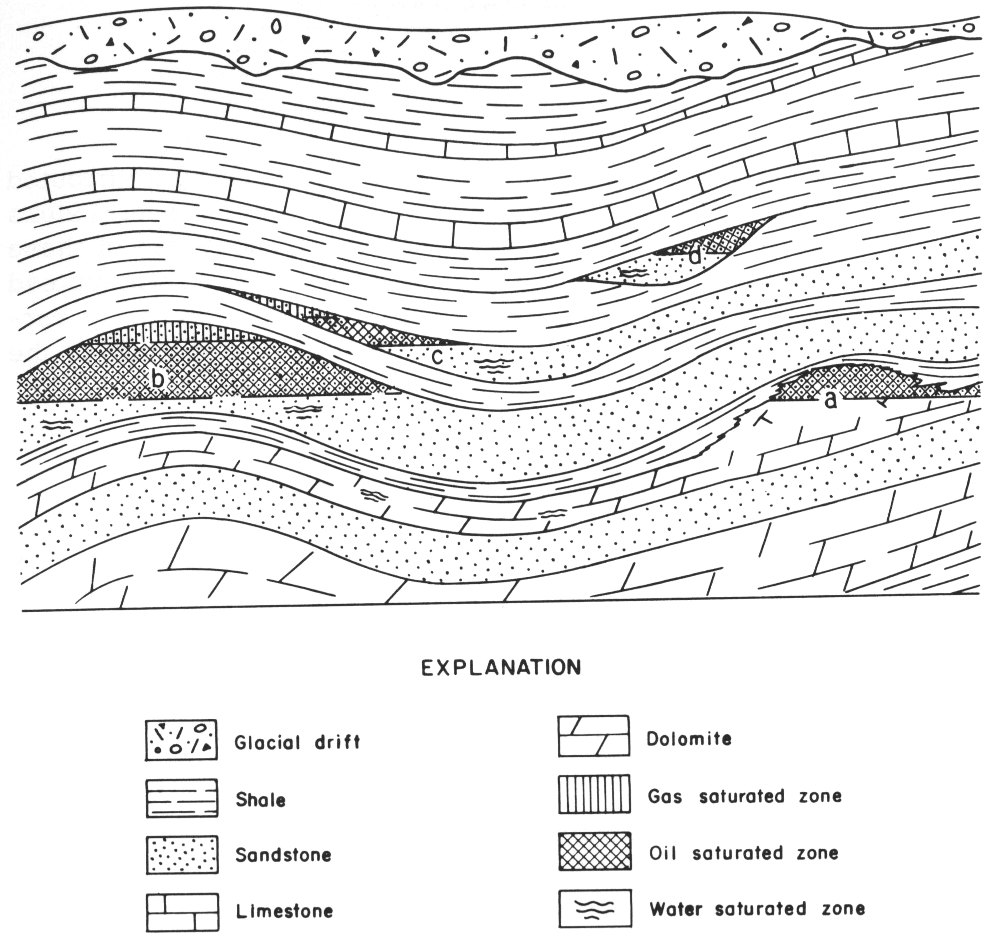
Figure 7—Places where oil is found in Illinois: (a) coral reefs, (b) anticlines, (c) pinch-outs, and (d) channel sandstones.
EXPLANATION
Glacial drift
Dolomite
Shale
Gas saturated zone
Sandstone
Oil saturated zone
Limestone
Water saturated zone
HOW IS OIL DISCOVERED?
Although prospect (test) drilling is still the only way to prove the presence or absence of commercial quantities of oil beneath the surface, careful study by a geologist of all available information may indicate the most favorable places for testing. Since oil 11 and gas migrate to the highest parts of the porous rock zones, the geologist tries to find these high places even though they may be several hundred feet underground. Sometimes dipping rocks can be seen in outcrops, and several geophysical methods have been used to indicate where such high places may occur underground. At other times, high places are found by studying with a microscope samples of rocks collected from wells already drilled in the surrounding area. The geologist notes the type and order of the formations which have been drilled. Many holes have been drilled based on such information.
Whether or not the test drilling is successful as a producing well, small samples of cuttings of the rock being drilled are collected and saved to be studied at a later time. Various instruments are also put down into the hole to record temperatures, pressures, electrical properties, and other characteristics of the rocks. This type of information, when carefully plotted on maps, serves to locate new areas for test drilling.
HOW MUCH OIL CAN BE OBTAINED FROM AN OIL POOL?
There is no way to tell before a hole is drilled whether or not oil will be found, how much oil is present, or what will be the best way to get it to the surface. Where subsurface pressures are great enough, oil may flow to the surface.
Generally speaking, about one-third of the oil actually present in the rocks can be pumped before the well becomes uneconomical to operate. This is called primary production. Oil operators have learned that by pumping water or gas down some wells into the oil-bearing formation, another third of the oil may be forced out through neighboring wells. This is called secondary production. Experiments that use steam or that burn some of the oil underground in an oil-bearing formation are attempts to recover the remaining third. These methods using heat are often referred to as tertiary production methods.
WHAT IS THE “BIGGEST” OIL WELL ON RECORD IN ILLINOIS?
Illinois’ largest well, near Centralia, flowed 12,000 barrels of oil in a 24-hour period. Most Illinois oil wells, however, 12 have to be pumped, and the majority of them are now producing 10 barrels or less a day. The deepest producing well, 5,354 feet, was drilled in 1960 in Wayne County, near Fairfield. In the same year the deepest oil test was drilled to a depth of 8,616 feet and was stopped in granite. This test is located in Fayette County near Beecher City and has its oil production from a zone over 4,000 feet above the bottom of the hole.
HOW MUCH OIL IS PRODUCED IN ILLINOIS AND HOW VALUABLE IS IT?
In 1963, about 75 million barrels of oil, 2.7 percent of the nation’s total, were produced in Illinois (fig. 8). This oil is valued at over $221,000,000.
IS OIL PRODUCTION INCREASING OR DECREASING IN ILLINOIS?
In 1940, our state had its highest yield of oil when 147,647,000 barrels were produced. Although production figures remained fairly high for some time, they have declined in the past few years. Since no new large oil discoveries have been made recently, Illinois’ total known oil reserves are decreasing yearly. In 1963, Illinois ranked eighth among the oil-producing states, with 420 oil fields consisting of 30,149 wells.