ILLINOIS STATE GEOLOGICAL SURVEY
Reading edition
WHY IS GEOLOGY IMPORTANT?
Geology and allied sciences are being called upon increasingly to aid in more intelligent and efficient discovery and utilization of mineral wealth. Our national life and welfare are more and more dependent upon the further discovery and proper use of the earth’s natural resources. Illinois is widely recognized by scientists, industrialists, and educators as being outstanding in its promotion of research and industrial development.
WHAT ARE SOME OF THE SERVICES AVAILABLE FROM THE SURVEY?
The occurrence and distribution of rock and mineral deposits in Illinois are studied by the State Geological Survey Division of the Department of Registration and Education (fig. 20). In seeking new information concerning the state’s natural mineral resources, physical and chemical studies of useful rocks, minerals, and mineral products are made. Techniques and methods are developed and experiments are conducted to find and prepare Illinois’ mineral substances for use.
The results of the Survey’s field and laboratory findings are published and made available to all citizens upon request. 31 Much information that has not been published is in the open files of the Geological Survey where it may be examined by the public. Members of the Survey’s scientific and technical staff answer requests for information received by letter, telegram, telephone, or personal interview.
Since the main ideas of geology are easy to understand and greatly increase one’s enjoyment and appreciation of the world in which we live, the Geological Survey publishes popular and educational booklets designed for the use of Illinois teachers and students. The Survey also distributes a labeled collection of rocks and minerals for class use in Illinois schools. Six geological science field trips are conducted each year throughout various sections of the state for teachers and interested laymen. Members of the Survey staff give illustrated lectures to organized groups about the geology and mineral resources of the state.

Figure 20—Geological Survey offices are located in the Natural Resources Building, Urbana, Illinois.
WHAT IS THE CHARGE FOR THESE SERVICES?
All of the Survey’s publications are distributed free to schools and teachers. Only topographic maps and certain base maps, which are prepared and printed by the U.S. Geological Survey in Washington, are sold at nominal prices.
32
33
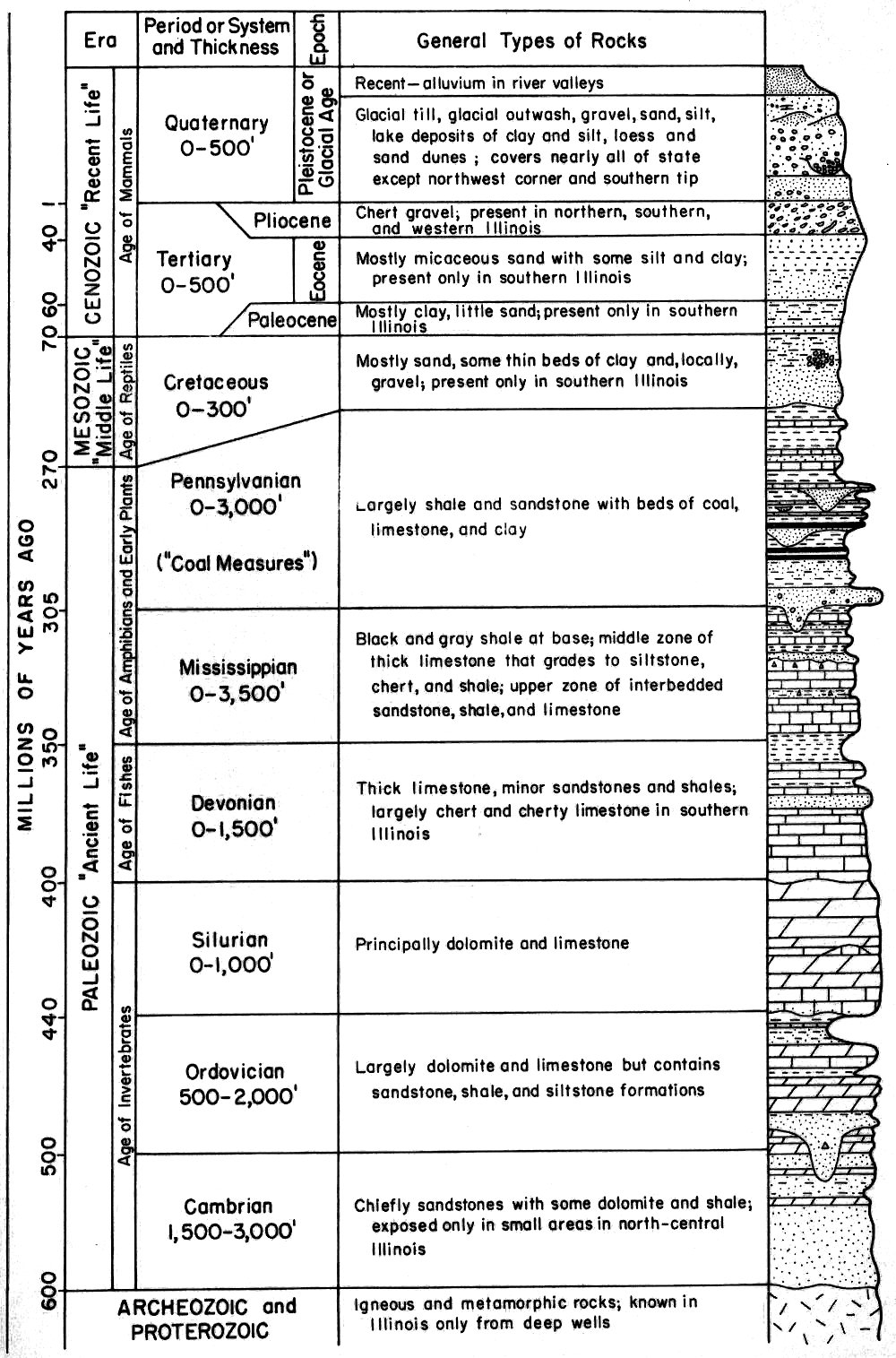
Era General Types of Rocks
Period or System and Thickness
Epoch
CENOZOIC “Recent Life”
Age of Mammals
Quaternary 0-500′
Pleistocene or Glacial Age
Recent—alluvium in river valleys
Glacial till, glacial outwash, gravel, sand, silt lake deposits of clay and silt, loess and sand dunes; covers nearly all of state except northwest corner and southern tip
Tertiary 0-500′
Pliocene Chert gravel; present in northern, southern, and western Illinois
Eocene Mostly micaceous sand with some silt and clay; present only in southern Illinois
Paleocene Mostly clay, little sand; present only in southern Illinois
MESOZOIC “Middle Life”
Age of Reptiles
Cretaceous 0-300′ Mostly sand, some thin beds of clay and, locally, gravel; present only in southern Illinois
PALEOZOIC “Ancient Life”
Age of Amphibians and Early Plants
Pennsylvanian 0-3,000′ (“Coal Measures”) Largely shale and sandstone with beds of coal, limestone, and clay
Mississippian 0-3,500′ Black and gray shale at base; middle zone of thick limestone that grades to siltstone, chert, and shale; upper zone of interbedded sandstone, shale and limestone
Age of Fishes
Devonian 0-1,500′ Thick limestone, minor sandstones and shales; largely chert and cherty limestone in southern Illinois
Age of Invertebrates
Silurian 0-1,000′ Principally dolomite and limestone
Ordovician 500-2,000′ Largely dolomite and limestone but contains sandstone, shale, and siltstone formations
Cambrian 1,500-3,000′ Chiefly sandstones with some dolomite and shale; exposed only in small areas in north-central Illinois
ARCHEOZOIC and PROTEROZOIC
Igneous and metamorphic rocks; known in Illinois only from deep wells
34
Illinois State Geological Survey Educational Series 9