THE ASSINIBOIN2
Reading edition
THE ASSINIBOIN2
History
Origin.—But little traditionary can be stated by these Indians as authentic of their origin which would be entitled to record in history, though many singular and fabulous tales are told concerning it. As a portion of people, however, once inhabiting another district and being incorporated with another nation, their history presents a connected and credible chain of circumstances. The Assiniboin were once a part of the great Sioux or Dacotah Nation, residing on the tributary streams of the Mississippi; say, the head of the Des Moines, St. Peters, and other rivers. This is evident, as their language with but little variation is the same, and also but a few years back there lived a very old chief, known to all of us as Le Gros François, though his Indian name was Wah-he´ Muzza or the “Iron Arrow-point,” who recollected perfectly the time of their separation from the Sioux, which, according to his data, must have been about the year 1760.3 He stated that when Lewis and Clark came up the Missouri in 1805 his band of about 60 lodges (called Les Gens des Roches) had after a severe war made peace with the Sioux, who at that time resided on the Missouri, and that he saw the expedition referred to near White Earth River, these being the first body of whites ever seen by them, although they were accustomed to be dealt with by the fur traders of the Mississippi. After their first separation from the Sioux they moved northward, making a peace with the Cree and Chippewa, took possession of an uninhabited country on or near the Saskatchewan and Assiniboin Rivers, in which district some 250 or 300 lodges still reside. Some time after the expedition of Lewis and Clark, or at least after the year 1777, the rest of the Assiniboin, at that time about 1,200 lodges, migrated toward the Missouri, and as soon as they found superior advantages regarding game and trade, made the latter country their home. One principal incident in their history which they have every reason to remember and by which many of the foregoing data are ascertained is a visitation of the smallpox in 1780 (see Mackenzie’s travels), when they occupied the British territory. Even yet there are two or three Indians living who are marked by the disease of that period and which greatly thinned their population, though owing to their being separated through an immense district, some bands entirely escaped. Upon the whole it does not appear to have been as destructive as the same disease on the Missouri in 1838, which I will have occasion to mention in its proper place in these pages and which reduced them from 1,200 lodges to about 400 lodges.
Name and Geographical Position.—The name of the Assiniboin among themselves is Da-co-tah, same as the Sioux, which means “our people.” By the Sioux they are called Ho´-hai or “Fish-eaters,” perhaps from the fact that they lived principally on fish while on the British grounds, as most of those Indians do. By the Cree and Chippewa they are called As-see-nee-poi-tuc or Stone Indians; hence the English name of Assiniboin arises. As has been stated, at the earliest date known they roved about the head of St. Peters, Des Moines, Lac du Diable, and Lac qui Parle; and they were then joined with the Sioux Indians, who inhabited and claimed all the lands between the Mississippi and the Missouri as low down as Big Sioux River and as high up as the head of Rivier à Jacques, thence northward toward Lac du Diable, other bands of Sioux (Teton) residing west of the Missouri. The number of Assiniboin when they separated must have been at least 1,500 lodges, averaging six souls to a lodge [or about 9,000 persons]. Their migration has been referred to and the extent of land they occupied in the British territory on the Saskatchewan, etc., was very large, but at present their habitat is entirely different, and it may be as well to state it here. The northern Assiniboin, 250 or 300 lodges, rove the country from the west banks of the Saskatchewan, Assiniboin, and Red Rivers in a westward direction to the Woody Mountains north and west among small spurs of the Rocky Mountains east of the Missouri, and among chains of small lakes through this immense region. Occasionally making peace with some of the northern bands of Blackfeet enables them to come a little farther west and deal with those Indians, but, these “peaces” being of short duration, they are for the most part limited to the prairies east and north of the Blackfeet range. The rest of the Assiniboin, say 500 to 520 lodges [who may be called the Southern Assiniboin], occupy the following district, viz., commencing at the mouth of the White Earth River on the east, extending up that river to its head, thence northwest along the Couteau de Prairie, or Divide, as far as the Cyprus Mountains on the North Fork of the Milk River, thence down Milk River to its junction with the Missouri River, thence down the Missouri River to the mouth of White Earth River, or the starting point. Formerly they inhabited a portion of country on the south side of the Missouri River along the Yellowstone River, but of late years, having met with great losses by Blackfeet, Sioux, and Crow war parties, they have been obliged to abandon this region and now they never go there. As before remarked, the Assiniboin still numbered 1,000 to 1,200 lodges, trading on the Missouri until the year 1838, when the smallpox reduced their numbers to less than 400 lodges. Also, being surrounded by large and hostile tribes, war has had its share in their destruction, though now they are increasing slowly.
Ancient and Modern Habitat.—Before proceeding further it would be well to state and bear in mind that of all the Indians now residing on the Missouri River the Assiniboin appear to have made the least progress toward acquiring civilized ideas or knowledge of any kind. Superstitious, lazy, and indisposed to thought, they make no attempt to improve themselves in any way. Neither are they anxious that others should teach them; consequently they are far behind the other tribes even as regards their own savage manner of life. This will receive further explanation. They do not think the Great Spirit created them on or for a particular portion of country, but that he made the whole prairie for the sole use of the Indian, and the Indian to suit the prairie, giving among other reasons the fact that the buffalo is so well adapted to their wants as to meat and clothing, even for their lodges and bowstrings. To the Indian is allotted legs to run, eyes to see far, bravery, instinct, watchfulness, and other capacities not developed in the same degree in the whites. The Indian, therefore, occupies any section of prairie where game is plentiful and he can protect himself from enemies. With regard to any other kind of right than that of possession and ability to defend, besides the general right granted by the Great Spirit, they have not the most distant idea. The Assiniboin conquered nothing to come into possession of their habitat, they had their difficulties with surrounding tribes and still have, as others have, and continue as they commenced, fighting and hunting alternately. Their first interview with Europeans (now spoken of) was when the traders of the Mississippi pushed their traffic as far as their camps, and from whom they obtained firearms, woolen clothing, utensils, etc. Afterwards these supplies were had from the Hudson Bay Co. and, latterly, from the Americans on the Missouri River. There is every reason to believe that the introduction of ardent spirits among them was coeval, if not antecedent, to that of any other article of trade. Before the trade was opened with them by the whites they say they used knives made of the hump rib of the buffalo, hatchets made of flint stone, mallets of the same, cooking utensils of clay and wood, bones for awls, and sinew for thread, all of which articles can yet be found among them. They made with these rude tools their bows and arrows, pointing the latter with stone, and, as game was abundant, hunted them on foot or threw them into pens built for the purpose, which method they continue to use to this day. In this way they had no difficulty in supporting themselves, and so contend that they have gained nothing by intimacy with the whites but diseases which kill them off in numbers and wants which they are unable at all times to gratify. They have never sold lands by treaty, and the only treaty (with the exception of that at Laramie, 1851) was made by them through an Indian agent of the United States named Wilson, at the Mandan village in 1825. But this was merely an amicable alliance for the protection of American traders and an inducement held out to the Indians to leave off trading at the Hudson Bay Co.‘s posts and establish themselves on the Missouri, without, however, any remuneration on the part of the United States.
Vestiges of Early Tradition.—They have no creditable tradition of the Mosaic account of the creation or deluge, neither of their ancestors having lived in other lands nor knowledge of foreign quadrupeds nor any idea of whites or other races occupying the country before the Indians. It is easy to perceive in converse with them that whites have from time to time endeavored to explain the Mosaic account of the creation and deluge, together with other scriptural records, but instead of comprehending the same they have mixed with their own superstitions and childish notions in so many various and nonsensical forms that none is worthy of record.
They have no name for America, neither do they know of its extent, for the most part believing that the lands occupied by themselves and the surrounding tribes compose the greatest part of the world, and certainly contain the greatest reputed number of people. It vexes and grieves them to be told of large tracts of land elsewhere, and they do not or will not believe the whites to be as human as they are.
There is nothing in this subject any Assiniboin could either comprehend or answer, except that there is a mound about 50 miles above the mouth of the Yellowstone on the west side and near the Missouri consisting of an immense pile of elk horns, covering an area of about an acre of ground, and in height about 30 feet. We have frequently inquired of these and the surrounding nations as to its origin, but it was raised previous to the knowledge or even tradition of any tribe now living in these parts. From the state of decay the horns are in it must be very ancient.
Names and Events in History.—There is no great event in the history of the Assiniboin that gives them cause to rejoice. True, they have occasionally gained a battle, but at other times have lost greatly by wars. Upon the whole they have had the worst of it; at least they, being a smaller nation than the Blackfeet and Sioux (their enemies) have felt the loss more severely. The principal calamity that first overtook them, and by which they suffered greatly, was the smallpox in 1780. (See Mackenzie’s travels and other authors.) On this occasion they lost about 300 lodges of their people, and it is to this day mentioned by them as their greatest first misfortune. In the spring of 1838 this disease was again communicated to them, being brought up the Missouri by a steamboat, and although every precaution had been used, the boat cleansed, and no appearance of disease for a long time aboard, yet it in some way broke out among the Indians, beginning with the Sioux tribes and ending with the Blackfeet. Being an eyewitness to this, we can with certainty give an account of its ravages. When the disease first appeared in Fort Union we did everything in our power to prevent the Indians from coming to it, trading with them a considerable distance out in the prairie and representing to them the danger of going near the infection. All efforts of the kind, however, proved unavailing, for they would not listen, and 250 lodges contracted the disease at one time, who in the course of the summer and fall were reduced to 65 men, young and old, or about 30 lodges in all. Other bands coming from time to time caught the infection and remained at the fort, where the dead were daily thrown into the river by cartloads. The disease was very virulent, most of the Indians dying through delirium and hemorrhage from the mouth and ears before any spots appeared. Some killed themselves.
On one occasion an Indian near the fort after losing his favorite child deliberately killed his wife, his two remaining children, his horses and dogs, and then blew his own brains out. In all this the Indians behaved extremely well toward the whites, although aware they brought the disease among them, yet nothing in the way of revenge took place, either at the time or afterwards. Being obliged to be all the time with them, helping as much as possible to save a few, they had plenty of opportunities should they have wished to do damage. Every kind of treatment appeared to be of no avail, and they continued dying until near the ensuing spring, when the disease, having spent itself, ceased. The result was that out of 1,000 lodges and upward of the Assiniboin then in existence but 400 lodges or less remained, and even these but thinly peopled. Relationship by blood or adoption was nearly annihilated, all property lost or sacrificed, and a few very young and very old left to mourn the loss. Most of the principal men having died, it took years to recover from the shock. Young men had to grow up, new leaders to be developed, remnants of bands to be gathered together, property to be had—in fact, under all these adverse circumstances, so slow has been the increase that during the interim of 17 years but 100 lodges have accumulated. In times like this no leader can be effective. All counsel was rejected; their chiefs and divining men shared the fate of the others. With the Mandan the disease was even more destructive. Before it they numbered 600 warriors and inhabited two large villages where the Arikara are now stationed, and when the disease ceased about 30 men remained, from which remnant have since sprung about 25 lodges. All this time an Assiniboin chief named The Gauche, or by the Indians “He who holds the knife,” was the principal man in the band which bore his name, consisting of 250 lodges.
These died in greater proportion than the others and after the disease had disappeared the old chief found himself at the head of about 60 fighting men. The Gauche was a very old man and had had the smallpox in the north; he was also famed in their annals as a leader and divining man. He had been very successful in his expeditions against the Blackfeet, and by the use of poisons administered occasionally to his people, while predicting their death, he had inspired in all the fear of a sorcerer. His life contains a history which our limits do not admit of describing, although well known, singular, interesting, and authentic. On this occasion he understood that the Mandan were rendered totally helpless by the effects of the smallpox, and conceived the idea of taking their village and in a measure retrieving his losses by the horses and other property of these Indians. Gathering together the remnant of his band, about 50 men, he proceeded thither. The writer saw him pass with the pipe of peace to lull suspicion, in order to enter their village in a friendly way, and then at a given signal each one with knife in hand to rush upon and destroy the unsuspecting friends. The whole was well planned, managed, and kept secret, and it would have succeeded but for an occurrence of which the Assiniboin was not then aware. The Arikara, a tolerably numerous people, having left the Missouri, had been for years residing on the Platte River, and having previously had the smallpox did not contract the disease to any extent. About the same time The Gauche was on his way to the Mandan, they returned suddenly from the Platte and took possession of their village a short distance from the Mandan. Now the Arikara numbered about 500 men, all deadly enemies to the Assiniboin, so that when the latter presented their pipe of peace the ceremonies were interrupted by an attack of the Arikara. The Assiniboin were routed, and about 20 of them killed.
The old chief, as usual, escaped, though his day of power was over. Shortly afterwards he predicted the day and hour of his own death at the fort—days beforehand, without any appearance of disease or approaching dissolution, and the writer with other gentlemen at the fort saw the same fulfilled to the letter. The conclusion was that he took poison, which he was long supposed to have received from the whites in the north and kept a dose for the fullness of time.
This man had more renown than any other leader spoken of, although several have done gallant actions. His success may be attributed to great cunning and the large force he always headed, together with the power his fetishes gave him over his fellows, who blindly followed his instructions and fought desperately under his prophecies, though his life shows the anomaly of a great leader being entirely destitute of every particle of personal intrepidity. Many other events have happened which form data in their history; indeed it is composed of reference to certain remarkable occurrences, such as the year of the smallpox, year of the deep snow, year of massacre of 30 lodges of Blackfeet, year of great rise of waters, and other natural phenomena.
Present Rulers and Condition.—Their present ruling chief is Man-to-was-ko, or the Crazy Bear, made chief by Colonel Mitchell, Commissioner of the United States, at the Laramie treaty in 1851. The choice could not have been better. The Crazy Bear has always been a respectable and brave man, greatly elevated above all the rest in intelligence but not ranking with some in military exploits, having never been a great warrior, though on some small occasions he has shown an utter contempt of death before his enemies. He is a mild, politic man, looking after his people’s interest, and viewing with a jealous eye anything inconsistent with them. Even when a very young man his opinions were always honored with a hearing in council, and he now bears his honors with great credit to himself and service to his people, endeavoring to carry out to the letter the stipulations of the treaty to which he is a party.
Among the principal soldiers and war captains may be mentioned To-ka´-ke-a-na, or the “First Who Flies.” This man is a son of the old chief, Wah-he´ Muzza, or “Iron Arrowpoint,” mentioned before. The whole of that old man’s numerous family have been, and those living still are, desperate men, proud and overbearing with their people, though good to the whites. From the eldest, named “The Sight,” who visited Washington City by General Jackson’s orders, to the one now mentioned, five in number have been killed by their own people in personal quarrels.
The one now spoken of has frequently led parties to battle and showed such a recklessness of danger that his name stands high as a warrior; has also killed two of his own people who were concerned in the murder of his brothers; was at the Laramie treaty and since behaves himself with great moderation; is one of the Crazy Bear’s principal soldiers and supports; and should the Bear die would undoubtedly take his place as chief of the tribe.
Wa-ke´-un-to, or the Blue Thunder, is another warrior and partisan in a band of 200 lodges, is not over 25 years of age, but has raised himself to distinction by going to war alone on the Sioux and bringing home scalps and horses; he has also headed several war excursions with great success and is generally liked by his own people.
Wo´-a-see´-chah, or Bad Animal, known to traders by the name of Le Serpent, is a war leader and chief of Les Gens des Canots Band, the same 200 lodges of which Blue Thunder is one of the warriors and camp soldiers. I believe he has never killed many enemies but has murdered in quarrels two of his own people, is considered a sensible man, very friendly to the whites, judicious in his government of his band, and also is a person whom it is not desirable to aggravate too much. Me-nah (The Knife), A-wah-min-ne-o-min-ne (The Whirlwind), Ish-ta-o-ghe-nah (Gray Eyes), He-boom-an-doo (La Poudrière), and others are soldiers and warriors whose histories are known to us and would present the usual features of savage life and warfare.
The Assiniboin speak but one dialect, being radically the same as the Sioux; no other is incorporated in it, though some few can in addition speak Cree and others of the northern bands of Blackfeet, but no more than one interpreter is required in transacting any business with each or all of them. A person who can speak the Sioux language well could interpret for the Assiniboin, or vice versa.
There are many elderly persons capable of stating their traditions and willing to impart any information they are in possession of regarding their history; but what is heard from them in this respect is so mingled with fable and superstition as seldom to admit of its serving as a basis for truth or knowledge or for a correct representation of their past condition. They do not exhibit any chain of connected facts; and though these oral tales have been preserved entire, transmitted in their original form through successive generations, and may possibly have been the belief of their ancestors, yet at the present day are regarded more as a source of amusement than a medium of instruction or means of perpetuating their history. Too much error has been the result of depending for knowledge on these traditions by people who only understand them in their literal sense or have been badly interpreted. All facts among the nations with whom we profess an intimate acquaintance and minute knowledge farther than a century back are involved in obscurity, mingled with fable, or embodied in their superstitions.
The time when the tribe reached its present location was from 1804 to 1825, when the most of them might be considered as established on the waters of the Missouri, the boundaries of which have been pointed out, though in 1839, 60 lodges of Assiniboin came over from the British northern possessions and joined those of the Missouri, since which time they have resided together.
Intertribal Rank and Relations.—As to the question, what rank and relationship does the tribe bear to other tribes, we are not aware of any political scale of superiority or inferiority existing among any of the tribes along the Missouri; neither do their traditions point out or assign any such particular position to each other. Being well acquainted with the manners and customs of the Sioux, the Arikara, the Mandan, the Gros Ventres, the Crow, the Assiniboin, the Cree, and the Blackfeet tribes we can safely say that no such distinction exists that would receive the sanction of all parties. There is, however, this: Each nation has vanity enough to think itself superior to its neighbors, but all think the same, and the more ignorant they are the more obstinately they adhere to their own opinions. All tribes are pretty much independent of one another in their thoughts and actions, and, indeed with the exception of the Gros Ventres, the Mandan and the Arikara, who are stationary and live in a manner together, neighboring tribes usually are completely in the dark regarding one another’s government, not even knowing the names of the principal chiefs and warriors unless told them or recognizing them when pointed out. In all the above-mentioned tribes there is no such thing as pretensions to original rank. Rank is the growth of the present, as often acquired as lost. The greatest chief any of these tribes ever produced would become a mere toy, a butt, a ridicule, in a few days after he lost his eyes or sense of sight.
Neither has affinity of blood in this sense anything to do with rank as to succession. If the son for want of bravery or other qualifications can not equal or follow the steps of his father chief, he is nothing more than an ordinary Indian. There are consequently no discordant pretensions to original rank, though it may be a matter of dispute which of two or three chiefs ranks at present the highest, and in this case it would be immediately decided in council by the principal men. In fact the rank or standing of each Indian, be he chief or warrior, is so well known, and his character so well judged by the vox populi that he takes his place spontaneously. A higher step than his acts and past conduct confer, imprudently taken, would have the effect of injuring him in their eyes as a leader. Every chief, warrior, or brave carves his own way to fame, and if recognized as one by the general voice becomes popular and is supported; if not, he mixes with hundreds of others who are in the same situation, waiting an opportunity to rise. There is no relative rank among tribes bearing the name of uncle, grandfather, etc. The names of the different bands among themselves or the surrounding tribes have no such signification. There are, of course, affinities of blood and relationship among the Indians as well as among whites. People have their fathers, uncles, grandfathers, brothers-in-law, etc., but this personal or family relationship has nothing to do with the clanship, nor has it any bearing on other tribes. As to the relations above alluded to we will have occasion to refer to them under the head of tribal organization and government. Among eastern or southern tribes such distinctions may exist, but we can vouch they have no name nor interest in all the tribes mentioned in the beginning of this answer. To prevent misunderstanding, it should be observed that when we speak of a tribe we mean the whole group who speak that language. Different tribes are different groups. Portions of these groups or tribes are called gentes, and portions or societies of these gentes are designated as subgentes, and the next or most minute subdivision of gentes would be into families.
“Peaces” are made between wild tribes by the ceremony of smoking and exchanging presents of horses and other property; sometimes women. The advantages and disadvantages are well calculated on both sides before overtures for peace are made. It is a question of loss and gain and often takes years to accomplish. The Crows, a rich nation, five years ago, through the writer as the medium made peace with the Assiniboin after half a century of bloody warfare. Why? The Crows being a rich nation and the Assiniboin poor, how could the former gain? The points the Crows gained were these: First, liberty to hunt in the Assiniboin country unmolested and secure from the Blackfeet; second, two enemies less to contend with and from whom they need not guard their numerous herds of horses; third, the privilege of passing through the Assiniboin country to the Gros Ventres village in quest of corn. Now for the other party. The Crows having large herds of horses and the Assiniboin but few, the former give them a good many every year to preserve the peace. The Crows winter with the Assiniboin, run buffalo with their own horses, and give the latter plenty of meat and skins without the trouble of killing it. The Crows are superior warriors and the others have enough to contend with the Blackfeet. Again, one enemy less, and jointly the numerical force is so augmented as to make them formidable to all surrounding tribes, while separately they would prey upon each other. It is in this case evident the peace must last, there being sufficient inducements on both sides to keep it, although upon the whole any of their “peaces” are liable to sudden and violent interruptions and are not to be depended upon.
Magnitude and Resources of Territory a Cause of the Multiplication of Tribes.—There can be no doubt that magnitude and resources of territory are the principal causes of an increase of population. All roving tribes live by hunting, and scarcity of animals produces distress, famine, disease, and danger by forcing them to hunt in countries occupied by their enemies, when game is not found in their own. Such a state of things happened in this district in 1841, when during a total disappearance of buffalo and other game some of the Assiniboin and Cree were under the necessity of eating their own children, of leaving others to perish, and many men and women died from fatigue and exhaustion. Although the above position is evident, yet we do not see how it could multiply tribes, much less dialects. A large territory with much game might induce portions of other tribes not having these advantages to migrate, make peace with the residing nation, and perhaps increase in a greater ratio than they otherwise would have done, but the language would remain the same, neither would it produce a separate tribe, but only a portion of the tribe who migrated.
The Gros Ventres of the Prairie were once Arapaho and lived on the Arkansas. They have for a century past resided with the Blackfeet, yet have preserved their own language. True, by these means they learn to speak each other’s language, but they do not commingle and make a separate dialect of the two. The Assiniboin from the Sioux, the Cree from the Chippewa, the Crows from the Gros Ventres are three other cases of separation, and in each the language is so well preserved that they understand without any difficulty the people whence they emanated. The causes of these separations, whether feuds, family discords, or in quest of better hunting grounds, does not now appear. Most probably it was dissatisfaction of some sort. From all appearances we may reasonably expect to see ere long a portion of the Sioux occupying the large disputed territory south of the Missouri and along the Yellowstone, as game is becoming scarce in their district since white emigration through it and Indians are thronging there from St. Peters and elsewhere.
The Sioux regard the Mississippi as once their home, and it is very certain that nation came from thence, also the Cree and Assiniboin, and perhaps others. It does not appear that the track of migration pursued any direct course. From certain facts, similitude of language and customs, it would seem some nations traveled from south to north or northwest, such as the Gros Ventres of the Prairie who were once Arapaho. The Arikara speak the same as the Pawnee and must have migrated westward. The Blackfeet moved from north to southwest, and the Crows, Cree, and Assiniboin west and north. It is reasonable to believe they spread out over these immense plains from all points and at different times as circumstances favored or forced them. The habits of the prairie Indian differ essentially from the Indian of the forest, and those of stationary and cultivating habits from both. It is impossible for us now to state with any degree of certainty the time of their first location on these plains, or to point out any one general course of emigration pursued by them.
Geography
Figure of the Globe.—It can not be expected that these Indians who are in a complete savage and unenlightened state should have any knowledge of the configuration of the globe or of its natural divisions. They know what a small lake or small island is and have names for the same as they are to be met with through their country. They think the earth to be a great plain bounded by the Rocky Mountains on one side and the sea on the other, but have no idea of its extent nor of any other lands except those they are acquainted with. Although told frequently, they can not realize extent of lands in any great measure, and without troubling themselves to think or inquire are content with believing there are few lands better or larger than their own. It is not in their nature to acknowledge inferiority, which would follow were they convinced of the extent of the territory and power of the whites. Of the sea they have a vague idea from information offered them by the traders, and would not believe there is such a body of water had not the same received a sort of sanction through the Cree and Chippewa, some of whom, having seen Lake Superior, represent it as the ocean.
Local Features of the Habitat.—The chief rivers running through the Assiniboin country are, first, the Missouri, which is so well known as to need no description here. The next is Milk River, on the northwest boundary, a very long and narrow stream; heads in some of the spurs of the Rocky Mountains east of the Missouri and lakes on the plains, runs a southwest course, and empties into the Missouri about 100 miles above the Yellowstone. Its bed is about 200 yards wide at the mouth, though the waters seldom occupy more than one-third of that space, except during the spring thaw, when, for a week or two, it fills the whole bed; is fordable on horseback all the year except at the time above alluded to and when swollen by continuous rains.
Rivière aux Tremble, or Quaking Aspen River, empties into the Missouri about 50 miles below Milk River, is about half the length and breadth of the others, and heads in the range of hills constituting the divide, called “Les Montaignes des Bois.” It is fordable at all times except during spring freshets and when swollen by rain. Neither of these streams is navigable by any craft larger than a wooden canoe except at the high stages of water above referred to, and then navigation would be difficult and dangerous owing to floating ice and driftwood. There are no rapids or falls in either of them.
Several creeks fall into the Missouri below the point on the east side called Big Muddy, Little Muddy, Knife River, etc., all of which contain but little water and are of no consequence.
White Earth River, the last, is about 100 miles in length and at the mouth a little more than 100 yards wide, contains but little water, always fordable, and not navigable by anything, empties into the Missouri near the commencement of the Great Bend. None of these rivers being navigable except the Missouri, goods are only landed at the following points along that river, viz: Fort Pierre (Sioux), mouth of the Teton River; Fort Clarke (Arikara) at their village; Fort Berthold (Gros Ventres village); Fort Union (Assiniboin), mouth of Yellowstone. Steamboats have gone up the Missouri as high as the mouth of Milk River, but heretofore goods for Fort Benton (Blackfeet), near the mouth of Maria River, have been transported by keel boats from Fort Union.
We know of no large navigable lakes in this district, though along the northern boundary there are many small ones, or rather large ponds of water, without any river running through them or visible outlet, being fed by snows, rain, and springs, and diminished by evaporation and saturation. Lakes of this kind are to be met with in many places on the plains and differ in size from 100 yards to 2 or 3 miles or even more in circumference, are not wooded, and contain tolerably good water. Small springs are also common, most of them having a mineral taste, though none are large enough to afford water power.
Surface of the Country.—The whole country occupied by the Assiniboin is one great plain, hills and timber only occurring where rivers run, in the valleys of which good land for cultivation is found, but the general feature appears to be sterile as regards arable land, producing, however, grasses of different kinds, some of which are very nutritious, and particularly adapted to raising horses, cattle, and sheep. The prairies may be said to be interminable and destitute of the least particle of timber except along the banks of the few streams before mentioned, and even these but thinly wooded. Water, however, can always be found in the small lakes and rivers spoken of. The Assiniboin do not cultivate the soil in any way, though the Gros Ventres and Arikara raise corn and pumpkins to some extent on the Missouri bottoms. By experiments made at or near Fort Union, we find that oats, potatoes, corn, and all garden vegetables grow well if the season be favorable. The soil, being light and sandy, requires frequent rains to produce good crops, which happens about one year in three; the others fail from drought and destruction by grasshoppers, bugs, and other insects. The natural productions of the country are few and such as no one but an Indian could relish. A wild turnip called by them teep-see-na, and by the French pomme blanche, when boiled is eatable, is found in quantity everywhere on the plains, will sustain life alone for a great length of time either cooked or in its raw state, can be dried and preserved for years, or pulverized and made into passable bread.
Wild rhubarb is found and eaten either raw or cooked. It has rather a pleasant sweetish taste. Artichokes grow in quantities near marshes. Chokecherries, bullberries, service berries, buds of the wild rose, red plums, and sour grapes are the principal fruits and are greatly sought after by the Indians, preserved, dried, cooked, and eaten in various ways, and considered by them great luxuries. Wild hops are in abundance which possess all the properties of the cultivated hop. These are all of any note the country produces.
Facilities for Grazing.—These Indians raise no stock of any kind, though judging from that raised at Fort Union it is one of the best grazing countries in the world. The supply of grasses of spontaneous growth is inexhaustible and very nutritious. The only difficulty is the severe cold winter and depth of snow, though if animals were provided for and housed during the severe cold we know that a hardier and better stock can be raised than in the States. As yet, however, no market being open for surplus stock and but few raised for the use of the fort, our attention has not been much directed to that business, but have no hesitation in advancing the opinion that horses, horned cattle, and sheep would thrive and increase well with proper care. We are not able to say whether water could at all times be had by digging on the high prairie and in the absence of springs or creeks, never having tried the experiment, though the country abounds in small lakes, cool springs, and creeks where good localities for grazing purposes could always be chosen. In the winter animals appear to want very little water and generally eat snow in its place.
Effects of Firing the Prairies.—We presume there must be some mistake that any of the tribes residing on the plains set them on fire to facilitate the purposes of hunting. It has the contrary effect, driving the game out of their own country into that of their neighbors. Buffalo may pass through a burnt country covered with snow, but can not remain, and travel until they meet with suitable grazing. Consequently the greatest precautions are used by both Indians and whites to prevent their taking fire in the fall, when the grass is dry (the only time it will burn), and the most severe penalties short of death are imposed on any person, either white or red, who even by accident sets the prairie on fire. A good thrashing with bows and sometimes tomahawking is in store for the poor traveler who has been so forgetful as not to put out his camp fires and they extend to the plains. These fires are made mostly by returning war parties, either with the view of driving the buffalo out of their enemy’s country or as signals to their own people of success in their expedition, though sometimes they originate in accident or petty malice of individuals. With regard to its injuring the soil it has no such effects; on the contrary, the next crop of grass is more beautiful than the other, as the undergrowth and briars are by that means destroyed. The same, unfortunately, is not the case with the timber. There are no forests on the plains to burn, though where the fire passes through the bottoms of the Missouri it consumes and kills great quantities of timber, which dries and decays and is only replaced in time by younger saplings. Fruit bushes are also destroyed, though they recover its effects in three or four years.
Waste Lands.—In this section there are no deserts or barren land of any extent; though there are some marshes, pools, and swamps which, however, are not so close together or extensive as to form any formidable obstruction to roads. Even if they could not be drained or otherwise disposed of, they could be left on either side of the way. Neither do these appear to affect the health of any of the Indians more than being the cause of producing hosts of mosquitoes, which are very annoying to man and beast.
Effects of Volcanic Action.—We are not aware of any remarkable appearances of this kind,4 neither are there to be found extensive sand plains or other tracts entirely destitute of herbage. The cactus is found everywhere, but not in such quantity as to destroy herbage or be a hindrance to animals traveling. A mile or two may occasionally be found where herbage is comparatively scarce. Still, even in these places there is sufficient for animals for a short time.
Saline Productions.—We do not feel ourselves competent to state the properties of the mineral springs so common throughout all this country. Some of them no doubt contain Glauber salt, as they operate as a violent cathartic; others have the taste of copper, sulphur, etc. What the country would produce in the way of gypsum, saltpeter, etc., we can not say, never having witnessed any geological or mineral researches and being personally completely uninformed regarding this branch of science.
Coal and Mineral Products.—Dr. J. Evans, who lately traveled through this country, can enlighten you on this subject. As for us, we must plead unadulterated ignorance.
Climate
The climate is pure and dry and perhaps the healthiest in the world. In the months of May and June, when east winds prevail, much rain falls, but during the rest of summer and fall the season is generally dry and moderately warm, except a short time in July and August, when intensely hot. There are occasionally severe thunderstorms accompanied by rain or hail; not more, however, than three or four in a summer, and these in a few hours swell the smallest streams so as to overflow their banks, but with the ceasing of the rain they fall as suddenly as they rise, and do no damage, as there are neither crops nor fences to injure. Tornadoes we have never seen here, although they do happen on the Missouri far below this place. Severe gales are occasionally met with, lasting but a few minutes. With regard to temperature and other natural phenomena I refer you to the accompanying tables.
Wild Animals
The most numerous and useful animal in this country is unquestionably the buffalo, both as regards the sustenance of all the Indians and gain of the traders. Any important decrease of this animal would have the effect of leaving the Indians without traders, no returns of smaller skins being sufficient to pay the enormous expense of bringing supplies so far and employing such a number of people. Buffalo are very numerous, and we do not, after 20 years’ experience, find that they decrease in this quarter, although upward of 150,000 are killed annually throughout the extent of our trade, without taking into consideration those swamped, drowned, calves frozen to death, destroyed by wolves, or in embryo, etc. It yet would appear that their increase is still greater than their destruction, as during last winter (1852-53) there were more found in this quarter, and indeed in the whole extent of our trade, than had been seen for many years before.
The buffalo is the Indian’s whole dependence. It serves him for all his purposes—meat, clothing and lodging, powder horns, bowstrings, thread and hair to make saddles. In the winter season the hides are dressed, made into robes and traded to whites, by which means they are able to buy all their necessaries and even some luxuries. Robes are worth about $3 each, and although the number sent to market is great, yet the high price paid for them to Indians and the danger of transportation is such that fortunes are more easily and often lost than made at the business. Beaver were formerly numerous and valuable, therefore much hunted by whites and Indians, but of late years the price of that fur being greatly reduced, and the danger of hunting considerable, does not induce either whites or Indians to hunt them. This animal has been trapped and killed to such an extent as to threaten their entire extinction, though for the last 10 or 12 years, since beaver trapping by large bodies of men has been abandoned, they have greatly increased, and are now to be found tolerably plentiful in all the small streams and in the Missouri and Yellowstone. These Indians do not and never did trap them much; though the Crow and the Cree still make good beaver hunts, they do not rely much on this either as a source of profit or food.
Elk, deer, bighorn, and antelope are numerous and afford a means of living and profit to the Indians although they are not hunted to any extent except in a great scarcity of buffalo. From this circumstance they do not diminish and are found now in much the same numbers as 20 years back.
Wolves are very plentiful and of three kinds, the large white wolf, the large grayback wolf, and the small prairie wolf, all a good deal hunted and many killed, though they continue to increase. They follow the buffalo in large bands, waiting an opportunity to pounce upon one that has been wounded or mired. They also destroy a great many small calves in the month of May when they are brought forth. The skins of the larger kind are worth 70 cents to $1 each; the smaller about 50 cents each.
Red and gray foxes, hares, badgers, skunks, wild cats, otters, ermines, and muskrats are found and killed when opportunity offers. Of all these the red fox appears to be the only one that has diminished in numbers. We are not aware that any animals have disappeared altogether, nor of any perceptible decrease of any except the beaver and red fox. The Indians kill only as many buffalo as are wanted for meat and hides. Taking only as many hides as their women can dress, they do not destroy them wantonly to any extent; consequently the destruction is limited, and that not being equivalent to the increase, but little diminution, if any, is perceptible, and the trade as long as this is the case can not have the effect of exterminating them. It is different as regards the beaver and fox. Their skins require no labor except drying, and being slower to increase must of course be the first to disappear if hunted. Grizzly bears are tolerably numerous on the Missouri and Yellowstone and are not hunted often, although killed occasionally. The animal being ferocious is not much sought after by the Indians.
Ancient Bones and Traditions of the Monster Era.—The Indians know from bones found that such animals existed and were of immense size, but their traditions never make mention of the living animal. To these bones, etc., they assign the general name of Wan-wan-kah, which is a creature of their own imagination, half spirit, half animal. Any whirlwind or great tempest would be attributed to the movements of the Wan-wan-kah, also any other natural phenomenon. Many stories are told of its actions, but all are fabulous, although they profess to believe in the existence of its powers, some even stating they have seen it crossing the Missouri in the form of a large fish covering half the breadth of that river.5
Animals Used as Armorial Marks.—These armorial marks or symbols, such as the eagle, owl, bear, serpent, etc., do not represent any tribal organization but kinship occasionally. Neither do they refer to any traditions of any early date, but are insignia adopted by themselves as their medicine or charm. Most Indians have a charm of this kind, either in consequence of some dream or of an idea that the figure has some effect in carrying out his views regarding war, the chase, or the health of his family. These are assumed for his own purposes, whether real or imaginary, to operate on his own actions or to influence those of other Indians. To these tangible objects, after Wakoñda, who is a spirit, they address their prayers and invocations. Neither do these symbols affect them regarding the killing of the same animals on all occasions, though after he has killed it he will smoke and propitiate [the spirit of] the dead carcass, and even offer the head small sacrifices of tobacco and provisions.
The Horse
Era of the Importation of the Horse.—When the horse was first introduced among them does not appear by any of the traditions of these ignorant people. The name of the horse in Assiniboin is shunga (dog) tunga (large), i. e., large dog. Among the Sioux it is named shunka (dog) wakan (divining), i. e., divining dog, which would only prove that the dog was anterior to the horse, inasmuch as they were obliged to make a name for the strange animal resembling some known object with which it could be afterwards compared.
Pictographs
Charts on Bark.—Their drawings of maps and sections of country are in execution miserable to us but explanatory among themselves. Most Indians can carve on a tree, or paint, who they are, where going, whence come, how many men, horses, and guns the party is composed of, whether they have killed enemies, or lost friends, and, if so, how many, etc., and all Indians passing by, either friends or foes, will have no difficulty in reading the same, though such representations would be quite unintelligible to whites unless instructed. (Pl. 64.) Some Indians have good ideas of proportion and can immediately arrive at the meaning of a picture, pointing out the objects in the background, though others can not distinguish the figure of a man from that of a horse, and as to their executions of any drawing they are rude in the extreme. Where the natural talent exists, however, there is no doubt they could be instructed.
Antiquities
From the Sioux to the Blackfeet, inclusive, there is not in all that country any mounds, teocalli, or appearances of former works of defense bearing the character of forts or any other antique structure. Not a vestige or relic of anything that would form data, or be an inducement to believe their grounds have ever been occupied by any other than roving tribes of wild Indians; nor in the shape of tools, ornaments, or missiles that would lead to any such inference. We have not been more fortunate in searching their traditions in the hope of finding some clue relative to these things. They do not believe that any persons ever occupied their country except their own people (Indians), and we can not say we have ever seen or heard anything to justify any other conclusion regarding the extent of territory mentioned.
The elk-horn mound, mentioned elsewhere, is evidently of remote date and the work of Indians, but proves nothing sought by these researches. It might be stated that although no antique vessels of clay are found, yet the Arikara now, and as long as the whites have known them, have manufactured tolerably good and well-shaped clay vessels for cooking, wrought by hand without the aid of any machinery, and baked in the fire. They are not glazed, are of a gray color, and will answer for pots, pans, etc., equally as well as those made by the whites, standing well the action of fire and being as strong as ordinary potter’s ware. They also have the art of melting beads of different colors and casting them in molds of clay for ear and other ornaments of various shapes, some of which are very ingeniously done. We have seen some in shape and size as drawn in Plate 65, the groundwork blue, the figure white, the whole about one-eighth inch thick, and presenting a uniform glazed surface.
Pipes
No antique pipes are found, but many and various are now made by all Indians.
Vessels and Implements
The Arikara and Gros Ventres, who raise corn, have other vessels as alluded to, but not the roving tribes, except the utensils furnished by whites. None of these things denote anything more than a people in the rudest state of nature, whose only boiling pot was once a hollow stone, or the paunch of a buffalo in which meat can be boiled and still is on occasions, by filling the paunch with water and casting therein red-hot stones until the water attains a boiling point, after which the stones are taken out, and one added occasionally to continue the heat, or the paunch suspended above a blaze at such a distance that the fire, though heating, does not touch it. Their spoons are yet made of the horns of the bighorn and buffalo, wrought into a good shape, some of which will hold half a gallon with ease. These are dippers. Others for eating are made smaller of horn and wood, yet large enough to suit their capacious mouths. (Pl. 65.) In all this and in everything they do, but one idea presents itself—that of crude, untutored children of nature, who have never been anything else.
The only ancient stone implements we have ever seen are the hatchet, stone war club, arrow point, buffalo shoulder-blade ax, hump-rib knife, and elk-horn bow, the shapes of which we have endeavored to draw in Plate 66, and all of which, except the knife, can yet occasionally be seen among them.
There is a total absence of anything antique, any shell, metal, wampum, or other thing formerly possessed by inhabitants supposed to have occupied this country. Neither are there any hieroglyphics or traditions to denote anything of the kind.
Astronomy and Geology
Earth and Its Motions.—Their knowledge on this subject is very limited. They believe the earth to be a great plain containing perhaps double the extent of country with which they are acquainted, and that it is void of motion. They do not believe the stars are inhabited by other people, but admit they may be abiding places of ghosts or spirits of the departed. They are not fond of talking about these things, neither do their opinions agree, each man’s story differing materially from the other and all showing extreme ignorance and superstition.
They believe that Wakoñda created all things and this one idea appears original and universal, further than which, however, they are at a loss.
If they can not be made to comprehend the extent of the earth and its laws of motion, etc., there is much less likelihood that they can have any reasonable idea of the field of space or other creations therein further than superstitious notions according to the fancy of the individual.
BUREAU OF AMERICAN ETHNOLOGY
FORTY-SIXTH ANNUAL REPORT PLATE 64
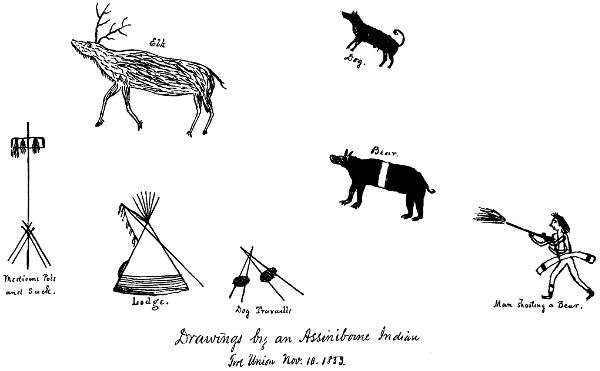
Drawings by an Assiniboine Indian Fort Union Nov. 10. 1853.
BUREAU OF AMERICAN ETHNOLOGY
FORTY-SIXTH ANNUAL REPORT PLATE 65
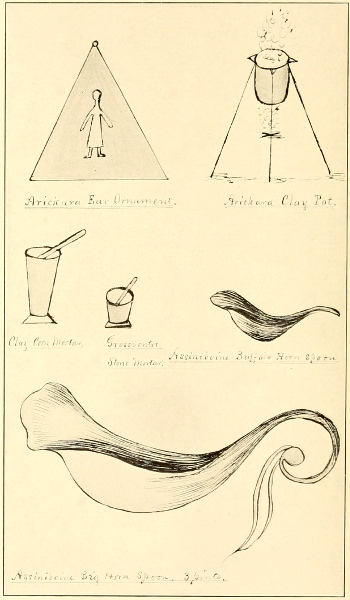
Culinary Utensils
BUREAU OF AMERICAN ETHNOLOGY
FORTY-SIXTH ANNUAL REPORT PLATE 66
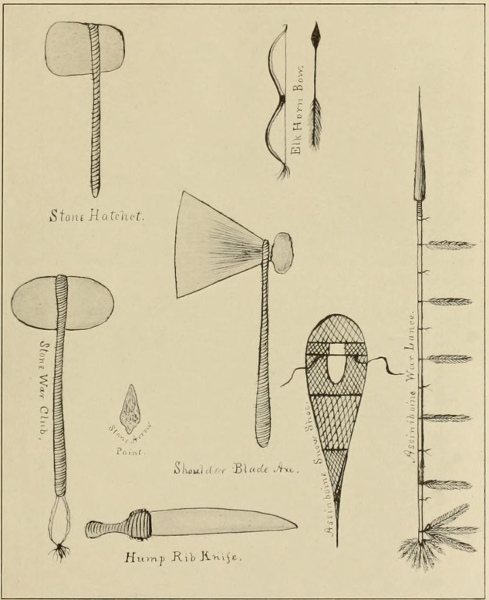
Characteristic Implements of the Assiniboine
BUREAU OF AMERICAN ETHNOLOGY
FORTY-SIXTH ANNUAL REPORT PLATE 67
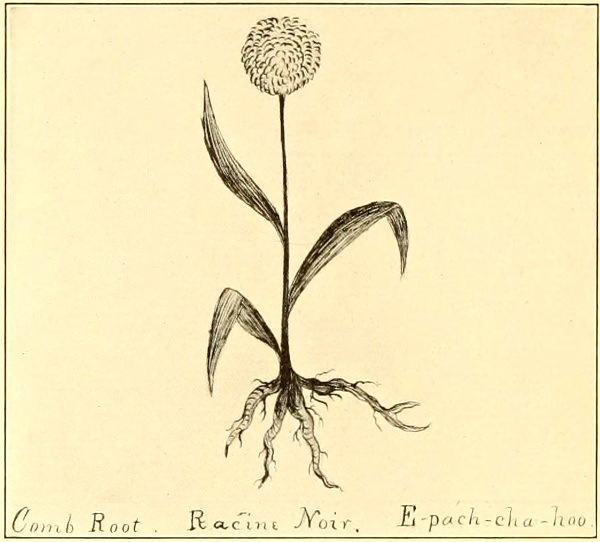
a, Comb root.
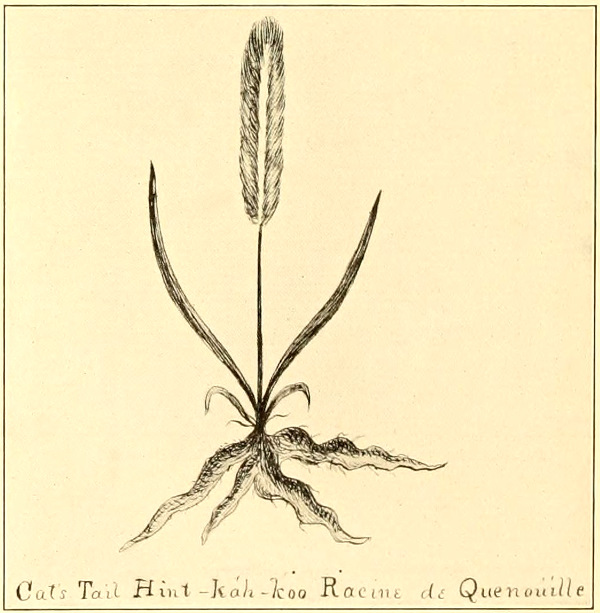
b, Cat-tail.
The Sun.—They take the sun to be a large body of fire, making its daily journey across the plains for the purpose of giving light and heat to all, and admit it may be the residence of Wakoñda; consequently it is worshiped, venerated, smoked, and invocated on all solemn occasions. We have often endeavored to explain the diurnal revolution of the earth, representing the sun as stationary, but always failed. They must first be brought to understand the attractions of cohesion and gravitation, for, as a sensible Indian stated on one of these occasions, “If at midnight we are all on the under side, what is to hinder the Missouri from spilling out, and us from falling off the earth? Flies, spiders, birds, etc., have small claws by which they adhere to the ceiling and other places, though man and water have no such support.”
The Sky.—Those who take the trouble to explain state the sky to be a material mass of a blue color, the composition of which they do not pretend to say, and think it has an oval or convex form, as apparent to the eye, resting for its basis on the extreme boundaries of the great plain, the earth. Hence their drawing, which is almost the only form in which they could represent it. Stars are small suns set therein, though they think they may be large bodies appearing small by seeing through space. Space is the intervening distance between earthly and heavenly bodies.
The Indians can not rationally account for an eclipse, supposing it to be a cloud, hand, or some other thing shadowing the moon, caused by Wakoñda to intimate some great pending calamity. Many are the prophecies on these occasions of war, pestilence, or famine, and their predictions are often verified. Predicting an eclipse does not appear to excite their wonder as much as would be supposed. The writer predicted the eclipse of the moon on December 25, 1852, months before, but received no further credit than that of having knowledge enough from books to find out it was to take place.
Their year is composed of four man-ko´-cha or seasons, viz., wai-too (spring), min-do-ka´-too (summer), pe-ti-e-too (autumn), wah-nee-e-too (winter). These are only seasons and do not each contain a certain number of days, but times—a growing time, a hot time, a leaf-falling time, and a snow time. These four seasons make a year which again becomes man-ko´-cha or the same as a season. This is difficult to explain. They count by the moon itself and its different phases, not computing so many days to make a moon, nor so many moons to a year.
They give each moon its name, beginning, say, with the March moon whenever it appears either in February or March, when it would be wee-che´-ish-ta-aza, sore eye moon; next would follow Ta-pa´-ghe-na-ho-to, frog moon; next pe-tai-chin-cha´-ton, buffalo calf moon; next wee-mush-tu, hot moon; next wah-pa´-ze-ze, yellow-leaf moon; next wah-pa-ich-pa´-ah, leaf-falling moon; next yo-ka´-wah-how-wee, first snow moon; next we-cho-kun, middle moon; next om-hos-ka-sun-ka-koo, lengthening days moon’s brother; and next om-has-ka, lengthening of days moon. Their year has no beginning nor end. They count and name the moons as they come, and these names are also varied. Any annual remarkably known fact respecting the season can be applied to the name of the same moon. Thus the sore-eyed moon can be called the snow-melting moon, and the falling-leaf moon be termed the moon when the buffaloes become fat. These moons suffer no divisions of time except their phases, viz., new moon, increasing moon (first quarter), round moon (full moon), eaten moon (second quarter), half moon, dead moon (invisible). Among themselves they have no division of time equal to a week, although they are aware that we count by weeks, or divining days (Sundays), and will often ask how many divining days (or Sundays) there are to a given period.
An Indian in counting any period less than a year will say 3 moons and a full (3½ moons), 4 moons and an eaten one (4¾ moons), 6 moons and an increasing one (6½ moons), etc. These serve all his purposes and when wishing to be more minute and exact he must notch each day on a stick. For a year or four seasons they say a winter. A man may say “I am 40 winters old and one summer.” Yet sometimes the same man will say, “I am 40 seasons old.” This is still right. He will also say that he is 80 seasons old, or 160 seasons old. All of these are correct and understood immediately, as in the one case you mentally take the half, and in the other the quarter. This is often done among themselves, but with whites they generally name the winter only to designate the year, yet man-ko´-cha (season) is the right name for a year and would be received as such by all the Assiniboin. The day is divided into the following parts: hi-ak-kane (daylight), umpa (morning), wee-he-num-pa (sunrise), wee-wa-kan-too (forenoon), wi-cho-kun (midday), we-coo-cha-nu (afternoon), we-coh-pa-ya (sunset), hhtie-too (twilight), eoch-puz-za (dark), and haw-ha-pip-cho-kun (midnight). Any intermediate space of time would be indicated by pointing the finger to the place the sun is supposed to have been at that time. They know nothing of the division of hours and minutes, yet some of the squaws living a long time in the fort can tell the hour and minute by the clock.
They know that the minute hand makes the revolution of the dial plate before it strikes and know the figures from 1 to 12; also that each figure is five minutes apart, and will say it wants so many fives to strike 9, or it has struck 10 and is 5 fives past. This they pick up nearly of their own accord, which proves that some are susceptible of intelligence and education. They know nothing of the solstices nor have any period such as a cycle or century, neither do they believe the world will come to an end or that their priests or any others have the power to destroy or rebuild it.
They know and name the North Star the same as we do—wa-se-a-ure-chah-pe (north star)—and also know the Ursa Major, sometimes calling it the “seven stars” and “the wagon.” They are aware that it makes its revolution around the polar star, pointing toward it, and this is the secret of their traveling by night when there is no moon. They call no other stars by name. The Milky Way is said to be moch-pe-achan-ka-hoo (the backbone of the sky). It is known by them to be composed of clusters of small stars, but they suppose it to bear the same relative position to the arch of the heavens, and to be as necessary to its support as the backbone of any animal to its body. Meteors are falling stars which become extinguished as they fall. They attract but little attention as their effects are never perceived. Aurora borealis is believed to be clouds of fire or something the same as electricity. Being very common and brilliant it creates neither wonder nor inquiry.
The moon is not believed to influence men or vegetables nor to have any other properties than to give light by night.6 They suppose it to be made of some body wasting away during a given period. Some say it is eaten up by a number of small animals (moles) and Wakoñda makes a new one on the destruction of the old. They know very well that all this is error and that the whites have a better philosophy, but will not take the trouble or can not comprehend our views of the motions of heavenly bodies. Having nothing else better explained to them, they adhere to their own ideas, which are of the simplest and most primitive kind, and do not appear to wish them superseded by others which they can not understand. The same remark would apply to all their astronomical and geographical opinions. They have a correct knowledge of the cardinal points, and honor the east as the first from the fact that the sun rises there. The pipe is first presented to the east, then to the south, supposed to be the power of the spirits of their departed friends, then west, then north, and lastly to the earth as the great grandfather of all. The amount of facts or real information they can give are mentioned and as for further explanations, as observed before, they do not delight to talk about these matters but appear to think them sacred or forbidden fields through which their thoughts ought not to roam. The subject affords no scope for research unless a writer is disposed to collect a number of fables, which would serve no purpose unless it be to develop their ignorance and superstition.
Future Life
Indian Paradise.—The Paradise of these Indians is in the south in warm regions (not necessarily in the heavens, yet in some imaginary country not belonging to earth), where perpetual summer, abundance of game, handsome women, and, in short, every comfort awaits them; also the satisfaction of seeing their friends and relatives. No quarrels, wars, disturbances, or bodily pain are allowed to exist, but all live in perfect harmony. Departed spirits have the power to revisit their native lands, manifest themselves to their friends in dreams, and if they have been neglectful in crying for or feasting them can trouble them with whistling sounds and startling apparitions, many of which are said to be seen and heard and are most religiously believed in by all. Consequently, the dead are feasted (a long ceremony), smoked, sacrificed to, and invoked, besides being cried for years after they are gone, perhaps as long as any of the relatives are living. The heavenly bodies they think may also be residences for spirits, but we think this idea is derived from the whites. The other is the most ancient and original tradition, if not the only one, and is universally believed. This subject will meet with further notice in the course of these pages.
Arithmetic
Numeration.—All these prairie tribes count by decimals and in no other way. The names of the digits are:
One—washe´nah. Two—noom´pah. Three—yam´ine. Four—topah. Five—ta´ptah. Six—sha´kpah. Seven—shakkowee. Eight—sha´kkando´gha. Nine—noo´mpchewo´oukkah. Ten—wixchemenah.
After ten the word akkai, dropping the name of the ten, serves until twenty, thus:
Eleven—akka´i washe. Twelve—akkai noompah. Thirteen—akkai yammene. Fourteen—akkai topah. Fifteen—akkai zaptah. Sixteen—akkai sha´kpah. Seventeen—akkai shakko´. Eighteen—akkai sha´kando´gha. Nineteen—akkai noompchewoukkah. Twenty—wixche´mmene noompa; i.e. for twenty, literally two tens.
From twenty to thirty the word “sum” or “more” (plus) is added, thus:
21—wixchemmena noompa sum washena (two tens plus one). 22—wixchemmena noompa sum noompa (two tens plus two). 23—wixchemmena noompa sum yammene (two tens plus three), and so on up to thirty, which is three tens or wixchemmene yam´mene. 31—wixchemmene yammene sum washena (three tens plus one). 32—wixchemmene yammene sum noompa (three tens plus two); the same as after twenty, and the same after each succeeding ten as far as one hundred, thus— 40—wixchemmene to´pah (four tens). 41—wixchemmene topah sum washena (four tens plus one). 50—wixchemmene zaptah (five tens). 51—wixchemmene zaptah sum washena. 52—wixchemmene zaptah sum noo´mpa. 60—wixchemmene shakpa (six tens). 61—wixchemmene shakpa sum washena. 62—wixchemmene shakpa sum noompa. 70—wixchemmene shakko (seven tens). 71—wixchemmene shakko sum washena (seven tens plus one). 72—wixchemmene shakko sum noompa. 73—wixchemmene shakko sum yammene. 74—wixchemmene shakko sum topah, etc. 80—wixchemmene shakandogha (eight tens). 90—wixchemmene noomchewouka (nine tens). 100—o-pah-wa-ghe. 101—o-pah-wa-ghe sum washea. 110—opahwaghe sum wixche´mmene. 160—opahwaghe sum wixche´mmene shakpa. 161—opahwaghe sum wixche´mmene shakpa sum washena. 170—opahwaghe sum wixche´mmene shakko. 180—opahwaghe sum wixche´mmene shakandogha. 190—opahwaghe sum wixche´mmene noomchewouka. 200—opahwaghe noompa. 300—opahwaghe yammene. 400—opahwaghe topah. 500—opahwaghe zaptah. 600—opahwaghe shakpah. 700—opahwaghe shakko. 800—opahwaghe shakandogha. 900—opahwaghe noomchewouka. 1,000—koke-to-pah-wa-ghe. 1,853—koketopahwaghe sum opahwaghe shakandoga sum wixche´mmene zaptah sum yammene. 2,000—koketopahwaghe noompah. 3,000—koketopahwaghe yammene. 4,000—koketopahwaghe topah. 10,000—koketopahwaghe wixchemmene. 20,000—koketopahwaghe wixchemmene noompa. 50,000—koketopahwaghe wixchemmene zaptah. 100,000—opahwaghe koketopahwaghe. 500,000—opahwaghe zaptah koketopahwaghe. 600,000—opahwaghe shakpah koketopahwaghe. 10,000,000—opahwaghe wixehemmene koketopahwaghe.
Although the computation could thus be carried on to a million yet the Indian would not appreciate the number. We think that after 5,000, or at the utmost 10,000, their ideas fail them; that is, they can not realize in thought more than that amount, yet are able mechanically to count it. This is evident, as they have no distinct name for a million, but are obliged to call it ten hundred thousand, and were they requested to go further would proceed eleven, twelve, thirteen hundred thousand, etc., but not comprehending the great number as a body. They can not multiply or subtract uneven sums without the aid of small sticks or some other mark. Thus to add 40 to 60 would be done by the fingers, shutting down one for each succeeding ten, naming 70, 80, 90, 100. But to add 37 to 94 would require some time; most Indians would count 37 small sticks and beginning with 94, lay one down for each succeeding number, naming the same until all were counted. Now tell them to add 76 to 47 and subtract 28. In addition to the first process, and counting the whole number of sticks, he would withdraw 28 and recount the remainder. They are easily confused when counting and consider the knowledge of figures one of the most astonishing things the whites do.
In counting with the hand, an Indian invariably begins with the little finger of the left, shutting it down forcibly with the thumb of the right; when the five fingers are thus shut he commences on the thumb of the right, shutting it with the left fist. When wishing to telegraph by signs a certain number less than 10 he holds up that number of fingers, beginning with the little finger of the left hand and keeping the others shut. Should the number be 7, then all the fingers of the left and thumb and finger of the right would be extended, holding up his hands, the rest of the fingers closed. Tens are counted by shutting and opening both hands; thus, 100 would be indicated by shutting and opening both hands 10 times in succession. The number 7 has two names, shakkowee and enshand (the odd number). They count fast enough in continuation from 1 to 100 but must not be interrupted.
Coin.—There is not now nor have we any reason to suppose there ever has been among them any coin, shells, wampum, or any other thing constituting a standard of exchange, neither are they acquainted with American money. Were a guinea and a button presented there is no question but the Indian would take the latter. They barter their furs for goods which have fixed prices, and are well acquainted with these prices, as also of the value of their robes and furs as a means of purchasing merchandise.
Keeping Accounts.—The Indians themselves keep no accounts. The manner in which accounts are kept by whites with them is as follows. We are not exactly acquainted with the minor operations in accounts kept by the Hudson’s Bay Co. with the Cree and the Chippewa, but from authentic information the following appears to be their system. A plue is equal to 1 pound beaver skin or 3 shillings sterling (say 67 cents); that is, 1 pound of the fur is worth at their forts 67 cents in merchandise at their fixed prices. Therefore a large beaver skin (2 pounds) is 2 plues; 6 muskrats, which are worth from 10 to 12½ cents each, is a plue; 1 wolf skin is counted a plue, being equal in value to the standard 67 cents; an otter skin is 2 plues, a red-fox 1, and so forth.
All skins and other articles of trade acquired by Indians are reckoned into plues by the trader and the Indians and the prices of merchandise are computed in the same manner. On the Missouri the plan is somewhat different, to explain which we annex the following accounts copied from our books. It will be necessary to observe that everything is brought to the standard of buffalo robes which have an imaginary value of $3 each in the country.
The Crazy Bear, Assiniboin Chief
1851 Dr. 1852 Cr.
Dec. 3 To 1-3 pt. white blanket 3 robes. Jan. 8 By 6 robes 6 robes.
To 2 yards blue cloth 2 robes. By 2 dressed cow skins 1 robe.
To ¾ yard scarlet cloth 1 robe. By 30 pounds dried meat 1 robe.
To 2½ pounds tobacco 1 robe. By 2 red fox skins 1 robe.
1852 By 2 raw cowhides 1 robe.
Jan. 16 To 1 horse 10 robes. By 1 large elk skin, raw 1 robe.
To 3 knives 1 robe. Feb. 10 By 4 robes 4 robes.
To 1 kettle, 2 gallon 2 robes. By 12 wolf skins 4 robes.
To 100 loads ammunition 1 robe. Balance forward 2 robes.
21 robes. 21 robes.
1853
Feb. 10 To balance on settlement 2 robes.
Pictorial or other signs are not used in accounts, either by them or the white people.
Elements of Figures.—A single stroke answers for 1 and each additional stroke marks the additional number as far as 100. When a stroke is made apart, the score is rubbed out and begun again. There are no written nor marked records kept, either on graves or otherwise, of ages or of events, scalps taken, or war expeditions.7 Their transactions, or coups, as they are called in this country, are pictured on their robes, lodges, and shields, but these wearing out are seldom renewed, particularly when the man becomes old. Also these coups are recounted publicly by the performer on occasions appointed for the purpose, which we shall notice hereafter, and moreover, are talked of often enough around their firesides. Ages are numbered by particular events that took place at the time they could first recollect, and afterwards by certain remarkable years from time to time. Though no Indian can be sure as to his exact age, yet he will not vary more than a year or two as to the time. The cross (X) is not used in counting or for any other purpose, neither does the dot or full comma signify a moon or anything else.
Medicine
General Practice.—They are careful of their sick relatives and particularly so in regard to their children or men in the prime of life. Very aged persons do not, however, meet with such kindness even from their own children, having become useless as a help in camp. Besides being a burden in traveling and a bore and expense, they are anxious to get rid of them and leave them on the plains to die. It must, by no means, be inferred from this that the Indian has no paternal feelings or affection; from several instances of the kind that have come under my observation I am assured it is their inability to carry about and along with them aged people. These Indians are poor, have but few horses and are constantly on the move, in all weather, sometimes requiring flight; therefore everything that might encumber in the way of baggage is thrown aside, and among other rubbish is classed the aged of both sexes. I am also told that it is often the desire of the aged to be left to die. To keep up appearances with his people, the Indian will generally pay a small doctor’s bill for the relief of his aged relatives, but nothing like the amount the same man would pay for his wife or child. To explain their mode of practicing medicine, surgery, etc., we must be somewhat prolix.
In every camp there are several doctors, both men and women, called by them divining men, who have the double reputation of physicians and sorcerers. This is generally some old wretch who is very ugly, of great experience, and who has art enough to induce others to believe in his knowledge, and can drum, sing, and act his part well.
The present great doctor and soothsayer is named “Bull’s Dry Bones,” a very old man who is now with me. This man was once sick and died while the camp was traveling. His friends packed and tied him up in several envelopes of raw hides, blankets, etc., and, after duly crying over him, placed the body in the fork of a tree as is their custom. By some means, however, the man came to life and after great difficulty worked himself out of his bonds, traveled and overtook the camp some days after they had left him. He stated to them that during his decease he had been in other worlds, seen much, knew everything, past, present, and future, and from this circumstance he has ever after been considered a great divining man and prophet. We will now state how they proceed in case of sickness. A child falls sick. The father or some other near relative immediately sends a gun or a horse to the divining man to secure his services. Sometimes smaller articles are sent, and the doctor, thinking them beneath his notice, will not pay a visit until enough is offered, which amount varies in proportion as the patient’s relatives are rich or poor. He then enters the lodge of the sick person in his medical capacity. His instruments are a drum, a chi-chi-quoin, or gourd rattle, and, perhaps, a horn cupping apparatus. He must have (although not perceptible) some things concealed in his mouth or about his person, as will presently appear, although they go usually through their operations entirely naked (except the breechcloth) and not in a hideous costume as has been represented. The doctor is accompanied by five or six others as old and ugly as himself, bearing drums, bells, rattles, and other noisy instruments.
All sing to the extent of their voices and make a terrible noise with the instruments spoken of. The doctor slowly approaches the patient, applying his mouth to his naked breast or belly, draws or appears to draw therefrom by suction a worm, sometimes a bug, a wolf hair, or even a small snake, making at the same time horrible gestures, grunts, and grimaces. This object he displays to the lookers-on, stating he has extracted the cause of the disease. This operation is repeated several times with like results, and after he and the accompanying band of music partake largely of a dog or other feast provided for them they leave for the time. The whole performance, with the music, incantations, preparations, and feast included, would occupy perhaps from two to three hours and often the whole night, if the performers are paid high. Frequently their diseases are colic from eating unripe fruits and berries or overloading the stomach, which, of course, get well in a short time and the credit is given to the doctor, each recovery aiding to raise his reputation and enlarge his practice. But if the case is serious and the patient gets worse, the doctor is then paid again and another visit takes place. The forms are always somewhat similar, but on this occasion, in addition to the full band of music and cupping with the horn, besides the usual grimaces, noises, etc., the patient is made to drink decoctions of roots or powders made by the doctors of pulverized roots, rattles of the rattlesnake, calcined bones, etc., the properties of which he is entirely ignorant, and probably the smallness of the dose preventing them from doing any harm. This, with the noise of the instruments and feast, concludes the second visit.
Sometimes the doctor performs alone and keeps up the drumming, etc., all night. In this way by a repetition of visits, if the case is of long duration, the whole of the property of the relatives of the sick person falls to the doctor and his assistants, who are also slightly paid for the music. And this is the cause of great individual distress and poverty, though the property given does not go out of the nation, but only changes hands and is liable in like manner to revert to others should the divining man fall sick. In case, after all, the patient dies, it is then the doctor who is in danger, and runs great risk of losing his life, by the parents or relatives of the deceased. Indeed, being aware of this they generally abscond to other camps when death approaches, and whatever property they leave behind is taken from them. No later than last winter the writer paid an Indian to prevent his killing the “Bull’s Dry Bones” (doctor) who the man said had poisoned his two children six years ago. But the old doctor, although a humbug, is an innocent man and would harm no one.
They have various forms of doctoring, in all of which the drum forms a principal figure, and songs and incantations, all of which are most religiously believed in by the Indians. Old women are as often practitioners as old men and of as great celebrity. There is also another reason why these Indians give away so much of their property to the divining man. Independent of these payments securing the doctor’s services, they are considered as sacrifices; that is, the man makes himself poor with a view of propitiating the Great Spirit.
Also it is considered and spoken of as a great honor to give away large articles to the divining man, such as horses, guns, etc., and goes to prove the affection with which they regard their sick relatives. For a long time afterwards the giver will boast of his liberality in these respects and is also looked upon as a man with a “large heart.” We must, at the risk of not being believed, state that on two particular occasions, and before witnesses, we have examined the divining man’s mouth, hands, and all his person, which was entirely naked, with the view of discovering where these worms, snakes, etc., were hidden, and that these examinations were made without any previous intimations to him who, never having been subject to examinations of the kind by Indians, was completely unprepared for the trial, yet he acquiesced cheerfully, afterwards continued his performance, and repeated it in our presence, drawing and spitting out large worms, clots of blood, tufts of hair, skin, etc., too large to be easily secreted, and leaving no visible mark on the patient’s body. The trick was well done and not yet known to any of us.
Their knowledge of anatomy consists in being acquainted with the larger bones and joints. They can set a broken arm or simple fracture tolerably well, and even replace a dislocated shoulder, which they do by pulling and outward pressure from the armpit, but this knowledge is not confined to the divining man nor is it his business more than any other who happens to be present. Most men of middle age have witnessed so many accidents of the kind that they can do this.
They are, however, unacquainted with the circulation of the blood and with any judicious treatment of internal diseases, for all of which they resort to incantations and drumming. They do, however, indiscriminately use the vapor bath or sweat house for various complaints. This construction is a small lodge thrown over a basketwork of willows stuck in the ground and bent in an oval or round form, the skins well pinned down and every aperture well closed. The doctor after heating some large stones red hot and putting them into the lodge enters with the patient, both entirely naked and taking along a kettle of water and, as usual, his drum. The lodge is then shut tight by the people on the outside. A brisk singing and drumming is kept up in the lodge by the doctor, who at intervals throws water on the stones and steam is raised. A violent heat and perspiration takes place, which they endure as long as they can; as soon as the patient is taken out he is immersed in cold water, which in nine cases out of ten results in his death. In this way the Crow Indians lost nearly 200 persons three years since during a prevailing influenza. The Mandan and Gros Ventres, however, being accustomed to cold bathing from their youth, are said seldom to suffer any inconvenience but often receive benefit from the vapor bath and immediate cold immersion. They have no names for fevers, consumptions, obstructions of the liver, etc., and can not explain further than by pointing out that part of their body which is in a state of pain.
Indeed, in this climate, except consumption, rheumatism and quinsy, diseases are extremely rare; and no febrile symptoms seen except in cases of wounds and parturition when puerperal fever often occurs, and assuming a typhoid form is generally fatal. They are also exempt from paralysis, toothache and almost all the thousand nervous complaints to which the whites are subject, among which might be mentioned baldness or failure of eyesight from age. Their materia medica is consequently in a very primitive state. They have no medicine except some roots, some of which are known to be good for the bite of the rattlesnake, frozen parts, and inflammatory wounds. The principal of these is the black root, called by them the comb root (pl. 67, a), from the pod on the top being composed of a stiff surface that can be used as a comb. It is called by the French racine noir, and grows everywhere in the prairie throughout the Indian country. It is chewed and applied in a raw state with a bandage to the part affected. We can bear witness to the efficacy of this root in the cure of the bite of the rattlesnake or in alleviating the pain and reducing the tension and inflammation of frozen parts, gunshot wounds, etc. It has a slightly pungent taste resembling black pepper, and produces a great deal of saliva while chewing it. Its virtues are known to all the tribes with which we are acquainted, and it is often used with success. A decoction of the root of cat-tail (pl. 67, b) is also used to reduce inflammation, and given internally to produce perspiration, but mostly as an external application for wounds, sprains, and pains of all kinds, as also the inner bark of the red willow; both of which are said to be beneficial, and are much used by the Indians and French voyageurs in all the Indian country.
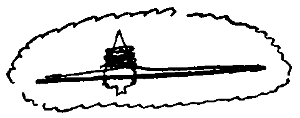
Figure 30.—Lancet
At the risk of a smile and perhaps something more from the enlightened civilized medical fraternity we will now state how they absolutely can and do cure hydrophobia, in hopes of furnishing them with a hint that may be improved upon. We have never actually seen this operation, but are as certain of its being done as we can be of anything not seen but in all other respects well authenticated. Although Indians are often bitten by mad wolves, yet they never die from the disease if operated upon. After it is known that the patient has hydrophobia, the symptoms of which they are well acquainted with, and has had a fit or two, he is sewed up in a fresh rawhide of a buffalo. With two cords attached to the head and foot of the bale the man is swung backward and forward through a hot fire until the skin is burnt to cinders and the patient is burned and suffocated [sic]. He is brought to the brink of the grave by the operation; taken out in a state of profuse perspiration and plunged into cold water; and if he survives the treatment the disease disappears. The remedy is terrible. Now, if the poison of the rattlesnake is expelled by perspiration by administering ammonia and other remedies, might not the poison communicated by the rabid animal undergo a like process by the violent treatment mentioned, or intense heat produce the desired constitutional revolution and effect a cure.
Depletion by Bleeding.—They bleed often, both when the pulse is full from sickness and at any time they think it beneficial.
The instrument is a sharpened arrow point or any other small piece of pointed iron. (Fig. 30.) They wrap the whole of this with sinew except as much as they wish to enter the vein. It is then tied into a split stick and secured firmly with sinew and being laid on the vein is knocked in suddenly with the thumb and middle finger. They also open the veins of their legs and arms while crying over dead relatives, making large transverse cuts with knives, arrow points, or flints. When they bleed they generally let the blood flow as long as it will without bandage. Cupping is done with a part of the upper end of a buffalo horn, about 2½ inches long, and a vacuum is produced by suction with the mouth which, with their powerful muscles and exertions, is, of course, double force. It is said to be useful in drawing out the poison of snake bites and is also used for pains and cramps in the stomach, besides for extracting worms, bugs, snakes, etc., as mentioned in the general practice. We believe it may have something of the effect of dry cupping with glasses; they do not, however, scarify before cupping except in cases of snake bites.
Stoppage of Blood and Healing Art.—For stopping of blood they use cobwebs, dried pulpy fungus, or very fine inner bark of trees. When these are not to be had finely pulverized rotten wood is used. These answer tolerably well when the divided artery is small. They have no good plasters or healing salves.
Bandages are mostly tied on too tight, with the view of stopping the bleeding and are left too long before being removed, which frequently results in gangrene. They are not skillful nor clean in these things, seldom washing a wound. From actual observation, which has been pretty extensive with regard to cuts and wounds of all kinds, we are disposed to believe that their cure does not depend upon any skill in treatment nor care taken of them, but upon their vigorous constitutions, extremely healthy climate, and strictly temperate mode of life, with perhaps a disposition to heal naturally in the absence of scientific knowledge vouchsafed to the ignorant Indian by an all-wise Creator.
Amputation.—They never amputate a limb, though fingers and toes often undergo that operation.8 The Assiniboin run a sharp knife around the joint of the finger and snap it off. The Crows do the same, but on other occasions take them off by placing a sharp tomahawk on the finger, it being laid on a block and the tomahawk being struck with a mallet. Whenever a Crow Indian dies his near relatives, male and female, sacrifice each a finger and sometimes two, and the loss of these people by sickness and enemies the last few years having been great, there is scarcely such a thing as a whole hand to be found in the Crow Nation. The men reserve the thumb and middle finger on the left and the thumb and two forefingers of the right hand to use the bow and gun, but all the rest are sacrificed.
They mostly take them off at the first and second joints, though occasionally lower down. These small amputations are seldom attended with any serious effect, but from their awkward operations the bone frequently projects and requires a long time to heal. They use splints and bark in fractures and lacerated bones, but are not skillful in applying them, nor attentive in removing them, and in a short time the wound smells bad. Their wounded are carried from the field in a blanket, robe, or skin, by four men each holding a corner, who are relieved by others when fatigued, in which way they transport them for days and sometimes weeks together. When very badly wounded in an enemy’s country and supposed to be mortally wounded they are left in some point of timber to die. A small stock of provisions and ammunition is left with them. They sometimes recover almost by miracle. Instances of this kind are not uncommon and serve to show the suffering an Indian will undergo and the different means he will use to preserve life.
Theory of Diseases and their Remedy.—They understand nothing of the properties of mineral medicines except a few simple ones given them by whites of later years, neither are they acquainted with the theory of diseases, being for the most part unable to describe their complaint so that any person could prescribe. They are as ignorant of any true knowledge of diseases or medicines as they are of astronomy or any other science.
It is hardly conceivable how the smallpox among Indians could be cured by any physician. All remedies fail. The disease kills a greater part of them before any eruption appears. We have personally tried experiments on nearly 200 cases according to Thomas’s Domestic Medicine, varying the treatment in every possible form, but have always failed, or in the few instances of success the disease had assumed such a mild form that medicines were unnecessary. It generally takes the confluent turn of the most malignant kind (when the patient does not die before the eruption), which in 95 cases out of 100 is fatal. It appears to be the natural curse of the red men, and here we leave it, perfectly willing others should do more. We have from year to year tried to introduce general vaccination with kinepock among them, and have even paid them to vaccinate their own children, but they will not have it done to any extent, and the few who will do it more to please us than to benefit themselves. Moreover, should any accident happen to the child or even should the Indian miss his hunt, or any casualty befall him or his family, the vaccination would be blamed for it and the good-hearted operator would find himself in a position of danger and expense. There is also great risk in giving them medicines, for should the patient die the whites would be blamed for poisoning him, and should he live the Indian drummer or doctor will get both the credit and the pay. Therefore, as their customs at present stand but little can be done for them, however willing people are to attempt it.
Parturition.—Men never interpose their services in cases of parturition.
When there is danger a midwife is called, and the deobstruents administered are castoreum and pulverized rattles of the rattlesnake, either of which have the effect of the ergot. Shampooing is also resorted to with the view of detaching the fetus or expelling the envelope. Nevertheless strangulation and consequently death of both mother and child often happens, not so much in the natural course as when destroyed expressly in utero, as is done by the Crow women and sometimes by the Assiniboin, though not to such an extent by the latter. This is accomplished by violent pressure on the abdomen, by leaning on a stick planted in the ground, and, swinging the whole weight of their body, they run backward and forward, or by violent blows administered by some other person called for the purpose, in all which operations, if the time be not well calculated for expelling the fetus, death is the consequence.