THE ASSINIBOIN2 (continued 4)
Reading edition
The whole of these Indians most sincerely believe in the theory of ghosts, that departed spirits have the power to make themselves visible and heard, that they can assume any shape they wish, of animals or men, and many will affirm that they have actually seen these apparitions and heard their whistlings and moanings. They are much afraid of these appearances, and under no consideration will go alone near a burial place after dark. They believe these apparitions have the power of striking the beholder with some disease, and many complaints are attributed to this cause. They therefore make feasts and prayers to them to remain quiet. Smaller evils and misfortunes are caused by their power, and a great many stories are nightly recounted in their lodges of the different shapes in which they appear.
Dreams are revelations of Great Mystery and have considerable influence over them, either in war expeditions or the chase. A bad dream on the part of the leader of a war party would be sufficient cause for their return, even if they were within a short distance of their enemies. It would also prevent an Indian from his customary hunting and have other effects of the like nature for a short time. Good dreams are therefore always desired and courted, particularly on the eve of war excursions. Faith in amulets and charms is general among the whole of these tribes. The material of these charms is of every possible variety, as also the different degrees of influence they exercise over different minds. The idea though thoroughly realized by ourselves is difficult to explain, but may be thus stated: Although the Great Spirit is all powerful, yet His will is uncertain; He is invisible and only manifests His power in extraordinary circumstances. The want of a tangible medium is felt, therefore, through which they can offer their prayers to all ghosts, lesser influences of evil, which overrule their ordinary occupations. Each Indian selects some object for this purpose and calls it his medicine, which is invested with a sacred character by the care with which it is guarded and the prayers, invocations, etc., made through it as a medium.
This charm or fetish is chosen in consequence of some dream or incident or idea presented on some important occasion, and consists of the skin of a weasel, otter, or beaver; heads and bodies of different kinds of birds, stuffed; images of wood, stone, and beads wrought upon skin; drawings of bulls, bears, wolves, owls, serpents, monsters, who have never existed; even a bullet worn round the neck; in fact anything resembling animate, inanimate, or imaginative creation, is selected according to the superstitious fancy of the individual. This charm, whatever it is, is inclosed in several envelopes of skin, and placed in a rawhide sack which is painted and fringed in various ways. This sack is never opened in the presence of anyone unless the Indian falls sick, when he has it taken out and placed at his head. Ordinarily this object is taken out in secret, and prayers and invocations made through it as a medium to the spirits he wishes to propitiate. They are aware that the object has no intrinsic power, but its virtue lies in their faith of their ceremonies, as exhibited through this charm as a visible medium to the supernatural. It is in fact the same operation of mind (though differently exhibited) as is displayed in the charms believed in by most of the lower order of whites. Although many ignorant white persons have faith in the charms, spells, etc., of quack doctors and old women, yet this does not destroy their belief in the Supreme Being, neither does it that of the Indian. As long as he has success in his different ordinary undertakings and is not troubled with the evils he fears, he will continue to say his medicine is good, but should he be disappointed and the case reversed, he will throw the charm away and substitute some other.
Thus the writing, paintings, and pictures done by whites are considered great charms by some Indians, particularly the Crows, and are eagerly sought after as such. In the same light is regarded the medal of the crucifixion given them, by Catholic priests.
What is the actual character of their worship when closely analyzed?
It is hoped that the preceding remarks have rendered this character plain. All their prayers, sacrifices, feasts and personal inflictions tend only to advance their temporal welfare and interest.
Several tunes are sung on some of these occasions when presenting the pipe to the Sun, etc., that are of a sacred character, partaking of the nature of thanksgiving for any signal success in war or otherwise. A few words are used, but the chant is solemnly performed without their usual gesticulations or levity.
The custom of holding as sacred the cult of the tobacco plant is general. No ceremony of importance takes place among them in which the pipe is not used. There are, however, several solemn occasions in which the manufactured tobacco will not answer, when they use that grown by themselves. These customs occur among the Mandan, Gros Ventres, Arikara, and Crows, the only nations who cultivate the tobacco plant. Sacrifices of small quantities of tobacco are also made on many occasions, and always a small piece is found wrapped with the medicine pipe or inclosed in the medicine sack.
Why it is considered sacred they can not explain, and the idea appears one of the most ancient and original among them.
These tribes do not worship fire in any form. The Sun is thought to be a body of fire and is worshipped next to the Great Mystery by all of them, not, however, because it is fire (though being luminous no doubt originated the idea) but because it is believed by most of them to be the residence, and by some the eye, of the Great Mystery. It is worshipped as the greatest visible symbol of the Great Mystery. No other ceremonies are in existence among them by which we would judge that fire is regarded with more reverence than water. On some occasions councils are opened with fire struck from flint, such as peace-making between two nations, ceremonies in the medicine lodge, and feasts to the dead, but in all ordinary councils among themselves this distinction is not made. In the cases where it is obtained from the flint it seems to be merely an adherence to ancient custom. No extra benefits are expected on that account, neither when questioned do they attach much importance to the fact. Fire would be nothing without the tobacco. In all these ceremonies with which we are well acquainted, we can safely say that the tobacco is the sacred material (not the fire). The rest depends on their invocations, etc., to the Great Mystery or his symbols to render the whole of an effective character in their estimation. We can not by inquiry find that there has ever been among them or their ancestors an idea of a holy or eternal fire.
Omens have great influence on them on all occasions and are of every possible variety. Storms, severe thunder, croaking of ravens, and unusual sounds in the night, or even the fall of their medicine sack or medicine pipe, would be sufficient to turn back a war party if any of these omens were considered by their leaders as unfortunate in their predictions, which they generally do. Councils would not proceed during severe thunder, an eclipse, or any unusual phenomena, though smaller omens would not be regarded. The flight of birds is seldom if ever considered ominous unless their passage be accompanied with some unusual appearances. Howlings of wolves and foxes in a peculiar manner, whistling and meanings of ghosts, and bad or bloody dreams would prevent the individual from war or the chase for a short time.
From all that has been written concerning their religion we would rather others would decide whether the Indians are in reality idolaters. That they render a species of worship to idols of almost every description is true, yet this worship only refers through these toys or charms to the great source of all power, or to supernatural interference. They do not believe in the virtue of the material of which they are made, nor do they ascribe to them an immaterial spirit, but the mind by viewing them has a resting point, a something to address in form, not for great protection and aid, but for daily favors, and averting of smaller evils.
Uneducated as they are, obliged mentally to grasp at protection from supernatural evil, in every way, from the great luminary the sun, as the most powerful, to the smallest atom that may possibly be of some aid, they, through these images or objects, endeavor to excite the interest of the Great Mystery, an Unknown Power, to whose approach no one certain way presents itself. If this be idolatry, be it so.
What else could be expected? That the Indians should be in advance of Christians, who have their charms, their chance, their fortune, and other ideas fully as repugnant to the belief in an all-wise disposer of events, as the customs of the Indians present? The very fact of the general practice of this species of idolatry appears to us to be the greatest evidence of their being true worshipers. It is in fact acknowledging a supernatural agency in everything; a belief in a ruling providence over this life in every situation. If their minds pursue wrong directions, and their prayers are for temporal, not spiritual welfare, it is not their fault. Why should they desire what they do not want? If no moral sense of right and wrong is found among them, no sins acknowledged, nor future punishments feared, it must follow that temporal welfare and personal advantage are all that remains worth praying or fasting for. If they pray and sacrifice to the sun and thunder it is nothing more than acknowledging the existence and power of God in these, His works.
If they depend on fetishes and amulets to aid them in ordinary life it is what many Christians do in a different way, yet these are not accused of idolatry. If the right ideas were instilled into the mind of the Indian he would be no more the savage, but the Christian, and would worship the same being in a different sense and form than he now does in any way his distorted imagination thinks may prove effective. Great evil or great good is evaded or invoked from the Great Spirit through great apparent mediums, as the Sun and Thunder.
Smaller evils and smaller benefits are averted or sought through the medium of charms which though not intrinsically of any virtue, yet benefits are the consequences attending on their prayers through them, their character being rendered sacred by constant care, and the importance of their position as mediums of worship. The identity of the Great Spirit as a being appears to be lost in their worship of the portions of creation capable of inspiring them with fear. His existence as a cause is admitted, but we do not observe He is often addressed except through some visible medium, which is as it were a separation of his power among these objects or animals.
The medicine sack contains the fetish or charm referred to, which with a lock of some dead relative’s hair and a small piece of tobacco is inclosed in several envelopes of skins of different kinds, on which pictures of imaginary or real animals are rudely drawn.
This sack is made of raw buffalo hide (dried), the hair scraped off and painted and fringed in various ways. It is well tied up, not pried into by anyone, and mostly suspended to a pole outside the lodge in camp or carried on the back of some woman when traveling. When the owner dies it is buried with him. This is the arcanum of the medicine sack, and it possesses none of the features of an ark, either inside or out.
Immortality
That the soul lives after death is the general assent, and that this is a final state, but by pursuing the inquiry we do not arrive at any certain idea of their occupation there, as they will always say they do not know. This much, however, some acknowledged, that when they die their soul is taken to the south to a warm country, though this place does not appear to be either on the earth or in the heavens. Here is a state of pleasure and happiness, free from all disease, trouble, want, war, or accident. Some are more comfortably situated than others, particularly those who have been great warriors and those who have been attentive to their sacrifices and other ceremonies. No punishment for offenses is apprehended, though rewards are granted. If still questioned they will describe a counterpart or nearly so of the Mohammedan paradise, or a shadowy image of this life, abstracting the evil. There is no resurrection of the body, though they are presumed to have other bodies furnished them in the future state, that present the same features as in this life, yet are not subject to its vicissitudes.
Animals of all kinds are found there, though it does not appear that they are the souls of those which lived in this world. Reasoning powers and immortality are not ascribed to the brute creation. Everything referring to a future state is not made the subject of their conversations, and each man’s opinions differ. Some deny any such a state and think death final to soul and body. Others that the soul never leaves the neighborhood of its burial place. All information regarding their belief in futurity is with difficulty extracted, and not much importance is placed on the fact of their being immortal beings; at their death also the greatest anxiety appears to be about their family and relations left behind. They admit its uncertainty, and fear nothing on the score of future punishment. Upon the whole there is nothing in their belief of a future state which affects much their general conduct through life and as little on the approach of death. From this fact we may conclude very reasonably that the foregoing system of their religion is the correct one, as they do not feel guilty of moral offenses toward the Great Spirit entailing future punishment, but expect to be rewarded for their devotedness in their manner of worship. These Indians will also smoke, invoke, and give small pieces of tobacco to the head of a bear after they have killed it. But this does not imply they are to meet the animal in a future state. It is a kind of thanksgiving, through the bear’s head, to the powers that have enabled them to accomplish the feat of killing it without accident.
The killing of a grizzly bear by a single man is no trifling matter and deservedly ranks next to killing an enemy. A coup is counted for that action in their ceremonies where they publicly recount their brave exploits. Moreover, every year persons are torn to pieces by these animals when wounded or surprised in thickets where the person can not escape. Therefore all ceremonies to the dead animal would have the nature of invocations for aid and protection from the supernatural powers whose business it is to interfere, and indeed such their words imply on these occasions. It may have been some such ceremony the Indian on the shores of Lake Superior made which was mistaken for begging the animal’s pardon.
Mythology
This subject would not present any useful information and only tire the reader with endless fable without arriving at any important conclusions. We could fill volumes with their stories of giants, demons, transformations of men into animals and other shapes, but do not think any fact thus elicited would avail any useful purpose. There are a great many traditions that would seem to prove that the doctrine of metempsychosis has formerly been the general belief, but they do not appear to put much confidence in their reality at the present day, and these stories are told more for amusement every evening than anything else. Neither does it please absolutely to contradict or deny that such things have been. In this way beaver are said to have been once white men from the sagacity they show in building their lodges, evading traps, etc. Thunder is said to be the flapping of the wings of the large medicine bird. Piles of rocks are supposed to have been heaped up by large white giants. The rainbow is called the sun’s wheel; though they are aware that the colors are formed by the sun shining through rain. All these and hundreds of others have legends of their formation which are very long and one or two generally occupy an evening to relate. Most of them, however, contain a kind of moral or double meaning and are occasionally interesting and imaginative, sometimes obscure.
To present an example we will record one recited by the “Thunder Stomach,” an Assiniboin warrior at the time we write and interpreted by myself, preserving as nearly as possible all the words and actually all the ideas of the Indian.
LEGEND OF THE ORIGIN OF THE URSA MAJOR AND POLAR STAR, BY THE THUNDER STOMACH, AN ASSINIBOIN WARRIOR
In the beginning a few Indians were made far in the northern regions. No sun nor moon had yet been formed, and all was utter darkness except the light of the snow. A lodge of Indians was situated on the bleak plains inhabited by eight persons who were seven brothers and one sister. The brothers all went out hunting and left the woman at home working at raiment. In their absence a stranger came outside the lodge and called to the woman to come out, using flattering words with a sweet mouth, but she moved not, nor looked upon his face. When her brothers returned she related the circumstance, and the eldest said, “You did right, my sister—had you listened to this man’s sweet words and looked upon his face, you would have been obliged to follow him wherever he went, without the power to stop or turn back.” She said nothing but continued her labors and they again left to hunt.
Being anxious to ascertain the truth concerning the stranger and expecting his visit, she put on four complete suits of raiment and four pairs of moccasins, one on top of the other; also tied on a pair of snowshoes. He came and used the same flattering words, when she stepped outside and looked upon his face. He immediately departed at a swift pace and she was obliged to follow in his tracks. Onward they traveled far over the plains in a northerly direction and over immense piles of snow. A long time passed without diminishing their speed, until at length they came to a lodge full of men (beings). Her conductor entered and disappeared, she followed and not seeing him took her seat near the door. “Move to the next,” said the man at her side, “I am not he whom you seek,” and she moved where he directed. “Farther on,” said her neighbor, and she again changed her place. “Next,” said the other, and she moved in this way from one to the other, until by making the circuit of the lodge she at last found herself at the entrance without seeing the one whom she had followed hither. She was about to leave the lodge when the eldest Indian, apparently the master, said, “Remain, I will tell you a story.” She stopped. “There was once a woman,” he continued, “who ran off with a young man, and came to a lodge full of strangers to seek her lover. She had on four entire dresses, and not finding the man, would have left, but one of her dresses fell off.”24
On saying this, an entire dress and pair of moccasins disappeared. He repeated the words four times and at the end of each repetition a dress was missing, which left her naked. They then took her up and cast her out into the cold snow to freeze to death.
The brothers on their return from hunting missed their sister and suspecting the cause of her departure followed the tracks and arrived outside the lodge where they found their sister nearly frozen to death. After wrapping her in a robe, and she had somewhat recovered, the eldest brother said, “Go back into the lodge and tell them a story in return.” She entered and said, “I come to tell a tale. There was once a woman coaxed off and forced to follow a strange man. She came to a lodge of strangers, who instead of protecting her, robbed her of all her clothing and threw her out in the snow to die. Such men have no hearts.” On concluding, the hearts of all the Indians inside flew out of their mouths and stuck to the lodge poles outside, where they were cut to pieces by the brothers. She left with her brothers for their home, but got separated from them in a snow storm and wandered every way, she know not whither. In the end, after a long time she came to a large house of iron with flames of fire coming out of the chimney. She feared to enter. “Come in,” said the master of the house. “If I enter, how shall I be treated? What relation shall I bear to you?” “I will be your brother,” he said. “No,” was the answer. “I will be your father.” “No,” was again the answer. “Your uncle,” “your friend,” still “no” was her answer. “I will be your husband.” This time she replied “Yes,” the large iron doors flew open and she entered, they closing violently behind her.
The inhabitant was a large, ugly man, and the interior of the building was strewn with human carcasses half devoured in their raw state. He was the first cannibal! The woman would have fled but could not, and was compelled to become his wife according to her promise. He treated her badly and although not forcing her to eat human flesh was continually devouring it himself. They lived as man and wife for a length of time, during which she had a male child by him. The brothers had never given up the search for their lost sister, and in the course of their travels for that purpose came to the house of the cannibal during his absence. The woman let them in and recognized them. The child was beginning to speak a few words, and among the first he pronounced were: “Mother, what fine, fat men; kill one of them that I may eat some good meat.” The brothers stared—the child was a cannibal! “You little fool,” said the mother, “would you eat your own uncle?” The brothers held a council with their sister as to the way the cannibal being could be killed and she undertook his destruction. It appears this being had the power of coming into his house any way he chose, through the floor, through the walls, or any other manner, and the only vulnerable part of him was a cavity in the top of his head, not protected by the bone of the skull. She heated a stone red hot, and when the cannibal as usual was coming up through the floor, head foremost, she threw the stone into the hole in his head and burned up his brains, causing instant death.
She then fled to a place of rendezvous appointed by her brothers, taking her child along. They returned to their home with their sister, and when they arrived held a council and condemned the child to death, to prevent the propagation of the race of cannibals. It was killed by the mother, and on killing it she was changed into a body of fire, caught up into the heavens and placed as the first star in the north, which was the polar star. The seven brothers were also changed into stars and form the constellation known as the Great Bear and are appointed to walk around and keep guard over their sister forever.
After the narrator had concluded I inquired if it had any other meaning than a story told to excite interest. He said it had, and that it showed the woman was revenged on all her persecutors, and for her resolution and good in cutting off the first cannibal and her own son, thereby destroying the species, was rewarded by being placed as a star; likewise her brothers who had protected her through life were stars also and guard her from harm. That if she had not acted thus a great part of the Indians would be cannibals. This he said was the commencement of stars, and their traditions named many other instances of like manner in which stars were created.
Manners and Customs
Constitution of the Assiniboin Family; Kinship.—There are terms for each degree of relationship and the collateral branches. These affinities are traced as far back as the great-grandfather, and the line of descent is distinguished by their referring to the names of the grandfather, father, or parents through some of their descendants living. The names for collateral relatives are the same by the father’s as by the mother’s side. All stepchildren become the children of all the wives the Indian has. The terms aunt and uncle are the same on both sides. The elder brother is called Ma-chin´-ah and the rest of the brothers Mis-soon-kah; the youngest is named the last. The eldest sister is called Me-tun´k-ah and the rest of the sisters Me-choon-ah. Their names are the same on either part. The name of a dead person is seldom mentioned, or if so, in a very low voice. Usually they name some living relative, and add his or her dead father. Where confusion exists as to a distant collateral relative they are all classed under the general head of cousins, though they are generally correct. They always address one of their nation as kindred if there is reason to believe the least possible degree of relationship is acknowledged, and never use their proper names if they are of kin. The name of the mother-in-law or father-in-law is never pronounced by the son-in-law. She never speaks to him nor he to her, neither do they ever look at the face nor go into the same lodge.
Should the father-in-law happen to go into a lodge where his son-in-law is seated, the latter would cover his face with his robe and not speak while the former remained. Usually they stop the one entering by crying out, “He of whom you are ashamed is here,” when the other goes away and postpones his visit. All communications on business to these people by their son-in-law is transacted through his wife or strangers. To speak to or name the father or mother of an Indian’s wife would excite the ridicule and laughter of the whole camp. They refer to them in speaking by mentioning my father- or mother-in-law, as the case may be, or sometimes say “my wife’s father,” or “her mother.” A woman does not mention the individual name of her husband nor he hers, but always say “my husband” or “my wife.” Most of the bands being made up of relatives, the terms denoting kindred are in constant use in conversation.
The hunter state with all these prairie tribes is precarious and uncertain. They are often weeks and months without enough meat and not infrequently reduced to absolute famine. Whenever the buffalo are plenty they have no difficulty in procuring more meat than they can use and then do dry some, but they are very improvident and their small supplies are soon exhausted.
Indians who have numbers of horses, like the Crows and Sioux, follow the buffalo at all seasons, with their camp, but those who have but few horses, like the Assiniboin, can not follow them through the deep snow. When they are far from their lodges the men go over the snow on snowshoes and pack the hides to camp on dogs. From observation and experience they know that the buffalo approach the timber when the snow is deep on the plains to eat twigs and wild rosebuds. They therefore place their camps along some stream in the commencement of the winter and await their approach. None of these nations except the Cree are good elk and deer hunters, consequently their whole dependence is on the buffalo, which, as we have stated, is precarious. Their raiment made of skins is durable, one suit being sufficient for a year, and game is always found in sufficient number to furnish them with garments before they actually need them. There is no distress on this score. Their habits and pursuits, as will be seen through these pages, do not admit of their wearing any other material than that made of skins; except in warm weather and for show on occasions, none other is worn.
Inasmuch as women are of great advantage to the Indians by their labor, a plurality of wives is required by a good hunter. The domestic peace of a family does not suffer much on that account. There are, to be sure, quarrels among the women occasionally, but these generally end in personal abuse and recrimination, or are quelled by the master, if present.
Upon the whole the domestic arrangement is benefited by having the labor divided, which would be too much for one woman. The Indians, mostly, treat their wives well, but these women require a hard ruler and sometimes they are obliged to strike severely. Jealousies among the women of the same lodge are nothing and do not affect the actions of the man further than to stop the disturbance. But jealousy on the part of the man toward some one of his women supposed to be unfaithful are accompanied by terrible punishments, not infrequently by death. Among the Blackfeet the noses of the women are cut off for this offense; others stab, strike, or kill as it happens. Women are not interfered with by the men in their management of household affairs. Such interference would excite too much ridicule for their pride.
Are the labors of husband and wife equally divided? The occupations of the man are as follows: Setting aside that of war which he occasionally follows after having a family, though not often, he is obliged to keep the family in meat and skins, and this occupies about one-third of his time. He makes his own bows and arrows, snowshoes, powder horns, and all implements of war and the chase, not purchased. He furnishes horses, either by war, bargains, or other means; collects, waters, and guards his horses; makes traps for wolves and foxes and kills and skins them; attends councils, feasts, and ceremonies; protects his family from insult and injury, and risks his life for them in hunting in different ways; all of which should be taken into consideration as forming a portion of his time and labor.
Sometimes his women will accompany him to the hunt and aid in skinning and butchering the animal, but this is only when the buffalo are near the camp. She never participates in his labors on other occasions. The usual occupations of the women are, to prepare the skins and dress them, which is a tedious and laborious operation; to cut up the meat in thin slices and dry it; to make all the clothing for the family, make lodges, cook, take care of their children and dogs, bring wood and water, pack and unpack animals, erect the tents, strike them, arrange the interior, carry burdens in traveling, render grease, pound meat, work at garnishing with beads and porcupine quills, make dogs travailles, saddle and unsaddle the master’s horse, etc. In nations where canoes are used, the men make the frame and the women sew and stitch over it the bark or skin. Men make the paddles, pans, bowls, cradles, and pipes. This is among the Cree and Chippewa. With those who plant, the labor of hoeing, planting, gathering, drying, and shelling the corn is all done by the women and children; but with these less hunting is done.
Owing to the length of time required to scrape, stretch, dry, dress, and smoke even one skin it will be seen that the labor of the woman is much greater than that of the man, and she must have help or she could not attend to the domestic affairs of a large family.
A surplus of dressed skins is also necessary to buy the supplies they can not and do not make and to replace stolen or crippled horses. Thus an Indian with but one wife can not amass property, as the whole of her time would be employed in the absolute requisite domestic labors without being able to collect any skins for trade.
The first woman an Indian marries and the last are generally his favorites, the first because he has become accustomed to her ways, has children by her, and who manages the lodge in all its domestic arrangements, and the last because she is youngest and often handsomest. The actual labor performed by either of these is not near as great as by the other women. Indeed, all the others are looked upon in the light of laborers. To support several women, of course, requires greater exertions on the part of the man in hunting, but this is more than compensated for by their labor in dressing skins, which enable him to purchase horses, guns, and other means to hunt with greater facility. When buffalo are plenty, anyone can kill. The raw hide of the animal has no value. It is the labor of putting it in the form of a robe or skin fit for sale or use that makes its worth. Women therefore are the greatest wealth an Indian possesses next to his horses. Often they are of primary consideration, as after war by their labor is the only way he could acquire horses, the only standard of their wealth.
There is never any difficulty regarding raiment. Skins are durable and during the summer (when they make it) every Indian will kill enough animals for that purpose. He must do so or die, as but a small portion of the skins of the animals requisite for food will furnish the clothing. As it stands in the winter season, the women are never idle, the men also have pretty constant employment, but from spring till fall they both have a comparatively easy life. Domestic discords are not very common in their lodges.
They do, however, happen, and jealousy on the part of the master is the principal cause. All Indians have great forbearance with their families. When not excited or disappointed in some other way they will put up with almost everything their women say or do, and endeavor to laugh it off. The women study their humor, choose their time for this, and never press it so far as to enrage their husbands. If an Indian has returned from an unsuccessful hunt, lost his horses, or any other circumstance has taken place, to sour his temper, all his family immediately perceive it, and the greatest attentions are paid to him or his wants as long as this humor lasts. Some men will on these occasions tease and find fault with everything in the lodges, but they are not contradicted nor quarreled with. It is now their time to forbear, and well they know that punishment of no trifling kind hangs on a slender thread.
Discords of a nature to bring on contention and blows are uncommon except those arising from the jealousy of the man toward some one of his women. Even a look or a word in secret to a strange man is often sufficient to produce a blow or a stab. Upon the whole, however, they live in tolerable harmony, much more so than would be supposed to exist among savages. The loss of youth and youthful attractions is not a cause of neglect, particularly if the woman has children by her husband. An Indian seldom exhibits any ill feeling toward his first wife, but on the contrary depends upon her to employ and manage the others. In this and all the domestic labors she is the principal and is addressed as such and possesses more influence over the man at middle age than ever or than any of the others. No doubt the youngest is a more attractive but not so useful an inmate, and gain is the principal object of the master. Wives are even more valuable in extreme age than parents, though but few live a great length of time. Their labors are too severe. Men of family are not very amorous; they study their interest. Children give the wife great additional power over the husband, so much so that even if afterwards they prove unfaithful or very obstinate they are punished but retained, whereas without offspring they would be cast off for the same offenses. The first wife, though not necessarily, nor always, the eldest, retains the preference, as has been stated; she is the domestic councillor.
The jealousies arising among the women are only occasional bickerings in the absence of the master, who if he perceives anything of the kind going on or anything else to mar his peace soon settles it by the argument of the tomahawk. Men of family are dignified, use great forbearance toward those under their charge, and consider it as disgraceful to be engaged in quarrels and squabbles with women, seldom interfere or abuse them, never strike their children, but evince a determination to see their home rendered pleasant and agreeable. Young women are vain, fond of dress, yet this is no source of discord. Fine dress is not sought eagerly by women of middle age. More frequently they take a pride in dressing the youngest wife, or their children, if any, even at their own expense, which greatly pleases the master and induces him to flatter them otherwise for this mark of respect.
There is order enough preserved in every Indian lodge to suit their mode of life and with a delicacy toward guests that would merit imitation elsewhere. If a child cries during conversation it is taken out. Boys and young men keep their mouths shut when the masters speak. They do not contradict, abuse, or interrupt. All have their places for sitting and sleeping, at the head of which, if men, are placed their arms and accouterments; if women, their sewing, garnishing, etc. These places are arranged by the eldest wife or by the grandmother as soon as the lodge is erected by spreading skins on the ground, and are uniformly the same in the same family. They can be and are changed whenever the necessities of the men require it, though the individual’s local privileges are not thereby disturbed.
Places are reserved for strangers or visitors, and baggage, water, cooking utensils, and provisions have each their space allotted. This is not perceived immediately by casual observers, but would be realized by a short residence. To present a more lucid idea of these locations in the interior, we submit the drawings (pls. 74 and 75), with the additional remark that the skin door is locked on the inside on going to bed by the mistress of the lodge to prevent the entrance of dogs and other intruders. The fastening is made by a paddle of wood twisted in a cord attached to each end of the transverse stick that forms the support of the skin door; the ends of the paddle are then thrust through the poles of the lodge and secured by loops of cord for the purpose. The whole is so constructed that any person acquainted with it would have some trouble to shut or open the door, even in the daytime. The form as represented in general, though, of course, differs when the family circle is great or small, but the same correct appointments of places are visible in all, be the inhabitants few or many. Sometimes different families, yet some way related, in default of lodging are compelled to occupy the same lodge; in this case, although they may be somewhat crowded, yet there is always a delicacy of arrangement made to prevent the promiscuous location of the different sexes.
Camp Life
In an Indian camp after one has become acquainted the very opposite of taciturnity presents itself. The evenings are devoted to jests and amusing stories, and the days to gambling. When not able to raise amusement among themselves they will invite some old man to relate fables and stories of the olden time. The soldiers’ lodge when not in session is the very theater of amusement and gaming by the chiefs and soldiers, all sorts of jokes are passed, and obscene stories told. Scarcely a woman in camp escapes their ribaldry, and they, consequently, never go near there. Yet, when business is to be attended to the reverse is the case, and one would not think it was then occupied by the same set of people. Ordinarily during the day in private families there is an evenness of temper, and great cordiality exhibited, with much affection shown to their children. These traits and amusements are not more observable when situated in remote parts of the plains alone, than in a large camp, perhaps not so much so for want of sufficient sources of amusement. The Indian of the plains or real savage is not the stoic ordinarily represented. Dancing, feasting, gaming, singing, stories, jests, and merriment occupy their leisure hours, and then all is fun and humor; but when in pursuit of game, sitting in council, traveling, trading, or war they are cautious, serious, quiet, and suspicious.
The number of meals they have in each 24 hours depends altogether on the supply of meat on hand. If plenty, each lodge cooks regularly three times per day—at daybreak, midday, and dark. But in addition to this pieces are kept roasting by the fire by the women and children nearly all the time.
Feasting is also common. In all those ways in times of plenty most of the men eat six, eight, ten, and as high as twenty times during a day and night. In times of comparative scarcity but two meals are had, morning and night. When meat is very nearly exhausted one meal must suffice, and for the rest the women and children are sent to dig roots or gather berries as the season and place afford. Feasts would then be desirable, but there is no one to make them, all being in want. Some who have nothing at all to eat in their lodge will send their children to watch when cooking is going on in another lodge, who report to their parents, and the man happens to drop in at the right time. No Indian eats before guests without offering them a share, even if it is the last portion, they possess.
When no meat can be found they eat up their reserve of dried berries, pomme blanche and other roots, then boil the scrapings of rawhide with the buds of the wild rose, collect old bones on the prairie, pound them and extract the grease by boiling. A still greater want produces the necessity of killing their dogs and horses for food, but this is the last resort and approach of actual famine, for by this they are destroying their means of traveling and hunting. One thing is remarkable, be they ever so much in want of food, the grown persons never murmur nor complain, though the children sometimes cry.
Their appetites are capricious. It would seem that they are always hungry. The quantity of meat an Indian can eat is incredible, and after eating at six or eight feasts in succession his appetite appears fully as good for the tenth or even the twentieth as at the first. Their power in this respect as actually witnessed by us on many occasions would not be credited if related. It is useless to endeavor to impress upon the minds of persons not accustomed to this even an approach to the truth. It can not be realized. A lean, lank Indian will eat from 3 to 10 hours nearly all the time and grow gradually larger from his breast downward until in the end he presents somewhat the appearance of the letter “S,” and all this without any apparent inconvenience. At other times they are from eight to fifteen days without eating anything, and often one or two months with barely enough to support life. After being deprived of food for a great length of time, and arriving suddenly on an abundance of game, they will feast again as observed and no evil effects follow.
They make no address nor grace to Wakoñda or any other supernatural power at ordinary meals, or common feasts. This is done on stated occasions which will be mentioned hereafter.
Courtship and Marriage
The way courtships are conducted is that the suitor in the first place always endeavors to induce the girl to run away with him. He has two objects in this. First, it shows her great regard for him and flatters his vanity that she leaves her parents and departs to another band, with and under his protection. Next, having the girl in his possession obviates the possibility of a refusal, and also he can afterwards pay his own price for her instead of that demanded by her relatives. To accomplish this they paint, dress, and adorn themselves extravagantly, and are always on the watch to catch the woman outside or away from the view of her parents. He dogs her steps so closely that opportunities must present themselves when he can recite to her his tale of love. Of course this consists of the usual promises and flatteries used by all men for like purposes which often prove successful. Should he obtain her consent to depart with him they will agree upon a place of rendezvous and signal, which he repeats to her in the night with his flute from outside the lodge at the appointed time to meet him, and they leave, traveling night and day until they arrive at another camp. Here they stay with some distant relative or friend three or four weeks and return as man and wife, when he looks around for some means to satisfy the parents. Or it sometimes happens that having become tired of her in the meantime he throws her on their hands and proceeds to seduce another. The young Indians are great profligates and boast of their success in this way.
If, however, by all their efforts they can not succeed in this they then marry. When this is decided upon no courtship is necessary. The suitor sends a horse by the hands of some respectable old man who ties the animal to the door of the lodge where her parents reside and, entering, presents a pan of cooked meat to the girl who is desired as a wife. Consent is asked and obtained or refused through the medium of this man. The nearest of kin are always asked (the girl’s father and mother); if she have neither then the eldest brother, or uncle, etc. If the parents refuse, both the victuals and horse are sent back and negotiation ends. But if the suitor be determined to have her he will try again, sending two or three horses, guns, kettles, and all he can raise, until objection on that score is overruled and she becomes his property by going to his lodge at dark and remaining there. When the right price is paid the offer is seldom rejected, though refusals are given on other grounds, such as old family feuds, or inability on the part of the applicant as a hunter or warrior. There is no tradition of the institution of marriage. It is a bargain and looked upon in this light by both parties, not merely a contract of sale, but one of amity, friendship, and mutual support of all related and concerned. Courtships and presents are only resorted to when the possession of the girl is aimed at without the consent of the parents. Otherwise the consent of the girl is not necessary, she being obliged to obey the wishes of her parents.
Neither the priests nor doctors nor any one else is consulted on these occasions, except the nearest relatives, and the negotiator is some man of standing or relation of the applicant. There is no parade or ceremony on the occasion nor are any gifts made by the mother-in-law to her daughter. On the contrary the son-in-law is regarded as their property. All he has and does is for years to the advantage of his wife’s parents. The most of the meat and skins killed by him are carried to her parents by her until she has a child and her husband commences working for himself. The foregoing is the marriage of a young man with a young woman. The son-in-law, as has been stated, never enters the lodge of his wife’s parents. Even in a casual passing when they meet elsewhere he is obliged to hide his face by drawing his robe over it, being as they say “abashed by them” or abashed to name or speak to them.
The men usually marry between the ages of 20 and 25 years and the women are given away from the age of 12 years upward. We are acquainted with but two instances of men of middle age among them who have never been married. The young of both sexes are extravagantly addicted to dress, particularly the beaus, who dress, paint, feather, and adorn themselves in every way imaginable, especially about the head, and are the most consummately vain fops in existence.
Widowers and widows remarry, the former in about one year after the loss of their wife and the latter from one to two and three years after the death of their husbands, in proportion as they are grieved for their loss. After a woman has had children her chances for a young husband are few, but middle-aged men do not consider this any objection if she in other respects is able to work and has a reputation for industry. The most advantageous time for a man to purchase a wife is on his return from a successful war excursion with the horses of his enemies in his possession. The manner in which his means to purchase have been procured gives him additional favor both with the girl as a brave man and with the girl’s parents as one who can at any time repair their losses in horses if it be necessary. After marriage the brothers-in-law on both sides become friendly, associate, make feasts, and exchange gifts, aiding each other on all occasions. No quarrels take place among them, nor indeed among any near relations. The whole forms a posse, a body, a support in times of trial, need and danger.
The right of divorce lies altogether with the husband. If a man has children by his wife he seldom puts her away even for adultery, the greatest offense. He will punish, but retain her on that account. Should they separate, all the larger children—that is, those who required no nurse and were able to take care of themselves—would remain with the man and the smaller ones depart with the woman. When the women have no children they are turned off without any scruple for much less offenses, or from jealousy by young husbands. Elder Indians require the labor of their women; therefore seldom willingly discharge them. Should he choose to do so, however, no one has a right to object, nor is any other consent asked; they are his property and he can do as he pleases with them. Occasionally they part from them a year or so and take them back afterwards. No property is given to the woman in the event of a separation.
Music
Their music on the flute referred to herein merits some notice. The instrument is made of wood, about the length and size of an octave flute, and the mouth on the principle of a whistle. There are four finger holes above and one underneath for the thumb. No tune or anything approaching it can be produced from this instrument, yet they can sound different calls in a shrill tone. It is played in several of their dances as an accompaniment to singing, not, however, producing any sound accordant with the voice. The principal purpose for which it is made and used is love making. By the various notes the following intelligence can be conveyed by the man outside to the woman inside the lodge, without any of the inmates except her knowing for whom they are intended, as the whistle can be distinctly heard at the distance of 100 yards or more: “I am here waiting for you,” “I am watched,” “Remain,” “I will come again,” “Meet me to-morrow,” and several other communications of a like nature. The meanings of these different sounds are agreed upon and understood by the parties beforehand. As the instrument admits of considerable variation in its tone and note all their calls are different, and no other person would understand them rightly. They might suspect some assignation to be going forward, but would not know with or between whom. Songs and this whistle are used in their serenades and dances.
Longevity
The changes, exposures, and deprivations attending on the life of the roving tribes are without doubt great causes of the slow increase of Indian population. We think from actual observation that not more than two out of five children live until youth is passed. Even a few days after their birth, and sometimes but a few hours after, they are packed on the backs of their mothers in all weather, exposed to cold, snow, and wet. They must be iron to stand this. Should they be so fortunate as to reach the age of 4 to 6 years they follow the camp on foot through spring thaws, exposed to rain and cold, for weeks together, and a great many thus die from cold, pleurisy, and rheumatism. No question but the uncertainty of their food also contributes to their mortality, not that they often absolutely starve to death, but are rendered weak and unable to stand the hardship the life requires. In maturity war takes off another portion of the remainder, and diseases contracted by the exposures of their youth, together with their continued exertions as required by their precarious life, places it beyond probability of many arriving at extreme age. It is evident that the hard labor the women perform after marriage ruins their constitutions. A woman is old on the plains at the age of 35 years, and seldom healthy. They have from 2 to 5 children, more are occasionally seen, but 7 or 8 is a rare occurrence. There are but few very old women. The usual diseases by which they are carried off are pains in the head, heart, and side, consumption, hemorrhages from the nose and other ducts, puerperal fever, peritoneal inflammations, deliveries, and rheumatism.
Some of these complaints are certainly produced by their continued stooping when in the act of scraping skins, others from exposure, and all aggravated by their injudicious medical treatment.
A woman ceases to bear at 40 years, often earlier. Children have been produced by women at the age of 15, though this is uncommon; from 18 to 35 is the usual period. Twins are often seen; that is as frequently as this happens among the same number of white women. It is remarkable that women who bear twins are liable to a repetition of twin bearing, and two or three pairs follow. Two instances have happened under our observation where women had three children at a delivery. Barrenness is met with, but is by no means common.
Hospitality
Entertaining visitors forms one of the Indian’s chief employments. Some of these meetings partake of the nature of dinner and supper parties. They are then called feasts. But as these will meet with consideration elsewhere we will allude in this place only to the custom of private entertainment, generally ascribed to hospitality. Independent of feasts, visiting and invitations to visit, as stated, occupy a great part of their time. Most of their private business, bargains, settling disputes, hearing news, asking advice, required loans, and indeed all their transactions with individuals are carried on when visiting, or invitations are sent with that view. They also invite to preserve good feeling and friendly relationship, but usually there is some point to be gained, or advantage to result from these pains. After cooking and preparing ready whatever is to be offered and having the lodge swept and put in order, a boy is sent to the lodge or lodges of their guests, or he hunts them up through the camp, saying to each “You are invited” or “called,” directs him to the lodge of his parents, and proceeds to pick up the others. Being acquainted with the situation of all the lodges, they are at no loss to find the way, or if they are, inquire of any one in the neighborhood. If strangers are invited, or whites, the boy precedes as guide and they follow. When the guests arrive they enter one after the other, saying on entering, “I have come.” They are shown to a seat in the back part of the lodge, nearly opposite the entrance, where clean skins have been spread on the ground for their reception.
If several are expected, the first who come talk and smoke with the master until all have arrived or been heard from. The pipe being laid aside, the woman of the lodge dishes out the meal in wooden bowls, handing one to each. When all are served the master says “Eat ye.” They fall to, but neither he nor any of his family partake of it while their visitors remain. The guests, however, are expected to do justice to the repast, and the more heartily they partake the better pleased the host appears. When the meal is over and the dishes laid aside the pipe is again introduced, and during the conversation of an hour or so that follows the object of the invitation is disclosed, and whatever business it is most likely settled or whatever favor desired granted. Such a thing as disinterested hospitality may possibly be met with, at least we have been present on some of these occasions where the object of the call was not visible, but it is entirely incompatible with a correct view of the Indian character to infer thereby that he had no object. On stated feasts, a feather, the lower end painted red, is sent as an invitation card, but on all ordinary occasions the message is by some one of the inmates of the lodge.
Casual visits without invitations are also common, sometimes only with the view of getting a meal, but mostly to accomplish some end or acquire some information. Guests, whether invited or not, are always awarded precedence. Any insult or imposition on a guest, once in an Indian lodge and under his protection, would be resented with greater severity than the same toward themselves.
We can not perceive in all this seeming friendliness toward guests any feeling of pure hospitality. An Indian never willingly, or without a motive, makes an enemy. The uncertainty of their lives and of everything they possess is such that mutual reliance on each other is required. It is more than probable that these attentions have for their object the forming of a name for liberality and securing the good will of as many neighbors as possible with the view of obtaining their assistance in times of need, or which is more evident, for present favors in small matters which are nearly always made known at the close of the visit. In the instances where the real object does not appear we are obliged to conclude that it lies deeper, requires a course of entertainments to accomplish, but nevertheless exists. When whites are invited and are merely travelers through their country, nothing at the time can perhaps be gained, but the rule holds good, for the Indians will always claim the same attentions when they are in turn the visitors, besides additional demands as a compensation for their hospitality. A casual observer would believe them to be the most hospitable people in the world, but a more minute acquaintance shows an undercurrent of pure selfishness in all they do. The sharing of the meat with each other in times of scarcity is no mark of liberality, or done from any other principle than the foregoing remarks present. It is a loan, or obligation, laid upon the person, to be repaid when their situations become reversed, or whenever the claimant thinks proper to remind him of it, which sooner or later he is sure to do in some way.
Indians of different nations are not only feasted by all the principal men in camp but loaded with presents to carry home. A short time after the donators pay a visit to the homes of their guests and receive as much or more in return.
Protecting a guest from insult and injury is done partly through the fear of the ridicule that would follow were he suffered to be badly treated in his lodge; it is a contempt of their power to support, and resented as such. Very often also it lays the stranger under obligations which are expected to be paid for, and usually are. Were we not limited in our remarks we could cite hundreds of instances that would prove true hospitality to have no existence among the savages of the plains. Everything they do and all their study is for the interest of self, visible or invisible to others, according to the nature of their views. We are not aware, however, that this course of hospitality is pursued with the view of covering stratagems, evil intentions, or to lull suspicion for the purpose of committing bad acts; it appears only to operate as a furtherance to all their ordinary wishes and bring about a favorable opportunity to make requests and transact other business.
Midwifery, Childbirth, Naming
Nearly all the old women and most of those of middle age exercise the office of midwives. When a woman perceives the pains of labor approaching, the lodge is cleared of all the men and children except the small ones, and the mother of the woman with some other experienced female acquaintances are invited. The doctor is also notified to have his medicine in readiness in case of it being wanted. The woman is placed on her knees and sticks set up in this form placed before her. She presses the abdomen on the cross stick, rubbing gently along it. The pains of labor are said to be very severe. If danger is apprehended, the doctor is sent for and administers a draft of pulverized rattles of the rattlesnake or decoction of roots. If the doctor be a man, he then retires; but if a female she remains. Cases of solitary confinement happen occasionally from lonely situations. No nurse is provided; the mother takes care of her children from their birth. The rite of circumcision is not performed, but they evince a great desire that their children should be naturally thus formed and attach an unaccountable importance to that incident.

On the birth of a child a horse is given with other property to those in attendance. After three weeks or a month has elapsed the ceremony of giving it a name takes place. There is no regular period of time for this, and sometimes five or six months pass before it is done. The probability is in this case that it is the want of means to pay for the ceremonial, as in these instances they give for a reason, “the parents are too poor.”
Usually, however, it is done about the time first mentioned and this ceremony is the same whether the child be male or female. Some medicine man generally makes the name, and sends word to the parents that on a certain day he will bestow it on the child. When the time has come a dog is killed and cooked or some other good dish is provided, and invitations are sent to some 20 or 30 of their friends and relatives to attend. When they are assembled the priest makes known to them the object of the meeting in a suitable speech to the supernatural powers, but principally to the tutelaries of departed grandfathers and grandmothers, invoking them to take the child under their protection, concluding with the name of the child distinctly spoken in a loud voice so that all can hear it. The feast is then divided, small portions thrown away for the dead and the rest eaten. A horse in the meantime is tied outside as a present to the medicine man for his services. He leads the horse around the camp, singing in a loud voice the child’s name and those of its parents. If the child be a male this name is borne until he kills or strikes his first enemy on their own (the enemy’s) land. On his return after accomplishing this, he blackens his face and that of his relatives as a token of his triumph. Some one of the medicine men who are always on the lookout for advantage blackens himself and gives a new name to the warrior by crying it out loudly through the camp, stating the change of name has been given in consequence of his great bravery in killing his enemies.
A horse is again given the priest and the second name is attached. This name lasts until by repeated successes at war he becomes entitled to the name of his father, if the parent be dead; if living, that of his grandfather is bestowed, during a ceremony of the same kind as has been related. But this name is never given without sufficient merit on the part of the warrior. It is the highest honor that could be bestowed, is never afterwards changed, and he ranks immediately as a councillor and brave. The foregoing will account for both the plurality of names among them and the manner in which the original family name and line of descent is preserved.
The names of females are not often changed, though some have two, one affixed at the first ceremony and the other originating in some marked feature, or personal appearance unusual among them, such as fair hair, gray eyes, etc., and sometimes from any deformity, as lameness, loss of an eye, teeth, etc. Generally, however, they have but one. The names given to children are not taken from the incidents of dreams or deemed sacred, but are the manufacture of the priest according to his fancy. He endeavors to make one to please the parents in order to secure the gift of the horse. This name is told them secretly by him and if acceptable is adopted; if not, they suggest another in its place to him.
The children and boys call each other familiarly by these names as in civilized life, and when grown continue to do so, unless of kin, when the degree of relationship is mentioned instead of the name.
Herewith is a list of names, male and female. Of the warriors several have two, but only one, the leader of the party here at the time, had three. Their names were taken down for insertion in this place. Those of the women I had of a warrior present, and those of the chiefs and soldiers I have known for years, some of whom having two or three names.
ASSINIBOIN NAMES
Partisan, “The Back of Thunder,” Ya-pa-ta Wak-keum
Names of 27 Assiniboin Warriors at Fort Union, December, 1853
Interpreted name. Indian name.
The Black Horn Hai-sap Sap-pah.
He Who Comes Laden Kee-hee-nah.
The War Club of Thunder Ya-chunk-pe Wah-ke-un.
Boiling Pe-gah.
The Backbone of Wolf Shunk-chan-ca-hoo.
The Four War Eagles Wah-min-de To-pah.
The Winner O-he-an-ah.
The Standing Bear Wah-bo-san-dah.
The Crow Conghai.
The Little Rocky Mountains Ean-hhai-nah.
The White Crow Conghai-ska.
He Who Sounds the Ground Muk-kah-na-boo-boo.
The Bear’s Child Wah-ghan-seecha Och-she.
The Iron Boy Muzza Och-she.
The Sound of Thunder Hhom-bo-oah Wah-ke-un.
The Grey Bull Ya-tunga-hho-tah.
He Who Deceives Calves Chin-chah-nah Ke-ni-ah.
The Dry Sinews Kun-sha-chah.
The Calf with Handsome Hair Chin-chah-nah He-wash-tai.
The Bull’s Face Etai-tah Tun-gah.
The Wolverine Me-nazh-zhah.
The Two-horned Antelope Yah-to-kah-hhai noom-pah.
The Large Owl He-hun Tungah.
The Large War Eagle Wam-min-de Tun-gah.
The Child of Two Bears Wah-ghan-see-cha noompa och-she.
Le Pene Rouge Chai-shah.
Names of 12 Camp Soldiers
He Who Wishes to Bring Them Ekando He chin-ah.
The Red Bull Tah-tungah Du-tah.
The Bad Bull Tah-tungah Shee-chah.
The Red Snow Wah Du-tah.
The Blue Thunder Wah-ke Un-to.
The Emptying Horn O-canah-hhai.
The Standing Water Minne Naz-zhe.
The Rose Bud Eater We-ze-zeet-ka Utah.
The Boy of Smoke Sho-to-zshu Och-she.
The Spotted Horn Hai-kan-dai Kan-dai-ghah.
Shot in the Face Etai-o-ke Nun-ei-a.
Bear’s Face Etai Wah-ghan.
Names of Some Chiefs, Occasional Leaders of Bands
The White Head Pah ska-nah.
The Grey Eyes Esh-tai-o Ghe-nah.
The Pouderie Hee-boom An-doo.
The Tourbillon Ah-wah minne o minne.
The Little Thunder Wah-kee-e-nah.
The Knife Menah.
Hair Tied Up in Front Pai-pach Kich-tah.
He Who Wounds Dogs Shunga Ou-nah.
The Claws Shak-kai-nah.
The Great Traveler Ca-wai-ghai Man-ne.
He Who is Above the Others Wa-caun-too.
The Marksman Coo-tai-nah.
Names of 20 Young Assiniboin Women
The Spotted Woman Kan-dai-ghah We-yah.
The One Leg Hoo wash e nah.
The Big Horn Woman Hai-kees-kah We-yah.
The Glittering Lodge Te Owah Ho-wat-tah.
The Four Thunders Wah-ke-un Topa.
The Four Women Topa Weyah.
The Season Maker Man-ka-cha Ca-ghah.
The Lodge on Fire Woman Te-ien da weyah.
She Who Makes the Clouds Moh pe ah caghah.
The Door Scratcher Te opah u-cai-ghah.
The Wing Bone Hoo pah hoo.
The Crow’s Cawing Coughai a-hho-ton.
The Head Made White Pah-kah shah-nah.
The Curled Hair Pah-hah e-u-me-ne.
The Hawk Woman Chai-tun We-yah.
The Red Chief Hoon yuh shah.
The Mane of the Flying Eagle Ap-pai Wam-min-de E-i-ah.
The Yellow Bear Wah-ghan She-chah-ze.
The Iron Body Chu-we Muz-zah.
The Fair-skinned Woman We-yah Skah.
Children
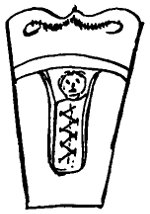
Fig 32.—Cradle Board
Cradles are not much used by the tribes of whom we write. A few are seen among them which they procure from the Cree and Chippewa. The back is a flat board with a bow bent across the front where the head of the child is placed. (Fig. 32.) A rim runs along the inside the size of the child, cloths are attached inside this rim to the boards or back, and the whole ornamented in various ways. The child is then bundled up, inclosed in the rim, and the cloth covers strapped over it. This is carried on their back, and at any time should the cradle fall the child is protected by the bow across from touching the ground. These Indians make a kind of sack with eyed holes in front of scarlet or blue cloth ornamented with beads, and the child being well wrapped, all except the head, it is placed in the sack and strapped up. There is no doubt but this is the cause of their feet being straight, although they are not intoed, as one would judge by their manner of walking. We can offer no objection to this mode of caring for children. Their natural growth is not affected thereby. At least it is the only method they could adopt to answer in extremes of cold, heat, and rain, with infants on their backs; besides their lodging affords little room for the conveniences used by civilized persons for rearing children.
They are as careful of their offspring as their manner of life will allow. Children are never weaned under 2 or 3 years old, giving for their reason that it retards their growth, but most likely having nothing but meat that a child can eat, they are obliged to do so. They call their mother enaw (mother) and their father at-tai (father). They address their children ma-chunk-she (my daughter) and ma-chink-she (my son). No abbreviations are used. They call them also by their given or proper names when there are several. There are no terms of endearment further than humming songs and meaningless words, such as white nurses use to very small children.
The domestic government is exercised by both father and mother. As long as the child is small the mother has the sole charge of it, but when it begins to speak the father aids in forming its manners. If a girl, he makes toy tools for scraping skins and the mother directs her how to use them. She also shows her how to make small moccasins, etc. Their first attempts in this way are preserved as memorials of their infancy. When a little larger, the scale of operations is increased and sewing, cooking, dressing small skins, and garnishing with beads and quills are taught, together with everything suitable for a woman’s employment. If the child be a boy the father will make it a toy bow and arrow, wooden gun, etc.
When a little larger he will give him still stronger bows and bring unfledged birds into the lodge for his son to kill. Larger still and he runs about with a suitable bow after birds and rabbits, killing and skinning them. Another stage brings him to learn the use of the gun, to ride, approach game, skin it, etc., all of which is taught him by his parent. The rest he acquires from the time and facility their manner of life affords for practicing these pursuits, and at the age of 17 or 18 makes his first excursion in quest of his enemies’ horses.
The father never strikes nor corrects his children from their birth to their grave, though the mother will sometimes give them a slap, yet it must be done in his absence or she would meet with immediate punishment. Notwithstanding this they are not nearly as vicious as white children, cry but little, quarrel less, and seldom if ever fight.
The boys are somewhat annoying when about 12 years old, but seldom do any serious mischief. The behavior of the girls is shy and modest.
The traditions related to the young in their lodges are usually extravagant fables and exploits of former warriors, exaggerated, of course, to make them interesting. Many local data and memoirs of events are thus preserved but so mingled with superstition by the different narrators as not to present any reliable truth. Most of the old men and many of middle age tell these stories in the lodges when they are invited for the purpose.
The grandmothers are also well versed in this and night after night the children learn a great deal, as soon as they are able to understand. The lives and actions of former warriors and other events of real life form a portion of the instruction thus conveyed.
These Indians living remote from civilization have no opportunity to steal white children, and we have never heard of one among them possessed by these means.
There are several half-breed children in all these nations, who, being raised with the Indians, are the same in all respects.
Cases of infanticide are very common among the Sioux, Crows, and Assiniboin, perhaps most so among the Crow women. It is not far from the correct number if we state that one-eighth of the children are destroyed in utero or after birth by the Crow women. The same also often is done by the Assiniboin, particularly if the father of the child has abandoned the woman before its birth. A quarrel with the husband or even unwillingness to be at the trouble of raising them are the causes for these actions. We think and have strong reason to believe that in some instances, they are destroyed at the instigation of their husbands, although they will not acknowledge this to be the case.
At all events no punishment is inflicted on the woman for the crime but frequently the means and time they use to produce abortions are the cause of the death of the mother. To produce its death in the womb they use violent pressure and blows upon the abdomen. Frequently they retire to the woods, bring forth the child alone, strangle it and throw it into the water, snow, or bushes. The whole of these measures are publicly talked of among them, and no great degree of repugnance is attached either to the act or to the woman, but the circumstance is laughed at as something ludicrous.
Male children are always desired by the husband. When small we see no difference made in their treatment or any preference shown, but when grown or nearly so the young man always takes precedence and is considered of far greater value than the girl. The feeling increases in his favor as he becomes of use at war or in the chase. Daughters, when matured, are married and sold, and here the greater interest in them ends; but sons are a source of profit and support for a good portion of their lives.
Suicide
Widows do not burn themselves on the funeral pile on the decease of their husbands, but frequently hang themselves for that loss, revenge, or for the loss of their children. Three suicides of this kind have been committed within the last few months in this neighborhood among the Assiniboin, one for revenge, the other two for the loss of their children. The first was the favorite wife of a camp soldier, who being scolded and accused of crime by the eldest wife, after telling her purpose, left the lodge, in the absence of her husband, and disappeared. Although search was made, yet a week elapsed before she was discovered hanging to the limb of a tree. She had climbed the tree, tied the cord to the limb, and descending, hooked on the noose standing on the ground, suspending her body by drawing up her legs. She hung so low that her knees nearly touched the ground and she could have risen to her feet at any time during the operation.
Another woman had her son (a young man) killed by the Blackfeet, and immediately afterwards another of her children died from disease. Several persons were appointed to watch the mother, suspecting her intentions; but they all fell asleep and she hung herself at the door of the lodge, between two dog travailles set on end. She was a tall woman and could only produce strangulation by swinging herself off the ground from her feet. She did it, however, and the body was brought to the fort for interment.
The third was a still more unfortunate case. The child of this woman had been sick some time and was expected to die. On the night in question it fell into a swoon and was to all appearance dead. No person being present the mother in the derangement of the moment went out and hung herself. The child recovered, but the mother was dead.
Every year in this way the women hang themselves, sometimes for the loss of their husbands, but more frequently on account of the death of their children, or for revenge. Suicides are also common among the men. They generally use the gun to produce death.
The Mandan and Gros Ventres, as has been stated, suspend themselves on sticks or skewers passed through incisions made in the back, and the motive for so doing has already been adverted to.
Spots are worn on the forehead and the under lip by some of either sex. Those on the women are for ornament. The bodies of some of the men are covered with tattooing to denote the warrior and brave. It is an operation requiring high payment, and is a mark also of the liberality and riches of the person who undergoes it, but no religious sects or opinions are thereby intimated. No rivers are deemed sacred or coveted in death by any of them.
Personal Behavior
These tribes are not degraded in the scale of being in their ordinary intercourse, connection or apparent actions. They frequently exhibit a delicacy in all these, but some of them, particularly the Crows, are addicted to customs, revolting to humanity, too much so for a lengthened description, among which may be mentioned sodomy, bestiality, etc. They all on occasions eat small portions of human flesh, not as a relish but to evince a savage fierceness toward the dead enemy. The Arikara are said to have devoured several entire bodies of their enemies in late years. We have witnessed a few cases of cannibalism among the Assiniboin, but they happened in time of actual famine, one of which, we will describe. About eight or ten years since a great famine prevailed among the Cree and Assiniboin. They separated and scattered everywhere over the plains in quest of game. It happened early in the spring when the ground was yet covered with snow and no roots could be found. A Cree Indian with his wife and three children were stationed near the head of Milk River alone and had been without food for a great length of time. The father took the occasion of his wife being out to kill and cook one of his children, a portion of which he forced her to eat on her return. When this was eaten, after an interval of some days he killed a second and this was likewise devoured. Still no indication of game presented itself. He desired her to go out that he might kill the remaining child, which she absolutely refused to do, offering herself in its stead.
It happened that some Assiniboin in traveling came upon his lodge, and seeing them coming he had barely time to smear himself and his wife over with white clay, the symbol of mourning, before they entered. To account for the disappearance of his children he appeared very much grieved and said they had died from want. The strangers, however, suspected all was not right, and when he had stepped out they inquired of the woman, who told them the truth. The visitors left after directing him to their camp, where some game had lately been found, and he proceeded thither with his lodge. When in the vicinity of the camp, he killed and scalped his wife, throwing her body in the bushes, proceeded to camp, displayed the scalp, stating he had killed a Blackfoot; that they had attacked him and killed his wife. The camp turned out to search for enemies and discovered the body of the woman and no trace of Blackfeet. The Indian in the meantime suspecting he would be discovered absconded, leaving the small child and baggage in camp. Being of another nation with whom they were at peace, he was not pursued and yet lives, but is despised by all.
At the period of the catamenia they sleep alone and are deemed taboo for ten days. The word in their language expressing that flux literally interpreted would mean “she who lives in a lodge alone,” and their traditions state that it was formerly the custom to pitch a tent outside for the woman to remain in during this period. After childbirth a woman is deemed taboo for 45 days.
Scalping
During a battle or whenever an enemy is slain they use no ceremony in taking the scalp except despatch. They are in great haste to get off or out of danger, and have no time for useless delay. A knife is run round the cranium, the foot placed on the dead man’s neck and a sudden jerk takes it off. The cultivation of the scalplock among the Sioux is a very ancient custom but we know of no mode of tracing its antiquity. The rest of these tribes wear their hair in any form that suits their fancy.
Oaths
The Indians have several kinds of oaths. They will say “Wakoñda hears me,” or they will swear by the skin of a rattlesnake, or the claws of a bear, wishing the snake to bite or the bear to tear them if they fail to fulfill their oath. They generally keep their oaths. The name Wakoñda in this is uttered in an audible voice with great solemnity and presenting the pipe to the Sun.
When Indians meet on the plains they halt within a few paces of each other, and if recognized as kin will name the relationship existing in a smiling tone. If strangers, one will inquire, “Where did you come from?” “Where going?” etc., during which they sit down and proceed to light the pipe. While smoking they will exchange news of their different places, make inquiries respecting their friends, about game, and anything of general interest, and when the pipe is finished they separate. No shaking of hands or touching of persons takes place, but if meeting with whites they will extend the hand to be shaken.
Smoking
This is so ancient a custom that even their traditions do not mention a time when their forefathers or ancestors did not smoke. There are tales among them whence came the tobacco seed and plant, particularly among the Mandan, Crows and Arikara, and perhaps among the Assiniboin, though we are not prepared at this time to relate them.
Fame
The principal avenue of fame is the pursuit of war. Other things tend to aid the individual and to render him respectable, as expertness in hunting, powers of prophecy, necromancy, and a name for wisdom, that is, the knowledge of governing, advising, making wise speeches, etc., but all these rather follow than precede the elevation of the man. Success in war is the first step; the others increase the importance of this. Acquiring a good many horses and women, by any means whatever, brings an individual into notice and makes him of importance, as thereby he can distribute many favors that a poorer yet braver man can not. Wealth in this finds him friends as it does on other occasions everywhere. But when rank is boasted, or chieftainship aimed at, bravery and success in war with capacity to lead are the principal requisites, without which all the other qualifications would be of no avail. We are acquainted with no Indian who has arisen to distinction without success in war being the principal cause of his advancement.
Stoicism
The stoicism exhibited by all these nations appears to be partly a natural disposition and partly a bias of their minds produced by thier peculiar mode of life. This display of feeling is only seen when the circumstance requires it. It is considered a mark of manliness to treat important subjects, transactions, and conversations with deliberation and decorum. Lighter matters are discoursed upon with appropriate levity. Their constant wants, shifts, and precarious positions induce a thoughtful manner. The knowledge of each other’s duplicity and the many ways used to circumvent and deceive to gain each his own ends produces caution. The uncertainty of their lives, liability to be revenged upon, and treacherous conduct generates suspicion. Being subject to severe reverses, extremes of want and danger, etc., a recklessness of life follows. Besides being the victims of superstitious dread, a morbidness of mind is acquired. But even all these would not without some natural peculiar disposition of mind account for their want of excitement and taciturnity and cover a hidden deep and dark design. Even when most expected, no trace of passion would be perceived by a stranger, but among themselves, or those who are well acquainted with their ways, their eye, countenance, smile, and every movement are as true an index to the workings of their mind as are observable among civilized persons in the most violent bursts of passion.
Taciturnity
Silence is not considered a mark of wisdom. A very silent man is not generally liked and somewhat feared, more so than a talkative one. Their wisdom consists in making apparent their good sense in speeches, advice, and in all their actions. Taciturnity may in some degree arise from their want of sufficient topics of conversation, as when obscene subjects are introduced this faculty is laid aside. All their ceremonies partake of the nature of solemnities, but when these are over and subjects or actions of a lighter nature employ their time they are as jovial and noisy as can be. In general, however, in common conversation Indians are not loquacious. Each sentence appears to be studied and no useless or superfluous words are introduced. They seldom speak twice or argue the point, even in debate in council. Each one states his opinion freely without interruption, and obstinately adheres to it. They never speak earnestly on a subject they do not thoroughly understand. They have a singular faculty of determination in everything they say or do. Even when surprised in extremes of danger their decision to act is made on the instant as if by instinct. No nervousness nor hesitation is evinced. When escape from death becomes impossible they are stolid, stubborn, and die like men.
Public Speaking
Their public speaking is only remarkable for applying their whole mind and soul to the business in hand. They state their opinions in a few words to the purpose, using only such metaphor as has a visible bearing on its elucidation. A great deal of the effects of their oratory is due to posture, gesture, and accent. The importance of the subject to them and their undivided attention bestowed upon it at the time is the cause of their forcible remarks. Some of these speeches are excellent in their way, but only so as they illustrate in a condensed form the opinions they wish to express. They are in fact the real children of nature. The prevailing circumstance governs the mind for the time and produces corresponding words and actions. The young and rising no doubt imitate the elders in some of the forms of set speeches but no pains are taken to learn them.
Travel
When they travel at night and have no moon to afford light they take their direction by the north star with which they are all acquainted, but when stars also are invisible they observe at dark the point from which the wind blows, and shape their course accordingly. By these means they will be able to pursue a right direction until they come to some hill or river with which they are acquainted, and regulate their travel from that point until the sun makes its appearance, and then they are at no loss. Traveling on the plains is much more difficult than in forests. In the terrible snowstorms that sweep over these prairies, darkening the atmosphere and rendering the sun, moon, and stars invisible, or indeed any object a short distance ahead, they are as much at fault to proceed as any other person, and at these times lie down, let the snow drift over and cover them, and remain thus until the storm passes, which is frequently two or three days and nights.
There are many ways of determining within a few hours of the time when an encampment has been deserted and the number of persons composing the party. The camp fires will show how many persons have slept there, the dung of the horses or dogs denotes the time, if the fires have become cool. The tracks of the men and animals and the remains of the meal are also means of judging. If scraps of meat or bone seen around are untouched by wolves or ravens they must conclude that the party has recently left.
In the summer the bending of the grass under their feet, tracks in crossing a stream or any marshy place, and in winter, tracks in the snow, will show to a tolerable certainty how many persons and what time they have passed. A slight rain would determine whether the tracks were before or since it fell. Snow would prove the same; the dew of the morning in summer or fall would reveal the time to within 24 hours. The grass nibbled by the horses by its appearance would denote whether the party had passed within a few days and the hardness of the dung of the animals brings the time to a still greater degree of certainty. A correct judgment is not, however, formed by any one of the above criterions, but by a comparison of the whole, and by following the trail, and observing also the carcasses of the animals killed by the party, their number, state of decay, etc. These with other smaller indications, particularly if an arrow or moccasin be lost or thrown away, will determine the number and nation that have passed and the time. The passage of war parties is distinguished from hunting parties of their own people by the absence of boys’ tracks or traces of dog travailles in the former, and by the precautions they take in their encampment.
Senses
There is an extreme acuteness in their sense of sight—that is, to see at a glance, over a wide extent of country, sometimes dotted by bushes, ravines, or hills, and distinguish the living objects when at rest from others. There is a great difference in the faculty of seeing far and what is called “picking up an object”—that is, distinguishing it from the inanimate bodies intervening. The Indians possess this power in so remarkable a degree as to appear a kind of instinct. At a distance of 12 or 15 miles they will distinguish animals from timber, even supposing they are not in motion. If moving they will discern between horses and buffalo, elk and horses, antelope and men, a bear and a bull, or a wolf and a deer, etc. But the greatest mystery is how they make out anything living to be there at such a distance, on the instant, when they themselves are in motion and the animal at rest. This they do when it is surrounded by a hundred other objects as like to living creatures as it is. Once pointed out, the movements are watched and its character thus determined. Their powers in this respect are truly astonishing and must be acquired. They also judge very correctly of the relative distances of objects, either by the eye or to each other. Smoke can be seen rising on the plains at a distance of 60 miles, and they will tell from that or any lesser distance within a few miles of the place where it rises. Their ideas of location are fully as remarkable.
An Indian will shoot 20 or 30 arrows in different directions, and to a distance of 100 yards or more among the tall grass, or in the snow, where no trace of them remains, yet he will pick up the whole without any difficulty; whereas a white man would have some trouble to find any one of the arrows. If they lose a whip, knife, or anything in traveling they can by returning generally find it, though no road marks their steps. Even the boys do all these things admirably. Finding lost horses or a camp from a given direction are also everyday occurrences, even if they have never been in the neighborhood of the place, yet they will find their way.