THE ASSINIBOIN2 (continued 6)
Reading edition
“Also that in battle he took an enemy’s horse” [one tap]. “That he fired fifteen shots” [one tap]. “Four years since, being near the Blackfeet camp with six others in quest of horses, they were discovered and pursued but succeeded in making their escape” [one tap on the drum]. “Alone and on foot he, three years since [naming the place] killed and brought to camp a full-grown grizzly bear” [one tap on the drum]. “Behold where one of the balls of the Blackfeet broke my arm” [one tap]. “Here an arrow pierced my thigh” [another sound of the drum], etc., until he has run through the catalogue of his meritorious acts, when he is honored with a general shout of approbation, the music strikes up, the song commences, and another round or two being performed, another warrior recounts his coups in the same manner. In this way they continue until all who wish have had an opportunity of renewing the remembrance of their past deeds, and reestablishing their importance as braves in the eyes of their countrymen. It takes some hours to prepare for and perform this dance and it is only done twice or thrice a year. Although the performers are naked, yet there is no idea of indecency29 attached to this fact. They are in a manner obliged to appear in this state so that they may publicly expose and point out any wound they may have received in battle.
Wounds behind are fully as honorable as those before. Running away where success is impossible is more commended than death or defeat by remaining. The number of shots a man has fired during the fight, if over 10, counts a coup, inasmuch as it shows he has stood his ground long enough to fire that many.
Killing an enemy counts nothing unless his person is touched or struck. The first who strikes the dead foe counts the best coup, although each succeeding one counts as far as the fourth.
Scalping does not count more than striking. Taking an enemy’s gun or horse or bow by any means counts a coup, likewise killing a grizzly bear alone and on foot. Scalps are very little valued by him who takes them. They are mostly cut up in small pieces and sent to the different camps. The hair seen on the warrior’s leggings is sometimes really the hair of the enemies slain by him, and at others his own, or horsehair. In either case it is the symbol of having killed.
If he has struck even one enemy he is entitled to wear hair on his shirt and leggings, but it is not absolutely necessary that it should be the same hair as that which he took from his enemy’s head. Any human hair or black horsehair will answer the purpose fully as well if he has a right to wear it.
Fox Dance (To-kah-nah Wah-che).—This is done by those who belong to the band called Foxes, who are pretty numerous among several nations. It is got up with the view of publishing their feats as in the preceding one, and also to display themselves as a body. Their costume consists of a deer or antelope skin, shirt, and leggings painted a bright yellow, and their faces painted with yellow stripes, besides other forms. A dressed fox skin being slit in the middle, the head of the man is thrust through, the skin spread out on his shoulders, the head of which lies on his breast, and the tail hangs down his back, the whole skin being fringed round with colored garnishing of porcupine quills, bells, and polished buttons placed in the eyeholes of the animal in the skin.
A headdress of foxes’ teeth, bored and strung, is stretched across the middle of the head from ear to ear, a lock of their hair is tied in front, which projects out several inches, and the rest, combed straight down behind, to which at about the middle is attached four war eagle feathers. Their lances are wrapped with fox skins cut in strips, and the tails of that animal sewed on the handle every 12 inches or so. Some also carry their bows and quivers of arrows at their side during the performance.
After having been warned of the meeting, and preparing in the above manner, they assemble at the sound of several drums and whistles at the spot appointed, being generally near the center of the camp. Here they form in line during the drumming and singing, which is kept up by five or six men and women who are invited for the purpose (this music) taking their stand to one side, the women as usual behind the drums, who sing, but take no part in the dance.
When ready they all start off at a swift pace and describe the movement of the coiling of a snake, and when wound up in this form, all commence jumping up and down, striking one foot immediately after the other on the ground, keeping exact time, and all singing with the music for the space of about a minute, when a general flourish on the drums and a shout or yell from the dancers concludes that round, and their places in line are resumed.
Some one of them now steps forward and counts his coups in the same manner as pointed out in the Brave Dance, which is succeeded by another movement in dancing, which is again followed by another speaking, and so on until all who wished have spoken, the drum denoting by taps the value and number of coups thus counted by each.
The whole concludes by a feast given by one or more of the most distinguished members of this club, during which their professions of amity and assistance are renewed, and presents often exchanged; the musicians also partake of the repast.
This club is composed of men from 20 to 25 or 28 years of age.
Duck Dance (Pakhan´tah Wah-che).—This is done by the band who bear that name and are not so numerous as the others. The same principles govern their proceedings, being to seek this occasion to publish and perpetuate the memory of their past deeds on the battle fields. The dancers are all naked except the breechcloth, which hangs down before and behind one or two yards. Their bodies are painted in various ways, principally striped, according to the fancy of the individuals. No arms are carried in the dance, but they hold in their hand a flat striped painted stick about 2 feet long, with which they keep the time. Women are excluded from the ring but form a portion of the music. All sing, both dancers and drummers. The evolutions are: Commencing in a ring, they mingle together for a few minutes and conclude with a general shout, after which coups are counted by those who wish, or who are able, as in the preceding. The time, step, and figure of every dance differ, but we can not describe them so as to be understood.
Bulls’ Dance (Tah-tun-gah Wah-che).—The kin called Bulls is perhaps the most numerous among them, and a good many middle-aged men and chiefs are found in this dance who do not figure in the others. Their headdress is the skin of a buffalo bull taken off as low as the shoulders of that animal, and dressed with the head, horns, hair and snout complete. Around the holes where the eyes were and in the nostrils and mouth are sewed pieces of scarlet cloth. The skin is then sewed up along the back of the neck. The head of the man is thrust in this, and the rest of his body being naked except the breechcloth and moccasins, is painted with black and red stripes. They carry guns and powder horns in the dance, moving without any order, jumping about, snorting, and shaking their horns at each other, and firing among their feet with powder. The song is the Bull Song. They usually are attended by six or eight drummers and singers, all males, who are not dressed in any remarkable manner.
No speeches are made by the Bulls during the dance, but they seek the occasion of other dances, such as the Braves or Soldiers to which most of them belong, to perpetuate the remembrance of their chivalrous deeds. This kin give a good many feasts to each other and are said to be remarkably faithful in the observance of their promises of mutual aid and protection.
Soldiers’ Dance (Ahkitchetah Wah-che).—This body of men having already been fully described in these pages it will, of course, be understood that their dance must include the most important personages in camp. They seldom perform, and only with a view of exhibiting their force as a body; and in the presence of strangers or visitors to count their coups or when a war party is in contemplation, with the intent of stimulating the ardor of the young to follow them to battle. They must have some object to dance for, as they are not men to expend much time merely for the sake of amusement and display; besides their characters and acts are so well known as to need no repetition.
Their costume is as nearly as possible that of warriors equipped for battle. From the nose up their faces are painted a bright red, and from thence down to the neck a jet black. The dancers form the ring on foot but are attended by a guard of mounted soldiers, dressed in very gay battle array, who ride round outside the ring all the time, striking, and keeping at a respectful distance either man or beast that is found in the way. A select band of drummers and female singers is chosen and placed apart, who having struck up the song, the dance is led off by a soldier alone, who moves out by short steps toward the center of the circle, is soon joined by all the rest, jumping and keeping the time, which round concludes with a loud yell and discharge of firearms, and the one who led off the dance counts his coups on his enemies in the manner before related. This is also accompanied by taps on the drum denoting the number and value of the coups and the speech, honored with a general shout of approbation.
The warrior resumes his place, another leads off, and the same behavior is repeated until all get through, the whole ending with a feast of dog meat given by the chief of the soldiers in the Soldiers’ Lodge, to which the strangers, if any in the camp, are invited. This is the most imposing and warlike dance they have, and is well calculated to inspire the young with a desire for glory. Their dresses and appointments are very gay and complete according to their rank, their gesticulation and oratory fierce and bold.
White Crane Dance (Pai-hun-ghe-nah Wah-che).—There is no band of this name, but the dance is got up by some divining man, most probably for some begging purposes. He is the principal figure, being painted yellow and wearing a dressed elk-skin robe on which a large two-headed crane is painted. The costume of the others is whatever their fancy dictates, and, of course, they put on the gayest attire they can afford. The dancers are young men of any and all kins who choose to take part, except women, who join the chorus. The evolutions are different from any of the rest, as also the song, but can not be described so as to be understood. The only one who speaks during the performance is the divining man, and the tenor of his speeches differs according to his object in introducing the dance.
Crow Dance (Cong-ghai Wah-che).—This dance is performed by the kin called Crows. Neck and head dresses of crow skins taken off the bird entire with wings and head on are worn by all, and crow feathers adorn their lances, shields, and other war implements. For the rest, it proceeds much in the same way as the others. These are mostly young warriors.
Dance of the Mice Comrades or Provision Stealers (Wok-e-po maun noomp-pe).—This is done by a band of young men bearing the above name. The dance is kept up all night and during it some of them take by stealth the provision bales from the rest of the camp who are asleep, on which they feast all night.
The dance is performed in a large lodge, or rather several lodges thrown into one for the purpose. The bales or other property thus obtained are kept until daylight, when the haranguer of the camp publishes that those who have lost anything will go and redeem it, and the several owners of the provision sacks present a piece of tobacco to the dancers, who deliver them their property. By visiting many lodges in the night a good deal of provisions, robes, etc., are secured, which often take the best part of the next day to distribute. The dress of this club, though gay, is not remarkable in any way except they hold in their hands the skins of stuffed mice or have the same attached to different parts of their attire. To describe the whole of their dances in detail with the different costumes would occupy too much space and perhaps not be required. We think enough has been written to present a general idea of these performances and their use with the Indians.
Whip Dance (Etchap-sin-tai Wah-che).—This dance is performed by as many warriors as choose to assemble with whips ornamented with eagle feathers and horse-skin wristbands tied to the whips. In this the number of horses they have stolen from their enemies at various times is boasted of.
Divining Dance (Tee-chagh-hah).—The divining dance is a complicated religious ceremony occupying a whole day and that part of it appropriated to dancing is done by men and women promiscuously, headed by some of the divining men without any distinction of kin or speeches regarding their coups. Their bodies are also scarified and pieces cut out of their shoulders.
Women’s Dance (Ish-kun Wah-che).—This is a dance in which women alone perform. They are painted in many ways and very gaily dressed. The men drum and sing for them and the dancers are ranged in two parallel lines opposite, dancing forward until they meet, and then resuming their places. Besides the foregoing, there are several other dances, all of which have for their object swaying popular feeling in some way. Very little is done by Indians in any form merely for amusement, and their dances in this respect partake of the nature of the rest of their employments.
Games
Most of these tribes, particularly the Sioux, are fond of ball playing in parties. The principal game at ball is called Tah-cap-see-chah, being the same denominated shinny or bandy by the whites. It is generally got up when two different bands are camped together and a principal person in each having made a bet of a blanket or gun, they choose from their bands an equal number of young men, who are always the most active they can select, the number varying from 15 to 40 on each side. Sometimes the play is headed by the chief of each band betting, though they take no part in the game, which is usually played by men 20 to 30 years of age. Each of the players stakes something against an equivalent on the part of one on the opposite side and every bet is tied together separately, which consists of shirts, arrows, shells, feathers, blankets and almost every article of trade or their own manufacture, and as fast as the bets are taken and tied together they are laid on a pile about the center of the playground, being given in charge of three or four elderly men who are chosen as judges of the sport. After this has been concluded two posts are set up about three-quarters of a mile apart and the game consists in knocking the ball with sticks toward these posts, they being the limit for either party in different directions.
They strip naked except the breechcloth and moccasins and paint their bodies in every possible variety of manner. Each is furnished with a stick about 3½ feet long, turned up at the lower end, and they range themselves in two lines, commencing at the middle of the ground and extending some distance on either side. The ball is cast in the air in the center of the course, struck by some one as soon as it falls, and the game begins, each party endeavoring to knock the ball to the post designated as their limit. The game is played three times and whichever party succeeds in winning two courses out of the three is judged conqueror. When the players are well chosen it is often an interesting game, and some splendid specimens of foot racing can be seen, but when one of them either intentionally or by accident hurts another by a stroke with the play stick a general shindy takes place, and the sticks are employed over each other’s heads, which is followed by a rush for the stakes, and a scramble. We have seen them when this was the case arm themselves and exchange some shots, when, a few being wounded, the camps would separate and move away in different directions. Supposing, however, the game proceeds in its proper spirit and humor, each bet being tied separately, the parcels are handed out to the successful party by the judges. This game is not often played by large parties of men, or if so it is very warmly contested and very apt to break up in a disturbance.
We have seen it also played by both men and women joined, a few men aiding two parties of women. This was among the Sioux, but with the other tribes it is generally played by men only.
Another mode of playing the game is by catching the ball in a network over a small hoop a little larger than the ball attached to the end of a stick. They catch it in this net as it flies through the air, and throw it from one to the other toward either goal. The man who catches can run with the ball toward the limit until he is overtaken by one on the other side, when he throws it as far as he can on its way, which is continued by the others. The women play hand and foot ball, also slide long sticks on the snow, or billiards with flat stones on the ice. We know of no other game at ball worth mentioning being played among them.
Foot racing is often practiced by the Mandan and Crows. The former nation before they were so much reduced by smallpox had a regular race course 3 miles in length, in which any and all, who chose, could try their speed, which they did by running three times around this space, betting very high on either side.
They still practice the amusement, but not so much as formerly.
Racing
Foot races among the Crow Indians are usually contested by two persons at a time, a bet being taken by those concerned, and many more by the friends and spectators on either side, consisting of blankets, buffalo robes, or some other article of clothing. They mostly run about 300 yards and in starting endeavor to take every advantage of each other, a dozen starts being often made before the race begins. These Indians also run horse races, betting one horse against the other. The same trickery and worse is displayed in their horse races as in their foot races, and often the loser will not pay. The Sioux also have foot races in which any one may join, provided he bets, which, if they have anything to stake, they are sure to do. The name of being a fast and long runner is highly prized among them all; indeed, after being a warrior and hunter that of being a good runner is next to be desired, but the principal aim in all these amusements appears to be the winning of each other’s property. They, of course, occupy and enable them to pass agreeably some of the long summer days, but we never see these things introduced without the bets or prospects of gain, and from this fact, together with the earnestness exhibited in betting, and in the contest, we conclude it to be no more than another mode of gambling, to which they are all so much addicted.
Gambling
Most of their leisure time either by night or by day among all these nations is devoted to gambling in various ways, and such is their infatuation that it is the cause of much distress and poverty in families. For this reason the name of being a desperate gambler forms a great obstacle in the way of a young man getting a wife. Many quarrels arise among them from this source, and we are well acquainted with an Indian who a few years since killed another, because after winning all he had he refused to put up his wife to be played for. Every day and night in the Soldiers’ Lodge not occupied by business matters presents gambling in various ways all the time; also in many private lodges the song of hand gambling and the rattle of the bowl dice can be heard. Women are as much addicted to the practice as men, though their games are different, and, not being in possession of much property, their losses, although considerable to them, are not so distressing. The principal game played by men is that of the Bowl or Cos-soo´, which is a bowl made of wood with a flat bottom, a foot or less in diameter, the rim turned up about 2 inches, and highly polished inside and out. A drawing and description of the arithmetical principles of this game is now attached in this place. Pl. 72.) The manner of counting therein mentioned is the manner in which we learned it from the Indians, but the value of each of the articles composing the dice can be and is changed sometimes in default of some of them being lost and again by agreement among the players in order to lengthen or shorten the game or facilitate the counting. However, the best and most experienced hands play it as it is represented. It can be played between two or four, that is, either one on each side or two against two. The game has no limit, unless it is so agreed in the commencement, but this is seldom done, it being usually understood that the players continue until one party is completely ruined.
The bowl is held by the tips of the four fingers inside the rim and the thumb underneath. The dice being put in, they are thrown up a few inches by striking the bottom of the bowl on the ground, so that each counter makes several revolutions. It is altogether a game of chance and no advantage can be taken by anyone in making the throws. The counters or dice never leave the bowl but are counted as the value turns up. One person having shaken it and the amount of his throw having been ascertained a requisite number of small sticks are placed before him, each stick counting 1. In this way the game is kept, but each keeps his adversary’s game, not his own; that is, he hands him a number of sticks equal to the amount of his throw, which are laid so that all can see them. Each throws in turn unless the big claw stands on end, in which case the person is entitled to a successive throw. By much practice they are able to count the number turned up at a glance and the principles of the game being stated on the drawing, we will now describe how it is carried on. It has been observed in these pages in reference to their gambling that it is much fairer in its nature than the same as carried on by the whites and this is worthy of attention, inasmuch as it shows how the loser is propitiated so that the game may not result in quarrel or bloodshed, as is often the case.
The game is mostly played by the soldiers and warriors, and each must feel equal to the other in courage and resolution. It is often kept up for two or three days and nights without any intermission, except to eat, until one of the parties is ruined.
Example.—A plays against B; each puts up a knife, and they throw alternately until 100 is counted by the dice; say A wins. B now puts up his shirt against the two knives, which is about equal in value; say A wins again. B then stakes his powder horn and some arrows against the whole of A’s winnings. Should B now win, the game commences again at the beginning, as A would only have lost a knife; but supposing A wins. B now puts up his bow and quiver of arrows against all A has won—the stakes are never withdrawn but let lie in front of them. Say A again wins. B then stakes his blanket and leggings, which are about equal in value to all A has won, or if not, it is equalized by adding or subtracting some article. Supposing A again to be winner, he would then be in possession of 2 knives, 1 shirt, 1 blanket, 1 powder horn, 1 bow and quiver of arrows, and 1 pair leggings, the whole of which the Indians would value at 8 robes. B now stakes his gun against all the above of A’s winnings. Now if A again wins he only retains the gun, and the whole of the rest of the property won by A returns to B, but he is obliged to stake it all against his gun in possession of A, and play again. If A wins the second time he retains the whole and B now puts up his horse against all of A’s winnings, including the gun.
A wins, he retains only the horse, and the gun and everything else reverts again to B, he being obliged to stake them again against the horse in A’s possession. If A wins this time, he keeps the whole; but if B wins, he only gets back the horse and gun, and all the rest of the property goes to A. Supposing B again loses and continues losing until all his personal property has passed into the hands of A, then B, as a last resort, stakes his wife and lodge against all his property in the hands of A. If A wins he only keeps the woman; the horse, gun, and all other property returns again to B with the understanding, however, that he stakes it all to get back his wife. Now if B loses he is ruined; but if A loses he gives up only the woman and the horse, continuing the play with the rest of the articles against the horse until one or the other is broke.
At this stage of the game the excitement is very great, the spectators crowd around and intense fierceness prevails, few words are exchanged, and no remarks made by those looking on. If the loser be completely ruined and a desperate man, it is more than likely he will by quarrel endeavor to repossess himself of some of his property, but they are generally well matched in this respect, though bloody struggles are often the consequence. We have known Indians to lose everything—horses, dogs, cooking utensils, lodge, wife, even to his wearing apparel, and be obliged to beg an old skin from some one to cover himself, and seek a shelter in the lodge of one of his relations. It is, however, considered a mark of manliness to suffer no discomposure to be perceptible on account of the loss, but in most cases we imagine this is a restraint forced upon the loser by the character of his adversary.
Suicide is never committed on these occasions. His vengeance seeks some other outlet, in war expeditions, or some way to acquire property that he may again play and retrieve his losses. There are some who invariably lose and are poor all their lives. A man may with honor stop playing with the loss of his gun; he has also a second opportunity to retire on losing his horse, and when this is so understood at the commencement they do, but when a regular set-to takes place between two soldiers, it generally ends as above described.
Ordinary gambling for small articles, such as beads, vermilion, rings, knives, arrows, kettles, etc., is carried on by playing the game of hand, which consists in shuffling a pebble from one hand to the other and guessing in which hand the pebble lies. They all sit in a ring on the ground, each with whatever stake they choose to put up before them. Both men and women join in the game and a song is kept up all the time by the whole with motions of the hands of him who holds the pebble. After singing about five minutes a guess is made by one of the parties as to which hand the pebble is in, and both hands are opened. If the guess has been correct, the one holding the pebble is obliged to pay all the rest an equivalent to the stake before them; but if the hand not containing the pebble be picked upon, all the ring forfeit their stakes to him. Either one man can thus play against the whole or he has it in his power to pass the pebble to the next, he betting like the others.
This is a very common game, and a great deal of property by it daily changes hands, though seldom such large articles as guns, horses, or women.
The usual game which women play alone, that is, without the men, is called chun-kan-dee´, and is performed with four sticks marked on one side and blank on the other, as described in Plate 73. The women all sit in a circle around the edge of some akin spread upon the ground, each with her stake before her. One then gathers up the sticks and throws them down forcibly on the end, which makes them rebound and whirl around. When they fall, the number of the throw is counted as herein stated. Each throws in turn against all others, and if the whole of the marked sides, or all the fair sides of the sticks are turned up, she is entitled to a successive throw. The game is 40, and they count by small sticks as in the preceding. In fine weather many of these gambling circles can be seen outside their lodges spending the whole day at it instead of attending to their household affairs. Some men prohibit their wives from gambling, but these take the advantage of their husband’s absence to play. Most of the women will gamble off everything they possess, even to the dresses of their children, and the passion appears to be as deeply rooted in them as in the men. They are frequently thrashed by their husbands for their losses and occasionally have quarrels among themselves as to the results of the game.
Another game is played by the boys and young men which consists of planting an arrow in the snow or ground and each throwing other arrows at it until struck, and he who strikes the planted arrow is winner of all the arrows then on the ground.
Death and Its Consequences
When a warrior dies the body is straightened and dressed in full war dress, as for battle, the face being painted red. It is then wrapped up in a blanket, which is again enveloped in scarlet cloth, or his flag, if he has one; then his bow, quiver, sword, gun, powder horn, battle ax, war club, tomahawk, knife, and his medicine or charm are laid alongside and the whole baled with the body in his buffalo robe, being the one on which his coups on his enemies are painted. The last covering is the raw hide of a buffalo, hair inside, which incloses all, and is strapped up tightly by strong cords passed through holes cut around the edge of the skin, the whole presenting the form of a large oblong bale. All this is done by some old men, often some of the divining men, though not those who attended him while sick; and the persons who pay this attention to the corpse know they will be well paid by the relatives of the deceased, as it is the greatest honor one Indian can confer on another and is a claim on the patronage of the relatives during their life. Before enshrouding the body some one of the persons who officiate cuts off a lock of the dead man’s hair, which he retains a year. At the end of that time the nearest relatives of the deceased buy the hair from him at a very high price in horses, blankets, etc. This is another long ceremony and should be described, but our limits do not admit of it.
When the body is thus dressed and prepared for interment it is the wish of the relatives to get it out of sight as soon as possible, or in a few hours after dissolution, but it often happens that there is no suitable place in the vicinity for burial and they are obliged to carry it along for several days. Most of these tribes prefer scaffolding the corpse on trees, which is the most ancient method of disposing of them, arising from the want of tools to excavate, particularly in the winter season, when the ground is frozen to the depth of 5 feet as solid as a rock, and for the reason that they wish the dead to be placed where they can at all times feast and speak to them. Of late years, however, they prefer their being interred by the whites at the different trading forts if possible, but as this can only happen to a few the others either scaffold them or inter them, when the weather admits, on the tops of hills, covered with large stones, which, being rolled on the grave after it is filled prevent the ravages of the wolves and foxes. In either case the clothing, arms, medal, or other trinkets not bequeathed are deposited with the body, and as the sanctum of the dead is never disturbed nor these articles renewed, they must present a sure criterion whereby to judge of their state of arts and arms at the time of the interment as far as it is possible to be determined by the nature of the materials thus deposited. Supposing they are near the timber, and the man has died in the night, the funeral takes place next day, or if he has died during the day it is disposed of the following morning.
At the moment life becomes extinct the relatives set up a loud howl, cut their hair and legs, and the neighbors crowd into the lodge, each endeavoring to excel the other in the violence of their lamentations, which are kept up without intermission from that time until the funeral is over, by all, and during this interval the whole of the property of the deceased, except his war horse and arms as mentioned, is given away by the relatives to those who lament. All his horses, skins, clothing, provisions, and a good part of that of his relatives (brothers, father, etc.) must pass into the hands of strangers; even the blankets off their backs, arms, and cooking utensils are seized and carried away by those who aid in mourning. If he has made a will, which occasionally happens, it is sometimes carried into effect, but usually the nearest relatives sit around the body howling, with their heads down, and pay no attention to the general pillage which then takes place, or if they do, it is only to tell each of the mourners which of their horses or other property to take away, giving the horses to those who have aided in laying out the dead man. Their custom is to make themselves as poor as they can be made on these occasions, either in property or with regard to their persons.
The body being placed on a horse travaille crosswise, it is conveyed to the spot for scaffolding by leading the horse, the whole following without any order and uttering loud howlings, both men and women. Several men now ascend the tree and draw up the corpse with strong cords attached to it, placing the feet as near toward the south as the fork of the tree will admit, and elevating the head part of the bale so that it may face in that direction, after which it is secured by the cords being tied round the limbs of the tree many times, to prevent the wind from blowing it down.
When this is finished they recommence cutting their legs and howling, calling on the deceased by the tie of relationship which bound them, thus: “My brother” or “my son,” adding, “remain in peace where you are; let your spirit go to the south and not be troubled; we will feast you; do not visit us in spirit; you are happy; and we are miserable.” These words are not distinguishable on account of the noise, and most probably muttered; as, having witnessed many of these funerals in every way, we have never heard any other words than lamentations; but they say they do pronounce them either mentally or very low, and that if it is neglected some more of their relatives will die; consequently we are bound to believe they utter these and other words in an audible voice. At this stage of affairs his war horse is led under the tree and shot, in addition to which, among the Crow Indians, a finger or two of each of the near relatives are chopped off and the blood smeared over their faces, left to dry there, and remain until it wears off. The deceased’s shield, lance, or other implement, too long or unwieldy to be enveloped with the body, are now tied at his head on the tree, and the mourners retire. Some of the near relatives, however, often remain all day and night, naked and barefoot, exposed to cold, snow, or rain, for several days and nights without eating until they are completely exhausted, and for a year or more afterwards wear nothing but an old torn skin, which, with their bodies and faces, is smeared over with white clay, and present a miserable appearance.
This is the most general custom among all the tribes of which we write of disposing of their dead, and nine-tenths of them are scaffolded in this way. Yet occasionally some, either by request or desire of surviving relatives, or in the event of their dying where no timber can be found, are interred on the top of a hill. In either case the mourning and ceremonies are the same. When interred, the hole or grave is excavated to the depth of about 5 feet, and made large enough to contain the implements before referred to, which are all buried with the body, the grave filled up and large rocks rolled upon it. In either way no inscription or device is made to mark the spot, nor any hieroglyphics carved on trees denoting the age, name of the person, or anything else. No consolation is offered to Indians at the time of the funeral, nor for several days afterwards. Those who wish to console must aid to mourn, but say nothing. In a few days, however, many elderly men invite the relations to feast and console them by the usual arguments the nature of the case dictates. The reason why the feet are placed southward and the face turned in that direction is that the Indian paradise is supposed to be in that quarter, and the soul is thus given to the South Wind to be carried off to that point. Very brave and formerly renowned warriors sometimes requested not to be interred in any way, in which case they are placed inside their lodge propped up, in a sitting posture, dressed and painted, the door of the lodge is closed tight, and the outside around the lodge inclosed by a hedge of thick branches and dirt to prevent the wolves from entering, and the whole is thus left on the plains.
In the course of time the lodge rots away, the wolves enter, and the bones are scattered about or carried away by them. This is the manner in which the Chief Wah-he´-muzza, or The Iron Arrow Point, ordered his obsequies to be performed, giving for his reason that he wished to remain above ground in order to see and hear his children all the time and to have the spot rendered remarkable by his being there.
The death of ordinary Indians is attended with like results, though if not warriors of note they are merely enveloped in their ordinary clothing and blankets or skins with their implements, but no horse is killed over their grave. When women die their favorite dogs are killed and all their tools for scraping and dressing hides, with their pillow and porcupine quills, are enveloped with them. If she be the wife of a chief or man of importance she is also wrapped in scarlet cloth, formerly in painted skins. There is as much mourning and distress observed on the death of their children, perhaps more, than when grown. On these occasions often some one of the parents destroy themselves, and all other Indians are very attentive to them for several days until the most violent grief is over. Should anyone offend the parent during this time his death would most certainly follow, as the man, being in profound sorrow, seeks something on which to wreak his revenge, and he soon after goes to war, to kill or be killed, either of which being immaterial to him in that state.
The reason the implements are deposited in the grave is that they are supposed to be necessary to his being in the world of spirits. It is a very ancient custom, perhaps coeval with their existence.
We know of no tumulus or barrow erected either in former or later times through this country containing many bodies or possessing the character of a charnel house, but are in the knowledge of the graves of many chiefs either on scaffolds or on hills.
Bodies are never interred in a sitting posture, though that manner is sometimes observed when deposited in the lodge above ground and the posture preserved by stakes driven in around the body with forks on the end supporting the different members and equilibrium.
There are no herbs or spices placed with the corpse, neither is it submitted to any process analogous to embalming. It is enveloped, as before mentioned, in skins to which those who can afford it add scarlet cloth and blankets.
Scaffolding of corpses is the general manner of disposing of them with all the prairie tribes, and the way they are prepared has been alluded to. They would prefer having them boxed instead of baled, but have no tools to prepare timber, and even if they had can not at all times procure it, which together with their lack of means to excavate in these frozen regions were no doubt the original causes of this mode of burial. When bodies are brought to the trading houses for interment or scaffolding they are always boxed by the whites, the coffin being made large enough to contain the implements and ornaments enveloped with the corpse. This in former times was a great honor done the Indians and highly recompensed, but of later years is a great bore and expense.
This method of securing them can, however, only be embraced when death takes place near the houses, and consequently happens to few. The Mandan and Gros Ventres, being stationed at the fort with those nations, have their dead boxed by the whites and placed on a scaffold made of posts planted near their villages. The Arikara prefer interring them in the ground, and all the rest of the tribes place their dead, secured in the manner described before, in the forks of trees, which in a year or two, as soon as the cords rot off and the envelopes fall to pieces, are blown down, and the bones are found scattered beneath. Carnivorous birds, such as eagles, ravens, and magpies, often pick at the envelope until they get at the body, but if it is well strapped in rawhide it is generally secure from either birds or beasts as long as it remains in the tree.
It is the custom of the Assiniboin to put up a funeral flag over the graves of their dead, particularly children, which at this time is composed of some such fabric as red flannel or calico tied to a pole, but which was formerly made of feathers and light skins. This is a very ancient custom, arising, we are told, from the necessity of having some such object thus raised which, fluttering in the wind, frightens away the beasts and birds of prey.
The custom of collecting and reinterring the bones is very general at the present day among all these tribes; indeed, it is seldom neglected if when they visit the scaffold they find the body to have blown down and the bones exposed.
The bones are picked by any one of the party, not related, in the presence of some of the relatives of the deceased, and this time buried in the ground, with demonstrations of grief and some scarifying, though they do not go into mourning dresses further than some white clay about the face, and no property is confiscated by others, as in the case of the first funeral, but those who aid are paid with some smaller articles. On these occasions a feast is made for the dead which, being eaten, and the spirit propitiated by prayer and invocation, the whole concludes, those concerned resuming their usual dress and occupations.
There is no such thing as charnel houses or receptacles for the dead in all the district of the upper Missouri, neither are there any appearances of such things having been, each individual being buried or scaffolded separately at the most convenient place and as soon as possible after decease.
Incineration of bones is not practiced by any of them, neither do their traditions mention this custom to have ever existed among them; they have a horror of the idea.
Their symbols of mourning have been referred to, which are cutting short their hair, scarifying their legs, cutting off their fingers (Crow Indians), wearing an old tattered robe or skin on their back, the rest of the body being naked except the breech flap of the men, or body dress of the women, bare legged, bare footed, the face, hair, body, and robe smeared with white clay, often intermixed with their blood.
When the lock of hair of the deceased has been redeemed by the relative by high pay to him who took it, which is done in a year or two after demise, this relic is inclosed in a small sack and carried on the back of some of the female relatives. A piece of tobacco is wrapped with it, which is used on several occasions, as before mentioned. There are periodical visits to the grave, twice or thrice a year for the first year, and afterwards for several years whenever they happen to be in the vicinity, and on these occasions takes place the feast to the dead, so often referred to in these pages, which is one of their principal ceremonies. A repast is made of corn or pounded meat mixed with grease and sugar, sometimes a dog is cooked by some medicine man, and a crowd of people being assembled round the grave after lamenting the dead by howling, smoke, and pray to the spirit, leave a portion of the feast for it, and the rest is eaten by those who attend the ceremony. One of their prayers at these times is recorded in a former page, together with the reason of these observances. Fires are kindled near the grave or under the scaffold, but do not appear to be of further use than to light the pipe by while smoking to the dead, and are suffered to expire at their leisure.
No gravestones or posts are planted to mark the place, or any inscriptions or devices painted or carved by any of these tribes, denoting the age of the deceased or any other thing.
As has been frequently stated, there are no large mounds perceived on the upper Missouri, the work of Indians, as have been discovered in some of the western States, but were it an object or custom to bury the dead in that manner we believe there is energy and power sufficient among any of these tribes to accomplish a work of the kind, even with the rude tools they have, in a loose soil, free of rock, and in the summer season. These mounds have most probably been national or public depositories for the dead of Indians in stationary huts; and as great superstition is attached to all funeral rites, it is not improbable they were excavated in a length of time by the united efforts of the nation. Being a work in which both women and children could join, and which could be executed with the most primitive tools, they no doubt worked at it in favorable seasons, stimulated to exertion by the directions and commands of the divining men. These marks of antiquity only prove the nation to have been numerous, stationary, and unanimous in the undertaking. The materials disinterred from these receptacles must show beyond doubt the state of arts and advancement of the tribe at the time the interment was made, supposing the articles thus exhibited to be of their own manufacture and not traded from Europeans. Bones reburied are not accompanied with a new deposit of instruments.
Those articles first enveloped with the body, if found, are reinterred with it, which, having been the property of the deceased, are valuable, but to none other. It is only when the corpses fall from scaffolds or the bones of the dead by some means have become exposed that a second burial takes place; otherwise no Indians disturb the repose of the dead.
Orphans and the Aged
The care of orphan children and the aged devolves upon the nearest relatives of their deceased parents, but neither the chiefs nor any other persons not of kin pay them the least attention, unless they are adopted into their families. The aged and infirm are supported by their sons and other relatives until they become helpless and a burden, and are then left in some encampment to perish. There are no very old people without some relatives. The fact of their being old presumes that some of their lineal descendants are living, and it is with these they reside; but should there be no kin whatever acknowledged they would only the sooner die, as neither chiefs, hunters, nor any others would take the least interest in them, much less furnish them with provisions or be troubled by packing them along in traveling. Should an aged person of this description die in camp the body would be wrapped in the skins composing its bed and stuck on a tree by some of the men, without the least symptom of mourning. The life of the aged of both sexes, even with their own children, is one of drudgery and misery, and when entirely helpless they are in a manner obliged to get rid of them in some way, as their manner of traveling and conveniences of lodging are not adapted to the infirm.
A very near and correct view of their means and disposition warrants the opinion that it is more through extreme necessity than hardness of heart that they resort to the inhuman alternative above mentioned. Age without power is never venerated even by sedentary Indians, though these can and do treat the infirm better than the roving tribes, because, being better prepared with commodious lodges and not obliged to travel, the burden of useless and aged persons is not so much felt. They are therefore tolerated for their talents in story telling and other qualifications, exciting more their laughter than their abuse or neglect. But it is always a hard fate. The others will say they have had their day, their youth, and their prime, have enjoyed much and should now die and remove the burden of their care. They all know and expect this to be their own fate if life be prolonged, and hence we find the influence of chiefs, once renowned, declining with age or debility. Their gallant acts and services are forgotten or laughed at, later incidents of the same nature replacing theirs in the memory of their friends; they are neglected, ridiculed, imposed upon, and, being helpless, submit.
It does happen with some divining men that the older and uglier they become the more they are feared for their supernatural powers, and these, as long as they can sing and drum, are well off, because they can always command property for their services and pay their way for any attention or assistance, besides their supposed supernatural powers prevent any practical jokes or petty torments from being inflicted as on ordinary aged persons.
There are but few old people of either sex. Their lives are too laborious, precarious, and exposed to secure an advanced age.30
Lodges
The lodges of the Sioux, Crows, Assiniboin, Cree, and Blackfeet are made of buffalo skins, hair shaved off and dressed, then sewed together in such a manner that when placed upright on poles it presents the form of an inverted funnel. The skins are dressed, cut out, and the lodge made up altogether by the women. When cut and sewed and laid on the ground it is in shape nearly three-quarters of a circle, with the two wings of skins at the small end to serve as vanes, which are changed by moving the outside poles with the wind, to prevent the lodge from smoking. The tent is stretched on poles from 12 to 20 feet in length according to the size of it, each family making one to suit the number of persons to be accommodated or their means of transporting it; therefore their sizes vary from 6 to 23 skins each, the one being the smallest, and the other the largest size in general use, the common or medium size being 12 skins, which will lodge a family of eight persons with their baggage, and also have space to entertain two or three guests. The area of a lodge of 12 skins when well pitched is a circumference of 31 feet, and the space each grown inmate requires for bed and seat would be about 3 feet in width. People seldom stand upright in a lodge. They enter in a stooping posture, and moving forward in this way to the seat opposite, sit there until they leave. (Pls. 74, 75.)
When sleeping the feet of every one is turned toward the center of the lodge, where the fire is made, the smoke escaping at the opening in the top. The material will last with some repairs about three years, not longer. They usually make new lodges every third summer and cut up their old ones for leggings and moccasins. Their lodges are always carried along when they travel with the camp, being packed on a horse in summer, or on a travaille in winter, in default of horses, and when the snow is deep they keep out wind and rain and answer all their purposes, but are cold, smoky, and confined. Families of from 2 to 10 persons, large and small, occupy tents of different dimensions, say, one of 6 skins for the former and one of 16 skins for the latter number. Lodges of 36 skins are sometimes found among the Sioux, owned by chiefs or soldiers. These when carried are taken apart in the middle in two halves and each half packed on a separate horse. When erected, the halves are again joined by wooden transverse pins, the poles are dragged on the ground, being tied together in equal-sized bundles, and slung to each side of the horses. A tent of this size will accommodate 50 to 80 people on an occasion of feast or council, as they can sit in rows three or four deep; about 30 persons, however, could sleep therein with ease, independent of the space required for baggage, provisions, and utensils. The females, young and old, aid in making them, and the eldest of them erects, removes, and arranges the locations of the interior in the manner described in a former answer.
They are never vacated and left standing, but are needed wherever they go to protect themselves and property from the weather. The skins are put up when sewed together in proper form without being smoked, as the smoke from the fire in the inside soon penetrates them and renders them impervious to rain. The men have nothing to do with the construction, erection, removal, or internal arrangement of the lodges.
BUREAU OF AMERICAN ETHNOLOGY
FORTY-SIXTH ANNUAL REPORT PLATE 73
Four sticks 12 inches long, flat and rounded at the ends, about 1 inch broad and one-eighth inch thick, are used. Two of them have figures of snakes burned on one side, and two the figure of a bear’s foot burned on. All the sticks are white on the sides opposite the burned sides.
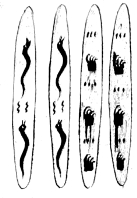
THROWS
Two painted or marked sides and two white count 2
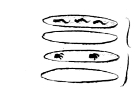
All the white sides turned up count 10
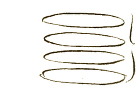
Three burned sides up and one white count nothing 0
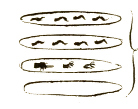
Four burned sides up count 10
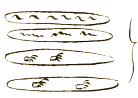
Nota Bene.—Three white sides up and one burned side up counts nothing.
The Chun-kan-dee´ Game
BUREAU OF AMERICAN ETHNOLOGY
FORTY-SIXTH ANNUAL REPORT PLATE 74
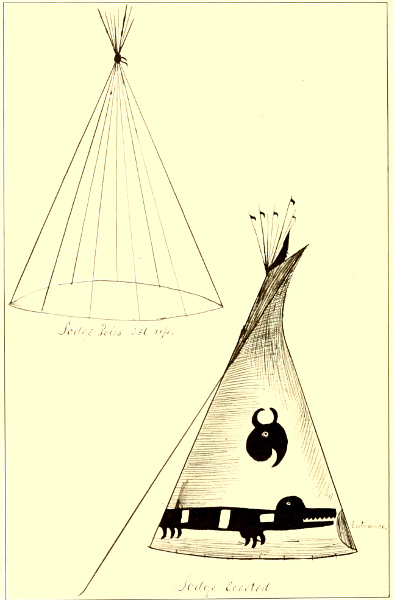
A Lodge Frame and a Completed Lodge
BUREAU OF AMERICAN ETHNOLOGY
FORTY-SIXTH ANNUAL REPORT PLATE 75
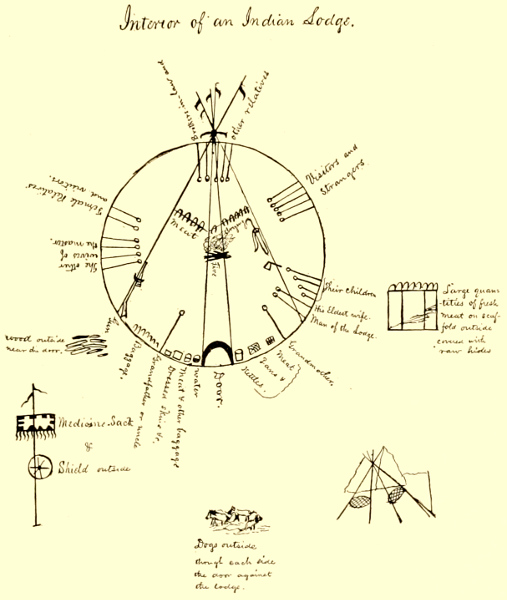
The Interior of a Lodge and Its Surroundings
BUREAU OF AMERICAN ETHNOLOGY
FORTY-SIXTH ANNUAL REPORT PLATE 76
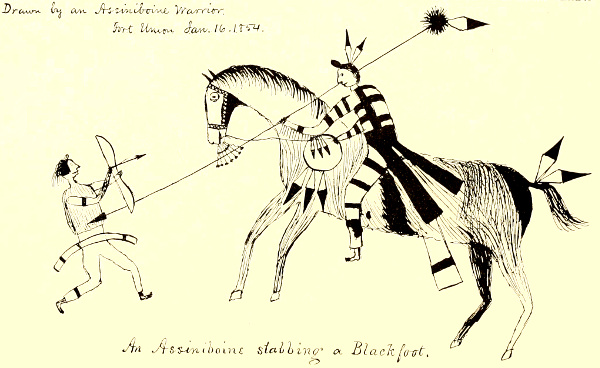
An Assiniboine stabbing a Blackfoot.
Drawn by an Assiniboine Warrior.
Fort Union Jan. 16. 1854.
The Mandan, Gros Ventres, and Arikara live in dirt cabins made by planting four posts in the ground, with joists on the top. From this square descend rafters to the ground in angular and circular shape, the interstices being filled with smaller sticks and willows; then grass is laid on, which is covered with mud, over which is thrown earth, and the whole beaten solid. An opening is left in the top for the smoke and a door in the side, which is extended into a covered passage of a few steps and will admit a man upright. These are large and roomy huts, will accommodate 30 or 40 persons each, but are generally occupied by one family, who frequently have their beds and bedsteads, corn cellar, provision room, and often a horse or two under the same roof. They are said to be damp and unhealthy.
The figures and representations of animals, etc., painted on their skin lodges are those of monsters seen by them in their dreams; also the hand is dipped in red paint mixed with grease and its impression made in many places over the tent. This denotes the master of the lodge to have struck an enemy. The same impression is also made on their naked bodies in some of their dances and has the same signification.
Canoes
Skin canoes are the only watercraft used by these tribes, and these are only to be found among the Mandan, Gros Ventres, and Arikara. They are made of the skins of one or two buffaloes with the hair on, not dressed, and stretched over a basketwork of willows. The women make, carry, and propel them with paddles, one person only paddling in front. A canoe of one buffalo skin will contain four persons and cross the Missouri, but they must sit very quiet or they will upset. The women carry these canoes on their backs along the bank to the place where they wish to cross, and on their return bring them to the village and turn them upside down to dry. A canoe of this kind is made in two or three hours and will last a year. Bark canoes are used by the Chippewa, but we are not well enough acquainted with their construction to describe them. When no skin can be found to make a boat war parties will cross any river on a raft.
Mental and Ethical Advancement
There is no doubt but most of these nations are disposed to advance from the barbaric type, though as yet they have made but little progress. Indeed, when we consider their mode of life, wants, and situation with regard to each other we can not imagine how they can well be anything more than what they are. Harassed by internal wars, pinched by necessities that compel them to constant exertion, discouraged by the ravages of diseases, and overwhelmed by innumerable superstitious fears, their condition is not one calculated to prepare either mind or body for the arts and habits of civilization. The whole tenor of an Indian’s life, and the sum and substance of all his labors is to live, to support his family, and rear his children, and he must bring them up in such a way that they in their turn can do the same. For this all is risked, and to this end the whole of their occupations, even their amusements, tend. They would be most willing to embrace any mode of life by which this main object could be realized with less risk and toil than the one they now pursue, but they must first be convinced of the certainty of success in the strange pursuit to which their formed habits must give way before they would apply themselves.
Their present manner is certainly precarious, but they would not abandon it unless some better way to live was made manifest, not by tales and speeches but by actual experiment. Indians (men) will not work. Even the slight attempt at agricultural labor by the few nations on the upper Missouri who raise corn and other vegetables devolves solely upon the women to perform them, and the men hunt as the other tribes. Meat must be had, and as yet no relish has been formed by any of them, except the Sioux, for the flesh of domestic animals. Notwithstanding all this, we see in many things a desire to change for the better, exhibiting itself in a general feature of improvement when compared with that of 20 years since. Within that time and within our acquaintance with these people the Sioux, Assiniboin, and other nations were much more savage than they now are. At the period to which we allude it was almost impossible for even the traders, much less strangers, to travel through their country without being robbed and often killed. Horses were stolen from whites on all occasions; every person outside the fort was liable to be abused, imposed upon, flogged, or pillaged, and even their dealings with each other were no better. Murders upon slight provocation, robberies, and misdemeanors of all kinds were common among them. Even whole bands armed against each other and skirmishes took place whenever they met.
All these things now, if not obsolete, are very rare. Whites move about among most of the nations with security of life and property, and the Indians are better clothed, provided for, armed and contented than formerly. For these happy results so far we are indebted to the unmitigated exertions and good counsel of a few white traders of the old stock, some good Indian agents, the entire abolishment of the liquor trade, and lately the humane endeavors on the part of the Government by the treaty at Laramie in 1851.
Medicine; Drugs
Most of them are beginning to see the superiority of drugs and treatment of the sick as exhibited to them by whites and are becoming aware that their drummings and superstitions are of no avail, but it is only a perception of truth, not as yet leading to any change in their superstitions, because no person instructs them in aught better. As it stands at present and to come to the point of this matter, we would say a disposition to emerge from barbarism is apparent among most of these tribes, though as yet no great advancement has been made. The small improvements alluded to only show the desire to exist, but their present organization, knowledge, and relative positions to each other as nations do not admit of further improvement, which must necessarily unfit them for their ordinary pursuits and successful contention with enemies.
Food
Their provisions, cooking utensils, manner of cooking, serving the meal and eating assimilates yearly more to that of the whites. Their conversation, desires, and willingness to listen to counsel for their benefit all convince of a disposition to advance toward civilization and exchange their present mode of life for one more certain in its resources, provided they could follow these employments secure from the depredations of neighboring tribes yet their enemies; but here is the difficulty, they are obliged to be always in readiness for war, also to make excursions on their foes to replace their stolen horses or revenge the death of their relatives.
They usually eat three times a day, morning, noon, and night, if meat is plenty, but the number of meals depends altogether on the supply of food, as has already been stated. Clay pots and other earthen vessels are still in use among the Mandan, Gros Ventres, and Arikara, being of their own manufacture, though they also have metallic cooking utensils.
The flesh of buffalo and other animals is cut in broad, thin slices and hung up inside the lodges on transverse poles over the fire, but high up in the lodge and in the way of the smoke, which soon penetrates it, and in a few days the meat is dried and fit to pack away. In the summer it is dried by spreading it in the sun, being cut up as above, which soon cures it. They employ no salt in curing any meat.
The parts of the buffalo eaten in a raw state are the liver, kidneys, gristle of the snout, eyes, brains, marrow, manyplies, or the omasum, testicles, feet of small calves in embryo, and glands of the calf envelope. Meat when cooked is either boiled or roasted, principally the former, and always rare in either way, not overdone. They have no salt for seasoning, but are fond of a little in the bouillon. In former times meat was boiled in the rawhide, in holes in the ground smeared with mud, and heated stones dropped in, or in pots made of clay and soft stone, but metallic cooking utensils, consisting of kettles of every size and description, have entirely replaced these. Tin cups and pans, with some frying pans, wooden bowls, and horn spoons, are yet common.
The tongues of buffalo sent to market are salted by the traders, who secure them from the Indians during the winter in the hunting season, and when frozen, salting them before the spring thaw comes on. None of these tribes preserves meat in any other way than above mentioned, some of which when dried is pounded and mixed with berries and marrowfat. It is then called pemmican, or in Cree pim-e-tai´-gan. Dried meat will keep but one year if free of wet, as afterwards the fat turns rancid and the lean tasteless.
The tail of the beaver is first turned in the blaze of a fire, the outside skin scraped off, then incisions are made each side lengthwise along the bone, and it is held in boiling water for a few minutes to extract the blood. It is then hung up in the lodge or in the sun and left to dry.
All inquiries regarding fish are inapplicable to these Indians, as they take none in quantity. The few catfish that are hooked by the Gros Ventres and Arikara are boiled in water, no salt added, and a horrid mess of bones and fish mixed together is produced, which no one but an Indian could eat. They eat but do not relish them.
All the hunter tribes rely greatly on the spontaneous roots and fruits found in the country and collect, dry, and pack them away, to be used in times of scarcity of animal food. We have known hundreds of Indians to subsist for one or two months on the buds of the wild rose boiled with the scrapings of rawhides. At all times the different kinds of roots and berries are a great resource, are used in their principal feasts and medicine ceremonies, are of great assistance when game is not to be found, are easily packed, and contain considerable nourishment. The following is a catalogue of those found among all the nations of which we treat, though there are several others whose names in English are unknown to us, and some of these now named peculiar to the most northern latitudes.
Roots, Berries, etc., Eaten by the Indians of the Upper Missouri
English Name Assiniboin name Method of preparation
Prairie turnip (pomme blanche) Teep-se-nah Dried and pounded.
Service berries We-pah-zoo-kah Dried.
Bull berries (grains des boeufs) Taque-sha-shah Do.
Chokecherries Cham-pah Pounded with seeds and dried.
Red plums Caun-tah Stones extracted and dried.
Wild grapes Chint-kah Not preserved; eaten ripe.
Currants Wecha-ge-nus-kah Do.
Gooseberries Chap-tah-ha-zah Do.
Wild rhubarb Chan-hn-no-ha Tops eaten raw or boiled.
Fungus growing on trees Chaun-no-ghai Not dried; found in winter.
Artichokes Pung-ghai Eaten raw or boiled; not preserved.
Berries of the red willow Chau-sha-sha Eaten raw only in great need.
Antelope turnips Ta-to-ka-na Teep-se-nah Boiled and dried.
Wild garlic Ta-poo-zint-kah Raw; not preserved.
A berry called Me-nun Not dried; eaten ripe.
Acorns31 Ou-tah-pe Roasted and dried.
Strawberries Wa-zshu-sta-cha Not dried.
Inner bark of cottonwood Wah-chin-cha-ha Resorted to in time of actual famine.
Berries of the smoking weed She-o-tak-kah Not preserved; eaten ripe.
A root resembling artichoke Ske-ske-chah Dried, pounded, and boiled.
Buds of the wild rose We-ze-zeet-kah Found everywhere all winter on the stalk.
Red haw berries Tas-paun Not dried; eaten in fall and winter.
Animals Eaten by Indians
Buffalo (wo-ta-cha)
{ bull Ta-tun-gah.
{ cow Petai.
Antelope Tah-to-ka-nah.
Elk Opoñ.
Deer Tah-chah.
Bear Wah-ghuñ-kseecha.
Wolf Shuñkto-ka-chah.32
Foxes
{ red Shunga shanah.
{ gray To-kah-nah.
Porcupine Pah-hee.
Badger Kho-kah.
Skunk Man-gah.
Rabbit Mushtinchanah.
Hare Mushtincha ska.
Ermine E-toonka sun.
Otter Petun.
Mink E-koo-sa.
Beaver Chap-pah.
Muskrat Sink-pai.
Glutton Me-nag-gzshe.
Lynx Ega-mo´
Mouse Pees-pees-anah.
Ground squirrel Tah-she-ho-tah.
Water turtle Kai-ah.
Terrapin Pat-kah-shah.
Horns of elk in the velvet. Tah-hai.
Horse Shungatun-gah.
Mule Sho-shonah.
Dog Shunka.
Snake (not eaten except by Cree).
Birds Eaten
Crow Ah-ah-nah.
Raven Con-ghai.
Magpie Eh-hat-ta-ta-na.
Owl He-hun.
Duck Pah-hon-tah.
Goose Man-ghah.
Crane Pai-hun.
Pelican Mid-dai-ghah.
Small bird of any sort. Sit-kap-pe-nah.
Eagles are not eaten.
Parts of Buffaloes Not Eaten
Glands of the neck. Sinews.
Bull’s pizzle. Horns, hoofs, and hair.
Every other part, inside and out, is eaten, even to the hide.
Sugar is made from the sap of the maple. Wild rice is gathered by the Cree and Chippewa on Red River and the adjacent lakes, but not by the upper Missouri tribes. In times of great scarcity old bones are collected by the nations of whom we write, pounded, and the grease extracted by boiling, and eaten together with any of the foregoing roots or berries that can be found. But these sad times always happen when the snow is deep, the ground frozen, and they can not be found. Then those who have not laid up a stock of some of these roots the previous summer are driven to the necessity of killing and eating their horses and dogs, which being exhausted and nothing more to be found they are compelled to eat human flesh.33
Garments; Dresses
In the materials of their clothing, as far as the cold climate will admit, articles of European manufacture have been substituted for their skins, but there being no fabric as yet introduced equal to or even approaching the durability and warmth of the buffalo skin, all hunters and travelers in the winter season must be clothed with the latter to preserve life or prevent mutilation by frost. Still in the summer season these are laid aside, being full of vermin and saturated with grease and dirt, and the Indian steps proudly around in his calico shirt, blanket, and cloth pantaloons. Their hair also, formerly tangled and matted, has been unraveled by the use of different kinds of combs, and the livestock, which found “a living and a home there,” has, by these instruments, been torn from their comfortable abode, thus rendering useless their original method of disposing of these vermin, viz., extracting them with their fingers and masticating them in turn for revenge.
Most of the clothing used by these tribes is made of skins of their own procuring and dressing, the process of which has already met with attention. They have different dresses for different seasons, also various costumes for war, dancing, and other public occasions, some of which have been described. In the summer seasons, when comparatively idle, the clothing traded from the whites is preferred on account of its superior texture and color, but in their usual occupations, in winter, at war, in the chase, or any public ceremonies among themselves, very few articles of dress thus obtained are seen, if we except some blankets, undercoats, scarlet cloth, and ornaments. Their own dresses of skins fancifully arranged, adorned with feathers, beads, shells, and porcupine quills, are much more highly prized by them than any article of dress of European manufacture introduced by the traders.
We will now detail a few of the most common or everyday dresses among them, in different seasons, male and female, estimating the cost of each in buffalo robes at $3 each, their value in this country.
Summer and Fall Dress for Men
No. 1
A buffalo robe, thin hair, or a dressed cowskin robe on the back 1 robe
Dressed deer or antelope skin leggings 1 robe
Cloth breech flap and moccasins ½ robe
2 ½ robes at $3=$7.50
No. 2
A scarlet blanket 4 robes
Beads worked in same 10 robes
Deerskin shirt and leggings fringed and garnished with beads and porcupine quills 5 robes
Breech flap of scarlet cloth and moccasin 1 robe
Necklace of bear’s claws 5 robes
Moccasins and handkerchief for the head 1 robe
26 robes at $3=$78.00
No. 3
White blanket 3 robes
Calico shirt 1 robe
Neckerchief and cloth breech flap 1 robe
Cottonade pantaloons 1 robe
Muskrat cap 1 robe
Moccasins 0 robe
7 robes at $3=$21.00
No. 4
White blanket 3 robes
Blanket capot 3 robes
Skin leggings, plain antelope skin 1 robe
Breechcloth and moccasins ½ robe
7 ½ robes at $3=$22.50
No. 5
Scarlet or Hudson Bay blanket 4 robes
Beads worked on same 10 robes
Scarlet laced chief’s coat 6 robes
Black fur hat and three cock feathers 2 robes
Silver hatband and plate 2 robes
1 pair silver arm bands 2 robes
Scarlet cloth leggings and hawk bells 1 robe
Black silk handkerchief and cloth breech flap 1 robe
Silver gorget, ear wheels and hair pipe 2 robes
Moccasins garnished with beads ½ robe
30 ½ robes at $3=$91.50
Winter Dress for Men Hunter’s winter dress of the Plains No. 7
Buffalo robe coat, hair inside 1 robe
Buffalo robe over it 1 robe
Skin cap and mittens, hair inside ½ robe
Blanket breech flap, robe, moccasins, belt knife, and fire apparatus ½ robe
Dressed cowskin leggings 1 pair snowshoes ½ robe
3 ½ robes at $3=$10.50
No. 2
White blanket coat with hood 3 robes
White blanket over it 3 robes
Flannel or calico shirt 1 robe
Blanket leggings 1 robe
Soled rope moccasins Blanket breech flap Skin mittens, hair inside 1 robe
9 robes at $3=$27.00
No. 2 is the dress of a wood hunter, ordinary warrior in winter, if we take away the blanket and substitute a buffalo robe; or it is worn in traveling, and is occasionally used by hunters in the Crow and Sioux Nations, but the Cree and Assiniboin mostly wear No. 1 winter on the plains. Other ordinary dresses are only variations of the foregoing, adding some articles and withdrawing others, but none of them are used when in full dress, on public occasions, among themselves, except sometimes No. 5. All their fancy dresses for dances, war, and feasts have their peculiar marks and distinction in rank; also the robes worn by chiefs, soldiers, or warriors in stated assemblies have their battle scenes painted on them in rude drawings, though intelligible to them. When merely designed to be ornamental the drawing consists of a representation of the sun, made by a large brilliant circle painted in the middle. Sometimes a calumet is pictured, and other devices, such as guns, bows, lances, horses, etc.
The dresses of the divining men are not distinguished from those of ordinary Indians by any marks, unless they are able and wish to renew the remembrance of their former coups on their enemies by wearing a robe on which they are drawn, but being generally old they seldom make any display in dress, though wearing a cap or piece of bearskin round the head is common with them. The rest of their clothing in summer would answer to No. 1 and in winter to No. 2, abstracting the blanket capot.
Women’s Summer Dresses
No. 1
Dressed cowskin cotillion 1 robe
Leggings of same ½ robe
Dressed cow or elk-skin robe 1 robe
Moccasins 0 robe
2 ½ robes at $3=$7.50
No. 2
Colored blanket 4 robes
Blue or scarlet cloth dress 3 robes
Garnishing of beads on same 5 robes
Scarlet cloth leggings ornamented with beads 2 robes
White deerskin moccasins worked with beads 1 robe
Heavy bead earrings and necklaces 4 robes
Brass-wire wristbands and rings 1 robe
20 robes at $3=$60.00
No. 3.—Crow Indians
Fine white dressed elk-skin robe 1 robe
Fine white bighorn skin cotillion adorned with 300 elk teeth 25 robes
Neck collar of large brass wire 1 robe
Fine antelope skin leggings worked with porcupine quills 3 robes
Brass wire wristbands and rings 1 robe
California shell ear ornaments 3 robes
Very heavy bead necklaces 3 robes
Moccasins covered with beads 2 robes
39 robes at $3=$117.00
No. 4.—Sioux
Fine white dressed elk skin robe, painted 1 robe
Fine white dressed antelope skin cotillion heavily ornamented with beads or shells on breast and arm 30 robes
Leggings of same ornamented with beads 3 robes
Bead or wire necklace 2 robes
Garnished moccasins and brass breast plate 1 robe
Ear bones 3 robes
40 robes at $3=$120.00
No. 5.—Common Sioux, Assiniboin, or Crow Dress
White blanket 3 robes
Blue cloth cotillion or green cloth 2 robes
Scarlet cloth leggings 1 robe
6 robes at $3=$18.00
No. 6.—Winter Dress
Buffalo robe 1 robe
Dressed cowskin cotillion 1 robe
Dressed cowskin leggings and shoes 1 robe
3 robes at $3=$9.00
No. 7.—Winter Dress—Crows
Buffalo robe much garnished with porcupine quills 4 robes
Big Horn cotillion trimmed with scarlet and ornamented with porcupine quills 3 robes
Leggings of elk skin, fringed and worked with quills 2 robes
Wrist, ear, and neck ornaments, say 3 robes
12 robes $3=$36.00
There are many other dresses worn, differing in cost according to the ornaments or labor bestowed on them, and the foregoing are varied with their fancy and means; some therefore would cost high and others merely a trifle. Those of mounted warriors, for dances, soldiers, etc., are still more valuable owing to the war eagle feathers and other decorations. It is difficult to determine the cost and durability of each costume. The cost has been stated, but every Indian can dress only according to his means, which, if sufficient, will adorn his clothing with ornaments to a great extent; but if limited, he must be contented with such materials for covering as are yielded by the skins of the animals that furnish him with food; consequently every shade and variety of dress is visible among them. Some portions of these dresses are only worn on occasions, while others are retained all the time, and wear out the sooner. As an ordinary rule, Indians, both male and female, renew their clothing of European manufacture every spring, though the portions discarded are cut up for leggings, breech flaps, hunting caps, gun wadding, etc.
It may be said to last six months if worn while hunting, or a year if only used at times, in traveling and while idle, as is comparatively the case in the summer season. A complete suit of skin will last the whole year round, its actual cost being only the labor of dressing, and as time in the summer is of no value to them it may be said to cost in reality nothing if not ornamented. Blankets and cloth are not damaged by wet but do not resist the cold. Skins are impervious to cold and wind but are destroyed by being wet, hence the necessity and advantage of wearing the one in summer and the other in winter, independent of the filthy nature of skins when long worn, and of the capability of woolens to be cleansed by washing. The dress of a mounted warrior pl. 76), as in battle or in the dance, would be as follows, the cost being estimated as before:
Mounted Warrior’s Dress
Buffalo robe painted with battle scenes and garnished with porcupine quills; best; 6 robes $18.00
Skin shirt and leggings garnished with human hair and porcupine quills, valued at 1 horse or 10 robes 30.00
War-eagle feather cap, largest kind; price, 2 horses, 10 robes each 60.00
Necklace of bear’s claws wrought on otter skin, 6 obes 18.00
Feathers of the war eagle on shield, lance, and horse, 10 robes 30.00
Garnished moccasins, 1 robe 3.00
Shell ear ornaments, 4 robes 12.00
Total 171.00
Another fancy dress would cost as follows:
Scarlet blanket, 4 robes, at $3 $12.00
Beads on same, 10 robes 30.00
Skin shirt and leggings garnished with porcupine quills and trimmed with ermine, 20 robes 60.00
Bear’s-claw necklace, 6 robes 18.00
Soldier’s cap of magpie feathers, tipped with red and fringed with ermine, 10 robes 30.00
Brass-wire arm bands, 3 robes 9.00
Eagle feathers on lance and shield, 6 robes 18.00
Shell ear ornaments and moccasins, 4 robes 12.00
Total 189.00
Both of the above dresses are principally of their own manufacture; yet if a trader wishes to purchase them he has great difficulty in doing so, even by paying the above prices in merchandise, of which they always stand in need; indeed, they seldom can be induced to part with them on any terms unless forced to sell to supply some reverse by loss of property which has happened to their families. The reason is that they are scarce, difficult to replace, and also it is the wish of the warriors to wear them during their lives on all public occasions and to be clothed with them when they die. Two tails of the war eagle of 12 feathers each would be worth two horses if wrought into a cap, or something more than a horse without. Usually the value of the tail feathers of this bird among any of the tribes of whom we write is $2 each in merchandise in this country, or 15 feathers for a horse.
Ten ermine skins will also bring a horse among the Crow Indians, and 100 elk teeth are worth as much, there being but two teeth in each elk which are suitable, and the tail feathers of the war eagle are the only ones used. The elk are not killed in great numbers by any one hunter, so that much time and bargaining are required for an individual to collect 300, the number usually wrought on a Crow woman’s dress. The eagles are scarce and difficult to catch; hence the value of these two ornaments.
The men in their homes in their own country at night divest themselves of their moccasins, leggings, and blanket capot (if any), retaining only the breech flap, and covering themselves with their robe or blanket; but when traveling, at war, in the chase, or encamped on the borders of their enemy’s country no portions of clothing are taken off at night; even their arms and accouterments are retained while sleeping. In the summer season the women lay aside their leggings and moccasins when going to bed, reserving only the petticoats, or cotillion, as it is called in this country, and covering themselves with the robe, but in the winter, or in traveling, no part of their clothing is taken off. Young unmarried and as yet untouched women take the precaution at night to wind around their dress a strong cord, strapping the same tightly to their body and legs.
This is done by some of their female relatives, the cord being well tied and wrapped around many times to prevent the consequences of any mistakes on the part of young men as to the location of their bed, which might happen if they entered during the night, or if they were guests. It is considered a great credit to a young woman never to have slept unbound as above previous to marriage. Saddles, billets of wood, and parts of clothing taken off serve as pillows for the men. Provision bales, wooden bowls, and baggage sacks answer the same purpose for the women. Rawhides, saddle blankets, apishimos,34 skins in hair, with grass and twigs beneath form the bed, which is seldom longer than two-thirds the sleeper, and about 3 feet wide.
Ornaments
All Indians are excessively fond of display in ornaments. Indeed, as may have been gathered from the preceding, the value of their dresses depends entirely upon the nature and extent of these decorations. Small round beads of all colors are used in adorning every portion of their dress, as also agate for their ears, hair, neck, and wrists, but these are by no means as valuable as several kinds of shells or as their ornamenting with colored porcupine quills. A shell, called by the traders Ioquois,35 is sought after by them more eagerly than anything else of the kind. They are procured on the coast of the Pacific and find their way to our tribes across the mountains through the different nations by traffic with each other until the Crows and Blackfeet get them from some bands of the Snake and Flathead Indians with whom they are at peace.
These shells are about 2 inches long, pure white, about the size of a raven’s feather at the larger end, curved, tapering, and hollow, so as to admit of being strung or worn in the ears of the women, worked on the breast and arms of their cotillions, also adorn the frontlets of young men, and are worth in this country $3 for every 10 shells. Frequently three or four hundred are seen on some of the young Crow or Blackfoot women’s dresses. The large blue or pearl California shell was once very valuable and still is partially so. It is shaped like an oyster shell and handsomely tinted with blue, green, and golden colors in the inside. One of these used to be worth $20, but of late years, owing to the quantity being introduced by the traders, the price has depreciated to about half that amount. These shells they cut in triangular pieces and wear them as ear pendants. Silver is worn in the shape of arm and wrist bands. Hat bands, gorgets, brooches, ear wheels, finger rings, and ear bobs are mostly in use among the Sioux, the upper nations preferring shells. Other ornaments consist of elk teeth, colored porcupine quills, and feathers of the white plover dyed. Feathers of ravens, owls, hawks, and eagles, furs cut in strips and wrought in various parts of their dress, besides a great variety of trinkets and paints furnished by the traders, among which are brass rings, brass and iron wire, beads, brass hair and breast plates, brass and silver gorgets, wampum moons, hair pipe, St. Lawrence shells, spotted sea shells, hawk bells, horse and sleigh bells, cock and ostrich feathers, thimbles, gold and silver lace, etc.
Paints and Dyes
The principal paints sold them are Chinese vermilion, chrome yellow and verdigris. Out of all these an Indian can please himself, and either buy such as are mentioned, or use the shells, feathers, furs, etc., their own country and labor produces.
The native dyestuffs for coloring porcupine quills and feathers are as follows: For yellow, they boil the article to be colored with the moss found growing near the root of the pine or balsam fir tree. For red, they in the same way use the stalk of a root called we-sha-sha, the English name of which is unknown to us. They have also some earths and ochers, which by boiling impart a dull red, violet, and blue color, but we are unacquainted with the process and their names in any other language except the Indian. Their native dyes, however, with the exception of the yellow, are superseded by those introduced by the traders, with all but the Crow Indians, who living near and in the Rocky Mountains find several coloring herbs and mineral substances unknown to the other tribes, which produce much better colors than these mentioned. At the present day they all mostly use the clippings of different colored blankets and cloth, which by boiling with the substance to be dyed, communicates the tint of the cloth to it in some degree. Thus rose, green, pale blue, and violet colors are obtained. For black they boil the inner papers in which Chinese vermilion is enveloped.
Tattooing
Tattooing is much practiced by all these tribes, and a great variety of figures are thus painted, sometimes in spots on the forehead, stripes on the cheeks and chin, rings on the arms and wrists; often the whole of the breast as low down as the navel, with both arms, is covered with drawings in tattoo. It is a mark of rank in the men, distinguishing the warrior when elaborately executed, and as the operation is one requiring the pay of one or two horses, it proves the person’s parents to have been sufficiently rich to afford that mark of distinction imprinted on their children, whether male or female. It is usually done on females at the age of 12 to 14 years, is only exhibited on them in the form of a round spot in the middle of the forehead, stripes from the corners and middle of the mouth down to the chin, occasionally transversely over the cheek, and rings around the wrist and upper parts of the arms. On them it is merely designed as ornament. Men are tattooed entire after having struck their first enemy, but smaller marks of this kind are also only ornamental. The material employed and the modus operandi are as follows: Red willow and cedar wood are burned to charcoal, pulverized, and mixed with a little water. This is the blue coloring matter. From four to six porcupine quills or needles are tied together with sinew. These are enveloped in split feathers; wrapping with sinew, until a stiff pencil about the size of a goose quill is had, with the quills or needles projecting at the end. One of the priests or divining men is then presented with a horse and requested to operate. At the same time a feast of dried berries is prepared, and a considerable number of elderly men invited to drum and sing. When all are assembled the feast is eaten with much solemnity and invocations to the supernatural powers.
The person to be tattooed is then placed on his back, being stripped naked, and the operator being informed of the extent of the design to be represented, proceeds to mark an outline with the ink, which, if correct, is punctured with the instrument above alluded to, so as to draw blood, filling up the punctures with the coloring matter as he goes along, by dipping the needles therein and applying them. The drumming and singing is kept up all the time of the operation which, with occasional stops to smoke or eat, occupies from two to two and a half days, when the whole of the breast and both arms are to be tattooed; and the price for the operation is generally a horse for each day’s work.
Badges of Office
There are no badges of office that we are aware of. These marks belong to kinships and appear only in their dress in the different dances, apart from which nothing is seen denoting official station. Rank is known by the devices drawn on their robes; that is, to a warrior who has struck an enemy and stolen horses is accorded the privilege of wearing a robe adorned with a representation of these acts; he is also entitled to make the impression of a hand dipped in red paint on his lodge or person, to wear hair on his shirt and leggings, and two war eagle’s feathers on his head. After making many coups he arrives at the degree of camp soldier36 and is known on public occasions by the addition to the above of the war-eagle cap or bear’s claw necklace, which, together with the advantage of publishing his feats in the dances and other ceremonies, establishes his standing among his people.
A still further progress, so as to rank with chiefs or councillors, is not attended with any additional display or mark of distinction; indeed, in that event their coups are seldom boasted of, that being rendered unnecessary from the fact of the whole nation’s being aware of the cause of his advancement, and although chiefs and councillors generally have appropriate dresses, as already described, they never wear them unless on the most important occasions, such as a battle, council with other nations, great religious assemblies, or an approaching dissolution. It is their greatest desire when arrived at the head of the ladder of fame to receive a flag or medal from some whites in power, which are worn or displayed on all ordinary convocations and councils. In like manner a sword would be the mark of a soldier in camp, but we see no other badges of office except what have already been referred to as existing in kins, which are laid aside as soon as the ceremonies which caused this display are concluded.
Beard
As has before been observed, these tribes have naturally little or no beard. What few hairs and down make their appearance on the face and other parts of the body are extracted by small wire tweezers of their own make. They have no method of killing or dyeing the hair; they cultivate it, and consider to cut it a great sacrifice. It is only clipped short or torn out by handfuls in excessive grief, but is never shaved, and until modern times but seldom combed.