Volume 2 — SPURRED GEESE (PLECTROPTERUS GAMBENSIS). VIII In a Primeval Forest
Frederic Whyte translation
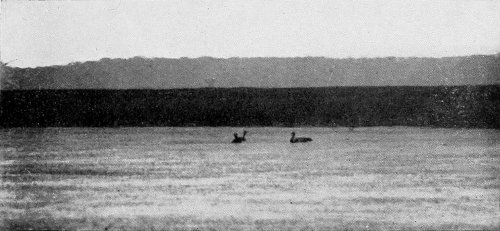
Scenes of marvellous beauty open out before the wanderer who follows the windings of some great river through the unknown regions of Equatorial East Africa.
The dark, turbid stream is to find its way, after a thousand twists and turns, into the Indian Ocean. Filterings from the distant glaciers of Kilimanjaro come down into the arid velt, there to form pools and rivulets that traverse in part the basin of the Djipe Lake and at last are merged in the Rufu River. As is so often the case with African rivers, the banks of the Rufu are densely wooded throughout its long course, the monotony of which is broken by a number of rapids and one big waterfall. Save in those rare spots where the formation of the soil is favourable to their growth, the woods do not extend into the velt. Trees and shrubs alike become parched a few steps away from the sustaining river. The abundance of fish in the river is tremendous in its wilder reaches—inexhaustible, it would seem, despite the thousands of animal enemies. The river continually overflows its banks, and the resulting swamps give such endless opportunities for spawning that at times every channel is alive with fry and inconceivable multitudes of small fishes.
It is only here and there and for short stretches that the river is lost in impenetrable thickets. Marvellous are those serried ranks of trees! marvellous, too, the sylvan galleries through which more usually it shapes its way! They take the eye captive and seem to withhold some unsuspected secret, some strange riddle, behind their solid mass of succulent foliage. It is strange that these primeval trees should still survive in all their strength with all the parasitic plants and creepers that cling to them, strangling them in their embrace. You would almost say that they lived on but as a prop to support the plants and creepers in their fight for life. Convolvuli, white and violet, stoop forward over the water, and the golden yellow acacia blossoms brighten the picture.
In the more open reaches dragonflies and butterflies glisten all around us in the moist atmosphere. A grass-green tree-snake glides swiftly through the branches of a shrub close by. A Waran (Waranus niloticus) runs to the water with a strange sudden rustle through the parched foliage. Everywhere are myriads of insects. Wherever you look, the woods teem with life. These woods screen the river from the neighbouring velt, the uniformity of which is but seldom broken in upon by patches of vegetation. The character of the flora has something northern about it to the unlearned eye, as is the case so often in East Africa. It is only when you come suddenly upon the Dutch palms (Borassus æthiopicus, Mart., or the beautiful Hyphæne thebaica, Mart.) that you feel once again that you are in the tropics.
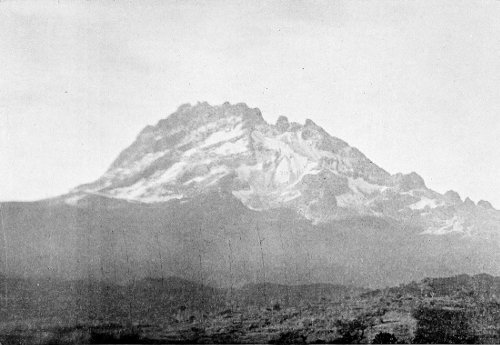
C. G. Schillings, phot.
VIEW OF MAWENZI, THE HIGHEST PEAK BUT ONE OF KILIMANJARO, TAKEN WITH A TELEPHOTO-LENS.
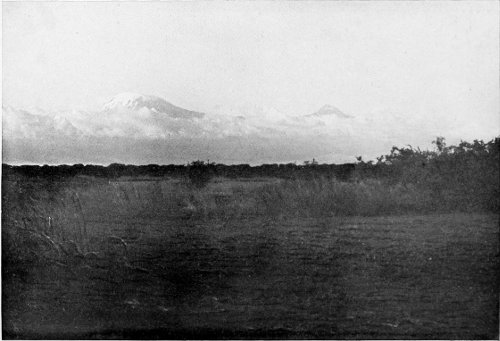
C. G. Schillings, phot.
VIEW OF KILIMANJARO, TAKEN AT SUNSET.
The river now makes a great curve round to the right. A different kind of scene opens out to the gaze—a great stretch of open country. In the foreground the mud-banks of the stream are astir with huge crocodiles gliding into the water and moving about this way and that, like tree-trunks come suddenly to life. Now they vanish from sight, but only to take up their position in ambush, ready to snap at any breathing thing that comes unexpectedly within their reach. Doubtless they find it the more easy to sink beneath the surface of the river by reason of the great number of sometimes quite heavy stones they have swallowed, and have inside them. I have sometimes found as much as seven pounds of stones and pebbles in the stomach of a crocodile.
The deep reaches of the river are their special domain. Multitudes of birds frequent the shallows, knowing from experience that they are safe from their enemy. One of the most interesting things that have come under my observation is the way these birds keep aloof from the deep waters which the crocodiles infest. I have mentioned it elsewhere, but am tempted to allude to it once again.
Our attention is caught by the wonderful wealth of bird-life now spread out before us in every direction. Here comes a flock of the curious clatter-bills (Anastomus lamelligerus, Tem.) in their simple but attractive plumage. They have come in quest of food. Hundreds of other marsh-birds of all kinds have settled on the outspread branches of the trees, and enable us to distinguish between their widely differing notes.
Among these old trees that overhang the river, covered with creepers and laden with fruit of quaint shape, are Kigelia, tamarinds, and acacias. In amongst the dense branches a family of Angolan guereza apes (Colobus palliatus, Ptrs.) and a number of long-tailed monkeys are moving to and fro. Now a flock of snowy-feathered herons (Herodias garzetta, L., and Bubulcus ibis, L.) flash past, dazzlingly white—two hundred of them, at least—alighting for a moment on the brittle branches and pausing in their search for food. Gravely moving their heads about from side to side, they impart a peculiar charm to the trees. Now another flock of herons (Herodias alba, L.), also dazzlingly white, but birds of a larger growth, speed past, flying for their lives. Why is it that even here, in this remote sanctuary of animal life, within which I am the first European trespasser, these beautiful birds are so timorous? Who can answer that question with any certainty? All we know is, that it has come to be their nature to scour about from place to place in perpetual flight. Perhaps in other lands they have made acquaintance with man’s destructiveness. Perhaps they are endowed with keener senses than their smaller snow-white kinsfolk, which suffer us to approach so near, and which, like the curious clatter-bill (which have never yet been seen in captivity), evince no sign of shyness—nothing but a certain mild surprise—at the sight of man.
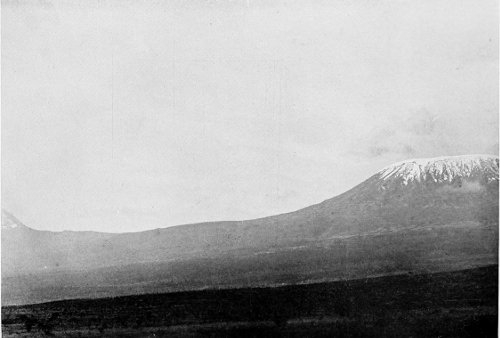
C. G. Schillings, phot.
KIBO IN THE FOREGROUND, WITH THE SADDLE-SHAPED RANGE CONNECTING IT WITH MAWENZI IN THE DISTANCE. THE AVERAGE HEIGHT OF THIS “SADDLE” IS MORE THAN 16,OOO FEET.
Now, with a noisy clattering of wings, those less comely creatures, the Hagedasch ibises, rise in front of us, filling the air with their extraordinary cry: “Heiha! Ha heiha!”
Now we have a strange spectacle before our eyes—a number of wild geese, perched upon the trees. The great, heavy birds make several false starts before they make up their minds to escape to safety. They present a beautiful sight as they make off on their powerful wings. They are rightly styled “spurred geese,” by reason of the sharp spurs they have on their wings. Hammerheads (Scopus umbretta, Gm.) move about in all directions. A colony of darters now comes into sight, and monopolises my attention. A few of their flat-shaped nests are visible among the pendent branches of some huge acacias, rising from an island in mid-stream. While several of the long-necked fishing-birds seek safety in flight, others—clearly the females—remain seated awhile on the eggs in their nests, but at last, with a sudden dart, take also to their wings and disappear. Beneath the nesting-places of these birds I found great hidden shaded cavities, the resorts for ages past of hippopotami, which find a safe and comfortable haven in these small islands.
The dark forms of these fishing-birds present a strange appearance in full flight. They speed past you swiftly, looking more like survivals from some earlier age than like birds of our own day. There is a suggestion of flying lizards about them. Here they come, describing a great curve along the river’s course, at a fair height. They are returning to their nests, and as they draw near I get a better chance of observing the varying phases of their flight.
But look where I may, I see all around me a wealth of tropical bird-life. Snow-white herons balance themselves on the topmost branches of the acacias. Barely visible against the deep-blue sky, a brood-colony of wood ibis pelicans (Tantalus ibis, L.) fly hither and thither, seeking food for their young. Other species of herons, notably the black-headed heron, so like our own common heron (Ardea melanocephala, Vig., Childr.), and further away a great flock of cow-herons (Bubulcus ibis, L.), brooding on the acacias upon the island, attract my attention. Egyptian Kingfishers (Ceryle rudis, L.) dart down to the water’s edge, and return holding tiny fishes in their beaks to their perch above.
The numbers and varieties of birds are in truth almost bewildering to the spectator. Here is a marabou which has had its midday drink and is keeping company for the moment with a pair of fine-looking saddled storks (Ephippiorhynchus senegalensis, Shaw); there great regiments of crested cranes; single specimens of giant heron (Ardea goliath, Cretzschm.) keep on the look-out for fish in a quiet creek; on the sandbanks, and in among the thickets alongside, a tern (Œdicnemus vermiculatus, Cab.) is enjoying a sense of security. Near it are gobbling Egyptian geese and small plovers. A great number of cormorants now fly past, some of them settling on the branches of a tree which has fallen into the water. They are followed by Tree-geese (Dendrocygna viduata, L.), some plovers and night-herons, numerous sea-swallows as well as seagulls; snipe (Gallinago media, Frisch.), and the strange painted snipe (Rostratula bengalensis, L.), the Actophylus africanus, and marsh-fowl (Ortygometra pusilla obscura, Neum.), spurred lapwing (Hoplopterus speciosus, Lcht.), and many other species. Now there rings out, distinguishable from all the others, the clear cry—to me already so familiar and so dear—of the screeching sea-eagle, that most typical frequenter of these riverside regions of Africa and so well meriting its name. A chorus of voices, a very Babel of sound, breaks continually upon the ear, for the varieties of small birds are also well represented in this region. The most beautiful of all are the cries of the organ-shrike and of the sea-eagle. The veritable concerts of song, however, that you hear from time to time are beyond the powers of description, and can only be cherished in the memory.
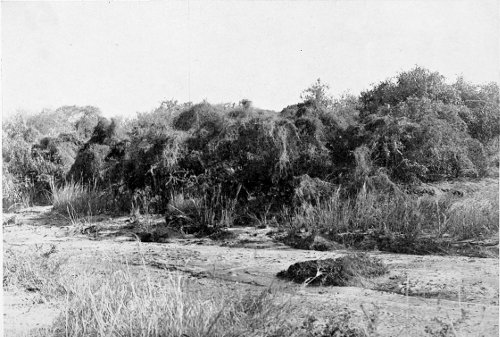
C. G. Schillings, phot.
RIVER-BED VEGETATION ON THE VELT.
There is a glamour about the whole life of the African wonderland that recalls the forgotten fairy tales of childhood’s days, a sense of stillness and loveliness. Every curve of the stream tells of secrets to be unearthed and reveals unsuspected beauties, in the forms and shapes of the Phœnix palms and all the varieties of vegetation; in the indescribable tangle of the creepers; in the ever-changing effects of light and shade; finally in the sudden glimpses into the life of the animals that here make their home. You see the deep, hollowed-out passages down to the river that tell of the coming and going of the hippopotamus and rhinoceros, made use of also by the crocodiles. It is with a shock of surprise that you see a specimen of our own great red deer come hither at midday to quench his thirst—a splendid figure, considerably bigger and stronger than he is to be seen elsewhere. A herd of wallowing wart-hogs or river-swine will sometimes startle you into hasty retreat before you realise what they are. The tree-tops rock under the weight and motion of apes unceasingly scurrying from branch to branch. Every now and again the eye is caught by the sight of groups of crocodiles, now basking contentedly in the sun, now betaking themselves again to the water in that stealthy, sinister, gliding way of theirs.
Not so long ago the African traveller found such scenes as these along the banks of every river. Nowadays, too many have been shorn of all these marvels. Take, for instance, the old descriptions of the Orange River and of the animal life met with along its course. No trace of it now remains.
I should like to give a picture of the animal life still extant along the banks of the Pangani. The time is inevitably approaching when that, too, will be a thing of the past, for it is not to be supposed that advancing civilisation will prove less destructive here.
So recently as the year 1896 the course of the river was for the most part unknown. When I followed it for the second time in 1897, and when in subsequent years I explored both its banks for great distances, people were still so much in the dark about it that several expeditions were sent out to discover whether it was navigable.
That it was not navigable I myself had long known. Its numerous rapids are impracticable for boats even in the rainy season. In the dry season they present insuperable obstacles to navigation of any kind.
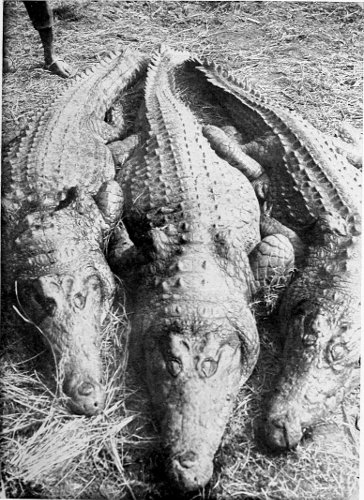
C. G. Schillings, phot.
A FISHERMAN’S BAG! THREE CROCODILES SECURED BY THE AUTHOR IN THE WAY DESCRIBED IN “WITH FLASHLIGHT AND RIFLE.”
The basin of the Djipe Lake in the upper reaches of the Pangani, and the Pangani swamps below its lower reaches, formed a kind of natural preserve for every variety of the marvellous fauna of East Africa. It was a veritable El Dorado for the European sportsman, but one attended by all kinds of perils and difficulties. The explorer found manifold compensation, however, for everything in the unexampled opportunities afforded him for the study of wild life in the midst of these stifling marshes and lagoons. The experience of listening night after night to the myriad voices of the wilderness is beyond description.
Hippopotami were extraordinarily numerous at one time in the comparatively small basin of the Djipe Lake. In all my long sojourn by the banks of the Pangani I only killed two, and I never again went after any. There were such numbers, however, round Djipe Lake ten years ago that you often saw dozens of them together at one time. I fear that by now they have been nearly exterminated.
Here, as everywhere else, the natives have levied but a small tribute upon the numbers of the wild animals, a tribute in keeping with the nature of their primitive weapons. Elephants used regularly to make their way down to the water-side from the Kilimanjaro woods. My old friend Nguruman, the Ndorobo chieftain, used to lie in wait for them, with his followers, concealed in the dense woods along the river. But the time came when the elephants ceased to make their appearance. The old hunter, whose body bore signs of many an encounter with lions as well as elephants, and who used often to hold forth to me beside camp fires on the subject of these adventures, could not make out why his eagerly coveted quarry had become so scarce. Every other species of “big game” was well represented, however, and according to the time of the year I enjoyed ever fresh opportunities for observation. Generally speaking, it would be a case of watching one aspect of wild life one day and another all the next, but now and again my eyes and ears would be surfeited and bewildered by its manifestations. The sketch-plans on which I used to record my day’s doings and seeings serve now to recall to me all the multiform experiences that fell to my lot. What a pity it is that the old explorers of South Africa have left no such memoranda behind them for our benefit! They would enable us to form a better idea of things than we can derive from any kind of pictures or descriptions.
I shall try now to give some notion of all the different sights I would sometimes come upon in a single day. It would often happen that, as I was making my way down the Pangani in my light folding craft, or else was setting out for the velt which generally lay beyond its girdle of brushwood, showers of rain would have drawn herds of elephants down from the mountains.1 Even when I did not actually come within sight of them, it was always an intense enjoyment to me to trace the immense footsteps of these nocturnal visitors. Perhaps the cunning animals would have already put several miles between my camp and their momentary stopping place. But their tracks afforded me always most interesting clues to their habits, all the more valuable by reason of the rare chances one has of observing them in daylight, when they almost always hide away in impenetrable thickets. What excitement there is in the stifled cry “Tembo!” In a moment your own eye perceives the unmistakable traces of the giant’s progress. The next thing to do is to examine into the tracks and ascertain as far as possible the number, age and sex of the animals. Then you follow them up, though generally, as I have said, in vain.
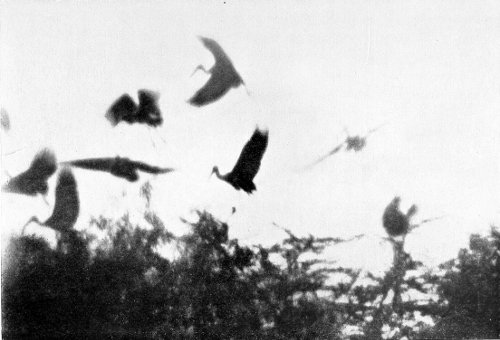
C. G. Schillings, phot.
CLATTER-BILLS SETTLING UPON THE BARE BRANCHES OF RIVERSIDE TREES.
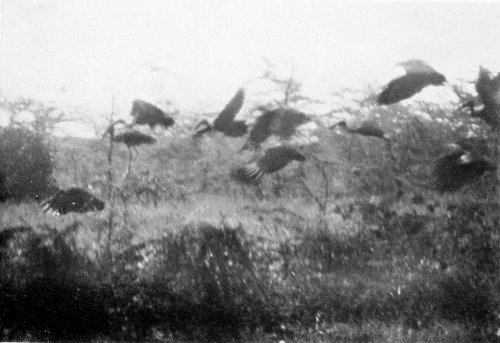
C. G. Schillings, phot.
CLATTER-BILLS (ANASTOMUS LAMELLIGERUS, Tem.).
The hunter, however, who without real hope of overtaking the elephants themselves yet persists in following up their tracks just because they have so much to tell him, will be all the readier to turn aside presently, enticed in another direction by the scarcely less notable traces of a herd of buffaloes. Follow these now and you will soon discover that they too have found safety, having made their way into an impenetrable morass. To make sure of this you must perhaps clamber up a thorny old mimosa tree, all alive with ants—not a very comfortable method of getting a bird’s-eye view. Numbers of snow-white ox-peckers flying about over one particular point in the great wilderness of reeds and rushes betray the spot in which the buffaloes have taken refuge.
The great green expanse stretches out before you monotonously, and even in the bright sunlight you can see no other sign of the animal life of various kinds concealed beneath the sea of rushes waving gently in the breeze. Myriads of insects, especially mosquitoes and ixodides, attack the invaders; the animals are few that do not fight shy of these morasses. They are the province of the elephants, which here enjoy complete security; of the hippopotami, whose mighty voice often resounds over them by day as by night; of the buffaloes, which wallow in the mud and pools of water to escape from their enemies the gadflies; and finally of the waterbuck, which are also able to make their way through even the deeper regions of the swamp. Wart-hogs also—the African equivalent of our own wild boars—contrive to penetrate into these regions, so inhospitable to mankind. We shall find no other representatives, however, of the big game of Africa. It is only in Central Africa and in the west that certain species of antelope frequent the swamps. In the daytime the elephant and the buffalo are seldom actually to be seen in them, nor does one often catch sight of the hippopotami, though they are so numerous and their voices are to be heard. As we grope through the borders of the swamp, curlew (Glarcola fusca, L.) flying hither and thither all around us, we are startled ever and anon by a sudden rush of bush and reed buck plunging out from their resting-places and speeding away from us for their life. Even when quite small antelopes are thus started up by the sound of our advance, so violent is their flight that for the moment we imagine that we have to deal with some huge and perhaps dangerous beast.
In those spots where large pools, adorned with wonderful water-lilies, give a kind of symmetry to the wilderness, we come upon such a wealth of bird-life as enables us to form some notion of what this may have been in Europe long ago under similar conditions. The splendid great white heron (Herodias alba, L., and garzetta, L.) and great flocks of the active little cow-herons (Bubulcus ibis, L.) make their appearance in company with sacred ibises and form a splendid picture in the landscape. Some species of those birds with their snow-white feathers stand out picturesquely against the rich green vegetation of the swamp. When, startled by our approach, these birds take to flight, and the whole air is filled by them and by the curlews (Glareola fusca, L.) that have hovered over us, keeping up continually their soft call, when in every direction we see all the swarms of other birds—sea-swallows (Gelochelidon nilotica, Hasselg.), lapwings, plovers (Charadriidæ), Egyptian geese, herons, pelicans, crested cranes and storks—the effect upon our eyes and ears is almost overpowering.
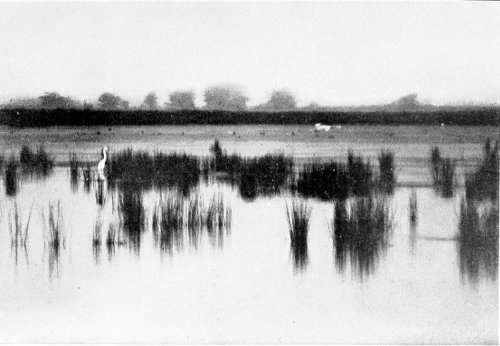
C. G. Schillings, phot.
A MARSHLAND VIEW. AN OSPREY IN AMONG THE REEDS—THE BIRD FOR WHOSE PROTECTION QUEEN ALEXANDRA OF ENGLAND HAS LATELY PLEADED.
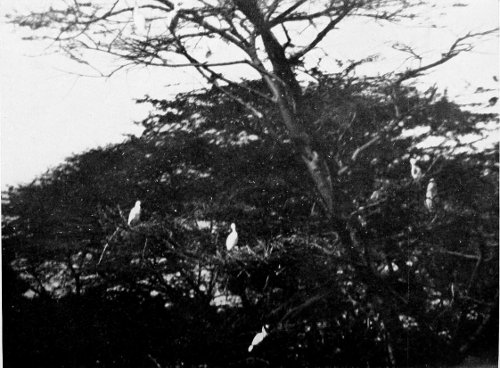
C. G. Schillings, phot.
SNOW-WHITE HERONS MADE THEIR NESTS IN THE ACACIAS NEAR MY CAMP AND SHOWED NO MARKED TIMIDITY.
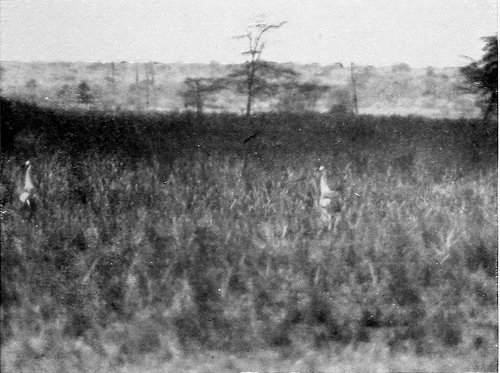
A SINGLE PAIR OF CRESTED CRANES WERE OFTEN TO BE SEEN NEAR MY CAMP.
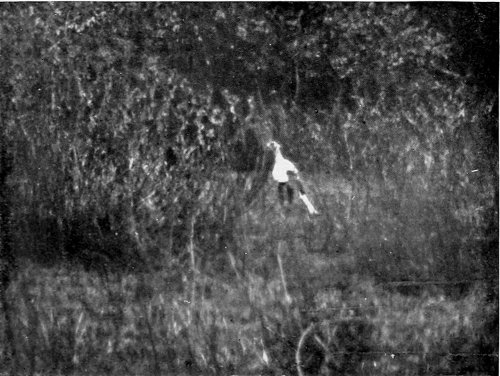
A SNAKE-VULTURE. I SUCCEEDED TWICE ONLY IN SECURING A PHOTOGRAPH OF THIS BIRD.
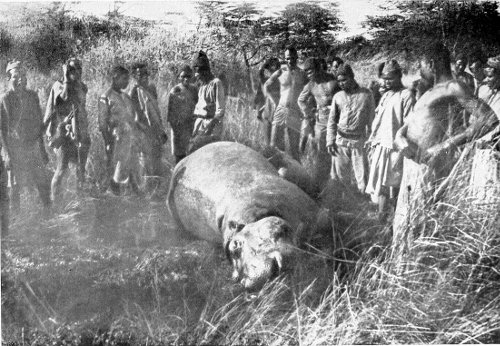
C. G. Schillings, phot.
PREPARING TO SKIN A HIPPOPOTAMUS. THE PRESERVATION OF THE HIDE OF THIS SPECIMEN PROVED UNSUCCESSFUL. IT IS ALMOST IMPOSSIBLE TO PRESERVE HIPPOPOTAMUS-HIDES WITHOUT HUGE QUANTITIES OF ALUM AND SALT, BOTH VERY HARD TO GET IN THE INTERIOR OF AFRICA. THE SKIN OF THE HEAD IS THINNER AND MORE MANAGEABLE THAN THAT OF THE REST OF THE BODY.
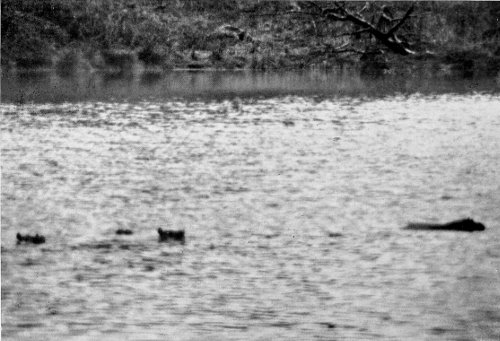
C. G. Schillings, phot.
HIPPOPOTAMI, POPPING THEIR HEADS OR EARS AND SNOUTS UP ABOVE THE SURFACE OF THE WATER.
How mortal lives are intertwined and interwoven! The ox-peckers swarm round the buffaloes and protect them from their pests, the ticks and other parasites. The small species of marsh-fowl rely upon the warning cry of the Egyptian geese or on the sharpness of the herons, ever on the alert and signalling always the lightning-like approach of their enemy the falcons (Falco biarmicus, Tem., and F. minor, Bp.). All alike have sense enough to steer clear of the crocodiles, which have to look to fish chiefly for their nourishment, like almost all the frequenters of these marshy regions.
The quantities of fish I have found in every pool in these swamps defy description—I am anxious to insist upon this point—and this although almost all the countless birds depend on them chiefly for their food. Busy beaks and bills ravage every pool and the whole surface of the lagoon-like swamp for young fish and fry. The herons and darters (Assingha rufa, Lacèp. Daud.) manage even to do some successful fishing in the deeper waters of the river. And yet, in spite of all these fish-eaters, the river harbours almost a superabundance of fish.2
Wandering along by the river, we take in all these impressions. For experiences of quite another kind, we have only to make for the neighbouring velt, now arid again and barren, and thence to ascend the steep ridges leading up to the tableland of Nyíka.
Behind us we leave the marshy region of the river and the morass of reeds. Before us rises Nyíka, crudely yellow, and the laterite earth of the velt glowing red under the blazing sun. The contrast is strong between the watery wilderness from which we have emerged and these higher ranges of the velt with their strange vegetation. Here we shall find many species of animals that we should look for in vain down there below, animals that live differently and on scanty food up here, even in the dry season. The buffaloes also know where to go for fresh young grass even when they are in the marshes, and they reject the ripened green grass. The dwellers on the velt are only to be found amidst the lush vegetation of the valley at night time, when they make their way down to the river-side to drink.3 It is hard to realise, but they find all the food they need on the high velt. When you examine the stomachs of wild animals that you have killed, you note with wonder the amount of fresh grass and nourishing shrubs they have found to eat in what seem the barrenest districts. The natives of these parts show the same kind of resourcefulness. The Masai, for instance, succeeds most wonderfully in providing for the needs of his herds in regions which the European would call a desert. I doubt whether the European could ever acquire this gift. Out here on the velt we shall catch sight of small herds of waterbuck, never to be seen in the marshes. We shall see at midday, under the bare-looking trees, herds of Grant’s gazelles too, and the oryx antelope. Herds of gnus, going through with the strangest antics as they make off in flight, are another feature in the picture, while the fresh tracks of giraffes, eland, and ostriches tell of the presence of all these. Wart-hogs, a herd of zebras in the distance—like a splash of black—two ostrich hens, and a multitude of small game and birds of all descriptions add to the variety. But what delights the ornithologist’s eye more than anything is the charming sight of a golden yellow bird, now mating. Up it flies into the sky from the tree-top, soon to come down again with wings and tail outstretched, recalling our own singing birds. You would almost fancy it was a canary. Only in this one region of the velt have I come upon this exquisite bird (Tmetothylacus tenellus, Cal.), nowhere else.
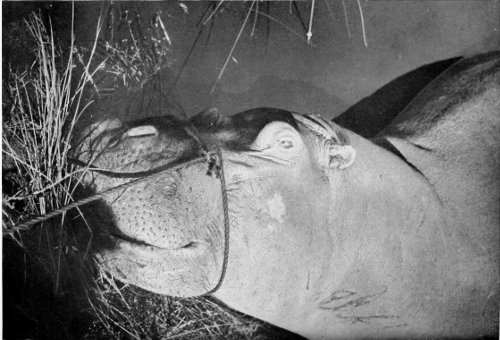
C. G. Schillings, phot.
HEAD OF A HIPPOPOTAMUS (HIPPOPOTAMUS AFR. ARYSSINICUS, Less.) WHICH I ENCOUNTERED ON DRY LAND AND WHICH NEARLY “DID” FOR ME.
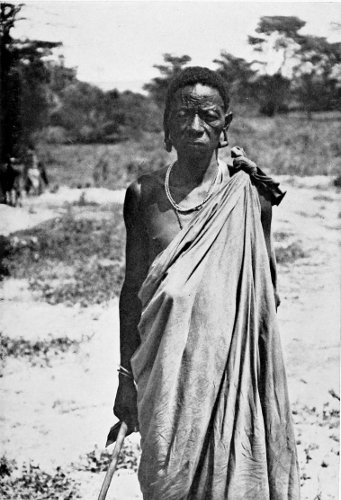
C. G. Schillings, phot.
MY OLD FRIEND “NGURUMAN,” A WANDOROBO CHIEF. HIS BODY IS SEARED BY MANY SCARS THAT TELL OF ENCOUNTERS WITH ELEPHANTS AND LIONS.
Thus would I spend day after day, getting to know almost all the wild denizens of East Africa, either by seeing them in the flesh or by studying their tracks and traces, cherishing more and more the wish to be able to achieve some record of all these beautiful phases of wild life. I repeat: as a rule you will carry away with you but one or another memory from your too brief day’s wandering, but there come days when a succession of marvellous pictures seem to be unrolled before your gaze, as in an endless panorama. It is the experience of one such day that I have tried here to place on record. Professor Moebius is right in what he says: “Æsthetic views of animals are based not upon knowledge of the physiological causes of their forms, colouring, and methods of motion, but upon the impression made upon the observer by their various features and outward characteristics as parts of a harmonious whole. The more the parts combine to effect this unity and harmony, the more beautiful the animal seems to us.” Similarly, a landscape seems to me most impressive and harmonious when it retains all its original elements. No section of its flora or fauna can be removed without disturbing the harmony of the whole.
Within a few years, if this be not actually the case already, all that I have here described so fully will no longer be in existence along the banks of the Pangani. When I myself first saw these things, often my thoughts went back to those distant ages when in the lands now known as Germany the same description of wild life was extant in the river valleys, when hippopotami made their home in the Rhine and Main, and elephants and rhinoceroses still flourished.... What I saw there before me in the flesh I learnt to see with my mind’s eye in the long-forgotten past. It is the duty of any one whose good fortune it has been to witness such scenes of charm and loveliness to endeavour to leave some record of them as best he may, and by whatever means he has at his command.
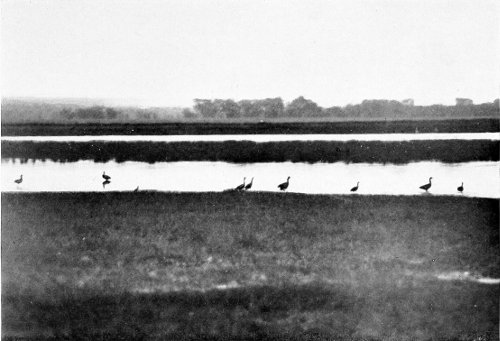
C. G. Schillings, phot.
EGYPTIAN GEESE.
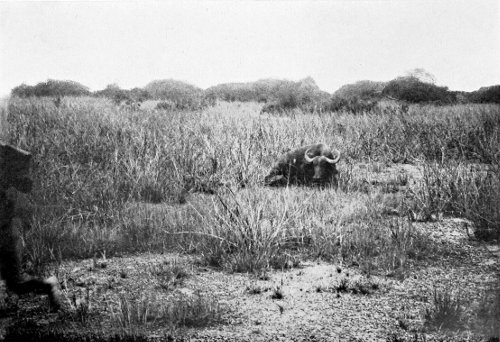
C. G. Schillings, phot.
A WOUNDED BUFFALO.
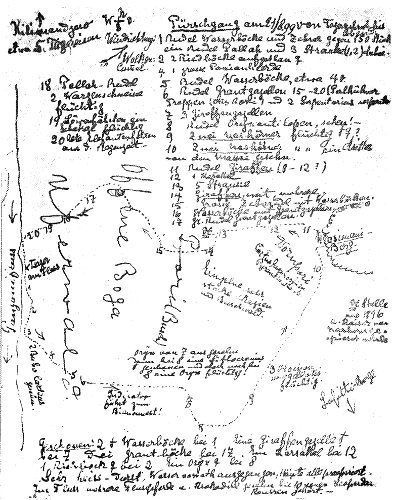
C. G. Schillings, phot.
FACSIMILE REPRODUCTION OF ONE OF MY HUNTING RECORD-CARDS, ENUMERATING ALL THE DIFFERENT ANIMALS I SIGHTED ONE DAY (AUGUST 21, 1898) IN THE COURSE OF AN EXPEDITION IN THE VICINITY OF THE MASIMANI HILLS, HALF-WAY UP THE PANGANI RIVER. THE DOTTED LINE SHOWS MY ROUTE AND THE NUMBERS INDICATE THE SPOTS AT WHICH I CAME UPON THE VARIOUS SPECIES OF GAME. AT ANOTHER TIME OF THE YEAR THIS DISTRICT WOULD BE ENTIRELY DESTITUTE OF WILD LIFE.
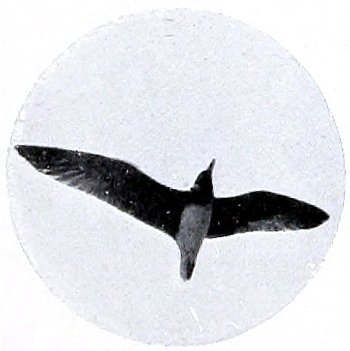
A SEA-GULL.