Volume 2 — A MASAI THROWING HIS SPEAR. IX After Elephants with Wandorobo
Frederic Whyte translation
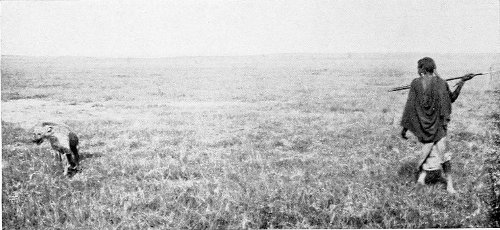
“Big game hunting is a fine education!” With this opinion of Mr. H. A. Bryden I am in entire agreement, but I cannot assent to the dictum so often cited of some of the most experienced African hunters, to the effect that Equatorial East Africa offers the sportsman no adequate compensation for all the difficulties and dangers there to be faced.
I cannot subscribe to this view, because to my mind these very difficulties and dangers impart to the sport of this region a fascination scarcely to be equalled in any other part of the world. It is only in tropical Africa that you will find the last splendid specimens of an order of wild creation surviving from other eras of the earth’s history. It is not to be denied that you must pay a high price for the joy of hunting them. That goes without saying in a country where your every requisite, great and small, has to be carried on men’s shoulders—no other form of transport being available—from the moment you set foot within the wilderness. I am not now talking of quite short expeditions, but of the bigger enterprises which take the traveller into the interior for a period of months. I hold that this breaking away from all the resources of civilised life should be one of the sportsman’s chief incentives, and one of his chief enjoyments. I can, of course, quite understand experienced hunters taking another view. Many have had such serious encounters with the big game they have shot, and above all such unfortunate experiences of African climates, that they may well have had enough of such drawbacks.
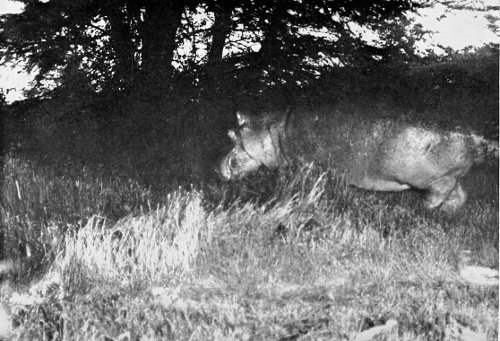
C. G. Schillings, phot.
A POWERFUL OLD HIPPOPOTAMUS ON HIS WAY TO HIS HAUNT IN THE SWAMP AT DAYBREAK. ONE OF MY BEST PHOTOGRAPHS.
Their assertions, in any case, tend to make it clear that sport in this East African wilderness is no child’s play. In reality, all depends upon the character and equipment of the man who goes in for it. The apparently difficult game of tennis presents no difficulties to the expert tennis-player. With an inferior player it is otherwise. So it is in regard to hunting in the tropics. It is obvious that experience in sport here at home is of the greatest possible use out there—is, in fact, absolutely essential to one’s success. Only those should attempt it who are prepared to do everything and cope with all obstacles for themselves, who do not need to rely on others, and whose nerves are proof against the extraordinary excitements and strains which out there are your daily experience.
I myself am conscious of a steadily increasing distaste for face-to-face encounters with rhinoceroses, and with elephants still more. There are indeed other denizens of the East African jungle whose defensive and offensive capabilities it would be no less a mistake to under estimate. The most experienced and most authoritative Anglo-Saxon sportsmen are, in fact, agreed that, whether it be a question of going-after lions or leopards or African buffaloes, sooner or later the luck goes against the hunter. Of recent years a large number of good shots have lost their lives in Africa. If one of these animals once gets at you, you are as good as dead. To be chased by an African elephant is as exciting a sensation as a man could wish for. The fierceness of his on-rush passes description. He makes for you suddenly, unexpectedly. The overpowering proportions of the enraged beast—the grotesque aspect of his immense flapping ears, which make his huge head look more formidable than ever—the incredible pace at which he thunders along—all combine with his shrill trumpeting to produce an effect upon the mind of the hunter, now turned quarry, which he will never shake himself rid of as long as life lasts. When—as happened once to me—it is a case not of one single elephant, but of an entire herd giving chase in the open plain (as described in With Flashlight and Rifle), the reader will have no difficulty in understanding that even now I sometimes live the whole situation over again in my dreams and that I have more than once awoke from them in a frenzy of terror.
Of course, a man becomes hardened in regard to hunting accidents in course of time, especially if all his adventures have had fortunate issues. When, however, a man has repeatedly escaped destruction by a hairs-breadth only, and when incidents of this kind have been heaped up one on another within a brief space of time, the effects upon the nervous system become so great that even with the utmost self-mastery a man ceases to be able to bear them. As I have already said, the total number of casualties in the ranks of African sportsmen is not inconsiderable.
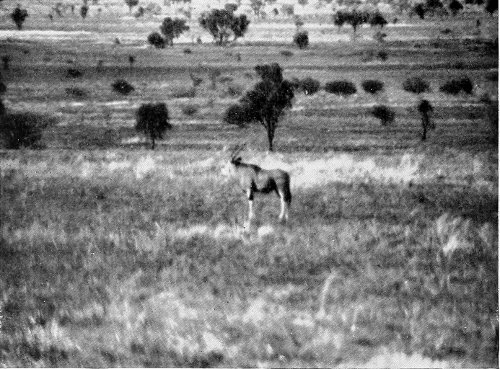
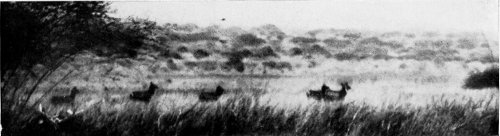
ORYX ANTELOPE BULL, NOT YET AWARE OF MY APPROACH.
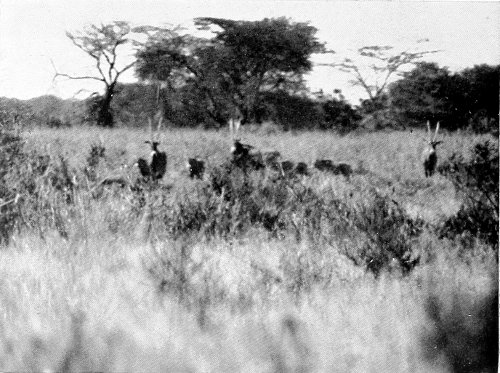
A HERD OF ORYX ANTELOPES (ORIX CALLOTIS, Thos.), CALLED BY THE COAST-FOLK “CHIROA.”
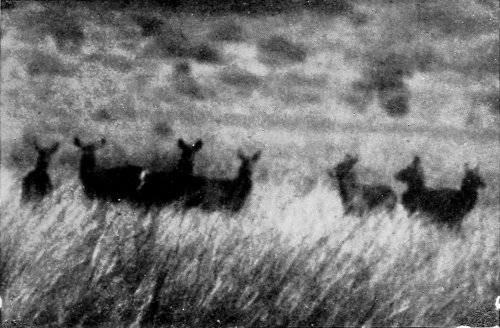
WATERBUCK. THEY SOMETIMES LOOK QUITE BLACK, AS THIS PHOTOGRAPH SUGGESTS. IT DEPENDS UPON THE LIGHT.
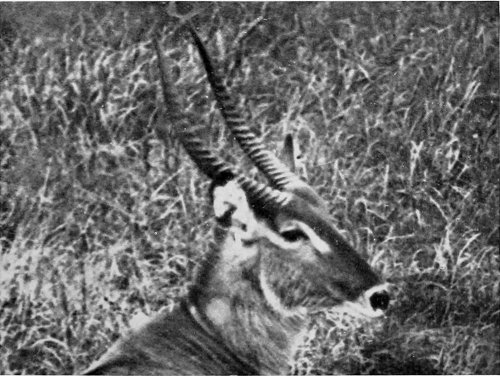
HEAD OF A BULL WATERBUCK (COBUS ELLIPSIPRYMNUS, Ogilb.).
In Germany, of course, we have time-honoured sports of a dangerous nature too, but these are exceptions—for instance, killing the wild boar with a spear, and mountain-climbing and stalking.
In order to understand fully the mental condition of the sportsman in dangerous circumstances such as I have described, it is necessary to realise the way in which he is affected by his loneliness, his complete severance from the rest of mankind. There is all the difference in the world between the situation of a number of men taking up a post of danger side by side, and that of the man who stands by himself, either at the call of duty or impelled by a sense of daring. He has to struggle with thoughts and fears against which the others are sustained by mutual example and encouragement.
But, as I have said, the great fascination of sport in the tropics lies precisely in the dangers attached. Therein, too, lies the source of that pluck and vigour which the sport-hardened Boers displayed in their struggles with the English. The perils they had faced in their pursuit of big game had made brave men of them.
Now let us set out in company with the most expert hunters of the velt on an expedition of a rather special kind—the most dangerous you can go in for in this part of the world—an elephant-hunt. In prehistoric days the mammoth was hunted with bow and arrow in almost the same fashion as the elephant is to-day by certain tribes of natives. Taking part in one of their expeditions, one feels it easy to go back in imagination to the early eras of mankind. This feeling imparts a peculiar fascination to the experience.
After a good deal of trouble I had got into friendly relations with some of these nomadic hunters. It was a difficult matter, because they fight shy of Europeans and of the natives from the coast, such as my bearers and followers generally. I knew, moreover, that our friendship might be of short duration, for these distrustful children of the velt might disappear at any moment, leaving not a trace behind them. However, I had at least succeeded, by promises of rich rewards in the shape of iron and brass wire, in winning their goodwill. After many days of negotiation they told me that elephants might very likely be met with shortly in a certain distant part of the velt. The region in question was impracticable for a large caravan. Water is very scarce there, rock pools affording only enough for a few men, and only for a short time. At this period of the year the animals had either to make incredibly long journeys to their drinking-places, or else content themselves with the fresh succulent grass sprouting up after the rains, and with the moisture in the young leaves of the trees and bushes.
I set out one day in the early morning for this locality with a few of my men in company with the Wandorobo. After a long and fatiguing march in the heat of the sun, we encamp in the evening at one of the watering-places. To-day, to my surprise, there is quite a large supply of water, owing to rain last night. The elephants, with their unfailing instinct, have discovered the precious liquid. They have not merely drunk in the pool, but have also enjoyed a bath; their tracks and the colour and condition of the water show that clearly. Therefore we do not pitch our camp near the pool, but out in the velt at some distance away, so as not to interfere with the elephants in case they should be moved to return to the water.
C. G. Schillings, phot.
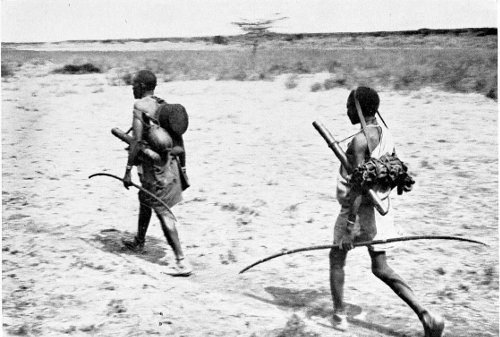
MY WANDOROBO GUIDES ON THE MARCH, WITH ALL THEIR “HOUSEHOLD FURNITURE” ON THEIR BACKS!
C. G. Schillings, phot.
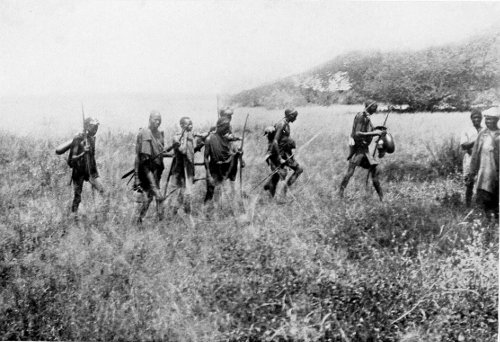
A PARTY OF WANDOROBO HUNTERS COMING TO MY CAMP. I GOT SEVERAL OF THEM TO ACT FOR ME AS GUIDES.
But the wily beasts do not come a second time, and we are obliged to await morning to follow their tracks in the hope of luck. The Wandorobo on ahead, I and two of my men following, make up the small caravan, while some of my other followers remain behind at the watering-place in a rough camp. I have provided myself with all essentials for two or three days, including a supply of water contained in double-lined water-tight sacks. For hour after hour we follow the tracks clearly defined upon the still damp surface of the velt. Presently they lead us through endless stretches of shrubs and acacia bushes and bow-string hemp, then through the dried-up beds of rain-pools now sprouting here and there with luxuriant vegetation. Then again we come to stretches of scorched grass, featureless save for the footsteps of the elephants. As we advance I am enabled to note how the animals feed themselves in this desert-like region, from which they never wander any great distance. Here, stamping with their mighty feet, they have smashed some young tree-trunks and shorn them of their twigs and branches; and there, with their trunks and tusks, they have torn the bark off larger trees in long strips or wider slices and consumed them. I observe, too, that they have torn the long sword-shaped hemp-stalks out of the ground, and after chewing them have dropped the fibres gleaming white where they lie in the sun. The sap in this plant is clearly food as well as drink to them. I see, too, that at certain points the elephants have gathered together for a while under an acacia tree, and have broken and devoured all its lower branches and twigs. At other places it is clear that they have made a longer halt, from the way in which the vegetation all around has been reduced to nothing. We go on and on, the mighty footsteps keeping us absorbed and excited. We know that the chances are all against our overtaking the elephants, but the pleasures of the chase are enough to keep up our zest. At any moment, perhaps, we may come up with our gigantic fugitives. Perhaps!
How different is the elephant’s case in Africa from what it is in India and Ceylon! In India it is almost a sacred animal; in Ceylon it is carefully guarded, and there is no uncertainty as to the way in which it will be killed. Here in Africa, however, its lot is to be the most sought-after big game on the face of the earth; but the hunter has to remember that he may be “hoist with his own petard,” for the elephant is ready for the fray and knows what awaits him. With these thoughts in my mind and the way clearer at every step, the Wandorobo move on and on unceasingly in front.
It is astonishing what a small supply of arms and utensils these sons of the velt take with them when starting out for journeys over Nyíka that may take weeks or months. Round their shoulders they carry a soft dressed skin, and, hung obliquely, a strap to which a few implements are attached, as well as a leathern pouch containing odds and ends. Their bow they hold in one hand, while their quivers, filled with poisoned arrows, are also fastened to their shoulders by a strap. In addition they carry a sword in a primitive kind of scabbard. Thus equipped they are ready to cope with all the dangers and discomforts of the velt, and succeed somehow in coming out of them victorious.
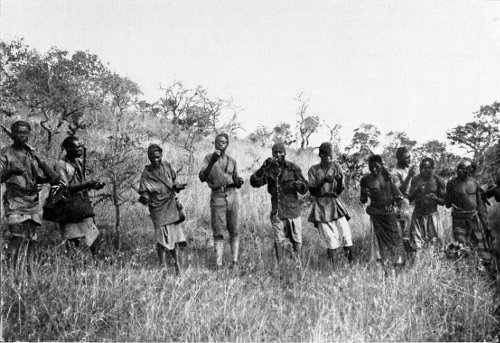
C. G. Schillings, phot.
A FEAST OF HONEY. A HONEY-FINDER HAD LED US TO A HIVE, AND HERE MY MEN MAY BE SEEN REJOICING IN THE RESULTS.
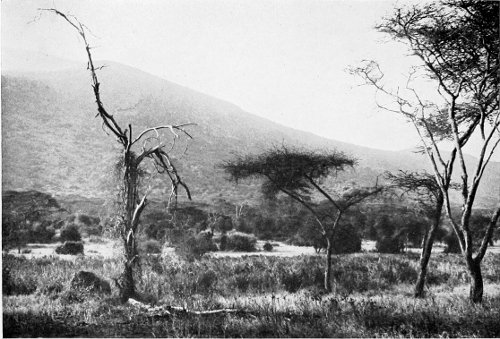
C. G. Schillings, phot.
ACACIA TREE DENUDED BY ELEPHANTS.
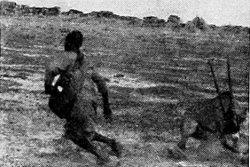
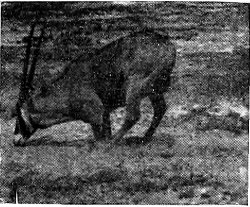
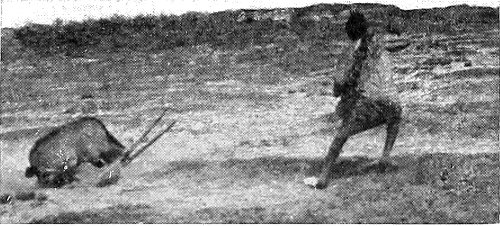
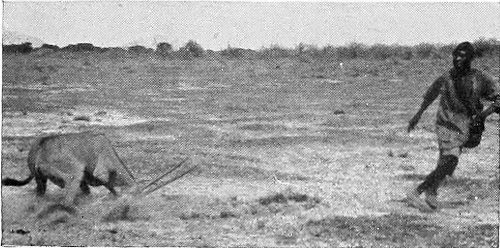
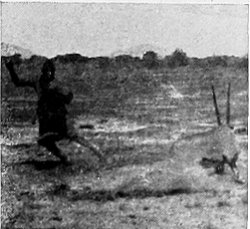
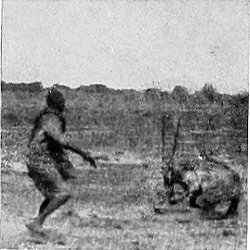
AN ORYX ANTELOPE’S METHODS OF DEFENCE.
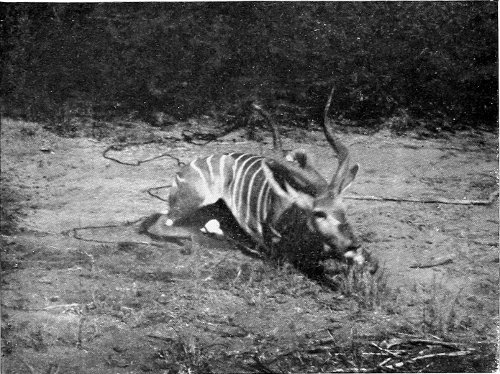
A DWARF KUDU (STREPSICEROS IMBERBIS, Blyth). I HAVE NEVER YET SUCCEEDED IN PHOTOGRAPHING THIS ANIMAL ALIVE AND IN FREEDOM. SO FAR I HAVE BEEN ABLE TO PHOTOGRAPH ONLY SPECIMENS WHICH I HAVE SHOT.
How thoroughly the velt is known to them—every corner of it! To live on the velt for any time you must be adapted by nature to its conditions. We Europeans should find it as hard to become acclimatised to it as the Wandorobo would to the conditions of civilised life in Europe. The one thing they are like us in being unable to forego is water—and even that they can do without for longer than we can. The most important factor in their life as hunters is their knowledge where to get water at the different periods of the year. Their intimate acquaintance with the book of the velt is something beyond our faculty for reading print. Our experiences in our recent campaigns in South-West Africa have served to bring home the wonderful way in which the natives decipher and interpret the minutest indications to be found in the ground of the velt and know how to shape their course in accordance with them.
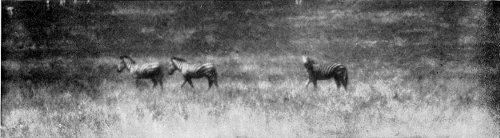
ZEBRAS.
C. G. Schillings, phot.
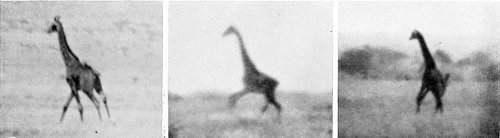
GIRAFFE STUDIES (GIRAFFA SCHILLINGSI, Mtsch.) SECURED BY TELEPHOTO-LENS.
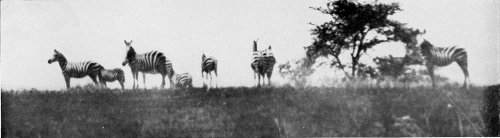
ZEBRAS (EQUUS BOHMI) OUT ON THE OPEN VELT.
C. G. Schillings, phot.
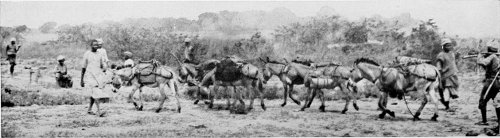
MY MASAI DONKEYS ARRIVING IN CAMP, ESCORTED BY ARMED MEN. BEARERS ADVANCING TO MEET THEM AND TO UNBURDEN THEM OF THEIR LOADS.
This had already been brought home to me in the regions through which I had travelled. You must have had the experience yourself to realise the degree to which civilised man has unlearnt the use of his eyes and ears. Whether it be a question of finding one’s bearings or deciding in which direction to go, or of sizing up the elephant-herds from their tracks, or of distinguishing the tracks of one kind of antelope from those of another, or of detecting some faint trace of blood telling us that some animal we are after has been wounded, or of knowing where and when we shall come to some water, or of discovering a bee’s nest with honey in it—in all such matters the native is as clever as we are stupid. We may make some progress in this kind of knowledge and capability, but we shall always be a bad second to the native-born hunter of the velt.
With such men to act as your guides you get to feel that traversing Nyíka is as safe as mountain-climbing under the guidance of skilled mountaineers. You get to feel that you cannot lose your way or get into difficulties about water. One reflection, however, should never be quite absent from your mind—that at any moment these guides of yours may abandon you. That misfortune has never happened to me, and it is not likely to happen when the natives are properly handled. Moreover, your friendship with them can sometimes be strengthened by the establishment of bonds of brotherhood. A time-honoured practice of this kind, held sacred by the natives, can be of the greatest benefit. I am strongly in favour of the observance of these praiseworthy native customs, and have always been most ready to go through with the ceremonies involved.
I endeavour to win the goodwill of my guides by keeping to the pace they set—an easy matter for me. In every other way also I take pains to fall in with the ways and habits of the Wandorobo, so as to attenuate that feeling of antagonism which my uncivilised friends necessarily harbour towards the European. I owe it to this, perhaps, that they did their utmost to find the elephant-tracks for me.
For hour after hour we continue our march, in and out, over velt and brushwood, coming every few hours to a watering-place, and meeting in the hollow of one valley an exceptionally large herd of oryx antelopes. Under cover of the brushwood, and favoured by the wind, I succeed in getting quite near this herd and thus in studying their movements close at hand.
C. G. Schillings, phot.
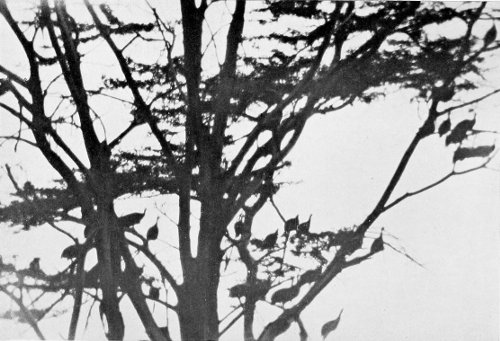
PEARL-HENS ON AN ACACIA TREE.
C. G. Schillings, phot.
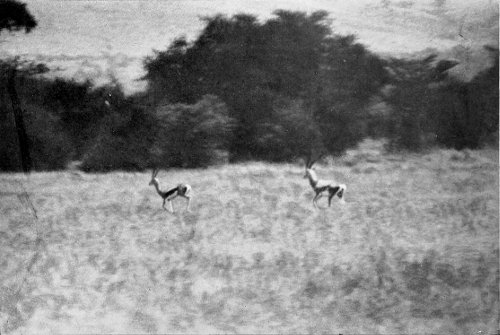
A PAIR OF GRANT’S GAZELLES TAKING TO FLIGHT.
In the bush, not far from these oryx antelopes, I come unexpectedly on a small herd of beautiful dwarf kudus. They take to flight, but reappear for a moment in a glade. This kind of sudden glimpse of these timid, pretty creatures is a real delight to one. Their great anxious eyes gaze inquiringly at the intruder, while their large ears stand forward in a way that gives a most curious aspect to their shapely heads. The colouring of their bodies accords in a most remarkable degree with their environment, and this accentuates the individuality of their heads, seen thus by the hunter. Off they scamper again now, in a series of extraordinarily long and high jumps, gathering speed as they go, and unexpectedly darting now in one direction, now in another. It is very exciting work tracking the fugitive kudu, and when it is a question of a single specimen you may very well mark it down in the end; but according to my own experience it is next to impossible to follow up a herd, for one animal after another breaks away from it, seeking safety on its own account.
Now we come again to an open grassy stretch of velt. With a sudden clatter of hoofs a herd of some thirty zebras some hundred paces off take to flight and escape unhurt by us into the security of a distant thicket. The older animals and the leaders of the herd keep looking backwards anxiously with outstretched necks. Even in the thicket their bright colouring makes them discernible at this hour of the day. But our attention is distracted now elsewhere. Far away on the horizon appear the unique outlines of a herd of giraffes. The timorous animals have noted our approach and are already making away—stopping at moments to glance at us—into a dense thorn-thicket. The wind favours us, so I quickly decide to make a detour to the right and cut them off. After a breathless run through the brushwood I succeed in getting within a few paces of one of the old members of the herd. This way of circumventing a herd of giraffes—my followers helping me by moving about all over the place, so as to put them off the scent—has not often proved successful with me, because it can only be managed when both wind and the formation of the country are in one’s favour.
To-day I have no mind to kill the beautiful long-limbed beast, but it is delightful to get into such close touch with him. Now he is off, stepping out again, swinging his long tail, his immense neck dipping and rising like the mast of a sea-tossed ship, and the rest of the herd with him.
Now, just because I have no thought of hunting, every kind of wild animal crosses my path! Their number and variety are beyond belief. We come upon more zebras, oryx antelopes, hartebeests, Grant’s gazelles, impalla antelopes; upon ostriches, guinea-fowl (Numida reichenowi and Acryllium vulturinum, Hardw.), and francolins. The recent rains seem to have conjured them all into existence here as though by magic.
But everything else has to give precedence to the elephant-tracks, which now are all mixed up, though leading clearly to the next watering-place, towards which we are directing our steps down a way trodden quite hard by animals, evidently during the last few days. Large numbers of rhinoceroses have trampled down this way to the water, but neither they nor the elephants are to be seen in the neighbourhood while the sun is up. They are too well acquainted with the habits of their enemy man, and they keep at a safe distance out on the velt. To-day, therefore, I am to catch no glimpse of either elephant or rhinoceros. Wherever I turn my eyes, however, I see other animals of all sorts—among others, some more big giraffes. I am not to be put off, however, and I decide to follow up the tracks of a number of the elephants, evidently males, giving myself up anew to the unfailing interest I find in the study of their ways, and confirming the observations I had already made as to their finding their chief nourishment on the velt in tree-bark and small branches.
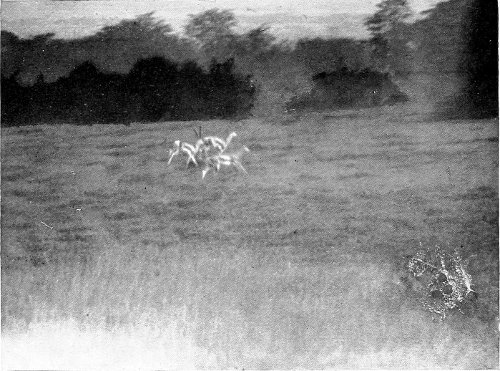
GRANT’S GAZELLES.
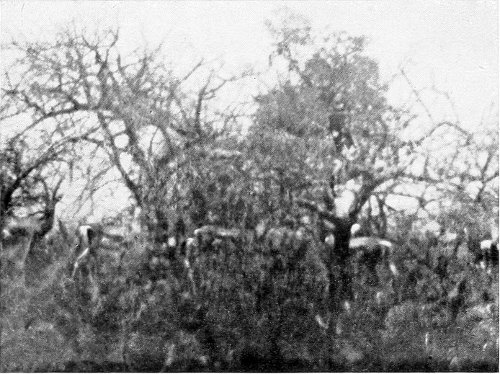
A GOOD INSTANCE OF PROTECTIVE COLOURING. A HERD OF GRANT’S GAZELLES ALMOST INDISTINGUISHABLE FROM THEIR BACKGROUND OF THORN-BUSH.
C. G. Schillings, phot.
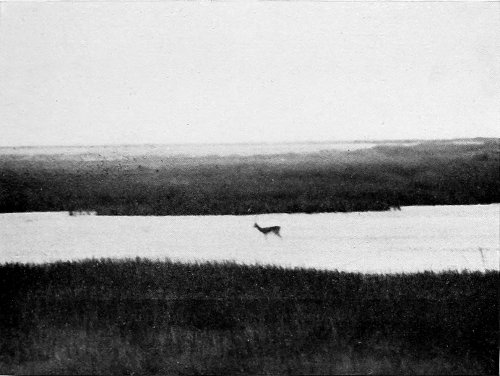
A GRANT’S GAZELLE BUCK STANDING OUT CONSPICUOUSLY ON THE DRIED-UP BED OF A LAKE NOW SO INCRUSTATED WITH SALT AS TO LOOK AS THOUGH SNOW-COVERED.
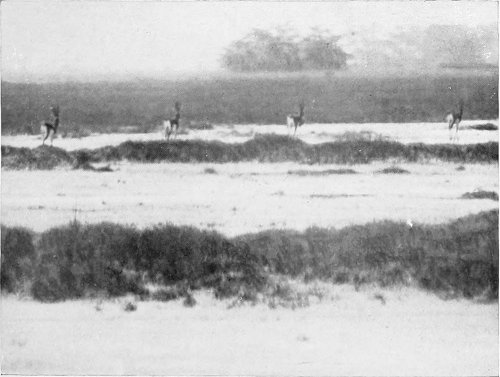
FOUR GRANT’S GAZELLES.
Night set in more quickly than we expected while we were pitching camp before sunset in a cutting in a thorn-thicket. Spots on which fires had recently been lit showed us that native hunters had been there a few days before, and my guides said they must have been the Wakamba people, keen elephant-hunters, with whom they live at enmity, and of whose very deadly poisoned arrows they stand in great dread. Therefore we drew close round a very small camp-fire, carefully kept down. The glow of a big fire might have brought the Wakamba people down on us if they were anywhere in the neighbourhood. It seems that natives who are at war often attack each other in the dark. It may easily be imagined, then, that the first hours of our “night’s repose” were not as blissful as they should have been! After a time, however, our need of sleep prevailed, sheer physical fatigue overcame all our anxieties, and my Wandorobo slumbered in peace. They had contrived a “charm,” and had set up a row of chewed twigs all round to keep off misfortune. Unfortunately it is not so easy for a European to believe in the efficacy of these precautions! It was interesting to observe that the Wandorobo evinced much greater fear of the poisoned arrows of the Wakamba than of wild animals. In view of my subsequent experience, I myself in such a situation would view the possibility of being attacked by elephants with much greater alarm.
As it happened, however, this night passed like many another—if not without danger, at least without mishap.
Day dawned. No bird-voices greeted it, for, strange to relate, we found nothing but big game in this wooded wilderness, save for guinea-fowl (Numida reichenowi and Acryllium vulturinum, Hardw.) and francolins. The small birds seem to have known that the water would soon be exhausted, and that until the advent of the next rainy season this was no place for them.
In the grey of early morning we made our way out again into the velt. We had to visit the neighbouring watering-places and then to follow up some fresh set of elephant-tracks. It turned out that some ten big bull-elephants had visited one of the pools, and had left what remained of the water a thick yellowish mud. They had rubbed and scoured themselves afterwards against a clump of acacia trees. Judging from the marks upon these trees some of the elephants in this herd must have been more than eleven feet in height. With renewed zest we followed up the fresh, distinct tracks through the bush, through all their twistings and turnings. Again we came upon all kinds of other animals—among others, a herd of giraffes right in our path. But these were opportunities for the naturalist only, not for the sportsman who was keeping himself for the elephants and would not fire a shot at anything else unless in extreme danger. Later, at a moment when we believed ourselves to have got quite close to the elephants, I started an extraordinarily large land-tortoise—the biggest I have ever seen. I could not get hold of it, however—I was too much taken up with the hope of reaching the elephants; but after several more hours of marching I had to call a halt in order to gather new strength. In the end we did not overtake them. They had evidently been seriously disquieted either by us or earlier by the Wakamba people. While we were pitching our camp in the evening, nearly a day’s journey from our camp of the night before, we sighted one after another three herds of elands and four rhinoceroses on their way out into the velt to graze. During these two days I had come within shot of about ten rhinoceroses while on the march, and had caught glimpses of many more in the distance.
C. G. Schillings, phot.
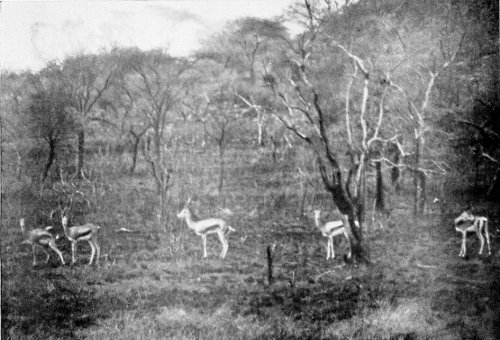
THE HERDS OF GRANT’S GAZELLES ARE SOMETIMES MADE UP ENTIRELY OF MALES, SOMETIMES ENTIRELY OF FEMALES. IN THIS PICTURE WE SEE A NUMBER OF YOUNG DOES IN SEARCH OF THE SCANTY FRESH GRASS ON A PORTION OF THE VELT WHICH NOT LONG BEFORE HAD BEEN BURNT UP.
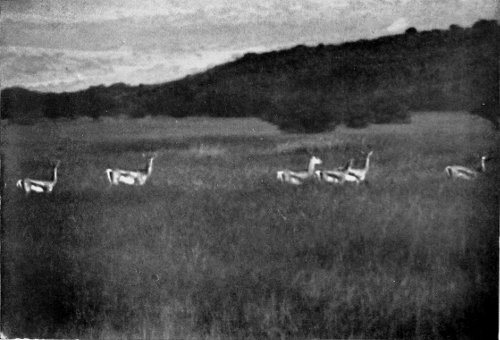
C. G. Schillings, phot.
A SMALL HERD OF GRANT’S GAZELLES. THE KILIMANJARO RANGE IN THE BACKGROUND.
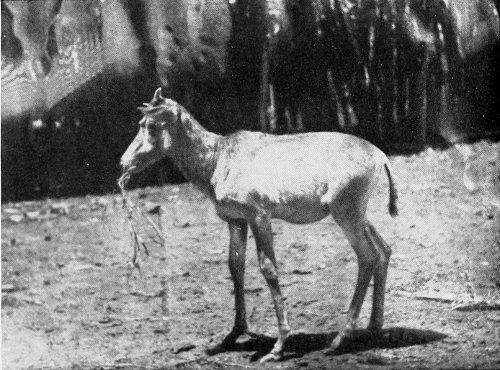
YOUNG MASAI HARTEBEEST. I DID NOT SUCCEED IN MY EFFORTS TO BRING BACK A SPECIMEN OF THIS SPECIES.
The third day’s pursuit of the elephants also proved entirely fruitless. We did not even come within sight of a female specimen.
My guides were now of opinion that the animals must be so thoroughly alarmed that any further pursuit would be almost certainly in vain, so we made our way back as best we could in a zigzag course to my main camp, and reached it on the morning of the fourth day.
Most elephant-hunts in Equatorial Africa run on just such lines as these and with the same result, yet they are among the finest and most interesting experiences that any sportsman or naturalist can hope to have. The wealth of natural life that had been given to my eyes during those three days was simply overpowering. But if you have once succeeded in getting within range of an African elephant, all other kinds of wild animals seem small fry to you. You have the same kind of feeling that the German sportsman has when after a Brunft stag—he cares for no other kind of game; he has no mind for anything but the stag. But the elephant fever attacks you out in Africa even more virulently than the stag fever here at home.
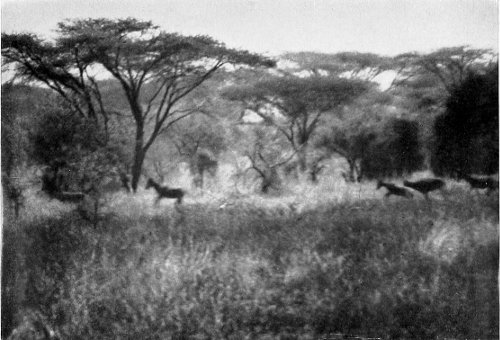
C. G. Schillings, phot.
A HERD OF HARTEBEESTS (BUBALIS COKEI, Gthr.).
HARTEBEESTS WITH YOUNG.
C. G. Schillings, phot.
WATERBUCK.
Yet it is fine to remember one’s ordinary shooting expeditions in the tropics. You need some luck, of course—the velt is illimitable and the game scattered all over it. But if the rains have just ceased, if you have secured good guides, if you yourself are equal to facing all the hardships, then indeed it is a wonderful experience. There is no doubt about it—you have to be ready for a combination of every kind of strain and exertion. You can stand it for a day perhaps, or two or three, but you must then take a rest. The man who has gone through with this may venture on the experiment of pursuing elephants for several days together. He will, I think, bear me out in saying that until you have done that also you do not know the limits of endurance and fatigue.
The most glorious hour in the African sportsman’s life is that in which he bags a bull-elephant. When he succeeds in bringing the animal down at close range in a thicket such as I have so often described, his heart beats with delight—it is just a chance in such cases what your fate may be. Wide as are the differences in the views taken by experienced travellers and by other writers in regard to African sport in general, they are all agreed that elephant-hunting is the most dangerous task a man can set himself. The hunting of Indian or Ceylon elephants—save in the case of a “rogue”—is not to be compared with the African sport as I understand it. I do not mean the easy-going, pleasure-excursion kind of hunt ordinarily gone in for in the African bush, but a one-man expedition, in which the sportsman sets himself deliberately to bag his game single-handed. That, indeed, is my idea of how one should go after big game in such countries as Africa in all circumstances whatever.
Barely as many as a dozen elephants have fallen to my rifle. Some of these I killed in order to try and get hold of a young specimen which I might bring to Europe in good condition—a desire which I have long cherished, but which has not yet been fulfilled. Others I killed so that I might present them to our museums.
There were immense numbers of other bull-elephants that I might have shot, and that are probably now roaming the velt, but that I had to spare because I was more intent upon photographing them. My photographs are, however, ample compensation to me. While, too, it is pleasant to me to reflect that I have left untouched so many elephants that came within easy range, I hope, none the less, some day to bring down a specimen adorned with a really splendid pair of tusks. This is an aspiration not often realised by African sportsmen, even when they have been hunting for half a lifetime. Elephants with tusks weighing nearly five hundred pounds, like those in our illustration, are extremely rare—even in earlier times they were met with perhaps once in a hundred years.
The hunting of an African elephant, I repeat in conclusion, is a source of the greatest delight to the sportsman, for even if he does not bag his game he is well rewarded for his pains by all the interest and excitement of the chase. But no one who has not himself gone through with it can estimate what it involves. Even with the most perfected equipment in regard to arms, it is often a matter of luck whether you kill the animal outright and on the spot.
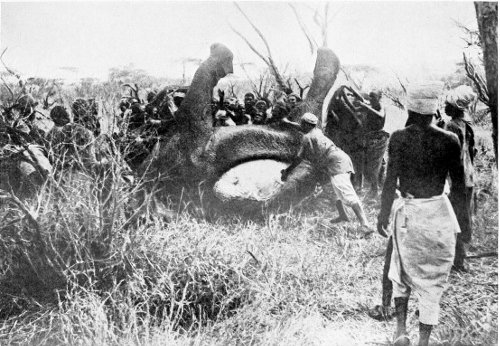
C. G. Schillings, phot.
THE SKINNING OF AN ELEPHANT. THIS SPECIMEN IS NOW IN THE NATURAL HISTORY MUSEUM, BERLIN.
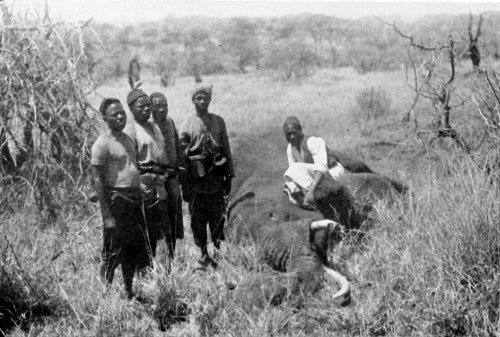
C. G. Schillings, phot.
PREPARING TO SKIN AN ELEPHANT.
An experience I had in the Berlin Zoological Gardens illustrates this. I was called in to dispatch a huge bull-elephant which had to be killed, and which had rejected all the forms of poison that had been administered to it. In order to give it a quick and painless end I selected a newly invented elephant-rifle, calibre 10·75, loaded with 4 gr. of smokeless powder and a steel-capped bullet. On reflection the steel cap seemed to me too dangerous in the circumstances, so I had it filed off. I shall allow Professor Schmalz to describe what now happened: “The first shot entered the skin between the second and third ribs, and then simply went into splinters. It did no serious damage to the interior organs, and a stag thus wounded would merely take madly to flight. A piece of the cap reached the lung, but only a single splinter had penetrated, causing a slight flow of blood. The second shot was excellently placed, namely just below the root of the lung. It lacerated both the lung arteries and both the bronchial, and thus caused instant death.”
The fact that, with such a charge, a bullet fired at a distance of less than four yards should have gone into splinters in this way says more than one could in a long disquisition, and serves to explain the secret of many a mishap in the African wilderness.4
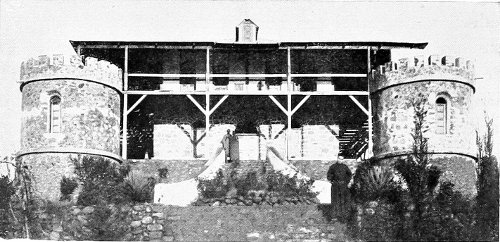
A MISSIONARY’S DWELLING NEAR KILIMANJARO IN WHICH I STAYED SEVERAL TIMES AS GUEST.
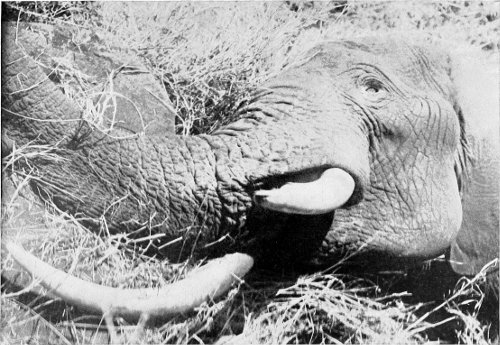
C. G. Schillings, phot.
HEAD OF A BULL-ELEPHANT KILLED BY THE AUTHOR. NOW IN THE NATURAL HISTORY MUSEUM, BERLIN.]
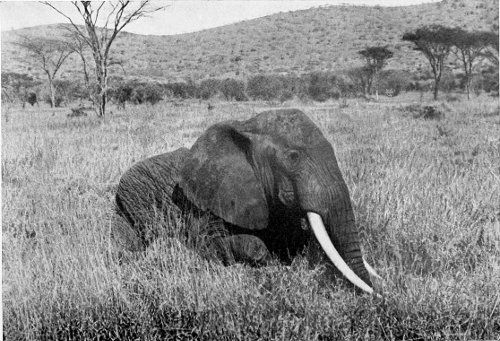
C. G. Schillings, phot.
A FINE SPECIMEN OF A BULL-ELEPHANT KILLED BY THE AUTHOR.
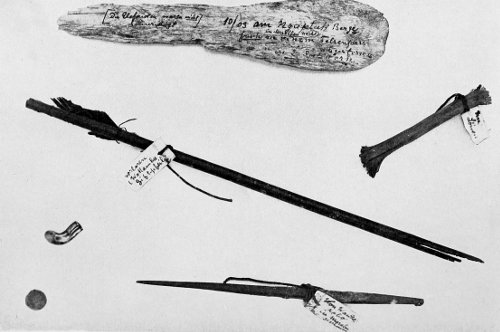
C. G. Schillings, phot.
SOME AFRICAN TROPHIES. 1. SPLINTER FROM AN ELEPHANT-TUSK BROKEN OFF IN A ROCKY REGION. 2. PORTION OF A TREE BRANCH WHICH I FOUND STUCK IN THE JAW OF A CAPTURED LION. 3. PORTION OF A POISONED ARROW WHICH HAD BEEN STICKING IN AN ELEPHANT THAT I WAS TRACKING; ARROW OF THE KIND USED BY THE WAKAMBA HUNTERS. 4. NICKEL BULLET, PUT OUT OF SHAPE, WITH WHICH I BROUGHT DOWN AN ELEPHANT. 5. IRON BULLET USED BY A NATIVE. 6. POISONED DART FOUND STICKING IN THE WING OF A MARABOU.