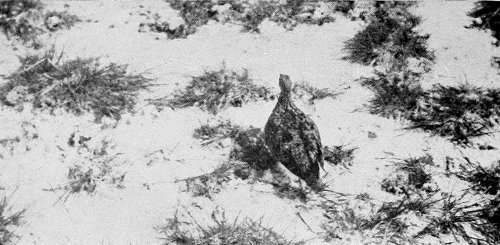
Volume 2 — A FOWL OF THE VELT (PTEROCLES GUTTURALIS SATURATIOR, Hart). XV Night Photography under Difficulties
Frederic Whyte translation
There is a notion prevalent, due to superficial observers, that there are certain drinking-places to which the wild animals are bound to come to quench their thirst, in all circumstances, during the hot season. Were this so the animals would have ceased ere now to exist. The poisoned arrow of the native, or the rifle of the white man, would long since have exterminated them. It is the case, however, that you can count upon finding game at specific drinking-places in the hot weather under certain circumstances, though much depends upon the direction of the wind and other things. The appearance of the larger beasts of prey by the waterside is enough, for instance, to make the others keep their distance for a considerable time.
When I have encamped in such localities it has generally been with a view to securing specimens of rare birds, and apart from this I have confined myself to making observations of the life of the animals. Very large bull-elephants were the only kind of big game that I had any mind to shoot, for I was never at a loss for other kinds. Elephants roam about in the hot season from one watering-place to another, sometimes covering great distances. They know the danger they run in frequenting any one particular watering-place too regularly. This is true of herds of other animals as well.
These watering-places are, of course, very productive to the natives, who make no account of time and who spread themselves out over a number of them during the hot weather, thus multiplying their chances. But the havoc worked among the wild animals by their poisoned arrows or the other methods of hunting which they practise, when they have not taken to powder and shot, is not serious. They have been hunting in this way since prehistoric ages, and yet have been able to hand over the animal kingdom to us Europeans in all the fulness and abundance that have aroused our wonder and admiration wherever we have set foot for the first time.
In the course of my last journey I encamped for the second time at the foot of the Donje-Erok mountain (the circuit of which is a two-days’ march), to the north-west of Kilimanjaro. The region had been well known to me since 1899. Previously to then it had been traversed only by Count Teleki’s expedition. His comrade, the well-known geographer Ritter von Höhnel, had marked its outlines on the map. No one, however, had penetrated into the interior, and here a wonderful field offered itself to the sportsman and explorer. A number of small streams take their rise on the Donje-Erok. In the dry weather these are speedily absorbed by the sun-dried soil of the velt, but in the wet season they have quite a long course, and combine to form a series of small swamps. When these have gradually begun to dry and have come to be mere stretches of blackish mud, they reveal the tracks of the herds of animals that have waded through them, elephants and rhinoceroses especially—mighty autographs imprinted like Runic letters upon wax.
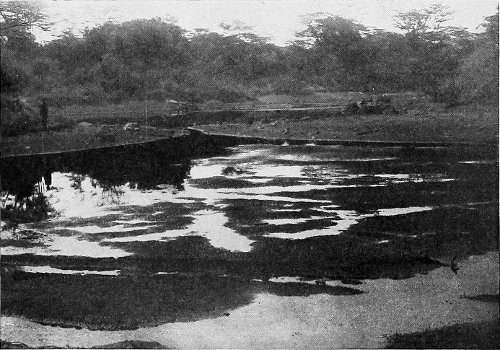
A RIVER-HORSE RESORT.
In the dry season great numbers of animals made always for a source—very speedily dried up—to the south of the mountain. It was in this vicinity that I proposed to secure my pictures of wild life.
My caravan was very much on the qui vive when at last, after a long march, we were able to strike camp. We had been attacked by a band of Masai warriors during the night and had driven them off. It was only natural, therefore, that we should exercise some caution. But our fatigue overcame all anxiety as to another attack. We had made a long forced march, and were worn out with our exertions and our sufferings from thirst and the heat. Some of the bearers, succumbing under the weight of their burdens, had remained behind. We had started on the previous morning, each of us provided as well as was practicable with water, and had marched until dark, passing the night waterless and pressing on at daybreak. It was absolutely essential now to get to a watering-place, so we put out all our efforts, just succeeding in reaching our goal after nightfall. This march was the more exhausting in that we had had only two hours’ sleep before the fray with the Masai. The bearers we had been obliged to leave behind were afterwards brought into camp safely by a relief party.
On exploring our vicinity next morning we found that our camp, which was to some degree safeguarded by a thorn-fence—a so-called “boma”—adjoined several earlier camps of native elephant-hunters, protected by strong palisades: a thing that had often happened to us before. These camps are to be recognised by the empty powder-casks left about or by the erection somewhere near of a fetich or charm to ward off evil, or something of the kind. It is only the natives who use firearms that have resort to such practices. So far as I know neither the Wakamba nor the Wandorobo are addicted to them. In this particular case the charm took the shape of an arrangement of large snail-shells in the midst of a small enclosure four feet square. That it proved efficacious was suggested by the spectacle of the skulls and remains of some twenty recently killed rhinoceroses within a few paces of the camp.... I had met with just the same state of things in 1900. These “sanctioned” elephant-hunters—or, to use the recognised term, these “trustworthy Fundi”—are an absolute pest. The arch exterminator of the elephants in the Kilimanjaro region was Schundi, the former slave of a Kavirondo chief. Schundi, in his capacity as a political agent and licensed elephant-hunter, scoured the entire country with his men from 1893 to 1900.19
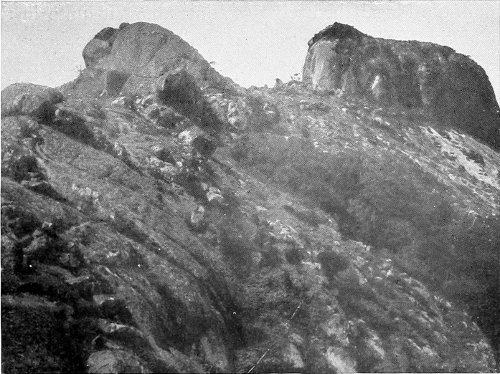
ONE OF THE PEAKS OF DONJE-EROK, IN THE VICINITY OF KILIMANJARO.
In the heart of the thicket we came suddenly upon a quite recent camp of native hunters of some kind—not Wandorobo, we judged, from utensils which they left behind, of a sort the Wandorobo never use. I was aware that other tribes had taken to hunting the animals in this region, the Masai themselves setting about it quite in the Wandorobo fashion. Our chief “find” in the camp, however, was a collection of some forty zebra-hides, quite freshly secured, and about the same number of hides of gnus as well as others of smaller game. Most of these skins were stretched out on the ground to dry, fixed with pegs. Probably the fugitives had taken a number of others away with them. I came to the conclusion that the natives were of the class that hunt on behalf of Indian, Greek, and other traders—a class far too numerous nowadays. The traders pay them very little for their labours, and themselves make huge profits out of it all.
I took possession of the skins, prepared the best of them very thoroughly and carefully, and then sent them to Moschi, for despatch to the Berlin Museum. This task occupied me for two days, but I undertook it with gusto, for I knew that by reason of the variety of species of zebras and gnus frequenting this region, this big collection of skins was of great scientific value. And I rejoiced the more over my treasure-trove in that it exempted me from shooting any more zebras or gnus myself. But my calculations were all to be upset. On my notification to the station that I had not bagged the animals myself, but had found them lying about in a bush-camp where they had been abandoned by nomadic native hunters, it was decided that they could not be recognised as my property without further proceedings. Eventually the matter was decided in my favour by a governmental decree, but in the meantime the skins were considerably damaged by insects and otherwise. Could I have foreseen this, I should not have been at the trouble and serious expense of saving them, but should have left them as a welcome feast to the hyenas and jackals. What I was still able to save out of the lot I sent later to the Berlin Museum.
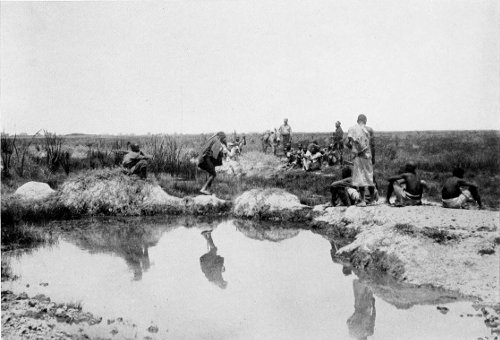
C. G. Schillings, phot.
WHEN STARTING ON A LONG “TELEKESA-MARCH”—A MARCH OF MORE THAN TWENTY-FOUR HOURS BEFORE REACHING THE NEXT WATERING-PLACE—MY MEN PROVIDED THEMSELVES WITH AS MUCH WATER AS THEY COULD CARRY.
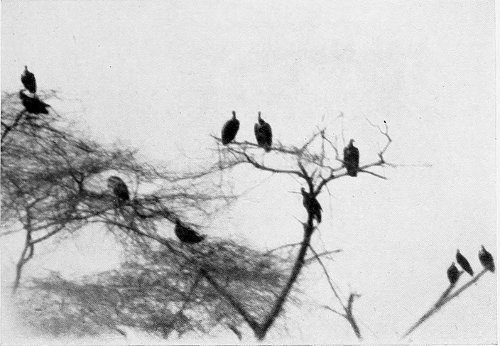
VULTURES.
Near some of the drinking-places along the river I found the cleverly contrived reed-shelters behind which the natives take refuge. The immense numbers of vultures and jackals and hyenas showed that these gluttonous creatures had found an abundance of provender, especially near the deserted camp. The vultures, which were of various species, came down from their perches on the trees and settled on the ground quite near us. It was brooding-time for some of the larger species, and presently I found a great number of their nests with young birds in them. It was very interesting to watch the old birds and their young together.
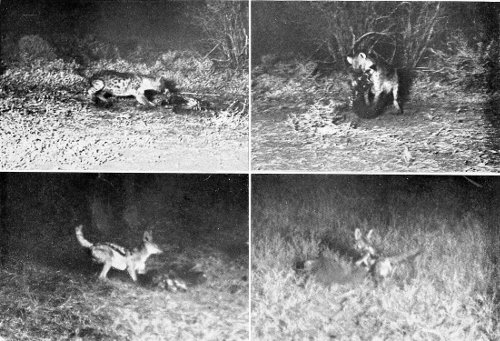
It took me about a week to decide on the spots best suited for my flashlight photographs. After a good deal of really hard work, and after any number of unsuccessful efforts, I was at last satisfied that my three cameras were so placed as to promise good results if I had any luck. But the fates seemed against me. There were hundreds of different drinking-places along the course of the stream, and with so great a choice at their disposal the animals appeared to give my camera a wide berth.
Some days later we had an unpleasant surprise. One of my Askaris had gone at daybreak, as was his custom, to examine one of my jackal traps. Suddenly we heard the sound of shots in the direction of the trap, about twenty minutes’ walk from the camp. As in view of my strict orders against shooting at game there could be no question of this, we at once assumed that we had to reckon with an attack by natives. In a trice I had all my arrangements made. Dividing my armed followers into two sections, I set out instantly with one of them in the direction of the Askari, leaving the other with Orgeich to defend the camp.
C. G. Schillings, phot.
FLASHLIGHT PHOTOGRAPHS.
C. G. Schillings, phot.
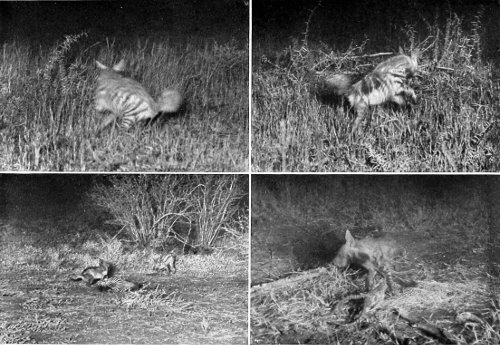
FLASHLIGHT PHOTOGRAPHS OF HYENAS (HYÆNA SCHILLINGSI, Mtsch.) AND JACKALS.
What had happened? It was the old story, so familiar to all experienced travellers, and showing how easily one may be drawn into a fight, yet how easily trouble may be avoided if one takes the right line. My Askari, normally a very steady and reliable man who had been in the service of the Government, had been startled by the sudden apparition right in front of him of a great band of Masai warriors armed with spears. They had raised their spears, no doubt instinctively, at the sight of the rifle-bearing soldier. He, for his part, and his two unarmed comrades, jumped simultaneously to the conclusion that these were the same Masai who had previously attacked us. He decided at once to fire. In an instant the Masai vanished in every direction.
It was not a laughing matter. There had been recent fights in the neighbourhood of my camp between Masai warriors and the inhabitants of the Uferi district—the remains of men who had been killed in these frays bore witness to the truth of what my guides had told me about them. And it was not long since certain European cattle-dealers, at a spot some two days’ journey farther on, had been murdered by the Masai. These facts, taken in connection with the night-attack, made us realise the need of caution.
On reaching the scene of the incident, I ascertained that a great band of Masai, accompanied by their wives, had been seen on the previous evening in the neighbourhood of the stream, and that they had encamped for the night in a mouldering old kraal in the thorn-thicket, and it was while slumbering peacefully in this that they were disturbed by my Askari. Scattered all over the place were goods and chattels of various descriptions which they had left behind them in their hasty flight, and which I now had carefully collected together. From their nature I concluded that the Masai were making for some place at a considerable distance, and that there was, therefore, no danger of unpleasant consequences. I returned to my camp to reassure my people, and at once got some of my Masai friends, who had been with me for a long time, to go after the fugitives and bring them back. That was the only way to effect an understanding—any other messengers would have failed in the mission.
Towards midday my Masai returned to camp with some thirty of the spear-armed warriors and a number of their women-folk. I gave them back their belongings, together with a present by way of amende for their fright. This they accepted with equanimity after the manner of all natives. Then they took their departure, the incident being thus happily terminated without bloodshed.
Curiously enough, Orgeich had had a somewhat similar encounter with Masai a short time before. He had been for a turn in the neighbourhood of the camp, and was coming back in the dark along a rhinoceros-track. When he had got to within a quarter of an hour’s walk of the camp, there was a sudden clatter right in front of him, and in the uncertain moonlight he descried a band of armed Masai. Remembering the recent night-encounter he instantly raised his rifle to fire. But the veteran soldier had self-control enough to resist the impulse, and in this case also there were no ill consequences. But, as he still continues to declare, it was a near thing.
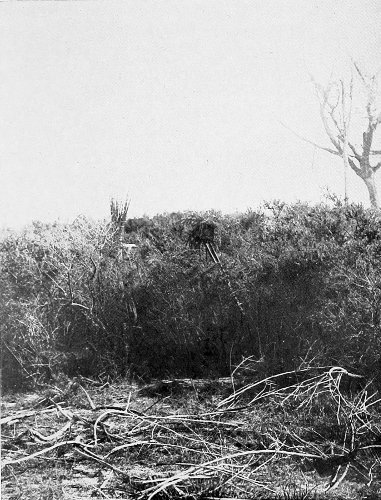
MY NIGHT-APPARATUS IN POSITION, READY TO WORK.
Such incidents, it will be recognised, can very easily lead to serious results.
Later I was to have an unpleasant experience in regard to natives. A band of nomadic hunters, perhaps those who had encamped where I found the zebra-skins, had “gone for” two of my cameras. They had taken away all those parts of them that could be of any use to them, and left them of course quite useless to me. It is noteworthy that they did not smash them to pieces, as Europeans might have done. They had merely detached the metal portions and others which they could turn to some account. This loss was, however, very annoying to me, and I found it necessary to establish two relays of men on guard to look after the sole remaining apparatus throughout the day.
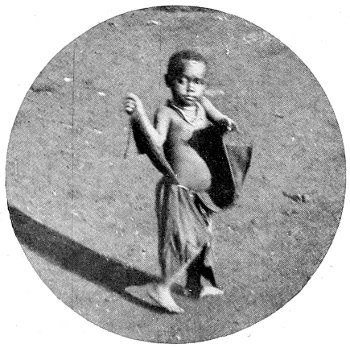
A PET OF THE CARAVAN.
C. G. Schillings, phot.
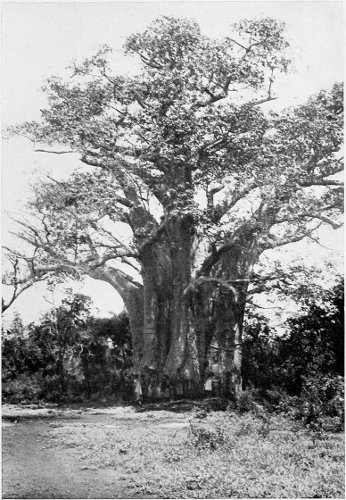
A BAOBAB (ADANSONIA DIGITATA). THESE TREES ARE OFTEN BELIEVED BY THE NATIVES TO BE INHABITED BY GHOSTS. THEY USED TO COME INTO THE STORIES TOLD BY MY FOLLOWERS.