Volume 2 — A STUDY IN PROTECTIVE “MIMICRY.” XIII A Vanishing Feature of the Velt
Frederic Whyte translation
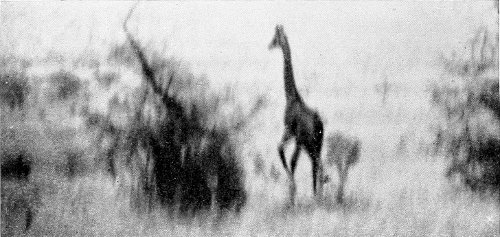
“When men and beasts first emerged from the tree called ‘Omumborombongo,’ all was dark. Then a Damara lit a fire, and zebras, gnus, and giraffes sprang frightened away, whilst oxen, sheep, and dogs clustered fearlessly together.” So Fritsch told us forty years ago, from the ancient folk-lore of the Ova-Herero, one of the most interesting tribes of South-West Africa.
If the photographing of wild life is only to be achieved when conditions are favourable, and is beset with peculiar difficulties in the wilderness of Equatorial Africa, one might at least suppose that such huge creatures as elephants, rhinoceroses, and giraffes could be got successfully upon the “plate.” But they “spring frightened away”! The cunning, the caution, and the shyness of these animals make all attempts at photographing them very troublesome indeed; for to secure a good result you need plenty of sunlight, besides the absence of trees between you and the desired object. And when everything seems to favour you, there is sure to be something wanting—very probably the camera itself. Fortune favours the photographer at sudden and unexpected moments, and then only for a very short while. One instant too late, and you may have to wait weeks, months, even years for your next opportunity. I would give nine-tenths of the photos I have taken of animal life for some half-dozen others which I was unable to take because I did not have my camera to hand just at the right moment. Thus it was with the photographing of the three lions I killed on January 25, 1897, and of the four others I saw on the same day, on the then almost unknown Athi plains in the Wakikuju country. Also with that great herd of elephants which so nearly did for me, and which I should have dearly liked to photograph just as they began their onrush. (I have told the story in With Flashlight and Rifle.) I remember, too, the sight of a giraffe herd of forty-five head which I came across on November 4, 1897,12 about two days’ journey north-west of the Kilimanjaro. The hunter of to-day would travel over the velt for a very long while before meeting with anything similar. In earlier days immense numbers of long-necked giraffe-like creatures, now extinct, lived on the velt; the rare Okapi, that was discovered in the Central African forests a short time ago, has aroused the interest of zoologists as being a relative of that extinct species.
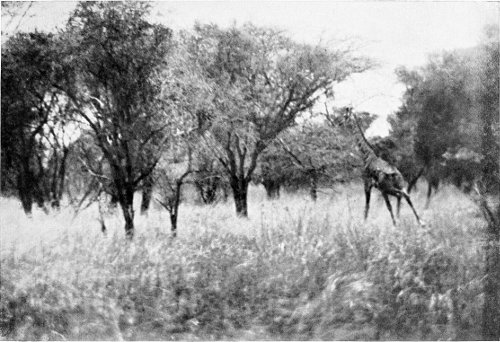
C. G. Schillings, phot.
A GIRAFFE IN FULL FLIGHT.
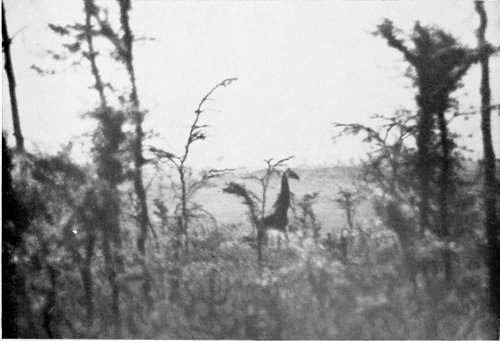
C. G. Schillings, phot.
A GIRAFFE BULL IN AN ACACIA GROVE.
Within the last hundred or even fifty years, the giraffe itself was to be found in large herds in many parts of Africa. The first giraffe of which we know appeared in the Roman arena. About two hundred years ago we are told some specimens were brought over to Europe, and caused much astonishment. The Nubian menageries some years ago brought a goodly number of the strange beasts to our zoological gardens.13 But how many people have seen giraffes in their native haunts? When, in 1896, I saw them thus for the first time, I realised how thin and wretched our captive specimens are by the side of the splendid creatures of the velt. Le Vaillant, in his accounts of his travels in Cape Colony and the country known to-day as German South-West Africa, gives a spirited description of these animals, and tells how after much labour and trouble he managed to take a carefully dried skin to the coast and to send it to Germany. That was seventy years ago. Since then many Europeans have seen giraffes, but they have told us very little about them. The German explorer Dr. Richard Böhm has given us wonderfully accurate information about them and their ways. But the beautiful water-colours so excellently drawn by a hand so soon to be disabled in Africa, were lost in that dreadful conflagration in which his hunting-box on the peaceful Wala River and most of his diaries were destroyed. Dr. Richard Kandt, whilst on his expeditions in search of the sources of the Nile, found the charred remains of the hut. “Ubi sunt, qui ante nos in mundo fuere?”
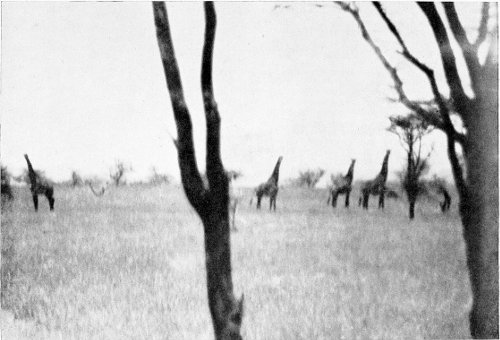
C. G. Schillings, phot.
A SUCCESSFUL PHOTOGRAPH, TAKEN AFTER A LONG PURSUIT AND MANY FAILURES.
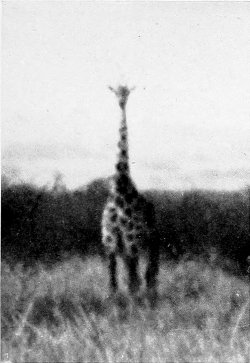
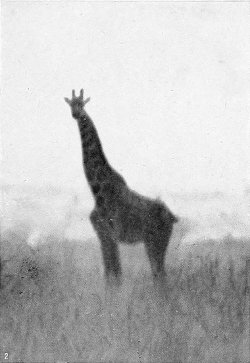
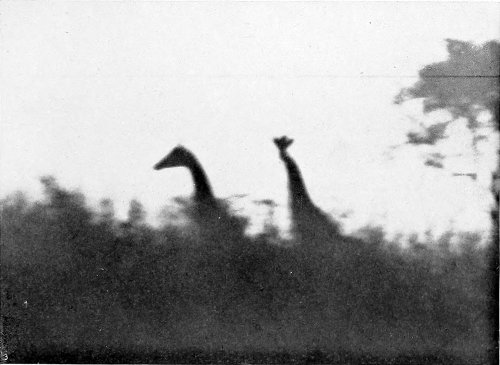
C. G. Schillings, phot.
TELEPHOTO STUDIES OF GIRAFFES (GIRAFFA SCHILLINGSI, Mtsch.).
Zoological experts tell us that there are several species of giraffe inhabiting separate zoological regions. In the districts I traversed, I came across an entirely new species.... Their life and habits interested me beyond measure. I often think of them still—moving about like phantoms among the thorny bushes, and in and out the sunlit woods, or standing out silhouetted against the horizon.
Though by nature peaceful, the giraffe is not defenceless—a kick from one of its immense legs, or a blow sideways with the great thick-necked head of a bull, would be quite enough to kill a mere man. But this gigantic beast, whose coat so much resembles that of the blood-thirsty tiger, leopard, and jaguar, never attacks, and only brings its forces into play for purposes of defence. It harms no man, and it has lived on the velt since time immemorial. It is the more to be deplored, therefore, that it should disappear now so quickly and so suddenly.
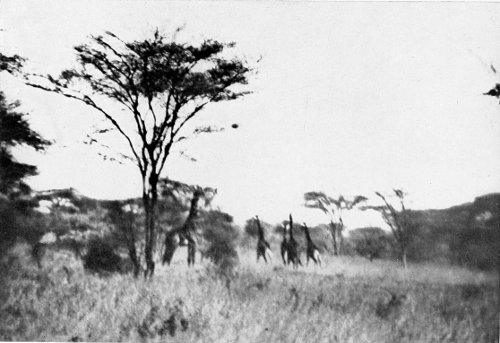
I have already remarked several times on the way giraffes and other African mammals harmonise in their colouring with their environment. Professor V. Schmeil has pointed out how my opinion in this respect accords with that of earlier observers.14 The way in which giraffes mingle with their surroundings as regards not only their colour but also their form, is especially astonishing. The illustration on page 550 proves this in a striking manner, for it shows how the outlines of the giraffe correspond exactly with those of the tree close to it.
One may spend days and weeks on the velt trying to get near giraffes without result. Far away on the horizon you descry the gigantic “Twigga”—as the Waswahili call it—but every attempt to approach is in vain. Then, all of a sudden it may happen—as it did once to me near the Western Njiri marshes, Nov. 29, 1898—that a herd of giraffes passes quite near you without fear. On the occasion in question, as is so often the case, I had not my photographic apparatus at hand. I could have got some excellent pictures with quite an ordinary camera. The giraffes came towards me until within sixty paces. They then suddenly took wildly to flight. The little herd consisted of nine head: an old very dark-spotted bull, a light-spotted cow, three younger cows with a calf each, and finally a young dark-spotted bull. Orgeich and I had been able to observe the animals quietly as they stood, as if rooted to the spot, with their long necks craned forward, their eyes fixed upon us.15 I cannot explain why the animals were so fearless on that occasion. It was a most unusual occurrence, for ordinarily giraffes manage to give the sportsman a wide berth.
Again, it may happen, especially about midday, that the hunter will sight a single giraffe or a whole herd at no very great distance. At these times, if one is endowed with good lungs and is in training, one may get close enough to the creatures before they take to flight.
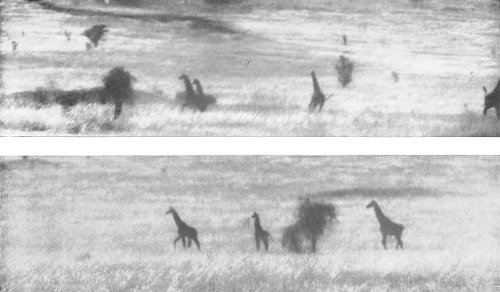
Hauptmann Merker, phot.
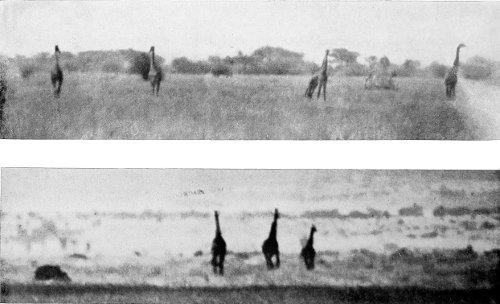
GIRAFFE STUDIES.
C. G. Schillings, phot.
GIRAFFE STUDIES.
Or it may happen that you will sight giraffes about noontide sheltering under the fragrant acacia trees. I remember one occasion especially, in the neighbourhood of the Gelei volcanic hills. I had hardly penetrated for more than about a hundred and twenty paces into an acacia wood, when I suddenly saw the legs of several gigantic giraffes—their heads were hidden in the crowns of mimosa. The wind was favourable. I might within a few minutes find myself in the middle of the herd! But, a moment later, I felt the ground tremble and the huge beasts with their hard hoofs were thumping over the sun-baked ground. They crashed through the branches and fled to the next shelter of mimosa trees. Although I might easily have killed some of them, it was absolutely impossible to take a photograph. But I was at times more fortunate in snapshotting single specimens. Carefully and cautiously, I would creep forward, of course alone, leaving my people behind, until I came within about twenty paces of the giraffe. By dodging about the trees or shrubs near which it stood I have sometimes managed to obtain good pictures of the animal making off in its queer way. The utmost caution was necessary. I had to consider not only the place where the animal was but the position of the sun, and that most carefully. The possibility of photographing giraffes with the telephoto lens is very slight indeed. One’s opportunities are turned to best account by the skilful use of an ordinary hand-camera.
In this way, also, I managed to get pictures of the peculiar motion of giraffes in full flight. My negatives are a proof of the comparative ease with which native hunters may hunt giraffes with poisoned arrows. I have often met natives in possession of freshly killed giraffe flesh.
In most cases bushes and trees are a great hindrance to the taking of photographs, especially of large herds. At such times it was as good as a game of chess between the photographic sportsman and the animals. For hours I have followed them with a camera ready to snapshot, but the far-sighted beasts have always frustrated my plans. Thus passed hours, days and weeks. But good luck would come back again, and I was sometimes able to develop an excellent negative in a camp swarming with mosquitoes.
It is especially in the peculiar light attendant on the rainy season and amidst tall growths that giraffes mingle so with their surroundings. It is only when the towering forms are silhouetted against the sky that they can be clearly seen on the open velt. At midday, when the velt is shimmering with a thousand waves of light, when everything seems aglow with the dazzling sun, even the most practised eye can scarcely distinguish the outlines of single objects. By such a light the sandy-coloured oryx antelopes and the stag-like waterbuck look coal-black; the uninitiated take zebras for donkeys—they appear so grey—and rhinoceroses resting on the velt for ant-hills. But giraffes especially mingle with the surrounding mimosa woods at this hour in such a way as only those who have seen it could believe possible.
When you see these animals in their wild state, your thoughts naturally revert to the penned-up tame specimens in zoological gardens or those preserved in museums. \ Well do I remember that the first wild zebra I saw looked to me little like a tame specimen in a zoological garden.
C. G. Schillings, phot.
A HERD OF GIRAFFES: THE LEADER, A POWERFUL OLD BULL, IN THE FOREGROUND.
C. G. Schillings, phot.
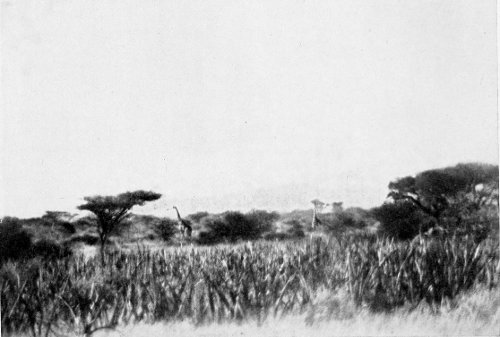
TWO GIRAFFES OUT OF A HERD I CAME UPON IN THE VICINITY OF THE MASAI COLONY CALLED KIRARAGUA, NOW ALMOST BEREFT OF WILD LIFE OWING TO THE IMMIGRATION OF THE BOERS. THE ANIMALS MAY HERE BE SEEN IN VERY CHARACTERISTIC SURROUNDINGS, ACACIA WOODS ALTERNATING WITH WIDE EXPANSES COVERED WITH BOWSTRING HEMP.
C. G. Schillings, phot.
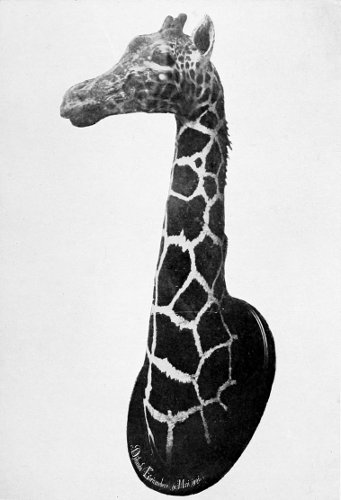
HEAD OF A GIRAFFE (GIRAFFA RETICULATA De Winton), KILLED IN SOUTH SOMALILAND BY THE EXPLORER CARLO VON ERLANGER. (BY KIND PERMISSION OF THE BARONESS VON ERLANGER.)
The death-knell of the giraffe has tolled. This wonderful and harmless animal16 is being completely annihilated! Fate has decreed that a somewhat near relative should be discovered in later days—namely the Okapi, which inhabits the Central African forests. It may be safely asserted that these unique animals will exist long after the complete extermination of the real giraffe. The species of giraffe, however, which has been dying out in the north and south of the African continent will be represented in the future by pictures within every man’s reach. Every observation as to their habits, every correct representation obtained, every specimen preserved for exhibition is of real value. And this I would impress on every intelligent man who has the opportunity of doing any of these things out in the wild.
Professor Fritsch saw giraffes in South Africa as late as 1863. Shortly before these lines were printed he gave a glowing account of the impression they then made on him, an impression which was renewed when he saw my pictures.
Large herds of giraffes still flourish in remote districts. My friend Carlo von Erlanger, whose early death is much to be regretted, found the animals particularly timid in South Somaliland when he traversed it for the first time. A fine stuffed specimen of these beautifully coloured giraffes is to be found in the Senckenberg Museum in Frankfort-on-Maine. An illustration gives the head of a giraffe killed by my late friend, and proves to the reader how much the two species differ—namely the South Somaliland giraffe as here depicted,17 and that which I was the first to discover in Masailand. We have in Erlanger’s diary and in this illustration the only existing information about the presence of the giraffe in South Somaliland, a region which none but my daring friend and his companions have so far traversed.
Hilgert, Carlo von Erlanger’s companion, mentions the frequent presence of the South Somali giraffe, but says that they showed themselves so shy that the members of the expedition generally had to content themselves with the numerous tracks of the animals or with the sight of them in the far distance.
Meanwhile an effort is being made to save and protect what remains of the giraffe species in Africa. But there is little hope of ultimate success. I do trust, however, that a wealth of observations, illustrations, and specimens may be secured for our museums before it is too late. In this way, at least, a source of pleasure and information will be provided for future generations, and the giraffe will not share the fate of so many other rare creatures which no gold will ever give back to us.
With sad, melancholy, wondering eyes the giraffe seems to peer into the world of the present, where there is room for it no longer. Whoever has seen the expression in those eyes, an expression which has been immortalised by poets in song and ballad for thousands of years, will not easily forget it, any more than he will forget the strong impression made on him when he looked at the “Serafa” of the Arabs in the wilderness.
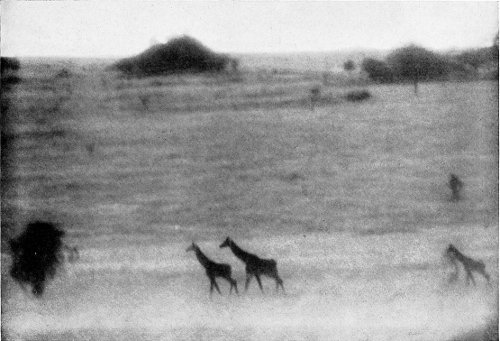
Hauptmann, Merker phot.
GIRAFFE STUDY.
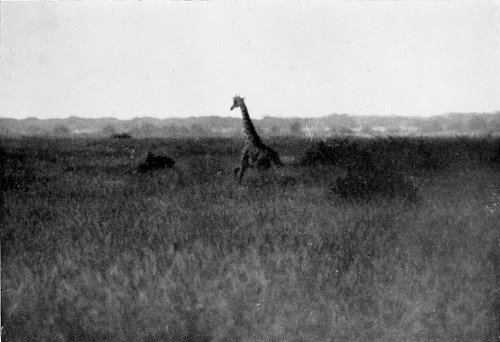
C. G. Schillings, phot.
A TELEPHOTOGRAPH TAKEN AT A DISTANCE OF 200 PACES.
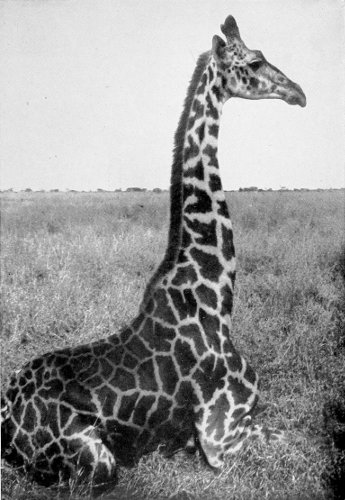
C. G. Schillings, phot.
GIRAFFA SCHILLINGSI, Mtsch.
The day cannot be far distant when the beautiful eyes of the last “Twigga” will close for ever in the desert. No human skill will be able to prevent this, in spite of the progress of human knowledge and human technique. The giraffe can never enter the little circle of domesticated animals. Therefore it must go. Perhaps its eyes will close in the midst of the Elelescho jungle, thus lessening still further the fascination of that survival from the youth of the world.
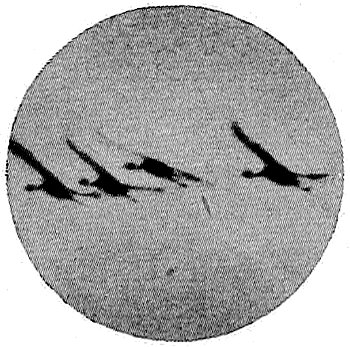
CRESTED CRANES ON THE WING.