Volume 1 — YOUNG GRANT’S GAZELLES ON A BLACK-BURNED STRETCH OF VELT. IV The Survivors
Frederic Whyte translation
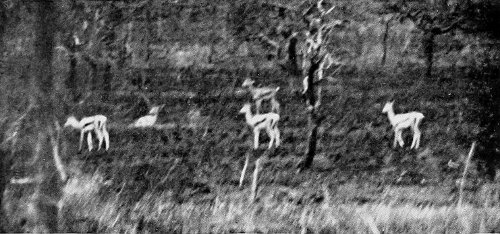
To learn to know anything with precision, to devote oneself to it and master it in its smallest details, one must generally make its study a labour of love. So the spread of more exact knowledge of the manifestations of nature around us must go hand in hand with the awakening of love for them and for the splendours they present to our view. And with this increasing impulse towards research and knowledge must come the desire to prevent as far as possible the rapid destruction of fauna and flora. Public opinion, in truth, has begun to range itself on the side of these much menaced glories of nature.
We have to observe and investigate. We have to get together some small portion of the vast material that is often so uselessly squandered, in order to employ it in the service of special branches of science, and to make some closer knowledge of these things accessible to every one. We have to establish great collections formed on a definite plan, and everywhere to save as much material as possible for scientific and educational purposes, so long as it can still be done. “If these ideas could be brought home to the right quarters, millions would be made available for this object,” writes one of the most learned specialists in these matters. Our zoological gardens and museums are already doing their best, but they are hampered by the want of pecuniary resources. Whilst the largest sums are freely provided for the purchase of antiquities, there is a dearth of means for doing what is necessary to save the treasures of our vanishing fauna while there is still time!
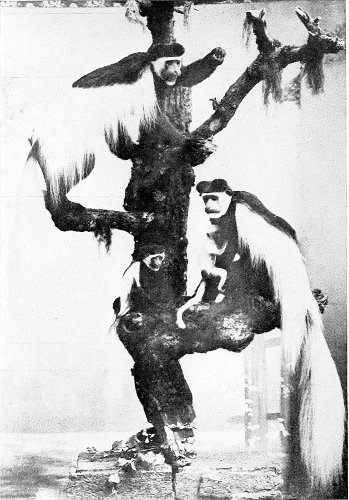
GROUP OF ’MBEGA MONKEYS, WITH THEIR WHITE-COATED YOUNG (FIRST DISCOVERED BY THE AUTHOR).
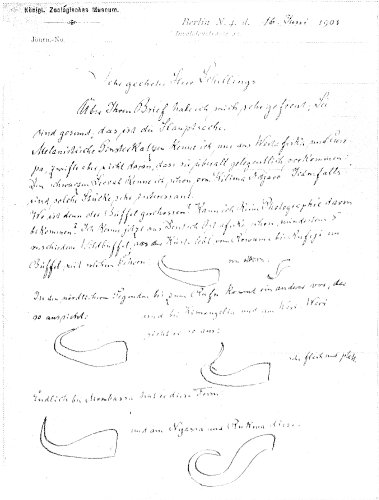
LETTER FROM PROFESSOR P. MATSCHIE, THE LEADING AUTHORITY ON THE DISTRIBUTION OF THE MAMMALIA OF GERMAN EAST AFRICA.
Other countries, America for instance, set us a glorious example. There you see public collections formed, affording panoramas of animal life so splendid, so beautiful, and planned on such grand lines, that the love of nature must be lighted up in the hearts of all who visit them.
What can be saved of these disappearing treasures must suffice for all time, and must in part at least be preserved in fire and thief-proof “zoological treasuries,” for it will be impossible to obtain such things again in the future, no matter what efforts may be made. Thus a great and difficult task presents itself to our museums. We can rightly require of them that they shall not merely exhibit the principal species of the animal world, but that they shall also preserve specimens of the most striking representatives of our still surviving fauna that are likely soon to become extinct. And these specimens must be guarded by all the resources of art and science against light and any other influence that might injure them. For such a far-seeing policy posterity will be grateful to us.
It seems, however, as though some unlucky star presided over the collecting of the larger species of the animal world. Let any one devote himself to these special pursuits and objects, and even if he win thereby the approval of experts and of wide circles of the public, still a certain odium will seem to attach to him. Obviously he must kill a certain number of animals, that are often quite unknown till then, and in almost every case have been hardly studied at all, in order that he may add them to the collections belonging to his native country. He gains the gratitude of science and of the learned, but he has to encounter the prejudices of others. People think that they are justified in throwing upon him, the scientific collector, the reproach of being an exterminator.
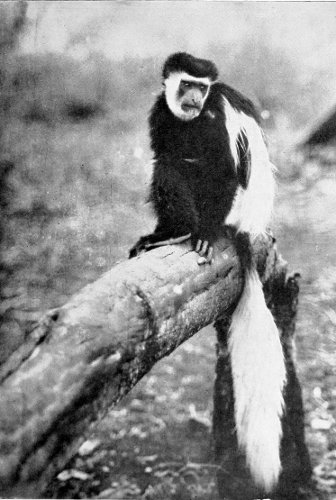
C. G. Schillings, phot.
A ‘MBEGA (COLOBUS CAUDATUS, Thos.)
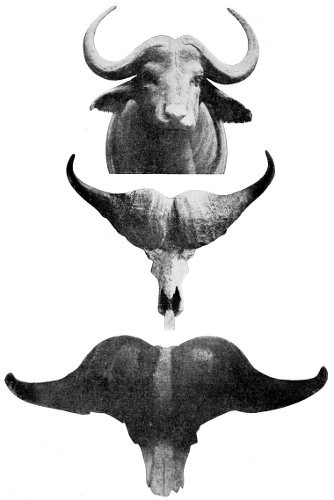
THREE NEW VARIETIES OF EAST AFRICAN WILD BUFFALOES: BUBALUS SCHILLINGSI Mtsch. spec. nov., FROM THE MIDDLE PANGANI, LAKE DJIPE MOMBASA; BUBALUS NUHAHENSIS, Mtsch. spec. nov., FROM UPOGORO, ’NDEMA, ’MBARAGANDU AND THE UPPER RUAHAIS; BUBALUS WEMBARENSIS, Mtsch. spec. nov., FROM THE TSHAIA MARSHES IN THE SOUTHERN WEMBERE STEPPE. THE ILLUSTRATIONS SHOW HOW GREATLY THE FORM OF THE BUFFALO’S HORNS VARIES IN DIFFERENT DISTRICTS, AND GIVE A PROOF OF THE IMPORTANCE OF SCIENTIFIC COLLECTIONS FOR EACH SEPARATE REGION.
I have to thank Professor Matschie for the two lower illustrations.
Those who speak thus completely forget that it was through the material thus placed before their eyes that they themselves obtained their very first knowledge of these beautiful creatures; that till then they hardly took any interest in such things; and that it is only by means of knowledge secured in this way that regulations for the preservation of these beauties of nature can be devised.
Let us suppose that every museum and scientific collection in the world were provided with a series of specimens of all the varieties of the animal world that are now most seriously threatened with extinction; let us further suppose that each of these institutions secured, besides, duplicate series of the hides and skeletons of each species. To make a striking comparison, all this, beside the wholesale destruction of the animal world of which we have to complain, would be like a week-end sportsman perhaps killing one hare during his whole life compared to the millions of hares killed every year in Germany.
If a species is already reduced to such a state that the taking of a few hundred, or even a few thousand, specimens for scientific purposes will exterminate it, we may say generally that, even without this proceeding, it is inevitably doomed to extinction. But the wretched egg-collecting by youths, for instance, is quite a different matter. Certainly there must be a great deficiency, when continually, year after year, wood and meadow are searched for birds’ nests by thousands of boys. This is obvious, and thus the rarer species are threatened in their very existence.
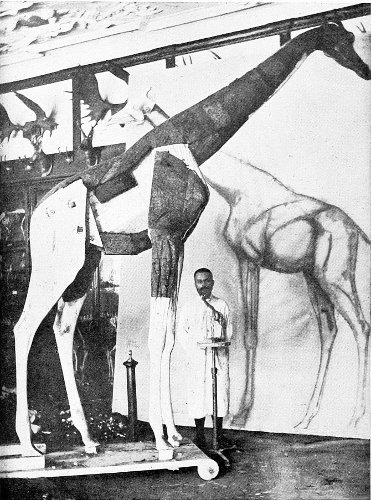
MODERN METHODS OF TAXIDERMY: SETTING UP.
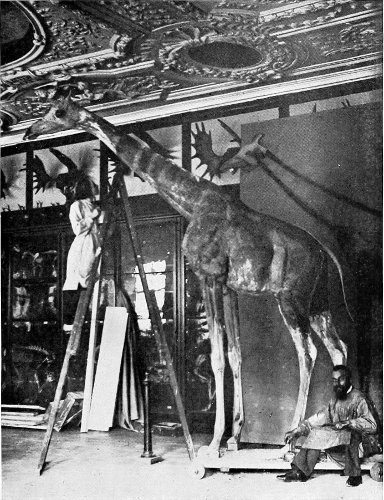
ONE OF MY SPECIMENS IN THE MUNICH MUSEUM.
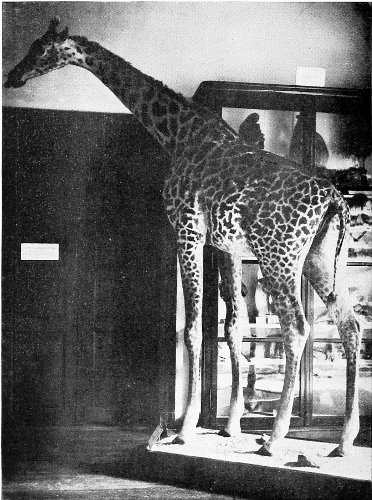
THE COMPLETED SPECIMEN IN THE MUNICH MUSEUM (GIRAFFA SCHILLINGSI, Mtsch.).
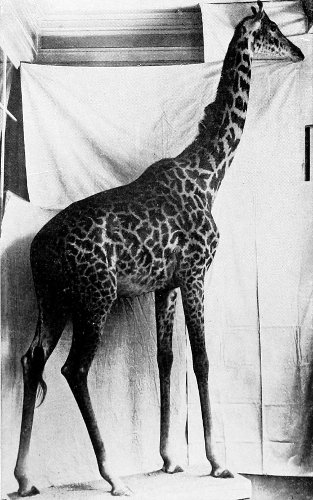
ANOTHER OF MY SPECIMENS IN THE STUTTGART MUSEUM.
Great stress ought always to be laid upon the point to which I have here called attention, and I can appeal to every expert on the subject for confirmation of my opinion.
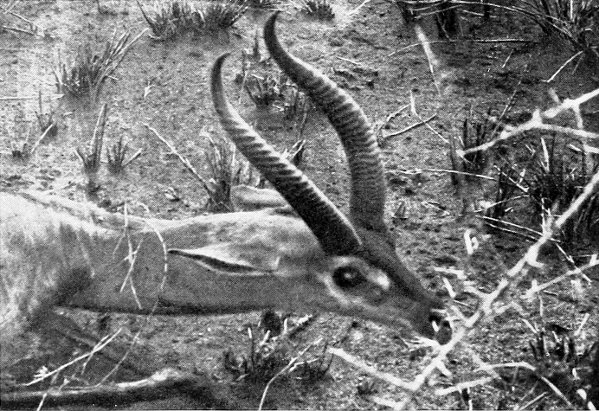
PHOTOGRAPHIC STUDY OF A MALE GIRAFFE GAZELLE (LITHOCRANIUS WALLERI, Brocke) SHOT BY THE AUTHOR. AN EXTREMELY BEAUTIFUL AND RARE SPECIES, FIRST SEEN BY THE AUTHOR IN GERMAN EAST AFRICA IN 1896.
I think that I have earned a special right to speak on this matter. For the last fifteen years I have hardly ever carried a gun when at home in Europe; I have refused the most pressing invitations to shooting parties; and I have sought pleasure only in the sight of our native wild animals, which I know so well, and in secretly watching and observing them. But in the midst of a yet unstudied foreign fauna, of which we still know little or nothing, where there is question of first obtaining some scanty knowledge oneself, and forming collections for definite scientific research—in the midst of an animal world of this kind I would not hesitate to shoot even large numbers of each species. For there would be good reason for not merely securing well-developed male specimens, as the hunter does, but also females and young animals in all the various stages of growth and colouring. This must be obvious even to a child, and no one will deny to science the right so to act, at least in those regions of Africa which—in comparison with India and other countries—are still untouched by civilisation, and which therefore, in their primitive unchanged condition, afford us doubly interesting results. Now supposing one has got together large collections, and has been so fortunate as to succeed in bringing them down to the coast and home to Europe. A collection of insects or of the lower animals may pass without remark; but woe to the slayer of the larger species of wild animals! These come under the description of “beasts of the chase,” and now a peculiar kind of bacillus quickly develops—the bacillus of “hostility to the hunter,” which, introduced into Europe from the tropics, finds here, too, a fostering soil. Let me be allowed to endeavour to find a prophylactic against this bacillus in these essays. I have already often laid stress upon the facts that such great quantities of the skins and feathers of birds are exported for the purposes of fashion, that by this trade whole species are threatened with extinction; that every individual European is allowed, without any hindrance, to send home his trophies of the chase—trophies which, with only a few exceptions, can have hardly any value for science; above all, that the extermination of the elephant in Africa is being carried out before our very eyes for the sake of his ivory; and that all this is held permissible. But let one make collections for scientific purposes, and scrupulously hand over every skin, every hide, with the horns and skull belonging to it, all carefully labelled, to some museum at home, and, according to widely expressed opinion, he is greatly to blame for the destruction of animal life.
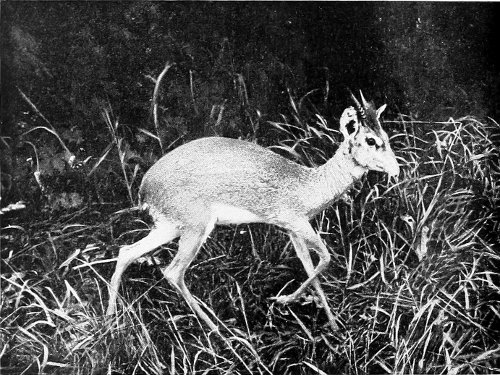
DWARF ANTELOPE IN THE CARLSRUHE NATURAL HISTORY MUSEUM.
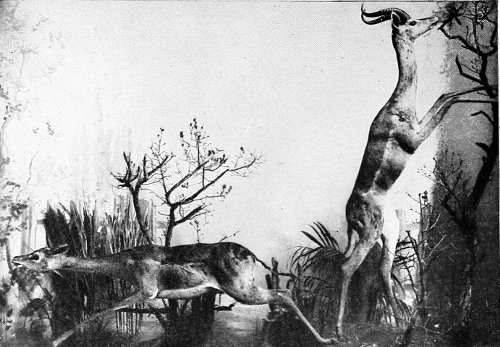
GROUP OF GIRAFFE GAZELLES (IN THE AUTHOR’S POSSESSION) PREPARED BY ROBERT BANZER OF OEHRINGEN. THE ONE ON THE RIGHT IS SHOWN IN ITS CHARACTERISTIC ATTITUDE WHEN BROWSING ON TREES OR BUSHES.
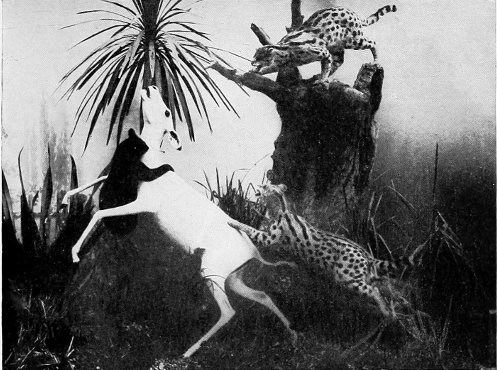
GROUP, ALSO PREPARED BY BANZER, SHOWING A SNOW-WHITE “BLACK-HOOFED” ANTELOPE, ATTACKED BY A BLACK SERVAL AND TWO OTHERS.
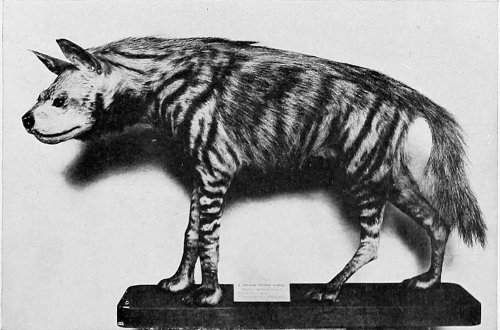
A SPECIMEN OF THE NEW SPECIES OF HYENA DISCOVERED BY THE AUTHOR IN GERMAN EAST AFRICA (HYENA SCHILLINGSI, Mtsch., NATURAL HISTORY MUSEUM, LONDON).
Happily in recent years our colonial collections have been considerably augmented. An extraordinarily large quantity of material has been forwarded to the Berlin Natural History Museum, amongst others, by officials, private individuals, and members of the garrisons abroad. Hence valuable results have been obtained for the zoology of these regions. Amongst the satisfactory results of the ever increasing activity in the zoological exploration of the Dark Continent are surprising and repeated discoveries of unknown species of animals, such as the Okapi (Ocapia johnstoni) and a black wild hog, till now completely unknown (Hylochœrus meinertzhageni, Oldf. Thomas). With the help of these collections, Professor Matschie, dealing with the mammalia, and Professor Reichenow with the birds, have succeeded in establishing the fact that each separate region of the Dark Continent possesses its own characteristic fauna. And most important conclusions with regard to the distribution of animals have thus been derived from these great systematic collections. My friend Baron Carlo Erlanger, the well-known African traveller, and the only one who has ever traversed Somaliland from end to end, though unhappily cut off by an early death, was able to confirm these theories, with reference to the countries he explored, by the ample collections he systematically formed. The whole science of zoology in relation to geography has been turned on to new lines of research, and has given the most important and most valuable results. Everything should be done to support efforts of this kind.
C. G. Schillings, phot.
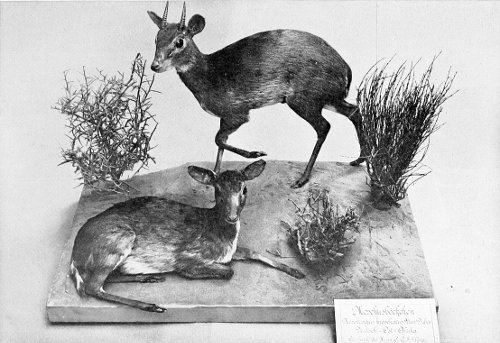
DWARF MUSK DEER, (NESOTRAGUS MOSCHATUS Van Duben) FROM THE AUTHOR’S COLLECTION IN THE BERLIN NATURAL HISTORY MUSEUM.
C. G. Schillings, phot.
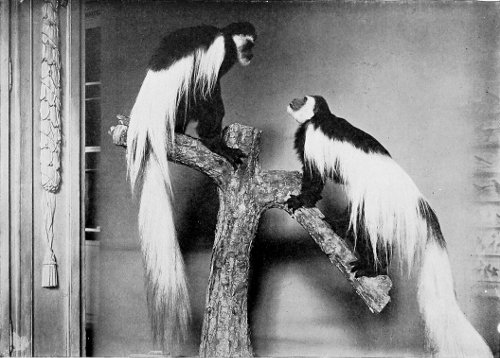
A PAIR OF GUEREZAS (COLOBUS CAUDATUS, Thos.). THIS LIFELIKE GROUP WAS PREPARED BY THE SKILLED TAXIDERMIST KERZ, OF THE STUTTGART MUSEUM.
But in this department it is to all increasing extent the duty of our German museums to promote a knowledge of and an interest in the animal world of far-off lands by the display of ample collections, so arranged as to convey instruction. There has already been gratifying progress in this respect, but it is clear that for the development of these ideas we need more extensive, up-to-date buildings for our collections and museums. Other countries, especially England, and above all America, are far in advance of us in this matter. Our zoological gardens have the task of putting the living animal world before us. Happily we are doing this by far-sighted methods. To the Zoological Gardens of Berlin belongs the credit of having, to a continually increasing extent, arranged a display of the animal world in appropriate surroundings, and with reference to systematic classification and to its relations with geographical distribution and ethnological science, so far as one can assume the connection or companionship of certain species with man. There we see the disappearing species of wild cattle housed, each according to its peculiar character, in enclosures that are strictly true to nature, and artistically designed. Thus, for instance, the American bison—now hardly to be obtained for its weight in gold is shown in surroundings that remind us of the North American Indians, these also a disappearing race. The ostrich-house takes us back to the land of the Pharaohs, of which the ostrich was once a characteristic inhabitant, as well as the ichneumon, the crocodile, and the hippopotamus. Then the class of rodents is brought before us in almost poetical surroundings, that seem quite to justify the German animal stories of the Middle Ages, and that are calculated to produce quite a different effect on the mind from that of a stiffly arranged exhibition of the regulation type, especially in the case of the rising generation. But on account of the difficulty of securing and maintaining certain species, and their shortness of life in close captivity, our zoological gardens can only properly carry out their programme so long as it is possible for them to continually renew their stock of animals.
On the other hand, the museums are all the more responsible for setting before our eyes the various species of animals even long after these have become extinct, and they must do this by means of works of art executed by the hand of man, masterpieces of taxidermy.
And by masterpieces of taxidermy I mean artistic groups of “stuffed” animals that will, as far as may be, show us their life and action, their ways and habits. In former times this work was left to the so-called “animal-stuffer.” He took a hide, filled it out with some material or other, and then, so far as he could, gave it the appearance of a quadruped or a bird. Thus one sees a stuffed hippopotamus of this good old time which looks, not like such an animal, but like a gigantic sausage. One sees stags or antelopes that somewhat resemble the wooden toys associated with the Christmas boxes of my childhood, and not the particular species of animals which they are intended to represent—in short, wretched caricatures with neither beauty nor fidelity to nature.
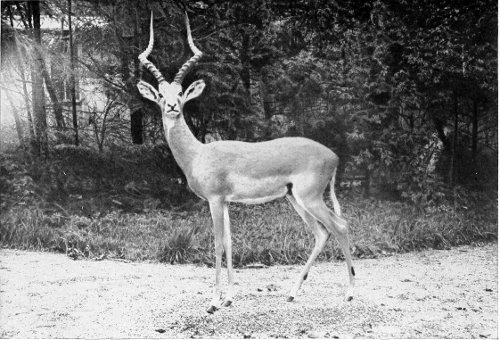
C. G. Schillings, phot.
BLACK-HOOFED ANTELOPE IN THE CARLSRUHE MUSEUM.
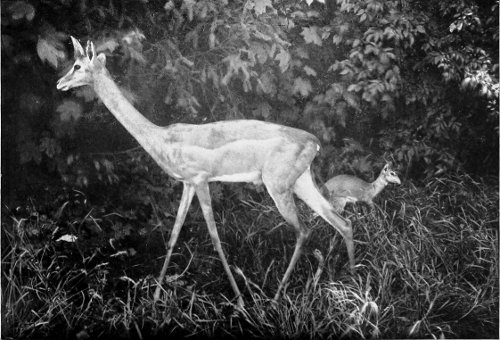
C. G. Schillings, phot.
GIRAFFE GAZELLE AND DWARF ANTELOPE IN THE CARLSRUHE MUSEUM.
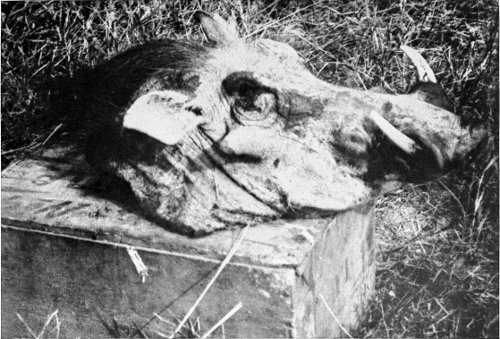
C. G. Schillings, phot.
HEAD OF AN AFRICAN WART-HOG SHOT BY THE AUTHOR.
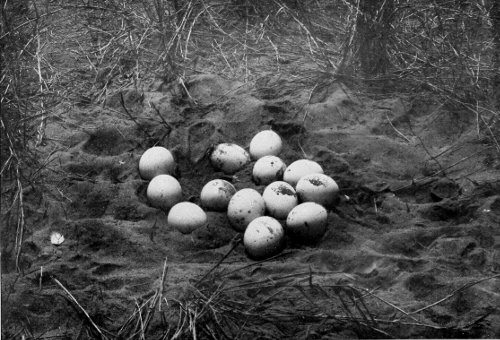
C. G. Schillings, phot.
PHOTOGRAPH OF AN OSTRICH’S NEST, JUST AS IT WAS FOUND. THE BIRD’S TRACKS MAY BE SEEN IMPRINTED ON THE SAND. THE DARK SPOTS ON SOME OF THE EGGS ARE PATCHES OF SAND.
Nowadays, however, more than this must be done—the best must be insisted on. Instead of the “stuffer,” the artist must come upon the scene. Using the methods of the sculptor, he can artistically fashion a form that will be true to life, and clothe this form with the hide or skin. Happily by these means we now find such works of art exhibited in ever increasing numbers, not only in museums abroad, but also in the public collections of our own country. But as yet this new department of artistic activity is not generally as well understood as it should be. It is still far too little valued.
What labour has to be devoted to the artistically correct setting up of even one single large mammal in a museum—for instance, a giraffe! First the animal must be hunted down in the wilderness, and its hide carefully prepared. Then, if it has been brought home in good condition, there follows a second laborious preparation, and finally the setting up. The difficult building up of the framework, and the work upon the giant beast till all is complete, require the labour of nearly a year. The very first conditions for the success of the whole are great patience, knowledge, and an ideal that is both artistic and true to nature.
Our illustrations show, in its various stages, the progress of the setting up of one of the giraffes I collected in Africa. It is easy to understand that besides artistic and scientific ability for the correct moulding of the form, various complex manipulations are required before the giant beast again stands before us as if “reawakened to life.”
I have further tried to show by illustrations of another giraffe, and of a series of antelopes, down to the tiny dwarf antelope, how under the hand of the artist the animal world can be made to rise up again, as if waked anew to life.
All our larger museums ought to exhibit the most important and most prominent representatives of the animal kingdom modelled in attractive groups in their natural surroundings.
In America it has become the custom for private individuals to place at the disposal of the zoological institutions extensive collections and large sums of money. With this help they are able to produce artistic work, true to nature, works of art, the consideration of which gives the spectator an insight into the life and habits of the animal world of his native land as well as of foreign countries. Unfortunately this custom has hardly yet been introduced amongst us.
My native city of Frankfurt23 can claim the honour of possessing, in the time-honoured Senckenberg Institute (now transferred to a new home), a museum founded by private effort and private interests, where one may see collections formed for exhibition, that may be pointed out as models of their kind.
The collector of such things can partake of no greater pleasure than he experiences when, making a tour of the museums of various places at home, he sees awakened to new life the wild creatures he formerly observed and laid low in far-off lands. So I could not deny myself the pleasure of adding to this book a number of pictures of animals and groups of animals which I secured in the wastes of Africa, and which are now set up in various museums. These are trophies that must allure every sportsman. It is of course not so easy a matter to secure them as it is to hack off without any trouble the antlers or horns of some wild animal that one has shot.
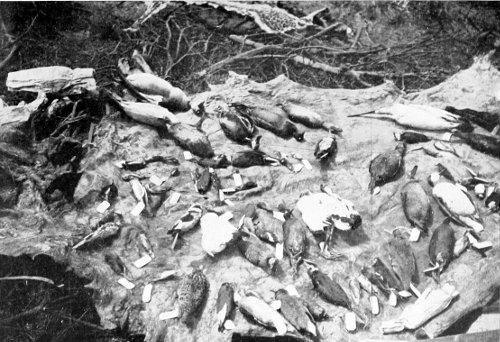
C. G. Schillings, phot.
DRYING ORNITHOLOGICAL SPECIMENS FOR MY COLLECTION.
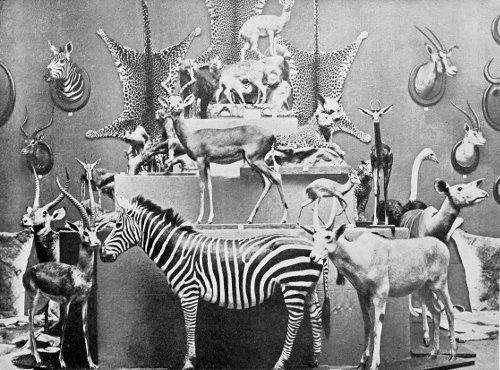
C. G. Schillings, phot.
GROUP MAINLY COMPOSED OF THE AUTHOR’S TROPHIES IN THE CARLSRUHE MUSEUM. IN FRONT, BELOW, FROM LEFT TO RIGHT, WATERBUCK, GRANT’S GAZELLE, BOEHM’S ZEBRA, YOUNG ELAND; AND ON THE RIGHT A YOUNG OKAPI (OCAPIA JOHNSTONI) FROM THE CONGO STATE, THE GIFT OF THE KING OF THE BELGIANS.
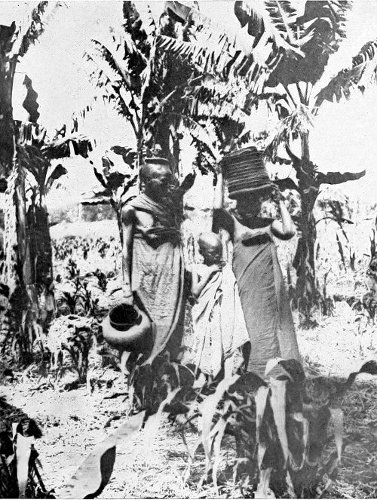
C. G. Schillings, phot.
WOMEN OF THE RAHE OASIS IN A BANANA GROVE.
Paintings, true to life, from the hands of artists, photographs taken directly from life, and finally these groups awakened, as it were, to a new life, are the means that can, and should, exert an educating and informing influence, so that all the beauty of this department of created nature may not be accessible only to a few learned men, but be open to all in general. If to an ever increasing degree this object finds support in influential circles, we shall thus obtain what must be somehow obtained. In the presence of the progress of industry and civilisation no one can indeed permanently prevent by protective measures the disappearance of certain species, even though we may hope to still delay the process of extinction by suitable regulations. But on this ground the duty that I have already indicated becomes more clearly imperative upon us. Its fulfilment cannot fail to be rewarded, in the case of all who take part in it, by the only true satisfaction that is given to mortals, the feeling of having done all that was in any way in our power to do.