Volume 1 — EGYPTIAN GEESE IN A SWAMP. V Sport and Nature in Germany
Frederic Whyte translation
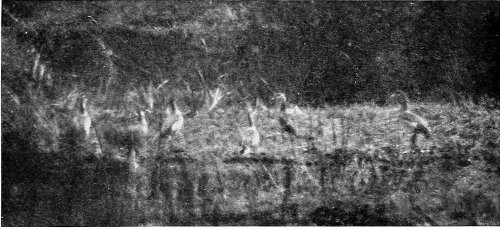
Not by far-away Lake Nakuro alone has “the Spell of the Elelescho” lived. It has lived, and still lives, all over the world; only that it goes by other names, and is linked with other symbols.
In the brief summer of the Polar regions, battling with the snow and ice and the long night, it lives in the few stunted willows and the scanty reindeer-moss. It can only be fully understood where the ungainly walrus, the mighty Polar bear, coloured like his own snowfields, and the herds of fur-adorned musk oxen and reindeer give life to the wilderness, and millions of sea-birds cover the cliffs, or wheel shrieking through the air. To all these creatures the appearance of man in these wide regions is so strange and unaccustomed that they show no fear of him, and even come hurrying up from all sides to look curiously at this strange new being.
In the high mountain regions of Central Asia, too, this spell survives, associated with the flocks of those timid creatures the primitive wild sheep, with the graceful wild goats, with the stately ibex,24 and with the life and movement of the countless huge bears of the mountains, and with a strange flora that I myself have never looked upon, but of whose existence I am as persuaded as of that of the spell itself.
It is to be found in the jungles of India, whence the tolerant natives have never driven it out. They have not expelled the animal world from its paradise. There in the region of the lotus-flower the spell may perhaps be recognised on still, moonlit nights.
It survives everywhere: in the Australian bush, in the New and the Old World, on all islands, in all rivers and waters, in the life and movement of the waves and depths of the ocean, so full of secrets everywhere; in a word, where man has not yet driven it away.
Once it lived everywhere in Germany, and even to-day it is still to be found in many places. It has its being where the mighty elk made its home on moor and marsh-land, and our forefathers hunted the aurochs and the bison in the primitive forest. To-day it is associated with the edelweiss and the chamois in the Alps; it has its being in the oak and beech woods, and where the green current of the Rhine flows down, or where the stag sends afar his cry of challenge to his rival, and the huntsman makes his way over the moor.
There one still experiences the spell of the Elelescho. But everywhere, all over the world, everywhere in our Fatherland, it once lived and held sway.
We may hope that the intimate and beautiful relations that the German sportsman establishes between himself and nature in his Fatherland will for a long, long time be handed down from generation to generation, and thus result in the maintenance and preservation of the noble old spell of the woodland and the wilderness. The ideal of true German sportsmanship has been developed in as high and full a sense as that of fair play in sport in England.
Both of these ideals will be judged in unfriendly fashion only by those who regard them from a distorted point of view. The English ideal of sport is winning the world to itself; the German ideal must do the same.
Coming from a good German school of sport, I consider myself fortunate in having learned to know the wonderful animal world of Africa. There is no doubt whatever that I must ascribe to the influence of this school the fact that my accounts of what I had experienced and seen met with such an appreciative reception both at home and abroad.
How wonderful is the chase in Germany! The primitive attraction for the chase must be a part of every man. One need only once have seen the excitement that seizes upon a gathering of thousands if on a sudden a hare or some other wild creature comes into sight. At such a moment, almost without exception, every one of them is on the move, without the least reflection, and even notwithstanding the consciousness that in no case can he himself secure the prize. It is the call of a strong impulse deep rooted in men. But in our Fatherland how grandly and nobly what we mean by “true sportsmanship” has developed out of this primitive instinct!
A certain kind of organisation of the business of the chase must have been in existence even in primeval times. Those who have made a study of this department of the life of nomadic hunters in many lands tell us that tribes and groups of families hunt only in well-defined areas, and as they value their lives do not venture to pass these boundaries. I have learned the same thing by my own personal experience of the Wandorobo and other nomad huntsmen of the African plateau. It must therefore have been the case everywhere, from the times when primitive men, the cave-dwellers, began their struggle with the mighty beasts of primeval days, down to our own times, when the chase is more and more regulated till at last it becomes the exclusive property of the owner of the land.
As a consequence of this right came measures for game preservation both against the interference of the stranger sportsman, and as regards the wild creatures themselves. Increasing knowledge taught the hunter that he could not kill more than a certain number of wild animals without extirpating them entirely in his district.25 Hence grew up our complex game-laws of to-day, and the general feeling that our hunting grounds should be used in as intelligent a way as possible. In Germany this problem has been solved to a remarkable extent. German sport has an important influence on the welfare of the people. Great numbers of our people are strengthened in body and mind by the chase, and, thanks to it, considerable sums of money are added to the resources of the country folk.
According to a moderate estimate there are now in Germany upwards of half a million sportsmen. Each year they kill about 40,000 head of red and fallow deer, about 200,000 roebuck, 4,000,000 hares, 4,000,000 partridges, and 400,000 wild ducks, in all some 25,000,000 kilograms (over 50,000,000 lb.) of wild game, of a value of 25,000,000 marks (£1,250,000), and forming nearly one per cent. of the total meat supply of Germany. The game leases bring in about 40,000,000 marks annually (£2,000,000).26 But these very sportsmen, who every year kill such a large quantity of wild animals, must at the same time be protectors and guardians of this same animal life! Strange as it may seem, many species of wild animals would have been long ago extinct if there were no sportsmen. For imperative reasons, the hunter must at the same time undertake the part of protector.
But this idea ought to be to include a great deal more than is now the case. As I have already said, no nation has known so well how to form a beautiful and poetical ideal of the chase and the spirit of sport as the Germans have done. But it is not to be denied that this perfect development, even in its very completeness, has in a certain sense become one-sided, in so far as sportsmen restrict their protection and guardianship to certain species of animals; one-sided, too, inasmuch as to a certain extent they regard their mission from the point of view of a close corporation. In this there is a certain advantage, but also a certain amount of danger now that, as a result of the rapid progress of civilisation, changes are introduced in every department of life so much more quickly than in earlier times.
Huntsmen and fishermen desire the complete extermination of all kinds of animals that they consider to be a cause of injury to their sport. The result is the destruction of many kinds of animals that are beautiful in form and constitute an ornament of the landscape. By the same kind of reasoning sportsmen, in their capacity of landlords and forest owners, ought to demand the extermination of the wild animals that obtain their food from field and forest. Naturally sportsmen do not want this, but they should, as far as may be, let themselves be guided by higher points of view. This is the case already in many instances. For example, as an instance of zealous game supervision inspired by scientific principles, we have lately had to welcome a valuable idea of Forest Commissioner Count Bernstorff. According to his plan, small labels that will not annoy the animals (the so-called “Game marks”) are attached near the ears of young roebucks and red deer. Thus their resting-places, their movements, their growth, can be carefully observed.... We are, therefore, actually living in a time when to a certain extent each individual head of game is numbered!
Interesting and valuable as such measures may be, should we not extend our loving care also to the animals that, though they are not reckoned as game, yet adorn and give animation to the land we live in? Some great landlords have given a bright example of progress in this direction. Thus in Hungary there are sporting estates on which wolf and bear are not completely exterminated, and in Germany estates on which the fox is spared to a certain extent. The result has been to the advantage of stags’ antlers and bucks’ horns on the estates in question. English landlords allow a free home to a pair of peregrine falcons or eagles, so as not to allow these beautiful birds to be completely extirpated.
From these examples it is clear that there can be various opinions as to the view generally taken with regard to “predatory animals.” If there is not merely a selfish protection for game animals, but also protection for the other mammals and birds, we shall thus preserve from extinction some of the glorious forms of the realm of nature, and prevent their being sacrificed to narrow interests. There is food for thought in the fact that (as I have often had occasion to observe in Africa) in primitive countries there is to be found an astounding abundance of animal life. Since prehistoric times man has been engaged in hunting with his simple weapons without, on the whole, very much diminishing the number of animals. A striking proof that the destruction of wild life is the work of the Europeans themselves, and of the native hunters carrying firearms under their authority, is afforded by the fate of the North American buffalo, the whales, walruses, and seals of the frozen seas, and finally by that of the elephant in certain districts and of the South African fauna taken as a whole.
We should not therefore act so rigorously in the proscription of our so-called “predatory” animals. Yet, for instance, my near neighbour, Freiherr H. Geyer von Schweppenberg, has lately shown that our pretty water-hen (Gallinula chloropus, L.) can do a great deal of damage to grass and corn.
In South Africa what are called “poisoning clubs” have been organised, which aim at the extermination of “noxious animals” by poison. The use of poison ought to be entirely forbidden by legal enactments, with the exception, perhaps, of its administration for scientific purposes. The strychnine canister—the use of which ought only to be allowed, and that in exceptional cases, to those who are making scientific collections—is now making its appearance everywhere all over the world. I have had news from the most distant countries of its employment, unhappily with far too great success.27 It is already some time since the last Lammergeier of the German hill districts fell a victim to it. It is thinning to frightful extent the numbers of the bears in Eastern Asia and other countries, though these are quite harmless to man. But in our Fatherland a completely organised “poison business” has grown up, which is a very serious matter.
I should like also to advocate strongly the legal prohibition of the use of pole-traps, to which all our owls and birds of prey fall victims.
If we go on as we are going, the time cannot be far distant when we shall have to strike out of the list of the living several interesting members of our native fauna. In North America, in recent times, the following species, amongst others, have some of them become extinct, others extremely scarce: the Californian grizzly bear (Ursus horribilis californicus), the San Joaquin Valley elk, or wapiti (Cervus nannodes), Stone’s reindeer (Rangifer stonei), the prongbuck or pronghorn (Antilocapra americana), the Pallas cormorant (Phalacrocorax perspillicatus), the Labrador duck (Camptolaimus labradorius), the ivory woodpecker (Campephilus principalis), the scotar (Aix sponsa), several other species of birds, and finally the American woodcock. This last falls a victim chiefly to professional hunters, who are accustomed to kill it by hundreds in its winter quarters.
“This list could perhaps be extended,” Mr. R. Rathbun, the Secretary of the Smithsonian Institute (whose kindness I have to thank for this information), adds at the end of his letter.
His communications have also been of special interest to me because they awoke in me old recollections. In the ‘forties of the past century my father received a letter from North America in which he was informed that on ground over which the New York of to-day extends, one could shoot in a single day hundreds of woodcock. I myself, in my young days, used to take care of a beautifully coloured parrot, of a kind that since then has been almost extirpated, and is hardly to be obtained any longer. Connurus carolinensis is the name of this beautiful species of parrot, which also appears on the list of extinct animals of North America. There, too, men have begun to give strong practical expression to the movement for animal protection. In sanctuaries like Yellowstone Park there is complete protection for all animal life, including beasts of prey, and the bears have become so tame that they allow visitors to come within a few paces of them. Count E. Bernstorff, who received permission to shoot one of the few bisons still preserved in the State of Wyoming, says “One might take the way in which the animal life of America is protected as an example in securing still better preservation for the survivors of the primeval wild life of Africa. One must acknowledge that the Americans and their noble President, a brave sportsman, are now doing all that is possible in this matter.”
President Roosevelt, in fact, has come forward manfully in the lists as a champion of widely extended protection for all the beauties of nature, and especially of the animal world. He endeavours by his words and writings to work effectually for these great and noble ideas, which bring to all men delight, profit, and contentment.28
Brought up in the school of German sportsmanship, I had later on to change completely my view as to our distinction between “noxious animals” and “beasts of prey.” The African wilderness swarms with beasts of prey, and yet also swarms with useful wild animals. The waters of Africa teem with the fish destroyers, and also teem with fish. We should not therefore act so short-sightedly and pedantically. We should not be so eager to hunt down the last fox, the last pine-marten. The nesting-places of herons and cormorants are becoming ever fewer; the places where the handsome black tree storks build in our German Fatherland can almost be counted on the fingers of one hand; and the same is nearly true of the nesting-places of our rarer birds of prey.
The killing of a wild cat has already become an event; it is the same with the eagle-owl.
Out of the mass of literature of recent date bearing on the subject, I take a single book. In a very readable essay, Der Uhu in Böhmen, Kurt Loos shows that only a few years ago this interesting and beautiful large owl (Bubo maximus) was to be found making its home to the extent of some fifty pairs in thirty-five districts of Bohemia; now only eighteen pairs are living there, in ten districts. The author demands protection for the surviving pairs of owls, as natural objects that should be preserved, and he makes out a strong case for his proposal. Röntgen-ray photographs are among the illustrations of this interesting work, and they suggest that in times when one can do one’s work with such excellent appliances, there is all the more reason for avoiding the thoughtless neglect of legacies left to us by Nature from the days of its primeval beauty.
Numerous other examples of the rapid disappearance of certain species in our Fatherland might be quoted here. Unfortunately we have, on the whole, very little right to reproach the people of Southern Europe on the subject of their custom of carrying on a systematic massacre of birds; for we ourselves are always trapping thrushes and larks, and there is the shooting of the woodcock in spring. There can be no doubt that, if we would give up this spring shooting of the woodcock, this bird, which has so won the heart of the German sportsman, would breed abundantly in our forests. On sporting estates in the wooded hills in Baden I have had occasion to observe this bird nesting; and it is to be regretted that German sportsmen, who in other matters obey the customs of the chase with such scrupulous conscientiousness, do not spare this bird in the spring-time, although they are thus extirpating from their hunting grounds a bird that breeds in the woodlands of our country. The North American woodcock is in process of extinction, for it also is not spared by sportsmen in its breeding grounds, and it is just as little in safety from them in its winter quarters. It is thus one of the disappearing birds of North America, whilst our European woodcock is not so much exposed to harm from systematic pursuit either in its partly inaccessible northern breeding grounds or in its winter abode. But it is indeed difficult to abolish old, deep-rooted practices that are no longer abreast of the times. “Che vuole, signore?—il piacere della caccia!” was the reply of an Italian to a tourist who remonstrated with him on the subject of the extraordinarily widespread destruction of doves by means of nets in Northern Italy. The same answer would probably be given by the monks29 of certain islands of the Mediterranean, who, keeping up an old custom, kill countless multitudes of turtle-doves during their migration. These are their favourite dainties, and they also export them largely in a preserved state. So, too, it will be a difficult matter to obtain from German sportsmen the complete abandonment of their pleasant spring campaign against the woodcock. Through the very interesting experiments of the Duke of Northumberland, who had marks put upon numbers of young woodcock, it has been ascertained that large numbers of them undoubtedly spend the whole winter in England. Now, if Professor Boettger and Wilhelm Schuster are right in their conclusions, drawn from similar observations, as to the return of the conditions of the Tertiary period, and if the species of birds they observed used at an earlier date not infrequently to winter with us, a more extended protection for the woodcock ought, at any rate, to be introduced.
The continual levying of contributions on our colonies of sea-gulls, to the injury of a great number of the other species of birds that inhabit our sea-coasts, should also be greatly restricted. If this is not done we shall witness, within a period already in sight, a lamentable extermination of our shore- and sea-birds. And how grateful for protection many species show themselves! Wherever it is extended to them they enliven the landscape in the most pleasing way. So, too, it has been found that certain species of gulls have adapted themselves to a kind of nocturnal life in the neighbourhood of our great commercial ports.
I may here mention as standing in special need of protection, and as wonderful adornments of our German landscape, whose preservation should find an advocate in every thoughtful man—the buzzard, the kestrel, the hobby-hawk, both our varieties of kite, the crane, the heron, the white and the black stork, the crested grebe, the water-hen, and the coot. All these enliven and embellish the landscape to a conspicuous extent, and should not be sacrificed to selfish interests.
I knew an old gamekeeper, a native of the March of Brandenburg, who throughout the course of a long life had been taking care of a shooting estate, which had grown up with him, so to speak. He protected his wild creatures, and was delighted at having a colony of storks’ nests and a group of badger burrows in his woods. For long years he was able to preserve a primeval oak, the largest in the whole district, which in the year 1870 he named the “King’s Oak.”
To-day no birds of prey breed any longer on this estate; the primeval village of badgers is in ruins, and irreverent hands have cut down the “King’s Oak.” But the old man, now that his time of service has expired, never sets foot on the estate, though he is passing the evening of his life in the neighbourhood.
That was a man who had innate in him a just and reverent feeling for the preservation of the beauties and glories handed down to us from the far past, and who loved, and, so far as it was possible, guarded these wonders of nature.
Let us once for all throw overboard the sharp distinction between “noxious” and “useful” animals, and within certain limits let us protect the whole world of animal and plant life. This would be the noblest form of game preservation, in the widest sense of the word.
I venture to dwell upon these ideas here, knowing that they are shared by a large number of men and women. Amongst our German game-preserving associations we have societies that have rendered great services to the protection of our native wild animals. An extension of these useful efforts to the protection of all our native fauna and flora in general is most certainly called for by the greatly altered conditions of our time. We are gradually coming to a period when every individual wild animal will be registered by specialists and indicated in a list! And we are also gradually approaching in our sporting estates the ideal of extensive, well-kept gardens, in which no touch of wild nature will any longer be left.
I appeal once more to the authority of President Roosevelt. He expresses the opinion that it is now not so much the question of preserving great supplies of any one species as of maintaining the primitive beauty of the forest in its wild life.
I think with pleasure of my youth, when, at a time when my father, in union with other game-preservers, founded the Jagdschutzverein (“Association for the Protection of Game”) of the Rhine Province, I had the opportunity of making myself acquainted with the old state of things in this department. My native district, the Eifel, still sheltered boars, eagle-owls, wild cats, and many other rare animals living in wild freedom. The ear of the boy learned to know and to love every cry of our native fauna. Roosevelt rightly remarks that many of the cries of American animals, such as the hoot of the owl, are falsely described as unpleasant. He who knows them well comes to love them, and would not like to miss them from the general concert of animal sounds. Here in Germany, too, we have evidence of this to a gradually increasing extent.
The German sportsman ought to give a shining example to those of other lands in this matter of the protection of all the dwellers in his hunting grounds. To his care is entrusted the whole German fauna in its widest extent. To secure the preservation of this splendid work of nature here in Germany is an enterprise that will earn the gratitude of every lover of nature, the thanks of millions of men. The German sportsman, as the chosen guardian and keeper of the wild life of his native land, must also become the protecting lord of all its animal and plant life; he should maintain his own estate in its primitive condition to the fullest possible extent. But to his estate, in a wider sense, also belongs the velt of German Africa, still so rich in wild life. Here, too, the German sportsman should take up the position of guardian and protector.
The well-known English writer Clive Philips-Wolley says that happily the old English sporting spirit is not dead; that the farthest and wildest hunting grounds of the world, a visit to which demands the greatest energy and courage, are still sought out by men of the English race, as in earlier days. England owes a great part of her colonies to men, eager for enterprise, who as hunters penetrated into unknown wildernesses; and the English hunter has, thanks to his courage and determination, always played a great part among strange peoples. The reckless conduct of travellers in far-off countries and among strange tribes is often sufficient to give a whole nation a bad character in the eyes of these people, while a right bearing may make it appear worthy of their admiration. Philips-Wolley further points out that the taking of “big bags” of game in far-off hunting grounds30 should not be considered merely from the point of view of stay-at-home people, but from the point of view of those who have special knowledge of the districts in question.
The time has passed when far-off lands were secured in this way. But I would wish for the German sportsman that he may, so far as is possible, visit the splendid hunting grounds that he can now find in the German colonies, and there become familiar with the chase in forms that our homeland can no longer offer to him. The more brethren of the green-coated guild go abroad nowadays, and bring us tidings of the fauna and of the hunting grounds of the German colonies, the more will our knowledge of this difficult subject be enlarged, and we shall be in a better position for working out practical protective regulations for the preservation of these splendid hunting grounds.
And what a deep charm for the hunter there is in pursuing the chase in such regions! It is true that circumstances have so greatly changed in a few decades of years that the old hunters—say those of fifty years ago—would probably not be able to take the same deep delight in the sport of to-day that they felt in their own time. It was quite a different matter to go out to meet the dangerous wild beasts of Africa with the simple weapons, the muzzle-loaders, of that time. True, the African hunters, whom Professor Fritsch made acquaintance with in Cape Colony about the time of the ‘sixties, already possessed long-range weapons. They used “small-bore rifles” firing an elongated bullet that carried up to 1,500 yards. These rifles were fitted with ivory sights and silver sighting-lines, for shooting at night. A hunter named Layard was at that time famous in Cape Colony for having brought down an ostrich at 1,750 yards!
Let us follow for once the wanderings of a hunter in East Africa, and give ourselves up completely to the charm of such a sporting expedition. No one is better fitted for making himself acquainted with lands that are remote, difficult of access and unhealthy, than the sportsman, who, even in such tracts of country, can find enjoyment. Besides the greater or less delight that the chase itself affords, much besides that is beautiful and desirable will present itself to him.
When he has got his caravan together he enjoys in the first place the feeling of primitive untrammelled life in the wilderness. We see, indeed, how amongst those who belong to the most highly developed of civilised nations, even in our own days, the need of some dim reflection of this life makes itself plainly felt. Thus, especially in America, we see how many dwellers in cities spend some days out ill the woods and prairies, in order to enjoy there for some time under the tent the pleasures of camp-life.
In a land which, like Africa, harbours all kinds of dangers, we must leave all hesitation behind us. In fact, the charm of danger must be an attraction to the huntsman. He has to justify the confidence of his followers and of his comrades. The natives who come in contact with him will by his bearing and conduct form their judgment of all his compatriots, and of his native land as a whole. So there imposes itself on him the duty of regarding himself as a representative of his nation. Though he is justified, if it comes to that, in defending his life even by bloodshed, he will nevertheless seek, as far as is possible, to enter into friendly relations with the native tribes. In many districts of Africa the European will traverse, with altogether superior weapons in his hands, countries whose inhabitants still fight with nearly the same weapons that were borne by prehistoric tribes. But notwithstanding this, he must remember that his superiority rests chiefly on the prestige that the European possesses in presence of the black man. But this prestige will not suffice, especially at night, to keep off all attacks. It is therefore necessary that proper precaution should be the rule. This is in the long run not such an easy matter, for generally in the midst of apparent peace no one will think of the possibility of an attack. But it often takes place without warning; and thefts at night will also sometimes happen. In short, the middle course between necessary precaution and needless nervousness is not always easy for the traveller to hit upon.
But all this, to a great extent, adds to the charm of that wild caravan life. There is something endlessly alluring in thus going out into the open country with all one’s belongings, pitching one’s camp by some pleasant place where there is water, and under shady trees, and wandering, free as the birds, wheresoever the desire or wish of the moment leads one. Of course, if no shady trees are to be found, if the water tastes strongly of natron, or looks more like pea-soup than clear spring-water, if swarms of mosquitoes annoy one in the night, and flies and other insects in the daytime, all this must be put up with as a part of this wild life. Free as the birds, we can indeed choose our way, but with the everlasting restriction that it lies where water is to be found, and that we can secure supplies.
But with a little good-humour one can get over all this, especially if one keeps before one’s eyes the fact that there are many worse things here, such as malaria, dysentery, and all the other numerous tropical diseases with which these lands are so lavishly supplied. But we could not find greater enjoyment in the primitive beauty and charm of this wilderness, even if all this were not so.
It is true that the hunter in Equatorial Africa cannot obtain such splendid trophies as the stag’s antlers, that marvellous structure built up by an animal organism, and, according to Röhrig’s striking researches, renewed again year after year in about eighteen weeks. But instead there beckon to him other prizes—the mighty horns of the buffalo, the heavily knotted horns of the eland, the strong spiral horns of the two species of kudus, the variously shaped horns of the cow-antelopes, the sword-like horns of the oryx-antelope, all the beautiful variously shaped antelope and gazelle horns, and many others that make most delightful trophies, and will be still more highly valued the more sportsmen go to these distant countries, and the more these treasures, often so difficult to obtain, are understood. The mighty weapons of the elephant, that glitter white in the sun, the uncouth horns from the head of the rhinoceros or the tusks of the hippopotamus, the head of a giant crocodile bristling with teeth, the plain and yet so eagerly coveted hide of the King of the Desert, and the glaringly variegated skin of the leopard—all these are souvenirs and trophies that have the greatest charm for the hunter; of the greatest charm and value if he himself has taken them, and not merely (to use the sharp words with which Roosevelt scourges such practices) contracted for their capture. The German sportsman must contend for all these trophies against certain unsportsmanlike elements, such as the Boers, who unfortunately seem to be now exterminating the wild animals on Kilimanjaro; but they belong to the sportsman much more than to such as these. German hunters should not hesitate to take by sportsmanlike methods their fair share of the stock of big game, and in this way, as has long been the case in India and Ceylon, a code of customs of the chase will grow up in the German colonies, suited to the special circumstances of the country. In a publication by Captain Schlobach, that is well worth reading, it was recently stated that the military posts at Olgoss and Sonjo on the Masai uplands were continually at starvation point, and, in default of other supplies, had often recently been provisioned entirely with the spoils of the chase.31 What would not German sportsmen (who contribute such large sums to the colonies) have given to be able to shoot these wild animals, and at the same time to help to spread in our colonies the ideals of the chase as understood in Germany, and to assist in the general recognition and success of German sportsmanship!
Our knowledge of the animal world of foreign lands is gradually increasing to such a satisfactory extent that not only do we find a general interest taken in the wild life and the hunting grounds of our colonies, but we shall also be in a position to introduce adequate measures of protection for this beautiful fauna.
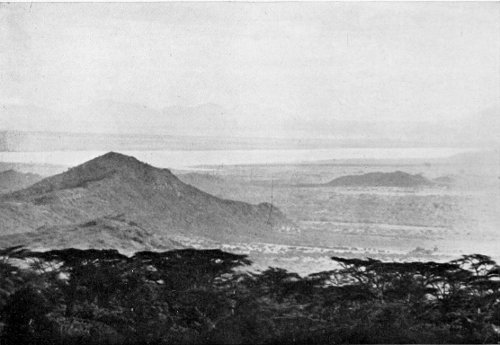
C. G. Schillings, phot.
THE NYÍKA: A BIRD’S-EYE VIEW.
In our colonies much has been lately done towards clearing up the hitherto hidden secrets of animal life. But if one remembers how many different opinions there are, even amongst authorities at home in Germany, with regard to many of the questions relating to our home fauna, one will pass a more lenient judgment on the many sharp controversies about matters of this kind in the tropics.
But nothing of value is to be hoped for from controversial strife over divergent theories. All men who have acquired expert knowledge on these difficult matters should rather unite in a common task, and strive by co-operation to obtain some adequate result.
In the wide British colonial possessions in Africa very extensive reservations have been established, in which no one is allowed to harm the animals. The practice of making exceptions in favour of certain officials has not been found to answer, and has been given up. So now wide districts of British Africa rank as animal sanctuaries.
In German Africa, too, the authorities have tried, as far as they can, to obtain useful results by similar methods. Unfortunately serious events of many kinds are daily contributing to the diminution in numbers of the fauna of German Africa. Thus the war in South-West Africa is sweeping away the still surviving stock of wild animals as with an iron broom.
In the face of all this, all parties concerned should take their share in common action. Our museums should be provided with the necessary material. Even if our knowledge of the African fauna has made sufficient progress, it further concerns us to exert an educating and informing influence on every pioneer of our colonies, so that he may not come in contact with that beautiful animal world in utter ignorance of it. Unfortunately we are still greatly wanting in this respect. However, in recent years a great amount of material has been placed at the disposal of the museums by our colonial officers, officials, and private individuals. Many of them have even made important contributions to our special knowledge of the animal world.
But now, whether it is a question of tracing out the hidden and unknown life and ways of that equatorial animal world that has come into our possession, or of investigating the customs and languages of races that are barely discovered, or of tracking the horrors of tropical diseases and the germs that excite them and becoming master of that miniature world of life with the lens and the microscope, or of going into the wilderness as a sportsman—the men who devote themselves to all these pursuits will be led onwards by that spell, whose name the reader guesses, the spell of unchanged primeval conditions and untouched nature!
May as many as possible of our German sportsmen go forth into our tropical possessions and yield themselves up to this spell! That which in our hunting grounds at home speaks to their hearts in the rustling of the oak and beech woods and on familiar moors and fields, they will find in a far higher degree in that far-off wilderness under the German flag. Returning home, may they, working in unison, and by mutually supplying what each may lack, bring into existence some splendid memorial of the joys of German sport.