Volume 1 — ORYX ANTELOPES TAKING TO FLIGHT. VI The Lonely Wonder-world of the Nyíka
Frederic Whyte translation
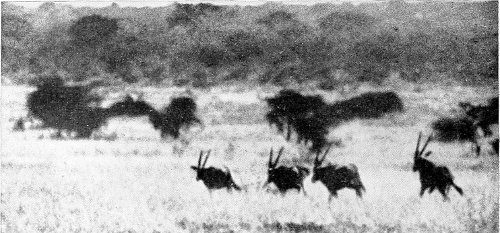
The endless wilderness of the Nyíka presents to the traveller so much that is strange, beautiful, and wonderful that at times his senses become wearied of these changing impressions of travel, and a longing comes over him for the familiar scenes he has learned to love at home.
As though in giant characters written on its rocks, the Nyíka tells us of the conditions and the life of the past and at the same time of everyday actualities, giving us its message as well by its snow-covered volcanic peaks as in the footprints and tracks of the mighty creatures that wander through it. It is a difficult undertaking to reconstruct in fancy all the splendours that must once have presented themselves to the eye in this region. But nevertheless I will tell of what I have looked upon in the past,—of the many beautiful sights that linger in my memory and rise up like the shadows of a mirage,—of the delightful manifestations of its moving life, coming and going on hill and in valley, as strange, wondrous, and unfamiliar forms reveal themselves to the astonished spectator.
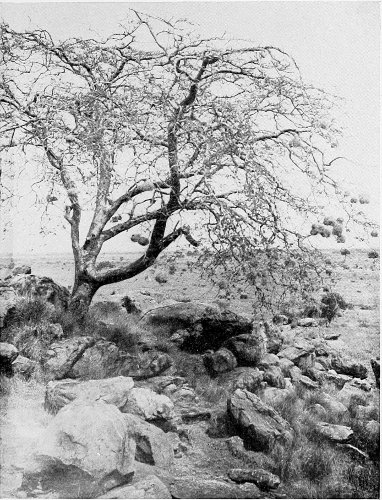
A VELT HILLOCK. THE SOLITARY TREE WAS FULL OF NESTS OF WEAVER-BIRDS.
The mystery of a deep harmonious influence belongs to the mighty wilderness. It reveals itself in its full beauty to him who has strenuously acquired a love for it by making a long sojourn in it and paying to it the tribute it demands.
A stony wilderness extends endlessly on all sides, and the sight ranges without limit over the expanse that loses itself in mist and cloud. A barren stony sea, as far as the eye can reach!
But it is not the velt or the African desert that lies below us as we rise one moment a hundred yards above the surface of the earth and the next three hundred yards and more. It is the sea of houses that form the capital of the German Empire.... In a few seconds the view takes in all the full extent of the mighty city, and then, as if in a dream, what we have just seen disappears from our sight. Borne by a breeze, of which we are hardly aware, our balloon sweeps towards the Baltic Sea.... It is a strange feeling thus to enjoy, thanks to our lofty point of outlook, an extended view far over the level March of Brandenburg with its teeming population all below us, a view which, old as the world is, has been vouchsafed to few mortal men. The city, with all its human life and activity, lies far below us. Its roar and tumult, that strange voice of the stony sea, has died away. We begin to make a long journey only a few hundred feet above the surface of the earth. Later on we rise, sailing through banks and clouds to a height of nine thousand feet above the earth, but before this higher ascent we have time and leisure to take a bird’s-eye view of “all that creeps and flies.” What an outlook over forest and plain! As we fly over them, horses grazing in paddocks, cattle on the pastures, for a moment suggest to me an illusion of the African velt peopled with its wild life. The eye, again and again fascinated by this prospect as a whole, can hardly grasp the details. Now our course is over endless open heaths, over moors and woodlands. The fleet-footed red deer, frightened by the drag-rope, look up in astonishment and stare at the strange monster, not knowing whither to turn in flight from such a menacing apparition. How the strange monster was a few hours later within a hair’s breadth of burying us in the waves of the Baltic Sea is another story....
C. G. Schillings, phot.
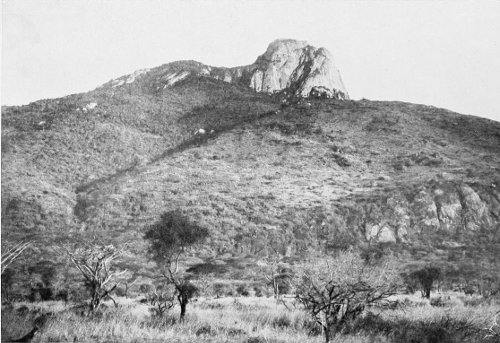
THE SUMMIT OF MOUNT ’NGAPTUK, ABOUT 6,000 FEET HIGH. THE CLEARNESS OF THE AIR MAKES IT LOOK AS IF THE ASCENT COULD BE QUICKLY MADE, BUT IT IS A WORK OF SEVERAL HOURS. I CLIMBED IT IN 1899—THE FIRST ASCENT BY A EUROPEAN. IN THE RAVINE RUNNING UP ON THE LEFT I FOUND SEVERAL ELEPHANTS. IN THE DRY SEASON THESE HILLS ARE THE RESORT OF NUMBERS OF RHINOCEROSES.
How many hundred times, after I had gone back to the Dark Continent, have I wished for such a lofty observatory, an airship that would bear me over velt and desert, and from which I could fathom all the secrets of the animal world of the tropics, instead of having to travel toilsomely, fettered to the earth, often merely making step after step automatically in the blazing heat of the sun. When one day such a wish as this is fulfilled, that animal world in its beauty and splendour will have to a great extent passed away....
I must, therefore, content myself with lofty observatories of another kind, that are not unfrequently to be found in the Masai uplands, in the form of numerous hills and rock masses. These afford splendid views and pictures of the animal creation to the spectator who waits patiently on their summits for hours and days, and has the help of good optical instruments. What life and activity displays itself there before our eyes under favourable circumstances! Though the wilderness may appear a desert solitude, bare and empty of all life, let only a few hours go by and the sun change its position a little, and already one sees movement under the trees and bushes that have been till now casting deep shadows. Then with measured steps, prudently regardful of their safety, all kinds of animals come forth to graze. We see the different wild species appearing, at first a few individuals, and soon in greater or smaller herds.
How far the eye carries in this clear transparent atmosphere, and what a wide tract of country we are able to overlook! In this tropical brightness, after weeks and months, and even years, I could not get rid of the perplexing illusion as to distances. The tract of country that my sight could command seemed always much less extensive than it really was. And again, we were continually being misled by shimmering reflections of the air, so that we took gnus for elephants, ostriches for rhinoceroses, zebras for wild asses, and we might even hold to our mistaken view for a considerable time. He who wants to watch the living animals in this way from a lofty point of observation, must be able to keep on persistently for hours. Thus only will the scene piece by piece become familiar to him. Thus only will all the moving life below him very gradually combine into one splendid and intelligible picture.
C. G. Schillings, phot.
ONE OF MY LOOK-OUT PLACES ON THE PLATEAU BETWEEN KILIMANJARO AND MOUNT MERU.
On the way to my look-out hill I pass thousands of the tracks made by wild animals.
At the very outset, the traveller from northern lands sees a most surprising sight in those hundreds of thousands of tracks made by wild animals, and faithfully preserved for weeks and even for longer periods in the dry season on the plains of Africa. The giants of the animal world leave behind them their mighty footprints, often for nearly a year, holes in which a man will sometimes break his leg. But the footprints of the smaller animals also last a long time on velt and plain. And the language of the wilderness rises to a most effectual appeal to our senses when these tracks are associated with the marked tarry scent of the waterbuck in the bush, the breath of the great wild herds on the plain, the strong scent left by elephant or rhinoceros in the primeval forest and in the sultry thickets, and the scent of the buffalo among the reed-beds.
There is often a chaos of tracks, a wild maze of paths trodden flat as a barn-floor, crossing each other, and then again uniting, so that the idea of tame herds, mentioned before as at times suggested, can no longer hold good.
To-day we have again waited patiently to see the wilderness gradually come to life in the hours of the afternoon. And we have not been disappointed.
Out from the shadows of scattered groups of trees there march great herds of the white-bearded gnus, that remind one so of small buffaloes. Slowly they make their way to the more open grazing ground and disperse themselves over it. But careful watch is kept by a few of them—the bulls that lead the herds, experienced old fellows! Under their guardianship the herd feels itself perfectly safe. There is also an unusually large drove of the wonderfully graceful impallah or black-tailed antelope. What a remarkable contrast is presented as the herds mingle together! The gnus, strongly built, haughty in their bearing, conscious of their strength against all animal foes, stand out wonderfully amongst their almost too graceful comrades, the impallah-antelopes. We can plainly distinguish that the females and those that are accompanied by young ones keep more together, while the bucks of the impallah-antelopes keep apart and look after their safety.
Now a dark black mass slowly separates itself from a large group of trees. It is followed by several forms that do not so easily catch the eye. Our field-glasses tell us that a small flock of ostriches has come to mix with the wild species already noted. Now there are perhaps well over three hundred head of these three kinds of wild animals united together in one gathering. They are used to come together in the most friendly way, without apparently taking much notice of each other. For a long time the sight of these creatures, all so different, holds us fascinated. But our optical instruments must restlessly explore the distance for new sights of the animal kingdom; and at the same time there are even better instruments of investigation at work—the eyes of my black companions.
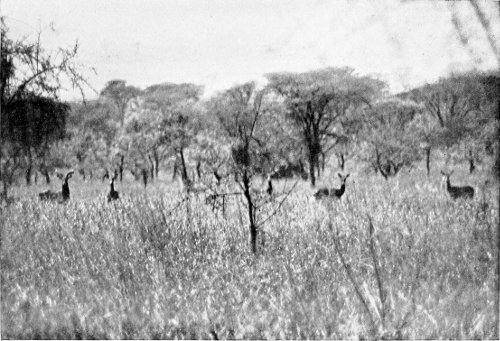
C. G. Schillings, phot.
HERD OF BLACK-HOOFED ANTELOPES.
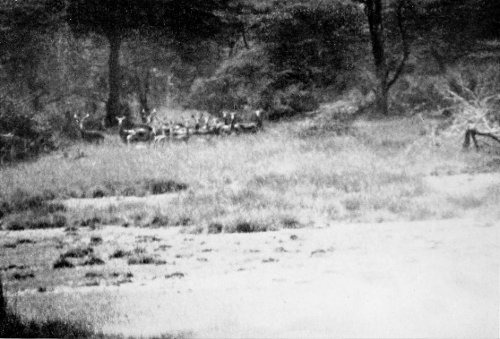
C. G. Schillings, phot.
A HERD OF BLACK-HOOFED ANTELOPES PHOTOGRAPHED AFTER STALKING THEM WITH THE CAMERA FOR HALF AN HOUR.
“Pharu, bwana!” now whispers one of my men, and points cautiously with his arm down to a certain point on the plain. His caution, however, is not necessary, for it is at a distance of at least a thousand yards that his sharp eyes have distinguished the outlines of two almost invisible rhinoceroses that are moving slowly through a group of acacias. What an effect that word “pharu” has upon me! For once more there has come close to me one of those strange, mighty beings that really belong to a time long passed, and which, like the elephant, the giraffe, the zebra, the gnu, and a few other forms, lend to the wilderness the charm of primeval days. Naturally still stronger is the effect of the cry of “Tembo!” on the hunter and the watcher amid such scenes. “Elephant!” This name electrifies even the weariest traveller. But when the word is “Twigga!” (“Giraffe!”)—even here in Europe the strange, slender-necked creature, moving in some acacia wood all flooded with the sunlight, comes up bodily before me—bodily and plainly to be seen, but alas, only in imagination!
After trying for a minute, I succeed in getting the massive creatures sharply defined in the middle of the field of my glass. But the clear view of them is something that comes and goes. Several times it looks as if the velt had swallowed them up; then they suddenly come into sight again, being specially visible to the eye when they show themselves sideways. Seen from front or rear, particularly when at rest, they are all but invisible. We are in luck; the rhinoceroses are ambling towards us, and come nearer and nearer, slowly following the line of some hollows in the ground.
Now, borne on strong pinions, and brightly illuminated by the sunbeams, one of the great bustards cuts through the sea of air, and sinks down into some low ground far away below us. This is not an unusual sight in the late hours of the afternoon, and soon after we see not only some more of the same species, but also three other bustards of a smaller and commoner species that is more active in flight. It is the Otis gindiana, which I have got to like so much on account of its charming gambols on the wing, that must be a pleasure to every lover of birds. At this time of day it carries on this strange tumbling in the air, and if the day is hot and dry it makes for the neighbourhood of the water, or in any case for certain hollow places of the velt that provide it with at least a certain amount of soft vegetable food. Another picture! A great flock of splendidly coloured crested cranes wings its strong undulating flight and goes away over the hill. I notice in the air the striking appearance of the snake-vulture and a pair of the nimble-winged Bateleur eagles, the “sky apes” of the Abyssinians. My gaze follows them eagerly into the distance.... In what various ways the bird world displays its mastery of the realms of air! Our attention is riveted now on the quiet gliding flight of the vulture in the highest levels of the air, now on the spectacle of a struggle in the air between some birds of prey and some ravens or bee-eaters that are annoying them. Searching the ground as it goes, the augur buzzard (Butco augur) wings its flight over the stone-strewn slopes of the adjacent hill. Bateleur eagles wheel in graceful circles high in air, let themselves fall down for several yards, and then shoot up again heavenward. For hours at a time they will carry on their strong-winged circling and plunging through the realm of air, apparently without effort or fatigue. Various kinds of kites show themselves in their oscillating flight, that makes them always so clever at escaping the gun; amongst them large numbers of Montagu’s harrier (Circus pygargus, L.), which at certain times of the year range restlessly over the velt. Hawks and sparrow-hawks wing their rapid flight in search of prey. In short, every kind and form of bird flight that one can imagine! For instance, the proud majestic flight of the larger species of vultures is essentially distinct from the heavy flight of the small Egyptian vultures (Neophron percnopterus, L.), whose flight the Crown Prince Rudolph of Austria most aptly described, when he remarked that at a distance the bird might easily be mistaken for a stork.
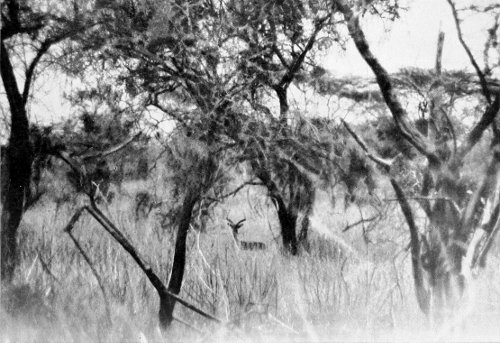
C. G. Schillings, phot.
BLACK-TAILED ANTELOPE BUCK PHOTOGRAPHED IN THE BUSH AT A DISTANCE OF ABOUT EIGHTY YARDS.
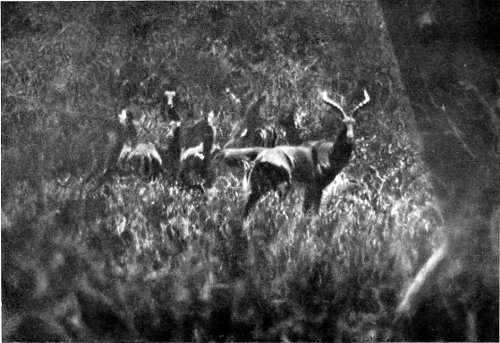
C. G. Schillings, phot.
A HERD OF ANTELOPES PHOTOGRAPHED IN THE BUSH AT FIFTY YARDS.
It is indeed a great pleasure to follow with the eye all the wondrously beautiful types of flight that the African birds of prey present to us. The enormous numbers of birds of prey, in a land that is nevertheless so rich in wild life, ought to suggest some salutary reflections to those who, here at home, with such dogged persistence wage war with guns and pole-traps against those creatures, which are so great an ornament to the landscape. For my part, I would on every point support the proposals of experienced men, like Freiherr von Besserer of Munich and Dr. von Bocksberger of Marburg, who advocate protection even for our birds of prey, at least within the Government domains. “Let us try,” says Von Besserer, “still to preserve them at least within certain limits. Let us grant them some few places of refuge. Let us not arraign them too strictly for every theft, so that future generations may also enjoy the spectacle of their beautiful flight.”
And now it seems, as if on some gigantic chess board, move after move is being made on the plain below us. We have hardly remarked the wild species already noted, when we suddenly find ourselves perplexed as to which point we shall first direct our gaze to, which is to attract the special attention of our eyes. To our right, two great herds of zebras come rolling along, and ever as they move are now plainly visible, now almost disappear, as if in regular alternation. To our left, on the crest of a ridge that rises there, suddenly sharply defined silhouettes appear—again it is a herd of gnus, and this time clearly one that numbers at least a hundred and fifty head. While our attention is still attracted by this beautiful spectacle, my trusty comrade Abdallah suddenly lays his hand upon my arm and, only with a glance of his eyes, indicates the little valley that lies stretched out below our feet. This time there is good excuse for his caution. For there, looking as if they were cast in bronze, two of the wonderfully beautiful giraffe-gazelles stand staring up in astonishment at the place where we are posted. It may well be that these timid children of the wilderness here had never yet been disturbed by the strange sight of a human figure. “Nyógga-nyógga!” whispered the lips of my comrade.
It is not often that one has the chance of seeing the nyógga-nyógga at such close quarters, and besides, it is extremely difficult to watch it without being noticed by it. It is so completely lost to sight in its surroundings, and is so extremely timid and watchful, that I have very seldom indeed succeeded in observing this splendid animal before it has itself remarked my presence. When I succeeded it was almost invariably towards evening when it had come out to feed. It is worth while to take full advantage of such moments, for the slightest disturbance instantly drives it away. And so it was now. It was not long before the two nyógga-nyógga, with their long necks stretched out, disappeared in the hollows of the broken ground that extended below the place where we stood. After this I caught sight of them a few times standing amongst the clumps of acacias, timid, surprised, and watchful; then the gazelles betook themselves to the protection of the wide velt, looking like mere points in the distance.
To me it seems as if the sonorous name that the Swahili language gives them, and also the softer name that sounds so sweetly in the mouth of a Masai,—“Nanyad,”—best and most fitly express their beauty, strangeness, and grace.
Again we turn our attention to all that is going on below us. This time it is the rhinoceroses, which have approached to within a few hundred yards of my post, that most engage our attention. We observe how they nibble here and there at the boughs of the Salvadora persica and other shrubs, and then again rub their rough hide or their horns against the strong trunk of a tree or on a block of stone. They have all this time been coming gradually nearer to the herd of gnus that we first noticed, and now at last they stand quietly on the level ground, only a hundred paces away from the old gnu-bulls which are acting as sentinels.
And now it is I myself who am the first to make out with the glass a third rhinoceros. “Wapi, bwana?” my companion eagerly asks me, and as I point out to him the place on the velt where I have picked the animal out, he approvingly confirms my observation with the remark: “Ndio, bwana, pharu mkubwa sana” (“Yes, master, a very big rhinoceros!”)
After some time we see that it is an old and unusually large bull; he, too, has gradually taken the same line as his two colleagues. Our observation proves to be correct, and we also remark before long that the first pair of rhinoceroses we had noticed is made up of an old cow and her nearly grown up young one.
More herds of zebras and gnus, and small troops of Grant’s gazelles and of impallah-antelopes have come into sight, and now they are joined by a whole crowd of hartebeests, which so far have kept themselves hidden in a side valley of the velt full of thick tall grass.
And now the moving mass of animal life is ever more abundant, more varied. I notice in the valley at the foot of my hill a string of guinea-fowl; how they hurry and scurry about, flutter up with sounding strokes of their wings, and then soon drop down again! And now my attention is attracted by a pair of Bateleur eagles, that wheel in the air, and enjoy themselves for an hour at a time playing on the wing. They probably have made their eyrie not far from this spot.
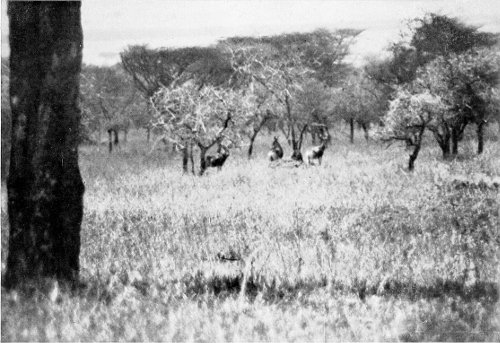
C. G Schillings, phot.
MASAI HARTEBEESTS (BUBALUS COKEI, Gth.) (THE “KONGONI” OF THE SWAHILI, “OL-KONDI” OR “OL-LUDJULUDJULA” OF THE MASAI).
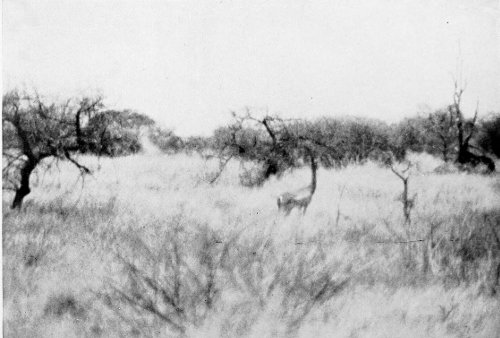
C. G. Schillings, phot.
GIRAFFE GAZELLE (LITHOCRANIUS WALLERI, Brooke) STANDING IN ITS CHARACTERISTIC ATTITUDE BEFORE TAKING TO FLIGHT.
For minutes at a time the cry of the francolin rings out clearly round about my post; then again it is silent. My eyes can indeed see animals of many kinds, and my sight ranges with restless efforts over the far distance; but so far I have looked in vain for a form that is frequent and familiar enough in this wilderness—the towering figure of the “Twigga.”
Where can the giraffes be hiding to-day? Why have they not come out to the still freshly green acacias in the far-stretching hollow to my left, where I have already marked their presence for whole days at a time?
And yet they are there, only I had failed to distinguish them. At last I can make out their strange forms, as they graze there among the acacias, and they stand out sharply under the oblique rays of the sun.
What poetry there is in the movements of all the various organisms that our eyes behold! Every variety of gait, from the heavy, swinging, and nevertheless rapid march of the pachyderms to the graceful speed of a pretty gazelle, speaks in a language of its own to him who has become familiar with the peculiar movements of this animal world. Just as at the outset the strange appearance of an animal one sees for the first time makes a surprisingly strong impression on one, so too does the great difference in the gait of the various species. But they were all soon familiar to me. So now at the sight of the giraffes I feel a pleasure and delight in their quaint coming and going, their heads appearing and disappearing, there below me in the midst of the green bowers of mimosa leaves, high over which my view ranges. What laws must be at work here too, by whose operation I am compelled to feel all this to be so beautiful, so harmonious, so splendid! I grasp the meaning of the words: “Therefore I believe that life will first open its eyes in that world of which Goethe said: ‘There is still the life of life, and this is only form.’”32
What a splendid sight there is from my lofty look-out! the whole of this mighty spectacle displays itself almost without a sound that I can hear. Only a few voices of birds, but no cry of any other animal reaches my ears. But as the breeze rises more and more towards evening, there begins in my immediate neighbourhood a strange and beautiful concert, that is already familiar to me. And now, as the wind blows more and more strongly through the perforated gall-nuts that hang on every tree above us, there resounds through the desert silence a strange melody, a strange language of musical notes that only the sound of the Æolian harp can to some degree represent.
These nut-galls on the acacias are bored quite through, and in many cases become the dwelling-places of small ants. If one disturbs them by tapping on the outside of their strange habitation,33 they come swarming out to fight with the disturber of their peace! It is not so often that their strange ways and doings concern a human being, but it comes to pass to-day. The watchful observer takes delight not only in the sound of these strange musical instruments, but also in the thought that they give shelter to a little world of their own, a peculiarly organised little state made up of living beings, just as the wide endless wilderness below them is a state with the various larger wild animals for its inhabitants.
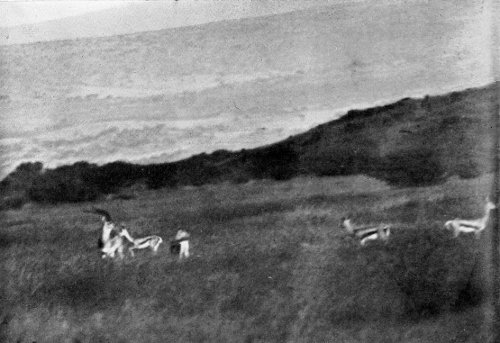
C. G. Schillings, phot.
GRANT’S GAZELLES (GAZELLA GRANTI, Brooke).
My diary records yet another kind of natural observatory, a giant tree uprooted on a wooded river-bank. Here, as it were, in the gallery of the wood, the huge trunk felled by the storm-wind offered me an inviting seat among its branches, and thence I enjoyed many a sight of the animal world around.
There I had a view of the river close at hand, and farther away many clearings of the wood, which at this time of the year showed a rich display of animal life. The ripening forest fruits had attracted into this neighbourhood large packs of baboons. It was good to watch their busy activity as I looked down from my observatory, where I sat hidden by a thick growth of creeper. Great herds of antelopes, and especially waterbuck and Grant’s gazelles, are regularly to be found in these wide clearings of the woods. I remember some hours of the afternoon when the life of the forest displayed itself here in a way that suggested Paradise. I saw at the same time a large drove of the graceful, wonderful pallahs, and, grazing in their immediate neighbourhood, some twenty Grant’s gazelle bucks which had joined together to form a great herd. The antelopes had scattered themselves over part of the clearing, feeding on the fresh growing grass there, but all the while keeping themselves somewhat apart from the herd of gazelles. But they had gradually drawn near to a party of waterbuck which were standing under an old shady tree, and now I had an opportunity of watching for a long time these three varieties of antelope, all so beautiful, yet so different. To my surprise, after some time they were joined by nine stately eland-antelopes, whose white side-stripes made them wonderfully prominent among the uniformly coloured coats of the waterbuck. Amongst these animals some three hundred baboons were moving about with a certain careless self-possession. They were all big ones, keenly devoted to the hunt for insects, pulling up grass and turning over stones. Some of the older individuals meanwhile scrambled up tree trunks for a few feet, and thence kept a careful look-out for the approach of any possible enemy.
I kept as still as a mouse, knowing well that the slightest movement would betray my presence to the timid, keen-sighted monkeys.
Now a numerous herd of zebras moved through the wood and across the clearing at a slow, careless pace. As they moved there was a bright shimmering of the variegated stripes of the beautiful “tiger-horses,” and again they would often be blurred into one uniform grey. They mingled with the waterbuck, which took very little notice of them, and evidently had known the zebras for a long time. It was wonderful to see the proud waterbuck, with their horns, which are at once weapon and ornament, and the stallion leaders of the zebra herd all continually on the alert watching against their enemies.
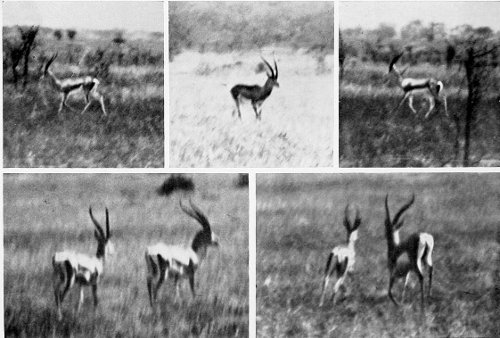
C. G. Schillings, phot.
TELEPHOTO STUDIES OF VARIOUS ATTITUDES AND MOVEMENTS OF GRANT’S GAZELLES.
There is a scuttling over the ground, for the little mongoose family, that live over there among the ant-hills, are making a sally from their fortress. Snake-like in their swift movements, the graceful little animals seem to glide along. Yonder two snake-vultures are looking for reptiles. Numbers of other vultures and marabous have flown down to the margin of the shallow water to bathe and drink.
Into the midst of all this gathering of animals there now come three ostriches, making for the fresh green growth along the marshy edge of the river-bank, and a number of francolins and guinea-fowl that gradually come crowding out of the undergrowth into the clearing to feed there. On the sandbank on which I look down as it extends far along the course of the river, there are some thirty huge crocodiles sunning themselves. I can see several smaller specimens of these mail-clad lizards on a flat part of the river margin not far from the sandbank.
Yesterday, too, six giant hippopotami paid a visit to this sandbank on the primeval river, and left tracks that my eye can plainly see in the glowing sunshine; to-day, however, I have waited in vain for them to show themselves. But suddenly from the reed-beds on the opposite bank of the stream the mighty voice of an old bull comes booming across to me.
Over this most peaceful picture of animal life the tropical sun blazes, casting deep shadows. At this hour of the day even the voices of the birds are generally silent. Only the melodious piping of the organ-shrike sounds somewhere near me, and often, too, the cries of one or other of the baboons which is being corrected with bangs and cuffs by an older member of the pack.
All the various kinds of animals assembled here get on quite peacefully together. They often almost touch each other, without taking the slightest notice of one another. Even the antelope bucks, adorned with dangerously pointed horns, make not the slightest use of their sharp weapons against the other species. All the time that I was looking down from my lofty seat I saw nothing but peace and good-fellowship. And yet how quickly a tragedy might interrupt this stillness and peace! The tracks of lions and leopards down there, the crocodiles on the sandbank, and the vultures hovering in the air told me that.
Often in this, and in other places, I have gained an insight into the life and ways of the animal world, and I have thus passed many enjoyable hours. Now one, now another species presented itself to my observation, but it was seldom that I saw such a large number of different species at the same time. But in all cases I have found that man is a disturbing element in the midst of such pictures of the animal Paradise. Even where I could feel sure that the appearance of a white man, a European, was quite unknown to the animals of the district, even then the very moment I showed myself the immediate result was a panic-stricken flight.
C. G. Schillings, phot.
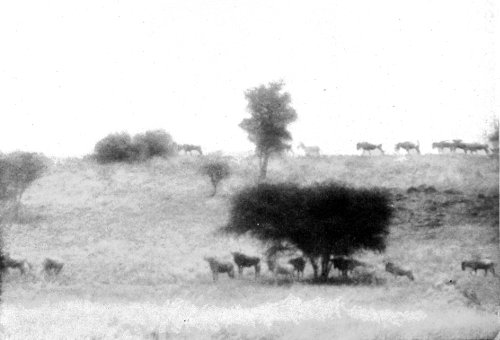
WHITE-BEARDED GNUS AND ZEBRAS TAKING REFUGE FROM THE MIDDAY SUN UNDER THE SHADE OF THE MSUALLI TREE.
I have still clearly before my eyes the picture that presented itself to me as I emerged from the over-growth of creepers on the boughs of that uprooted tree. First a shrill cry from the monkeys. In a trice the little young ones were clinging to their mothers, and with long bounds the whole crowd of them galloped away over the level ground, hidden in a cloud of dust, and disappeared on the far side of the clearing. There a good many of them halted to look back. Of all the animals known to me only the baboons and the spotted hyenas take to flight in this way. The spectacle has such a surprisingly strange and unaccustomed, almost uncanny effect, that it always recurs to me when I think of these animals.
The antelopes follow the example of the fugitive baboons, after first rushing hither and thither, right and left, leaping wildly into the air. At this moment the impallah-antelopes, especially, make a splendid picture. Bounding along as if on springs of steel, they shoot up several yards high into the air. Wherever the eye turns it sees the graceful forms of these beautiful animals in all possible positions, making long bounds, some four feet high off the ground, and in every other attitude that one can imagine. But the end of all these splendid pictures, each seen for a moment, is a general stampede. Whirling clouds of dust in the far distance tell for some time longer which way the fugitives have taken.
But it is not every day that such varied pictures, so richly stored with the life of the primitive animal world of the tropics, present themselves to the traveller. And it needs, too, a trained eye to enjoy all the separate impressions in their combined effect, as making up one masterpiece of Nature. But often, too, an almost too great wealth of beauty gathered together in a small space presents itself to our eyes. Thus, more especially, I keep a memory of these small idyllic lakes of the wilderness, that are hidden away here and there in the Nyíka district, and give a home to a wealth of animal life that often seems almost too abundant. We sometimes find one of the most interesting species of the larger mammalia, the hippopotamus, living here in somewhat narrow quarters, but thus more easily accessible to observation than in the great lake basins, where it lives in hundreds or thousands, but where also it can much more easily get away from the sight of the observer. It is true that one can see numerous heads emerging from the water in the distance, one can mark the thin spray of water blown from their nostrils, forming numbers of little fountain jets that glitter in the sun. But the peculiar life and activity of these giants of the animal world goes on chiefly at night, invisible to our eyes. In the smaller lakes it is all different.
C. G. Schillings, phot.
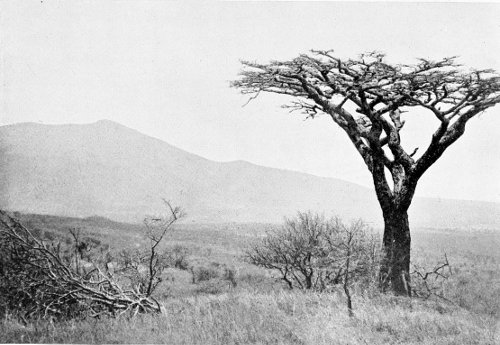
IN THE MIDST OF THE VELT IN THE NEIGHBOURHOOD OF THE GREAT NATRON LAKE I FOUND A SOLITARY OLD ACACIA. THE DISTRICT WAS NEARLY WATERLESS. THE TRUNK OF THE TREE SHOWED THE MARKS OF ELEPHANTS THAT HAD RUBBED THEMSELVES AGAINST IT.
C. G. Schillings, phot.
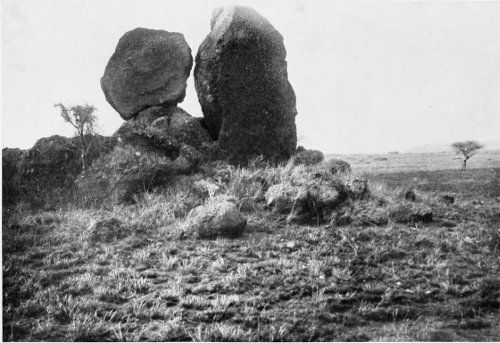
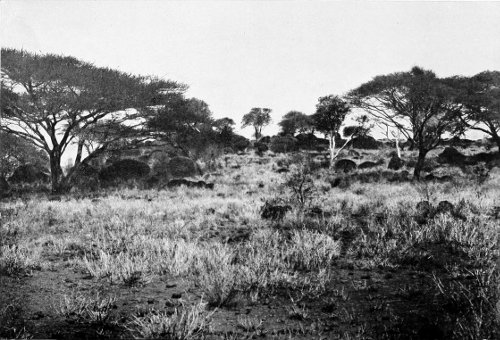
A TYPICAL LANDSCAPE WITH ACACIAS AND SCATTERED BOULDERS—THE CAMPING PLACE OF MARAGO-KANGA NOT FAR FROM THE EASTERN ‘NJIRI SWAMPS. NEAR THIS CAMPING PLACE MY PEOPLE SHOWED ME THE ALMOST UNRECOGNISABLE GRAVE OF AN ENGLISH HUNTER WHO HAD BEEN KILLED BY A BUFFALO. I HAD IT PUT IN ORDER, AND MY ASKARI (ARMED FOLLOWERS) FIRED A VOLLEY OVER IT.
I remember with pleasure a certain gathering of hippopotami in one of the lakes that lie hidden away between Kilimanjaro and Mount Meru, and which were discovered some years ago by Captain Merker. When I saw them there were still living in them some hundreds of hippopotami, and it was easy to watch their doings in the water. Gathered in herds they played about in the water under the bright sunlight, showing little sign of timidity. Especially the young ones, that were still going about with their mothers, had so little fear that I sometimes saw them rising almost completely out of the water. They were also sometimes to be seen resting in the sunshine on the sandbanks by the lake margin. Some of these lakes were of such small extent that the animals had to come up to breathe at a distance of at most only some twenty yards from the observer. But all the same they were generally inhabited by quite a number of hippopotami. It was then a great pleasure to watch these beasts for hours at a time, from the lofty look-out place provided by the surrounding heights that rose steeply from the edge of the lake. They kept up good fellowship with the crowds of water and marsh fowl that give life to these lakes. All these animals displayed themselves to the spectator at as close quarters and as plainly as in a zoological garden. The rosy red pelicans fishing in flocks of hundreds at a time presented the most charming contrast to the uncouth quadrupeds. Even now in fancy these lakes come before my sight, lakes that lie far from all human ways and doings in a silent solitude. Dark clouds float over it. The proximity of the massive and dark Mount Meru often causes a cloudy veil to hang over that volcanic plateau with its crater lakes. Again I climb the steep cliffs that ring them round, and again my gaze sweeps over the level surface of the water. But though there has been no decrease in the numbers of the waterfowl that enliven the lakes, the hippopotami have, alas! disappeared. I found on the occasion of my last journey a small number still there, but I hear from Professor Sjöstedt,34 the Swedish naturalist, who lately visited these lakes, that the hippopotami, who had made the lakes their home since dim far-off times, have almost disappeared. The Boers35 have killed everything. I came upon one here some years ago who was killing a lot of the hippopotami; others have followed up the work of this forerunner with more serious results. Attempts to make settlers at home in primitive regions are almost always inconsistent with a protection of the primitive animal world, even though these animals inhabit lonely upland lakes, hidden away in the wilderness, far from human settlements.
Thus in memory picture follows picture.
Besides the harmonies of the wilderness, the impressions of the eye are always those that come back alluringly in my recollections. However truly the artist may be able to reproduce all these various impressions, there is one kind that will always be missing from his pictures, namely, all the fleeting movement. To take as an instance only one out of an abundance of forms, who can reproduce in pictures the endless variety of birds, the world of winged life! Every day added to my knowledge of these multitudinous flocks, through the increase day by day of my bird collection, which I obtained at the cost of much labour, and which has been the means of giving to science many hitherto unknown species. As I added each new bird to it, I added also to my knowledge of these beautiful creatures, as yet so little known, and slowly, very slowly I became familiar with them. What splendour of forms and colours! In what enormous flocks does the feathered race inhabit the wilderness and the primeval forest! The Biblical account of the flocks of quails in the desert sounds to us like a legend, and yet it is no legend. At times when we too were marching across the same kind of ground, there flew past us with a whirr of many wings huge flocks of quails, that sought and found their safety in flight. At times I have also seen similar flocks of snipe. How long has it been since both these kinds of birds appeared in such flocks in our country at home?
C. G. Schillings, phot.
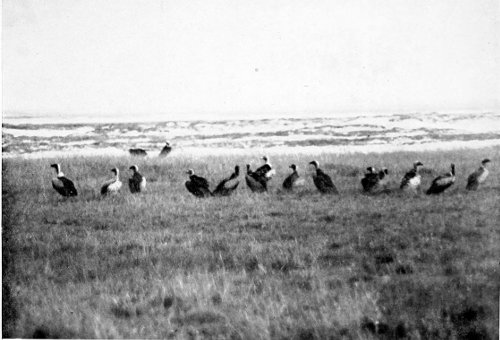
HUNGRY VULTURES NEAR MY TENT ON THE TREELESS VELT.
The endless variety of form and colour, the movements of the animals which the eye perceives under the ever-changing tropical light, that shows everything brilliantly and sharply defined, all this taken together makes up memory-pictures of a charm that nothing can surpass. But he only can picture them to himself who has gone forth and made them his own.
The huge sea-turtle comes creeping along, emerges from the waters of the Indian Ocean, and makes for the sandhills to lay its eggs there. Its giant track on the sand leads me to its nest. To my astonished eyes this peculiar track looks as if a ploughshare had torn through the ground.
The Indian Ocean, which is the home of this huge sea-turtle, shelters also in quiet bays the strange Dugong or sea-cow, and great is the surprise of even the natives themselves when from time to time they capture in their nets this remarkable creature, which is becoming rarer every year.
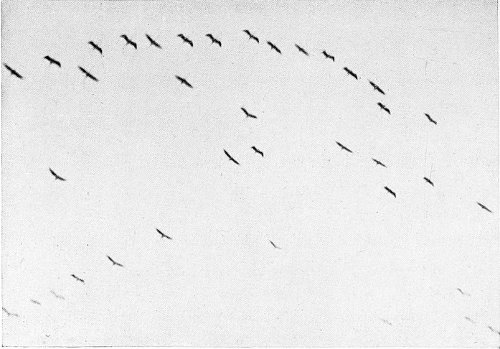
FORMATION OF A FLOCK OF FLAMINGOES IN FLIGHT.
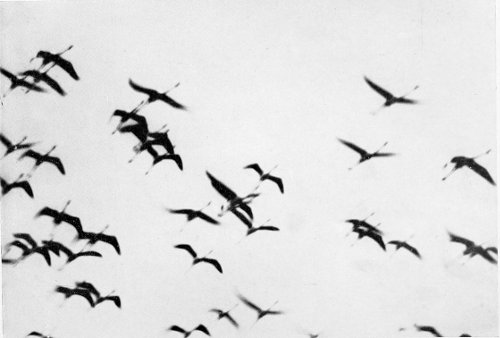
C. G. Schillings, phot.
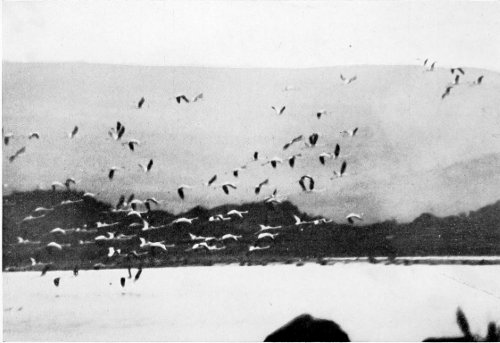
FLIGHT OF FLAMINGOES (TAKEN AT SHORTER RANGE. THERE WERE THOUSANDS IN THIS FLOCK).
In the lagoons one sees emerge from the surface the head of a great giant snake, a good five yards long, the African python; others I have come upon suddenly on the open velt. There are continually thrilling moments! It may be that memory conjures up for us the delightful fairy-like image of a rare dwarf antelope seen perhaps once only in the shades of the forest, a dwarf antelope that, with strange large eyes and ears alert, watches one’s approach, and then like a flash of lightning disappears in the thickets; it may be that in memory one sees the reddish brown, mud-smeared body of a giant elephant emerge from the midst of some densely tangled primeval forest; it may be that a tree suddenly bursting into bloom yields me a wonderfully beautiful new kind of bird, which I grasp in my hand, delighted with its robe of feathers; it may be that suddenly the massive giant form of a rhinoceros appears before me in the tall grass, unexpected, menacing, standing as if chiselled out of stone; it may be that my free gaze ranges without limit over the wide prospect, and sees in primitive abundance the strange life of the tropics; in every case the impressions received seem to the beholder fascinating beyond description.
Monotonous as the surroundings of the landscape may appear to the newcomer, poor and barren though the velt may seem to be for weeks at a time, yet, enlivened and permeated by the mighty flood of all this strange animal life, it has a beauty and a charm whose influence no one can escape who makes his way into the midst of it with open heart and eyes.
He who looks around him with clear-sighted vision, and tries to see more than others, has revealed to him the beauties of Nature in the greatest and most wonderful way, and is drawn in the highest sense of the word to admiration of them. Here is verified, as Sir Harry Johnston says in his preface to my first book, “the old nursery story of eyes and no eyes.”
It is thus that I lie for long hours in the wilderness, and observe, admire and enjoy. What a wealth of impressions is brought before the eyes among these ever-changing, at first strange but gradually familiar sights, in the midst of the foreign-looking landscape, bathed in a light that has a marvellous influence, and in its full power is almost blinding.
Now the dwarfs, and again the giants of the animal world rivet our attention. But it is especially the primeval abundance, the great profusion of large and small wild life, that gives an impression that is now delightful, now overwhelming. One must have seen, with the eye of the hunter, gigantic old bull-elephants in the primeval forest, great herds of rhinoceroses and giraffes in one single day, thousands of zebras and antelopes gathered together—one must have felt all this profuse wealth of life, to be able to understand its full beauty and grandeur.
Yet there are days when one looks around in vain for all this life and activity, when, on account of the weather, or some other reason, the animals do not show themselves so freely. One must also take due account of the extensive periodical migrations of the African fauna. Many an erroneous judgment as to the alleged scarcity of wild life, in districts in which other hunters pursued the chase at an earlier date with success, is to be thus explained.
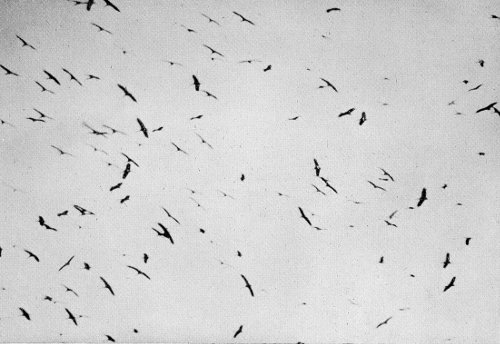
C. G. Schillings, phot.
THIS TELEPHOTOGRAPH OF STORKS ON THE WING WILL GIVE SOME IDEA OF THE HUGE FLOCKS IN WHICH THEY START ON THEIR NORTHERN MIGRATION IN FEBRUARY.
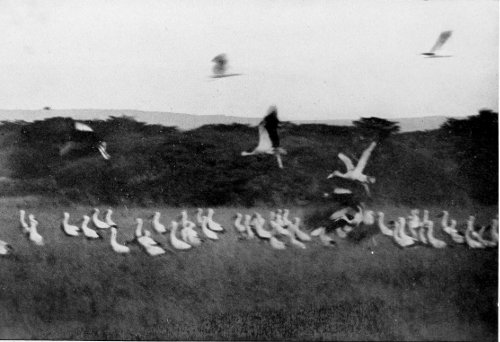
C. G. Schillings, phot.
WHITE STORKS GATHERING FOR THEIR NORTHERN MIGRATION TO EUROPE.
But, on the other hand, there are also days when such an abundance of animal forms presents itself to our eyes, that the most lively imagination can form no idea of all this profusion. On such days, I have often wished that one could have a gigantic photographic apparatus, an instrument that would be capable of making a record of all I saw. But on such days, also, I have more than once made a mental apology to explorers whose lives have long closed in death. When, for instance, in former years I had looked over the sketches of the late Cornwallis Harris, sketches showing the life of the South African fauna as he saw it about the year 1837, I more than once had my doubts about the correctness of his representations of it. As the result of what I myself have seen, I have quite given up such doubts.
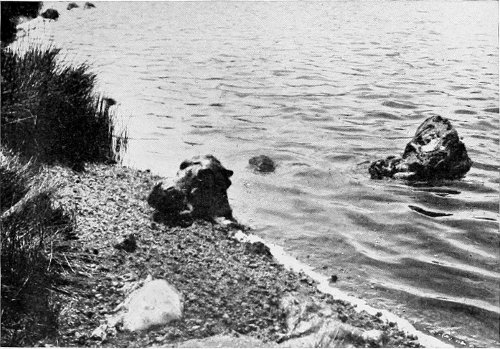
REMAINS OF RHINOCEROSES KILLED BY THE BOERS ON THE SHORE OF ONE OF THE MERKER LAKES.
The original sketches left to us by Cornwallis Harris (which I must say do not always rise to a high level From the artistic point of view36) are coloured sketches accompanied by descriptions, and show us such multitudes of wild animals that they seem to border on the fabulous. For we see in them elephants, rhinoceroses, giraffes, buffaloes, zebras and antelopes, all gathered together in crowds, and thus one inclines involuntarily to the opinion that all these have been brought together in one picture merely to give illustrations of the various species. But my own observations have shown me that our artist is perfectly correct. One sees how necessary it is to make documentary records of such observations. The men of a later time, as I plainly realise, may be able to place before themselves a picture of all this primitive abundance of animal life only with the greatest trouble and by means of earnest study of every authority bearing on the matter.
Enormous periods of time must have gone by to develop all the beauty and splendour of this so varied and so highly organised life. My thoughts range over far distant times. I see, looking so near that it seems as one could touch it with one’s hands, one of the mightiest volcanoes of our earth gradually unveiling itself and stripping off its robe of clouds. The volcanic regions below it remind me of the story of how all my surroundings were developed.
Born in fire, and evolved, differentiated, and formed to so much beauty, which no hostile hand has yet come to destroy, the scene around me is so splendid that my eyes keep ranging over it, more and more eager to contemplate all its splendours.
C. G. Schillings, phot.
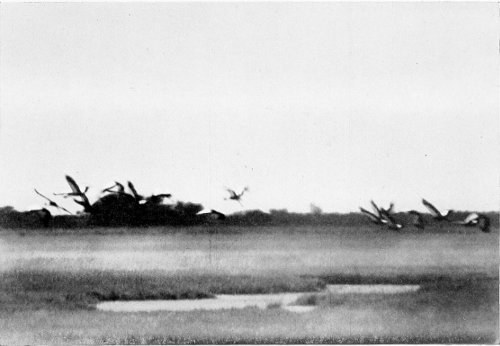
CRESTED CRANES IN FLIGHT.
C. G. Schillings, phot.
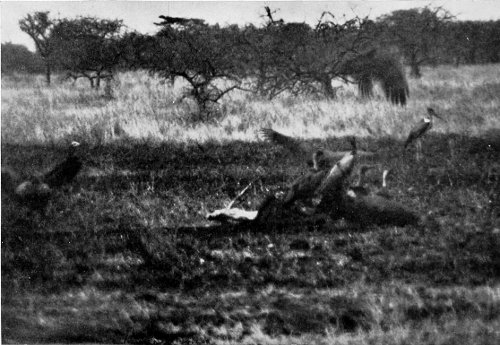
IN A WONDERFULLY SHORT TIME VULTURES AND MARABOUS FLY DOWN FROM AN EXTREME HEIGHT IN THE AIR TO FALL UPON ANY DEAD ANIMAL.
A strange feeling comes over me. I think of all the beautiful spots of our old world. They have all been taken possession of under carefully devised arrangements and methods, well protected by the eye of the law, and often only occasionally open to access, and then on condition of payment. But the beauty I am contemplating has now been hopelessly abandoned to intruders, who have neither knowledge nor taste nor sense, and who are at this moment so barbarously destroying it.
But these thoughts must give way to others that are more pleasant and consoling. How wonderful to be able to revel in this wilderness, to feel in oneself the influence of all these splendours, notwithstanding all dangers and all difficulties, however great! Everything around us undulates and shimmers, bathed in a dazzling sea of light. Gradually the colouring of plain and hills, the dome of the sky and the whole surrounding landscape, changes to duller and less definite tints. The sun-illumined air rises in waves from the earth, and the various strata of it form an ever-changing chaos of reflected light. Over all there is deep peace. A spell that accords with the mood of the moment seems to stream down from the dome of the sky over this solitude, lying so far from the noisy activity of the world.
All that I here behold has been going on since those far times, directed by natural law, in ever-recurring succession. But to-day for the first time a member of the complex society of civilisation takes delight in this mountain rising amidst all this primeval beauty.
Who could possibly set down this poetry upon paper—the poetry of the velt and its wild inhabitants, the moods of East African Nyíka? The master of colouring has not yet arisen who could give us a picture of these mighty gatherings of wild herds, and of these deserts that seem overcrowded with animal forms, that yet live so peacefully together, nor can the master of the pen, though he may have been able by his words to conjure up some idea of them in the mind.
One who has perhaps felt and enjoyed their spell more than any one else is Alfred Brehm. But he has travelled only in regions that had long been under the influence of man and his activity. He has only once seen the king of beasts, and has never looked upon the giraffe—whose beautiful eyes the Arab compares with the eyes of his beloved—and many other forms of the African fauna.37 Nevertheless he has done wonders, thanks to his deep feeling for his subject, his intimate understanding of it, and his incomparably poetical power of description. He has given us imperishable pictures in words that are among the most beautiful that have ever been written about Nature. Our old famous teacher, Dr. Schweinfurth, has seen and described similar scenes. With these two we may rank in equal honour the name of the German explorer Richard Böhm,38 who unhappily lost his life so tragically and at such an early age on the shores of Lake Upämba in Southern Urúa, of which he was the discoverer. Many others might also be named who were deeply influenced by these primeval splendours. But the fauna of South Africa has vanished unsung and untamed, before any artist or master of words arose to place in a fitting way its beauties on record for all time!
C. G. Schillings, phot.
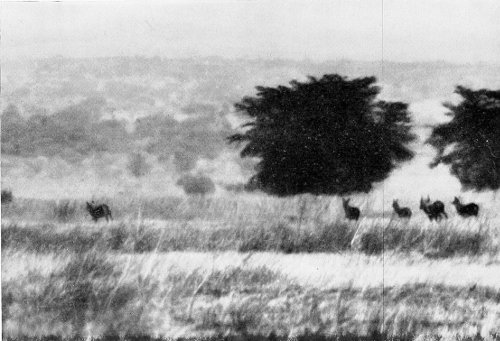
TELEPHOTOGRAPH OF A HERD OF WATERBUCK (COBUS ELLIPSIPRYMNUS, Ogilb.) RUNNING AWAY.
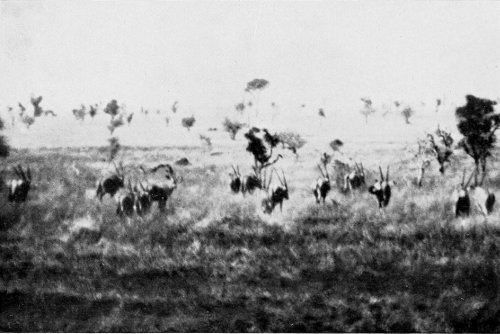
C. G. Schillings, phot.
ORYX ANTELOPES (ORYX CALLOTIS, Thos.); “CHIROA” OF THE SWAHILI, “OL GAMASSAROK” OF THE MASAI): A MOST DIFFICULT ANIMAL TO STALK.
Masters of words like Ludwig Heck, by whose skilful pen the life of the mammalia has been lately described anew for us in Brehm’s Tierleben, and like Wilhelm Bölsche, would perhaps have been capable of grasping, and reproducing the impressions that the traveller feels in those far lands. But they have never trodden these distant countries, and they must therefore confine themselves to describing artistically and yet truly what they have never actually seen, from ideas based on their own clear understanding of the observations of others.
The sun is setting. It is time for me to come down from my hill and return to my camp. The sun goes to his rest in flaming splendour, there is a glowing radiance of violet and purple light; soon dark night will surround me. Thoughtfully I tread my homeward way, with my mind richly stored with impressions, but anxious as to my efforts to describe all that I have seen, and doubtful as to my success.
“To have passed a thousand and more days, a thousand and more nights in the wilderness with a great longing in my heart in some way to grasp and make my own all the splendour I have seen and all its charm; to have again and again delighted in the beauty of the Nyíka: this does not make me capable of reproducing it. And even if after many decades of years I could fully comprehend it, I should never succeed in reproducing it in its full significance and bringing it home to the minds of those who have never looked upon it with their own eyes.”
So runs a passage in my diary.
Descriptions of things similar to those that I have told of in inadequate words in these slight sketches of the Nyíka district of East Africa may be read of other regions of our earth. The life and activity of the Arctic fauna, of those gigantic creatures of to-day, the whales, and of the Polar bears, the musk oxen, the wild reindeer, the walruses, the seals—those most sagacious creatures—and the life of many other animal forms—all these together are waiting for the hand that will describe them in word and picture and put on enduring record for all time this changing life. Thus only will a new existence be given to those forms of life for which the sentence “Vae Victis!” has gone forth.
May the master soon appear who will be able to give us a noble and true picture of the East African Nyíka in all its vast proportions. For, as the night is now descending on the wilderness, so will an everlasting night soon come down upon all the life and movement that I have tried so inadequately to describe in merest outline.
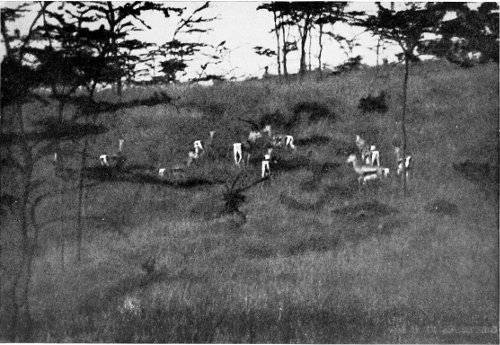
C. G. Schillings, phot.
GRANT’S GAZELLES.
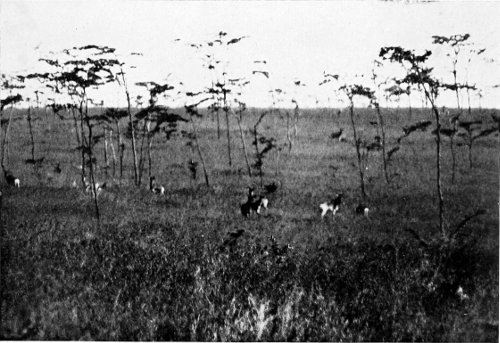
C. G. Schillings, phot.
HARTEBEESTS IN THE NEIGHBOURHOOD OF THE WESTERN ’NDJIRI SWAMPS.
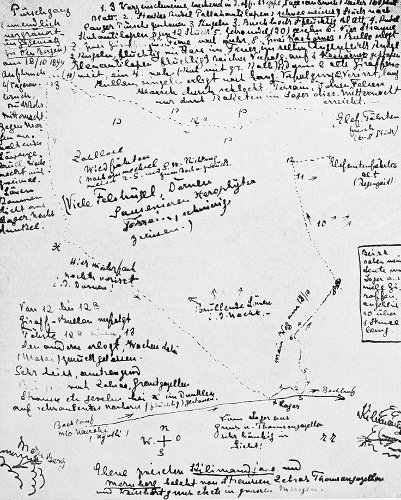
A PAGE OF MY DIARY SHOWING HOW I NOTED MY MOVEMENTS AND OBSERVATIONS BY MEANS OF A ROUGH MAP.
About a century ago the “Twilight of the Gods” (Götterdämmerung) began for all the wild life of the Cape region of South Africa. Even before these hundred years had run out it was ended; this abundant flood of life had disappeared....
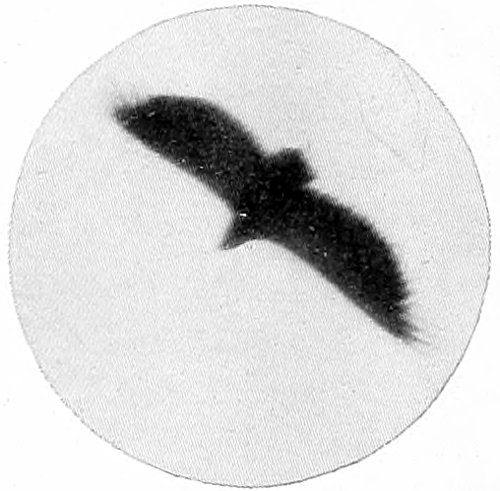
BATELEUR EAGLE IN FLIGHT.
C. G. Schillings, phot.
LIKE A ROSY RED CLOUD THE FLAMINGOES FLY DOWN ON THE MARGIN OF THE NATRON LAKE.