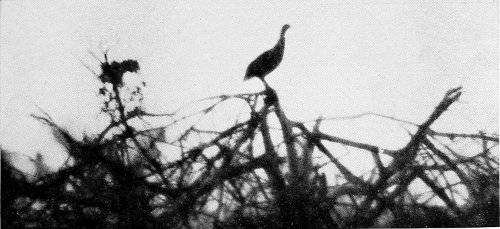
Volume 1 — A FRANCOLIN PERCHED ON A THORN-BUSH. VII The Voices of the Wilderness
Frederic Whyte translation
The German sportsman knows well the mysterious charm that speaks to the listener, when in the woods in spring he hears the note of the woodcock and the cry of the ptarmigan, and when in autumn he hears the call of the stag to its mate. It must be that the listener is subject to some atavistic influence, some impulse rooted in the dim past now quickening into life.
Let him who understands this charm follow me through the equatorial wilderness, and listen with me to the music of songs and notes that we may call the language of the Nyíka. We shall hear it there on every side, by day and by night. True, fully to understand this language one should have King Solomon’s magic power, which made its possessor understand the speech of animals, or like Siegfried have dipped one’s hand in the blood of the dragon, and thus have acquired the gift of holding converse with the birds.
This much is certain, in the wildernesses of Africa this primeval language is still to be heard. In our hunting grounds at home the voices of the aurochs, the bison, the ibex, the bear, the lynx, and the wolf have been silenced, and many other voices that have belonged to the wild open country since primeval days have all but died away. I have indeed learned to understand only a few words of this language of the wilderness, though I have heard thousands of its sounds. But I may be able to tell something about it.
What a strong and deep impression this world of sound makes upon the traveller at so many hours of the day and night! Every region, every different kind of country has its own characteristic harmony. One does not always hear it—it depends upon the season of the year and the time of the day, on the changes of weather, and much else. But when one has become even to some small extent familiar and conversant with these various voices, one enjoys this music-language Of the Nyíka with a sense of deep delight and ever growing understanding. Sometimes it is most difficult to find out the names of the individual speakers. Often they keep very quiet; they seem to be like great vocalists on tour: they appear suddenly, and then disappear again for a long time, without letting one see any more of them. Then the traveller may often listen long, in vain, for the singer—gone without leaving a trace behind. But it is not only the soloists that charm us. There is also the combined effect of all the voices of nature uniting in one vast impressive chorus. This has made such an impression upon me that I shall try, so far as my limited powers permit, to describe it to the reader. This musical language of the wilderness is in itself powerful, rich and impressive, but all this in a still greater degree for him who, observing things with the eyes of a seer, knows many of the voices that resound in it will not be heard much longer. Although for long, long ages, through hundreds of thousands of years, this tumult of sound has been heard, these voices, or many of them, will soon be silent victims of civilisation! They are going, and with them many of the euphonious names of places with which the natives have distinguished every spot, but which the Europeans, as they penetrate into the country, feel themselves obliged to change.
It may seem that I myself am not quite guiltless of such misdeeds. It is true that I named an island, that resort of the wild buffaloes in the Pangani River, “Heck Island,” in honour of Professor Ludwig Heck. But the island had till then no name whatever. One feels sad, on glancing over the map of Africa, to note the degradation of so many old traditional names, which is in no way justified, and is a sign of the hasty and violent introduction of civilised life. “The Boers are not people who think much about natural history,” says a writer somewhere. And in fact, through their agency, the euphonious names of the various wild species of South Africa are now to a great extent already obsolete. They hastily gave vulgar-sounding names of their own to the wild animals.39 Thus the oryx antelope became the “gemsbock,” and the cow-antelope, because it was tenacious of life and difficult to kill, the “hartebeest.” The gnu, on account of its wildness, was called the “wildebeest,” the bustard the, “pauw,”40 the hyena the “wolf,” and the giraffe—incredible though, it may seem—the “kameel”! Hand in hand with this went the changing of place-names: so we read of “Hartebeests Fontein,” “Olifants River,” “Kameeldoorn,” “Zwartkop,” and we have a whole series of unpleasant, and sometimes utterly ugly names by the introduction of which the beautiful aboriginal names of various places have become obsolete. Thus not only do the primitive inhabitants of the land disappear, but their names, too, are blown away upon the wind.
Countless are the voices that resound by day in the Nyíka. But by night these voices speak still more mysteriously and wonderfully to him who listens to them, bringing him into still closer union with nature. From the multitude of these voices I choose a few only.
Old memories come back to me! It is in the year 1896. I have just landed, and am sitting in my night shooting-encampment by an inlet of the sea near Dar-es-Salaam. A concert of the voices of nocturnal birds mingles with the sharp buzz of the mosquitoes. Again and again one hears a strange cry. Unspeakably sad and monotonous, this peculiar sound rings out over the waters of the inlet; in the distance a changing answer comes back in response to it.
C. G. Schillings, phot.
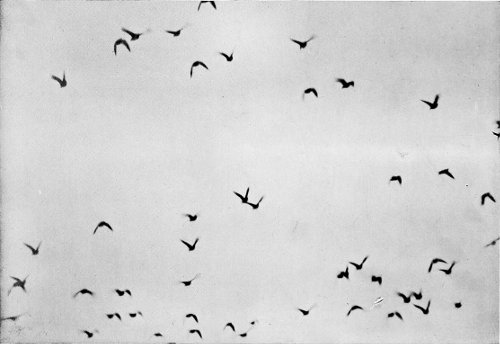
FLIGHT OF SANDFOWL.
I did not then suspect that it would take me nearly a year to be absolutely certain that this sound was uttered by an extremely shy and restless kind of cuckoo!
This sound of the African night always made the strongest impression upon me, and remains indelibly in my memory. All that one heard from near at hand, or from the distance miles away, had its origin not in man’s voice or in human activity of any kind, but most come from birds and beasts to a great extent unknown to us. One had to interpret, to conjecture, to build up theories. Often one struck upon the correct solution. But often enough, too, the interpretation one accepted proved to be false, and then one’s anxiety to find out the true solution, aroused anew, was doubly keen. The first time I heard it, I had no difficulty in interpreting for myself the cry of the monkeys harassed in the night by leopards, a screaming of a kind one cannot easily forget, plainly expressing the greatest terror. The first time one heard the neighing of the herds of zebras it was much more difficult to recognise the sound, and the gobbling cry of the ostrich had at first a still stranger effect. But as soon as I had heard the voice of the zebras a few times, it was clear to me that the extinct quagga of South Africa must have derived its name from its cry. If one puts the accent on the second syllable, and pronounces the g softly and deep in the throat, one has, as one repeats it, a wonderful reproduction of the cry of the zebra as I heard it myself.41
What a pity that all this cannot be put on permanent record by some such apparatus as a gigantic phonograph! But unfortunately we are still a long way from such a possibility.
No one will be surprised at my keeping specially in mind that endlessly melancholy cry of the cuckoo in the darkness. How lonely and empty our German woodlands would seem without the cuckoo and the cuckoo cry! As a matter of fact the African primeval forest never hears the same cry that has become so clear to ourselves. Our cuckoo, migrating in a few days all the way from the north to the equator, flies in restless haste through wood and plain, but he is silent. His cry is heard only in our country at home. But in the East Africa district of Pori, amongst many other cries those of two species of cuckoo are heard in rivalry. These are the sickle cuckoo—the “Tipi-tipi” of the Swahili—a reddish-brown fellow that flutters in heavy flight everywhere about the bush, the reedy bogs and hill-slopes; and the solitary cuckoo (Cuculus solitarius, Step.), about whose cry I was for a long time mistaken. The unceasing, low cry of the former, the sickle cuckoo, if it is heard even a few times, can never again be forgotten. It sounds like—“Dut-dút—dududu—dut-dút.” One hears it by day and also in the darkest night, contrasting strongly with the sharply defined, clear note of our European cuckoo, though the latter listens in silence to the cry of his cousins all through the winter under the equator. This cry seems to me, with its low, dull, softly prolonged tones—so different from the louder cry of its northern relative—to be quite in keeping with its mysterious tropical home. For the sickle cuckoo knows all its deepest mysteries, and no bird ranges so unweariedly through the densest thickets and over the most inaccessible regions. In the most hidden, solitary, and unknown spots42 it would come fluttering up from the ground at my feet, often startling me. It seemed to me as if the bird wanted to call my attention to newly discovered mysteries, as its “Dut-dút—dududu—dut-dút” came sounding to me, now here, now there, low, soft and melodious, by day under the brooding noonday heat, and just the same in the midnight hours.
At night, too, he is seconded, as I have already mentioned, by his more timid cousin, with an ever repeated “Kí-kü-kü—kí-kü-kü,” that resounds monotonously in the distance.
There is a strange charm in continually hearing these voices again and again, without knowing the little singers; and a triumph at last in making out which they are.
“During a sleepless night,” said Richard Wagner, “I once went out upon the balcony of my window on the Grand Canal at Venice. As if in a deep dream the legend-haunted city of the lagoons lay spread out before me under the darkness. Out of the soundless silence there came the loud call of a gondolier waking up just then on his boat ... then from the farthest distance the same call answered back along the dark canal; I recognised the old, melancholy, melodious sounds, doubtless as old as the canals of Venice and their people. After a solemn pause the far-sounding dialogue at last began, and it seemed to me to melt into harmony, till the notes heard close at hand and coming more softly from afar died away as sleep came back to me again.”
Who could describe in such noble words the impression made upon our minds by the spell of the sounds and songs of the nocturnal wildness, and all its strange and beautiful music? All that at first is strange there, and even alarming, comes gradually to be something one loves intimately. Shall I ever be able to listen to it all again? Who knows? Let me try then to make some record of what I have so often heard, and in these few sentences attempt to give some faint echo of these once familiar voices.
We are in the midst of the great forest. Giant podocarpus and juniper trunks rise up towards the sky. It is cool and shady all around us here; we breathe a moist, and not unfrequently a musty air. The sunlight plays only upon the tops of these giants of the primeval woods, and can but scantily illumine the almost bare ground below them, sending here and there shimmering, dancing rays of light amongst the tree-trunks. High overhead the giants arch their branches, interlacing them in a vast living roof of green. Only where clearings make a break in the mass of trees, a sea of light floods all the ground—a flood of light so strong that our eyes, accustomed to the obscurity, the mysterious semi-darkness of the forest, are dazzled, and there comes to our minds involuntarily recollections of old Bible pictures, in which such floods of light are shown streaming down from heaven to earth. A confusion of trees, creepers and undergrowth, with amidst it uprooted tree-trunks lying mouldering away; the earth black, and often marshy; no road or way far and wide, but only here and there the tracks and beaten paths made by the elephants and rhinoceroses that have roamed the old forest since primeval times.
C. G. Schillings, phot.
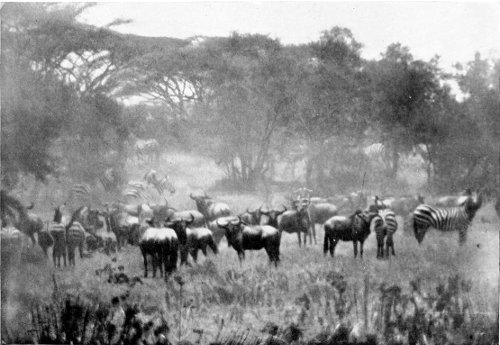
ZEBRAS AND GNUS.
Deep silence all around. If the traveller stands still and holds his breath, this silence seems to weigh down upon the soul with a weird force. At such moments it is as though some vague disaster threatened, or something wicked and dangerous were creeping around unseen.
Suddenly, a squealing and chattering. There is a scurry up and down the tree-trunks, and again there is a strange sound of spitting and growling. Just now there had come over us a feeling such as is expressed in Böcklin’s43 masterly picture, directly inspired by nature, Schweigen des Waldes (the “Silence of the Forest”). We had almost expected each moment that legends set before us by the power of his genius would here become realities; we felt that here one might surprise nymphs and dryads. The spell is soon broken. The gnomes of the primeval forest, the tree-climbing hyraxes, have scared away the silence. Wonderful to say, these dwarfish hoofed animals, the nearest still surviving relatives of the rhinoceros, are here scrambling up and down on the trunks of the venerable trees.
From all sides, from every spot, every direction, there resound the same cries, and again there is silence all around us. Here, far in the depths of the primeval forest, the bird world seems to have no home. But hark! I hear a curious chirping, and I notice on a bare bough above me one of the most gloriously coloured of African birds, the banded trogon (Heterotrogon vittatum, Shell.), which, uttering a most peculiar sound, is carrying on its characteristic sport—flapping its beautiful wings.
Then loud-sounding trumpet-like notes break on the ear. We hear a rushing in the air, and big hornbills with their huge beaks come sailing, as I judge by their cries, through the air, and alight on the top of a giant juniper (Juniperus procera). They, too, fly away after awhile; their trumpeting, dies away in the distance, and again there is silence all around. Their voices and that of the brightly coloured helmet-bird give to the primeval forest of Africa a strange charm that is all its own.
But now there suddenly breaks forth a remarkable sound, rising and again falling as I listen, a strange music of a most peculiar kind. It is the chatter of the colobus monkeys, a sound that cannot be described in words. A party of these wonderful creatures seems to be in good humour, for their song comes to me in chorus unceasingly, and in rising strength. “Murúh-murúh-murúh-rrrrrrmúh rrrrrrmúh-murúh quoi-quo-quo-quo-rrrr,” it sounds, now swelling strongly out, now gently dying away. These, too, are doomed to death, who now are letting us hear their primitive song, that in our days may so easily be their death-song; for these monkeys are keenly hunted for the sake of their beautiful fur, and their song often betrays them to the hunter, eager for their spoils. Some poisoned darts, which I find here with points as sharp as needles, and which were once shot with a bad aim at the little monkeys, are evidence enough of this.
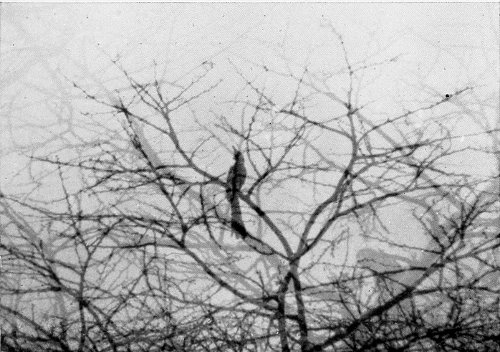
AN ALARUM-TURACO (CHIZAERHIS LEUCOGASTRA) IN ITS PLACE OF SAFETY AMONG THE ACACIA THORNS.
And again I hear the great wood ringing and echoing with the countless cries of birds. There was a time, too, when the call of millions of the now all but extinct passenger pigeon resounded in North America; so, too—and of this I have no doubt—the cooing of the ringdoves was heard repeated by thousands of birds in our beech and oak woods at home when the acorns and beech-nuts were in season.
On the lonely uninhabited western slopes of the highest giant mountain of the German possessions, Mount Kilimanjaro, certain forest fruits flourish in profusion. There is heard on every side a strong, sweet-sounding dove-note, like that of our ringdove. A handsome large species of wood-pigeon (Columba aquatrix, Tem.) has gathered in hundreds of thousands. The rustle of their wings, as they rise or come down in great flocks,mingles with their beautiful calls and cries; the ear can hear nothing else. Voice, form, and movement so strongly remind one of our own ringdoves that one feels carried away to far-off, familiar scenes, and the illusion is helped by the character of the Kilimanjaro landscape, which in certain of the higher regions has less of a tropical than of a northern aspect. How strange it is; the cry of this bird all at once transports the traveller to his own land! Truly there is a magic in sound. With the poorest appliances, the slightest equipment, the creative fancy can in a moment build a bridge to the Fatherland. The call of this beautiful dove sounding here on every side, its love-inspired circling high in air above the tops of the giants of the primeval forest, surrounds it with a dream-picture, and makes me suddenly breathe the air of the beech woods. I am in the northern woods in springtime; cool and fragrant the northern air blows round me. But ah! thousands of miles of land and sea divide me from all that, and cool reflective reason counts only on the possibility, not the certainty, of my ever seeing my native land again.
And yet this beautiful picture has a strengthening and consoling influence. It drives away the trouble of home-sickness—a dismal thing!
I can hear many other voices besides these in the primeval forest. But those that impress themselves in the most completely enduring way on the memory are the strange cry of the tree-hyrax, the peculiar note of the hornbills, that calling of the doves, the remarkable chorus of song of the ‘Mbega monkeys, strange beyond all description, and the trumpeting of the lord of the primeval forest, the elephant.
Another tone-picture—an early morning at a drinking-place in the desert. One could feel the cold in the night, but the quick coming warmth of the equatorial sun’s rays has soon roused the animal world to active life. There is the cry and call of the francolins on all sides. But the chief part in this early concert is taken by the thousands of turtle-doves, flying from all directions to the water. Everywhere a murmuring and cooing, that the Masai are able to re-echo so incomparably in the name of the turtle-dove in their language—“‘Ndurgulyu.” As an accompaniment to this, there is the rustling and wing-clapping of all the feathered visitors at the water. Towards evening, the air in the neighbourhood of a much-visited drinking-place is literally filled with these beautiful and swift-winged birds. The rustling and beating of their wings in rapid flight makes in itself a concert. I not unfrequently came upon places that bore the name of the “Doves’ water,” or the “Doves’ resting-place.” All the various voices of the many species of doves that find a home in the Nyíka resound again in the traveller’s ears for years after. Whether it be the strange voice of the parrot-pigeon, that ushers in the concert with a hollow “Kruh-kruh” and follows it up with some remarkable notes, or the melancholy cry of the little steel-spotted pigeon that comes to us from the thickets, or the strong, loud-sounding love-notes of the already-mentioned Columba aquatrix, Tem., so like our ringdove, or, above all, the familiar sweet voices of the many small kinds of turtle-doves—all these sounds, the rustling and fluttering and beating of wings, the living, moving picture presented by all these beautiful birds, belong inseparably to the essence and being of the Nyíka. When the turtle-doves greet the morning with their soft cooing, their call is answered from afar by strange guttural tones borne swiftly through the air, sounding, like “Gle-glé-lágak-glé-ága-ága,” from the velt-fowl hurrying like themselves to the water. Brehm, in his Leben der Vögel, has already raised a poetical monument to them made up of beautiful lines. But I could not picture to myself the morning concert of the bird world in the Nyíka without the strange cry of the sand-fowl and the cooing of the doves, and the peculiar sound of the beating wings of the velt-fowl as they rise in scattered flight from their resting-places,—a sound that impresses itself strongly and distinctly on the ear, more than that of any other bird I know, as the “Kláck-kláck-kláck” of the rising woodcock strikes the ear of the sportsman in Germany.
The wonderful flight of the velt-fowl, their calls and cries, their hurry and bustle, afforded me ever new interest. It always seemed to me as though the wide wilderness here sent out its lovingly guarded favourite children as envoys, with the mission of making it known that even now, in this dull, barren time, life has not died out even in the most remote deserts. So I see and hear them once more in fancy, beautiful, timid, and full of the joy of life. It is thus their countless millions enliven the wastes of Africa, as well as the endless tundra marshes of Asia.
Deep, long-drawn-out notes, like those of musical glasses, ring in my ears. The brooding noonday heat is round me. The sun is in the zenith, and hardly another sound is to be heard all around. The wilderness lies before me in the hot glowing sunlight as if dead. My weary bearers have given themselves up to a dozing sleep, at the place where I have at last halted, after a march of many hours with a few companions.
Before me is a miniature mountain-world lighted up by the dazzling sunbeams. There is a mass of precipitous rocks, so characteristic of the Masai-Nyíka district, that stretches away into the distance. The Candelabra Euphorbias spread out their strange forms against the light, in grotesque clumps, and seem to me to make themselves one with the rocks, whose inorganic character and nature appear to be repeated in their characteristic forms.
From out of the midst of this stony wilderness these remarkable notes come sounding in my ears. They seem to be mysterious voices of rock and stone. The eye searching expectantly for the singer that is uttering this bell-like melodious music can discover nothing. And yet the notes come from the throat of a bird. It is once more some hornbills that are making their song of love and wooing resound in this wilderness. I have been able to listen to them for hours, losing myself in dreams, and I cannot say why I seemed to identify precisely these bird-voices with the voice of the African Sphinx, that legendary Sphinx which has sung already to so many, and lured many back again for ever. Thus may the songs and voices of the old sanctuaries of Northern Africa once have been. Again and again, when I heard it, I had to think of those men who, with burning longing in their hearts, went forth into the Dark Continent to wrest from it the secrets of its fauna, but had to pay for the undertaking with their lives.
A burning glow of sunshine, a dazzling light in overwhelming abundance over all the desert waste of rock—and amidst it, again and again, that deep, ghostly, metallic note, that directly impresses the traveller as though it were the language of the wilderness, peculiarly its own. But how can I describe all this in words?
And at a moment like this, as if to heighten the effect, over there the voice of the mightiest bird that the earth bears in this our day sounds forth. I hear in the distance the ringing cry of a hen-ostrich, and I listen to it with attention strained to the highest point.
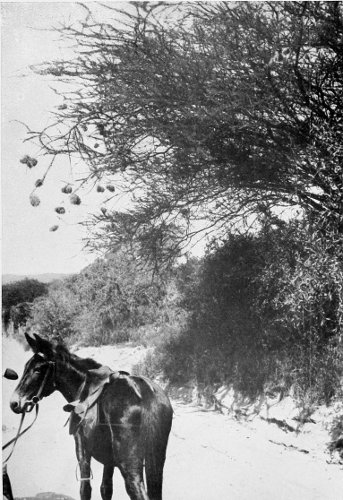
C. G. Schillings, phot.
NESTS OF WEAVER-BIRDS ON THE BOUGHS OF AN ACACIA.
The strange duet has now long died away. But it often comes up to me again in the midst of the movement of civilised life and takes me back on the wings of fancy to the glorious beauty of the wilderness.
But that uncouth tropical singer is not really needed to conjure up this frame of mind. A little unseen lark, all by itself, can evoke for me the charm of the solitudes of Nyíka as with a magic wand.
How this comes to pass, I will tell the reader. We must make a long tour. Now we are in the north, in our native country, in the midst of the spring, amongst spreading fields of our German homeland. The song of the lark fills the air, and our heart expands to its music. We go out upon the open moor. We hear a trilling and quavering of another kind, with a strangely sweet touch of sadness in it, especially at night—the song of the woodlark. But now let the reader follow me to the little island of Heligoland. In the glare from the lighthouse, that sends afar its rays,—in this case rays that bring destruction,—countless numbers of larks flutter and wheel about, bewildered in the darkness of the autumn night, and full of anxiety and fear. On a dark, rainy October night thousands of them fall victims to the death that lies waiting in ambush for them below this tower raised by the hand of man. Their little wings have brought them safe over the ocean to the small island. But there one hears no rejoicing song, No! there resounds only something like an agonised cry for help from weak creatures in the direst peril of death.
Millions of larks fly thus each year southwards and northwards, obedient to that mysterious migratory impulse that guides them on their way.
The song of the lark and the cry of the lark are very different things. To those who know them they mean a song of happy springtime, and a cry for help in the night of death.
How comes it that I thus speak of, and have to think of, sounds uttered by the birds here at home? Simply because over there, in other lands, my fancy so often and so readily imagined the flying bird to be a messenger,—a courier for thoughts of home,—and connected such wishes and longings with its appearance and disappearance.
In autumn, the noblest of our northern songsters makes its way in a few days and nights into the inmost heart of the Dark Continent. It disappears again in spring, to return to the north over velt and desert, morass, mountain and sea. The cuckoo, that only a few days ago could be seen in our northern lands by the eyes of men who knew how to recognise it, I see on the African velt, a wandering, fleeting visitor. Thus it seems to bring me a greeting, like that brought by our oriole, our nightingale, and many other children of the homeland.
No one can be surprised that in these solitudes these birds, and their coming and going, are closely associated with our thoughts. It is the less to be wondered at seeing that they are all such eloquent witnesses to the miracle that these weak creatures with their feeble wings twice each year traverse continents and fly safely over seas.
We cannot help thinking of the lark and its spring song at home, when in the wilds of Africa we hear its voice; and it appeals so impressively to the wanderer in the wilderness, that afterwards it has the power of bringing back by its music a picture of the Nyíka in all its characteristic wildness. It is a song that has a character of its own. When I hear it, if it is in the Nyíka, I cannot help thinking of the songster’s frail, weak brethren of Europe, that, following an irresistible impulse, are perhaps at this moment meeting their death on the little island of Heligoland—obedient to the same instinct that sends myriads of their kind each year towards pole or equator. For even as the northern song of the lark awakens the soft, poetic spell of smiling fields, so, too, the mysterious and still deeply veiled spell of the Nyíka can find expression in its wonderful music.
Small, invisible almost, it rises in the air. Soon it is lost to sight in the sky. Then suddenly a song that, though so often heard before, is still a marvel, comes distinctly on the ear, its notes sharply accented and emphasised as if it were close to us. There is a sharp, rhythmical, clapping sound, as if small laths or pieces of whalebone were being rattled together. It comes from that tree right in front of us. No mistake about it seems possible. But the eye searches in vain for the producer of the sound.
Again and again one is deceived in this way. Who could imagine that that little bird far away over there, a hardly perceptible speck on the horizon, is producing this strange music? “Knáck! knáck! knáck!” again, and yet again, it comes to us ringing out loud and clear. Our little invisible songster does not tire of pouring out its strange misleading song. It is a kind of love-song of a species of lark, which was discovered by Fischer some fifteen years ago and bears the name of the naturalist, now long deceased; Mirafra fischeri, Rchw.,44 is its scientific name. Its clapping and rattling are undoubtedly part of the charm of a journey in certain districts of the Masai-Nyíka.
Even in my tent, in the midst of the comparatively loud noise of the busy camp of my numerous caravan, I can hear the clapping, rattling voice of this lark. Some hundreds of yards away it flies up into the sky, like our own skylark, and hovers about clattering in the air, so loudly and distinctly that if I did not know its character and habits, I would have been continually looking for it close to my tent. It is very hard to quite free oneself from this illusion. One continually thinks that one hears the cry of the bird in one’s immediate neighbourhood, the sound being produced much in the same way as that of the snipe.
And yet another strange voice of a lark resounds in my ears: a melancholy, plaintive, soft sound, till now unknown to me and to most others. All night long its calls and cries resound about my camp. I should never have thought that it was a lark (Mirafra intercedens Rchw.) that thus made itself heard in the night, as our woodlarks do in moonlight nights at home. It was at the cost of much careful research that the discovery was made of what bird produced this song.
And the strange voice of yet another bird is inseparable from my recollections of the wilderness of East Africa. The xerophytic flora of the far-spreading thorny mimosa thickets gives shelter to a privileged member of the bird world, which is thus guarded in safety from all danger amid their thorny boughs and branches. I refer to a peculiar bird, belonging to the group of the Musophagidæ, grey-feathered, green-beaked, long-tailed, and adorned with a crest. This strange fellow roves about restlessly—a bird about as big as a jay, misleading the traveller with his cry in the most curious way. Science calls him Chizaerhis leucogastra, Rüpp.; the German language has given him the name “Lärmvogel” (“noisy bird”).
And he has a perfect right to bear his name. There resounds somewhere near us, and in a way that completely deceives us, now the barking and snarling of a dog, now the bleating of sheep. Following the direction of the sound we look to see what produces it, and we find our bird hopping about nimbly upon the tops of the thorn-trees and acacias, appearing to have no anxiety about the thorny spikes of the branches, in which he makes his home. With a cleverness that borders on the miraculous he makes his way amongst them, protected by them against the attacks of birds or beasts of prey, and in his conscious reliance on the security of his dwelling-place, so to say, mocking at all enemies. So deceptive are his cries that at first, and especially when I was in the neighbourhood of native settlements, I was continually looking everywhere for sheep and their shepherds.
Many other typical bird-voices live in my memory. I hear the peculiar plaintive cry of the large cormorants that are busy with their fishing by the salt lakes of the wilderness, a cry that seems most fitted for these solitudes. The mysterious chattering and chirping of the little swamp-fowl come to my ear from the shallows and the bushes along the banks of silent rivers of the primeval forest, a bird-language so strange that the natives believe the birds are conversing with the fish in the stream. I hear the cackling of the knowing Nile-geese, that seem to be always engaged in conversation; when on the wing, too, a pair of them, in their affectionate fidelity, have always some warning, some reminder of something or other to call out to each other. Where their cry resounds one hears also frequently that of the wonderful, wailing peewit; it has a plaintive and melancholy effect on the mind of the listener. Far different is the noisy outcry of its brightly coloured cousin, a denizen of the thirsty wilderness (Stephanibyx coronatus, Bodd.). Shrill and harsh the voice of the bird rings out, a watch-cry by day and night, and when in bright moonlight nights they fly in flocks over the camp. Swarms of these remarkable birds, the police of the wilderness in feathered uniforms, flutter around the traveller as he approaches. They ruin his attempts to stalk wild animals, and their strident screeches, to which all other animals hearken, haunt him long after, as also the call and cry of the large, yellow-eyed thick-knee, an inhabitant of the loneliest solitudes. But I cannot imagine the low shores of African lakes and the sea-coast without the cry of the widely distributed sandpiper, which has its home in the far north. In winter its low plaintive cry is heard at every step: but even in summer the trained ear can distinguish it here and there. These individual stragglers from the north are thus to be found during all times of the year in this distant country, while the most of their kindred tribe have successfully made their way to the Polar lands, their usual summer breeding-place.
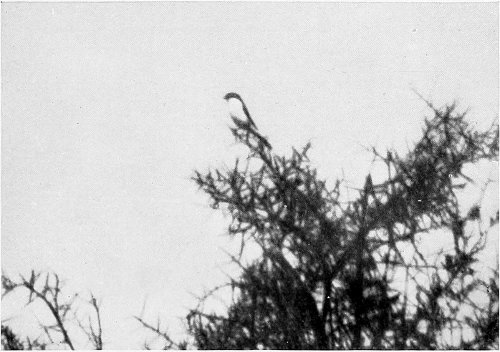
A SHRIKE (LANIUS CAUDATUS, Cab.) ON THE LOOK-OUT FROM THE HIGH BOUGHS OF AN ACACIA. ITS CRIES WHEN IT SEES A HUNTER ON THE MOVE OFTEN WARN THE ANIMALS HE IS STALKING.
High over my head the voice of the pretty avocet (Recurvirostra avocetta, L.), one of the most charming forms of the bird world known to us, transports me by magic to the distant and mournful lakes of the Masailand wilderness. What the dwarf bustards (Otis gindiana, Oust.) keep calling out to each other with their continually repeated “Rágga-ga-rágga” is not to be discovered. But their cry, which has kept the fancy of the natives busy since olden days, is as inseparably associated with regions on which the grass grows high, as the voices and cries of the sandfowl, the francolins, and, above all, the jarring outcries of the guinea-fowl, on the velt. All the manifold voices of doves, cuckoos, parrots, hornbills, bee-eaters, shrikes, orioles, starlings, finches, weaver-birds, sylvians, and the rest, calling, exulting, rejoicing, uttering cries of alarm or complaint, have woven themselves into my recollections of happy days and days of toil.
Thus there still rings in my ear the triple note of the yellowish green bulbul (Pycnonotus layardi, Gurn.), which, like our sparrow, is present everywhere, till one almost tires of it. Most curious is the friendly play which the handsomely coloured glossy starling (Spreo superbus, Rüpp.) carries on with a weaver-bird (Dinemellia dinemelli, [Hartl.] Rüpp) in flights like those of our sparrows. It comes back to me all the more vividly when I recall the notes uttered by these two birds, which, though such close friends and taking such delight in each other’s company, are so distantly related. The curious warbling of the honey-finder (Indicator indicator, Gm.), which often guides the man who follows it to a wild bees’ nest, also easily makes a permanent impression on the ear of the traveller.
And there are many other bird-voices that delight any one who takes pleasure in sound. When silvery moonbeams streamed over the camp, the night-jars (especially Caprimulgus fossei [Verr.] Hartl.) buzzed and hummed forth their strange song everywhere around. No matter how remote and desolate the wilderness in which the traveller laid down his head to rest, these goat-suckers were to be heard. Their voice makes a strong impression on us even in our own country in the lonely woods, but its effect is much more striking, on the far-off equatorial velt. With noiseless soft beating of its wings the bird comes gliding past us; its wings almost touch us. When it pours forth its song, its monotonous sleepy song, I could listen to it for hours. In the daytime it starts up suddenly from the ground here and there in front of you, uttering the feeblest of cries, that it is impossible to represent. In the next instant it vanishes like some huge moth, and even the sharpest eye cannot distinguish it amongst the dry branches and leaves, or clinging close to the rocky ground. The song of the night-jar is among my most vivid recollections of the bird-voices of Africa.
In the neighbourhood of water, wherever it may be, and in the thick undergrowth, wherever the African wilderness extends, you hear the call and cry of a peculiar bird-voice. It rings out through the stillness with a deep double piping note, that impresses itself in a lasting way on the ear. It is the voice of the handsome organ-shrike (Laniarius æthiopicus, Gm.). These shrikes, which mate permanently, always utter this note in such quick succession, one of the pair after the other, that at first you think you are listening to only a single bird. This beautiful bird-note indicates the proximity of water, and thus it has acquired quite a special significance in these countries.
Finally there is no sound from the throat of a bird that I call to mind so plainly, or so continually, as the song of the African nightingale (Erithacus africanus, [Fschr.] Rchw.). I have very frequently heard this beautiful song during the months of our winter, in many districts round Kilimanjaro. When I heard it unexpectedly for the first time, I was most deeply moved by it. Ten years ago I heard it during a day’s march in the wooded gullies of the great volcanic mountain, and it was most clear and full and beautiful. I never expected thus to hear this northern bird-voice in the tropics. Later on, when I was camped at a considerable altitude in the primeval forests of Kilimanjaro, I was saluted with the cries of northern migratory birds, that, wheeling round the mountain, seemed to be flying over its everlasting snowfields. It was a strange coincidence in those Christmas days, the song of the northern nightingale, and those northern birds of passage on the wing under the equatorial sun! It is worth noting that this voice of the nightingale was the only genuine northern bird-song that I ever heard in Africa. That our nightingale also sometimes breeds there is indicated by the discovery of its nest by the late Dr. Fischer. But the problem of the extraordinary identity in character of this nightingale with its northern sister still awaits solution. Many difficult observations will have to be made in order to investigate it thoroughly.
What a contrast to this song of our northern nightingale is presented by the voices of the hyenas and jackals, the strange cry uttered by the leopard, all the sounds emitted by the antelopes, and finally the indescribably startling, harsh-sounding bellow of the crocodile!
But neither individually nor collectively can the effect of all these voices be expressed in words. They associate themselves with the forms of a flora untouched by the hand of man, and the unceasing throb of animal life. I think of them all together as a theatre of nature now flooded with sunlight, now in the mysterious darkness of night, or with glistening moonbeams playing over it. What impresses one so much is not merely these individual voices, but the way in which all the myriad voices mingle in one mighty chorus.
If this symphony of nature is to be written down, it must be by some master who will combine in one marvellous melody these musical utterances that are so mighty and impressive, so full of mystery and charm, and so often dying away in the deepest and most delicate cadences. None of these tones should be missing, no note of them all should be struck out.
I should like to set in contrast with this mighty primeval harmony of the wilderness the sounds and voices of the modern industrial world, which gradually and unwittingly we take to be something natural. He who would feel all its greatness and perfection must keep himself far away for weeks and months from the screaming whistle he hears on the railway, and the howling siren of a steamship.
Then there is the insect world! Those flower-covered bushes have attracted a multitude of great droning beetles. They hasten to them in heavy flight. On the ground a host of scarabæus beetles are busy with their special work. The ceaseless sharp chirps of the cicadas sing their continual song. Through all its variations there goes on this hum and buzz of the millions and millions of the lower creation. And joined with it there ring out the thousands and thousands of songs of the birds; the powerful voices of the great mammals bellow over plain and bushland, through swamps and primeval forests, over dale and hill. The concert of the feathered songsters is suddenly silent, as, it may be, the harsh cry of the leopard resounds, or the mighty, dull, rumbling roar of the king of the desert thunders over the earth; or the trumpet-like cry of the elephant vibrates through the woods; or harsh war-cries from human lips, battle-songs of primitive men, are heard—but heedless of it all, even at these moments, day and night resound the weak voices of all the myriads of lesser creatures of the animal world. But he who penetrates into this wilderness must have receptive senses to understand the full beauty of it all. For him this harmony exists wherever the primitive animal world lives its life.
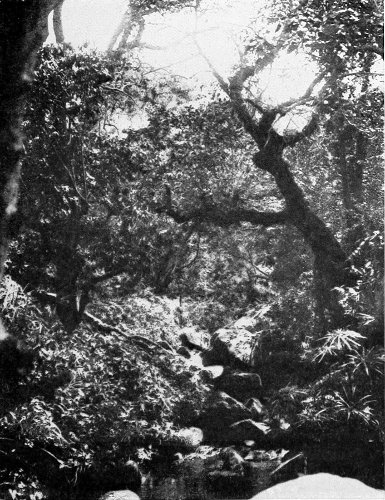
ON THE WEST SIDE OF KILIMANJARO I FOUND A BROOK, CALLED BY THE MASAI “MOLOGH.” ABOUT TEN MILES FROM THE WESTERN ‘NJIRI SWAMPS IN THE DRY SEASON IT SUDDENLY DISAPPEARS AMONG THE STONES AND REACHES THE SWAMPS BY AN UNDERGROUND CHANNEL.
Glorious and grand, too, is the language of Nature when she herself raises her primeval voice, associated with no sound of life that we can perceive. Thus it is in the hours of storm by night, when on the plain, or in the primeval forest, or on the hill slopes, the thunder roars round the little camp, and the crackling lightning comes down in zig-zags. Then the rumbling thunder, the rushing downpour of the water-floods, the roar of the storm-wind, speak with an impressiveness that is beyond all description. Then in their hour of death the giants of the primeval forest, the mighty, venerable trees, suddenly themselves find a voice that strikes loudly on the ear: they groan in the embrace of the wind, and under its fury crash thundering to the ground. Then, when the earth and the rocks under our feet seem to shake, when the powers of Nature are let loose in all their might, when weak little man in his small tent, alone in the midst of all this violence, listens to the sounds, alone and abandoned like the sailor on a frail plank in the midst of a raging ocean, then it is that the wilderness sings its greatest, noblest, most wonderful song.
The traveller may yet return to the African wilderness and hear once more the voices of the smaller denizens of the wild. The chirping of cicadas will lull him to rest, or the buzzing of the mosquitoes forbid it. Their chirping and buzzing will bear witness that these waves of life roll on untroubled and uninjured by the incoming of civilisation. But the greater voices will become rarer and rarer. Soon the trumpeting of the elephant, the roar of the lion, the bellow of the hippopotamus will be heard no longer.
But to-day one can still hear all these sounds which I have described, and which our most remote ancestors listened to all day and all night in the ages when there still lived in Europe a fauna very similar to that which we find dying out in East Africa. By day and night they go forth in trees and thickets, by swamp and reed-bed. The song of birds is accompanied by the monotonous deafening chorus of the bullfrogs. Even in the traveller’s tent the crickets chirp, and the night-jar buzzes and buzzes past it, and tells and whispers of the nightly life and movement of the animal world, in its monotonous mysterious song.
A jackal holds a conversation with the evening star. In the dark night the deep bass of the hyena is heard; and then it laughs aloud, in a weird, shrill, shrieking treble. This laugh, seldom uttered, but when heard making one’s heart shudder, is not a thing to forget; on feverish nights it plagues one still in memory. No one need jest about it who has not himself heard it. He who has heard it understands how the Arabs take the hyenas to be wicked men living under a spell.
Now at last the lion raises his commanding voice, and one thing only is wanting to the whole nocturnal spell—the noisy trampling of timid and harassed droves of zebras and other herds of wild things. But if the ground of the velt, hardened by the burning sun, rings once more to the thundering hoof-beats of the zebras, the eye fails in the darkness, and only our ears perceive by their numberless sounds the waves of life that are surging around us; and then indeed the listener comes to full consciousness of how rich the animal-language of the Nyíka still is.... Nowhere else in the world of to-day do all the voices of the wild resound more impressively, and for him who listens to this language there is no escape from that mysterious spell—the Spell of the Elelescho!