TWO: PORTRAITS (continued 2)
Reading edition
1933
109
II. AMERICAN TRAITS
1. IN DEFENSE OF OUR VULGARITY
If refinement implies spiritual values, vulgarity might be called their aggressive absence. The values need not be individually acquired. They may be traditional, unconscious. They are not necessarily linked to personal traits like morality and learning. The Negro peasant in the Alabama black belt is illiterate and often drunk. But in his native state, he draws from the soil and sky in whose cycles he is seasoned, a grace which is refinement even if it be unconscious like the grace of a flower. Perhaps he is transplanted to some crude mining suburb of Birmingham. Probably, then, he loses his refinement. But if the loss remain passive, if it be not aggressive, he is not yet vulgar. Give him now a shrewd head by means of which he pushes north and lands in Harlem. Teach him that he is a free-born, American citizen on whom it is incumbent to amuse himself in metropolitan fashion. Hand him a little money and a good dose of our contemporary eighteenth-century notion of Equality. Now, his absence of refinement will grow aggressive. He will be vulgar.
We all came from Europe with a modicum of refinement. And the collateral descendants of our forebears have it still in the mines and farms of Britain, in the towns of Germany and Italy, in the ghettos of Galicia. No natural peasant of Europe is quite without it. For this refinement is almost as widespread as vegetation—as perishable, as passive.
Transplanted, we lost this leguminous bloom. But we were not vulgar until we had grown conscious of being 110great. American vulgarity is the sum of our spiritual loss and of our assertive energy. Were we less lordly, our lack of spiritual values would not make us vulgar. And were we spiritually full, our assertiveness might prove a virtue. Vulgar people exist everywhere. We are perhaps the only nationally vulgar people. And therein dwells not alone our predicament, but our hope.
Surely, this vulgarity is clear in all our words and acts, from Maine to Texas! In my optimism, I would have it no less than universal. I would not be cheated of finding it, wherever America and Americanism wave. Politicians of other lands may be merely corrupt or dull: ours are vulgar. There is naught vulgar about the servant of a European lord. But there is naught more vulgar than an American lackey at post before the barracks of Park Avenue—save the barracks themselves, and the millionaires they house. Our newspapers are vulgar. But so are many of our churches. Witness their aggressiveness, their display of results, their want of the sanctity of silence. Our evangelists are vulgar, being void of vision and full of advertising. But the Menckenites who rail against them are no less vulgar—for the identical reason. Chicago is doubtless vulgar: but so is Ben Hecht who hates Chicago. And the whole land has turned the motorcar into vulgarity’s badge: since it has become an instrument of display, a means of elocuting at so many miles per hour the owner’s social status up and down the country.
Now, if you analyze this universal vulgarity of ours, you will discover in it a constant element of misplaced effort. The European servant may be quite as spiritually void as ours; but he is less vulgar because he is less striving: what he lacks is precisely the unfounded aspiration which makes our lackey vulgar. Our advertisements are vulgar because they strive so commonly to be something beyond the nature of advertisements—sermons or homilies, editorials or art. Our newspapers 111are vulgar because they presume to be arbiters of taste and morals; and our churches are vulgar because they labor for results of the spirit with methods of factory and salesroom.
Run down the list, and it will bear me out. This vulgarity of ours means no intrinsic lack of spiritual will and energy; it means the failure of that good will and energy. We dwell in a confusion of impulses and forms. The spirit is exiled from the deed. The deed hungers vainly for justification by the spirit. That is why we are aggressive. And the spirit lacks body. That is why we are wistful, credulous, neurotic. High energy we have—energy of the kind known as religious. It vaporizes for lack of a container; or it is misapplied in the pushing of old creeds no longer fit to house it. Emptiness grows emphatic because it strives to be full.
Now, all this is the due consequence of our past. For more than three centuries, old forms of thought and life—for the most part hostile to each other—were dumped upon our soil. Not until about 1860 had they all rotted enough to begin to come together; rotted enough for the first tender shoot of a true America to rise from the fecundity of decay. In our outward life, we are still committed to forms of living which our nascent spirit has rejected. We lug around the archaic body of theological pioneers; and by means of it we attempt to stammer out the rounded New World vision of a Whitman. The result, of course, is a botch. The result, also, is a promise. This madness of ours, finding symbols in motors, dramas in football games, art in advertisements, morality in statutes, and sermons in tabloid papers, lacks only a working method to become supremely sane. Deflect this misplaced will to unity into some channel that will hold it; and we shall see how the energy which mothers American vulgarity and American folly can father greatness.
Nor must we forget that all these forms of life in which today we express vulgarity, because they are not proper conduits 112for the clamorous spirit with which we endeavor to infuse them, are not American at all—are European. We may produce 90 per cent of the motors of the world; we may measure our progress by our physical power: but the machine and the gold-and-iron standard of value are fundamentally and historically of Europe. Our contribution has been not in the form, but in the spirit which deforms it. We have not made the machine: we have made of the machine the carrier of a Dream. Mr. Henry Ford may be more vulgar than M. Citroën of Paris, because he is a tuppenny prophet: but it is the prophet in him, not the mechanic, which is of our land.
The world wistfully senses this. Europe reads the book of Henry Ford and studies the vulgarest of American expressions through a deep instinct and a mastering hunger. It seeks new spiritual gold. It knows—although it may not analyze the knowledge—that our vulgarity is an ore which holds it.
1926
2. THE MOVIES AND THE MASSES
The American motion picture is a truly popular art. It has more than one audience, of course: Broadway patronizes it, and Europe, and Africa and Asia. But whereas it could get along without these more decorative plaudits, it depends vitally on the American masses. A film that will please only the capitals and languish in the locals, means little to Hollywood’s master minds. It is the people who count: the workers.
It is, hence, fair to say that the sentiments, attitudes and dreams of the American masses will find, if not flattery and full reflection, at least some harmonious note on the American screen. The makers of our movies are, of course, high middle class, with all the ideals and prejudices of wealth. You may 113accuse them of “putting across” their standards in their work. But you give them a heroism which they lack, if you suggest that they would go to the length of imbuing their wares with unpopular ideas, just because they believed them. Much as they love success and armies, the makers of the movies would refrain, no doubt, from confessing their weakness in public, if such confession weakened their incomes. After all, these men have made money because they have pleased the public. They will keep their money only so long as they hold off from antagonizing their public. If you find in our motion pictures a set of standards, a gamut of values, not only bourgeois, but actually oligarchic, military, antiproletarian, the reason must be, not alone that these suit the bourgeois fashioner of the films, but as well that they do not too radically displease the proletarian patrons.
What the tastes and standards in the movies are, is plain enough. Films devoted to the depiction of labor or rural life are extremely rare. High life is the average film life. Or life in the rising provincial class which begins with a Ford and attains a Packard. Alternate with this is the romantic cowboy world of the West. But such tales are no more proletarian than those of Wall Street. Here also is a realm of the picaresque, sentimental, admittedly mythic, and aspiring to the one True Value: the money and position of the middle class.
Run over in your mind the movies you have seen in a year. How many dealt honestly with the life of a farmer, of a carpenter, of a factory hand? If the hero began as a mechanic, was he not an automobile manufacturer at the end? If he was a stableboy at the outset, did he not own the stable or marry the girl who owned it, at the fade-out? If Reel One found him a country bumpkin, was he not a magnate ere you left the theatre?
Our movie world, like any theatre of its audience, is a confessional of the masses. And what it seems to mirror very 114plainly, indeed, is that the achievement of bourgeois status is the heart’s desire of the average toiling man and woman in our country.
This is nothing new. But the obvious conclusion, that this is what the masses really and positively value, is the conclusion we do not wish to make. Worship of big guns, military, financial, social, on which the American movie thrives, is indeed the tonal will of the moviemakers. This is what really moves the businessmen and women who distribute, produce, direct, compose and act our movies. But the true reason why the masses—above all, the plastic sons and daughters of the masses—accept such values is that they have not received a set of values of another kind.
The people must love, must worship, something. What school and church provide them, as substance for their dreaming, has gone so dim that it disappears in the brash glamour of our jungle. The movie gives an idealization of the powers and hungers of daily American life. Empty the people go from church and schoolroom. But the press agent of the silver screen needs only to give a twist to the actual presences of the busy street in order to make the shopgirl a lady and the laborer a millionaire.
The corruptly glamorous values of an exploiting class are absorbed by the people, not because the people are corrupt, but because they lack values and glamour of their own. They have no ethos, they have no myth, they have no simplest story in which the elements of the laboring life take on essential and intrinsic worth. Lincoln, let it not be overlooked, became a corporation lawyer—like any movie hero. And Whitman has not yet been translated into American speech. But when a poet does arise, inspired to sing, as Burns did for his people, the values and virtues of laboring men as men, rather than as aspirants to wealth, the masses will follow him—even in the movies.
115It is significant that no one has yet given the movie audience a set of values other than the prevailing. Has anyone tried? We suspect that such a poet would not languish in the anterooms of all the movie magnates.
And one reason for our confidence is the unique case of Charlie Chaplin. The average moviegoer does not love Chaplin more than he does Doug Fairbanks or Harold Lloyd or Lon Chaney because he thinks that Chaplin is a greater artist. The average movie fan believes that the high art of the screen is in such stars as Swanson or the Gishes. He is likely to be a bit ashamed of his love for Charlie. There are a dozen more “admired” actors. But the average American loves Chaplin most tenderly because Chaplin on the screen is so often a poor cuss of the people who remains one: and who “puts it over,” not by becoming a millionaire, but by remaining a human being. Charlie as waiter, bricklayer, fireman, bank sweeper, pawnbroker’s assistant, convict, is not at the tale’s end and in accordance with film formula, the owner of the restaurant, the contractor, the fire commissioner, the banker, the police lieutenant. He remains, fragilely, wholly, triumphantly, of the people. (“The Gold Rush,” in which Charlie strikes gold, is an exception.) He is the frail and unutterably sweet beginning of a movie mythos in which the common man may absorb poetic values not by changing his class, but by becoming himself. And this is the true reason why the common man adores him.
Here is a first step in our American labor and farmer movement which remains to be taken. It consists in the creating of living values within the life of laborer and farmer. Only so will the extrinsic values of “getting ahead” and of “getting into another class” be displaced. When such living values exist, the radical movements organized to put labor into power will have something to work with.
1927
116
3. THE COMEDY OF COMMERCE
Industrialism’s mood is tragic. In the early years, men’s wonder gave to it the glamour of romance. Something of the delicious terror memorialized in “The Castle of Otranto” went to men’s consideration of these new giants fleshed of iron and belching steam. But the monsters’ bite was too hard; too dolorous was the displacement which they brought to good men’s lives. These were no proper prodigies like the “Gothic,” avenging merely wrongs and rescuing the noble. So the romantic mood grew swiftly dark. With the early socialists and anarchists, it took on the Doom note of prophecy. Zola made it tragic. In the muckraking days of our magazines, the tales of factory and mill were grey and ominous. They were, indeed, replicas of the infernos of our industrial towns. Laughter, like the hero-workman’s little girl, languished and died in those swart caves whose breath was a blast and whose light was a sear of fire.
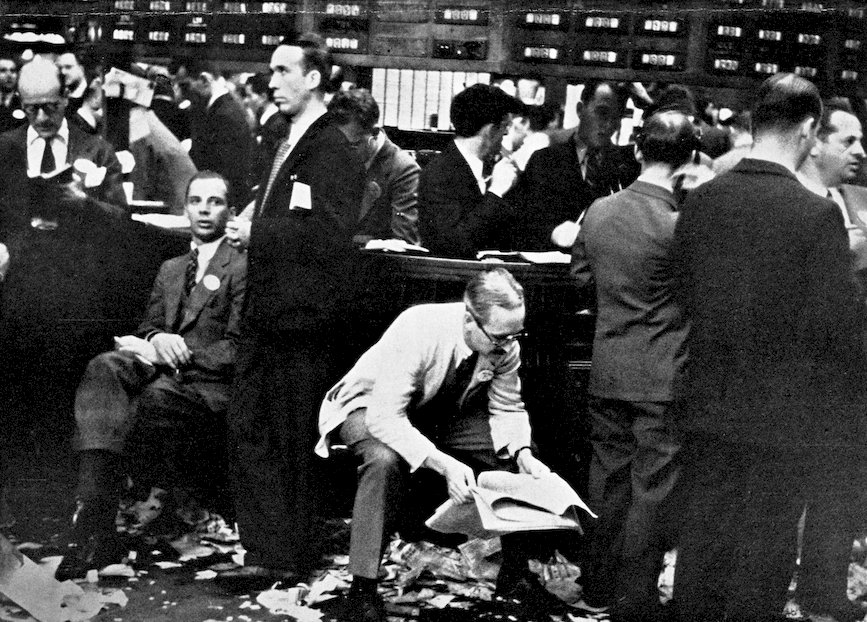
But as industrialism became more the usual circumstance, we began to react against it. And our reaction, having as its aim recovery, was comedic. That particular response to the grim industrial glower, which is the Comedy of Commerce, has found perfection in America. In England, the monsters’ bite has been too cruel. There are no spirits left, there is no energy, for the recovering laugh. In the Latin countries, the monsters’ sway is not bitter enough as yet to have provoked a systematic answer. (There are signs of it in France.) In Germany, as soon as industrialism flourished, the Teuton genius turned not to a balance of frolic or of smiles, but to an ideal compensation. The machine was drafted by neo-Hegelian argument into the soldierly service of Kultur. In America, we had no such metaphysical bent. The best we 117could do with our industrial tragedy was to cover it up with a surface, coruscating and comedic.
The symbol of this new comedy is the electric light on Broadway. It is, of course, commercial and of industrial antecedents. It is bright, dazzlingly. It displays power and wealth, yet it does not reveal. Instead it covers, with its hard cold beams, the rather shoddy buildings. It distracts the eye from the beholding of sources. It is a light that blinds. Any artist will assure you that the electric light is false—in the sense that it deforms.
But thanks to such enterprise, it will soon be inexact to speak of our “industrial cities.” Industry must continue, of course, to have its home. But industry will not continue to control the tone and nature of our dwellings. It will be disguised or hidden. It will become as the kitchen or the plumbing system of our social house, as the bowels of our social body. And we will be outwardly bedecked and bedizened in an obtrusive laughter the ingredients of which, indeed, will be the results of industry, and the purpose of which will be to deny its parent.
Already, not alone New York among our splendid cities has cloaked this tragic source of its greatness in the comedy of commerce. Forget the blare of the Broadway lights, and think of the shop windows. How gaily drugstores, hardware stores, delicatessens, shine with their myriad cavorting forms and colors. Think of the newspapers whose columns of dour news are plentifully (and profitably) balanced with the comedic patter of the advertisements. In our popular magazines, the reaction is complete. The mill town is disappearing from them; the honest workman’s daughter languishes less in print. It is the doughty salesman, the go-getter of commerce, with his steed a motor and his muse a flapper, who commands the pages not already commandeered by “National Advertisers.” Our more sophisticated books reveal the same aversion. Our 118“first-line” critics must, above all, be comic—if not clowns. They must provide the sedative of laughter. And the books they tout do likewise. Tragedy is nefas. The tragic stuff about us has cowed our spirit from the enterprise of making it a means for that joyous confrontation of truth which is tragedy. We glance off into comedy—if not farce. And the cleverism, the anecdote, the epigram, the swift cartoon—so close to the heart of the salesman—clutter as well the minds of our intellectual classes.
It is so with the theatre. In such a typical success as “The Show-Off” (called our best comedy by many of the reviewers) a minor role fell to Industry. Not the boy mechanic who actually invents is the hero; but the salesman, the show-off, the man who by empty bluff and in utter ignorance of the product he is pushing, puts over the invention. The industrial source of wealth remains wistfully indulged and sedulously hidden beneath the noisy comedy of commerce.
© Ernst W. von Seckendorff
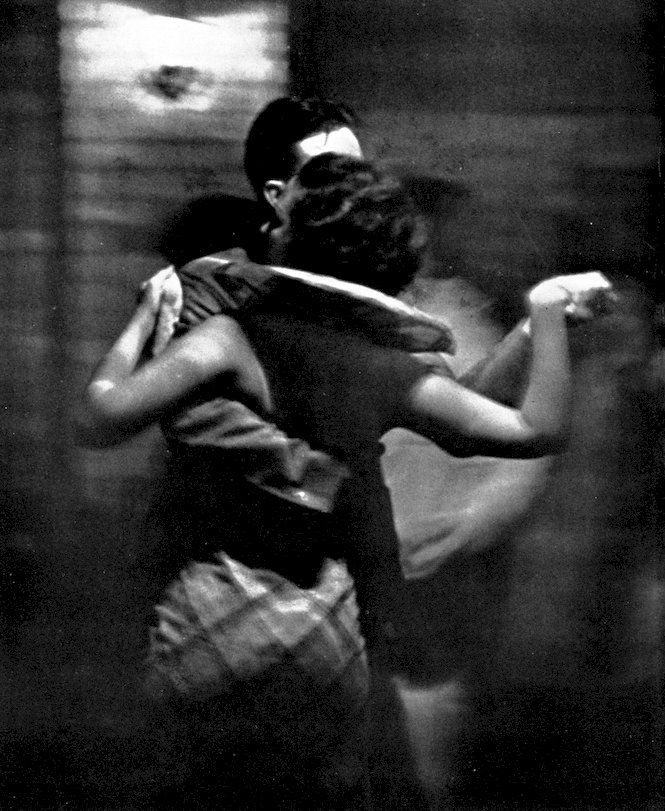
The comedy of commerce is a comedy of display. It is a denial of the industrial gloom by a boast of brightness. And yet its materials and its very rhythms are conditioned tragically by the tragic world it aims to deny. It is only a disguise; often frenetic, often wistful, never more than momently successful. Nowhere is this more plain than in the music of the comedy of commerce—Jazz. I do not desire to discuss the music roots of jazz: whether they lead you back to the Barbary Coast of San Francisco or to the Argentine or to the Congo. The product we have naturalized is the song of our reaction from the dull throb of the machine. Jazz syncopates the lathe-lunge, jazz shatters the piston-thrust, jazz shreds the hum of wheels, jazz is the spark and sudden lilt centrifugal to their incessant pulse. Jazz is a moment’s gaiety, after which the spirit droops, cheated and unnurtured. This song is not an escape from the Machine to limpid depths of the soul. It 119is the Machine itself! It is the music of a revolt that fails. Its voice is the mimicry of our industrial havoc.
You will find this irony in all corners of our successful world. Industry is the source of our power and of our sorrow. We are ashamed of its ugliness, hurt by its cruelties. We will employ the power it gives us to escape the sorrow. We seem so adept! We have ten thousand gay contrivances, all born of industry, to hide it. But all of them are like that paragon, the motor. Its chief purpose, of course, is to carry us away from factory smoke: ourselves figuratively, and the laborers whose Fords stand parked outside the mill, literally, when the day’s work is done. But alas! the machine that carries us away from industrialism carries its spirit along. The clever story in the Satevepost, the bungalow, the radio, the song and dance—all the little acts of the comedy of commerce—hold the bitter taste, essentialize the spirit and the forms of the industrial discomfort they are supposed to combat.
The Comedy of Commerce is a failure. It is an antidote brewed of the poison it would save from. We must go deeper for a healing laughter. Laughter that heals must come from health, not from the disease. It must spring from the whole vision and whole experience of life, not from a mere shrewd juggling and twisting of any of life’s products.
1925
4. JAZZ AND FOLK ART
In “The Comedy of Commerce,” I referred to jazz, not in uncomplimentary terms, but critically as an instance of the art of a commerce- and industry-ridden people. Many readers gave protest. So far as I could see, the chief point against me was that I had dared be critical of a folk art. Jazz, went their 120sentimental plaint, was the expression of a people. (I had not denied it.) Hence, hands off! Hence, down on worshipful knees!
There has, indeed, been abroad for a full century the curious notion that folk art—as once the king—can do no wrong: that folk art is necessarily good art: that the critic who dares to question folk art commits the unpardonable sin.
This is a point I would examine briefly, forgetting jazz as the mere pretext for it. The notion, to begin with, seems to be quite modern. Before Rousseau, folk art was known, of course; was appreciated; was, indeed, taken for granted. It was neither idealized nor despised. It was the art of the folk: the elite regarded it with the same relative eye with which they looked upon the people. The people was the mass, the soil, the loam, whence they had sprung; the body, if you will, for the aristocratic spirit. It was indispensable and it was causally, if not finally, good. No tyrant could think otherwise, without deleting the very substance of his power. Molière, in the first act of “Le Misanthrope,” expressed the common philosophic attitude toward folk art. To excoriate the precious nonsense of Oronte, Alceste quotes a popular Parisian ditty, and declares it vastly better than the sophisticate’s sonnet. He shatters the courtier with a point which today would be altogether lost. For he is uttering a paradox. Here, in our language, is the gist of his attack: “This popular Parisian song—you know its class—may not be much; but it is sincere, sweet, lovely. And your sonnet, M. Oronte, which should of course be an improvement on such primitive traits, shows but their total loss.”
The crowning of folk art is a corollary from Rousseau who preached a “return to Nature”—as if civilized man were somehow miraculously out of nature; and “a return to infancy”—as if his own doctrines had not been the dream of a weary adult. If you accept the Rousseauistic premise, the 121modern notion follows about art. The best art, then, will be the least cultured, the most primitive, the most childlike. And poor man, addicted hopelessly to beauty, had best pursue his weakness in the art of folk who, thinking least, are least attainted. If, however, you reject the creed of Rousseau—which does not mean that you deny his value and his genius; if it seems clear to you that civilized man belongs as much to nature as a tree does, and that man’s need to live well, to know true, to aim high, is as healthy and as natural a function as the tree’s to grow good roots and blossom, then this indiscriminate adoring of folk art, merely because it is folk art, is nonsense.
Dante was once ten years old. He was a remarkable child. He babbled sonnets and rondeaux which revealed his nature. Do you put the prattlings he produced at ten before the “Divina Commedia” he composed at fifty? If you are the usual folk-art worshiper, why not? Were those lyric works of Dante’s youth not the pure Dante? the untrammeled sign and substance of his soul? Were they not Dante’s folk art? And the “Divina Commedia”! what alien and sophisticate and unoriginal matters dulled the raptures of his early years to this! Aristotle, Aquinas, Virgil, the apocalypses of Jerusalem, the pseudo epigraphia of Alexandria—the whole theology and logic of the school-men had to “debauch” the pure Dante, ere he was ready to write his intricate, conscious poem. If you are a real lover of art, surely you will turn with mild disgust from the “Commedia” to his childhood singing.
I do not think this caricature of the folk art fad is too unjust to sharpen a just point. It is literally true that if greatness be ever in a man or a race, it must potentially have been there at the outset. Therefore the beginning expressions of that man or race will hold the germ of their significance. Most men, moreover, fail (perhaps most races also) to fulfill their spiritual promise. The promise universally exists. No 122child, no child-race is without it. Only the mature achievement is rare. And so it follows that the search for spiritual values among children will be, by and large, more fruitful than among men and women. But to say that the art expression of all children gives more than the art expression of all adults, because children all have the germ and adults seldom the flower—only this bad logic can lead us to conclude that child art and folk art are best, or even always good. Folk art is the seed of great art: seeds are more numerous than flowers. To cultivate the seed at the expense of the flower is a defeatism and a folly we are not quite cured of.
But folk art is not naïve in its elements, any more than are the babblings of the “purest” child. It is, more often, the naïve mirroring and mimicry of ideas caught from above. The emotions of folk art are childish. Yet they are the result of unconsciously inherited ideas, imposed by ruling classes. Take, for instance, the folk arts of medieval Christian Europe, the spirituals of the American Negro slave. Did the folk invent the intricate theology and philosophy on which they rested? Rather, they vulgarized the product of intellectual minorities—Prophets, Plato, Plotinus and the Patrists: made it a pabulum, at last, which later intellectuals could re-employ for the creating of more cultivated art. Another example: Russian folk music reveals traces of liturgical and synagogical music. Now, a new group of cultivated artists—Rimsky, Stravinsky, Ornstein—reforms this popularized pabulum of older minorities into a fresh intellectualized music.
© Fairchild Aerial Surveys
Or consider our jazz. Jazz is not so much a folk music—like the Negro spirituals—as a folk accent in music. It expresses well a mass response to our world of piston rods, cylinders and mechanized laws. The response is of the folk and is passive. The nature of our world itself is due to the work and temperament of minorities alien to the jazzmakers. Jazz expresses a personal maladjustment to this world, righted by sheer and 123shrewd compliance. And this, doubtless, is why the races at once most flexible and most maladjusted—the Negro and the Jew—give the best jazz masters. Since the rhythm of our age is not transfigured in jazz, as in truly creative art, but is assimilated, the elements of the age itself which we may disapprove will appear also in jazz. In other words, a folk art—being so largely an art of reaction and of assimilation—will contain the faults of the adult minorities that rule the folk, as well as the pristine virtues of the people.
And we have other folk arts. “The Rosary”—jazzless, European saccharine—is as truly a folk art as any of the Berlin or Gershwin ditties. Harold Bell Wright’s books—messes of Victorian notions in decay—are also an American folk art. The New York “Daily News” is the daily art of a folk numbering several millions.
The adorers of folk art in its own divine right need but observe what they adore. That will be enough to cure them. Nor should they forget that in all culturally early epochs, dissatisfaction with folk art is one of the incentives for the production of great art.
1926
5. STRAIGHT STREETS
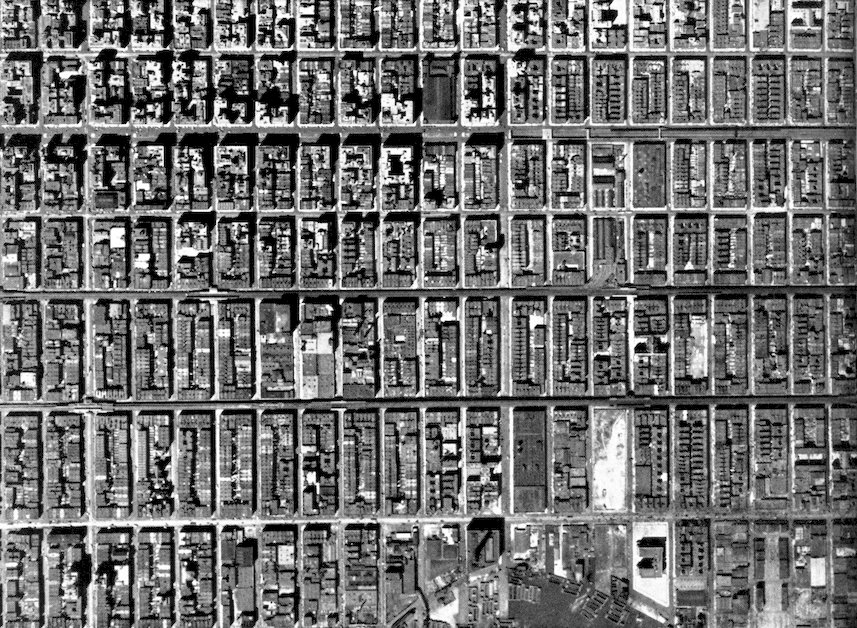
What is the meaning of our cities of rectangular streets? What is their effect on our souls? It is plain that Nature likes curves. You may find rough angles in rocky mountain wastes, or in the sort of creature that a microscope makes vaguely visible. But the Nature of man and near to man is a sinuous, rounded being. Think of our bodies and of the bodies of animals—not a Euclidean angle in the lot. Think of the shapes of flowers, plants, trees; of the configuration of the hills and fields; of the sweep of waters; of the globe. Now think of our 124interior worlds. Our physical dynamo has not a straight line in it. And our mental digestion is tortuous as our intestines. Logic may proceed theoretically like a plummet; but there’s nothing natural in such logic. Draconian justice might be called rectilinear, but it, too, does not exist in Nature. Uprightness when it is not tempered by the curves of mercy is repellent. Man’s mind moves in curves. His thoughts arch, vault, melt into reverie. Dream and sense swerve into each other. His heart, too, is full of arcuations. And the heart’s desires are parabolas. There is naught angular within us. Nor above us. Space, we have learned from Riemann, has a crimp and a curve. The “straight gravitational line” of Newton proves to be the “Einstein shift.” From the detour of solar systems back upon themselves within a spheroid Space, to the devexities of dream, man has a universe full of everything but angles. And yet, the American urbanite has elected to spend his days in a gridiron.
The towns of the Old World were and still are curved creatures. From Iceland to the Cape of Good Hope you will not find an ancient city that does not gyre like a heart or twist like the intestines. Indeed, the European links angles with humanity only in his thought of death. Christ was killed on a cross. St. Laurentius was roasted on a grid. When the fanatical Felipe of Spain built a monastery to express his contempt for life and his withdrawal to the grave, he patterned it after a gridiron.[5]
Curves rest: angles tire. How often the American abroad lets his eye float down the gentle swerve of a street and is soothed sensuously, and is moved as by a freshet of pleasant impulse. It is the curve! The jolliest street in Manhattan—the one that is most human, most laughing, most restful—is Broadway, which has a curve or two; and even at its straightest runs diagonally to the ruthless grid, thus giving the delusion of a 125flex. No wonder it has become the avenue of shows, the road for informal saunterings clear up to Harlem. No wonder the automobile, our pathetic symbol of escape, has made Broadway its home.
If straight bobbed hair delights, the reason is that it sets off the curves of our girl’s face. Her straight dress has value in so far as it reveals the rondures of her body. American civilization has revolutionized the shape of cities. It may yet appreciably alter the shape of man.
For we seem to be angularized in almost everything else. Not alone our streets are straight and stiff. Our houses are as rigid as if they were made of the building blocks of Brobdingnagian babes. Where else is there a spectacle like the recently grown splendor of Park Avenue—that parade of pompous tombs, shutting in wealth and shutting out the sun? Is it possible that the disfavor of Riverside Drive as a residence street among our leaders is due to the swinging rise and fall of that untypical parkway? Our laws, like our houses, become more rectangular and upright. Our morals are strait like the gates of Ellis Island. Even our faces.... If there be in all the world a human countenance made of angles instead of the immemorial curves, it must be that of Calvin Coolidge. So perhaps biology will give way after all to the rectangular will of our American world. Perhaps the flapper of tomorrow will have pyramidal breasts....
There is a reason for all this, and a good one. If you care to go to the heart of the matter you entrain by the Santa Fé and alight in some New Mexican pueblo.
The Indian’s culture is prophetic of what our culture must be. His nature is a guide to the understanding and achievement of our own. This does not mean that we are going to give up motors, and dress in paint and feathers, nor that the skyscraper will dwindle to the wigwam, nor even that our women at some distant date will be swinging their papooses 126across their shoulders. But it does mean that there is something deeper than these discrepancies between the Indian and ourselves. Something deeper, which we share.
The Amerind was profoundly, beautifully adjusted to the land. If you study him in his demeanor, his dance, his music, his pyramiding pueblos or his simple tepees, in his flinted arrows, in his decorations, you will find that the general symbol of his expression is a curve so sharp and so severe that it barely escapes being an angle. The curve is the way of acceptance: the angle is the way of resistance. America is a feverish world. Its geological tempo is not like that of Europe. It is far more terribly intense. I am certain that when the ancestors of the Indian crossed to America from Mongolia (or Atlantis) they resisted this atmospheric fury, as have we, with an angular restraint. That reaction was not a culture, any more than our present reactions from Europe or from mechanical civilization constitute a culture. The Indian culture began when his innate spiritual and intellectual values formed a solution with the world about him: his culture was achieved when the responses between his soul and the world had rounded into a unified life which expressed both fully. After many ages, the Indian’s first reactive restraint toned down, and became the subtle and fertile curve of the Indian music, the symbolic gesture of his dance, the exquisite reticence of his demeanor.
Recently Dr. Jung of Zurich was in this country and made a visit to the pueblos in which he had been rightly advised that he would find archetypical remains of classic Indian culture. Dr. Jung had psychoanalyzed many Americans, and found in them all (whether their ancestry was Nordic, Latin or Semitic) a unique alliance of wildness and restraint which did not exist in the European nature. Dr. Jung’s intuition told him that he would find this combination, so hidden in our souls, culturally expressed in the Indian 127pueblo. He was right. Despite the ponderous luggage with which we came from Europe and which so differs from what the Indian brought along, we must inevitably go the Indian’s way in the spirit, since we have come his way in the flesh.
When Babbitt tells us that American towns are laid out “regular” because it “pays,” he does not know how deeply he is right. Regularity and angularity pay, indeed, because such is the beginning of our self-assertion against a cosmic factor. In our straight streets, in our jazz, in our dress, in our morals, in our lantern-jaw Puritans, in our raillike girls, we manifest the first stage of resistance to the furious fire which is the nature of our world. The rigid angles will smooth out, will take on the curves of life—will become the forms of our American culture.
1925
128
III. IDEAS
1. SERIOUSNESS AND DADA
(An Exchange with Malcolm Cowley)
a.
It is possible in small space to touch but briefly, and upon one of its phases, the complex and defunct Dada movement. Its immediate progenitors were the Italian heirs of Athens and of Rome—they called themselves futurists: a restless Jew whose ancestors had settled in Rumania brought it to Paris. It had behind it, therefore, the ripe Mediterranean littorals and the full growth of Europe. It was a salutary burst of laughter in a world that felt itself too old. Europe was crystallized and desired a solvent. It creaked in stratified forms and laws and notions, and it yearned to explode.
The War was a violent but unsatisfactory excursion of a similar sort. The ponderous machinations of diplomacy had prepared this laughter of young millions rushing to a bright shambles from the straitened gloom of ordered cities and inherited farms. But the war was too superficial. Jaded Europe learned the inconsequent effect of such inebriety as death and murder. The deep spirit of the land was unmoved by columns of men miles long and by guns that raked cities. It was the esthetes of France—the solemn romanticists, the shrill Parnassians, the symbolists, the votaries of Bergson, it was the pragmatists of Germany and the rhetoricians of Italy, who invited the release of Dada by their formulations, hedgings-in and dogmas. There is no doubt that the face of Europe 129yearned for the smashing of a few cathedrals. But also the heart of Europe hungered after the battering of a few spiritual laws.
Dada was an emanation of this will of a too sober, too mature, too sanctified rationalist church. Scampering in disarray against metrics and the still more cloying bondages of “freedom,” imping against the roll of such millstones as Truth, as Unity, as Beauty, Dada was as logical as the most Freudian hallucination. It was an eruption, a breakup, a shower: it was a jag and a reversion. And having cooled the face of the old land and made Europe forget her uncomfortable age, it disappeared.
Good jokers, the Dadaists were: wistful creators, against sour sense, of sweet absurdity. But they did nothing more ridiculous than the installation of the Dada mood in American letters. Europe called for Dada by antithesis: America for analogous reasons calls for the antithesis of Dada. For America is Dada. The richest mess of these bean-spillers of Italy, Germany and France is a flat accord beside the American chaos. Dada spans Brooklyn Bridge; it spins round Columbus Circle; it struts with the Ku-Klux Klan; it mixes with all brands of bootleg whisky; it prances in our shows; it preaches in our churches; it tremolos at our political conventions. Dada is in the typical Western university that spends $50,000 on cows and $200 on books. It is in the esthetics of Mr. Bryan, whose favorite work of art is any old Madonna. It is in the commercial comedy of our advertisements. (Do Your Duty: Chew Mixlets Gum. Be an American: Throw Your Rubbish Here.) It is in the counterpoint of callow Hollywood and the immemorial desiccation of the California desert. It is in the medley of strutting chimneys and bowed heads, of strutting precepts and low deeds that make America. We are a hodgepodge, a boil. We are a maze of infernos and nirvanas. Our brew of Nigger-strut, of wailing Jew, of cantankerous 130Celt, of nostalgic Anglo-Saxon, is a brew of Dada. No wonder they imported our essential chaos to lighten the regularities of France! But we are young, and what we need is a bit of mature action. We are fantastic ourselves, and what we need is integrating thought. We are the most fecund joke on earth—for the overserious others. What we need, by way of rounding our lives into livableness, is a bit of seriousness for ourselves.
Our complexities provoke strange paradox in our deeds. Ourselves a spontaneous combustion of contrariety and antithesis, there grew up in us a fear and a shame of the spontaneous. (This is, of course, a trait of adolescence.) In order to become unspontaneous, we turned to Europe. Our attention was caught by a lot of youths of age on a “bust” of spontaneous laughter. In all solemnity, we artificed their spontaneity, crowning thereby the best of the Dada jokes. But we did not create Dada art. Dada art arose from the traditional maturity of Europe. The intellectual stuff and stamina, in our own case, were lacking: and what we got were weakling strains of the European pose muddled with American incompetence and lost against the background of American bewilderment.
A healthy reaction to our world must, of course, be the contrary of Dada: it must be ordered and serious and thorough. Dada worked well in overmature Europe. We, by analogue, must be fundamental, formal. That, indeed, is the proper mood of youth. The young cutup in the literature of our land is the bromide. We need him doubtless, but humbly in the rank and file. To be coruscant, smart and swift in the American language is to be platitudinous and banal. Therefore it is that the literature which poses as most advanced in the United States is for the most part quite the contrary—is as undifferentiate, indeed, from the common wallow, as the Mecca Mosque on Fifty-fourth Street, as the Hearst headlines, 131or as were the jokes of Josh Billings. Our cosmopolites who think that they are emulating Aragon and Cocteau and Firbank, our local realists and shockers who think they are reforming us, are all in reality but sweepings of the immense centrifugal action of the American world. Our surface twists and scintillates and shrieks. They are caught in it, they are slavish functions of the American mass which they profess to lead. They are the reflections of a world that is Dada and that is in danger of becoming narcissistic: of growing infatuated with its own twitching image.
The first step in the absorption and control of our Dada Jungle is the achievement of a serious, of a literally religious temper. The academies are turned away from America: their earnestness is frivolous. The neoclassicists are turned away from America: their nostalgia is anemic and their grace is shallow. The realists are submerged by America. The pragmatists are bluffed by America. The clever and decorative boys who clutter our “serious” magazines are reflecting not even America’s surface, but Europe’s thirsty reflection of our surface. None of this is serious, although doubtless all of this has its place in the chemistry of ferment....
If we can produce a handful of serious creators—men unafraid of unpopular words like philosophy, profundity, saintliness, devotion—and if we can keep them alive and at work a score of years, perhaps there’ll be a start toward integration: and after several hundred years, we may be mature enough to inspire a Dada of our own.
b.
Dear Mr. Frank:
The progress of literature (and here progress does not imply a betterment) is largely a series of reactions, a passage from one extreme to the other: romanticism succeeding 132classicism, realism against romance, estheticism against naturalism and Dada against the esthetes. But given the fact that every national literature starts from a different point and follows a different course, their reactions of a given moment can hardly be the same. For American writers to revolt from the tradition of Remy de Gourmont or Mallarmé is empty imitation, a gesture with no more significance than could be given to a French protest against anticigarette laws in the state of Kansas.
To this measure your attack, in the last issue of 1924, against a hypothetical group of American Dadas was completely justified. It would have been more valuable, however, less obviously biased, had you gone on to consider that the progress of literature is also a discovery of new principles, involving a rejection or reaffirmation of the old; and that such principles are international.
To call Dada “a ‘bust’ of spontaneous laughter” was absurd. You were on safer ground when you spoke of it as a reaction against European writers whom you listed as “the solemn romanticists, the shrill Parnassians, the symbolists, the votaries of Bergson ... the pragmatists of Germany and the rhetoricians of Italy”; or when you added that since few of these schools were represented in America, a similar American reaction would be stupid.
But Dada was also a discovery: that nonsense may be the strongest form of ridicule; that writing is often worst when it is most profound, saintly or devoted and best when it is approached in a spirit of play; that associational processes of thought often have more force than the logical; that defiance carried to the extremes of bravado is more to be admired than a passive mysticism.[6] Dada was the sense of exhilaration 133which was born when our old shackles were tested and found to be rusted away.
There was nothing geographical in these discoveries. But you prefer to play geographer.
You have been to Paris and carry back the gossip of Monsieur X the poet and Monsieur Y the novelist. Other American writers (I was one) have been to Paris. Some met Paul Fort and wrote polyphonic prose in his manner, some met Paul Valéry and became classicists, some met Soupault or Tzara and wrote a Yankee Dada, some met Jules Romains and his little group, studied his treatises, adopted his more solemn faults with some of his virtues and are proud to be called the Unanimists of America. There were a few Americans who met many writers of many schools, took the best of each and retained enough personal force to write about their own surroundings in their own manner, but you, Mr. Frank, are not generally included in their number.
Neither am I. One tries to keep free of the ten schools and two academies, but in this day of slogans we must all be ticketed, must possess a little slip of red, white or yellow cardboard printed with a name. I was in doubt which name to choose, but your article decides me. Let me therefore be considered as your butt: the clever but not coruscant, smart or swift young man who clutters our more serious magazines, the American Dada.
Malcolm Cowley
Dear Mr. Cowley:
It was good of you to send me a copy of what you consider your answer to my article “Seriousness and Dada,” with the invitation that I—as you phrase it—“continue the debate.” I have read carefully what you say; and I am forced to conclude that if there is to be a debate upon the principles suggested in my little essay, it has yet to begin. Until it does, I rest.
134Many questions of fact rather than of theory are brought up, it is true, by your letter: but they are irrelevant to the issue. I might point out that your definition of the progress of letters is a good juvenile one, defining nothing. I might suggest, after your linking of the term “mysticism” with the adjective “passive” that you study a mystic, taking your choice from Hosea, Plato, Paul, Plotinus, Gabirol, Abélard, Aquinas, Bernard, Roger Bacon, Dante, Spinoza, Pascal, Teresa, Calvin, Blake, Dostoevski, Whitman, or any other who may appeal to you, and explain to us why and how this mysticism is passive. Finally, I might refer to your allusion to myself as having “been in Paris and returned with the gossip of M. X. and M. Y.” or to your veiled reference to my American “unanimism,” as convicting you of an impertinence which in turn is the result of an ignorance so essential as to disqualify you in your present temper from true intelligent discussion.
However, all of this is aside the point of my paper which sought by no means to destroy American Dada, but merely to put it snugly in its little place. The one statement in your letter which has the force of relevance is that in which you volunteer to be considered an American Dada. Of course, one must accept you so, since you insist upon it. I admit, however, that I for one could accept you in this guise with less regret had not my acquaintance with your poetry convinced me that you will be fit for better things when you achieve the moral courage to confront the reality of our world, and the spiritual energy to take issue with it; instead of permitting yourself to be flung off by its centrifugal action, in the fond belief that because you fly off to Nothing in a graceful pirouette and with a foreign oath upon your lips you are being any the less booted and beshat by the very elements of life which you profess to despise.
W. F.
135This exchange appeared in the December issue of 1924, a little magazine edited and published by Edwin Seaver.... Of course, out of Dada have come the surréalistes; and the best of their leaders (Tristan Tzara, Louis Aragon, André Breton, etc.) combine their romantic creed with communism. Malcolm Cowley has moved in a similar direction. At least one of the important writers associated with Dada, Pierre Drieu La Rochelle, has moved into fascism, like Marinetti and other earlier Italian futurists.
2. MR. MENCKEN, KING OF THE PHILISTINES
America, which protects its deer and partridges, still has perpetual open season for philosophy hunting. Dr. Durant turned “The Story of Philosophy” into a best seller by the shrewd device of leaving philosophy out and putting in its place anecdotal stories, whole chapters on nonmetaphysical authors, and his own not too subtly diffused contempt for the entire silly business of “ultimate problems.” John Dewey, the most characteristic American mind of his generation, has always been an antiphilosopher at heart (with unconscious vestiges of the poor side of Hegel). And here is Mr. Mencken, tripping upon the autumnal scene, all decked out in leather jerkin, hunting cap, cartridge belt, and his usual supply of automatic popguns.
“If you want to find out,” says Mr. Mencken, “how a philosopher feels when he is engaged in the practice of his profession, go to the nearest zoo and watch a chimpanzee at the wearying and hopeless job of chasing fleas. Both suffer damnably and neither can win.” The “fleas” in this case, you realize, are truth, the absolute, any ultimate concept of the real world, any distinction at all between reality and appearance. Elsewhere, in the same lofty Menckenian column, the same matter is called “bunk.” “For the absolute, of course,” 136he absolutely assures us, “is a mere banshee. No such thing exists. Philosophy in the narrow technical sense”—read, in the sense of the whole silly lineage from Pythagoras to Whitehead—“is largely moonshine and wind music.”
At last I know, from Mr. Mencken’s rigorous definitions, what is his secret desire: the unsated hunger which all his literary work has struggled to fulfill. Since, to his mind, philosophy is bunk and wind and moonshine, is it not clear that Mr. Mencken looks upon himself as a writer of philosophy? And if he strives to sharpshoot all the other philosophical fellows off the field, who can blame him, since he knows that his own particular brand of brass fanfare is the best for us?
Let us therefore take him as a philosopher: take him seriously, I mean, of course. And consider the matter of this “bunk” of metaphysics. A moment’s inquiry should make clear that if the philosophical “woolgathering” of man is to be judged merely by practical results—by results in the way man has lived; in contrast with the metaphysicians, the builders of temples were builders in sand, the makers of empires were but furious blowers of bubbles.
Of course, the findings of metaphysics—the logic of reality, and of epistemology—the logic of knowledge, are disputed, disputable, relative, impermanent. What is not? Even the term “eternal” is a pitiful, anthropomorphic thing, having no life and no sense save in the mouth of the evanescent creature who knows himself for mortal. If you will have nothing less than the eternal, what will you do with language, music, economics? what with religions, empires, arts? Do these outlast philosophy? On the contrary, they rest and have ever rested upon it.
Take the age of the Upanishads, nearly thirty centuries behind us. Do we speak the language of that day? We speak its philosophical thought. Do we live by its arts, its customs, 137its gods, its laws? Yet its metaphysics is a cogent factor in modern psychology, in modern letters. The era of the Upanishads is living for us, solely through its professional philosophers—those “idle” sitters-about who spent their days spinning webs about Absolute and Will—webs so marvelously strong that they have outlasted cities and cultures.
What exists now of the Greece and Magna Græcia of the sixth century before Christ? Chiefly Pythagoras: and through him a good deal of history, ancient and modern, of science, ancient and modern, of mathematics, of physics, of religious doctrine. From his philosophy of number came the science of numbers: came Euclid: came the whole forever adumbrating realm of physics and mechanics, the modern mathematics of analysis, the modern critical realism (via other philosophers, of course, like Descartes and Leibnitz) which in men like Mach, Einstein, Russell, Whitehead, is once again transfiguring the world. From the abstractions of these technical philosophers of preclassic Greece came Plato (even as Aeschylus and Tragedy came from the Eleusinians): came Aristotle, came Plotinus: came at last such fairly practicable structures as the whole civilization of Christian Europe. From the moonshine of such men as Pythagoras, Protagoras, Plato, Heraclitus, Democritus and Zeno, tough-minded men managed to build states, churches, sciences, atomic theories, machines. Similarly, the prophets of Israel, the wise men of India and North Africa—questers of that Absolute which, in their ignorance they called God or Atman, whereas Mr. Mencken in his more modern language calls it bunk or fleas—gave to man a concept so very real that he has dwelt in it, builded from it his art, his ethics and his state, for many thousand years.
Mr. Mencken probably forgets that Bacon’s preparation for modern science was possible to him only because he rested wholly on a metaphysical faith: the assumption of an 138absolute Order without which, as Hume points out, there could be no science, because there could be no deduction from particular to general, from appearance to Law, from passing effect to eternal Cause. So Newton, also, rose from an intricate, profound, world-satisfying structure of metaphysical faith which a whole lineage of “professional flea-chasers” from Plato to Aquinas had molded at last into the Christian Cosmos.
Perhaps Mr. Mencken does not know that Dante, Cervantes, Shakespeare, Goethe, had their metaphysics—had, above all, their masters, technical and abstruse, in metaphysics. Has not his careful study of the philosophical classics, which he assures us he “rereads every year when the weather is too hot for serious mental work,” revealed to him that his favorites, Conrad and Nietzsche, are romantic versions of Schopenhauer who, in turn, rests upon Kant and the philosophers of India? If he has no use for Kant, his disgust with the post-Kantian idealists (Hegel, for instance) is utterly beneath words. Yet, from these sources come psychoanalysis, Marxism, the Nietzschean anti-Marxism: come the non-Euclidean and n-dimensional geometers (Gauss, Riemann, Lobachevski, Minkowski), who in their turn nourished Lorentz, Einstein, the critical realists—makers of the modern world. And straight from Hegel is derived the impressionistic style in criticism which Mr. Mencken so adorns—since it is, indeed, his own.
It is one of the burdens of philosophy that lesser men turn its noble doubts into dogmatic denials: chip from its high structure of critique little stones to fling against it. In all ages, heedless people accept what the great past bequeaths them, live by it, and betray it. The man who is most proud of his Buick is most contemptuous of the thinker whose intricate thought made his car possible. The man most at ease 139in his Zion sneers most at the makers of the concepts which built his state and his morals.
1926
3. PSEUDO LITERATURE
The term, I believe, is Schopenhauer’s. He declared that there are two streams of writing, for the most part indistinguishably merged save for a very few. One of these, the effect of creative thought and of creative vision, he called literature; and all the rest, however pleasant and respectable, he outlawed. To go back to any flourishing epoch is to be convinced that Schopenhauer was right and that our present status is not essentially unique. The modish ladies of Weimar forsook Goethe for the “more modern” Kotzebue. Pradon and Quinault outbid Racine for favor. Alexandria, Rome, Athens, Jerusalem, had swarms of writers who were so close to the contemporary clamor that they have died with it into as whole a silence. The printing press and the mock crowning of demos have merely aggravated an immemorial condition. Where only a minority could read, only a minority could be idle readers. Now that everyone is forced to read, the flood of words without creative source is stintless, and there are organized for it great armies of “distributing agents,” of which an unconsciously servile group call themselves reviewers—even critics! The swollen plethora of pseudo literature has perhaps lowered the visibility of the real through its sheer mass. But if this be argued an increased deterrent to the life and health of literature it is more than overcome by the increasing of the potential public for what is good. The more persons who can read at all, the more may read what is authentic.
There is then no good ground for the friend and writer 140of literature to complain. He has traditionally addressed a minority in a minority; and it exists for him today. The new presence of hawkers and bawlers purveying printed goods to the mob has not altered his position any more than has the deformation of the democratic doctrine into the myth that everybody is as good as everybody else. If the writer hungers after enormous sales, he is the victim of confusion: unconsciously, he desires to leave his true domain. If he feels that he is entitled to the royalties of a Michael Arlen or to the popularity of a Fannie Hurst, the urgence of his vision must be very weak. For it is the glorious compensation of the wooers of beauty and of truth that all other of life’s guerdons are by contrast dull. To have heard clear, even once, the word of God is to hear it forever in all the calls of life.
More serious and more concerning is another phase of this mutual attraction between the real with its rigorous solitude and the false with its populous cordialities. The purveyors of pseudo literature are so many that they fall into classes. They have their snobs, too, their social climbers. And there is among their readers an ample group sufficiently emerged from the rest to desire “culture” even at the cost of thrills. These persons are aware of the term “literature” and want their share in it. Their conception, of course, is derived from shallow study of the past. Incapable of recognizing the essence of an art, they dwell on its external traits and manners. And the contemporary writers who most flatter them are the emulators of these imitable parts. Such authors are competent in style, they are elegant, they reproduce in terms of up-to-dateness the forms and virtues of previous pioneers. Most of them will be novelists, dramatists, even poets. But they must have their critics. And to them falls the dangerous task of establishing a rationale for their kind; an aggressive apologia for all their sterile wares.
141The creative, the heroic, the religious spirit of true literature is by such critics utterly ignored; and by repeated omission comes to be regarded as nonexistent. The novel which flows well, the tale which is pleasing, the construction which reflects current thought or current passion is hailed as good, and the more reflective, hence passive, it is, the higher is rated its importance. Unconsciously, it is assumed that literature has no independent body: that its real substance is the public taste. From this fallacy it follows that criticism becomes a solemn discussion of secondary traits—timeliness, grace and color. The primary creative stuff of literature without which these secondary qualities can have no true existence is forgotten. The terms of what is genuine are borrowed for what is false. And the confusion grows.
What hungry common reader could dream, from contemporary criticisms of Mr. Hergesheimer, of Mr. Cabell, of Miss Cather—supply your own names from the current columns—that these are makers of books with an essential lack: a lack as crucial as that which parts organic death from life? The books of such novelists are competent in so far as they are elegant reflections of styles in form and thought and language. As contributions to the creative life of the mind and of the spirit, they are inept. Their source is neither a luminous vision nor an authentic knowledge; but rather the shrewd perusal of past masters and present moods. Neither their purpose nor their substance adds one iota to the experience of man. To call them literature is to degrade the name.
And it is precisely urgent that the name “literature” be not degraded. For there is much in a name: much directing of intelligence, much shaping of powers. And we possess an age in which intelligence is not small, but confused, in which powers are lavish, but debauched. A critic of our day as aware as were Abélard and Anselm, would be as concerned as they were with the pragmatic virtues of the Name. He 142would know, as they did, that a confusion in words is the symbol of confusion in continents and souls. Much of the dangerous condition of our time springs from the fact that in the readjustment of social and spiritual forms, names have become the prostituted playthings of any fool or knave who wishes to mouth them.
Thus, the gigantic reaches of pseudo literature from the Hearst papers to Harold Bell Wright, being allotted their proper place, do no great harm. They touch only the senses they appeal to; they convince only minds incapable of conviction; there is no formidable claque to name them other than they are. Far more pernicious is the snob class of pseudo literature; for it sails under false colors and of late it proceeds almost unchallenged.
The challenge of other days was a competent tradition. Pseudo literature has always thrived on pretension. But an audience to whom the classics, holy or profane, were valid had an incessant standard to protect it. If a French academician extolled Quinault, there was Euripides to answer. If an Alexandrian put out a bad pseudepigraphia of Ezra, the Chronicles could face him. Our situation is more arduous. In the general liquidation of old forms, the esthetic tradition has dissolved. We must build up a new critical standard not only within, but from the current chaos.
1925
4. “UTILITARIAN ART”
It is revealing that the notion of “art for art’s sake,” of art sprung from itself and for itself, arose with the utilitarianism of the nineteenth century. If you will read the conversations of Goethe, the prefaces of Racine, the notebooks of Leonardo, the prose works of Dante, and finally trace back 143to Aristotle and to Plato, you may marvel (if you are a “modern”) at the ethical bias in all our classic art. Not alone Milton believed that he was writing “to justify the ways of God to men.” It is safe to say that if a respectable goldsmith of the Renaissance had been cornered for a “reason” for his work, he would have professed some moral or some religious purpose not too remote from that which moved the Alexandrians and the prophets. While theology was hale, esthetics was its handmaid. Later, art went into the service of the God of Reason; and later still, took on the harness of metaphysics when that logic had assumed the imperatives of revealed religion. Only when modern man has debauched the ideal of spiritual progress—old as the Hindus and the Hebrews—to a bare functional or mechanistic pattern do we come upon art so divinely considered that it may have no “purpose.”
The reason for this is not far to seek. While man’s fate was still linked with gods or with godlike values, the arts could honorably serve. When that fate was mechanized into some economic or utilitarian or biological “design,” art rebelled and set up a church of its own. The dogma of “pure poetry” and of “art for art’s sake” is a reaction from the dogma of vulgar materialism and of “man for his belly’s sake.” Being a reaction, it partakes of the nature of the source whence, however obscurely, it has risen.
The doctrine of utilitarianism had two esthetic offspring. One is obvious: it is the art which in devious ways aims to “get results” in actual life. The debased condition of such art is coming to be suspected even by the bourgeoisie. The other offspring is the art of the Ivory Tower—the art of “esthetics”—the art of “purposelessness” and of aloofness. And I wish to make clear that these two are radically one. However they may differ in the intelligence that makes them, they are both utilitarian: they are both debased from art’s full function.
144The philosophy of utilitarian materialism defined life in terms of the pursuit of specific material values. (I speak of it in the past, for it still lingers only in the minds of tyros.) It committed the fallacy of taking some “end” or process within life—economic or sexual, personal or biological—and setting it up as the Cause. Like all geneticisms, it was illogical and was, indeed, refuted in the texts of the very philosophers whose shallow disciples had invented it. Now, the same point may, of course, be raised against the nugatory notion of “utilitarian art.” Whereas art in its full sense is an organic event of life, sensorily formed, autonomous and yet contingent, like any individual, on its living context, utilitarian art disavows this individual organism of art, and aims to reduce art’s essence to some specific effect within the world of men.
Examples of this class of instrumental or utilitarian art are everywhere about us. Such is the “art” of advertisement, of exhortation: such is the play “with a thesis,” the fiction of reformers like Upton Sinclair or H. G. Wells. Such, too, are the industrial “arts” whose purpose is to turn out salable machines, rather than livable ones, as was the purpose of the ancient craftsmen who worked for an intimate, spiritually harmonious client. The arts of the popular magazines are no less utilitarian. A story which strives simply to amuse is kin to the story which endeavors to reform. The novel that “cleaned up” the Chicago Packingtown may have been more laudable, it was not more utilitarian than the tale that aims merely at killing a few hours’ boredom. In both instances, you have that organic life process called art narrowed and debased to meet some specific sensory demand. Whether the demand be for clean meat or a vicarious amour, esthetically your books are of one class.
And as “utilitarian art” must be grouped—and condemned also—the current works of the esthetes. Mr. Cabell’s fancies may be more refined than Mr. Sinclair’s: they are as remote 145from the whole province of art which can “help” in life by no less fact than that it is life. Mr. Cabell, engineering an escape from life, is not in the lineage of the masters: he is an epigone of the materialists who lowered the whole life process into a “struggle” for comfort or for survival. I see no essential esthetic difference between the schools of Mr. Cabell and Mr. Aldous Huxley, and that of Pollyanna. In the latter case, you get sugar instead of a whole experience of life; in the former, you get some acrid opiate. If this is in any way the revelation of a superior taste, then the jaded adult who adores rotted cheese is superior in taste to the child who calls for candy.
The organism of art is, of course, constructed of physical materials with sensory and ideological associations, even as is the individual life made up of physical substances. In life, these materials—chemical, mineral, vegetable—are mysteriously organized into the unitary, indivisible living organism. And in true art, the same holds. The sensory appeals—to eye, ear, appetite, memory, emotion—are the materials which the artist has composed into the organic whole called art: which differs from its elements, even as life from its ingredients. A utilitarian philosophy of life might be called one in which some group of these materials in life is made more causative than the whole. A utilitarian art, by analogue, is one in which the main matter (instead of the means) is some appeal to the senses.
Purposely, my definition lumps with the commercial, the pornographic, the dully sensational artists, a whole school of haughty favorites: for instance, Virginia Woolf. Analyze “Jacob’s Room,” and what do you discover? A sensitive woman (the authoress) with deft hands picks to pieces the banal story of an English boy. Upon her nerves, its fragments register sensations. She is not, like James Joyce or D. H. Lawrence, composing these sensations into organic life. 146They are her end and she is using them for a personal sensory delectation which her reader may share. She is not creating at all: she is transposing.
You may apply, for yourself, the same criterion to our music or our painting. Is the composer building the sensory ingredients of his music into an organic life which transcends bare sense, as life transcends inorganic matter? or is he using his theme—transposing it perhaps from a well-known tonal to a striking dissonance—in order to get a sensory appeal? If this is his end, even though his name be thrice Russian, he is as completely a utilitarian artist as the man who writes a Buick advertisement.
1927
5. ART IN OUR JUNGLE
When you have done with the latest work on relativity or the theory of quanta, and the once so solid universe has melted into a mere congeries of spaceless, timeless, substanceless vibrations, go to some modern art gallery and bask in the certainties of our painters. For the best of these are men who hold to a reality or are resolved to re-establish it.
From Picasso to Weber, from Marin to Orozco, it is amazing how harmonious most of these painters and sculptors are, in their formal purpose, even in their formal use of color. They are builders of structure. Not of architectures or machines: not even, for the most part, of such designs as the fugue or the canon. The structure which they seek to produce is the answer to the chaos which they find about them. It is as if they were plunging through a liquidated world; and as they fall they build—in order to cease falling.
The best of them are workers in a crisis. Confusion of fundamentals is our atmosphere. Emergency in danger is 147their temper. Their response to the carpers who expect them to be pretty and pleasant is: “We need ground to stand on!” Would you criticize the manners of the man who rescued you at sea? or judge by metropolitan standard the costume of the fireman who led you from a blazing building? If not—and only then—are you in the proper mood to appreciate the contemporary artist.
Let us hope that the modern gallery director has interspersed a number of pretty or “academic” paintings among the works of the creators and of the seekers of form. They establish a curious dissonance. Who shall quarrel with dainty ladies flimsily attired and dancing to a rose? or with excellent gentlemen silk-hatted and promenading with a spaniel? But what if you find them at their peaceful antics on the walls of an embattled city? In some such way are men like Charles W. Hawthorne, Childe Hassam, Henri Martin, most of the British, out of place in a serious exhibition.
The capacity of any generation for misunderstanding its art is not mysterious: it is equal to, for it is the same thing as, each man’s capacity for ignoring the essence of his soul. How long is it, since you last heard the usual Wise Word about the whole esthetic movement since Cézanne? “Oh, ho—a Saturnalia of decay! These wistful little artists, so out of touch with the great world; reflecting their defeat, their impotence, their despair. These inadequate anarchists glorifying their own chaos! How lucky it is that we have Solid Science!” Well, your too-solid scientific world has melted. Gone is the atom, gone is ether, gone is the whole Mechanism in which, from Aristotle to Newton, man dwelt irrelevant and complacent. The conclusions of our physicists hurl us back, through three thousand years of certainties, to the “vagary” of the Upanishad: our universe is but the Breath of Brahma.
Relation, Vibration, entity of Movement, conformity of 148impalpable motions into a dream called substance—these are the lean relics of our centuries of science. And these are the precise materials with which the contemporary artist is creating truth and beauty!
The age which produces Picasso, Maillol, Brancusi, Derain, Braque, Marin, Juan Gris, Rivera, Orozco, is not alone an age of art: it is an age of classical and of religious creation. Only the labelmakers, the “wordmen” are lacking, in order that we may know it. These artists are, if anything, too somberly intent upon their basic purpose. Were the saints more pure to their ideal? Man Ray extracts the essential line of jazz, and has no time for dancing. Picasso establishes the formal counterpoint in a woman’s body, and has no eye for the woman. Brancusi’s Bird is the bird at its height: a sort of hero-bird which neither mates, sleeps nor builds its nest—a bird, a bird which soars, which is sheer soaring. One and all, these men make a demand on nature as heroic as their own temper of salvation. One and all, they seem to say: “You, bird; you, woman; you, farm; you, landscape—you are doomed: all of our glamorous dream of earth, sky, men is doomed. Unless you are transfigured—unless you will permit that our spirit of the god burn you pure of your phenomenal dross—of your associations of sentiment, of hierarchy—unless you go to your allotted place as parts of an essential Whole, you are doomed. For we assure you, O bodies and sights of nature—you do not exist save in that Whole. The old men who sought to build up their Whole, by adding you together one by one, as you appeared to yourselves, were wrong. You’ve crumbled and disappeared. The very atoms of your bodies—the very words of your consciousness, have vanished. All that remains is God. If we can reinterpret our tragic memory of you—O bodies and colors of existence—in terms of God, perhaps we can bring you back to life.”
Of course, I am saying this in words: the painters are 149creating this in paint. Spaniards, Frenchmen, Rumanians, Americans, Orientals, all are tending toward a single declaration. And it would be a shallow error to believe that this symphonic kinship is due simply to the influence of the schools or of certain men in Paris. Paris for fifty years has been the focus of so much modern art, because men from all the world were looking in one direction. Paris is not an influence, it is a confluence. The reason why Cézanne rediscovered El Greco, and why French Colonials brought African sculpture to their metropolis, is aside my point. The significant is that the arabesque or body-language of Picasso, the plastic lyres of Maillol and Brancusi, the mosaics of Braque and of Marin, the rituals of O’Keeffe, the revelations of Julia Codesido and Sonia Brown, the mass equations of Derain and Walt Kuhn, and the instinct rhapsodies of Walkowitz and Epstein, are so many personalized departures from a common experience and toward a common purpose.
The common experience is that the old static formulas and bodies wherein Western civilization dwelt are gone; that only relations and the movements of relations are real and are immortal. The common purpose is, to produce from these immediate experiences of relation new bodies (unities) and new forms (faiths and ideas) wherein mankind may dwell and thrive again. And the achievement is already of sufficient stature to presage a modern classic art.
1926
6. THE ARTIST IN OUR JUNGLE
Gilbert Seldes has revived what might be called the classic debate of American culture: Should an American artist stay at home? Mr. Seldes holds that the artist is at home wherever he chooses to settle. And he cites instances in favor of his 150contention. He is indirectly seconding Edmund Wilson who reproached Van Wyck Brooks for writing an admirable book about Henry James without more than a word about the novelist. Mr. Brooks, of course, was writing about Henry James the exile; and employed him as a symbol in his own thesis which is contrary to that of Mr. Seldes. It seems to me that the considerations and examples presented by both sides have suffered, because they were neither specific nor general enough. Perhaps the exiles of Joyce, Stravinsky, Picasso, were successful; perhaps the pilgrimage of Henry James meant failure. If a law or a rule is to be sketched from these instances, the elements that enter into them should be essentially understood. One might study the basic idiom of the arabesque which Picasso brought with him from Málaga, or the basic folk voice with which Stravinsky came away from Russia; and plot the intellectual transfiguration of these primary materials by the schools of Paris. Or one might attempt to correlate the chaste designs which Henry James desired to produce, and the American chaos from which he escaped in order to produce them. One might at the end decide that James was a shrewd tactician, saving his art by retreat; or that Picasso was a brilliant culturist, enhancing his art by transplantation. Yet the general and haunting problem of the artist in America, which unconsciously inspires all these arguments, would be as untouched as ever.
This problem of the artist is, after all, not unrelated to the question of his materials. In some manner, the successful creator organizes a fusion between what we call his will, his vision or his experience, on the one hand, and what we call life, on the other. Both the creative will and the workable objective material must exist, else there will be no art. Now with this simple idea to illumine us, let us venture into the specific dilemma of the American artist and the American world.
151The first thought to occur is that this material of ours is still inchoate; it has not been digested by the conceptual activity of previous generations of American artists and thinkers; and in this it is abysmally apart from the native material of the European. The arabesque, for instance, has been an essential form in Andalusian life for so many ages that Picasso must have absorbed it as instinctively as he did his language. Ages of cultural selection have simplified the expressional background of European peoples; these simplifications beget traits and provide tools for the European artist which he can take with him: moreover, the relation between these concepts in different European countries is so close that deeply a European artist remains at home, wherever he is, in Europe.
A concept is an essence; and it can be transported. Or, to shift the figure, if one belongs to a world which has culturally refined its gold, one can leave that world yet take the gold along. But if one has had the fortune—good or ill—to be born upon the scarce-scratched surface of an unmined treasure, and if one indeed wants that treasure for his own—then, it is necessary to get down and dig.
This, it seems to me, is the very human crux of our classic problem: Should an American artist stay at home? The answer may be left to him. He will seek the material fitted for his creative will. To the peculiar will of Henry James, of Whistler, of Ezra Pound, it seems clear that the right material was best available abroad. The point of vision of these artists was static; they required a fixed focus wherefrom to trace in leisured sureness the Apollonian intricacies of their designs.
The creator who yearns to weave ever more intricate glosses upon a given fundamental statement of life is fortunate if he is born across the water. France, for instance, will provide him with a completely conceptualized experience which he can build on and variate forever. And if such a man is born in America and yet feels drawn to the, after all, 152not too-distant cultures of Europe, it is idle to begrudge his departure.
But there is another kind of artist: he who rejects the fixed limits of any established cultural status, and whose will it is to forge the parabolas of chaos into unitary form. This creator might broadly be termed the religious artist, in so far as his purpose is to bind together what appears confusion, and to make whole what strikes the sense as multiform and diverse.
If an artist of this kind is born in America, he is fortunate indeed. For he inherits a world particularly apt for his purpose. The life of America is a stupendous symbol of the human chaos which such an artist beholds in all life ere the transfiguring magic of his unitary vision has been worked upon it. And yet the implicit idea of America is symbolic of just such a unitary will. America, in other words, is a multiverse craving to become One; it both challenges and invites the purpose of the religious artist.
This American will to be One is manifest in every noble chapter of our history. More encouraging still, it is the very theme of our follies, the essence of our most ignoble social acts. It is the ideology shallowly applied, of our bar on immigration. It is the unconscious factor in our sumptuary laws, in our pathetic efforts to legislate uniformity of morals. We are not One; and we desire to be One. The whole American scene is, hence, a symbol on a human plane of the sort of activity which takes place in the mind of the religious artist. It provides him with the challenging material; it energizes him toward creation.
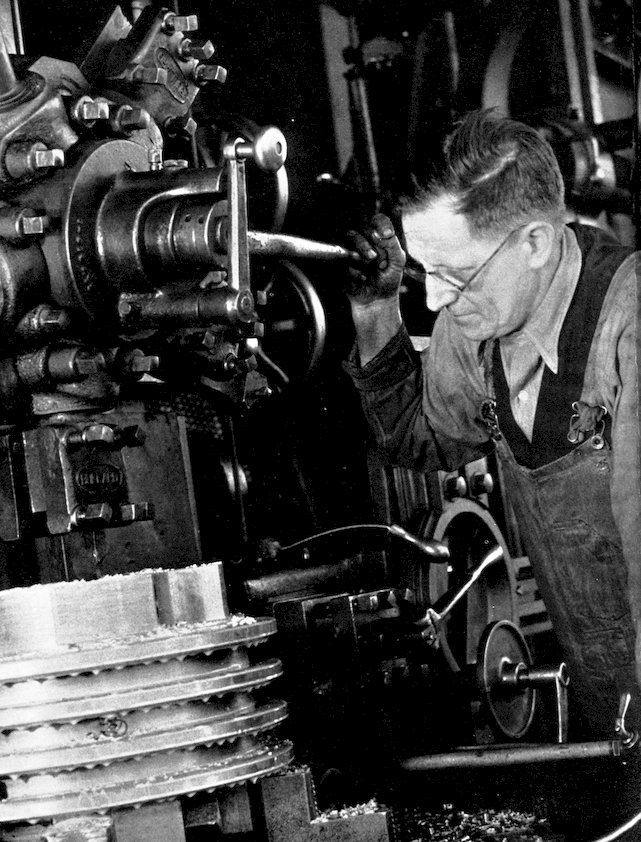
© Robert Dudley Smith, R. I. Nesmith Associates
The Middle Ages in central Western Europe established a similar apt symbol for the religious artist. Europe was a turbulent chaos in material and fact. Yet it possessed in the ideal Body of the Catholic Church a unitary will. It was this marvelous conjunction of material and will in the objective 153world, with material experience and will within the artist, that made possible the success of Dante, of Aquinas, of the Gothic architects, of the polyphonists—a success not equaled in the modern European epochs, whose art has been for the most a wistful echo or a frustrate fragmentation of that last great Synthesis.
The American artist whose will is to join in the tristful litany over the dissolving body of European culture does well, like T. S. Eliot, to live abroad. The American artist who feels within himself the power to add to the intricate glosses of that culture does well, like Ezra Pound or Henry James, to live abroad. But the artist who is tempted to the task of forging new organic life from chaos may bless his stars if America is his home. For in all the world there is no symbol of this chaos so potent and so pregnant as our American jungle.
Moreover, the failure of artists of this high aim heretofore in our land need dishearten no one. It is true that the athletic will of Poe was not supported by a consonant strength of nerves. It is true that Melville broke down. It is true perhaps that Whitman sounded little more than a summons. But failures of a kind so heroic—and all within a century—will, we may be sure, discourage only those whose intimate desire it is, for their own comfort’s sake, to be discouraged.
1925
7. THE MACHINE AND METAPHYSICS
At first thought there seems an insoluble difference between the machine and the tool. The tool is passive in the hand of the workman, and by that fact comes to express his will both intimately and directly. The tool is, indeed, an extension of the hand. The crude laborer has a crude tool 154and does crude work. The subtle craftsman becomes an artisan, an artist: the tool holds close to his nature and works his will in ways so immediate that the instinctive love attaching limb to mind goes over, consciously, into the brush, the knife, the hammer.
With the machine, this alchemy inspiriting a thing of wood or stone is gone. The machine is set in motion and achieves therewith a somewhat autonomous life. Moreover, the nature of this life does not depend upon the man who works it. Its qualities and its powers are fashioned for it and are inevitably determined, at a source to which the machinist has no access. An inventor, abstracted from his products, designs their future acts. The machines go forth. And the mechanic by a series of rote behavior sets them going, runs them, stops them without for an instant coming into creative contact with the thing by which he lives. A crude man may work at a delicate machine: a blind or illiterate man may print a book: a man with no sense of texture or design may run a machine which manufactures lace or turns out decorations. And conversely, the delicate man—the creative man—can find no immediate channel for his will in running a machine. Whatever creativeness or delicacy it possesses has been ordained for it and is aloof. He cannot swerve it from its stubborn independence. All he can do is care for it. Attendant, doctor, nurse—however you look at it, he is the slave of a creation which in its act and its idea remains beyond him.
Now all this is clear enough and from it philosophers deduce our woes, rightly—and wrongly our despair. If this state of things were final, we might forsee man’s downgoing in sterile servitude to a too-exterior, too-permanent grandeur. For, indeed, much of our common misery has sprung from man’s loss of tools which were his own and through which in myriad ways he did express himself. With the tool came 155beauty, because it was a subtly extended and yet obedient hand bringing between subject and object that harmony which is beauty’s norm. With the tool came contentment, because by means of it the humblest worker put his seal on his craft; and came pride and those births of pride—morality and value—since the work of the tool was the man himself, and so must be good, and so must be regarded. Finally, with the tool came fullness: for that man alone is unified and full who has spent himself in self-expressive labor. And by contrast, the man is empty and disrupted who has been spent in labor which excludes his deep co-operation. Thus far the pessimists of the machine are right. But here their rightness ends. Could they look back upon what must have been the experience of man ere he mastered the tool, they might more sanguinely look forward.
The primitive man, wielding an artifact, paddling a dugout or making an instrument of a horse, had to undergo a profound psychological revolution ere this element in his hands, stone or wood or flesh, could become an extension of his personal will. He had to grow. How far he had to grow you can see symbolized for yourself by comparing your own hand with the paw of a dog. The step was inscrutably vast: so vast that once man made it, he dared not look back, and soon he forgot—and still he fights to forget. Who shall say what tragic ages went to the transition? to what insanities and despairs men plunged with the strange tool in their bewildered hands, with a wild horse beneath them? Surely, those unmastered weapons must have committed follies; must have broken the measure of men’s life; must have inspired the wiseacres of that day to gloomy forecasts. We do not know the names of the Rousseaus of these desperate generations in which man’s brain had not yet instinctively grasped the tool. But nothing is more certain than that they existed.
Now, with the machine, we are once more primitive. The 156tool is ours: we have tamed it and made it part of our dominion by a step in consciousness. Before the machine, we are still barbarian or savage even like early man before a horse or a stone. Through a failure to make a certain further step in consciousness, before the machine we are still external.
Of course, there are differences. And it is precisely they which point to a new departure in man’s life. If the machine were merely a more complex tool, there would not be this new element to our exciting day. The machine is a new part of nature: one which did not, like the stone or the horse, exist before. There is in the machine a marriage of what we call the old elements and what we call the human. The domestic animal, in this sense, was a tool: its elements were outside of human nature. In dominating it, as with any other tool, we mastered a part of external nature. And this was comparatively simple, since in our use of the tool we did not come in conflict with any human will. But if we dominate the machine—make it part of ourselves—we shall have won control over a realm of nature which includes mankind; for man’s will, other men’s wills, are constant and determining factors of the machine. We shall have won a victory of consciousness not merely over the nature of the external world—but over our own nature.
The problem was one of consciousness in the days of the stone artifact; and it is again of consciousness today. It is a problem profound as human destiny, inscrutably complex. Yet I think the heart of it can be thus simply stated. The animal, so far as we can see, is incapable of the idea of any part of nature becoming part of itself. Man, with the tool, achieved this: fused unto himself the animal and the stone. Call the process what you may, this attitude of his toward portions of the physical world was metaphysical. And no savage could paddle a canoe without this metaphysical inheritance, made instinct.
157We flounder before the machine, we are features more or less groveling of its external life, because we lack an instinctive metaphysical consciousness to make us master and absorb it—to fuse the machine with all its elements of will and act into our own expression. Such consciousness, of course, must be evolved vastly beyond the childish metaphysics beneath the use of a tool. In the machine are adumbrated the will of the inventor, the will of the owner, the will of many workers, the will, indeed, of an age and of a world. Only when the individual worker experiences that these wills are not alien to him; that these elements of life contained in the machine fuse, in a higher synthesis, together with his own, into a unitary act—only then will his spirit in participation be able to go out through the machine, so that it and the whole mechanized world may once again, in his joy, in his beauty, in his human pride, express him.
But such a mechanic would possess the consciousness of a Spinoza? No less! No less is needed, in order that the human world may not go down before this new Nature—the free-spawning mechanical invention. The modern machine converges with the wisdom of the ages to force man ahead. From India, from Judea, from Greece, from Germany, has come the single canon: that life is unitary, that experience is One, and that the human consciousness in one form or another must know and be this One. The machine will compel us, at this human crisis, to experience what heretofore merely great men have known. The machine again makes metaphysics man’s most practical engagement.
1925