FOUR: SOME PRACTICAL CONCLUSIONS FOR THE SURVIVAL OF MAN
Reading edition
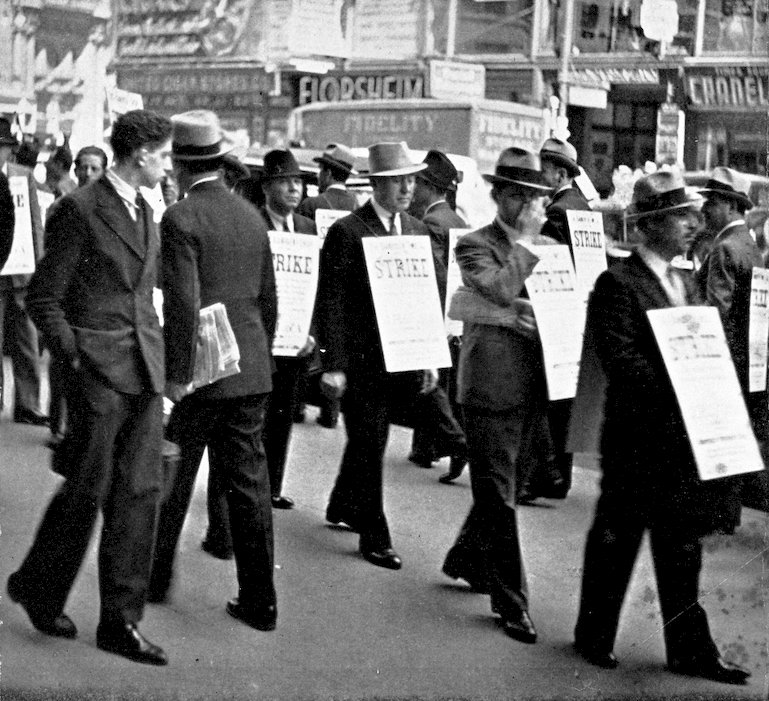
© F. Allan Morgan, A.R.P.S.
231
1. SOLIDARITY IS NOT ENOUGH
(Notes written in the Great Textile Strike of 1934)
a.
At dawn, they are all outside the mills: men, girls, mothers with children. The huge structure, submerged in mist, leaps suddenly with lights; the gates swing open; nobody goes in. The men talk in lively groups, the mothers smile, the girls have put on their glad rags and there is song in their throats. At the doors stand a few guards, glumly. In half an hour, they swing the gates shut and the lights snap out. The crowd of strikers, sure of its strength, strolls up the long flank of the mill, stretches in the morning sun; idles down to the next mill where stands another crowd before shut doors.
The strike has begun gaily. Men and women have joy of themselves in their common purpose, like a young animal discovering the health of its body.
Over on the North Side, before the open gates of a mill stands the crowd of strikers. Half a dozen girls pass forward, their heads low, their shoulders hunched. They are going to work. As the guards let them in, women call after them: “Ain’t you ashamed!”; men mutter angry and then ugly words. The thousand strikers understand the six disloyal girls; a sharp doubt stirs in them all, particularly the women. “We need the money too ... maybe they’re right. Maybe we’ll lose and only the girls will win.... Rent ... milk ... coal ... winter coats for the children.” The strikers are murmuring against their own fears ... the faithful presence of poverty and cold ... which they see personified in 232the six girls. The girls are at work now. The mill has become the form of their betrayal, and of the fear of the strikers. Already the holiday mood is gone.
b.
Fall River molders in the ruins of an industrial era. Small mills, built like castles with Colonial windows and with ivy on the brick, have been abandoned to the sweatshop rats. And the wood houses of the workers have died into festering shanties, the streets rank as rotten teeth. A man climbs the outside stair of one of these dead houses and enters a room at dawn. A mother stands at the stove; three men bend over a mimeograph machine in the far corner; and from two cots four children eagerly look up at the comrade.
He takes a leaflet, reads it, and nods. “Here’s another we need at once.” The children hear the words: “... the independent unions ... because they hate the U.T.W. they won’t come out. We got to show ’em that they must come out. We got to make ’em see, even if the A.F.L. did doublecross ’em, we must stick together....”
The men huddle again over the mimeograph machine. One of them is Portuguese, the first shaft of sun lights his fine hard mouth; another is a French Canadian, lumberly, musical, a Northern spruce walking the world. The man who has come in with the text of the new leaflet is a Yankee with the lantern jaw and gangling limbs of his Puritan forefathers.
“Here, you drink coffee first,” sings the mother.
“No time——”
“You drink coffee first,” she insists.
c.
Back in the South Side of New Bedford, five thousand strikers gather round the bandstand in a park to hear their leaders. Near by the harbor waters dance in the morning sun, 233dance up to the silent shadow of the mills. But a little along there is a line of mills athrob with labor: the great tire-fabric plants called the Fisk and the Devon, which recognize no union and worked clear through the six months’ strike of 1928.
William Batty, chairman of the strike committee of the U.T.W., gets to his feet. He is a burly fellow with a sharp nose and piercing eyes in his red face. He praises the strikers, he praises the President, he hurls his contempt and hate at the “Reds who are trying to make trouble.” One gets the impression, as he talks, that the strike belongs to him and to the other leaders: the workers are accessories and servants. “Leave it all to us,” is the burden of his message. “Washington”—sacrosanct word; “Strike headquarters in the Carpenters Building”—a Temple which only U.T.W. leaders are good enough to enter. The man has power, and has shrewdness. No doubt of that. Look at the heavy shoulders, the thin-lipped mouth. But where does he belong? He is standing on the bandstand a bit above the workers, he is talking a good deal down to them: one hears, in the rumble of his hatred for communists and shop committees, the echo of other voices, more shrewd, more potent: voices of politics and Money.
After Batty comes Ferdinand Sylvia, U.T.W. organizer and local favorite, who is running for State Representative on the Democratic ticket. A little, passionate Portuguese he is, and clever; the hard black eyes are nobody’s fool. How he praises the workers! “I’m proud of you. You’re making history today. We got a great friend in the White House who will help us against the bosses.... All you got to do is stick together. We’ll go back to Washington and do the rest.” There is no personal enthusiasm in the crowd for these leaders. But there is devotion to the cause which these men lead; and above all, there is the will, tense and a little wistful, to believe that they are truly leaders.
234Sylvia speaks of the tire-fabric mills that are still working and holding New Bedford from a 100 per cent tie-up. “Go down and picket,” he cries. “Get ’em all out!” The mass, five thousand strong, moves quiet down the harbor.
d.
A youth with the high forehead of a poet, the Socialist Minister Glen Trimble, starts the picket line before the Fisk and Devon plants. Batty waves the crowd on the opposite side of the street to join; a couple of hundred men, women, girls, are soon patrolling. They are having a good time. They sing “Who’s Afraid of the Big, Bad Wolf” and, in lesser number, the old I.W.W. “Solidarity” song. Down from the windows peer the workers who refuse to strike. In the eyes of some is a defensive disdain: “If I can despise the strikers. I’ll not feel the need to join them.” Others are torn in conflict. Some of the boys and girls look down in veritable terror: not terror at the pickets, but at something in themselves that holds them back ... that makes them fear to join their sisters and their brothers. Fear of their own fear—the beginning of wisdom.
I slip into the office and ask for the manager. He says he’ll talk to me, provided I do not disclose his name for publication (I do not blame him). The same stale line about his “happy family of workers,” and the conscientious refusal to let “outside and alien organizers interfere in our affairs.” “We figure,” he says, “we can run our plant best with our own men. We give better minimum wages than NRA has asked for.”
“But,” I ask, “aside from the issue of wages, don’t you recognize a democratic, an American, a human issue? Labor is struggling to organize, like the bosses and business. Aren’t you working against the American spirit by discouraging your men from getting together? You admit conditions are 235bad in other mills. Why don’t you encourage these workers to help their brothers by joining the same union?”
The managerial eye grows cold and blank; the hands twitch. Then, obliquely: “I don’t get you. What good would it do if these men struck with the others? If one is starving, is it better that two starve?”
I realize the hopelessness of making a class-bound man hear the theme of loyalty and dignity in another class—in the class which he must exploit and degrade in order to survive. I expected no better. But as I return to the town center (while the pickets march) for a bite to eat, I find that the waitress is on the side of the strikers; the barkeep across from the best hotel, mixing me an excellent Tom Collins, says: “Sure, the tire-fabric mills should strike!” and the garage mechanic who fills my tank is warmly and openly with the strikers. This was not the case four years ago at the last great strike. Even a cop on the corner confidentially leans to me and says: “I guess the boys’ve got it!”
Up in the Labor Temple sits a little Scot, Abraham Binns, and runs the works. Dispatches pickets to hesitant outlying mills; phones Washington, puffs his pipe, and wonders, if Federal Relief backs down, where the funds will come from to feed the strikers. A sincere old-timer, he is, with a good eye for the detail of the battle and no vaguest notion of what, really, the battle is about. A thirty-hour week, a minimum wage? Sure! But that a world is breaking and has to be replaced by another lest the heart of mankind perish?...
I ask him about the National Textile Workers Union.
“They’re communists,” he burrs, as if to say: “They’ve got the smallpox.”
The workers think they can force the bosses to abolish the stretch-out. Binns sees that, and he’ll fight for it, too. But he does not guess that what the workers really want is to 236live, and that they must create a new world to live in. What chance has such a leader against Capital, the shrewdly conscious foe that knows, indeed, it is fighting to live and for its world to live in?
e.
Yonder in Hazelwood Park, a young woman is talking: she knows what Binns and Batty have never dreamed of.
It is dusk of the first day. Seventeen thousand of the twenty thousand textile workers of New Bedford have come out; the exceptions being the tire-fabric mills. The talker is Ann Burlak, organizer of the N.T.W., herself a weaver and the child of Ukrainian workers of Northern Pennsylvania. The Boston and local papers have put the spotlight on Ann. She is the “red flame”; she is reputed to be “in hiding in the tenements of the South Side,” and the police announce they will run her in “on the slightest provocation.”
Ann is a tall blond girl in her early twenties. Her body bespeaks tenderness and grace; you feel that, were it not for a stronger love, she’d spend a lot of her time dancing. The firm jaw, the clear eye, the intelligent brow, make you understand why there’s so little time for dancing. On the bandstand, all around her, is a bunch of kids. They frolic about, none too silent, in the way of children; and I wonder how she manages to keep her mind, and her hearers’ minds, on her subject. The local N.T.W. organizer, Walter Burke, has the same concern; and he tries to shoo away the kids. But he is far too gentle about it; the kids refuse to go; and when Burke observes that they are not troubling Ann he gives up. Then it comes to me, that far from disturbing this reputed “fireeater,” the gathered children give Ann Burlak the appropriate setting. Truly, she is speaking for them; of the gay young world they can inherit, if their parent-workers know what they want, and fight for it, and know how to fight.
237How different her tone from the U.T.W. leaders who harangued their crowd from the same stand! Ann Burlak appears to have faith in the workers and to be pleading with them to take hold of their own battle. She has to go easy. If she tells them straight what their leaders are up to, dickering with politicians and capitalists, they will scare. If she tells them straight what her motherly heart is full of: that the bosses cannot lose under capitalism, that the workers under capitalism cannot win, they will turn pale, and glance about them and cease to listen. It is a subtle task, this leading of the ignorant American workers to the realization of their own needs, of their own powers, of their own nature. And Ann Burlak does it well. Gradually, unobtrusively, she draws her hearers to the facts about “arbitration,” to the shortcomings of the U.T.W., to the single devotedness of the slandered “Reds.” The men and women listen. They have come, many of them, to have a look at the “red flame”; a good show for nothing. “They say she’s hot stuff,” explain the boys in the bench before me. Curiosity and frivolity fade, as the tall young woman gives her sensible heart and her motherly mind to her hearers. Mothers find themselves face to face with the truth: the bare cupboards of their homes, the bare bodies, the bare futures, of their children. Men see with their eyes what for long their hearts, despite the palaver of journal and politics, have known: that they, the workers, live in an enemy country! Latin, Slav or Yankee, they live in a land possessed and ruled by foes who are sworn to exploit and to degrade them.
At the close of her pleading to the workers to know themselves, to respect themselves, to be themselves, Ann Burlak tries to lead them in song. The men and women pitifully follow. And I am minded of the singing at a camp meeting which I recently attended. How the words rang for Christ’s 238second coming! Surely, had Christ been in his heaven, he must have answered these splendid ringing voices. And the thought came: When the workers of America learn to sing the coming of their world on earth as their fathers, the Christians, sang for their world in heaven, the Revolution will not tarry.
f.
It is midnight, after the first day. Around the Fisk and Devon mills, gravid with lights and labor, stand battalions of police: the comparatively kindly town constables with clubs and the sinister khaki-clad motor-cops with guns in their holsters and tear gas in reserve. On the park side are massed the strikers, a good ten thousand. Glen Trimble harangues them.
“They won’t let us picket? We’ll see about that. All of you here at the crack of dawn. And when the workers file in to work, we’ll have a picket line for them to pass through.”
A Negro in the crowd, in a quiet penetrant voice, says: “Why wait till tomorrow? Why not picket now?”
The crowd turns toward the mill; Trimble accepts the challenge. The police clubs stop them. The picket line halts, wavers, turns. And its repressed energy gathers in hands behind. Stones fly from the park side, and smash the mill windows. The police press forward.
Seven hours later, huge shut vans roll up to the red buildings and disgorge officers. Far off, beyond an empty lot, fully a fifth of a mile from the mills, stands the crowd and boos as the tire-fabric workers pass through to their jobs. Near the gates, they form hesitant knots. A man stays behind, while his wife enters. A girl looks up at a bevy of her sisters beckoning from a top mill window, grasps her bag and joins them. The police, guns swinging, slide across the empty lot, and the workers fade in the grey background of the harbor.
“There’ll be no picket line,” shouts the police chief at 239Batty and Sylvia. “We had enough last night. Look at them windows. Just you let your men come up, and we’ll take care of ’em.”
But while the clubs and the guns mass at the Devon side of the huge block, and the crowds die before them, another corps of workers comes to birth on the farther slope of the mills; a line forms ... marches.
The sun rises, the mill throbs. The clusters of hesitant workers have vanished, either inside to the machines or away. Suddenly, a gate swings open. The crowd rises in voice: “THEY’RE COMING OUT”: and forward, four abreast, march the Fisk workers to join their brothers and sisters.
Sylvia crows like a cock. “I’m proud of you!” And to Mary Vorse and me: “Tell ’em in Washington and New York, New Bedford has the world’s best workers.” Even the cops smile. The walk-out is 100 per cent. Now what?...
I think of the heroic tiny groups of revolutionary organizers throughout the nation: individuals, isolated, threatened, resourceless save for their own luminous spirit. Pleading with the workers, against the workers, to know themselves, to be themselves, to fight the good fight; while the official leaders and the pack of papers and the towns and the churches vomit their fear of the new world in the form of insults and lies. Workers, like everyone else, get the leaders they deserve. The workers are pitifully ignorant. Ignorance is the mother of misleaders.
I think of the great show of strength that the Textile Strike—like San Francisco yesterday—has summoned. And, while Ignorance is in the saddle, of the inevitable betrayal!
When the American workers know what they are, there’ll be a different story.
That is the task of all young men and women: let thousands, each in his own way, go among the people, and humbly, 240quietly explain the cause of Life, which is the cause of Revolution.
Solidarity is not enough.[13]
2. WITH MARX, SPINOZA....
a.
This essay would not have been written at this hour had it not been for the dark hour of the German Jews. But their catastrophe is the deepening, within the crisis of the world, of a threat that for two centuries has gathered against Jewry. Judaism has never solved the challenge of the modern world; and this challenge is now a crisis—one of those historic crises from which Jewry must be reborn, if at all, through the threshold of death.
I do not stop to swell the lamentations that the fate of half a million highly cultured Jews has aroused in all sane people. My object is more stern. It is to analyze the response of the Jews in the United States to Hitler: to expose and study from the response certain traits of modern Jewry. There has been, in all the tears and rage, one constant refrain. “Why are we persecuted?” cry the leaders. “We are not different from you Gentiles—not in any point of thought, conduct or allegiance, that counts. In Germany, we are good Germans; in America, we are good Americans. There is no reason for this persecution.” Now, Jews have often suffered persecution; although I suspect never by such ruthlessly efficient methods as the German. But Jews have always known why they were maltreated. It was because they were different; in thought, in conduct, in allegiance, in all that counted, a peculiar people. It was because they were Jews. 241This might cause great sacrifice. But since Jewishness was the treasure of their lives, source of their beauty and joy, they deemed even the price of persecution not too great to pay for being Jewish. They took the persecution for granted, meeting it as shrewdly as they could. The stress of their energy and will was focused, not on avoiding or denying reasons for persecution, but on being Jews. Here, then, is an enormous difference. For the first time in a history of three thousand years, the leaders of Jewry do not know why they are persecuted: for the first time they disclaim any reason for persecution.
This sheds new light on the German Jewish disaster. Are these half million victims to be considered undifferentially as suffering human beings? Then they deserve no more pity and help—no more and, of course, no less—than the millions of other sufferers of our dark age: than the Negroes of our South, for instance; than the countless families broken by unemployment; than the communists whom Hitler and the Balkan sadists are torturing and maiming. But such pooled pity does not satisfy the Jewish leaders. In their appeals and reports they are careful to separate their cause from others. They imply that German Jewry calls for more than its quantitative share of the concern of a world riven with anguish; they assume, indeed, that a great people, whose value to mankind is high, is being menaced. Now this claim, on the evidence of the past, can be denied by no intelligent man. The Jews have through the centuries made contributions to the Western world that are inestimable, and organic. But are not the contemporary leaders confused in time? Should the Jews be saved today for what they were in the past? Such a plea runs counter to all natural law. What is there alive in contemporary Jewry to distinguish it from any other quantitative group of human beings?
The answer, alas! is, there is nothing. There are still, it is 242true, traditional Jewish communes in Eastern Europe and North Africa. But we do not hear from them; they provide no Jewish leaders. Indeed, the modern world no longer gives them nurture or function, and they are doomed by their own archaic form. The Jewry that protests against Hitlerism and is menaced by it the world over, and that assumes its past worth as argument for its present survival, is a “progressive” Jewry, freed from that past. It is the Jewry that cries: Why are we persecuted? Let us examine it, then, for Jewishness—and in its most prosperous member, the Jews of the United States.
First, I must define the Jew; and this, fortunately, can be done without raising the old problems of race and nation. To be a Jew has always meant to live a certain way of life: a way which, evolving with the ages and with the cultural-economic conditions of the lands, was yet an organic growth from a single tradition. This tradition was one; and the Jewish groups made it organic with their lives. Other nations had prophets, the Jews enacted theirs. Other nations had arts, the Jews lived theirs. Other peoples had high standards for personal, communal and cosmic relations: the Jews, by the minutiae of their 613 commandments, made flesh and bone of their vision of the divine and the eternal. The defining Jewish trait is unification of values, personal and communal, into an organic body of behavior. The defining Jewish term is action.
The Jewish principle—unity of value and deed, harmony of person and group—has always had a dual form. That the values of the person shall be fulfilled in the community, there must be social justice. And that within the cosmos there shall be preserved and furthered the values of men and of Man, there must be God. Social justice, of course, was an aspiration limited by the economy of the particular land and era—limited, that is, by possibility. What did God mean to the 243Jew? At first by miracle and confusedly, then rationally, God meant the dynamic immanence, in the world of matter and of man, of what the person most deeply recognized as his own truth and worth. God meant the principle of order, the will to unity, in an otherwise chaotic multiverse. God meant value in Being. The Jews, as a people, were the first to understand that this Value-in-Being could not be abstract, not diffuse, not impersonal, although it transcended individuals; but was myriadly focused and fleshed in human lives. This means that for the Jew every man and woman holds a purposive and creative place in life’s dynamic process.
Now, bearing this definition in mind, where—outside the vanishing Old World ghettoes of our East Side—are the Jews? Where in New York, in Cincinnati, in Chicago, in San Francisco? The American Jew is as divided in his ideals and his behavior as any Gentile. His amusements and his arts, his family life and his business methods, his loyalties to class, state and God, are the same tissue of contradictions. Like any Gentile, he scrambles for the dollar, lives for his belly, shares in the stampede for cheap delights. As businessman, he also exploits his brother; as citizen, he votes for the same liars, crude or gilded. He shouts the same chauvinistic phrases and is ready, with the rest, in time of war, to rush with the courage of Gadarene swine to his destruction. He enjoys (and writes) the same inane novels, movies. In a society whose crucial trait is the abyss between ideal and deed, he—the Jew—is indistinguishable from his neighbor. Is the “Jewishness” of these modern Jews a dynamic pattern of action? or is it a mere moldering heap of sentiment, vanity and habit?
I am speaking of the prosperous American Jew; not yet of the rank and file, the humble clerks and clothing workers, artisans and mechanics. These, as Jews, are passive. And in so far as they have Jewish leaders to make them act (as contradistinguished from labor leaders, for example), they choose 244the very type who have grown great by shrewd collaboration with a world that is the antithesis, in every value, to what is Jewish. This is a cardinal point in the lethal condition of American Jewry. Its leaders and spokesmen, in their loyalty to the exploiting class, have dangerously identified the Jew with a bourgeoisie that is degenerate and doomed. In the Middle Ages, the Jew was allied functionally with the rising burgher class whose destiny it was to break the feudal system. This alliance was one reason for the Jew’s survival. But burgherdom, in medieval Europe, played a different moral part from the grande bourgeoisie of today. In the realm of practicable action, the burgherdom stood for social justice and intellectual freedom, as against the exploiting landowning gentry and the landowning church. Technically, the profit system always meant exploitation of labor. But socially, this early bourgeois exploitation was in the direction of justice, since it was a departure from slavery and spread the margin of leisure whereby man’s culture could alone advance. Until the invention of the machine, some exploitation of men was needed in order that a privileged portion of mankind could think—and at last, by perfecting the machine, and spreading possible leisure to all humanity, abolish the need of human exploitation altogether. The alliance of medieval Jewry with burgherdom was therefore within the rhythm of advancing social justice, and hence harmonious with Jewishness. But today, the dominant bourgeoisie is the power of stratified social injustice: it is the power of war, of spiritual death and intellectual ruin.
The intensity of American Jewish allegiance to the exploiting class can be measured by the lives of the prominent Jewish leaders.
Almost without exception they are lawyers, judges, merchants, bankers, proprietors of newspapers and other vast affairs; men who have grown great in the American game of 245grab, men indistinguishable in spirit, mind and action from thousands of other divided men who (with like shamelessness) call themselves Christian. In a few instances, they are writers and rabbis—apologists, rank or subtle, of the exploiting classes.
Since their deeds are contradictions of their ideals, are such leaders Jews? Is a folk that such men lead, a Jewish folk? From the Jewish premise that value and vision must become action, a trait of Jewry has ever been to create true Jewish leaders.
But it may be said, there are other Jews, greater than these: not necessarily American, yet the real leaders of Jewry. There are Albert Einstein, Sigmund Freud, Alfred Stieglitz, Henri Bergson, Leon Trotsky ... others. These men are great, and are leaders, and are Jews. But they are not leaders of Jews. They are leaders of scientists, philosophers, artists, revolutionists. They and other great Jewish men of our times are products of Jewish life; but modern Jewry cannot claim them. They are the offspring of the old communal Jewry which still existed in their formative years. And the fact that they have been forced to function quite outside modern Jewry is another proof of its present dissolution. The Jewish world no longer holds its men of genius; the highest products of its spirit, of its intellectual discipline and of its sense of life, leave the parent body. And the world of Jews, in deadly division from the Jewish spirit, chooses leaders who hasten its death.
Consider now the pitiful, the ironical condition of the Jew. To suffer for a cause that our soul loves is bearable: is, indeed—since we must suffer—man’s most enviable destiny. But to suffer for nothing! To be hated and ruined as a Jew, when one’s life is not Jewish! The Jews of Germany, taken as a whole, exist inertially because their past way was 246Jewish and because it takes more than a generation to destroy a way of life so strong and so vital. If two hundred years ago, they had ceased living as Jews, Hitler and the Nazis, who are ignorant men, would probably not have heard of them. Hitler persecutes them now because in a confused way he has inherited what was a real reason, then, for a German in revolt against Western civilization to dislike real Jews who had so much to do with its creating.
But that is only half the picture. The Jews are allied with an agonizing and desperate middle class. When that class flourished, the Jews, functioning in it, were tolerated by it. Now that it droops and its spoils dwindle, it turns—like a man in a panic—against its weaker neighbor. It is the principle of “every man for himself”—the basic law of bourgeois life. Oh, the ironical confusion in the fate of the modern Jew! He is persecuted by barbarous and desperate men because of ideals that he no longer lives: and he is persecuted by a class to which, in the main, he is loyal, because he is a rival of its barbarous way of life—a way that contradicts his own ideals!
This is Germany today: who doubts that with variations it may be America tomorrow? that it may be any capitalistic country where the Jew, in his present, is a minority factor in a desperate middle class and in his past a reminder of the liberal culture of the Western world, against which that desperate class is in revolt?
b.
Now for the final questions: How can the Jew survive in the modern world, and why should he survive? To answer clearly, I must first state some of the reasons why he survived in the past. And since the kaleidoscope of Jewish generations is so great, I take the latest period of undisputed Jewish health: the Middle Ages (which lasted for the Jews until the eighteenth century), when the Jews lived, harmonious and whole, 247within a Europe of violent divisions, and often savagely hostile.
1. Jewry’s strict unity of ideal and conduct made the community, although small and surrounded, an efficient body. All its energy was conserved for itself and applied functionally for survival; whereas in a greater community where value and deed are divided, there is conflict, loss of energy, disease.
2. In Judaism, both ideally and actively, there was no separation between man and group. Although infiltrations from Alexandrian and Platonized Egypt corrupted the ancient Hebrew knowledge that there is no personal immortality, this superstition of a surviving individual soul (the deepest cause of the failure of European cultures) was never strong against the healthy Jewish unification of individual and commune. Therefore, medieval Jewry had no destructive egoism—no “great men”—to mislead it for discordant personal ends. (The egoistic leader battens on the accumulated egoisms of his rabble.) In Jewry, the leaders were as organic to the commune as an eye or a brain to the body. Moreover, these leaders were not soldiers, not megalomaniacs of fame and money: they were the seers and the thinkers. Here, then, was a social body whose eyes and brain literally led it—in contrast to our modern world in which the eye and the brain often appear to be discards or decorations.
3. Jewry had, despite theological and cultural differences, a deep community of values with Christian cultural leaders. These recognized the worth of the Jewish ethic; the beauty of the Jews’ concept of Godhead as immanent in human action. The best in Christian Europe at all times respected, and often learned from, the “hated” Jews. And during the ages when the church was strong, it had enough influence to defend the Jews against extremities of persecution.
4. Through these times, Jewry had an economic function. Its activities in international commerce, banking, exchange, and in the practical sciences of communication and of navigation, did a necessary work in feudal Europe. And this allied Jewry with the struggling middle class—the burghers who were to inherit and transform feudal Europe. Without this function and the alliance with a rising economic class, Jewry’s inner harmony of action could not have saved it. For there would have been lacking a 248harmony of function within the larger body of the Gentile world.
To return, now, to our time; the Jew obviously can survive, if the immutable essence of the Jewish social organism can somehow be transformed to function in the modern world. And obviously, the Jew should survive, if this essential Jewish nature still has a part to play before mankind. These questions are the subject for a book—which I shall write, if I live long enough. Here, I can but sketch my answer.
The Jewish principle of value-in-Being, of God and social justice, of the enactment of value by individual and group, did not exist in vacuo. It existed within a matrix. And this matrix was the agrarian economic-cultural world—a world so basally static that the eighteenth-century Galician Jew shared it, fundamentally unchanged, with Amos and Isaiah. So long as the matrix held, the Jew could follow the commandments of his prophets as interpreted by twenty centuries of fathers.
We may now see why the Jewish organism broke in the impact with the modern world. Modern industrialism destroyed the simple, paternalistic economy under which the Jewish commune approximated social justice. And modern thought and science corroded the theologic-ethic form under which the Jew knew God. To survive, the Jewish principle must be transfigured into modern terms. Judaism must embrace an again workable program approximating social justice: and that means the unequivocal destruction of the unjust anarchy called industrial capitalism. And Judaism must redefine what it has always meant—or meant to mean—by God.
Now, let the reader answer: Is the principle of social justice needed today? And that Man may live, must there be, not an anthill system, but a living social form that nurtures the inward need of every human being to create and to share 249his inward vision and value? If your answer is Yes, then there is need in the world of what has been, for nearly thirty hundred years, the Jewish principle. And as if history urged that this cardinal dual need of the world may yet be the peculiar business of the Jewish people (there have always been, in all nations, saintly and isolated men who lived and died for it, as greatly as any Jew), the need stands most forcibly answered in the work of two Jews—Jews of a “new remnant,” Marx and Spinoza.
I place Marx first, because in the perspective of function he comes first—although Spinoza lived two centuries before him and profoundly influenced his thinking. Marx, from the Jewish premise of history as an organism evolving toward “good,” has given to the industrial world a realistic logic and a technique of social justice. Time, of course, has amended or refuted many details of his plan; yet it is nonetheless categorical that every man who wants to enact social justice in the modern world must be a Marxist in spirit although he may reject certain Marxist dogmas. The modern Jew, if he is to exist, must interpret Marx as a prophet as surely as his forebears interpreted Moses and Isaiah. Marx (despite chronology) comes before Spinoza, because the social discord is a disease immediately threatening the survival of civilized mankind; and because collective consciousness comes before mature self-consciousness. Marx without Spinoza is an imperative, immediate, primitive first step in action. Spinoza, without Marx, remains an abstract philosophy, removed from possible action.
But as Marx is the man who most surely projected the prophetic aspiration of social justice into a workable modern program, Spinoza is the prophet who has completed the purifying of the knowledge of God into the God of inwardness, of substance and of action. If Marx carries on Moses and Ezra, Spinoza carries on Isaiah and Jesus. It is he who has 250best established the organic being of God in matter and in human thought; who has made rational the ancient mystic intuition that the cosmic dwells within the man in so far as the man grows self-conscious. By giving value to matter in a form acceptable to the age of science, Spinoza will crown the work of Marx, who gives reality to a program of social justice in the age of machines.
Now, it may be that Spinoza and Marx are the swan song of Jewry: the final message of a great people before its ultimate death. It may be that the work of unifying and enacting their contributions shall fall to other peoples. There is a Soviet Union in the world, and China, and the two Americas; from such virgin soil may come the fulfillment of the prophets. I do not know. But I do know that, if the Jew is to survive as an organic group, he must enact his modern prophets as his fathers (after rejecting them, also) enacted the prophets of Scripture. And I conclude by broadly sketching what the modern Jewish way of living must be.
To begin with (for, I repeat—in the field of action, Marx comes before Spinoza), the Jew must renounce loyalty to the exploiting class. Without that, all his “service” is a “vain oblation.” Today, as twenty-six centuries ago, the word of the prophet is true:
Bring no more vain oblations;
It is an offering of abomination unto Me;
New moon and sabbath, the holding of convocations—
I cannot endure iniquity along with solemn assembly....
Cease to do evil;
Learn to do well;
Seek justice....
“Learn to do well!” In our industrial world, this means active allegiance to the class whose historic function it is to abolish economic exploitation—the base of social injustice 251and of war—by doing away with economic classes altogether. This new allegiance will not be easy; since the Jews for centuries have been forced to earn their bread within the middle class, it will have the value, by itself, of a religious conversion. But this new loyalty as a group does not mean that the Jew will be submerged in the working class or in any proletarian body like the communists. He must fight for the workers (and the farmer and the intellectual, too, are workers), help them with his brain and body; but he may be detached from them, at least at present, because of his particular stewardship of values—“the realm of God,” in each man, with which the harried and hungry worker has not had time to grow familiar.
The revolutionary proletariat cannot trouble about God. There are good functional reasons for the atheism of most Marxists. The word “God” has been monopolized so long by the apologists of the class of exploitation: theologians, philosophers, poets! To detach (as Spinoza did) the reality in God from all the accumulated lies is a problem that calls for subtlety beyond the present anguished state of the masses; for energy that the masses and their immediate leaders cannot spare from the day’s struggle. It is unhistorical to expect the active revolutionist of our time to do more than reject the false “God” of the churches and the synagogues. Yet the true experience of God must not die even in the heat of revolutionary battle. The first Marxist ends cannot be won and man be raised from animal penury and fear into the human stage of security and leisure unless the individual finds life good: and this can be only through the Spinozistic sense of God. The experience of the divine in mortal life must be preserved. Wherefore, there is need today of a people, scattered through the nations, that know and nurture the experience of God. By the tradition of ages, by their ancient 252prophets and their modern thinkers, the Jews have inherited the challenge and the right to be such a people.
This Jewish “remnant”—and only the remnant, through the ages, has preserved the Jew—will be loyal to the class of social revolution; but through its consciousness of God it will be still separate, and must remain so. It will understand the functional “atheism” of many simple-minded revolutionists, and not demand that it be understood in return. The God in man will be the still secret treasure it must lovingly preserve against the day when men, free of fear and hunger, learn to look within themselves where God is. Thus, the Jews will still be a peculiar people. And they will be subject to the dislike and distrust of the zealot for whom the word “God” is anathema; although it was in the name of God that his values of social justice and individual dignity were preserved and prepared, through the barbaric ages.
Now, a majority cannot rise to so high a challenge of rebirth. Bankers, merchants, lawyers, professional men and politicians, even artisans and mechanics among the Jews, will not yield their old allegiance to the middle class, although that class turns (as it is turning!) against them. And these will disappear in the general human welter, as Jews have disappeared in Assyria, Babylon, Alexandria and Rome. But what a magnificent remnant there may be! The teacher, the doctor, the engineer, the clear-eyed man of commerce who knows and hates the rottenness of capitalist commerce, the Jewish worker and the student—above all, the Jewish student! Already, these are on the side of the productive class that alone holds the energy to remake the world. Already, they accept Marx. Let them fulfill this knowledge with devotion to the inward value—the God whom Spinoza has explored in man and in matter—and there will be again, in the world, a Jewish remnant!
253Persecution? It is already here, even in America; and as the capitalistic era shrinks, darkens and despairs, it will grow worse. The lesson of Hitler, in offering the Jew as the traditional scapegoat for the accumulated rage of a bewildered people, is bound to be learned; already we have our little Hitlers, profiteers of suffering stupidity and blindness. The Jewish people are going to suffer. And for those who are individually and innocently hurt, and who know not why, there can be no soothing words. Before their anguish, we can only bow our heads, humbly, as they enact the world-old mystery of pain. But at least, for the conscious Jew, the real Jew, there will again be reason for Jewishness, reason to bear his persecution; and comrades to help him bear it. And if individual Jews die, their death will be in the cause of humane life; no man can ask a higher guerdon. And the history of the Jews will hearten them with knowledge, that when a people is ready to be persecuted and to die for a good cause, the cause lives—and the people.
Postscript:
This article, which appeared in “The New Republic” in 1933 and was reprinted in many journals, is itself an abbreviated form of an essay published in French by “Europe,” of Paris, and in Spanish by “Sur,” of Buenos Aires. I have used it here, rather than the longer version, because both are a project or programmatic abstract of the essay I must someday write, in which all the terms of my argument will be more fully and fundamentally defined. Recent attacks on socialism and communism by prominent Jews—rich men, shallow, slavish, scared, of the kind I have described, or by truckling labor leaders, make the writing of this essay an imperative duty.
I trust it is clear in my conclusion about the possible leadership of a Jewish “remnant” in our recreative task, that I have not mentioned the like necessary role of a Christian “remnant,” only because this paper deals specifically with the Jews. That the prophetic-revolutionary strain is not dead in the American Protestant churches is proved by the labors of such men as Reinhold Niebuhr—one of the truly creative minds of America.
254
3. FROM MANY MESSAGES TO MANY PEOPLE
i. War Is with Us Now To the First United States Congress Against War, Held in New York, 1933
Two thousand delegates from every part of the country, and of every shade of progressive opinion, are meeting in New York in a Congress Against War. A most laudable enterprise; and a most needed. For war threatens the world; and with war, civilization, still staggering from the blows of the last conflict, may definitely founder. The crisis is immediate and tragic. But no congress of good men can avert it. All that this congress can do is to bring men’s consciousness to focus upon the present danger; and to raise men’s consciousness to the pitch of intensity where it becomes action.
Before everything else, we must become aware that war is already here! The political and economic setup of the modern nations IS war. Battles on land and sea, millions of lives destroyed, cities and fields laid waste, are but a concentrated form of the jungle anarchy that is called “government” in the metropolis, that is called “diplomacy” in the embassies, that is called “business” in factories, mills, mines and markets.
So long as we have nations playing the lone game of power and aggression, or banding together like packs of wolves in “alliance” against other nations, we have war—war in peace. And all the congresses of the world will not prevail against the inevitable, periodic outbreak of this constant war into pitched battles.
So long as we have a social system within each nation that divides the citizens into classes whose economic basis is 255exploiter and exploited; a social system in which success means power gained at the expense of others and enjoyed to the exclusion of others, we have war—civil war in peace, within each nation. The small ruling class is brutalized by its success in enslaving others; the large classes are brutalized by their slavery—brutalized the more if they are not conscious of enslavement. In such a social system (and all the “planned economics” of capitalism can only make it more dangerous by disguising it), it is inevitable that the state and the nation will reflect, on a large scale, the jungle spirit of individual men. It is inevitable that the jungle greed of such a state and nation will come into conflict with the greed of other nations where the same system prevails. It is inevitable that this normal state of conflict shall break out, from time to time, in formal warfare.
But our present condition of war is even deeper! So long as war prevails in the internal economic structure of each nation, it will prevail as well in the internal psychic structure of the men and women who constitute the nation. A society that is a rationalized jungle of greed and violence, encourages the lust for individual power in all men and women and atrophies the social instinct in all men and women. The members of such a society war upon each other in their individual lives: and each individual soul is itself the seat of warfare. Of course, such divided men band together in gangs, classes, nations, to make war upon other gangs, classes, nations.
War has been the constant condition of what we call civilization. War between individuals, war between classes, war between peoples—each seeking profit and power at the expense of others. But there is a new factor in the situation of today.
Modern science has made war deadlier than it has ever been: so that war now threatens—not only persons and individual 256nations, but all mankind. And this new factor of science, by its potentiality of large-scale production and co-operation, has also made the old systems of exploitation and rivalry no longer needed.
This is the crucial state of the world—its mortal danger and its hope. War, as never before, is a menace to human survival. And war (military, economic, social war) has been made unnecessary, as never before, by our modern mastery of means of production, distribution, communication, whereby it is feasible today for all men to live in plenty and with leisure, without enslaving or exploiting others.
The United States Congress Against War represents a good impulse. But men’s protest against war is not a new event in the so-called Christian world. It has been futile, throughout the ages, because war was organic in men’s way of living. Similarly, this congress will not pass the limits of “good intentions” unless it writes down formally in its record that the abolition of war means revolution. Fundamental revolution. Revolution in the social structure of the nations, and revolution in the souls of men and women.
ii. To the Students of Cuba (April, 1931)
I am following with deep emotion your struggle to renovate—indeed to re-create—the life of Cuba. I am poignantly aware of the terrible dilemma that confronts you. Your government is the slave of irresponsible financial interests of the United States, and of the State Department at Washington which with cynical hypocrisy is launched on a deliberate campaign to imperialize the entire Caribbean. If your prostitute government remains in office, Cuba will continue to 257be a “factory” for American investments, a “factory” protected by no laws such as limit exploitation on American soil; since you Cubans are not citizens of the United States and your political “independence” more and more is coming to mean the privilege of our exploiters to work in your country with a ruthless irresponsibility which they would not dare to display in their own. Yet, if you overthrow this government, it may mean the landing of American marines in Havana and the swift setting up of a new rule which will be the replica of Machado’s—the other horn of the dilemma!
What can you do? What can a citizen of the United States urge you to do? In a way I am ashamed to speak to you, ashamed to mention my own sorrow and my shame, as a native of the oppressor country, who is helpless to help you. Men like myself in the United States are powerless. There is no enlightened public opinion here with any punch to it. Most of our good will is Platonic, in the bad sense of the word. And who, here, is interested in a students’ revolutionary movement? Our intellectuals, as a body, have lost contact with the spiritual, the human source of art; our student groups are too pampered and too infantile to get excited over anything but football.[14] You are alone in your fight, alone with the student bodies and the workers of other Hispano-American countries who, for the most part, are as dispossessed as you. You are alone with the truth!
Yet I can say to you: Go on! If for no other reason, go on because only then will you be happy. Do not let so-called practical affairs and worldly wisdom compromise your ideal. Look at the men who have made these “necessary compromises”: the successful men, the rulers of the world. See what ugly, misshapen, miserable men they are. Look well at the “practical” men, and do not go the hideous way which 258they have gone, and of which the ignoble shambles of the modern world is the result. Even if you are imprisoned, even if you are shot down (as some of you have been), you must have the satisfaction of knowing that you are living the sole way that makes life tolerable. The enemies who have sold themselves for dollars are not happy; the indifferent ones, in Cuba, in the United States, who follow opportunism—for success, for pleasure, for power—are not happy. They must drug themselves with ever more success, more pleasure, more power, lest they awake to the intolerableness of their way of living. And that is why they hate you: because you are the constant revealers to themselves of their own nullity. They must deny their nullity; and by a common psychologic mechanism they do so by denying you who make them cognizant of it.
I cannot promise you success in your present endeavor to free Cuba and to bring Cuba to real independence. It would be false to promise it. You may not succeed in actually overthrowing the hideous anarchy of which men like Machado are mere minor servants. So to do requires more than your good will; it requires method, technique and long hard work. But this triumphant method can come only from such will as yours. Before you achieve it, perhaps you individually will be crushed, since the ordered anarchy and greed of the modern world has method. But even if this is so—this worst which must be bravely envisaged, it makes no difference in what you must do, not merely from a sense of duty, but in order to be happy! You must go on struggling to free and to reorganize your country; knowing that that labor is its own reward; that the man who gives his life for freedom, by that fact is alive and is free.
You know that your problem as Cubans struggling for independence is not apart from that of most of the other nations of America Hispana. Yet you are divided from your 259allies, not alone by mountains and deserts and seas, but by proud persistent nationalisms, by differences of race and culture—the differences of Indian, Negro, mestizo, criollo. You are all rich in plunder, and the imperialist power feeds on it the better by exciting the disunities between you. But you are profoundly gifted peoples; your resources of the spirit are as great as the resources of your lands—greater, surely, than the difficulties inherited from your historic pasts. You will help yourselves and one another, synchronously, by deeper self-understanding. For brothers who fulfill themselves achieve thereby not homogeneity, but harmony. Without harmony, both your lands and your cultures would be taken from you. But you are already far on the way to achieving this organic unity among you, in cultural terms and in terms of political aspiration.
The imperialist power exploits you and incites you to fratricidal war, because it has allies within your borders: your own capitalists and their servants, the politicians. If you effectively fight the domestic enemy, the foreign enemy will at last be helpless against you, even as he was helpless against revolutionary Russia. I know that your task is more complex than was Russia’s, because you are not politically united. But, essentially, it is one problem.
And it is our problem, too. We in the United States fight the same foe as you. This, when we attain a conscious intelligentsia and a conscious working class, will serve to unite us.
Only from the platform of War Against Capitalism can you effectively meet your national problem. For your foe is only superficially an alien government; more deeply it is the capitalist power with its twin heads: the Machados at home, the armed Dollar abroad. Most deeply, it is the ignorance of all the people—in Cuba, in America Hispana, in the United States.
260Students of Cuba, you have come out into the clear air of action; you have created leaders for yourselves, and a program. You are blessed in this. I find myself almost envying you, rather than pitying you despite your anguish and your struggles. My heart and my mind are with you. If I could feel that my word warmed you in the slightest degree, heartened your perseverance, it would be for me an inexpressible joy, who am alone here in this great country—alone, and unable to act for and with men like you who stand for everything I cherish.
Note: This is one of many messages by the author clandestinely introduced, printed in pamphlet form, and distributed, in Latin-American countries under brutal dictatorships. It has been re-Englished from the Spanish text.
iii. The Touchstone on the anniversary of the October Revolution, 1935
More than ever, in this day of spiritual and social confusion, the attitude of men toward Soviet Russia is a touchstone of the quality of their good will. By this criterion three large groups stand forth.
There are, first, the enemies of the Soviet Union: and these are the souls whose true love, despite all their fine words of God and Man and Freedom, is for their pocket-books. Their real nature is manifest in their leaders, archetypes of human ugliness and degeneration—the Hearsts, the Hitlers, the Hoovers. A second group consists of the “liberals,” the “socialists,” the idealistic “revolutionaries” who are so busy deploring the mistakes and injustices committed in the Soviet Union that they have no time to understand or to defend it. These are men (when they are sincere) so infatuated with their own private notion of what truth and justice should look 261like that the spectacle of a great nation, heroically serving truth and justice with the humble tools of humble human nature, leaves them cold. Essentially, these are men devoted to their own egos: men whose professional love for mankind masks a childish and shallow and ill-tempered self-adoration.
The third group consists of those who know that in the Soviet Union a people is dedicated to the task for which in all ages the inspired few—the prophets and the poets—have given their lives: the task of founding upon earth, at last, a culture not of slaves but of men, a society of universal justice, in which human truths shall be sought and expressed by the common and communal life of all men and women. They know that this people consists not of gods, but of humans. They know that this people must meet and overcome, in their great undertaking, the obstacles of a hostile world and, no less, the obstacles of their own enslaved past and of their faulty natures as human beings. They know that the labor of the Soviet Union is the more precious because it is the work of humble men and women, subject to trial and error; and that those who reject this labor because of its failures and imperfections are at heart cowards. They know that if the dark years, in which we have lived since the Great War, shall appear in the perspective of history as the time of a great Dawning, the reason is the light that has come since 1917 from Russia.
These sincere men and women, today more than ever, while the clouds of aggressive ignorance and ill will gather upon the world, must declare their devotion to the Cause of the Soviet Union.
262
iv. To Romain Rolland on His Seventieth Birthday
Your seventieth birthday comes at a time when France holds in her hands the immediate destiny of the Western world. The result of the struggle for power in France between the elements of reaction typified by the Croix de Feu, which are the forces of death, and the elements of re-creation typified by the Front Uni, which are the forces of life, may well determine the result, at least as it affects those still living, of the same struggle throughout the Occident. If France fails, Great Britain fails; the sinister forces in the United States, emboldened by a century of capitalist anarchy, may sweep America into the same disaster. If France fails, Western man may fail: a period of overwhelming darkness may intervene for us all, before that future time when our progeny once again takes up the Torch, held aloft meanwhile—who knows for how long?—by the Soviet Union and perhaps by certain parts of China, India, America Hispana that prove inaccessible to fascist armies.
In this crucial scene of mankind, as so often in the past, France plays a leading role. And we, who celebrate your seventieth birthday, Romain Rolland, perforce look upon you as the symbol of our hope in your great country. You are a great man, a great person, Romain Rolland, because you are a symbol; because a world spirit speaks through you. At this hour of crisis and of celebration, for many in my country, you incarnate the genius which for eight centuries has sustained French culture.
This genius is a kind of “common sense,” rare alas!—both individually and collectively rare. It is “common” only as essence, as the universal, is common. It is compounded of a ruthless clarity in meeting the Real and in relating its parts 263together; of an invincible courage in following whither the Real leads at whatever sacrifice of individual peace and comfort; and of a creative vision in so mastering the facts that they may ever more closely conform with man’s intuition of his dignity and destiny.
As I look about me at the world in which I have now lived for over forty years, meeting men of all qualities of mind and temperament and talent, I am appalled at the rarity of this “common sense”; and I am no longer amazed at the cruel and dolorous pass to which the world has come. Men of genius in the usual sense of the word are not rare; nor men of physical courage, nor men of imagination. But terribly rare is the man who, capable of knowing the truth, continues to serve the truth beyond the point at which such service begins to make him suffer; terribly rare is the man of imagination who, finding that he can sell his gifts at high price unto the prostitutes and exploiters who rule the world, elects still to give his gifts into the hands of his humble brothers; terribly rare is the man who, possessing courage, does not get drunk with it and lose his control of reality, finding it easier to move armies or mobs than to master his own ego.
Men of this rare “common sense” will, perhaps, someday be more common; this, then, will be a different world. But until that time of maturity arrives, these men are historic. You are one of them, Romain Rolland. In you, there is no break between conviction and action; between recognition of the truth and every word and deed within your power to fulfill it; between the responsibility you feel for your dignity as an heir of Man and the responsibility you feel for your dignity as a servant of men. Ten years ago, I called you a whole man, Romain Rolland. I cannot improve this term, today. The whole man is he who possesses this common sense I speak of.
264I pray that France may duly celebrate the seventieth birthday of her great son and heir to those intellectual and ethical qualities which have made France great. If she does so, it will have to be by her actions. France knows where the truth lies: will she have the common sense to serve it? She knows that truth lies first of all in fearless realization of the collective economic freedom which can alone make true those principles of Egalité, Fraternité, Liberté, which now for a hundred years she has flaunted on all her public buildings. To this end, the people of France must grimly sever from their loyalty to La Patrie those greeds and inertias and self-indulgences of class which are the germs of fascism and of death. The hour has come when France must accomplish the promise of her great tradition to herself and to the world. She must mature into realization. It will hurt, it will be heroic. But if France fails now, she goes down; she commits that suicide of the spirit which ever precedes decomposition of the body.
Great nations mirror their powers and their vision in the lives of their great men. Let France, today, look to herself by looking to you, Romain Rolland. Let her study the clear progress of your thought from the humanitarian idealism of your bourgeois youth, through the trial of war which schooled you to find the truth in facts, and to the strong revolutionary realism which is your deed, today. What France sees, in studying you, let her understand to be the symbol of her own ineluctable course, if she would continue to be France.
... This prayer to France, this challenge to France, this confidence in France, is my way, Romain Rolland, of celebrating your seventieth birthday.
January, 1936
Note: This letter, before publication, was read at the great mass meeting held in the Paris Trocadéro, on Romain Rolland’s birthday.
265
v. To the Premier of France
Dear Léon Blum: I presume to address you in this personal form because you are more than the head of a French government, you are more than leader of the People’s Front of the French nation: historic circumstance has made you arbiter of the present destiny of Europe, perhaps of us all. To fulfill your role, only a true man can suffice. And it is to the man that I am speaking.
All the world knows just what is happening in Spain. The Spanish people last February by a great majority chose a government of their own—somewhat similar to the one you are now leading. Having created a government of their own, they proceeded by means moderate and legal to create a Spain of their own. And as their program began to take effect, the enemies of the people of Spain, they who hate the people because they exploit them and because their privilege depends on the continued degradation of the people, took arms against the nation. Alone, these reactionaries would have failed, for they had almost a whole nation against them. Even with the trained mercenaries of the army, with the resources of vested property and vested superstition, they would have failed. But there were allies at hand—groups of the same kind, some in power and in possession of their respective countries, dealers in falsehood and blood, manipulators of ignorance and confusion. With the military and economic aid of these enemies of the Spanish people, and of their own peoples, Spain is being invaded, Spain’s democracy is being crushed, the world is being forced to stand by day after day while the machines manned by mercenaries and by the lusters after power destroy the naked body of a nation.
Léon Blum, this is no civil war of Spain; this is the conquest 266of the Spanish people by an armed international class to whom the destruction of life in the defense of property is an everyday routine. This class knows no frontiers. Its henchmen, called Hitler, Mussolini, Franco, the Tories of Great Britain and America, may mouth national slogans, but they are of one brotherhood, they adore one Baal and one Mammon. Was the conquest of Ethiopia a civil war? Plenty of African troops fought with Mussolini against the Negus who to them was a local exploiter less desirable perhaps than the Italian. But who fights against the loyalists in Spain? A military caste traditionally removed from sympathy with the people, a clerical caste trained to submission to the powers that be, all the dupes and victims of these castes—in other words, the forces, whether in Spain, in Italy, in France or in Britain, who are the sworn enemies of you, your party and your allies.
This is not a civil war in Spain; this is the civil war of Europe. This is a war of attempted conquest, Léon Blum, waged by all the elements you have devoted your life to combat against all the values you hold dear. It is your war, Léon Blum; it is our war.
The fascists of Italy and Germany know this. They know that the fascists of Spain are fighting their battle of conquest. Therefore they are giving aid to their own kind. And the reactionaries of Japan, the United States, of every nation where money or privilege is in power, by the force of credits and propaganda are helping the men of their own stamp in Spain in order that their machines may prevail against a defense of mere human flesh and blood.
This, Léon Blum, is the war in which you have declared that France must remain neutral.
In all Europe there are three governments that can claim with validity to represent the interests of the entire people. They are Spain, which is fighting for life; your government, 267and the Soviet Union. The U.S.S.R., far removed from the immediate scene of battle and menaced by the two most aggressive militarist states of the world, Germany and Japan, cannot act alone; cannot act at all without regard to the decision of its sole ally, the French Republic. If the Soviet Union made legal its overwhelming sympathy for the Spanish nation as against your neutrality pact, you, Léon Blum, would fall; the People’s Front of France would fall; there would be chaos in France to match Spain’s, and perhaps a similar fascist uprising.
What does this mean, Léon Blum? It means that yours is the decision. In all Europe, France alone can act; France by the unified nature of its government and by the immediate threat to it both east and south, must act.
The world knows where your heart lies in this struggle. We know that if you could purchase victory for Spain with your life, you would gladly give your life. We know that what holds you back is the refusal of the British government to join you, is the criminal leadership of English Labor, is—in a word—your fear of war waged against the lives of your people by the united fascists. Yes, that is the superiority of the fascists over men and women of the democracies. The fascists, despising life, readily risk it; despising the lives of others, readily mislead and destroy them; whereas at the Left are they who hesitate because they think, because they feel, because they are more wholly human.
But, Léon Blum, it is a true saying: He who hesitates is lost. There is another old saying: He who loses his life shall find it. The words originally had a supernatural meaning. We can give to them a modern, psychological, rational form. We can say: “He who through fear of losing what he values dares not run risks is sure to lose what he values.” You fear war if you aid the Spanish people; you fear to alienate Britain; you fear to provoke the enemy who are giving aid to their 268factions by every means in their power. And your fear is helping the enemy; your fear is making more hopeless the cause of the people not only in Spain but in Germany and Italy, who need encouragement to rise against their executioners. Your fear is making more assured the position of the fascists when at last, made mad by their successes, they choose to unleash their war against you. Your fear—if need be—to risk war now is making war inevitable; and meantime your hesitancy and caution are throwing to the fascists the first battles.
Léon Blum, we who in everything human know ourselves superior to the fascists must equal them in daring and in resolution. Otherwise, our hatred of war and love of humanity will defeat us and deliver the world to the war makers. There are times when the best strategy is to get one’s eye on the goal and to move toward it. This is the strategy of the fascists, and it has been victorious in Ethiopia, on the Rhine and elsewhere. It is a strategy not every nation is able to pursue. Britain is too divided to pursue it. France has the power, the perspective, the government—and the incentive!—to pursue it.
Already the aid of the fascists to their kind in Spain, while France rigidly and solitarily remains neutral, is demoralizing the masses of all countries. They say to themselves, in England, in France, in Brazil, in the United States: “The fascists help their gangs; we leave our people to be massacred and their cities to be bombed.” The masses do not understand that the U.S.S.R. must act with France, must uphold your hand, Léon Blum. None of us understands what holds you back. Your “neutrality” is breaking the heart and spirit of the peoples, everywhere, who soon or late must fight your battle.
If I have presumed to address this letter to you, Léon Blum, it is because I know that my anguish is that of millions before the tragedy of Spain; and that my expectation of 269your leadership is that of millions everywhere—not excluding those in Italy and Germany—who cannot act alone, but who are waiting to follow.
We implore you: Recognize the facts in Spain. Recognize that there is no neutrality in this irrepressible conflict between the two possible futures of mankind—the way forward to human dignity, the way backward to slavery. Open the frontiers of France for aid to the legitimate government of Spain before it is too late! Help them with food, guns, planes, credit, and above all with the moral force that will be theirs when they know that the French are their comrades. If you do this, at once, you will be doing merely what one legitimate government should do for another; you will be doing merely what the fascists, the world over, are doing for their conspirators in Spain.
If you do less than this, Léon Blum, you are betraying what your country represents, what your People’s Front gave you the mandate to perform. You will be betraying mankind.
October, 1936
vi. Values of the Revolutionary Writer
(This address was read at the first session of the American Writers Congress held in New York in April, 1935.)
1. Definitions
The world stands at the crossways. It goes forward into the socialist order, or human culture, not as we know it but as we aspire to create it, will perish. I do not say the way forward is certain. The life of man is at issue; and with man the alternatives are present, at all times, of life or of death. They are present now. But this is certain. To agonize within the present system, to refuse to get clear by the social revolution 270of the working classes, means the plunge of Western man into a darkness to which his productive and his intellectual forces, if they continue uncontrolled, must doom him: a darkness from which even the intimations of light that have made our present, will have vanished. This makes clear that the cause of the socialist society is not, finally, a political-economic problem: it is a cultural problem: it is the human problem.
I propose to show the specific value, in this crisis, of the literary work of art—not as a chorus of revolutionary politics, not as an echo to action: but as an autonomous kind of action. I propose to show that above all in America today, owing to our peculiar cultural conditions, the revolutionary writer must not be a “fellow traveler”: that his art must be co-ordinate with, not subordinate to, the political-economic aspects of the re-creation of mankind.
This requires some definition of history and of literary art (for we are engaged in making history). Fortunately, I may point to the historic sense of mankind, implicit in Marx, as of a body which, like all organic life, evolves by reason of inward assimilations of an objective world from which it wins sustenance and on which it reacts—all according to a pattern which is the nature of the organism: a pattern which in man is capable of great variations chiefly through the process of what, vaguely, we call consciousness.
The part of consciousness, or if you prefer, of experience, in historic evolution is important for us because it leads straight to the social function of art. The work of art is a means (among other things) for extending, deepening, our experience of relationship with life as this organic whole. The feeling of intimate kinship with any part of the objective world is what we mean by beauty. As this relationship expands to an inclusive social form, it is what we mean by culture. The basic social function of art is so to condition men that 271they will, as a social body, be the medium for the actions of growth and change required by their needs. These social actions, to be healthy, must be performed within the true experience of the whole of life involved—and the conveying, the naturalizing, of this experience is the especial function of art.
I will make this plain. Suppose a man needs to hammer nails for his new house. He must hit the nails square on the head. But in order to do this, the man must be in good general condition. If his eyes are poor, if his brain is dizzy, all his technical skill of wrist-action won’t save him from hammering nails badly. No man, it is obvious, is in shape for even an act so simple as hitting a nail on the head unless his body and mind are a fit medium for the job. No society of men or class of men is in shape for any needed action, save in so far as it has been conditioned to become the effective medium for that action.
In simple societies, the prime conditioning arts are lyrical: they are music, the song, the dance. By means of the experience absorbed and sustained through them, the folk becomes the effective medium for the kind of action its emotional and economic needs, and the needs of its rulers, call for. In our world where a chaos of forces is breaking down the life of man before our eyes, the chief conditioning art—although all arts have their place—must be one to synthesize our complex pasts and present, and to direct them. This is the art of words, by which man captures the worlds and selves that have borne him, and renders them alive with his own vision.
We know now, roughly, the kind of social action to demand of our literary art. It is in general to condition men for the multitude of direct actions of which their life consists: it is, with us, the crucial task of conditioning our readers—who 272we hope will be the workers, the farmers, and their allies, to become the effective medium of revolution.
This subtle process of conditioning is not to be confused with the work of direct preparation for daily struggle: work which falls primarily to the teachers, the theorists, the organizers of party and of union, who are largely conditioned by the accumulated work of writers. And it must be clear that this work of conditioning the social body, however invisible it seems, is the direct action of the writers. Words, of course, are also instruments for “preparation”: reportage, pamphlets, slogans, manifestoes (this paper is a kind of manifesto), have their legitimate uses in political work. But only in so far as the need of the revolutionary medium is understood; and as the main function of literary art, which is to create this medium, prevails. The writer who forgets this, in order to bend his art to some seemingly more immediate task, weakens the organic health and progress of mankind by betraying his integral part in it. And in a world full of hunger, of hideous injustice, of threatening war, only a clarity rare, hard and heroic, will hold the literary artist to his own often thankless, often obscured, yet fundamental, action.
2. The American Writer Under Capitalism
I apply at once these definitions to the special problems of the American revolutionary writer. To this end, we must first glance at the general state of readers and writers in our country.
We have never lacked literary talents. But the economic soil in which they rooted was washed away ere the roots could hold. We have had great writers. They have been influential abroad, where an organic cultural life possessing what we still lack—memory and consciousness—could employ them. Here, a Poe, a Whitman, a Thoreau, a Melville, could 273win only sentimental disciples because the discontinuity of ethnic and industrial conditions made their message obsolete more quickly than a generation could mature to hear them. We Americans are weak—infinitely weaker than the peasants of China, America Hispana, or old Russia—in that intuitive connection with soil and self and human past, which makes of a folk an effective medium for creative action. In this, our common state of cultural malnutrition, the need of sound literary art cries aloud. But our writers have been attainted by the disease they must help to cure. A sense of impotence, derived from their unconnectedness with the vital classes of the American world, has delivered them up to a succession of European fads and dogmas; and their reflections of foreign literary styles, like the shallow glints of a kaleidoscope, have added up to nothing. When they have turned to our world, our writers have been unable to resist the overpowering pulls of the capitalist system. They have been entertainers, purveyors of candy and cocktails. When at the end of the War, they began to rebel in numbers, their revolt was hollow: an exhibitionistic beating of drums or a snarl and a sneer.
Now the deepest cause of their subjection as writers, and of their impotence, is the hidden ideology of the American system, which—liberal and conservative alike—most of our writers have absorbed. And this is painfully to the point, because—whether they know it or not—the same ideology prevails among our revolutionary writers. Far too many of us have taken over the philosophy of the American capitalist culture that we are sworn to overthrow.
3. The American Revolutionary Writer
This American ideology, which has ruled from the beginning—from the time of those prophets of bourgeois business: 274Benjamin Franklin and Alexander Hamilton, the true masters of our way of life—is a shallow, static rationalism derived from the thinnest, not the deepest, eighteenth-century minds of France and Britain: an empirical rationalism based on fact-worship, on a fetishism (both unscientific and unpoetic) of the finished cut-and-dried report of the five senses, which is not remotely related to the organic rationalism explicit in Spinoza and implicit in the historical dialectic of Marx. Had this vulgar rationalism ruled in seventeenth-century England and France, there would be no modern science. It is, since it ignores the organic and evolving nature of man, by definition the foe of all creative work: the foe, therefore, however hidden, of art and revolution.
Briefly, I will disclose symptoms and attitudes in our revolutionary writers, which reveal (although the writers know it not) this sterile philosophy....
(1) Disbelief in the autonomy of the writer’s art; in its integral place as art in the organic growth of man and specifically in the revolutionary movement. This self-distrust makes the writer capitulate as artist: leads him to take orders, as artist, from political leaders—much to the dismay of the more intelligent of said political leaders. It moves the American writer to misapply in his art borrowed foreign definitions of values which have cogence in their place and time of origin; but are meaningless here. This is a carry-over of the faddism of middle-class American writing.
(2) From the same inorganic view of life and hence of art, comes the servile or passive concept of revolutionary literature as primarily “informational,” “reflective,” “propaganda.” This is, of course, borrowed from the mid-Victorian, middle-class idea of utilitarian or moralistic art. There is no reason why good literature should not be of high documentary importance, and have a strong political appeal. Indeed, in a 275dynamic age like ours, a profound literary art, insofar as it must reveal the deepest evolving forces of man at the time, must be “propaganda” for these forces and for the goal of these forces. But this kind of propaganda derives from the work’s effectiveness as literary art and is dependent on it.
(3) What murders the effectiveness of so much of our revolutionary writing? The clue is the word “murder.” We all know that murder is a conspicuous American trait: there are more murders, we are told, in the United States in a day than in some European countries in a month. Now murder is a sort of short cut: it is an oversimplified solution of a problem—say, a nagging wife or husband—by simply getting rid of them. It eliminates the life of which the problem is a factor. What murder is to the art of life, this dead philosophy is to knowledge; and translated into literary terms it becomes “oversimplification.” Call it, if you prefer, a kind of misplaced or forced direct action. Here are some of its results:
(a) Novels, aiming to reveal the revolutionary portent and substance of our world, which are stuffed with stereotypes ... or imitate the spiced journalese of newspaper reports of surface events ... or echo the bravado (hiding weakness) of the Hemingway-Dashiell Hammett school ... or borrow the drab pedestrian effects of Victorian realism—as if these were adequate to convey the body—tragic, farcical, explosive, corybantic, tender, deep as hell and high as heaven, of American life!
(b) Proletarian tales and poems which portray the workers as half-dead people devoid of the imagination, soaring wills and laughter, which are the springs of creation—and of revolution.
(c) Laborious essays in criticism and literary history in which the organic bodies of the works of poets and prosemen 276are mangled and flattened to become mere wallpapering for the structure of a political argument.[15]
(4) In these refusals, often by men of genuine literary gift, to recognize the material for a deep revolutionary art, lies the one ideological taint. Its final evil is to turn Marxism itself into a dogmatically, mechanically shut philosophy. And the effect of this, were it to prevail on our eager, unschooled and sensitive youth (workers as well as writers), would be to repel them: indeed, to drive many of them (and not the worst because the worst bewildered) to seek a home in reactionary schools of thought which do lip service to old forms of man’s organic intuitions.
If the youth of America are drawn by the decayed loyalties of nationalism and church into the ranks of fascism, it will be in part because our revolutionary writers have been thwarted, by this dead rationalism implicit in the dying capitalist culture, from making clear that life today—in the depths that call for sacrifice, loyalty and love—is on the side of revolution.
The American revolutionary writer ... to act his part, which is to create the cultural medium for revolution ... must see life whole. He will have a political creed; if he is a generous man, it will be hard for him to forgo some share of the daily political-industrial struggle. But his political orientation must be within, must arise from, his orientation to life as an artist. Any course of action, any creed, lives within the dynamic substance of life itself: and this substance, in all its attributes, is the business of the artist. Therefore it is proper to state that the artist’s vision of life IS the material of his art.
277There is much confusion among us as to “material” and “subject.” The subject of a book is a mere label or container; it may mislead or be empty. Our revolutionary poet or proseman, by his loyalty to the working class (whether born in it or not) and by his natural selection of strong, expressive subjects, will write more and more of the struggles of farmer and worker. But if his vision be sound, it will make—whatever his subject—the material for revolutionary art. The term “proletarian” applied to art should refer to the key and vision in which the work is conceived, rather than to subject. It should be a qualitative, not a quantitative, term. A story of middle-class or intellectual life, or even of mythological figures, if it is alight with revolutionary vision, is more effective proletarian art—and more effective art for proletarians—than a shelf full of dull novels about stereotyped workers.
I wish to characterize two of our specific problems.
We writers have two highways for reaching mastery of our material. We must go into life ... in persons and in self. These two ways are really one; and the writer must follow them together, else he will make headway in neither. If we look upon persons or classes, save with the eye of self-knowledge, we will not see them; and if we look inward upon self, save with an eye disciplined by objective understanding, we will see only the mists of egoism which are the tree self’s denial. Even more complex is this double way we must take, and never cease from taking. If we look upon persons of one class we will not know them unless we see the class opposing. If we look upon the present of any scene, we will not know it unless we see within it the past ... and its dynamic direction: its future. This is the dialectic of the artist.
Because classes are in mortal conflict, and because we have taken sides, does not mean they have nothing in common: it means they have life in common. The class struggle, for us, is a focus of light, a modern form, by which timeless ingredients 278of human nature common to every person are revealed. It is not a substitute for understanding, but a kind of spectrum wherein hunger, passion, love, pity, envy, worship, dream, fear, despair and ecstasy receive a dynamic modern order.
The other branch of our simultaneous highway is the self. Self is the integer of value and of social action, the norm and form of life as man may know it. The revolutionary writer must understand the person, or his portraits of social struggle will be flat and ephemeral as the poster on a billboard. As early as Shakespeare, Cervantes and Racine, the artists were creating the image of the “lonely Soul,” the “atomic will”—an image which served to make the medium in which the Protestant-bourgeois, individualist economy could flourish. We must have poets to sing the image of the new and truer person: the person who knows his integration with group and cosmos; the person through whom the Whole speaks.
Only by bringing home the timeless human values in the class struggle to every member of the exploited classes and to the sensitive of all classes (for under capitalism all decent men and women are oppressed) can the writer stimulate the will to revolutionary action. Only by deepening his comprehension of cultural historic forms, such as religion, in which, however faultily and impurely, man’s profoundest intuitions of his organic nature were embodied, can the writer touch the spirit of the American worker and farmer and middle class, to release their spirit from obsolete forms into new creative channels. And only thus can we save them from the decayed devotions which are the treacherous bait of the fascists.
Thus, for the American revolutionary writer to give less than the whole picture is poor philosophy, poor art—and poor strategy.
We are aware there is war; we have declared this war to be ours; and we know that in war strategy is important. But 279this is a war whose battleground is the world—the world of extension and, no less, the world of inward depth. In this battle are countless separate struggles. Many, engaged on their particular fronts, are forced by the crisis of their position to ignore its relativity in the whole; or to misprize and forget values which do not appear to apply to their one urgent need. Therefore we writers must know the breadth and depth of the whole struggle: know its background and its foreground: know its ultimate values within its immediate aims: in order that, by the common experience of our work, the balance and unity be kept; that in the fever of struggle no human heritage of truth and freedom languish; and that the great war for Man move, without error or blindness, to its issue.
Our special work is the universal. In our field there can be no strategy but the whole truth.
If a writer doubts this, I doubt he is an artist.
If we believe that communism is the organic next step of the world to be released by freeing the world’s forces of health, we must believe in the art revealing man’s depths which bear this destiny. We will embody in our work the substance of life: the blood, the bone, the eye, the conscious embrace of necessity whose child is freedom—knowing that in so far as we create this truth, we are moving, and moving those who hear us, toward the Revolution.