ONE: BOOM YEAR SKETCHES
Reading edition
3
1. I DISCOVER THE NEW WORLD
a.
The most important room at home was the library. Our house was the usual four-story brownstone segment in the unbroken wall of an upper West Side block. There were plenty of windows. Those to the north looked out upon the street where grocery wagons rattled by day and by night the gas lamps dimly slumbered. Those to the south gave a broad view of another wall of houses which at dark became fantastic with lighted windows holding many secrets and black silhouettes mysteriously alive behind drawn blinds. And beyond the houses was the glow of the great city. The library had but a single window; it was too little for so large and low a room. Even by day the library was dark and, since the window opened on a strip of yard choked by an ugly ailanthus, I never looked through that window. When I was in this room New York did not come in; New York stayed distant and silent. The real world became this world of books; and almost all the books had come from Europe.
Among the pictures on the walls were those of two Americans: Washington and Lincoln. But they had little to do with the America outside the window. They spoke to me less eloquently than the novelists and poets of England, than the thinkers of Germany, than the Athenians and Romans all living on the shelves. This library in my father’s house in the city of New York was a sanctuary of Europe. It glowed with a secluded quiet and with a life of its own. And here my childhood lived with an intensity and depth of feeling that not school, not the streets could give me.
My father nearly every year went to Europe. We would go down to the ship often, on the eve of his sailing, board 4the great vessel, and dine with the captain in his cabin. I was in Europe then: everything, from the food we ate to the words we heard, was strange to America. Father sailed away, and mother bundled us children into a train. We got at last into a shimmer of meadows and of young green trees. But even in the mountains Europe was not far distant. Letters would presently arrive with foreign stamps. They were long letters: page upon page of personal description in which my father narrated his adventures in Hamburg, in London, in Paris. His trips were short—business trips. When he came back he brought Europe still more vividly along; in the air of his clothes, in the scent of his label-plastered luggage. And then mother was always there: and that made more of Europe. Mother was an artist. She sang every day. Beethoven, Wagner, Brahms, Schubert, Schumann, Wolf—these were the voices that came with us even to the mountains.
My room in the city home was on the top floor. I was the youngest, a tragic fate since it meant my going earliest to bed. It was not easy, this clambering up from the lighted drawing room filled with the cheer of guests, through the shadowed house. But the fourth floor was mine, and already I was a confirmed breaker of laws. I knew that my father would presently sit down at the organ or the piano to accompany my mother. I would then take a blanket from my bed, wrap myself snugly, and seat myself on the stair. My mother’s singing came clearly through the house. School was a dim fable beside the reality of those songs; even the strong words on the library shelves were weak by contrast. That lovely, breathing voice with its perfect modulation and its subtle colors brought the lands across the sea miraculously near as I sat in guilt—and in ecstasy—upon the stair.
So when I went to Europe (several times before I was old enough for college) I found lands familiar to the library of my father and to my mother’s music: familiar also through 5the American poets, Longfellow, Lowell, Holmes. Cooper’s redskins and sea rovers were more remote to me than the cockneys of Dickens, the Parisians of Balzac. As to Poe, whose wistful little house my father showed me in a Fordham waste of goats and cans, his land seemed a wraithlike world in no way kin to the rectangular New York that was, for me, most of America.
Of course, this European “nature” of my boyhood was wholly and merely conscious surface. My hours of school, my mates of the street, the values and activities of parent and relative, under all, the food I ate and the air I breathed—flesh of my flesh, bone of my bone—were American. But these depths were voiceless, and I did not know them. Even the family traditions: the adventures of my father’s father in New York during the Civil War, the tales of my mother’s mother about the Yankee army that burned her Alabama home and stole her heirlooms, and about her running the blockade in a tiny rowboat in Mobile bay (with mother a child in arms and the constant fear that if she cried the Yankee ships would find them) failed somehow to come as close as the great tales I read in Homer or in Tolstoi: tales of Europe. America was in me, of course; but too close for my roving mind to know it.
b.
In my fifteenth year I had a great adventure. I picked up a history of American literature which spoke, coldly and slightingly enough, of an unknown poet, of whose curious style there was appended an example called “O Pioneers!”
I procured a green-bound volume, “Leaves of Grass”; it had a title page in archaic type and the portrait of an ancient bearded sage, all grey, who signed himself Walt Whitman. I read, studied, annotated, as I might have done with the Bible if I had been reared religiously. Whitman stirred deep 6voices in my soul; he inspired me. I believe in those early days I understood him well enough. But one so obvious fact escaped me, since I was not ready for it: the fact that this man was an American, that his experience was related to my own and that this was why I loved him! I thought he was as remote—and holy—as a Hebrew prophet!
That spring there was the annual oratory contest at the high school. The usual bright lads rose before an auditorium of a thousand people and bespoke “The Spirit of ’76,” “The Blessings of Democracy,” and so forth. And then a strange thing happened. A short, black-haired boy stood upon the rostrum and for half an hour harangued the audience about the merits of an unknown, dead poet called Walt Whitman. He must have been eloquent as well as amusing, for the judges gave him the gold medal for his effort. But the whole affair remained somehow outside his experience as an American. These teachers who had rewarded him for praising Whitman kept on quoting Longfellow. Whitman’s value seemed well symbolized by the useless medal of gold which the boy’s mother put away and which he never saw again. Whitman was an outsider, a myth—almost an outcast.
But Europe came ever closer. I was done with school and too young for college. So I was sent abroad. I discovered myself at sixteen, at seventeen, to be of an age which on the Continent was deemed the age of a man! I consorted with students from every land of Europe: Russians, Spaniards, Serbians, Jews from Egypt, burly football players from Great Britain. They were not “pretty” fellows. They knew life—women—books. We sat about at night, drinking our tea with rum; and the air was less thick with tobacco smoke than with the thunder of exciting talk. Revolution, art, morality, death: all the old dwellers of the books which I had met in my father’s library took on flesh, grew warm, grew urgent. And here at last, so many miles from his Manhattan, Whitman 7became alive; Poe found recognition. “America?” said my European friends. “It is the place that gave us Poe and Whitman.”
I had engaged my room at Harvard. But I wanted to go to Heidelberg, I wanted, like my friends, to make the rounds of the great universities of Germany, England, Paris. I wanted to persevere in this world of midnight tea and rum with its dizzy flights into art and metaphysics. Europe beckoned me on, like a dark, mellow woman in whom the Mother eternally old and the Lover wondrously young were merged. And my father would not have stood against my will. He was an imperious, passionate man, whose prime passion was respect for the personality of others. A tyrant in matters of deportment, he hated all interference in adventures of the spirit. He had watched me, perhaps amused, perhaps with a hidden pang, go about at the age of twelve with my undigested load of Ibsen and Zola and Tolstoi. He had observed me, bored with school, become a truant, frequent the vaudeville shows or barricade myself from furious teachers in the office of our high school paper. Now, when the formal letters came from Heidelberg, telling the young American that he knew enough to be admitted, my father would not have said no, whatever his conviction. But my older brother was less philosophical. He came to Europe; and in a hotel room high above the Seine we had what for me was a decisive battle.
“You are not going to Heidelberg,” said my brother. “You are going to be an American, by gum! And what’s more, you are not going to Harvard. You’re queer enough as it is. You’re going to be not only an American, but as human an American as I can make you. I’m going to send you to a place that will smooth out your angles and your crotchets. Yale for you.”... And to Yale I went.
I suppose I had been ill-prepared for the “dear old Campus.” My classmates were engrossed in football, not in 8ideas; in Greek-letter fraternities, not in secret revolutionary orders. They got drunk on beer and sang sentimental songs, whereas my friends in Europe had sipped their liquor soberly for the most part, and got drunk on Nietzsche. Good, groping, earnest fellows, my chums at Yale seemed children to me. I went through college a rather cantankerous rebel. To amuse myself I wrote dramatic criticism for a local paper, losing no occasion to bewray America’s woeful “lack of culture”; I played Bach; I wrote a book on the Literature of Modern France; and always my eyes continued to turn east, across the Atlantic Ocean.
Active journalism in New York was a leap from a nursery to a sort of jungle. The academic cloisters had struck me as anemic imitations of the full-blooded youthfulness which I had seen in Europe. I liked sport well enough; but was there not as well an athleticism in literature and in philosophy? Now came New York once again: a New York of murders, robberies, politics, and visiting celebrities who spent the interviewer’s hour telling him pleasant things about America which were not so.
This New York seemed wholly body. While the slums reeked with poverty and vice, while the high spirit of youth was trampled out by the thresh of mechanical progress, the City seemed aware only of problems of traffic, of taxation, of money. A vast town, New York; but since it was concerned only with the mechanics of sheer physical growth, it struck me as a baby—a sort of Brobdingnagian baby. If a man proposed municipal ownership of public utilities, or cheap gas, he was treated like a monster. If a woman was suspected of infidelity, it seemed right to drag her to a divorce court; and the important thing—the only important thing—seemed to be to ascertain the fact; the deep hidden significances of her character, of her unhappiness, of the subtle treatment of her husband—all these elements of truth were ignored. I could 9not accept this gross, this infantile America, which was all the America I knew. Being a child myself, I made the same old gross mistake: I imagined that my Paradise existed “over there,” across the sea. I packed a bag at last and went to live in Paris.
c.
When I arrived it was nightfall. I left my bags at a hotel and wandered up the Boul’ Mich’—the gaudy thoroughfare of the Latin Quarter. I saw no face that I knew in the thronged terraces of the cafés which made two fertile banks from the Gardens of the Luxembourg down to the Seine. But I felt happy and I felt at home. I began to write. I found myself in a world where writing—the sheer creative act—was considered a sacrament and a service: not because of what it brought, not for what it did—for itself. It was in the air—this rhythm of creation. Life was looked on as a lovely, mysterious adventure, and its true priests were they who sang of it, who pictured it, who revealed its beauty. I made friends. Here, among these swarms of enthusiasts who spent their days arguing about a picture or a poet, I found men after my own heart. And I found a woman, a true daughter of this world who took me in and made me part of it. And then, after a brief year, just as I was beginning truly to be at home, I packed my bags and I went back to New York!
What had happened? I was having a good time and a successful one. Living was cheap there. It was extremely easy for a journalist like myself to send articles and stories to the United States, convert the few dollars into many francs, and live like a young lord in this perpetual holiday town where poverty was no disgrace, where there was as much honor in contributing to certain magazines as in being elected to the Senate! Did not wealthy ladies of Paris find the same thrill in climbing five musty flights of stairs to the garret of an obscure 10American author that our own ladies found in dining with celebrities from Paris? Was there indeed not a whole world here fashioned for the artist and ruled by his desire? Paris itself, vast and modern, had the leisurely freedom of an aristocratic village. Here was a huge city in which there were happy people, in which there were trees and gardens, in which there was room for all moods, all liberties—even for a bit of license.
I had more than I had ever had, and yet I gave it up quite simply because I did not want it, and I could not stand it. In several of the cafés of Paris there gathered artists from America. Many of them had not been home in years; most of them came from small places in the interior and had had no contact with Europe until they had come over. They spoke seldom of our country. But when they did, they sneered, they jeered, they swore they were done with the barbaric land that had given them birth. I could not argue with them; so much of what they said was simply fact. Yet it was in the company of these Americans that I began to feel most sharply my need of coming back. If what they said was true, all the more urgent was the return of men like themselves who claimed to be conveyers of the truth, creators of beauty—men who could endow America with what they accused America of lacking.
But I went little with these expatriates. My knowledge of the language, my love and, bit by bit, my work gained me an entrance into the true world of France, which before the War was the home of so much of Europe. I was happy here, but I was not needed. I was being nourished by what other men, through centuries and ages, had created. I was a parasite. At least, so it seemed to me. I do not believe that I thought further in those youthful days. Certainly, I thought scarcely at all of what I was going to find when I returned. I knew simply that I was going home. I left the best friends 11that I had ever had, the most congenial home, I left my love (she never understood). I took a boat. I rented a room in Washington Place. I stared at the dirty wall—and wondered what madness had driven me. No matter. I was where I belonged!
d.
The year was 1913 and I was twenty-three. I was alone and miserable as I had never been. In Paris they had not understood why I had left them. But in America no one even knew that I was here. I had outgrown my old friends. I was done with newspapers. Everything that a young man most needs—companionship, ideas, love—was beyond the ocean. Here? I lay on my iron cot and stared at the blank walls; I heard the elevated trains pound past and the arrogant motors shuffle and the crowds press, press in their weary quest for money—in their vast indifference to all which made my world. I was unable to eat, unable to sleep—unable to work. At times, in my weakness, I thought of what I had left behind in Paris. But always I knew that I was not going back—never going back until I had proven to my friends abroad, both the Europeans and the Americans, that I was right in leaving.
In 1914 America was not what the young artist or writer found ten years later. There were no magazines hospitable to virgin efforts, there were no Little Theatres, no liberal weeklies. The land seemed a hostile waste, consumed by the fires of possession. Whatever “literature and art” there was had to be imported from Europe in order to find a market. But did not this fact prove that such as I were needed? The very fact that life was hard here, that life did not seem to want me, that America was quite resigned to letting me starve—did not this prove that I was needed, and that I had come home?
12So I set to work upon the pleasant task of making myself wanted in a world that seemed to be getting along extremely well without me. I soon learned that it was getting on so well, chiefly on the surface. I had a vision then, in those dark days, which gave me light and strength, and which has never left me.
I saw our land as a fumbling giant child, idealistically hungry as was no other land in all the West, but helpless to express its hunger. Our forefathers had come here brimful of religious energy: Puritans from England, Catholics from Spain, Jews from Germany and Russia. And here were material things that must be done: a continent to clear, bridges to build, a nation to house. Our fathers had learned to perform these substantial chores; they had performed them so miraculously well because of the spiritual force which drove them. But now that they longed to express their deeper dreams, their subtler ideals, they did not know how. So that, for want of better, they poured all their poetry and most of their religion into the business at hand: made it express their idealism which they could not express otherwise at all!
We spent so much time making money because the poets had not yet come to teach us to make better things. We were so proud of our machines because the builders of more significant beauty had not yet come among us. We were such busybodies about the personal habits of our neighbors—keeping them from an innocent drink or even from a cigarette—because the teacher had not yet appeared to show us better ways of ennobling our souls. And finally, we marched about in white sheets, passed restrictive laws against immigration, grew intolerant of the chaos of creeds and races in our midst, because we were not yet strong enough, mature enough, to conceive of a unity of inclusion rather than of exclusion.
Now I was ready to see America. I had intellectually or in the flesh been “round the world.” I had known personally 13the men of modern Europe, studied the masters of ancient Greece, Israel, and India. I discovered America last—which was the right way to discover it, since America is to be the last word, the summing up of all the yesterdays which have poured their blood upon the American shores.
I went west. Under the noisy, dirty, braggart mood of Chicago I felt a childlike spirit—I found childlike men. I found a fertile and sweet world pushing up in this town which Sandburg called the Hog-butcher of the world—pushing up under the coal and the grime like springtime grass beneath the muck of winter.
I helped to edit a country paper in the heart of Kansas. I spoke to the farmers, wrote for them, lived with them. And though I had done the same thing with the intellectuals of Paris, I found here a warmth of response which I had not found abroad. Here in this crude corngrower hungering to “git America and his dream together,” and in his overworked wife scheming to give her girls the “culture” she had never had, was a seed of the spirit which needed only nurture and the sun to flower. And I had talks in the kitchens of solitary farms that moved me in a way mysteriously deep and gave me strength.
I lived with coal miners. I found them hungry for light, possessed of an infallible instinct for the tragic beauty of the world. They, too, were spiritual seed long underground and ready to push up. And when a fellow who had mined since he was twelve and who had never seen his dad by light of day piloted me through a leaky shaft with a care that was loving and paternal, I realized what I had won by giving up salutes of another sort in Paris.
I went south—to the country which my mother had left as a baby. I spent months in lodgings in that slumberous aristocrat of cities, Richmond. Here, too, were esthetes, weavers of silly images of distant Paradise. I did not see them. I saw 14a people, stricken still under the curse of a past and under the load of an intricate present: a people hungering for light, for expression—a people hungering and, hence, a people growing. I came to know the Negroes in the cypress swamps of Alabama and Mississippi. I lived with them, I spoke to them in their churches and their schools. In these dark breasts was a flame. I realized the wondrous wealth of spirit and of dream which America possesses in her Negroes.
And I saw the Indians of the Southwest pueblos. In their classic ceremonial dances, in their deeply unselfish religion of nature, in the dignity and restraint of their lives and culture, I recognized an American past—and an American example. Here was a spiritual splendor which America had created. Like all our past it was waning. Would we create it anew in our own culture?
e.
Finally, after the War, I went again to Europe. I had begun to put my vision of America into books. Many intellectuals had sneered. A large group of them had even come together under the leadership of one of the Americans who spend their time in Paris and had published a fat book to prove that America was hopeless, an altogether unlivable place. Much of the response which my books had won had come, not from the intellectuals, but from those very byways of our country—the farms of the West, the cities of the North, the fields of the South—where I had wandered and where I had been nourished. And some of the response had come from Europe. My books had been translated. And now that I was again in Paris the writers of that great city called me to them and told me with warm hospitality that this new America of which I wrote was what they needed. For, they said, the spiritual power of Europe was declining. Europe’s noon was past. Europe, which had created and nurtured us, 15now needed nurture! If America was indeed to be a land to distil new spiritual values out of our modern chaos it would be the savior of the Old World!
Some of the writers of France and England had been here, and were pessimistic. “Do not believe him,” they said. “He and his sort are only importations from Europe—they represent a transplanted dream of the Old World. They cannot thrive in America. They will be crushed out. Their light is a twilight, not a dawn. The future of America is steel, more steel; is gold, more gold; is the triumph of a sordid, ignorant Herd. There is no hope.”
But at these men I smiled. They had seen what I saw as a boy: they had been repelled by the crude, the ignorant surface....
A few days before I left for home I was sitting in a library infinitely richer than the one in my father’s house. It was the library of the master, Anatole France. There he sat in his red skullcap by the open fire. About him in manuscript, in illuminated volume, in precious bibelot, ranged wide treasures of European culture, and in him lived the essence of that culture—the exquisite distillation of the thought of a hundred ages.
“Make no mistake,” he smiled at me, “Europe is a tale that has been told. Our long twilight is before us. But I believe in your American dream. And I will tell you why. It is not because of your books. It is because of the pictures I have seen, in common magazines, of your girls and your women. You have said a great deal about Puritanism, about materialism in America. Those glorious girls belie all that. How could an ugly world produce such women? How could such women produce an ugly world?”...
1925
16
2. A SAVAGE ISLE
a.
I’ve been away from home for almost a year. In France, in Germany, in Lithuania and Poland, in Egypt and Palestine and Tunis, I’ve talked with eager men about my own fabulous country. Everywhere people knew about America. They told me all about it. I learned a lot.
I’m a peaceful fellow, not given to argument. And I’m impressionable, delighted to agree with what is told me. This I find particularly easy when what I hear is pleasant; when I am taken, for instance, in my capacity of American, for a citizen of Eldorado or of Ophir. So gradually, as the months of my absence grew, I found myself accepting what I heard, in Europe, Africa and Asia, about my native land.
By the time I took ship from Boulogne, this—more or less—is the portrait of America which the industrialist of Essen, the rabbi of Posen, the Vilna medical professor, the Tunisian judge, the merchant of Damascus, the Parisian dentist, the nationalist of Egypt, had impressed upon me:
America ... meaning above all New York ... is the most modern, the most civilized, the most genteel, the most efficient, the most expeditious, the most comfortable spot on earth. In America, there are no low or humble classes. In America, everywhere, the families dwell on the twentieth floors of palaces equipped with electric ice and radiant heat; and when they descend to the street it is to roll away in private autos. In America, everybody has a hand in the state; everybody has a heart for public welfare; everybody reads; everybody considers everybody’s rights to peace and comfort. In America, the rich lavish their money upon scientific progress for its own sake; and of course, in America, everyone is rich.
17... In America, the women are beautiful, free and pure. They are comrades to men. The American man is as pure as his mother. Vice is not tolerated, drink is unknown.
... It is true that this American folk is overconcerned with material well-being. But at least it has uplifted material well-being to the rank of an art. The American people have perhaps too great a care for money. But, at least, they spend it with splendor, and get for what they spend their heart’s desire. For here are gleaming cities, marvelously fed with sun and air; here are farmlands ribboned with smooth roads and labored by miraculous machines.
... In America, to sum up, are men and women elegant, cheerful, leisured, powerful, serene. The rest of the backward world is jealous of America, of course. The world, in places, quite sincerely thinks that there are spiritual values which shining America may have missed. But America is the apogee of material refinement. Beside American towns, Paris must seem an unkempt village, Warsaw a dumpheap....
b.
Finally my boat put into the great American harbor. I came up on deck, my eyes shiningly ready to enjoy the America of the talkers of Europe, Africa and Asia.
I saw no scintillant city rising like an army of arrows toward the Sun, its father. What I saw was a conglomerate of buildings, formless with haphazard shapes, a phalanx of skyscrapers as formidable from the distance as an old comb lacking half its teeth. A sprawling and grimy town above the noble Hudson. And the famous buildings, if they were at all the symbol of power, made me think of a baby giant, in weak control of his muscles, who had heaped this tilting mess of blocks upon the floor of his playroom.
The river-front streets had a brash rottenness that hurt, after the mellow rottenness of Fez. The houses were cheap 18and dirty. They revealed no imagination: a dull obsession seemed the architect of these innumerable banks of brick. A folk had dumped these houses where they stood, with its mind elsewhere or totally absent, with its heart cold or altogether lacking. As the taxi shunted me along, going slower than a rickshaw in Pekin (a taxi dirtier than any in Madrid, and driven by a man who needed but a soiled burnoose and a turban to brother him with the sword-eater in the Tangier Sacco), I thought of the improvised squalor in certain modern sections of Egyptian towns and of the far sweeter and swifter rhythm of the Saharan camel. And as the traffic crawled under the marshaling terror of the cop, I remembered the ease and speed with which one flies through the intricate network of Paris. Fifth Avenue has a splendor; Park Avenue (when at last I reached it) flaunted the elegance of a Brobdingnagian refrigerator, electrically cooled. But I’d gone through an hour of back yard and alley to get there....
I went uptown. I discovered empty lots throughout the heart of the city, and unpaved stretches of street where my car bumped precisely as I had been bumped on the winter-logged roads of Poland. Indeed, more and more, this iridescent city of men’s dreams—in its disorder, in its dirt, in its noise, in its lack of form and style—brought to my mind the towns I had seen in Eastern Europe: towns where for ten unceasing years armies, rebellions, insurrections, pogroms, have spewed their havoc.
I dismounted at last from my taxi, and began to look into the faces of this most pampered, ultracivilized and genteel people. Since they are having a good time, enjoying the “top of the world,” why are they so gloomy about it? Since they are at ease in their Zion of physical comfort, why are they so uncomfortable, so nervous, so harassed? Since they have been polished off by all the polishing machines of the Modernist Machine Age, why do their brutal faces make me quake? I 19am no dauntless Galahad. But I have roamed the water front of Antwerp, searched the night kasbah of Algiers, tramped the lightless wastes of London’s Wapping, tempted the traps of Cádiz and of Jaffa. I have never seen faces more sullen, more dehumanized, than these of New Yorkers. I forgot all about my conversations with the informed gentlemen of Europe, Africa and Asia. I recalled certain statistics and knew that I was in a town where thieving is a soft profession and where holdups and assassinations hugely outnumber the totals in populous European countries.
Also, I was forced to remember that alcohol intoxicates. In my first ten hours I saw more drunkenness in my native village than I had observed in as many months in Spain.
c.
At last I was safely in bed in a room the price of which for the night was a little over the cost of a week’s rental of a furnished farm in France. There came to my blasted ears, beneath the zephyrous purr of a million motors emitting carbon gas and of a thousand radios drenching the air with the still more noxious fumes of ballyhoo, fragments of flattering talks about my native land in Paris, Berlin, Warsaw, Jerusalem and Cairo.
“Comfort” ... I heard: “speed ... efficiency” ... “mechanical perfection” ... “civilization too easy, too happy, too refined.”... On the fields of France they had once builded great Gothic myths; and Egypt has her Sphinx; and Palestine wove the legends of Jehovah. Now, the sons of these mythmakers croon fables of an America where houses sing with gladness, and men move noiselessly and swift from pleasure to pleasure.
Please do not mistake me. I have no grouch; I am not pessimistic. I live in the land of my birth through choice; I deem myself fortunate in being a New Yorker. But the notion 20that our country is at an apex of perfection is the most inept falsehood. We are barbarians in a savage jungle, we are at the sultriest beginning.
That, precisely, is the fun of living here. Everything, however primitive and basic, still must be accomplished: the present generation of Americans are more profoundly pioneers than Daniel Boone, more original adventurers than Columbus. The myth consists of supposing that we are, to date, more than a lot of babies rising from the womb of Europe.
Of course, the European and African and Asiatic supporters of this myth have been helped by ourselves. They have got their “information” and their “facts” from the News. That modern Wonder, compact of cable, print, radio, and motion picture—has it not “linked the whole world close together,” making each man know all about his brothers? And could I expect the American myth to fail to carry in Morocco, when it succeeds right here?
Grab your paper and plunge into the subway. The steel corridors have an infernal beauty and the subway stinks. The noise deafens you and you are jammed for forty minutes between strap-hanging troglodytes all reading the same paper. That paper shrieks an incessant alternation of Lust and Death, fulfilling the portrait of a savage jungle. No matter. On the editorial page you will be sweetly informed that your land is the Pinnacle of Progress, your town the culmination of man’s seeking ages. And you, too, will be convinced of the American—the modern—myth.
© Acme
d.
I know a way out, if you want one. Let the conduits of “information” and “news” be placed in the hands of philosophers and men of science. For instance, give the dailies to the metaphysicians; the weeklies to the psychologists, the radio 21and movies to experts in social science. And let it be stipulated that no edition and no story be released, until the entire Board agree upon the truth. This would at once diminish the output of press, radio and cinema to precisely what that output was in the year 1200 B.C., and thereby enhance our accurate knowledge of the world—and of America—to what that knowledge was in those more illumined days.
1928
3. A MOB AND A MACHINE
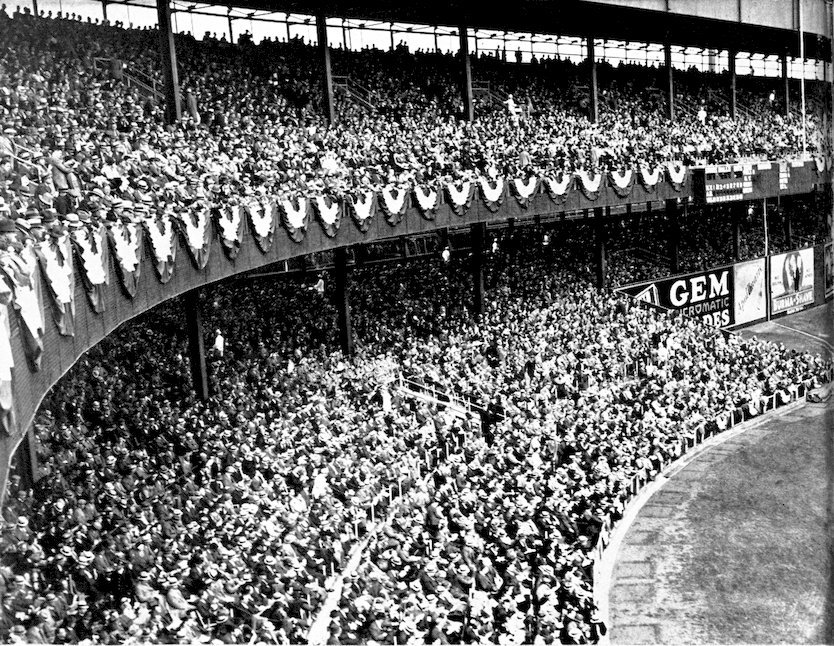
I went up to the opening ball game at the Polo Grounds. A number of thousands of others went along with me. I suppose it may safely be surmised that all of us were there to have a good time. However varied our definitions of what a good time is, all of us, at least, must have had the idea that a good time was to be had at a ball game.
What happened to us, up there, strikes me as pathetic. I am not referring to the particular brand of ball played that afternoon by the Giants or the Braves. It was typical baseball, more or less: and it was the typical scene.
Here was the great stadium filled with the black human mass. The field is enormous; the stands must be huge to compass the field. The majority of us were pretty remote from the inner diamond where most of the game takes place. On the periphery of it all were we—we, the great human throng—spread parabola-wise around the field. And in one corner of that field was the tight, shut diamond: and was the machine of players going through its motions.
It would be hard to exaggerate the abyss that separates a ball game at the Polo Grounds from the vast crowds that watch it. We all know the picture of the hungry lad peering at the man in Childs who flips the wheat cakes on the grid 22inside the window. It seems to me that that boy is less remote from his cakes than we were from our ball game.
Just think of those titanic stands of steel. If they are not wholly filled, their emptiness makes a menacing unlit presence all about, chilling the spectacle of the game. And if they are packed, they form a human mob so great it is unwieldy. No normal ball game can stir it more than ten seconds out of every hour.
We and the teams, moreover, had so little in common! Good baseball, such as is habitually played by the Major Leagues, is a smooth-running, impersonal affair. As little is left to the discretion of the players on the field as it is possible to leave them. They are tools, or rather parts of a mechanism run by a “mastermind” who sits on the bench. Batsman and fielder mechanically carry out motions whose plan and purpose are established for them. Even in the ultimate personal element that remains—the hitting of the ball, the fielding of the ball—the good player is a specialist, a coldly trained performer whose ways are very far removed from the ways of the urban, sedentary throng. The beauty of baseball, indeed, is precisely in its mechanical perfection. It is related to the beauty of a machine, rather than of art.
Far, far away is the crowd. It is not close in any sense, as is the theatre crowd, for instance, close to the actors on the stage. A theatre is a shut, packed unity: crowd and performers are physically knit. And what the physical proximity of audience and stage does not effect, the emotions expressed on the stage supply. Humor, pathos, passion, dancing, music—these are all symbols enacted by the players and immediately current in the life of every man and woman watching. But the ball game is a machine: by and large, it remains as separate from the mob as might a brilliantly intricate dynamo set out upon the field.
Sitting there, that day, I understood why Babe Ruth—ignoble, 23fat fellow that he is—deserves his vogue. I understood that a man like the Babe is indeed greater than the National Game. It is such as he who enable the wistful mob to have some sort of contact with the game. For baseball is only clockwork; but the Babe is a boy—moody, clever, human. He “gets across.” One crowd sees the game: another crowd follows it on the scoreboard of Times Square; America reads of it in Kalamazoo and Junktown. All, with a difference only of degree, are separate from this highly organized, privately owned, secretly controlled affair of baseball.
Here comes a player, with whom the crowd can identify itself. Babe Ruth catapulting the pill into the grandstand is a symbol. There have been subtler batsmen, but all of them, Lajoie, Wagner, Sisler, Cobb, aimed for the base hit which stays inside the field. The Babe’s home run is an effort on the part of the machine to connect with the crowd. When the ball reaches the bleachers, contact is established. The game and the watchers of the game for that instant have the ball in common. Babe Ruth is the demagogue of baseball.
Not only is Babe Ruth greater than the game: such little episodes as the periodic scandals, so deplored by moral managers and punctilious pressmen, are little less than godsends. If they did not crop up from time to time, Judge Landis would do well to invent them. They, too, introduce into the machinery of baseball certain negotiable passions: public responses to bribery, temptation, nobility and vice, come to reinforce the old worn response of partisanship—a response difficult to sustain when players are swapped from town to town like cattle. Anything that makes us feel—even if what we feel is only anger—helps the game.
What a hungry, wistful crowd we are, seated in our ascetic seats! The game itself rarely holds us. Most of us, where we are placed, cannot spot a ball from a strike, until we see it posted. We cannot tell Bancroft from Marriott at 24the bat, without looking up the number and consulting our score card. And save for a few tense moments, the game is as static down there as a dead motor on a winter morning.
No wonder we are driven to help ourselves to entertainment!
We call every player by his first name. That helps. It makes him less remote, away down there.
We shout advice to him. Praise. Vituperation. We josh him, we cuss him out. That helps. It makes us, in some wise, participants, after all, in our great National Sport.
When a ball comes our way, we make the most of it. We shout at a long fly, even if it is caught. We pray for a home run in our particular direction.
But even when the game runs on, smooth and cold and remote, we can make use of it. It permits us to act like children—or like madmen. That helps, by golly! Where else can we scream ourselves hoarse—about nothing? Where else can we make all the strange, uncivilized noises of which the human throat is capable? We hoot, shout, boo, scream, whistle. We get excited—without consequences. We get profane, abusive, grandiose—without danger of having to pay. Downtown, excitement about much is bad business. Here, corybantic ecstasy about nothing is good form. To hell with the ball game, after all. We can enact lyrical dramas of rage, disgust, beatitude—flinging our jewels of gesture to the empty air, even if the game be a machine and a sell.
And after an hour and a half of this, we can pack ourselves like grains of sand into a stifled elevated train, and read in the headlines of the paper we have just bought what a significant national event we have just witnessed....
It is quite true that the old-fashioned humble game was better sport. The bleachers hugged the field. The players were visible: we could see the sweat on them and the look in their eyes. They made more errors, but even in that were they not 25closer to us? Well, like everything else in our America, the Game’s got bigger—and that means better. Even sport had to be specialized. It used to be an enjoyable means of moving our own bodies. Not any more. Now there’s a machine that does the moving, while our forty thousand bodies sit packed and rancid in the grandstands. You gotta expect to pay for the privilege of belonging to the most progressive country on earth.
1925
4. MURDER AS BAD ART
Nearly every day you see the statistics in the papers. “Half as many homicides in Erie in an hour, as in England in an era.” “As many assassinations in St. Louis in a second, as in Yucatán in a year.” “More murders in Manhattan in a month, than in Schleswig-Holstein in a century.” From which it is to be inferred that private slaughter is an American activity.
When, moreover, you observe the high consideration accorded to our slayers—a consideration expressed in most cases by letting them alone (and this, in a democracy where such a privilege is almost unheard of!) or—in the few authenticated instances of capture—by hero worship and adulation, it becomes further clear that we regard the murderer somewhat as Spaniards the matador, as Frenchmen the poet, as Germans the philosopher, as Jews the prophet.
Murder is an American expression, a folk art. It contains some virtue so close to our desire that we have protected it jealously from the class distinctions which begin to encroach on our once so purely democratic life. The American murderer can win a front page, be he millionaire or beggar. The same sob sisters will write him up—gilded clubman or lowly 26loafer. There is no hierarchy here but Merit; no limit to glory save the intensest competition. Murder, in short, is an American art. My quarrel with it is that it is bad art; and that America’s growing devotion to it threatens our cultural progress.
Consider, first, the psychology of murder. Murder is above all a solution. We take an elementary case. A hates B—hates the sight and presence of B. So A kills B. A no longer sees what he hates to see. He has succeeded: he has found a solution. This is the instinctive murder. We will complicate it with a higher impulse. A wants B‘s purse. B, alive, would prefer not to give his purse to A. So A shoots B or slits B’s throat. B no longer objects to giving A his purse. A, once again, has succeeded. He has found a solution. This is the emotional murder—what the Europeans know as the crime passionnel: since the commercial desire, the will to earn, is the dominant American emotion. We go still higher in the category. A wants B’s girl, or B’s social status as Beer Baron. B, active and alive, is too handsome and too clever. A spoils B’s beauty by bashing in his face, and overcomes B’s intellectual superiority by bashing out his brains. A, now unimpeded, wins Girl and Fortune. He has succeeded again: found a solution again. This is the intellectual murder: since Shakespeare and Milton severally tell us that love of woman and love of fame are the last infirmities of the noble mind.
Having thus placed murder under the Microscope provided by a scientific age, we have detected in it a constant germ: what might be called the success bacillus—the will to a quick solution. Now it must be understood why murder is so advanced and wide a practice in the United States. We are believers in success: we are clamorers for a solution: we are no brookers of delay. Take our three hypothetic situations between A and B; and consider how in a less successful milieu than our own they might be blunderingly met. A 27French A hates a French B: he grins and bears it—or he fights, perhaps vainly, to overcome his hatred—or he avoids B—or possibly he comes close to his foe and, by studying him well, strains to turn hate to love. These are arduous endeavors, for which there is no guarantee of success. None of them gets results, like arsenic or a bullet.
A London A covets the purse of a London B. Unless he is as atypical as genius, A will not dream of murder. He will pick B’s pocket, or gamble with him, or slip by stealth into his room at night—or even do without! Again, it is clear that success is less assured. The solution is in doubt: the result is far below 100 per cent certain.
And now, finally, A belonging to any of the effete societies of Europe has a rival in B for a girl and for social fortune. He will probably try to get at the girl (an uncertain method where a moment’s success “carries no insurance”) or he may try to outstrip B by study and application. The processes are long, difficult, full of hazard. The American way of assassination is sure-fire.
But the American method gets so quickly and nakedly at the result, by destroying what stands in the way: which is Life itself. And not alone the life of B: what A avoids—trial, struggle, doubt—is just that content of experience which enriches living and is the stuff of art. The American system is very competent, and very sterile. It is related neither to life nor to art: but rather to the machine.
Let us consider our other American arts. We shall then see at once how general is this love of a quick solution; and how systematically we eliminate from life those elements which might hinder a solution. Quite recently we were mad over the Crossword Puzzle. The puzzle was soluble: it made success easy: and it contained nothing—neither sense nor content—except the incentive toward success. Even if one did happen to fail, despite the aid of dictionaries and of neighbors, 28in finding the “3-letter word meaning the adult of kitten,” next morning’s paper put an end to the agony. Similarly, there is the Movie and the Popular Story. They must contain a mechanism leading in simple and directest terms to Success and a solution. They must dispense with any forms of “life” that might impede solution. We can see now how harmoniously murder fits in with the other common ways of American Law and Order.
So much for our recognizable arts. If we tum to our public life—to our “serious” side—we encounter the same habit. We have social problems: and we solve them. Folks get drunk on alcohol? Easy: abolish alcohol. Roundhead foreigners cluttered up our landscape? Easy: abolish immigration. Dour dramas corrupted Sweet Sixteen? Easy: censor the drama. Crazy communists upset bedtime story mood of bourgeois gentlemen? Easy: jail ’em and let the Supreme Court of the United States outlaw their nonsense. These are all problems they still have in blundering, backward Europe. By gosh, we’ve solved them.
And we’re constructive, too: not merely defensive. Having money means having a good time. We’ve learned that. So we are abolishing every value, and throwing in contempt each occupation, which does not aim at money: either in the earning of it or in the display of it, once it has been earned. And finally, success is success. Having discovered this, there is nothing left but to murder all moods and impulses which would deny this crucial American proposition.
You have the idea. We jolt off more folk in New Jersey in a week than they do in France in a generation, because murder is so consonant with the American Idea. Of course, murder’s the low form of our art: a folk art. (We have our pickpockets, too.) But you can’t get away from it. The murderer is a go-getter. The murderer has a problem, and he solves it. The murderer sees what he wants, and he takes it. 29The murderer believes in quick action: he is a maker of success: he is a man with results. (“Success” magazines and popular platform artists please copy.)
And all this makes for bad art because—as Goethe put it—“art is long.” The short cut gets you “there.” But what if the “short cut” cuts out life itself? You’ve had nothing on the way. And when you are once “there,” what can you do but start again—on another short cut—for the next place? This is the joker in our competence. We do away with the means: and behold! The Means are everything and the End is nothing. It’s like the modern Sunday afternoon. We used to go nowhere in particular, on foot: and see the country. Now we motor a hundred miles to X. And X is nothing. And we’ve gone so fast, and swallowed so much carbon monoxide gas, that the way was nothing either. So we speed on to Y and to Z, ad infinitum, ad nauseam.
To solve the problems of life is very simple. All you need do is to eliminate—to murder—life. That gets rid of the problems: and that explains 99/100 of what men call civilization. For life is all Problem, and the brave dwelling therein: and the solution is death. A good life is the art of avoiding quick solutions. And murder—this so popular American practice, this so simple mechanical means toward a solution—is a good symbol of the bad art of America.
1925
5. THE BATTLE OF A CENTURY AND A HALF
PHILADELPHIA (JULY 4, 1776-SEPT. 23, 1926)
The rain was the hero of the evening. The gentle falling rain. It appeared second on the scene, pattering down so modestly just after Tunney had climbed up, and preceding the 30Champion Dempsey. It was not greeted quite so cordially by the crowd as were Gene and Jack. But ere long it made itself felt. At the end, it held undisputed sway.
The rain was the hero of that memorable hour in which the Mauler of Manassa lost his crown to the Sweet Marine—for a variety of reasons. To begin with, everybody saw the rain; and don’t you dream for an instant that every one of those good 130,000 American patriots who had come so far—at such expense and trouble—just to celebrate their country’s Sesquicentennial birthday, saw the Fight. Did the seats lack visibility? Not a bit of it. A marvel of architectural finesse is the great stadium. But even Mr. Rickard could not stretch the structure of men’s sight nor mold to a more plastic shape the sort of scrap he had staged. The seeing was carefully graded, as everything should be in an orderly Republic.
For $27.50 (up) you saw the Fight, and the stripe on Jack’s trunks; you saw the exquisite process whereby Dempsey was softened, slowed, mauled, unshaped by the obdurate indifference of Tunney. The sum of $16.50 gave you two men—one square head and one oblong—manifestly clad in purple and blue trunks; face and condition a blank, but bodies spinning visibly enough, and hopping and hugging and lunging, boring and jabbing in a ten-round dance. Fairly balanced, they were, under the heavy crown of the loudspeakers. No one went down, no one went through the ropes. Tunney was steadfast and Dempsey was wild. So $16.50 got a mere guess at the decision of the Fight you had come so laboriously to behold. At $10.00, what you saw was a couple of bright bugs with swift antennae, making love or something in true insect fashion—and getting nowhere, so that you could notice. And at $3.30, you beheld, all about a far flame, a spot, a sky of moveless, pivotless heads, a sky rolling with human thunder. And that was worth the money.
But when the rain came, the gentle falling rain, it played 31no favorites. It did not pour buckets on Mayor Walker’s crown, and drip a mere drop on Paddy. And how the rain was needed! Don’t you believe it put a damper on that mob. Individual men and women may have been disgruntled—although they didn’t show it. But the crowd itself, and the spirit of the show, called for the rain.
In the mists which tided to the crowd from the high shell walls, see a symbol of tedium, and you’ve got the idea. A solid, stolid thing was the mob, massing from the ringside. When the lights that stared from brackets all around went out, the crowd seemed dead. Myriad heads rose from the flanks of the thing like carven facets—like knobs—like artificed protuberances on a woody substance. You felt that a plane, if it were big enough, could run over the vast surface, and smooth it, and smooth off the heads. You felt there’d be a lot of sawdust, and that’s all. You were unjust, however. For when the lights screamed back, shedding their green-blue ice on the hot crowd, you saw that each of these myriad individual knobs had a face: mostly a man’s, perhaps a woman’s, face. The expression was dull, not too lifelike; and almost never varied. But if you doubted the monumental genius of the painter of all those phizes, you couldn’t help admiring the assiduity for going to such trouble.
Then the Fight, to make the stadium come alive. Shouts, cheers, murmurs, ran at first through the inert thing: trickled, jabbed at it, harried—and failed to fuse it together. Many sparks and no flame. The spirit of the evening was not a spirit of fire. Sogginess, wetness—spirit of the rain was what Philadelphia summoned from its weary streets to meet the wearied visitors from afar. And that’s why, when the rain did fall, it was right. You can’t blame Mr. Rickard. How could he know? How could he know, for instance, that this stadium, unlike other circuses, sprawls too horizontal from the ring, is too fluid in its forms to be galvanized into a furious 32hard passion? A fight scene should be more vertical, more funnel-shaped. Then your scrappers have a chance, with their lean frail arms, to weave a spell to pull the human lump together—fire it, make it the mad, single-howling creature which loomed above Dempsey and Firpo in New York.... And how could Mr. Rickard foresee that his two prize babies, this time, would keep their feet so well?
If the prize fight is to outlive its present mastodonic bulk, and not—like other dinosauri—collapse from sheer flatulent vastness, the pugs’ arms will have to grow stronger so that there is more flooring, or their legs will have to grow feebler, so that there is more flopping. In a huge stadium, you can see a man go down flat—and that is always worth a week’s salary and ten hours’ sweating in trains. But boxing, boring, sparring, dancing, spinning—but a bloody nose and Jack’s shut eye—what’n’ell do such fine points get you, when you cannot see them? The fat ball park developed the fat Babe Ruth. Slugging makes contact with the huge modern mob, where all the place-hitting of Nap Lajoie would be lost. The fisticuff equivalent of a fast-bounding ball in the bleachers is a couple of giants tumbling each other, as in the Dempsey-Firpo fracas. There was none of that in Philadelphia.
The crowds were childish about it; and you cannot blame them. They wanted action: thudding, sudden action. Without it, they were bored. How far they had come! what hours they had voyaged, leaving wife and children! what hours’ hard earnings expended! what sweat exuded! what shoe leather worn away, in order to be in Philly! Was it to see two boxers, bobbing in a white-roped ring? Once they were there, they couldn’t wait to get home. A knockout in round one would have delighted them. Immediate action—what the French in another context call la jouissance immédiate—that was the infantile temper of the crowd. They howled down the announcer, when he wasted time on adjectives. They 33were nonpartisan. They were for Tunney when his blow landed; they were for Jack when the thud of his glove came over the acred heads. They were for anybody who’d bring it all crashing to a decisive thrill. Poor public! Hadn’t they paid two million dollars for something? I suppose that is why Mr. Rickard, whose influence with the weather is well known, brought down the rain.
Which leads me to our Showman. The show was, of course, the packed stadium. Or, if you prefer, the show was the show itself. The Fight was the pretext for bringing the show together. To this end, Jack and Gene fought for championship. To this end, one hundred and fifty years ago, our fathers fought for independence. So that Philadelphia might have her celebration and dawdle through it meagerly for many months on such nurture as the Pageant of Freedom (loss $700,000)—and recoup it all in the sudden financial glory of a scrap fight, which a hundred-odd thousand paid for, and which the radio stay-at-homes alone followed clearly. But if the Show was the show itself—who saw it?
Not the newspapermen, not the frontiersmen in the wide, cheapest spaces. All of them erroneously had their eyes on the ringside. The chief appreciator of this thing of beauty was the chief creator of it: Mr. Tex Rickard himself.
From 8:00 to 9:30 P.M. I followed this enraptured artist as he moved from entrance to entrance of his golden dump. I was happy to catch the esthetic gleam in his eye, and to hear him murmur:
“Gee! Only look at ’em all! See that silver blimp tipping the stadium askew as if we were on a boat in a storm. See that Penn State Building yonder, like a city in the air. See the heavens rolling, rumbling near. All so fluid, all so fairy-like—above the solid substances of my crowd! One hundred thirty thousand ... solid ... solid ... paid for! By Michael Angelo,” cried our leading modeler of mobs, “it’s 34worth earning half a million dollars to make a thing as beautiful as this.”...
And so, to make that beauty perfect, he summoned down the rain. It worked on the crowd like water on a thirsty plant. It eased them—brought them together. It gave them something more immediate and urgent than that distant dance in the ring. Water, drooling from one bosom to another, joined them. The little raindrop, bounding from head to head, made brothers as it bounded. We knew that our forefathers, fighting for freedom, had fought to make a Nation, after all.
Men and women removed their hats and swathed their heads in handkerchiefs that gleamed in the gloom like turbans. The stadium turned Oriental; the fight fans became worshipers at some rite. Now, the remoteness of the bout was good—since a rite before an altar should be occult. Now, the cavortings and borings of two men on a light-blazed box seemed fitting. And it was well that a little man in an incongruous dinner coat should make noiseless speech under a diadem of arcs and amplifiers; and that his voice should loom, by some sudden miracle, into each shadow of the conchshaped pile. And, finally, it was right that at the very end, at least a hundred thousand of the worshipers (who had, they thought, come to see a fight) should stand quiet until the Metal Voice belched forth the news to them of who had won.
Slowly, sweetly they plashed away through the mud and the motors, toward their distant homes. Through the waterlogged rhetoric of a National Fair which needed a prize fight to put it on the map. And the heavens wept gently.
But when we reached the Penn Station at Broad Street, all my hopes for mankind were reborn. With a greater drive than Dempsey’s, with more stamina than Tunney’s, silent mobs of men stormed with drenched bodies through the gates—to 35the New York trains. And then I knew that my brothers, after all, were capable of enthusiastic action when some high purpose urged them.
1926
6. ENNOBLING OUR CRIMINALS
So it has come to this. They’re advertising for the crook and the yegg. The first practical sign of the uplift was in the modest little placards which blossomed out some time ago in the “L” stations: they reminded prospective robbers of ticket offices that, if they were caught, they’d get from six to seven years. The suggestion, of course, was: not to be caught, and doubtless some few courageous men were thereby inspired to do better work. But now there are to be flamboyant posters—every bit as good as the old ones which urged us to Buy Liberty Bonds, to Save Sugar, to Save the World from the Kaiser.... These new works of democratic art speak out to all whom they concern: “You CAN’T win. Ships Don’t Sail Beyond the Arm of the Law.” Or, “You CAN’T win. You Have to Get All the Breaks. One Little Slip Means Sing Sing.”
It is fair to assume that these exhortations are not addressed to the little girl who works all day in a milliner’s shop; nor even to the plumber riding home from his pipes. There must be a criminal class, large and plebeian enough to use the streetcars, to whom these advertisements are devoted and whom they are aimed to improve. This is highly significant as perhaps the final proof that we are a democracy. I feel, however, that much good material is neglected by not putting the posters also in the taxis.
At last the criminal class is to be exalted. Today, of course, it is small pumpkins to hold up a bank clerk or sandbag an 36aged millionaire as he saunters from his club. Mediocre men—men of conservative instincts and cool passions—have degraded the ranks of crime. All this is now to be changed. The crook is to be challenged! The yegg is to be dared! “You can’t win” shout the ads. This will, of course, discourage the weak members. It will fire and inspire the strong ones. It will weed out the cautious crooks. It will raise the moral and spiritual standard of the whole fraternity of pillagers, marauders, brigands, thugs and pirates who grace our peaceful land, and serve to circulate moneys and emotions.
Dick Turpin, Robin Hood, the great corsairs, had no encouragement like this. They worked against a spirit of states and peoples which in every way encouraged “virtue.” When one thinks of the drawbacks of those days one wonders that picaroons, spielers and strong-arm men survived at all! It merely goes to show the indestructibility of genius. Men were discouraged from peculation by thoughts of God, and by the subtle suggestion of the priests that it was harder to go straight! Moses had thundered: “Thou shalt not”—with the assumption that, of course, thou couldst. Jesus of Nazareth went even further. He made it clear that it was almost impossible to be good. For ages, the aristocracies and the churches kept up their propaganda, discouraging crime on the ground that crime was easy, forgivable and mean.
We have changed all that. “You can’t win my swag!” challenges the banker, knowing well that this is the very tune to inspire the daring crook against him. Indeed, the best of this new scene of our Democratic Drama is the altruism of the leaders.
They have suffered, after all, very little from holdups. Crime has been endemic, but sporadic. The land buccaneering art needed uplift and stimulation. It needed the standards and the token of popular support which advertising—that university of democracy—alone would give it. Enough vivid 37posters encouraging superior youth to bust safes or board bullion-carrying motors—through the method of challenge and of a call to adventure, and we can look forward to the day when all banks will be broken, all rich ladies stripped of their jewels, and all motors in the hands of thieves, save, of course, those taxis which are already run by licensed yeggmen.
Our ruling class disproves the cynicism of the materialist philosopher. Are they not now inspiring a criminal class, with educational posters, to despoil them?
But perhaps there’s a way out of this dilemma, after all.
Everyone knows that about fifty years ago our pioneers and pork-barrel experts instituted the campaign which has resulted in the present flood, throughout the land, of novelists and poets. Advertising methods in those days were more intimate, because the science had not been standardized. Yet the process was essentially the same as that now begun for the benefit of our criminal classes. Instead of shouting in posters, it was whispered about: “Write Poetry—and Starve.” “Creators—You Can’t Win. The Possessive Arm of the Law Will Get You, Even in Paris.”
The result, of course, was Greenwich Village, and our ten thousand Little Theatres. In the bright lexicon of youth, there’s no word of challenge like CAN’T. But the crowning stroke of this maneuver for supplying our land with a sufficiency of poets, was the system of awards and prizes which has since sprung up.
The creators, of course, were first challenged into existence by the possessors. Then, those who were wise enough to make their imagination and their art work for the possessors, were paid sumptuously in coin.
Similarly, bank robbers and holdup men must first be inspired to know the dignity of their calling. These posters will help to draw the right class of energetic youth. All that 38remains, then, will be to announce positive rewards for those criminals who make good.
1925
7. READING THE SPORTS
Oh, how glad I am that spring is coming and that baseball’s here! For once again, I can get something from the papers. I am what America would unanimously call a highbrow. Put me down as that, since the Majority Rules. It is because I am a highbrow, spending my days and nights in philosophic contemplation, that I rely on the sports in our dailies. During these last months, life has been bitterly empty. At its best, pro football is a vague business, and tennis is the sort of game you must see in order to believe. I have suffered frightfully for lack of news. But now I am myself again. The sun shines promisingly in my window. Mayor Walker has thrown out the first ball and at last I can spend my pennies evening after evening, for Baseball Finals: certain at last of having news to read.
It is, if you insist on explanations, because I am a highbrow spending my days and nights in philosophic contemplation that I require the sports. You don’t see? Well: let’s examine the matter like two highbrows together.
I prop my morning paper carefully (so as not to spill it) against the water tumbler, with its edge held down by the plate which holds my grapefruit. Right column spread: Briand and the League of Nations. Do I read it? No. Why do I not read it? Because I am not concerned in International Affairs? Wrong again. It is because I am concerned in International Affairs, and know something about International Affairs, and know a good deal about papers—that I skip this column. For I am aware, whatever the true crux of the 39crisis, that I’ll not find it printed. Vague conjectures, superficial facts, details, a perfect avoidance of everything causal—of all that counts in this particular matter—this is what my faithful paper spreads before me, on International Affairs. Next door, an article about the Police and Bootlegging and the Crime Wave in our city. I am exceeding interested in all crime news, and in the liquor market. That is why I skip the column. If I desire to be sure what really happened, I must wait till I can drop in on the boys who know one thing and who write another.... Left column: the big story about Congress. It also fails to qualify. Nothing but the hot air is in the print. The real plots, plans, motives, are as far from this open page as are the committee rooms and dining rooms of Washington from the visitors’ gallery at the Capitol.
I turn the page. I fare no better. Discovery of ruins in Yucatán, Egypt, the Gobi Desert. I know the “desk” has sedulously deformed the trickle of “quick” news which the telegraph has shot across the sea.... Divorce? I’ll get none of the violet rays of subtle human truth in this odious, scarlet, lyingly “whole” report. Taxi smashup? Perhaps the names at least are right (though even they may be misspelled, unless they’re famous). Music? I happen to know too much about music to marvel convincedly at Marion Talley’s voice.
Ah, but here is the book page! I may glance at the ads. They tell me at least, with a modicum of truth, that Mr. Mencken’s new novel is out; and that the Hexameter Epic to which Mr. Broun has devoted so many years of silence is to be published in the fall. But will these lengthy and pontifical disquisitions about the current output give me either facts or credible opinion? Alas! I fear not. There is more honesty and candor here than in the sections devoted to politics and crime. But not more competence. Real information about books and art requires an informer with background 40and perspective, and fairly permanent esthetic standards.
And I crave facts! I’m a highbrow: I want to know at least of SOMETHING that’s happened in the world, since yesterday. So I turn to the sports page.
I am told that Babe Ruth fanned three times, and I believe it! I am told that Vance pitched as good a game as that famous one of Walter Johnson’s, five years ago in Detroit. I’ll stake my dollars, it’s true! Here is the statement that the Giants blew in the seventh and the Pirates hammered five earned runs. I know it! I know the runs were earned! (What a relief it is, to know anything at all in our chaotic world—when even the atom has crumbled!)
I am pretty certain that these boys in the Majors are really Major Leaguers, and deserve to be there, by the best of baseball standards. I believe these baseball critics. I am willing to accept, without the tedium of a personal inquiry, that the fellows who are playing in Paterson or Oshkosh are not as good as their brothers in Big Time. But I am quite as sure that the real Major Leaguers in politics, law, business, literature, education, are usually ignored by the papers; whereas every morning there’s a new crop of tenth-rate Minors in the five-column spreads.
McGraw would stand for no Mayor Hylan in his line-up. It wouldn’t pay him, as it paid Tammany. No sentimental blurb can hide the fact if Ruth has batted .170 for a week. No lack of a blurb can blur the fielding and batting splendor of George Sisler. There’s plenty of stuff about the past, that we believe in; plenty of hopes for the future. But today—what can we believe today? In the sports I get rare satisfaction, for I can say: “It’s in the papers, and I do believe it.”
You’ve got to have some certainties at breakfast. You’ve got to have some English written in a style living, appropriate, honest. There’s plenty of fiction: forty pages, daily, in our 41average-sized journals. Forty pages of cake. That’s all very well. But, being a plain highbrow, I need a little of the bread of fact. Thank the Lord for baseball.
1926
8. THE NEW CONQUISTADORES
So I went to Florida for a rest....
Of course, I left all my money there in real estate ventures, and had to return by boat. This is a cheaper way than Pullman, and I soothed my pride by arguing that it would round out my experience. In Miami, Sarasota, St. Augustine and Jacksonville, I had encountered nothing but millionaires. There must be a nether side, an “other half of the world,” even in Florida. More modest revelers in sunshine surely must go south by winter and doubtless I would find these coming north by boat.
I was mistaken. The steamer was crowded. Every cabin and berth were occupied by men and women who, according to admissions obliquely and nonchalantly let fall in talk, were larded with money. Everyone had tried to get a de luxe stateroom, alas! and had failed. Everyone, moreover, was traveling by boat because of a tender love of the sea. There was not much wind; but a good portion of our company were sick. Nor do I recall any gazing at the ocean, save on one or two instances when porpoises were sighted. Perhaps there was more sea to the voyage than the pampered landowners had bargained for. It is true that from beginning to end the boat was utterly surrounded.
And besides, there was too much of an intellectual, cultural, public-spirited nature to discuss on board for any childish pleasure in salt water. These were men and women on a holiday. Yet, everybody knows that the athletic mind 42finds rest, not in lazing, but in a simple change of the topic of cerebration. These men and women had gone South ostensibly in quest of sunshine, alligators, golf and bathing. Their alert minds had soon discovered that Florida today was the very apex of American progress, the cynosure of all live American eyes, the ideal of every purse possessed of the creative impulse to increase and multiply. What more inevitable than that, returning to their estates in Kalamazoo, Newark and the Bronx, they should discuss and discuss?
We were foregathered in the smoking room.
“They are sure doing wonders down there in Florida.” A heavy Elk spoke with gleaming eyes. His chest was deep and so was his voice. It was strange how two-dimensional those eyes seemed.
As the four others of us round the table nodded and sipped our near beer and chewed at our cigars, I became aware of a strange presence overhead. The smoking room was fitted out after the fashion of an old English inn. In the ceiling were open rafters clouded in smoke. And here, straight above us, through the darkling mist, I saw another group of men gathered like us about an oaken table.
At first, I thought that there must be a mirror in the beams, catching our group through the haze; for these men above were placed like us. But as my vision cleared I saw that they were different, after all. They were clad in steel coats of mail; swords swanked angularly at their sides; they wore flaring boots; armored gauntlets were drawn off, and freed the harsh-haired fists of conquistadores clasping silver goblets filled with ruby wine.
My neighbor answered—a weasel fellow, all grey, whose nose seemed in a perpetual tremor of scenting and searching:
“Why, Jacksonville’s population alone has doubled in ten years!”
43—Tell the Padre that we have made another hundred converts, came from the smoke-veiled rafters.
“They got 268 manufacturing plants that can turn out $50,000,000 worth of goods a year.”
—Our first stone building at San Agustin is a school for the Indians.
“You know that filling-in of marsh water front at Sarasota cost the Ringling Brothers about $10,000. They sold it at $13,500 the acre.”
—The new Cathedral was built by Christian natives. We have sent the deed of the property as a gift to the University of Salamanca.
“Miami has a transient population of 90,000. That’s what pays ... the transients.”
And over my head the echo:—We are being urged to marry with the Indian if need be, and to settle. Are these men not the hidalgos of a great land? Has not Don Francisco called them brothers of the Spaniard?
“Fifteen thousand hotels in Florida.” The Elk eyes glowed.
—A Mission in the Everglades at last! was the refrain.
“The whole thing is stupendous,” came the shrill voice from the grey man at my side. “It’s the greatest land rush in the history of the U. S. A.”
“Which means, in the history of the world,” said a surgeon who operated in lots on the side. He was a man burly and sinuous. There was in him something of the otter and a good deal of the boar. “Why, compared to this, the great movements of history—the gold rush into California, the dash to the Klondike, the opening of the Middle West and the Northwest with Harriman and Hill, were puny.”
He was an eloquent as well as learnèd speaker. And as each glorious instance rolled from his soft mouth, there came an echo mysteriously transformed by the smoky rafters....
44—Movements of history ... passage of the children of Israel across the Red Sea ... the quest of the Holy Grail ... Crusades ... Columbus....
“But it ain’t business only!” I protested.
“You bet not,” said the Elk. “‘Come to Florida and see the nation at play.’” He quoted the great line without hesitation.
I saw our nation at play. Motoring ... movies ... lot jugglings ... motoring ... walnut chocolate fudge sundaes and bad booze ... motoring ... boosting, boasting ... motoring....
Overhead clinked silver goblets. The conquistadores were humming a “malagueña.” From the mist about them came a glow as of mellow vineyards yielding sunny wines, and of women dancing. Below, hard lips told of sport.
Said our Elk: “I dropped in on the Yankees at St. Petersburg. Those boys clear a fortune even out of training.”
The tale of sport from overhead was different. Honor and love were counters; the players risked life and joyously won death.
“Not alone a nation at play,” exclaimed the surgeon. “Florida is a frontier with all the culture of the capitals. Here is a whole state being opened up, with the best accommodations! For modern improvements, New York’s got nothing on it.”
“And they ain’t forgot religion,” added the grey man with the tremulous nose. “They just put up a church in De Land, cost $300,000. You bet I bought all the lots I could in a town like that. Where they spend money on a church, they’re going to stick. A swell church means business.”
—Our Mission was builded by volunteers from the old Settlements elsewhere. They were not paid, of course; but we had to shoot many infidel natives who did not understand 45why we wanted to build so fair a church in a land that was not ours. Yes, many were killed and some were tortured. There is no room for infidels. We let the gold go home for the greater glory of our Gracious Queen.
“Well,” cried I, emptying my mug of legal beer, “Florida is certainly a hum-dinging first-class show of American progress.”
“It’s enough to make you proud,” said the Elk.
“—and rich,” smiled the sly surgeon.
“Why, in Jacksonville every guy in town’s got to wear a big button—and if he don’t, you just bet he gets into trouble. It’s yellow and on it is printed in red [those are old Spain’s colors, you know]: We are believers in Jacksonville.”
—We are believers in God, came clearly from the rafters.
1925
9. TWO FACES
In the literary office of a certain magazine there is a vast table piled with books. “Mostly junk,” the editor will explain. My hand feathers the outskirts and picks a volume with title: “Calvin Coolidge. His First Biography.” I am not permitted to speak of it here. Nor shall I linger wistfully over the so symbolic circumstance that a book about a living President should be a thing void of ideas, vile in composition, rancid, and false in spirit. Within its covers, I found the portraits of two faces: one of the President and one of the President’s mother. Thereby hangs my tale.
She was beautiful. She looks out at you in a black dress of satin, sterncuffed in white, high-collared, with a cameo at the throat. The hands lie demure in the lap. The hair is drawn tight and sideways to the ears. She looks out at you, 46not so much from the frontispiece of a book as from New England.
She is impressive. The sharp small chin is firm. The mouth is pursed, its prim lips faintly flexed into a downward frown. The nose is straight. It has delicacy; its nostrils seem to quiver not from emotion, but from restraint of emotion. Under the plastered hair is a forehead high and ample: a square forehead which is the feminine form of the stern unsubtlety of pioneers. It holds a mind serene through exclusions, correct through lack of doubts. The eyebrows are straight as a whiplash. Above them the flesh puckers like a girl’s, ere the forehead’s rigor claims it. But the eyes are deep-set as in some dark seclusion.
They glower. Their gaze is reproof. And their sight is a shadow. Pain lurks in them, muted and proud, and constant. There speaks a virtue assumed, a mastery willed: almost a habitude of judgment. The eyes dominate all. Under the girlish brows with their faint fleshliness, above the exquisite nose, within the contour both fragile and brittle which the folded hands whitely enhance, these eyes are paramount. Tenderness turns hard; frailty assigns itself master; weakness wills itself mighty. The result is a transformation. This face, so gracious in its elements, gives for its final word inhospitality and shutness. The result, in more personal terms, is Calvin Coolidge.
His face is the response to his mother’s. She was the obscure farmer’s wife in the Connecticut River Valley. There, as with countless other women, her loveliness had its begrudging bloom. Winters long as a siege, summers of swift fever, the inclement lordship of Puritan ideals, made her astringent. Weather attuned to will hardened this flesh and drew the spirit down to the sure rigor of material affairs. Virtue became a saying of Nay and an economic cunning. Poetry took property for symbol. And so at last, on a certain 47Fourth of July, this daughter of New England gave birth to Calvin Coolidge. Not she alone. A whole decadent Puritan tradition gave birth to him; fathered his spirit; molded his memorable face.
The little man waxed great. And as he grew, his face became the caricature of his mother’s fairness. It is a caricature horrible in its significance, superb in its logic.
Chin, mouth, nose, brow, eyes of Calvin Coolidge are children of the splendors strangled in his mother. Her face already is this twilight, is a recession of splendors. Her features speak but greyly an ancestral greatness. Moral power, will, devotion, chastity, singleness of vision, bore this woman. But the essence of their means to life made the mind intense to the exclusion of content; made the beauty neurotic; made the virtue shut. Made, inevitably, their own culminant death whose Person now presides the American lands.
The chin of Calvin Coolidge has grown pointed, out of all proportion: it is a shallow, contentless thrusting. The lips have almost disappeared. The mouth is a crease of shrewd, complacent purpose. The fold of resolution beneath his mother’s nose becomes a dugout of meanness. The nose itself is bulbous, perhaps with too much half-baked nutriment: it is a proboscis of forwardness unchallenged along the path which the canny eyes select from all the paths of the world. The forehead is blown into a windy conch, unruffled and unfilled save with the echoes of dead covenants. It crowns the face like a seashell; and the face itself becomes, beneath it, a pucker of soft parts like some naked creature peering forth for food. The head, indeed, is the Rhetoric of absence. The face is the expression of an immaculate instinct for sure and mean details.
© Fairchild Aerial Surveys
Again, as with his mother, the man’s eyes give the key. They have lost the tragedy of hers. They have flattened, hardened, and come out to the surface. They do not, from 48a secret depth, glower upon a hostile world: but have pressed, with a twist and a leer, to Victory. They twinkle. They have the lasciviousness of cold possession. They are the logical eyes of the battener on nullities: the eyes of the democratic politician.
So, as Calvin Coolidge, professional legislator, might declare: The Nays have it. Here is a face at last, ultimate and stripped to the model of a will like a machine. A face where no dream lingers beyond the dreams approved by a smug world: a face which no thought troubles that has no answer in the current coinage: a face that knows not passion, unless it be charted and chartered in the Statutes. The mother’s frown is gone with the conflict it expressed. Here, in lieu, is a smirk. All the realms of spiritual risk which her men, good pioneers, to such good purpose barred, have here stayed out, indeed. A race’s turning of its ideal power into the body of Success becomes this face and body, stripped to cunning, instinct with the spirit of acquisition. The symbol becomes a man; the man becomes a symbol. He crawls up the greased ladder of public honors. He becomes a leader and an idol, in whom the mob can worship its own meanness....
1926
10. THE DRUG ON THE MARKET
It is prevalent and poisonous. And the land is proud of it. Its manufacture is a huge industry; its sale is a popular art. Billions of dollars are spent in making it: millions more go to the appurtenances of its use: and billions are paid in wages to men and women who devote their lives, openly, to its production, distribution, upkeep. The states all license it, turning a tithe of the wealth spent for it by our people to their own coffers. Great magazines and newspapers grow 49fatter with its advertisements. Some papers, indeed, are entirely given to its commercial and esthetic aspects. And no publication, however ethical in editing its columns, however adverse to such drugs as coffee or tobacco, refuses to display its blandishments for money.
All America lives under its influence, and does not suspect that it is enslaved by a drug. “Shows” are planned yearly in great towns to propagate its sales and sing its praises. Special sections of the dailies detail its progress. Schools teach the beginner how to enjoy it. And everywhere ordinances and officials tune the whole life of the land to the needs and habits of those who use it.
It comes in varieties of kind which display distinct differences in expenditure of money. And these gradations have a truly hierarchic value. In a democracy where castes are vague, where money-power has few manifest badges of dress or standard of living; where, indeed, millionaire and clerk go to the same movie, read the same books, travel the same roads, and where intellectual distinctions must be very carefully concealed, the conspicuous uses of this drug have become a standard of social status. The lowest classes aspire, first of all, to earn the means of visibly possessing it. When they have risen so far, they may be said to have a foot on the first rung of the Ladder of Success. Thence, they are urged, instructed, exhorted, by advertisement, editorial, numberless methods of herd pressure, to progress upward. It is neither uncommon nor unworthy to mortgage a farm or keep it bare of such luxuries as furniture and books, in order to purchase a more showy form of the drug: one whose effects are swifter and whose price is higher.
Like all drugs, this one has estimable virtues. Its effect is great on the motility of man, when used in moderation. It is a synthetic product. It is not found in a state of nature, but must be concocted; although, of course, from natural 50ingredients both mineral and vegetable. I do not know how man first came to put it together. Probably his love of new combinations led him. I doubt whether the incentive to increase our mobility on earth was there at the beginning. (The thing, by the way, was invented in Europe; and in Europe, largely still, it is controlled within the limits of good use.) But America soon transformed it from a delicate ornament to the mastering instrument it is today. It increases man’s power to move things, and to move himself. It increases his power to see things. It opens up to him stretches of the world he might elsewise never reach: communities of action and intercourse with other men whom he might elsewise not come near enough to work with.
This virtue of the drug is a positive contribution. It makes it not unworthy to be placed in man’s esteem beside other concoctions long known and loved. Alcoholic drinks, for instance, with their heat-making, cheer-making, fat-making, nerve-relaxing power: tobacco, which is a subtle sedative to mind and stimulant to nerve: coffee and tea which cheat fatigue: opium, morphine, cocaine, ether, by means of which men and women are helped across the crises of the body without the drain of too great suffering.
The drug’s most typical and most desired effect is the sense of self-motion. The user feels that he is “on the go.” The faith that he is covering ground or getting somewhere (although that “somewhere” be of no intrinsic value) is, of course, the type of morbid rationalization common to all addicts of all poisons. The sensation of flight is the main matter. The drug is a means of physical escape. It becomes a symbol of psychological escape.
Now, “progress” is an American superstition whose chief feature is movement. To progress, you’ve got to move on: you’ve got to be perpetually passing from what is to what will never, never be—since as soon as that is, it also must be 51passed. This superstitious tic is potently flattered by the effects of our drug. From being a means of motion and escape, it has grown into a symbol of progress. It began by cajoling our nerves. It ends by cajoling our ideals.
Of course, this subtle transition from use to abuse is generic of all vices. Far too soon, the ill annuls the good which tempted us into the path leading to addiction. But with older narcotics, men have had time to learn the dangers hidden in delight. They have elaborated mental and moral mechanisms to protect them. It is deemed a “social vice” in Europe to drink too much liquor. Men almost everywhere have become “afraid” to employ opiates without the doctor’s sanction. Sometimes this instinct of defense hardens into law. America, for instance, as befits a timid land, was armored by Constitutional Amendment against the ravages of a mug of beer, against the blight of a little glass of wine. (This may not be known to the reader, who can verify it by consulting any lawyer.) The instinct of self-protection is naturally strong in the small and the weak. This makes it all the more amazing that America has developed no defense, and no awareness of the need of defense, against the holocaustic uses of this drug on our market.
The reason is, that we have not yet had it long enough. The lapse from use to abuse has been too subtle and too short. And the reason is, also, that there has been confusion between the sensory effects of the drug and what Americans consider their ideals. The notion, for instance, of bare movement as value—is this, indeed, a human value or is it the delusion of a drug fiend? or the idea of utilitarian progress whereby all present life is successively sacrificed to a never-reached tomorrow? or the standard of measuring worth which makes man neglect himself and give his love only to the accumulation of dead external objects? It might well be 52argued that such “values” as these are the results of a drug habit, rather than the spiritual traits of a Great Republic.
The key to the popular appeal of this narcotic is, then, an induced sense of flight—idealized into the delusion of “progress.” The addict becomes nervous and restless. He hungers to “progress” with his drug to help him move; and also he aims to heighten the outward splendor of the drug itself, so that the world may judge his “progress” in the world by it. Battening on change, he dares not stop. He must go on moving. And since even motion can become a constant almost as steady as rest, he must be forever changing his pace of motion. His life must be accented motion—ever irregularly accented. And change, from being a means, becomes an end.