ILLUSTRATED CATALOGUE OF THE COLLECTIONS OBTAINED FROM THE INDIANS OF NEW MEXICO AND ARIZONA IN 1879.
Reading edition
By James Stevenson.
INTRODUCTION.
It is not my intention in the present paper—which is simply what it purports to be, a catalogue—to attempt any discussion of the habits, customs, or domestic life of the Indian tribes from whom the articles were obtained; nor to enter upon a general comparison of the pottery and other objects with articles of a like character of other, nations or tribes. Occasionally attention may be called to striking resemblances between certain articles and those of other countries, where such comparison will aid in illustrating form or character.
The collection contains two thousand eight hundred and fifty-eight specimens. Although it consists very largely of vessels and other articles of pottery, yet it embraces almost every object necessary to illustrate the domestic life and art of the tribes from whom the largest number of the specimens were obtained. It includes, in addition to pottery, implements of war and hunting, articles used in domestic manufactures, articles of clothing and personal adornment, basketry, trappings for horses, images, toys, stone implements, musical instruments, and those used in games and religious ceremonies, woven fabrics, foods prepared and unprepared, paints for decorating pottery and other objects, earths of which their pottery is manufactured, mineral pigments, medicines, vegetable dyestuffs, &c. But the chief value of the collection is undoubtedly the great variety of vessels and other articles of pottery which it contains. In this respect it is perhaps the most complete that has been made from the pueblos. Quite a number of articles of this group may perhaps be properly classed as “ancient,” and were obtained more or less uninjured; but by far the larger portion are of modern manufacture.
ARTICLES OF STONE.
These consist of pestles and mortars for grinding pigments; circular mortars, in which certain articles of food are bruised or ground; metates, or stones used for grinding wheat and corn; axes, hatchets, celts, mauls, scrapers &c.
The cutting, splitting, pounding, perforating, and scraping implements are generally derived from schists, basaltic, trachytic, and porphyritic rocks, and those for grinding and crushing foods are more or less composed of coarse lava and compact sandstones. Quite a number of the metate rubbing stones and a large number of the axes are composed of a very hard, heavy, and curiously mottled rock, a specimen of which was submitted to Dr. George W. Hawes, Curator of Mineralogy to the National Museum, for examination, and of which he says:
“This rock, which was so extensively employed by the Pueblo Indians for the manufacture of various utensils, has proved to be composed largely of quartz, intermingled with which is a fine, fibrous, radiated substance, the optical properties of which demonstrate it to be fibrolite. In addition, the rock is filled with minute crystals of octahedral form which are composed of magnetite, and scattered through the rock are minute yellow crystals of rutile. The red coloration which these specimens possess is due to thin films of hematite. The rock is therefore fibrolite schist, and from a lithological standpoint it is very interesting. The fibrolite imparts the toughness to the rock, which, I should judge, would increase its value for the purposes to which the Indians applied it.”
The axes, hatchets, mauls, and other implements used for cutting, splitting, or piercing are generally more or less imperfect, worn, chipped, or otherwise injured. This condition is to be accounted for by the fact that they are all of ancient manufacture; an implement of this kind being rarely, if ever, made by the Indians at the present day. They are usually of a hard volcanic rock, not employed by the present inhabitants in the manufacture of implements. They have in most cases been collected from the ruins of the Mesa and Cliff dwellers, by whose ancestors they were probably made. I was unable to learn of a single instance in which one of these had been made by the modern Indians. In nearly all cases the edges, once sharp and used for cutting, splitting, or piercing, are much worn and blunt from use in pounding or other purposes than that for which they were originally intended. On more than one occasion I have observed a woman using the edge of a handsome stone axe in pulverizing volcanic rock to mix with clay for making pottery. Nearly all the edged stone implements are thus injured. Those showing the greatest perfection were either too small to utilize in this manner or had but recently been discovered when we obtained them.
The grinders and mortars are frequently found composed of softer rock, either ferruginous sandstone or gritty clays. For a more complete knowledge of these stone implements we must depend on a comparative study of large collections from different localities, and such information as the circumstances attending their discovery may impart, rather than upon their present condition or the uses for which they are now employed.
Metates or grain-grinders, pestles and rubbing stones belong to the milling industry among the Indians. The metates are generally quite large and heavy, and could not well be transported with the limited means at the command of Indians. They are therefore well adapted to the uses of village Indians, who remain permanently in a place and prosecute agricultural pursuits. They are generally of rectangular shape, and from 10 to 20 inches in length by 6 to 12 in width, and are composed of various kinds of rock, the harder, coarse-grained kinds being preferable, though in some instances sandstone is employed; the most desirable stone is porous lava. These stones are sometimes carried with families of the Pueblos moving short distances to the valleys of streams in which they have farms in cultivation. In the permanent villages they are arranged in small rectangular bins (see Fig. 508), each about 20 inches wide and deep, the whole series ranging from 5 to 10 feet in length, according to the number of bins or divisions. The walls are usually of sandstone. In each compartment one of these metates or grinding stones is firmly set at a proper angle to make it convenient to the kneeling female grinder. In this arrangement of the slabs those of different degrees of texture are so placed as to produce an increased degree of fineness to the meal or flour as it is passed from one to the other. But a small number of these slabs were collected on account of their great weight. Accompanying these metates are long, slim, flat stones, which are rubbed up and down the slabs, thus crushing the grain. These hand-stones are worn longitudinally into various shapes; some have two flat sides, while the third side remains oval. The same variety exists in regard to the texture of these rubbing-stones, as in the concave grinders.
The pueblo of Zuñi, from which the most important portion of the collection was obtained, is situated in New Mexico, near the western border, about two hundred miles southwest from Santa Fé.
At the time of Coronado’s visit to this country the pueblo was located at what is now known as “Old Zuñi,” on the summit of a high mesa. The modern Zuñi is situated upon a knoll in the valley of the Zuñi River, about two miles from the site of the old town. Certain writers have regarded Zuñi, or rather “Old Zuñi,” as one of the “Seven Cities of Cibola.” The evidences found at and around both the old and present Zuñi are certainly not sufficient to warrant this view, and further and more careful investigations are necessary.
Zuñi, although lying on the line of travel of military expeditions, emigrant trains, and trade between the Pacific coast and the Rio Grande, the foreigners visiting them have seldom remained long in their village; nor has the advancing wave of Caucasian settlement approached sufficiently near to exert any marked influence on their manners and customs; at least the form and decoration of their pottery bear no marked evidence of the influence of the more highly civilized races.
The collection made here by the expedition was more extensive than that from any other place, and numbers about fifteen hundred objects, of which by far the larger part is composed of earthenware articles. These include large and small water vases, canteens of various sizes and shapes, cooking cups, and pottery baskets used in their dances, paint-pots, ladles, water jugs, eating bowls, spoons, pepper and salt boxes, pitchers, bread-bowls, Navajo water jugs, treasure boxes, water vases, cups, cooking pots, skillets, ancient pottery, animals, and grotesque images. It belongs mostly to the variety of cream-white pottery, decorated in black and brown colors; a portion is red ware, with color decorations in black. There are also several pieces without ornamentation, and one or two pieces of black ware, but the latter were most probably obtained from other tribes, and possibly the same is true in reference to a few pieces of other kinds which present unusual figures or forms.
A slight glance at the figures depicted on the tinajas, or water vases, will suffice to show any one who has examined the older pottery of this region, specimens and fragments of which are found among the ruins, that a marked change has taken place in their ideas of beauty. Although the rigid, angular, zigzag, and geometric figures are yet found in their decorations, they have largely given way to carved lines, rounded figures, and attempts to represent natural objects.
A few apparently conventional figures are still generally retained, as around the outside of the necks of the vases and on the outer surface of the bowls, probably suggested originally by the rigid outlines of their arid country, and in fact by their buildings. The figure of the elk or deer is a very marked feature in the ornamentation of their white ware, and is often found under an arch. Another very common figure is that of a grotesquely-shaped bird, found also on the necks of water vases and the outer surface of bowls.
ARTICLES OF CLAY.
Tinajas, or water vases, are called in the Zuñi tongue tkāh-wi-nā-kā-tēhl-le. They are usually from 8 to 12 inches in height, and from 12 to 15 in diameter. A smaller size of the same form of vessels, which are from 5 to 7 inches in height and from 8 to 10 in diameter, are called det-tsān-nā. They are of three colors, cream white, polished red, and black: there are in the collection comparatively few of the second, and but one of the last variety. The decorations are chiefly in black and brown, but four or five pieces being in black. The decorations of the cream-white group present some four general types—those represented by Figs. 359, 363, 364, and ——, in which the uncolored circular space forms the distinguishing characteristic; those of which Fig. 360 may be considered a representative, of which type there are but two specimens in the collection; those represented by Fig. 361, and those distinguished by the rosette (see Figs. 366, 367, 368, and 370).
The following appear to be unique: (39935) Fig. 371, (40785) Fig. 375, (41149) Fig. 372, and (41167) Fig. 374.
By a careful study of these decorations we find that they consist chiefly of the following figures, which are combined in various ways: triangular figures, usually on the neck; large open circles, frequently in a diamond figure, as in Fig. 359 (39871); scrolls; or arches as in Figs. 361, 362, &c.
In no instance do we find the meander or Greek fret on these, or in fact any other Zuñi vessels. A marked characteristic of the decorations on the pottery of this pueblo is the absence of vines and floral figures so common on those of some of the other pueblos. The nearest approach to the vine is the double line of scrolls seen in (40785) Fig. 375. Although the checkered figure is common on bowls, the Zuñi artists have appreciated the fact that it would be out of place on the convex surface of the water vase. The elks or deer—for it is difficult to tell which are intended—are usually marked with a circular or crescent-shaped spot, in white, on the rump, and a red diamond placed over the region of the heart, with a line of the same color extending from it to the mouth, both margined with white; the head of the animal is always toward the right.
As will be observed by examining the decorated pieces, the surface is divided into zones by lines—sometimes single, sometimes double, but generally slender—one near the base, one or two around the middle, one at the shoulder, and one at the rim; thus forming one zone embracing the neck, and two or three on the body, exclusive of the undecorated base. Sometimes there is but one zone on the body as seen in Figs. 364 (40322) and 359 (39871); sometimes two, as shown in Figs. 367 (40317) and 370 (41146); but often three, the middle one quite narrow, as seen in Figs. 361 (39934) and 362 (41150). Although not always shown in the figures, the lines at the rim, shoulder, and bottom are seldom wanting in Zuñi vases. The zones are often interrupted by broad perpendicular stripes or inclosed spaces in which circles, scroll figures, or rosettes are inserted.
Measurements of these vessels show considerable uniformity of proportion, the widely exceptional specimens being also exceptional in decorations. As indicating size and proportion I give here the measurements of some typical as well as some abnormal specimens.
The figures show the height, the diameter of the body at the widest part, and the diameter of the mouth in inches.
Number. Height. Diameter of body. Diameter of mouth.
1 2 3 4 5 6 7 8 9 10 11 12 13 14 8.25 10.25 11.00 12.00 10.75 11.00 7.25 7.00 4.25 4.40 3.50 3.50 7.75 9.00 12.00 13.75 13.25 14.50 14.50 13.00 10.00 9.25 6.75 5.50 4.50 4.25 8.00 9.75 6.75 7.50 7.15 8.50 8.25 8.00 5.00 5.40 4.60 3.75 3.25 2.90 5.75 6.50
If we reduce these to proportion, using the diameter of body as the unit of measurement, the result is as follows:
Number. Height. Diameter of mouth.
1 2 3 4 5 6 7 8 9 10 11 12 13 14 .69 .75 .83 .81 .74 .84 .72 .56 .54 .54 .58 .57 .61 .50 .81 .63 .80 .78 .82 .97 .91 .59 .68 .68 .72 .68 .72 .67
From this it will be seen that No. 148, which is represented by Fig. 373 (39774), is unusually broad in proportion to the height. Nos. 152 and 153 vary to the extreme in the other direction; No. 153 is shown in Fig. 364 (40322). Excluding these and taking the means of the large and small kinds separately we find the average ratios to be as follows:
Height. Diameter of mouth.
Large .78 .57
Small .78 .61
Most of the water jugs of both the Shinumos and Zuñians are in the form of canteens, usually more or less spherical, and varying in capacity from a pint to four gallons. On each side there is a small handle in the form of a loop or knob, through or around which is placed a small shawl or strip of cloth, or a cord long enough to pass over the forehead so as to suspend the vessel against the back just below the shoulders. The other jugs are of various fanciful shapes, which will be noted in the catalogue. A large portion are of plain brown ware, a few plain white, and others white with colored decorations. Various names are used apparently to designate the different kinds rather than the uses for which they are intended.
The decorations, when present, are always on the upper side, which is more convex than the lower, or side on which it is intended the vessel shall lie when not in use. In the ornamented white ware the lower portion is usually red or brown.
As all these clay fabrics are the work of North American Indians, it is scarcely necessary for me to say that they are unglazed, a characteristic, so far as I am aware, of all aboriginal pottery.
Some of the specimens, especially of the black ware, show a smooth finish, and may perhaps, without violence to the term, be classed as lustrous. This is not the effect of a varnish or partial glazing, but is a polish, produced generally, if not always, by rubbing with a polishing stone.
Although, as a rule, the paste of which the ware is made is comparatively free from foreign matter, yet many pieces, especially of the decorated ware, when broken, show little whitish or ash-colored specks. These, when found in aboriginal pottery east of the Mississippi, have, I believe, been without question considered as fragments or particles of shell broken up and mixed with the paste. This may be correct in reference to the pottery found east of and in the Mississippi Valley, but this whitish and grayish matter in the pottery of the Indians of New Mexico and Arizona is in most cases pulverized pottery, which is crushed and mixed with the paste. Black lava is sometimes crushed and used in the same manner.
The principal material used is a clay, apparently in its natural state, varying in color according to locality. Although comparatively free from pebbles or lumps of foreign matter, we detect in some of the coarser specimens small particles of mica and grains of other materials, and in one broken specimen the elytron of a small coleopterous insect. But as a general rule, the paste appears to have been free from foreign matter.
A slight glance at this large collection is sufficient to show that the potters worked by no specific rule, and that they did not use patterns. While it is apparent that only a few general forms were adopted, and that, with few exceptions, the entire collection may be grouped by these, yet no two specimens are exactly alike; they differ in size, or vary more or less in form. The same thing is also true in reference to the ornamentation: while there is a striking similarity in general characteristics, there is an endless variety in details. No two similar pieces can be found bearing precisely the same ornamental pattern.
Much the larger portion of the collection consists of vessels of various kinds, such as bowls, cooking utensils, canteens, bottles, jars, pitchers, cups, ladles, jugs, water vases, ornamental vessels, paint-pots, &c. These vary in size from the large vase, capable of holding ten gallons, to the little cup and canteen, which will contain less than half a pint. The other and much smaller portion includes all those articles which cannot be classed as vessels, such as images, toys, toilet articles, representations of animals, &c. The collection can perhaps be most satisfactorily classified by reference to the coloring, ornamentation, and quality, thus:
1. The red or uncolored pottery, which is without ornamentation of any kind. Some of this is coarse and rough, and in this case always more than ordinarily thick; but the larger portion has the surface smooth and often polished. The color varies from the natural dull leaden hue of the clay, to a bright brick red, the latter largely predominating.
2. The brown ware, or that which shows an admixture of mica. This, although uniformly without color decorations, is occasionally marked with impressed figures and lines. Although inferior in quality, being coarse and fragile, it presents more symmetrical though less varied forms than are usually found in the preceding group. The influence of contact with the European races is here very apparent, as, for example, in the true pitcher and other common utensils and an apparent attempt at glazing.
3. The black ware which is without ornamentation. This variety in quality and character is precisely like the polished red of the first group; but is slightly in advance of that in regard to finish, and perhaps, as heretofore remarked, may be classed as lustrous, while the red may be classed as semi-lustrous. The paste of which this black ware is formed appears to have been better prepared than that of the preceding varieties, and is the hardest and firmest in the collection.
4. The cream-white pottery decorated in colors. This extensive group, which includes fully two-thirds of the entire collection, embraces almost every known form of earthenware manufactured by the tribes from whom it was obtained. The paste of which it is formed is similar in character to that of the black ware. When broken the fracture shows very distinctly the effect of burning, the interior being of the natural leaden color, shading off to a dull grayish white as it approaches the outer surface. The opaque or creamy-white color of the surface is produced by a coating of opaque whitewash. Upon this white surface the figures are afterwards drawn.
The only colors used in decorating pottery are black, red, and some shade of brown. But of this we will speak more fully when we come to describe the peculiar methods practiced by the different tribes in making and adorning pottery.
Although there is a strong general similarity in this colored ornamentation, the great variety of details renders it difficult to classify the figures so as to convey a correct idea of them to the reader. We shall therefore have to refer him to the numerous cuts and the colored plates which have been introduced for the purpose of illustrating the catalogue.
The following general statement is about all that can be said in reference to them before descending to specific details.
So far as the coloring is concerned they are of two kinds, those having the figures wholly black, and those which are partly black and partly brown or red. The differences in the decorated pottery appear to be always accompanied by certain other variations sufficient to warrant speaking of them as different varieties or groups. The former (those having the figures wholly black), which are made of the ordinary plastic blue clay, have only the upper half or two-thirds of the body of the vessel overlaid with the white coating for receiving the decorations, the lower part being uncoated, and of the natural pale red or salmon color produced by burning, but usually well polished. As additional distinguishing features of this group we notice that the shape is more generally globular, the workmanship rather superior, and the pottery somewhat harder and less friable than that of the other group; the angular and geometrical figures formed by straight lines are more common in this group; here we also find the meander or Greek fret correctly drawn, the vine, and several other designs rarely or never found in the other group. The figures of animals, which are common to both varieties, are in the former more usually distributed in zones or groups, while in the latter they are generally placed singly in inclosed spaces. The latter variety, in which we see the curve freely used, shows an evident advance over the ornamentation of the older pottery of this region; and while the figures must be classed as rude, and the outlines are less sharp, and not so well defined as in the older specimens, yet they indicate clearly a mental advance in the greater variety of conception.
The figures of this entire class, as regards forms, may be grouped under three general headings: first, the geometrical, which is the most common; second, the figures of animals; and, third, rude attempts at floral decorations, which forms are rather rare. Strange to say, in but few instances can any attempt at representing the human form or any part of it be discovered in these color decorations.
The geometric figures present an endless variety; but we notice, as is shown by the cuts and plates, that triangles with an elongate acuminate apex and the zigzag are very common in the black-brown decorations. The checkered figure also is not uncommon. The animals most frequently represented are the elk or deer and birds. The floral decorations are chiefly vines well drawn, and rude attempts at representing trees, and the flowers of various species of Helianthus.
5. Red ware with color decorations. This ware is represented by but few vessels, which are in every respect similar to the best variety of the red pottery heretofore mentioned, except that it is marked with figures in black, many of which are decorated only on the upper portions around the neck or rim.
6. The ancient pottery, of which Figs. 680 (40816) and 693 (40817) are good examples.
The Pueblo tribes of New Mexico and Arizona, with rare exceptions, manufacture earthenware vessels for domestic use. The Pueblo of Taos may be mentioned as one of these exceptions; although the manner of living, the general habits, and characteristics of the tribe are similar to those of the other Pueblo Indians, and although they make use of pottery for domestic purposes, they do not manufacture it. Some pieces, such as water jars and vessels used for cooking, are made in the village, but this occurs only in such families as have intermarried with other tribes where the manufacture of the native ware is carried on.
The Pueblos among whom the manufacture of pottery or earthenware utensils may be classed as a conspicuous feature of their peculiar civilization at the present time, are situated geographically as follows: San Juan, Santa Clara, San Ildefonso, Cochiti, Santo Domingo, San Felipe, Sandia, and Isleta, located on the Rio Grande; Pojake, Tesuke, Nambe, Jamez, Zia or Silla, Santa Ana, Laguna, and Acoma, situated on the tributaries of the Rio Grande; Zuñi, and some small pueblos of the same tribe all within the borders of New Mexico. Zuñi however is located on the Rio Zuñi, which flows into the Little Colorado River.
The Moki pueblos, numbering seven in all, are embraced in what is called the Province of Tusyan, and are located within the Territory of Arizona, near its northeastern corner.
The Zuñians and Shinumos, although situated farther from civilized people and less influenced by their usages than any of the other Indians mentioned, surpass all the other tribes in the manufacture of all kinds of earthenware. The collections made from these tribes, as will be seen by reference to the catalogue, exceed, both in number and variety, those from all the others combined. The collection as enumerated in the catalogue includes specimens from all the pueblos referred to.
Although the uses of these articles are to a great extent the same among all the Pueblo tribes, and the shapes and forms are apparently similar, yet to the experienced eye there is no difficulty in detecting the peculiarities which distinguish one from the other, or at least in assigning them to the tribes with which they originated.
It will be observed by reference both to the colored and wood-cut illustrations that there are special distinctions between the ornamentation of the pottery of the pueblos of the Rio Grande Valley and of those situated on the tributaries of the Rio Colorado. In the decorations of the former the birds and vine are conspicuous and constantly recurring features, while in the Zuñi and Shinumo pottery the elk, domestic animals, and birds peculiar to these arid regions are the figures most frequently used. The difference is easily accounted for when we are informed of the fact that the former tribes reside in the valley of the Rio Grande, which is well adapted to the culture of the grape as well as other crops. The ever-present vine and the numerous birds which flock to this fertile valley will naturally suggest figures for decoration. On the other hand, the Zuñians and Shinumos reside in regions almost destitute of water, and hence without any attractive vegetation; therefore their designs are drawn chiefly from the sharp outlines of their dwellings, their domestic animals, birds, and the elk and antelope that graze in the little grassy oases. None of these are actually drawn from nature, but from imagination and memory, as they never have an object before them in molding or painting.
In none of the cases referred to do we observe any attempts to imitate the exact forms or ceramic designs of the so-called ancient pottery, fragments and sometimes entire vessels of which are found throughout this southwestern region. This seems strange from the fact that in the use of stone implements we find but few which are the result of their own handiwork. The old ruins are searched, and from them, and the debris about them, stone pestles, mortars, hammers, hatchets, rubbing stones, scrapers, picks, spear and arrow heads, and polishing stones are collected by the inhabitants of nearly all the pueblos, and are kept and used by them.
The clay mostly used by the Zuñians in the manufacture of pottery is a dark, bluish, carbonaceous, clayey shale found in layers usually near the tops of the mesas. Several of these elevated mesas are situated near Zuñi, from which the natives obtain this material. This carbonaceous clay is first mixed with water and then kneaded as a baker kneads dough until it reaches the proper consistency; with this, crushed volcanic lava is sometimes mixed; but the Zuñians more frequently pulverize fragments of broken pottery, which have been preserved for this purpose. This seems to prevent explosion, cracking, or fracture by rendering the paste sufficiently porous to allow the heat to pass through without injurious effect. When the clayey dough is ready to be used a sufficient quantity is rolled into a ball. The dough, if worked by a careful artist, is first tested as to its fitness for molding by putting a piece of the paste to the tongue, the sensitiveness of which is such as to detect any gritty substance or particles, when the fingers fail to do so. The ball is hollowed out with the fingers into the shape of a bowl (this form constituting the foundation for all varieties of earthenware) and assumes the desired form by the addition of strips of the clay; all traces of the addition of each strip are removed before another is added, by the use of a small trowel fashioned from a piece of gourd or fragment of pottery, the only tool employed in the manufacture of pottery.
The bottoms of old water jars and bowls form stands for the articles while being worked by the potter. The bowls are filled with sand when objects of a globular form are to be made. Although I have often watched the process, yet in no instance have I ever observed the use of a potter’s wheel, measuring instrument, or model of any kind. The makers, who are always females, depend entirely on memory and skill derived from practice to accomplish their work. The vessels when completely formed are laid in some convenient place to sun-dry. A paint or solution is then made, either of a fine white calcareous earth, consisting mainly of carbonate of lime, or of a milk-white indurated clay, almost wholly insoluble in acids, and apparently derived from decomposed feldspar with a small proportion of mica. This solution is applied to the surface of the vessel and allowed to dry; it is then ready for the decorations.
The pigments from which the paints are derived for decorative purposes are also found in the vicinity of the mesas, and are employed by the Indians in the production of two colors, each of which varies slightly according to the intensity of heat in the process of baking, or the manner in which it is applied. One varies from a black to a blackish-brown, the other from a light brick red to a dark dull red color. The material which produces these colors is generally found in a hard, stony condition, and is ground in a small stone mortar, just as we reduce India ink for use. When the pigment is properly reduced, and mixed with water so as to form a thin solution, it is applied with brushes made of the leaves of the yucca. These brushes are made of flat pieces of the leaf, which are stripped off and bruised at one end, and are of different sizes adapted to the coarse or fine lines the artist may wish to draw. In this manner all the decorations on the pottery are produced.
The substance used in producing the black ware is a clayey brown hematite, or ferruginous indurated clay, quite hard. The material used to produce the red or brown colors is a yellowish impure clay, colored from oxide of iron; indeed it is mainly clay, but contains some sand and a very small amount of carbonate of lime. These are the principal ingredients and methods involved in the manufacture of Zuñi pottery.
The method practiced by the Zuñians in baking pottery differs somewhat from that employed by the tribes who make quantities of black and red ware. It seems to be a necessity on the part of the Zuñians to observe the greatest care in this operation. Their pottery is nearly all decorated and must be baked free from contact with the peculiar fuel used for that purpose. During the baking process it sometimes happens that a piece of the fuel, which is composed of dried manure carefully built up oven-shaped around the vessels to be baked, falls against the vessel. In every such instance a carbonized or smoky spot is left on the jar or bowl, which is regarded by the Indians as a blemish. The kiln is carefully watched until the fuel is thoroughly burnt to a white ash, when the vessels can be removed without danger of such blemishes.
The mode of manufacturing pottery adopted at the pueblos of the Rio Grande Valley is quite similar to that described as practiced by the Zuñi, Shinumo, Acoma, and Laguna Indians, but there is considerable difference in the method of decorating and polishing. Polishing is practiced chiefly by the Indians of the eastern pueblos, and but little by those of the more western region.
The pueblos of Santa Clara, Cochiti, San Juan, Tesuke, &c., manufacture large quantities of pottery for sale in addition to that made for their own use. It is in these eastern pueblos that the black polished ware is chiefly found, and it is in the production of this class of ware that the chief difference in the ceramic art between the two sections exists. The clays used in the manufacture of this ware are of the same character as those of which the other is made; the paste is prepared in the same way, so that when the vessels are formed and ready for the kiln they are of the color of the original clay. In other words, the change to the black color is not produced in making the paste or in moulding or forming the vessel, but during the process of baking. The manner of forming the vessel is the same as with the western tribes; and when, formed it is dried in the sun in the same way; after this a solution of very fine ochre-colored clay is applied to the outside and inside near the top, or to such parts of the surface as are to be polished. While this solution thus applied is still moist, the process of polishing begins by rubbing the parts thus washed with smooth, fine-grained stones until quite dry and glossy. The parts thus rubbed still retain the original red color of the clay. The vessels are again placed in the sun and allowed to become thoroughly dry, when they are ready for baking. It is in this part of the process that the great differences in color are produced. The vessels are placed together in a heap on a level spot of ground and carefully covered over with coarsely broken dried manure obtained from the corrals. The kiln thus formed is then ignited at several points.
It is proper to add here that the clays used by the Santa Clara Indians are of a brick-red color, containing an admixture of very fine sand, which, no doubt, prevents cracking in burning, and hence dispenses with the necessity of using lava or pottery fragments, as is the custom of the Indians of the western pueblos. The burning is carried on until a sufficient degree of heat is obtained properly to bake the vessels, which still retain their original red brick color. At this juncture such of the vessels as it is desired have remain in that condition are removed from the fire and allowed to cool, when they are ready for use. Those which the artists intend to color black are allowed to remain and another application of fuel, finely pulverized, is made, completely covering and smothering the fire. This produces a dense, dark smoke, a portion of which is absorbed by the baking vessels and gives them the desired black color. It is in this manner that the black ware of these eastern pueblos is produced.
It is said that among the Cochiti, Santa Clara, and some other Pueblos a vegetable matter is employed to produce some of their decorative designs; this, however, I was unable to verify, though some of the Indians assured me of the fact, and furnished me a bunch of the plant, which Dr. Vasey, of the Agricultural Department, found to be Cleome integrifolia, a plant common throughout the Western Territories. A few specimens of the ware, some burnt and some unburnt, said to be decorated with the oil or juice of this plant were secured.
As heretofore remarked, notwithstanding the variety in ornamentation, there are really but few different figures, and these are mostly quite simple. Any one interested in the study of Indian art can find in the figures and plates of this catalogue all the original conceptions of the artists of the Pueblo Indians as depicted by them.
While it is of value in the study of ethnology, and as affording a means of comparison in the study of archaeology, there is nothing in the composition or ornamentation, or in the form of the vessels, that ceramic artists of the civilized races would desire to copy.
As a means of reference in the study of ancient American pottery, I consider the collection invaluable, as it can scarcely be possible that the forms and decorations contain nothing that has been handed down from a former age. Although the figures used have no symbolic characters connected with them in the mind of the modern artist, yet it is more than probable that at least some of them did have such a meaning to the ancient artists. For example, the little tadpole-shaped figure on the clay baskets used in their dances and sacred ceremonies by the Zuñians is understood by them to represent a little water articulate, which, as heretofore stated, is probably the larva of some insect or crustacean, very common in the pools and sluggish streams of the country inhabited by these Indians. Now, it is possible that this figure has been used with the same meaning from time immemorial, but I find, as pointed out to me by Prof. Cyrus Thomas, that almost exactly the same figure is on a vessel pictured on Plate VII of the manuscript Troano, where a religious ceremony of some kind is evidently represented. The same figure is also found in Landa’s character for the Maya day Cib, a word signifying copal, a gum or resin formerly used in religious ceremonies as incense. I find also on Plate XXXV of the same manuscript the figures of bowls or pots with legs similar to those of the Zuñi. I do not point out these resemblances as proof of any relation between the two races, but as mere illustrations of what possibly may be learned by a careful study of the forms and decorations of this pottery. It may also be well to add here another fact to which Professor Thomas calls my attention, viz., the similarity between the manner of wearing the hair by the Shinumo women, i.e., in knots at the side, as represented by the female images, and that of the ancient Maya women, as shown in numerous figures on the manuscript Troano. Any one familiar with General Cesnola’s collection from Cyprus cannot fail to be reminded of it when he examines this collection of Indian pottery; especially the colors used and the general character of the specimens; but an inspection of the two collections is necessary in order to have this general resemblance brought to mind, as it does not appear so distinctly on a comparison of the published figures only. The figures on Plate XLIV of his “Cyprus” bear quite a striking resemblance to those on some specimens of Cochiti ware. The quadruple cup, Fig. 25, page 406, is almost exactly like the Zuñi quadruple cups, and was probably used for the same purpose. The same type of multiple cups is also shown in Plate IX of the same work. The two tea-pot-like vessels represented on Plate VIII, as well as the two bird-shaped pieces on the same plate, are much, like the similar vessels of Cochiti pottery, several of which are figured in this catalogue.
The resemblance of this Indian ware, in the form of the vessels, to that found in the ancient mounds of this country is so marked that it is scarcely necessary to remind the reader of the fact, but it may be well to call attention to the much, larger proportion of water vessels among the Indian pottery than is seen in collections from the mounds. This, however, may perhaps be accounted for by the scarcity of water in the western region.
The custom of the Zuñi artists of making a diamond or triangle over the region of the heart of the elk and deer figures with a line running to the mouth, although somewhat singular, is quite consistent with the Indian practice of symbolic writing. I was informed by the Zuñi Indians that it was intended to denote that “the mouth speaks from the heart.” A similar mark occurs in the decoration of the vase figured in Cesnola’s “Cyprus,” page 268.
Contemporaneous and somewhat closely related tribes may use widely different figures in the decoration of their ware, and hence it is unsafe, in studying ancient specimens, to draw hasty conclusions from slight differences in this respect; and I think I may also safely add that a comparatively short period of time, a century or so at most, may suffice to bring about a great change in the same tribe in the form and manner of decorating their pottery. It also shows us that the ware of a given tribe, which does not bear the impress of civilized influence, can, by a careful study, be distinguished in nearly all cases from that of any other tribe. I feel so confident of the truth of this statement, that I would not hesitate to undertake to pick out all pieces of Zuñi ornamented ware from a collection of thousands of specimens of modern Pueblo Indian pottery if indiscriminately mixed together.
The Shinumo pottery in general appearance and form bears a strong resemblance to that of Zuñi; in fact it is almost impossible to separate the ornamented bowls and water vases of the two if mingled together. There are certain figures found in the one which never occur in the other, but there are a number of designs, especially of those most generally seen, that are quite common to the pottery of both tribes.
The different varieties of ware, the red or brown without decorations, the white with decorations, and the black are in general use with the tribe, and specimens of each are contained in the collection. But few specimens of the purely micaceous ware are found, either in Zuñi or Wolpi.
The preponderance of the large round water jugs in the Shinumo collection over that of Zuñi is noticeable. This form of vessel seems to be more in use by tribes whose villages are quite remote from water or which are situated on high mesas difficult of access. The kinds of vessels, however, which are common with the Zuñians are also common with the Shinumos, and those intended for the same use are generally of the same shape or similar in form. But, as with the decorations, there are also vessels so markedly distinct and variant from those we find at Zuñi as to show very readily at least tribal distinctions between the ceramic artists and manufacturers.
The proximity of Laguna to Acoma led us to anticipate what we afterward found, viz., a great similarity in the forms of their vessels, and also in their manner of ornamentation. The principal differences consist in the more profuse use of the forms of birds and flowers, the first evidently representing prairie grouse and the last some form of sunflower. There is an absence of the geometrical forms, of lines and angles commonly observed on the works of more distant pueblos.
Quite a number of animal representations, made hollow for use as drinking vessels, were obtained, displaying grotesquely imitative forms of deer, elk, sheep, big-horn, antelope, and other animals with which they are familiar. All of these objects have more color laid on them than is to be found on the pottery of their neighbors of Acoma, the birds and animals being painted in a light rufous fawn color not in use elsewhere, and the only instance of the employment of green is on a tinaja of this pueblo used in coloring some foliage.
VEGETAL SUBSTANCES.
This class of ware comprises a very diversified group of objects; indeed, so great is the variety that I will not attempt a general description of them. Specific reference will be made to the objects as they occur in their places in the catalogue.
The objects of basketry or wicker-work are quite varied in form, construction, and decoration. Those made by the Zuñi Indians are so rude and coarse as not to entitle them to any merit. The larger baskets made by this tribe are used for carrying corn, melons, peppers, &c. The smaller are used for holding beans, shelled corn, and other coarse small materials.
The basketry of the Shinumos is of a finer and more finished quality. Among these are many jug or canteen shaped baskets, from which, no doubt, many of the forms of their pottery water vessels have been copied. These are sometimes globular, with large round bodies and small necks. They are generally very closely woven and are then coated over with a resin or gum which renders them capable of holding water. Like some of their water jugs, in pottery, they have small horsehair ears or loops attached to the sides through which strings are passed for carrying them either over the head or shoulder. This class of water jug basketry all show evidences of age, and it is possible that they were manufactured by the Apaches or other tribes skilled in the art. The flat kinds are designed to hold fine grain and meal, and are also frequently used for winnowing. This is done by placing a small quantity of grain in the basket, and by a skillful motion throwing the grain up into the wind and again catching it as it comes down. This motion is kept up until the wind has separated the chaff from, the grain. Many of the flat baskets are decorated in colors, as will be seen by the accompanying illustrations.
It is quite probable that most of the finer ware of this class is manufactured by the Apache Indians, who are celebrated for this work, and finds its way among the Pueblos through the medium of barter.
The basketry of the Zuñians is usually made of small round willows and the stem of the yucca, the leaves of which attain a long slender growth in that region. It is quite certain that the basketry used for holding water is not manufactured by the Zuñians, and probably not by the Shinumos, though many are found with them.
As previously stated, the basketry manufactured by the Shinumo Indians is of a more finished class and of a greater variety than that made and used by any of the other Pueblos, as will be seen by reference to the accompanying illustrations. Among the examples of this ware, obtained at Wolpi, is a large number of the flat or saucer-shaped kind; these vary both in size and character of construction as well as decoration. The manner of making one form of this class is quite interesting as well as curious. A rope-like withe of the fiber of the yucca, made quite fine, is wrapped with flat strips of the same plant. In forming the basket with this rope the workman commences at the center, or bottom, and coils the rope round, attaching it by a method of weaving, until, by successive layers of the rope, it attains the desired dimensions. These are quite highly and prettily ornamented in black, white, and yellow, and are compact and strong. Another variety of baskets of similar shape and size, and also fancifully ornamented, was obtained from the same Indians. These are made from small round willows. They exhibit less skill in construction, but are handsomely ornamented. Another kind was also obtained from the Shinumos, which, however, are attributed to the Apaches and probably found their way into the Moki villages through trade. These are large bowl-shaped baskets, almost watertight, but generally used as flour and meal baskets. They are also ornamented black and yellow, produced by weaving the material of different colors together while making the basket.
There are many other forms and varieties, which will be referred to at the proper time, as they occur in the catalogue.
The Pueblos employ a variety of plants and herbs for medicinal and dyeing purposes, some of which were collected. Their botanical names were not determined, but they are indigenous to the regions inhabited by the Indians using them.
Ornaments and musical instruments employed in dances and religious ceremonies do not differ much among the Pueblo Indians; the principal ones being the drum, rattle, notched sticks, a kind of fife, and a turtle-shell rattle. The latter instrument is the shell of a turtle, around the edges of which the toes of goats and calves are attached; this produces a very peculiar rattling sound. The shell is usually attached to the leg near the knee.
COLLECTIONS FROM ZUÑI.
ARTICLES OF STONE.
AXES, HAMMERS, AND MAULS.
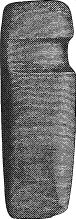
Fig. 352 (40560) (⅓)
1. (40139). Flat rubbing or grinding stone of silicified wood.
2. (40551). Stone axe, ō´-lā-ki-le, with groove near the larger end.
3. (40552). Imperfectly-made stone axe, ō´-lā-ki-le, grooved at each edge; basalt.
4. (40553). Large axe, with groove around the middle; sandstone.
5. (40554). Axe, grooved at the middle, square and flat on top; basalt.
6. (40555). Small centrally-grooved axe; schistose rock.
7. (40556). Axe, grooved in the middle.
8. (40557). Axe, grooved near the blunt end, which is shaped similarly to the edge.
9. (40558). Axe, grooved near the end.
10. (40559). Small hatchet, ō´-lā-ki-le, of basalt doubly grooved, edge beveled from both sides, hammer end about one and a half inches in diameter.
11. (40560). Grooved axe, ō´-lā-ki-le, of fine black basalt, well polished; groove well worn. The face or side is intended to be near the holder when in use. Fig. 352. This specimen was found in Arizona, near Camp Apache, and was presented by Mrs. George P. Buell. It is one of the largest in the collection with such perfect finish.
12. (40561). Grooved in the center; of porous basalt.
13. (40562). Hammer grooved in the center, rounded off at each end.
14. (40563). Small hatchet-shaped instrument, square at the back, and rounded at the front edge.
15. (40563a). Rudely-made axe, grooved near the blunt end.
16. (40564). Small axe, with a groove round the body quite near the blunt end; basalt.
17. (40565). Axe, three and a half inches long.
18. (40566). Quite small, probably a hatchet, of firm basalt, grooved near the hammer end.
19. (40567). Much larger than the last, basaltic; groove quite deep and smooth, hammer end circular, large, and blunt.
20. (40568). Grooved axe of quartzitic rock.
21. (40569). Pick-shaped axe, grooved entirely around, with imperfect depressions which were in the water-worn boulder from which it was made; about six inches in length.
22. (40570). Boulder of sandstone with groove near the middle.
23. (40571). Flat basaltic boulder, grooved near the center, straight on the back, and tapering above and below the groove.
24. (40572). Small basaltic hammer and axe with groove near the large end.
25. (40573). Small grooved axe composed of hard sandstone; hammer end large, edge quite perfect.
26. (40574). Small boulder of basalt, ground to an edge at one end and rounded off at the other; doubly grooved.
27. (40575). Large basaltic stone considerably chipped off from pounding hard substances, grooved near the center, both ends quite blunt; probably used as a pounding stone.
28. (40576). Flat basaltic boulder, used as a pounder.
29. (40577). Basaltic hatchet grooved in the middle; quite rough.
30. (40578). Grooved axe of a very heavy, solid character, apparently designed more for mauling than cutting.
31. (40579). Large, heavy basaltic hammer and axe with groove around the body near the hammer end; about seven inches long.
32. (40580). Axe, grooved in the middle, upper or hammer end unusually long in proportion to the size.
33. (40581). Flat axe made from a water-worn boulder, oval in outline, both edges designed for cutting or splitting. Deep groove encircling the body, with protrusions above and below it to prevent the handle from slipping out; greenstone.
34. (40582). Hard, fine-grained sandstone axe wedge-shaped, without a groove.
35. (40583). Grooved axe with round body.
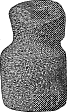
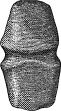
Fig. 349 (40584) (⅓) Fig. 350 (39903) (⅓)
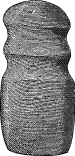
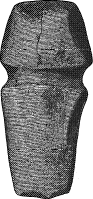
Fig. 348 (40703) (⅓) Fig. 351 (42205) (⅓)
36. (40584). Fig. 349. Axe with a broad, shallow groove near the upper end, which is much narrower and smaller than the lower; of mottled volcanic rock, white, green, and black.
37. (40585). Axe grooved in the middle, irregular in shape, and much chipped off at the lower edge and rounded off at the top.
38. (40806). Made from a very fine, hard metamorphic rock, small enough to be classed as a hatchet; crescent-shaped at the top.
39. (40703). Fig. 348. A very dark brown axe, speckled with reddish spots. This axe bears a much finer polish than most of those in the collection.
40. (40704). Axe, grooved near the upper end, which is cone-shaped.
41. (40705). An almost square axe of basaltic rock, grooved on the sides, flat on top.
42. (40706). Axe of quartzitic rock, flat and thin; grooved.
43. (40900). Long, narrow axe, grooved near the upper end.
44. (40901). Axe, made from a water-worn boulder, almost to its present shape.
45. (40902). Small, round axe of basalt, having a shallow groove near the larger end.
46. (40903). Grooved basaltic axe.
47. (40904). Maul, with rough surface, one side flat, the other convex, with a groove.
48. (40258). Double-grooved axe of porphyry, well polished and quite perfect.
49. (41260). Grooved axe of compact sandstone; wedge-shaped.
50. (42204). Stone maul of basalt, with groove; very rough.
51. (42205). Grooved axe of basalt. Fig. 351. This specimen was obtained at Fort Wingate, in New Mexico, but was probably found in or around some of the ruins.
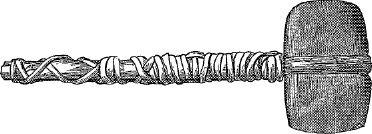
52. (42229). This is one of the finest specimens in the collection, and, as shown by the cut, Fig. 347, has the handle attached, ready for use. This is formed of a willow withe bent round the axe and doubled, extending out far enough to form a handle and wrapped with a buckskin string; of compact basalt.
Fig. 347 (42229) (⅓)
53. (42230). Shallow-grooved axe of basalt.
54. (42231). Axe, with a shallow groove near the larger end.
55. (42232). Axe of basalt, grooved on the sides.
56. (42233). Grooved axe, in size and shape the same as (42226).
57. (42234). Grooved axe of a peculiar black mottled rock, with white, marble-like streaks through it; groove surrounding it in the center.
58. (42235). Irregularly-shaped axe with a wide and deep groove surrounding it, curiously mottled with reddish and green streaks. Specimens of this kind are quite rare.
59. (42236). Grooved axe; sides well polished and exhibiting peculiar reddish spots.
60. (42237). Small grooved axe of metamorphic rock.
61. (42238). Grooved axe.
62. (42239). Small grooved axe of schistose rock, much flaked off at each end.
63. (42240). Axe, grooved on three sides; similar in size and shape to (42223).
64. (42241). Grooved axe with flattened top.
65. (42242). Same as the preceding.
66. (42242). Grooved axe with two edges.
67. (42244). Celt-shaped axe of basalt; it appears to have been used as a rubbing stone.
68. (39869). Zuñi maul with circular groove around the centre, used generally for grinding or pounding soft foods, such as red-pepper pods; of porous lava.
69. (39903). Double-edged axe, ō´-lā-ki-le, with groove around the middle; volcanic rock, from Zuñi. See Fig. 350.
70. (42349). Rounded end of a sandstone metate grinder converted into a flat hammer by grooving it at the opposite edges.
71. (41291). Pounder of sandstone. It was originally a common axe. Thumb and finger depression on the sides.
72. (40871). Lava Chili pounder with cap-shaped ends; grooved.
73. (40906). Lava rock pounder; small.
METATES, OR GRAIN-GRINDERS, AND PESTLES.
74. (40870). Square red sandstone metate.
75. (42280). Flat sandstone grinding slab.
76-82. The following numbers represent the rubbers accompanying the metates. The Indian name is yä´-lĭn-ne: 76, (40909); 77, (40910); 78, (40911); 79, (40912); 80, (40913); 81, (40914); 82, (41259); sandstone rubber.
MORTARS, PESTLES, ETC.
These are found in use at all the pueblos, but are more common in Zuñi and the Moki villages than elsewhere, as these Indians use mineral pigments more extensively and in greater variety than any of the others.
The pestles and mortars obtained from these tribes are all too small to be used for any other purpose than grinding pigments. Many of them appear to be quite old, and were probably handed down from distant ancestors, or obtained from the ruins. Some of them are evidently of modern manufacture.
83. (40707). Mortar; a round, flat, quartzitic boulder with round cavity on one side about one inch in diameter and half an inch deep, and a square depression on the other about an inch deep and two inches in width; indigo still clinging to the surface of the depression.
84. (40708). Mortar of quartzite, the body nearly square and flat; depression round and about four inches in diameter, quite shallow.
85. (40709). Mortar of coarse-grained sandstone, almost perfectly round, the cavity quite deep, and lined with red ochre or vermilion.
86. (40710). Mortar of a flat sandstone with irregular rim about four inches in diameter.
87. (40711). Paint mortar of a small round quartz boulder.
88. (40712). Mortar of fine-grained sandstone about six inches long by three wide; sides square. This mortar was in use by the Zuñians for the purpose of grinding a pigment of yellowish impure clay, colored by the oxide of iron, with which they decorate their pottery, and which produces the brown and reddish-brown colors.
89. (40713). Small mortar of sandstone.
90. (40714). Mortar made from a flat water-worn quartz boulder with a circular depression about half an inch deep. The bottom of this mortar shows evidence of its having been used as a grinding stone previous to being converted into a mortar, or it may have been used for both purposes, as both the paint cavity and the rubbing side show recent use.
91. (40715). Paint mortar of basalt, used for grinding the yellow pigment for ornamenting pottery; about four inches in diameter, cavity about one inch deep, bottom ground flat.
92. (40716). Flat paint mortar, of quartz rock, almost round, about an inch thick, depression quite shallow; used for grinding a pigment of azurite or carbonate of copper, small nodules of which they collect at copper mines. This pigment is used in painting and decorating wooden images and gods.
93. (40717). Mortar similar to the above, and used for the same purpose.
94. (40718). Paint mortar made from a large irregularly round ferruginous sandstone. Used in pulverizing a reddish pigment for decorating pottery.
95. (40719). Mortar of a globular shape, made from a coarse-grained sandstone, used for grinding or mixing vermilion.
96. (40720). Paint mortar of sandstone. The whole mortar is only about an inch thick; made from a section of an old metate rubber.
97. (40722). Paint mortar of quartzite; blue pigment grinder. Size about four by three inches. This, like many of the flat mortars, has been first used as a rubbing stone and subsequently converted into a paint mortar.
98. (40723). Mortar made from a quartz boulder.
99. (40724). Sandstone mortar.
100. (40725). Paint mortar of sandstone, very flat.
101. (40726). Paint mortar, with oblong shallow depression; sandstone.
102. (40728). Square paint mortar; cavity about half an inch deep; sandstone impregnated with iron. Quartzitic pestle accompanying it.
103. (40729). Paint mortar of quartzite; almost square; depression almost worn through by use; quartz pebble pestle accompanying it.
104. (40730). Small round paint mortar of basalt, with white quartz pebble pestle.
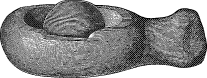
Fig. 353 (40731) (⅓)
105. (40731). Fig. 353. Paint mortar and pestle of quartz, with a knob on the end, which serves as a handle. This mortar was used in grinding an azurite pigment.
106. (40732). Mortar shaped somewhat like a ladle; the projecting end is provided with a small groove out of which the paint is poured.
107. (40733). Small sandstone mortar.
108. (40864). Paint mortar of sandstone.
109. (40868). Paint mortar of basalt, almost square.
110. (40869). Flat, square sandstone paint mortar; black water-worn pebble for pestle.
111. (40907). Chili or red pepper mortar of very porous lava rock; oval bottom, shallow cavity, about four inches thick and eight in diameter. These lava mortars may have been used for other purposes, but at the present time the Indians use them in crushing the pods and seeds of red pepper, and occasionally for crushing parched corn. They are quite common.
112. (40908). Food mortar of lava rock; square with flat bottom. Mortars of this kind are used in crushing grain and seeds.
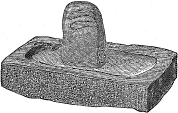
Fig. 358 (42272) (½)
113. (42272). Fig. 358. Paint mortar of very hard, fine-grained sandstone. The specimen is a very fair type of all the square paint mortars and pestles. The depression is often square instead of round. In grinding pigments the Indians generally move the pestle backward and forward instead of around as is done by our druggists.
114. (41273). Small sandstone paint mortar, much like the preceding.
115. (40227). Small egg-shaped paint pestle of white quartz. The general name of these in Zuñi is äh-shŏc-tōn-ne.
116. (42276). Flat sandstone, circular and about five inches in diameter; used as a quoit; originally a rubbing stone.
MISCELLANEOUS OBJECTS.
117. (39755). Eight specimens not very well defined. They are flint flakes, showing, by their shape, that they were designed for scrapers and groovers, being flat or slightly concave on one side and oval on the other.
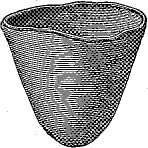
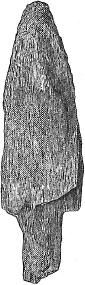
Fig. 354 (42266) (⅓)
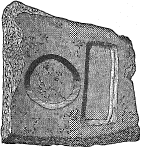
Fig. 356 (41289) Fig. 357 (40808) (¼)
118. (41289). Fig. 356. This is a sandstone mould for shaping metal into such forms as suit the fancy of the Indians for bridle and other ornaments; one cavity is rectangular, about four inches long by one in width; the other about two inches in diameter. Silver, which has long been a metal of traffic among these tribes, is the one which is usually melted down for ornamental purposes. After it is taken from the mould it is beaten thin, then polished.
119. (41290). Is a portion of the same mould, with one cavity square and the other in the shape of a spear-head.
120, 121. (42266), Fig. 354, and (42267), are crucibles, which were used in connection with the moulds for melting silver and other metals. Many other ornaments are made in the same manner.
122. (40808). Fig. 357. This is a large, rudely chipped spear-head of mica schist, obtained at Zuñi, which was carried in the hand of one of the performers in a dance. It does not show any evidences of having been used in any other way. They called it äh´-chi-än-tēh-ä-hla.
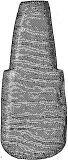
Fig. 355 (42245) (⅓)
123. (42245). Fig. 355. Handsomely-shaped and well-polished skinning knife of a remarkably fine-grained silicious slate. Above the shoulders on one side it is worn off to an oval surface, and is flat on the other.
124. (40915). Round sandstone, which is called a gaming stone; it is quite round, and bears the same name in Zuñi as the pestle, āh-kä-mon-ne.
125. (40916). Quartz stone, flat and rounded at the ends as a sort of last to keep moccasins in shape while being sewed; called yä´-lĭn-ne.
126. (41239). String of alabaster beads, tem-thla.
127. (41240). Charm, representing the upper part of the body and head of a bird.
128. (41241). Charm; representing a horse; quartz.
129. (41242). Charm; bird’s head and upper part of body.
130. (41243). Charm; horse and saddle.
131. (41244). Charm; representing entire bird; quartz.
132. (41245). Charm; head and upper part of body of a bird.
133. (41246). Charm; the same.
134. (41247). Agate arrow-head.
135. (40870). Disk of sandstone, slightly convex in the centre; used in games.
136. (42325). Flat sandstone slab, with the horns of male and female deer engraved on one side.
137, 138. (40721) and (41249). Flat sandstones, used for baking wi-a-vi, a thin, wafer-like bread, by heating the rocks and then spreading a gruel-like mixture of corn meal over them. The largest one of these stones is about three feet in length by two in width. They are used by the Zuñi and Moki pueblos quite extensively.
139. (42324). Eighty chip flints and flakes of agate, quartz, chalcedony, &c.
ARTICLES OF CLAY.
WATER VASES.
140. (39871). Form and decorations shown in Fig. 359. The slender shading lines only are brown, the rest of the figuring black; the base in this as in most Zuñi pottery is reddish or slate colored. This may be considered as the type of one variety of decorations, readily distinguished by the unadorned circular spaces, the large scrolls, and the absence of animal forms. The larger forms of these vases are called by the Zuñians kāh´-wi-nā-kä-tēhl-le; the smaller forms, det-tsan-na.
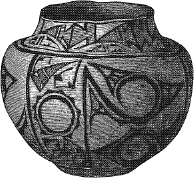
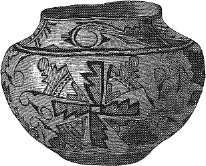
Fig. 359 (39871) (⅕) Fig. 360 (39916) (¼)
141. (39916). The ornamentation is well shown in Fig. 360. The combinations on this piece are rare on Zuñi pottery, and the chief figure on the body is more symmetrical than is usual in this group of ware. This may also be considered as representing a second type of decorations of which there is but one other example in the collection.
142. (39920). This belongs to the variety represented by Fig. 360, and varies chiefly in having the neck decorated with leaf-like figures, and in having the scrolls replaced by triangles with inner serratures.
143. (39934). The largest size; Fig. 361. The decorations of this piece belong to a third variety, distinguished chiefly by the presence of the elk or deer. Attention is called to the three figured zones or belts on the body, the upper with the arch inclosing an elk; the middle and narrow belt adorned with figures of birds with a long crest feather. The helix or scroll is freely introduced in this variety. The one here figured is typical of quite a large group. The animals are usually black, as are the lines separating the spaces.
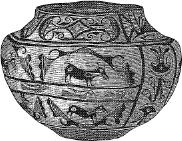
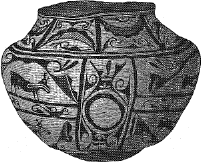
Fig. 361 (39934) (⅕) Fig. 362 (41150) (¼)
144. (41150). This is similar in size and decorations to Fig. 361, and is shown in Fig. 362. The difference in the form of the bird in this from that in the preceding is worthy of notice.
145. (39933). Similar to No. 143 (Fig. 361); bird scrolls as in No. 144.
146. (40322). Medium size, represented in Fig. 364. It may be grouped in the variety of which Fig. 359 is given as the type.
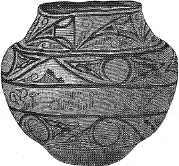
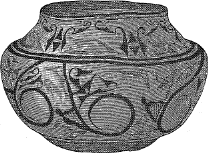
Fig. 363 (41158) (⅕) Fig. 364 (40322) (⅓)
147. (39936). Large size; decorations resembling those in Fig. 364, but with two belts of scrolls on the body.
148. (41154). Medium size; figures as in No. 147.
149. (41155). 150. (41162). Medium size; decorations similar to the preceding, except that No. 150 (41162) has figures of sheep on the neck.
151. (41158). Large size; the ornamentation of this piece, as will be seen by reference to Fig. 363, belongs to the variety represented by Fig. 359 and 364, but differs in having on the body a middle zone of bird-like figures.
152. (41161). Large size; similar to Fig. 363.
153. (39943). Decorations very similar to those shown in Fig. 359.
154. (39937). Medium size; ornamentation similar to that seen in Fig. 361.
155. (40312). Large size; shown in Fig. 365. As will be seen by comparison the decorations are the same as those in Fig. 361, except that the elk is omitted and a figure of scrolls introduced in its place.
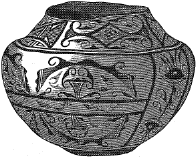
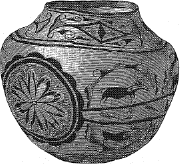
Fig. 365 (40312) (⅕) Fig. 366 (40310) (⅕)
156. (40310). Fig. 366. Large size. In the decorations of this piece we observe a new feature, a rosette or flower, showing a decided appreciation of the beautiful, either suggested by the flowers of the Helianthus or by something introduced by Europeans, but most probably the former. The different forms of this figure found on this ware furnish, perhaps the best evidence of taste exhibited by the Zuñian artists.
157. (40313). Fig. 368. Large size. In this we see the same figures as in Figs. 363 and 366 brought into combination with the rosette, the birds being replaced by sheep.
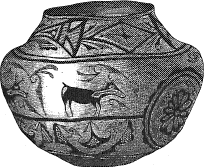
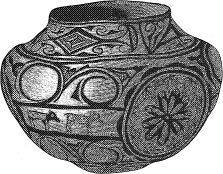
Fig. 367 (40317) (⅕) Fig. 368 (40313) (⅕)
158. (40318). Large size; similar to No. 149, except that the rosette is introduced in place of the circle.
159. (40314). Decorations belong to the variety shown in Fig. 361.
160. (40316).
161. (40317). Fig. 367. A little study of these figures will satisfy any one that although there is an apparently endless variety in details, there are, in fact, but comparatively few different figures.
162. (41146). Fig. 370. This belongs to the same variety as Fig. 368.
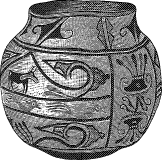
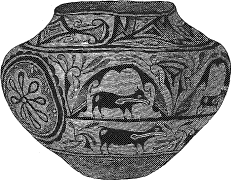
Fig. 369 (40701) (¼) Fig. 370 (41146) (¼)
163. (40315). Large size, similar to that represented in Fig. 370, but varying in form, having the expansion at the shoulder more prominent and tapering more rapidly from thence to the base. The figures remind us of the trappings often seen in Japanese cuts.
164. (40319). Medium size; decorations similar to those in Fig. 361, except that here the elk or deer stands on a broad black band in which there is a row of white diamonds.
165. (40321). Medium size; of the variety represented in Fig. 361, but in these smaller pieces the bird zone is omitted, and there is but one figured zone on the body. In this example a small elk is represented as standing on the back of a larger one.
166. (40700). Medium size, belonging to the same type as the preceding. On the neck are figures of grotesque kite-shaped birds.
167. (40701). Medium size; Fig. 369. This and the preceding one are not designated as vases in the original Smithsonian Catalogue, nor in my field list, but according to the form should be classed in this group.
168. (41165). Medium size; decorations similar to those of Fig. 367, but varying in having the figure of a bird introduced in the middle belt with a small double scroll arising out of the back. The lower belt has the same bird reversed.
169. (39935). Medium size. The unusual decorations of this piece are shown in Fig. 371. It differs, as does also Fig. 369, from the usual form; the body is more nearly spherical, the neck more gracefully curved, and the rim slightly flaring. The proportions are also different; height, 8.75 inches; diameter of body, 10; of mouth, 6.5.
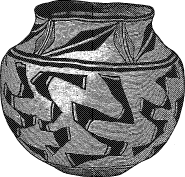
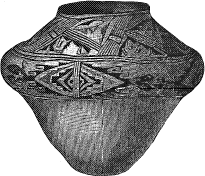
Fig. 371 (39935) (¼) Fig. 372 (41149) (¼)
170. (41144). Decorations similar to those in Fig. 364; (41144) varies in having the figures of elk or deer on the neck and in the coarser or ruder scrolls.
171. (41147).
172. (41149). This somewhat abnormal form is well shown in Fig. 372. It is of medium size.
173. (41152). This belongs to the same type, both as to form and decorations.
174. (41153). Large size; of the usual form, but the decorations on the body peculiar, the design being crudely architectural.
175. (41156). Medium size, belonging to the type represented by Fig. 361.
176. (41163). Medium size. This pretty vase has a somewhat peculiar decoration, which can be best described as a kind of patch-work representing small fragments of pottery.
177. (41166). Medium size, with the usual elk and scroll figures.
178. (41167). This specimen, which is rather above medium size, presents one of the most chaste designs in the entire group. It is represented in Fig. 374. Attention is called especially to the leaves and to the simple meander in the stripes.
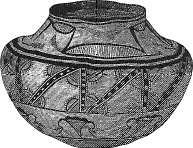
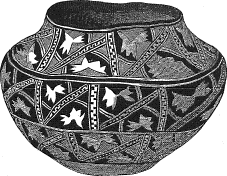
Fig. 373 (39774) (¼) Fig. 374 (41167) (¼)
179. (41168). Marked with the usual elk and scroll figures. Medium size.
180. (39774). The decorations of this piece, shown in Fig. 373, may be classed with the peculiar type with oblique and vertical bands represented in Fig. 374.
181. (39917). Figures similar to those in Fig. 363.
182. (40768). The decorations on this piece consist entirely of representations of pyramids or possibly of pueblos, and are arranged in bands, one on the neck and two on the body; the two upper bands show the figures inverted.
183. (40770).
184. (40771). No. 183 is decorated with scrolls and bird scrolls and a scalloped line around the shoulder; No. 184 with elks and scrolls on the body.
185-188. 185, (40800). Fig. 378. The grotesque or kite-like bird seen on the neck, though rarely seen on the large water vase, is common on the small ones. To this type belong the following Nos. 186, (40769); 187, (40772); 188, (40791).
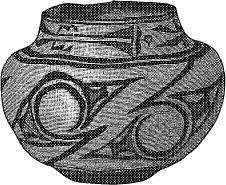
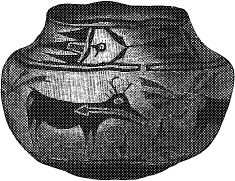
Fig. 377 (40777) Fig. 378 (40800) (¼)
189. (40773). These have the usual triangular and scroll designs without animal figures, as in Fig. 364.
190. (40776).
191. (40777). Fig. 377. The decorations on this evidently belong to the same type as those represented in Fig. 359, the bird on the neck being the only variation. To this type also belong the following numbers: 192, (40778); 193, (40792); 194, (40794).
195. (40779). These belong to the type represented by Fig. 361, distinguished chiefly by the elk, triangular figures, and scrolls.
196. (40781).
197. (40788).
198. (40787).
199. (40788).
200. (40801).
201. (40780). The decorations on these are similar to those shown in Figs. 366, 367, 368, and 370, in which the rosette is a distinguishing characteristic. Nos. 201, 202, and 203 are without figures of animals; No. 204 has a double belt of elk figures between the rosettes.
202. (40784).
203. (40786).
204. (40790).
205. (40782). The designs on this remain unfinished; except that the triangles on the neck and the arches in which it was evidently the intention to place the figures of animals, are shown.
206. (40785). Fig. 375. This pretty vase, as will be seen by reference to the figure, has the diameter greater in proportion to the height than usual. Although the design is tasteful the hues are coarse and not so well drawn as the figure indicates.
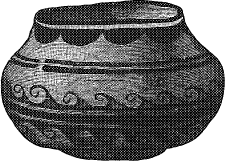
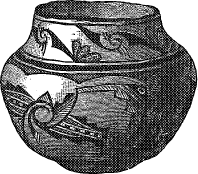
Fig. 375 (40785) (⅓) Fig. 376 (40793) (⅓)
207. (40789). On this there is an evident attempt to represent a pueblo or communal dwelling and the ladders.
208. (40793). Shown in Fig. 376.
209. (40795). Neck and lower belt of the body marked with vertical lines and oblique diamonds; upper belt with inverted pyramidal figures.
210. (40849). Very small; marked with oblique scalloped lines.
211. (40850). Very small; elk and grotesque bird on the body.
212. (40851). Very small; decorations similar to those on the middle belt of Fig. 373.
213. (41105). Similar to that shown in Fig. 361.
214. (40774). Marked with transverse lines and scrolls; design simple and unique.
The following specimens are red ware:
215. (40311). Large size; without ornamentation.
216. (40775). Small; form peculiar, diameter of the body greatest at the base, mouth flaring; decorations in black, consisting of triangles pointing downwards, and lines.
217. (40798). Medium size. See Fig. 381.

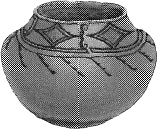
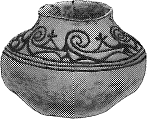
Fig. 381 (40798) Fig. 383 (41145) Fig. 384 (41052)
218. (40799). Small; without ornamentation.
219. (40802).
220. (41145). Large. See Fig. 383.
221. (41052). Medium size. See Fig. 384.
222. (41151). Medium size; without ornamentation.
223. (41157).
224. (41159).
225. (41160). Medium size; with a scalloped band in black around the rim and shoulder.
Black ware:
226. (39930). Large size; without ornamentation.
The only black water vase obtained at Zuñi; it was doubtless procured from some other tribe. The black ware obtained from, this tribe is in nearly all cases used for cooking, or holding liquids or moist foods. As remarked in another place, the Zuñi black ware is generally small except in cases where large quantities of food are to be cooked, which occurs at feast tunes, when very large vessels are employed.
WATER JUGS AND JARS.
These vary so greatly in form that it is impossible to give any general description that would convey a correct idea.
227. (39885). Somewhat mug-shaped, with handle; the top is rounded to the small mouth, no neck. White ware with scalloped bands and a Maltese cross.
228. (39886). Similar in form, but smaller, without handle or decorations.
229. (39899). Somewhat similar in form to the preceding, except that it is lower and more depressed, and instead of a mouth, at the top there is an orifice at the side as in the canteens, with which this should probably be classed.
230. (39940). Similar to No. 228.
231. (40062). Similar in form to No. 227, but without handle; with a double scalloped band around the constricted portion, and a single one around the mouth; figure of an insect on the upper half; apparently intended to represent a butterfly or large moth.
232. (40608). Small unhandled jug in the form of a smelling bottle. Unadorned.
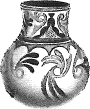
Fig. 399 (39928)
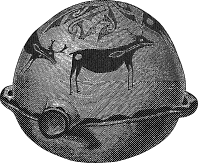
Fig. 387 (40077) (⅙)
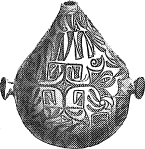
Fig. 400 (40078)
233. (40611). Similar to No. 232.
234. (40697). Like No. 228, with slight decorations.
235. (40608).
236. (41140). An amphora or slender jug with two handles.
237. (39928). A jar shown in Fig. 399.
238. (39922). Mē-hē-tō, canteen of large size. Plain brown, as are also the following specimens:
239-242. 239, (40079); 240, (40081); 241, (40082), this has a small flower on one side; 242, (40083).
243-245. 243, (40088); 244, (40090); 245, (40091).
246-248. 246, (40085); 247, (40086), and 248, (40676), plain, white.
249. (40077). White with color decorations. Fig. 387.
The following eight specimens are also white with colors:
250. (40078). Decorated profusely with scrolls, leaves, and other figures. See Fig. 400.
251. (40080). Figure of a coiled snake or worm, without head or other character to indicate what it was intended to represent.
252. (40084). Usual scroll figures.
253. (40087). Decorated with simple loops and bands.
254. (40089). Radiating serrate lines.
255. (40092). Vase-shaped, with three colored bands.
256. (40093). Shown in Fig. 385.
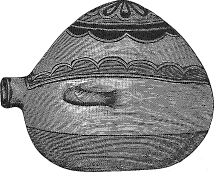
Fig. 385 (40093) (⅓) Fig. 398 (40886) Fig. 379 (39659)
257. (40886). Handsome piece, with floweret at the apex, scrolls on the side, and a scalloped band around the middle. The bands are always horizontal, the vessel being on its side. See Fig. 398.
258. (39914). Mē-hē-tō-tsān-nā, canteens of small size. Red. Double, with two sets of handles and two chambers, but with only one orifice. Decorations in white, those on the larger piece consisting of meanders of the simplest form, a figure very unusual on Zuñi pottery.
259. (39659). Brown, with handle and decorations in black. See Fig. 379.
260. (39923). Plain brown.
The following are also plain brown, red, or yellow:
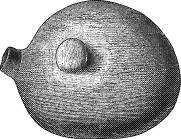
Fig. 390 (40097) (⅓)
261-271. 261, (40094); 262, (40095); 263, (40096); 264, (40097), Fig. 390; 265, (40099); 266, (40100); 267, (40101); 268, (40687), Fig. 386; 269, (40688); 270, (40689); 271, (40690).
272. (40102). White, with an oblique scalloped band.
273. (39872). White, shown in Fig. 389.
274. (40686). White, decorations as in Fig. 389.
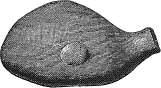
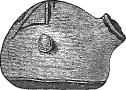
Fig. 386 (40687) (⅓) Fig. 389 (39872) (⅓)
275. (40685). White, with a single flower.
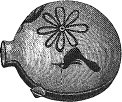
Fig. 388 (40695) (⅓)
276. (40691). White, egg-shaped, with a single handle; decorated with a figure of the horned toad.
277. (40692). White, form and decorations like those shown in Fig. 385.
278. (40098). With outline figures of birds.
279. (40695). White, shown in Fig. 388. Although obtained at Zuñi, this piece may have been manufactured at one of the other pueblos.
JUGS OF FANCIFUL FORMS.
280. (39913). Fig. 395. Zuñi name Mē´-wi-i-pä-chin.
281. (39887). Similar to No. 280.
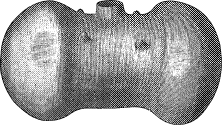
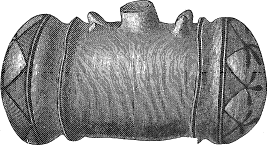
Fig. 392 (39889) (⅕) Fig. 394 (39915) (⅓)
282. (39889). Fig. 392. Mē´-wi-kē-lik-tōn-ne. Plain red.
283. (39915). Fig. 394.
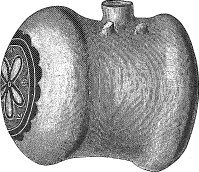
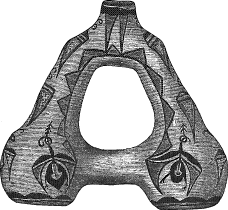
Fig. 393 (40104) (⅓) Fig. 395 (39913) (⅓)
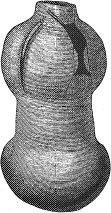
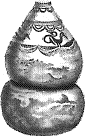
Fig. 391 (40106) (⅓) Fig. 402 (40103)
284. (40103). White, bottle-shaped, with constriction below the middle; scalloped bands and bird figures around the upper third. See Fig. 402.
285. (40104). Shown in Fig. 393.
286. (40105). Similar to No. 285. Marked with the figure of a bird having the wings spread. Navajo. Kō´-sē-tŏm-me.
287. (40106). Fig. 391.
288. (39887). Fig. 396. A double-globed canteen; triangular, with orifice at upper convexity.
289. (39914). Fig. 397. Red ware, with white lines on the lower globe and decorations in black on the upper, with orifice in each globe.
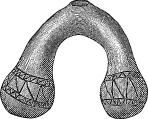
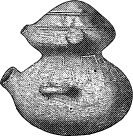
Fig. 396 (39837) (⅓) Fig. 397 (39914) (⅙)
PITCHERS.
These are of the usual form, of such vessels, except that they are generally without the lip. It is possible that to a certain extent they have been patterned after those observed in use among the Europeans or white races with whom these Indians have come in contact. But we shall presently find specimens similar in form among the ancient pottery found in the ruins of the cliff houses. We are inclined to believe that the form is original and not borrowed. The figures introduced will suffice to illustrate the form and usual decorations. The specimens obtained are generally small, varying in capacity from a pint to half a gallon. These are known in Zuñi by the name Ē´-mūsch-tōn-ne.
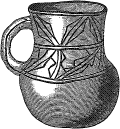
Fig. 403 (39918) (¼)
290. (39918). Shown in Fig. 403.
291. (40668). With scalloped margin and decorations similar to those on Fig. 403.
292. (40669). Without handle and should be classed with the cups. Figures of plants.
293. (40671). Triangles on the upper portion; simple meander on the bowl.
294. (40672). Similar to the following.
295. (40673). With scalloped margin and zigzag lines on white ground; small right-angle handle.
296. (40674). With scalloped marginal and middle bands. The following are brown ware with but slight decorations:
297-310. 297, (40838); 298, (40839); 299, (40841); 300, (40843), outline figures similar to those on No. 293; 301, (40844); 302, (40887); 303, (40888); 304, (40889); 305, (40890), is really black but not polished; 306, (40891); 307, (40893); 308, (40894); 309, (40897); 310, (40898).
311. (40842). Scalloped rim and similar in size and shape to 298, (40839).
312. (40845). Small, white, with decorations and of unusual form, in fact in the original field list is classed among the canteens. The mouth is prolonged obliquely in the form of a large tube. It should perhaps be classed with the water jugs.
313. (40892). Form and decorations shown in Fig. 405.
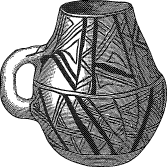
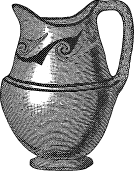
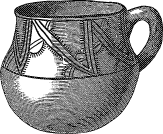
Fig. 405 (40892) (⅓) Fig. 406 (41005) (¼) Fig. 407 (41136) (⅓)
314. (40895). Scalloped margin; decorated with scrolls.
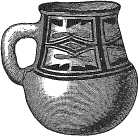
Fig. 404 (40840) (¼)
315. (40896). Scalloped margin. Figures of the little water animal so often represented on the earthenware baskets.
316. (40899). Without handle; diamond figures on the neck.
317. (41005). Fig. 406.
318. (41013). Slender neck and small mouth; jug-shaped, marked with twigs and leaves. This does not appear to be of Zuñi manufacture.
319. (41136). Fig. 407.
320. (40840). Shown in Fig. 404.
CUPS OR CUP-SHAPED VESSELS.
Under this general head are included two forms: one, closely resembling the true cup, as shown in the figures and to which the Zuñis apply the name sāt-tsān-nā-mū-yā, and those in the form of ollas or bowls, and without handles. The decorations of the true cup-shaped vessels, especially on the inner surface, follow somewhat closely the patterns found on the bowls. Here we see the zigzag marginal line, the scalloped bands, the interlaced or tessellated bands with star points, triangles, scrolls, &c.; but the elongate triangle or lance point is seldom present. As no new figure is introduced it is unnecessary for me to describe the decorations. A few are of red or brown ware.
The following numbers refer to true cups:
321-345. 321, (40058); 322, (40615); 323, (40616), Fig. 408; 324, (40617); 325, (40618); 326, (40619); 327, (40620); 328, (40621), Fig. 409; 329, (40622); 330, (40623); 331, (40624); 332, (40625); 333, (40627); 334, (40638); 335, (40639); 336, (40640); 337, (40641); 338, (40643); 339, (40644); 340, (40837); 341, (40847); 342, (40848); 343, (40880)—this is an unusually large cup and although having a handle may have been used as a bowl; 344, (40998); 345, (41148), an unburnt specimen.
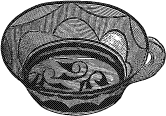
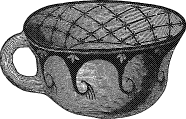
Fig. 408 (40616) (⅓) Fig. 409 (40621) (⅓)
The following are without handles and are either small bowls or paint cups:
346-355. 346, (40426); 347, (40436); 348, (40458); 349, (40642); 350, (40853), a small bowl-shaped cup, sūt-tsān-nā; 351, (40994); 352, (40995); 353, (40996); 354, (40997); 355, (41000).
EATING BOWLS.
The smaller forms are called sāt-tsān-nā.
356. (39962). Fig. 410. The ornamentation is typical of a variety very common on Zuñi bowls. The design on the outer surface is more constant than that on the inner, in which the figures of animals, especially the elk, are sometimes introduced. The distinguishing feature of this type is the zigzag line on the inner margin.
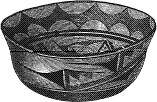
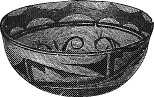
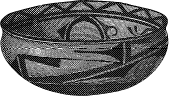
Fig. 410 (39962) (¼) Fig. 411 (40266) (¼) Fig. 412 (40285) (¼)
The following numbers belong to the same type:
357-378. 357, (39746); 358, (39973); 359, (39975); 360, (39981); 361, (39984); 362, (39988); 363, (39989); 364, (39991); 365, (39993); 366, (39994); 367, (39997); 368, (39999); 369, (40004), duplicate of Fig. 411; 370, (40005); 371, (40231); 372, (40234); 373, (40236); 374, (40239); 375, (40246); 376, (40249); 377, (40250); 378, (40259).
379-396. 379, (40260); 380, (40266), shown in Fig. 411; 381, (40274); 382, (40285), shown in Fig. 412; 383, (40504); 384, (40512); 385, (40513); 386, (40516); 387, (40517); 388, (40519); 389, (40522); 390, (40527); 391, (40530); 392, (40541); 393, (40546); 394, (40528); 395, (40203); 396, (40211).
397. (39951). Decorated, on the inner margin only, with triangles.
398. (39952). Similar to that shown in Fig. 411, except that the inner marginal line is scalloped.
The following numbers may be classed in the same group:
399, 400. 399, (40205); 400, (40210).
401. (40521). Similar to No. 397, except that it has the interior below the marginal line decorated with scrolls.
402. (39902). Decorated on the inner surface only, with the usual scrolls; marginal band simply a narrow line or entirely wanting.
The following belong to the same type:
403-417. 403, (39960); 404, (40002); 405, (40006); 406, (40232); 407, (40233); 408, (40237); 409, (40263); 410, (40268); 411, (40284), in this small specimen there are but few figures; 412, (40503); 413, (40505); 414, (40520); 415, (40524); 416, (40981); 417, (40987).
418. (40906). The decorations of this piece belong to a variety which is readily distinguished by the broad checkered band on the inner margin.
There are two sub-varieties, one with and one without figures on the external surface. This and the following specimens belong to the latter group:
419, 420. 419, (40533); 420, (39890).
421. (40001). This belongs to the former group, as represented by Fig. 412.
422. (39898). External decorations as in Fig. 410, except that the lower margin of the oblique line is furnished with scrolls as in Fig. 375, inner surface with leaves, and a zigzag marginal line.
423. (39908). This and the following thirty-one specimens have the external surface ornamented as in Fig. 410, the decorations of the inner surface varying and differing from those already enumerated. In this the marginal line is simple.
424. (39909). Marginal line scalloped; central rosette of simple lines.
425. (39963). Zigzags in irregular lines, no marginal band; form semi-globular.
426. (39963). Triangles and scrolls; somewhat mug-shaped.
427. (39972). Usual form; decorations as in the preceding.
428. (39975). Ornamentation as represented in Fig. 422.
429. (39976). Double scrolls; no marginal bands.
430. (40000). Margin as in Fig. 422; no other inner decorations.
431. (40204). Scroll figures; no marginal band; form hemispherical.
432. (40216). Similar to Fig. 423, as are also the following specimens:
433-443. 433, (40218); 434, (40223); 435, (40238); 436, (40240); 437, (40284); 438, (40286); 439, (40501); 440, (40506); 441, (40507); 442, (40510); 443, (40514); the inner decorations of this piece vary in having the figures of the elk below the marginal band.
444-447. 444, (40515); 445, (40547); 446, (40985); 447, (40217). Zigzag marginal band; no other inner decorations.
448. (40241). Marginal band double, upper line undulate, lower, straight with star points.
449. (40245). Marginal band composed of rows of stars, as in Fig. 414.
450. (40251). Only the inner decorations consist of radiating serrate lines.
451. (40258). Similar to that shown in Fig. 424.
452. (40273). Inner decorations apparently intended as floral; marginal line very slender.
453. (40275). Inner figures; radiating scrolls.
454. (40287). Similar to No. 453.
455. (40558). Inner figures in the form of blocks or tiles; marginal band undulating.
456. (40549). Inner decorations consist of two narrow crenate bands, one marginal and the other just below it.
457. (39891). This and the following thirty-nine specimens are without external ornamentation. In this one the inner figures are radiating scrolls, and birds.
458. (39892). Slender marginal scalloped band only.
459. (39893). Serrate marginal band only.
460. (39953). Similar to Fig. 424.
461. (39954). Birds with wings spread, and scrolls.
462. (39958). Differs from the usual form in having the margin undulating. The inner decorations consist chiefly of combinations of triangles. Similar to
463. (39971). Similar to the preceding.
464. (39959). Scrolls and triangles.
465. (39960). Scrolls and leaves.
466. (39961). Oblique serrate lines.
467. (39986). Broad net-work, marginal band, as seen in Fig. 414; form unusual, being constricted near the base.
468. (39992). Marginal band composed of sigmoid figures.
469. (39996). Very small; central diameter with rays from the points; the marginal band is simply a narrow line.
470. (40209). Ornamental marginal band only.
471. (40212). Scalloped marginal band, and central rosette or flower.
472. (40224). Scalloped marginal band, and figures of deer.
473. (40225). Zigzag band and the usual scroll figures.
474. (40229). Two slender bands, and central radiating scrolls.
475. (40242). Zigzag marginal line only.
476. (40248). Narrow scalloped marginal band; no other figures.
477. (40252). Zigzag band and floral decorations.
478. (40253). No marginal band; oblique triple and dotted lines.
479. (40265). Serrate marginal band and central rosette.
480. (40270). No band except a simple line bounding the central figure of radiating leaves.
481. (40272). Three plain bands.
482. (40481). Broad marginal band in figures arranged in square blocks.
483. (40485). Very small; marginal net-work band, central floral figure.
484. (40490). Similar to the preceding.
485. (40489). Plain marginal band; central floral figures.
486. (40492). Zigzag marginal band as in Fig. 425.
487. (40498). Marginal band as in Fig. 414.
488. (40499). Scalloped marginal band.
489. (40508). Zigzag band and floral decorations.
490. (40511). Marginal band composed of lines of stars.
491. (40530). Similar to No. 486, having also a central figure.
492. (40536). Marginal band of scrolls and triangles.
493. (40537). Net-work marginal band.
494. (40539). Scalloped band and central figure of twigs and leaves; unusually chaste design.
495. (40542). Like No. 467.
496. (40545). Scalloped marginal band.
497. (39967). Do.
498. (39965). Zigzag inner marginal band; figures of the elk externally and internally.
499. (39966). External and internal zigzag marginal band.
500. (39969). No external decorations; marked internally with oblique lines, no band.
501. (39970). Scroll figures on the inner surface; on the outer, triangles pointing in opposite directions; no bands.
502. (39977). Dish-like, undulate, external and internal marginal band.
503. (39978). Inner band of crosses, and central figure, outer serrate marginal band.
504. (39982). Decorations same as those represented in Fig. 414, with a wide, latticed, marginal band on the inner side of the bowl.
505. (39983).
506. (39985). Both surfaces decorated with scroll figures.
507. (39987). Inner surface with scroll figures, outer with but a marginal scalloped band.
508. (39990). Both surfaces marked with oblique serrate Hues; unusually flaring.
509. (39998). Inner surface with reversed elks; outer with oblique lines, with each side serrate.
510. (40007). Inner surface with serrate band and birds; outer with serrate band.
511. (40213). Elk and scrolls internally; an outer scalloped band.
512. (40215). Resembles No. 501.
513. (40219). The decorations on this bowl are unusual; those of the inner surface consist of a slender crenate marginal band, and below this a woman holding a child and apparently closely wrapped in a robe of some kind and placed transversely; the outer margin is marked with a broad band of crosses regularly spaced by perpendicular lines.
The following numbers belong to the type represented in Figs. 356, 411, and 412:
514-520. 514, (39979); 515, (40220); 516, (40221); 517, (40243); 518, (40274); 519, (40493); 520, (40523), inner marginal band consists of scrolls and triangles.
521. (40227). Inner marginal band broad and divided into diamond spaces; outer surface ornamented with figures similar to those on vase represented by Fig. 372.
522. (40230). Although classed with the bowls this is shaped somewhat like the paint pots; outer and inner bands.
523. (40247). Resembles No. 504.
524. (40254). Two broad undulate lines on the external surface; inner surface with blocks and scrolls.
525. (40256). Inside with crenate marginal lines, and circular space and triangles as in Fig. 359. External surface with a simple scalloped band.
526. (40264). External surface as in the preceding; internal scrolls and triangles.
527-533. 527, (40267); 528, (40269); 529, (40487); 530, (40495); 531, (40509); 532, (40529); 533, (40531). The decorations on these specimens belong to the same general type as those of No. 526.
534. (40271). Mug-shaped with flat bottom; outer surface marked with five scalloped bands; inner with scrolls.
535. (40279). Outer surface with triangular figures; inner with a scalloped marginal band and a similar band below.
536. (40482). Similar in form to No. 534. Outer and inner decorations consist almost entirely of triangles.
537. (40483). Without bands; interior, scrolls; exterior, geometrical figures.
538. (40488). This belongs to the type represented by Fig. 411; rosette on the inner surface.
539. (40491). Similar in form and decorations to No. 534.
540. (40496). Form like the preceding; inner face decorated with stars; outer with the usual triangular figures.