G. APPENDIX
Reading edition
(i) Species list of specialised habitats
INTRODUCTION
Although some fungi prefer one type of woodland more than another many fungi are less specialised and may be found in all kinds of woods. Indeed many fungi which we usually associate with a woodland fungus flora can also be commonly seen in pastures and gardens, e.g. Laccaria laccata (Fries) Cooke, Hygrophoropsis aurantiaca (Fries) Maire.
It is useful to consider the fungi of different woodland types separately, but this in some cases is very difficult because some species are not exclusive; indeed some species may grow in completely contrasting habitats, e.g. Amanita muscaria (Fries) Hooker in both birch and conifer woods, or on contrasting substrates, e.g. Fomes fomentarius (Fries) Kickx on birch in Scotland and beech on the continent of Europe. The picture becomes even more complex because frequently woods, in fact, often include several tree species growing in close proximity and it is then difficult to draw connections between a fungus and the tree with which it is truly growing—we know little or nothing except for mycorrhizal fungi, why certain fungi prefer certain habitats.
A parallel example is that phenomenon seen in certain polypores which only attack twigs or branches and not stumps or trunks, whilst others grow exclusively on stumps. We know little of the reasons for these demarcations, even when they occur within the same host. Mycology, therefore, offers to the beginner and the professional many opportunities in physiology and ecology.
In grassland areas it is difficult to know where to draw the line between one plant-community and another when listing species, for although ecologically distinct both would come under the name grassland. In the field, however, this is often very obvious and there is little doubt that fungi can give just as accurate an indication as to the soil-type, as many mosses or vascular plants. In sand-dune systems, the mobile dunes offer a different ecological niche to that of the fixed dunes which in many ways resemble grasslands. Thus although the lists below are split into easily manageable units, some flexibility must still be allowed. It is meant only as a guide—and will differ in some cases from one place to another, even within the British Isles.
General Woodland
Agaricus silvicola (Vitt.) Peck
Amanita citrina S. F. Gray
A. excelsa (Fries) Kummer
A. rubescens (Fries) S. F. Gray
A. vaginata (Fries) Vittadini
Boletus calopus Fries
B. erythropus (Fries) Secretan
B. piperatus Fries
Cantharellus infundibuliformis Fries
Clitocybe clavipes (Fries) Kummer
C. fragrans (Fries) Kummer
C. nebularis (Fries) Kummer
C. odora (Fries) Kummer
Collybia butyracea (Fries) Kummer
C. confluens (Fries) Kummer
C. dryophila (Fries) Kummer
Hebeloma crustuliniforme (St Amans) Quélet
Hygrocybe strangulatus (Orton) Moser
Hygrophoropsis aurantiaca (Fries) Maire
Inocybe eutheles (Berkeley & Broome) Quélet
I. fastigiata (Fries) Quélet
I. geophylla (Fries) Kummer
Laccaria laccata (Fries) Cooke
Lactarius mitissimus (Fries) Fries
L. piperatus (Fries) S. F. Gray
L. subdulcis (Fries) S. F. Gray
Limacella glioderma (Fries) Maire
Mycena filopes (Fries) Kummer
M. galopus (Fries) Kummer
M. pura (Fries) Kummer
M. sanguinolenta (Fries) Kummer
M. vitilis (Fries) Quélet
Paxillus involutus (Fries) Fries
Ripartites tricholoma (Fries) Karsten
Russula adusta (Fries) Fries
R. atropurpurea (Krombholz) Britz.
R. delica Fries
R. foetens (Fries) Fries
R. nigricans (Mérat) Fries
R. ochroleuca (Secretan) Fries
R. xerampelina (Secretan) Fries
Tricholoma agyraceum (St Amans) Gillet
T. orirubens Quélet
T. saponaceum (Fries) Kummer
T. sciodes (Secretan) Martin
T. terreum (Fries) Kummer
T. virgatum (Fries) Kummer
Tylopilus felleus (Fries) Karsten
Hydnum repandum Fries
Phallus impudicus Persoon
Scleroderma citrinum Persoon
S. verrucosum Persoon
Leotia lubrica Persoon
Microglossum viride (Fries) Gillet
On wood
Armillaria mellea (Fries) Kummer
Crepidotus variabilis (Fries) Kummer
Hypholoma fasciculare (Fries) Kummer
H. sublateritium (Fries) Quélet
Pluteus cervinus (Fries) Kummer
Calocera cornea (Fries) Fries
Coriolus versicolor (Fries) Quélet
Merulius tremellosus Fries
Schizophyllum commune Fries
Stereum hirsutum (Fries) Fries
S. rugosum (Fries) Fries
Lycoperdon pyriforme Persoon
Coryne sarcoides (S. F. Gray) Tulasne
Cudoniella acicularis (Fries) Schroeter
Nectria cinnabarina (Fries) Fries
Xylosphaera hypoxylon Dumortier
X. polymorpha (Mérat) Dumortier
Conifer Woods
characterised by species of Suillus, Chroogomphus, Gomphidius, several Lactarius and Russula spp.
Agaricus sylvatica Secretan
Amanita porphyria (Fries) Secretan
Boletus badius Fries
B. pinicola Venturi
Chroogomphus rutilus (Fries) O. K. Miller
Clitocybe flaccida (Fries) Kummer
C. langei Hora
Collybia distorta (Fries) Quélet
Cortinarius callisteus (Fries) Fries
C. gentilis (Fries) Fries
C. mucosus (Fries) Kickx
C. pinicola P. D. Orton
C. sanguineus (Fries) Fries
C. semisanguineus (Fries) Gillet
Cystoderma amianthinum (Fries) Fayod
Gomphidius glutinosus (Fries) Fries
G. maculatus Fries
G. roseus (Fries) Karsten
Hygrophorus hypothejus (Fries) Fries
Hypholoma marginatum (Fries) Schroeter
Inocybe calamistrata (Fries) Gillet
Lactarius camphoratus (Fries) Fries
L. deliciosus (Fries) S. F. Gray
L. helvus (Fries) Fries
L. rufus (Fries) Fries
Leccinum vulpinum Watling
Marasmius androsaceus (Fries) Fries
Mycena adonis (Fries) S. F. Gray (= Hemimycena)
M. amicta (Fries) Quélet
M. capillaripes Peck
M. coccinea Quélet
M. rubromarginata (Fries) Kummer
M. vulgaris (Fries) Kummer
Nolanea cetrata (Fries) Kummer
N. cuneata Bresadola
Rozites caperata (Fries) Karsten
Russula caerulea Fries
R. decolorans (Fries) Fries
R. emetica (Fries) S. F. Gray
R. erythropus Peltereau
R. nauseosa (Secretan) Fries
R. obscura Romell
R. paludosa Britz.
R. queletii Fries
R. sardonia Fries
Tricholoma albobrunneum
T. flavovirens (Fries) Lundell
T. focale (Fries) Ricken
T. imbricatum (Fries) Kummer
T. vaccinum (Fries) Kummer
Ramaria ochraceo-virens (Jungh.) Donk
R. invallii (Cotton & Wakef.) Donk
Sarcodon imbricatum (Fries) Karsten
Sparassis crispa (Wulfen) Fries
Thelephora palmata (Bulliard) Patouillard
T. terrestris Fries
Geastrum pectinatum Persoon
Hypogeous
Rhizopogon luteolus Fries
Elaphomyces granulatus Fries
E. muricatus Fries
On cones
Baeospora myosura (Fries) Singer
Strobilurus esculentus (Wulf. ex Fr.) Singer
S. stephanocystis (Hora) Singer
S. tenacellus (Fries) Singer
Auriscalpium vulgare S. F. Gray
On conifer wood
Gymnopilus penetrans (Fries) Murrill
Hypholoma capnoides (Fries) Kummer
Mycena alcalina (Fries) Kummer
Lentinus tigrinus (Fries) Fries
Paxillus atrotomentosus (Fries) Fries
P. panuoides (Fries) Fries
Pholiota flammans (Fries) Kummer
Pleurotellus porrigens (Fries) Singer (= Pleurocybella)
Pluteus atromarginatus Kühner
Tricholompsis rutilans (Fries) Singer
Xeromphalina campanella (Fries) Maire
Calocera viscosa (Fries) Fries
Dacrymyces stillatus Nees ex Fries
Pseudohydnum gelatinosum (Fries) Karsten
Gloeophyllum sepiarium (Fries) Karsten
Heterobasidion annosum (Fries) Brefeld
Hirschioporus abietinus (Fries) Donk
Laetiporus sulphureus (Fries) Murrill
Phaeolus schweinitzii (Fries) Patouillard
Stereum sanguinolentum (Fries) Fries
Tremella encephala Persoon
T. foliacea (Persoon) Persoon
Tyromyces stipticus (Fries) Kotlaba & Pouzar
Deciduous Woods General
Amanita fulva Secretan
A. inaurata Secretan
A. virosa Secretan
Boletus edulis Fries
B. chrysenteron St Amans
B. luridus Fries
B. subtomentosus Fries
Collybia peronata (Fries) Kummer
Lactarius vellereus (Fries) Fries
Russula cyanoxantha (Secretan) Fries
R. grisea (Secretan) Fries
R. heterophylla (Fries) Fries
R. lutea (Fries) Fries
R. ochroleuca (Secretan) Fries
Tricholoma album (Fries) Kummer
T. columbetta (Fries) Kummer
T. saponaceum (Fries) Kummer
T. sulphureum (Fries) Kummer
Cantharellus cibarius Fries
Clavulina cinerea (Fries) Schroeter
C. cristata (Fries) Schroeter
Hydnum repandum Fries
Geastrum rufescens Persoon
Lycoperdon perlatum Persoon
Helvella crispa Fries
H. elastica (St Amans) Boudier
H. lacunosa Fries
Disciotis venosa (Persoon) Boudier
Paxina acetabulum (St Amans) Kuntze
Peziza badia Mérat
P. succosa Berkeley
On wood
Coprinus disseminatus (Fries) S. F. Gray
C. micaceus (Fries) Fries
Crepidotus mollis (Fries) Kummer
Galerina mutabilis (Fries) P. D. Orton
Gymnopilus junonius (Fries) P. D. Orton
Mycena galericulata (Fries) S. F. Gray
Oudemansiella radicata (Fries) Singer
Pholiota squarrosa (Fries) Kummer
Pleurotoid fungi (see p. 74)
Psathyrella candolleana (Fries) R. Maire
P. hydrophilum (Mérat) Maire
Coniophora puteana (Fries) Karsten
Meripilus giganteus (Fries) Karsten
Tremella mesenterica Hooker
Beech Woods
Amanita citrina var alba Gillet
Boletus edulis Fries
B. satanus Lenz
Collybia fuscopurpurea (Fries) Kummer
Coprinus picaceus (Fries) S. F. Gray
Cortinarius pseudosalor J. Lange
C. bolaris (Fries) Fries
Hygrophorus chrysaspis Métrod
Laccaria amethystea (Mérat) Murrill
Lactarius blennius (Fries) Fries
L. pallidus (Fries) Fries
L. tabidus Fries
Marasmius cohaerens (Fries) Cooke & Quélet
M. wynnei Berkeley & Broome
Mycena capillaris (Fries) Kummer (on leaves)
M. pelianthina (Fries) Quélet
Russula alutacea (Fries) Fries
R. fellea (Fries) Fries
R. lepida Fries
R. mairei Singer
R. virescens (Zantedschi) Fries
Tricholoma ustale (Fries) Kummer
Clavariadelphus pistillaris (Fries) Donk
Geaster triplex Jungh
G. fimbriatum Fries
Hypogeous
Melanogaster variegatus Vittadini
Tuber aestivum Vittadini
On wood
Oudemansiella mucida (Fries) Höhnel
O. radicata (Fries) Singer
Panus torulosus (Fries) Fries
Pholiota adiposa (Fries) Kummer
Stropharia squamosa (Fries) Quélet
Bjerkandera adusta (Fries) Karsten
Datronia mollis (Fries) Donk
Hiericium coralloides (Fries) S. F. Gray
Lentinellus cochleatus (Fries) Karsten
Pseudotrametes gibbosa (Fries) Bond. & Singer
Bulgaria inquinans Fries (a large dark brown, gelatinous discomycete)
Several pyrenomycetes are recorded and dealt with by J. Webster in a popular account published in The Naturalist, London 1953, pp. 1-16.
Birch Woods
Amanita crocea (Quélet) Kühner & Romagnesi
Boletus edulis Fries
Cortinarius armillatus (Fries) Fries
C. crocolitus Quélet
C. hemitrichus (Fries) Fries
Lactarius glaucescens Crossland
L. glyciosmus (Fries) Fries
L. lacunarum Hora
L. torminosus (Fries) S. F. Gray
L. turpis (Weinm.) Fries
L. uvidus (Fries) Fries
L. vietus (Fries) Fries
Leccinum holopus (Rostkovius) Watling
L. roseofractum Watling
L. scabrum (Fries) S. F. Gray
L. variicolor Watling
L. versipellis (Fries & Hök) Snell
Russula aeruginea Lindblad ex Fries
R. betularum Hora
R. claroflava Grove
R. gracillima J. Schaeffer
R. nitida (Fries) Fries
R. pulchella Borszczow
R. versicolor J. Schaeffer
Tricholoma fulvum (Fries) Saccardo
On wood
Fomes fomentarius (Fries) Kickx
Lenzites betulina (Fries) Fries
Piptoporus betulinus (Fries) Karsten
Oak Woods
Amanita phalloides (Fries) Secretan
Boletus albidus Rocques
B. appendiculatus Fries
B. pulverulentus Opatowski
B. reticulatus Boudier
B. versicolor Rostkovius
Gyroporus castaneus (Fries) Quélet
Hygrophorus eburneus (Fries) Fries
Lactarius chrysorheus Fries
L. quietus (Fries) Fries
Leccinum quercinum (Pilát) Green & Watling
Russula vesca Fries
Tricholoma acerbum (Fries) Quélet
Hypogeous
Hymenogaster tener Berkeley & Broome
On wood
Mycena inclinata (Fries) Quélet
Psathyrella obtusata (Fries) A. H. Smith
Daedalea quercina Persoon
Fistulina hepatica Fries
Hymenochaete rubiginosa (Fries) Léville
Peniophora quercina (Fries) Cooke
Inonotus dryadeus (Fries) Murrill
Stereum gausapatum (Fries) Fries
Specific Tree Species
Alder
Lactarius obscuratus (Lasch) Fries
Naucoria escharoides (Fries) Kummer
N. scolecina (Fries) Quélet
On wood
Clavariadelphus fistulosus var. contorta (Fries) Corner
Exidia glandulosa (St Amans) Fries
Inonotus radiatus (Fries) Karsten
Plicaturiopsis crispa (Fries) Reid
Ash
On wood
Inonotus hispidus (Fries) Karsten
Daldinia concentrica (Fries) Cesati & de Notaris
Elder
On wood
Hirneola auricula-judae (St Amans) Berkeley
Hyphodontia sambuci (Fries) J. Eriksson
Elm
On wood
Lyophyllum ulmarius (Fries) Kühner
Rhodotus palmatus (Fries) Maire
Volvariella bombycina (Fries) Singer
Rigidoporus ulmarius (Fries) Imaz
Hazel
Lactarius pyrogalus (Fries) Fries
Leccinum carpini (R. Schulzer) Reid
On wood
Hymenochaete corrugata (Fries) Léville
Sarcoscypha coccinea (Fries) Lambotte (red discomycete occurring in early spring)
Hawthorn
Entoloma clypeatum (Fries) Kummer
On wood
Pholiota squarrosa (Fries) Kummer
Phellinus pomaceus (Persoon) Maire
Stereum purpureum (Fries) Fries
Hornbeam
Lactarius circellatus Fries
Leccinum carpini (R. Schulzer) Reid
Poplar
Lactarius controversus (Fries) Fries
Leccinum aurantiacum (Fries) S. F. Gray
L. duriusculum (Schulzer) Singer
Mitromorpha hybrida (Fries) Léville
On wood
Agrocybe cylindracea (Fries) Maire
Pholiota destruens (Brondeau) Gillet
Bjerkandera fumosa (Fries) Karsten
Oxyporus populinus (Fries) Donk
Willow
Hebeloma leucosarx P. D. Orton
H. mesophaeum (Persoon) Quélet
H. testaceum (Fries) Quélet
Lactarius lacunarum Hora
On wood
Daedaleopsis rubescens (Fries) Schroeter
Pluteus salicinus (Fries) Kummer
Phellinus igniarius (Fries) Quélet
Trametes suaveolens (Fries) Fries
Grasslands
Agaricus arvensis Secretan
A. campestris Fries
A. macrosporus (Moëller & Schaeffer) Pilát
Agrocybe semiorbicularis (St Amans) Fayod
Calocybe gambosum (Fries) Singer
C. carneum (Fries) Kummer
Cantharellula umbonata (Fries) Singer
Clitocybe dealbata (Fries) Kummer
C. ericetorum Quélet
C. rivulosa (Fries) Kummer
Clitopilus prunulus (Fries) Kummer
Dermoloma atrocinereum (Fries) P. D. Orton
D. cuneifolium (Fries) Singer
Entoloma porphyrophaeum (Fries) Karsten
Hygrocybe aurantiosplendens R. Haller
H. berkeleyi (P. D. Orton) Orton & Watling
H. chlorophana (Fries) Karsten
H. coccinea (Fries) Kummer
H. conica (Fries) Kummer
H. calyptraeformis (Berkeley & Broome) Fayod
H. flavescens (Kauffman) Singer
H. marchii (Bresadola) Singer
H. nivea (Fries) Orton & Watling
H. nitrata (Pers.) Wunsche
H. obrussea (Fries) Fries
H. pratensis (Fries) Donk
H. psittacina (Fries) Wunsche
H. punicea (Fries) Kummer
H. reai (Maire) J. Lange
H. russocoriacea (Berkeley & Miller) Orton & Watling
H. splendidissima (P. D. Orton) Moser
H. unguinosa (Fries) Karsten
H. virginea (Fries) Orton & Watling
Lepiota procera (Fries) S. F. Gray
Lepista luscina (Fries) Singer
L. saeva (Fries) P. D. Orton
Leptonia griseocyanea (Fries) P. D. Orton
L. incana (Fries) Gillet
L. sericella (Fries) Barbier
L. serrulata (Fries) Kummer
Leucoagaricus naucina (Fries) Singer
Melanoleuca strictipes (Karsten) J. Schaeffer
Mycena flavoalba (Fries) Quélet
M. leptocephala (Fries) Gillet
M. fibula (Fries) Kühner
M. swartzii (Fries) A. H. Smith
Nolanea papillata Bresadola
N. sericea (Mérat) P. D. Orton
N. staurospora Bresadola
Psathyrella atomata (Fries) Quélet
Rhodocybe popinalis (Fries) Singer
Clavaria fumosa Fries
C. vermicularis Fries
Clavulinopsis corniculata (Fries) Corner
C. fusiformis (Fries) Corner
C. helvola (Fries) Corner
Bovista nigrescens Persoon
B. plumbea Persoon
Calvatia utriformis (Fries) Jaap
C. excipuliformis (Fries) Perdeck
Corynetes atropurpureus (Fries) Durand
Geoglossum cookeianum Nannfeldt
G. glutinosus Fries
G. nigritun Cooke
Trichoglossum hirsutum (Fries) Boudier
Lawns: Wasteland: Hedgerows
Agaricus hortensis (Cooke) Pilát
A. bisporus (J. Lange) Pilát
A. xanthodermus Genevier
Agrocybe dura (Fries) Singer
A. erebia (Fries) Kühner
A. praecox (Fries) Fayod
Coprinus comatus (Fries) S. F. Gray
C. acuminatus (Romagnesi) P. D. Orton
C. atramentarius (Fries) Fries
C. micaceus (Fries) Fries
C. plicatilis (Fries) Fries
Flammulaster granulosa (J. Lange) Watling
Lacrymaria velutina (Fries) Konrad & Maublanc
Lepiota cristata (Fries) Kummer
L. friesii (Lasch) Quélet
L. rhacodes (Vittadini) Quélet
Lepista nuda (Fries) Cooke
L. sordida (Fries) Singer
Lyophyllum connatum (Fries) Singer
L. decastes (Fries) Singer
Marasmius oreades (Fries) Fries
Melanophyllum echinatum (Fries) Singer
Mycena olivaceomarginata (Massee) Massee
M. fibula (Fries) Kühner
M. swartzii (Fries) A. H. Smith
Panaeolus fimicola (Fries) Quélet
P. foenisecii (Fries) Schroeter
Psathyrella gracilis (Fries) Quélet
P. squamosa (Karsten) Moser
Tubaria furfuracea (Fries) Gillet
T. pellucida (Fries) Gillet
Volvariella speciosa (Fries) Singer
Langermannia gigantea (Persoon) Lloyd
Aleuria aurantia (Fries) Fuckel
Morchella esculenta St Amans
Verpa conica Persoon
On herbaceous material
Coprinus urticicola (Berkeley & Broome) Buller
Panaeolus subbalteatus (Berkeley & Broome) Saccardo (in middens)
Crucibulum laeve (de Candolle) Kambly
Cyathus olla Persoon
Helicobasidium brebissonii (Desmazieres) Donk
Pistillaria micans (Persoon) Fries
P. quisquilliaris Fries (on bracken stems)
In greenhouses
Lepiota rhacodes var. hortensis Pilát
Leucocoprinus cepaestipes (Fries) Patouillard
L. birnbaummii (Corda) Singer
L. brebissonii (Godey) Locquin
L. denudatus (Rabenhorst) Singer
L. lilacinogranulosus (Henning) Locquin
Psilocybe cyanescens Wakefield
Near out-buildings, stables, etc.
Anthurus archeri (Berkeley) E. Fischer
Asteroe ruber La Billardiere
Clathrus ruber Persoon
Lysurus australiensis Cooke & Massee
Queletia mirabilis Fries
Specialised habitats
(a) Dung
Bolbitius vitellinus (Fries) Fries
Conocybe coprophila (Kühner) Kühner
C. pubescens (Gillet) Kühner
C. rickenii (J. Schaeffer) Kühner
Coprinus cinereus (Fries) S. F. Gray
C. ephemeroides (Fries) Fries
C. macrocephalus (Berkeley) Berkeley
C. patouillardii Quélet
C. narcoticus (Fries) Fries
C. niveus (Fries) Fries
C. pellucidus Karsten
C. pseudoradiatus Kühner & Josserand
C. radiatus (Fries) S. F. Gray
Panaeolus semiovatus (Fries) Lundell
P. sphinctrinus (Fries) Quélet
Psathyrella coprobia (J. Lange) A. H. Smith
Psilocybe coprophila (Fries) Kummer
P. merdaria (Fries) Quélet
Stropharia semiglobata (Fries) Quélet
Pyrenomycetes: Genera—Sordaria; Podospora; Sporormia; Delitschia.
Discomycetes: Genera—Cheilymenia; Ascobolus; Coprobia.
A key to the common dung fungi is given in Bull. British Myc. Society, 1968 by Watling & Richardson.
(b) Burnt patches
Aureoboletus cramesinus (Secretan) Watling
Coprinus angulatus Peck
C. lipophilus Romagnesi & Heim
Hebeloma anthracophilum Maire
Mycena leucogala (Cooke) Saccardo
Myxomphalia maura (Fries) Hora
Pholiota highlandensis (Peck) A. H. Smith
Psathyrella pennata (Fries) Pearson & Dennis
Tephrocybe anthracophila (Lasch) P. D. Orton
T. ambusta (Fries) Donk
T. atrata (Fries) Donk
Coltricia perennis (Fries) Murrill
Anthracobia macrocystis (Cooke) Boudier
A. maurilabra (Cooke) Boudier
A. melaloma (Fries) Boudier
Ascobolus carbonarius Karsten
Geopyxis carbonaria (Fries) Saccardo
Lamprospora astroidea (Hazslinzky) Boudier
Peziza echinospora Karsten
P. petersii Berkeley & Curtis
P. praetervisa Bresadola
P. violacea Persoon
Pyronema omphalodes (St Amans) Fuckel
Tricharia gilva Boudier
Trichophaea woolhopeia (Cooke & Phillips) Boudier
(c) Sand-dunes
Agaricus bernardii Quélet
A. devoniensis P. D. Orton
Conocybe dunensis P. D. Orton
Eccilia nigella Quélet
Hygrocybe conicoides P. D. Orton
Inocybe devoniensis P. D. Orton
I. dulcamara (Persoon) Kummer
I. dunensis P. D. Orton
I. halophila Heim
I. serotina Peck
Laccaria maritima (Theodowicz) Singer
Psathyrella ammophila (Durieu & Léville) P. D. Orton
Stropharia albocyanea (Desmariezes) Quélet
Geaster striatum de Candolle
Tulostoma brumale Persoon
Vascellum depressum (Bonorden) Smarda
Phallus hadriani Persoon
Corynetes arenarius (Rostrup) Durand
Peziza ammophila Durieu & Montagne
(d) Heathland
Cystoderma amianthinum (Fries) Fayod
Entoloma helodes (Fries) Kummer
E. madidum (Fries) Gillet
Galerina mniophila (Lasch) Kühner
G. praticola (Moëller) P. D. Orton
G. vittaeformis (Fries) Moser
Hygrophoropsis aurantiaca (Fries) Maire
Hygrocybe cantharella (Schweintz) Murrill
H. lacma (Fries) Orton & Watling
H. laeta (Fries) Kummer
H. ovina (Fries) Kühner
H. subradiata (Secretan) Orton & Watling
H. turunda (Fries) Karsten
Hypholoma ericaeum (Fries) Kühner
H. subericaeum (Fries) Kühner
Mycena epipterygia (Fries) S. F. Gray
M. olivaceomarginata (Massee) Massee
Omphalina velutina (Quélet) Quélet
Clavaria argillacea (Persoon) Fries
Lycoperdon foetidum Bonorden
(e) Marshes
Cortinarius uliginosus Berkeley
Coprinus friesii Quélet (on grass-stems)
C. martinii P. D. Orton (on Juncus)
Entoloma sericatum (Britz.) Saccardo (under birches)
Galerina jaapii Smith & Singer
G. paludosa (Fries) Kühner
G. sphagnorum (Fries) Kühner
G. tibiicystis (Atkinson) Kühner
Hygrocybe cantharella (Schweinitz) Murrill
H. coccineocrenata (P. D. Orton) Moser
H. turunda (Fries) Karsten
Hypholoma elongatum (Fries) Ricken
H. udum (Fries) Kühner
Laccaria proxima (Boudier) Patouillard
Marasmius menieri Boudier on Typha
Mycena belliae (Johnston) P. D. Orton on Phragmites
M. bulbosa (Cejp) Kühner on Juncus
M. integrella (Fries) S. F. Gray on Cladium
Omphalina ericetorum (Fries) Quélet Lange
O. oniscus (Fries) Quélet
O. philonotis (Lasch) Quélet
O. sphagnicola (Berkeley) Moser
Pholiota myosotis (Fries) Singer
Psathyrella sphagnicola (Maire) Favre
Tephrocybe palustris (Peck) Donk
Cudoniella clavus (Fries) Dennis
Mitrula paludosa Fries
Scutellinia scutellata (St Amans) Lambotte (with bright red disc and conspicuous brown hairs at the margin)
Vibrissea truncorum Fries (an orange-capped fungus with a black stem)
(f) Mountain tops
Amanita nivalis Greville
Cortinarius anomalus (Fries) Fries
C. cinnamomeus (Fries) Fries
C. tabularis (Fries) Fries
Russula alpina (Blytt) Moëller & Schaeffer
R. xerampelina var. pascua Favre
(g) Mossy areas on the ground, rocks or stumps
Galerina hypnorum (Fries) Kühner
G. mniophila (Lasch) Kühner
G. mycenopsis (Fries) Kühner
G. praticola Moëller
C. unicolor (Sommerf.) Singer (often on wood)
Leptoglossum lobatus (Fries) Ricken
L. retirugis (Fries) Kühner & Romagnesi
Mycena corticola (Fries) Ricken (on wood)
M. hiemalis (Fries) Quélet (on wood)
M. olida Bresadola (on wood)
Omphalina rickenii Hora
Cyphella muscigena (Pers.) Fries
Cyphellostereum levis (Fries) Reid
Neottiella rutilans (Fries) Dennis
(h) Hypogeous fungi
Melanogaster variegatus Vittadini
Rhizopogon luteolus Fries
R. rubescens Tulasne
Elaphomyces granulatus Fries
E. muricatus Fries
Gyrocratera ploettneriana Hennings
Hydnotrya tulasnei Berkeley & Broome
Melanogaster variegatus Vittadini
Tuber aestivum Vittadini
T. rufum Fries
(i) On rotten fungi
Nyctalis asterophora Fries
N. parasitica (Fries) Fries
Collybia cirrhata (Fries) Kummer
C. cookei (Bresadola) J. D. Arnold
C. tuberosa (Fries) Kummer
(ii) Glossary of technical terms
Specialised colours are placed in capitals
Adnate (of the gills or tubes), broadly attached to the stem at least for one quarter of their length. See p. 267.
Adnexed (of the gills or tubes), narrowly attached to the stem by less than one quarter of their length. See p. 267.
Amygdaliform (of the spore), almond-shaped.
Amyloid (of the spore-walls, spore-ornamentation or hyphal walls), greyish or bluish or blackish violet in solutions containing iodine.
Apiculus (of the spore), the short peg-like structure at the basal end of the spore by which it is attached to the basidium. See Fig. 5, p. 15.
Arcuate-decurrent (of the gills or tubes), curved and extending down the stem. See p. 267.
Ascus, a clavate to cylindrical or subglobose cell in which the (asco-) spores are borne, usually in eights.
Basidium, a clavate or subcylindrical cell on which the (basidio-) spores are borne, externally on stalks. See Fig. 5, p. 15.
Cap (of the fruit-body), that structure which bears the spore-bearing layers beneath it (= pileus).
Caespitose (of the fruit-body), aggregated into tufts.
CINNAMON-BROWN, the colour of cinnamon powder obtainable from the grocer.
Clavate (of the stem, or cystidia), club-shaped.
Convex (of the cap), curving outwards. See Plate 9, p. 55.
Cortex (of the cap or stem), outer layers of the tissue.
Cortina, a cobweb-like veil at first connecting the margin of the cap and stem, but at maturity often only present as remnants on the stem and/or cap-margin. See p. 267.
Cystidium, a differentiated terminal cell usually on the surface and edges of the cap, gill and stem: facial cystidia occurring on the gill-face: marginal cystidia occurring on the gill-margin. See Fig. 4, p. 15.
DATE-BROWN, the colour of packed dates.
Decurrent (of the gills and tubes), with a part attached to and descending down the stem. See p. 267.
Deliquescent (of the gills, cap or entire fruit-body), changing into a liquid at maturity.
Depauperate poorly developed.
Depressed (of the cap), having the central portion sunken, and (of the tubes) sunken about the apex of the stem. See Plate 1, p. 29.
Dentate see toothed.
Distant (of the gills), greater than their own thickness apart.
Divergent (of the gill-trama in transverse longitudinal section), with the hyphae curving downwards and outwards on both sides of a central zone as if combed. See Fig. 9A, p. 17.
Ellipsoid (of the spores), elliptic in outline in all planes.
Emarginate (of the gills), notched near the stem. See Sinuate, p. 263.
Excentric (of the cap), laterally placed on the stem.
Expallent (of the cap), becoming paler when drying.
Expanded (of the cap), opened out when mature. See Plate 10, p. 61.
Fibrillose (of the cap and stem-surfaces), almost smooth but for distinct parallel longitudinal filaments (fibrils).
Fleshy (of the fruit-body), of a rather soft consistency: readily decaying.
Floccose, with loose, cottony surface; diminutive—flocculose.
Free (of the gills and tubes), not attached to the stem. See p. 267.
Frondose trees, broad-leaved trees.
Fruit-body, the whole agaric (toadstool or mushroom, polypore, etc.), as usually understood.
Germ-pore, a differentiated apical, usually thin-walled portion of the spore. See Fig. 5, p. 15.
Gill, the structure on which the reproductive tissue is borne in agarics, resembling plates.
Globose (of the spore), round in outline in all planes.
Glutinous (of the cap or stem), provided with a sticky jelly-like coating.
Heteromerous (of the cap and stem-flesh), with discrete nests of rounded cells in a background of filamentous cells: characterises members of the Russulaceae. See Fig. 10B, p. 17.
Homoiomerous (of the cap and stem-flesh), not sharply differentiated into two types of cells, although some may be swollen: characterises agarics other than members of the Russulaceae. See Fig. 10A, p. 17.
Hygrophanous (of the cap), translucent when wet, opaque and often paler on drying.
Hymenium, the superficial layer of cells in which basidia occur. See Fig. 9A-D, p. 17.
Hyaline, appearing as if clear glass.
Hypogeous, growing under ground.
Hypha, a fungus filament composed of a chain of several cells; plural—hyphae; adjective—hyphal.
Inverse, (of the gill-trama in transverse longitudinal section), with the hyphae curving upwards and outwards on both sides of a central zone. See Fig. 9B, p. 17.
Irregular (of the gill-trama in transverse longitudinal section), lacking any clear pattern as to hyphal arrangement. See Fig. 9D, p. 17.
Mealy, covered in powdery granules, resembling meal.
Mycelium, a mass of fungus-filaments (hyphae).
Mycorrhiza, a symbiotic association of a fungus and the roots of a higher plant.
Non-amyloid (of the spore-wall, spore-ornamentation and hyphal walls), remaining uncoloured or becoming yellowish in solutions containing iodine.
OCHRACEOUS, bright clay-colour: colour of ochre (yellow-brown).
OLIVACEOUS BROWN, a dull clay-brown with an additional but distinct hint of dirty green.
Plano-convex (of the cap), regularly rounded although almost flat. See Plate 13, p. 67—adult fruit-body.
Pruinose (of the cap and stem-surfaces), finely powdered.
Pubescent (of the cap and stem-surfaces), with short, soft hairs.
Putrescent (of the fruit-body), soft and very easily decaying.
Pyriform (of the spore), pear-shaped.
Regular (of the gill-trama in transverse longitudinal section), with hyphae showing no distinct curvature and practically parallel to the gill-surfaces. See Fig. 9C, p. 17.
Remote (of the gills or tubes), separate from the stem by a zone of cap-flesh. See p. 267.
Resupinate (of the fruit-body), spore-bearing tissue facing outward and attached to support by what would have been the cap had the fungus been a normal agaric.
Ring, a girdling veil on the stem. See p. 267.
Rugulose (of a surface), covered in small wrinkles.
RUST-BROWN, the colour of rusty iron.
Saprophyte (of an organism), using dead material for active growth.
Scurfy (of the cap and stem surfaces), with small irregular loosely attached scales.
Sessile (of the fruit-bodies), lacking a stem.
Septate (of the structural units of the fruit-body), with cross-walls; septum—cross-wall.
Sinuate (of the gills), having a concave indentation of that part of the edge nearest the stem. See Plate 32, p. 111.
SNUFF-BROWN, a dull dark clay-brown said to resemble the colour of snuff.
Spore-print (or deposit), the mass of spores obtained by allowing the fruit-body to discharge its spores at maturity.
Stem (of the fruit-body), that structure which supports the cap (= stipe).
Sterile, a tissue or structure not involved in the reproductive process, or failing to take part.
Sterigma, the point-like structure at the apex of the basidium actually bearing the spores.
Striate (of a surface), having minute furrows or lines.
Subdecurrent (of the gills or the tubes), having the gill-attachment extending slightly down the stem. See p. 267.
TAWNY, sand-coloured.
Tomentose (of the cap and stem surfaces), densely matted and woolly.
Toothed (of the gills or cap-margin), as if with teeth (= dentate).
Trama (of the gills), the tissue between the layers bearing basidia (hymenia).
Umbilicate (of the cap), having a central, small depression. See p. 267.
Umbonate (of the cap), provided with a broad, flattened, raised centre (the umbo).
Uncinate (of the gills), emarginate, but with a long descending decurrent tooth because the cap does not expand. See Plate 14, p. 69.
Veil, a general term for the tissues which protect the whole or part of the developing fruit-body.
Viscid (of the cap or stem), very slippery to the touch.
Volva, a persistent cup-like structure at the base of the stem. See p. 267.
Waxy (of the gills), lustrous because they are thick and watery.
Illustrations
Text-figures and line-drawings of the greater number of the fungi mentioned in the text have been included in the book. It is impossible to supply colour pictures of a high quality in a book such as this without raising the price of the publication astronomically. The plates in six easily obtainable popular books have been used to represent whenever possible the fungus described in the text, as accurate colour illustrations are very useful in identification. The titles of these books have been abbreviated for clarity.
Abbreviations for illustrations used throughout the text
F—Findlay, W. P. K. (1967), Wayside and Woodland Fungi, London.
Hvass—Hvass, E. & H. (1961), Mushrooms and Toadstools in Colour, London.
LH—Lange, M. & Hora, F. B. (1963), Collins Guide to Mushrooms and Toadstools, London.
NB—Nicholson, B. E. & Brightman, F. H. (1966), Oxford Book of Flowerless Plants, Oxford.
WD—Wakefield, E. & Dennis, R. W. G. (1950), Common British Fungi, London.
Z—Zeitlmayr, L. (1968), Wild Mushrooms, London.
(iii) Fairy rings
Object: To assess the annual radial growth of fairy-rings and to correlate this with any obvious environmental change.
Materials: Graph and tracing papers, tape-measures, note-book, pencil and rule, small pieces of cane about four inches long and coloured dye (e.g. Eosin solution, Janus Green).
Method: Select a fairy-ring on the school cricket pitch or hockey pitch, school lawn, local golf course or park at a time when the fruit-bodies are first visible. Carefully mark the centre of the ring by driving into the soil a piece of cane until the top is only just visible. Plot this point on graph paper and relate it to any prominent feature nearby, e.g. post, tree or hedge.
Carry out weekly observations throughout the fruiting season plotting the individual fruit-bodies on tracing paper, which is trimmed so as to make a replica of the original graph-sheet. A small dab of coloured dye placed on a fruit-body will assist one in recognising fruit-bodies from previous observations. During the fruiting season observe and plot the zones of differently coloured vegetation—devise some method of describing (and measuring) these colours perhaps by comparison with a colour-chart, printed or hand prepared. Continue observations on the ring at monthly or fortnightly intervals after the disappearance of the fruit-bodies, and record subsequent changes in the vegetation for twelve months.
This project can be continued for several years and for different species of fungus. Weather conditions may be noted simultaneously with the growth observations, or obtained from a reliable source of similar information close by. In this way not only is the increase in ring size measured but the results can be considered in the light of climatic data; fungal growth appears to be dependent on favourable weather conditions.
Further experiments:
Compare the effect that different species of agaric have on the same type of vegetation.
Observe selected fairy-rings for several seasons then either apply fertilisers, particularly calcium-based fertilisers to the ring-area, or mow the vegetation. Note increase in fruit-body production, if any, changes in period of fructification or increase in rate of ring development.
Prepare transects across the fairy-ring and observe the species of flowering plants and mosses present, the differences between species in the two stimulated zones, and the colonisation of the dead zone by annuals and later perennial grasses and herbs.
To the soil from each zone apply simple soil-dilution plate-methods for the culture and isolation of soil fungi and bacteria. Compare the results with those obtained by similar methods from soil without the fairy-ring.
(iv) Development of the agaric fruit-body
In the soil or substrate the hyphae of agarics frequently grow in close contact with each other, indeed the intertwining of such hyphae to form small knots is common in many fungi. In these intertwining hyphae, those close together divide and branch, later branching again to form a heap of tissue. The fruit-body develops from, or within, this knot and at its earliest stage is usually covered by loosely branched and irregularly arranged hyphae. To the unaided eye the primordium, for this is what such a structure or early beginning is called, appears to be enveloped in a mass of pale hyphal strands, often giving the fruit-body a woolly appearance when seated on the soil, wood, herbaceous debris, etc. If more than one primordium develops in close proximity, usually all but one abort early in development, or they remain checked in formation at this stage until those close by have matured. Some species which grow on wood are caespitose, that is clustered together, and in these cases all or many more of the primordia develop fully and simultaneously.
Often it is possible to search and find these primordia in the fields and woods, and if they are examined under the low-power of a microscope it is possible to study how the fruit-body subsequently develops from its small beginnings and the part played by the ring and volva in the development determined. Thus the origin of the veil can be located, its development followed as well as its disintegration. When the fungus is grown in pure culture on sterile dung, or soil, or wood, or simply on artificial media prepared in the laboratory the full sequence of events can be more easily followed. This is how the professional mycologist conducts his observations. By very careful studies it has been found in recent years that the development of the fruit-body, the origin of the gills, etc. can assist in the classification of the higher fungi. Thus some species have no protective tissue around the developing gills (gymnocarpic) whilst others have one or even two, simple or complex, tissues around the developing gills or pores (hemiangiocarpic). It is these tissues which give rise to the ring, volva, cortina, etc. This most exciting part of the study of the higher fungi is illustrated in the accompanying figures (Figs. 12 & 13) along with the various types of gill-attachment mentioned in the text (Fig. 11 A-H). If the agaric has two tissues surrounding it as the cap expands and matures, first the outer tissue or skin breaks leaving pieces on the stem and/or cap and then the second skin breaks as the cap expands still further. The last skin leaves remnants on the stem and sometimes bits and pieces at the cap margin. Only now can the agaric shed its spores from the fully exposed gills.
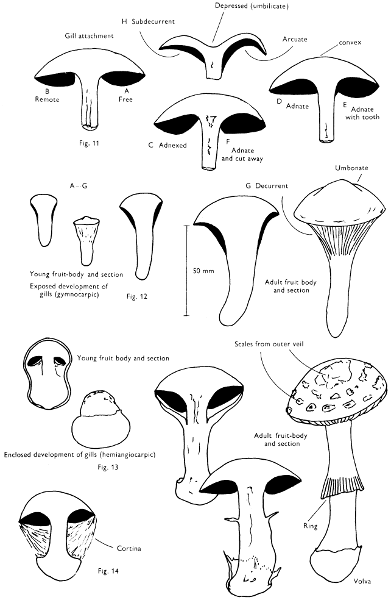
Larger illustration
(v) References
A. Reference Texts
Some references have already been given on p. 264. Findlay, Hvass & Hvass, Lange & Hora, Nicholson & Brightman, Wakefield and Dennis and Zeitlmayr.
In addition to these the following texts are suggested:
Henderson, D. M., Orton, P. D. & Watling, R. (1969). British Fungus Flora: Agarics and Boleti: Introduction, H.M.S.O., Edinburgh.
Hennig, E. (1958-60). Handbuch für Pilzfreunde, Jena (in German).
Haas, H. (1969). The Young Specialist looks at Fungi, London.
Pilát, A. & Usak, O. (1951). Mushrooms, London.
Pilát, A. & Usak, O. (1961). Mushrooms and other fungi, London.
Ramsbottom, J. (1951). Handbook of Larger fungi, London.
Ramsbottom, J. (1953). Mushrooms and Toadstools, New Naturalist, London.
Romagnesi, H. (1963). Petit Atlas des Champignons, Bordas (in French).
Smith, A. H. (1963). Mushroom Hunters’ Field-guide, Michigan.
Wakefield, E. M. (1954). Observer’s book of Common fungi, London.
Watling, R. (1970). British Fungus Flora: Agarics & Boleti, Part I, H.M.S.O., Edinburgh.
B. General Texts
Talbot, P. M. B. (1971). Principles of Fungal Taxonomy, London.
Webster, J. (1970). Introduction to Fungi, Cambridge.
C. Journals
Bulletin Trimestriel de la Société Mycologique de France, Paris. (Official organ of the French Mycological Society.)
Coolia, Leiden. (Official organ of the Dutch Mycological Society.)
Mycologia, New York. (Official organ of the American Mycological Society.)
Schweizerische Zeitschrift für Pilzkunde. (Official organ of the Swiss Mycological Society.)
Transactions of the British Mycological Society, (Official organ of the British Society: Hon. Sec. Dr B. E. Wheeler, Imperial College of Science and Technology Field Station, Silwood Park, Sunninghill, Ascot, Berks, also publishes a Bulletin intended for the amateur.)
D. Advanced Texts
Dennis, R. W. G., Orton, P. D. & Hora, F. B. (1960). New Check List of British Agarics and Boleti, suppl. Trans. British Mycological Soc.
Moser, M. (1967). in Gams Kleine Kryptogamenflora, Band IIb Stuttgart (in German).
Kühner, R. & Romagnesi, H. (1953). Flore Analytique des Champignons Supérieurs de France, Paris (in French).
Rea, C. (1922). British Basidiomycetae, Cambridge.
Revue de Mycologie (journal) Paris (in French).