A. AGARICS AND THEIR RELATIVES
Reading edition
Key to major genera
1. Spores distinctly coloured in mass and coloured individually under the microscope 2
Spores not, or faintly, coloured in mass and hyaline under the microscope 25
2. Spores blackish or some shade of brown 8
Spores pinkish 3
3. Stem laterally attached to the cap or absent Claudopus (and some species of Clitopilus)
Stem centrally attached to the cap 4
4. Stem with a cup-like structure enveloping the base Volvariella
Stem lacking any special structure at its base 5
5. Gills not attached to the stem (free), or with part attached to and descending down the stem (decurrent) 6
Gills attached to the stem but not descending down the stem 7
6. Gills remote to free from the stem Pluteus
Gills distinctly attached and descending down the stem Clitopilus (see also Eccilia p. 102)
7. Gills broadly attached to the stem (adnate) Entoloma
Gills narrowly attached to the stem (adnexed) Leptonia & Nolanea
8. Stem laterally attached to the cap Crepidotus
Stem centrally attached to the cap 9
9. Spore-print some shade of brown 10
Spore-print blackish to purplish black 18
10. Spore-print bright rust-brown 11
Spore-print dull clay-brown or ochraceous 16
11. Stem with the veil girdling the stem (ring), or cobweb-like (cortina) 12
Stem without the veil girdling the stem or when present then easily lost 13
12. Stem with distinct ring or ring-zone Pholiota & related genera
Stem with cobweb-like veil or faint filamentous ring-zone Cortinarius & Gymnopilus
13. Gills attached to the stem but not descending down the stem (adnexed to adnate) 14
Gills free of the stem, or distinctly attached to and running down the stem (decurrent), and then often joined together at the apex of the stem or at their base 15
14. Cap-surface composed of rounded cells Conocybe
Cap-surface composed of filamentous cells Galerina
15. Gills free of the stem and the whole fruit-body very fragile Bolbitius
Gills attached to and running down the stem (decurrent), easily separable from the cap-tissue and frequently veined at apex of stem Paxillus
16. Cap scaly, fibrillose and roughened Inocybe
Cap smooth, greasy or viscid 17
17. Cap-surface composed of rounded cells Agrocybe
Cap-surface composed of filamentous cells Naucoria & Hebeloma
18. Gills or complete fruit-body becoming liquefied Coprinus
Neither the gills nor fruit-body collapsing into a slurry of cells 19
19. Gills free to remote from the stem or attached and descending down the stem (decurrent) 20
Gills attached in some way to the stem but not descending down the stem (adnate to adnexed) 21
20. Gills decurrent; stem possessing a cobweb-like veil Gomphidius and Chroogomphus
Gills remote or free; stem possessing a usually persistent ring Agaricus
21. Gills distinctly spotted or distinctly mottled; stem stiff but breaking with a snap when bent; growing on dung or in richly manured areas Panaeolus
Gills not spotted or distinctly mottled; stem cartilaginous or not, and fruit-body growing on dung or not 22
22. Gills broadly attached to the stem (adnate) and with a veil girdling the stem Stropharia
Gills narrowly attached to the stem (adnexed) or with concave dentation near the stem (sinuate), or if adnate then lacking a ring 23
23. Gills with concave indentation near the stem (sinuate) and cap and stem with a cobweb-like veil Hypholoma
Gills attached to the stem but lacking a distinct concave indentation near the stem 24
24. Stem stiff but breaking with a snap when bent; edge of cap incurved at first and cap-surface composed of filamentous cells Psilocybe
Stem fragile; edge of cap straight even when young and cap-surface composed of rounded cells Psathyrella
25. Fruit-body fleshy and readily decaying, often firm but never tough 26
Fruit-body tough and not easily decaying 47
26. Parasitic on other agarics Nyctalis
Not parasitic on other agarics 27
27. Spore-bearing layer on fold-like often forked gills or simply on irregularities 28
Spore-bearing layer (hymenium), on distinct well-formed gills 29
28. Spore-bearing layer on fold-like gills Cantharellus
Spore-bearing layer on surface of irregularities Craterellus
29. Cap easily separable from the stem 30
Cap not easily separable from the stem 31
30. Stem with girdling veil (ring) and/or with a persistent cup-like structure at the base (volva); cap usually with warts or scales distributed on its surface Amanita
Stem with a ring but lacking a volva; cap surface powdery, hairy or scaly Lepiota & related genera
31. Cap, stem and gills brittle; stem never stiff and either exuding a milk-like juice or not; spores with spines or warts which stain blue-black in solutions containing iodine 32
Cap, stem and gills soft or if stem stiff then snapping when bent; gills never brittle 33
32. Fruit-body exuding a milk-like fluid Lactarius
Fruit-body not exuding milk-like fluid Russula
33. Gills thick, watery and lustrous (waxy) or with a bloom as if powdered with talc; often brightly coloured 34
Gills not waxy and rarely over 1·5 mm thick 36
34. Gills rather watery and lustrous (waxy); spores smooth 35
Gills rigid not watery, with powdery bloom; spores with distinct spines Laccaria
35. Fruit-body with a distinct veil and growing in woods; cap often viscid or pale coloured Hygrophorus
Fruit-body lacking a veil and usually growing in fields; cap usually brightly coloured and sometimes viscid Hygrocybe
36. Stem with girdling veil (ring) and/or stem not attached to the centre of the cap (eccentric) 37
Stem central and lacking a ring 38
37. Stem central and possessing a ring Armillaria
Stem not centrally attached to the cap members of the ‘Pleurotaceae’ (p. 74)
38. Stem fibrous 39
Stem stiff only in the outer layers 42
39. Gills with a concave indentation near the stem (sinuate) 40
Gills attached to and descending down the stem (decurrent) 41
40. Spores with warts which darken in solutions containing iodine Melanoleuca
Spores not so colouring in solutions containing iodine Tricholoma & related genera
41. Spores with warts which darken in solutions containing iodine Leucopaxillus
Spores not so colouring in solutions containing iodine Tricholoma & related genera
42. Gills thick and with rather blunt edges Cantharellula & Hygrophoropsis
Gills thin and with distinct and sharp edges 43
43. Gills attached to and descending down the stem (decurrent); cap often depressed at the centre and sterile cells absent from the gills and the surface of the cap Clitocybe & Omphalina
Gills attached to the stem but not descending down the stem (adnate to adnexed) or if descending then distinct sterile cells on the gills, cap and stem 44
44. Cap-edge straight and usually striate when young; cap thin and somewhat conical and gills descending down the stem or not Mycena & related genera
Cap-edge incurved, non-striate and cap rather fleshy; gills not descending down the stem 45
45. Stem dark and woolly at least in the lower half and the cap viscid; fruit-bodies growing in clusters on tree-trunks Flammulina
Stem not dark and woolly 46
46. Cap viscid and stem usually rooting; fruit-body growing directly on wood or attached to wood by long strands or cords of mycelium (rhizomorphs) Oudemansiella
If cap viscid then fruit-body neither attached to wood by cords of mycelium nor stem with a rooting base Collybia & related genera
47. Stem central and gills often interconnected by veins; cap can be dried and later revived, purely by moistening Marasmius & related genera
Stem not attached to the centre of the cap and fruit-body although persistent not easily revived to natural shape after once being dried 48
48. Spore-print blue-black with solutions containing iodine 49
Spore-print yellowish in solutions containing iodine 50
49. Gills toothed or notched along the edges Lentinellus
Gills even along their edges and not toothed Panellus
50. Gills appearing as if split down their middles Schizophyllum
Gills not splitting 51
51. Gills notched or toothed along their edges Lentinus
Gills even along their edges and not toothed Panus
52. Spore print yellowish, purplish, black or pink 53
Spore-print some shade of brown, but without purplish flush 56
53. Spore-print yellowish or pinkish 54
Spore-print purplish brown or blackish 55
54. Spore-print yellowish Gyroporus
Spore-print pinkish Tylopilus
55. Spore-print purplish brown Porphyrellus
Spore-print blackish and spores ornamented Strobilomyces
56. Cap glutinous and stem with or without girdling veil (ring); within the tubes the sterile cells (cystidia) cluster together Suillus
Cap at most viscid and then only in wet weather and sterile cells within the tubes individually placed 57
57. Stem-surface covered with distinct black or dark brown or white then darkening scales; spore-print clay-brown with or without a flush of cinnamon-pinkish brown Leccinum
Stem-surface covered completely or in part with a network or pattern of faint lines or pale yellow or red-rust but never black dots; spore-print olivaceous buff Boletus & related genera
(i) Agarics of woodlands and copses
(a) Mycorrhizal formers
Leccinum scabrum (Fries) S. F. Gray Birch rough stalks or Brown birch-bolete.
Cap: width 45-150 mm. Stem: length 70-200 mm; width 20-30 mm.
Description: Plate 1.
Cap: convex and becoming only slightly expanded at maturity, pale brown, tan or buff, soft, surface dry, but in wet weather becoming quite tacky, smooth or streaky-wrinkled and cap-margin not overhanging the tubes.
Stem: white, buff or greyish, roughened by scurfy scales which are minute, pale and arranged in irregular lines at the stem-apex, and enlarged and dark brown to blackish towards the base.
Tubes: depressed about the stem, white becoming yellowish brown at maturity, with small, white pores which become buff at maturity and bruise distinctly yellow-brown or pale pinkish brown when touched.
Flesh: watery, very soft in the cap lacking distinctive smell and either not changing on exposure to the air or only faintly becoming pinkish or pale peach-colour.
Spore-print: brown with flush of pinkish brown when freshly prepared.
Spores: very long, spindle-shaped, smooth, pale honey-coloured under the microscope and more than 14 µm in length (14-20 µm long × 5-6 µm broad).
Marginal cystidia: numerous and flask-shaped. Facial cystidia: sparse, similar to marginal cystidia.
Habitat & Distribution: Found in copses and woods containing birch trees, or even accompanying solitary birches.
General Information: This fungus is recognised by the pale brown cap, the white, unchanging or hardly changing flesh and the cap-margin not overhanging the tubes. There are several closely related fungi which also grow with birch trees but they need some experience in order to distinguish them. This fungus was formerly placed in the genus Boletus, indeed it will be found in many books under this name. Species of Leccinum are edible and considered delicacies in continental Europe. The majority can be separated from the other fleshy fungi with pores beneath the cap, i.e. boletes, by the black to brown scaly stem and rather long, elongate spores. The scales on the stem give rise to the common name ‘Rough stalks’ which is applied to this whole group of fungi.
Illustrations: F 39C; Hvass 253; LH 122; NB 1556; WD 891.
Suillus grevillei (Klotzsch) Singer Larch-bolete
Cap: width 30-100 mm. Stem: width 15-20 mm; length 50-70 mm.
Description: Plate 2.
Cap: convex or umbonate at first, later expanding and then becoming plano-convex, golden-yellow or rich orange-brown, very slimy because of the presence of a pale yellow sticky fluid.
Stem: apex reddish and dotted or ornamented with a fine network, cream-coloured about the centre because of the presence of a ring which soon collapses, ultimately appearing only as a pale yellow zone; below the ring the stem is yellowish or rusty brown, particularly when roughly handled.
Tubes: adnate to decurrent, deep yellow but becoming flushed wine-coloured on exposure to the air, with angular and small sulphur-yellow pores which become pale pinkish brown to lilaceous or pale wine-coloured when handled.
Flesh: with no distinctive smell, pale yellow immediately flushing lilaceous when exposed to the air, but finally becoming dingy red-brown, sometimes blue or green in the stem-base.
Spore-print: brown with distinct yellowish tint when freshly prepared.
Spores: long, ellipsoid, smooth and pale honey when under the microscope, less than 12 µm in length (8-11 µm long × 3-4 µm broad).
Marginal cystidia: in bundles and encrusted with amorphous brown, oily material. Facial cystidia: similar in shape and morphology to marginal cystidia.
Habitat & Distribution: Found on the ground accompanying larch trees either singly or more often in rings or troops.
General Information: This fungus is easily recognised by the poorly developed ring, overall golden-yellow colour and pale yellow viscidness on the cap which comes off on to the fingers when the fruit-body is handled. There are several closely related fungi which also grow with coniferous trees, e.g. Suillus luteus Fries, ‘Slippery jack’, but many need experience in order to identify them. All these fungi were formerly placed in the genus Boletus, because of the fleshy fruit-body with pores beneath the cap. The larch-bolete receives its common name from the close relationship of the fungus with the larch. On drying S. luteus and S. grevillei may strongly resemble one another but the former can be distinguished when fresh by the chocolate brown, sepia, or purplish brown cap and the large whitish, lilac-tinted ring.
Plate 1. Fleshy fungi: Spores borne within tubes
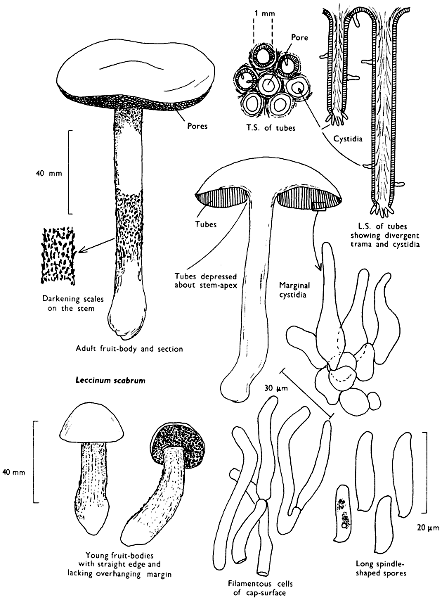
Larger illustration
Plate 2. Fleshy fungi: Spores borne within tubes
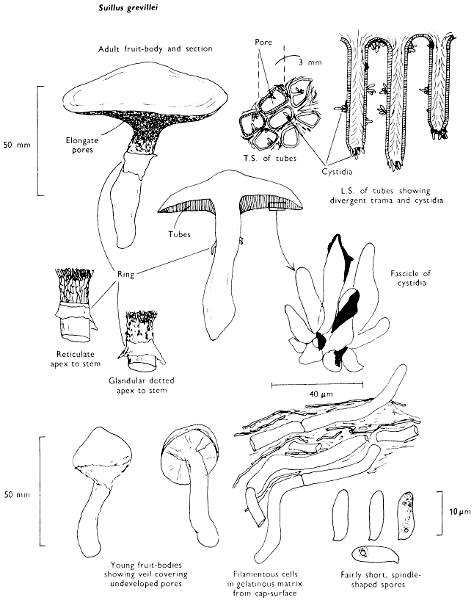
Larger illustration
Species of Suillus are edible and rank highly in continental cook-books, although they have disagreeably gelatinous-slimy caps, a character, in fact, which helps to separate them from other fleshy pore-fungi.
Illustrations: F 41a; Hvass 257; ML 187; NB 1044; WD 842.
Boletus badius Fries Bay-coloured bolete
Cap: width 70-130 mm. Stem: width 34-37 mm; length 110-125 mm. (36-40 mm at base).
Description: Plate 3.
Cap: hemispherical, minutely velvety, but soon becoming smooth and distinctly viscid in wet weather, red-brown flushed with date-brown and darkening even more with age and in moist weather to become bay-brown.
Stem: similarly coloured to the cap but paler particularly at the apex, smooth or with faint, longitudinal furrows which are often powdered with minute, dark brown dots.
Tubes: adnate or depressed about the stem, lemon-yellow but immediately blue-green when exposed to the air and with angular, rather large similarly coloured, pores which equally rapidly turn blue-green when touched.
Flesh: strongly smelling earthy, pale yellow but becoming pinkish in centre of the cap, and blue in the stem and above the tubes when exposed to the air, but finally becoming dirty yellow throughout.
Spore-print: brown with a distinct olivaceous flush.
Spores: long, spindle-shaped, smooth, honey-coloured under the microscope and greater than 12 µm in length (13-15 µm long × 5 µm broad).
Marginal cystidia: numerous, flask-shaped and slightly yellowish.
Facial cystidia: scattered and infrequent and similar to marginal cystidia in shape.
Habitat & Distribution: Found in woods, especially accompanying pine trees, but often found fruiting on the site of former coniferous trees, even years after the trunks or the stumps have been removed.
General Information: This fungus is recognised by the rounded, red-brown cap, coupled with the pale yellow flesh and greenish yellow tubes, both of which become greenish blue when exposed to the air. There are several species in the genus Boletus which stain blue at the slightest touch or when the flesh is exposed to the air, e.g. B. erythropus (Fries) Secretan, a common bolete with a dark olivaceous cap, orange pores and red-dotted stem.
The flesh of some species of Boletus, e.g. B. edulis Fries, however, remains unchanged or at most becomes flushed slightly pinkish. Although many people say they recognise B. edulis, the ‘Penny-bun’ bolete—a name derived from the colour of the cap, there is some doubt as to whether the true B. edulis is common in Britain as we are led to believe. B. edulis and its relatives are highly recommended as edible (see p. 35). B. badius is also edible, but it is ill-advised to eat any bolete which turns blue when cut open.
Illustrations: B. badius—F 38c; Hvass 248 (not very good); LH 191; NB 1095; WD 851. B. edulis: F 42a; Hvass 246; LH 191; NB 1433.
General notes on Boletes
There are nearly seventy boletes recorded for the British Isles and evidence of others which have as yet not been fully documented. As a group they are characterised by being fleshy, possessing a central stem and producing their spores within the tubes, and not on gills as in the common mushroom. It is the first character by which the boletes differ so markedly from the other pored fungi, such as the ‘Scaly Polypore’ (see p. 140).
The boletes have long been classified in the genus Boletus, but instead of referring all the pored, fleshy fungi to a single large genus several genera are now recognised. The separation of these genera is based on differences in colour of the spore-print and differences in the anatomy of the tubes, cap and stem, etc., e.g. members of the genus Suillus have colourless or pale coloured dots on the stem exuding a resin-like liquid in wet weather, which is clear and glistening in some species but turbid and whitish in others, gradually darkening and hardening so that the stem is ultimately covered in dark brown or reddish smears or spots; members of the genus Leccinum on the other hand never exude liquid and have coarse or fine roughenings on the stem which are usually dark, but may commence white and ultimately darken depending on the species; many species of Boletus possess a very distinct raised network all over the stem, whilst others have it present only in part, or have minute, often brightly coloured, dots replacing it.
Plate 3. Fleshy fungi: Spores borne within tubes
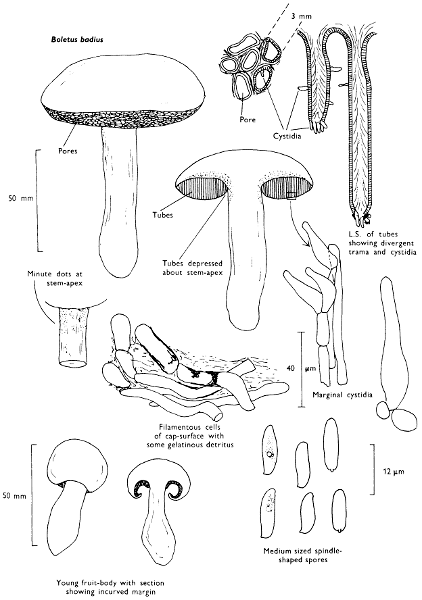
Larger illustration
Within this single, yet not particularly large, group of fungi, several biological phenomena are demonstrable. There is good evidence that the majority of British boletes are mycorrhizal; several species are known to be associated only with one species of tree or group of closely related tree-species. Thus Suillus grevillei and S. aeruginascens (Secretan) Singer grow in association with larch trees; S. luteus and Boletus badius in contrast grow in association with pine trees; Leccinum scabrum with birch trees; L. aurantiacum (Fries) S. F. Gray, with poplar trees and L. quercinum (Pilát) Green & Watling, with oak trees.
Boletus edulis can be separated into several distinct subspecies which are associated with different trees; the two commonest subspecies are those associated with birch and with beech trees. It is well known that although present in this country during the warmer periods of the Ice-Age, larch neither survived the intense cold of the last advance of the ice nor migrated back into Britain after the ice had melted. Thus all larches which we see in Britain have been planted by man. There is little doubt that mycelia of many fungi were introduced along with these plants very probably including the mycelium of the larch-bolete. A similar pattern can be seen with other introduced trees, although not to such a marked degree, e.g. spruce trees. The beech tree, however, is native to the south of England, unlike the larch returning to this country after the ice had melted; it has been planted extensively outside its former range in northern areas of the British Isles taking with it its associated fungi. There is some evidence that some stocks of beech and fungi have been introduced from continental Europe in comparatively recent times.
A parallel, yet inexplicable association is found between the bolete Suillus bovinus (Fries) O. Kuntze and its close relative Gomphidius roseus (Fries) Karsten where the mycelium of two fungi are found intertwined forming a close association! Parasitism although rare is also found amongst the boletes, and an uncommon parasitism at that—a fungus on a fungus; for example in Britain although infrequent Boletus parasiticus Fries grows attached and ultimately replaces the spore-tissue of the common earth-ball (Scleroderma, see p. 192).
Those fungi which grow on dead and decaying substrates are called saprophytes and although the greater number of higher fungi would be included in this class of organisms the character is infrequent amongst the boletes. One British example of this type of fungus is the rare Boletus sphaerocephalus Barla which grows on woody debris.
Chemists have long been interested in boletes, for as noted above the flesh of some species when exposed to the atmosphere turns vivid colours, a feature often incorporated into the Latin name, e.g. Boletus purpureus Persoon, from the purple colours produced whenever the fruit-body is handled. The reaction appears to be an oxidation where in the presence of an enzyme and oxygen a pigmented substance or substances are produced. What the significance of these colour-changes is in nature is as yet unknown; however, what is interesting is that many of the chemicals involved are unique and have only recently been analysed completely; they are related to the quinones.
There is little doubt that it is this rapid and intense blueing of the flesh of many boletes that has lead to a belief that they are poisonous. It is uncertain whether there are any truly toxic species of Boletus but several have unpleasant smells and tastes which make them very unattractive. Boletus edulis is the important ingredient, however, which gives the distinctive taste to so-called dried mushroom soup. Thousands of fruit-bodies are collected annually in the forests of Europe to be later dried and processed for incorporation into soup. Boletes appear to form an important part of the diet of several rodents and deer and in Scandinavia in the diet of reindeer.
Probably one of the most obscure of our British boletes is Strobilomyces floccopus (Fries) Karsten, the ‘Old Man of the Woods’. It has a black, white and grey woolly, scaly cap and stem, and the flesh distinctly reddens when exposed to the air. The spores are almost spherical, purple-black in colour and covered in a coarse network when seen under the microscope. All these characters readily separate Strobilomyces from all other European boletes; however, in Australasia, members of this and related genera form a very important part of the flora.
Chroogomphus rutilus (Fries) O. K. Miller Pine spike-cap
Cap: width 30-150 mm. Stem: width 10-18 mm; length 60-120 mm.
Description:
Cap: convex with a pronounced often sharp umbo, wine-coloured, flushed with bronze-colour at centre and yellow or ochre at margin, viscid but soon drying and then becoming paler and quite shiny.
Stem: yellowish orange, apricot-coloured or peach-coloured, streaked with dull wine-colour, spindle-shaped or narrowed gradually to the apex from a more or less pointed base.
Gills: arcuate-decurrent, distant, at first greyish sepia then dingy purplish with paler margin, but finally entirely dark purplish brown.
Flesh: lacking distinctive smell and reddish yellow or pale tan in the cap, rich apricot- or peach-colour towards the stem-base.
Spore-print: purplish black.
Spores: very long, spindle-shaped, smooth, olivaceous purple and greater than 20 µm in length (20-23 × 6-7 µm).
Marginal cystidia: cylindrical to lance-shaped and up to 100 × 15 µm.
Facial cystidia: similar to marginal cystidia.
Habitat & Distribution: Found in pine woods, usually solitary or in small groups. Fairly common throughout the British Isles and characteristic of Scots Pine woods.
General Information: This fungus can be distinguished by the purplish or wine-coloured cap and the gills being pigmented from youth. There is only one other British species of this genus, i.e. C. corallinus Miller & Watling.
Chroogomphus is separated from Gomphidius by the flesh having an intense blue-black reaction when placed in solutions containing iodine, and the gills being coloured from their youth. In many books Chroogomphus is placed in synonymy with the genus Gomphidius. However, Gomphidius glutinosus (Fries) Fries, G. roseus (Fries) Karsten and G. maculatus Fries all have whitish gills when immature which gradually darken, and their flesh simply turns orange-brown in solutions of iodine. G. glutinosus is uniformly grey in colour and is most frequently found under spruce and other introduced conifers: G. roseus has a pale-pinkish coloured cap and white stem, and grows with pine; G. maculatus grows under larch and is flushed lilaceous at first but becomes strongly spotted with brown when handled.
Illustrations: Hvass 192; LH 213; WD 833.
Plate 4. Fleshy fungi: Spores blackish and borne on gills
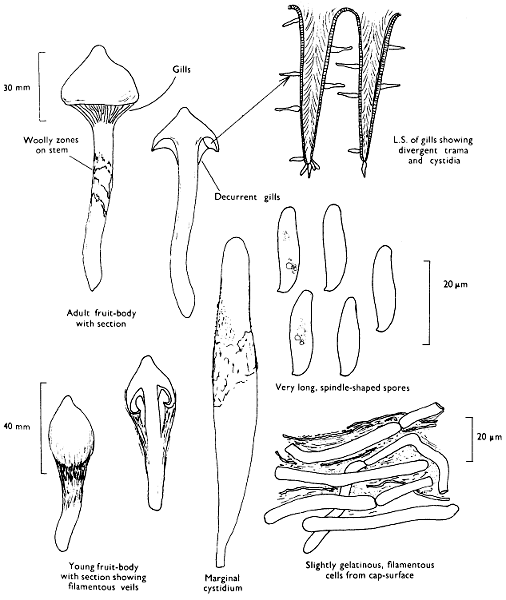
Larger illustration
Paxillus involutus (Fries) Karsten Brown roll-rim
Cap: width 50-120 mm. Stem: width 8-15 mm; height 30-75 mm.
Description:
Cap: at first convex with a strongly inrolled, downy margin, but then expanded and later frequently depressed towards the centre, clay-coloured, ochre or yellow-rust, slightly velvety but becoming smooth or sticky particularly in wet weather and readily bruising red-brown when fresh.
Stem: central or slightly eccentric, thickened upwards, fibrillose-silky, similarly coloured to the cap but typically streaked with red-brown particularly with age.
Gills: ochre or yellow-brown then rust and finally darker brown, decurrent, crowded, often branched and united about the apex of the stem; easily peeled from the flesh with the fingers and rapidly becoming red-brown on handling.
Flesh: thick, soft and with slightly astringent smell and yellowish to brownish but becoming red-brown after exposure to the air.
Spore-print: rust-brown.
Spores: medium-sized, ellipsoid, smooth, deep yellow-brown and rarely greater than 10 µm in length (8-10 × 5-6 µm).
Marginal cystidia: numerous lance-shaped or spindle-shaped.
Facial cystidia: scattered and similar in shape to marginal cystidia.
Habitat & Distribution: Found on heaths and in mixed woods, particularly where birch has or is now growing, or even accompanying solitary birch trees.
General Information: This fungus is easily recognisable by the strongly inrolled, woolly margin of the cap and yellow-brown gills which are easily separable from the cap-flesh. P. rubicundulus P. D. Orton is similar but grows under alder and has yellow gills unchanging when handled and dark scales on the cap. P. atrotomentosus (Fries) Fries and P. panuoides (Fries) Fries both grow on coniferous wood and have smaller spores; the former is recognised by the dark brown to almost black shaggy stem and the latter by the shell-shaped cap devoid almost completely of a stem.
Illustrations: F 41c; Hvass 189; LH 185; NB 1158; WD 702.
Plate 5. Fleshy fungi: Spores brown and borne on gills
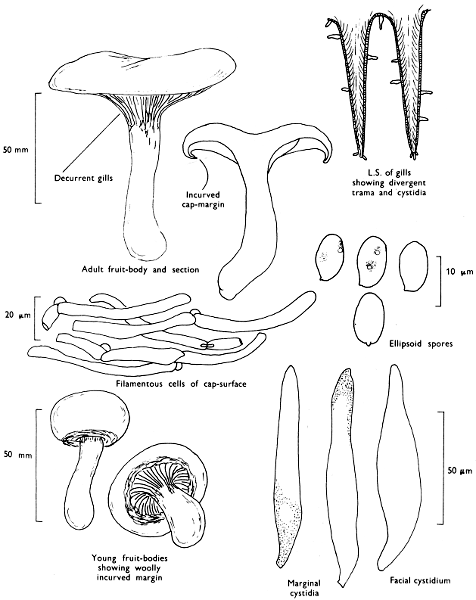
Larger illustration
Cortinarius pseudosalor J. Lange
Cap: width 60-125 mm. Stem: width 15-25 mm; length up to 180 mm.
Description:
Cap: bell-shaped or bluntly conical only slightly expanding with maturity, smooth or wrinkled at centre but often furrowed at the margin, slimy, brown with a distinct olive flush when in fresh condition and becoming ochraceous brown and shiny when dry.
Stem: usually swollen to some degree about the middle, slimy particularly towards the base, whitish throughout when young except for a faint amethyst or violaceous flush in the lower part; as the slime dries the stem becomes shiny and the outer surface breaks up into fibrillose scales or scaly, irregular ring-zones.
Flesh: lacking distinct smell, white with ochraceous flush in the cap, white in the stem, thick and soft in the cap but fibrous in the stem.
Gills: adnate, broad, rather thick, frequently veined and distant, ochraceous brown and finally deep rust-brown.
Spore-print: rust-colour.
Spores: long, slightly almond-shaped in side view, finely warted throughout and not less than 12 µm in length (13-14 × 7-8 µm).
Marginal cystidia: ellipsoid or club-shaped, hardly different from the surrounding undeveloped basidia.
Facial cystidia: absent.
Habitat & Distribution: Found on the ground in copses and woods especially those containing beech.
General Information: Recognised by the conical, grooved cap and the slimy spindle-shaped stem with a distinct violaceous flush; this fungus is often misnamed C. elatior Fries but this is a much less common fungus. There are several closely related fungi, but these grow with other tree-species and need much more experience to distinguish one from the other. C. pinicola P. D. Orton is one such species growing in the litter under Pinus sylvestris, Scots Pine; this species is fairly common in the remnant pine woods of Northern Scotland. The large size, sticky or glutinous cap and stem indicate that this fungus belongs to Cortinarius, subgenus Myxacium.
Illustrations: Hvass 145; LH 162; NB 119; WD 601.
Plate 6. Fleshy fungi: Spores brown and borne on gills
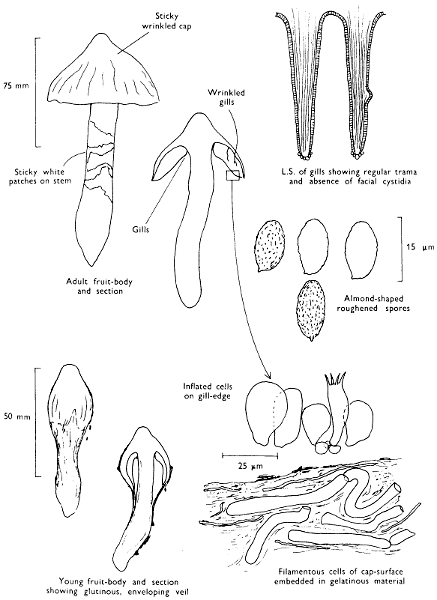
Larger illustration
General notes on Cortinarii
The genus Cortinarius is the largest genus of agarics in the British Isles, indeed in Europe and North America—perhaps in the world. It includes some of our most beautiful agarics, yet it is one of the least satisfying to the mycologist because of the difficulties experienced in identifying collections—partly because many species are so seldom seen.
Cortinarius contains just under two hundred and fifty recognisable British species, although recent research has shown that many more are yet to be described from this country as new to science. Except for some very characteristic species the individual members within the genus Cortinarius are often very difficult to separate one from the other; however, Cortinarius is one of our least difficult genera to recognise in the field owing to the presence when mature of rust-coloured gills and a cobwebby veil which extends from the margin of the cap to the stem. This structure is termed a cortina (Fig. 14) and in young specimens covers the gills with delicate filaments. As the cap expands the cottony or cobwebby filaments are stretched and either disappear entirely or may collapse to form a ring-like zone of filaments on the stem. In some species a second completely enveloping veil is also found, and this veil is viscid in one distinct group of which C. pseudosalor already described is a member. The gills in the genus are variable in colour when young although constant for a single species; they may be lilaceous purple, orange, brown, red, yellow-ochraceous or tan, but ultimately in all members at maturity they become rust-colour. The spores under the microscope are richly coloured, yellow to red-brown and are frequently strongly warted; in mass they are rust-brown and this character coupled with the presence of the cobweb-like veil characterises the genus.
Within the genus Cortinarius there is a wide range of characters varying from species with distinctly sticky caps and stems, some with sticky caps and dry stems to those with both dry caps and stems. A few species are very large and fleshy whilst others are quite slender and many of the latter rapidly change colour on drying out and are then said to be hygrophanous. However, although there is such a large spectrum of characters in a single genus the species all have in common the cortina and rust-coloured gills, the latter often appearing as if powdered with rusty dust.
Utilising the characters mentioned above this very large genus can be split into the following six sections, called by the mycologist subgenera:
Large to medium sized fleshy agarics with viscid caps and stems—Myxacium
Large, fleshy agarics with viscid or tacky caps when fresh but dry stems—Phlegmacium
Large to medium sized agarics with dry, scaly or humid caps and dry stems which if orange tawny are robust—Cortinarius
Medium, rarely large, agarics with dry, silky to innately fibrillose caps, slender stems and frequently with at least part of the fruit-body yellow, orange or reddish—Dermocybe
Medium to small agarics with silky fibrillose, non-hygrophanous caps which may become tacky in wet weather and then usually with robust, clavate-bulbous stems—Sericeocybe
Small, less frequently medium or large agarics, all with distinctly hygrophanous caps—Hydrocybe.
In several continental books some or all of these divisions are recognised as distinct genera in their own right. The subgenus Telamonia which occurs in many texts was formerly thought to differ from Hydrocybe in the presence of a universal veil; the universal veil is a second veil which completely envelopes the fruit-body when it is young and is in addition to the cortina. However, the modern treatment would seem to suggest that the presence of the universal veil is not of the utmost importance and so the two subgenera are incorporated into one. The name Hydrocybe reflects the character of changing colour as it dries out because of the loss of water. Within each subgenus the species are distinguished by the colour of the young gills and of the cap, the veil colour and texture, and microscopic characters of the spores, particularly their size.
The majority of species of Cortinarius are mycorrhizal and like the boletes possess very specific relationships with tree species. Thus some are typical of coniferous woodland and others typical of deciduous woodland in general, whilst others typify woods of a particular tree, e.g. beech, oak, birch, pine, larch. Some species are characteristic of woods on limestone or chalky soils (calcareous) whilst others are characteristic of woods on sandy, heathy acidic soils. For example, Cortinarius armillatus (Fries) Fries which is found in damp woods and possesses one or more cinnabar-red or scarlet zones on the stem and red fibrils at the stem-base appears to be connected with birch. Several species are associated with native trees whilst others have undoubtedly been introduced from abroad. They are very important in the economy of the woodland ecosystem.
One of the most beautiful and easily distinguished of our British species is Cortinarius violaceus (Fries) Fries which has uniformly deep violet-coloured stem and cap and coloured cystidia on the gill-margin, a character unusual in Cortinarius.
No species are known to be truly poisonous and many species are known to be edible, but many are too small to be of any value. Some of the larger species are regarded as good to eat, but frequently are too scarce. Thus the necessity for experience to recognise the different species, coupled with their often unpleasant tastes make them an unimportant group of agarics for eating.
Russula ochroleuca (Secretan) Fries Common yellow russula
Cap: width 50-100 mm. Stem: width 20-35 mm; length 50-100 mm.
Description: Plate 7.
Cap: yellow-ochre or dull yellow becoming paler with age, or flushed faintly greyish green, convex but soon expanding and becoming flat or depressed in the centre, smooth, or granular when young and slightly tacky in wet weather, faintly striate at the margin.
Stem: white at first then flushed slightly greyish, smooth or wrinkled, firm at first but quickly becoming soft and fragile.
Flesh: brittle, firm at first then soft, white, yellow under cap-centre.
Gills: white at first then flushed pale cream-colour, brittle, adnexed to free, rather distant.
Spore-print: faintly cream when freshly prepared.
Spores: medium-sized, hyaline, broadly ellipsoid or subglobose to almost globose, coarsely ornamented with prominent warts which stain blue-black when mounted in solutions containing iodine and which are faintly interconnected by low ridges, about 8 × 7 µm in size (9-10 × 7-8 µm).
Marginal cystidia: prominent, lance- to spindle-shaped and often filled with oily material.
Facial cystidia: similar in shape to marginal cystidia and projecting some distance from the gill-face.
Habitat & Distribution: Commonly found in mixed woods from summer until late autumn.
General Information: Easily recognised by the ochre-yellow cap, very pale cream-coloured spore-print and greying stem. Two other yellow-capped species of Russula are commonly found. R. claroflava Grove with yellow spore-print and blackening fruit-body which grows with birches in boggy places, and R. lutea (Fries) S. F. Gray which is much smaller, having a cap up to 50 mm and very deep egg-yellow gills and spore-print; it grows in deciduous woods.
Illustrations: F 22a; Hvass 226; LH 119; NB 1371; WD 491.
General notes on the genus Russula
A large genus with nearly one hundred distinct species in the British Isles and several others yet unrecognised or undocumented. This genus is composed generally of large toadstools often beautifully coloured, indeed the majority have brightly coloured caps in reds, purples, yellows or greens depending on the species although a few are predominantly white bruising reddish brown or grey to some degree.
Such large and distinctive fungi one would think would be the easiest members of our flora to identify, unfortunately they are not. They form a group quite isolated in their relations, the only close relatives being members of the genus Lactarius, to be dealt with later (see p. 50). The flesh of members of both Lactarius and Russula contains groups of rounded cells, a feature unique amongst agarics and explains why in Russula the fruit-bodies, cap and gills and sometimes the stem are brittle and easily break if crushed between the fingers. The fruit-body does not exude a milky liquid when the flesh is broken.
The spore-print varies, depending on the species involved, from white to deep ochre and individual spores are covered in a coarse ornamentation which is composed of isolated warts or warts interconnected by raised lines, or mixtures of both. The ornamentation stains deep blue-black when the spores are mounted in solutions containing iodine and the pattern which is produced appears in many cases to be of a specific character.
The majority of the species, if not all north-temperate species are mycorrhizal and the familiar host-tree fungus relationship can be recognised:—
R. claroflava Grove, with birch in boggy places, R. emetica (Fries) S. F. Gray with pine in wet places, R. betularum Hora with birch in grassy copses and R. sardonia Fries with pines. Brief notes are here included giving the basic characters of eight common species, but it must be appreciated the identification of many species within this genus is difficult.
R. atropurpurea (Krombholz) Britz. Blackish purple russula
Cap: width 50-100 mm. Stem: width 14-25 mm; length 60-80 mm.
Cap: deep reddish purple but becoming spotted with either cream-colour or white blotches.
Stem: white but becoming flushed greyish or stained brownish with age.
Gills: white then very pale yellow.
Flesh: white in cap and stem.
Spore-print: white.
On the ground in mixed woods and copses, particularly those containing oak.
Plate 7. Fleshy but brittle fungi: Spores whitish and borne on gills
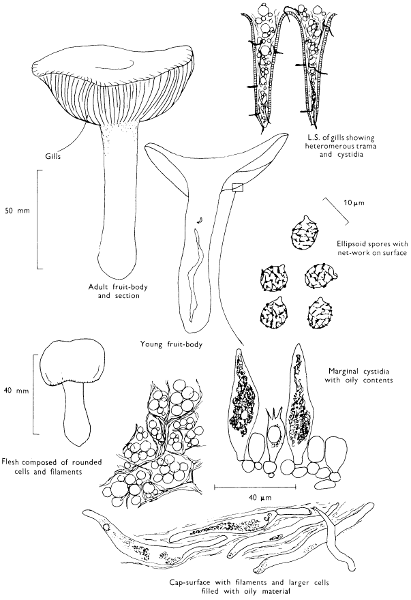
Larger illustration
Russula cyanoxantha (Secretan) Fries
Cap: width 50-150 mm. Stem: width 10-30 mm; length 50-100 mm.
Cap: lilac, bluish to purple often with green tints.
Stem: pure white.
Gills: pure white.
Flesh: white.
Spore-print: white.
Common in deciduous woods, especially beech-woods.
R. emetica (Fries) S. F. Gray Emetic russula
Cap: width 50-100 mm. Stem: width 8-15 mm; length 25-70 mm.
Cap: bright scarlet fading with age to become spotted pinkish, slightly viscid when moist.
Stem: spongy, fragile.
Flesh: white.
Gills: pure white.
Spore-print: pure white.
In pine woods usually in boggy areas.
R. fellea (Fries) Fries Geranium-scented russula
Cap: width 40-75 mm. Stem: width 10-20 mm; length 30-75 mm.
Cap: tacky when fresh, straw-coloured or pale tawny brown.
Stem: similarly coloured to the cap.
Gills and flesh: pale straw-colour and smelling of House Geraniums (i.e. Pelargoniums).
Spore-print: cream-coloured.
Common under beech.
R. foetens (Fries) Fries Foetid russula
Cap: width 70-170 mm. Stem: width 15-30 mm; length 50-90 mm.
Cap: slimy, dingy yellow to tawny, margin strongly furrowed and ornamented with raised bumps.
Stem: whitish then flushed or spotted with rust-brown.
Gills: straw-coloured, often spotted brown with age and beaded with watery droplets when growing under moist conditions.
Flesh: white to cream, brittle and with foetid-oily smell.
Spore-print: pale cream-colour.
Common in deciduous woods.
R. mairei Singer
Cap: width 30-75 mm. Stem: width 7-15 mm; length 35-70 mm.
Cap: scarlet red but developing creamy areas with age, dry.
Stem and gills: white but with a distinct although faint greenish grey flush, the former fairly firm.
Flesh: white.
Spore-print: pure white.
Commonly accompanying beech, even individual trees in gardens.
R. nigricans (Mérat) Fries Blackening russula
Cap: width 75-200 mm. Stem: width 15-35 mm; length 25-75 mm.
Cap: cream-coloured then flushed sooty brown, finally black as if scorched by proximity to bonfire.
Stem: white then dark brown.
Gills: pale ochre reddening when bruised, thick and very distant.
Flesh: white slowly dull red on cutting then brown and finally changing soot-colour after some time.
Spore-print: white.
Common in deciduous woods.
R. xerampelina (Secretan) Fries
Cap: width 50-140 mm. Stem: width 15-30 mm; length 40-60 mm.
Cap: deep blood-red or brownish red.
Stem: white with a flush of red towards the base.
Gills: cream then ochraceous.
Flesh: white staining brownish and smelling strongly of fish- or crab-paste, and staining dark green when a crystal of green iron sulphate is rubbed into it.
Spore-print: deep cream-colour.
Common in mixed woods; a very variable fungus with many colour-forms, but easily recognised by the green reaction with ferrous sulphate.
Lactarius turpis (Weinm.) Fries Ugly milk-cap
Cap: width 60-200 mm. Stem: width 10-25 mm; length 40-75 mm.
Description:
Cap: firm, convex usually with a central depression at maturity, dark olive-brown or dark greyish olive with a yellow-tawny, woolly margin when young which soon disappears, and the whole cap becomes sticky with age and turns deep purple when a drop of household ammonia is placed on it.
Stem: short, stout, similarly coloured to the cap except for the distinctly ochraceous apex, slimy and pitted.
Gills: crowded, cream-coloured to pale straw-coloured, but soon spotted with dirty brown, particularly when bruised.
Flesh: white or greyish ochre exuding a milk-like liquid which lacks a distinct smell and is white and unchanging when exposed to the air.
Spore-print: pale pinkish buff.
Spores: subglobose or ellipsoid and covered in a network of strongly developed, raised lines interconnected by finer ones, both of which stain blue-black in solutions containing iodine, generally 8 × 6 µm in size (7-8 × 6-7 µm).
Marginal cystidia: lance- or spindle-shaped and filled with oily contents.
Facial cystidia: similar to marginal cystidia.
Habitat & Distribution: Common in woods and copses, or on heaths especially in boggy places but always where birch is growing.
General Information: Easily recognised by the dull colours and purple reaction with alkali; there is no British species with which L. turpis can be mistaken. The purple reaction is similar to that found in the familiar school laboratory reagent litmus, for the compound found in L. turpis turns purple in alkali and reddens in acidic solutions. First discovered by Harley in 1893 this reaction marked the beginning of a whole series of chemical studies on the agarics which has led to the discovery of many unique compounds.
Illustrations: Hvass 214 (but too green); LH 213; NB 1133; WD 381.
General notes on the genus Lactarius
There is little doubt that the genus Russula and the genus Lactarius are closely related; in fact they stand aside from the other agarics in the very important character mentioned on page 46. In Europe the easiest distinction between the two genera is that members of the genus Lactarius exude a milk-like juice which may be white or variously coloured depending on the species involved (e.g. purple in L. uvidus (Fries) Fries, yellow in L. chrysorheus Fries). The cap, stem and frequently the gills are brittle and when broken liberate the milk-like liquid; when the fruit-body is dry, however, the presence of this liquid may be difficult to demonstrate. The spores have a blue-black ornamentation under the microscope when mounted in iodine, and although when in mass the colours are not as varied as those found in the genus Russula there is every likelihood that they will play an important role in the classification of the group in the future. The colour of the spore-print has been rather neglected, although the genus includes some rather unusual fungi.
Plate 8. Fleshy and milking fungi: Spores whitish and borne on gills
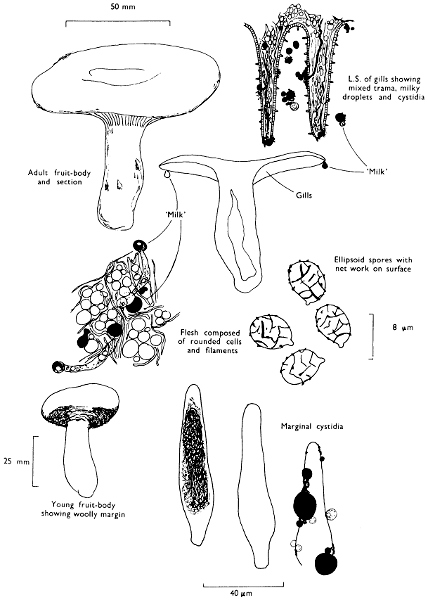
Larger illustration
The odours of many species are very distinct and vary from the smell of coconut and spice to those of various flowers; an odour commonly met with is termed ‘oily rancid resembling butter which has become mouldy’; in early books it was described as being the smell of bed-bugs!
The majority of the species are undoubtedly mycorrhizal: thus L. torminosus is found with birch, L. deliciosus and L. rufus with conifers and L. quietus with oak. Brief notes are given on additional species:—
L. camphoratus (Fries) Fries Curry-centred milk-cap
Cap: width 20-50 mm. Stem: length 20-50 mm; width 4-6 mm.
Cap and stem: red-brown.
Gills: reddish brown.
Flesh: reddish buff with an aromatic odour resembling spices which becomes very strong when dried and exudes a pale thin milk-like liquid.
Common in conifer woods and plantations.
L. deliciosus (Fries) S. F. Gray Saffron milk-cap
Cap: width 50-120 mm. Stem: length 20-60 mm; width 15-25 mm.
Cap: viscid, dirty greyish ochre with flush of tawny but soon becoming greenish with age.
Stem: dirty buff or greyish ochre, spotted with green particularly with age or on handling.
Gills: orange-yellow bruising deep orange but becoming green with time.
Flesh: pinkish to apricot-coloured but becoming green with age and exuding a rich orange-red fluid which gradually becomes greyish green.
Frequent in conifer woods and plantations.
L. glyciosmus (Fries) Fries Coconut-scented milk-cap
Cap: width 20-50 mm. Stem: length 30-50 mm; width 5-8 mm.
Cap: usually with a central ‘bump’, greyish lilac, dull and minutely scaly or velvety.
Stem: white to pale yellowish.
Gills: pale yellowish to flesh-coloured then flushed lilaceous.
Flesh: pale yellowish or flushed lilaceous, smelling strongly of desiccated coconut and exuding a white unchanging milk-like liquid.
In woods and on heaths, particularly where birch is growing.
L. quietus (Fries) Fries Oak milk-cap
Cap: width 30-80 mm. Stem: length 40-80 mm; width 10-15 mm.
Cap and stem: milky cocoa-coloured, zoned with reddish brown.
Gills: pale ochraceous then flushed red-brown.
Flesh: similar to gills, smelling strongly of rancid oil, and exuding a white, thin milk-like liquid which becomes very, very faintly yellow on exposure to the air.
Common wherever oak is growing.
L. rufus (Fries) Fries Rufous milk-cap
Cap: width 50-90 mm. Stem: length 50-90 mm; width 10-15 mm.
Cap: dark red-brown with a distinct, usually sharp ‘bump’ in centre.
Stem: pale red-brown throughout or whitish at base.
Gills: pale reddish brown and exuding a white, unchanging milk-like fluid.
In pine woods and less frequently with birches on acid heaths.
L. torminosus (Fries) S. F. Gray Woolly milk-cap
Cap: width 40-150 mm. Stem: length 60-100 mm; width 15-30 mm.
Cap: pale strawberry-pink or pale salmon colour, distinctly zoned, slimy when wet at centre and strongly shaggy fibrillose at margin.
Stem and gills: pale strawberry colour.
Flesh: tinged salmon-pink and exuding a white unchangeable milk-like liquid.
Frequent where birches grow.
Amanita muscaria (Fries) Hooker Fly agaric
Cap: width 100-175 mm. Stem: width 30-40 mm; length 150-275 mm.
Description:
Cap: bright scarlet to orange-red with scattered whitish or yellowish fragments of veil particularly towards the centre and hanging down from the margin, viscid when moist, striate at margin with age.
Stem: white, striate above the soft easily torn, although prominent, ring which is white above and yellow below; stem-base swollen and ornamented with patches of yellowish or white veil-fragments which form concentric rings or ridges of tissue.
Gills: white, free, crowded, fairly thick, minutely toothed at their edge.
Flesh: soft, lacking distinctive smell, or at times slightly earthy and white, yellowish below cap-centre.
Spore-print: white.
Spores: long, hyaline under the microscope, ellipsoid, smooth about 10 × 7 µm in size (10-13 × 7-8 µm).
Marginal cystidia: composed of chains of swollen, hyaline cells.
Facial cystidia: absent.
Habitat & Distribution: Found in birch-woods, less frequently collected in the vicinity of conifers; wide-spread and fairly common, but it is erratic in its appearance giving the impression of being absent from a locality until one season it suddenly fruits in profusion.
General Information: An easily recognised fungus because of its striking colour. It is also very familiar and well-known because it appears so often on Christmas cards, and features commonly in illustrations in children’s story-books. The fungus contains a poison which formerly was used to kill flies—hence the common name of ‘Fly agaric’ and the scientific name from the latin name for the house-fly. The red skin of the cap, where the major amount of the poison resides, was cut up with a little milk and sugar or honey; flies attracted to this sweet concoction inadvertently ate the poison and later perished. This fungus has a very well documented and long history and appears in the legends of many countries. It is featured in Greek mythology, Slavic and Scandinavian folk-lore and indeed appears in the pre-history of Indian tribes of N.E. Asia. It has even been connected with the formation of certain sects within the early Christian church.
Illustrations: F. frontispiece; Hvass 1; LH 117; NB 1131; WD 21.
Plate 9. Fleshy fungi: Spores white and borne on gills
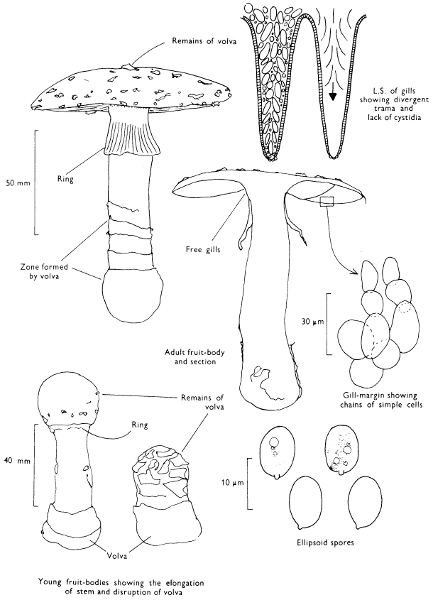
Larger illustration
Notes on the genus Amanita
The genus Amanita contains many important mycorrhizal fungi including the ‘Blusher’, A. rubescens (Fries) S. F. Gray, the ‘Tawny grisette’, A. fulva Secretan, and the ‘False death-cap’, A. citrina S. F. Gray. The first grows on heaths and in woods with a variety of trees; A. fulva frequently grows with birch and A. citrina with several leafy trees although its var. alba (Gillet) E. J. Gilbert appears to be confined to beech woods. However, there is some evidence that many members of the genus in drier more southern countries than Britain, are non-mycorrhizal. In fact the genus as a whole may be southern-temperate in its distribution. In the British Isles the number of species of Amanita recorded decreases as one goes north, or the frequency of single species except for a few widespread forms falls off northwards. In a few cases a more familiar southern species is replaced in similar habitats by another species, e.g. A. phalloides (Fries) Secretan is replaced by A. virosa Secretan the ‘Destroying angel’ in Scotland, and A. citrina frequently in the north by A. porphyria (Fries) Secretan. Species of Amanita are usually large conspicuous fungi and the genus contains some of our best known agarics. One, A. muscaria (Fries) Hooker has already been mentioned, but the genus also includes the ‘Death-cap’ A. phalloides and ‘Caesar’s mushroom’ A. caesarea (Fries) Schweinitz, a fungus not found in this country but considered to be superior in edibility to all other fungi; thus edible and deadly poisonous species are found closely related and this simply emphasises how important it is not to eat the agarics one finds in the woods and fields except when accompanied by a ‘real’ expert. Deaths or near fatalities in Europe and North America are recorded annually due to the eating of fungi belonging to this genus.
The poisonous qualities of the fungi in this genus—only a very small amount of poison is often sufficient to produce fatal results—has led to a close connection between these fungi and black magic and the supernatural. This connection is even more emphasised when it is learnt that some have an intoxicating effect. Hence the long history mentioned earlier.
Members of the genus Amanita are characterised by their anatomy and certain macroscopic features; the former is illustrated under A. muscaria, i.e. the divergent gill-trama. The main macroscopic character of note is the presence of a volva at the base of the stem and it is the details of this volva which helps to distinguish different species. A. phalloides has a distinct, loose, membranous sheath, in A. citrina the volva is reduced to a narrow rim around the bulbous stem and in A. rubescens and A. muscaria the volva is simply a series of concentric zones of woolly scales. All the four species noted above possess a ring, but A. fulva the ‘Tawny grisette’ and A. vaginata (Fries) Vittadini the ‘Grisette’ only possess a volva; this has lead to the use of the generic name Amanitopsis in many books, now no longer considered necessary.
The veil in Amanita is probably the most highly developed amongst our common agarics and from Appendix iv it can be seen how the scaly cap and stem originate and how the volva differs from the ring. The volva and cap-scales constitute what has been called the universal veil and the ring which stretches from the cap margin to the stem has been termed the partial veil.
The spores of species of Amanita are large and their shape and chemical reactions help to distinguish the different species within the genus. One of the most interesting features, however, is that the spore-mass, although usually described as white, in many species is not white but flushed greenish grey, etc. The slight subtleties in colour of the spore-print assist in classification.
The following notes may be instructive in conjunction with the information above (for common names see above).
(i) Possessing a ring on the stem:—
A. citrina S. F. Gray
Cap: width 55-80 mm. Stem: width 18-22 mm; length 70-80 mm.
A lemon-yellow or whitish capped agaric with bulbous stem-base, white patches of volva on cap and white stem with flesh strongly smelling of new potatoes.
Spores: almost globose and measuring 9-10 × 7-8 µm.
A. excelsa (Fries) Kummer
Cap: width 75-140 mm. Stem: width 20-28 mm; length 85-120 mm.
A greyish or brownish capped agaric with clavate stem-base, grey patches of volva on the cap and white concentrically scaly stem with flesh unchanged on exposure to the air.
Spores: broadly ellipsoid and measuring 9-10 × 8-9 µm.
A. rubescens (Fries) S. F. Gray
Cap: width 70-120 mm. Stem: width 12-25 mm; length 65-100 mm.
A reddish fawn or pinkish buff capped agaric with swollen stem-base, pinkish or flesh-coloured patches of volva on cap and reddish concentrically scaly stem with flesh becoming reddish when exposed to the air.
Spores: ellipsoid and measuring 9-10 × 5-6 µm.
A. pantherina (Fries) Secretan ‘Panther’
Cap: width 48-95 mm. Stem: width 12-20 mm; length 65-100 mm.
An olive-brown or smoky brown capped agaric with only slightly swollen stem-base, white patches of volva on the cap and white concentrically scaly stem with unchanging flesh.
Spores: ellipsoid and measuring 8-12 × 7 µm.
A. phalloides (Fries) Secretan
Cap: width 70-85 mm. Stem: width 12-20 mm; length 85-120 mm.
A greenish or yellow-olive capped agaric with stem sheathed in membranous volva, white patches of volva on cap and smooth, white stem with white flesh.
Spores: broadly ellipsoid and measuring 10-12 × 7 µm.
(ii) Lacking ring on stem:—
A. fulva Secretan
Cap: width 40-60 mm. Stem: width 10-15 mm; length 100-150 mm.
A thin, tawny-brown agaric with stem sheathed in membranous volva and pale tawny, slightly scaly stem.
Spores: globose and 10-12 µm in diameter.
A. vaginata (Fries) Vittadini
Differs from A. fulva in the cap being metallic grey or silvery in colour.
(b) Parasites
Armillaria mellea (Fries) Kummer Honey-fungus
Cap: width 50-150 mm. Stem: width 10-12 mm; length 75-150 mm.
Description: Plate 10.
Cap: at first convex then more or less flattened or slightly depressed, very variable in colour, yellowish, olive, buff, sand-coloured or some shade of brown, at first covered in small, brownish or ochraceous scales which give the young cap a velvety aspect, but gradually the scales disappear with age except at the cap-centre; margin striate and usually paler than centre of the cap.
Stem: equal or swollen at base, often several grouped together, white at apex above a whitish, rather thick, ring which is flushed with olive-yellow or red-brown at its margin; stem-base fibrillose, whitish but finally red-brown at maturity.
Gills: adnate or slightly decurrent, whitish then flushed flesh colour and developing brownish spots with age or in cold, wet weather.
Flesh: with rather strong and unpleasant smell, white or flushed pinkish in the cap, brown and stringy in the stem.
Spore-print: very pale cream colour.
Spores: medium-sized, hyaline, ellipsoid, less than 10 µm in length (8-9 × 5-6 µm).
Marginal cystidia: variable, hyaline, cylindric and not well-differentiated.
Facial cystidia: absent.
Habitat & Distribution: This fungus grows in troops or is found joined at the base to form clusters. It is always attached to old trees, trunks, stumps and buried wood, either directly or by its vegetative stage which darkens and aggregates to form strands resembling boot-laces which are called rhizomorphs.
General Information: This rather variable, and therefore often perplexing, fungus causes a destructive rot of trees and can travel long distances through the soil with the use of its rhizomorphs. It commonly grows on several species of broad-leaved trees, but can also colonise conifer trees. It also attacks garden shrubs, such as privet-hedges, and is particularly destructive to Rhododendrons causing a wilt of the whole shrub and subsequent death; it has also been recorded as attacking potatoes. The actively growing mycelium which can often be found growing under the bark of infected trees, exhibits a luminosity if freshly exposed and placed in a darkened room. The rhizomorphs of A. mellea are highly specialised structures composed of mycelial threads some of which have become rather more differentiated than is normally found in the vegetative stage of other agarics.
Illustrations: F 27a; Hvass 26; LH 93; NB 1411; WD 43.
Pholiota squarrosa (Fries) Kummer Shaggy Pholiota
Cap: width 50-120 mm. Stem: width 17-25 mm; length 95-125 mm.
Description: Plate 11.
Cap: convex, but expanding and becoming flattened with a slight central umbo, ochre-yellow to yellowish rust-colour and covered with dark brown recurved scales which are particularly dense at the centre.
Stem: variable in length and thickness depending on how it is attached to the substrate, whether in a deep crack or wound, or in a depression, and how many specimens are in the cluster; its colour is similar to that of the cap, exhibits a small, dark brown fibrillose, torn ring or ring-zone and is ornamented with recurved red-brown scales below that ring.
Gills: broadly adnate with a decurrent tooth and crowded, yellowish at first then rust-coloured.
Flesh: with strong, pleasant but pungent smell, yellowish brown, soft in the cap, fibrous in the stem.
Spore-print: rich rust-brown.
Spores: medium-sized, pale brown under the microscope, smooth, ellipsoid, and 6-8 × 4 µm in size.
Marginal cystidia: spindle-shaped, hyaline, numerous.
Facial cystidia: flask-shaped with a small apical appendage and becoming rich yellow when immersed in solutions containing ammonia.
Habitat & Distribution: Common in clusters in woods, gardens or parks, on wood or at the base of the trunks of broad-leaved trees in summer and autumn.
Plate 10. Fleshy fungi: Spores white and borne on gills
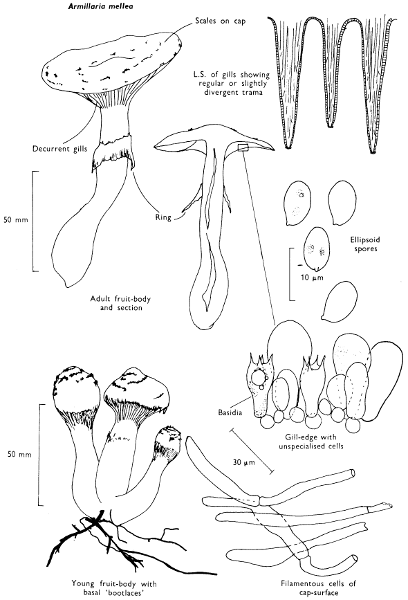
Larger illustration
General Information: Although rather a common easily recognisable and aesthetically pleasing fungus growing in its characteristic clusters at the base of trees, it is a weak parasite entering the living tissue after invading decayed areas of the tree. This is the reason why when branches are broken off trees by wind, snow or storms, they should be carefully trimmed to remove ragged edges and the wound treated with a protective tar to stop the entry of rain, cold and fungus spores. Other more destructive fungi may enter a tree through such wounds; P. squarrosa frequently attacks mountain ash or rowan.
It is recognised by the dry scaly cap and stem which helps to distinguish it from the sticky capped P. aurivella (Fries) Kummer with similar habitat preferences but wider spores (6-9 × 4-5 µm). P. adiposa (Fries) Kummer is found on beech trees and it, too, has a viscid cap, but the spores are 5-6 × 3-4 µm in dimensions.
Illustrations: Hvass 134; LH 149; WD 542.
Plate 11. Fleshy fungi: Spores rust-brown and borne on gills
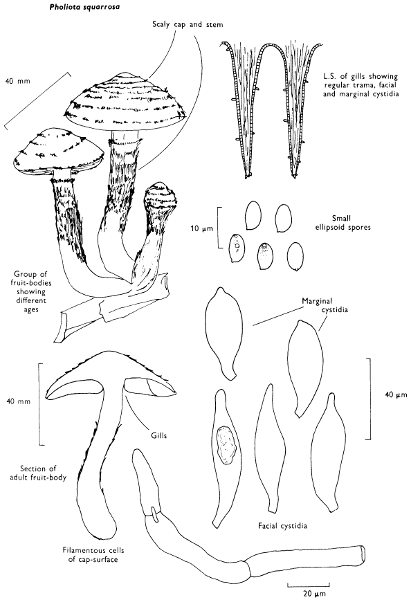
Larger illustration
(c) Saprophytes—wood inhabiting or lignicolous agarics
Hypholoma fasciculare (Fries) Kummer Sulphur-tuft
Cap: width 20-50 mm. Stem: width 6-13 mm; length 40-100 mm.
Description:
Cap: sulphur-yellow, flushed with sand-colour or red-brown at centre then ochraceous yellow throughout, convex at first with margin incurved and clothed with fibrillose remnants of a yellow-olive veil, but then becoming flattened and losing evidence of that veil.
Stem: equal or flexuous, usually with several joined at base, similarly coloured to the cap, fibrillose streaky or with some fibrils from the veil stretching from the cap to the stem in young specimens.
Gills: sinuate and crowded, at first sulphur-yellow then olive-green, but finally with a flush of purple-brown.
Flesh: with rather strong and unpleasant smell, yellow throughout.
Spore-print: purple-brown.
Spores: medium-sized, ellipsoid or ovoid, smooth, purple-brown and less than 10 µm in length (6-8 × 4 µm).
Marginal cystidia: flasked-shaped, short, cylindric and hyaline.
Facial cystidia: more swollen than marginal cystidia and with silvery contents which yellow in solutions containing ammonia.
Habitat & Distribution: The sulphur-tuft grows in dense clusters on and around old stumps of broad-leaved trees, and can be found throughout the year; it also grows on conifers, but less frequently.
General Information: It may be recognised by the greenish tint of the immature gills and of the young cap. H. capnoides (Fries) Kummer grows on the wood of coniferous trees and has a much more ochraceous brown cap and stem than the sulphur-tuft and slightly larger spores—7-8 × 4-5 µm. H. sublateritium (Fries) Quélet grows on hardwoods but is bigger than H. fasciculare and has a brick-coloured cap and very sturdy stem (spores 6-7 × 3-4 µm).
Illustrations: F 37b; Hvass 176; LH 147; NB 1415; WD 762.
Plate 12. Fleshy fungi: Spores purplish brown and borne on gills
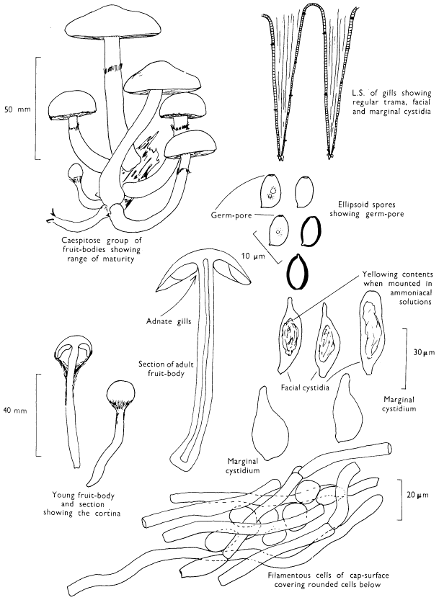
Larger illustration
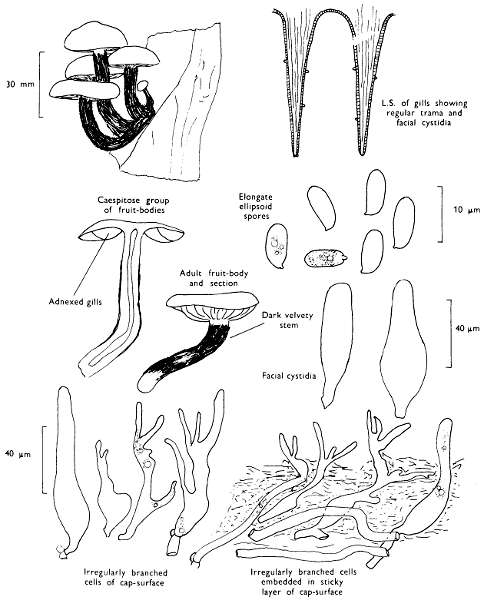
Flammulina velutipes (Fries) Karsten Velvet-shank
Cap: width 20-80 mm. Stem: width 5-10 mm; length 35-60 mm.
Description:
Cap: bright sand-colour or slightly red-brown at centre, convex at first then flattened with age, smooth, slimy because of the presence of a sticky elastic skin, rather rubbery to the touch.
Stem: cylindrical or slightly swollen towards the base, dark brown and densely hairy or velvety, tough and rubbery to handle.
Gills: adnexed, very unequal and somewhat distant, pale yellow, gradually becoming buff as the spores mature.
Flesh: with rather pleasant smell, yellowish, watery and soft.
Spore-print: white.
Spores: medium-sized, hyaline, ellipsoid and about 8 × 3-4 µm in Size (7-9 × 3-4 µm).
Marginal cystidia: hyaline, elongate, broadly flask-shaped.
Facial cystidia: similar to marginal cystidia.
Habitat & Distribution: Found in clusters on old stumps, fallen trunks and on the wounded parts of standing trees.
General Information: This fungus can be recognised by the clustered habit, the viscid, bright tawny cap and the dark velvety stem. This is one of the few agarics which occurs regularly late in the season, even appearing in the winter, although it can be seen growing in its familiar groups at almost any time of the year. This fungus holds a rather isolated position in classification and was once placed in the genus Collybia. It may be found in several books under this last genus.
Illustrations: F 18b; Hvass 80; LH 109; NB 1413; WD 214.
Plate 13. Fleshy fungi: Spores white and borne on gills
Larger illustration
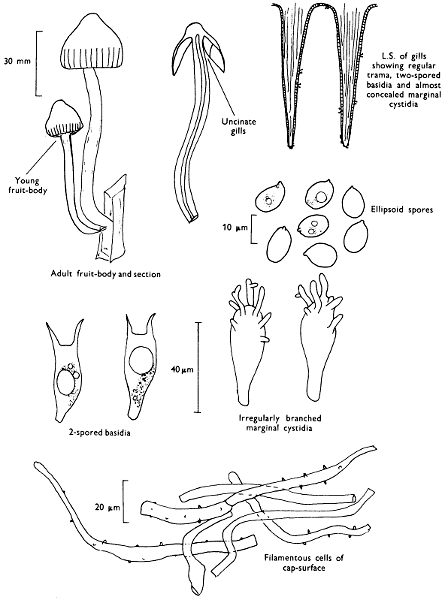
Mycena galericulata (Fries) S. F. Gray Bonnet mycena
Cap: width 25-50 mm. Stem: width 3-6 mm; length 50-125 mm.
Description:
Cap: conical or bell-shaped then expanding but retaining a central umbo, never completely flattened, smooth, greyish, pale sepia or dirty white and striate with darker lines from the margin to the centre.
Stem: similarly coloured to the cap, smooth, shiny, tough and usually noticeably downy at base.
Gills: at first white flushed distinctly pale pink with age, uncinate, rather distant and sometimes with interconnecting veins.
Flesh: white with little or no distinctive smell.
Spore-print: white.
Spores: medium-sized, hyaline, broadly ellipsoid, smooth, about 10 × 7 µm in size (9-12 × 6-8 µm) and staining bluish grey when mounted in solutions containing iodine.
Marginal cystidia: club-shaped but the apex ornamented with blunt hairs of varying lengths.
Facial cystidia: absent.
Habitat & Distribution: Commonly found, in all but the coldest months, in woods, parks or gardens, often in dense clusters on stumps and fallen trunks of broad-leaved trees.
General Information: This is one of our commonest members, and one of the largest in the genus Mycena; many species in this genus are quite small yet are nevertheless very important components of the woodland flora decomposing leaves, twigs, etc., and contributing in this way to the recirculating of organic matter.
The name Mycena is derived from the same Greek word as that which refers to the country around the ancient city of Mycenae in the plain of Argos, and from whence Agamemnon came and gathered his forces to invade Troy to reclaim Helen his wife. It has been suggested that this similarity in name came about through the necessity for an army stationed in Argos, early in the history of Ancient Greece, to rely on the mushrooms found on the plains about to save the soldiers from starvation.
Illustrations: F 17a; Hvass 119; LH 109; NB 1338; WD 263.
Plate 14. Fleshy fungi: Spores white and borne on gills
Larger illustration
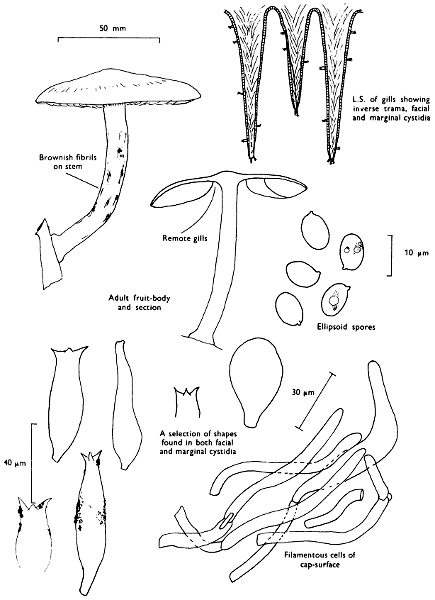
Pluteus cervinus (Fries) Kummer Fawn pluteus
Cap: width 40-100 mm. Stem: width 10-15 mm; length 75-125 mm.
Description:
Cap: conical, rapidly expanding and then becoming plano-convex or flattened with only a slight but persistent umbo, dark brown, umber or vandyke brown, viscid when wet and often with radiating fibrils.
Stem: white, streaked to varying degrees with dark brown fibrils, cylindrical or slightly swollen towards the base, where it is attached to the substrate.
Gills: remote, very crowded, thin, at first white then distinctly salmon-pink.
Flesh: with pleasant smell, white and soft.
Spore-print: dull salmon-pink.
Spores: medium-sized, very faintly buff under the microscope, broadly ellipsoid and 7-8 × 5-6 µm in size.
Marginal cystidia: flask-shaped, the majority with three or four hooks at the distinctively thick-walled apex.
Facial cystidia: similar to marginal cystidia but sometimes intermixed with those lacking hooks.
Habitat & Distribution: This fungus grows singly or in groups on old stumps and fallen trunks throughout the year except for the most wintry months; it is commonest in autumn.
General Information: This fungus may also grow on old sawdust heaps, a habitat which is often very worth while examining in detail by the interested amateur during wet seasons. In summer sawdust heaps dry out but after a good soaking, which, of course, can be applied artificially by frequent watering with a hose or watering-can, many interesting fungi develop. On sawdust heaps containing conifer debris a larger species with black or dark brown edge to the gills is found—P. atromarginatus Kühner.
The peculiar pointed cystidia found on the gill-edge and on the gill-face of P. cervinus were thought by some early mycologists to stop mites and insect larvae from crawling up between the gills and damaging the developing spores. There is no evidence that this actually takes place in nature; the real purpose of these obscure structures is unknown and has been little studied.
Illustrations: Hvass 127; LH 121; NB 1351; WD 502.
Plate 15. Fleshy fungi: Spores pinkish and borne on gills
Larger illustration
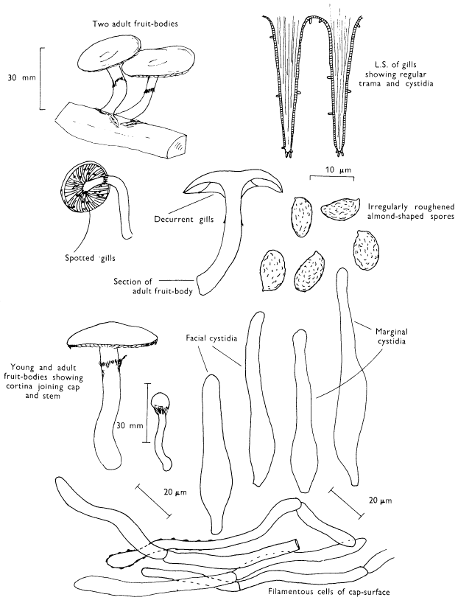
Gymnopilus penetrans (Fries) Murrill
Cap: width 20-50 mm. Stem: width 4-7 mm; length 20-50 mm.
Description:
Cap: convex then becoming flattened at maturity, dry, slightly scaly, golden tawny, or rusty yellow and when young with the remnants of a rapidly disappearing yellow cortina hanging from the margin.
Stem: yellow above and red-brown or orange-tawny below and darkening on bruising; veil forming a delicate fibrillose zone in the upper part of the stem which is soon lost on excessive handling.
Gills: adnate to slightly decurrent, thin and crowded, at first golden yellow, but soon spotted rust colour.
Flesh: yellow and lacking distinctive smell.
Spore-print: rich orange-tawny.
Spores: medium-sized, ellipsoid, finely roughened and deep yellow brown under the microscope, less than 10 µm in length (7-8 × 5-4 µm).
Marginal cystidia: hyaline, flask-shaped with long often slightly irregular neck.
Facial cystidia: similar to the marginal cystidia, but often broader.
Habitat & Distribution: This fungus is found on sticks or twigs or chips of coniferous wood, particularly in plantations.
General Information: Although it has only comparatively recently been recognised in Britain it is very wide-spread. It has been confused with, indeed described under, the name of the less-common fungus Gymnopilus sapineus (Fries) Maire which also grows in conifer woods; it is easily distinguished, however, by its spotted gills. Both the fungi above can be found in books under the old name Flammula, from the bright colour of the caps of many of its constituent members, but Flammula has been used for a genus of flowering plants also and this has precedence.
Illustrations: F 29a; Hvass 152 not very good; LH 175 not very good; NB 1096.
Plate 16. Fleshy fungi: Spores rust-brown and borne on gills
Larger illustration
Notes on the artificial family group ‘Pleurotaceae’—the Oyster mushrooms
One of the common features of lignicolous fungi is the fact that they lack a distinct stem or if one is present it is attached to one side of the cap, i.e. lateral. However, in the past the correlation of the habitat with lack of stem has induced mycologists to define a single family to include all these forms. After studying the anatomy and microscopic characters this grouping has been found to be entirely artificial and simply reflects how the morphology is tied up intimately with the ecology of a species.
In this one family members of the genera Panus, Panellus, Lentinus, Lentinellus, Crepidotus, Pleurotellus, and Pleurotus have all been grouped together, but some of the genera are more related to the polypores referred to later (p. 135); many of those with brown spores are better placed with Cortinarius and some of those with white or cream-coloured spores are better placed close to Mycena and Tricholoma. This leaves as a residue the genus Pleurotus, a genus which although rather heterogeneous contains one familiar member, i.e. the common Oyster mushroom, Pleurotus ostreatus.
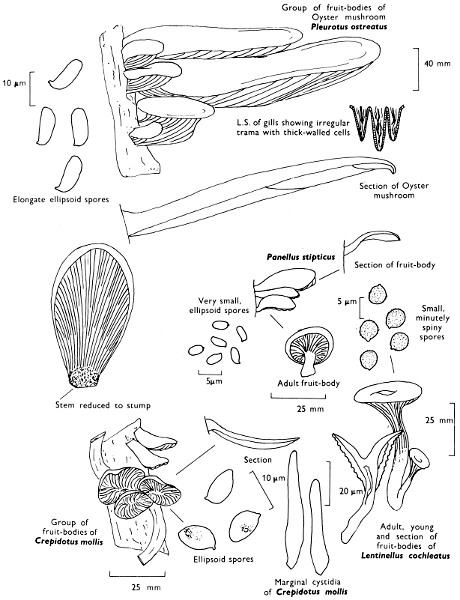
Pleurotus ostreatus (Fries) Kummer Oyster mushroom
Grows up to 150 mm across.
Cap: flattened, shell-shaped, smooth or slightly cracked, deep bluish grey, gradually becoming brownish with age and finally dark buff.
Stem: absent or very short, passing gradually into one side of the cap.
Gills: white flushing dirty yellow with age, rather distant and deeply decurrent.
Flesh: white, soft and with very pleasant smell.
Spore-print: pale lilac.
Spores: long, hyaline, oblong under the microscope and 10-11 × 4 µm in size.
Marginal and facial cystidia: absent.
Habitat & Distribution: Common, clustered in tiers on stumps, trunks, posts, etc.
General Information: This fungus is not infrequent on old telephone-poles and forms white sheets of mycelium immediately under the bark of fallen trees. Although frequent in autumn it may be found throughout the year and is easily recognised by its size and bracket-like, shell-shaped caps. It surprisingly has a pale lilac spore-print and not as might be expected a white spore-print. In the var. columbinus Quélet the young caps are a beautiful peacock-blue; this variety frequently grows on poplars.
Illustrations: F 1252; Hvass 109; LH 107; NB 1252; WD 311.
Plate 17. Wood-inhabiting, fleshy but leathery fungi: Spores whitish or brownish and borne on gills—‘Pleurotaceae’
Larger illustration
Panus torulosus (Fries) Fries
is a tough, funnel-shaped, yellowish cinnamon fungus with oblong-ellipsoid, small, hyaline spores measuring 5-6 × 3 µm and changing yellowish not bluish grey in iodine solutions.
Panellus stipticus (Fries) Karsten
forms tiers of pale cinnamon-brown, more or less kidney-shaped, scurfy caps on old wood and has egg-shaped, hyaline, small spores measuring 4 × 2-3 µm which become bluish grey in iodine solutions.
Lentinellus cochleatus (Fries) Karsten
forms irregular lobed and twisted, flattened or funnel-shaped dirty brownish caps with a fragrant smell, toothed gill-edges and almost spherical, small, hyaline spores measuring 5 × 4 µm which become bluish grey in iodine solutions.
Lentinellus apparently has very close affinities to Auriscalpium, ‘the Ear pick fungus’, (p. 158) both in the structure of the spores and the anatomy of the fruit-body.
Lentinus lepideus (Fries) Fries
forms very tough fruit-bodies with convex or flattened, pale yellowish caps and stems ornamented with dark tawny or brown scales. The stem is often eccentric and buried in cracks or soft rotten wood on which it grows; the spores are non-amyloid. It grows on pine stumps but also on decaying or unprotected railway sleepers and wooden paving blocks, joists, etc., made of conifer wood. When the fungus fruits in a darkened environment, such as a cellar, the mushroom-like fruit-bodies are not produced but are replaced by slender branched structures similar to the ‘Stag’s horn’ or ‘Candle-snuff fungus’ (p. 206), or to certain of the Fairy Club fungi (p. 172). Similar growths have been recorded for Polyporus squamosus which grows on hard wood timber and is described in detail later (p. 140).
Crepidotus mollis (Fries) Kummer Soft slipper toadstool
Cap: up to 45 mm across and in tiers, sessile, shell-shaped or kidney-shaped, smooth, rubbery and brownish ochre in colour.
Gills: pale buff then cinnamon-brown and finally flushed snuff-brown, thin and crowded.
Flesh: watery, gelatinous beneath the skin of the cap and whitish buff.
Spore-print: warm brown.
Spores: ellipsoid, smooth, medium-sized, pale buff under the microscope and 8-9 × 5-5·5 µm in size.
Easily recognised by the soft elastic cap which can be stretched without breaking, the brown gills and pale buff spores. (See Plate 49, p. 153.)
Illustrations: LH 177; NB 1453; WD 691.
The artificiality of classifying all those agarics with both a spoon-shaped or bracket-shaped fruit-body, and a reduced (or lacking) stem is further exemplified by the presence of similar genera in other groups of fungi. For instance Claudopus is typified by pink, angular spores (Plate 28) and Clitopilus is characterised by longitudinally ridged spores, i.e. they are not angular in all optical sections but only when seen end on (see p. 101). An example of the former is C. parasiticus (Quélet) Ricken which grows on dead remains of woody fungi, and of the latter C. passackerianus (Pilát) Singer which may invade mushroom beds. Both species are quite small though the last fungus is similarly coloured to the more familiar Clitopilus prunulus (Fries) Kummer, ‘The Miller’, so common in woods and fields.
Thus in the British Isles agarics with eccentric stems may be found, in the white, brown and pink-spored groups—and in the tropics and subtropics the picture is completed by the existence of the genus Melanotus in the black-spored agarics. M. bambusinus Pat. grows on bamboos and M. musae (Berk. & Curt.) Singer grows on dead leaves and debris of bananas; the latter is also a probable agent in the decay of fibres in the tropics.
(d) Saprophytes—terrestrial agarics
Melanoleuca melaleuca (Fries) Murrill
Cap: width 40-110 mm. Stem: width 50-80 mm; length 50-90 mm.
Description:
Cap: dark brown, umber or vandyke when moist, hygrophanous and becoming very much paler on drying almost tan, convex then flattened sometimes umbonate, smooth or wrinkled.
Stem: white or whitish covered in brownish fibrils which increase in number with age or after handling; solid, rather elastic and slightly swollen towards the base.
Gills: white, broad, crowded and as if cut out from behind before joining the stem.
Flesh: with pleasant smell, soft, white, becoming brownish with age, particularly in the stem.
Spore-print: very pale ivory-colour.
Spores: medium-sized, ellipsoid, hyaline under the microscope and roughened by distinct dots which become blue-black when mounted in solutions containing iodine, 8 × 4-5 µm.
Marginal cystidia: spear- or sword-shaped, roughened with crystals at the top and appearing as if barbed like fish-spines.
Facial cystidia: numerous and similar to marginal cystidia.
Habitat & Distribution: Common in autumn in woods; also found in pastures.
General Information: A very common fungus which is rather confusing to the beginner because of its variation in colour, brought about by the change in colour with change in content of water. However, this fungus can be easily recognised by the unusually ornamented cystidia found on the gill-faces and gill-margins. This character and the fact that the spores possess amyloid ornamentation define in part the genus Melanoleuca. In many books this common fungus is found under the genus Tricholoma; however, members of this latter genus have neither amyloid ornamented spores nor barbed cystidia.
Illustrations: LH 103; WD 131.
Plate 18. Fleshy fungi: Spores white and borne on gills
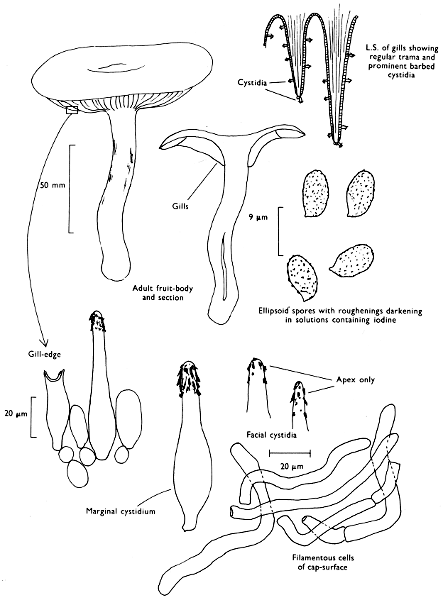
Larger illustration
Clitocybe infundibuliformis (Weinm.) Quélet Common funnel-cap
Cap: width 20-60 mm. Stem: width 8-13 mm; length 35-75 mm.
Description:
Cap: yellowish ochre flushed slightly pinkish buff or cinnamon but later pale tan on ageing or drying, funnel shaped.
Stem: colour like cap or slightly darker, flexible but firm and solid.
Gills: white or faintly flushed buff, decurrent and crowded.
Flesh: with pleasant slightly floral smell, white, soft and fairly thin.
Spore-print: white.
Spores: medium-sized, hyaline, tear-drop shaped, smooth, 6-7 × 3-4 µm and not blueing when mounted in solutions containing iodine.
Marginal cystidia: little different from young basidia in dimension and shape, although some may have a short apical prolongation.
Facial cystidia: absent.
Habitat & Distribution: Woods, copses, heaths and hill-pastures from summer to autumn.
General Information: An easily recognisable fungus because of its graceful stature, thin, funnel-shaped pinkish buff cap and tear-drop-shaped spores. Several Clitocybe species grow in woodlands, many of them appearing later in the season when colourful agarics are rarer.
The genus Clitocybe is characterised by the fleshy cap with incurved margin when young, fibrous, fleshy stem and decurrent gills. C. clavipes (Fries) Kummer has a smoky brown, top-shaped cap, fragile stem which also has a distinct swelling at its base, and strong rather unpleasant smell. C. nebularis (Fries) Kummer is similar, but is pale cloudy grey, has a less fragile stem and a fairly pleasant smell. This species if often covered in a bloom which develops further as the fruit-body deteriorates. The agaric Volvariella surrecta (Knapp) Singer is a rare parasite of C. nebularis (see p. 247) and it has been suggested that this bloom may in fact belong to this species. However, I have on several occasions tried to encourage the bloom to reproduce by keeping hoary looking fruit-bodies of C. nebularis in a damp-chamber, but as yet I have never been successful.
Nevertheless, it is an exercise which would be of great interest to continue and a source of great excitement if the small pink-spored agaric were produced. C. fragrans (Fries) Kummer is a small, sweetly aromatic-smelling species found in frondose woods, and C. langei Hora, is a mealy-smelling species of conifer plantations.
Illustrations: F 16a; Hvass 55; LH 95; WD 162.
Plate 19. Fleshy fungi: Spores white and borne on gills
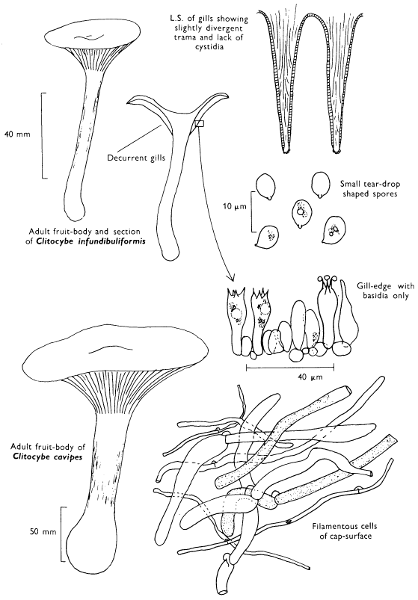
Larger illustration
Hebeloma crustuliniforme (St Amans) Quélet Fairy-cake mushroom
Cap: width 40-80 mm. Stem: width 8-12 mm; length 38-85 mm.
Description:
Cap: pale yellow buff or pale tan with a distinct reddish buff or cinnamon-brown tint, darkening only slightly with age; smooth, at first tacky to the fingers, but then dry and shiny at centre, convex and hardly expanding.
Stem: cylindrical or slightly swollen towards the base, whitish and with a flush of pinkish buff at apex, and covered all over in small, white scales.
Gills: sinuate, crowded, pale clay-colour or buff, but finally dull dark yellow ochre except for the distinct white margins which are beaded in wet weather with droplets of liquid.
Flesh: whitish with a very strong smell of radishes.
Spore-print: dark clay-colour.
Spores: long, slightly almond-shaped, pale brown under the microscope, distinctly warted and about 11 × 6 µm in size (10-12 × 6-7 µm).
Marginal cystidia: cylindrical to skittle-shaped with slightly to distinctly swollen apex.
Facial cystidia: absent.
Habitat & Distribution: Common in autumn on the ground by pathsides and in woodland clearings.
General Information: Recognisable by the uniform cinnamon or pinkish buff cap, white woolly scales on the stem and distinctive, strong smell of radish. There is some evidence that this species may on occasions be mycorrhizal; further field studies are required.
There are several closely related fungi which are difficult for the amateur to differentiate from H. crustuliniforme; there is no doubt that there are several species present in the British Isles which do not appear in the Check List of British Agarics & Boleti; in fact, it would appear that there are several yet to be described as new to science. Although individual species are fairly difficult to delimit, the genus Hebeloma itself is easily recognised, most members being medium sized with brown sinuate gills, whitish, yellowish, or pinkish, i.e. pale, caps and white-powdered stems. The word ‘crustulin’ which appears in the Latin name of H. crustuliniforme is itself from the Latin and means small cake, referring to the cap-shape, which remains fairly constant throughout the fungus’ growth. The common name is derived from this also.
Plate 20. Fleshy fungi: Spores dull brown and borne on gills
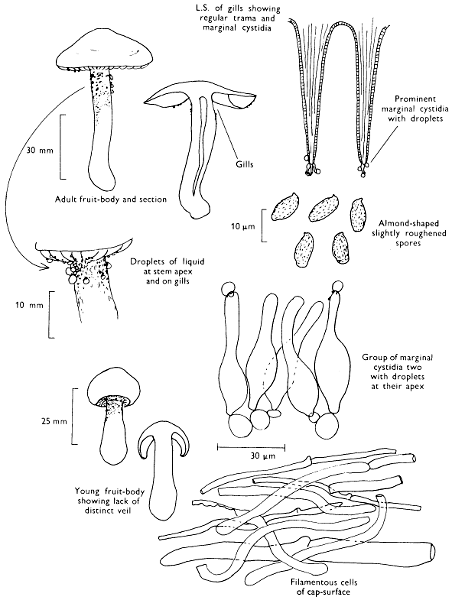
Larger illustration
Inocybe geophylla (Fries) Kummer Common white inocybe
Cap: width 10-25 mm. Stem: width 3-6 mm; length 30-50 mm.
Description:
Cap: conical with incurved margin then bell-shaped and retaining a distinct umbo even when mature, silvery white then ivory and finally pale tan particularly centrally and silky fibrillose throughout.
Stem: slender, cylindrical but for a small swelling at the base, silky and shining with a few fibrils from a former cortina which may be brownish due to spores adhering to it at maturity.
Gills: adnexed to free, crowded, pale ochraceous becoming clay-coloured.
Flesh: white with smell of newly dug potatoes, strong when fresh.
Spore-print: clay-colour.
Spores: medium sized, ellipsoid or slightly French-bean-shaped, smooth, yellow-brown under the microscope and 9-11 × 4-5 µm in size.
Marginal and facial cystidia: flask- to spindle-shaped with distinctly thickened walls and frequently ornamented with crystals apically.
Habitat & Distribution: Common in troops in woodland clearings, by pathsides or on the edges of ditches bordering woods.
General Information: This fungus is easily recognised by the very pale uniform colour, the colour of the spore-print, silky umbonate cap and small size. The cortina connects the cap-margin and the stem and consists of a cobwebby structure which collapses at maturity.
A violet coloured variety, var. lilacina Gillet is frequently found, in fact, even accompanying var. geophylla; it differs only in the lilac-colour of the cap and stem. I. geophylla is a member of the very large genus Inocybe, further members of which will be dealt with later (see p. 238).
The genus is well defined with dull-yellow spore-print, well differentiated sterile cells on the gill-edge (and often on the gill-face) and the cobweb-like veil, or cortina, stretching from the cap-margin to the stem and easily observed in young specimens. The genus is split into three distinct groups: those with smooth spores, those with nodulose spores and those with subglobose spores ornamented with long projections. I. geophylla is included in the first group. The group which includes the nodulose-spored members has been elevated to the rank of genus by some authors, i.e. Astrosporina—a name referring to the spore-shape eg., I. asterospora.
Illustrations: F 13a (too blue); LH 155; NB 1395; WD 654.
Plate 21. Fleshy fungi: Spores dull brown and borne on gills
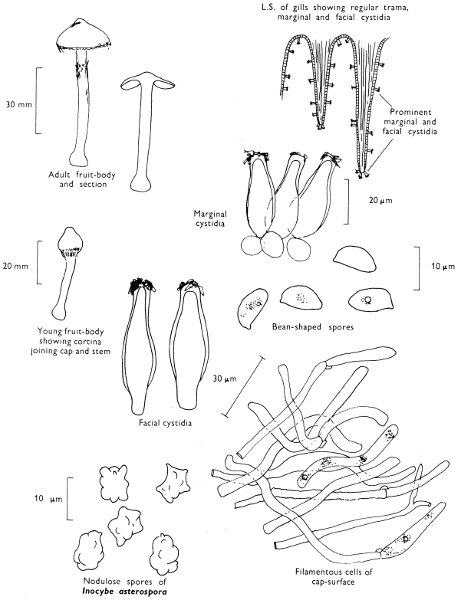
Larger illustration
Laccaria laccata (Fries) Cooke Deceiver
Cap: width 12-28 mm. Stem: width 4-8 mm; length 15-60 mm.
Description:
Cap: hygrophanous, reddish brown or brick-colour becoming ochraceous on drying, but can be rapidly returned to the original colour by placing on the top a drop of water which is rapidly absorbed; fragile, convex at first then flattened or depressed about centre, smooth or surface scaley, striate at margin when moist.
Stem: similarly coloured to the cap, fibrous, cylindrical, tough and usually with white woolly base.
Gills: adnate with or without a decurrent tooth, thick, distant and pinkish or pale reddish-brown, powdered with white when mature.
Flesh: red-brown, soft in the cap and fibrous in the stem.
Spore-print: pure white.
Spores: medium sized, hyaline under the microscope and spherical, 7-8 µm in diameter and beautifully spiny.
Marginal and facial cystidia: absent.
Habitat & Distribution: Common in troops in woodland, copses, on heaths; in fact it may be found in nearly all possible habitats.
General Information: This is a very common agaric which in the future will probably be split into several distinct species; unfortunately it is as variable as it is common, hence the common name ‘deceiver’; it is often mistaken at first glance for many other species quite unrelated. I have seen even the most experienced mycologist pick up rather unfamiliar specimens of Laccaria laccata in mistake for a species of Lactarius or a species of Collybia, etc. I would hate to say more because I have been ‘deceived’ myself on more than one occasion. L. laccata appears to be a composite species, but because of the difficulty in defining some of the characters the splitting of the species has not as yet been satisfactorily solved. The smell, however, may well give a clue for some specimens smell very strongly of radish whilst others are odourless.
L. proxima (Boudier) Patouillard
, differs in having ellipsoid spores; it is larger in stature and is common in wet places.
L. amethystea (Mérat) Murrill
, differs in the deep violet or amethyst-colour of the fruit-body and commonly grows in shaded woods.
L. bicolor (Maire) P. D. Orton
, which is less frequent, has lilaceous gills and violaceous mycelium at the base of the stem.
Illustrations: Hvass 66; NB 1331; WD 202.
Plate 22. Fleshy fungi: Spores white and borne on gills
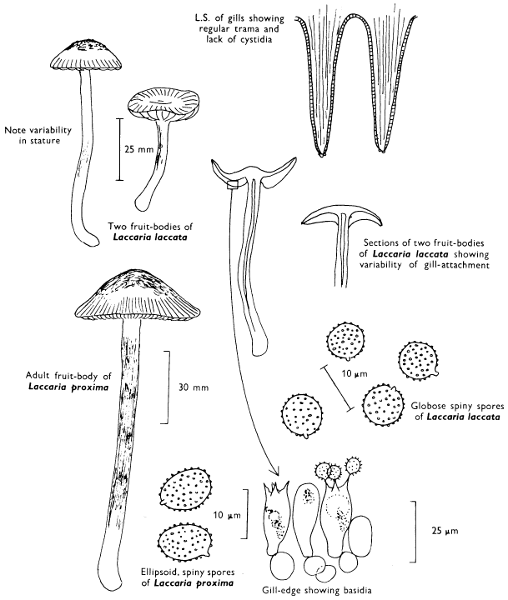
Larger illustration
Mycena sanguinolenta (Fries) Kummer Small bleeding mycena
Cap: width 10-17 mm. Stem: width 2-4 mm; length 50-80 mm.
Description:
Cap: bell-shaped or conical expanding only slightly with age and so remaining umbonate, reddish-brown, striate to the margin from the darker apex and blotched age with red-brown spots.
Stem: pale reddish brown, very slender, fragile, woolly at the base and exuding a red-brown juice when broken.
Gills: adnate, fairly distant, whitish to flesh-colour with a dark red-brown edge and not noticeably becoming blotched with red-brown.
Flesh: with no distinctive smell, reddish-brown and very thin.
Spore-print: white.
Spores: medium sized, hyaline, ellipsoid to pip-shaped, smooth about 10 µm long (9-10 × 4-5 µm) and becoming bluish grey when mounted in solutions containing iodine.
Marginal cystidia: awl-shaped, pointed at the apex, swollen below and filled with dark red-brown contents.
Facial cystidia: absent.
Habitat & Distribution: Solitary or in small groups on poorly kept lawns, in woods and copses; it is particularly frequent in the beds of needles found in pine woods.
General Information: This fungus is easily recognised by the slender habit, reddish juice exuded when broken and habitat preferences. Mycena haematopus (Fries) Kummer is larger and grows in tufts on wood, but also has a red-brown juice which, however, spots the gills. Another very common species of Mycena is M. galopus (Fries) Kummer which has a greyish or brownish cap and exudes a milk-like juice. The related M. leucogala (Cooke) Saccardo is almost black (see p. 216). These agarics exuding juice when broken have a flesh composed of filaments, a very different flesh-structure to species of Lactarius (see p. 50) and although their spores are amyloid they do not turn blue-black in iodine because of the presence of amyloid crests and warts. There are few additional species of agaric which exude a milk-like liquid, but the majority of these are tropical or subtropical. The second names or epithets for the four species mentioned above all refer to the ‘latex’—sanguinolenta—bleeding, haematopus blood-foot; galopus, milk-foot and leucogala, white milk. For notes on Mycena one is referred to p. 68 describing M. galericulata (Fries) S. F. Gray.
Illustrations: WD 284.
Plate 23. Fleshy, milking fungi: Spores white and borne on gills
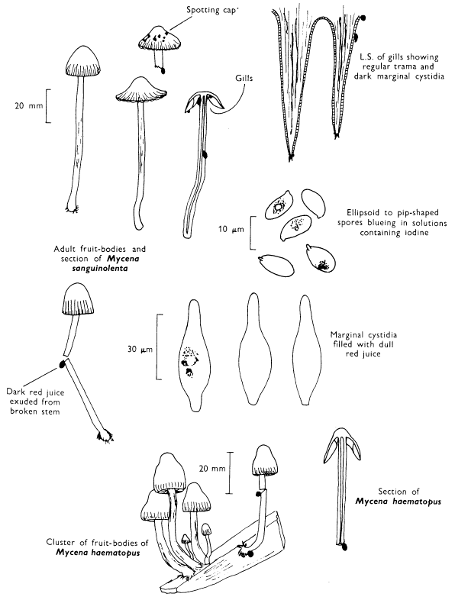
Larger illustration
Collybia maculata (Fries) Kummer Spotted tough-shank
Cap: width 80-130 mm. Stem: width 5-20 mm; length 50-158 mm.
Description:
Cap: white but soon becoming spotted with reddish-brown, finally cream-colour with red-brown blotches, convex then becoming flattened, fleshy, firm and tough.
Stem: white becoming streaked red-brown, thickest in the middle, longitudinally furrowed or striate and often narrowed downwards into a long irregular root embedded in the deep litter.
Gills: very crowded, cream-coloured, becoming spotted red-brown with age.
Flesh: with pleasant smell, white and fibrous in the stem.
Spore-print: pinkish cream-colour.
Spores: small, almost spherical, hyaline under the microscope, about 5 µm in diameter (4-5 × 5 µm) and not blueing when placed in solutions containing iodine.
Marginal and facial cystidia: absent.
Habitat & Distribution: Common in troops in woods, particularly beech but also found in pine woods and on heaths.
General Information: Easily recognised by the crowded, narrow, cream coloured gills and the cap being entirely white when young, but which rapidly becomes spotted red-brown as it develops. ‘Maculatus’ means spotted and refers to the red-brown blotches which develop irregularly on the cap, stem and gills as the fruit-body matures.
The genus Collybia is characterised by the fruit-body being tough, the cap-margin incurved at first and the spore-print white or whitish. The common fungus C. maculata has always been assumed to have a white spore-print but if a cap is placed on a piece of white paper gills-down and left for twelve hours there is a surprise in store for the careful observer.
Illustrations: F 15a; Hvass 77; LH 101; NB 1034; WD 212.
Plate 24. Fleshy fungi with tough stem: Spores white to cream and borne on gills
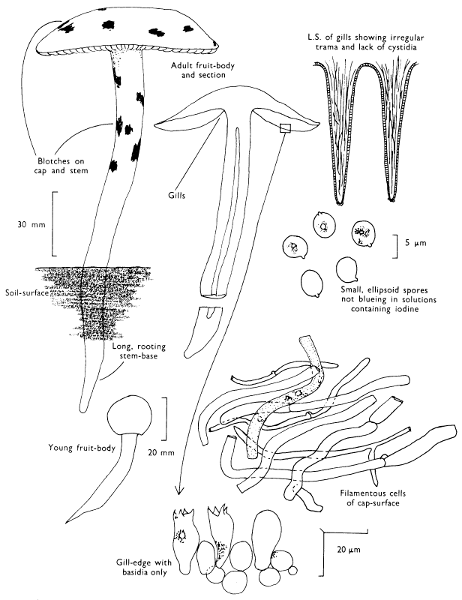
Larger illustration
The specialised substrates of certain species of Marasmius and related genera
A whole series of very small fungi are found in woodland communities which appear to be closely related one to another because their caps are usually tough, although membranous, dry rapidly yet do not decay, and, moreover, revive on remoistening. Their gills are also rather tough and their spores always white in mass. They are placed in the genus Marasmius. Collybia or Marasmius peronatus (Fries) Fries the ‘wood woolly foot’ is one of our larger more familiar agarics related to this group, but whereas it grows on all kinds of leafy detritus, even wood, these small fungi appear to be very specific to the substrate on which they grow.
M. androsaceus (Fries) Fries
grows both on heather and on pine-needles (see p. 231).
Cap: whitish or pinkish buff.
Stem: black and hair-like.
Spores: pip-shaped and 7-9 × 3-4 µm.
M. buxi Fries
grows on box leaves.
M. epiphylloides (Rea) Saccardo & Trotter
grows on ivy leaves.
M. graminum (Libert) Berkeley
grows on grass stems.
Cap: red-brown.
Stem: dark brown.
Spores: pip-shaped, 8-12 × 4-6 µm.
M. hudsonii (Fries) Fries
grows on holly leaves.
M. perforans (Fries) Fries
grows on pine needles (now placed in the genus Micromphale).
M. undatus (Berkeley) Fries
grows on bracken stems.
Cap: reddish brown or greyish and wrinkled.
Spores: egg-shaped, 8-9 × 6-7 µm.
Except for their rather special requirements as to substrate preference, these species have in common small size, rather tough horny stems and cap composed of erect ornamented cells.
Several agarics which grow on cones have also been placed in Marasmius. They are frequent in spring and early summer the fruit-bodies being attached by a very long rooting stem and cord of fluffy hyphae to buried cones in conifers. The biology of these fungi is still unknown, but the cones to which they are attached are always closed yet buried often several inches beneath the surface of the soil. It is yet to be found whether the spores of the agaric infect the cones after they drop or whether the cones fall because they have become infected. How do the cones become so deeply buried? Are squirrels or rodents involved? All the species which grow on cones have brown or tawny caps and yellowish brown stems.
Plate 25. Fleshy fungi with wiry to tough stem: Spores white and borne on gills, fruit-body frequently reviving when moistened
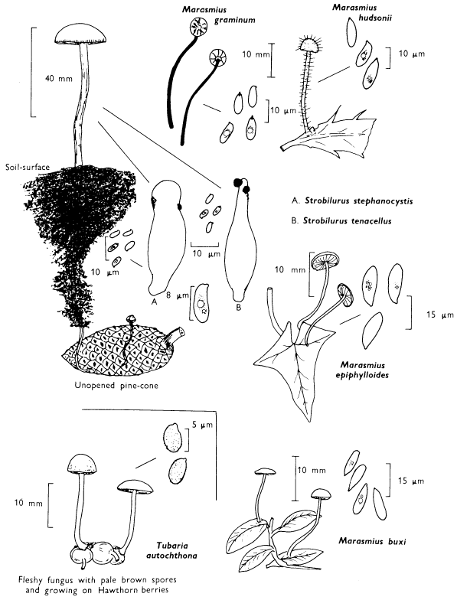
Larger illustration
Strobilurus stephanocystis (Hora) Singer
has cystidia with rounded heads and grows on pine-cones.
S. tenacellus (Fries) Singer
has pointed cystidia and grows on pine-cones.
S. esculentus (Fries) Singer
has lance-shaped cystidia and grows on spruce cones.
Baeospora myosura (Fries) Singer
is tough and pale-coloured and is similar in general characters to species of Strobilurus, but has amyloid spores and fruits on pine-cones in the autumn.
When discussing the specialised plant-substrates, such as cones, one must mention the small brown-spored, pale buff coloured agaric Tubaria dispersa (Persoon) Singer, or Tubaria autochthona (Berkeley & Broome) Saccardo, which grows on the ground under hawthorns, often in troops in summer and autumn, attached to old hardened hawthorn berries.
(ii) Agarics of Pastures and Meadows
(a) Agarics of rough and hill pastures
Hygrocybe pratensis (Fries) Donk Butter mushroom
Cap: width 20-80 mm. Stem: width 5-12 mm; length 30-70 mm.
Description:
Cap: convex then expanding to become plano-convex with a broad low umbo, tan, pale russet or even yellowish buff throughout or slightly darker at the centre.
Stem: gradually thickened upwards, similarly coloured to the cap or paler if the cap is dark russet.
Gills: pale buff, deeply decurrent and often connected up at their bases by veins.
Flesh: buff or pale tan, thick and soft in the cap, slightly fibrous in the stem.
Spore-print: white.
Spores: medium-sized, ellipsoid to egg-shaped, hyaline under the microscope, 7-8 × 5 µm in size and not becoming bluish grey in solutions containing iodine.
Marginal and facial cystidia: absent.
Habitat & Distribution: Common in pastures or on heaths from early summer to late autumn.
General Information: A fungus easily recognised by the uniform buff-colour of the stem, cap and gills. As one might expect from the common name it is edible; it is held in high regard by many mushroom-pickers.
Although ‘pratensis’ specifically means fields, reflecting the habitat of the fungus, this and related species can also be found on heaths and pastures often intermixed and forming a most interesting flora. The following are perhaps the most commonly seen:
H. lacma (Fries) Orton & Watling and H. cinerea (Fries) Orton & Watling are similar in stature, but metallic grey in colour except for the persistently yellow stem-base in H. lacma.
H. subradiata (Secretan) Orton & Watling is flesh-coloured or brownish and H. virginea (Fries) Orton & Watling is white.
H. nivea (Fries) Orton & Watling and H. russocoriacea (Berkeley & Miller) Orton & Watling are much smaller, the former white and odourless and the latter off-white with a very strong smell of incense.
Illustrations: F 12b; Hvass 95; LH 77; NB 332; WD 333.
Plate 26. Fleshy fungi: Spores white and borne on thick, waxy gills
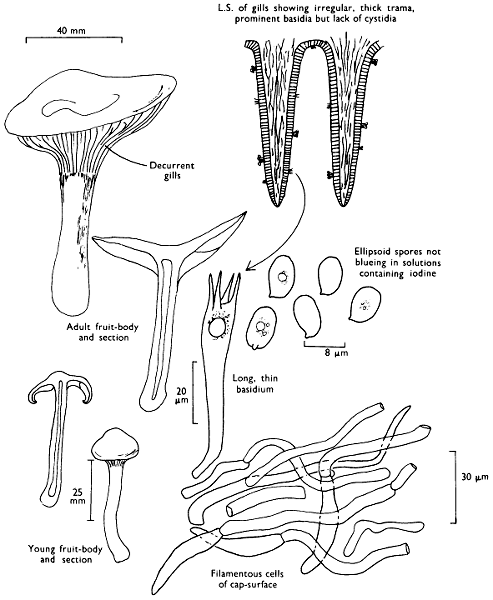
Larger illustration
Hygrocybe psittacina (Fries) Wunsche Parrot hygrophorus
Cap: width 12-25 mm. Stem: width 3-8 mm; length 30-60 mm.
Description:
Cap: very slimy with colourless sticky fluid, deep bluish green when fresh, but becoming more and more ochraceous-orange with age or completely fading out to a yellow ochre, bell-shaped at first then expanded except for central umbo.
Stem: like the cap very slimy, apple-green or bluish green throughout but becoming ochraceous like the cap except at the apex which is persistently green.
Gills: adnate yellow or apricot-coloured, greenish towards their base, broad, distant and rather tough.
Flesh: whitish, tinged green in the cap and yellow or apricot-colour in the stem.
Spore-print: white.
Spores: medium-sized, hyaline, ellipsoid, not blue-grey in solutions containing iodine and 8-9 × 4-5 µm in size.
Marginal and facial cystidia: absent.
Habitat & Distribution: Common in grassland and hill-pastures, but it also occurs in copses and woodlands.
General Information: This fungus is easily recognised by the distinctive colours, but it is rather deceptive for the cap and the stem soon become faded; however, the green colouration persists at the apex of the stem and it is by this that in the faded state the fungus can still be identified. H. laeta (Fries) Kummer fades to similar colours but the cap is flesh-colour at first or sordid brown and the gills are flesh-coloured or greyish; it prefers upland pastures and heathland: its spores are smaller, being 5-7 × 4 µm.
Illustrations: F 12a; Hvass 92; LH 79; NB 336; WD 345.
General notes on Hygrophori
Hygrophori are some of our most colourful groups of agarics, many are brightly coloured with caps in reds, greens, yellows, oranges, etc., the colour often accentuated by the usually slimy aspect. Traditionally the genus Hygrophorus has been split into three groups as follows:—
Limacium with slimy cap, adnate to decurrent gills and slimy or tacky stem which may also often be ornamented with dots, especially towards the top.
Camarophyllus with dry cap, smooth and fibrous stem and decurrent gills.
Hygrocybe with thin, fragile, sticky or moist cap, smooth fibrillose stem and gills varying from free to decurrent.
The last two sections have been joined together into the single genus Hygrocybe and all the members seem to be saprophytic or intimately associated with grassland communities. The first section Limacium now makes up the genus Hygrophorus and its members are thought to be mycorrhizal with trees, e.g. H. hypothejus (Fries) Fries with pine, the ‘Herald of the winter’ because it occurs at the end of the fungus season and H. chrysaspis Métrod, a whitish, sickly-smelling fungus under beech. Results from examining the anatomy of the gills appears to confirm these divisions. All the Hygrophori have a homogeneous flesh, white spores, central, fleshy stem and thick, waxy gills; microscopically this group of fungi can be recognised by the very long basidia.
The following are common examples of the genus Hygrocybe:—