Chapter XVI
Reading edition
COMPARATIVE COST AND VALUE OF FOODS
241. Cost and Nutrient Content of Foods.—The market price and the nutritive value of foods are often at variance, as those which cost the most frequently contain the least nutrients.[75] It is difficult to make absolute comparisons as to the nutritive value of foods at different prices, because they differ not only in the amounts, but also in the kinds of nutrients. While it is not possible to express definitely the value of one food in terms of another, approximate comparisons may be made as to the amounts of nutrients that can be secured for a given sum of money when foods are at different prices, and tables have been prepared making such comparisons.
Transcriber's Note: Fig. 56. is not of good quality, but has been placed for information.
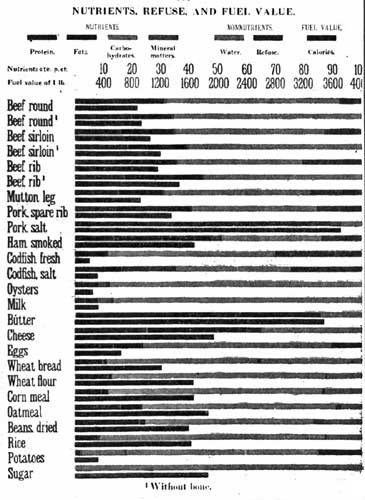
Fig. 56.—Composition of Foods.
(From Office of Experiment Stations Bulletin.)
242. Nutrients Procurable for a Given Sum.[7]—To ascertain the nutrients procurable for a given sum first determine the amount in pounds that can be obtained, say, for ten cents, and then multiply by the percentages of fat, protein, carbohydrates, and calories in the food. The results are the amounts, in pounds, of nutrients procurable for that sum of money. For example: if milk is 5 cents per quart, two quarts or approximately four pounds, can be procured for 10 cents. If the milk contains fat, 4 per cent, protein, 3.3 per cent, carbohydrates, 5 per cent, and fuel value, 310 calories per pound, multiplying each of these by 4 gives the nutrients and fuel value in four pounds, or 10 cents worth of milk, as follows:
Protein0.13 lb.
Fat0.16 lb.
Carbohydrates0.2 lb.
Calories1240
If it is desired to compare milk at 5 cents per quart with round steak at 15 cents per pound, 10 cents will procure 0.66, or two thirds of a pound of round steak containing on an average (edible portion) 19 per cent protein, 12.8 per cent fat, and yielding 890 calories per pound. If 10 per cent is refuse, there is edible about 0.6 of a pound. The amounts of nutrients in the 0.6 of a pound of steak, edible portion, or 0.66 lb. as purchased would be:
Protein0.11 lb.
Fat0.08 lb.
Calories534
It is to be observed that from the 10 cents' worth of milk a little more protein, 0.08 of a pound more fat, and nearly two and one half times as many calories can be secured as from the 10 cents' worth of meat. This is due to the carbohydrates and the larger amount of fat which the milk contains. At these prices, milk should be used liberally in the dietary, as it furnishes more of all the nutrients than does meat. It would not be advisable to exclude meat entirely from the ration, but milk at 5 cents per quart is cheaper food than meat at 15 cents per pound. In making comparisons, preference cannot always be given to one food because of its containing more of any particular nutrient, for often there are other factors that influence the value.
243. Comparing Foods as to Nutritive Value.—In general, preference should be given to foods which supply the most protein, provided the differences between the carbohydrates and fats are not large. When the protein content of two foods is nearly the same, but the fats and carbohydrates differ materially, the preference may safely be given to the food which supplies the larger amount of total nutrients. A pound of protein in a ration is more valuable than a pound of either fat or carbohydrates, although it is not possible to establish an absolute scale as to the comparative value of these nutrients, because they serve different functional purposes in the body. It is sometimes necessary to use small amounts of foods rich in protein in order to secure a balanced ration; excessive use of protein, however, is not economical, as that which is not needed for functional purposes is converted into heat and energy which could be supplied as well by the carbohydrates, and they are less expensive nutrients.
Transcriber's Note: Fig. 57. is not of good quality, but has been placed for information.
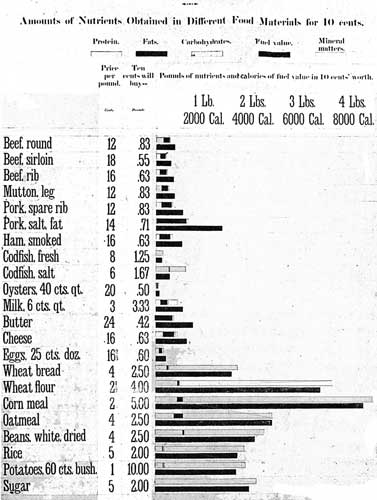
Fig. 57.—Pecuniary Economy of Food.
(From Office of Experiment Stations Bulletin.)
Ten Cents will Purchase:
(From Farmer's Bulletin No. 142, U. S. Dept. of Agr.)
KIND OF FOOD MATERIALPrice per PoundTotal Weight of Food MaterialProteinFatCarbohy- dratesEnergy
CentsPoundsPoundPoundPoundsCalories
Beef, sirloin250.400.060.06—410
Do.200.500.080.08—515
Do.150.670.100.11—685
Beef, round160.630.110.08—560
Do.140.710.130.09—630
Do.120.830.150.10—740
Beef, shoulder clod120.830.130.08—595
Do.91.110.180.10—795
Beef, stew meat52.000.290.23—1530
Beef, dried, chipped250.400.100.03—315
Mutton chops, loin160.630.080.17—890
Mutton, leg200.500.070.07—445
Do.160.630.090.09—560
Roast pork, loin120.830.110.19—1035
Pork, smoked ham220.450.060.14—735
Do.180.560.080.18—915
Pork, fat salt120.830.020.68—2950
Codfish, dressed, fresh101.000.11——220
Halibut, fresh180.560.080.02—265
Cod, salt71.430.220.01—465
Mackerel, salt, dressed101.000.130.20—1135
Salmon, canned120.830.180.10—760
Oysters, solids, 50 cents per quart250.400.02—0.0190
Oysters, solids, 35 cents per quart180.560.030.010.02125
Lobster, canned180.560.100.01—225
Butter200.500.010.40—1705
Do.250.40—0.32—1365
Do.300.33—0.27—1125
Eggs, 36 cents per dozen240.420.050.04—260
Eggs, 24 cents per dozen160.630.070.06—385
Eggs, 12 cents per dozen81.250.140.11—770
Cheese160.630.160.200.021185
Milk, 7 cents per quart3½2.850.090.110.14885
Milk, 6 cents per quart33.330.110.130.171030
Wheat flour33.330.320.032.455440
Do.2½4.000.390.042.946540
Corn meal, granular2½4.000.310.072.966540
Wheat breakfast food7½1.330.130.020.982235
Oat breakfast food7½1.330.190.090.862395
Oatmeal42.500.340.161.664500
Rice81.250.08—0.972025
Wheat bread61.670.130.020.872000
Do.52.000.160.021.042400
Do.42.500.200.031.303000
Rye bread52.000.150.011.042340
Beans, white, dried52.000.350.031.163040
KIND OF FOOD MATERIALPrice per PoundTotal Weight of Food MaterialProteinFatCarbohy- dratesEnergy
Cabbage2½4.000.050.010.18460
Celery52.000.02—0.05130
Corn, canned101.000.020.010.18430
Potatoes, 90 cents per bushel1½6.670.100.010.931970
Potatoes, 60 cents per bushel110.000.150.011.402950
Potatoes, 45 cents per bushel¾13.330.200.011.873935
Turnips110.000.080.010.541200
Apples1½6.670.020.020.651270
Bananas71.430.010.010.18370
Oranges61.670.01—0.13250
Strawberries71.43.010.010.09215
Sugar61.67——1.672920
It is to be noted in the table that, ordinarily, for the same amount of money the most nutrients can be obtained in the form of milk, cheese, sugar, and beans, corn meal, wheat flour, oatmeal, and cereals in bulk. While meats supply protein liberally, they fail to furnish carbohydrates as the vegetables. As discussed in the chapter on Dietary Studies of Families, unnecessarily expensive foods are often used, resulting either in lack of nutrients or unbalanced rations.
EXAMPLES
1. Compute the calories and the amounts of protein, fat, and carbohydrates that can be procured for 25 cents in cheese selling for 18 cents per pound; how do these compare with the nutrients in eggs at 20 cents per dozen?
2. Which food furnishes the larger amount of nutrients, potatoes at 50 cents per bushel or flour at $6 per barrel?
3. How do beans at 10 cents per quart compare in nutritive value with beef at 15 Cents per pound?
4. How does salt codfish at 10 cents per pound compare in nutritive value with lamb chops at 15 cents per pound?
5. Compare in nutritive value cream at 25 cents per quart with butter at 30 cents per pound.
6. Calculate the composition and nutritive value of a cake made of sugar, 8 oz.; butter, 4 oz.; eggs, 8 oz.; flour, 8 oz.; and milk, 4 oz.; the baked cake weighs one and three fourths pounds.
Average Composition of Common American Food Products
(From Farmer's Bulletin, No. 142, U. S. Dept. of Agr.)
FOOD MATERIAL (as purchased)RefuseWaterProteinFatCarbohy- dratesAshFuel Value per Pound
ANIMAL FOOD%%%%%%Calories
Beef, fresh:
Chuck ribs16.352.615.515.0—0.8910
Flank10.254.017.019.0—0.71105
Loin13.352.516.117.5—0.91025
Porterhouse steak12.752.419.117.9—0.81100
Sirloin steak12.854.016.516.1—0.9975
Neck27.645.914.511.9—0.71165
Ribs20.843.813.921.2—0.71135
Rib rolls—63.919.316.7—0.91055
Round7.260.719.012.8—1.0890
Rump20.745.013.820.2—0.71090
Shank, fore36.942.912.87.3—0.6545
Shoulder and clod16.456.816.49.8—0.9715
Fore quarter18.749.114.517.5—0.7995
Hind quarter15.750.415.418.3—0.71045
Beef, corned, canned,
pickled, dried:
Corned beef8.449.214.323.8—4.61245
Tongue, pickled6.058.911.919.2—4.31010
Dried, salted, and smoked4.753.726.46.9—8.9790
Canned boiled beef—51.825.522.5—1.31410
Canned corned beef—51.826.318.7—4.01270
Veal:
Breast21.352.015.411.0—0.8745
Leg14.260.115.57.9—0.9625
Leg cutlets3.468.320.17.5—1.0695
Fore quarter24.554.215.16.0—0.7535
Hind quarter20.756.216.26.6—0.8580
Mutton:
Flank9.939.013.836.9—0.61770
Leg, hind18.451.215.114.7—0.8890
Loin chops16.042.013.528.3—0.71415
Fore quarter21.241.612.324.5—0.71235
Hind quarter, without tallow17.245.413.823.2—0.71210
Lamb:
Breast10.145.515.419.1—0.81075
Leg, hind17.452.915.913.6—0.9860
Pork, fresh:
Ham10.748.013.525.9—0.81320
Loin chops19.741.813.424.2—0.81245
Shoulder12.444.912.029.8—0.71450
Tenderloin—66.518.913.0—1.0895
Pork, salted, cured, pickled:
Ham, smoked13.634.814.233.4—4.21635
Shoulder, smoked18.236.813.026.6—5.51335
Salt pork—7.91.986.2—3.93555
Bacon, smoked7.717.49.162.2—4.12715
Sausage:
Bologna3.355.218.219.7—3.81155
Pork—39.813.044.21.12.22075
Frankfort—57.219.618.61.13.41155
Soups:
Celery, cream of—88.62.12.85.01.5235
Beef—92.94.40.41.11.2120
Meat stew—84.54.64.35.51.1365
Tomato—90.01.81.15.61.5185
Poultry:
Chicken, broilers41.643.712.81.4—0.7305
Fowls25.947.113.712.3—0.7765
Goose17.638.513.429.8—0.71475
Turkey22.742.416.118.4—0.81060
Fish:
Cod, dressed29.958.511.10.2—0.8220
Halibut, steaks or sections17.761.915.34.4—0.9475
Mackerel, whole44.740.410.24.2—0.7370
Perch, yellow dressed35.150.712.80.7—0.9275
Shad, whole50.135.29.44.8—0.7380
Shad, roe—71.220.93.82.61.5600
Fish, preserved:
Cod, salt24.940.216.00.4—18.5325
Herring, smoked44.419.220.58.8—7.4755
Fish, canned
Salmon—63.521.812.1—2.6915
Sardines[A][A]5.053.623.712.1—5.3950
Shellfish:
Clams—80.810.61.15.22.3340
Crabs52.436.77.90.90.61.5200
Lobsters61.730.75.90.70.20.8145
Eggs: Hen's eggs[B]11.265.513.19.3—0.9635
Dairy products, etc.:
Butter—11.01.085.0—3.03410
Whole milk—87.03.34.05.00.7310
Skim milk—90.53.40.35.10.7165
Buttermilk—91.03.00.54.80.7160
Condensed milk—26.98.88.354.11.91430
Cream—74.02.518.54.50.5865
Cheese, Cheddar—27.427.736.84.14.02075
Cheese, full cream—34.225.933.72.43.81885
VEGETABLE FOOD
Flour, meal, etc.:
Entire wheat flour—11.413.81.971.91.01650
Graham flour—11.313.32.271.41.81645
Wheat flour, patent roller process
High-grade and medium—12.011.41.075.10.51635
Low grade—12.014.01.971.20.91640
Macaroni, vermicelli, etc—10.313.40.974.11.31645
Wheat breakfast food—9.612.11.875.21.31680
Buckwheat flour—13.66.41.277.90.91605
Rye flour—12.96.80.978.70.71620
Corn meal—12.59.21.975.41.01635
Oat breakfast food—7.716.77.366.22.11800
Rice—12.38.00.379.00.41620
Tapioca—11.40.40.188.00.11650
Starch————90.0—1675
Bread, pastry, etc.:
White bread—35.39.21.353.11.11200
Brown bread—43.65.41.847.12.11040
Bread, pastry, etc.:
Graham bread—35.78.91.852.11.51195
Whole wheat bread—38.49.7.0.949.71.31130
Rye bread—35.79.0.0.653.21.51170
Cake—19.96.3.9.063.31.51630
Cream crackers—6.89.7.12.169.71.71925
Oyster crackers—4.811.3.10.570.52.91910
Soda crackers—5.99.8.9.173.12.11875
Sugars, etc.:
Molasses————70.0—1225
Candy[C]————96.0—1680
Honey————81.0—1420
Sugar, granulated————100.0—1750
Maple sirup————71.4—1250
Vegetables:[D]
Beans, dried—12.622.5.1.859.63.51520
Beans, Lima, shelled—68.57.1.0.722.01.7540
Beans, string7.083.02.1.0.36.90.7170
Beets20.070.01.3.0.17.70.9160
Cabbage15.077.71.4.0.24.80.9115
Celery20.075.60.9.0.12.60.865
Corn, green (sweet), edible portion—75.43.11.119.70.7440
Cucumbers15.081.10.7.0.22.60.465
Lettuce15.080.51.0.0.22.50.865
Mushrooms—88.13.50.46.81.2185
Onions10.078.91.4.0.38.90.5190
Parsnips20.066.41.3.0.410.81.1230
Peas (Pisum sativum), dried.—9.524.61.062.02.91565
Peas (Pisum sativum), shelled—74.67.00.516.91.0440
Cowpeas, dried—13.021.4.1.460.83.41505
Potatoes20.062.61.8.0.114.70.8295
Rhubarb40.056.60.40.42.20.460
Sweet potatoes20.055.21.40.621.90.9440
Spinach—92.32.10.33.22.195
Squash50.044.20.70.24.50.4100
Tomatoes—94.30.90.43.90.5100
Turnips30.062.70.90.15.70.6120
Vegetables, canned:
Baked beans—68.96.92.519.62.1555
Peas (Pisum sativum), green—85.33.60.29.81.1235
Corn, green—76.12.81.219.00.9430
Succotash—75.93.61.018.60.9425
Tomatoes—94.01.20.24.00.695
Fruits, berries, etc., fresh:[E]
Apples25.063.30.30.310.80.3190
Bananas35.048.90.80.414.30.6260
Grapes25.058.01.01.214.40.4295
Lemons30.062.50.70.55.90.4125
Muskmelons50.044.80.3—4.60.380
Oranges27.063.40.60.18.50.4150
Pears10.076.00.50.412.70.4230
Persimmons, edible portion—66.10.80.731.50.9550
Raspberries—85.81.0—12.60.6220
Strawberries5.085.90.90.67.00.6150
Watermelons59.437.50.20.12.70.150
Fruits, dried:
Apples—28.11.62.266.12.01185
Apricots—29.44.71.062.52.41125
Dates10.013.81.92.570.61.21275
Rhubarb40.056.60.40.42.20.460
Figs—18.84.30.374.22.41280
Raisins10.013.12.33.068.53.11265
Nuts:
Almonds45.02.711.530.29.51.11515
Brazil nuts49.62.68.633.73.52.01485
Butternuts86.40.63.88.30.50.4385
Chestnuts, fresh16.037.85.24.535.41.1915
Chestnuts, dried24.04.58.15.356.41.71385
Cocoanuts[F]48.87.22.925.914.30.91295
Cocoanut, prepared—3.56.357.431.51.32865
Filberts52.11.87.531.36.21.11430
Hickory nuts62.21.45.825.54.30.81145
Pecans, polished53.21.45.233.36.20.71465
Peanuts24.56.919.529.118.51.51775
Piñon (Pinus edulis)40.62.08.736.810.21.71730
Walnuts, black74.10.67.214.63.00.5730
Walnuts, English58.11.06.926.66.80.61250
Miscellaneous:
Chocolate—5.912.948.730.32.25625
Cocoa, powdered—4.621.628.937.77.22160
Cereal coffee, infusion (1 part boiled in 20 parts water)[G]—98.20.2—1.40.230