Chapter XXXII · Twentieth Century Music
Reading edition
There was once an old man who said: “I have lived to see the post-chaise give way to the locomotive but I cannot and will not accept the automobile!” What would he have said to the aeroplane? But this old man was not different from the people today, who seem unable to accept the new music and take it as a personal affront when they must listen to it. Like the automobile and the aeroplane, however, it is here, and is a part of the 20th century!
Nothing that lives stands still; there must be constant change and growth, or decay sets in. This is as true of music as it is of ourselves and the things around us. We have watched this process of change in music from prehistoric man to the 20th century; we have seen certain periods bursting with new ideas, works and forms; we have seen individuals tower above their fellows, marking epochs to which their names have become attached, like the Palestrinian era, the Bach era, and the Wagner period; and we are living in a moment of new ideas, works and forms, on which we cannot pass final judgment. Time alone must be the judge!
There is no point at which a period ends and a new one begins, for they overlap. We saw harmony grow out of polyphony; we saw the romantic Beethoven rise out of 516the classic Beethoven; in the romantic Chopin, we found the germs of impressionism (for definition, see page 483), and in Debussy’s impressionism, we see the breaking away from traditions into a new world of sound.
Polyform Music
When we begin our music lessons, we are taught the musical alphabet,—the major scale, and then, the minor and the chromatic. So accustomed are we to these scales that we forget there was a time when they did not exist, and that new ones may be added, for they are not fixed for all time. There have been, as you know, the no-scale time, the pentatonic scale, the Greek modes, the Ecclesiastical or Church modes, the diatonic (major and minor) scale, the chromatic scale and the so-called whole-tone scale of Debussy. Beethoven and all the writers of the classic period used the diatonic scales which gave their works a definite tonality, that is, a home tone to which all the tones try to return. If, for example, you sing Yankee Doodle and stop before the last note, you feel very uncomfortable, because you have not sounded the home tone towards which all the tones are reaching. To the diatonic modes, Chopin and Wagner added a frequent use of the chromatic scale, which enriched music. In addition to diatonic and chromatic harmony, along came Debussy with his melodies in whole steps, and he also went back to the old Greek modes, using them in new and unexpected ways. Today we have all the past to draw upon and the composers are quick to take advantage of their rich inheritance and to add innovations.
In the 20th century the influences have come from Paris and Vienna,—Debussy and Schoenberg,—and later Stravinsky, the Russian. From the French has come a style of writing called polytonality, and from Vienna has come atonality. Don’t be afraid of these names for they are easily explained!
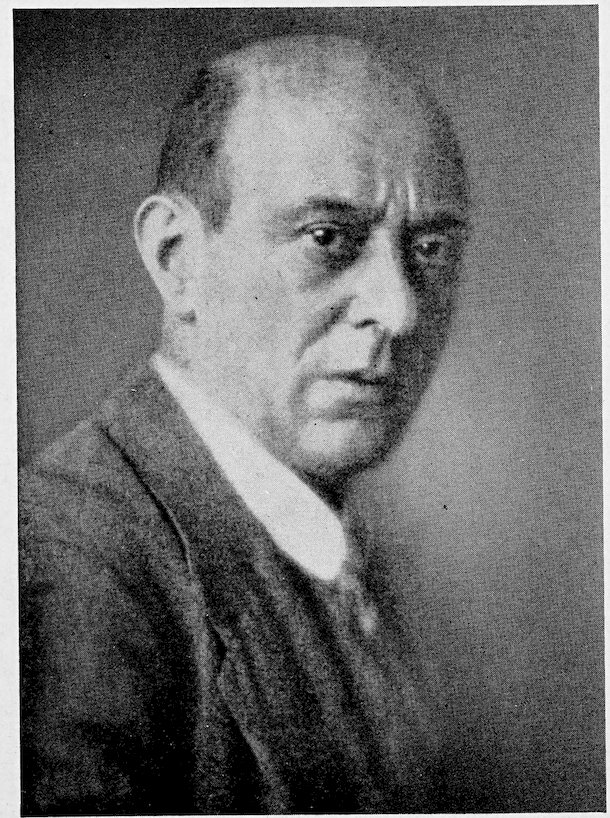
Courtesy of “Musical America.” Arnold Schoenberg (Austrian).
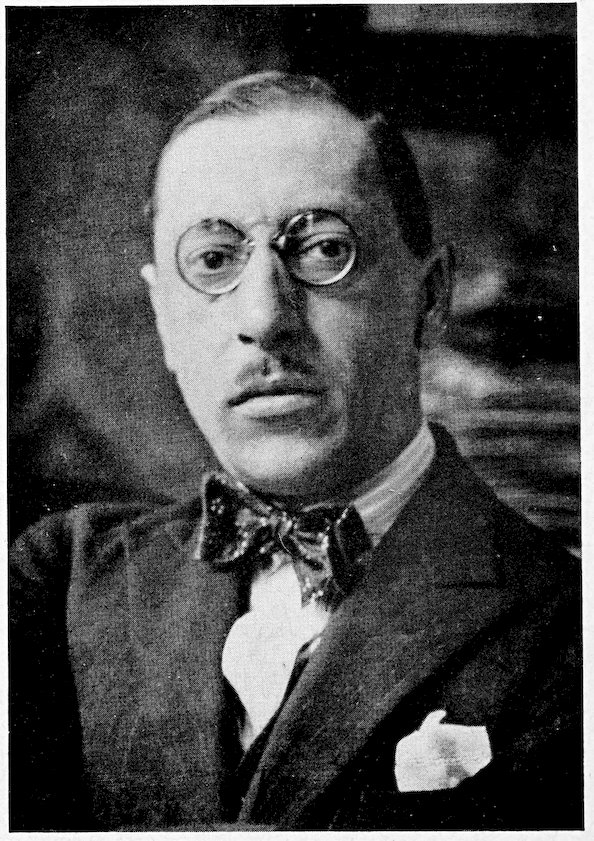
Igor Stravinsky (Russian).
Composers of Music in Extremely Modern Style.
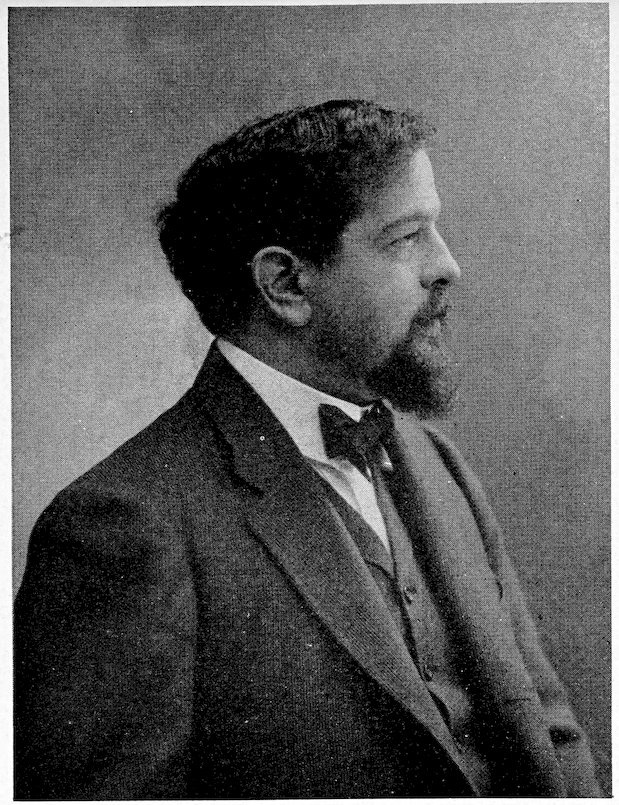
Claude Achille Debussy.
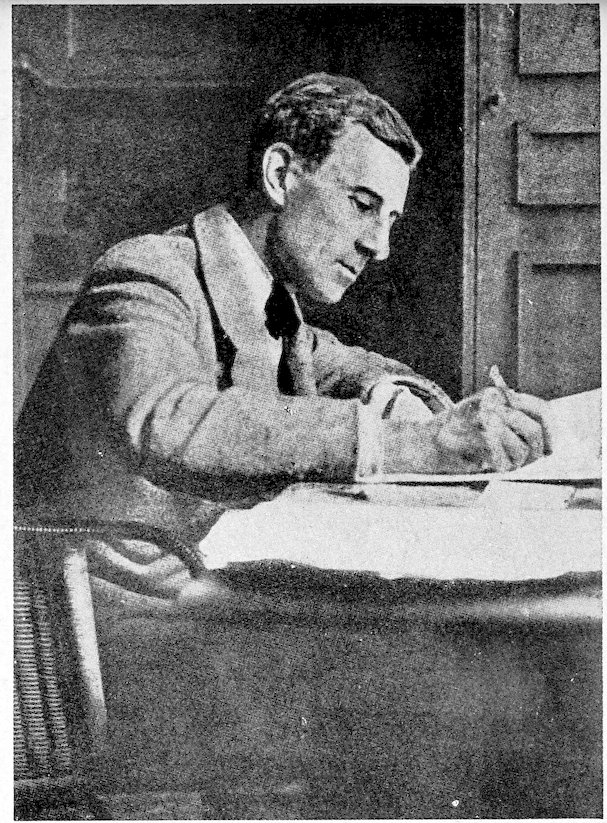
Courtesy of Roland Manuel. Maurice Ravel.
Leaders of the French Impressionistic School.
517Having said that tonality is a system in which all tones gravitate to a central tone (they all come home to roost!) it is not difficult to understand through the formation of the word poly—many, tonal—tones, that it means the use of several keys or tonalities at the same time, a counterpoint of key against key, or scale against scale, instead of note against note as it was in the Golden Age of Polyphony. Think of a cantus firmus in C major, and a counter melody in F♯ minor! (Between ourselves if skilfully handled, it has possibilities!) Ravel, Milhaud and Honegger know how to do it. Of course in the old system we change from key to key by means of a musical bridge called modulation, but in polytonality, the bridge is discarded, and the unrelated keys are heard piled on top of each other in layers.
Atonality, the system which Schoenberg and his followers use, is based on the chromatic scale of twelve half steps, on each one of which, chords (major and minor) may be built. This gives a more varied tonal paint-box than the old diatonic modes and the chromatic scale of former days, for it has now become an independent scale, and is not a part of the diatonic family.
Multi-and Poly-Rhythms
Rhythm also reflects this age of unrest, and there have been decided changes which seem to return to the Middle Ages to the period of bar-less music writing. Instead of finding a piece written throughout in ¾ metre or ⁴⁄₄, it will be multi-rhythmic or poly-rhythmic. Multi-rhythmic means many shiftings from one rhythm to another; poly-rhythmic means a counterpoint of different rhythms all played at the same time. The English composer, Cyril Scott, uses multi-rhythms (where almost every measure changes its metre), and the French Florent Schmitt uses poly-rhythms, 518(for example, triplets against eighth notes in common time in the right hand, and ⁶⁄₈ metre in the left).
In the 15th and 16th centuries every one wrote motets, masses and madrigals; in the 17th century every one wrote suites and from this time on, opera; in the 18th, sonata form; in the 19th, sonatas and short romantic pieces. In the 20th century, no one form is used more than another, but all forms are undergoing changes as the composers reach out for freedom. This is the day of the large orchestra and of the small chamber music groups; symphonies have been replaced by the shorter symphonic poem, the tendency being for short forms. The four-hour music drama has given way to the one-act operas, and the dance drama or ballet as the Russian Diaghilev introduced it, is a 20th century development. The orchestral writing has changed greatly from the methods of Berlioz, Wagner and Strauss, for while they were masters of large mass effects, the composers of today are treating each instrument individually, in other words, they are using orchestration, poly-instrumentally! In chamber music, we have the string quartet, but in addition, many experiments are being made in combining instruments of unrelated families, like strings, wind, brass and percussion, as we find in Stravinsky’s chamber music.
It is often said that modern music has no melody, but it would be more correct to say that it has new melody, resulting from the attempt to push aside old forms, old harmonies, old rhythms; now we have arrived at a new era of polyphony, abounding in dissonance, that often is cacophonous rather than harmonious. We call this period the Polyformic era.
Another Renaissance
The men who ushered in this Polyformic era were Claude Debussy in Paris, Arnold Schoenberg in Vienna, 519and Alexander Scriabin in Russia. Richard Strauss, then at his height, is a good example of the overlapping of two periods, for he represents the classical German school of the 19th century, and has also pointed the way to the future. Igor Stravinsky, although younger, is one of the strongest factors in this new Renaissance which in scope and power reminds us of the rebirth of learning in the Middle Ages.
Another cause for the breaking away from old forms and conditions was the World War, which cut off the composers from the usual sources of musical supply, and forced them to develop their own ideas. This led to new groups arising in all parts of the world, who, rebelling against restraint, put wild experiments in the place of time honored customs.
Claude Achille Debussy
Although Claude Achille Debussy (1862–1918) was almost forty when the 20th century came in, only in this century has his work been known and imitated. He was the direct outcome of a movement in France, after the Franco-Prussian War to develop French music along the lines started by Rameau and Couperin. This meant breaking away from the classic models of Beethoven and the dramatic music of Wagner. He exchanged the romantic style of Schumann and Chopin for a new impressionistic style.
Claude Debussy was born in St. Germain-en-Laye, near Paris. He attended the Paris Conservatory when he was eleven and studied with Marmontel, Lavignac and Guiraud. In 1884, with a cantata, L’Enfant Prodigue, he won the Prix de Rome which has started the career of so many French composers! During this, his first period, he wrote many lovely songs to poems by Verlaine and Baudelaire, 520the same impressionistic poets who inspired Charles Martin Loeffler in America; Suite Bergamasque, which includes the lovely Clair de Lune (Moonlight); the work which first brought him fame, L’Après-midi d’un Faune (Afternoon of a Faun); the beautiful string quartet; Chansons de Bilitis; Three Nocturnes for Orchestra, and the unique opera Pelleas and Melisande, which took him ten years to write! It was first given in the Paris Opéra Comique (1902).
In this opera, Debussy showed himself an innovator; it was a new kind of harmony and melody and never before had an opera like it been written. He gave an exact impression in music of Maeterlinck’s imaginative, mystic play. This is not a case where music drowns the meaning of the story but each word is colored and interpreted by the music. Debussy accomplished what the Camerata, Gluck and Wagner tried to do. By the time he wrote Pelleas and Melisande, his style was established and the proof of his high attainment is seen in his many imitators.
He worked very slowly and carefully and often destroyed what had taken him hours to write. Although an innovator, he was a deep student well grounded in the traditions of the past, a lover of Mozart and of the 18th century French writers, and when he seemingly broke all rules he gave something new in their place, not in the spirit of experiment but of sincere conviction.
He was surrounded by painters who like Claude Monet, Pissarro and Sisley did not paint actual things, but rather ideals of things; and by poets who like Verlaine, Gustave Kahn, Henri de Régnier, Pierre Louys and Stéphane Mallarmé did not write about things but rather the impression and images things gave them. He was absorbed and delighted by this non-photographic kind of art and translated into his music the veiled, mystic, idealistic, silver glimmering impressions that others put into paint and into words. This is Impressionism in art.
521Musically, Debussy was influenced by Wagner, although he fought against him, and by some of the French composers in whose day he began to write, like Chabrier and Chausson. From Moussorgsky and other Russians he learned much about old modes, color effects and free expression; and with Erik Satie he talked over many musical problems, no doubt gaining much from this curious musical caricaturist and humorist. No matter how extreme and absurd Debussy’s music might have sounded twenty-five years ago to the people, they must have felt the mystic beauty and rare poetic charm of his work.
Someone, as a joke, put a Butterick pattern on a playerpiano roll as a music record, and it sounded so ridiculous that a composer hearing it, said: “Ah, that must be a Debussy piece!” But, you see this was twenty-five years ago!
No matter how revolutionary his piano pieces may have sounded, today they have become almost classics! The combination of poetic imagination, romanticism and impressionism are seen in the titles: Reflets dans l’eau (Reflections in the Water), L’Isle joyeuse (Happy Island), La Cathédrale engloutie (The Engulfed Cathedral), Jardins sous la pluie (Gardens in the Rain).
For his daughter Claude, who died the year after her father, Debussy wrote six little piano pieces called the Children’s Corner. At the time he was writing them, little Claude used to drag the manuscripts around like a ragdoll, telling anyone she met, “These are my pieces, my father is writing them for me.” They were: Dr. Gradus ad Parnassum, Jimbo’s Lullaby, The Doll’s Serenade, The Snow Falls, The Little Shepherd and Golliwogg’s Cakewalk.
Among his later works are: Three symphonic sketches, La Mer (The Sea); the mystery play on a book by d’Annunzio, Le Martyre de St. Sebastien (The Martyrdom of St. Sebastian); a work for two pianos, Noir et Blanc (Black 522and White); a Sonata for Violoncello and Piano and twelve Studies for Piano.
In his Minstrels, Children’s Corner and General Lavine we find humor, a characteristic of 20th century music.
His music was vague and dreamy, and many composers were weakened rather than strengthened by trying to imitate him, for they had neither his genius nor his poetry. What he gave us was genuine, what others tried to copy was affected. His inventions such as the whole-tone scale and the pastel shades of music were so much a part of him that to use them today shows a lack of originality. But to those coming after him, who did not imitate him but worked out their own ways, he was a path-breaker of great value.
Maurice Ravel
Maurice Ravel (1875) has lived in or near Paris most of his life, although he was born in Ciboure, Basses-Pyrénées. He was a student at the Conservatory under Gabriel Fauré and André Gédalge. He did not receive the Prix de Rome, perhaps because in his early works he already showed tendencies, which must have seemed revolutionary to musicians who had not yet grown accustomed to the innovations of Debussy. Ravel developed his ideas at the same time and under the same influences as Debussy. You will often hear that Ravel imitated Debussy, but it is less an imitation than a development along the same lines. Ravel, too, is an impressionist, a poet, a lover of veiled mystic effects, suggesting images rather than reproducing them. He has a keen rhythmic sense, perhaps a heritage of his birthplace, so close to the Spanish border.
None of the 20th century composers understands the orchestra better than Ravel as may be seen in his ballet Daphnis and Chloe, Rhapsodie Espagnole, his delightful 523Mother Goose and La Valse. His short opera, L’heure espagnole is full of charming music and splendid workmanship; his quartet written in 1902–3 is one of the finest examples of 20th century chamber music. For piano he has added a rich contribution in the Sonatina, Pavane for a Dead Child, Valses nobles et sentimentales, Les Miroirs (Looking Glasses), Gaspard de la Nuit, Le Tombeau de Couperin (The Tomb of Couperin), and his songs are very beautiful, including Histoires Naturelles (Natural History) and the Greek and Hebrew folk songs.
Ravel’s latest work is a revelation of all his abilities, L’Enfant et les Sortilèges (The Child’s Sorceries), a ballet in early form with modern music. It is a fantasy tale about a little boy, who will not do his lessons and in a fury injures a squirrel; the chairs, grandfather’s clock, frogs, fairies, sprites, squirrels, arithmetic dwarfs from the book he has destroyed, and tea-pots rebel and talk “at him,” until he binds up the wound of the squirrel. Into this, Ravel puts humor and even sentiment; he makes some of the chairs dance a minuet, other characters, a fox trot, and includes many old and new dances. He shows his magic handling of the orchestra and with extreme cleverness he even has the chair and the shepherdess sing a song in canon form and at the end all join in singing a fugue of “heavenly beauty.”
A follower of Ravel is Maurice Delage, who has written some very interesting songs and an orchestral work in which he is modern enough to imitate the sounds of an iron foundry!
An enthusiastic follower and friend of Ravel, is Roland Manuel, critic, writer and composer. He has never written what is called ultra (very) modern music, but everything he does, songs, chamber music, operetta, or ballet is marked with good taste, refinement and fine musicianship.
Other Frenchmen who have added to the 20th century style are Paul Dukas (1865), whose opera based on Maeterlinck’s 524Ariane et Barbe Bleue (Ariadne and Blue Beard) is second only to Debussy’s Pelleas et Melisande; Vincent d’Indy (1851); Déodat de Sévérac (1873–1921), a writer of charming piano music whose impressionism reflects his love of Nature; Albert Roussel (1869), a pupil of the Schola Cantorum, whose Symphony and opera Padmavati show splendid talent; Florent Schmitt (1870) whose orchestral works and piano quintet are important; André Caplet (1880–1925), Charles Koechlin (1867), and Erik Satie (1869–1925).
Erik Satie—Cartoonist
Erik Satie is a riddle! Many are the heated discussions he has caused. His influence has been through what he has said, not what he has done. He was a caricaturist rather than a great composer, giving amusing titles to frivolous little pieces that show humor, in which one never knows whether he was laughing at or with the world. He loved short disconnected pieces and did much to make the young composer break away from long symphonic forms. He was a friend of Debussy, godfather to the Group of Six, and later to four “youngsters” who call themselves the “School of Arcueil” where Satie lived. His name should have been Satyr for with his pointed ears, eyebrows, and beard, he looked the part! Among his compositions are the ballets, Parades and Relache, and a dramatic aria with orchestra, Socrates.
The School of Arcueil, which has not yet proven its value is composed of Sauguet, Maxime Jacob, Desormières and Clicquet-Pleyel, who take pleasure in American jazz effects and have tried amusing experiments.
The Group of Six
The World War reacted directly and indirectly upon a group of composers in France. Daring and brutality are 525the keynote of almost all the works of the years from 1914 to the present day. Debussy and Ravel with their poetic imagery did not express the feelings of the younger men, so they were pitilessly brushed aside by Les Jeunes (The Young) who overthrew the accepted forms for their own experiments.
These young composers did not band together like the “Russian Five,” but a French critic called them “The Six,” and the name stuck! They were not united by oneness of purpose or by ideal, they just happened to be friends and their music was often presented on the same programs and Erik Satie “who had been throughout thirty-five years the instigator of all audacity, the manager of all impudence” was their confidential adviser. The six are Germaine Tailleferre who played her piano concerto in America (1925) and has written two charming ballets; Louis Durey (1888); Georges Auric (1899), and François Poulenc (1899), both of whom have written ballets; Darius Milhaud (1892) and Arthur Honegger (1892).
Of these, Milhaud and Honegger are by far the most important. Milhaud has written ballets, chamber music and orchestral works with great fluency, often showing fine gifts and flashes of beauty. Born into this age of storm and stress, Milhaud has written brutally, but he is at heart a romantic composer and will probably change as we get further away from the war.
Honegger has had a sensational success with a work in oratorio form, Le Roi David (King David), and with a tone poem, Pacific—231, which is a type of locomotive. Honegger has broken from the Group, and has gone his own independent way, writing beautiful songs, orchestral and chamber music, and giving promise of being one of the most important composers of the period.
There are many other young French composers showing the different tendencies of the day, some are writing in 526classic form, some in romantic, but all are very independent. Some have wiped out the past and are trying to build anew, not realizing that they are building on sand, for there can be no skyscraper without a foundation deep enough to carry it!
Alexander Scriabin
Alexander Nicolai Scriabin (1871–1915) was born in Moscow, Russia, and was sent to a military school; instead of becoming an army officer, he turned to music, and was a pupil of Safonov, for several years conductor of the New York Philharmonic Orchestra, and of Taneiev. His early works show the influence of Chopin and Arensky, but he soon developed a style of his own, that has made him one of the important composers of the beginning of the 20th century. An English writer, Eaglefield Hull, thinks that “the sonatas of Scriabin are destined in the future to occupy a niche of their own, together with the forty-eight Preludes of Bach, the thirty-two Sonatas of Beethoven, and the piano works of Chopin.” To explain in a few words the innovations of Scriabin would be impossible, but he broke away from fixed scales and tonality, and opened new roads to composers following. He used neither polytonality nor atonality, although his methods border on the latter. He built new chords, not major and minor as we know them, but in intervals of fourths. Here is a typical Scriabin chord which he used as we use a major triad (c-e-g) as the center around which to build a composition:
[Audio content is not currently supported on your device. [MusicXML]
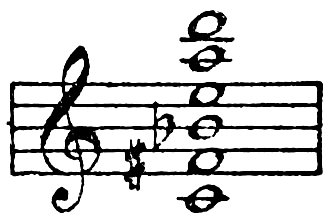
Won’t you be surprised to hear that Scriabin went back to Pythagoras and his theory of harmonics or overtones to 527get this chord? He called these combinations “mystic chords” for he was a student of Theosophy, and wanted to use music as a means to express occult ideas. With this in mind, he wrote a tone-poem, Prometheus, which, according to Scriabin’s directions, Modest Altschuler played in New York with a color organ throwing colors on a screen while the orchestra was playing the music. Two other of his large works for orchestra Le Divin Poème and Le Poème de L’Extase show his extraordinary harmonic originality.
Besides the ten sonatas in very free form, he wrote hundreds of shorter piano pieces, disclosing his deep poetic, mystic nature. Composers have imitated him, but his music is so tagged with Scriabin’s individuality that, like the whole-tone scale of Debussy, imitation is easily detected.
L’Enfant Terrible of Modern Music—Stravinsky
Igor Stravinsky (1882) has influenced more young musicians than any other living composer! He intended to become a lawyer, but instead studied composition with Rimsky-Korsakov, and his early works reflect his teacher. We never know how meeting someone may change our course in life, and Stravinsky’s meeting with Serge Diaghilev changed his!
Diaghilev, director of the Russian Ballet, recognized a gift in the young Stravinsky, who was busy writing an opera from a fairy tale of Hans Christian Andersen, The Nightingale. He commissioned him to write a ballet on a fairy tale, L’Oiseau de Feu (The Fire Bird) which was produced in Paris (1910) and brought Stravinsky instant fame. The next year this was followed by the delightful Petrouchka. His most famous score Le Sacre du Printemps (Rites of Spring) was produced in Paris in 1913, causing a near-riot, as it was received with hissing and catcalls by 528a public unprepared for its brutality, its savage rhythm, and raucous dissonance.
In this work Stravinsky went back to primitive times when Russia was pagan, and he explains, “Thus we see Russian peasants dancing in the springtime, accompanying the rhythms by their gestures and their feet.” An English critic Edwin Evans, sees behind the pagan rite, “The marvelous power ... in all Nature to grow, to develop, and to assume new forms.” (We have watched this happen in music.)
After Le Sacre du Printemps, Stravinsky wrote Les Noces a ballet founded on pagan Russian marriage customs. In this work he has used a chorus of voices and four pianos in place of an orchestra. He finished the opera The Nightingale and in 1917 wrote an orchestral poem based on the themes from the opera.
In the short ballet L’Histoire du Soldat (Story of the Soldier), Stravinsky has used popular music of the fair, circus, music hall, not folk music, and we find our jazz and tango in it, as also in his Piano Rag Music and Ragtime for orchestra. His songs composed for the most part to nonsense verses, are among the cleverest things he has done.
Stravinsky wrote a group of string quartet pieces in which he made the violins sound like bells. This was not because he tried to imitate bells but on the strings he uses the harmonics or overtones that are heard in bells. This is one of the secrets of his unusual harmonies.
Overtones
We hear so much about overtones and harmonics that perhaps we can trace for you the growth of music along the path of Pythagoras’ theory, showing how we arrived at this era of dissonance.
529
Harmonic Series
[Audio content is not currently supported on your device. [MusicXML]

First men and women singing in unison produced music in octaves, 1 and 2 of the harmonic series. Next came the centuries of organum when the parts were sung in fifths and fourths, 2, 3, and 4 of the harmonic series. Then followed the centuries of the major triad (c-e-g), 4, 5, and 6 of the harmonic series. When the 7th overtone in the harmonic series appeared, we had the very important dominant 7th chord (c-e-g-b♭), looked upon as outrageous heresy and dissonance! It was years, even centuries, before it was admitted as a respectable member of the family! The 9th harmonic forming the dominant 9th chord (c-e-g-b♭-d) had the same hard row to hoe, and is one of our modern chords. César Franck shocked the musicians by opening his famous violin sonata with this chord! We can trace the whole-tone scale of Debussy to the 7th, 8th, 9th, 10th, and 11th overtones of the series, (b♭-c-d-e-f#). Scriabin’s “mystic chord” is formed from the 8th, 11th, 7th, 10th, 14th, and 9th overtones (c-f#–b♭-e-a-d). It is a short step now to polytonality and atonality, to Stravinsky, Schoenberg, Milhaud, and Honegger.
You have seen the white ray of sunlight enter your window, which upon a second glimpse divides into all the colors of the rainbow. In other words, the white light is the fundamental tone, which is the sum of all the other colors, much as any single tone is the sum of its overtones, and it is with these overtones that our modern composers are experimenting. Here we see that modern music is the result of evolution (slow growth) and not revolution!
530
Heart Music Disappears
Stravinsky, l’enfant terrible in music, the most daring composer of a most daring period has thrown over all restraint! His music has no heart quality, and so strongly is he influencing the younger men, that “heart music” has gone out of style, a brusque, ugly music taking its place, because the composers are afraid that to show sentiment would be weakness! However, the high class music of today is trying to express humor, activity and vigor, for which reason our jazz appeals to Europeans. The War made Stravinsky the “man of the hour” in music. He is the direct opposite of the refined, beauty-worshipping Debussy and mystic Scriabin. The composers upset by the devastating war, needed strong food, and they hungrily pounced upon the morsels flung to them by Stravinsky, the ring-leader.
But withal, “the worm will turn” and already, those with ears to hear, realize a change in the air, and they foretell a new classic period made out of this hurly-burly of many forms, touched by the fairy wand, “Things-that-Live”! And Stravinsky himself has turned.
After Stravinsky had written several ballets for his countryman, Diaghilev, he turned his attention to chamber music, and wrote works for small groups of wind instruments and a string quartet, Concertino, and a concerto for piano and wind instruments, in which he tried all sorts of experiments. He believes in absolute music, and has written these without program, making the music express what he has to say. Whether he has succeeded, must be laid before Judge Time. He is supreme master of orchestration, and is largely responsible for treating each instrument as though it were playing a solo, which we described as poly-instrumentation. We should not have enjoyed Stravinsky as a neighbor, for he begged, borrowed or 531bought every kind of instrument and learned all their tricks by trying them out himself.
We know very little of what is going on in Russia today, but Serge Prokofiev, one of the younger Russian composers, has left his home and lives in Paris where his works are often given. He has written piano concertos, violin concertos, and the best we have heard from his pen is a chorus with orchestral accompaniment, Sept, ils sont Sept (Seven, they are seven). He has also written ballets and operas.
A fellow-student with Serge Prokofiev in the Petrograd conservatory was Nicolai Miaskovsky, now living in Moscow where he heads the musical movement. His principal works are symphonies, one of which was played in Paris by a countryman, Lazare Saminsky, in June, 1925.
Another young composer whose piano sonatas have come out of Russia is Samuel Feinberg. They are somewhat in the style of Scriabin.
The two Tcherepnins, father and son, are living in Paris. The son, Alexander, has written chamber music in 20th century style.
Poland
In modern Poland, Karol Szymanowski (1883) has written symphonies, chamber music, songs, piano sonatas and many other piano pieces which reflect Polish national color and French impressionism (See Page 520).
Lady Dean Paul, who writes under the name of Poldowski, although living in London, is really a Pole. (Page 439.)
Tadeusz Iarecki, of New York City, recently received a prize in Poland for writing the best composition by a native composer. This same quartet took the first Berkshire Chamber Music Prize (1918) and was published in New York by a society whose object is the publication of American Chamber Music.
532Alexander Tansman (1892) a young Pole has met with unusual success in Paris, where he writes works for orchestra, chamber music and ballet.
Arnold Schoenberg, Musical Anarchist
Arnold Schoenberg, born in Vienna (1874), taught himself until he was twenty. He then studied with Alexander von Zemlinsky, who later became his brother-in-law. Zemlinsky once pointed him out saying, “He is in his early twenties and I have taught him all I know; he brought me an orchestral work recently for which he had to paste two pieces of score paper together to write out his score, so large an orchestra had he employed!” This was his tone poem, Pelleas and Melisande, first performed in 1904. To this early period belong some songs, a song cycle with orchestra on texts by Jens Peter Jacobsen, Gurrelieder, and the sextet, Verklärte Nacht (Illumined Night).
Both Richard Strauss and Gustav Mahler were his friends, and through Mahler’s efforts many of his compositions were performed. His string quartet was played in America by the Flonzaley Quartet. His Chamber Symphony, and his second string quartet, with solo voice, performed (1924) at the Berkshire Chamber Music Festival, belong to this same period.
So far, all that Schoenberg composed was based more or less on models of the past, but being naturally an anarchist in music he tried to escape from doing what others had done. Instead of writing works that took fifty minutes to play like his string quartet (in one movement), he wrote five orchestral pieces and piano pieces that were mere suggestions of compositions, so short were they. He cut out all development of themes, all old forms, all feeling for tonality, writing in the twelve-tone scale which we explained as atonality; he built his chords in intervals 533of fourths instead of thirds, and purposely changed all the rules of harmony; he distorted all the intervals, using a seventh or ninth instead of the octave, and making every fourth and fifth a half step larger or smaller than was customary. His melodies are marked by large skips and queer intervals, but when one once knows his language, by its very queerness, it is easily recognized as Schoenberg’s. Although he has broken away from the slavery of old traditions, he may have “jumped out of the frying-pan into the fire”!
In Pierrot Lunaire, a cycle of twenty-one songs with chamber music accompaniment, he uses a curious effect for the voice “which must be neither sung nor spoken.” This same effect he uses in chorus in his music drama, Die Glückliche Hand (The Lucky Hand) for which he also wrote the libretto. Although this and another music drama Erwartung (The Awaiting) were begun in 1909, they were both performed for the first time in 1924 in Vienna. This long delay was due to the prejudice against the work of this innovator, who on the one hand has been laughed at, scorned, and reviled, and on the other praised to the skies by a small group of disciples and imitators whose works sound very much like their teacher’s.
Among these pupils are Egon Wellesz (1885) who more than the other disciples has broken away from the master. He has gone his way in writing music for the stage and combining the old ideas of ballet and orchestral music with Greek drama in a modern dance drama. He has also written interesting chamber and orchestral music. Dr. Wellesz is also an authority on musical history; he has written many books and articles on the subject, especially on early opera, Byzantine and Oriental music. He has written a book on Schoenberg (1921).
Alban Berg (1885), also a Schoenberg pupil, has written unusually fine chamber music and a new opera, Wozzek, fragments 534of which were played at a festival in Prague (Czecho-Slovakia) in May, 1925, by the International Society of Contemporary Music, a movement most valuable in encouraging and developing modern music. This society holds yearly meetings in Europe, at which are heard the works of all the young composers of the world, each country having a branch, which sends its share of new works to make the festival’s programs.
Others of the Schoenberg group are Anton von Webern (1883), Paul Pisk, Karl Horovitz (1884–1925), Ernest Krenek, and Ernest Toch (1887).
Erich Korngold
Erich Wolfgang Korngold (1898) startled the musical world, just before the War, by the astonishing compositions he wrote as a little boy. Among these were orchestral works and a piano sonata of extraordinary promise. He was born in Vienna and is the son of a musician and musical critic. Young Korngold is known in America as the composer of Die Todte Stadt (The Dead City) an opera in which the soprano, Maria Jeritza, made her first appearance at the Metropolitan Opera House. In many ways the opera goes back to the old pre-Wagner form and is full of melody, unusual in a young 20th century composer! He has written other operas bordering on the lighter Viennese operetta and has kept away from the Schoenberg influence.
Modern German Music
Richard Strauss was the last of the great classic school of German composers, which for two hundred years had led the world in music. Curious as it seems, he has not influenced directly the younger composers, who turned to Debussy, Busoni, Schoenberg and Stravinsky. (Page 410.)
535
Busoni the Great
Ferruccio Busoni (1866–1924) although an Italian, had a strong influence in two fields of German music, that of piano playing and composing. He lived in Berlin and was one of the brilliant thinkers and musicians of the period. He left chamber music and orchestral works, also several operas, one of which, The Harlequin, finished just before his untimely death, combines traditional form with radical ideas. His sonatinas for piano and a set of studies on American Indian Themes are important. He made a deep study of all methods, old and new, and gave his pupils the advantage of this wide experience.
Although the young Germans are not copying the huge symphonic form of Bruckner and Mahler, these two have gained greatly in popularity and are serving as models. Hans Pfitzner (1869), opera composer, is one of the most German of the living composers of the pre-war period; Franz Schreker (1878), an Austrian, living in Berlin, has taught many of the younger composers. He writes operas and songs. Schoenberg, although in Vienna, is felt even in Berlin.
Hindemith
Of the young Germans, Paul Hindemith is the most important. He was born in 1895 and according to Riemann, “is the freshest and most full-blooded talent among the younger German composers.” He seems to satisfy the two factions, for he is not too radical for the Old or too old-fashioned for the New, so as Lawrence Gilman says, “he carries water on both shoulders.... He seems to be able to write polytonally or atonally if he chooses, and also to write as the Academics might observe, like a gentleman. Richard Strauss is reported to have said to him: ‘Why do you write atonally when you have talent?’”
536Today he is viola player in the Amar Quartet, but he has played in cafés, in the “movies,” dance halls, operetta theatres, and jazz bands! Although only thirty, he has many chamber music pieces to his credit and three dramatic works. His success has been tremendous.
A society to further an interest in the new music was founded by Hermann Scherchen and Eduard Erdmann. Scherchen created a sensation in Berlin just before the war by conducting Schoenberg’s Pierrot Lunaire, and after having been a prisoner of war in Russia he came back with renewed purpose of bringing the new music to the public. He has published a few songs and a string quartet. His right-hand man Erdmann, besides being a pianist, has written a symphony, the first attempt of a youth without orchestral experience, which astonished the audience as a combination of Richard Strauss, Schoenberg, “to which is added a portion of genuine Erdmann flavor,” says Hugo Leichtentritt.
Another young German is Heinz Tiessen (1887), who is writing besides piano music in atonality, incidental music to a drama by Hauptman, and songs.
Philipp Jarnach (1892), a pupil of Busoni, Spanish by birth, educated in Paris, lives in Berlin and writes in the new style. Kurt Weill (1900) is also a gifted Busoni-ite.
Ernst Toch (1887), Viennese by birth, who lives in Germany has written string quartets, sonatas, concertos, and a symphony.
Heinrich Kaminsky is accepted in Germany as the composer who is trying to build a bridge from Bach to modern times. His Concerto Grosso for double orchestra commands great respect.
Hungary—Bartók and Kodály
Béla Bartók (1881) and his friend Soltan Kodály (1882) have done much to bring Hungarian folk music into the 537modern world, for they are steeped in folk tunes, which they use with skill and imagination. Bartók has written a short opera, two ballets, orchestral works, string quartets, violin sonata, and many piano compositions. His children’s pieces are delightful, based as they are on Hungarian folk tunes.
We have spoken at length of the gypsy music of the Hungarians brought to us by Brahms, Liszt and Sarasate (violinist and composer). We also told you that the Hungarians were Magyars. Adjoran Otvos, in the League of Composers Review says: “Bartók and Kodály have accomplished a pioneer work of quite a different nature, an exploration into the folk music of Hungary which has yielded a collection of historic significance, the most important and only authentic one made in that country.
“Bartók, poor and supported only by a scholarship, started in 1905, an investigation of the music of his race. Spending a week with a friend in the country, he heard a servant, while at work, singing a tune quite different from the hybrid (mixed breed) gypsy airs which pass for Magyar music, in Hungary and elsewhere. He contrived to conceal himself and day after day, while the servant worked, recorded a number of songs whose primitive character, he at once recognized. With this impetus, he embarked on a tour which lasted over two years, as long as his money held out. On his journeys among the peasants he met Kodály, out on a similar mission of research. Without previous inkling of each other’s aims, they proceeded together, recording the ancient songs of the Magyars in the compilation which is famous today.”
Ernest von Dohnányi
Ernest von Dohnányi (1877) a noted pianist and composer of Hungary has spent most of his life in Berlin and 538has toured Europe and America in piano recitals. He has written many works for orchestra, chamber music, piano and opera, all of which show more influence of Brahms than of men of his own land. He has been engaged as conductor of the State Symphony Orchestra of New York for the season 1925–26.
A twenty-eight year old pupil of Béla Bartók, Georg Kosa, shows decided gifts in his first orchestral work, Six Pieces for Orchestra.
Czech School
The Czech school founded by Smetana and Dvorak and Zdenko Fibich (1850–1900) and continued by Vitezslav Novak (1870), Josef Suk (1874), and Vaclar Stepan (1889), has had a rebirth in the 20th century. Leos Janacek, although over seventy, is the leading spirit; Rudolf Karel (1881), a pupil of Dvorak, Bohuslav Martinu, a follower of Stravinsky, and Ernest Krenek (1902), a pupil of Schreker, and Alois Haba (1893), pupil of Novak and Schreker are the working forces. (Janacek died in 1928.)
The Quarter-Tone Man
Alois Haba first wrote chamber music, then he tried some interesting experiments for which he is known as the “quarter-tone man.” We have heard of quarter-tones among the Hindus and Arabs (Chapter VI) and as the human ear has become more educated, the possibility of dividing the scale into quarter-tones is much discussed, and seems to be the next step in developing music along the line of overtones (see above). Did you ever realize that as with eyes that are far-sighted or near-sighted, ears may vary too, in the amount they hear? Most people think that every one hears alike, but this is not so. Stravinsky was one day sitting with a friend on the shore of a Swiss Lake near which he lived. The friend said the water was calm and still, but Stravinsky heard, a definite musical sound! Many of these musical sounds unheard by our ears he has shown us in his music. In the same way it is said that Haba has an extraordinarily keen ear and in trying to express what he hears, he has written two string quartets in the quarter-tone system. Stringed instruments are not in tempered scales and lend themselves to any division of the interval, into third-tones, as Busoni tried, and quarter-tones as Haba has written. But he has gone further and has made a piano on which quarter-tones may be played. This may prove to be the basis of music of the future, or it may be merely one of the numerous experiments without lasting value.
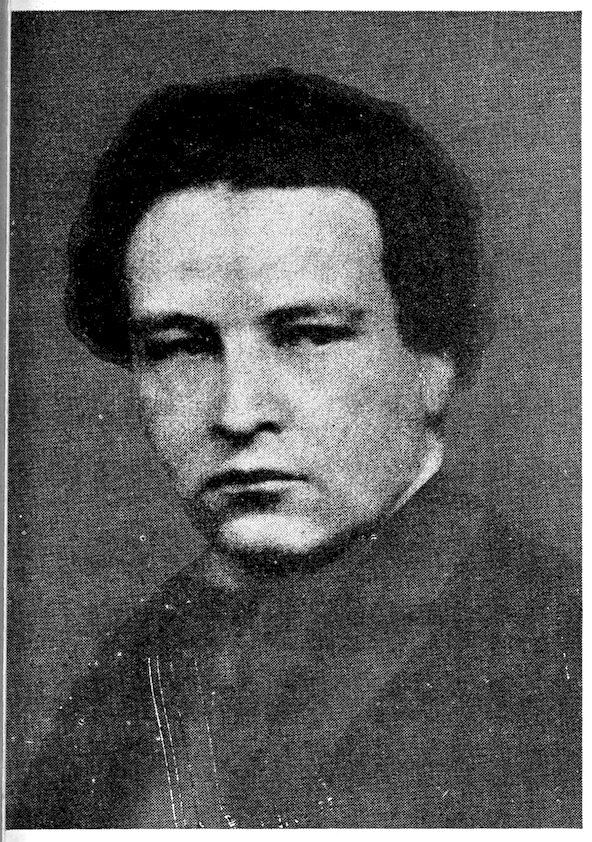
Arthur Honegger. (Swiss-French)
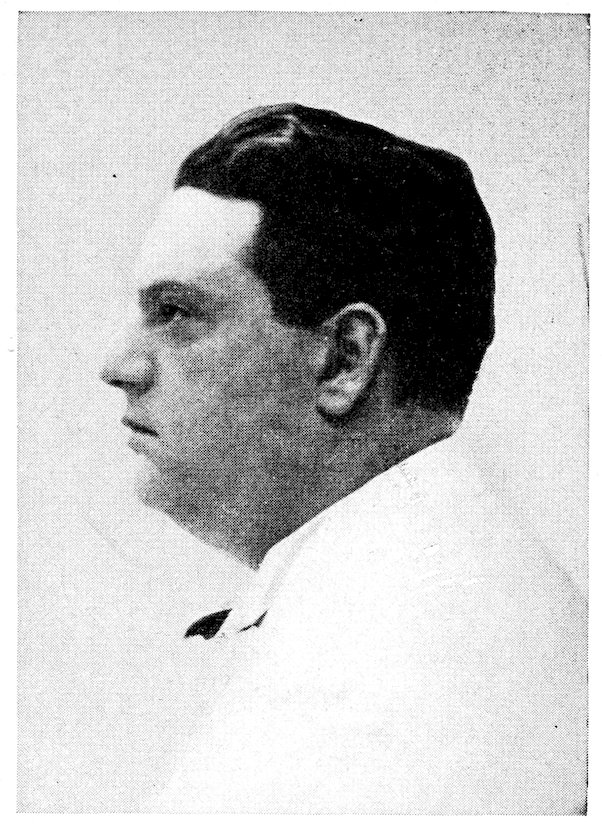
Darius Milhaud. (French)
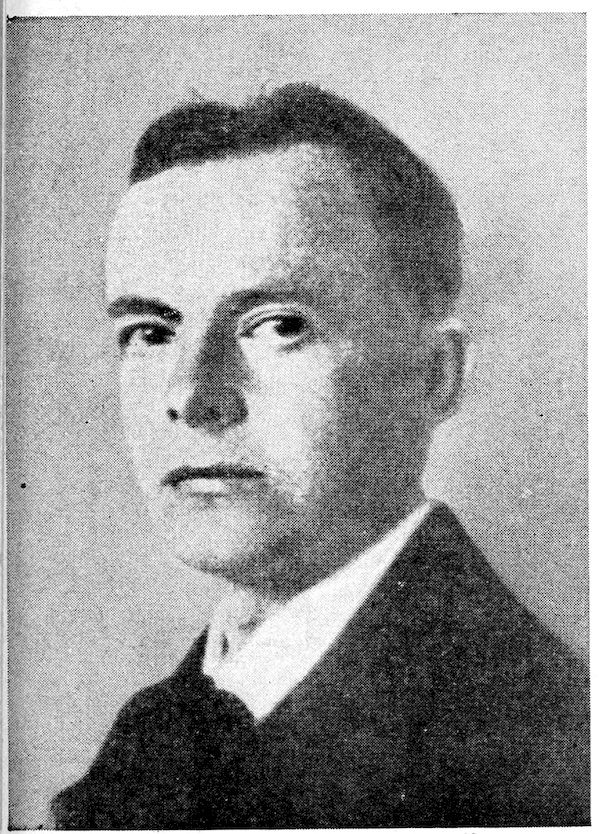
Courtesy of “The Musical Quarterly.” Béla Bartók. (Hungarian)
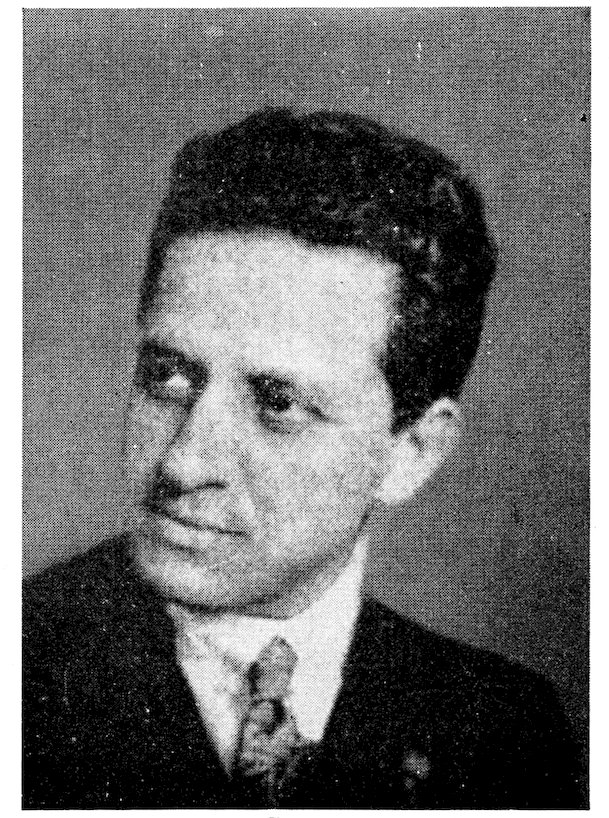
Photograph, Victor Georg. Louis Gruenberg. (American)
Composers of Today.
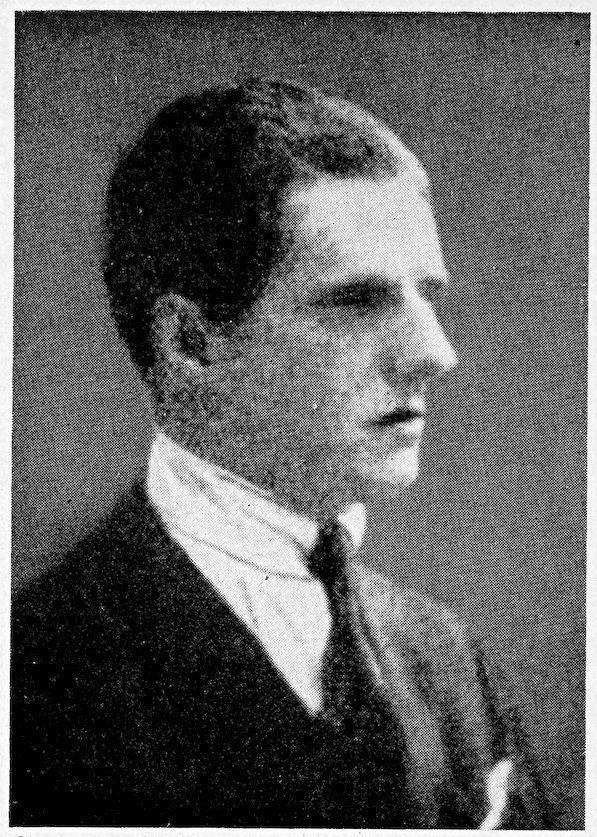
Courtesy of “The Musical Digest.” G. Francesco Malipiero. (Italian)
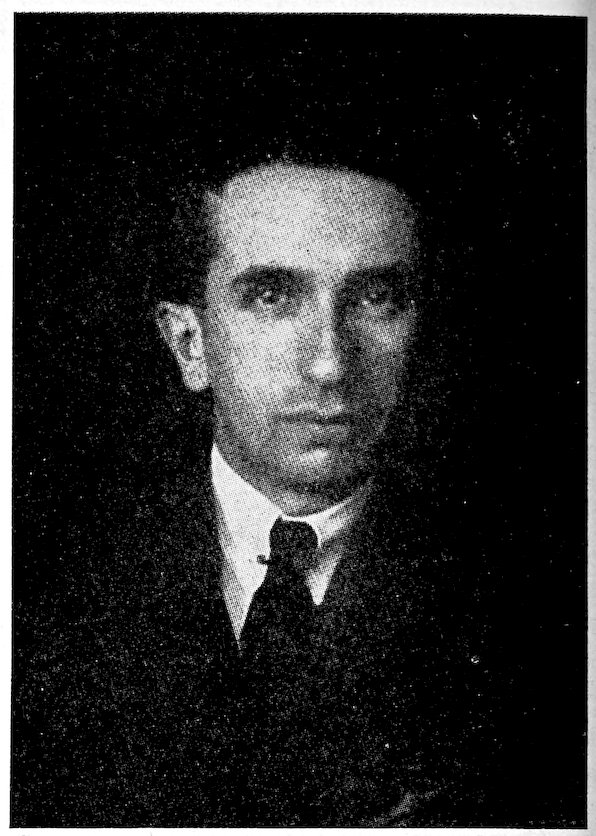
Courtesy of “The Musical Quarterly.” Alfredo Casella. (Italian)
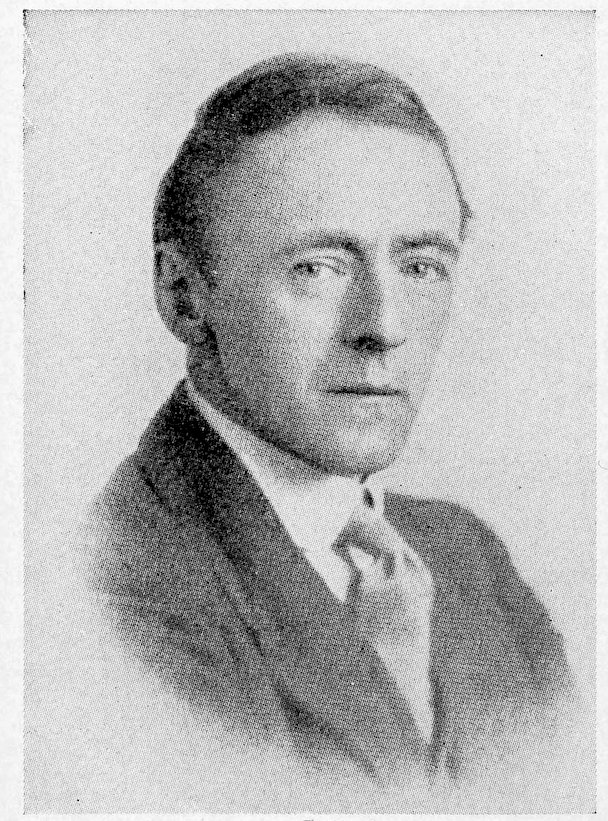
Photograph, Mendoza Galleries. Arnold Bax. (English)
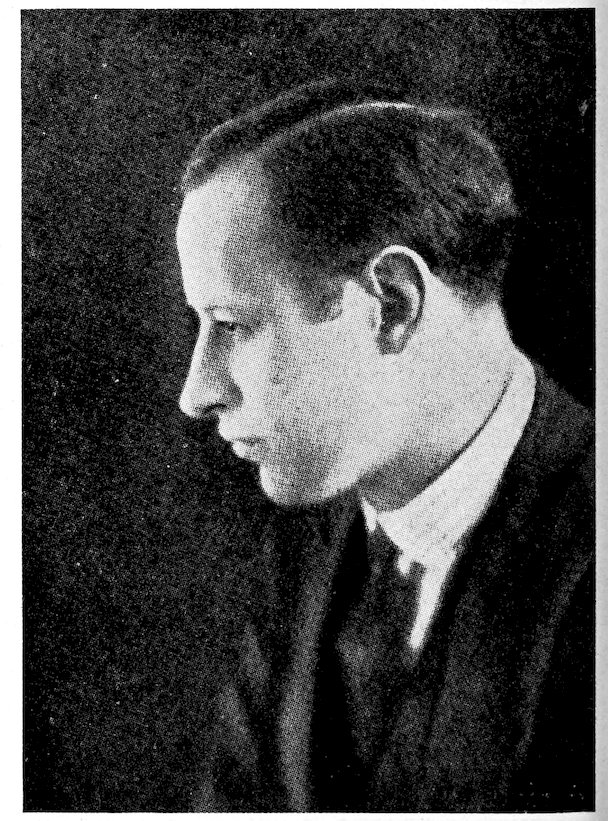
Photograph, Bertam Pach. Eugene Goossens. (English)
Composers of Today.
539
Italy and the New Order
For many centuries Italy has been known as producing the opera of the world. Of late years opera has not been considered the highest form of musical art, so with the coming of the 20th century, a group of composers has been working in Italy, trying to get away from the old opera writing and to develop along the line of orchestral and chamber music.
Alfredo Casella (1883) is perhaps responsible for this movement for he lived in Paris for many years and came in contact with Debussy’s music and the modern movement there. One of his earliest works to attract attention in America was War Films, a series of orchestral pictures that were very real. He has written piano pieces, chamber music and orchestral works and one of his latest is a ballet, in which it looks as though he were leaving his path of dissonance for in this he has used folk song as a basis for a new and delightful expression.
G. Francesco Malipiero (1882) has written two string 540quartets, one of which received the Coolidge Prize of the Berkshire Chamber Music Festival; in these he has broken away from the large sonata form. He has also written lovely songs.
Ildebrando Pizzetti (1880) has written two operas on texts by Gabrielle d’Annunzio called La Nave (The Ship) and Fedra. His most recent work, Fra Ghirardo was performed at the Metropolitan in 1929.
Ottorino Respighi (1879) wrote operas in true Italian fashion, but deserted them for chamber music and orchestral works. Pines of Rome and Fountains of Rome, we hear often. His Violin Concerto in Gregorian Mode was played by Albert Spalding. His latest opera, La Campana Sommersa (The Sunken Bell) was given at the Metropolitan in 1928.
All these men show the traces of the Italian love of melody, with the influence of French impressionism, and German romanticism.
Two or three of these modern Italians now live in Paris, among them Santoliquido and Vincenzo Davico, both song writers.
And now Noah’s Ark has been put to music by a young Italian, Vittorio Rieti with wit and humor, in a work for orchestra, played in May, 1925, at the Prague Festival.
Manuel de Falla
In Spain, one man who has continued along the lines of Albeniz and Granados is Manuel de Falla (1876). He studied first with Felipe Pedrell, the father of the modern Spanish school. In 1907 he went to Paris where he met Debussy and Dukas. He wrote a ballet El Amor Brujo (Love, the Magician). He combines a picturesque Spanish folk style with a modern way of writing music. One of his most attractive works is a scenic arrangement from 541a chapter in Don Quixote, Cervantes’ masterpiece, as Spanish as a Spanish fandango. It is a marionette ballet called El Retablo de Maese Pedro (Master Pedro’s Puppet Show). It is a charming work and you will like it. His writings have simplicity, and freshness, which can come only from deep study and so perfect a mastery of art that there is no self-consciousness. He is a true nationalist delighting in Spanish color; his music has nobility and humanness as well as charm.
The Netherlands
Clarence G. Hamilton says in his Outlines of Music History that Netherland composers are patriotically laboring for a distinctive school. Few names are known outside of Holland, with the exception of Alphonse Diepenbroek (1862–1921), Dirk Schaefer (1874), Sem Dresden (1881), James Zwart (1892), Julius Roentgen (1855), who has collected many of the Dutch folk songs, and Dopper, conductor and composer for orchestra.
In Belgium, Jan Blockx (1851–1912) wrote successful operas and chamber music; Paul Gilson (1865) has written orchestral and chamber music works which have won him a foremost place among modern Flemish composers; both César Franck and Guillaume Lekeu were Flemish (Belgian); Joseph Jongen, while not writing in the very modern style, is well known for his symphonic poems, chamber music, a ballet S’Arka (produced at the Théâtre de la Monnaie, Brussels), songs, piano pieces and organ works.
Switzerland
Jaques Dalcroze (1865) is better known as the inventor of Eurythmics, a system of music study from the standpoint 542of rhythm, than as composer, but he has written many charming songs in folk style. Gustave Doret (1866), has written several operas, cantatas, oratorios which have been performed in his native land and in Paris. Hans Huber (1852) has a long list of compositions in all forms. Ernest Bloch, though born in Switzerland is living in America and is by far the greatest innovator of these Swiss writers. Emile Blanchet, is a writer of piano music, rather more poetic than of the very modern style. Arthur Honegger, the foremost young composer of France, though born in Havre, is often claimed as a Swiss composer, because his parents are Swiss. Rudolph Ganz, pianist, composer and conductor in America was born in Switzerland.
England
When we come to Frederick Delius (1863) we meet first with a new feeling in English music. He has written orchestral pieces (Brigg Fair, concertos, On Hearing the First Cuckoo in Spring), chorals (Appalachia, The Song of the High Hills and others), chamber music and songs. He was the first Englishman to write in the impressionistic way. His opera The Village Romeo and Juliet is very modern in form, and the music interprets the story and is not built like the Italian operas.
Delius is of Dutch-French-German stock, but was born in England, and has lived there and in France. He never tried for music posts or prizes but has remained apart to compose. Though his work often sounds like the 18th century virginal music, he is not conscious of it.
He has, in his chorals, done some of the best work since Beethoven, says one biographer, and in them are strength, power and beauty, quite different indeed from the sensuous and sweet smaller works. He is a careful worker, a great idealist, and a truly great musician.
543There are many well-trained musicians like Holbrooke and Hurlstone who have done much for music in England but this chapter belongs to those who are carrying on 20th century ideas.
Among them is Vaughan Williams (1872) to whom folk music is as bread to others. He uses it whenever he can. In his London Symphony, his most famous work, he has caught the spirit of the city and it is a milestone of the early 20th century. Isn’t it curious that the most important work written on the poetry of our American Walt Whitman is by an Englishman! This is the Sea Symphony for orchestra and chorus, an impressive work by Vaughan Williams. He has also written Five Mystical Songs, Willow Wood (cantata), On Wenlock Edge (six songs), Norfolk Rhapsodies, In the Fen Country.
Granville Bantock (1868) is a musical liberator for he was the first to free English composers from the old style of Mendelssohn and the new kind of classicism of Brahms, and release them to write as they felt. He wrote music on the Rubaiyat of Omar Khayyam (Persian), Sappho, Pierrot of the Minute, Fifine at the Fair, Hebredean (Scotch) Symphony, which shows his love of Scotch music, and many other works. He succeeded Elgar at Birmingham University and has made valuable studies and collections of Folk Music.
A lover of chamber music, the fantasy and fancy, is Frank Bridge (1879). He is a thorough musician and has written The Sea, the Dance Rhapsodies for orchestra, symphonic poem Isabella on Keats’ poem of the same name. Three Idylls for Strings and other works.
Gustave Holst (1874) whose original name was von Holst although he is not of German descent, was a pupil of Sir Charles V. Stanford and is now an inspiring teacher and conductor. He has had many posts and has written many important works: an opera, The Perfect Fool, the 544Hymn to Jesus, one of the finest choral works of the century, The Planets, a very fine orchestral work, military band music, songs and part songs, some of which are written with violin accompaniment,—a charming idea!
John Ireland (1879), has written a fine piano sonata and a violin sonata, Decorations (a collection of small pieces), Chelsea Reach, Ragamuffin and Soho Forenoons, chamber music and orchestral pieces.
Cyril Scott (1879) was trained in Germany. He is a mixture of French impressionistic writing and Oriental mysticism, as you can see from the titles of his pieces: Lotus Land (Lotus is an Egyptian flower), The Garden of Soul Sympathy, and Riki Tiki Tavi, a setting of Kipling’s little chap of the Jungle Book, which is very delightful. He is one of the first English Impressionists who paved the way for the young English School. He has made many interesting experiments in modern harmony and rhythm.
Arnold Bax (1883), of Irish parentage, is a gifted and poetic composer who has written many things in small and large forms, chamber music and piano sonatas, The Garden of Fand for orchestra, Fatherland, a chorus with orchestra and other things, all of which show him to have a creative imagination and rich musical personality.
Lord Berners (1883) (Gerald Hugh Tyrwhitt-Wilson), a lover of the works of Stravinsky and Casella of the modern Russian and Italian Schools, was trained in an old-fashioned way, and then Stravinsky and Casella, seeing in his music possibilities for freer writing, encouraged him to break away from old ways, and he became one of the most modern of the young English composers. He writes interestingly in caricature and sarcasm, in fact he is a musical cartoonist in such pieces as the Funeral March of a Pet Canary, Funeral March of a Rich Aunt, full of originality and of fun in choosing subjects. He wrote, too, three pieces, Hatred, Laughter and A Sigh which are amazing 545musical studies. His work is interesting because of its daring in his very correct surroundings.
Eugene Goossens (1893) of Flemish ancestry, understands dissonance and modern combinations, which he uses with fascinating charm. His violin sonata and Nature Pieces for piano show his depth of feeling, his Kaleidescopes (12 children’s pieces) show his humor, love of the grotesque, and Four Conceits, his power to be musically sarcastic. His Five Impressions of a Holiday and Two Sketches for String Quartet are so delightful that modern music would have lost much without them. He is a gifted conductor and has directed concerts in London, in Rochester, New York, and is engaged as guest conductor of the New York Symphony in 1925–26.
Arthur Bliss (1891) like Stravinsky, whom he admires, is the enfant terrible of English music and is not held down by any rule or fixed standards except that of good taste. He uses instruments in daring ways, and shows a natural knowledge of them. One of his pieces is for an unaccompanied Cor Anglais (English horn). Among his pieces are The Committee, In the Tube (Subway) at Oxford Circus, At the Ball. He wrote a Color Symphony, so-called because when composing it, he experienced a play of color sensation, although he did not write it to be used with the color organ, as does Scriabin in Prometheus. He is a most daring experimenter, and altogether an interesting young musician. In Rout, a gay piece for voice and chamber orchestra, he used meaningless syllables in place of words. He spent several years in Los Angeles, but has returned to England.
America
In America we not only hear the works of all the people of whom we have spoken in this chapter, but among our 546composers are a few who show marked twentieth century ways of composing. Some of them are American born, some have adopted the country, but all are working for the advancement of American music: Loeffler, our first impressionist, Bloch, Carpenter, Gruenberg, Whithorne, Morris, Jacobi, Marion Bauer, Eichheim, Carl Engel, Ornstein, Varese, Salzedo, Ruggles, Cowell, Antheil, and Copland.
Several organizations have worked for the cause of modern music by presenting concerts devoted to works by contemporary Europeans and Americans. The Pro Musica Society has been responsible for the visits to this country of Maurice Ravel, Bela Bartok, Darius Milhaud, Alexandre Tansman and Arthur Honegger.
The League of Composers (founded 1923) has had many notable “first performances” of compositions by Schoenberg, Bloch, Bartok, Stravinsky, Gruenberg, Malipiero, Hindemith, Copland, de Falla, Whithorne, Carrillo, etc.
Our Good-Bye
This book has been longer than it should have been, yet our sins have been of omission rather than commission. But if we have only made you realize that the world cannot stand still, that music is always growing whether we understand it or not, and the good is handed on to the next generation even though much “falls by the wayside,” we will not have written in vain.
547