Chapter XXVI · More Opera Makers—Verdi and Meyerbeer to Our Day
Reading edition
After reading about the feats of the Wizard it is not surprising that he had many followers,—those who openly claimed to take him for an example, and others who did not realize how much they received from him and would not like to have been called his followers!
Verdi—The Grand Old Man of Italy
After following the Italian methods of writing opera and having become a very famous composer, Verdi received inspiration from Wagner in the last three or four years of his very long life. He was much loved and it is difficult to tell whether it was his operas or his beautiful character which prompted the affection. He was called “the Grand Old Man of Italy.” A national hero was he, and the Italians’ idol. Praise and flattery did not make him proud but spurred him to work through trouble and good fortune, and so he became one of the greatest opera writers. He was born a few months after Wagner, in the village of Roncole near Parma, and his life was interesting, for he lived at the time when opera was popular and was going through the Wagner upheaval which spread all over Europe.
He had a unique chance to make opera more important 378in Italy, and succeeded in giving it a new impetus, even though in the beginning his popular things followed popular patterns.
Verdi and the Organ grinder
Giuseppe Verdi (1813–1901) was the son of an innkeeper and, as a little boy, showed marked musical talent. He was a good obedient little fellow, but always rather melancholy in character and never joined the village boys in their noisy amusements. “One thing only could rouse him from his habitual indifference, and that was the occasional passing through the village of an organ grinder. To the child, who in after years was to afford an inexhaustible repertory to those instruments for half a century all over the world, this was an irresistible attraction. He could not be kept indoors, and would follow the strolling player as far as his little legs could carry him.” (Grove’s Dictionary.)
Who has not heard the Miserere from Il Trovatore played, all out of tune, by an Italian organ grinder who sends a little monkey around with a cup to gather in the pennies? We remember an organ grinder in San Francisco who ground out the Miserere. Each year or two that we returned there were more of the notes missing. Ten years later, the performance was quite “toothless” and sounded very funny.
All his life, Verdi kept a little spinet that his father bought for him in 1820. We see him then, at seven, deep in musical study and at ten he was the organist of Roncole, going to school in Busseto, a nearby town. One night when he was walking the three miles to go back to Busseto after church, the poor little fellow was so weary that he missed the road and fell into a canal, narrowly escaping death! Is it not splendid that his village appreciated his 379talent and gave him a scholarship which made it possible for him to go to Milan to continue his musical studies!
His Operas
He did not compose an opera until 1839 when his Oberto in the style of Bellini was produced in Milan with such success that he received orders to write three more from which he gained much good-will and fame.
It must have been a thrilling time for opera writers, because Wagner was composing, too, and you know the great excitement he caused. Amidst this interesting whirl of opinion, Verdi wrote one of the operas ordered by the Milan director, and during this time he was sorely stricken by the deaths of his wife and two lovely children. Besides this, his opera failed and in his discouragement the poor young man made up his mind to give up composition. However, a rare good friend coaxed him back to his work after a little rest, and he produced his successful Nebucco (Nebuchadnezzar) (1842), I Lombardi the next year and his well known Ernani (1844). In this, his first period, he used as models, Bellini and men of his type, not writing anything startlingly new.
In his second period he wrote operas nearly as fast as we write school compositions, and among the famous things are Rigoletto (1851), Il Trovatore, La Traviata (story from Dumas’ Camille or Dame aux Camelias), (1853), and The Masked Ball (1859). Ernani and Rigoletto are founded on stories by Victor Hugo. The first performance of La Traviata in Venice was a failure due more to the performers, than to the opera itself which still crowds opera houses of the world.
The greatest opera of his third period is Aida (1871), one of Verdi’s masterpieces. An opera on an Egyptian subject was ordered by the Khedive of Egypt for the opening 380of the Italian Opera House in Cairo, for which Verdi received $20,000. Mariette Bey a famous Egyptologist made the first sketch in order to give the right local atmosphere to the libretto. Curiosity ran so high that every seat was sold before the first night and it was a great success. Think how electrified the audience must have been by the tenor solo, “Celeste Aida,” one of Caruso’s greatest successes; by the realistic Nile scene; the voice of the priestess in the mammoth Egyptian temple, and the famous march with trumpets made specially for it!
Dear old lovable Verdi was a wise man as well as an accomplished composer. He used more modern methods in Aida to hold audiences who were hearing about Wagner and his startling innovations.
Other operas of this third period were La Forza del Destino and one given at the Paris Grand Opera, Don Carlos, which was not up to his standard. Until this time he showed great mechanical skill and a sense of color and melody. The great singers have revelled in the operas of his second period. In our day Marcella Sembrich, Nellie Melba, Frieda Hempel, Luisa Tetrazzini, Amelita Galli-Curci, Florence Macbeth and many others have sung the coloratura,—frilly, soaring, gymnastic-singing, still very popular. However in Aida, Verdi departed much from the usual, and people said that he was copying Wagner, because they didn’t know the difference between the influences which change a person’s ways, and imitation.
So he deserted the old models, Auber, Meyerbeer and Halévy for something more substantial, his deeper and gigantically conceived Aida. James Wolfe of the Metropolitan Opera said of the bigness of this work as produced at the Metropolitan Opera House in New York: “I have played before audiences of 30,000 in arenas in Mexico. I am so at home in the opera that I do cross-word puzzles waiting for my cue, and yet at the Metropolitan when I 381first played the King in Aida with its flaming music, its hundreds of people and its scores of horses, I was over-awed and frightened!”
After this, Verdi’s splendid mass, The Requiem, was written for the death of the Italian hero Manzoni. In it he approaches the German school in depth and seriousness, veering away from the emptiness of Italian writing.
In his last efforts he seems definitely influenced by Wagner; for, with his Otello and Falstaff we find a new Verdi, surpassing in form and sincere melody anything that he had done. He was very fortunate to have Arrigo Boito, his friend, to write librettos based on Shakespeare’s Othello and Merry Wives of Windsor. When Falstaff was given in New York (1925) a young American baritone, Lawrence Tibbet, in the rôle of Ford, flashed into fame.
Verdi was a man of the people, loving Italy and being loved in return, a master of voice, ready to take good suggestions to improve his work, always kind, high-minded, and generous. He knew the orchestra and wrote for it in a way that not only gave, in his last three masterpieces, a new flavor to Italian opera, but led the way for future composers.
Boito and His “Mefistofele”
Arrigo Boito (1842–1918), journalist, poet, and composer sprang into prominence with his Mefistofele, in which the Russian singer, Chaliapin, has attracted huge audiences at the Metropolitan. When it was first given in Italy, the audiences missed the coloratura arias, and the critics were very hard on the young composer. So he went back to journalism for many years. His next opera Nero has a gory plot, but is real and not embroidered as were most of the Italian operas. Boito had studied in Germany and had absorbed much of the realism and truthfulness 382that Gluck and Wagner, taught. Nero had an elaborate first performance (1924) by the celebrated Arturo Toscanini, one of the greatest living conductors, at La Scala in Milan. It is a tremendous stage spectacle, surpassing in scenic effect many of the older melodramas.
“Cavalleria Rusticana” and “I Pagliacci”
In 1890 the first truly realistic opera was written in Italy. A prize was offered by the publisher Sonzogno and an unknown man, Pietro Mascagni, won it with Cavalleria Rusticana (Rustic Chivalry). He was born in 1863, the son of a baker. He was a musical boy, but his father wished him to be a lawyer, so he had to work at the piano in secret. One day when he had been locked up by his father who did not want him to practise, he was discovered by his uncle, who sympathized with him and took him to Count Florestan, who helped the young musician to study in Milan.
Mascagni’s work in Cavalleria Rusticana was vivid and he used both the old and the new style of writing. It is full of the most entrancing melody (the Intermezzo, the Brindisi, or drinking song, and Santuzza’s aria, Voi lo sapete). He also wrote Iris and Amico Fritz, which never equalled Cavalleria.
With Ruggiero Leoncavallo (1858–) it was different, for only after writing a number of operas did he produce a success in the world-famous I Pagliacci. He wrote the tragic story of these strolling players as well as the music, which is not as popular in style as Cavalleria, but it is superbly put together and very dramatic. As these operas are both short, they are often performed together. The rôle of Canio (I Pagliacci) was one of Caruso’s masterpieces. How wonderful to think that his voice has been preserved for the future generations through his records of 383which Ridi Pagliaccio (Laugh Clown) is one of the finest. It is generally admitted that Caruso’s voice was the most glorious of our age, and certainly there was no artist more idolized than he. In this same opera Antonio Scotti’s performance of the famous Prologue is equally beautiful.
Giordano
Umberto Giordano (1867) goes into peculiar realms for subjects for his operas. He uses local political intrigues and literature for his themes, and is known especially for his André Chenier and Fedora which are given in many opera houses of the world. In Siberia he uses folk songs of Russia. He has recently set The Jest by Sem Benelli librettist of L’Amore dei Tre Re (The Love of Three Kings) by Italo Montemezzi.
Puccini the Popular Idol
Now we come to a delightful opera maker, Giacomo Puccini (1858–1924). He is the greatest modern Italian with the exception of Verdi. He has a distinctive touch that gives him individuality. He keeps a nice balance between voice, orchestra and melody. His music is always full of color and feeling. His themes, for the most part, touch the heart and have gained wide popularity.
His first opera was Manon Lescaut, the same story which Massenet used in his delightful opera Manon; La Bohème is his next and is often said to be his best. It is a tale of artist life in the Latin Quarter of Paris and is full of romance, color, gaiety and sadness. His story is taken from Murger’s Vie de Bohème, which was a fortunate choice. Madame Butterfly is another of his glittering successes. It has a decided Japanese flavor in its musical phrases. It is based on a story by John Luther Long, which was made into a 384play by David Belasco. Butterfly was one of Geraldine Farrar’s loveliest rôles.
Tosca, in which Farrar, Caruso and Scotti made a famous trio, is a blood curdling drama of murder, cruelty and love, full of music which mirrors the story. The libretto was taken from Victorien Sardou’s La Tosca, a celebrated drama in which the “divine Sarah” (Bernhardt) made one of her most brilliant successes.
He uses interesting little musical devices which make it easy to recognize a Puccini piece, and his music has charm. It is built on Italian tradition but is distinctly of the 19th century. He enjoyed the greatest popularity of his day, and there have been few, excepting perhaps Verdi and Wagner, whose operas have been so well known. His beautiful melody, piquant airs, fine rhythms, clever orchestration and humanness of plot, make Puccini very often touch the edge of opéra comique. Although he uses a musical phrase over and over again, it is not like the Wagner leit-motif. There are no concerted finales or clearly defined stopping places as there used to be in earlier operas. So you see, Puccini profited by Wagner and Verdi.
His Girl of the Golden West, a California story of the days of ’49, had its world première (first production) at the Metropolitan Opera House (1910). For some time Puccini had been looking for a libretto for a new opera. While in New York, to be present at the Metropolitan production of Madame Butterfly, he was also searching for material in the hope of finding an American story. Again David Belasco came to his aid. His own Girl of the Golden West, a picturesque play, was being given and he invited Puccini to see it. He was interested and turned it into an opera. The rehearsals at the Metropolitan were most interesting with Puccini and Belasco working together. Emmy Destinn and Caruso sang the leading rôles.
385It is realistic, dramatic, beautiful in parts, and not written for coloratura exhibitions! But when it was produced it proved too Italian for Americans and too American for the Italians, so Puccini was disappointed in its lack of success.
Puccini’s operas, as well as Verdi’s and others, have a new popularity, that of the mechanical player audience, the gramophone and playerpiano.
Wolf-Ferrari and “The Jewels of the Madonna”
One of the most delightfully witty opera writers is Ermanno Wolf-Ferrari (1876), son of a German father and Italian mother, and writer of The Secret of Suzanne (her secret was that she smoked!) a very droll and amusing story. He is musical grandchild to Mozart, so delicately does he sketch and so charming is his melody. If you hear his operas, including the tragic and exciting but beautiful The Jewels of the Madonna, you will certainly say that he can make more out of a little, than almost anyone. With a small orchestra he seems to work miracles, and his melodies are gracious and his rhythms captivating.
Montemezzi Visits America
Whether it was Lucrezia Bori (Spanish soprano) or Montemezzi who made L’Amore dei Tre Re (The Love of Three Kings) so entrancing, is hard to say. Here is lovely music flowing on endlessly! It is rich and deep; the voice is handled delightfully, and the orchestration is masterly and beautiful throughout. The Love of Three Kings is real music drama and few other operas have so fine a libretto.
Montemezzi with his American wife paid a visit to America (1925) and was fittingly received at the Metropolitan 386Opera House where Edward Johnson and Lucrezia Bori delighted people with the lovely opera.
Some of the other modern names in Italy are Giovanni Sgambati (instrumental pieces); Giuseppi Martucci (instrumental pieces); Marco Enrico Bossi, a famous Italian organist whose visit to this country in 1925 ended tragically, as he died on the boat on his way home, and Buongiorno, Eugenio di Parani and Franchetti, and Amilcare Ponchielli (1834–1886), composer of La Giaconda.
Now let us turn to what France has done in opera in the second half of the 19th century.
French Opera
When Meyerbeer was musical czar of Paris, we see not only Wagner in France, but six other important composers. Hector Berlioz (1803–1869) was a tone poet; Charles Ambroise Thomas (1811–1896), Charles François Gounod (1818–1893), and Georges Bizet (1838–1875) were opera writers; Charles Camille Saint-Saëus (1835–1921) was a composer of concertos, piano and chamber music and of one famous opera; and César Franck the Belgian (1822–1890) who lived in Paris, although not an opera writer, influenced the composers of opera who lived after him.
Mignon came from the heart of one of these, Ambroise Thomas, winner of the Prix de Rome, and in 1871 the director of the Paris Conservatory. He wrote several works, among them a successful opera Hamlet, yet none have done as much for his reputation as Mignon.
Félicien David (1810–1876) is known for his symphonic poem Le Desert and his Laila Rookh, an opera which was given at the Opéra Comique.
Another well known name is Benjamin Godard (1849–1895). Do you remember the Berceuse from his opera 387Jocelyn? He wrote Le Dante and La Vivandière and many salon pieces for young students of the piano.
Gounod’s “Faust”
Faust, in connection with music, makes us think of Gounod. Gounod was born in Paris and showed musical ability when a boy. He was graduated from the Conservatory and won the Prix de Rome (1837).
His interest always seemed to be in religious music for he went to Italy to study Palestrina and Bach. His study resembled a church for it had stained glass windows and an organ, and furnishings which gave it a religious atmosphere. After he returned from Rome he studied for the priesthood but soon gave it up.
Gounod’s musical training was very broad for at first he was influenced by Rossini, Weber and Mozart, and later by Bach and Palestrina.
His Messe Solennelle (Solemn Mass) was given in 1861 and his Faust in 1859. This is considered to be one of the most tuneful operas written in the 19th century, and packs opera houses all over the world. His Romeo and Juliette, though not as popular is still given and his Médecin Malgré Lui (Doctor in Spite of Himself) (from Molière’s play), “is a gem of refined setting” says Clarence Hamilton.
Among his other operas are Philemon and Baucis, La Reine de Saba (The Queen of Sheba) both inferior to Faust.
During the Franco-Prussian war he lived in London where he produced his oratorios The Redemption and Mors et Vita (Death and Life) with his Gounod Choir, and held in England a somewhat similar place to Handel and Mendelssohn, for he, too, had many disciples.
He was a master of beautiful melody and instrumentation.
388There is a new school in Paris whose slogan is, “Back to Gounod” in order to recapture his way of writing melody!
Everybody Loves “Carmen”
In Georges Bizet we see a man of genius who produced but one great work. To be sure he lived only thirty-seven years, two years longer than Mozart with his hundreds of pieces, yet Bizet is of great importance in French opera and is looked upon by musicians as a man of rare power, and he is loved by everyone for his marvelous Carmen. Louis Gruenberg, the American composer, said, “I have looked in vain for a flaw in Carmen but it is perfection throughout. It is the one opera in the world that wins both musicians and the masses alike, and it disarms criticism.”
Emma Calvé will always be remembered as Carmen, for she not only sang the part with its intense melody and Spanish color, but she lived it on the stage.
Bizet is an amazing orchestral tone painter, and one of the greatest of all opera writers.
The story of Carmen is taken from a novel of Prosper Mérimée and is full of the sun, the shadows, the fascinating dances, the bull fight and the romance which belong particularly to Spain. Carmen is an opéra comique, for in the original version as played in Paris it has spoken dialogue.
His other things full of charm are Jeux d’enfants, four-hand pieces, the Arlesienne Suite (dances) so pictureful and emotional. It is used as ballet sometimes for Carmen.
Bizet was not appreciated and at first Carmen was a failure, but many geniuses ahead of their time have shared the same fate.
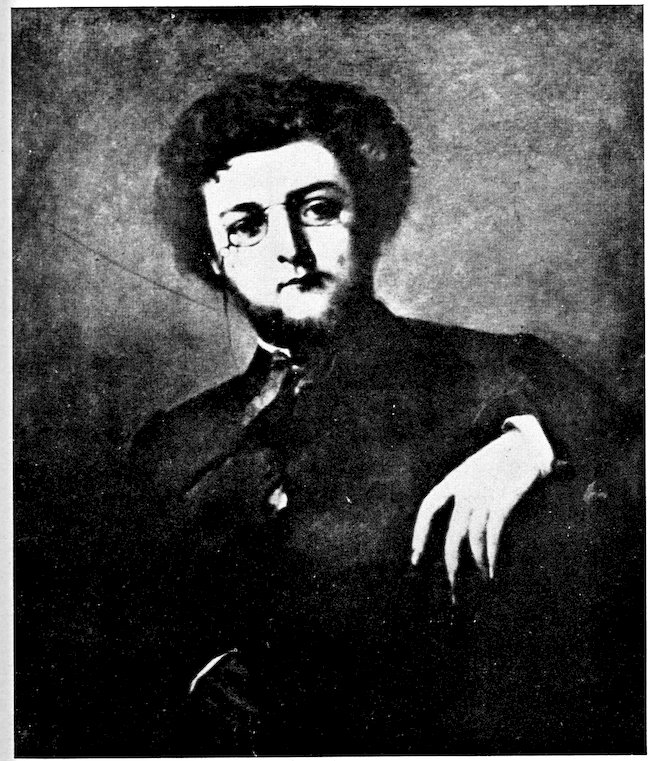
After a painting by Giacometti. Georges Bizet.
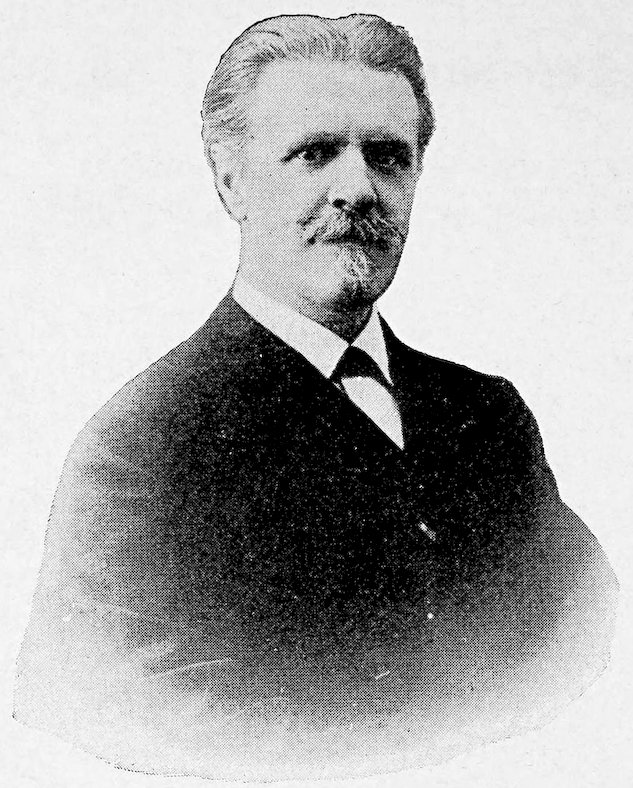
Vincent d’Indy.
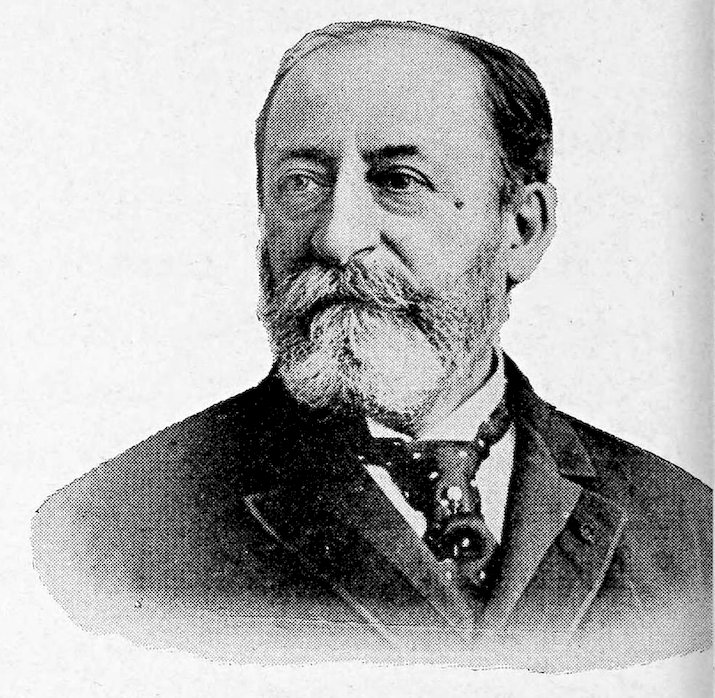
Camille Saint-Saëns.
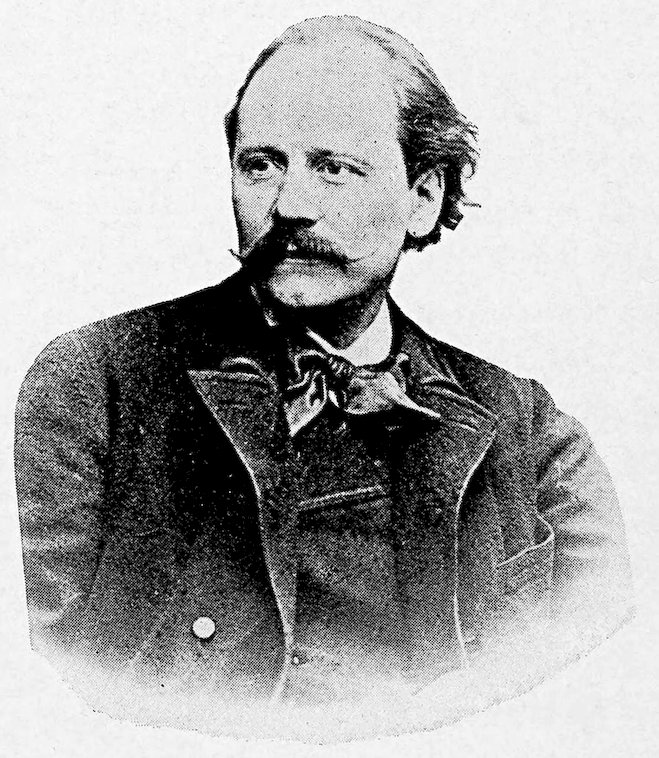
Jules Massenet.
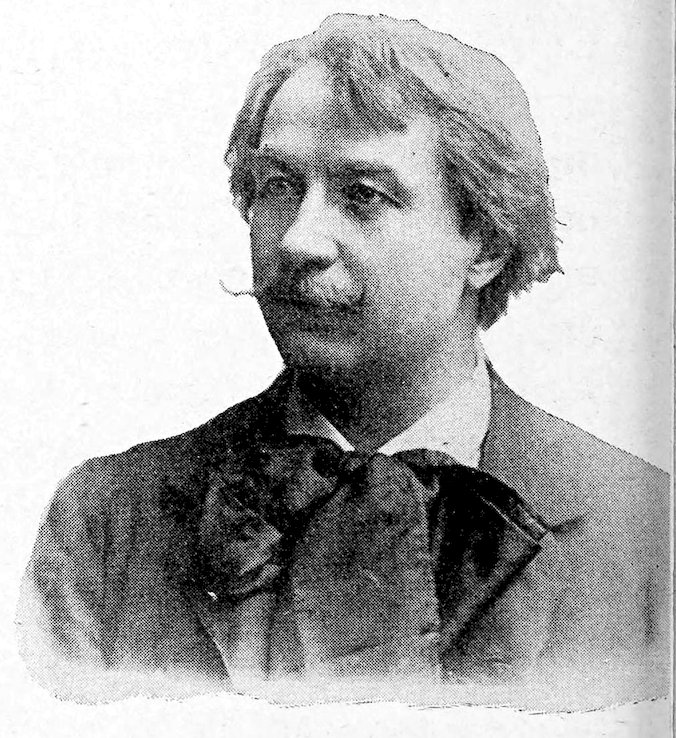
Gustave Charpentier.
French Composers of the 19th Century.
389It seems quite reasonable that after all the experiences France has been through in the early and middle 19th century she should now blossom out, not with remodelled Italian opera, but with her own opera and her own ways of writing music.
The two influences were without doubt from César Franck and Bizet whose sincerity not only influenced musicians but rather quickly gained the public. The third influence was of course, Wagner, who, though he infuriated many, gained followers for his theories everywhere that his music was heard. In France, Reyer and Chabrier were both Wagner enthusiasts and did much to bring him finally into the Paris Opera House a little before the 20th century (adapted from The Art of Music). Out of these influences came a fine group of gifted composers,—d’Indy, Dukas, Charpentier and others.
Ernest Reyer (1823–1909), who was an ardent follower of Wagner, had a hard time because of the new harmonies he used. His last opera Salammbo is better known to us than the others, and his works are still played in Paris at the Grand Opera.
A man famous as composer of the tone poem, España, Emmanuel Chabrier (1841–1894) must come in here, for at the time of his death he was writing a most interesting opera, Briseis, which was finished by his pupils. The day before he died Robert Louis Stevenson stopped in the middle of a sentence, in his novel The Weir of Hermiston, one of his best. The first woman to receive the Prix de Rome in France, Lili Boulanger (1892–1918) did much of her composing in bed during her last illness; her devoted sister Nadia, a prominent musician in Paris, and had received the second Prix de Rome, finished the deathbed works. And did we not see Mozart finishing his Requiem on the last day of his life? Illness and impending death seem not to matter to men and women who have genius.
This group was striking out for something new, and was influenced by Wagner’s theories, Franck’s return to the 390old classic style, the Russian school, the re-action against Wagner and the renewed interest in orchestral concerts in Paris (adapted from C. G. Hamilton).
Saint-Saëns—the Child Prodigy and Octogenarian
Camille Saint-Saëns (1835–1921) wrote in all styles from classic to the newest of program music. He is another who gave concerts before he was twelve years old; he studied at the Conservatory, lived in Paris as a composer, organist and pianist, was a learned man and a very good musical critic. Later in life he lived in Algiers, which accounts for the oriental touch in his music. He journeyed over much of the world and we heard him in Carnegie Hall, on his last trip to this country in 1915, on his way to the San Francisco exposition where he played the organ and conducted his opera Samson and Delilah. He played some of his most technically difficult pieces when he was in his eighties. He wrote some symphonies, some descriptive symphonic poems, Le Rouet D’Omphale, Phæton, Dance Macabre (very weird and rhythmic) and others. Out of five, his G minor is the most brilliant piano concerto.
He is best known for his opera Samson and Delilah which is carried into fame by the two arias, My Heart at Thy Sweet Voice and Love Come to My Aid. This last is of the finest lyric writing in French opera and the first is surpassingly emotional. The choral parts (often sounding like early Hebrew music) show a real master at work, and the effect of the whole is very dramatic, whether sung as oratorio or opera.
It is not as an opera writer, however, that Saint-Saëns wished to go down to history for he threw his whole strength into trying to make the French public know and love the classics. Paul Landormy says: “From the historic point of view, Saint-Saëns is a notable figure. Saint-Saëns is 391the French Mendelssohn.... He undertook the musical education of France at the exact moment when Berlioz despaired of succeeding with the task, and he prepared the public for the great French School of symphonists which arose toward the end of the 19th century.”
In 1871 Saint-Saëns was made president of the newly formed National Society of Music of which you will read later.
The ballet was used to advantage by Clement Philibert Léo Délibes (1836–1891) a master of this form of music and dance. He built up a certain atmosphere that is particularly French. His ballets, Coppelia and Sylvia and his opera Lakmé are conventional and very popular. Lakmé is opéra comique because of the spoken words and of its romantic character. Délibes always has a certain delicacy of color, and charm which captivates.
Another composer who writes in an exotic vein (or an out-of-the-nation-to-which-he-belongs way, with all the color of the other nation in costumes and scenes) is Edouard Victor Antoine Lalo (1823–1892). Lalo was trained to sincerity by his models, Beethoven, Schubert and Schumann. This does not mean copying, for his music is not anything like the music of these men. He skilfully drew a variety of effects from his orchestration, and his music has individuality. His best known work in opera is Le Roi d’Ys. He also wrote a work for violin and orchestra Symphonie Espagnole which is a pet of all the violinists because of its brilliancy and beauty.
Massenet
Jules Massenet (1842–1912) was something like a modern French Meyerbeer and an Offenbach combined, yet his work is far more worth while. Before he died he was at the height of his popularity in Europe and America, 392and the repertory of the Hammerstein Opera in New York included many of Massenet’s works. He composed operas so rapidly that his public could not forget him!
He built on Gounod and Ambroise Thomas and gained much from Wagner. He used continuous melody and some of the principles of the leit-motif. Wagner’s music compared to Massenet’s was thick for Massenet’s is thin!
Whether Massenet will always remain popular is a question. His operas are engaging and clever, and he knew how to write theatre music to please the public. The most important of his operas (about fifteen), are Manon and Le Jongleur de Notre Dame. The title parts of both were sung by the brilliant Mary Garden, in this country. (See Chapter VIII.) Manon ranks second to the Jongleur. You know, too, the Meditation from Thäis, another of his popular successes. It was written for Sybil Sanderson, an American singer, in Paris. Massenet’s operas did not show his tremendous knowledge of counterpoint, of which he was professor at the Conservatory. His position was later filled by André Gédalge who has taught most of the composers of today. Gédalge is also the composer of some very fine symphonies, sonatas and an extraordinary Treatise on the Fugue.
Other writers of this period are Xavier Leroux (1863–1919), Gabriel Pierné, born the same year, composer of a delightful oratorio, Children’s Crusade. He is now conductor of the Colonne Orchestra in Paris. André Messager, born ten years before these two is the composer of some very charming light operas of which Veronique is the best known. There are also the great organists Charles Marie Widor (1845) with ten organ symphonies and many other works, and Alexandre Guilmant (1837–1911), a great organist who came to America while one of the writers of this book (Ethel Peyser) was at Vassar College, where he inaugurated the new organ.
393
Followers of César Franck
Although César Franck was not a successful opera writer, he influenced composers by showing how to combine modern harmony successfully with the classic form.
Among the many César Franck’s revival of the classic style influenced are Gabriel Pierné, Henri Duparc (1848), and Ernest Chausson (1855–1899), Franck’s pupils. Chausson was first known through Helen, a three-act opera and Le Roi Arthus, which show what he might have accomplished had not an accident caused his death. Besides the operas he wrote beautiful chamber music, orchestral works and songs. His Poem for violin is full of gentle, yet deep feeling. All his work has veiled mystery and is very lovely.
The most important pupil of César Franck is Vincent d’Indy (1851), one of the most important figures in France. He founded, with Charles Bordes and Guilmant, the organist, the Schola Cantorum, and revived interest in sacred music. He has been in this country and is admired for his symphonic works, his operas Fervaal and L’Étranger (The Stranger), piano pieces and chamber music. One of his symphonic poems, Istar, was made into a ballet for Mme. Ida Rubenstein and was performed for the first time at the Grand Opera in Paris, in 1924.
Alfred Bruneau (1857) links the Wagner period with Debussy’s. His operas are rarely given outside of Paris. His manner was new and caused much discussion. He based many of his plots on Émile Zola’s writings, and was conductor of the Opéra Comique. The Attack on the Mill was given in America.
Charpentier’s “Louise”
Gustav Charpentier (1869) comes next. He made his name with the delightful opera about the dressmaker 394apprentice Louise, a musical novel on the life in Montmartre, one of the artist quarters of Paris. Charpentier wrote the book, which was the story of his own life. He also wrote its sequel Julien. No one who has ever been in Paris fails to be deeply stirred by this picture of the simple home life of the midinette or sewing girl. Mary Garden created the part of Louise in America and it was the first rôle of her operatic career. In one scene, you hear the almost forgotten street cries of Paris. He has also written a charming work for orchestra, Impressions of Italy, which is the result of his having won the Prix de Rome in his youth.
This brings us up to the 20th century to which we shall devote an entire chapter. But in order to finish our story of French opera, we will merely introduce you to Claude Achille Debussy, the ultra-modern harmonist and weaver of mystery and beauty, who ushered in the 20th century with his lovely and enchanting opera, Pelleas and Melisande written on the play by Maurice Maeterlinck. For ten years the composer worked over this masterpiece, and it was produced for the first time at the Opéra Comique, in Paris in 1902. Here we find something that never had been before,—opera completely separated from all the old ideas of what opera should be. But in tearing down the old, Debussy gave something very rare, beautiful, sensitive, touching a very high artistic peak, in its place. This was pure impressionism in music, just what romanticism was to the early 19th century. This carries the French School to its highest degree of mystic beauty.
Coming later than Debussy’s opera are Maurice Ravel’s L’Heure Espagnole (The Spanish Hour), Henri Rabaud’s Marouf, Paul Dukas’ Ariane et Barbe Bleue, also a Maeterlinck libretto and second only to Pelleas and Melisande in atmospheric charm, Albert Roussel’s Padmavati, an Oriental opera, that has been produced very recently at 395the Grand Opera in Paris, and Florent Schmitt’s Le Petit Elfe Ferme l’Oeil (The little elf winks its eye) presented at the Opéra Comique in 1924.
Humperdinck—The Fairy Tale Man—Germany
Outside of the operas of Richard Strauss, of which we have written elsewhere, there have been few outstanding opera writers in Germany since Wagner. Among those are Ludwig Thuille (1861–1907), whose Lobetanz was given at the Metropolitan Opera House in 1911; Eugene d’Albert (1864), who has lived in Germany most of his life, although he was born in Scotland, and wrote the lovely Tiefland which was performed in America; Max Schillings (1868), whose Mona Lisa was performed at the Metropolitan; Hans Pfitzner (1869), who wrote an operatic legend based on Palestrina; Siegfried Wagner (1869), son of Richard; and Leo Blech (1871).
The one great exception was Engelbert Humperdinck (1854–1921), born in Bonn, Beethoven’s birthplace. He is perhaps closer to the hearts of children than any one else who ever wrote music. This seems much to say, but when you hear that it was he who wrote that beautiful little fairy story Hansel and Gretel, we are sure you will agree. The San Carlo Opera Company has given special performances of it in English. Would it not be nice if operas were given in the language you best understand? You would then find out for yourselves that this is the story of Babes in the Woods. How fine it would have been too, if you had been able to hear in your own language the other opera written by Humperdinck! This was Koenigskinder (Children of the King), which gave one of the loveliest rôles to Geraldine Farrar, and brought a large flock of real geese on the stage to take part in the performance. The other name of the opera is The Goose-Girl, which explains 396the presence of the geese. Geraldine Farrar always brought one or two with her when she acknowledged the applause and there was always an awful squawk! In this opera too, there is a horrid old Witch. Humperdinck found joy and inspiration in the folk music of Germany, much of which deals with fairies, elves, witches and inhabitants of the world of imagination.
Humperdinck was a great musician and he had the honor of being asked to prepare the score of Parsifal for the publishers.
Because of the beauties of his melodies, the lovely subjects he selected and his sympathy with the finer and higher things of life, it is a pity that Humperdinck left so few works.
He was attracted to the theatre and wrote much music as theatre music for plays. This is called incidental music, that is, it is incidental and the play’s the thing! Just before he died Humperdinck wrote the incidental music for the Miracle which is a great spectacle in pantomime. This means that there is no speaking, only tableaux and acting. He did not live to finish it, but it was completed by his son, for the production made by Max Reinhardt.
397