Chapter XXXI · America Comes of Age
Reading edition
For many years Boston was a center of musical life.
At the close of the Civil War a school was well under way in New England, which we might call the classical period of American music.
B. J. Lang
Although Benjamin J. Lang (1837–1909) never published his compositions and never allowed them to be heard, he had much influence on Boston’s musical life, having been conductor of the Handel and Haydn and of the St. Cecilia societies, and the piano teacher of such musicians as Arthur Foote, William Apthorp, Ethelbert Nevin and Margaret Ruthven Lang, his daughter.
John Knowles Paine
John Knowles Paine (1839–1906), was the first professor of music at Harvard. In 1862, he gave his services without pay for a course of lectures on music, but they were not appreciated. When President Eliot became head of the University, music was made part of the college curriculum with Professor Paine at the head of the department. In 1896, Walter R. Spalding was made assistant and since Professor Paine’s death has been full professor.
476Professor Paine was the first American who wrote an oratorio. St. Peter was performed in 1873 in Portland, Maine, his birthplace. Next, he wrote two symphonies, one of which was often played by Theodore Thomas. Paine’s Centennial Hymn opened the Philadelphia Exhibition, with more success than the Wagner March, it is said.
Professor Paine was a pioneer in many fields of American composition and taught American composers to follow in the lines of sincerity and honesty which he carved out for himself.
Dudley Buck
Dudley Buck (1839–1909), was a noted organist, composer and teacher. He did not remain in New England (Hartford, Connecticut) where he was born, but held church positions in Chicago, Cincinnati, Brooklyn, and New York, and was active in the musical life of these different cities. His principal works were anthems and hymns, still in use, music for the organ and valuable text-books, also many popular cantatas.
George Chadwick
George Chadwick, one of our most important composers, was born in Lowell, Massachusetts, in 1854. He studied in Germany with Reinecke, Jadassohn and Rheinberger, three celebrated teachers who had more to do with forming the taste of the American composers than any American teacher.
Chadwick comes of a musical family. His musical life began as alto singer in a Lawrence church choir, where later he blew the bellows of the organ, but soon was promoted from blowing to playing it. He began composing while in High School. He was a student at the New England Conservatory, founded in 1867, but was not allowed 477to study with the idea of becoming a professional. When he saw that he would receive no further help from his father toward music-training, the young musician of twenty-two went to Michigan for a year. He taught music, conducted a chorus, gave organ recitals, saving enough to study in Leipsic. Jadassohn told Louis Elson that Chadwick was the most brilliant student in his class.
In 1880, Chadwick returned to Boston where he has lived ever since. From 1880 he was first, teacher, then musical director of the New England Conservatory. Some of his pupils have become leaders in American music,—Horatio Parker, Arthur Whiting, J. Wallace Goodrich (organist), Henry K. Hadley and others.
Chadwick has composed more orchestral works than any other American. A list of them includes three symphonies, a sinfonietta, six overtures, three symphonic sketches for orchestra, a lyric sacred opera, Judith, music to the morality play Everywoman, much chamber music, many choral works and about fifty songs, of which the best known is perhaps Allah.
Arthur Foote
Arthur Foote (1853) is one of the few prominent composers whose training bears the label “made in America,” for he never studied abroad. He was born in Salem, Massachusetts, and worked with Stephen Emery, a prominent theory teacher. Foote was graduated from Harvard in 1874, where he studied music in Professor Paine’s department. After organ study with B. J. Lang, Foote became organist of the First Unitarian Church founded in 1630, which post he filled from 1878 to 1910. This is doubtless the longest record of an organist in one church in America. Foote has been one of America’s finest teachers, and has influenced many, not only by his teaching, but by his 478broad-minded criticism. His harmony text-book, written with Walter R. Spalding, is among the most valuable and reliable in the musical world.
Foote has written scholarly and beautiful chamber and orchestral music which has placed him in the foremost ranks of American composers, but he has won the hearts of the entire English-speaking world by two little songs, Irish Folk Song and I’m Wearing Awa’.
Horatio Parker
Horatio Parker (1863–1919) inherited his talent from his mother who played the organ in Newton, Massachusetts, but she had a hard time interesting her son in music, for he disliked it very much. But at fourteen he had a change of heart going to the other extreme of having literally to be dragged away from the instrument. He studied with Emery and Chadwick, and then went to Germany to work with Rheinberger. He was organist in several churches and in 1894 was made professor of music at Yale University where he remained until his death.
In 1894, his best known work was performed in Trinity Church, New York. It is an oratorio, Hora Novissima (The Last Hour), on the old Latin poem by Bernard de Morlaix, with English translation by Parker’s mother also the author of the librettos for two other of his oratorios. Hora Novissima, one of America’s most important works, has been performed many times, not only in America, but it was the first American work given at the English Worcester Festival. It was so successful that Dr. Parker received the commission to write for another English festival at Hereford, and he composed A Wanderer’s Psalm. This was followed by The Legend of St. Christopher which contains some of Parker’s most scholarly contrapuntal writing for chorus. As another result of England’s 479recognition of his music, Cambridge University conferred upon the American composer the honorary degree of Doctor of Music.
Parker became famous for winning the prize of $10,000 offered by the Metropolitan Opera Company in 1911 for the best opera by an American. This was Mona, a story of the Druids in Britain, for which Brian Hooker, the American poet, wrote the libretto. In spite of the work having won the prize, it had no success with the public, and did not outlive its first season.
In 1915 Parker and Hooker won another $10,000 prize offered by the National Federation of Music Clubs, with an opera called Fairyland. It has not seen the light of day since its performances in Los Angeles.
Frederick Converse
Frederick Converse (1871), like many other Boston musicians, was graduated from Harvard (1893), when his Opus I, a violin sonata, was publicly performed. After study with Chadwick, he went to Germany to Rheinberger, returning in 1898, with his first symphony under his arm. He is now living in Boston. Converse has written many orchestral and chamber music works, and has often set Keats, the English poet, or used his writings as inspiration for his music,—Festival of Pan and Endymion’s Narrative, two symphonic poems, and La Belle Dame sans Merci, a ballad for baritone voice and orchestra.
Converse was the first of the present day Americans to have had an opera The Pipe of Desire produced by the Metropolitan Opera Company (1910).
Two College Professors
David Stanley Smith, a native of Toledo, Ohio (1877), belongs to this New England group, for he was graduated 480from Yale University and since 1903 has been, first, instructor in the music department and later full professor. He has composed some excellent chamber music, and several of his string quartets were played by the famous Kneisel Quartet (1886–1917) which organization has had a generous share in improving musical taste in this country.
Edward Burlingame Hill, born in Cambridge, Massachusetts (1872), is one of the professors of music at Harvard University. He has composed piano pieces, songs, and orchestral works, and has written many articles on music.
Mrs. H. H. A. Beach Prepares the Path for American Women
One of the most important composers of the New England group, is Mrs. H. H. A. Beach (1867). She was Amy Marcy Cheney, an astonishing little child who before her second year sang forty tunes. Louis Elson tells that at the age of two she was taken to a photographer, and just as he was about to take the picture, she sang at the top of her voice, See, the Conquering Hero Comes! She could improvise like the old classic masters, and could transpose Bach fugues from one key to another, at fourteen. When sixteen, she made her début as a pianist, and at seventeen she played piano concertos with the Boston Symphony Orchestra, also with Theodore Thomas’ orchestra.
Mrs. Beach received her training in America. Her first work in large form was a mass sung in 1892 by the Handel and Haydn Society. She next composed a scena and aria for contralto and orchestra, sung with the New York Symphony Society. It was the first work by a woman and an American to be given at these concerts, which Walter Damrosch conducted.
481The next year, Mrs. Beach was invited to write a work for the opening of the woman’s building at the Chicago Columbian World’s Exposition. She has two piano concertos and a symphony (The Gaelic) to her credit, also a violin sonata, a quintet for flute and strings, many piano pieces and splendid songs among which must be mentioned The Year’s at the Spring, June, and Ah, Love, but a Day.
Mrs. Beach prepared the way for other American women, not only by showing that women could write seriously in big forms, but also by her sympathetic encouragement of talent and sincerity wherever she finds it.
Margaret Ruthven Lang (1867), daughter of B. J. Lang, is also a Boston composer. Irish Mother’s Lullaby is the best known of her many art songs, in addition to which she has written an orchestral Dramatic Overture which Arthur Nikisch played, when he was conductor of the Boston Symphony Orchestra.
Among our best song writers are many women:—Harriet Ware, Gena Branscombe, Alice Barnett, Fay Foster, Eleanor Freer, Mana Zucca (who has written also a piano concerto, and piano pieces), Rhea Silberta, Ethel Glenn Hier (piano pieces and songs), Fannie Dillon (piano pieces and violin compositions), Mabel Wood Hill (songs, chamber music and an arrangement of two preludes and fugues of Bach for string orchestra), Lilly Strickland, Mabel Daniels, Katherine Ruth Heyman (songs, many of them in old Greek modes, and a book, Relation of Ultramodern Music to the Archaic), Rosalie Housman (songs, piano pieces and a complete Hebrew Temple Service), Gertrude Ross, Mary Turner Salter, Florence Parr Gere and Pearl Curran, writer of several popular successes. And although she is not a composer of art songs, we must not forget Carrie Jacobs Bond, whose End of a Perfect Day has sold in the millions, and her songs for little children have brought joy to many.
482
One of Our Most Scholarly Musicians
Another Boston musician and composer, teacher of piano and composition is Arthur Whiting (1861), nephew of the organist and composer George Whiting. He has made a specialty of harpsichord music, and plays charmingly on the little old instrument. Since 1895, he has lived in New York City.
Charles Martin Loeffler—First Impressionist in America
Charles Martin Loeffler is a composer belonging to a different class from any of the Boston group just mentioned. Loeffler is French by birth, as he was born in Alsace in 1861, French in his musical training and in his musical sympathies. For forty-two years he has lived in Boston, twenty of them at the second desk (next to the concertmaster) of the Boston Symphony Orchestra. He was the first composer to write in this country, the kind of music that existed at the end of the 19th century in France,—the music of Fauré, Dukas, Chausson and Debussy. The seed he planted did not fall on fertile soil, for all his fellow musicians as well as the orchestral conductors, from whose hands the public received its music, were Germans and German trained. They knew their “three B’s,” their Wagner and even the French Berlioz, but Loeffler brought something different, something disturbing, and was not easy to place. His music belonged neither to the classical nor to the romantic school.
Not only in America did this new French music have a fight, but on its own ground in France was it misunderstood! But you have seen from Monteverde to Wagner that the path of true innovation never ran smooth!
483Loeffler’s work is original, the work of a musician completely master of the modern orchestra and of modern harmony with its colorful and expressive effects. Besides this there was a spirit that never before had come into art. This was given the name of Impressionism, the getting of effects from objects, painted, or described in literature, without elaborate details. In music, composers who try to suggest to the hearer an image existing in their own minds are called Impressionists. This image may be a thought, an emotion, a definite object, a poem, a picture, a beautiful tree, the grandeur of Niagara, any one of a thousand things that await the hand of the Alchemist-Musician to be transmuted into tone.
All Loeffler’s compositions reflect this impressionism, and he was the first, but not the last of these poetic tone impressionists in America. He is foremost a composer of symphonic poems: La Mort de Tintagiles (The Death of Tintagiles) after the play by Maurice Maeterlinck, A Pagan Poem after Virgil, La Bonne Chanson (The Good Song) after Verlaine, La Vilanelle du Diable, The Mystic Hour with male chorus, Psalm 137 with female chorus. He also wrote an eight part mixed chorus, For One who Fell in Battle. Other orchestral works include a suite in four movements for violin and orchestra called Les Veillées de l’Ukraine (Evening Tales of the Ukraine), concerto for ’cello and orchestra, first played by Alwyn Schroeder with the Boston Symphony Orchestra, Divertissement for violin and orchestra, and Spanish Divertissement for saxophone and orchestra. There are also important works for chamber music: two rhapsodies for clarinet, viola and piano, an octet for strings and two clarinets, a quintet and a quartet built on Gregorian modes; and he has written a group of songs for medium voice and viola obligato with French texts by Verlaine and Beaudelaire, two impressionist poets.
484
The Red Man Attracts Composers
The next composer, Henry F. Gilbert, born in Somerville, Massachusetts (1868), brings us into an interesting field, the study of Negro and Indian folk music. After working with Edward MacDowell, Gilbert turned his attention to a thorough investigation of Negro music, resulting in orchestral works based on Negro themes such as, American Humoresque, Comedy Overture on Negro Themes, American Dances, Negro Rhapsody, and The Dance in Place Congo, a symphonic poem which was mounted as a ballet at the Metropolitan Opera House (1918).
Gilbert tells that the Comedy Overture was rescued from a wreck that was to have been a Negro Opera, based on Joel Chandler Harris’ Uncle Remus. What a pity he did not complete it!
The American Humoresque is based on old Negro minstrel tunes like Zip Coon, Dixie, and Old Folks at Home.
Gilbert was one of the founders of the Wa-Wan Press, established at Newton Center, Massachusetts, by Arthur Farwell. It was organized (1901) by composers in the interest of American compositions, and to study and encourage the use of Indian music. He died in 1928.
Arthur Farwell was born in St. Paul, Minnesota (1872). He attended college in Boston and studied music with Homer Norris (1860–1920), a Boston organist and composer, whose cantata Flight of the Eagle was based on a Walt Whitman poem. Farwell was also a pupil of Humperdinck in Berlin and Guilmant in Paris. The Indian music research, in which he is a pioneer, led him into the West to live among the Redskins and to make phonograph records of hundreds of tunes. He is also interested in community singing and music for the people. Practically a new field is his music for Percy MacKaye’s pageants Caliban and The Evergreen Tree.
485Carlos Troyer, a very old Californian who died recently, spent his life collecting Zuni and Mojave-Apache songs, having realized their artistic value long before any one else. In his youth he was an intimate friend of Liszt. He travelled, later, through South American jungles, with his violin and music paper, writing down the tunes he heard, and several times he would have been burned by the savages, but saved himself by playing for them.
Harvey Worthington Loomis contributed a piano version of Omaha Indian melodies to the Wa-Wan Press (1904) called Lyrics of the Redman. In the preface Loomis shows that Indian themes should be used impressionistically, for he says: “If we would picture the music of the wigwam and the war-path we must aim by means of the imagination to create an art work that will project, not by imitation but by suggestion, the impression we have ourselves received in listening to this weird savage symphony in its pastoral entourage (surroundings) which, above all, makes the Indian’s music sweet to him.”
Natalie Curtis’ valuable service to Indian and Negro music was cut off by her tragic death in Paris (1921), from an automobile accident. Fortunately she left several works in which she gave not only information on the music of these primitive Americans and also the Songs and Tales of the Dark Continent of Africa, but in them she set down quite unconsciously the beauty of her character and the sincerity of her purpose. There are four volumes of Negro Folk Songs, and The Indians’ Book, besides the African book. Recently we heard two Spanish-Indian melodies, a Crucifixion Hymn and Blood of Christ, that Miss Curtis found in use in religious festivals near Santa Fe, New Mexico. They are Spanish in character, and are almost unaltered examples of the songs of the Middle Ages brought down to us by the Indian. These were arranged by Percy Grainger according to directions left by Miss Curtis.
486Several American operas have been written on Indian legends and it would be difficult to find more picturesque subjects.
Our Light Opera Genius
Victor Herbert’s Natoma, given by the Chicago Opera Company in 1911, is an Indian story and one of his two grand operas. Born in Dublin, Ireland (1854), Herbert was the grandson of the novelist Samuel Lover. He was educated in Germany, and was a fine ’cellist. He came to the Metropolitan Opera orchestra as first ’cellist in 1886, and since then until his death in 1924, he delighted every one with his incomparable melodies in light operas.
After Patrick Gilmore’s death, Herbert in 1893, became bandmaster of the 22nd Regiment band which had become famous in 1869 and 1872 for two monster Peace Jubilees held in Boston. We think the 20th century, the age of gigantic enterprises, but——! for the first Jubilee, Gilmore had a chorus of 10,000 voices, and a band of 1,000! Not satisfied with this volume, in the second Jubilee he doubled the number! He also had cannons fired to increase the drum battery!
From Gilmore’s Band, Herbert became conductor of the Pittsburgh Symphony, also guest conductor of the New York Philharmonic Orchestra, but he had made such a success as composer of light operas, that he finally devoted all his time to the theater. Among Herbert’s most popular successes are: The Serenade, The Idol’s Eye, Babes in Toyland, Mlle. Modiste, Naughty Marietta, The Madcap Duchess, etc.
Julian Edwards (1855–1910), like Victor Herbert was born a British subject, in Manchester, England, and was a successful composer of light opera. He also wrote many sacred cantatas.
487
Sousa, the March King
Our most famous bandmaster is America’s “March King,” John Philip Sousa (1856), once leader of the United States Marine Band. Who has not marched to Stars and Stripes Forever, Washington Post, or Liberty Bell? Who does not love them, be he “high” or “low brow”? With Sousa leading, the band has played around the world, and no American composer is better known abroad. In fact, Sousa’s music was considered as “typically American” twenty years ago as is jazz today.
Another Indian Opera
Now for the Redskins again! Charles Wakefield Cadman’s Indian opera Shanewis was given at the Metropolitan Opera House in 1918. Cadman is well known for many songs which have become popular, At Dawning and The Land of the Sky-blue Water, a lovely Indian song. Born in Johnstown, Pennsylvania (1881), Cadman received musical training in Pittsburgh. For some years he has been living in California.
Another Pennsylvanian, who spent several years among the Indians, studying their music and using genuine themes for his opera Poia is Arthur Nevin (1871), younger brother of Ethelbert Nevin. For several years he was professor of music at the University of Kansas.
A professor at the same college is Charles Sanford Skilton (1868), writer of many cantatas and orchestral Indian dances.
Thurlow Lieurance (1897), one of the latest recruits to Indian music lore, is so well known for By the Waters of Minnetonka that we almost forget other songs and a music drama in which he has used Indian themes tellingly. One of these is a Navajo blanket song.
488The blankets woven by the Navajo women are not only remarkable examples of primitive art, but tell the stories of the tribe. No two blankets are the same, and like the music we write, are expressions of the weaver’s hopes, fears, joys and sorrows.
Homer Grunn (1880) who taught piano in Phoenix, Arizona, profited by the opportunity to gather Indian tunes, which he has put into songs, a music drama and orchestral works.
Ethelbert Nevin—Poet-Composer
Ethelbert Nevin (1862–1901) told his father that he would not mind being poor all his life if he could just be a musician! And the father, a music lover himself, allowed his sensitive, dream-loving, poetic son to study in America and in Europe. Perhaps “Bert’s” mother had something to do with the decision, for she, too, was sensitive and fine, and so much of a musician that her grand piano was the first to cross the Allegheny mountains into Edgeworth, the town near Pittsburgh where the Nevins were born.
Ethelbert Nevin was a romanticist who found the medium of his expression in short songs and piano pieces. He had a gift of melody surpassed by few and he reached the heart as perhaps no other American except Stephen Foster had done. Narcissus for piano and The Rosary have swept through this country selling in the millions. Mighty Lak’ a Rose, published after his early death, was a close third. Several others of his songs may be ranked among the best that America has produced. Nevin was what Walt Whitman would have called a “Sweet Singer.”
Robin Hood and His Merrie Crew Come to Life in the 19th Century
Reginald de Koven (1859–1920) will ever be remembered for his delightful light opera Robin Hood on which we were 489brought up. His song, Oh, Promise Me, will probably be sung when he will have been forgotten. De Koven’s last two works were operas, of which Canterbury Tales after Chaucer was performed at the Metropolitan Opera House and Rip Van Winkle from Washington Irving and Percy Mackaye, by the Chicago Opera Company. One of his best songs is a setting of Kipling’s Recessional.
“Pilgrim’s Progress”—An American Oratorio
One of the most respected American composers is Edgar Stillman Kelley, born in Sparta, Wisconsin, in 1857, whose American forefathers date back to 1650. After study in Stuttgart, Kelley went to California, where he was composer, teacher, critic, lecturer, writer and light opera conductor. Later he was professor at Yale, dean of composition at the Cincinnati Conservatory, and since 1910, a fellowship at the Western College at Oxford, Ohio, gives him the leisure and economic freedom to compose. His orchestral works include incidental music to Ben Hur, Aladdin, Chinese suite, a comic opera, Puritania, Alice in Wonderland, two symphonies, Gulliver and New England, incidental music to Prometheus Bound, and an oratorio based on Bunyan’s Pilgrim’s Progress. If you do not know Kelley’s delightful song, The Lady Picking Mulberries, allow us to introduce the little Chinawoman to you. You will meet at the same time an old acquaintance,—Mr. Pentatonic Scale.
Several of the older school of composers in America, faithful pioneers whose works are rarely heard now were Silas G. Pratt (1846–1916); Frederic Grant Gleason (1848–1903), who lived and worked in Chicago from 1877 to the time of his death; William Wallace Gilchrist (1846–1916), a writer of cantatas and psalms, Episcopal church music, two symphonies, chamber music and songs, who spent 490most of his life in Philadelphia; Homer N. Bartlett (1846–1920), composer of piano pieces; William Neidlinger (1863–1924), writer of many charming children’s songs.
Frank van der Stucken (1858) who was born in Texas, but lived in Europe from 1866 until 1884, was the first conductor to give an entire program of American orchestral works in America and also at the Paris Exposition of 1889. For years he was conductor of the Cincinnati Symphony Orchestra and he has composed many large orchestral works. He died abroad in 1929.
Rosseter Gleason Cole (1866), composer of songs, piano pieces, organ pieces, cantatas and works for orchestra and ’cello, takes his themes from American and general sources. He is organist in Chicago and has charge of the music courses of the summer session of Columbia University. He has held many important posts and taken numerous prizes. His cantata The Rock of Liberty was sung at the Tercentenary Celebration, 1920, of the settlement of Plymouth.
Arne Oldberg, born in Youngstown, Ohio (1874) is director of the piano department of Northwestern University (Michigan) and has many orchestral works, written symphonies, concertos and overtures, which have had frequent hearings. He has also composed much chamber music.
There are also Harry Rowe Shelley (1858), writer of much important church music; James H. Rogers, composer of teaching pieces for the piano and many fine songs, including a cycle In Memoriam, which is a heartfelt expression of sorrow in beautiful music; Wilson G. Smith, composer of many piano teaching pieces and musical writer; Louis Coerne, writer of opera and of works for orchestra; Ernest Kroeger of St. Louis who also used Indian and Negro themes in works for orchestra and piano; Carl Busch of Kansas City, composer of orchestral works, cantatas, 491music for violin and many songs, in some of which we see the Indian. In California we meet Wm. J. McCoy and Humphrey J. Stewart who have composed church music and have written often for the yearly out-door “High Jinks” of the San Francisco Bohemian Club, in which many important composers have been invited to assist; Domenico Brescia, a South American composer living in San Francisco, who wrote interesting chamber music played at the Berkshire Chamber Music Festivals; and Albert Elkus, a composer of serious works for orchestra and piano. Smith died in 1929; Coerne in 1922.
But this is growing into a musical directory! And even neglecting many who have done much to make music grow in America, we must proceed for we have important milestones ahead.
For many years New York has been the American center of music. Few of the people in musical life are native New Yorkers, but have come from all parts of the States and Europe to this musical Mecca.
MacDowell Greatest American Poet-Composer
The greatest romanticist and poet-composer of America up to the present is Edward MacDowell (1861–1908). Some of the romanticism of the early 19th century has become mere imitation of the style which arose as a protest against the insincere forms of the 18th century. But the true spirit of romance never dies and never becomes artificial,—such romance had MacDowell. He was sincere, always a poet, always himself, and in spite of his Irish-Scotch inheritance, German training and love of Norse legends, he expressed MacDowell in every note. He lived before the time when we question “How shall we express America in Music”? In fact he was much against tagging composers as American, German, French, and so on.
492Edward MacDowell, born in New York City, began piano lessons when he was eight. One of his teachers was the brilliant South American Teresa Carreño, who later played her pupil’s concerto with many world orchestras. At 15, he entered the Paris Conservatory where he was fellow student with Debussy.
While there, MacDowell studied French, and during a lesson amused himself by drawing a picture of his teacher. When caught, the teacher, instead of rebuking him, took the sketch to a friend, a master at the École des Beaux Arts, the famous old art school of Paris. The artist found the sketch so good that he offered to train him without charge but Edward had made up his mind to be a musician and did not accept the offer.
In 1879, MacDowell studied composition at Frankfort with Joachim Raff, one of the composers of the Romantic period. Raff introduced him to Liszt, who invited MacDowell to play his first piano suite at Zürich (1882). The composer’s modesty is reflected in these words which Lawrence Gilman quotes: “I would not have changed a note in one of them for untold gold, and inside I had the greatest love for them; but the idea that any one else might take them seriously had never occurred to me.” This suite was his first published composition.
In 1884, he married Miss Marian Nevins of New York, and theirs was one of the most beautiful marriages in musical history, although their meeting was amusing! The young girl had crossed the ocean to continue her music studies at a time when it was not a common occurrence, and when she went to Raff for lessons, he sent her to a young countryman of hers, “an extraordinary piano teacher.” She was indignant to be sent to a young inexperienced American in that fashion, but she went! The young inexperienced American did not want to teach an American girl, because he felt she would not be serious enough to do the kind of work he demanded, but he accepted her! Later she accepted him!
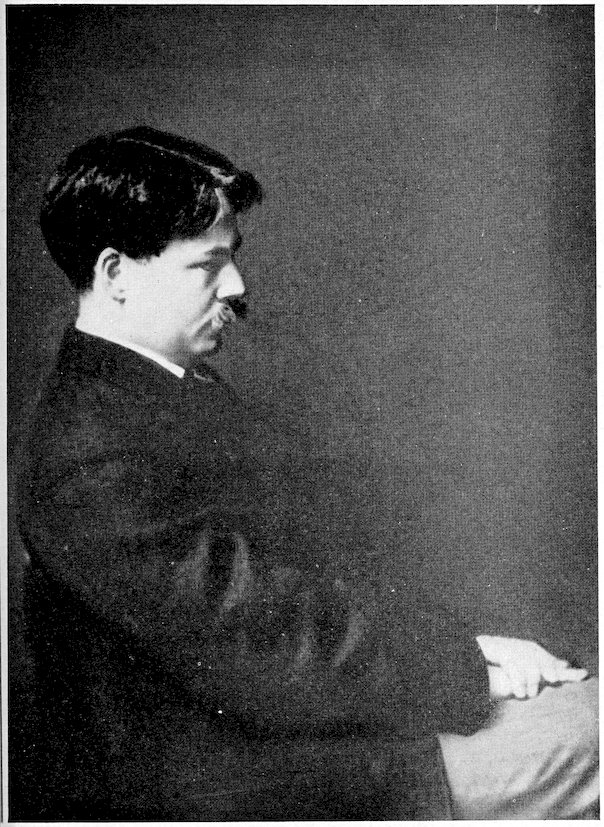
Edward MacDowell. America’s Greatest Poet-Composer.
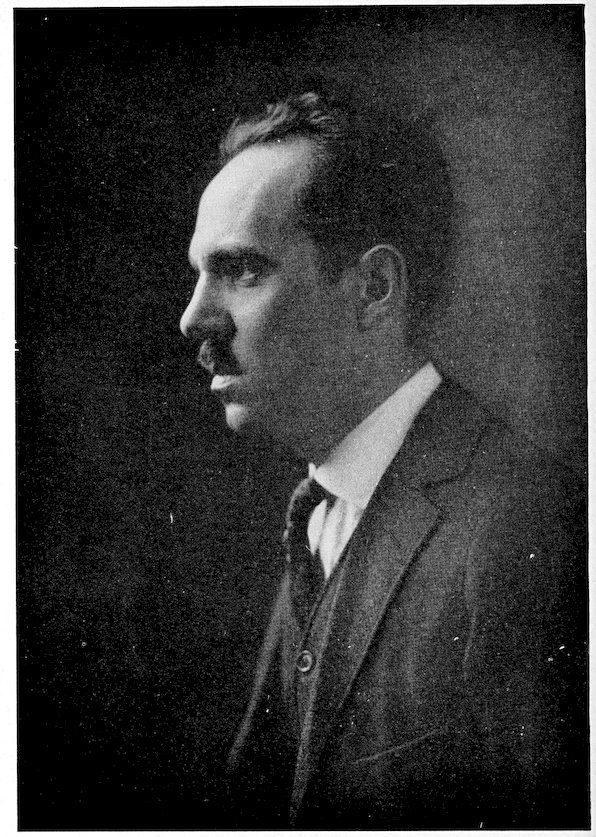
Charles Griffes. American Impressionist.
493In 1888, he established himself in Boston as pianist and teacher. His first concert was with the Kneisel Quartet, and in 1889 he successfully played his concerto with the Boston Symphony Orchestra. He made tours through the States giving recitals and appearing with the orchestras. Winning immediate recognition, his position as an exceptional composer grew. In 1896 the Boston Symphony Orchestra presented his first piano concerto and his orchestral Indian Suite on the same program in New York. Such an honor had never before been shown an American!
In 1896, he became professor of the new Chair of Music at Columbia University in New York City. After resigning his post in 1904, his health broke as the result of an accident, and for several years he was an invalid. All the care of physicians, devoted friends, his parents, and his courageous wife, could not restore his memory, and in 1908, he died in New York and was buried in Peterboro, N. H. A natural boulder from where he often watched the sunset, marks the spot—fitting for one who loved Nature as he did.
Shortly before his passing, a group of friends formed a society, the MacDowell Club of New York, which has for its object the promoting of “a sympathetic understanding of the correlation of all the arts, and of contributing to the broadening of their influence, thus carrying forward the life-purpose of Edward MacDowell.” He wished musicians to know the value of associating with artists outside of the field of music. Eugene Heffley, (1862–1925) an intimate friend of MacDowell and first president of the MacDowell Club did much to make the MacDowell music known and loved, just as he did for Charles Griffes, Debussy, Ravel, Scriabin and others who have come with new messages.
Some people have statues erected, others have towns and 494streets named for them, but besides the numerous MacDowell Clubs throughout the States, the most beautiful memorial is the MacDowell Association at Peterboro. Early in his career, MacDowell found it impossible to work well in the city, and by happy chance he and his wife discovered a deserted farm which they bought for the proverbial “song.” Here the composer spent his summers in the beautiful New Hampshire woods, in the heart of which he built the little log cabin, which in his words, is
A house of dreams untold
It looks out over the whispering tree-tops
And faces the setting sun.
And in this “house” he told many of his dreams in lovely melody! While ill, he often expressed the desire to share the inspiration-giving peace and beauty of his woods with friends, workers in music and the sister arts. Out of this wish has grown the colony for creative workers, which has been a haven to hundreds of composers, poets, painters, sculptors, dramatists, and novelists. The “Log Cabin” is the seed out of which twenty studios have sprung. The small deserted farm has spread over 500 acres, and Mrs. MacDowell with the aid of faithful friends has made a dream come true!
MacDowell was a composer for the pianoforte, although he wrote some lovely songs; a few orchestral works, best known of which is The Indian Suite, in which he employs Indian themes; and several male choruses written when he conducted the New York Mendelssohn Glee Club. We love and remember him for his Woodland Sketches, Sea Pieces, Fireside Tales, New England Idyls (opus 62 and his last work), virtuoso-studies, and the four sonatas—the Tragica, Eroica, Norse and Keltic.
W. H. Humiston (1869–1924), composer, lecturer, musical critic, organist, assistant conductor of the New York 495Philharmonic Orchestra and a pupil of MacDowell, had the most complete collection of Bach and Wagner in this country and was a great authority on their writings. This collection now belongs to the MacDowell Association, and is in the colony library at Peterboro.
Henry Holden Huss
Henry Holden Huss (1862), born in Newark, New Jersey, has lived in New York since his early twenties when he returned from studying with Rheinberger in Munich. Before his European days he was a pupil of his father, George J. Huss, a Bavarian who came to America during the 1848 revolution, and was one of the best musical educators in this country. Huss also studied with O. B. Boise (1845–1912), an American theorist and teacher. As concert pianist, Huss has played his piano concerto, one of the best American works, with all the important orchestras. Raoul Pugno, the much-loved French pianist, and Adele aus der Ohe also played it abroad and in America.
Huss has always aimed for the highest ideals as teacher, composer and pianist. A classicist at heart, his works are written on classic models,—a beautiful violin sonata with poetic slow movement, many chamber music works, a concerto for violin and orchestra, besides The Seven Ages of Man for baritone and orchestra, often sung by the late David Bispham, Cleopatra’s Death, for soprano and orchestra, a female chorus Ave Maria, and many fine art songs and piano pieces, the most beautiful of which is a tone poem To the Night, a lovely impressionistic composition that ranks with the best that America has produced.
Two other pupils of O. B. Boise, Ernest Hutcheson (1871) an Australian, and Howard Brockway (1870), a Brooklynite, have done much to make music grow in America. Hutcheson, who studied also with Max Vogrich in Australia 496and Reinecke in Leipsic, has made so enviable a career as pianist and teacher, that one forgets he has a symphony, a double piano concerto and several other large works in manuscript. Brockway, who harmonized Lonesome Tunes, folk songs from the Kentucky Mountains collected by Miss Loraine Wyman, is also the composer of a symphony played in Boston (1907) by the Symphony Orchestra, a suite, ballad-scherzo for orchestra, many piano works and songs. Hutcheson, Brockway and Boise were teachers in the Baltimore Peabody Institute, one of the important music schools, under direction of Harold Randolph, a fine musician and pianist.
George F. Boyle (1886) of New South Wales has, since 1910, been professor at the Peabody Institute. He has composed many piano pieces, songs and orchestral works.
Rubin Goldmark
Rubin Goldmark (1872), is known as the best toastmaster in the music world! Born in New York, he was one of Dvorak’s most talented pupils and inherits his gifts from his noted uncle Carl Goldmark (1830–1915), a Hungarian composer of the overture Sakuntala and the opera The Queen of Sheba, the symphony The Rustic Wedding and much else. Rubin Goldmark has written several important tone poems,—Samson, Gettysburg Requiem, Negro Rhapsody, based on negro themes, and other fine things for orchestra, chamber music, piano and violin numbers and as a teacher he has laid the foundations for several American composers among whom are:—Frederick Jacobi, Aaron Copland and George Gershwin. Each score from Goldmark’s pen is an addition to American music.
Henry Hadley
Henry K. Hadley (1871) by right of birth and training belongs to the New England group of composers, but most 497of his life was spent in Germany where he got his orchestral experience, and in different parts of America where he has conducted orchestras—Seattle, Washington, San Francisco and New York. Hadley is one of the few Americans who has conducted the New York Philharmonic Orchestra.
Hadley has taken many prizes for opera, symphony, cantata and an orchestral rhapsody. To this he has added numerous other orchestral and chamber music works and over 100 songs.
Albert Mildenberg’s “Michael Angelo”
In these days when the cry is for American opera, it seems regrettable that an opera ready for production should lie idle because of the death of its composer. Perhaps no work in history has had a more tragic story than Michael Angelo by Albert Mildenberg (1878–1918). In 1908, Mildenberg signed a contract in Vienna for the production of the opera. The following year on the way to Europe, the ship, Slavonia, was wrecked, and although the composer escaped, his entire orchestral score and parts went to the bottom of the sea. Courageously he rewrote the work, and sent it to the Metropolitan Opera House in competition for the $10,000 prize, won by Horatio Parker. Before it had reached the judges, in some way, still unexplained, the major part of the score disappeared! Again, Mildenberg set to work with the sketches he had, and made a third score, but it cost him his life, for though the opera was completed before his death, he was too ill to carry it further.
In addition to this grand opera, Mildenberg, a pupil of Rafael Joseffy, wrote many piano pieces. He also composed The Violet, I Love Thee, and Astarte, songs that had a popular vogue and are still found on many programs, 498and romantic comic operas, The Wood Witch and Love’s Locksmith, besides a cantata and many choruses.
Two other operas which had Metropolitan Opera House productions were The Temple Dancer by John Adam Hugo (1873) and The Legend by Joseph Carl Breil (1870).
John Alden Carpenter—Modernist
John Alden Carpenter (1876), one of America’s foremost composers, was born in Park Ridge, Illinois, and educated at Harvard where he took the music course, studying afterwards in England with Edward Elgar, the English composer. A business man, Carpenter still devotes his time to composing music that has put him among America’s leading musical lights. While he might be called a romanticist, his tendencies are impressionistic, and none understands better than he the charms of rich and unusual harmonies, the use of modern melodic and orchestral effects, and the value of humor in music. All these we find in his Adventures in a Perambulator for orchestra, and his ballet Krazy Kat, where jazz rhythms are used to great advantage. One of the most beautiful works of its kind, is the ballet after Oscar Wilde’s The Birthday of the Infanta, performed by the Chicago Opera Company, and his first ballet written for the Metropolitan Opera Company is called Skyscraper, certainly American! Carpenter’s settings of Tagore’s Gitanjali are among America’s finest songs; he has many others, a concertino for piano and orchestra and a violin sonata.
An All-American Symphony
Eric Delamarter (1880), born in Lansing, Michigan, has written a Symphony After Walt Whitman in which he has used twenty-year old street songs from the “Barbary 499Coast” (San Francisco Bowery), Lonesome Tunes of Kentucky, and a fox-trot rhythm with newer street songs. These, Delamarter has woven into a symphony with skill and sincerity. The material is All-American although neither Negro nor Indian.
Delamarter is a well-known musical critic in Chicago, an organist, composer of many other works for orchestra, organ, and oratorios, incidental music for drama, cantatas and songs and since 1917 assistant conductor of the Chicago Symphony Orchestra.
Noble Kreider and Edward Royce, son of Professor Josiah Royce of Harvard University, have both written well for the piano. Harold Bauer has played variations and short pieces by Edward Royce.
Ernest Schelling—Pianist-Composer
Ernest Schelling (1876), born in Delaware, New Jersey, appeared as pianist at the Academy of Music in Philadelphia, at the age of four! His musical training abroad included several years with Paderewski. He has made many concert tours in Europe and America, and for two seasons has conducted the children’s concerts of the New York Philharmonic Society. His important orchestral works include a symphonic legend, a suite, two numbers, Suite Phantastique and Impressions From An Artist’s Life, for piano and orchestra, and his latest work to enjoy wide popularity, The Victory Ball.
John Powell—Virginian
All the charm and refinement of the Southern gentleman are reflected in John Powell’s personality, along with an earnest sincerity and conviction. He was born in Richmond, Virginia, (1882), is a graduate of the University of 500Virginia, and a pupil of Theodor Leschetizky and Navratil in Vienna. He has made an international reputation as brilliant pianist and is also one of our most gifted composers. Powell’s works show classical training in form, with which he combines a rich romantic feeling and a love for folk music.
He believes that music should draw on the folk element for its strength, and has proved his theory by using freely the folk music he knows best, that of the negro. In the South, At the Fair, piano pieces, show this early influence and his fund of humor, and in his Negro Rhapsody for piano and orchestra, Powell has painted a picture of the negro in many moods—sinister and menacing, primitive bordering on barbaric, as well as humorous, care-free and childlike.
His Sonata Teutonica which first brought him before the public is of extraordinary strength, length and talent. He has written other sonatas for piano and for violin, songs, chamber music and orchestral works.
Negro Spirituals versus Jazz
This brings us face to face with one of the most discussed questions of the day: the influence of Negro music and jazz on serious composition. The pure Negro music is the Spiritual and not jazz, which may be the typically American idiom we have been waiting for.
It is not Negro but is developed from the Negro dance rhythm, from a real folk music; it is the result of Negro music played upon by American life and influences; through it we may learn to free ourselves musically, and show the true American spirit of adventure and daring which until now has been absent in our native compositions. The path has been travelled from the songs of Stephen Foster, Negro Minstrels, “coon songs” and “cake walks,” to jazz with its elaborate orchestration unlike any other existing 501music, and its complicated rhythms. Jazz rhythm is contrapuntal rhythm. Europe says that it is our one original and important contribution to music! This is a strong statement, but as “imitation is the sincerest form of flattery,” their serious 20th century composers have flattered us by writing jazz, and we have Piano Rag by Stravinsky, a Syncopated Sonata by Jean Wiener, jazz by Darius Milhaud, Casella, Honegger, and even Debussy was tempted into writing Golliwogg’s Cake Walk.
In Los Angeles (April, 1925), Walter Henry Rothwell with his Philharmonic Orchestra played an American Caprice by Henry Schoenefeld (1857) one of many works in which the composer has used Indian and Negro themes.
Henry Thacker Burleigh, Most Noted Colored Composer
His arrangement of the Spiritual, Deep River, has made Harry Burleigh’s name known on two continents, and its success has led many into that field. Burleigh (1866) was one of the foremost among the Dvorak pupils, and has held the position of leading baritone in St. George’s Church for many years, as also at the Temple Emanuel on Fifth Avenue. His name is found on practically every program where Spirituals are sung.
Of Burleigh’s race is R. Nathaniel Dett (1882), conductor of the Hampton Singers, also director of the music department of Hampton College. His name was introduced by Percy Grainger, who played his characteristic Negro dance called Juba Dance in Europe and America. Dett’s greatest works are his arrangements of the Spirituals for chorus. Grainger wrote of him: “There is in his treatment of blended human voices that innate sonority and vocal naturalness that seem to result only from accumulated long experience of untrained improvised polyphonic 502singing, such as that of Southern Negroes, South Sea Polynesians and Russian peasants. These things are branches of the very tree of natural communal song.”
David Guion, a young Texan, is well known in this field and also for his piano setting of Turkey in the Straw.
Louis Gruenberg Finds New Paths
Louis Gruenberg (1884) was born in Russia but came to America at the age of two. At nineteen he went to Europe and became the pupil of Ferruccio Busoni, the Italian pianist-composer who spent most of his life in Berlin and Vienna and also taught for two years at the New England Conservatory of Music.
Gruenberg had followed conventional lines of composition for some years, receiving prizes in Berlin and New York (in 1922 he was awarded the Flagler prize for a symphonic poem Hill of Dreams). His works of this period comprise symphonic poems, a string quartet, a piano concerto, a symphony, a suite for violin, also a sonata, two operas, songs and piano pieces.
He began to study America, to ask himself what was the spirit of Americanism that had not yet found its way into music, and his answer was not the Negro jazz, but the white man’s jazz expressing the “spirit of the times.” As a result he changed his way of writing. The compositions of this period are a violin sonata, a set of piano pieces called Polychromatics, a Poem in sonatina form for ’cello, four pieces for string quartet, a viola sonata, an orchestral tone-poem, a group of short piano pieces in jazz rhythms with the amusing name of Jazzberries, three violin pieces in the same style, a group of songs Animals and Insects, texts by Vachel Lindsay, and that same poet’s Daniel which Gruenberg has set as Daniel Jazz for tenor and chamber music orchestra, and Creation, a Negro sermon by James 503Weldon Johnson, a poet, who has just won the Spingarn Prize for the most distinctive work (1924–1925) of an American of African descent.
Two Jazz Geniuses
Irving Berlin, the genius of the age in writing typical American jazz, was born in Russia and has had no musical training. He picks out his irresistible melodies by ear and his aide writes them down to the delight of the millions in all corners of the earth, from New York to the Sahara desert, where the phonograph has carried them. The sheiks no longer sing in ancient pentatonic melody to their lady loves, but turn on the phonograph which ably plays some of his hundred American songs: My Wife Goes to the Country, Snooky Ookums, Along Came Ruth, If You Don’t Want Me Why Do You Hang Around? Mandy, Say it with Music, What’ll I Do, All Alone, and many from the musical revues (Music Box Revue, especially). His earlier Alexander’s Rag Time Band goes back to cake walk days and has become a classic of its kind and the model for popular music following it. He rose from poverty to riches through giving great delight to the public.
George Gershwin (1898) flashed into the lime-light through his jazz piano concerto Rhapsody in Blue and his extraordinary playing of it with Paul Whiteman’s Orchestra. In this piece we find a merging of classic form with the “voice of the people”! It will be interesting to watch this young man, not yet thirty, to see the outcome of grafting a musical education on to his unusual natural gifts. As a result of the success of his experiment he has been commissioned to write a New York Concerto for the New York Symphony. He is a Brooklyn boy brought up as a “song plugger” for a publisher of popular music, playing their songs in vaudeville acts and in cafés.
504
Charles Tomlinson Griffes
Charles Tomlinson Griffes (1884–1920) was a poet-composer whose early death was a serious loss to America, for every thing he wrote was an addition to our music. He was impressionistic in style, and we are grateful for the lovely art songs, Five Poems of Ancient China and Japan, three songs with orchestral accompaniment to poems of Fiona MacLeod, ten piano pieces and the Sonata which have never been surpassed in beauty and workmanship by any American, the Poem for flute and orchestra, the string quartet on Indian themes, and his orchestral tone-poem, The Pleasure Dome of Kubla Khan. For the stage, Griffes composed a Japanese mime-play, Schojo, a dance drama, The Kairn of Korwidwen and Walt Whitman’s Salut au Monde, a dramatic ballet. The last two were presented at the Neighborhood Playhouse, where interesting experiments in music and the drama have been made by the Misses Lewisohn.
Griffes was a native of Elmira, New York, and his first studies were made with Miss Mary S. Broughton, who recognized her young pupil’s unusual talent and took him to Germany for study. His composition work was done with Humperdinck, and Rüfer, and from 1907 until his death he taught music at Hackley, a boys’ school in Tarrytown, New York.
Lawrence Gilman, American critic, says of him: “He was a poet with a sense of comedy.... Griffes had never learned how to pose—he would never have learned how if he had lived to be as triumphantly old and famous as Monsieur Saint-Saëns or Herr Bruch or Signor Verdi.... It was only a short while before his death that the Boston Symphony Orchestra played for the first time (in Boston) his Pleasure Dome of Kubla Khan ... and the general concert-going public turned aside ... to bestow an 505approving hand upon this producer of a sensitive and imaginative tone-poetry who was by some mysterious accident, an American!... He was a fastidious craftsman, a scrupulous artist. He was neither smug nor pretentious nor accommodating. He went his own way,—modestly, quietly, unswervingly ... having the vision of the few....”
Whithorne’s American Impressions
Emerson Whithorne (1884) was born in Cleveland, Ohio, and studied there and in Europe. After writing some forty songs and compositions in Oriental and European fashion, he has given us in his New York Days and Nights, a group of piano pieces in which are cleverly pictured Times Square, Hudson River ferry boats, Trinity Church chimes, etc. His latest work is a ballet, Sooner and Later, written with Miss Irene Lewisohn for the Neighborhood Playhouse, in which they have combined the primitive and the very modern in an original and pictureful manner.
Albert Spalding—America’s Violinist-Composer
When Walter Damrosch took the New York Symphony Orchestra on tour in Europe, Albert Spalding (1888, Chicago) went along as joint soloist with John Powell, playing his violin concerto. Besides this, Spalding has written many small pieces for violin, other orchestral and piano works, and a string quartet played (1924) by the Flonzaley Quartet. Spalding ranks with the great violinists of the world.
Three other violinists showing talent as composers are Edwin Grasse (1884), who in spite of the handicap of blindness, has composed some charming violin pieces, violin sonatas and string quartets; Samuel Gardner, who has 506written orchestral works, chamber music and short violin pieces; and Cecil Burleigh, short poetic pieces for violin and for piano and a violin concerto.
American Music Guild
To encourage the composing and appreciation of high class American composition, ten American composers formed an association, the American Music Guild. The members are Marion Bauer, Chalmers Clifton, Louis Gruenberg, Sandor Harmati, Charles Haubiel, Frederick Jacobi, A. Walter Kramer, Harold Morris, Albert Stoessel and Deems Taylor.
Albert Stoessel (1894, St. Louis) is professor of music at New York University, conductor of the New York Oratorio Society, of the New York Symphony concerts at Chautauqua, N. Y., of the Worcester Festival and composer of chamber music and orchestral works.
Deems Taylor (1885, New York) is musical critic of the New York World, and the composer of songs and orchestral works (Through the Looking Glass Suite) and he has written much choral and incidental music for plays and motion pictures. One of his most graceful works is the ballet in The Beggar on Horseback. His opera The King’s Henchman was given at the Metropolitan Opera House in 1927. The book is by Edna St. Vincent Millay.
A. Walter Kramer (1890, New York) is a critic and writer on musical subjects, composer of many songs that have made his name familiar, orchestral works, a Rhapsody for violin and orchestra, pieces for violin, organ and piano, and a symphonic tone poem on Masefield’s Tragedy of Nan.
Harold Morris (1889, Texas) has never written little pieces, but has jumped into classical forms which he treats in a most modern way, in piano sonatas, a violin sonata, a trio, quartet, a concerto for piano and orchestra, and a tone poem on a Tagore text. He has studied only in America.
507Frederick Jacobi (1891, San Francisco), had his latest work, a symphony, performed in 1924; he has also written a string quartet on Indian themes, songs with orchestra, short pieces and orchestral tone poems in all of which his gift of poetic expression is uppermost.
Chalmers Clifton (1889, Jackson, Miss.), is conductor of an orchestra which has as object the training of young orchestra players, a much needed addition to American musical education. He has written some chamber music and music for a pageant.
Sandor Harmati (1894), Hungarian by birth, founded the Lenox String Quartet and has composed several string quartets and orchestral works. He has taken numerous prizes for his compositions and is now conductor of the Omaha Symphony Orchestra.
Charles Haubiel (1894, Delta, Ohio), has composed works in the classical form and is teacher of piano and theory.
Marion Bauer (1887) was born in Walla Walla, Washington. She has written 30 songs, 20 piano pieces, two violin sonatas, a string quartet, and a work for chamber music orchestra, and choruses. She writes and lectures on music, and is Asst. Professor at New York University.
American Academy in Rome
A few years ago Edward MacDowell was one of the founders of an Academy in Rome for American students on the principle of the Roman prize of the Paris Conservatory. Several of the young prize-winners have profited by their visit to the ancient city of culture where they are living and working with funds provided by the Academy. Unfortunately the music fellowship does not admit women! Among those to enjoy this advantage are Leo Sowerby (1895, Grand Rapids, Michigan) who has written a piano concerto and a double piano concerto, also a work called 508Synconata in syncopated rhythms which has been played by Paul Whiteman and many other compositions in large and small forms; Howard Hanson (1896, Wahoo, Nebraska) who is now director of the Eastman School of Music at Rochester, New York, and has written a number of orchestral and chamber music works; and Wintter Watts, the composer of many beautiful art songs and an orchestral tone poem, Young Blood.
Leo Ornstein—The Independent
“What are discords?” was asked of Leo Ornstein (1895, Russia). “I can not tell,” he answered. “Somewhere there is a law of harmony.... What it is I can not tell. Only I know that under certain conditions ... I hear it, I get color impressions.... If some of the tones are gray, somber, violent is that my fault?... In a word, I am not concerned with form or with standards of any nature.” This is the young composer’s declaration of independence, and in his early compositions he has lived up to it! One of his piano works, Wildmen’s Dance, goes back to primitive man for his inspiration and wild rhythms. He is original and daring as few Americans have ever been. His last work was a piano concerto played by him with the Philadelphia Symphony Orchestra. He has written sonatas for piano, for ’cello and violin, besides many piano pieces, which he plays well, as he is an exceptional pianist.
Although he has been in America since childhood, his early life in Russia, in which he suffered the terrors of the pogroms (the massacres of the Jews), is reflected in his work. His training was under the direction of Bertha Tapper and Percy Goetschius.
A gifted young modernist whose orchestral and chamber works are often played by important organizations, is 509Aaron Copland (1898), pupil of Rubin Goldmark and Nadia Boulanger, of Paris. He received (1925) the first Guggenheim Fellowship in Music.
Experimentalists
Henry Eichheim, of Boston, has had many performances of his colorful Chinese and Japanese impressions. Carl Ruggles is an independent thinker and composer, experimenting in many combinations of harmonies and instruments. Two extremists, who have not yet proven the value of their ideas and whose works must be regarded as experiments are Henry Cowell of California and George Antheil who lives in Paris. Sometimes, however, out of the wildest experiment comes something that may make music grow.
Song Writers
There are many composers who are well known not for symphonies and chamber music but for songs. There are so many that we can list but a few: Alexander Russell, R. Huntington Woodman, Carl Deis, William Arms Fischer, Charles Fonteyn Manney, Clayton Johns, Sidney Homer, Charles Gilbert Spross, Oley Speaks, Louis Campbell-Tipton, Philip James, William C. Hammond, G. Bainbridge Crist, Marshall Kernochan, Eastwood Lane, Richard Hammond, Harry Osgood, Charles B. Hawley, Adolph Martin Foerster, Richard Hageman, Edward Ballantine, Clough Leighter, Victor Harris, Isidore Luckstone, Percy Lee Atherton, John Beach, Paolo Gallico, Arthur Bergh, Morris Class, Walter Morse Rummel, Blair Fairchild, Rudolph Ganz (Swiss-American), Eugen Haile (German-American), Frank La Forge, Harold Vincent Milligan, Timothy Spelman, Edward Horsman, Tom Dobson, Oscar 510G. Sonneck. Mr. Sonneck (1873–1928) was less known as a musicianly composer, than as a musicologist whose vast knowledge made him invaluable as the first librarian of the music division of the Library of Congress in Washington (1902–1915). His books form an important addition to musical Americana. He was editor of the Musical Quarterly, and secretary of the Beethoven Association.
Foreigners Writing in America
Many who are making music grow in America were born in Europe and while they may not be American composers, they are composers in America, and most of them have become American citizens.
Ernest Bloch, born in Geneva, Switzerland (1880), has been here since 1916, when the Flonzaley Quartet played his String Quartet. Owing to his Jewish descent his work shows an Oriental strain rather than Swiss national feeling. Among his important orchestral works are Jewish Poems, Psalms, a symphony, Israel, Schelomo, for ’cello and orchestra, a prize symphonic rhapsody, America, and a Concerto Grosso for strings. He took the Coolidge prize with his Viola Suite, and has also a violin sonata and a piano quintet. He has taught in New York, Cleveland and San Francisco. A pupil, Ethel Leginska, the English pianist and orchestral conductor, has composed an interesting string quartet, piano pieces and works for orchestra.
Percy Aldridge Grainger, born in Melbourne, Australia (1882), appeared as a pianist at the age of ten and has never stopped since! His mother was his first teacher and later he was a pupil of Busoni and intimate friend of Grieg, whose concerto he played upon his first American appearance (1915). During the World War he became naturalized and served in the American army. As composer he 511is unique, being self-taught, and although knowing the compositions of all the great masters, he goes to folk music for his themes and ideas, and has become an authority on British and Scandinavian folk music, and is collecting music of the American Indian and the Negro.
Among Grainger’s best known pieces are: Molly on the Shore, Colonial Song, Shepherd’s Hey, Irish Tune from County Derry, Country Gardens and Turkey in the Straw, all folk-melodies around which he has woven most fascinating harmonies, and has brought back the old songs in modern dress. In the spring of 1925 he gave two concerts which he called, with true Grainger originality, “Room Music” instead of chamber music.
Carl Engel, although born in Paris (1883), and educated in France is an American citizen and the director of the Music Division of the Library of Congress in Washington, D. C. Engel has written in addition to essays in delightful style, a Tryptich (a violin sonata in three movements), and enchanting songs, marking him a lover of modern harmony.
Two Frenchmen in New York, Carlos Salzedo, one of the world’s leading harpists, and Edgar Varese are foremost among the innovators, bringing to the public through their own compositions and the work of the International Composers’ Guild, the latest styles in music. They hand the public the new works of the most extreme composers before the ink is dry on the manuscript. Most of these are composed in dissonance or so-called cacophony (from two Greek words kakos,—bad; phono,—sounds). Through the efforts of these men, the League of Composers, and the Pro Musica Society (E. Robert Schmitz, founder and president), many present day compositions are heard in America.
Lazare Saminsky, a Russian, choirmaster at Temple Emanu-El, New York, has written several symphonies and a chamber opera, Gagliarda of a Merry Plague. He has made a deep study of Hebrew music.
512Kurt Schindler, (Berlin, 1882), first conductor of the New York Schola Cantorum, a chorus, is an authority on Russian, Spanish and Finnish folk music, of which he has made many collections. He has also written art songs and choruses.
Leopold Godowsky, born in Russia (1870), one of the greatest living pianists, has written much for piano and made many arrangements.
Among the world famous violinists, several living in America, Fritz Kreisler (1875), Mischa Elman (1892) and Efrem Zimbalist (1889), have added to violin literature, arrangements of piano pieces and songs, as well as a few original compositions. Kreisler, with Victor Jacobi, wrote the music for the light opera Apple Blossoms.
Some Patrons of Music in America
America has been fortunate in its patrons of music who like the Esterhazys and Lobkowitzs of old have advanced music by founding and maintaining orchestras, music schools, chamber music, festivals and prize competitions. Among these are Henry Lee Higginson (1834–1919), Boston Symphony; Harry Harkness Flagler, New York Symphony; W. A. Clark, Los Angeles Philharmonic; George Eastman, Rochester Symphony and Eastman School of Music; Juilliard Musical Foundation, Mrs. Edward Bok, Curtis Institute of Music in Philadelphia; the Edward J. de Coppet (1855–1916), the Flonzaley Quartet; Carl Stoeckel, festivals at Norfolk, Connecticut; Mr. and Mrs. Daniel Guggenheim and Mr. and Mrs. Murry Guggenheim, summer concerts by Edwin Franko Goldman’s Concert Band; Mrs. Elizabeth Shurtleff Coolidge, Berkshire Chamber Music Festivals. Also the American Society for the Publication of Chamber Music, the National Music League, the Walter Naumberg prize, the National Federation of Music 513Clubs, the League of Composers, the National Bureau for the advancement of Music, and many music schools and settlements have helped to make music grow.
It is not out of place to include here Arthur P. Schmidt (1846–1921) of Boston as a patron of music, for by his devotion to American composers and the faith with which he published their works as early as 1876 has made music grow. Under this head we must also include Gustav Schirmer (1829–1893) and Oliver Ditson (1811–1888).
Symphony Orchestras
Besides the orchestras in Boston, New York and Chicago, of which we have already told you, many new ones have been formed to the advancement of music in America: Philadelphia, (Leopold Stokowski, conductor); Detroit, (Ossip Gabrilowitsch); San Francisco, (Alfred Hertz); Cincinnati, (Fritz Reiner); Los Angeles, (Arthur Rodzinsky); St. Louis, (Guest Conductors); Cleveland, (Nikolai Sokoloff and Rudolph Ringwall); Rochester, (Eugene Goossens); Syracuse, (Vladimir Shavitch); Omaha, (Sandor Harmati); Portland, Oregon, (Willem van Hoogstraten); Minneapolis, (Henri Verbrugghen); State Symphony Orchestra, New York City, founded by Josef Stransky, (Emo von Dohnanyi and Alfredo Casella, in the season of 1925–26); and the American Symphony Orchestra composed entirely of Americans under Howard Barlow, founder and conductor; the Young Men’s Symphony Orchestra (Paul Henneberg), founded by the late Alfred Lincoln Seligman with Arnold Volpe, conductor; American Orchestral Society, (Chalmers Clifton). (See page 514.)
Besides the orchestras mentioned, the symphony orchestras of the motion picture houses all over the country are doing a very great service by the excellent music and the fine performances given to millions of people every day.
514Among orchestras which helped to build love of music in this country were the Russian Symphony Orchestra (Modest Altschuler), the Volpe Symphony Orchestra (Arnold Volpe), and the People’s Symphony Concerts (F. X. Arens), all of which are out of existence.
Within the last few years the desire for music in the summer time has led to many open air concerts and operas. Of these the concerts of the Philharmonic Orchestra in the Lewisohn Stadium, those in the Hollywood Bowl (Los Angeles, California), Willow Grove, Pa., the Goldman Concert Band, playing on the Campus of New York University and in Central Park are the most widely known.
Ravinia Park which provides one of the most magnificent opera companies possible to assemble makes a delightful summer night playground for Chicago people.
We regret that opera has not kept pace with the symphony orchestras in America. The Metropolitan Opera Company (New York City), the Chicago Opera Company (Chicago, Illinois), the San Francisco Opera Company (G. Merola’s new venture), the Philadelphia Civic and the American Opera Company are in operation (1929). There are many cities holding summer opera.
There is every reason to be proud of the growth of music in America, and New York City today is the great musical center of the world.
Since writing this chapter, New York has lost the State Symphony, The American Symphony Orchestra, and the New York Symphony Society. Walter Damrosch has turned his orchestral interests to the radio in order to enlarge the sphere of music education. Due to the merger of the Philharmonic Symphony, Ernest Schelling conducts the concerts for children.
515